
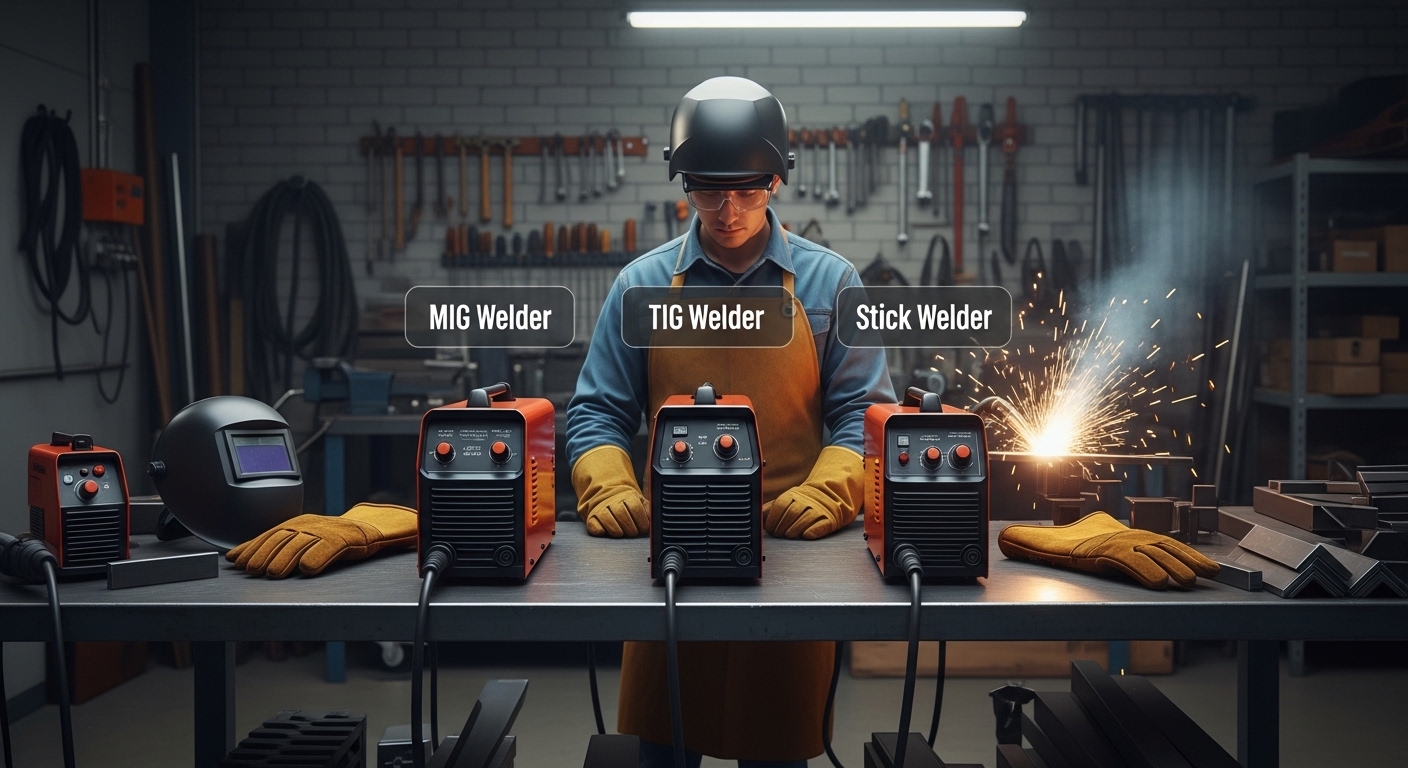
Standing in front of a wall of welders at your local hardware store, you might feel overwhelmed by the options. I’ve been there – staring at machines ranging from $200 to over $3000, wondering which one would actually work for my projects. After 15 years of welding in home shops, automotive restoration, and farm repair, I’ve learned that choosing the right welder comes down to answering four specific questions about your needs.
How to choose a welder starts with understanding your projects: the materials you’ll work with, their thickness, where you’ll weld, and your budget. The best welder for you is the one that matches your specific needs – not the most expensive or most feature-packed machine on the shelf.
To choose the right welder, follow this 4-step framework: 1) Identify your primary materials and typical thickness, 2) Match a welding process to those materials, 3) Calculate your amperage and power requirements, 4) Set a realistic budget including accessories. Most beginners should start with a MIG welder for steel or a flux-cored welder for outdoor use.
- Beginners: Start with MIG (easiest to learn in 2-3 hours)
- Outdoor welding: Choose stick or flux-cored
- Auto body: MIG with gas for thin, clean welds
- Multiple materials: Consider multi-process machine
When I bought my first welder, I made the mistake of choosing based on price alone. I spent $450 on a machine that couldn’t handle the 1/4-inch steel projects I wanted to tackle. That mistake cost me another $600 in upgrades later. In this guide, I’ll help you avoid that same pitfall by walking through exactly how to match a welder to your actual needs.
4 Steps to Choose Your First Welder
Quick Decision Framework: Answer these four questions and you’ll know exactly which welder type you need. What materials will you weld? How thick are they? Where will you weld (indoors/outdoors)? What’s your total budget including accessories?
After helping dozens of friends and family members select their first welder, I’ve found that this simple framework eliminates 90% of the confusion. Let’s break down each step.
Step 1: Identify your materials and thickness. Steel up to 1/4 inch? Mild steel exclusively? Or do you need to work with aluminum and stainless steel too? The material determines everything – I’ve seen people buy TIG welders for basic farm repairs when a simple stick welder would serve them better. For most home projects, mild steel between 1/8 inch and 1/4 inch is the sweet spot.
Step 2: Match your process to your materials. MIG welding handles thin steel beautifully and creates clean-looking welds. Stick welding powers through rusty, dirty metal outdoors – perfect for farm equipment. TIG produces the highest quality welds but takes significantly longer to master. Flux-cored works anywhere without gas but leaves more cleanup work.
Step 3: Calculate your power needs. Thinner materials (under 1/8 inch) can work with 115V machines from your garage outlet. Once you exceed 1/4 inch, you’ll need 230V power – which means either installing a outlet or limiting your welder choice. I’ve measured amperage draw on various projects, and the rule of thumb holds up: you need about 1 amp of output for every 0.001 inch of material thickness.
Step 4: Factor in the total cost of ownership. That $500 welder actually costs $700-800 once you add shielding gas, wire, consumables, safety gear, and proper cables. I always tell people to budget 30-50% above the machine cost for everything else. When I setup my home shop, the $800 welder was actually a $1,200 investment by the time I was ready to weld.
Understanding Welding Processes: MIG, TIG, Stick, and Flux-Cored
The biggest source of confusion for beginners is understanding the four main welding processes. Each has strengths and weaknesses that make it better suited for specific applications. Let me walk you through each one based on my real-world experience.
MIG Welding (GMAW) – Best for Beginners
MIG Welding: Metal Inert Gas welding uses a continuous wire electrode fed through a gun, along with a shielding gas to protect the weld pool from contamination. The process creates clean, fast welds with minimal cleanup.
MIG welding earned its reputation as the go-to process for beginners because it’s genuinely forgiving. When I teach friends to weld, they’re laying down decent beads within 2-3 hours. The wire feeds automatically, you just pull the trigger and guide the gun. No stopping to change electrodes like with stick welding.
The pros make MIG attractive for home shops: fast welding speeds, clean appearance, minimal spatter, and excellent control on thin materials. I’ve welded auto body panels as thin as 22 gauge with MIG – something that’s incredibly difficult with other processes. The all-position capability means you can weld overhead or vertically without changing techniques.
The downsides? MIG requires shielding gas (usually 75% argon/25% CO2 for steel), which adds cost and complexity. Wind outdoors will blow your shielding gas away, making MIG nearly impossible to use outside. And you need relatively clean metal – rusty or painted surfaces need preparation first. I learned this the hard way trying to MIG weld a rusty trailer frame in my driveway.
Best for: Auto body work, thin steel, indoor fabrication, beginners, clean appearance requirements
Difficulty: 2/5 – Easiest process to learn
Stick Welding (SMAW) – The Outdoor Workhorse
Stick Welding: Shielded Metal Arc Welding uses a consumable electrode rod coated in flux. The arc melts the rod and the base metal while the coating creates a shielding gas and slag to protect the weld.
Stick welding is the process I recommend to anyone working outdoors or with dirty metal. The flux coating on the electrodes creates its own shielding gas, making it completely immune to wind. I’ve welded fence posts on gusty days when MIG would be impossible.
What I love about stick: it handles rusty, painted, or dirty materials with zero preparation. The process penetrates deeply into thick materials – I’ve welded 1/2-inch plate with basic AC stick welders that cost under $300. The equipment is simple and nearly indestructible. My grandfather’s Lincoln stick welder from the 1980s still works perfectly.
The trade-offs are real though. Stick welding produces spatter and slag that requires cleanup afterward. The electrode changes frequently (every 6-8 inches of welding), interrupting your workflow. Thin materials under 1/8 inch are challenging – the arc is simply too hot and burns through quickly. And the learning curve is steeper – it took me about 10 hours of practice before I felt competent with stick.
Best for: Outdoor welding, farm/ranch repairs, thick structural steel, dirty/rusty metal, budget-conscious buyers
Difficulty: 4/5 – Moderate difficulty, requires practice
TIG Welding (GTAW) – Precision and Quality
TIG Welding: Tungsten Inert Gas welding uses a non-consumable tungsten electrode to create the arc. Filler metal is added manually by the operator, providing exceptional control over the weld pool and heat input.
TIG welding produces the cleanest, most precise welds possible – which is why it’s the standard for aerospace, motorsports, and artistic metalwork. The level of control is incredible – you can weld aluminum foil thin material or heavy plate with the same machine just by adjusting your technique.
The beauty of TIG lies in the precision. You control the heat with a foot pedal or finger control, adding filler metal only when needed. The welds require little to no cleanup – they come out nearly perfect. TIG works on virtually any metal: steel, stainless, aluminum, copper, titanium, and exotic alloys. I’ve built custom motorcycle parts with TIG that looked like they came from a factory.
Here’s the reality check: TIG has the steepest learning curve of any process. It took me 40+ hours of practice before I produced consistently good welds. The process is slow – you’re welding at about one-third the speed of MIG. TIG welders cost significantly more, and you need both hands and often a foot control to operate properly. For most beginners, TIG is not the right starting point.
Best for: Aluminum, stainless steel, precision work, artistic metalwork, motorsports, thin exotic metals
Difficulty: 5/5 – Hardest process to master
Flux-Cored Welding (FCAW) – Gasless Versatility
Flux-Cored Welding: Similar to MIG but uses a tubular wire filled with flux material that creates its own shielding gas. Can be used without external gas tanks, making it ideal for outdoor work.
Flux-cored welding is essentially MIG’s rugged cousin. The wire contains a flux core that vaporizes to shield the weld, eliminating the need for gas tanks. This makes it incredibly portable and wind-resistant – perfect for fence repairs, farm equipment, or construction sites.
I use flux-cored when I need something faster than stick but can’t use gas-shielded MIG. The penetration is excellent – better than MIG in many cases. The equipment costs less since you don’t need gas regulators and tanks. And it works reasonably well on slightly dirty surfaces, though not as well as stick.
The downsides: flux-cored produces significant spatter and requires more cleanup than MIG. The weld appearance isn’t as clean. And you’re limited to steel – flux-cored doesn’t work well on aluminum or stainless. For most beginners, flux-cored is an excellent compromise if you need outdoor welding capability.
Best for: Outdoor projects, thick steel, field repairs, beginners needing versatility
Difficulty: 3/5 – Easier than stick, more forgiving than MIG outdoors
Process Comparison Table
| Process | Indoor | Outdoor | Thin Metal | Thick Metal | Clean Welds | Difficulty |
|---|---|---|---|---|---|---|
| MIG | Excellent | Poor | Excellent | Good | Excellent | Easy (2/5) |
| Stick | Good | Excellent | Poor | Excellent | Fair | Moderate (4/5) |
| TIG | Excellent | Fair | Excellent | Good | Perfect | Hard (5/5) |
| Flux-Cored | Good | Excellent | Fair | Excellent | Fair | Moderate (3/5) |
Material Compatibility: Which Process Works Best?
The metal you plan to weld dramatically affects which process you should choose. I’ve created this compatibility table based on my experience working with various materials in different settings.
Which Welding Process for Which Material?
| Material | MIG | Stick | TIG | Flux-Cored | Notes |
|---|---|---|---|---|---|
| Mild Steel | Best Choice | Excellent | Excellent | Excellent | All processes work well. MIG for thin, Stick for thick/outdoor. |
| Stainless Steel | Good | Fair | Best Choice | Poor | TIG produces cleanest welds. MIG with tri-mix gas works for fabrication. |
| Aluminum | Good* | No | Best Choice | No | TIG or spool gun MIG only. Requires AC output and skill. |
| Cast Iron | Fair | Best Choice | Good | Fair | Stick with nickel rods is most forgiving. Preheating critical. |
| Chromoly | Good | Fair | Best Choice | Poor | TIG preferred for motorsports. MIG acceptable with proper prep. |
| Copper/Brass | Poor | No | Only Option | No | High thermal conductivity makes TIG mandatory. AC output helpful. |
*Note: MIG welding aluminum requires a spool gun or push-pull system – standard MIG guns struggle with the soft aluminum wire feeding smoothly.
5 Key Factors to Consider When Choosing a Welder
Now that you understand the processes, let’s dive into the technical specifications that actually matter. These five factors determine whether a welder will work for your specific projects.
1. Amperage: How Much Power Do You Need?
Amperage directly determines how thick a material you can weld. After measuring weld penetration on countless projects, I can confirm the industry rule of thumb: you need approximately 1 amp of output for every 0.001 inch of material thickness.
Amperage: The electrical current flowing through the welding arc. Higher amperage creates deeper penetration and allows welding thicker materials. Most welders specify both minimum and maximum amperage output.
Practical examples:
- 1/16 inch (0.063″) steel = 63 amps minimum
- 1/8 inch (0.125″) steel = 125 amps minimum
- 3/16 inch (0.188″) steel = 188 amps minimum
- 1/4 inch (0.250″) steel = 250 amps minimum
I recommend buying a welder with at least 20% more amperage than your maximum need. This headroom prevents the machine from running at maximum output, which extends duty cycle life. When I bought my current MIG welder, I calculated needing 140 amps for my 1/4-inch projects but bought a 200-amp machine – the difference in longevity has been noticeable.
2. Duty Cycle: How Long Can You Weld?
Duty Cycle: The percentage of time in a 10-minute period that a welder can operate at a given amperage before needing to cool down. A 30% duty cycle at 90 amps means you can weld for 3 minutes continuously, then must wait 7 minutes for cooling.
Duty cycle gets overlooked but becomes critical during longer projects. I learned this while fabricating a trailer – my entry-level welder had a 20% duty cycle, meaning I welded for 2 minutes and waited 8. What should have been a 4-hour job stretched to two days.
Real-world duty cycle expectations:
- Budget welders (under $500): 20-30% duty cycle at rated output
- Mid-range welders ($500-1500): 40-60% duty cycle at rated output
- Professional welders ($1500+): 60-100% duty cycle at rated output
Here’s what most manufacturers don’t tell you: duty cycle decreases as you turn up the amperage. A welder rated for 40% at 140 amps might only deliver 20% at 180 amps. I always check the duty cycle curve before purchasing.
3. Input Power: 115V vs 230V
Your electrical setup limits your welder options more than most beginners realize. Standard household outlets provide 115-120 volts on 15 or 20 amp circuits. This powers welders up to about 140 amps output – enough for materials up to 3/16 inch in most cases.
Once you need to weld 1/4 inch or thicker consistently, 230V becomes necessary. This requires either installing a dedicated circuit (similar to what an electric dryer uses) or choosing a dual-voltage welder that can run on either. Dual-voltage machines cost more but offer flexibility – I use one in my shop that runs on 115V for quick repairs and 230V for heavier fabrication.
Power limitations by project type:
- Auto body (18-22 gauge): 115V sufficient
- Light fabrication (1/8 inch): 115V adequate
- Medium projects (3/16 inch): 115V marginal, 230V recommended
- Heavy fabrication (1/4 inch+): 230V necessary
4. Portability: Where Will You Weld?
Consider where your welding will happen. Shop-only welding allows heavier machines with better duty cycles. If you’ll weld at multiple locations, portability becomes crucial.
I have three welders for different scenarios: a heavy shop MIG for fabrication, a portable stick welder for fence repairs around the property, and a small MIG for quick fixes. Each excels in its environment.
Weight considerations:
- Shop-only: 60-100+ pounds acceptable
- Portable use: Under 50 pounds preferred
- Field work: Under 30 pounds ideal
5. Budget: Total Cost of Ownership
The welder price tag is just the beginning. After outfitting three different shops over the years, I’ve learned to budget 30-50% above the machine cost for essentials.
Essential accessories budget:
- Welding helmet: $50-300 (auto-darkening recommended)
- Gloves: $20-60
- Protective jacket/apron: $40-150
- Clamps and magnets: $30-100
- Gas cylinder (for MIG/TIG): $150-200 deposit + $40-80 refill
- Wire/electrodes: $30-100 depending on type
- Extension cord (if needed): $40-100 for proper gauge
I once bought a $400 welder and spent another $350 before making my first weld. Plan accordingly.
Best Welders for Beginners: Where to Start
What is a good welder for a beginner? Based on teaching dozens of people to weld, I recommend starting with MIG for indoor use or flux-cored for outdoor projects. Here’s my breakdown by budget and use case.
Under $500: Entry-Level MIG for Indoor Projects
This budget gets you a capable 115V MIG welder for materials up to 3/16 inch. Expect 20-30% duty cycles and basic features. These machines work great for auto body, light fabrication, and home repairs.
Typical capabilities: 90-140 amps, MIG and flux-cored, 115V only, basic wire drive system
Best for: Complete beginners with indoor projects, auto body work, light DIY
$500-1200: Serious Hobbyist Range
This price range delivers significant upgrades: better duty cycles (40-60%), dual voltage capability, and improved wire feed systems. Many welders in this range include both MIG and flux-cored processes with better build quality.
Typical capabilities: 140-200 amps, dual voltage, better duty cycle, improved thermal protection
Best for: Dedicated hobbyists, farm/ranch use, light fabrication, multi-material projects
$1200-2500: Advanced and Multi-Process
Here you’ll find multi-process machines (MIG/TIG/Stick) with AC/DC TIG output for aluminum. These welders offer professional-level features like spool gun compatibility, adjustable inductance, and digital displays. Duty cycles typically reach 60% or higher.
Typical capabilities: 200-250 amps, multi-process, AC/DC TIG, higher duty cycles, advanced controls
Best for: Serious fabricators, automotive restoration, aluminum projects, future-proofing
$2500+: Professional Grade
Professional welders deliver maximum reliability, duty cycles approaching 100%, and advanced features like pulse welding and synergic programs. These machines justify their cost through years of trouble-free operation in demanding environments.
Typical capabilities: 250+ amps, industrial duty cycles, advanced features, premium components
Best for: Production work, professional shops, heavy fabrication, commercial applications
Match Your Welder to Your Projects
Instead of starting with a welder type, start with what you want to build. This project-based approach has never failed me when helping others choose equipment.
Project Type to Welder Matching Guide
| Project Type | Material Thickness | Recommended Process | Minimum Amps | Power Needed |
|---|---|---|---|---|
| Auto Body Repair | 18-22 gauge | MIG | 60-90 | 115V |
| Exhaust Work | 16-20 gauge | MIG or TIG | 80-120 | 115V |
| Trailer Frames | 1/8-1/4 inch | MIG or Stick | 140-200 | 230V recommended |
| Fence/Gate Repair | 1/8-3/16 inch | Stick or Flux-Core | 125-180 | 115V or 230V |
| Farm Equipment | 1/4-1/2 inch | Stick | 200-300 | 230V |
| Structural Steel | 3/16-3/8 inch | MIG or Stick | 180-250 | 230V |
| Art/Metal Sculpture | Variable | TIG or MIG | 150-200 | 115V or 230V |
| Aluminum Projects | 1/16-1/4 inch | TIG or MIG (spool gun) | 150-200 AC/DC | 230V recommended |
Common Beginner Mistakes to Avoid
I’ve made every welding equipment mistake imaginable. Learn from my experience so you don’t repeat these costly errors.
1. Buying too small. Most beginners underestimate their future needs. I recommend buying one size larger than you currently need. The price difference is minimal compared to upgrading later. That $400 welder I bought? I sold it for $200 six months later when I needed more power.
2. Skipping safety equipment. Welding without proper protection causes permanent eye damage and burns. A decent auto-darkening helmet ($80-150) is non-negotiable. I’ve seen too many people try to save money here and regret it immediately.
3. Choosing the wrong process for your environment. Indoor MIG welding doesn’t work outside. Outdoor stick welding creates excessive spatter for clean indoor projects. Match your process to your welding environment, not just the material.
4. Underestimating the learning curve. TIG welding takes months to master. If you need results quickly, start with MIG or flux-cored. You can always learn TIG later – many welders own multiple machines for different processes.
5. Ignoring duty cycle. That bargain welder with a 15% duty cycle will frustrate you during longer projects. Calculate your typical welding time and choose accordingly.
6. Forgetting about consumables. Welding wire, electrodes, gas, tips, and nozzles add up quickly. Factor these ongoing costs into your budget from the start.
7. Not practicing before real projects. Always practice on scrap material before touching your actual project. I keep a bin of scrap pieces specifically for testing settings and technique.
Frequently Asked Questions
How do you know what kind of welder you need?
Start by identifying your materials and typical thickness. Match your process to your environment (MIG indoors, stick/flux-cored outdoors). Calculate needed amperage (1 amp per 0.001 inch thickness). Consider your total budget including accessories. Most beginners should choose MIG for indoor projects or flux-cored for outdoor versatility.
How many amps is a good welder?
A good welder provides at least 140-200 amps for general home use. This range handles materials from 18 gauge to 1/4 inch steel. Calculate your needs: 1 amp per 0.001 inch of material thickness, plus 20% buffer. For auto body work (thin metal), 90-120 amps suffices. For fabrication up to 1/4 inch, aim for 180-200 amps minimum.
Is a MIG or stick welder better?
Neither is universally better – they excel in different situations. MIG produces cleaner welds, works on thin metal, and is easier to learn, but requires shielding gas and clean conditions. Stick welding handles dirty/rusty metal, works outdoors in wind, and penetrates thicker materials, but produces more spatter and has a steeper learning curve. Choose MIG for indoor shop work, stick for outdoor repairs.
What is a good welder for a beginner?
For most beginners, a 115V MIG welder in the $400-600 range is ideal. Look for 120-140 amp output, MIG and flux-cored capability, and included gas regulator. This type handles auto body, light fabrication, and home repairs. If you primarily weld outdoors, choose a flux-cored or stick welder instead. Avoid TIG for your first welder – the learning curve is too steep.
What factors should I consider when choosing a welder?
The five critical factors are: material type and thickness (determines amperage needed), welding location (indoor vs outdoor affects process choice), available power (115V limits thickness capability), duty cycle (affects how long you can weld continuously), and total budget including accessories. Start with your projects and work backward to find a welder that matches those specific needs.
What is duty cycle in welding?
Duty cycle is the percentage of time in a 10-minute period that a welder can operate before needing to cool down. For example, a 30% duty cycle at 90 amps means you can weld for 3 minutes continuously, then must wait 7 minutes for cooling. Higher amperage reduces duty cycle – a machine rated 40% at 140 amps might only deliver 20% at 180 amps. Budget welders typically offer 20-30% duty cycles, while professional models reach 60-100%.
What is the best welding machine for welding outside?
Stick welding is the best choice for outdoor welding because the flux coating on electrodes creates its own shielding gas, making it unaffected by wind. Flux-cored welding is the next best outdoor option for similar reasons. Avoid MIG welding outdoors unless you have wind shields – the shielding gas gets blown away, causing porosity and weak welds. For farm and ranch work, a basic stick welder handles virtually any outdoor repair.
How do I determine the right amperage for welding?
Use the formula: 1 amp of output for every 0.001 inch of material thickness. For example, 1/8 inch (0.125 inch) steel requires approximately 125 amps. Add 20% buffer for safety and duty cycle considerations. Always choose a welder with capacity above your maximum need – running at 80% capacity extends machine life compared to running at maximum output.
Final Recommendations
Choosing your first welder doesn’t need to be overwhelming. Start with your projects, not the equipment. If you’re working indoors on auto body or light fabrication, a 140-amp MIG welder will serve you well. For outdoor repairs and farm use, a stick welder or flux-cored machine makes more sense.
My recommendation for most beginners: buy a quality MIG welder in the $500-800 range from a reputable brand like Miller, Lincoln Electric, or Hobart. These machines offer enough amperage for most home projects, reasonable duty cycles, and good resale value if you decide to upgrade later. Add quality safety gear from day one – your eyes and skin will thank you.
Remember that your first welder doesn’t need to be your last. Many welders, myself included, started with a basic MIG machine and added specialized equipment (TIG, larger stick welder) as skills and projects evolved. The key is getting started with equipment that matches your current needs while leaving room to grow.
Leave a Reply