
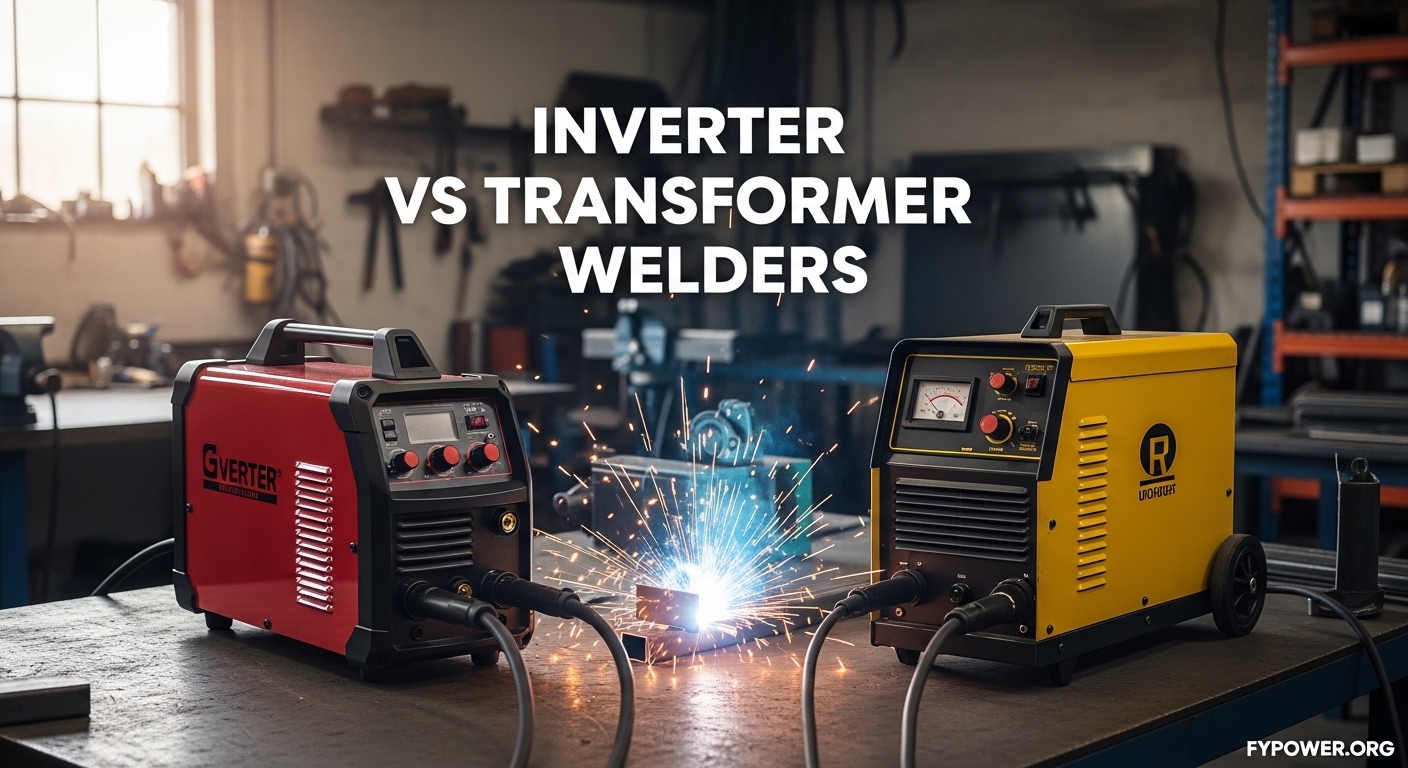
The main difference comes down to power conversion technology. Inverter welders use advanced electronics to convert power efficiently through high-frequency switching. Transformer welders rely on traditional copper coils and magnetic induction.
I’ve spent years working with both types in different settings. The choice between them affects your daily welding experience more than you might expect.
Inverter welders are lighter and more energy efficient. Transformer welders are simpler and more durable. Each has strengths depending on where and how you weld.
The quick answer: Inverter welders are better for most users due to portability, energy efficiency, and advanced features. Choose transformer welders for heavy industrial use where durability and repairability matter more than weight.
At a Glance: Quick Comparison
| Feature | Inverter Welders | Transformer Welders |
|---|---|---|
| Weight | 40-60 lbs | 80-150 lbs |
| Energy Efficiency | 85-90% | 60-70% |
| Initial Cost | $150-$3,000 | $200-$4,000 |
| Durability | 8-12 year lifespan | 15-25 year lifespan |
| Repairability | Requires specialist | Most electricians can fix |
| Best For | Field work, DIY, professionals | Heavy industry, farm use |
How Each Technology Works?
What Is a Transformer Welder?
Transformer welders use traditional technology that has been around for decades. They work through magnetic induction between copper coils.
When you plug in a transformer welder, electricity flows through a primary coil. This creates a magnetic field that induces current in a secondary coil. The ratio between coils steps down voltage while increasing amperage.
Transformer: A device that transfers electrical energy between circuits through electromagnetic induction. In welding, it steps down high voltage, low amperage input to low voltage, high amperage output needed for welding.
This simple design has been proven in industrial settings for generations. The large copper windings are rugged and can handle harsh conditions.
I’ve seen transformer welders still running strong after 20 years of daily use in fabrication shops. The simplicity means fewer things can go wrong.
What Is an Inverter Welder?
Inverter welders represent modern welding technology. They convert power through electronic circuitry rather than magnetic coils.
The process starts by converting incoming AC power to DC. Then electronic switches called IGBTs rapidly turn this DC on and off at high frequencies. This creates a high-frequency AC signal that a smaller transformer can efficiently step down to welding voltage.
IGBT (Insulated Gate Bipolar Transistor): Electronic component that acts as a high-speed switch. It enables the rapid power switching that makes inverter welders smaller, lighter, and more efficient than transformer models.
This high-frequency operation allows for much smaller transformers. That’s why inverter welders weigh so much less.
The electronic control also enables advanced features. Things like adjustable inductance, AC balance for TIG, and pulse welding parameters are only possible with inverter technology.
Head-to-Head Comparison
Portability and Weight
The weight difference is dramatic. Inverter welders typically weigh 40-60 pounds. Transformer welders usually weigh 80-150 pounds or more.
I’ve carried both types to job sites. The difference matters when you’re climbing stairs or working alone. An inverter welder can be carried with one hand. A transformer unit often requires two people or a cart.
Size is another factor. Inverter welders are compact enough to fit in toolboxes or store on shelves. Transformer welders need dedicated floor space.
For field welding, the portability advantage goes entirely to inverters. If you move your equipment frequently, the weight savings alone might justify the higher cost.
Energy Efficiency
Inverter welders are significantly more efficient. They operate at 85-90% efficiency compared to 60-70% for transformer models.
This efficiency difference means real savings. A typical inverter welder uses 20-30% less electricity for the same welding output.
I’ve monitored power consumption in my shop. Over a year of regular use, an inverter welder can save $150-300 in electricity costs compared to a transformer model.
The efficiency also means less heat generation. Your shop stays cooler, and the welder experiences less thermal stress.
Duty Cycle and Performance
Duty cycle measures how long a welder can operate before needing to cool down. It’s the percentage of time within a 10-minute period.
Duty Cycle: The percentage of time a welder can operate within a 10-minute period before overheating. A 30% duty cycle at 150 amps means you can weld for 3 minutes, then must wait 7 minutes for cooling.
Both types can offer good duty cycles, but inverter welders maintain output more consistently as input voltage fluctuates. This matters when running on generators or long extension cords.
Inverters also provide smoother arc characteristics. The high-frequency control allows for more precise welding parameters. Most welders notice the difference immediately.
Durability and Lifespan
Transformer welders win on longevity. They typically last 15-25 years with minimal maintenance. The simple construction means fewer failure points.
Inverter welders generally last 8-12 years. The electronic components have more potential failure points. However, modern inverter technology has improved significantly.
Harsh environments favor transformers. Dust, moisture, and vibration affect electronics more than copper windings. I’ve seen transformer welders operating in dirty fabrication shops for decades without issue.
The repairability difference is significant. Any competent electrician can diagnose and fix a transformer welder. Inverter repairs often require specialized knowledge and replacement parts.
Cost Comparison
Initial cost favors transformer welders at the entry level. A basic transformer stick welder costs $200-300. Comparable inverter models run $300-500.
At the professional level, prices overlap. Mid-range units from both types cost $500-1,500. Premium inverter welders can exceed $3,000.
Consider total ownership cost over five years. An inverter welder costs more upfront but saves money on electricity. The breakeven point is typically 7-10 years of regular use.
Repair costs also differ. Transformer repairs are usually simpler and cheaper. Inverter repairs can exceed $500 if major components fail.
Pros and Cons of Each Type
Inverter Welder Advantages
- Lightweight: 40-60 lbs vs 80-150 lbs for transformers
- Energy efficient: Saves 20-30% on electricity
- Advanced features: AC balance, pulse, adjustable inductance
- Multi-process: Many models support MIG, TIG, and stick
- Better arc control: Smoother welding with less spatter
- Generator friendly: Most run well on smaller generators
- Compact size: Easy to store and transport
- Input power flexibility: Many run on 120V or 240V
Inverter Welder Disadvantages
- Higher initial cost: 30-50% more than comparable transformers
- Electronic complexity: More potential failure points
- Limited lifespan: 8-12 years vs 15-25 years
- Repair difficulty: Requires specialized technicians
- Environmental sensitivity: Heat and moisture affect electronics
- Component costs: Repairs can exceed $500
Transformer Welder Advantages
- Proven reliability: Decades of field testing
- Long lifespan: 15-25 years typical
- Simple repair: Most electricians can fix them
- Lower entry cost: Basic models start under $200
- Rugged construction: Handles harsh environments
- Familiar technology: Well-understood by repair shops
- High amperage capacity: Better for heavy industrial use
Transformer Welder Disadvantages
- Heavy weight: 80-150 lbs, difficult to move
- Lower efficiency: Wastes 30-40% of input power
- Limited features: Basic welding controls only
- Single-process typically: Most do one type of welding
- Higher operating costs: More electricity consumption
- Fixed input voltage: Usually 120V or 240V, not both
- Large footprint: Requires dedicated floor space
Which Should You Choose?
Choose an Inverter Welder If…
DIY Projects
Automotive Work
Professional Shop
TIG Welding
Most users are better served by inverter technology. The portability alone justifies the choice for anyone who moves their equipment.
I recommend inverters for DIY users and beginners. The lighter weight and better arc control make learning easier. You’ll develop better techniques faster.
Professional fabricators who do multiple processes benefit from inverter versatility. One machine can handle MIG, TIG, and stick welding with the right accessories.
Field welders almost universally choose inverters. The ability to run on generators and carry the unit by hand makes them the only practical choice for mobile work.
Choose a Transformer Welder If…
Farm Use
Primary Stick Welding
Budget Conscious
Heavy industrial applications still favor transformer welders. The durability and repairability matter more than weight when the machine never leaves the shop.
Farm and ranch users often prefer transformers. The simplicity means local repair shops can fix them. They tolerate the dust and rough handling common in agricultural settings.
If your budget is tight and you only need basic stick welding, a transformer welder offers good value. You’ll get a reliable machine that can last decades.
By User Type Recommendations
| User Type | Recommendation | Reasoning |
|---|---|---|
| Beginner/DIY | Inverter | Easier to learn, lighter, more features |
| Field Welder | Inverter | Portability essential, generator friendly |
| Shop Fabricator | Inverter | Multi-process, better arc control |
| Heavy Industrial | Transformer | Maximum durability, easy repair |
| Farm/Ranch | Transformer | Simple, rugged, locally repairable |
| TIG Specialist | Inverter | AC balance, pulse, advanced features |
Frequently Asked Questions
What is the difference between inverter and transformer welder?
The main difference is power conversion technology. Inverter welders use advanced electronics (IGBTs) for high-frequency power conversion, making them lighter and more efficient. Transformer welders use traditional copper coils and magnetic induction, making them heavier but simpler and more durable.
Are inverter welders better than transformer?
Inverter welders are better for most users due to portability, energy efficiency, and advanced features. However, transformer welders excel in heavy industrial applications where durability and repairability matter more than weight. Neither is universally better – the choice depends on your specific needs.
Do inverter welders use less electricity?
Yes, inverter welders use 20-30% less electricity than transformer welders. They operate at 85-90% efficiency compared to 60-70% for transformer models. Over a year of regular use, this can save $150-300 in energy costs depending on your local electricity rates and welding frequency.
How long do inverter welders last?
Inverter welders typically last 8-12 years with proper care and maintenance. Factors affecting longevity include operating environment, usage patterns, and build quality. Modern inverter welders from reputable brands have improved significantly in reliability compared to early models.
Can inverter welders run on generators?
Yes, most inverter welders run well on generators and often require smaller generator sizes than transformer welders. However, some inverter models are sensitive to generator power quality. Look for models specifically labeled as generator-friendly if you plan to use portable power.
Why are inverter welders so expensive?
Inverter welders cost more due to complex electronic components including IGBTs, circuit boards, and capacitors. The technology requires more research and development. However, prices have decreased as the technology has matured, and energy savings can offset the higher initial cost over time.
What are the disadvantages of inverter welders?
Key disadvantages include higher initial cost (30-50% more than comparable transformers), shorter lifespan (8-12 years vs 15-25 years), electronic complexity that makes repairs difficult, sensitivity to harsh environments, and potentially expensive component failures.
Are transformer welders more reliable?
Transformer welders are generally more reliable in harsh environments and over very long time periods. Their simple construction with fewer electronic components means fewer potential failure points. However, modern inverter welders from quality brands have proven reliable for typical shop and field use.
Which is better for beginners inverter or transformer welder?
Inverter welders are better for beginners. They are lighter and easier to move, offer better arc control for learning proper technique, and often include helpful features like adjustable inductance. The improved welding characteristics help beginners develop good habits faster.
Can you use inverter welder for TIG?
Yes, inverter welders excel at TIG welding. Many inverter models support both AC and DC TIG output, include adjustable AC balance for aluminum welding, and offer pulse TIG capabilities. Inverter technology provides the precise control needed for quality TIG welds.
The Verdict
Inverter welders represent the future of welding technology. They offer advantages that matter to most users: lighter weight, better efficiency, and advanced features.
The technology has matured significantly. Modern inverter welders from reputable brands are reliable and durable. Concerns about early failures are largely outdated.
However, transformer welders still have their place. Heavy industrial shops and farm users benefit from their rugged simplicity. Sometimes old-school technology is the right tool for the job.
Consider how you’ll use the welder. If portability, efficiency, or advanced features matter to you, choose an inverter. If you need maximum durability and simple repairs, a transformer welder might be better.
I’ve owned both types over the years. My personal shop uses inverters now because the advantages outweigh the drawbacks for my work. But I still keep an old transformer stick welder as a backup.
The best choice depends on your specific needs, budget, and working conditions. Think about where you’ll weld, how often, and what processes you need. That will point you to the right technology.
Leave a Reply