
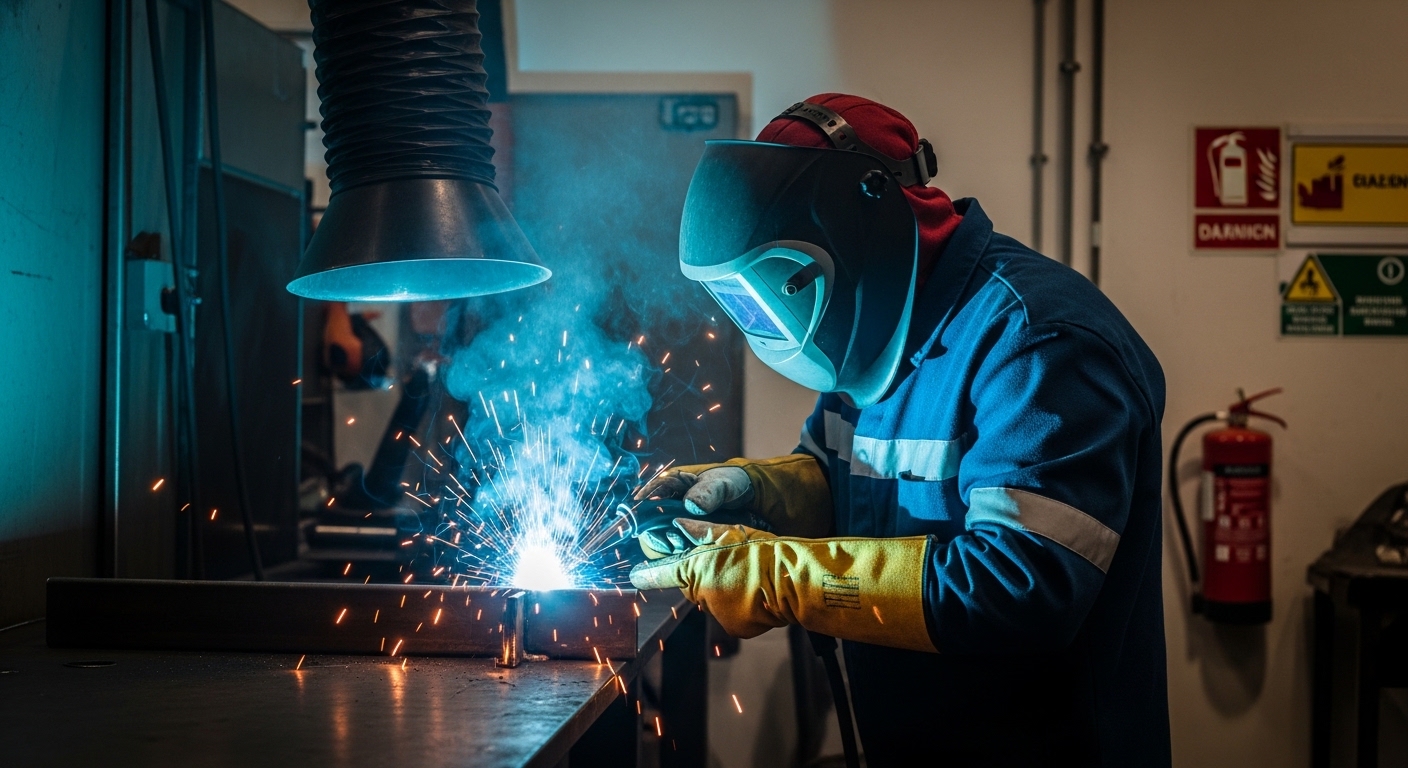
I’ve spent 15 years in welding shops, both professionally and in my home garage. I’ve seen sparks land in sneakers. I’ve watched guys weld without respirators until they couldn’t breathe. I once witnessed a garage fire that started from a single spark hitting a cardboard box 20 feet away.
MIG welding creates intense UV radiation, toxic fumes, electrical shock hazards, and fire risks all at once. The arc reaches temperatures over 10,000 degrees Fahrenheit. Molten metal splatter travels in unpredictable directions. Without proper protection, you risk permanent eye damage, respiratory illness, severe burns, or worse.
Is MIG Welding Safe?
MIG welding is completely safe when you follow proper safety procedures. The key protections include: wearing an auto-darkening helmet with shade 10-13, using respiratory protection in enclosed spaces, ensuring proper ventilation, keeping a fire extinguisher nearby, and maintaining proper grounding of your equipment.
- Key Fact: Over 500,000 welders are injured annually in the US, but most injuries are preventable
- Bottom Line: Safety isn’t optional – it’s the difference between a lifelong career and a lifelong injury
After teaching dozens of beginners and running my own fabrication business, I’ve learned that safety habits form before welding skills. Skip protection now, pay later. The guys who laughed at safety gear in their twenties? They’re the ones with breathing problems in their forties.
Understanding MIG Welding Hazards
MIG welding creates five serious hazards that every welder must understand. Knowing what can hurt you is the first step in protecting yourself from it.
Quick Summary: MIG welding produces invisible UV/IR radiation that damages eyes instantly, toxic metal fumes that accumulate over time, high-voltage electrical current that can stop your heart, sparks that travel up to 35 feet, and molten metal that causes severe burns. All five hazards require specific protection.
UV and Infrared Radiation
The welding arc emits ultraviolet and infrared radiation stronger than the sun. Staring at the arc without protection causes photokeratitis – commonly called arc eye or flash burn. I’ve had it twice. Your eyes feel like they’re full of sand. Light becomes unbearable. It can happen in seconds, and symptoms appear 6-8 hours later – often waking you up at 2 AM in agony.
UV radiation also causes skin burns similar to sunburn but much faster. I’ve seen welders with sunburned necks after just 30 minutes of welding without a collar. Long-term exposure increases skin cancer risk significantly.
Welding Fumes and Gases
MIG welding fumes contain metal particles from both the base metal and the filler wire. Common fumes include manganese, which causes neurological problems similar to Parkinson’s disease. Galvanized steel produces zinc oxide fumes that cause metal fume fever – flu-like symptoms that can last for days.
Shielding gases like argon and CO2 displace oxygen in confined spaces. Several welders die annually from asphyxiation in tanks or enclosed areas. The fumes you can’t smell are often the most dangerous.
Electrical Shock
MIG welders operate between 20-50 volts at the arc but use 120-240 volt input power. The real danger comes from wet conditions or sweating. Your body’s resistance drops when wet, turning a normally safe situation deadly. I never weld without rubber-soled boots, even in my own garage.
Electricity always seeks the path of least resistance to ground. If that path happens to be through your body because of improper grounding, the results can be fatal. Even non-lethal shocks can cause you to jerk and trigger worse accidents.
Fire and Explosion Hazards
MIG welding throws molten metal droplets up to 35 feet in all directions. Each spark is approximately 3,000 degrees Fahrenheit. I’ve personally started three small fires before I learned to clear my welding area properly. One spark in the wrong pile of sawdust or near a gasoline container can destroy everything.
Shielding gas cylinders are pressurized to over 2,000 PSI. A damaged valve can turn a cylinder into a missile. I knew a fabricator who had a cylinder punch through a block wall when it fell over and the valve broke off.
Burns and Heat Injuries
Molten metal doesn’t discriminate. It sticks to skin, clothing, hair – anything it touches. The weld pool stays hot enough to cause severe burns for minutes after you stop welding. I still have burn scars from when I started wearing inadequate gloves.
Hot workpieces are another major burn source. Just because you stopped welding doesn’t mean the metal cooled down. I use welding markers to write “HOT” on pieces when I’m teaching – saves everyone from painful lessons.
Essential PPE for MIG Welding
Quick Summary: Complete MIG welding PPE includes: auto-darkening helmet (shade 10-13), safety glasses underneath, leather welding gloves, flame-resistant jacket and pants, leather boots, and respiratory protection when indoors. Budget-friendly options exist for every item except eye protection – never compromise there.
Head and Eye Protection
Never weld without a proper helmet. Never. I don’t care if it’s just a quick tack weld. I don’t care if you think you can turn away fast enough. You can’t, and you’ll pay for it later.
Auto-darkening helmets cost $80-300 but are worth every penny. They let you see your work area clearly before striking an arc, then darken in 1/20,000 of a second. Fixed-shade helmets are cheaper but force you to nod your head to lower the helmet – clumsy and imprecise.
| Lens Shade | Amperage Range | Application |
|---|---|---|
| Shade 10 | 60-160 amps | Light MIG welding (most hobbyist work) |
| Shade 11 | 160-250 amps | Medium MIG welding |
| Shade 12-13 | 250+ amps | Heavy MIG or outdoor welding |
Safety glasses underneath your helmet are non-negotiable. Slag chips fall when you lift your helmet. Grinding happens nearby. Your helmet gets knocked off. ANSI Z87.1 rated glasses cost $15-30 and prevent countless eye injuries. I keep spares in my shop for visitors who forget.
Respiratory Protection
Do you need a respirator for MIG welding? It depends on your situation. Outdoor welding with clean steel? Probably fine. Indoor welding, especially with coated metals? Absolutely required.
For occasional home welding, a N95 respirator costs under $20 and provides basic protection against most metal fumes. For regular welding, especially indoors, invest in a half-face respirator with P100 filters for around $50-75. The filters last about 40 hours of actual welding time.
Metal Fume Fever: A condition caused by inhaling metal oxide fumes, particularly zinc oxide from welding galvanized steel. Symptoms include fever, chills, nausea, headache, and muscle aches. Typically appears 4-12 hours after exposure and resolves within 24-48 hours, but repeated exposure can cause permanent damage.
I use a powered air-purifying respirator (PAPR) for long welding sessions. They cost $300-600 but provide positive pressure, cooling airflow, and the highest level of protection. Worth it if you weld daily indoors.
Hand and Body Protection
MIG welding gloves are thinner than stick welding gloves because you need finger dexterity for the gun trigger and wire feeding. Look for gloves with split cowhide or elk skin in the palm for durability, with lighter leather or Kevlar on the fingers for feel.
Expect to spend $25-50 for quality gloves. Cheap gloves wear out in weeks. Good gloves last months. I replace mine when the fingertips get slick – trying to weld with slippery gloves is dangerous.
Clothing matters more than beginners think. Cotton burns. Polyester melts into your skin. I’ve seen both happen. Flame-resistant cotton welding jackets cost $50-100. Leather lasts longer but costs more and gets hot in summer. I own both and choose based on the job.
Long sleeves, long pants, closed-toe boots – every single time. No shorts. No sneakers. No synthetic fabrics. I once caught a spark in my denim jeans. It burned through the pocket, hit my leather wallet, and stopped. If I’d been wearing thinner fabric or been bare-legged, that story ends differently.
Leather boots with steel toes are ideal. High-top leather work boots are acceptable. Anything else is asking for trouble. Hot metal rolls. It doesn’t stop when it hits your shoe.
Ventilation and Fume Protection
Proper ventilation separates responsible welding from recklessness. The fumes you can’t see are often the most dangerous.
Natural Ventilation
Outdoor welding with a cross-breeze provides adequate ventilation for most hobbyist applications. The key is ensuring fresh air can flow across your work area and carry fumes away. Position yourself upwind whenever possible.
Open garage doors count as natural ventilation only if there’s adequate airflow. Two open doors on opposite walls create a draft. One open door with a fan pulling air out works too. An open door with dead air? That’s not ventilation – that’s a false sense of security.
Mechanical Ventilation
For indoor welding, you need active air movement. Box fans in windows or doorways can help, but position them to pull fumes away from your breathing zone, not blow sparks around your shop. I’ve seen fans spread sparks to flammable materials more often than they’ve cleared fumes.
Dedicated ventilation systems cost $200-600 for home workshops. They mount overhead or in windows and use ductwork to capture welding fumes at the source. Worth every penny if you weld indoors regularly.
Local Exhaust Ventilation
Portable fume extractors sit right next to your welding area and capture fumes before they disperse. Quality units cost $300-800 and filter 95-99% of welding fumes. I use one with a flexible arm that I position about 6 inches from my weld joint.
For production shops or serious home fabricators, a downdraft table pulls fumes down through the tabletop. These cost $1,500-4,000 but provide excellent protection for bench welding work.
When Respirators Are Mandatory
| Situation | Respirator Required? | Recommended Type |
|---|---|---|
| Outdoor welding, clean steel | Usually No | None if well-ventilated |
| Indoor welding, good ventilation | Recommended | N95 disposable |
| Galvanized or coated metals | Yes – Mandatory | P100 half-face respirator |
| Confined spaces | Yes – Mandatory | PAPR or supplied air |
| Stainless steel welding | Yes – Mandatory | P100 with acid gas cartridges |
Fire Safety and Prevention
Every spark from your MIG welder is a potential fire starter. Respect them, contain them, and always be prepared.
Fire Extinguishers
Keep an ABC-rated fire extinguisher within 10 feet of your welding area. ABC extinguishers handle ordinary combustibles (Class A), flammable liquids (Class B), and electrical fires (Class C) – covering everything that might happen while welding.
A 10-pound extinguisher costs $60-100 and provides adequate capacity for home workshops. Check the pressure gauge monthly. Know how to use it before you need it. I fire-test my extinguishers annually in a controlled setting to ensure they work.
Clearing Your Work Area
Before striking your first arc, clear a 35-foot radius of flammable materials. That’s right – 35 feet. Sparks fly farther than you think. I’ve found hot sparks 40 feet from my welding position.
Quick Summary: Before every welding session, remove cardboard, paper, rags, sawdust, dry grass, gasoline, oil, and any other flammable materials within 35 feet. Cover what you can’t move with a fire-resistant welding blanket. Keep a charged fire extinguisher nearby and inspect the area for 30 minutes after you finish welding.
Welding blankets cost $20-50 and cover immovable objects. I use them to protect nearby equipment, walls, and furniture. Quality blankets use fiberglass or silica fabric and can withstand direct flame contact.
Fire Watch Procedures
For significant welding jobs, especially in commercial settings, a fire watch person stays behind after welding ends to watch for fires that smolder before breaking out. The fire watch continues for at least 30 minutes after welding stops.
I use this practice at home after any extended welding session. Sparks can smolder in cardboard, wood, or insulation for 20-30 minutes before flames appear. Thirty minutes of observation beats explaining to the fire department how your garage burned down.
Flammable Materials
Never weld on or near containers that held flammable materials – even if they appear empty. Vapors remain and can ignite explosively. I once refused to weld a rack that a customer wanted mounted on an old oil drum. Good call – that decision possibly saved both of us.
Gasoline, oil, paint, solvents, and cleaning chemicals must be stored outside your 35-foot safety zone. If you weld in a garage, move flammable liquids outside before starting.
Electrical Safety Requirements
Electricity powers your welder, but it can also kill you if you don’t respect it.
Proper Grounding
Your work clamp must make solid metal-to-metal contact with the workpiece. Loose connections cause voltage drops, poor welds, and electrical hazards. I clean both the workpiece and clamp contact point to bare metal before clamping.
Never attach your work clamp to a painted, rusted, or oily surface. The electrical connection must be clean and secure. I’ve seen welders try to ground through chains, which creates dangerous current paths and poor welds.
Equipment Inspection
Inspect your welding cables before every session. Look for cracked insulation, exposed conductors, and damaged connectors. I replace cables at the first sign of wear – a shocking experience during welding can cause you to jerk and trigger worse accidents.
Check your welder’s case for damage. Never operate a welder with a damaged power cord or missing covers. The internal components carry lethal voltage even when the welder is turned off but still plugged in.
Working Conditions
Never weld in wet conditions. Water and electricity don’t mix. If your workshop floor is wet, wait. If you’re sweating heavily, take a break and dry off. If it’s raining and you’re outside, set up a canopy or wait for better weather.
I keep a rubber mat to stand on when welding in my garage. It provides insulation from concrete floors and adds another layer of protection against electrical shock.
Setting Up a Safe Welding Area
A well-designed welding area prevents accidents before they happen. Your workspace should be planned around safety, not convenience.
Layout Considerations
Position your welding table away from walls and clutter. You need access from multiple sides, and sparks need clear paths to the floor. My welding table sits six feet from the nearest wall, with concrete floor extending 15 feet in every direction.
Fire-resistant flooring makes a huge difference. Concrete is ideal. If you have wood floors, protect them with a welding mat or sheet metal. I’ve seen more than one workshop fire start from sparks falling through floorboard gaps.
Lighting and Visibility
Good overhead lighting lets you inspect your work area and spot potential hazards before welding. I use 5000K LED shop lights – they provide clear, shadow-free illumination that makes it easy to see scattered sparks or problems.
Your welding area should also have emergency lighting or access to natural light. If the power goes out while you’re welding, you need to see your way out safely.
Storage and Organization
Store flammable materials in a designated area away from your welding zone. My workshop has a separate metal cabinet for oils, solvents, and paints. It’s located 40 feet from my welding table.
Keep your PPE organized and accessible. If your helmet, gloves, and jacket are easy to grab, you’re more likely to use them every time. I hang mine on a pegboard right next to my welder – no excuses.
Welding Curtains and Screens
Transparent welding curtains protect bystanders from UV radiation while allowing visibility. They cost $100-300 and are essential in shared workspaces. I have one separating my welding area from the rest of my garage.
The rule is simple: anyone within 35 feet of welding must have eye protection or be behind a welding curtain. UV radiation reflects off walls and surfaces, bouncing around corners to damage unprotected eyes.
Common MIG Welding Safety Mistakes to Avoid
I’ve made most of these mistakes myself. Learn from my errors so you don’t have to repeat them.
Skipping PPE for “Quick” Welds
Every weld deserves full protection. I once did a 10-second tack weld without gloves. A tiny piece of slag landed between my fingers and burned deep enough to leave a permanent scar. Now I wear full PPE even for testing wire feed.
The worst injuries happen during the jobs you think are too small to matter. Treat every arc the same way – with full respect and full protection.
Welding Without Proper Ventilation
Opening a garage door isn’t always enough. I spent years welding in my garage with just the door open, assuming that provided adequate ventilation. I now know that fumes accumulated in the corners and ceiling, creating a hazardous breathing environment.
Invest in proper ventilation or a quality respirator. Your lungs can’t be replaced. I’d rather spend $300 on a fume extractor than deal with respiratory problems decades later.
Improper Grounding Techniques
I’ve seen welders attach ground clamps to painted surfaces, rusty frames, or even the workbench instead of the workpiece. This creates electrical hazards and poor welds. Always ground directly to clean, bare metal on the piece you’re welding.
Never use your workpiece grounding as a substitute for your welder’s safety ground. The green ground prong on your plug provides essential protection. Never bypass it or use grounding adapters without proper grounding.
Neglecting Post-Welding Inspection
Sparks smolder. Fires start slowly. I once finished welding, cleaned up, and went inside for dinner. Twenty minutes later, I noticed smoke coming from the garage. A spark had landed in a cardboard box and smoldered until it ignited.
Now I inspect my welding area thoroughly before leaving. I look for glowing spots, check behind equipment, and scan for any sign of smoke. This 30-second habit has prevented at least three potential fires.
Rushing Through Safety Setup
Being in a hurry causes accidents. I’ve caught myself skipping steps when rushing to finish a project. Every time I cut corners, I create risk. Now I force myself to slow down and follow my safety checklist completely.
The five minutes you save rushing aren’t worth the potential lifetime of consequences. Treat safety setup as part of the welding process – because it is.
MIG Welding Safety Checklist
Use this checklist before every welding session. Print it out. Post it near your welder. Make it a habit until following safety procedures becomes automatic.
Before Welding
| Check | Item |
|---|---|
| Welding helmet ready and functional (test auto-darkening) | |
| Safety glasses (ANSI Z87.1) clean and available | |
| Welding gloves in good condition (no holes or slick spots) | |
| Flame-resistant clothing covering all skin (long sleeves, long pants) | |
| Leather boots or high-top work shoes | |
| Respirator available if needed | |
| Fire extinguisher charged and accessible | |
| 35-foot area cleared of flammable materials | |
| Work clamp secured to clean bare metal | |
| Cables inspected for damage | |
| Adequate ventilation confirmed | |
| Welding curtains in place if bystanders present | |
| Floor area protected (concrete or welding mat) | |
| No working on containers that held flammables |
During Welding
| Check | Item |
|---|---|
| Monitor spark travel – adjust position if needed | |
| Watch for smoke or unusual smells | |
| Keep fire extinguisher in sight | |
| Never leave active arc unattended | |
| Stop immediately if you feel tingling or shock |
After Welding
| Check | Item |
|---|---|
| Turn off welder and unplug if done for day | |
| Coil cables properly (no kinks or damage) | |
| Close gas cylinder valve | |
| Inspect area for hot spots or smoke | |
| Wait 30 minutes before leaving area unattended | |
| Mark hot workpieces if others have access | |
| Store PPE properly for next use |
Frequently Asked Questions
What safety equipment is required for MIG welding?
Essential MIG welding safety equipment includes an auto-darkening welding helmet (shade 10-13), ANSI Z87.1 safety glasses, leather welding gloves, flame-resistant clothing (long sleeves and pants), leather boots, and respiratory protection when welding indoors or working with coated metals. A fire extinguisher should always be within 10 feet of your welding area.
Do you need a respirator for MIG welding?
A respirator is mandatory for indoor MIG welding, welding galvanized or coated metals, stainless steel welding, and work in confined spaces. Outdoor welding with clean steel in well-ventilated conditions may not require respiratory protection. Use at minimum an N95 mask, though a P100 half-face respirator provides better protection against metal fumes.
Can you weld MIG without a helmet?
No, never weld MIG without proper eye protection. The welding arc produces intense UV radiation that can damage your eyes in less than one second. This causes photokeratitis (arc eye), a painful condition that feels like sand in your eyes and can lead to permanent vision damage. Auto-darkening helmets are the best option as they allow you to see your work clearly before and during welding.
What shade lens is needed for MIG welding?
MIG welding typically requires lens shade 10-13. Shade 10 works for most light MIG welding (60-160 amps), shade 11 for medium applications (160-250 amps), and shades 12-13 for heavy MIG work or outdoor welding. Auto-darkening helmets adjust automatically within this range, providing the right shade for your specific amperage setting.
Is MIG welding safe indoors?
MIG welding can be safe indoors with proper precautions. You must ensure adequate ventilation through open doors, windows with exhaust fans, or a fume extraction system. Respiratory protection is recommended for indoor welding. Additionally, you need fire-resistant flooring, cleared flammable materials, a fire extinguisher nearby, and proper grounding of all equipment.
Are MIG welding fumes toxic?
Yes, MIG welding fumes can be toxic depending on the materials being welded. Common toxic components include manganese (linked to neurological issues similar to Parkinson’s), hexavalent chromium from stainless steel (carcinogenic), zinc oxide from galvanized steel (causes metal fume fever), and other metal particulates. Long-term exposure without proper ventilation or respiratory protection can cause serious chronic health conditions.
What type of fire extinguisher for welding?
Use an ABC-rated fire extinguisher for welding applications. ABC extinguishers handle Class A fires (ordinary combustibles like wood and paper), Class B fires (flammable liquids and gases), and Class C fires (electrical fires) – covering all possible fire types in a welding environment. Keep a 10-pound extinguisher within 10 feet of your welding area and check the pressure gauge monthly.
How far away should you be from MIG welding?
Bystanders should stay at least 35 feet away from MIG welding operations unless they are wearing proper eye protection or behind a welding curtain. UV radiation from the welding arc can reflect off walls and surfaces, causing eye damage at surprising distances. Welding curtains or screens are essential in shared workspaces to protect others from UV exposure.
MIG welding safety isn’t complicated, but it is non-negotiable. Every experienced welder I know has either had a close call or carries a scar from a safety lapse. The difference is they learned from it – and now you can learn from them instead.
Buy quality PPE. Set up your workspace properly. Follow the checklist every single time. Your eyes, lungs, and skin can’t be replaced. Protect them now, and you’ll enjoy welding for decades to come.
Leave a Reply