
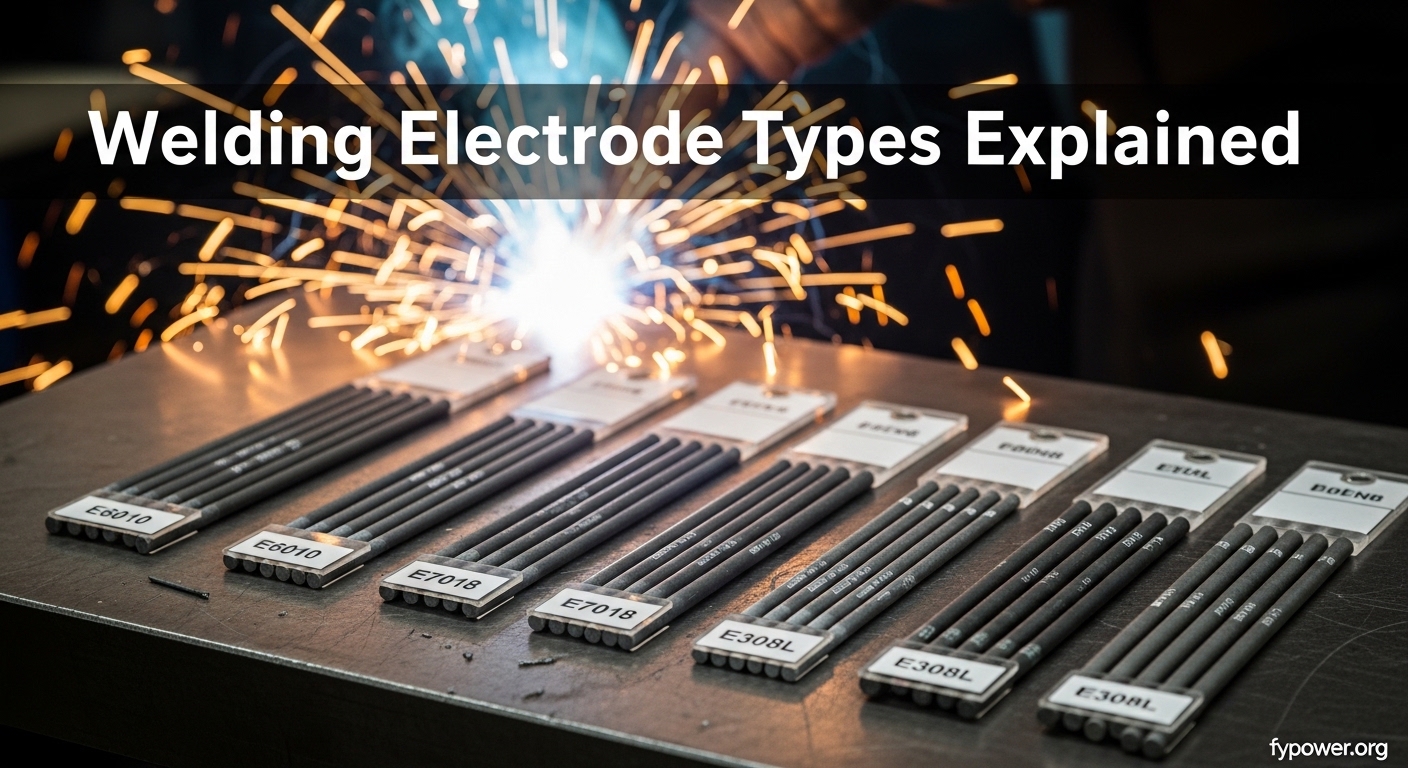
A welding electrode is a coated metal wire made of materials similar to the base metal being welded. It conducts electrical current to create an electric arc that generates heat and melts to fuse metals together. Understanding electrodes is fundamental to successful stick welding.
The electrode you choose determines everything about your weld: penetration depth, bead appearance, strength, and whether the weld will hold or fail. In my 15 years of welding experience, I have seen the right electrode save a project and the wrong one cause cracks that required complete rework.
This guide covers the AWS numbering system, common electrode types, and how to select the right electrode for your specific application. Whether you are a beginner hobbyist or a professional welder, understanding electrodes is essential for quality welds.
A welding electrode is a coated metal wire that conducts current from your welder to create an arc. The arc generates heat up to 10,000 degrees Fahrenheit, melting both the electrode and base metal to form a welded joint.
- Consumable electrodes: Melt into the weld (stick welding, MIG)
- Non-consumable electrodes: Do not melt (TIG tungsten)
- AWS classification: Electrode numbers indicate strength, position, and coating type
Consumable vs Non-Consumable Electrodes
Welding electrodes fall into two main categories based on how they function in the welding process. The distinction matters because it determines your welding technique and equipment setup.
Consumable Electrode: A coated metal wire that melts into the weld pool as it burns, becoming part of the finished weld. Used in stick welding (SMAW) and MIG welding (GMAW).
Consumable electrodes serve two purposes simultaneously. They carry the welding current to create the arc, and they provide filler metal that becomes part of the welded joint. The flux coating burns off to create shielding gas that protects the molten metal from atmospheric contamination.
Non-Consumable Electrode: An electrode that does not melt during welding. It only carries the current to create the arc. Filler metal is added separately from a different rod. Used primarily in TIG welding (GTAW).
Non-consumable electrodes are typically made of tungsten or tungsten alloys. They maintain their shape throughout the welding process and can last through many welds before needing replacement or resharpening. TIG welding provides the highest quality welds but requires more skill and specialized equipment.
For most beginners and general fabrication work, consumable stick electrodes are the most common choice. They are versatile, portable, and work well on dirty or rusty materials that would cause problems with other welding processes.
Understanding AWS Electrode Numbering System
The American Welding Society (AWS) uses a standardized numbering system to identify electrode characteristics. Every electrode designation tells you exactly what that rod can do, if you know how to read it. After training over 100 welders, I have found that understanding this system is one of the most important skills for any welder.
For a standard carbon steel electrode like E6010 or E7018, the numbering system follows a specific pattern. Each digit or letter corresponds to a specific property of the electrode.
Breaking Down the AWS Number System
The electrode designation follows this format: E XX Y Z
- E – Stands for Electrode
- First two digits – Minimum tensile strength in thousands of PSI
- Third digit – Welding position capability
- Fourth digit – Flux coating type and current polarity
Tensile Strength (First Two Digits)
The first two digits indicate the minimum tensile strength of the weld metal in thousands of pounds per square inch (PSI). A 60 indicates 60,000 PSI, while 70 indicates 70,000 PSI.
Quick Reference: E60XX = 60,000 PSI strength, E70XX = 70,000 PSI strength, E80XX = 80,000 PSI strength. Higher numbers mean stronger welds.
Welding Position (Third Digit)
The third digit tells you which welding positions the electrode can be used in. This is crucial because not all electrodes work in all positions.
- 1 – All positions (flat, horizontal, vertical, overhead)
- 2 – Flat and horizontal fillet welds only
- 4 – Flat, horizontal, overhead, and vertical down
Position 1 electrodes are the most versatile and commonly used for general fabrication and field work. Position 2 electrodes are designed for heavy deposition in flat position only, such as in structural fabrication shops.
Flux Coating and Current (Fourth Digit)
The fourth digit indicates the type of flux coating and the welding current the electrode is designed for. This is perhaps the most complex part of the numbering system because it combines coating chemistry with electrical characteristics.
AWS Flux Coating and Current Reference Table
| Digit | Coating Type | Welding Current | Penetration |
|---|---|---|---|
| 0 | Cellulose sodium | DCEP (DC+) | Deep |
| 1 | Cellulose potassium | AC or DCEP (DC+) | Deep |
| 3 | Titania sodium | AC, DCEP, or DCEN | Light |
| 4 | Iron powder, titania | AC, DCEP, or DCEN | Medium |
| 8 | Low hydrogen, iron powder | AC or DCEP (DC+) | Medium |
Common Welding Electrode Types Explained
Understanding the numbering system is useful, but knowing how each electrode performs in real-world applications is what matters. These are the electrodes you will encounter most frequently in fabrication shops and field work.
E6010: The Deep Digger
E6010 is widely known as the “deep digger” for its aggressive penetration characteristics. The cellulose sodium coating creates a digging arc that cuts through rust, paint, and mill scale without stopping. When I worked pipeline construction, E6010 was the industry standard for root passes on pipe welds.
This electrode works only on DCEP (DC+) polarity, which limits its use with AC welders. The arc force is strong but can be challenging for beginners to control. The fast-freeze slag makes it excellent for vertical and overhead welding, and it is the go-to choice for root passes on thick materials.
Best uses: Pipe welding, root passes, dirty or rusty materials, outdoor work, welding through paint or coatings.
Limitations: DC only, requires higher skill level, produces more spatter, rougher bead appearance.
E6011: The Versatile Alternative
E6011 is essentially an AC-friendly version of E6010. The potassium in the flux coating allows it to run on both AC and DC current, making it the electrode of choice for welders with AC-only machines. In my experience running maintenance departments, E6011 was often the only electrode we stocked because it worked with every welder in the shop.
The penetration is nearly as deep as E6010, though slightly less aggressive. The fast-freeze characteristic remains, making it suitable for all-position welding including vertical and overhead work. I have found E6011 to be the most versatile electrode for field repairs where material condition is unknown.
Best uses: Farm equipment repair, general maintenance, AC welders, dirty metal, root passes when AC is required.
Limitations: Slightly less penetration than 6010, still produces significant spatter, rougher bead finish.
E6013: The Beginner Favorite
E6013 is often called the “sheet metal rod” or “beginner rod” because of its forgiving characteristics and smooth operation. The titania-based flux coating creates a stable, quiet arc that is easy to strike and maintain. When teaching welding students, I always start with E6013 because it builds confidence without the frustration of constant rod sticking.
This electrode produces a smooth, uniform bead with excellent appearance. Light penetration makes it ideal for thinner materials where burn-through is a concern. The slag removes easily in large pieces, leaving a clean finish. E6013 runs on both AC and DC and is the most versatile electrode for hobbyists and DIY welders.
Best uses: Sheet metal work, thin materials, beginners, cosmetic welds, general fabrication, AC buzz boxes.
Limitations: Not suitable for structural applications, poor on dirty metal, limited penetration.
E7018: The Structural Standard
E7018 is the industry standard for structural welding and critical applications. The low-hydrogen coating produces crack-resistant welds with excellent mechanical properties. Every structural steel fabrication shop I have worked in stocked E7018 as the primary electrode for production welding.
What makes E7018 special is its low-hydrogen formulation. Hydrogen in the weld metal can cause cracking, especially in thick sections or high-strength steels. E7018 minimizes this risk, making it mandatory for code-required work and structural applications. The iron powder in the coating increases deposition rates, allowing faster welding.
Best uses: Structural welding, heavy equipment fabrication, critical welds, thick materials, pressure vessels, code work.
Limitations: Must be kept dry, requires rod oven for storage, more expensive, DC preferred for best results.
Important Storage Note: E7018 electrodes absorb moisture from the air, which can cause porosity and hydrogen cracking. Store them in a rod oven at 225-300 degrees Fahrenheit. Once removed from the oven, use them within 4 hours for critical applications.
Other Common Electrode Types
Beyond the four main electrodes, several specialized types serve specific purposes:
- E7024: Jet rod with heavy iron powder coating. High deposition rate, flat and horizontal only. Excellent for fast production welding on thick materials in flat position.
- E308/309: Stainless steel electrodes. Use E308 for welding 304 stainless, E309 for joining stainless to carbon steel.
- E7014: Similar to 6013 but with iron powder for higher deposition. All-position electrode with medium penetration.
- Cast iron electrodes: Specialized nickel or iron-based rods for welding cast iron. Require special technique and pre-heat typically.
Electrode Type Comparison Chart
Common Electrode Comparison
| Electrode | Penetration | Current | Positions | Skill Level |
|---|---|---|---|---|
| E6010 | Deep | DC+ only | All | Advanced |
| E6011 | Deep | AC/DC | All | Intermediate |
| E6013 | Light | AC/DC | All | Beginner |
| E7018 | Medium | AC/DC+ preferred | All | Intermediate |
| E7024 | Medium | AC/DC | Flat/Horiz only | Intermediate |
How to Choose the Right Welding Electrode?
Selecting the correct electrode depends on several factors. The right choice makes welding easier and produces better results. Based on my experience troubleshooting weld failures, electrode selection is one of the most common mistakes I see.
Consider Material Thickness
Material thickness determines electrode diameter and penetration requirements. Too much penetration on thin material causes burn-through, while insufficient penetration on thick material creates weak welds.
Electrode Size Guide by Material Thickness
| Electrode Diameter | Material Thickness | Amperage Range |
|---|---|---|
| 1/16 inch (1.6mm) | Up to 1/8 inch | 20-40 amps |
| 3/32 inch (2.4mm) | 1/8 to 1/4 inch | 40-90 amps |
| 1/8 inch (3.2mm) | 1/4 to 3/8 inch | 90-140 amps |
| 5/32 inch (4.0mm) | 3/8 inch and up | 130-180 amps |
Match Welder Type
Your welder determines which electrodes you can use. AC-only welders require AC-compatible electrodes (E6011, E6013, E7018). DC welders can run any electrode, but DCEP (DC+) is preferred for most stick welding applications.
Assess Material Condition
Clean, shop-ready materials allow use of E6013 or E7018 for the best weld appearance. Rusty, painted, or dirty materials benefit from E6010 or E6011, which penetrate through contaminants. I learned this the hard way after hours of grinding rusty farm equipment before discovering E6011 could weld directly through the rust.
Position Considerations
Vertical and overhead welding require electrodes with fast-freezing slag (E6010, E6011, E6013, E7018). Flat-position-only electrodes like E7024 will sag and create poor welds out of position. Always check the position rating in the electrode designation.
Best Welding Electrodes for Beginners
Starting with the right electrode makes learning to weld much easier. Based on my experience teaching new welders, the wrong electrode causes unnecessary frustration and can discourage beginners from continuing.
E6013 is the best starting point. It strikes easily, runs smoothly, and produces attractive beads. The forgiving nature of 6013 allows you to focus on technique without fighting the rod. Start with 3/32 inch diameter on 16-20 gauge sheet metal to get the feel for arc length and travel speed.
Progress to E6011 for versatility. Once comfortable with 6013, move to E6011 to learn handling a more aggressive arc. The deep penetration will prepare you for real-world repair work where materials are not always clean.
Add E7018 for structural work. When you are ready for heavier fabrication, learn proper storage and handling of E7018. The low-hydrogen characteristics are essential for any structural or critical welding.
Electrode Storage and Moisture Control
Proper electrode storage significantly affects weld quality. Most welders learn this after experiencing porosity or cracking issues that trace back to wet electrodes. In humid environments, moisture control is absolutely critical.
Low-hydrogen electrodes like E7018 are most sensitive to moisture. They should be stored in a rod oven at 225-300 degrees Fahrenheit. If you buy low-hydrogen electrodes that were not stored in an oven, they may already be contaminated. Re-drying requires specific temperatures and times specified by the manufacturer.
Cellulose-coated electrodes like E6010 and E6011 are less sensitive but still benefit from dry storage. Keep all electrodes in their original sealed cans until ready to use. Once opened, store in a dry location or use an electrode storage pouch with desiccant.
Storage Rule of Thumb: If electrodes have been exposed to humid air for more than 4 hours, they may need re-drying. When in doubt, buy fresh electrodes for critical work. The cost of new electrodes is far less than the cost of rework.
Frequently Asked Questions
What is a welding electrode?
A welding electrode is a coated metal wire that conducts electrical current to create an arc for welding. The electrode melts into the weld pool, providing filler metal that joins the base materials together. Stick welding electrodes have a flux coating that creates shielding gas to protect the weld from contamination.
Is 6013 or 7018 welding rod better?
Neither is universally better. E6013 is easier to use and better for thin materials, sheet metal, and beginners. E7018 produces stronger welds and is required for structural applications, but it needs dry storage and more skill to use properly. Choose E6013 for general DIY work and light fabrication, E7018 for structural or critical welds.
Which is better 6011 or 7018 welding rod?
E6011 and E7018 serve different purposes. E6011 penetrates deeply and works well on dirty or rusty metal, making it ideal for repair work and root passes. E7018 produces stronger, more ductile welds with better appearance but requires clean metal and proper storage. Many welders use 6011 for the root pass and 7018 for fill and cap passes on structural welds.
What are the four types of welding electrodes?
The four main categories are: 1) Consumable stick electrodes (SMAW) like E6010 and E7018, 2) Continuously-fed solid wire (MIG/GMAW), 3) Flux-cored wire (FCAW) with hollow core containing flux, and 4) Non-consumable tungsten electrodes (TIG/GTAW). Stick electrodes are most common for general welding and repair work.
What do the numbers on welding electrodes mean?
The AWS electrode numbering system indicates specific properties: E stands for electrode, the first two digits show minimum tensile strength in thousands of PSI, the third digit indicates welding position (1=all positions, 2=flat/horizontal only), and the fourth digit represents flux coating type and current. For example, E7018 is a 70,000 PSI electrode for all positions with low-hydrogen coating.
What size welding electrode should I use?
Match electrode diameter to material thickness. Use 1/16 inch electrodes for material up to 1/8 inch thick, 3/32 inch for 1/8 to 1/4 inch, 1/8 inch for 1/4 to 3/8 inch, and 5/32 inch for material 3/8 inch and thicker. When in doubt, start with a smaller electrode and increase size if penetration is insufficient.
Leave a Reply