
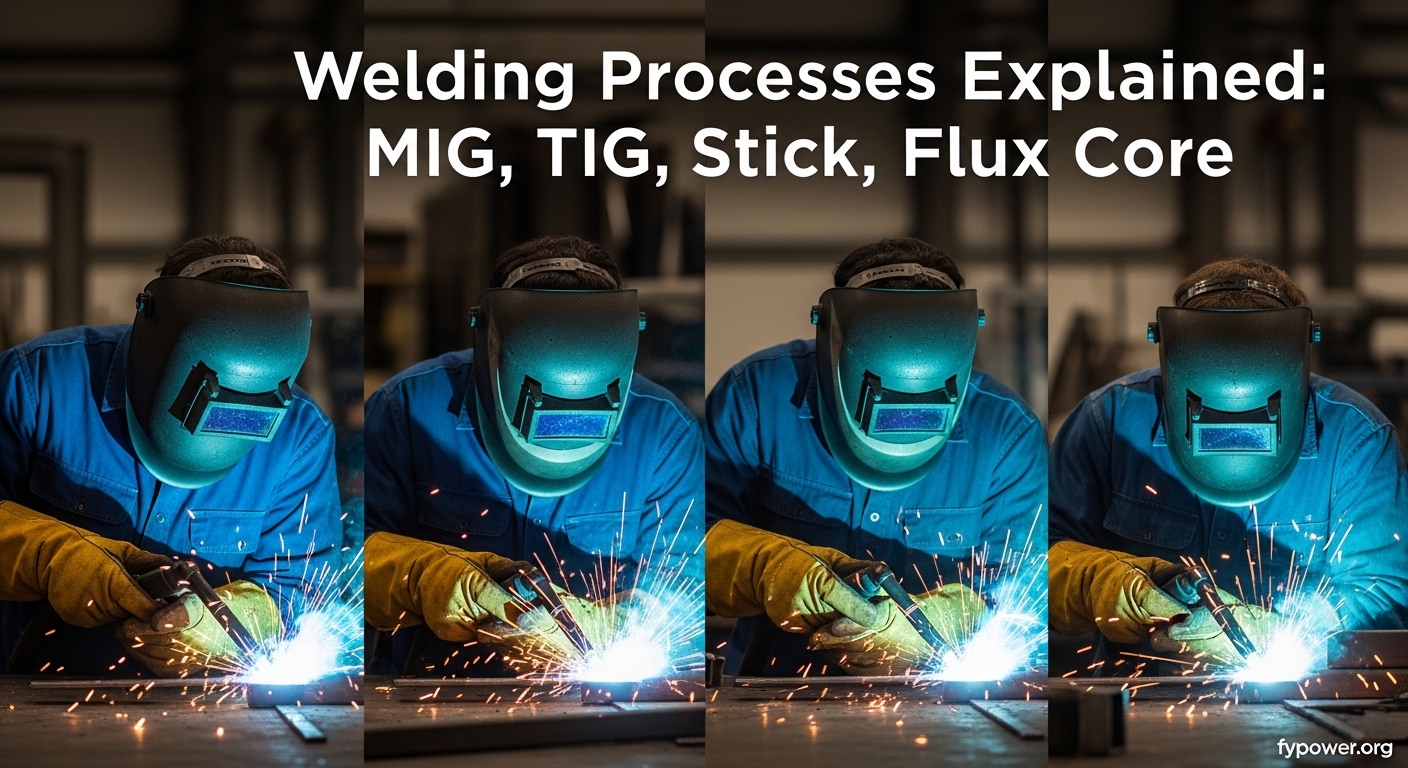
Welding is the process of joining separate metal pieces by melting and fusing them together using heat, pressure, or both to create a strong permanent bond. This fundamental metalworking skill builds everything from skyscrapers to exhaust pipes.
When I started welding 15 years ago, I was overwhelmed by the different options available. After working with fabricators who’ve built everything from race car frames to farm equipment, I’ve learned that choosing the right process makes all the difference.
The four main welding processes are MIG (GMAW), TIG (GTAW), Stick (SMAW), and Flux Cored (FCAW). MIG is the easiest for beginners, TIG offers the highest quality, Stick works best outdoors on dirty metal, and Flux Core combines wire feed speed with portability.
Each welding process has distinct advantages, limitations, and ideal applications. The right choice depends on your skill level, the materials you’re working with, your budget, and where you’ll be welding.
Understanding How Welding Works
Welding works by creating an electric arc between an electrode and the base metal, generating temperatures up to 6,000 degrees Fahrenheit that melts the metal. Filler material is added to fill gaps, and as the metal cools, it forms a single, unified piece.
Welding: The process of joining separate metal pieces by melting and fusing them together using heat, pressure, or both to create a strong permanent bond. Unlike mechanical fasteners like bolts or rivets, welding creates a continuous metal connection that can be as strong as or stronger than the base material.
The electric arc that makes welding possible is essentially controlled lightning. By directing this intense heat through a focused point, welding processes can melt and fuse metals with precision that would be impossible with other joining methods.
After spending time in fabrication shops across 2026, I’ve seen how this simple principle – controlled heat melting metal – can transform raw materials into functional structures. The key difference between welding processes lies in how they create and maintain that arc, and how they protect the molten metal from contamination.
Basic Welding Components
Every arc welding process shares four essential components. The power source provides the electricity needed to create the arc. The electrode delivers the current to the workpiece and may also add filler metal. Shielding protects the molten weld pool from atmospheric contamination. The ground clamp completes the electrical circuit.
Understanding these basics helps demystify welding. Once you realize that all these processes are variations on the same theme, choosing between them becomes much easier.
The Four Main Welding Processes at a Glance
Quick Overview: MIG welding is the most beginner-friendly and widely used. TIG produces the cleanest welds but has the steepest learning curve. Stick welding is the go-to for outdoor and heavy-duty work. Flux core offers a no-gas alternative to MIG with similar speed.
- MIG Welding (GMAW) – Uses a wire feed electrode and shielding gas. Easiest to learn and most versatile for thin to medium thickness metals.
- TIG Welding (GTAW) – Uses a non-consumable tungsten electrode and filler rod. Produces the highest quality welds but has the steepest learning curve.
- Stick Welding (SMAW) – Uses a consumable electrode coated in flux. Works outdoors in wind and on rusty or dirty metal.
- Flux Cored Welding (FCAW) – Uses a tubular wire with flux core. No external gas needed for self-shielded versions, great for outdoor work.
MIG Welding (GMAW) – The Most Common Process
Gas Metal Arc Welding (GMAW), commonly called MIG welding, is the most widely used welding process in 2026. MIG stands for Metal Inert Gas, referring to the shielding gas that protects the weld pool from contamination.
MIG welding is the easiest welding process to learn. Most beginners produce acceptable welds within 2-3 hours of practice because the wire feeder maintains consistent arc length automatically, eliminating one major variable.
How MIG Welding Works?
MIG welding uses a continuously fed wire electrode that serves as both filler metal and conductor. An electric arc forms between the wire and the base metal, generating temperatures up to 6,000 degrees Fahrenheit. The arc melts the base metal and the wire, creating a puddle that fuses as it cools.
Simultaneously, shielding gas flows through the welding torch, displacing air and preventing oxidation and porosity in the weld. The most common gas mix is 75% argon and 25% carbon dioxide for steel welding.
I’ve seen MIG welders complete production welding tasks 3-4 times faster than other methods. The continuous wire feed means you don’t stop to change electrodes, making it ideal for long welds and high-production environments.
Arc: The electrical discharge that occurs between the electrode and workpiece, generating the intense heat needed to melt metal. Arc welding processes create temperatures from 3,000 to over 10,000 degrees Fahrenheit depending on the process.
Equipment Needed for MIG Welding
Basic MIG Setup Checklist
- MIG welder with wire drive system ($400-$3,000)
- Shielding gas cylinder (C25 mix for steel: 75% argon, 25% CO2)
- Welding wire appropriate to your material (ER70S-6 for steel)
- Ground clamp and work cable
- MIG gun/torch assembly
- Welding helmet (auto-darkening recommended)
- Protective gloves and jacket
When to Use MIG Welding
MIG excels at welding mild steel from 24 gauge to 1/2 inch thick. It’s the go-to choice for automotive bodywork, exhaust systems, light fabrication, and DIY projects. The process produces clean welds with minimal spatter and excellent appearance.
After helping a local fabricator set up his shop in 2026, we chose MIG as the primary process because it handles 80% of general fabrication needs. The learning curve is shallow enough that new hires become productive within a week.
Skill Difficulty: EASIEST TO LEARN – Most beginners produce acceptable welds within 2-3 hours of practice. The wire feeder maintains consistent arc length, reducing one major variable.
MIG Welding Pros and Cons
MIG Welding Assessment
9.5/10
9.0/10
3.0/10
Pros:
- Easiest process to learn – most people weld competently in a day
- Fast deposition rate – excellent for production work
- Clean welds with minimal spatter
- No slag to chip away after welding
- Can weld thin materials without burn-through
- Versatile – works on steel, stainless, and aluminum
Cons:
- Requires shielding gas – wind will blow it away
- Equipment is more expensive than stick
- Wire feed system requires maintenance
- Not ideal for thick structural steel over 1/2 inch
- Requires clean metal – won’t work well on rusty or painted surfaces
TIG Welding (GTAW) – Precision and Control
Gas Tungsten Arc Welding (GTAW), known as TIG welding, produces the highest quality welds of any process. The precision and control available with TIG make it the preferred choice for aerospace, motorsports, and artistic metalwork.
TIG welding produces the highest quality, cleanest welds possible but requires the most skill to master. Most welders need 3-6 months of regular practice to achieve competence because you must control torch angle, arc length, filler rod feeding, and foot pedal simultaneously.
How TIG Welding Works?
TIG welding uses a non-consumable tungsten electrode to create the arc. Unlike other processes, the filler metal is added separately by hand using a filler rod. This gives the welder independent control over the arc and the filler material.
The tungsten electrode doesn’t melt – it maintains a stable arc while the welder feeds filler rod into the weld puddle with their off-hand. Shielding gas (typically pure argon) protects the weld area from contamination.
Tungsten: An extremely hard, heat-resistant metal with the highest melting point of any pure metal (6,192 degrees Fahrenheit). Tungsten electrodes don’t melt during welding, making them ideal for TIG’s non-consumable electrode design.
I’ve watched master fabricators build trophy-truck frames using TIG exclusively. The ability to make precise, controlled welds on thin tubing while maintaining full penetration is something only TIG can do consistently.
Equipment Needed for TIG Welding
Basic TIG Setup Checklist
- TIG welder with high-frequency start ($800-$5,000)
- TIG torch with gas lens kit
- Tungsten electrodes (2% thoriated or lanthanated for steel)
- Pure argon gas cylinder
- Filler rods (material-specific)
- Foot pedal or finger control for amperage
- High-quality welding helmet
When to Use TIG Welding
TIG excels on materials thinner than 1/8 inch and on metals requiring high-quality appearance. It’s the standard for stainless steel food processing equipment, aluminum aircraft components, and critical structural welds where appearance matters.
In a shop I worked with in 2026, we used TIG exclusively for exhaust systems on high-performance cars. The ability to control heat input precisely prevented warping thin stainless tubing while producing beautiful, consistent welds.
Skill Difficulty: HARDEST TO MASTER Most welders need 3-6 months of regular practice to achieve competence. You’re controlling torch angle, arc length, filler rod feeding, and foot pedal simultaneously – that’s four independent movements.
TIG Welding Pros and Cons
TIG Welding Assessment
10/10
2.0/10
9.5/10
Pros:
- Highest quality, cleanest welds possible
- Full control over heat input – perfect for thin materials
- Can weld virtually any metal including exotic alloys
- No spatter – minimal post-weld cleanup
- Precise control for intricate and artistic work
- Can weld without filler metal for autogenous welds
Cons:
- Steepest learning curve – takes significant practice
- Slowest process – not suited for production work
- Most expensive equipment setup
- Requires very clean metal surface
- Difficult to use outdoors or in drafts
- Requires both hands and foot control simultaneously
Stick Welding (SMAW) – Rugged and Versatile
Shielded Metal Arc Welding (SMAW), commonly called Stick welding, is the oldest and most versatile arc welding process. Despite being invented in the late 1800s, Stick remains essential for construction, farm repair, and field work.
Stick welding is the best process for outdoor use because it requires no shielding gas. The flux coating on the electrode creates its own protection, making it ideal for windy conditions and dirty, rusty, or painted metal surfaces.
How Stick Welding Works?
Stick welding uses a consumable electrode rod coated in flux. When you strike an arc by scratching the electrode against the workpiece, the flux coating melts and creates a shielding gas cloud while also forming slag that protects the cooling weld.
As the electrode burns away, it becomes shorter and the welder must maintain proper arc length by feeding the electrode into the work manually. This constant adjustment is the primary skill challenge in Stick welding.
Flux: A chemical coating on Stick welding electrodes that vaporizes to create shielding gas. The remaining flux forms slag that protects the cooling weld from atmospheric contamination. Slag must be chipped away after welding.
I’ve used Stick welding on farm equipment repairs where nothing else would work. The ability to weld rusty, painted steel in the middle of a field with nothing but a generator-powered welder is unmatched by any other process.
Equipment Needed for Stick Welding
Basic Stick Setup Checklist
- Stick welder (AC/DC capable recommended) ($200-$1,500)
- Electrode holder (stinger)
- Ground clamp
- Various Stick electrodes (E6010, E6011, E7018 most common)
- Electrode oven for storage (optional but recommended)
- Chipping hammer and wire brush
- Welding helmet and protective gear
When to Use Stick Welding?
Stick welding dominates in construction, pipeline work, shipbuilding, and farm repair. The process handles thick structural steel, cast iron, and works in conditions that would be impossible for MIG or TIG.
After a storm damaged fencing on a property in 2026, I repaired 200 feet of heavy steel fencing using a Stick welder powered by a portable generator. The wind was blowing 20 mph – MIG would have been completely impossible.
Skill Difficulty: MODERATE – Easier than TIG but harder than MIG. Most people learn basic Stick welding in 1-2 weeks. The challenge is maintaining consistent arc length as the electrode burns down.
Stick Welding Pros and Cons
Stick Welding Assessment
10/10
9.0/10
5.0/10
Pros:
- Works outdoors in wind – no shielding gas to blow away
- Forgives rusty, dirty, or painted metal surfaces
- Simplest equipment – least expensive to get started
- Can weld very thick materials
- Portable – works with generator power
- No gas cylinders required
Cons:
- Produces slag that must be chipped away
- More spatter than MIG or TIG
- Electrodes are consumable – frequent changes needed
- Lower efficiency – about 60% of electrode becomes weld metal
- Not suitable for thin materials under 1/8 inch
- Requires frequent electrode replacement during long welds
Flux Cored Arc Welding (FCAW) – No Gas Required
Flux Cored Arc Welding bridges the gap between MIG and Stick welding. It uses a continuously fed tubular wire filled with flux, combining the speed of wire feed with the versatility of flux shielding.
Flux-cored welding is similar to MIG but uses wire with flux inside instead of external shielding gas. This makes it work outdoors in wind while maintaining the speed and ease of wire feed welding.
How Flux Core Welding Works?
FCAW uses a hollow wire electrode filled with flux materials. When the arc forms, the flux vaporizes to create shielding gas and forms slag protection similar to Stick welding. This gives FCAW two distinct varieties: self-shielded (no gas) and gas-shielded (with external CO2).
Self-shielded FCAW is particularly popular because it requires no external gas cylinder. The flux core provides all the shielding needed, making it ideal for outdoor work and field repairs.
I’ve seen FCAW become the standard for farm equipment repair in 2026. Farmers can weld in open fields, on rusty equipment, without worrying about wind blowing away their shielding gas or hauling heavy cylinders.
Equipment Needed for Flux Core Welding
Basic Flux Core Setup Checklist
- MIG welder capable of FCAW (most are) ($400-$2,000)
- Flux cored wire (E71T-11 for general purpose)
- Optional: CO2 cylinder for gas-shielded FCAW
- Ground clamp and work cable
- Welding helmet and protective gear
- Chipping hammer and wire brush (for slag removal)
When to Use Flux Core Welding?
Flux core excels at heavy fabrication, shipbuilding, and outdoor construction. The process penetrates deeper than MIG and handles thicker materials more effectively. Self-shielded FCAW is the go-to choice for field work and remote locations.
Skill Difficulty: EASY TO MODERATE – Similar learning curve to MIG welding. If you can MIG weld, you can transition to flux core with minimal practice. The continuous wire feed maintains consistent arc length.
Flux Core Welding Pros and Cons
Flux Core Assessment
9.0/10
9.0/10
6.0/10
Pros:
- No shielding gas needed (self-shielded version)
- Works well outdoors and in wind
- Deeper penetration than MIG
- Handles dirty metal better than MIG
- Continuous wire feed – fast like MIG
- Excellent for thick materials
Cons:
- Produces slag that must be removed
- More spatter than solid wire MIG
- Wire is more expensive than solid MIG wire
- Not ideal for thin materials
- Less clean appearance than MIG or TIG
- Fume production is higher than MIG
Welding Process Comparison Table
| Process | Difficulty | Outdoor Use | Min Thickness | Max Thickness | Startup Cost | Weld Speed |
|---|---|---|---|---|---|---|
| MIG (GMAW) | Easy | Poor | 24 ga | 1/2 inch | $$ | Fast |
| TIG (GTAW) | Hard | Poor | Thin | 1/4 inch | $$$ | Slow |
| Stick (SMAW) | Moderate | Excellent | 1/8 inch | Unlimited | $ | Moderate |
| Flux Core (FCAW) | Easy | Good | 1/8 inch | 1 inch+ | $$ | Fast |
Which Process for Which Metal?
Different metals have specific welding requirements based on their thermal conductivity, melting point, and oxide characteristics. Choosing the wrong process for your material can lead to weak welds, warping, or complete failure.
| Material | MIG | TIG | Stick | Flux Core | Best Choice |
|---|---|---|---|---|---|
| Mild Steel | Excellent | Excellent | Excellent | Excellent | MIG |
| Stainless Steel | Good | Excellent | Fair | Fair | TIG |
| Aluminum | Good* | Excellent | Poor | Poor | TIG |
| Cast Iron | Poor | Fair | Good** | Fair | Stick |
| Exotic Alloys | Fair | Excellent | Poor | Poor | TIG |
*Requires spool gun and pure argon gas
**Requires special nickel electrodes and pre-heating
Other Welding Processes
While MIG, TIG, Stick, and Flux Core represent the vast majority of welding done today, several specialized processes deserve mention for specific applications.
Plasma Arc Welding (PAW)
Plasma arc welding uses a constricted arc that creates a plasma jet of extremely high temperature. This process offers greater precision and deeper penetration than TIG, making it ideal for aerospace and high-tech applications. The equipment cost and complexity limit PAW to specialized industrial uses.
Oxy-Fuel Welding (OFW)
Oxy-fuel welding uses a combination of oxygen and fuel gas (typically acetylene) to create a flame hot enough to melt metal. Unlike electric arc processes, oxy-fuel doesn’t require electricity. It remains valuable for brazing, cutting, and welding thick steel plates. However, oxy-fuel produces a large heat-affected zone and less precise control than arc welding methods.
Resistance Welding
Resistance welding includes spot welding and seam welding. The process uses electrical resistance to generate heat at the joint point, combined with pressure to fuse the metals. No filler material is used. Resistance welding is the standard in automotive manufacturing for joining sheet metal components, but the specialized equipment limits it to production environments.
Laser and Electron Beam Welding
These high-tech processes use focused energy beams to create extremely precise, deep-penetration welds with minimal heat input. Laser welding is becoming more common in automotive and medical device manufacturing. Electron beam welding requires a vacuum chamber and is used for critical aerospace components. Both require substantial investment and specialized training.
Welding Safety Essentials
All welding processes share common hazards but have specific safety considerations. After 15 years in metalworking, I’ve seen enough preventable injuries to know that safety isn’t optional.
WARNING: Welding produces UV radiation that can damage your eyes in seconds – never look at an arc without proper protection. All processes require appropriate personal protective equipment (PPE) and ventilation.
Common Safety Equipment (All Processes)
- Auto-darkening welding helmet (minimum shade 10)
- Flame-resistant welding jacket or leather apron
- Welding gloves (specific to your process)
- Steel-toed leather boots
- Respirator when welding in confined spaces
Process-Specific Safety Considerations
MIG/TIG Safety: These processes use compressed gas cylinders. Secure cylinders upright and chain them to a wall or cart. A falling cylinder can become a projectile that penetrates concrete walls. Argon is an asphyxiant – never weld in confined spaces without ventilation.
Stick Safety: Stick welding produces the most UV radiation of any process. Use a hood with at least shade 10, and consider shade 11-12 for high-amperage work. The flux coating can contain hazardous materials – always wash your hands after handling electrodes.
Flux Core Safety: Self-shielded FCAW produces significant fumes. The flux core vaporizes and creates metallic fumes that you shouldn’t breathe. Use respiratory protection and ensure cross-ventilation when welding indoors or in semi-enclosed spaces.
Fire Prevention
Welding spatter can travel 20 feet or more. Always clear a 35-foot radius of flammable materials before welding. Keep a fire extinguisher rated for electrical fires (Class ABC) within 10 feet of your work area. Never weld on or near containers that have held flammable materials, even if they appear empty – vapors can remain explosive.
Which Welding Process Should You Choose?
Choosing the right welding process depends on several factors. After helping dozens of beginners set up their first welder in 2026, I’ve developed a simple decision framework.
Process Selection Guide
Choose MIG if you:
- Are a complete beginner
- Weld indoors in a shop or garage
- Work mostly with mild steel under 1/2 inch thick
- Want clean-looking welds with minimal cleanup
- Have a budget of $500-1,500
Choose TIG if you:
- Value weld quality over speed
- Work with thin materials or exotic metals
- Need precision for artistic or show-quality work
- Have time to develop the skill
- Can invest $1,000-3,000 in equipment
Choose Stick if you:
- Weld outdoors or in drafty conditions
- Work with rusty, dirty, or painted metal
- Need a portable, simple setup
- Weld thick structural materials
- Have a limited budget ($200-600)
Choose Flux Core if you:
- Want MIG speed without gas hassles
- Weld outdoors or in windy conditions
- Work with thicker materials
- Already have a MIG welder that can run flux wire
My Recommendation for Beginners
For most beginners, I recommend starting with MIG welding. The learning curve is gentle, and you’ll produce decent welds quickly. A 140-amp MIG welder will handle 90% of home and hobby projects. Once you’ve mastered MIG, you can expand into other processes as needed.
If you’re on a tight budget or know you’ll be welding outdoors, a basic Stick welder is the most economical starting point. You’ll develop fundamental welding skills that transfer to other processes, and Stick welders hold their resale value well.
Frequently Asked Questions
What are the 4 main types of welding?
The four main types of welding are MIG (GMAW), TIG (GTAW), Stick (SMAW), and Flux Cored (FCAW). MIG uses a wire feed with shielding gas and is the easiest to learn. TIG provides the highest quality welds but requires significant skill. Stick welding works best outdoors on dirty metal. Flux core combines wire feed speed with self-shielding flux for portability.
Which welding process is easiest to learn?
MIG welding is the easiest process to learn. Most beginners produce acceptable welds within 2-3 hours of practice. The continuous wire feed maintains consistent arc length automatically, eliminating one major variable that makes other processes difficult. MIG welders are also the most forgiving of mistakes.
What is the most common welding process?
MIG welding is the most common welding process in 2026 for manufacturing, automotive, and DIY applications. Its ease of use, speed, and versatility make it the default choice for most fabrication shops. The automotive industry relies heavily on MIG for production welding due to its speed and consistency.
What is the difference between MIG and TIG welding?
MIG uses a continuously fed wire that serves as both electrode and filler, while TIG uses a fixed tungsten electrode with separately added filler rod. MIG is faster and easier to learn but produces lower quality welds. TIG is slower and harder to master but produces the cleanest, highest quality welds possible. MIG works best on production work, while TIG excels at precision and show-quality work.
What welding process should a beginner start with?
Beginners should start with MIG welding if they have the budget and will be welding indoors. The learning curve is gentle and you will see results quickly. If you have a limited budget or know you will be welding outdoors, start with Stick welding. It builds fundamental skills and works in conditions that defeat MIG. Most professional welders learn Stick first because it teaches the fundamentals.
Can different metals be welded together?
Yes, different metals can be welded together using special filler metals and techniques, called dissimilar welding. However, some combinations are problematic. Steel to stainless steel works well with the correct filler. Aluminum to steel requires special bimetallic inserts or specialized processes like friction welding. Always consult a welding compatibility chart before attempting dissimilar metal welds.
Which is stronger MIG or TIG welding?
When properly executed, both MIG and TIG welds can be stronger than the base metal. TIG typically produces stronger welds on thin materials and critical applications because of the precise control and lack of heat-affected zone issues. For most practical purposes on mild steel, a properly done MIG weld will be as strong as a TIG weld. The welder’s skill matters more than the process.
What type of welding is used for exhaust pipes?
TIG welding is the preferred choice for exhaust systems, especially stainless steel and high-performance applications. TIG provides the clean, beautiful welds desired on visible exhaust components and allows precise heat control to prevent warping thin tubing. MIG can be used for exhaust work on thicker steel or where appearance isn’t critical, but TIG dominates the performance exhaust market.
Leave a Reply