
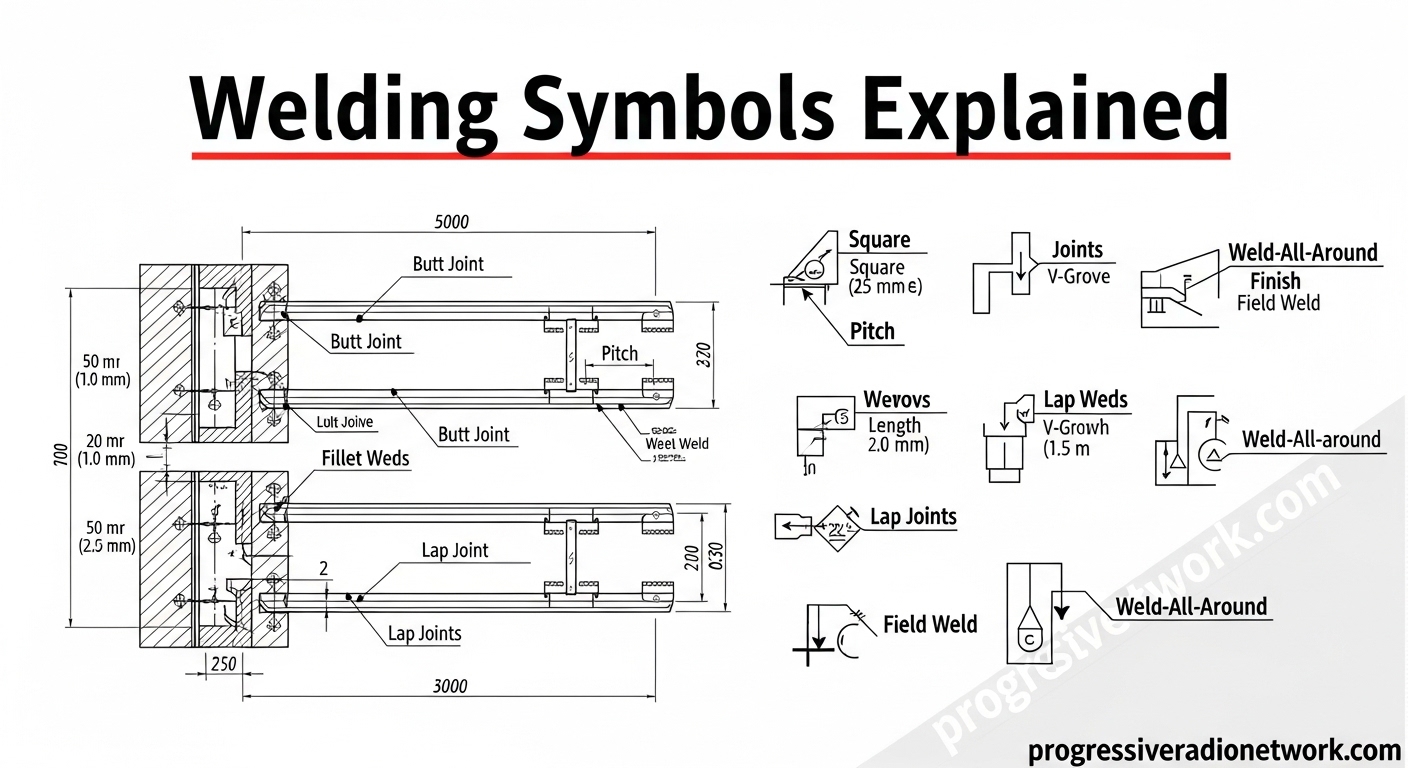
Misreading a welding symbol can cost thousands of dollars in rework. I’ve seen welders fabricate entire structures only to realize they welded the wrong side of the joint.
Welding symbols are the universal language of metal fabrication. These standardized graphical symbols communicate exactly how welds should be made, what type of joint to prepare, and what specifications to follow.
Welding symbols are standardized graphical representations used on engineering drawings to specify weld type, size, location, and other requirements according to AWS A2.4 standards.
- Standard: AWS A2.4 (American Welding Society)
- Purpose: Universal communication between designers, welders, and inspectors
- Users: Welders, engineers, inspectors, fabricators
The standard that governs these symbols in the United States is AWS A2.4, published by the American Welding Society. This standard defines every symbol, line, and specification used in welding drawings today.
After training dozens of welding students, I’ve found that symbols typically take 4-6 weeks to master with daily practice. Let me walk you through everything you need to know.
Anatomy of a Welding Symbol
The five basic elements of a welding symbol are:
- Reference line: The horizontal foundation line
- Arrow: Points to the joint location
- Leader line: Connects arrow to reference line
- Tail: Holds supplementary information
- Basic weld symbol: Indicates weld type
Reference Line: The horizontal line that serves as the anchor for all welding symbol elements. Information below this line applies to the arrow side, while information above applies to the other side.
Every welding symbol is built on the reference line. Think of it as the foundation.
The arrow and leader line extend from one end of the reference line. The arrow points directly to the joint that needs welding.
The tail extends from the opposite end and contains additional information like welding process specifications or reference numbers.
The weld symbol itself sits on or straddles the reference line, telling you what type of weld to make.
Visual Element: Complete Welding Symbol Structure
    (Optional Specifications)
              |
              TAIL
              |
    ___________|___________
   |                       |
   |    [WELD SYMBOL]      |  <-- REFERENCE LINE
   |_______________________|
              |
              |
            ARROW
              |
              V
          (JOINT)
Figure 1: Basic welding symbol structure showing all five elements
Arrow Side vs Other Side: The Critical Difference
Arrow side means the side of the joint the arrow points to. Other side means the opposite side of the joint.
- Arrow side: Symbol elements below reference line
- Other side: Symbol elements above reference line
- Both sides: Symbols on both top and bottom
This distinction causes more confusion than any other aspect of welding symbols.
When the weld symbol appears below the reference line, the weld goes on the arrow side (the side the arrow points to).
When the weld symbol appears above the reference line, the weld goes on the other side (opposite the arrow).
When symbols appear on both sides of the reference line, you need to weld both sides of the joint.
| Symbol Position | Weld Location | Visual Example |
|---|---|---|
| Below reference line | Arrow side | ____/ V | |
| Above reference line | Other side | V |____ |
| Both sides | Both sides of joint | V | |____V |
Real-World Consequences
I once worked with a fabricator who welded 20 feet of pipe before realizing the arrow pointed to the root side, not the face side.
They had to cut out every weld and start over.
That mistake cost them $3,000 in labor and materials.
How to Read a Welding Symbol Step by Step?
Quick Summary: Read welding symbols by starting at the arrow, identifying the weld type on the reference line, checking dimensions, and reviewing the tail for specifications. Always verify arrow side vs other side placement before welding.
Follow these steps to read any welding symbol:
- Locate the reference line and arrow
- Identify which side gets the weld (arrow or other)
- Read the weld symbol type
- Note the dimensions (size, length, spacing)
- Check the tail for additional specifications
Reading a welding symbol is like reading a sentence from left to right, with specific information in specific locations.
Step 1: Find the Arrow
Start at the arrow and follow it to the joint.
This shows you exactly where the weld needs to be made on the actual workpiece.
Step 2: Check Symbol Position
Look at where the weld symbol sits relative to the reference line.
Below the line means arrow side weld.
Above the line means other side weld.
Step 3: Identify the Weld Type
The shape on the reference line tells you what kind of weld to make.
A triangular shape means fillet weld.
A square or rectangular shape indicates groove weld.
Step 4: Read the Dimensions
Numbers to the left of the symbol indicate weld size.
Numbers to the right show weld length.
Step 5: Check the Tail
The tail often contains critical information.
Look for process specifications (GMAW, SMAW, GTAW).
Reference numbers may point to separate welding procedure specifications.
Fillet Weld Symbols Explained
A fillet weld symbol is a triangular shape placed on the reference line. The number to the left indicates weld size (leg length), and numbers to the right show length and spacing for intermittent welds.
- Symbol: Right triangle shape
- Size: Shown to the left of symbol
- Length: Shown to the right of symbol
Fillet welds are the most common weld type in fabrication.
They join two surfaces at approximately right angles, like T-joints and lap joints.
The fillet weld symbol looks like a right triangle drawn on the reference line.
Fillet Weld Dimensions
The weld size appears to the left of the symbol.
This number represents the leg length (the distance from the joint root to the weld toe).
For a 1/4 inch fillet weld, you’ll see .25 or 1/4 to the left of the triangle symbol.
Length specifications appear to the right of the symbol.
If no length is specified, the weld runs the full joint length.
Intermittent Fillet Welds
Intermittent welds show two numbers to the right.
The first number is weld length.
The second number is center-to-center spacing (pitch).
An intermittent fillet weld showing “4-12” means: 4-inch welds spaced 12 inches apart.
| Symbol Element | Location | Meaning |
|---|---|---|
| Weld size | Left of symbol | Leg length of fillet weld |
| Weld length | Right of symbol | Length of continuous weld |
| Pitch (spacing) | Right of length | Center-to-center distance |
Groove Weld Symbols Complete Guide
Groove welds join parts within a groove or opening.
They’re used for butt joints where full penetration is required.
Groove weld symbols vary based on the joint preparation required.
Square Groove Weld
The symbol is two vertical lines connected by a horizontal line at the bottom.
No joint preparation is needed for thin materials.
The edges are butted together and welded directly.
V-Groove Weld
The symbol looks like the letter V placed on the reference line.
Both pieces are beveled to form a V-shaped groove.
This is one of the most common groove weld preparations.
Bevel Groove Weld
The symbol shows a single vertical line with an angled base.
Only one piece is beveled while the other remains square.
This saves preparation time when appropriate for the application.
U-Groove and J-Groove
U-groove symbols show a curved U shape.
J-groove symbols show an L shape with a curved corner.
These are used for thicker materials requiring special joint preparation.
Flare-V and Flare-Bevel
These symbols indicate groove welds on curved surfaces.
Flare-V symbols show a V shape with curved sides.
Flare-bevel shows a single curved surface preparation.
Groove Weld Symbol Quick Reference
| Weld Type | Symbol Shape | Application |
| Square groove | Rectangle with open top | Thin materials, no prep needed |
| V-groove | V shape | Standard butt joint, both sides beveled |
| Bevel groove | Single vertical line with angled base | One-sided preparation |
| U-groove | U shape | Thick materials, J-shaped prep |
| J-groove | L with curved corner | Single-sided U preparation |
Other Weld Type Symbols
Plug and Slot Welds
Plug weld symbols show a rectangle positioned on the reference line.
They indicate holes in one member filled with weld metal.
Slot weld symbols are similar but indicate elongated holes.
Dimensions include hole diameter or slot length and width.
Spot and Seam Welds
Spot weld symbols are circles placed directly on the reference line.
They indicate discrete weld points rather than continuous welds.
Seam weld symbols show a circle with a line through it.
These represent continuous rolled welds between overlapping sheets.
Stud Welds
Stud weld symbols show a circle with a cross or X inside.
They indicate welding a metal stud to a surface.
This process uses specialized equipment and is common in construction.
Edge Welds
Edge weld symbols show a modified V shape on its side.
They indicate welding along the edges of two flanged pieces.
This joint type is common in sheet metal work.
Backing and Surfacing Welds
Backing weld symbols show a semicircle opening toward the reference line.
They indicate a backing weld made before the main groove weld.
Surfacing weld symbols show a semicircle opening away from the reference line.
These indicate build-up welds on surfaces for wear resistance or dimension restoration.
Supplementary and Special Symbols
Field Weld Symbol
A field weld symbol is a flag-shaped symbol placed at the junction of the reference line and arrow. It indicates the weld must be made at the construction or installation site, not in the fabrication shop.
The field weld symbol looks like a flag at the arrow-reference line junction.
This symbol tells everyone that the weld happens on site.
Shop welds are typically done under controlled conditions.
Field welds face environmental challenges and require portable equipment.
I’ve seen contractors reject entire fabrications because shop welds were made where field welds were specified.
Weld All Around Symbol
The weld all around symbol is a circle connecting the arrow to the reference line. It indicates a continuous weld around the entire joint perimeter.
This symbol appears as a circle at the arrow-reference line junction.
It means weld continuously around the joint.
Common applications include pipe connections, box frames, and enclosed structures.
Contour Symbols
Contour symbols indicate the desired weld surface finish.
A straight line across the symbol corner means flush finish.
A curved line bulging outward indicates convex contour.
A curved line dipping inward shows concave contour.
Finish Symbols
Finish method letters appear above contour symbols when needed.
C means chipping
G means grinding
M means machining
H means hammering
R means rolling
These symbols tell you what additional processing the weld needs after welding.
Weld Dimensions and Specifications
Weld sizes appear to the left of the weld symbol. Length and spacing appear to the right. Groove weld dimensions include root opening, depth of bevel, and included angle specified around the symbol.
Understanding dimension placement is critical for making welds that meet specifications.
Size Dimensions
For fillet welds, the number to the left indicates leg size.
This is measured from the joint root to the outer surface of the weld leg.
For groove welds, multiple dimensions may appear.
The first number typically indicates weld reinforcement or penetration depth.
Root Opening
Root opening appears inside the groove weld symbol.
It specifies the gap between joint members before welding.
This dimension is critical for proper penetration.
Depth of Bevel
This number appears outside the groove symbol, near the bevel angle.
It indicates how deep to prepare the bevel on the joint edge.
Included Angle
The bevel angle appears outside the groove weld symbol.
It specifies the total angle between beveled surfaces.
Common angles are 45, 60, and 75 degrees depending on joint design.
Length and Pitch
For continuous welds, the length appears to the right of the symbol.
For intermittent welds, both length and pitch appear.
The format is always “length-pitch” such as “4-12”.
Real-World Welding Symbol Examples
Let’s apply what we’ve learned to practical examples.
Example 1: Simple T-Joint Fillet Weld
3/8
_____|V
|
Symbol: 3/8 inch fillet weld on arrow side
This symbol specifies a 3/8 inch fillet weld.
The triangle below the reference line means arrow side weld.
No length specified means weld the full joint length.
Example 2: Intermittent Lap Joint
1/4 4-6
_____|V
|
Symbol: 1/4 inch intermittent fillet, 4-inch welds, 6-inch spacing
This specifies 1/4 inch fillet welds.
Each weld is 4 inches long.
Welds are spaced 6 inches apart center-to-center.
Example 3: Double V-Groove Butt Joint
60° 1/8
V
_____|
|
V
Symbol: Double V-groove, 60 degree included angle, 1/8 root opening
The V symbols on both sides indicate weld from both sides.
60 degrees specifies the included angle for each side.
1/8 inch root opening means gap between members before welding.
Example 4: Field Weld with Specification
GMAW
|
5/16 _____|V–flag
|
Symbol: 5/16 inch field weld using GMAW process
The flag symbol indicates field weld required.
GMAW in the tail specifies MIG welding process.
5/16 inch fillet weld on arrow side.
Common Welding Symbol Mistakes to Avoid
After reviewing forum discussions and talking with inspectors, here are the most common errors:
Mistake 1: Ignoring Arrow Side
The most expensive mistake is welding the wrong side of the joint.
Always verify symbol position relative to the reference line.
When in doubt, ask before welding.
Mistake 2: Missing Field Weld Symbol
I’ve seen fabricators complete welds in the shop only to have them rejected.
The field weld flag means those welds must happen on site.
Shop welding field welds creates rework and delays.
Mistake 3: Misreading Intermittent Spacing
Confusing weld length with spacing causes issues.
The first number is always weld length.
The second number is always pitch (center-to-center distance).
Getting this backwards means too many or too few welds.
Mistake 4: Overlooking Tail Information
The tail often contains critical welding procedure references.
Ignoring tail information can mean using the wrong process or filler metal.
Always check the tail before starting to weld.
Mistake 5: Confusing Old and New Symbols
AWS A2.4 was updated in 2012 with some symbol changes.
Older prints may use deprecated symbols.
When you see unfamiliar symbols, verify the standard being used.
Practice Quiz: Test Your Knowledge
Try these questions to test your understanding of welding symbols.
Question 1
A fillet weld symbol appears below the reference line. Which side of the joint do you weld?
Question 2
What does a flag symbol at the arrow-reference line junction indicate?
Question 3
An intermittent fillet weld symbol shows “3-9” to the right. What does this mean?
Question 4
What information is contained in the tail of a welding symbol?
Question 5
What does a circle connecting the arrow to the reference line indicate?
Question 6
A groove weld symbol shows “60” outside the V. What dimension does this specify?
Question 7
What does the letter “G” above a contour symbol mean?
Question 8
Where is weld size specified on a fillet weld symbol?
Answers:
1. Arrow side (the side the arrow points to)
2. Field weld – must be made at the installation site
3. 3-inch welds spaced 9 inches apart center-to-center
4. Welding process, specifications, or reference numbers
5. Weld all around – continuous weld around entire joint
6. Included angle of the groove preparation
7. Grind – the weld surface must be ground
8. To the left of the weld symbol
Welding Symbol Quick Reference Chart
| Symbol | Type | Description |
|---|---|---|
| |_| | Square groove | Butt joint with no bevel |
| / V \ | V-groove | Both members beveled |
| _| / | Bevel groove | Single member beveled |
| _|_| | Fillet | Approximately 90-degree joint |
| [] | Plug | Hole filled with weld metal |
| O | Spot | Discrete point weld |
| flag | Field weld | Weld at installation site |
| O | Weld all around | Continuous around joint |
Frequently Asked Questions
What are the basic elements of a welding symbol?
The five basic elements are the reference line (horizontal foundation), arrow (points to the joint), leader line (connects arrow to reference line), tail (holds supplementary info), and basic weld symbol (indicates weld type).
How do you read a welding symbol?
Start at the arrow to find the joint location. Check if the weld symbol is above (other side) or below (arrow side) the reference line. Read the weld symbol type to identify the weld. Check numbers to the left for size and numbers to the right for length. Review the tail for process specifications.
What is the difference between arrow side and other side?
Arrow side is the side of the joint that the arrow points to. Other side is the opposite side of the joint. When the weld symbol appears below the reference line, weld the arrow side. When it appears above, weld the other side.
What is AWS A2.4?
AWS A2.4 is the American Welding Society standard that defines welding, brazing, and nondestructive examination symbols. It provides the standardized rules for creating and interpreting welding symbols in the United States.
What does the tail of a welding symbol indicate?
The tail contains supplementary information such as welding process (GMAW, SMAW, GTAW), specification references, or other notes. When no tail is shown, no supplementary information is specified.
What is a field weld symbol?
A field weld symbol is a flag-shaped symbol placed at the junction of the reference line and arrow. It indicates that the weld must be made at the construction or installation site rather than in the fabrication shop.
What does the weld all around symbol mean?
The weld all around symbol is a circle connecting the arrow to the reference line. It indicates a continuous weld around the entire perimeter of the joint, commonly used on enclosed structures and pipe connections.
How are weld sizes shown on symbols?
Weld size appears to the left of the weld symbol. For fillet welds, this indicates leg length. For groove welds, it may indicate penetration depth or reinforcement. Length appears to the right of the symbol.
What do contour symbols mean in welding?
Contour symbols indicate the desired surface shape of the finished weld. A straight line means flush, a line bulging outward means convex, and a line curving inward means concave. Letters above the contour symbol specify the finish method.
How do you read a fillet weld symbol?
Identify the triangular symbol on the reference line. The number to the left shows weld size (leg length). The number to the right shows weld length. Check if the symbol is below (arrow side) or above (other side) the reference line to know which side to weld.
What are supplementary symbols in welding?
Supplementary symbols provide additional welding information such as field weld (flag), weld all around (circle), contour and finish requirements, backing or spacer symbols, and melt-through symbols.
What is the reference line on a welding symbol?
The reference line is the horizontal line that serves as the foundation of the welding symbol. All weld symbols, dimensions, and specifications are placed on or around this line to communicate welding requirements.
Leave a Reply