
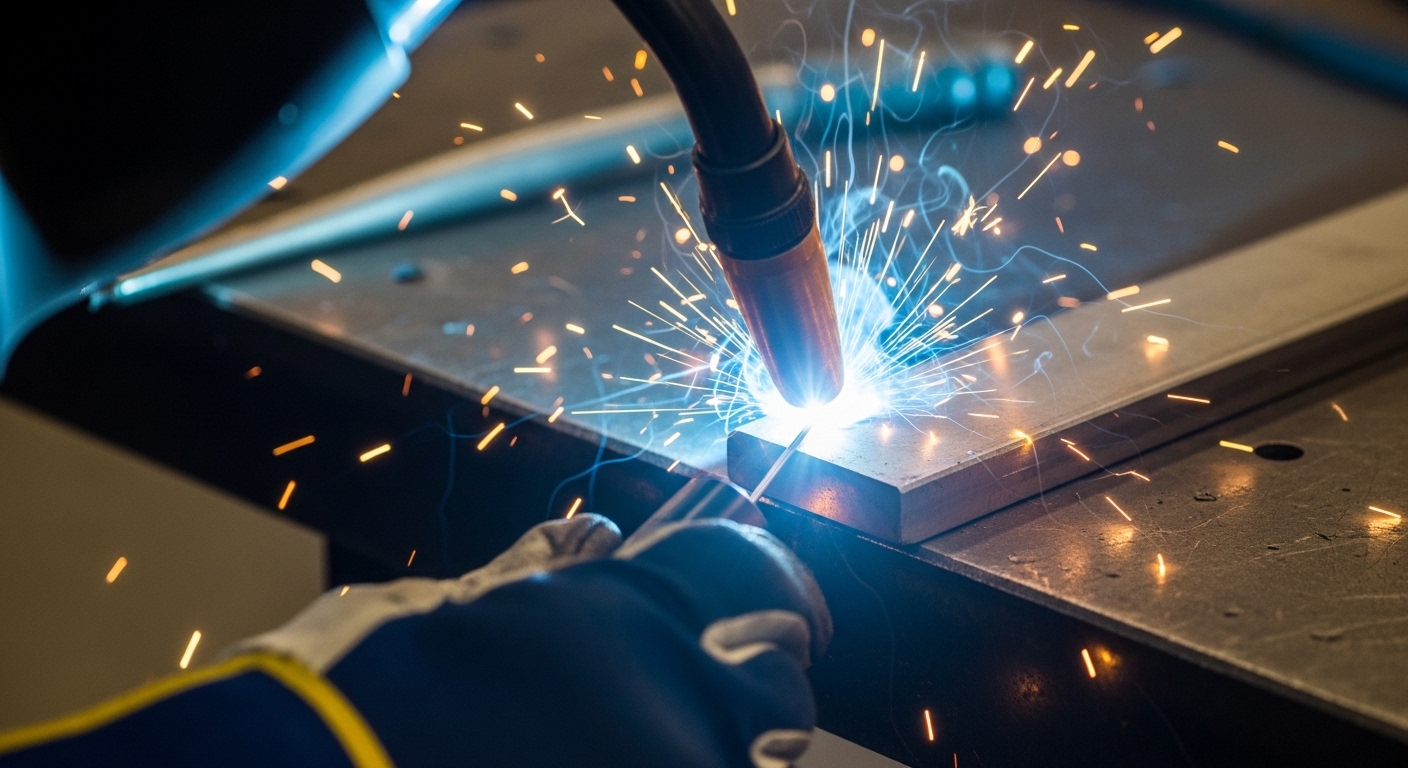
I remember my first time trying to start a TIG arc. I had this fancy-looking torch, expensive tungsten, and absolutely no idea how to make the spark happen. The guy at the welding store said “just scratch it like a match,” which sounded simple enough until I was actually staring at a piece of steel.
That was ten years ago. Since then, I’ve taught dozens of people to TIG weld, and scratch start remains the most confusing topic for beginners. Let me clear up the confusion.
Scratch start TIG is a basic arc ignition method where the tungsten electrode is touched to the workpiece and quickly scratched across the surface (like striking a match) to initiate the welding arc. It’s the simplest and most affordable way to start TIG welding, requiring no special high-frequency components or expensive lift-arc circuitry.
How Scratch Start TIG Works
Scratch start TIG works by physically touching the tungsten electrode to the metal workpiece, scratching it along the surface for 1-2 inches to create a spark, then lifting slightly to establish the welding arc. This momentary contact completes the circuit and creates enough heat to ionize the shielding gas path, allowing current to flow continuously.
The mechanics are straightforward. Your TIG torch carries welding current through the tungsten electrode. When you touch tungsten to grounded metal, electricity flows. The trick is doing it without destroying your tungsten in the process.
Quick Summary: Scratch start mimics striking a match—brief contact, quick motion, immediate lift. Master the timing and you’ll start arcs consistently. Rush it and you’ll be constantly grinding new tungsten points.
Here’s the step-by-step process I teach my students:
- Set your amperage — Start slightly higher than your welding setting. I typically add 15-20 amps for starting, then back down once the arc establishes.
- Position the torch — Hold it at a 70-80 degree angle from the workpiece, with the tungsten about 0.5 inches above the surface.
- Initiate gas flow — If you have a solenoid valve, flip the switch. If not, open your manual valve a second before starting.
- Make contact — Gently touch the tungsten to the metal. Don’t stab it—think “gentle kiss” not “hammer strike.”
- Scratch the surface — Drag the tungsten across the metal for about 1-2 inches, like lighting a wooden match.
- Lift immediately — As soon as you see sparks, lift the tungsten about 1/8 inch from the surface. The arc should establish.
- Adjust and weld — Reduce amperage if needed, add filler rod when ready, and begin your weld.
The whole motion takes less than a second. Too slow and your tungsten sticks. Too fast and the arc never forms. It’s muscle memory—you’ll develop a feel after about 50 attempts.
I’ve found that most beginners struggle with step 5 and 6. The scratching motion needs to be smooth and confident. Hesitation causes sticking. Aggressiveness causes tungsten breakage.
Pros and Cons of Scratch Start TIG
After using scratch start for years on various projects—from roll cages to exhaust systems—I can tell you it’s not perfect. But it has some genuine advantages that keep me coming back.
Under $300
Stick Welder + Torch
Moderate
Shorter
Advantages of Scratch Start
- Minimal equipment cost — You can TIG weld with a basic stick welder and a TIG torch adapter. I built my first setup for under $250. Compare that to a dedicated TIG machine at $800+.
- Simplicity — Fewer components means fewer things to break. No high-frequency circuit boards to fail, no solenoid valves to replace.
- Works with most stick welders — Almost any DC stick welder can run scratch start TIG. This includes transformer boxes and inverter machines.
- No electromagnetic interference — High-frequency start can mess with electronics nearby. Scratch start is electrically quiet.
- Durable equipment — Transformer stick welders are virtually indestructible. I have a 30-year-old Lincoln that still runs perfectly.
The cost advantage is real. When I was starting out, I couldn’t justify spending $1,200 on a TIG machine for hobby projects. Scratch start let me learn TIG fundamentals for a fraction of the price.
Disadvantages of Scratch Start
- Tungsten contamination — Every time you touch tungsten to metal, it picks up contamination. This shows up as inclusions in your weld.
- Shorter tungsten life — You’ll sharpen tungsten more often. I go through about 3x more tungsten with scratch start versus lift arc.
- More difficult to start — The learning curve is steeper. Most beginners need a few hours of practice before consistent starts.
- No remote control — Unless you add accessories, you’re stuck with fixed amperage at the machine while welding.
- Less suitable for aluminum — While possible, aluminum TIG with scratch start is frustrating. The oxide layer makes starting difficult.
- Precision limitations — Scratch start can be tricky on tight joints where you can’t easily scratch without hitting surrounding material.
In my experience, tungsten contamination is the biggest issue. I’ve ruined more than one critical weld by unknowingly using contaminated tungsten. The inclusions are tiny black specks in the weld bead that weaken the joint.
Scratch Start vs Lift TIG: Key Differences
Lift TIG (also called lift arc) is the middle ground between scratch start and high-frequency start. It addresses many of scratch start’s drawbacks while keeping costs reasonable.
| Feature | Scratch Start | Lift TIG |
|---|---|---|
| Starting Method | Scratch tungsten on workpiece | Touch tungsten, lift slightly |
| Tungsten Contamination | Higher risk | Low risk (machine reduces amps) |
| Equipment Cost | Lowest ($200-400) | Moderate ($400-800) |
| Ease of Starting | Moderate (requires practice) | Easy (almost foolproof) |
| Tungsten Life | Shorter | Longer |
The key difference is how the machine handles the moment of contact. With scratch start, full welding current flows immediately upon contact. With lift TIG, the machine detects contact and reduces current to a low level (typically 5-10 amps) until you lift the tungsten.
This makes lift TIG much more forgiving. I’ve seen beginners go from struggling to start arcs consistently to nailing it 95% of the time just by switching to a lift TIG capable machine.
Scratch Start vs High Frequency Start
High-frequency (HF) start is the professional standard. It uses high-voltage, high-frequency oscillation to ionize the gas gap and start the arc without any contact with the workpiece.
| Feature | Scratch Start | High Frequency Start |
|---|---|---|
| Starting Method | Contact required | No contact needed |
| Tungsten Contamination | Possible | None |
| Equipment Cost | Lowest ($200-400) | Highest ($800-3000+) |
| Ease of Starting | Moderate | Instant, effortless |
| Electromagnetic Interference | None | Can interfere with electronics |
| Aluminum Capability | Poor to fair | Excellent (with AC output) |
No, you don’t need high frequency for TIG welding. It’s a convenience, not a requirement. For steel and stainless steel, scratch start works perfectly fine. HF start becomes more valuable when welding aluminum or production work where consistent starts matter.
Understanding Tungsten Contamination
Tungsten Contamination: Occurs when the tungsten electrode picks up foreign material from the workpiece during scratching or sticking. This contamination melts into the weld pool and creates hard, brittle inclusions that can cause weld failure.
Is scratch start bad for tungsten? Yes and no. It shortens tungsten life and increases contamination risk, but proper technique minimizes both issues. I’ve used the same piece of ceriated tungsten for dozens of scratch-start welds when I’m careful.
Contamination shows up in a few ways:
- Black specks in the weld — Tiny inclusions of base metal melted into the filler
- Arc instability — The arc wanders or sputters due to an irregular tungsten tip
- Difficulty starting — Contaminated tungsten doesn’t start as reliably
After a bad stick (where the tungsten digs into the metal), I always grind back at least 1/4 inch to remove contaminated material. Skipping this step is how you end up with dirty welds.
When to Use Scratch Start TIG
Scratch start TIG is ideal for certain situations and less suitable for others. Based on my experience, here’s where it shines:
Stainless Steel
Automotive Repair
Home DIY Projects
Learning TIG Basics
Budget Builds
Is scratch start TIG good for beginners? It’s a mixed bag. The technique is harder to learn initially, but it forces you to develop good torch control and understanding of arc dynamics. I learned on scratch start, and I believe it made me a better welder. However, if you’re easily frustrated, lift TIG might be a better entry point.
Can you scratch start TIG aluminum? Technically yes, but it’s frustrating. The aluminum oxide layer resists arc initiation, and aluminum requires AC output which many basic stick welders don’t provide. I’ve done it, but I wouldn’t recommend it for anything beyond emergency repairs.
For steel and stainless steel, scratch start is perfectly capable. I’ve built furniture, repaired exhaust systems, and fabricated structural steel using only scratch start TIG.
Equipment for Scratch Start TIG
One of scratch start’s biggest advantages is minimal equipment requirements. Here’s what you need:
Essential Equipment
- DC stick welder — Any CC (constant current) stick welder with DC output works. Transformer boxes are cheap and durable. Inverter stick welders are lighter and often have better arc characteristics.
- TIG torch — An air-cooled torch is sufficient for most scratch start work. I use a #17 torch with a flexible head. Gas-cooled torches work too but are overkill for the amperages typically used.
- Tungsten electrodes — 2% Ceriated (orange) or 2% Lanthanated (blue) work best for scratch start. Avoid pure tungsten—it’s too fragile. 1/16 inch diameter is a good all-around size for 40-150 amps.
- Argon gas — 100% argon is standard for TIG. A small 80 cubic foot cylinder lasts me about 2-3 hours of welding time.
- Gas regulator — A simple flowmeter regulator works. Set it to 15-20 CFH for most applications.
- Ground clamp — Your stick welder came with one. Make sure it makes good contact—scratch start struggles with poor grounding.
What type of tungsten is best for scratch start? I recommend 2% Ceriated (WC20) or 2% Lanthanated (WL20). Both hold up well to the scratching motion and restrike easily. Thoriated tungsten works too but has radioactive concerns during grinding. I stopped using it years ago.
Optional but helpful equipment includes a foot pedal amperage control (requires specific machine compatibility), finger control for torch-amperage adjustment, and an auto-darkening helmet. The helmet makes a bigger difference than most beginners realize—being able to see exactly where your tungsten is before starting helps immensely.
Common Scratch Start Mistakes to Avoid
After teaching scratch start to many beginners, I’ve noticed the same mistakes appear repeatedly. Avoid these and you’ll save hours of frustration:
Top 5 Beginner Mistakes
- Pressing too hard — You need only light contact. Heavy digging causes sticking and contamination.
- Scratching too far — A 1-2 inch scratch is plenty. Longer scratches increase contamination risk.
- Lifting too slowly — The arc establishes when you lift. Hesitation causes the tungsten to stick.
- Lifting too high — Lift more than 1/4 inch and the arc breaks. You want to stay close.
- Not grinding frequently — Use a dedicated tungsten grinder. Contamination from sharing wheels transfers to your tungsten.
The most common frustration I see is beginners giving up after 20 attempts. Scratch start takes practice. Set aside an hour with scrap metal and just practice starting arcs. Don’t try to weld—just start, establish a stable arc, and break it off. Repeat 50 times.
Tips for Better Scratch Start Results
After years of scratch start welding, I’ve developed techniques that make starting more consistent:
- Keep tungsten sharp — A sharp point concentrates current and makes starting easier. I use a dedicated diamond grinding wheel for tungsten only.
- Clean your metal — Scratch start struggles on rusty or painted surfaces. Grind to bare metal before welding.
- Pre-flow your gas — Start argon flow a second before scratching. This purges air from the area.
- Use scratch pads — For tricky starts, create a small “scratch pad” area adjacent to your joint where you initiate the arc, then walk it over.
- Increase starting amperage — Set amps 15-20% higher for starting, then dial back. This makes arc initiation easier.
- Check your ground — Poor ground contact causes starting problems. Move your clamp closer to the work area if struggling.
- Use proper tungsten size — Too small and it overheats. Too large and it’s hard to start. Match tungsten diameter to your amperage range.
The scratch pad technique is one I use constantly. When welding in a tight corner where I can’t scratch easily, I create a small flat area nearby, start the arc there, then walk the arc over to my actual joint. It adds a few seconds but saves frustration.
Frequently Asked Questions
What is scratch start TIG?
Scratch start TIG is a basic arc ignition method where the tungsten electrode is touched to the workpiece and quickly scratched across the surface (like striking a match) to initiate the welding arc. It is the simplest and most affordable way to start TIG welding.
How does scratch start TIG work?
The welder touches the tungsten to the metal, scratches it along the surface for approximately 1-2 inches, then lifts slightly to establish the arc. The scratching motion creates a spark that ionizes the gas path, allowing current to flow and create the welding arc.
What are the disadvantages of scratch start TIG?
The main disadvantages are tungsten contamination from touching the workpiece, shorter tungsten life, steeper learning curve, difficulty with aluminum, and typically no remote amperage control while welding.
Is scratch start TIG good for beginners?
Scratch start TIG has a steeper learning curve than lift TIG or high-frequency start, but it teaches fundamental skills and costs much less. It can be good for determined beginners on a budget, but those easily frustrated may prefer lift TIG.
What is the difference between scratch start and lift TIG?
Scratch start requires full contact and scratching at full current, while lift TIG detects contact and automatically reduces current to low amps until you lift. Lift TIG reduces tungsten contamination and is easier to use.
Can you TIG weld with a stick welder?
Yes, most DC stick welders can be used for scratch start TIG welding with a TIG torch adapter and argon gas. This is a popular budget-friendly approach to getting started with TIG welding.
Do you need high frequency for TIG welding?
No, high frequency is not required for TIG welding. It is a convenience that makes starting easier and cleaner, but scratch start and lift TIG are both valid alternatives that work well for steel and stainless steel.
Is scratch start bad for tungsten?
Scratch start can shorten tungsten life and increase contamination risk, but proper technique minimizes these issues. Grinding away contaminated material after each stick and using appropriate tungsten types reduces the impact.
What type of tungsten is best for scratch start?
2% Ceriated (orange) or 2% Lanthanated (blue) tungsten work best for scratch start. Both hold up well to the scratching motion and restrike easily. 1/16 inch diameter is a good all-around size.
Can you scratch start TIG aluminum?
Technically yes, but scratch start TIG with aluminum is difficult due to the oxide layer and the need for AC output, which many basic stick welders do not provide. It is not recommended except for emergency repairs.
Scratch start TIG remains the most accessible entry point into TIG welding. It’s not perfect, but it works—and for many of us, that’s enough. If you’re on a budget or just curious about TIG welding, scratch start lets you learn the fundamentals without breaking the bank.
Leave a Reply