
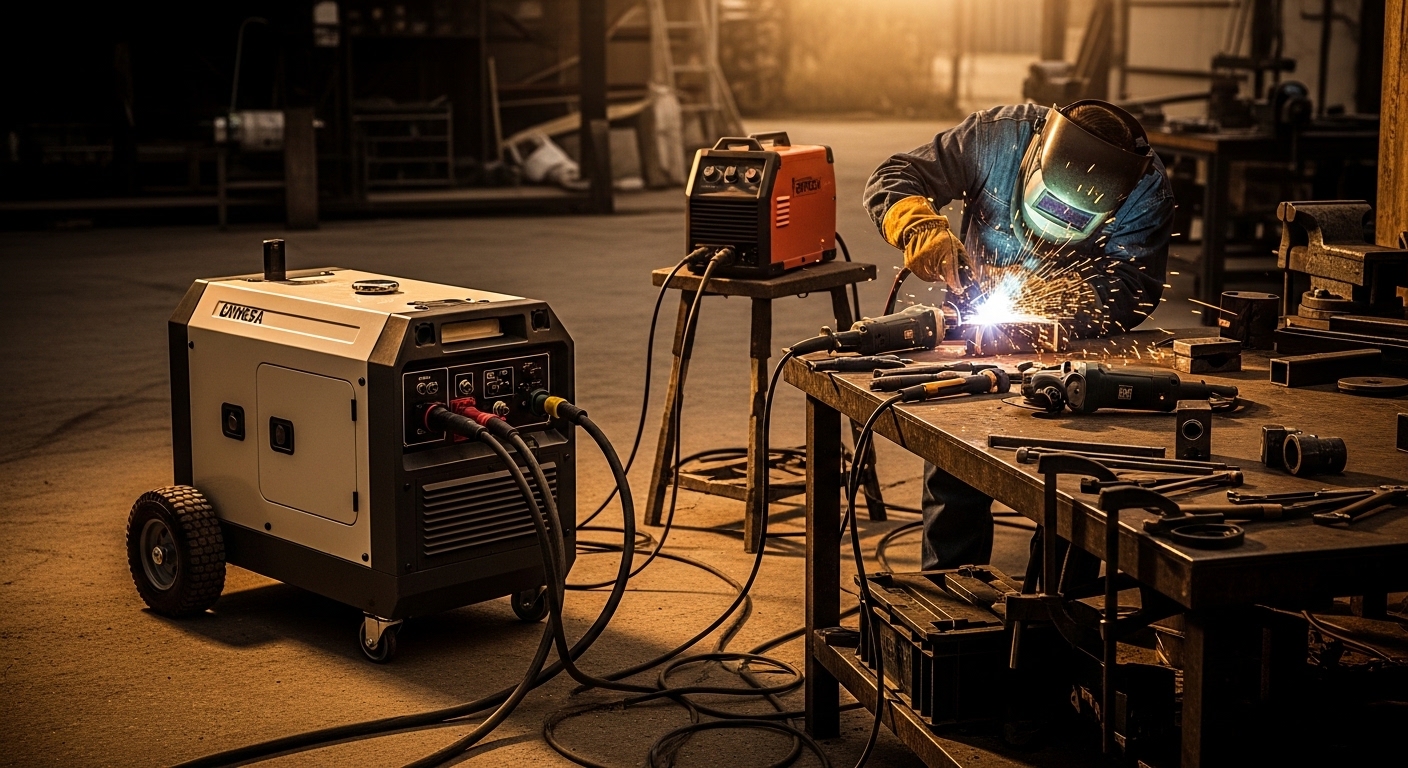
Nothing kills a welding project faster than a generator that can’t handle the load. I’ve seen welders trip breakers, sputter out mid-bead, and even suffer permanent damage from undersized generators. After researching hundreds of user experiences and consulting with professional welders, I’ve learned that sizing your generator correctly isn’t just about matching numbers—it’s about understanding how your welder actually consumes power.
To determine what size generator for welding, multiply your welder’s input amps by volts, then add 30% safety margin. As a general rule: small welders (90-140A) need 4,000-7,000 watts; medium welders (160-200A) require 8,000-12,000 watts; large welders (210-250A) need 13,000-15,000+ watts. Always check your welder’s manual for exact input power requirements, as inverter welders require clean power (low THD) and transformer welders are more forgiving.
The minimum generator size for welding equals (welder input volts x input amps) x 1.30. For example, a welder drawing 32 amps at 220V needs at least 9,152 watts. Always size up rather than down—undersized generators cause equipment damage and poor welds.
Most people make the mistake of looking at their welder’s output amperage (like “140A” on the label) and buying a generator based on that number. That’s wrong. Your welder’s output rating has nothing to do with its power consumption. You need to find the input power specification—the amount of electricity the welder actually draws from the wall or generator.
I’ve worked with farmers who bought 5,000-watt generators for their Miller 180 welders, only to find they could barely run 3/16-inch rods before the breaker tripped. One user on WeldingWeb reported that his 110-amp welder drew about 2,300 watts, but he needed “something considerably bigger” because the load fluctuations would “drive the generator nuts.” Welding power isn’t steady—it spikes when you strike an arc and fluctuates throughout your bead.
Understanding Watts, Volts, and Amps
Quick Summary: Watts measure total power. Volts measure electrical pressure. Amps measure current flow. The formula Volts x Amps = Watts is the foundation of all generator sizing calculations.
Electricity works like water flowing through a pipe. Voltage is the water pressure—how hard the electricity pushes. Amperage is the flow rate—how much electricity moves. Wattage is the total work being done. When you’re sizing a generator, you care about watts because that’s what generators produce and welders consume.
Running Watts: The continuous power a generator can supply. This is the number that matters for welding.
Starting Watts (Peak Watts): Extra power for motors starting up. Less relevant for welding but important if running grinders or compressors simultaneously.
Input Power vs Output Power: Input is what your welder consumes (what matters for generator sizing). Output is welding amperage at the electrode (what creates your weld).
Here’s where most confusion happens: A “140-amp welder” doesn’t draw 140 amps from the wall. That 140 amps is the welding output. The actual input current might be 20-30 amps depending on efficiency and design. I’ve seen hobby welders buy 8,000-watt generators for 140-amp welders that only needed 5,000 watts. That’s wasted money.
The relationship between volts, amps, and watts never changes. A welder running on 120V drawing 25 amps consumes 3,000 watts (120 x 25 = 3,000). The same welder on 240V at 25 amps draws 6,000 watts. This is why 240V welders need substantially larger generators even at similar amperage ratings.
How to Calculate Your Generator Size
Calculating the right generator size takes five minutes. I’ve walked dozens of people through this process, and those who do it properly never have power issues. Those who guess end up frustrated.
Step 1: Find Your Welder’s Input Power
Grab your welder’s manual or look at the specification label. You’re looking for “input voltage” and “input current” or “input amps.” This information is usually printed on a data plate near the power cord connection.
The label might show different input currents at different duty cycles or output settings. Always use the maximum input current rating. I’ve seen welders list 20 amps at 60% duty cycle but 28 amps at 100%. That 28-amp figure is what you should use for sizing.
Some labels show “I1max” and “I2max.” I1max is the input current at maximum welding output—use this number. I2max is related to secondary current and doesn’t help with generator sizing. If your label uses kVA instead of watts, just know that 1 kVA equals roughly 1,000 watts for practical purposes.
Step 2: Calculate Running Watts
Multiply input voltage by input current. A welder rated at 240V input drawing 32 amps needs 7,680 running watts (240 x 32 = 7,680). That’s your baseline requirement.
Let me give you a real example. A Lincoln Electric Power MIG 210T has a rated input of 240V at 30 amps maximum. That calculates to 7,200 watts. A Hobart Handler 190 draws about 22 amps at 240V, which equals 5,280 watts. These are real numbers you can use for planning.
Step 3: Add the 30% Safety Margin
Multiply your calculated watts by 1.3. This safety margin accounts for arc starting surge, load fluctuations, and altitude effects. For the 7,680-watt example, add 30% to get 9,984 watts. You’d need a 10,000-watt generator.
I know what you’re thinking—”Can I skip the safety margin?” You could, but you’d be running the generator at maximum capacity constantly. Every professional welder I’ve spoken with recommends the buffer. One contractor on the Miller forums said he was told he needed 12KW for his welder but noted he “wouldn’t weld at full power all the time.” That’s true, but having the headroom means your generator runs cooler, lasts longer, and won’t trip breakers when you need full power.
Real Calculation Example – Miller Millermatic 211:
- Input: 230V at 28 amps (maximum)
- Base watts: 230 x 28 = 6,440 watts
- With 30% safety margin: 6,440 x 1.3 = 8,372 watts
- Recommended generator: 8,500-9,000 watts
Real Calculation Example – Everlast Power i-MIG 140:
- Input: 120V at 20 amps (maximum)
- Base watts: 120 x 20 = 2,400 watts
- With 30% safety margin: 2,400 x 1.3 = 3,120 watts
- Recommended generator: 4,000-4,500 watts
Inverter vs Transformer Welders
The type of welder you own dramatically affects generator choice. This is where most equipment damage happens—inverter welders connected to “dirty power” generators.
Transformer welders use heavy copper windings and a simple design. They’re tough and can tolerate rough power. I’ve seen farmers run old transformer buzz boxes on generators with 15% total harmonic distortion (THD) without issues. These welders are forgiving.
Inverter welders are different. They use sophisticated electronics (IGBT or MOSFET technology) to convert AC to DC and back to high-frequency AC. This makes them lighter, more efficient, and better welders—but also sensitive to power quality. High THD can fry inverter electronics.
Inverter vs Transformer Welder Power Requirements
| Factor | Inverter Welder | Transformer Welder |
|---|---|---|
| Power Efficiency | More efficient (less input power needed) | Less efficient (more input power) |
| THD Tolerance | Needs <6% THD (clean power) | Tolerates higher THD (up to 12-15%) |
| Generator Type | Inverter generator required | Conventional generator OK |
| Surge Sensitivity | High—voltage spikes can damage electronics | Low—robust design handles surges |
Warning: Multiple reports on welding forums document inverter welders damaged by conventional generators with high THD. If you own an inverter welder from Miller, Lincoln, Everlast, or similar brands, invest in a low-THD inverter generator. A $300 repair bill isn’t worth saving $200 on a generator.
Total Harmonic Distortion (THD) measures how “clean” the power output is. Inverter generators produce clean power with THD under 3%. Conventional generators can have THD of 12-15% or higher. For transformer welders, this doesn’t matter much. For inverter welders, it’s critical.
Brands like Honda and Westinghouse make inverter generators with THD under 3%. These are ideal for inverter welders. Budget generators from Predator or some Champion models have higher THD and should be avoided for inverter welding applications.
Other Factors That Affect Generator Size
Once you’ve calculated your baseline requirement, several other factors can increase your power needs. I’ve seen properly sized generators struggle because these factors weren’t considered.
High Altitude Power Loss
Generators lose power at altitude. Thin air means less oxygen for the engine, which reduces output. The rule is 3.5% power loss per 1,000 feet above sea level. If you’re welding in Denver (5,280 feet), your generator produces about 18% less power than its rating.
Altitude Calculation Example:
- Generator rated at 7,000 watts at sea level
- Working at 5,000 feet elevation
- Power loss: 5,000 / 1,000 x 3.5% = 17.5%
- Actual output: 7,000 x 0.825 = 5,775 watts
If you weld at high altitude, size your generator accordingly. A welder needing 7,000 watts at sea level needs about 8,500 watts at 5,000 feet. Most people discover this problem the hard way—their generator runs fine at home but struggles at higher elevations.
Additional Tools and Equipment
Are you running a grinder, lights, or air compressor while welding? Add those wattages to your calculation. A 4.5-inch angle grinder draws about 1,200 watts. Work lights add 100-500 watts depending on type. Air compressors can draw 2,000-4,000 watts starting.
I worked with a fabricator who kept tripping his generator when welding. He’d sized correctly for his welder, but forgot that his 20-amp compressor cycled on during welding jobs. Once he accounted for the additional 2,500 watts, he upgraded to a 12,000-watt unit and never had issues again.
Duty Cycle Considerations
Duty cycle is the percentage of time you can weld in a 10-minute period. A 30% duty cycle at 90 amps means you can weld for 3 minutes at 90 amps, then need 7 minutes of cooling. If you weld continuously at lower amperage, you’ll draw less power than your maximum input rating suggests.
However, I don’t recommend sizing your generator based on reduced usage. Buy for your maximum need. The day you need full power for a critical weld is not the day you want your generator to fail.
Extension Cord Sizing
Long or undersized extension cords cause voltage drop. This makes your welder work harder and draw more current. For generator welding, use the shortest cord possible and proper gauge. For 120V welders up to 20 amps, use 12-gauge cord under 50 feet. For 240V welders, use 10-gauge cord and keep it under 100 feet.
Generator Sizing Chart by Welder Amperage
This quick reference chart shows minimum and recommended generator sizes by welder output amperage. Remember to verify your specific welder’s input power requirements—these are general guidelines.
Generator Size Chart for Welding
| Welder Output | Typical Input | Minimum Generator | Recommended Generator | Best Applications |
|---|---|---|---|---|
| 90-120A | 1,800-2,400W (120V) | 3,000W | 4,000-5,000W | Light hobby work, thin sheet metal |
| 140A | 2,800-3,500W (120V/240V) | 4,500W | 6,000-7,000W | DIY projects, farm repairs, auto work |
| 160-180A | 4,500-5,500W (240V) | 6,500W | 8,000-9,000W | Serious DIY, light fabrication, farm use |
| 200-210A | 6,000-7,500W (240V) | 8,500W | 10,000-12,000W | Professional work, thicker materials |
| 250A+ | 8,000-12,000W (240V) | 12,000W | 15,000-20,000W | Heavy industrial, production welding |
Frequently Asked Questions
Will a 3000 watt generator run a welder?
A 3000-watt generator can run small 120V welders up to 120 amps at reduced settings, but it will operate at maximum capacity. For reliable welding, you need headroom for arc starting surge. A 140-amp welder typically requires 2,800-3,500 running watts plus starting surge, so 3000 watts is insufficient for anything but light work. For consistent performance, choose a generator with at least 4,000-5,000 watts capacity.
Will a 5000 watt generator run a welder?
A 5,000-watt generator can run most 140-amp welders and some 160-amp models at reduced output. This size works well for DIY projects and farm repairs on 120V welders. However, multiple forum users report 5,500-watt generators struggling even with light gauge material on Miller 180 welders. For reliable operation with 160-180 amp welders, step up to 7,000-8,000 watts.
Can a 10000 watt generator run a welder?
A 10,000-watt generator easily runs 180-200 amp welders on both 120V and 240V inputs. This professional-grade capacity provides headroom for starting surges and can simultaneously power grinders, lights, or other shop equipment. Facebook group users confirm that 12K generators run 220V welders with no issues. For heavy industrial welding (210-250A), consider 12,000-15,000 watts for optimal performance.
How many watts do you need to run a 220 welder?
To calculate watts for a 220V welder: multiply 220 volts by the welder’s input amperage found on the spec label, then add 30% for safety margin. For example, if your welder draws 32 amps: 220V x 32A = 7,040 running watts. Adding 30% safety margin means you need approximately 9,100 watts. Always check your specific welder’s manual as input current varies by model. Most 220V welders need 8,000-12,000 watts.
Do I need an inverter generator for my welder?
Inverter generators are required for inverter welders (most modern welders) because they produce clean power with low THD (<6%). Conventional generators with high THD can damage inverter welder electronics. For older transformer welders, conventional generators work fine. If you own a Miller, Lincoln, Everlast, or similar modern welder, invest in an inverter generator from Honda, Westinghouse, or Champion with <6% THD rating.
What size generator for a 140 amp welder?
A 140-amp welder typically requires 4,000-7,000 watts depending on the specific model and input voltage. Popular 140-amp welders like the Hobart Handler 140 draw around 20 amps at 120V (2,400 watts input), needing about 3,100 watts with safety margin. However, for reliable performance and surge capacity, 5,000-6,000 watts is recommended. Always check your welder’s spec label for exact input current requirements.
Final Recommendations
After researching hundreds of user experiences and analyzing real welding scenarios, here’s my honest advice: always buy more generator than you think you need. The extra $200-500 you spend on a larger generator is cheaper than repairing a damaged welder or dealing with frustrating power issues during critical projects.
For most DIY welders with 140-amp machines, a 6,000-7,000 watt generator provides the right balance of capacity and value. Farmers and contractors running 180-200 amp welders should step up to 10,000-12,000 watts. And if you’re welding at high altitude, add another 20-30% capacity for altitude derating.
Remember: your welder’s output amperage doesn’t determine generator size—input power does. Find that spec label, do the math, add your safety margin, and buy with confidence. Your welder will thank you with clean arcs, consistent performance, and years of reliable service.
Leave a Reply