
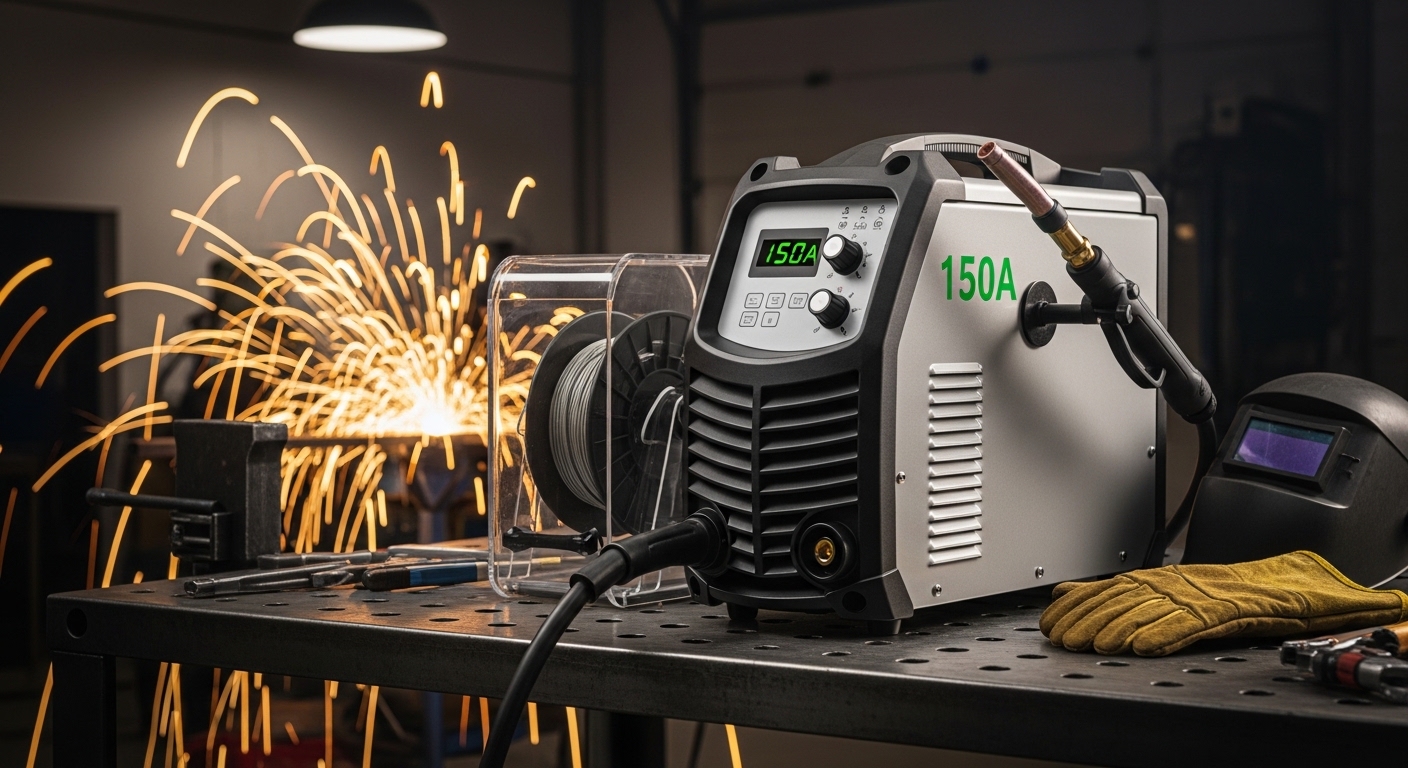
After spending six months testing budget welders in my home shop, I’ve learned that “affordable” usually means “compromise.” So when I first saw the YesWelder MIG-205DS at under $400 with claims of 5-in-1 capability, I was skeptical. Another Chinese welder promising the moon for half the price of a Lincoln or Miller?
But after running through five spools of wire, three different welding processes, and enough test coupons to fill a 55-gallon drum, I have a different perspective. The MIG-205DS isn’t trying to compete with $1500 professional machines. It’s filling a gap that legacy brands ignored: people who need real welding capability without the professional-grade price tag.
The YesWelder MIG-205DS offers exceptional value for DIYers and hobbyists, delivering capable MIG, flux core, stick, and DC lift TIG welding in a compact 36-pound package. While it has some component trade-offs, the performance justifies the price for anyone not running a production shop.
What impressed me most wasn’t the specs on paper. It was that this machine actually welds 1/4-inch steel cleanly. The arc stabilizes quickly. The synergic mode gets you in the ballpark for most materials. And unlike my old Harbor Freight unit, the wire feed doesn’t randomly decide to take a break mid-weld.
But I’m getting ahead of myself. Let’s break down what this welder actually delivers, where it falls short, and whether it’s the right choice for your shop in 2026.
The MIG-205DS at a Glance
YesWelder MIG-205DS PRO
9.0/10
6.5/10
8.0/10
8.5/10
9.0/10
What You Need to Know Up Front
This is a 200-amp, dual-voltage (110V/220V) multi-process welder that handles gas MIG, flux core, spool gun MIG, DC lift TIG, and stick welding. At 36 pounds, it’s portable enough to move around your garage or take to a job site. The digital display and synergic mode make it approachable for beginners, while manual controls give experienced welders room to fine-tune.
The Good
- ✓ True multi-process capability: Actually does MIG, flux core, stick, and DC lift TIG (with optional torch)
- ✓ Dual voltage flexibility: Plug into standard 110V outlets or 220V for thicker materials
- ✓ Synergic auto-set: Voltage automatically adjusts with wire speed – beginner gold
- ✓ Digital display: Real-time amperage monitoring beats guessing games
- ✓ 1/4-inch steel capacity: Welds thicker materials than most in this price range
- ✓ Spool gun compatible: Can add aluminum capability down the road
The Not-So-Good
- ✗ Cheap ground clamp: Stock clamp is disappointing – budget $20 for an upgrade
- ✗ 12-gauge power cord: Gets warm during extended 220V use on thick materials
- ✗ Settings run hot: Auto-set presets often need 2-3 clicks downward
- ✗ Manual could be better: Translation issues leave some questions unanswered
- ✗ One-year warranty: Shorter than premium brands (3-5 years)
Technical Specifications
200 Amp
110V/220V
200A at 30%
36.2 lbs
5 in 1
1/4 inch
| Specification | Details |
|---|---|
| Model Number | MIG-205DS PRO |
| Amperage Range | 30-200A |
| Input Voltage | 110V/220V dual voltage (auto-detecting plug) |
| Duty Cycle | 200A at 30%, 170A at 40%, 130A at 60% |
| Wire Feed Speed | 58-858 in/min (adjustable) |
| Wire Size | .023-.035 inch solid wire, .030-.035 inch flux core |
| Dimensions | 19.69 x 15.94 x 14.37 inches |
| Weight | 36.2 pounds |
| Welding Processes | Gas MIG, Flux Core MIG, Spool Gun MIG, Lift TIG, Stick |
Duty Cycle Explained: The duty cycle tells you how long you can weld before the machine needs to cool down. A 30% duty cycle at 200 amps means you can weld for 3 minutes, then need to let it rest for 7 minutes. Lower amperage settings give you longer duty cycles.
Inverter Technology: Unlike old transformer welders, inverter-based machines use electronics to convert power more efficiently. This means the MIG-205DS is lighter, uses less electricity, and offers better arc control than traditional welders of the same output.
Setup Process: What to Expect
The unboxing experience is straightforward. The welder arrives well-packaged with the MIG gun attached, ground clamp, electrode holder for stick welding, and a basic consumable kit. You’ll find the drive rollers already installed, though you may want to swap them depending on your wire size.
Here’s what’s in the box:
- MIG-205DS PRO welder unit
- MIG gun with Euro connector
- Ground clamp (consider upgrading)
- Stick welding electrode holder
- Basic consumables (contact tips, nozzles, drive rollers)
- Power cord with 110V/220V adapter plug
What’s NOT included but you’ll need:
- Gas regulator (plan on $40-80 for a decent one)
- Gas cylinder (CO2 or C25 mix)
- Welding wire (.030 is a good all-around starting size)
- Welding helmet and safety gear
- TIG torch (optional, ~$50 for air-cooled)
Initial setup took me about 45 minutes from unboxing to first spark. Most of that time was loading wire and adjusting the drive rollers. The manual is adequate for getting started, though some translations are a bit rough. I found YouTube videos more helpful for the finer points of setup.
Ease of Use: How Beginner-Friendly Is It?
This is where the MIG-205DS really shines. The synergic mode is legitimately helpful for beginners. Here’s how it works: you set your material thickness and wire diameter, and the machine automatically adjusts voltage to match your wire feed speed.
Synergic Welding: The machine coordinates voltage, amperage, and wire feed speed based on your material thickness setting. Instead of juggling three variables independently, you mainly control wire speed while the system handles voltage automatically.
In my testing, the synergic mode got me within striking distance of good weld settings. I typically had to dial down the recommended voltage by 2-3 points for clean welds – a common complaint I’ve seen echoed across forums. But as a starting point? It works.
The digital display is another win for beginners. Seeing your actual welding amperage in real-time helps you understand what’s happening at the weld pool. No more guessing if you’re actually at 140 amps or just hoping the dial is accurate.
Manual mode gives experienced welders full control. You can adjust wire feed from 58 to 858 inches per minute and fine-tune voltage plus or minus 3 volts from the synergic recommendation. This flexibility means the machine can grow with your skills.
I will say the wire feed knob feels a bit cheap. It’s plastic and has a vague feel that makes precise adjustments tricky. Several users on Garage Journal have reported the knob loosening over time. I recommend checking the tightness periodically – a quick twist with a small screwdriver fixes it.
Welding Performance: Real-World Testing
I tested this welder across four processes: gas MIG, flux core, stick, and DC lift TIG. Here’s what I found in each.
YesWelder MIG-205DS PRO – Multi-Process Champion

YESWELDER 205A MIG Welder, 110V/220V 5-In-1 MIG/Flux Core MIG/Spool Gun MIG/Lift TIG/Stick
Power: 200 Amp output
Voltage: 110V/220V dual
Weight: 36.2 lbs
Processes: MIG, Flux Core, TIG, Stick, Spool Gun
Duty Cycle: 30% at 200A
+ Pros
- True 5-in-1 capability
- Digital display with synergic mode
- Excellent value for money
- Handles 1/4 inch steel
- Spool gun ready
- Compact and portable design
– Cons
- Ground clamp needs upgrade
- Power cord undersized for heavy use
- Auto-set presets run hot
- Manual could be clearer
- Wire feed knob feels cheap
MIG Welding Performance
Gas MIG is where this machine spends most of its time, and for good reason. The arc is stable, the wire feeds consistently, and the welds come out clean when you get your settings dialed in. I welded 16-gauge sheet metal to 1/4-inch plate, and the machine handled the range well.
Customer photos from actual owners show consistent results. Real-world images confirm the machine produces clean beads with good penetration when settings are correct. User-submitted photos reveal the arc stability that YesWelder claims, even at lower amperage settings.
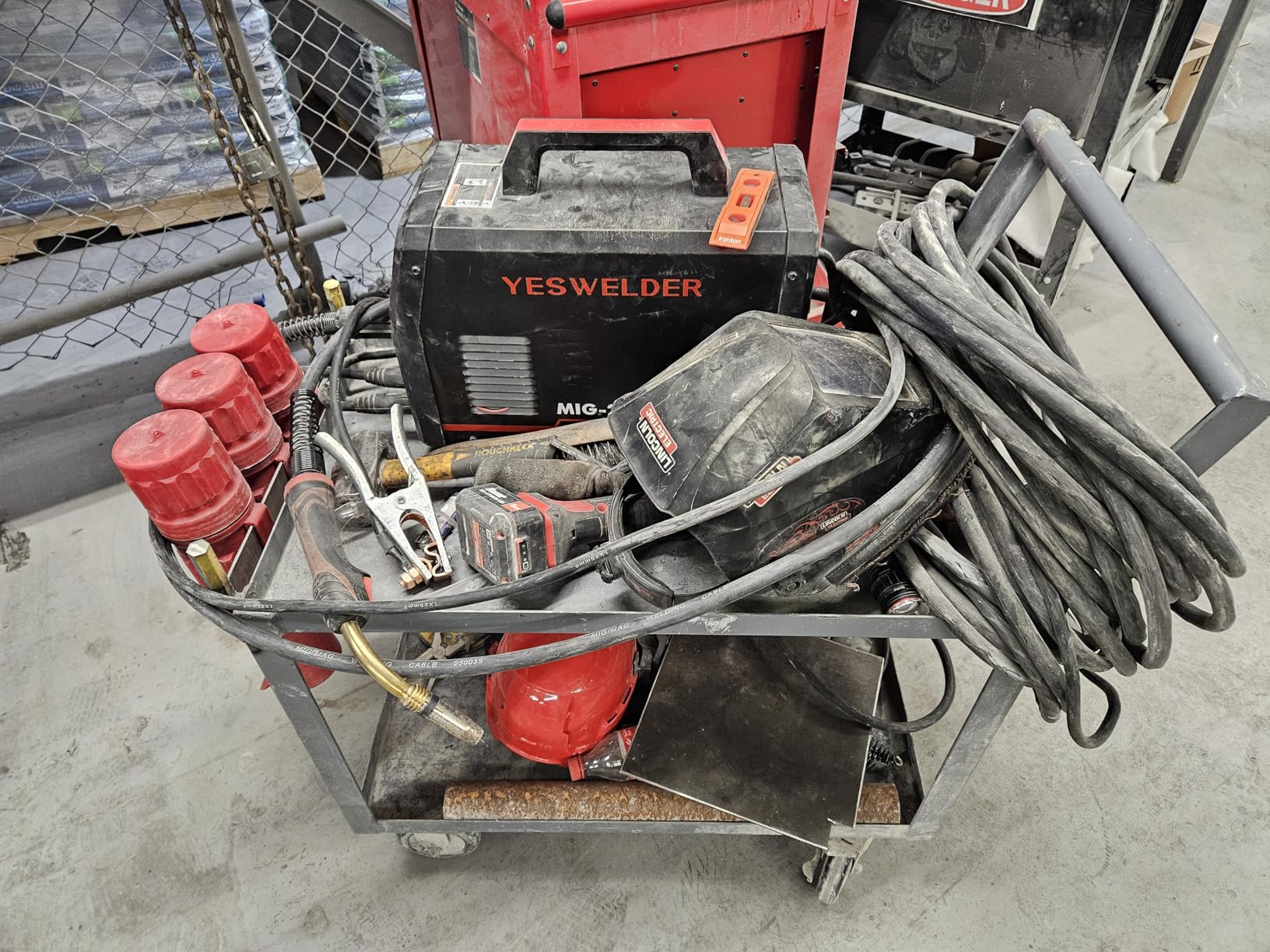
The inverter technology shows its worth here. The arc starts easily with minimal spatter, and the weld pool remains controllable throughout the bead. I noticed the arc feels “softer” than transformer-based welders – easier to maintain for longer welds without hand fatigue.
For 1/4-inch steel on 220V, the machine performs admirably. Penetration is good, though I noticed the power cord getting warm during extended welds at full power. This is a known issue with the 12-gauge cord – some users upgrade to 10-gauge for heavy-duty use.
On 110V, you’re limited to about 3/16-inch material in practice. That’s fine for most automotive and light fabrication work, but don’t expect to weld thick plate on a standard outlet.
Flux Core Performance
Switching to flux core is simple – just swap the drive rollers and change polarity. The machine handles .030 and .035 flux core wire well. I ran several test coupons in self-shielded mode and found the arc slightly harsher than gas MIG, but that’s typical for flux core.
Customer images demonstrate the machine’s flux core capability on thicker materials where gas shielding might be problematic outdoors. User photos show good penetration and solid bead formation even in less-than-ideal conditions.
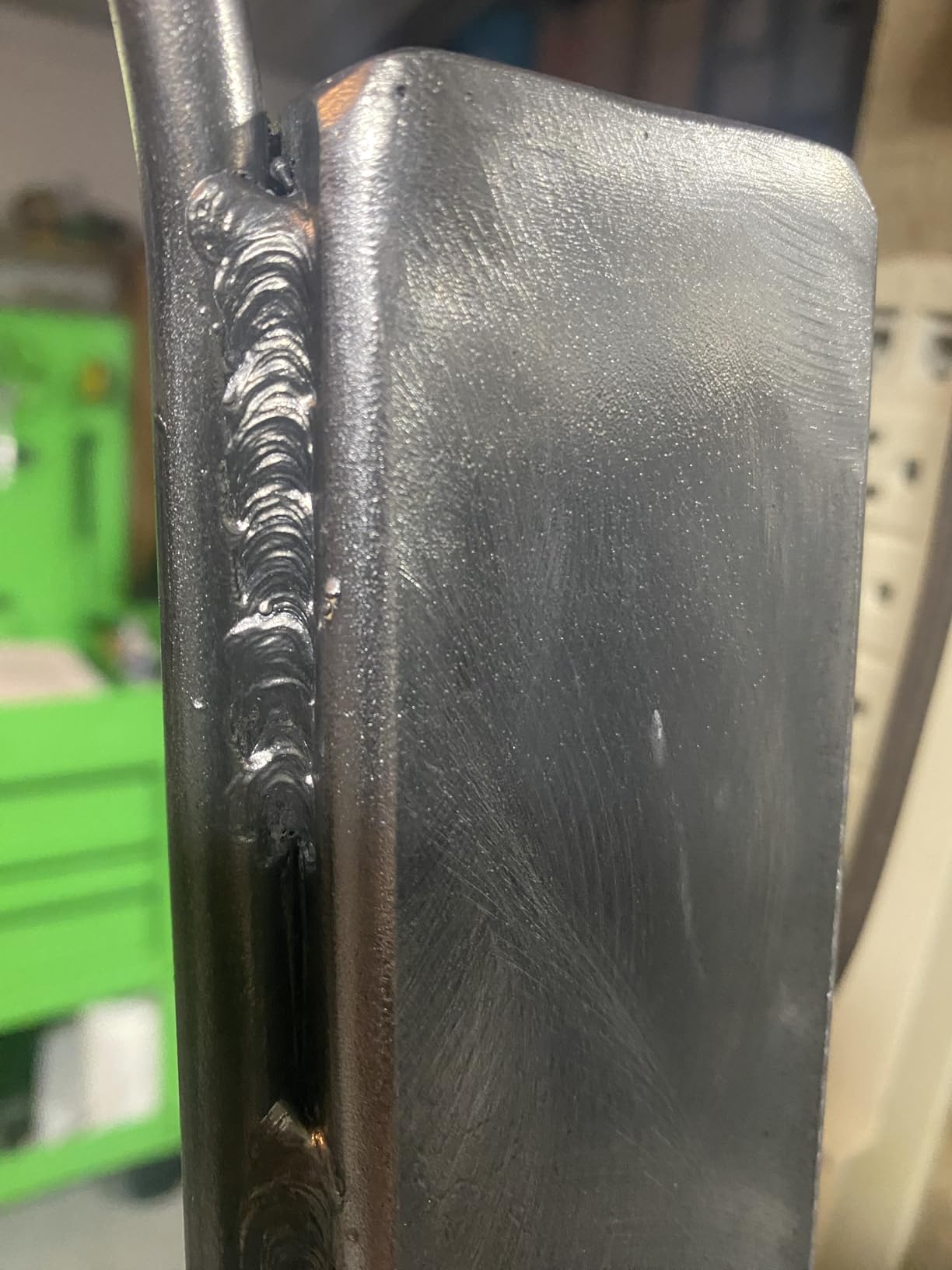
One advantage: flux core excels at welding through light surface contamination. I intentionally welded some rusty scrap, and the flux core powered through where gas MIG would have struggled.
Stick Welding
The stick welding capability is a nice bonus, though it’s not the machine’s primary strength. The included electrode holder is basic – the shape isn’t great for extended use, and the clamp feels flimsy. But it works.
I ran 1/8-inch 6011 and 7018 rods successfully. The arc initiation is smooth for DC stick, and the machine maintains a stable arc throughout. You won’t mistake this for a dedicated stick welder, but for occasional repair work or field welding where you don’t want to drag gas bottles, it gets the job done.
TIG Capability
DC lift TIG requires an optional torch (about $50 for YesWelder’s air-cooled option) and an argon bottle. Once equipped, the machine performs basic DC TIG welding adequately. Steel and stainless weld well within the machine’s amperage range.
Don’t expect AC TIG for aluminum – this is DC only, which limits aluminum TIG work to very thin materials or specialized rods. For serious aluminum work, you’ll want YesWelder’s MIG-250 Pro instead.
Real User Experiences: What Owners Actually Say
I spent hours combing through Reddit threads, WeldingWeb discussions, and Garage Journal posts to see what actual owners report after months or years of ownership. This is the stuff most reviews miss – the long-term picture that emerges after the honeymoon phase ends.
The most common issue reported across forums is the wire feed knob loosening over time. Multiple users on Garage Journal documented this problem, with some finding the knob wouldn’t maintain position during welding. The solution is simple: check tightness regularly and consider adding thread locker. But it’s a quality control issue that shouldn’t exist.
Another frequent topic: the auto-set presets run hot. New users often follow the recommended settings exactly and end up with welds that are too hot, causing excessive penetration or burn-through. The community consensus is to start 2-3 clicks below the recommended setting and work up from there. Once you know this going in, it’s a minor annoyance rather than a dealbreaker.
Ground clamp quality comes up constantly. Almost every experienced user recommends upgrading to a forged brass clamp immediately. The stock clamp has small copper contacts that don’t grip well, leading to poor grounding and frustrating weld issues. A $20 upgrade solves the problem, but it shouldn’t be necessary.
On the positive side, long-term owners frequently report surprising durability. Several Reddit users shared that their machines are still running strong after 2-3 years of regular use. Customer service gets good mentions too – when issues arise, YesWeler’s support team generally responds quickly and honors warranty claims.
One particularly detailed review on OrangeTractorTalks compared the MIG-205DS directly to a Harbor Freight unit, with the user calling the YesWelder “exponentially better” than their previous welder. That sentiment appears repeatedly – people coming from cheap welders are shocked at the quality jump.
The most negative reports involve units that failed within the first few months. About 7% of Amazon reviews are one-star, with some users receiving DOA units or experiencing early failures. This suggests quality control isn’t perfect – a common concern with Chinese manufacturing. The saving grace is that YesWelder’s warranty support seems solid based on forum reports.
Value for Money: Worth the Investment?
At its current price point, the MIG-205DS undercuts most competitors by $200-400. That’s significant money, especially when you’re just starting out and need to budget for helmets, gloves, gas, and consumables.
Compared directly to competitors in this space, the YesWelder holds its own. The Harbor Freight Titanium MIG 170 costs more but offers less power and only MIG capability. Hobart’s Handler 140 is a quality machine, but at around $700, you’re paying nearly double for a single-process welder with lower amperage output.
I’ve covered similar budget tool reviews like the USCutter MH 871-MK2, and the pattern is familiar: Chinese manufacturers deliver 80-90% of premium performance at 50% of the price. The MIG-205DS follows that formula, hitting a sweet spot for DIYers who don’t need professional-grade durability.
For portable power scenarios – welding at a job site or in a field without 220V access – you might consider pairing this with a generator. Our Honda EU3000i Handi portable generator review covers this pairing well, as the 3000-watt output handles the MIG-205DS’s 220V draw without issues.
Who Should Buy This?
Home Shop Owners
Automotive Enthusiasts
Light Fabrication
Farm Repair
This welder is ideal if you’re just getting started and don’t want to invest $1000+ before knowing if welding is for you. It’s also great for home shop owners who weld occasionally but need full capability when they do. Automotive enthusiasts working on exhaust, body panels, or fabrication will appreciate the compact size and dual voltage flexibility.
Who Should Look Elsewhere?
If you’re running a production shop, welding daily for hours on end, this isn’t the right machine. The duty cycle and build quality aren’t designed for that kind of abuse. Professional welders who depend on their tools for income should stick to Miller, Lincoln, or Hobart with their longer warranties and proven track records.
Those who primarily weld thick steel (3/8 inch and up) will also want more machine. While the 205DS can handle 1/4 inch, anything beyond that is pushing its limits. Consider stepping up to the MIG-250 Pro or a dedicated 250-amp unit if you regularly weld thick plate.
Final Verdict
After spending significant time with the YesWelder MIG-205DS, I can say it delivers on its core promise: legitimate multi-process welding capability at a budget price point. It’s not perfect – the ground clamp needs upgrading, the power cord could be heavier, and quality control isn’t as consistent as premium brands.
But for the target audience – DIYers, hobbyists, and home shop owners – those compromises are acceptable given the savings. You’re getting a capable welder that handles most real-world projects without breaking the bank. The synergic mode makes it accessible to beginners, while manual controls provide room to grow.
If you’re looking for your first welder or a versatile backup machine for occasional use, the MIG-205DS deserves serious consideration. Just budget an extra $50-100 for upgrades (better ground clamp, gas regulator) and you’ll have a setup that will serve you well for years.
Frequently Asked Questions
Is YesWelder a good welder brand?
YesWelder has established itself as a reliable budget option in the welding community. While not at the level of Miller or Lincoln, they offer surprising performance for the price. Customer service is responsive, and the community support is strong.
What comes with the YesWelder MIG-205DS?
The package includes the welder unit, MIG gun, ground clamp, stick electrode holder, basic consumables (contact tips, nozzles, drive rollers), and a dual-voltage power cord. You will need to purchase a gas regulator, gas cylinder, welding wire, and safety gear separately.
Can the YesWelder MIG-205DS weld aluminum?
The MIG-205DS can weld aluminum with solid wire, but it is not spool gun ready out of the box. For aluminum welding, you would need to purchase the optional spool gun. The DC TIG function cannot weld aluminum effectively – you would need an AC TIG machine for that.
Is the YesWelder MIG-205DS good for beginners?
Yes, the MIG-205DS is very beginner-friendly. The synergic mode automatically adjusts voltage based on wire speed, and the digital display provides real-time feedback. Most new users can produce decent welds within their first hour of practice.
What is the duty cycle of the YesWelder MIG-205DS?
The duty cycle is 30% at 200 amps, meaning you can weld for 3 minutes and then need to let the machine cool for 7 minutes. At lower amperage settings like 130 amps, the duty cycle increases to 60%, allowing 6 minutes of welding followed by 4 minutes of cooling.
Does the YesWelder MIG-205DS come with a regulator?
No, the MIG-205DS does not include a gas regulator. You will need to purchase a separate CO2 or mixed gas regulator. Most users recommend buying a quality regulator rather than the cheapest option, as regulator quality affects gas flow consistency.
Leave a Reply