
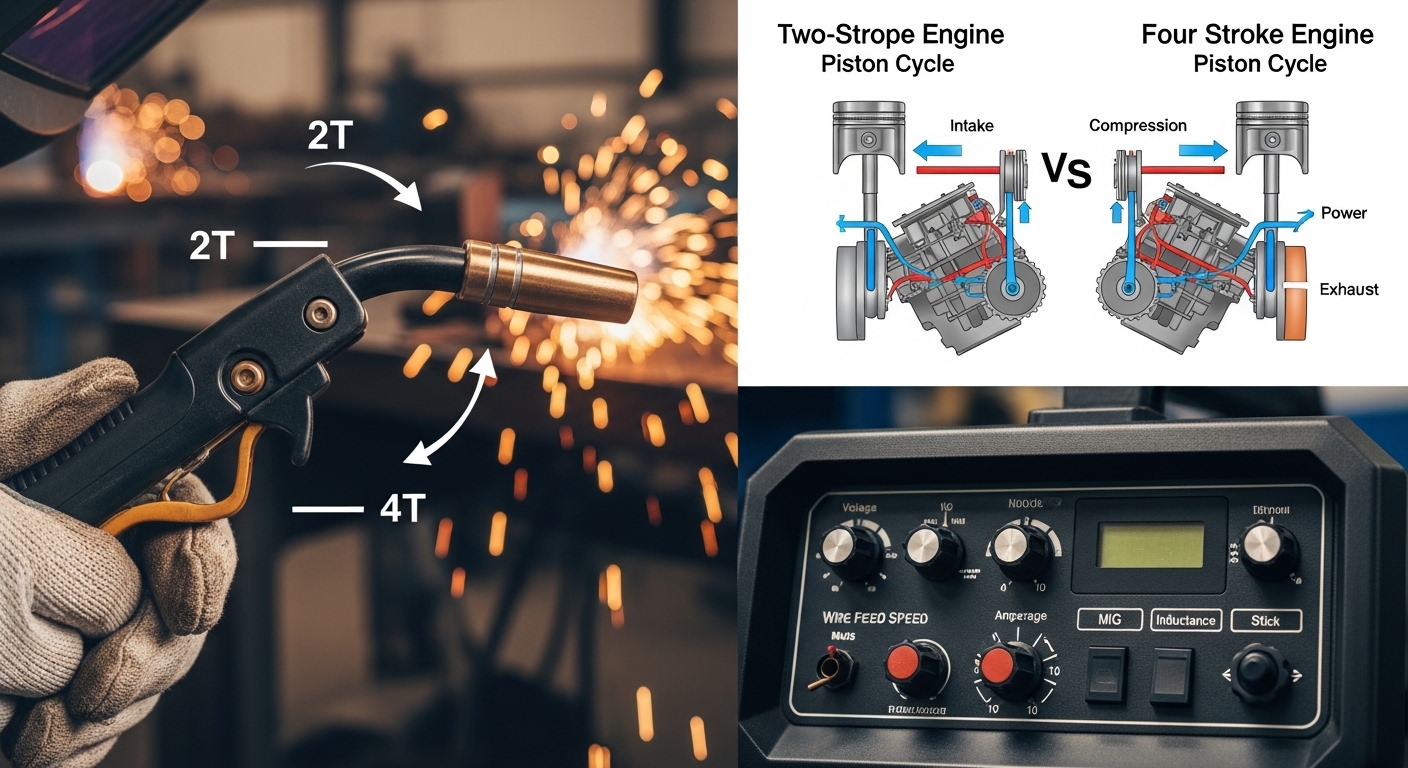
Searching for “2T vs 4T” can be confusing because this term has completely different meanings depending on your context. You might be a welder wondering about torch control modes, a motorcycle enthusiast comparing engine types, or a parent trying to understand toddler clothing sizes.
2T vs 4T refers to three different things: In welding, it compares torch trigger modes (2-touch vs 4-touch). For engines and motorcycles, it compares 2-stroke vs 4-stroke engine designs. For children’s clothing, it indicates toddler sizes (2T fits roughly 2-year-olds, 4T fits roughly 4-year-olds).
I’ve researched all three contexts to help you find the information that actually applies to your situation. Let me quickly help you identify which section you need.
Which Context Applies to You?
Quick Context Guide: Find your situation below and jump to the relevant section.
| If You’re Looking For… | Your Context Is… | Jump To Section |
|---|---|---|
| Welding torch settings, trigger control, MIG/TIG modes | Welding (Torch Control) | 2T vs 4T in Welding |
| Dirt bikes, motorcycles, engine types, stroke differences | Engines (2-Stroke vs 4-Stroke) | 2-Stroke vs 4-Stroke Engines |
| Toddler clothes, children’s sizing, age 2-4 clothing | Clothing (Toddler Sizes) | 2T vs 4T Toddler Sizes |
2T vs 4T in Welding: Torch Control Modes Explained
2T and 4T in welding refer to how your torch trigger operates. 2T (2-touch) is momentary control where you hold the trigger to weld and release to stop. 4T (4-touch) is latching control where you press once to start and once to stop.
Think of 2T like a car’s horn that only works while you press it. 4T is like cruise control on your car.
2T Mode (2-Touch): Press and hold the torch trigger to start welding. Release the trigger to stop the arc. Simple, direct control for quick start and stop welding.
4T Mode (4-Touch): Press trigger once to start welding. Release trigger and welding continues. Press trigger again to stop welding. Reduces hand fatigue during long weld runs.
How Each Mode Works in Practice
In 2T mode, your finger stays on the trigger the entire time you’re welding. This gives you immediate control to stop the arc instantly by releasing.
I’ve welded in 2T mode for tack welds and short joints. It feels natural for quick work because you’re already holding the trigger anyway.
4T mode works differently. You press and release to start, the welder keeps the arc going, and you press and release again when finished.
This is like setting cruise control. Once welding starts, you can focus on your technique without maintaining constant trigger pressure.
Professional welders I’ve spoken with on welding forums consistently mention hand fatigue as a deciding factor. One welder put it simply: “I prefer 4T because it saves fatigue in your hand.”
2T vs 4T in TIG Welding
For TIG welding, both modes serve different purposes depending on your weld length and complexity.
2T for TIG is best when: You’re making short welds, doing tack welds, or need frequent starts and stops. The trigger gives you precise control over arc initiation and termination.
4T for TIG excels when: You’re running long beads or welding in awkward positions where maintaining trigger pressure becomes difficult. The latching feature lets you focus entirely on torch manipulation.
Many TIG welders use 2T for most work. However, 4T becomes valuable during long pipe welds or extensive fabrication work where hand fatigue becomes a real issue.
2T vs 4T in MIG Welding
MIG welding applications for these modes follow similar logic, but 4T sees more frequent use in production environments.
2T for MIG works well for: Short stitch welds, spot welding, and repair work. The momentary control helps with heat management on thin materials.
4T for MIG shines during: Long continuous welds, production work, and situations requiring consistent travel speed. Forum feedback indicates “4T is mostly for long runs. It’s handy if you’re doing lots of long runs.”
Pros and Cons: Welding Edition
| 2T Mode | 4T Mode | |
|---|---|---|
| Best For | Short welds, tacking, quick start/stop | Long runs, reduced fatigue |
| Control Type | Momentary (hold to weld) | Latching (press on, press off) |
| Finger Fatigue | Higher during long welds | Significantly reduced |
| Learning Curve | Easier for beginners | Requires practice for timing |
| Emergency Stop | Instant (just release) | Requires second trigger press |
Which Welding Mode Should You Choose?
Start with 2T mode if you’re new to welding. The direct control helps you develop proper technique without complicating the process.
Switch to 4T once you’re comfortable and notice hand fatigue affecting your weld quality. The difference becomes obvious during longer projects.
Many welders keep their machine in 2T for general work and switch to 4T only for specific jobs that involve extended welding time.
2-Stroke vs 4-Stroke Engines: The Complete Comparison
2T and 4T in engines refer to how many piston strokes complete one power cycle. 2-stroke engines complete the cycle in two movements (up and down). 4-stroke engines need four movements (intake, compression, combustion, exhaust).
This fundamental difference creates distinct advantages for each engine type depending on how and where you ride.
How the Engine Cycles Work
2-Stroke Cycle (2 movements):
- Up stroke: Compression creates power, fresh fuel enters the bottom
- Down stroke: Combustion pushes piston down, exhaust exits
Everything happens in two piston movements. The engine fires every revolution, which is why 2-strokes feel punchy and responsive.
4-Stroke Cycle (4 movements):
- Intake stroke: Piston goes down, fuel-air mixture enters
- Compression stroke: Piston goes up, mixture compresses
- Combustion stroke: Spark plug fires, piston pushed down
- Exhaust stroke: Piston goes up, pushes out exhaust gases
The engine fires once every two revolutions. This creates smoother, more predictable power delivery.
Power Characteristics and Performance
2-stroke engines deliver their power differently than 4-strokes. Understanding this difference helps you choose the right engine for your riding style.
2-stroke power delivery: Explosive and hit hard in the mid-to-high RPM range. Riders describe this as “coming on the pipe” when the power band suddenly engages.
4-stroke power delivery: Smooth and linear across the RPM range. Power builds progressively from low to high RPM without sudden spikes.
Quick Summary: 2-strokes feel like lightswitch power – off then suddenly ON. 4-strokes feel like a dimmer switch – gradual power that builds steadily.
Power comparison gets interesting when comparing engine sizes. A 125cc 2-stroke produces similar power to a 250cc 4-stroke. This is why 2-strokes are called “powerful for their size.”
Weight and Physical Differences
2-stroke engines weigh less than comparable 4-strokes. This matters when you’re loading your bike into a truck or picking it up after a crash.
Because they have fewer parts, 2-strokes are simpler and lighter. A modern 250 4-stroke can weigh 20-30 pounds more than its 2-stroke counterpart.
This weight difference affects handling. Lighter bikes feel more agile and easier to maneuver through tight terrain.
Maintenance and Reliability
2-strokes have fewer moving parts. This means fewer things can break and simpler maintenance procedures.
However, 2-strokes require pre-mixed fuel (oil and gas combined). You need to measure and mix fuel correctly every time you fill up.
4-strokes have more complex internal components: valves, camshafts, timing chains. When a 4-stroke needs engine work, it costs significantly more.
Forum members consistently mention maintenance costs as a major factor. One rider noted: “Another disadvantage to a modern water cooled 4t over a 2t is more complicated maintenance and the higher cost for engine repairs and rebuilds.”
Riding Characteristics by Terrain
Real rider experiences from forums reveal clear preferences based on where and how you ride.
Tight woods and technical trails: 2-strokes excel here. Their lighter weight and snappy power help navigate obstacles. The ability to quickly blip the throttle helps in technical sections.
Open tracks and desert riding: 4-strokes dominate. Their smooth power and stability at speed make them less fatiguing for long rides. One rider explained: “Faster pace wide open riding, 4t all day.”
Enduro and hard enduro: Opinions vary, but many prefer 2-strokes for extreme terrain. “For woods, racing on mixed terrain, tricks or hard/extreme enduro then it has to be 2t.”
Long distance dual-sport: 4-strokes win. “I use 4t for any bike that is on the road or has to go long distance.”
2-Stroke vs 4-Stroke Comparison Table
| 2-Stroke | 4-Stroke | |
|---|---|---|
| Power Cycle | 2 piston movements | 4 piston movements |
| Power Delivery | Explosive, hits hard | Smooth, linear |
| Weight | Lighter | Heavier |
| Moving Parts | Fewer | More |
| Fuel | Pre-mix required | Oil and gas separate |
| Maintenance Cost | Lower | Higher |
| Traction | Can be tricky | Better rear wheel traction |
| Best Terrain | Tight, technical trails | Open tracks, long distance |
Environmental Considerations
2-strokes produce more emissions because some unburned fuel escapes through the exhaust. This led to EPA regulations that restricted 2-strokes in street bikes and many recreational vehicles.
Modern 2-strokes have improved significantly. Direct injection and other technologies have reduced emissions while maintaining the characteristic power advantage.
4-strokes burn fuel more completely, producing fewer emissions. This environmental advantage helped 4-strokes become dominant in street-legal motorcycles.
Is 2T or 4T Better for Beginners?
This question appears frequently in forums. The answer depends on your riding goals and prior experience.
4-strokes are generally considered easier for beginners because the smooth power delivery is more forgiving. You’re less likely to loop out or lose traction unexpectedly.
However, some experienced riders argue beginners should start on 2-strokes to learn proper throttle control and riding fundamentals.
The consensus: If you’re riding easy trails and learning basic skills, start with a 4-stroke. If you’re ambitious and want to develop advanced techniques, a 2-stroke can teach valuable lessons about power management.
2T vs 4T in Toddler Clothing Sizes
2T and 4T in clothing refer to toddler sizes for approximately 2-year-olds and 4-year-olds respectively. The “T” stands for toddler and indicates these clothes are designed for children who are not yet potty trained.
What Toddler Sizes Mean
2T: Fits toddlers approximately 2 years old, typically 26-28 pounds and 32-34 inches tall. These clothes feature roomier bottoms to accommodate diapers.
4T: Fits toddlers approximately 4 years old, typically 34-38 pounds and 37-40 inches tall. Slightly slimmer than 2T and 3T as children transition away from diapers.
The key difference between toddler sizes (2T, 3T, 4T) and regular children’s sizes (2, 3, 4) is the cut. Toddler sizes allow more room for diapers.
Toddler Size Reference Chart
| Size | Approximate Age | Weight | Height |
|---|---|---|---|
| 2T | 2 years | 26-28 lbs | 32-34 inches |
| 3T | 3 years | 29-32 lbs | 34-37 inches |
| 4T | 4 years | 34-38 lbs | 37-40 inches |
Choosing Between Sizes
Every child grows differently. Use the size guidelines as a starting point, but always consider your child’s current measurements.
If your child is between sizes, size up for longer wear. Toddlers grow quickly, and slightly larger clothes last through growth spurts.
For pants, prioritize waist fit if your child wears diapers. Toddler sizes provide the extra room needed for comfort.
Quick Reference: All 2T vs 4T Meanings
| Context | 2T Means | 4T Means |
|---|---|---|
| Welding | 2-Touch (momentary trigger control) | 4-Touch (latching/cruise control) |
| Engines | 2-Stroke (2 movements per power cycle) | 4-Stroke (4 movements per power cycle) |
| Clothing | Size 2 Toddler (approx. age 2) | Size 4 Toddler (approx. age 4) |
How to Choose Between 2T and 4T
Welding Mode Decision Guide
Choose 2T for welding if you make short welds, do frequent tack welds, prioritize quick start/stop control, or are just learning to weld.
Choose 4T for welding if you make long continuous welds, experience hand fatigue, weld in awkward positions, or want to focus entirely on technique rather than trigger control.
Pro Tip: Start with 2T until you notice hand fatigue affecting your weld quality. That’s your signal to try 4T mode.
Engine Type Decision Guide
Choose a 2-stroke engine if you ride tight technical trails, want lighter weight for easier handling, prefer simpler and cheaper maintenance, enjoy responsive power delivery, or mostly ride off-road.
Choose a 4-stroke engine if you ride open tracks and desert, need street legality, prefer smooth predictable power, want better traction, or ride long distances regularly.
Pro Tip: Many experienced riders eventually own both. One forum member shared: “Having owned both at the same time I’d agree, the 2T are awesome single track / woods bikes and so so when the distances start to stretch out.”
Toddler Clothing Decision Guide
Choose 2T if your child is approximately 2 years old, weighs 26-28 pounds, is 32-34 inches tall, and still wears diapers regularly.
Choose 4T if your child is approximately 4 years old, weighs 34-38 pounds, is 37-40 inches tall, or is transitioning away from diapers.
Frequently Asked Questions
What’s better, 2T or 4T?
The answer depends entirely on your context. For welding, 4T is better for long runs while 2T excels at short welds. For engines, 2-strokes are lighter and punchier while 4-strokes offer smooth power and stability. The key is identifying which context applies to your situation first.
What’s the difference between 2T and 4T?
In welding, 2T means momentary trigger control (hold to weld) while 4T means latching control (press on, press off). For engines, 2T is a 2-stroke engine that completes its power cycle in two piston movements, while 4T is a 4-stroke engine using four movements. In clothing, 2T and 4T refer to toddler sizes for approximately 2-year-olds and 4-year-olds respectively.
Why do people prefer 2-stroke over 4-stroke?
Riders prefer 2-strokes because they’re lighter, simpler, and produce more power per cubic centimeter. A 125cc 2-stroke delivers similar power to a 250cc 4-stroke. 2-strokes also have fewer moving parts, making maintenance easier and cheaper. Their snappy power delivery makes them fun to ride in technical terrain where quick throttle response matters.
Why is 2T two-stroke?
2T stands for two-stroke because the engine completes its entire power cycle in two piston movements: one up and one down. During the up stroke, compression happens while fresh fuel enters the bottom. The down stroke creates power from combustion while exhaust exits. This efficient design produces power every revolution.
Is 4T better than 2T?
Neither is universally better. 4-stroke engines are better for street use, long distance riding, and riders who want smooth predictable power. 2-strokes are better for tight trails, riders who want lightweight bikes, and those who enjoy punchy power delivery. In welding, 4T mode reduces fatigue during long welds while 2T offers better control for short work. The right choice depends on your specific application.
Is 2T more powerful than 4T?
2-strokes produce more power per cubic centimeter than 4-strokes. A general rule is that a 2-stroke produces roughly double the power of a same-size 4-stroke. This is why 125cc 2-strokes compete with 250cc 4-strokes. However, 4-strokes can still be more powerful overall in larger displacements and deliver that power more smoothly across the RPM range.
Is it harder to ride a 2-stroke or 4-stroke?
4-strokes are generally considered easier to ride, especially for beginners. Their smooth, linear power delivery is more forgiving and less likely to catch riders off guard. 2-strokes require more skill to manage their explosive power band. The snappy throttle response that makes 2-strokes fun also demands better throttle control and rider technique to avoid traction loss or looping out.
Leave a Reply