
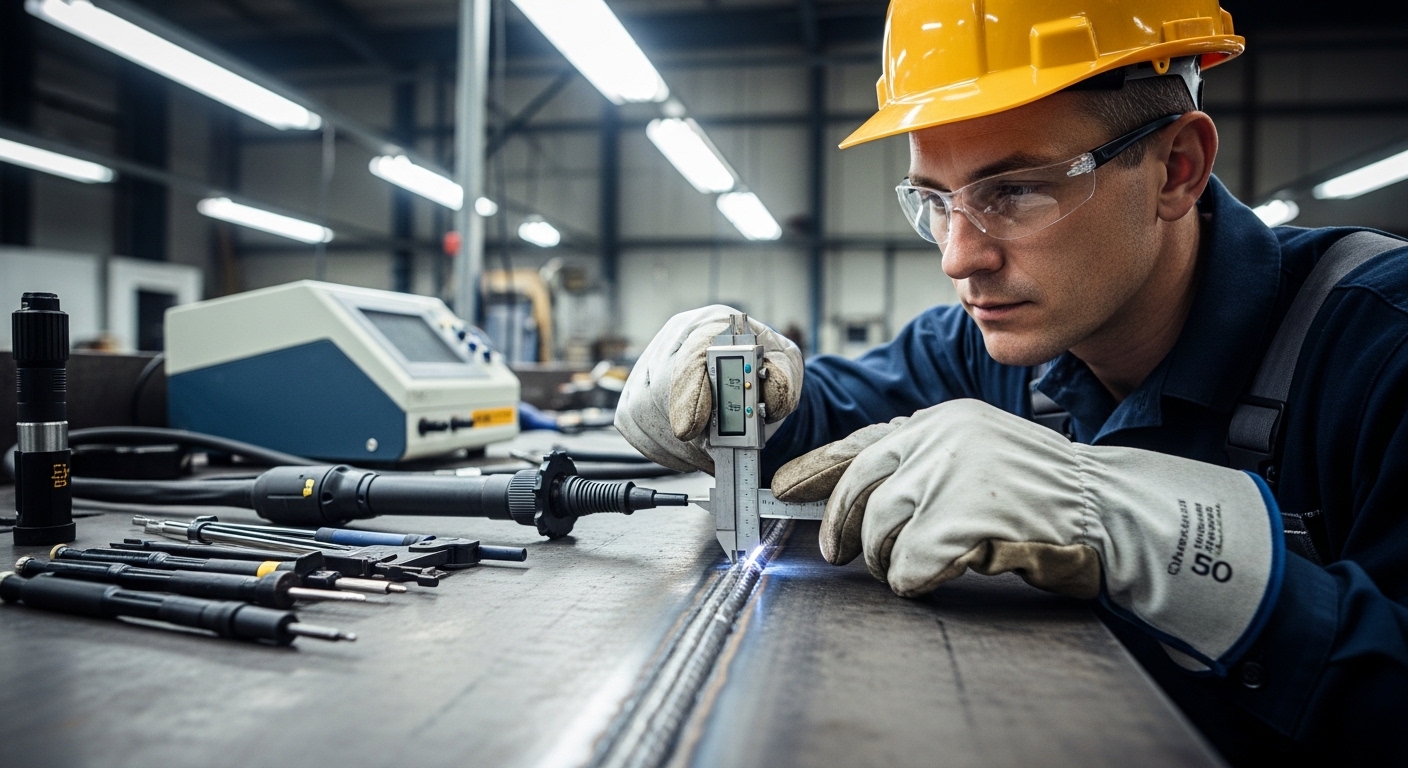
Weld quality testing is the process of evaluating welded joints to ensure they meet safety and performance standards through visual inspection, non-destructive testing (NDT), and destructive testing (DT) methods. The five most commonly used testing methods are visual inspection, liquid penetrant testing, magnetic particle testing, radiographic testing, and ultrasonic testing.
I’ve spent years in fabrication shops watching welders sweat over qualification tests. One failed weld can cost thousands in repairs, downtime, and reputation damage. I’ve seen a single missed crack lead to three weeks of rework on a pressure vessel job that should have taken two days.
Weld quality testing exists to catch these problems before they cause failures. The process examines welded joints for defects that could compromise structural integrity. Testing happens at three stages: before welding begins, during the process, and after completion.
The stakes are high. In industries like oil and gas, construction, and aerospace, a weld failure isn’t just expensive. It can be catastrophic. That’s why weld quality testing combines visual examination with sophisticated NDT methods and rigorous destructive testing.
The Five Main Weld Testing Methods
Weld testing methods fall into two categories: non-destructive testing (NDT) and destructive testing (DT). NDT evaluates welds without damaging the workpiece. DT destroys test specimens to verify mechanical properties.
Quick Summary: The five primary weld testing methods are visual inspection (VT), liquid penetrant testing (PT), magnetic particle testing (MT), radiographic testing (RT), and ultrasonic testing (UT). Visual inspection catches 80-90% of surface defects, while the other NDT methods detect internal flaws that the eye can’t see.
- Visual Inspection (VT): The most common method, examining surface conditions with the naked eye or basic tools
- Liquid Penetrant Testing (PT): Uses dye to reveal surface-breaking defects
- Magnetic Particle Testing (MT): Detects surface and near-surface flaws in ferromagnetic materials
- Radiographic Testing (RT): Uses X-rays or gamma rays to image internal weld structure
- Ultrasonic Testing (UT): Uses high-frequency sound waves to find internal defects
NDT vs Destructive Testing: What’s the Difference?
| Aspect | Non-Destructive Testing (NDT) | Destructive Testing (DT) |
|---|---|---|
| Workpiece Status | Remains intact and usable | Test specimen is destroyed |
| Primary Use | Production weld inspection | Procedure and welder qualification |
| Cost | $50-500 per test depending on method | $100-300 per test specimen |
| What It Detects | Surface and internal defects | Mechanical properties (strength, ductility) |
| Common Methods | Visual, PT, MT, RT, UT | Bend test, tensile test, nick break |
| Turnaround Time | Immediate to 24 hours | 2-5 days for lab processing |
Visual Inspection: The Foundation of Weld Testing
Visual Inspection (VT): The most fundamental weld testing method, using eyesight enhanced with tools like magnifiers, lights, and gauges to identify surface discontinuities and verify weld dimensions meet code requirements.
Visual inspection accounts for approximately 80-90% of all weld testing. It’s fast, inexpensive, and catches most surface defects. I’ve watched inspectors reject welds in seconds based solely on visual cues that newcomers missed entirely.
Essential Visual Inspection Equipment
| Tool | Purpose | Cost Range |
|---|---|---|
| Fillet weld gauge | Measure weld throat and leg size | $15-50 |
| Cambridge weld gauge | Measure reinforcement, undercut, misalignment | $75-200 |
| High-intensity flashlight | Reveal surface defects in low light | $30-80 |
| Magnifying glass (5-10x) | Examine small cracks and porosity | $20-60 |
| Borescope | Inspect inaccessible areas | $150-500 |
| Digital camera | Document findings for reports | $100-400 |
Inspectors follow a systematic approach. They check base material condition before welding begins. They monitor during the process. And they perform a thorough examination after completion.
Visual Inspection Checklist
Pre-Weld Inspection
- Base material condition and cleanliness
- Joint fit-up and alignment
- Pre-heat temperature verification
- Welding procedure specification (WPS) requirements
- Qualified welder verification
During Welding
- Interpass temperature monitoring
- Root pass quality
- Cleaning between passes
- Welding parameter compliance
Post-Weld Inspection
- Weld profile and reinforcement
- Surface discontinuities (cracks, porosity, undercut)
- Weld size verification
- Spatter and arc strikes
Common Weld Defects Every Inspector Should Know
Discontinuity vs. Defect: A discontinuity is an irregularity in the weld. It becomes a defect only when it exceeds acceptable limits defined by the applicable code or standard. Not all discontinuities are rejectable.
Understanding what can go wrong helps you recognize problems when they appear. I’ve categorized defects by type because each requires different detection methods and prevention strategies.
Surface Defects (Visible to Visual Inspection)
Cracks: The most serious weld defect. Cracks can be longitudinal (along the weld), transverse (across the weld), or in the heat-affected zone. Any crack length typically exceeds code allowances and requires repair.
Undercut: A groove melted into the base metal at the weld toe or root. It reduces cross-sectional area and creates stress concentration points. Most codes allow undercut up to 1/32 inch depending on application.
Porosity: Gas pockets trapped in the weld metal. Appears as small round voids. Codes typically allow scattered porosity up to a certain percentage of weld area. Clustered porosity is usually rejectable.
Slag Inclusion: Non-metallic material trapped in the weld. Occurs when slag from previous passes isn’t cleaned properly. Linear slag inclusions longer than 1/4 inch typically require repair.
Overlap/Cold Lap: Weld metal that flows over base metal without fusion. Creates a weak point prone to cracking under load. Almost always rejectable.
Underfill: Weld face falls below the adjacent base metal surface. Reduces weld throat thickness. Most codes require flush or positive reinforcement.
Internal Defects (Require NDT Detection)
Incomplete Penetration: The weld metal doesn’t fully extend through the joint thickness. It’s a critical defect that significantly reduces weld strength. I’ve seen this cause pipe failures under pressure testing.
Lack of Fusion: Weld metal doesn’t bond with base metal or previous weld passes. The weld looks complete but isn’t actually connected. This defect is particularly dangerous because it’s invisible from the surface.
Internal Porosity: Similar to surface porosity but located inside the weld. Requires radiographic or ultrasonic testing to detect. Codes limit porosity based on aggregate area.
Non-Destructive Testing Methods Explained
When visual inspection isn’t enough, NDT methods provide deeper insight without damaging the workpiece. Each NDT method has strengths, limitations, and typical applications.
Liquid Penetrant Testing (PT)
Penetrant testing finds surface-breaking defects that visual inspection might miss. It works on any material regardless of magnetic properties.
How it works: Apply a colored dye to the cleaned weld surface. Let it penetrate into any surface openings. Remove excess penetrant and apply developer. Defects trap penetrant, which stains the developer to reveal flaws.
Best for: Detecting fatigue cracks, porosity open to surface, lap seams, and lack of fusion that breaks the surface.
Limitations: Only finds defects open to the surface. Can’t detect subsurface flaws. Surface roughness can create false indications.
Cost: $50-150 per test. Kits cost $200-500 for in-house use.
Magnetic Particle Testing (MT)
Magnetic particle testing detects surface and slightly subsurface defects in ferromagnetic materials.
How it works: Magnetize the weld area. Apply iron particles (dry or suspended in liquid). Defects disrupt the magnetic field, causing particles to cluster at flaw locations.
Best for: Finding cracks (including subsurface), lack of fusion, undercut, and inclusions in carbon steel and other magnetic materials.
Limitations: Only works on ferromagnetic materials. Requires demagnetization afterward. Can’t detect deep subsurface defects.
Cost: $75-200 per test. Yokes cost $400-1,200 for equipment purchase.
Radiographic Testing (RT)
Radiographic testing uses X-rays or gamma rays to create images of weld internal structure. It’s like taking an X-ray of a bone at the doctor’s office.
How it works: Place radiation source on one side of the weld. Place film or digital detector on the opposite side. Radiation passes through the weld. Defects absorb radiation differently, creating contrast in the image.
Best for: Detecting internal porosity, slag inclusions, incomplete penetration, lack of fusion, and cracks oriented perpendicular to the radiation beam.
Limitations: Radiation safety requirements. Planar defects (like cracks) must be properly aligned to be visible. Expensive equipment and licensing requirements.
Cost: $200-500 per weld. Requires certified radiographer and safety protocols.
Ultrasonic Testing (UT)
Ultrasonic testing uses high-frequency sound waves to detect internal flaws. I’ve found UT particularly effective for thick welds where radiographic sensitivity decreases.
How it works: A transducer sends sound waves into the weld. When waves hit a defect or material boundary, they reflect back. The instrument measures time and amplitude of returning signals to locate and size flaws.
Best for: Detecting cracks, lack of fusion, incomplete penetration, and measuring weld thickness. UT can find defects oriented in any direction.
Limitations: Requires highly trained operators. Surface condition affects coupling. Reference standards needed for calibration.
Cost: $150-400 per weld. Ultrasonic equipment costs $5,000-25,000.
Destructive Testing for Welder Qualification
Destructive Testing (DT): Testing methods that involve cutting, breaking, or otherwise destroying test specimens to evaluate weld quality. Used primarily for procedure qualification (PQR) and welder certification (WPQ).
While NDT examines production welds without damage, destructive testing verifies that welding procedures and welders can create sound welds. Test welds are sacrificed so production welds don’t fail.
Bend Testing
Bend tests evaluate ductility and fusion quality by bending a test specimen until it fractures or reaches a specified angle.
Types of bend tests:
- Root bend: Tests weld root quality
- Face bend: Tests weld face quality
- Side bend: Tests entire weld cross-section
Acceptance criteria: No cracks or open defects exceeding 1/8 inch on the convex surface after bending.
Bend testing costs $100-200 per specimen. Results are available within hours of testing.
Tensile Testing
Tensile testing measures the weld’s strength by pulling a specimen apart in tension. It’s commonly used in qualifying welding procedures.
What it measures: Ultimate tensile strength, yield strength, and elongation. The weld must meet or exceed the base metal’s minimum tensile strength requirements.
Procedure: Machine a test specimen from the weld. Place it in a tensile testing machine. Apply tension until failure. Record maximum load and calculate strength.
Tensile testing costs $150-300 per specimen. Requires lab equipment typically found at testing laboratories.
Nick Break Testing
Nick break testing fractures a weld specimen to examine the internal fracture surface for defects.
Procedure: Cut notches in the weld specimen. Break the specimen by striking or bending. Examine the fractured surface for porosity, slag inclusions, lack of fusion, or other internal defects.
This low-cost test ($50-100) provides quick insight into weld internal quality without sophisticated equipment.
Macro Etching
Macro etching reveals the weld’s internal structure through chemical etching and visual examination.
Procedure: Cut a cross-section of the weld. Polish the surface. Apply acid etchant to reveal the weld’s internal structure. Examine under magnification for penetration, fusion, and defects.
Macro etching costs $75-150 per specimen. It’s particularly useful for procedure qualification and weld development.
Understanding Welding Positions: 1G through 6G
Welding position codes indicate the orientation of the weld relative to gravity and the welder. These positions dramatically affect difficulty and testing requirements.
| Position | Type | Description | Difficulty |
|---|---|---|---|
| 1G | Plate | Flat position, weld face horizontal | Easiest |
| 2G | Plate | Horizontal position, weld axis vertical | Easy-Moderate |
| 3G | Plate | Vertical position, welding upward | Moderate |
| 4G | Plate | Overhead position | Moderate-Hard |
| 5G | Pipe | Pipe horizontal, welder stationary | Hard |
| 6G | Pipe | Pipe at 45-degree angle, welder moves | Hardest |
Position affects weld quality significantly. Gravity influences molten metal flow, penetration, and defect formation. Welders qualified in 6G are typically qualified for all positions. Most codes require separate testing for groove welds (1G-4G) and pipe welds (5G-6G).
I’ve seen experienced plate welders struggle their first time in 6G position. The combination of overhead welding, pipe rotation, and changing angles makes 6G the ultimate welder qualification test.
CWI Certification and Career Opportunities
CWI (Certified Welding Inspector): Professional certification from the American Welding Society (AWS) that verifies an individual’s knowledge and ability to inspect welds to code requirements. CWI is recognized globally as the standard for welding inspection certification.
Is getting a CWI worth it? Based on my experience talking with certified inspectors, the answer is overwhelmingly yes for anyone serious about a welding career.
CWI Certification Requirements:
- Minimum 5 years of welding-related work experience OR
- Associate degree or higher in welding technology plus 3-4 years experience OR
- Engineering degree with some welding experience
- Pass a three-part examination (visual, practical, code application)
CWI Exam Costs:
- AWS member exam fee: approximately $1,070
- Non-member fee: approximately $1,370
- Study materials and prep courses: $500-2,000
- Recertification every 3 years: $525-650
Salary Impact:
CWI certification typically increases earning potential by 15-30%. Certified inspectors commonly earn $70,000-100,000 annually depending on location and industry. Senior CWIs in specialized industries can exceed $120,000.
Career Advantages:
Beyond salary, CWI certification opens doors to quality control management, welding inspection firms, and independent consulting. I’ve watched welders transition from production work to inspection roles with better hours, less physical stress, and more career stability.
One Reddit welder described it perfectly: “Becoming a CWI was the best thing for me. It closed the deal on raises because it saves the company money and time, taught me more about fields I only knew a little about, and gives me the opportunity to apply my experience and knowledge to helping others navigate our industry.”
Industry Standards and Codes You Need to Know
Weld quality testing doesn’t happen in a vacuum. Every inspection follows specific codes that define acceptance criteria, testing requirements, and qualification procedures.
Major Welding Codes
| Code | Organization | Application |
|---|---|---|
| ASME Section IX | ASME | Pressure vessels and piping |
| AWS D1.1 | AWS | Structural steel welding |
| API 1104 | API | Pipeline welding |
| AWS B2.1 | AWS | Welding procedure and performance qualification |
| ASNT SNT-TC-1A | ASNT | NDT personnel qualification |
Before performing any weld inspection, identify the governing code. Acceptance criteria vary significantly between codes. A defect rejectable under AWS D1.1 might be acceptable under ASME Section IX.
How to Evaluate Weld Quality: Step-by-Step
Evaluating weld quality follows a systematic process. Skip steps and you risk missing critical defects.
Step-by-Step Process: Start with pre-weld verification of materials and procedures. Perform visual inspection during and after welding. Select appropriate NDT methods based on code requirements and weld criticality. Document findings thoroughly. Refer to applicable code for acceptance criteria.
- Verify Requirements: Identify the applicable code and acceptance criteria before beginning inspection.
- Pre-Weld Inspection: Check base material condition, joint fit-up, and pre-heat requirements.
- Visual During Welding: Monitor root pass quality and interpass cleaning.
- Visual After Welding: Complete thorough visual examination before any NDT.
- Select NDT Method: Choose appropriate NDT based on weld type, material, and code requirements.
- Perform NDT: Conduct testing according to written procedures.
- Evaluate Findings: Compare indications to code acceptance criteria.
- Document Results: Create inspection report with findings and disposition.
Essential Weld Testing Equipment
Getting started with weld testing requires basic equipment. As inspection needs grow, more sophisticated tools become necessary.
Basic Visual Inspection Kit ($200-500):
- Fillet weld gauge
- High-intensity flashlight
- 5x magnifying glass
- 6-inch steel ruler
- Digital camera
Professional Inspection Kit ($1,500-3,500):
- All basic items plus:
- Cambridge multipurpose weld gauge
- Borescope
- Surface temperature gauge
- Pocket calculator for acceptance criteria
- Tablet for digital reporting
NDT Equipment Costs:
- Penetrant testing kit: $200-500
- Magnetic particle yoke: $400-1,200
- Ultrasonic tester: $5,000-25,000
- Radiographic setup: $50,000-150,000 (typically outsourced)
Frequently Asked Questions
What is the quality test for welding?
The quality test for welding depends on the application. Visual inspection is the most common and accounts for 80-90% of all weld testing. For critical applications, non-destructive testing methods like radiographic, ultrasonic, magnetic particle, or liquid penetrant testing are used. For welder and procedure qualification, destructive tests including bend testing and tensile testing are performed on test specimens to verify mechanical properties.
Is getting a CWI worth it?
Yes, getting a CWI (Certified Welding Inspector) certification is worth it for welding professionals seeking career advancement. CWI certification typically increases earning potential by 15-30%, with certified inspectors commonly earning $70,000-100,000 annually. Beyond salary, CWI opens doors to quality control management, inspection firms, and consulting roles. The certification costs approximately $1,000-1,400 for the exam plus study materials, but the career ROI typically pays for itself within 1-2 years through increased earnings.
How to evaluate weld quality?
To evaluate weld quality, follow a systematic process: first, verify the applicable code and acceptance requirements. Perform pre-weld inspection of base materials and joint fit-up. Monitor the welding process for proper technique. After welding, conduct thorough visual inspection checking for surface defects like cracks, porosity, undercut, and slag inclusions. If required by code or application, perform appropriate NDT methods such as penetrant, magnetic particle, radiographic, or ultrasonic testing. Document all findings and compare to acceptance criteria.
What is 1G, 2G, 3G, 4G, 5G, 6G in welding?
Welding positions 1G-4G refer to plate welding: 1G is flat position (easiest), 2G is horizontal, 3G is vertical uphill, and 4G is overhead. Positions 5G and 6G refer to pipe welding: 5G is horizontal pipe with the welder stationary, and 6G is pipe at a 45-degree angle requiring the welder to move around the pipe (hardest). Position affects weld quality because gravity influences molten metal flow. Most codes require separate qualification tests for each position, with 6G certification typically qualifying for all positions due to its difficulty.
Leave a Reply