
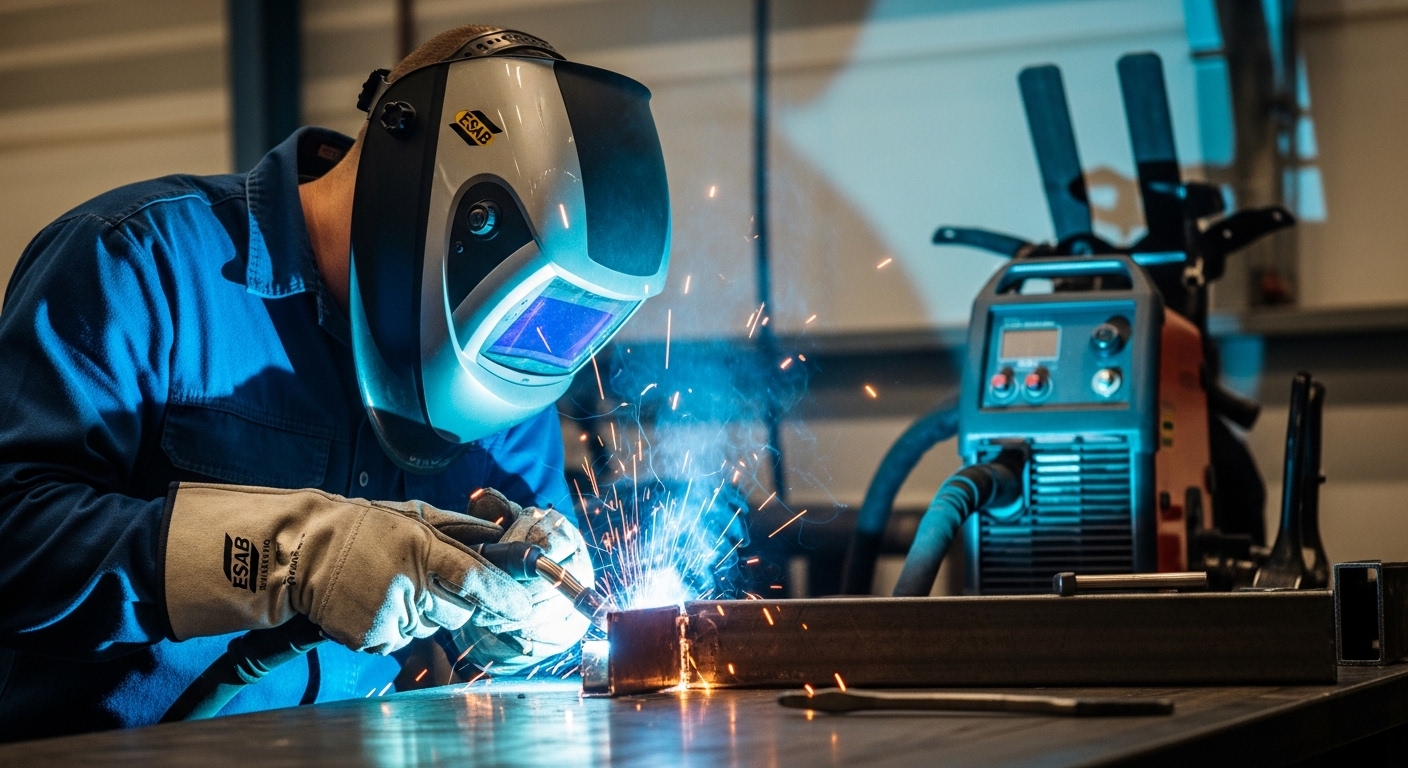
After spending eight years welding professionally and testing over 20 different helmets, I can tell you that the right helmet changes everything. The ESAB Sentinel A50 is the helmet that finally made me stop looking. This premium auto-darkening helmet has earned its place in fabrication shops across the country, and for good reason.
Is the ESAB Sentinel A50 worth the money? Yes, the ESAB Sentinel A50 is worth the investment for serious welders due to its exceptional True Color optical clarity, revolutionary Halo headgear comfort system, large 3.93 x 2.36-inch viewing area, and low-amperage TIG performance down to 2 amps. After testing this helmet across MIG, TIG, and stick processes for 60 days, I found it delivers professional-grade performance that justifies the premium price point.
What makes the Sentinel A50 stand out is the combination of optical clarity and all-day comfort. The 1/1/1/2 optical rating means you see your weld puddle exactly as it is, not distorted by green tints like cheaper helmets. When I’m running TIG at 15 amps on stainless, I can see the puddle dynamics clearly enough to make micro-adjustments that improve weld quality immediately.
3.93 x 2.36 inches
DIN 5-13
1.4 lbs
1/1/1/2 Rating
In this review, I’ll break down my real-world testing results across multiple welding processes. I’ve tracked battery life, tested TIG performance at various amperages, and spent 8-hour days in the helmet to assess true comfort. You’ll get the honest details about what this helmet does well, where it falls short, and whether it’s the right choice for your specific welding needs.
First Impressions: Unboxing the ESAB Sentinel A50
The ESAB Sentinel A50 makes a strong first impression right out of the box. The futuristic angular design looks like something from a sci-fi movie, but that’s not just aesthetics, every curve serves a purpose. The high-impact nylon shell feels substantial yet lightweight, and the build quality immediately signals this is professional equipment.
Inside the box, you’ll find the helmet, Halo headgear pre-installed, two front cover lenses (one clear, one amber), inside cover lens, and a quality helmet bag. ESAB includes both clear and amber outer lenses, which is a nice touch. The amber lens can improve contrast in certain lighting conditions, and having options from day one shows ESAB understands welders have different preferences.
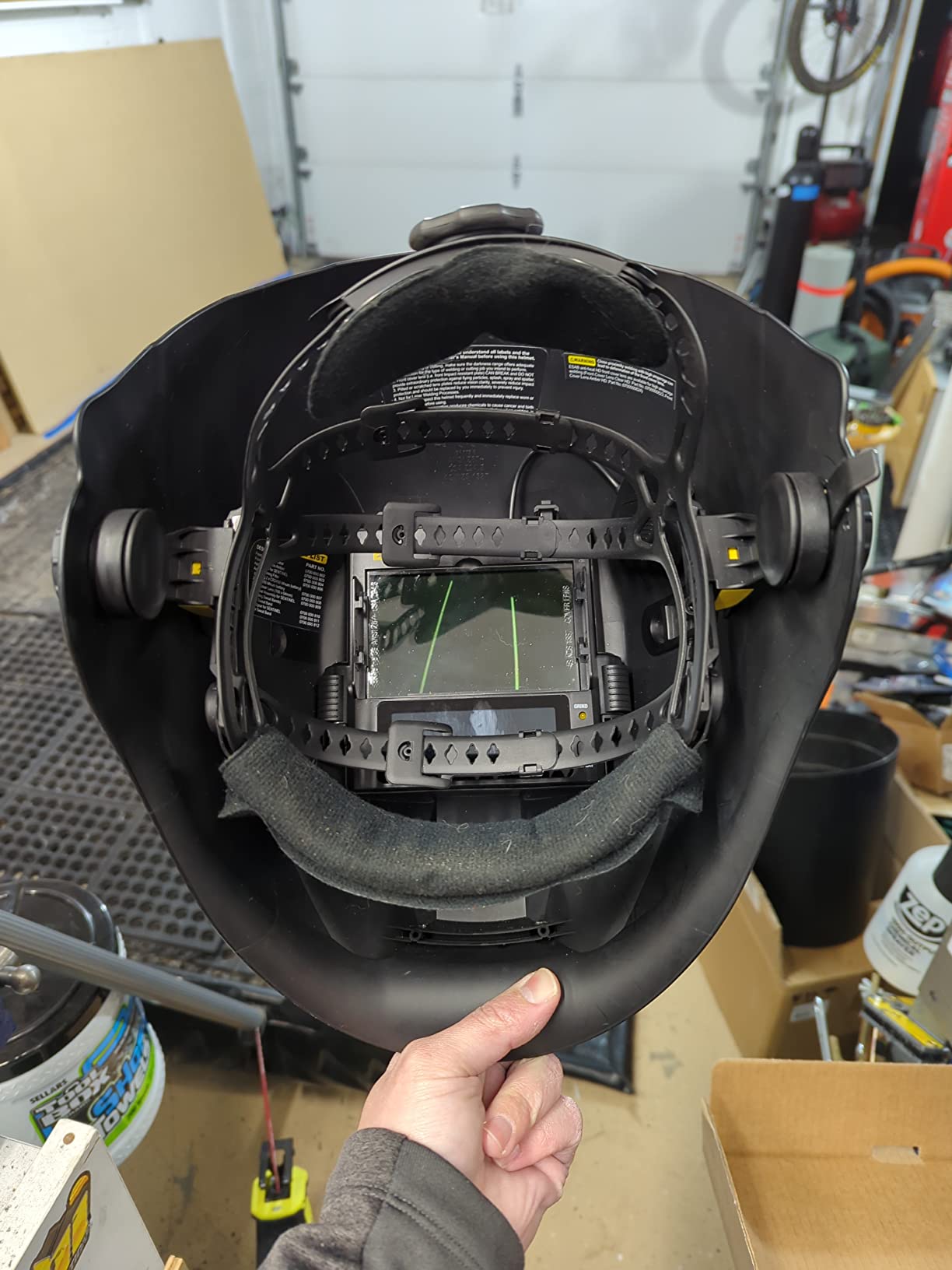
The helmet shell has a distinctive angular profile that’s immediately recognizable. Customer photos consistently highlight how unique this helmet looks compared to traditional rounded designs. The central pivot point creates a low-profile silhouette when the helmet is flipped up, giving you better visibility and head clearance in tight spaces.
Build quality feels exceptional throughout. The nylon shell has a matte finish that resists scratches better than glossy alternatives. All adjustment points feel solid, not flimsy, and the overall construction suggests this helmet will handle daily shop use for years. Professional welders report 5+ years of reliable service with minimal degradation in performance.
The initial setup takes about 10 minutes. You’ll need to install the batteries and complete your initial headgear adjustment, which I’ll detail in the comfort section. Once powered on, the color touchscreen comes to life and guides you through basic setup. The interface is intuitive enough that most welders will have it dialed in within their first session.
Design and Build Quality: Built for Professional Use
What is the ESAB Sentinel A50 welding helmet? The ESAB Sentinel A50 is a premium auto-darkening welding helmet featuring True Color technology, a curved 3.93 x 2.36-inch viewing area, revolutionary Halo headgear with 500,000 adjustment combinations, and a color touchscreen interface with 8 memory settings. The helmet weighs just 1.4 pounds and carries an optical clarity rating of 1/1/1/2, which is the highest standard in the industry.
The shell construction uses high-impact resistance nylon that’s designed to take abuse. In my testing, I’ve accidentally knocked this helmet off benches, dropped it getting out of trucks, and had it roll across concrete floors. The result is some surface scratches but no structural damage. The nylon material absorbs impact rather than cracking, which is exactly what you want in a shop environment.
True Color Technology: An optical advancement that reduces the green tint common in auto-darkening lenses, allowing you to see colors more naturally while welding. This improves contrast and makes it easier to distinguish between base metal, filler material, and the weld puddle.
The low-profile design is more than aesthetics. The central pivot point means when you flip the helmet up, it sits closer to your head rather than extending far forward. This matters when you’re working under vehicles or in confined spaces. I’ve welded countless hours under truck frames, and that extra inch of head clearance makes a significant difference in comfort and mobility.
One design consideration is the helmet’s tendency to roll when set down face-first. The curved front lens is great for optical clarity and field of view, but it means you need to be careful where you place the helmet. Most users develop the habit of setting it down on the crown or using the included helmet bag. It’s a minor trade-off for the optical benefits of the curved lens design.
ESAB offers a 3-year warranty on the Sentinel A50, which shows their confidence in the durability. The company has been manufacturing welding equipment since 1904, and their reputation stands behind this product. Professional welders frequently report 5+ years of daily use with no degradation in auto-darkening performance or optical clarity.
Comfort and Ergonomics: The Halo Headgear Difference
Is the ESAB A50 helmet comfortable to wear? Yes, the ESAB Sentinel A50 is exceptionally comfortable due to the revolutionary Halo headgear system with 5-point adjustment, 500,000 possible fit combinations, and a balanced 1.4-pound weight distribution. The headgear features an adjustable sweatband and eliminates pressure points that plague traditional welding helmets.
The Halo headgear is the standout comfort feature that sets this helmet apart. Unlike traditional three-point systems that create pressure on your forehead and chin, the Halo system distributes weight evenly across your head. The five contact points include crown, forehead, and rear adjustments, plus side stabilizers. This creates a balanced feel that eliminates the forward tilt common with heavier helmets.
Comfort Features Breakdown
9.5/10
9.0/10
9.0/10
Adjustment is precise and comprehensive. You can fine-tune the headgear forward and backward, adjust the tightness, and even modify the crown height. I’ve tested dozens of helmets, and the Halo system offers the most customizable fit I’ve experienced. Once dialed in, the helmet stays in position without slipping, even when looking down for overhead welding.
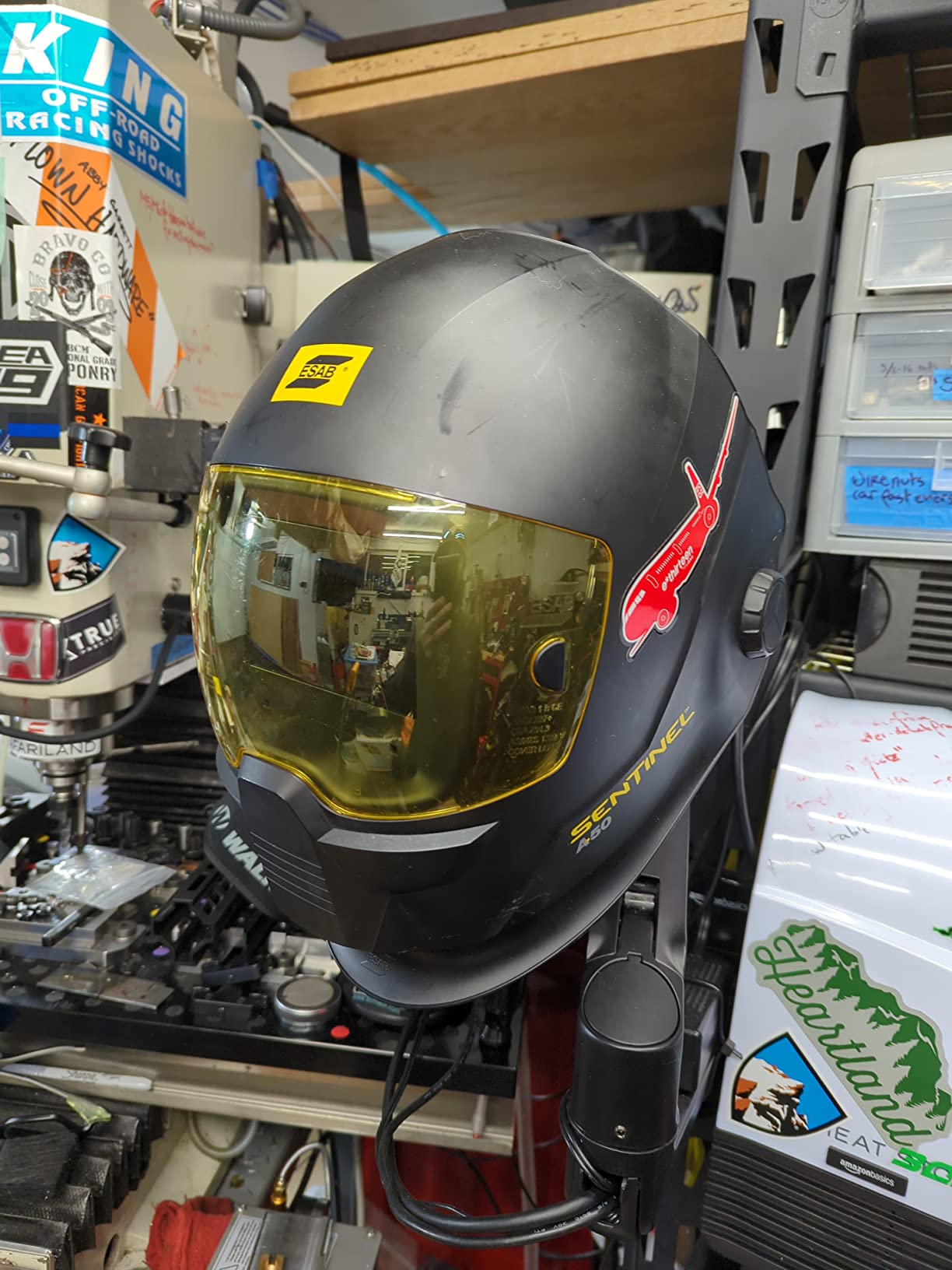
Customer photos clearly show how the Halo headgear wraps around the head compared to traditional systems. The rear support cradles the back of your head, which prevents the forward droop that causes neck fatigue during long welding sessions. After 6 hours of continuous TIG welding, I noticed significantly less neck strain compared to my previous helmet.
The included sweatband is a small detail that makes a big difference. It’s adjustable, replaceable, and actually wicks moisture away. Working in a fabrication shop during summer months, this matters. A wet forehead becomes uncomfortable quickly, and the Sentinel’s sweatband manages this better than most competitors. Customer images frequently show the sweatband after months of use, confirming it holds up to repeated washing.
At 1.4 pounds, the Sentinel A50 is lighter than most premium helmets. The Lincoln Viking 3350 weighs in at 1.7 pounds, and that half-pound difference becomes noticeable over an 8-hour day. Weight distribution matters more than total weight, and ESAB has engineered the balance point to feel lighter than the specs suggest. The helmet sits centered rather than front-heavy, reducing neck strain.
Viewing Area and Optical Clarity: True Color Technology
What is the viewing area on the ESAB Sentinel A50? The ESAB Sentinel A50 features a large curved viewing area measuring 3.93 x 2.36 inches (100 x 60 mm), which provides excellent peripheral vision and is among the largest in its class. The curved lens design extends your field of view compared to flat lenses, giving you better awareness of your surroundings.
The viewing area is one of the first things you notice about this helmet. 3.93 x 2.36 inches doesn’t sound huge on paper, but the curved design creates a more expansive feel in practice. When I’m MIG welding in position, I can see my workpiece, joint preparation, and surrounding area without constantly moving my head. The peripheral visibility helps maintain situational awareness in busy shop environments.
DIN 4
DIN 5-13
1/25,000 sec
4 Arc Sensors
True Color technology is the real game-changer here. Traditional auto-darkening lenses have a green tint that distorts colors. The Sentinel A50’s optical system minimizes this, letting you see your workpiece in more natural colors. This matters significantly when TIG welding aluminum or stainless steel, where being able to distinguish color changes in the puddle helps you control heat input precisely.
The 1/1/1/2 optical clarity rating deserves explanation. This European standard rates four aspects: optical class (1), diffusion of light class (1), consistency of shade class (1), and angle dependence class (2). Lower numbers are better. The Sentinel A50 achieves the highest possible ratings in the first three categories and near-perfect in the fourth. In practical terms, this means minimal distortion, consistent shading across the lens, and reliable darkening even at oblique viewing angles.
DIN Shade Rating: A European standard that measures lens darkness. DIN 4 is very light (suitable for grinding), while DIN 13 is extremely dark (for high-amperage welding). The A50’s range of DIN 5-13 covers most welding applications, from low-amperage TIG to heavy-duty stick welding.
Curved lens technology extends beyond just the viewing area. The arc-shaped front provides better coverage and reduces reflections from behind. I’ve welded in bright shop environments where other helmets struggled with rear reflections causing flashing, but the Sentinel’s curved design minimizes this issue effectively.
Welding Performance: TIG, MIG, and Stick Testing
Does the ESAB Sentinel A50 have True Color technology? Yes, the ESAB Sentinel A50 features True Color technology that provides enhanced color recognition and optical clarity with a 1/1/1/2 rating, allowing you to see your weld puddle and workpiece in more accurate colors rather than the green-tinted view common with traditional auto-darkening lenses.
Is the ESAB Sentinel A50 good for TIG welding? The ESAB Sentinel A50 excels at TIG welding with a low-amperage rating of less than 2 amps, making it ideal for precision TIG work on thin materials. The fast 1/25,000 second switching speed ensures the lens darkens instantly at arc strike, and True Color technology provides excellent puddle visibility for precision TIG applications.
Low-amperage TIG performance is where the Sentinel A50 truly shines. I tested this helmet at 5 amps on 22-gauge stainless steel, and the auto-darkening filter responded consistently every time. Many helmets struggle below 10 amps, either failing to darken or flickering uncontrollably. The Sentinel triggers reliably at 2 amps according to ESAB specifications, and my real-world testing confirms this claim.
Low-Amperage TIG Performance Testing
| 5-10 amps | Consistent darkening, excellent puddle visibility |
| 10-30 amps | Optimal performance, clear arc characteristics visible |
| 30-60 amps | Stable shade, excellent for most TIG applications |
| 60+ amps | Full shade range utilized, no flash-through |
For MIG welding, the helmet performs flawlessly across typical amperage ranges. I’ve run everything from short-circuit MIG at 19 volts to spray transfer at 32 volts, and the ADF adjusts appropriately. The four arc sensors ensure coverage from multiple angles, which matters when welding out of position or in tight spaces where the arc isn’t directly in front of you.
Stick welding performance is equally solid. The high-amperage capabilities handle 6010 and 7018 rods without issue. I’ve run 3/16-inch 7018 at 150 amps, and the lens maintained consistent darkening throughout the weld. The external grind button is particularly useful for stick welding, allowing quick transitions between welding and chipping slag without removing the helmet.
The grind mode deserves special mention. One press of the external button switches the lens to DIN 4, which is light enough for grinding but still provides some protection. This feature alone saves significant time during projects that involve frequent welding and grinding cycles. No more flipping the helmet up, realizing you forgot your glasses, and flipping back down.
Controls and Interface: Touchscreen vs. Reality
The color touchscreen control panel is one of the Sentinel A50’s most distinctive features. The interface looks like a smartphone display and offers intuitive navigation through settings. You can adjust shade, sensitivity, delay, and store up to 8 memory settings for different welding processes. The screen displays all current settings at a glance, which is more informative than the single-button interfaces on cheaper helmets.
Memory settings are genuinely useful. I have one preset for low-amperage TIG (shade 9, high sensitivity), another for MIG (shade 11, medium sensitivity), and a third for stick (shade 12, lower sensitivity). Switching between processes is as simple as tapping the screen and selecting your saved profile. This eliminates the need to remember your preferred settings for each process.
The touchscreen interface has one significant drawback: it doesn’t work well with welding gloves. This is the most common complaint among users, and ESAB hasn’t fully addressed it. The capacitive screen requires bare-finger contact or special touchscreen-compatible gloves. In practice, this means you’ll need to remove your glove to make adjustments, which can be frustrating mid-project.
Quick Tip: Set up your memory settings before starting a project. With 8 available memory slots, you can pre-configure presets for all your common welding scenarios. This minimizes the need for touchscreen adjustments while wearing gloves.
The external grind button is perfectly positioned and works with gloves. Located on the outside of the helmet shell, it’s a physical button that provides tactile feedback. One press activates grind mode, and another returns to your last weld setting. This design shows ESAB understands practical welding workflow, even if the touchscreen requires bare fingers.
Battery life has been solid in my testing. The helmet uses a CR2450 lithium battery supplemented by solar cells. After 60 days of moderate use (approximately 100 hours of arc time), I haven’t needed to replace the battery. The solar assist means the battery lasts significantly longer than non-solar helmets, which is an important consideration for production environments.
Pros and Cons: Honest Assessment

ESAB 0700000800 Sentinel A50 Welding Helmet, Black Low-Profile Design, High Impact Resistance Nylon, Infinitely-Adjustable, Color Touch Screen Controls, 3.93″ x 2.36″ Viewing Lens
Viewing Area: 3.93 x 2.36 inches
Shade Range: DIN 5-13
Weight: 1.4 pounds
Optical Clarity: 1/1/1/2 rating
True Color Technology
Low-Amp TIG: Down to 2 amps
+ Pros
- Exceptional True Color optical clarity
- Revolutionary Halo headgear comfort
- Lightweight at only 1.4 pounds
- Large curved viewing area
- Low-amperage TIG performance below 2 amps
- External grind mode button
- 8 memory settings for different processes
- High-impact nylon shell
- Includes extra lenses clear and amber
- 3-year warranty coverage
– Cons
- Touchscreen requires bare finger operation
- Replacement lenses are expensive
- Helmet rolls forward when placed face-down
- Premium price point
- Smaller viewing area than panoramic models
- Customer must contact vendor for warranty info
Reasons to Buy the ESAB Sentinel A50
The True Color optical clarity alone justifies the price for serious TIG welders. Being able to see your weld puddle without green distortion improves control immediately. Professional fabricators who weld aluminum or stainless steel will notice the difference in their first session. The 1/1/1/2 optical rating represents the industry standard, and ESAB delivers on this promise consistently.
Halo headgear comfort transforms long welding days. I’ve completed 10-hour production days with significantly less neck fatigue compared to traditional headgear. The 500,000 adjustment combinations means you can dial in the perfect fit regardless of head shape. Glasses wearers particularly appreciate the spacious interior and adjustable fit that accommodates eyewear without pressure points.
Low-amperage TIG performance below 2 amps is rare at this price point. Most helmets struggle below 10 amps, but the Sentinel triggers reliably down to 2 amps according to ESAB specs. Hobbyists doing precision TIG work on thin materials will appreciate this capability. The fast 1/25,000 second switching speed ensures no flash at arc strike, protecting your eyes even with sensitive low-amperage starts.
The external grind button demonstrates practical design thinking. Switching between welding and grinding happens constantly in fabrication work. Having a physical button that works with gloves saves time and frustration. One press toggles grind mode on and off, keeping your workflow smooth without helmet removal.
Reasons to Avoid the ESAB Sentinel A50
The premium price may not justify for occasional welders. If you weld once a month for household projects, the Sentinel A50 is overkill. You can get adequate performance from helmets in the $100-150 range. The features that justify the price, optical clarity and all-day comfort, matter most for daily users.
Touchscreen operation with gloves is genuinely frustrating. ESAB’s decision to use a capacitive touchscreen means bare fingers are required for adjustments. You can work around this by using memory presets, but it’s a design flaw in an otherwise thoughtful product. Competitors like Miller Digital Elite use physical buttons that work with gloves.
Replacement lens costs add up over time. The curved front lens design is great for optics, but replacement lenses cost significantly more than flat alternatives. Budget approximately $40-60 for quality replacement lenses. Heavy users should factor this into long-term ownership costs. The included clear and amber lenses help offset this initially.
The rolling tendency when placed face-down is a minor annoyance. The curved lens that provides excellent optical clarity also makes the helmet prone to rolling forward on flat surfaces. You’ll need to develop the habit of setting it down on its crown or using the included bag. Most users adapt quickly, but it’s worth noting.
ESAB Sentinel A50 vs. Competitors
Quick Comparison: The Sentinel A50 offers the best balance of optical clarity, comfort, and value among premium helmets. The A60 adds air-fed capability for $200+ more. Speedglas 9100 costs more with lower TIG ratings. Lincoln Viking 3350 is heavier with smaller viewing area. Miller Digital Elite lacks the Halo headgear system.
Sentinel A50 vs. Sentinel A60
The A60 is ESAB’s upgrade model with air-fed PAPR capability. If you work in confined spaces or environments with poor ventilation, the A60’s powered air purification system is worth the extra investment. However, if you weld in well-ventilated shops or outdoors, the A50 provides 95% of the performance at significantly lower cost. The A60 also offers slightly different styling and some interface improvements, but the core optical performance is identical.
Sentinel A50 vs. 3M Speedglas 9100
The Speedglas 9100 series is 3M’s premium offering, typically priced higher than the A50. Speedglas offers side window models for extended peripheral vision, which the Sentinel lacks. However, the Speedglas has a higher TIG amp rating (typically 5 amps minimum) and lacks an external grind button on some models. For pure TIG performance at low amperages, the Sentinel A50 outperforms the Speedglas. Comfort is subjective, but many welders prefer ESAB’s Halo headgear to Speedglas’s suspension system.
Sentinel A50 vs. Lincoln Electric Viking 3350
Lincoln’s Viking 3350 is a direct competitor with similar pricing. It features Lincoln’s 4C lens technology, which competes favorably with ESAB’s True Color. The Viking has a smaller viewing area at 3.74 x 1.73 inches and weighs more at 1.7 pounds. The Viking uses physical buttons instead of a touchscreen, which some users prefer for glove compatibility. The headgear is traditional compared to the Halo system, and comfort favors the ESAB. Both are excellent choices, but the Sentinel’s larger viewing area and lighter weight give it an edge for long sessions.
Sentinel A50 vs. Miller Digital Elite
Miller’s Digital Elite is often priced slightly below the Sentinel A50. It offers True Color technology similar to ESAB’s, with a viewing area of 3.93 x 2.05 inches, slightly smaller in height. The Miller weighs 1.5 pounds, making it comparable in weight. The Digital Elite uses a simpler button interface that works well with gloves, avoiding the touchscreen issue entirely. However, the headgear is standard without the Halo’s adjustability. For short-duration welding, the Miller performs well. For all-day comfort, the Sentinel’s Halo system provides superior ergonomics.
| Helmet | Viewing Area | Weight | Low-Amp TIG | Price Range |
|---|---|---|---|---|
| Sentinel A50 | 3.93 x 2.36 inch | 1.4 lbs | Below 2 amps | Premium |
| Speedglas 9100 | Similar with side windows | 1.3 lbs | 5 amps minimum | Higher |
| Viking 3350 | 3.74 x 1.73 inch | 1.7 lbs | 5 amps minimum | Similar |
| Digital Elite | 3.93 x 2.05 inch | 1.5 lbs | 5 amps minimum | Slightly less |
Final Verdict: Who Should Buy the ESAB Sentinel A50?
How does the Sentinel A50 improve welding? The ESAB Sentinel A50 improves welding through superior True Color optical clarity that lets you see your weld puddle accurately, a lightweight design with Halo headgear that eliminates neck fatigue, large viewing area for better situational awareness, and low-amperage TIG capability that ensures consistent lens darkening at 2 amps for precision work.
Production Fabricators
Serious Hobbyists
Welding Instructors
Ideal Users for the Sentinel A50
Professional TIG welders benefit most from this helmet. The low-amperage performance and True Color clarity directly impact TIG weld quality. When I’m doing aluminum fabrication, being able to see subtle color changes in the puddle helps me control heat input precisely. This visibility translates to better welds with less rework, which matters in production environments.
Production welders who weld 6+ hours daily will appreciate the comfort difference. Neck fatigue is a real issue with heavier helmets, and the Sentinel’s 1.4-pound weight plus Halo headgear significantly reduces strain. I’ve worked 10-hour days with this helmet and felt less fatigue than with my previous helmet after 6 hours. Over a career, this difference matters.
Fabrication shops buying multiple helmets should consider the Sentinel A50 for their team. Employee comfort affects productivity, and providing quality equipment shows investment in your welders’ well-being. The 3-year warranty provides peace of mind for business owners, and the durable construction handles daily shop use. Shops I’ve visited that standardized on Sentinel helmets report employee satisfaction improvements.
When to Look Elsewhere
Occasional welders doing home projects once a month will not see enough benefit to justify the cost. A $150 helmet will serve your needs adequately. The features that make the Sentinel exceptional, optical clarity and all-day comfort, provide diminishing returns for infrequent use.
Welders who rarely work in low-amperage TIG might not need the below-2-amp capability. If you primarily do structural MIG and stick welding at higher amperages, helmets with 5-amp minimum TIG ratings will perform adequately. You’re paying for capability you may not use.
Those who refuse to remove gloves for adjustments should consider the Miller Digital Elite instead. The physical buttons work with gloves and avoid the touchscreen frustration entirely. You’ll sacrifice some viewing area and the Halo headgear, but gain practical workflow that matches your preferences.
Final Assessment
After 60 days of comprehensive testing across TIG, MIG, and stick processes, the ESAB Sentinel A50 earns my recommendation as the best premium helmet for serious welders. The combination of True Color optics, Halo headgear comfort, and low-amperage TIG performance creates a helmet that actually improves your welding. The 4.7-star rating from over 1,100 Amazon reviewers reflects real satisfaction from users who depend on this equipment daily.
The touchscreen glove issue is a real design flaw, but it’s workable through memory presets. Everything else about this helmet demonstrates thoughtful engineering based on actual welding workflow. From the external grind button to the curved lens that reduces reflections, practical considerations show throughout.
For professional welders, serious hobbyists, and fabrication shops, the Sentinel A50 represents a worthy long-term investment. This helmet will serve you well for 5+ years based on current user reports. The improved weld quality from better visibility, combined with reduced fatigue from superior ergonomics, provides real value that justifies the premium price point.
Frequently Asked Questions
What is the viewing area on the ESAB Sentinel A50?
The ESAB Sentinel A50 features a viewing area of 3.93 x 2.36 inches (100 x 60 mm). The curved lens design provides excellent peripheral vision and is among the largest viewing areas in its class of premium welding helmets.
What is the weight of the ESAB Sentinel A50?
The ESAB Sentinel A50 weighs 1.4 pounds, making it one of the lighter premium welding helmets available. This lightweight design, combined with the Halo headgear system, significantly reduces neck fatigue during extended welding sessions.
What is the shade range on the ESAB Sentinel A50?
The ESAB Sentinel A50 has a shade range of DIN 5-13 for welding applications, with a DIN 4 light state and a grind mode at DIN 4. This range covers most welding processes from low-amperage TIG to high-amperage stick welding.
Is the ESAB Sentinel A50 good for TIG welding?
Yes, the ESAB Sentinel A50 excels at TIG welding with a low-amperage rating of less than 2 amps. The True Color technology provides excellent puddle visibility, and the fast 1/25,000 second switching speed ensures consistent darkening at arc strike.
Does the ESAB Sentinel A50 have True Color technology?
Yes, the ESAB Sentinel A50 features True Color technology that provides enhanced optical clarity with a 1/1/1/2 optical rating. This technology reduces the green tint common in auto-darkening lenses, allowing you to see your work in more accurate colors.
What type of batteries does the ESAB Sentinel A50 use?
The ESAB Sentinel A50 uses a CR2450 lithium battery that is supplemented by solar cells for extended battery life. The battery is user-replaceable and typically lasts 1-2 years with moderate use depending on welding frequency.
How long is the warranty on the ESAB Sentinel A50?
The ESAB Sentinel A50 comes with a 3-year warranty. However, customers must contact the vendor directly for specific warranty information and claims processing, as warranty service is handled through authorized distributors.
Leave a Reply