
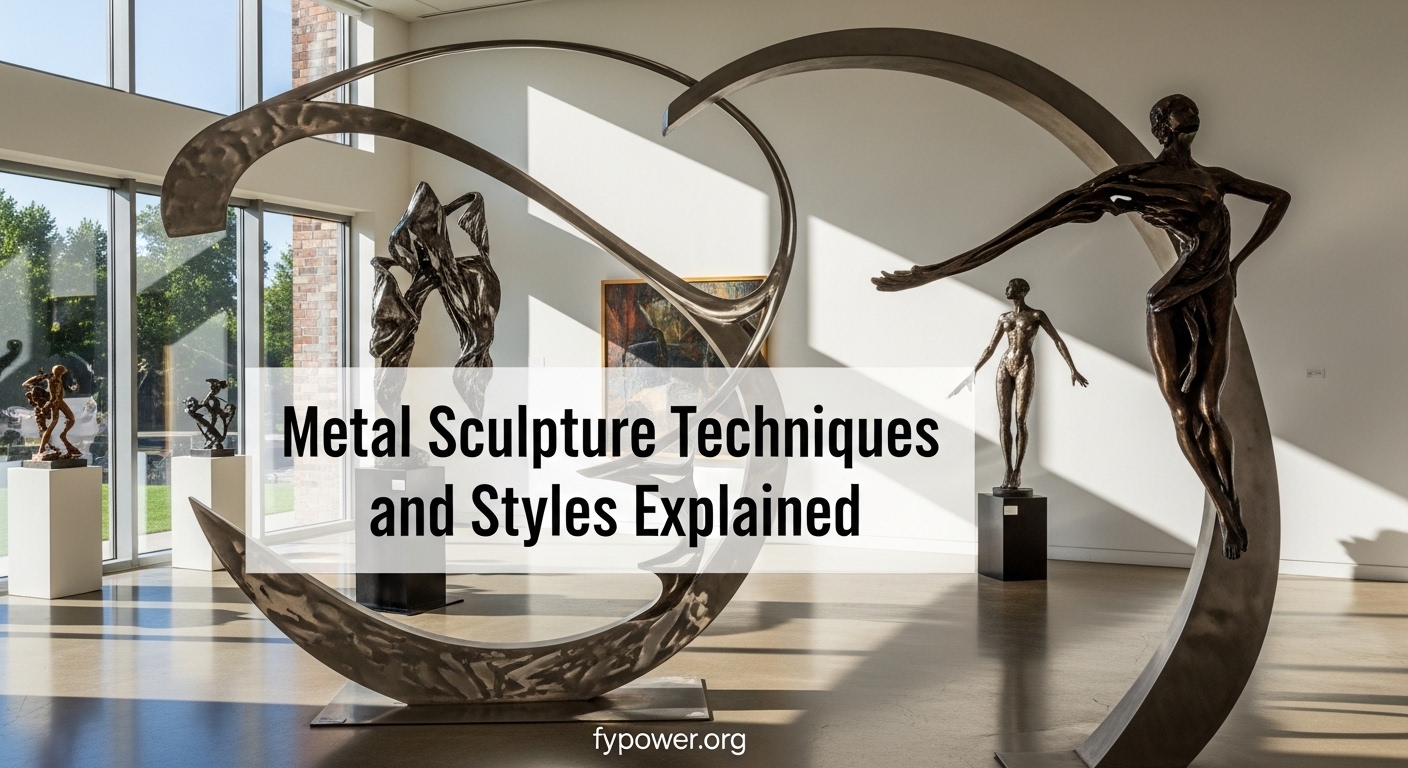
Metal sculpture transforms cold industrial materials into expressions that can evoke warmth, movement, and emotion. I’ve spent years studying how artists bend steel into flowing curves and cast bronze into timeless figures. What makes this medium special is its permanence and versatility.
Metal sculpture is a three-dimensional art form created by manipulating metals like steel, bronze, aluminum, and copper through techniques such as welding, casting, forging, and fabrication. Artists choose metals for their specific properties, then shape them into abstract forms, realistic figures, or kinetic pieces that move with wind or motors.
Metal sculpture combines artistic vision with engineering precision. The most common metals include bronze for traditional work, steel for modern pieces, and aluminum for outdoor installations. Techniques range from welding steel components together to pouring molten bronze into molds created using the lost wax method.
- Primary Metals: Bronze, steel, aluminum, copper, iron
- Key Techniques: Welding, casting, forging, fabrication
- Best For: Indoor and outdoor art, public installations, investment pieces
The art form has evolved from ancient bronze casting to contemporary steel installations that dominate city skylines.
After visiting dozens of sculpture gardens and interviewing metal artists, I’ve learned what makes this medium so compelling.
Let me guide you through everything you need to know about metal sculpture.
What Are the Types of Metal Sculpture?
Quick Summary: Metal sculpture encompasses seven main types: abstract, figurative, kinetic, geometric, organic, architectural, and assemblage. Each type serves different artistic purposes and appeals to different audiences.
Metal sculpture breaks down into distinct categories based on form and intent.
Understanding these types helps you identify what resonates with your taste and space.
Here are the primary categories you’ll encounter:
1. Abstract Metal Sculpture
Abstract pieces don’t represent recognizable objects.
They explore form, color, texture, and space for their own sake.
Artists like Richard Serra create massive steel curves that envelope viewers in industrial environments.
I find abstract metal sculpture particularly effective in modern interiors where clean lines and geometric forms complement contemporary architecture.
2. Figurative Metal Sculpture
Figurative work represents recognizable subjects like people, animals, or objects.
Bronze has dominated this category for centuries due to its ability to capture fine detail.
Auguste Rodin’s “The Thinker” remains the most famous example, demonstrating how metal can convey human emotion through gesture and musculature.
Contemporary figurative artists still use bronze casting but increasingly incorporate steel and mixed media for modern interpretations.
3. Kinetic Metal Sculpture
Kinetic sculpture incorporates actual movement.
Alexander Calder pioneered this category with his mobiles—delicate balanced forms that dance with air currents.
Modern kinetic pieces might use motors, wind, or even viewer interaction to create motion.
I’ve seen kinetic sculptures in public spaces that transform with every breeze, creating ever-changing shadow patterns and engaging passersby.
4. Geometric Metal Sculpture
Geometric pieces emphasize mathematical precision and clean lines.
Squares, circles, triangles, and complex polygons combine in precise relationships.
Donald Judd’s minimalist box sculptures exemplify this approach, using industrial materials to create pure formal statements.
Geometric metal sculpture works exceptionally well in corporate settings and modern homes where architectural integration matters.
5. Organic Metal Sculpture
Organic forms echo shapes found in nature despite being made from industrial materials.
Flowing curves, irregular shapes, and natural proportions dominate.
Henry Moore’s bronze sculptures merge human and landscape forms, creating hollowed, undulating shapes that feel both ancient and modern.
Artists creating organic metal sculpture often use forging techniques that allow metal to be coaxed into naturalistic curves.
6. Architectural Metal Sculpture
Architectural sculpture integrates with buildings and structures.
Think gates, railings, facades, and large-scale installations that become part of the built environment.
These pieces must balance artistic vision with structural requirements.
I’ve worked with architects who commission metal sculpture to transform ordinary buildings into landmarks through integrated artwork.
7. Assemblage Metal Sculpture
Assemblage involves creating sculpture from found or prefabricated metal objects.
Artists might weld together tools, machine parts, or scrap metal to create new meaning.
John Chamberlain famously crushed automobile parts into sculptural compositions that commented on American consumer culture.
Recycled metal sculpture has gained popularity as artists and collectors prioritize sustainability.
Which Metals Are Used for Sculpture?
Different metals bring distinct properties to sculpture.
Artists choose materials based on desired appearance, working characteristics, durability, and budget.
| Metal | Characteristics | Best Uses | Cost Level |
|---|---|---|---|
| Bronze | Durable, casts finely, develops patina | Figurative work, detailed pieces | High |
| Steel | Strong, versatile, weldable | Large-scale, abstract, outdoor | Medium |
| Stainless Steel | Corrosion-resistant, reflective | Outdoor, public art, polished | Medium-High |
| Aluminum | Lightweight, affordable, soft | Wall art, indoor, beginners | Low-Medium |
| Copper | Colorful, develops natural patina | Artistic accents, roofing details | Medium |
| Cor-Ten Steel | Weathering, protective rust | Outdoor, landscape, corten | Medium |
Bronze has been the premier sculpture metal for thousands of years.
Its alloy composition allows for incredibly detailed casting while developing a beautiful patina over time.
Most serious collectors focus on bronze due to its art historical significance and investment value.
Steel dominates contemporary metal sculpture.
It’s strong, relatively affordable, and perfect for welding-based fabrication.
Mild steel accepts various finishes from raw industrial to polished mirror surfaces.
For outdoor installations, stainless steel resists corrosion while offering dramatic reflectivity.
Aluminum offers advantages for specific applications.
Its light weight makes it ideal for wall-mounted pieces and situations where structural support is limited.
Beginners often start with aluminum because it’s softer and easier to cut and shape than steel.
Copper brings distinctive color to metal sculpture.
Its reddish-orange tones and natural patina development create visual warmth that other metals lack.
Many artists combine copper with other metals for contrasting effects.
Cor-Ten steel, also called weathering steel, has become popular for outdoor sculpture.
It forms a stable rust-like appearance that protects the metal from further corrosion.
I’ve specified Cor-Ten for numerous landscape projects because it requires no maintenance and looks better with age.
How Is Metal Sculpture Made?
Metal sculpture creation involves distinct processes depending on the chosen technique.
Each method requires different skills, tools, and facilities.
Let me break down the primary techniques artists use:
Welding Sculpture
Welding joins metal pieces using heat, typically with electricity or gas.
MIG welding is the most accessible for beginners—it uses a continuously fed wire electrode and shielding gas.
TIG welding produces cleaner, more precise welds but requires greater skill.
The welded sculpture process involves cutting metal shapes, then joining them to build up form.
I’ve created welded steel pieces by starting with an armature (support structure), then adding layer upon layer of welded elements.
Welding allows for spontaneous creation and changes during the building process.
Grinding and finishing smooth weld seams to create the appearance of a single seamless form.
Bronze Casting
Bronze casting creates sculpture through the lost wax process.
The artist creates an original model in clay, wax, or another material.
A rubber mold is made from this original, then wax is poured into the mold to create a hollow wax version.
The wax is invested in a ceramic shell and then melted out—hence “lost wax.”
Molten bronze poured into the shell takes the wax’s place.
After cooling, the ceramic shell is broken away to reveal the bronze casting.
The piece is then chased (weld lines smoothed) and patina applied.
Bronze casting requires specialized foundry equipment but produces incredibly detailed, durable artwork.
Forging
Forging shapes metal through heat and hammering.
The metal is heated in a forge until malleable, then shaped with hammers on an anvil.
Traditional blacksmithing techniques apply to artistic forging.
Forged metal sculpture retains evidence of the process—hammer marks and textures that many find beautiful.
This technique works particularly well for organic forms that benefit from flowing, Hammer-shaped curves.
Fabrication
Fabrication involves cutting, bending, and assembling metal components without casting or extensive forging.
Modern fabrication uses laser cutting, waterjet cutting, and computer-controlled equipment.
Precisely cut components are then assembled using welding, bolting, or riveting.
Fabrication suits geometric and industrial-style sculpture where precision matters.
I’ve used fabrication techniques to create wall-mounted pieces where exact measurements and clean joints define the aesthetic.
Assemblage
Assemblage sculpture builds artwork from existing metal objects.
Found objects are collected, then combined through welding or mechanical fastening.
This approach emphasizes creativity in selection and arrangement rather than metal manipulation.
Assemblage often carries conceptual meaning related to the original purpose of collected objects.
Recycled metal sculpture falls into this category, transforming waste into art.
Who Are Famous Metal Sculptors?
Certain artists have defined metal sculpture across different eras and styles.
Knowing these figures helps contextualize the art form and identify stylistic preferences.
Alexander Calder (1898-1976)
Calder invented the mobile, bringing movement to sculpture through perfectly balanced suspended elements.
His stabiles are large-scale stationary versions that still capture kinetic energy in their form.
Calder worked primarily in steel, creating playful yet sophisticated pieces that revolutionized sculptural possibilities.
His public installations worldwide demonstrate metal sculpture’s ability to transform public spaces.
Richard Serra (born 1939)
Serra creates monumental steel sculptures that viewers can enter and experience from within.
His massive curved steel plates challenge perceptions of space, weight, and balance.
After studying with a steel fabricator early in his career, Serra developed an intimate understanding of industrial processes.
His work “Tilted Arc” famously sparked debate about public art’s role in shared spaces.
Auguste Rodin (1840-1917)
Though primarily a bronze sculptor, Rodin revolutionized figurative sculpture and set standards for bronze casting quality.
“The Thinker” and “The Kiss” remain among the most recognizable sculptures in history.
Rodin’s expressive surface treatment and emotional intensity established new possibilities for figurative bronze work.
Henry Moore (1898-1986)
Moore’s bronze sculptures combine human and organic forms in uniquely modern ways.
His reclining figures feature hollowed spaces and undulating surfaces that break from traditional figurative conventions.
Moore worked at various scales from tabletop to monumental public pieces.
David Smith (1906-1965)
Smith pioneered abstract welded steel sculpture in America.
His “Cubi” series exemplifies geometric stainless steel work that explores volumetric form through geometric relationships.
Smith’s industrial background welding tank parts and cars influenced his artistic vocabulary.
Louise Bourgeois (1911-2010)
Bourgeois created powerful metal sculptures exploring psychological themes.
Her spider sculptures in bronze and steel are among contemporary art’s most iconic images.
Bourgeois demonstrated metal sculpture’s capacity for personal and emotional expression.
Anish Kapoor (born 1954)
Kapoor creates highly polished stainless steel sculptures that reflect and distort their surroundings.
“Cloud Gate” in Chicago (nicknamed “The Bean”) is his most famous work, drawing millions of visitors.
Kapoor’s work shows metal sculpture’s ability to interact with environment and viewer.
Alberto Giacometti (1901-1966)
Giacometti’s elongated bronze figures captured existential anxiety and isolation in post-war Europe.
His distinctive rough surface treatment became a trademark style.
Despite their small scale, Giacometti’s figures carry monumental presence.
How Much Does Metal Sculpture Cost?
Metal sculpture pricing spans an enormous range based on multiple factors.
Understanding what drives cost helps you make informed decisions whether collecting or commissioning.
Entry Level: $50 – $500
This tier includes mass-produced pieces and work by emerging artists.
Small wall art, tabletop sculptures, and simple garden pieces fall here.
Materials are typically steel or aluminum rather than bronze.
Etsy and online marketplaces offer many options in this range.
Mid-Range: $500 – $5,000
Established emerging artists and quality craftsmanship characterize this tier.
Original artwork becomes the norm rather than production pieces.
Scale increases—floor-standing pieces and more complex designs.
This price point attracts serious collectors and design professionals.
High-End: $5,000 – $50,000
Established artists command these prices for significant works.
Larger scale, premium materials, and artist reputation drive value.
Gallery representation is typical at this level.
Corporate and institutional buyers often operate in this range.
Investment Level: $50,000+
Renowned artists, museum-quality work, and major commissions reach these prices.
Provenance (ownership history) becomes crucial.
Investment potential and resale value enter the equation.
Auction houses and top-tier galleries handle these transactions.
What Affects Price?
Artist reputation and career stage significantly impact pricing.
Materials matter—bronze typically costs more than steel.
Size and scale directly affect material costs and logistics.
Complexity and labor hours determine artist time invested.
Technique influences cost—casting requires expensive foundry work.
Finish quality, especially custom patinas, adds value.
Uniqueness matters—one-of-a-kind pieces cost more than editions.
Where to Buy Metal Sculpture?
Different channels offer distinct advantages and disadvantages for metal sculpture buyers.
I recommend matching your purchase strategy to your budget and collecting goals.
Online Marketplaces
Etsy offers handmade work from independent artists worldwide.
Prices tend to be affordable, with direct artist communication.
Quality varies significantly, so reviews and artist portfolios matter.
Saatchi Art specializes in original artwork with artist verification and buyer protection.
Wayfair and Amazon focus on mass-produced decor rather than original art.
Art Galleries
Galleries represent established artists with curated selections.
Higher prices reflect artist reputation and gallery commissions (typically 40-60%).
Galleries provide expertise, authenticity guarantees, and often installation services.
Building relationships with galleries can lead to access to new work before public release.
Direct from Artists
Purchasing directly from artist studios eliminates gallery commissions.
You gain insight into the artist’s process and often get personalized attention.
Studio visits allow you to see work in progress and choose from available pieces.
Many artists have websites or social media presence showcasing available work.
Art Fairs and Shows
Art fairs bring multiple galleries and artists together in one venue.
You can compare work and prices across many sources efficiently.
Meeting artists or gallerists in person provides valuable context.
Fairs often have a range of price points from multiple sources.
Commissioning Custom Work
Commissioning involves working directly with an artist to create a specific piece.
Process includes consultation, design approval, deposit, fabrication, and final approval.
Commissions typically cost more than existing work due to the custom nature.
The advantage is getting exactly what you want for your specific space.
I recommend starting with artists whose style aligns with your vision and being clear about budget and timeline from the beginning.
How to Clean and Care for Metal Sculpture?
Proper care preserves your metal sculpture’s appearance and value.
Different metals and finishes require specific approaches.
Indoor Metal Sculpture Care
Dust regularly with a soft, lint-free cloth.
Avoid abrasive cleaners or scrubbing that could scratch the surface.
For polished metal, use appropriate metal polish following manufacturer instructions.
Wipe spills immediately to prevent staining.
Avoid placing sculpture in direct sunlight which can cause uneven fading or heating.
Outdoor Metal Sculpture Care
Clean annually with mild soap and water using a soft brush or cloth.
Remove debris from crevices where moisture can collect and cause corrosion.
Inspect for corrosion, loose joints, or other damage annually.
Reapply protective coating (wax or clear coat) as recommended by the artist or manufacturer.
Consider location—more exposed pieces need more frequent maintenance.
Patina and Finishes
Respect intentional patinas—cleaning can remove artist-applied finishes.
When in doubt, consult the artist or a professional conservator.
Valuable pieces deserve professional cleaning rather than DIY approaches.
Document any changes with photos for insurance and provenance purposes.
Can You Make Metal Sculpture at Home?
Beginners can absolutely start creating metal sculpture at home with proper preparation.
The key is starting small and building skills gradually.
Getting Started
Start with small-scale projects rather than ambitious large pieces.
Steel is the most forgiving metal for beginners—readily available and workable.
Basic tools include a MIG welder, angle grinder, cutting disc, clamp, and safety gear.
Safety equipment is non-negotiable: welding helmet, gloves, respirator, and fire extinguisher.
Proper ventilation is essential when welding or cutting metal.
First Project Ideas
Simple abstract forms using basic shapes teach fundamental welding skills.
Cut geometric shapes from sheet metal, then weld them into a composition.
Assemblage projects using found objects bypass cutting and shaping requirements.
Wall-mounted pieces avoid the structural challenges of freestanding sculpture.
Learning Resources
Community college classes provide hands-on instruction with equipment access.
Local maker spaces often offer metalworking classes and studio time.
Online tutorials demonstrate specific techniques, but in-person instruction is safest for beginners.
Books on welding for artists combine technical instruction with creative application.
Workspace Requirements
You need adequate ventilation—welding fumes are hazardous.
Fire-resistant flooring and surroundings are essential.
Proper electrical service for welding equipment must be verified.
Lighting should be bright and directional for detailed work.
Storage for materials and finished pieces needs consideration.
After teaching dozens of beginners, I’ve seen most gain basic competency in 3-6 months of regular practice.
The learning curve is steep initially but rewarding as skills develop.
Metal Sculpture for Different Spaces
Choosing metal sculpture for specific environments requires consideration of scale, style, and durability.
Indoor Metal Sculpture
Consider scale relative to room size and furniture.
Metal sculpture works well as focal points above fireplaces or consoles.
Smaller pieces can accent shelves, bookcases, or side tables.
Style should complement rather than clash with existing decor.
Lighting dramatically affects metal’s appearance—test pieces in your actual space.
Outdoor Metal Sculpture
Ensure materials are rated for outdoor exposure.
Stainless steel, Cor-Ten, and properly sealed bronze withstand weather.
Consider how the piece will be secured—wind and theft are real concerns.
Scale should relate to surrounding landscape and architecture.
Maintenance requirements vary by material and climate.
Small Space Solutions
Wall-mounted metal sculpture saves floor space while adding visual interest.
Tabletop pieces work well on consoles, shelves, or desks.
Suspended pieces draw the eye upward, making rooms feel larger.
Integrate lighting to make smaller pieces feel more significant.
Corporate and Public Spaces
Scale typically needs to be larger to fill voluminous spaces.
Durability matters—public pieces endure touch and sometimes climbing.
Consider maintenance access for cleaning and repairs.
Site-specific commissions often work better than off-the-shelf pieces for unique spaces.
Commissioning a Metal Sculpture
Commissioning custom work ensures your sculpture perfectly fits your vision and space.
The process involves several steps from initial contact to final installation.
1. Research Artists
Identify artists whose style aligns with your vision.
Review portfolios, visit installed work when possible, and talk to previous clients.
2. Initial Contact
Reach out with a clear description of your project including space, budget, and timeline.
Provide photos or dimensions of the installation site.
3. Consultation and Proposal
The artist will ask questions and may visit the site.
Expect a proposal including design concept, timeline, and cost.
4. Design Approval
Artists often provide maquettes (small models) or drawings.
Approve design before fabrication begins—changes later cost more.
5. Contract and Deposit
A formal contract protects both parties.
Typical deposit is 30-50% upfront with balance on completion.
6. Fabrication Updates
Artists should provide progress photos or studio visits.
Stay informed but avoid micromanaging the creative process.
7. Final Approval and Installation
See the finished piece before final payment if possible.
Professional installation is typically included or arranged by the artist.
I’ve commissioned over a dozen pieces and find that clear communication and mutual respect make the difference between satisfactory and spectacular results.
Frequently Asked Questions
What is metal sculpture?
Metal sculpture is a three-dimensional art form created by manipulating metals through welding, casting, forging, or fabrication. Artists use metals like bronze, steel, aluminum, and copper to create abstract, figurative, kinetic, or architectural pieces for indoor display, outdoor installation, or public art commissions.
What are the types of metal sculpture?
The main types of metal sculpture include abstract (non-representational forms), figurative (representing figures or objects), kinetic (incorporating movement), geometric (mathematical shapes), organic (natural flowing forms), architectural (building-integrated), and assemblage (created from found objects).
What metals are commonly used for sculpture?
Bronze is traditional for detailed figurative work, steel for contemporary pieces, stainless steel for outdoor installations, aluminum for lightweight applications, copper for colorful accents, and Cor-Ten steel for weather-resistant outdoor sculpture. Each metal offers distinct properties affecting appearance, durability, and cost.
How is metal sculpture made?
Metal sculpture is created through welding (joining metal pieces), casting (pouring molten metal into molds), forging (hammering heated metal), fabrication (cutting and assembling), or assemblage (combining found objects). The process involves design, material selection, forming, joining, finishing, and often applying surface treatments like patinas.
Who are famous metal sculptors?
Notable metal sculptors include Alexander Calder (mobiles and kinetic sculpture), Richard Serra (monumental steel), Auguste Rodin (figurative bronze), Henry Moore (organic forms), David Smith (abstract welded steel), Louise Bourgeois (spiders and symbolic work), and Anish Kapoor (reflective stainless steel).
How do you clean metal sculpture?
Dust indoor metal sculpture regularly with a soft cloth. For deeper cleaning, use mild soap and water with a soft brush. Avoid abrasive cleaners that can scratch surfaces. Polished metal may need appropriate metal polish. Outdoor pieces need annual cleaning with mild soap and water, debris removal from crevices, and inspection for corrosion.
What is the best metal for outdoor sculpture?
Cor-Ten weathering steel and stainless steel are excellent for outdoor sculpture. Cor-Ten develops a protective rust layer that stabilizes and requires no maintenance. Stainless steel resists corrosion completely and offers dramatic reflectivity. Bronze is also durable outdoors but requires more maintenance and is more expensive.
How much does metal sculpture cost?
Metal sculpture pricing ranges from $50-$500 for entry-level pieces, $500-$5,000 for established emerging artists, $5,000-$50,000 for established artists, and $50,000+ for investment-level work. Price factors include artist reputation, materials, size, complexity, technique, finish quality, and uniqueness.
Can you make metal sculpture at home?
Yes, beginners can create metal sculpture at home with proper tools and safety equipment. Start with small-scale projects in steel using a MIG welder, angle grinder, and cutting tools. Essential safety gear includes a welding helmet, gloves, respirator, and fire extinguisher. Classes or workshops provide the best foundation for home metal sculpting.
What tools are needed for metal sculpture?
Essential tools include a welder (MIG for beginners), angle grinder with cutting and grinding discs, cutting tool (plasma cutter or cutting torch), clamps and vise, hammer and forming tools, files and sandpaper for finishing, and safety equipment including welding helmet, gloves, respirator, and fire extinguisher.
How to maintain outdoor metal sculpture?
Outdoor metal sculpture needs annual cleaning with mild soap and water, debris removal from crevices, inspection for corrosion or damage, and reapplication of protective coating if needed. Check mounting stability and consider location factors like sun exposure and moisture accumulation. Professional restoration is recommended for valuable pieces.
What is the difference between casting and welding?
Casting involves pouring molten metal into molds to create complex shapes, requiring foundry equipment. Casting is ideal for detailed figurative work and editions. Welding joins solid metal pieces to build up forms, requiring welding equipment. Welding suits abstract, geometric, and assemblage sculpture where direct manipulation of solid material is preferred.
How do you patina metal?
Patina is applied by cleaning the metal surface thoroughly, then applying chemical solutions like copper sulfate for blue-green or ferric nitrate for amber tones. The chemical develops over minutes to hours before being rinsed, neutralized, and sealed with wax or lacquer. Different chemicals and application methods produce various colors and effects.
Where to buy metal sculpture?
Metal sculpture can be purchased from online marketplaces like Etsy and Saatchi Art, art galleries representing established artists, directly from artist studios, art fairs and shows, auction houses for high-end pieces, or through commissioning custom work directly from artists. Each channel offers different price points and advantages.
What is kinetic sculpture?
Kinetic sculpture incorporates actual movement powered by wind, motors, or hand interaction. Pioneered by Alexander Calder with his mobiles, kinetic art creates dynamic, ever-changing compositions. These pieces require engineering knowledge to achieve proper balance and movement while maintaining structural integrity over time.
Leave a Reply