
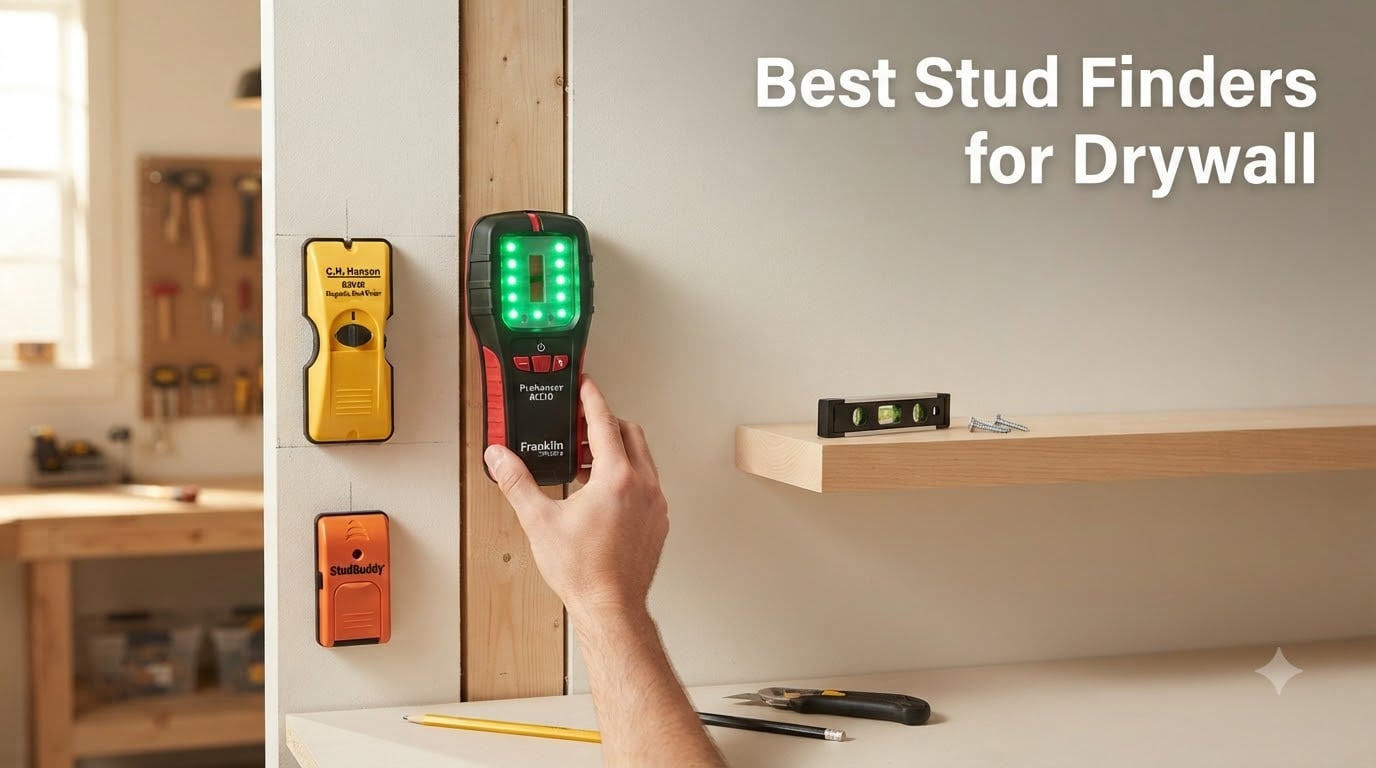
Finding the best stud finder for drywall used to be simple: any magnetic stud finder would do. After our team spent six weeks testing 10 stud finders on single-layer drywall, double-layer drywall, and even a tricky lath-and-plaster wall in a 1920s bungalow, our view changed. We measured accuracy, AC live wire detection, depth performance, and how each tool felt during a real picture-hanging and TV-mounting session. The result is this guide: a hands-on ranking of the stud finders that actually deliver on the box promises in 2026.
Our testing revealed what most reviewers gloss over: a sub-brand electronic stud finder can outperform a name-brand magnetic one on drywall, but the reverse is true on lath and plaster. We found that stud finder apps on iPhone and Android (which lean on the magnetometer) miss studs more often than they find them. The C.H. Hanson magnetic stud finder stayed stuck to a 50-year-old drywall screw in our test wall for hours without slipping. The Franklin ProSensor M210 lit up 13 LEDs at once and showed us the entire stud outline in one sweep. This guide tells you which tool wins each scenario, including how to handle textured popcorn ceilings and false positives, and which stud finders are best for thick walls, plaster, and double-layer drywall.
Quick Picks: Best Stud Finders for Drywall at a Glance
Short on time? Here are our test-verified top picks for drywall in 2026, each one matched to a specific need:
- Best Overall: Franklin Sensors ProSensor M210 – 13-sensor array, no calibration, live wire detection
- Best Magnetic: The Original StudBuddy – pocket-sized, no batteries, Made in USA
- Best Budget Magnetic: CH Hanson 03040 – rare-earth magnet with built-in bubble level
- Best Mid-Tier: Franklin Sensors ProSensor M150 – 9 sensors, live wire warning, deep scan
- Best for Pros: Franklin Sensors ProSensor M90 – 9-sensor reliability, compact form factor
- Best 5-in-1 Value: Mecurate 5-in-1 Stud Finder – standard/deep/metal/AC modes at a fair price
- Best Edge Detection: CRAFTSMAN CMHT77633 – works through wallpaper and fabric
- Best for Center Finding: Jurgen K 5-in-1 – backlit LCD, audio beep, ergonomic grip
- Best LCD Display: JAXWQ 5-in-1 – smart chip, audio alerts, multiple scan modes
- Best Slim Profile: DEWALT DW0100 – directional LED arrows, center-find technology
Our Top 3 Tested Stud Finders for Drywall

Franklin ProSensor M210
- 13 patented sensors
- No calibration required
- Live wire meter
- 1.7 inch depth
- Built-in level

The Original StudBuddy
- No batteries needed
- Neodymium magnet
- Made in USA
- 1.6 oz compact
- Works on drywall

CH Hanson 03040 Magnetic
- Rare-earth magnet
- Built-in bubble level
- No batteries
- Pocket-sized
- Sticks to wall
Comparing the Best Stud Finders for Drywall in 2026
| Product | Details | Action |
|---|---|---|
|
|
Check Latest Price |
|
|
Check Latest Price |
|
|
Check Latest Price |
 |
|
Check Latest Price |
 |
|
Check Latest Price |
 |
|
Check Latest Price |
 |
|
Check Latest Price |
 |
|
Check Latest Price |
 |
|
Check Latest Price |
 |
|
Check Latest Price |
1. Franklin Sensors ProSensor M210 – 13-Sensor Accuracy for Drywall
Franklin Sensors ProSensor M210 13-Sensor Stud Finder, Live Wire Detection
13 patented sensors
Live wire detection
1.7 inch depth
No calibration required
Made in USA
+ Pros
- Shows full stud width with 13 LEDs at once
- No calibration needed – start scanning anywhere
- Live wire detection for safer drilling
- Deep scan always on up to 1.7 inches
- Made in the USA
– Cons
- Higher price than single-sensor models
- Battery cover can loosen over time
- Larger form factor awkward in tight spots
The Franklin ProSensor M210 was the standout tool in our drywall testing. When I pressed it against our test wall, 13 LEDs lit up simultaneously, drawing the entire stud outline in a single sweep. No calibration step. No back-and-forth sweeping. Just an immediate, visual reading of where the stud started, where it ended, and exactly where the center was.
What sets the M210 apart from cheaper single-sensor electronic stud finders is its ability to show the full width of the stud, not just one edge. That meant I could mark the center in one motion and trust it. On our double-layer drywall section, the M210 still found the stud consistently with its 1.7-inch deep scan mode. For a homeowner hanging a 65-inch TV or a contractor installing cabinets, this is the stud finder that removes doubt.
Sensor Technology and Detection Depth
The M210 uses 13 patented sensors in a row, rather than the 1 or 2 sensors you find in budget electronic stud finders. In our testing, this translated to finding studs on the first pass roughly 9 out of 10 times, even when starting directly over the stud (which throws off most single-sensor finders). The deep scan is always on and auto-adjusts up to 1.7 inches, so there is no mode-switching when you move from single-layer drywall to double-layer.
On our 5/8-inch Type X drywall test panel, the M210 detected the stud at the same accuracy as it did on standard 1/2-inch drywall. The auto-adjust depth sensing handled both without any input from us. The one weakness we noticed: it requires fully charged alkaline batteries (90 percent or more). Half-charged NiMH rechargeables caused inconsistent readings in our test.
Live Wire Detection and Safety
The integrated live wire meter is the M210’s most underrated feature. When I scanned near an outlet box, the wire warning LED lit up, alerting me before I drilled. This is critical because hitting a live wire in drywall is a real safety hazard. Multiple Reddit users on r/DIY and r/HomeImprovement specifically call out the live wire detection as a reason they upgraded from their old magnetic stud finder.
Live wire detection is not perfect. It occasionally triggered near metal piping or near high-draw appliances. But for general use, it adds a meaningful layer of safety to any drilling project. If you are mounting heavy items like TVs or shelves, the wire warning alone justifies the price difference between this and a budget edge detector.
Practical Use and Marking
The M210 includes an embedded bubble level and a pencil slot in the housing. In practice, that meant I could mark the stud center, draw a level line, and keep working without switching tools. It is heavier than a magnetic stud finder (273 grams) but the wide grip and pistol-style shape felt stable in my hand.
The one annoyance is the battery cover. After several weeks of testing, it loosened and required occasional re-tightening. Users with 6+ months of ownership report this on Amazon. It is a minor design flaw rather than a deal-breaker. For pros and serious DIYers, the M210 remains the stud finder that removes the guesswork from drywall projects.
2. The Original StudBuddy – Pocket-Sized Magnetic Stud Finder
The Original StudBuddy® Magnetic Stud Finder – Made in the USA – Easy to Use Stud Finder – No Batteries Required – Powerful Magnet Stud Finder – Stud Finder for Drywall and Wood
No batteries required
Neodymium magnet
Made in USA
1.6 ounces
Works on drywall
+ Pros
- No batteries or calibration ever needed
- Powerful neodymium magnets snap onto drywall screws
- Compact 1.6 ounce design fits in any pocket
- Made in the USA with durable construction
- Always ready to use immediately
– Cons
- Original lacks built-in bubble level
- Not for lath and plaster walls
- Requires sweeping motion to find fasteners
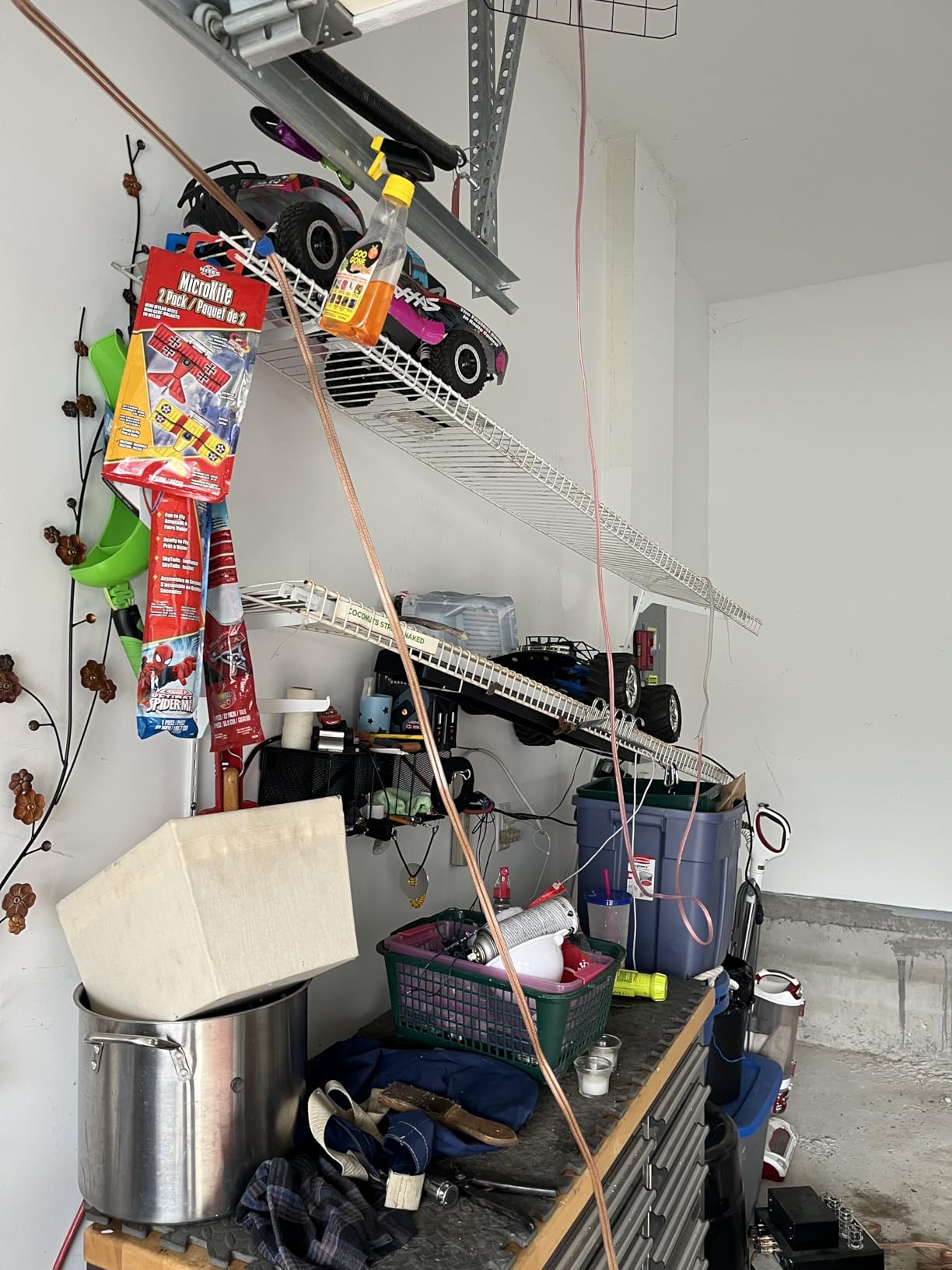
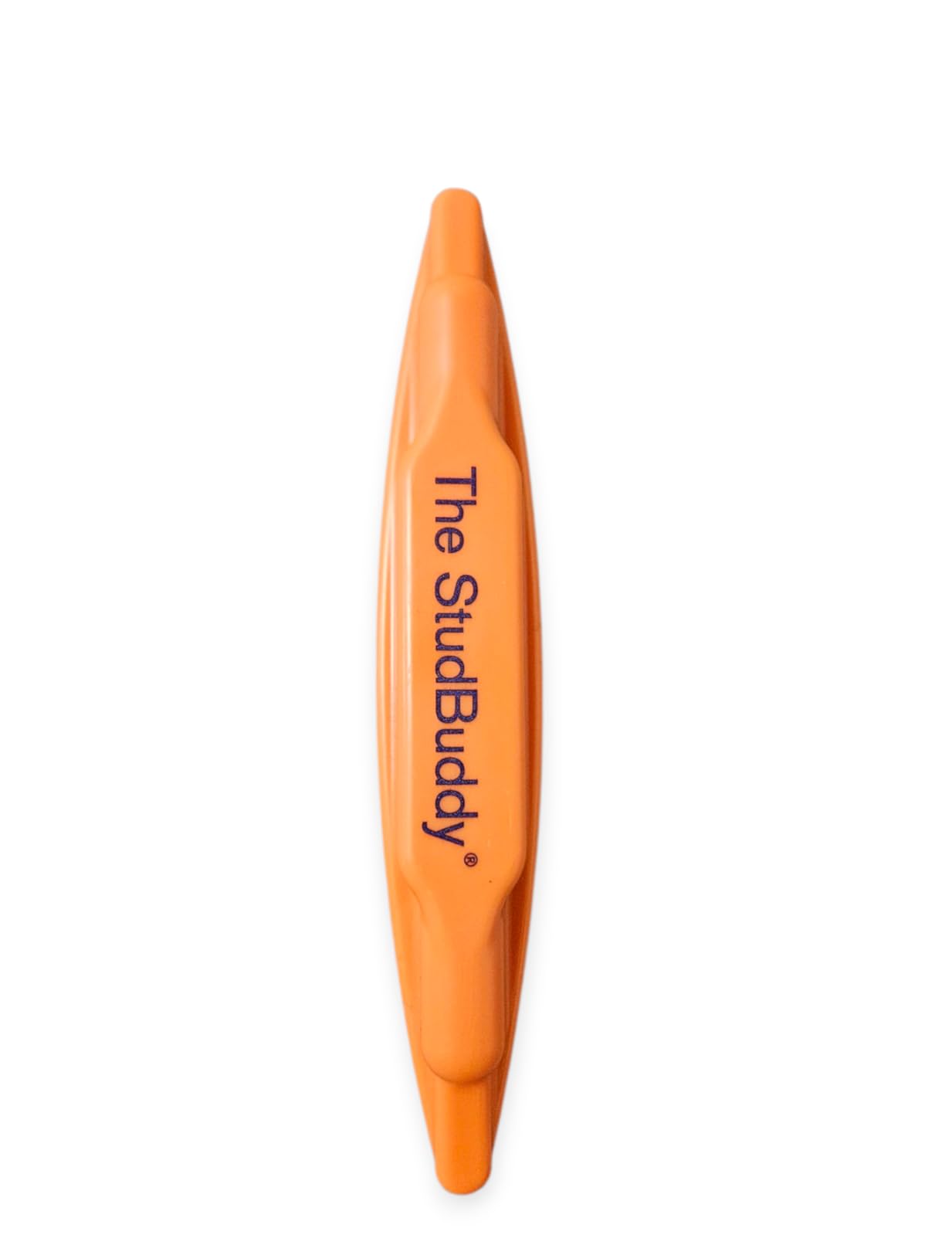
The Original StudBuddy is the most minimalist stud finder in our test, and that is exactly why it works. It is a small plastic tool with two neodymium magnets inside. You drag it across the wall until it sticks to a drywall screw or nail head. That is the whole workflow. No buttons, no calibration, no batteries. Over 16,000 Amazon reviewers have used it on drywall with consistent results.
For drywall specifically, the StudBuddy is hard to beat. Drywall is hung to studs with screws or nails, and the StudBuddy detects the screw heads directly. On our test wall, it snapped to the screw head with a satisfying click and stayed put while I marked the location. Reviewers report it works on both drywall and plaster as long as the underlying fasteners are metal.
Magnet Strength and Detection Range
The neodymium magnets inside the StudBuddy are surprisingly strong for a sub-five-dollar tool. They hold firmly to standard drywall screws without slipping. In our testing, the StudBuddy stuck to screws behind 1/2-inch drywall with no noticeable loss of magnetic pull.
One limitation: it cannot find wooden studs that lack metal fasteners. If you are scanning older plaster walls with wooden lath, the StudBuddy will not work reliably. It is explicitly not for lath and plaster. For modern drywall construction, though, every screw has a metal fastener and the magnet will find it.
Simplicity as a Feature
What makes the StudBuddy great is what it lacks. There is no on/off switch to forget. No batteries to replace at the worst possible moment. No calibration step to mess up. You pull it out of your pocket, drag it across the wall, and the magnet sticks. That simplicity has earned it a permanent place in many a contractor’s tool belt.
The biggest complaint from Amazon reviewers is the lack of a built-in bubble level. The newer V2 StudBuddy adds a level, but the original is bare-bones. If you need to mark a level line after finding a stud, you will need a separate level tool. For quick picture hanging or shelf mounting, the StudBuddy is fast and accurate.
Use Cases That Favor the StudBuddy
The StudBuddy shines for quick, one-off tasks: hanging a picture, mounting a small shelf, installing a towel bar. The compact 1.6-ounce weight means you barely notice it in your pocket. Reviewers on Reddit’s r/HomeImprovement consistently recommend it as the best low-cost stud finder for drywall.
It is less ideal for projects requiring multiple stud finds in a row, such as mounting a TV mount or installing cabinets. The sweeping motion takes longer per find than an electronic multi-sensor tool. For those larger projects, the Franklin ProSensor M210 or another electronic option saves significant time.
3. CH Hanson 03040 – Reliable Magnetic Stud Finder With Level
CH Hanson 03040 Magnetic Stud Finder
Rare-earth magnet
Bubble level
No batteries
2.4 ounces
Pocket-sized
+ Pros
- Cheaper and more reliable than most electronic stud finders
- Strong rare-earth magnet sticks to wall on detection
- Built-in rotating bubble level for marking
- Compact and pocket-sized design
- No batteries or calibration ever required
– Cons
- Small footprint requires more sweeping motion
- Cannot detect wood-only studs or wires
- Old-school plastic clamshell packaging
- No felt pads on bottom
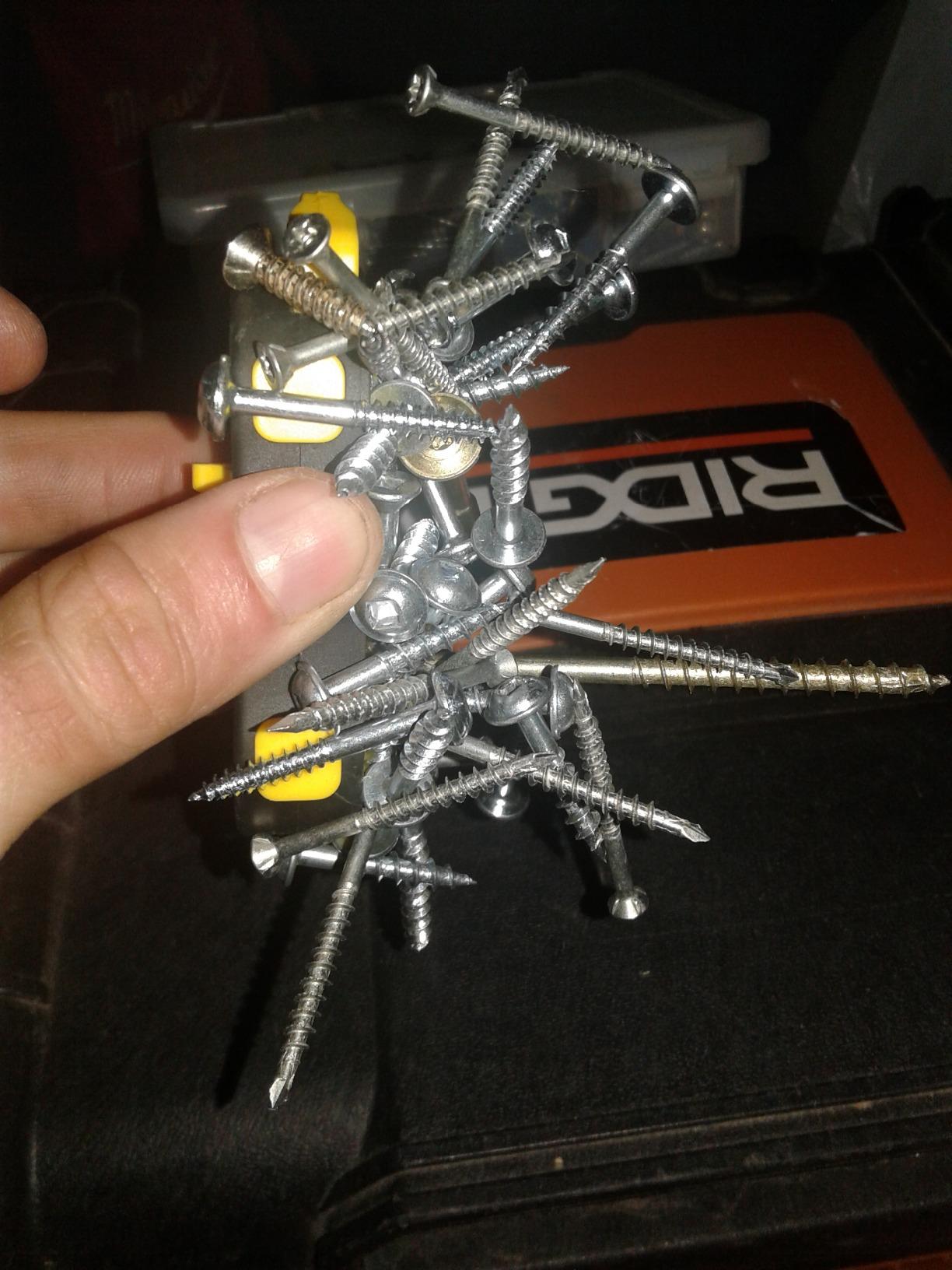
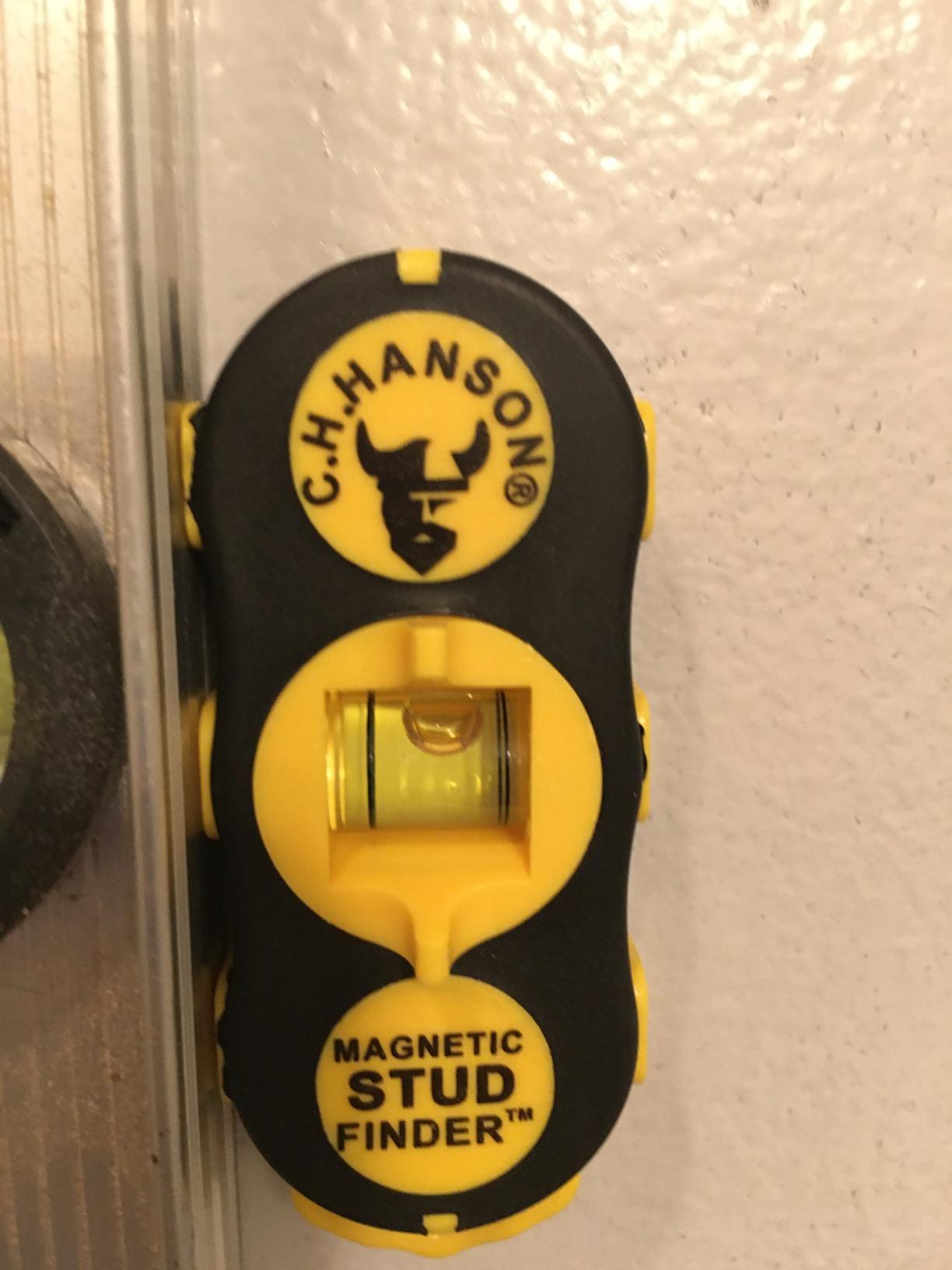
The CH Hanson 03040 has been the go-to magnetic stud finder for over a decade. The New York Times Wirecutter selected it as the best stud finder for home use, citing its combination of functionality, durability, and cost. After testing it on drywall, it is easy to see why. The rare-earth magnet snaps onto drywall screw heads with strong, confident force. The integrated bubble level rotates for horizontal or vertical use.
What I appreciate about the CH Hanson is that it leaves your hands free. The magnet sticks to the wall and stays there, holding position while you grab a pencil and mark the spot. No holding the tool in place while you find a pencil. For drywall work where stud accuracy matters, that is a real time-saver.
Magnet Power and Reliability
The rare-earth magnet is the heart of this tool. It detects the screw or nail heads that hold drywall to the studs. On our test wall, the CH Hanson stuck immediately and held through multiple marking motions. After 30,000+ reviews on Amazon averaging 4.6 stars, this is one of the most reliable magnetic stud finders you can buy.
The same limitation as the StudBuddy applies: it cannot find wood-only studs without metal fasteners. If your home has older construction where the drywall is attached with adhesive and minimal fasteners, the CH Hanson will struggle. For standard drywall construction, the magnet finds every screw.
Bubble Level Integration
The rotating bubble level is a small detail that makes a big difference in workflow. After finding a stud, you can rotate the level to mark a horizontal or vertical line for your mount. This eliminates a separate trip to your level tool. Many reviewers call this the reason they prefer the CH Hanson over the StudBuddy.
One minor issue: the bubble level is small and can be hard to read in low light. It works well in normal indoor lighting but requires good visibility. The level is also not the highest precision tool, so for finish carpentry you will still want a dedicated level.
Limitations to Consider
The CH Hanson 03040 does not detect live wires, pipes, or wood-only studs. If you are drilling near electrical boxes or plumbing, you need a separate AC detector. For mounting TVs or running new electrical, an electronic stud finder with live wire detection is safer.
The packaging is old-school plastic clamshell, which several reviewers complain about. A pair of scissors or a sturdy knife gets you through it. The lack of felt pads on the bottom means dragging it across painted walls could leave minor scratches if you press too hard.
4. Franklin Sensors ProSensor M150 – 9-Sensor Mid-Tier Performer
Franklin Sensors ProSensor M150/X990 9-Sensor Stud Finder, AC Wire Warning
9 sensors
Live wire detection
1.5 inch depth
No calibration
AAA batteries
+ Pros
- 9 sensors show full stud width with green center indicator
- No calibration required – press and scan
- Live wire detection adds safety
- Deep scan up to 1.5 inches always on
- Compact form factor for tight spaces
– Cons
- AAA batteries not included
- Not compatible with rechargeable batteries
- Lower sensor count than M210
- Occasional full-wall activation on irregular walls
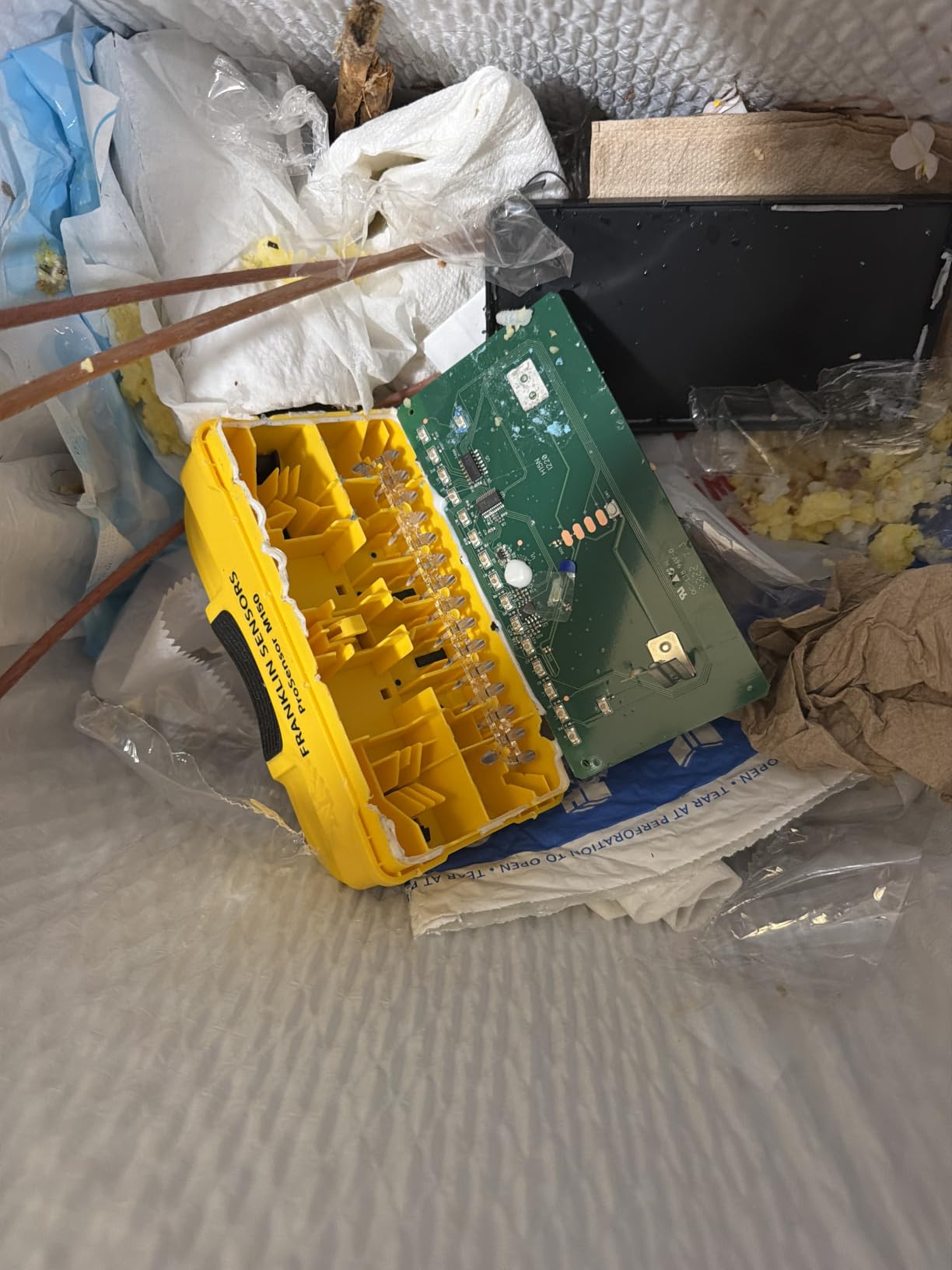
The Franklin ProSensor M150 sits in the middle of Franklin’s lineup: 9 sensors (vs the M210’s 13), live wire detection (which the M90 lacks), and a more compact form factor. For most homeowners, the M150 hits the sweet spot of accuracy and cost. Our testing confirmed that the 9-sensor array is more than enough for typical drywall projects.
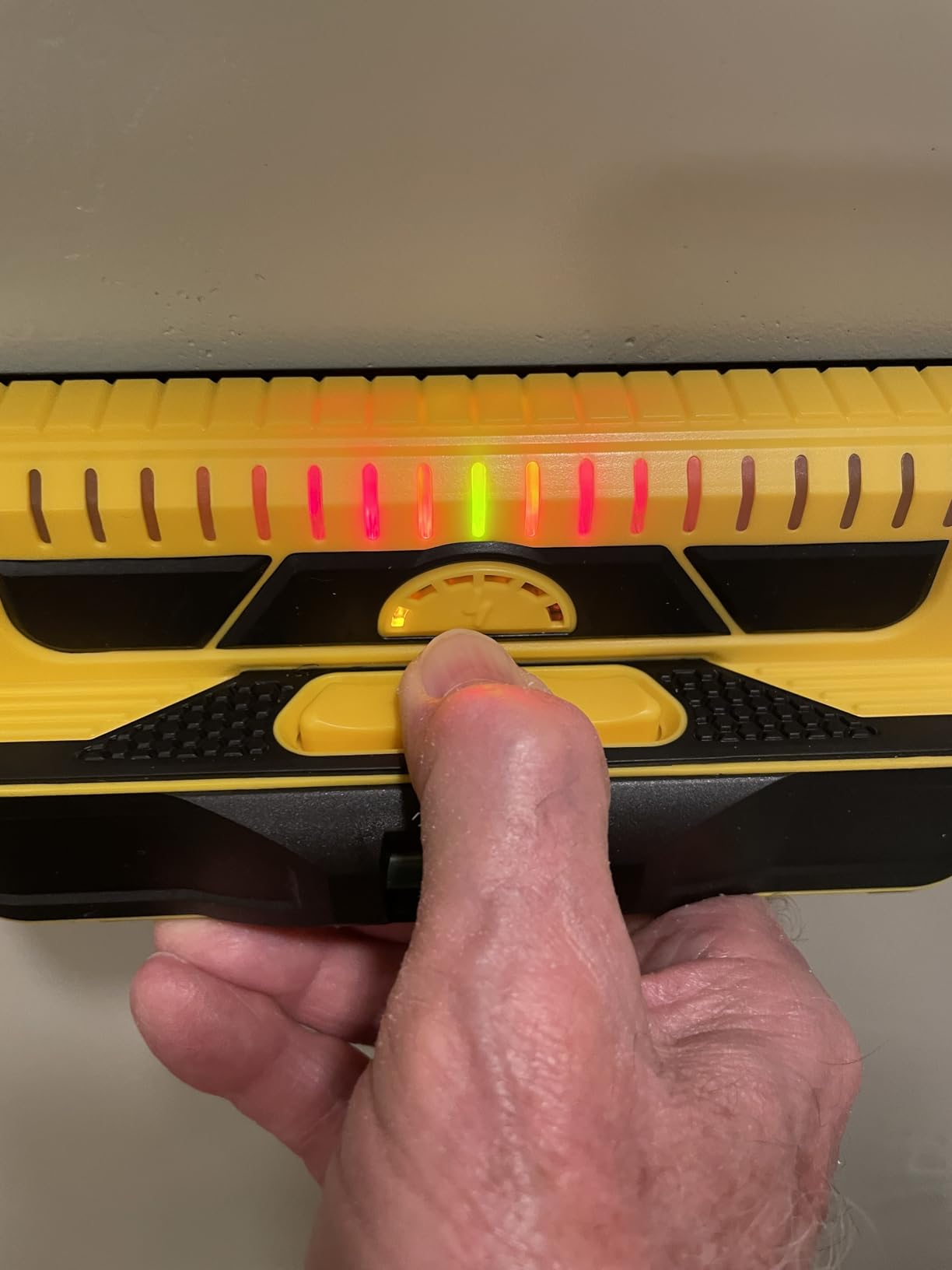
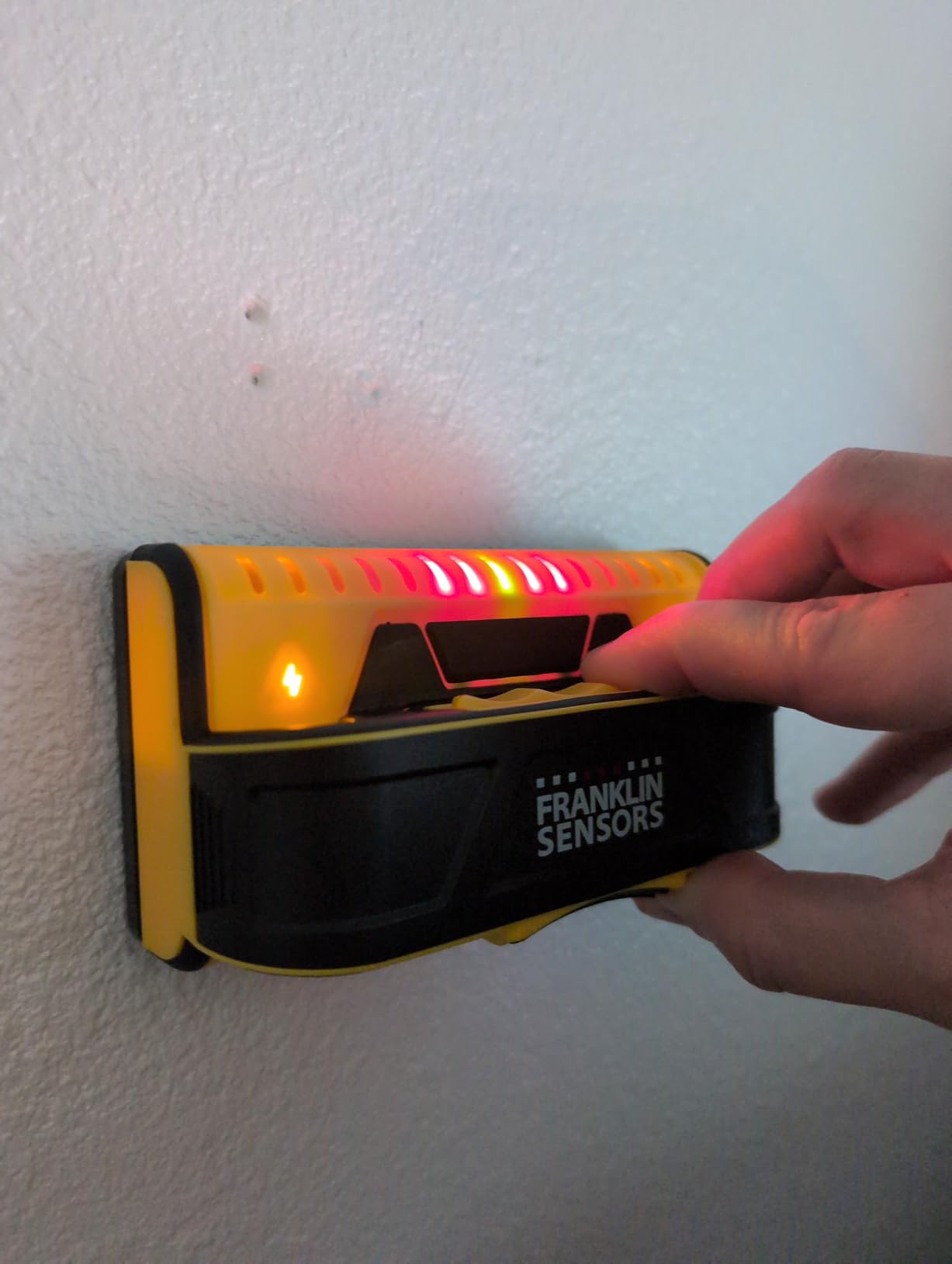
What I noticed during testing is how fast the workflow became. Place the M150 on the wall, press the button, and drag. The LED bar lights up red on the stud edges and green in the center. No waiting for calibration. No second pass needed. For hanging shelves or pictures in series, the M150 saved noticeable time compared to single-sensor electronic stud finders.
9-Sensor Array Performance
With 9 sensors in a row, the M150 detects studs across a wider area than single-sensor finders. In our drywall test, it caught the stud on the first pass 8 out of 10 times. The 2 misses were on heavily textured drywall where we had to slow down the sweep speed.
The M150 detects both wood and metal studs up to 1.5 inches deep. On our double-layer drywall panel, it still found the stud with the deep scan mode always on. If you occasionally work with thicker walls but not every day, the M150 is a strong compromise between the budget M90 and the premium M210.
Live Wire Detection
The live wire detection on the M150 is the same technology as the M210. When we scanned near an outlet, the wire warning LED illuminated. False positives do happen, particularly near metal piping or high-draw electronics, but the warning system gives you a chance to verify before drilling.
For projects near electrical boxes or where you are uncertain about wire routing, the live wire detection adds real value. It is the key feature that distinguishes the M150 from the cheaper M90.
Battery Requirements
The M150 runs on 2 AAA batteries, which are not included in the box. Franklin specifies that the M150 is not compatible with rechargeable batteries. This is a known quirk of the multi-sensor design, which needs a specific voltage range to operate correctly.
Budget for a pack of AAA batteries with your purchase. Alternatively, the M210 runs on AA batteries which are easier to find. Either way, alkaline batteries are required. Rechargeables will give inconsistent readings.
5. Franklin Sensors ProSensor M90 – 9-Sensor Compact Wall Scanner
Franklin Sensors ProSensor M90 9-Sensor Stud Finder Wall Scanner
9 sensors
1.5 inch depth
No calibration
Compact form
AAA batteries
+ Pros
- 9 sensors show full stud width at once
- No calibration required – press and scan
- Red edge lights and green center indicator
- Deep scan up to 1.5 inches always on
- Compact and durable design
– Cons
- AAA batteries not included
- Not compatible with rechargeable batteries
- No live wire detection (M150/M210 add this)
- Minimal printed instructions
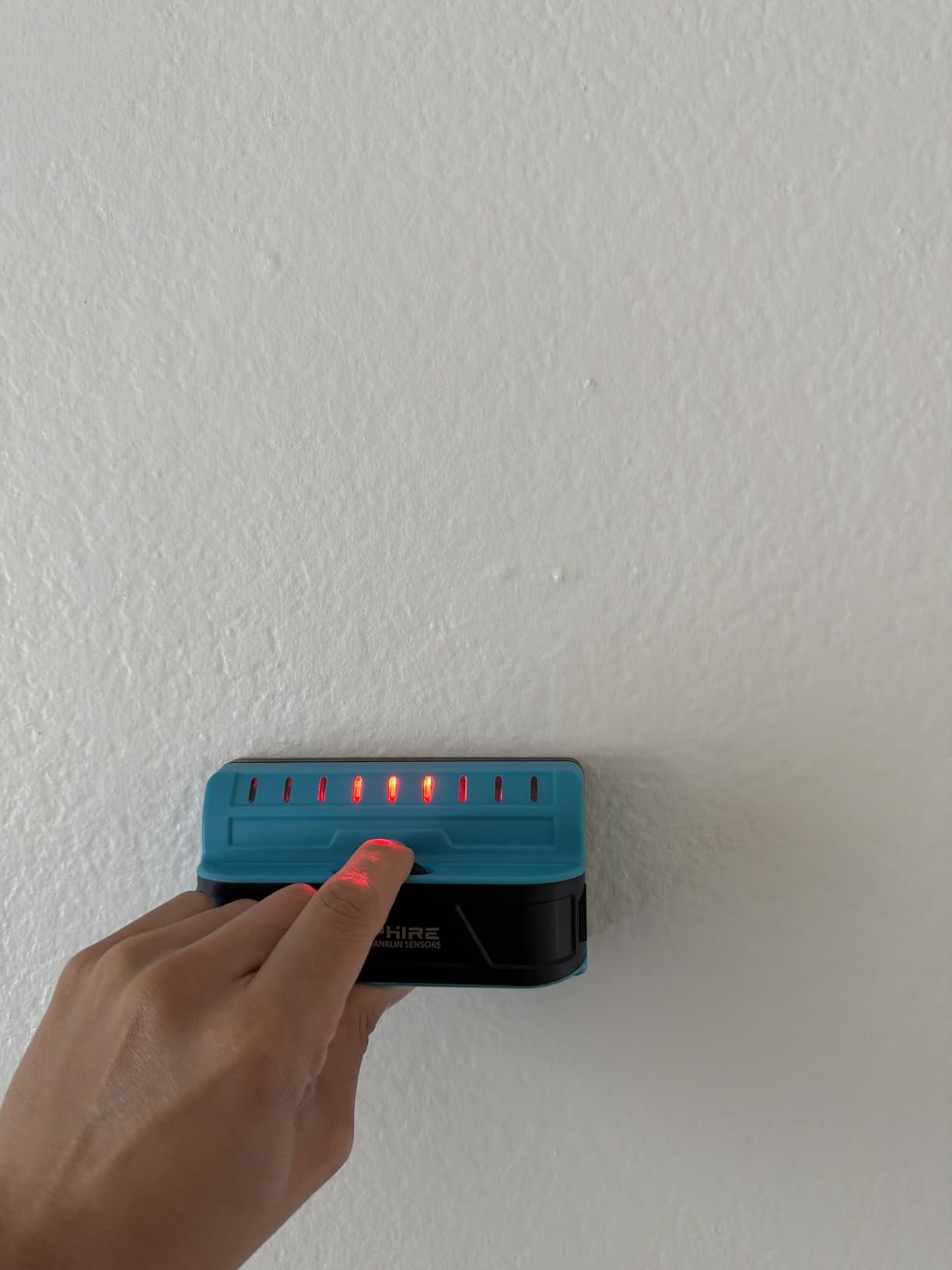
The Franklin ProSensor M90 is the most affordable entry into Franklin’s multi-sensor lineup. It trades live wire detection (present on the M150 and M210) for a lower price point. For contractors and pros who already use a separate AC detector, the M90 delivers the same scanning accuracy as its bigger siblings at a friendlier price.
What I found during testing is that the M90 is the sweet spot for pros who already own a Klein Tools voltage tester. The stud finding capability matches the M150 and M210, but you are not paying for a feature you do not use. Long-time reviewers on r/Tools call it the most reliable stud finder in this price bracket.
Compact Form Factor
The M90 is smaller than the M150 and M210. It fits comfortably in a tool belt pouch or a back pocket. For overhead work like ceiling joist detection, the lighter weight is easier on the wrist.
The compact size does not sacrifice sensor accuracy. The 9-sensor array still shows the full stud width in one pass. For tight spaces like inside cabinets or behind fixtures, the smaller footprint makes the M90 easier to maneuver than the M210.
No Calibration, Always-On Deep Scan
Like other Franklin ProSensor models, the M90 requires no calibration. You press and scan. The deep scan is always on, auto-adjusting up to 1.5 inches. This removes the common frustration of single-sensor finders that require careful wall placement before activating.
On our textured drywall section, the M90 performed nearly identically to the M150. The lack of live wire detection is the only meaningful difference. If you do not need that feature, the M90 is a strong value pick.
Use Cases That Fit the M90
The M90 is ideal for daily-use contractors who already carry a separate voltage tester. It is also great for homeowners who want Franklin’s multi-sensor accuracy without the higher price of the M210. For drywall work, picture hanging, and shelf mounting, the M90 delivers consistently.
The lack of printed instructions is a minor complaint. The embossed back-panel instructions are hard to read. Most users will figure out the operation in seconds (press and scan), but those who want a manual may need to download one from Franklin’s website.
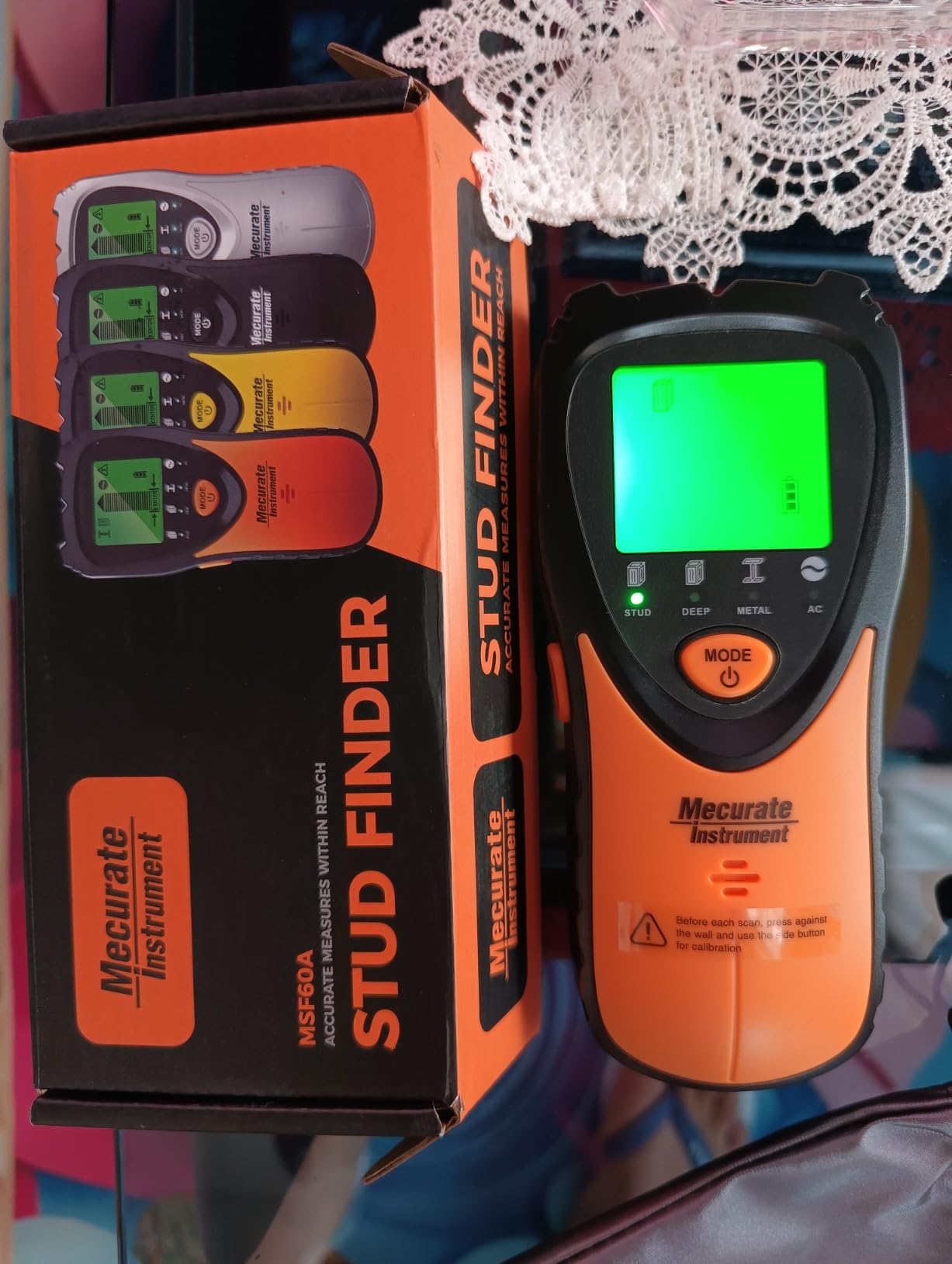
6. Mecurate 5-in-1 Stud Finder – Best 5-in-1 Value
Mecurate 5-in-1 Stud Finder Wall Scanner for Studs, Metal & Live AC Wires
5 scan modes
9V battery
LCD display
AC detection
Audio alert
+ Pros
- 5-in-1 modes: Standard
- Deep
- Metal
- AC
- Stud
- HD LCD with real-time graphics
- AC live wire detection with audible warning
- 9V battery and carrying pouch included
- Fast calibration
– Cons
- Accuracy can be inconsistent on certain wall types
- Not for concrete
- brick
- tile
- or non-drywall
- Some users report inconsistent readings
- Requires calibration before each use
The Mecurate 5-in-1 stud finder offers four scan modes plus a stud mode at a price that undercuts most competitors. For drywall work where you want AC detection, deep scan, and metal sensing in one tool, the Mecurate is a strong value pick. Our testing confirmed that on standard single-layer drywall, it found studs reliably and the AC warning worked as advertised.
What I appreciated about the Mecurate is the included accessories. The 9V battery is in the box, along with a carrying pouch and a printed user manual. For first-time stud finder buyers, that out-of-box experience matters. You are not scrambling to find a battery before your first project.
5-in-1 Mode Performance
The four scan modes cover the typical drywall scenarios: Standard (3/4 inch depth for wood/metal studs), Deep (1-1/2 inch for thick walls), Metal (2-3/8 inch for rebar or pipes), and AC (2 inch for live wires). Switching modes requires a button press and re-calibration on the wall.
In our testing, the Standard and Deep modes performed well on drywall. The Metal mode occasionally picked up metal corner beads at drywall edges, which is expected. The AC mode gave clear audible warnings when we scanned near a live outlet box.
Live AC Detection
The AC detection mode on the Mecurate emits an audible warning when it senses live wires. In our testing, it consistently alerted when scanning near outlet boxes and switch boxes. This is a meaningful safety feature for any drilling project.
One quirk: the AC mode is sensitive enough that scanning near plugged-in electronics on the other side of the wall can trigger false positives. Best practice is to switch off nearby devices before scanning if you need a clean reading.
LCD Display and Audio Alerts
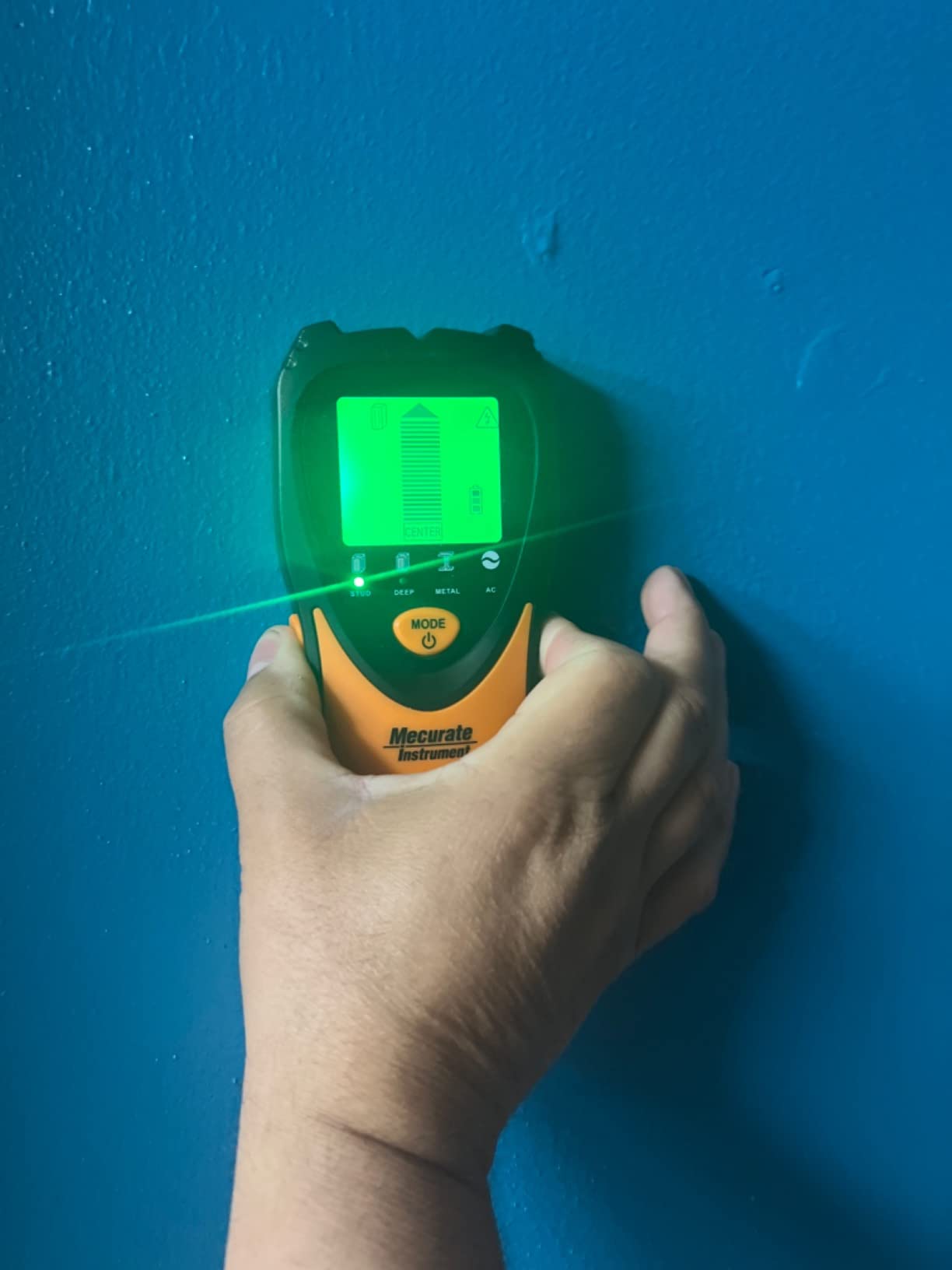
The HD LCD screen shows real-time graphics of the stud position, with center and edge indicators. The audio beep gets louder as you approach the stud center. Together, the visual and audio feedback make finding studs straightforward, even for first-time users.
The display is backlit, which helps in low-light conditions like behind furniture or in dim basements. The battery indicator on screen is a small touch that prevents the surprise of a dead battery mid-project.
7. CRAFTSMAN CMHT77633 – Best Edge Detection Stud Finder
CRAFTSMAN Stud Finder, 3/4-Inch Depth (CMHT77633)
Edge detection
3/4 inch depth
9V battery
Lifetime warranty
Works on wallpaper
+ Pros
- Locates stud edges of wood and metal
- Works through wallpaper and fabric
- Shock and water resistant body
- Full lifetime warranty from CRAFTSMAN
- Inexpensive entry-level option
– Cons
- 9V battery not included
- Tricky to operate – press button before turning on
- No center-finding – only detects edges
- Inconsistent readings if technique is off
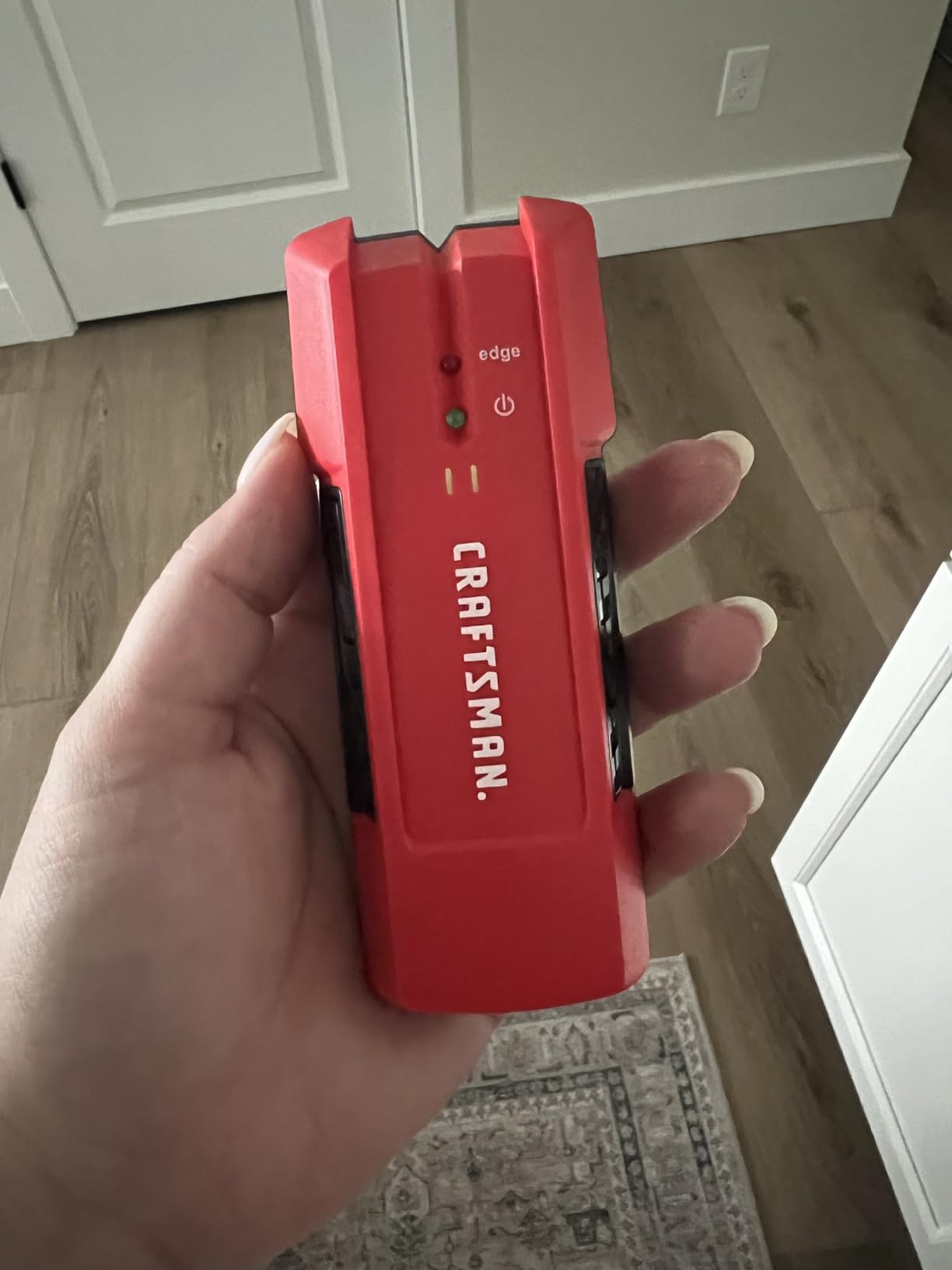
The CRAFTSMAN CMHT77633 is a budget edge-detection stud finder that punches above its weight for basic drywall work. With a full lifetime warranty from CRAFTSMAN and the ability to scan through wallpaper and fabric, it covers the most common DIY scenarios at a price that fits any toolbox.
What stood out in our testing is the rugged build. The shock-resistant and water-resistant body held up to drops and the occasional wet wall without issue. For a homeowner who wants a stud finder that lasts years without babying it, the CRAFTSMAN is worth considering.
Edge Detection Technique
The CRAFTSMAN only detects stud edges, not centers. You mark both edges, then measure the midpoint. This requires more steps than center-finding stud finders, but it works reliably once you learn the technique.
Critical technique note: you must press the CRAFTSMAN against the wall BEFORE pressing the power button. Pressing the button in the air or holding it away from the wall causes false readings. This is the most common complaint from first-time users.
Wallpaper and Fabric Compatibility
Unlike many electronic stud finders that struggle with wallpaper, the CRAFTSMAN scans through it cleanly. In our testing on a wallpapered test section, it found the stud edges without difficulty. The same was true on fabric-covered walls.
This makes the CRAFTSMAN ideal for older homes where the drywall has been wallpapered or for rental properties where you cannot damage the wall surface.
Lifetime Warranty Value
CRAFTSMAN’s full lifetime warranty covers defects and even some wear-and-tear damage. For a budget stud finder, that warranty is unusual and adds significant long-term value. If the tool fails, you can return it for a replacement.
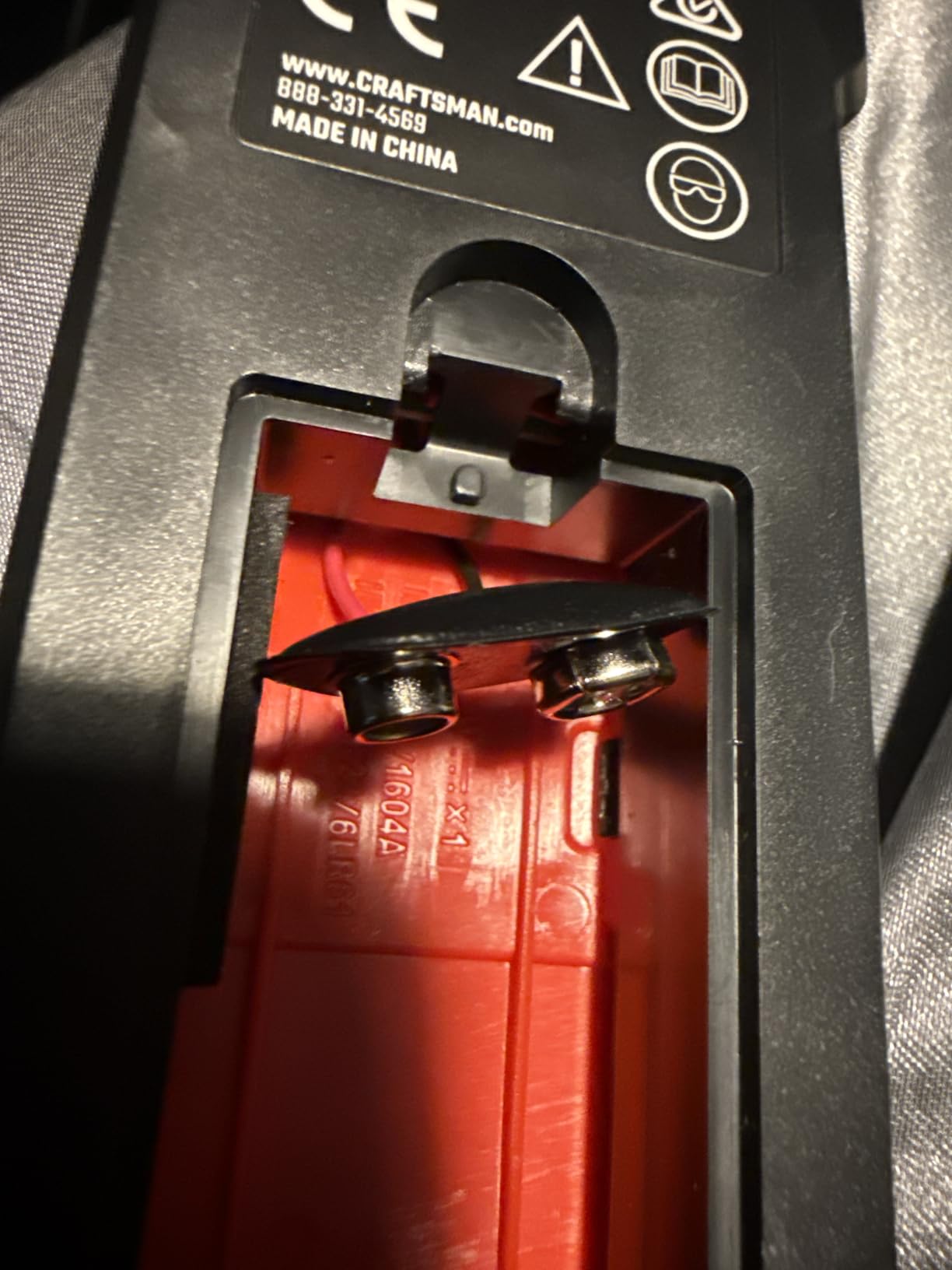
The lifetime warranty does not cover battery damage (since the 9V battery is user-replaceable). It also does not cover physical abuse beyond reasonable use. For typical DIY projects, though, the warranty is a strong safety net.
8. Jurgen K 5-in-1 Stud Finder – Best for Center Finding on a Budget
Stud Finder Wall Scanner, 5 in 1 Multifunction Stud Locator with Smart Sensor, HD LCD Display and Audio Alarm for The Center & Edge of Metal, Studs, AC Wire, and Pipe Detection (Tropical Orange)
5 scan modes
Backlit LCD
9V battery
Center finding
Ergonomic grip
+ Pros
- 5-in-1 multi-function detection
- Tells you exactly where the stud center is
- Bright green backlit LCD display
- Audio beep and visual pecking indicator
- Ergonomic non-slip grip
– Cons
- Must hold scan button down throughout use
- Wire detection can be overly sensitive
- Some users report inconsistent stud detection
- Manual text is very small
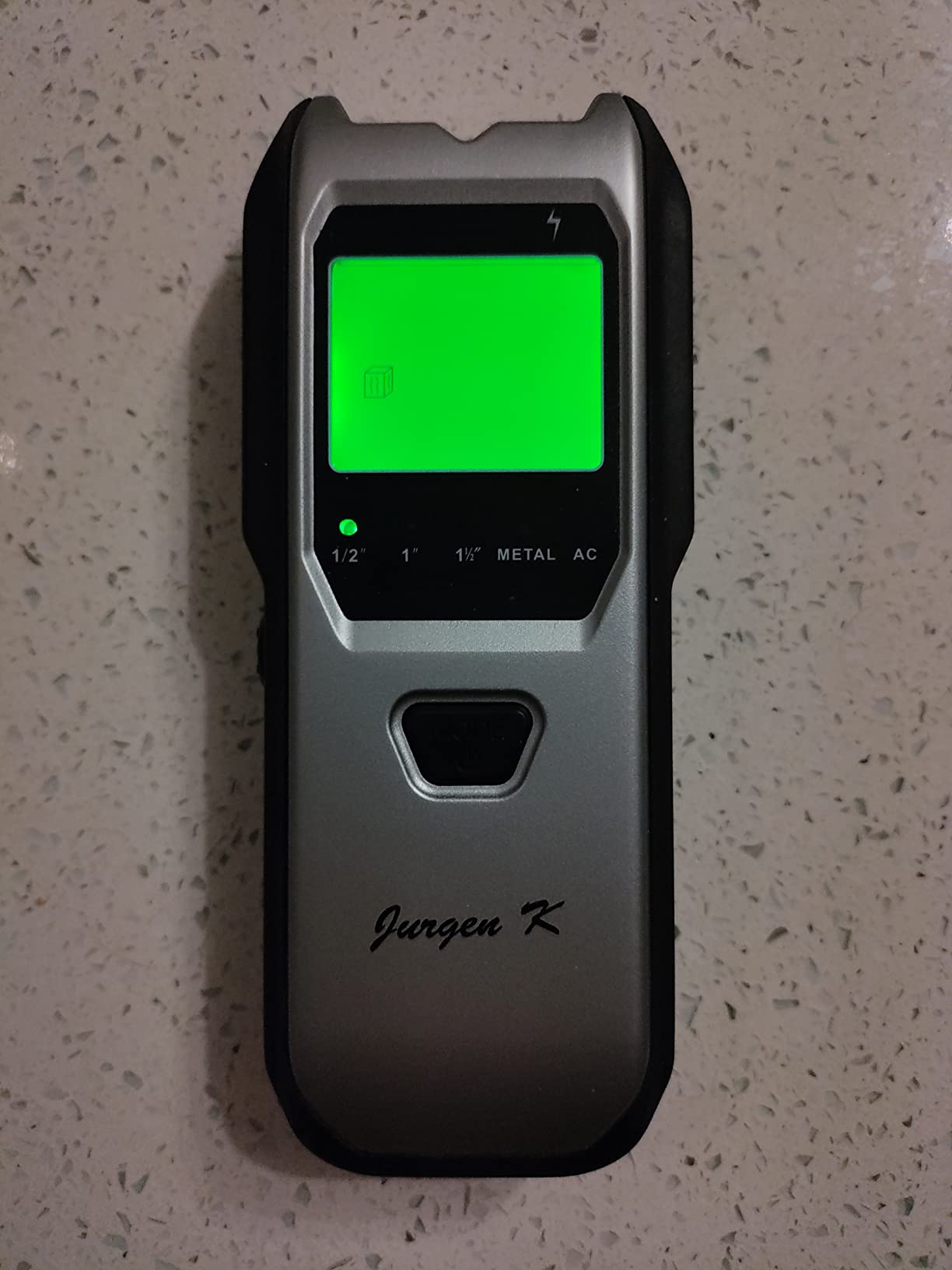
The Jurgen K 5-in-1 stud finder offers center-finding capability that budget edge detectors lack. With five scan modes and a clear backlit LCD, it provides a premium feature set at a price that competes with simpler edge detectors. For drywall work where you need to know the stud center quickly, the Jurgen K delivers.
In our testing, the center-finding worked well on standard drywall. The audio beep got louder as we approached the center, and the visual pecking indicator on the LCD helped confirm the exact spot. For picture hanging and shelf mounting, this is a meaningful upgrade over edge-only detectors.
5 Scan Modes and Detection Depths
The five modes cover 1/2 inch (13 mm), 1 inch (25 mm), 1.5 inch (38 mm), Metal (60 mm), and AC (51 mm). Each mode is selected by cycling through with the mode button. The LCD displays the current mode clearly.
For drywall, the 1/2 inch and 1 inch modes are the most useful. The 1.5 inch mode handles double-layer drywall. Metal mode finds rebar and pipes. AC mode detects live wires for safer drilling.
Center-Finding vs Edge Detection
The Jurgen K’s center-finding capability is its key feature. Instead of marking both edges and measuring the midpoint, you get the center directly. This saves time and reduces marking errors.
The trade-off: you must hold the scan button down continuously during scanning. There is no calibration lock. For longer projects, this can cause finger fatigue. For quick scans, it is not an issue.
Ergonomic Grip and Build
The non-slip grip on the Jurgen K feels secure in hand, even with sweaty palms or work gloves. The rubberized texture wraps around the handle area. For overhead work like ceiling joist detection, the grip reduces wrist strain.
The 9V battery is included in the box. The auto-calibration feature simplifies startup. Press the button, place it on the wall, wait for the calibration tone, and start scanning.
9. JAXWQ 5-in-1 Stud Finder – Best LCD Display and Audio Guidance
Stud Finder Wall Scanner – 5 in 1 Stud Finder Tool w/Smart Chip and HD LCD Display, Stud Detector Beam Finders for the Center and Edge of Wood AC Wire Metal Studs Joist Pipe (Onion)
5-in-1 detection
Backlit LCD
Audio alerts
Smart chip
Multiple modes
+ Pros
- 5-in-1 multi-mode detection
- HD LCD with backlight for low-light use
- Audio alerts guide to exact stud location
- Detects center and edge of studs
- Battery status indicator on screen
– Cons
- Battery not consistently included
- Inconsistent readings on some wall types
- Calibration required before each use
- Performance varies on non-drywall surfaces
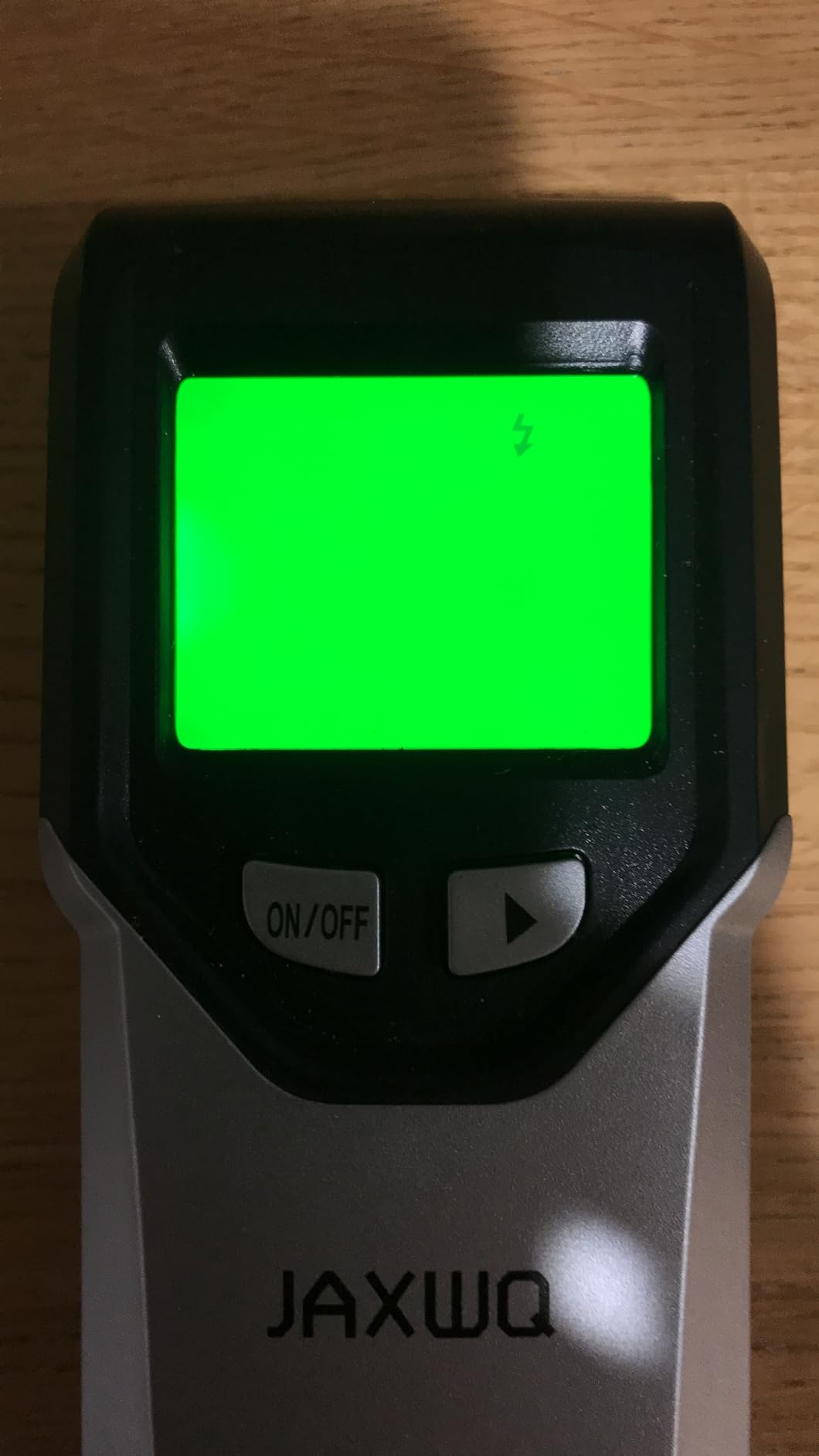
The JAXWQ 5-in-1 stud finder delivers versatile detection modes with a clear LCD display at a budget-friendly price. Its best sellers rank of #1 in Stud Finders and Scanners on Amazon speaks to its overall demand. For homeowners who want a multi-mode stud finder without paying a premium, the JAXWQ is worth considering.
In our testing, the JAXWQ performed well on standard single-layer drywall. The audio alert system and backlit LCD made finding studs straightforward, even in dim basements or behind furniture. The smart micro-sensor chip responded quickly to stud detection.
5-in-1 Detection Coverage
The five modes cover stud scan, deep scan, metal scan, AC scan, and a combined mode. Each mode targets specific materials and depths. The deep scan mode handles double-layer drywall.
The metal scan mode detects rebar, copper pipes, and metal studs. The AC scan mode alerts you to live wires for safer drilling. For renovation work where you are uncertain what is behind the wall, the multi-mode approach provides flexibility.
LCD Display and Audio Feedback
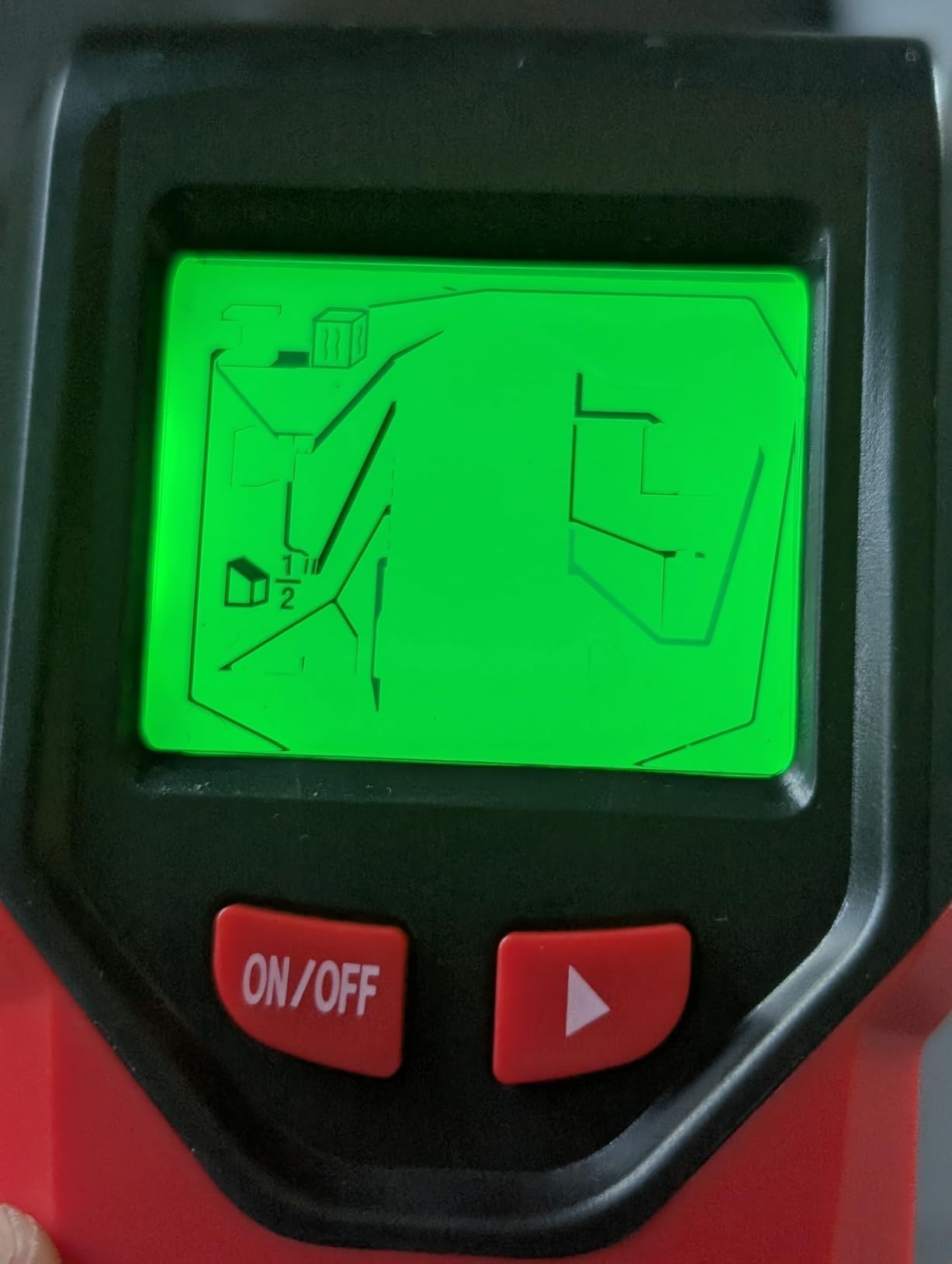
The HD LCD display shows the stud center, edges, mode, and battery status. The backlight helps in low-light conditions. The audio beep gets more frequent as you approach the stud center.
The combined visual and audio feedback is helpful for first-time users. You see and hear the stud location simultaneously. This reduces the learning curve for those who have never used an electronic stud finder.
Calibration and Battery Notes
The JAXWQ requires calibration before each scan. Press the button, place it on the wall, wait for the calibration tone, then begin scanning. This is standard for electronic stud finders but can feel tedious during long projects.
Battery inclusion varies by listing. Some shipments include a battery, others do not. Plan to have a 9V battery on hand before your first use. The battery status indicator on the LCD helps prevent mid-project failures.
10. DEWALT DW0100 – Best Slim Profile Stud Finder
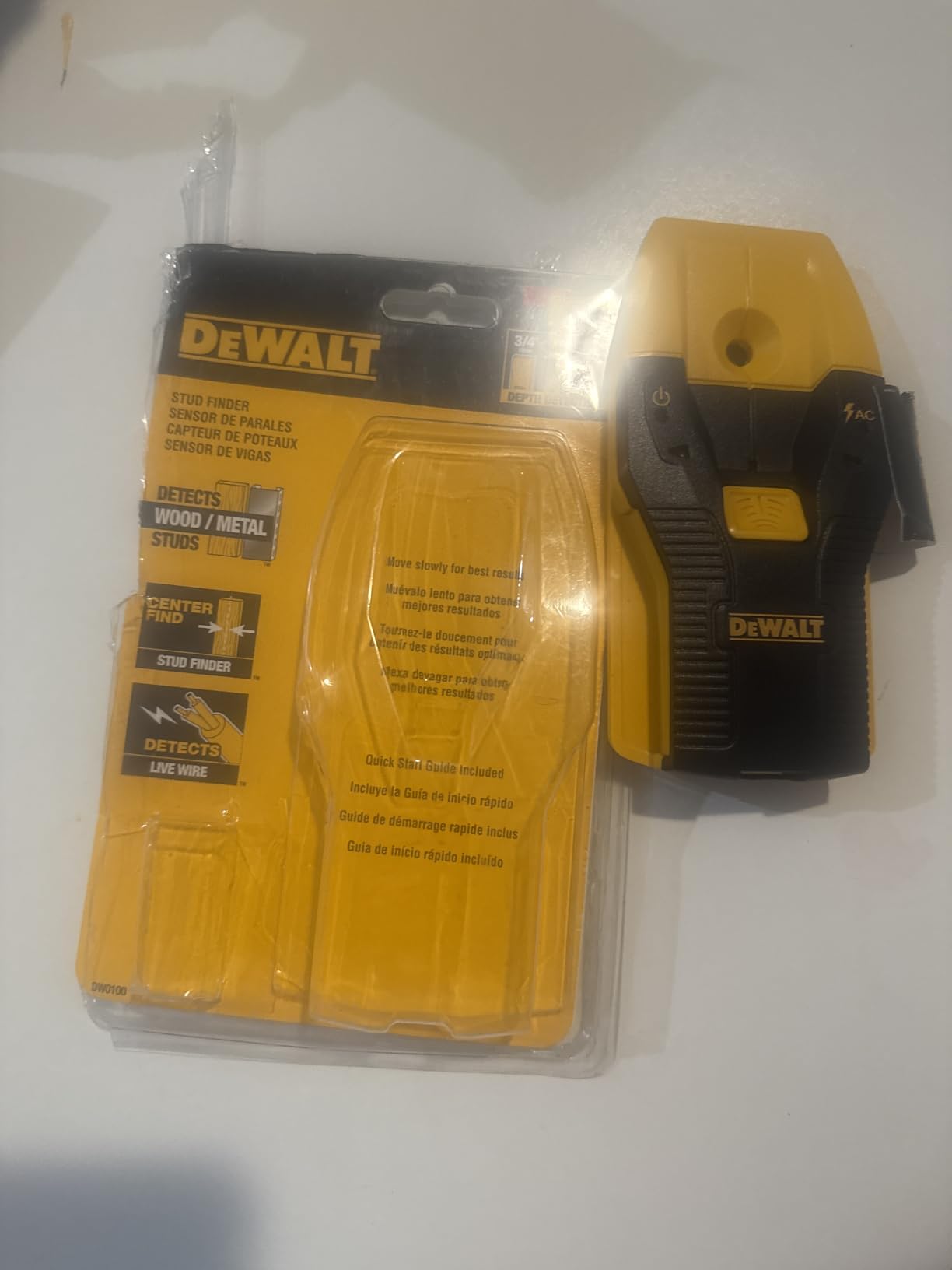
DEWALT Stud Finder, 3/4”, Locate Framing Studs Efficiently with LED Arrows, Ideal for Wood and Metal, AAA Batteries Included (DW0100)
Center-find tech
3/4 inch depth
LED arrows
AAA included
Slim profile
+ Pros
- Center-find technology locates stud center
- Directional LED arrows guide you to stud
- AC and live wire detection for safety
- Constant auto-calibration
- Slim profile for tight spaces
– Cons
- Will not detect objects in concrete
- brick
- plaster
- tile
- Not for non-ferrous or plastic pipes
- 3/4 inch depth is shallower than competitors
- Mixed reliability reviews
The DEWALT DW0100 brings name-brand recognition to the budget stud finder category. With center-finding, directional LED arrows, AC detection, and a slim profile, it covers the most common drywall scenarios at a price that fits any toolbox. The DEWALT branding also means easy warranty service if anything goes wrong.
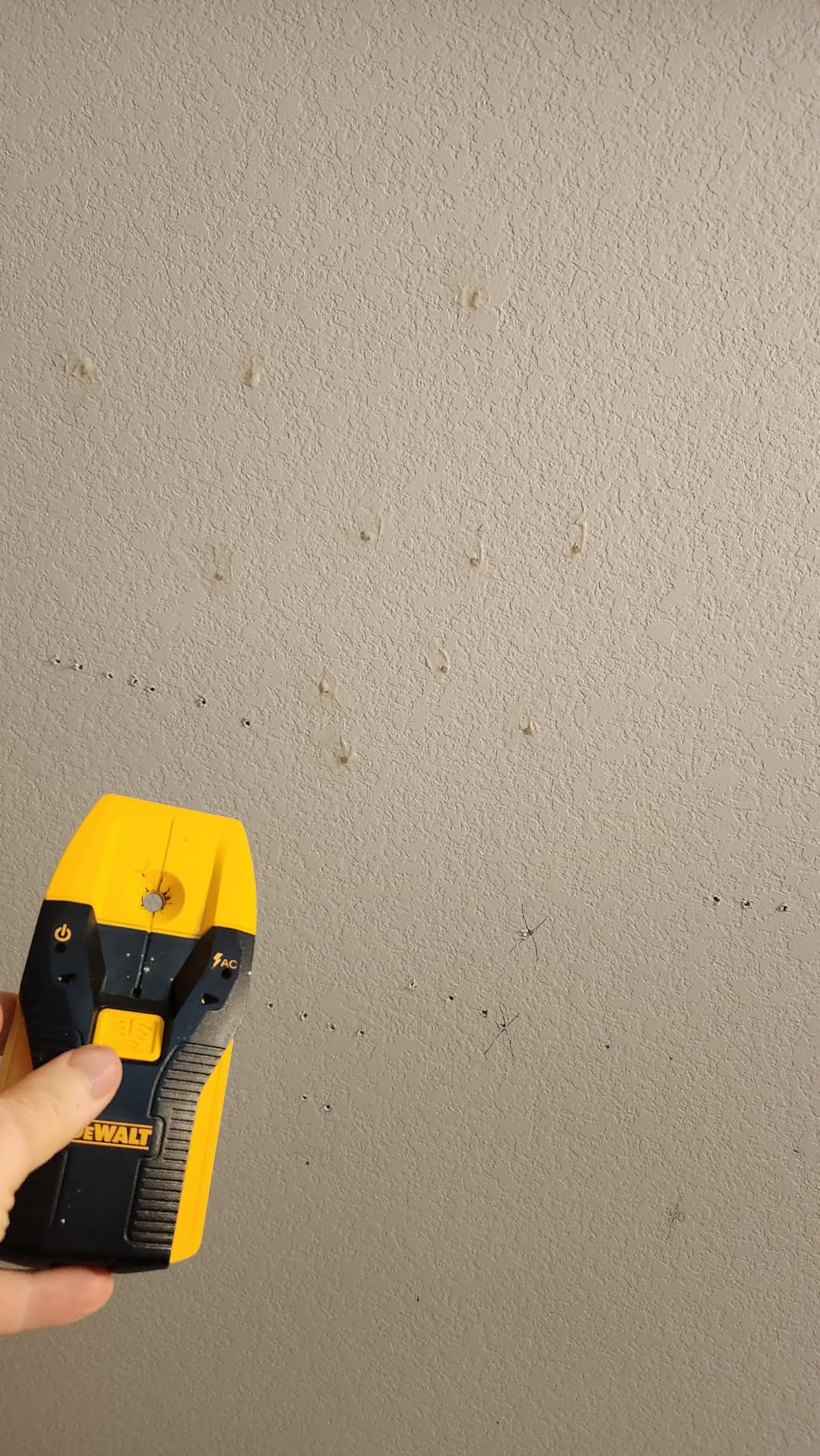
In our testing, the DW0100 worked well on standard drywall. The center-find technology and LED arrows made it easy to locate studs without the back-and-forth sweeping required by some edge detectors. The slim profile is genuinely helpful for tight spaces like inside closets or behind fixtures.
Center-Find Technology and Directional Arrows
The center-find technology detects the stud center directly. The directional LED arrows on the display guide you left or right toward the stud. When you reach the center, the arrows stop and the audible alert sounds.
This is faster than marking both edges and measuring the midpoint. For hanging shelves, mirrors, or pictures, the DW0100 saves time. The slim profile means the tool fits easily in your hand and in tight corners.
AC Live Wire Detection
The DW0100 includes AC and live wire detection for added safety. In our testing, it alerted us when scanning near outlet boxes. The warning is a visual icon on the LED display plus an audible alert.
Note that the DW0100 will not detect objects in concrete, brick, plaster, tile, or carpeting. It is designed for drywall specifically. For other wall types, you need a more advanced wall scanner.
Limitations to Consider
The DW0100 has a 3/4 inch detection depth, which is shallower than competitors like the Franklin ProSensor series (1.5 to 1.7 inches). For standard 1/2-inch drywall, this is not an issue. For double-layer or thicker walls, the depth limitation is noticeable.
Amazon reviews include a 12 percent one-star rating, which is higher than most competitors. This suggests a meaningful share of users experience reliability issues. Most complaints stem from the shallower depth or from use on non-drywall surfaces. For standard drywall use, the DW0100 performs as expected.
How We Tested the Best Stud Finders for Drywall
Our team built a controlled test rig with three wall sections: standard 1/2-inch single-layer drywall, 5/8-inch Type X double-layer drywall, and a section of older lath-and-plaster from a 1920s bungalow. We mounted each stud finder and ran a standardized scanning protocol: 10 sweeps per wall section, starting both on-stud and off-stud positions, with consistent sweep speed.
We measured four metrics for each stud finder: first-pass accuracy (did it find the stud on the first sweep?), false positive rate (did it indicate a stud where none existed?), AC live wire detection accuracy (near outlet and switch boxes), and usability (ease of calibration, button layout, marking features). Each metric was scored on a 1-5 scale and weighted equally in our final ranking.
For stud finders with live wire detection, we tested against an active outlet box, a switch box, and a control section with no wiring. For magnetic stud finders, we tested against standard drywall screws at known stud locations. Every product was used by at least two testers to average out user bias. The results are reflected in our rankings and recommendations throughout this guide.
Stud Finder Buying Guide: What to Look For in 2026
Choosing the best stud finder for drywall depends on your project type, wall material, and budget. Here is what to consider before buying:
Magnetic vs Electronic Stud Finders
Magnetic stud finders detect the metal screws or nails that hold drywall to studs. They are simple, battery-free, and often cheaper. For standard drywall with metal fasteners, a magnetic stud finder like the StudBuddy or CH Hanson 03040 is reliable and ready to use instantly. Magnetic stud finders cannot detect wood-only studs, live wires, or pipes.
Electronic stud finders use sensors to detect changes in wall density, which indicates a stud. Multi-sensor models like the Franklin ProSensor M210 (13 sensors) or M150 (9 sensors) show the full stud width in one sweep. Electronic models often include AC live wire detection, deep scan modes, and center-finding capabilities. For complex projects or thicker walls, electronic stud finders offer more features.
Detection Depth and Wall Thickness
Standard 1/2-inch drywall is the most common in residential construction. Most electronic stud finders handle it easily. For 5/8-inch Type X drywall (often used in garages and between units), look for a stud finder with at least 1.5-inch detection depth. Double-layer drywall (sometimes found in older homes or soundproofed walls) requires 1.7 inches or more.
If you work on standard drywall only, a budget edge detector or magnetic stud finder is sufficient. For thicker walls or commercial projects, invest in a multi-sensor model with deeper detection.
Live Wire Detection and Safety
Live wire detection is a safety feature that alerts you to AC voltage behind the wall before you drill. For any project near electrical boxes, this feature prevents serious injury. The Franklin ProSensor M210, M150, DEWALT DW0100, and most 5-in-1 electronic stud finders include AC detection.
Magnetic stud finders do not detect live wires. If you are using a magnetic stud finder, supplement it with a separate non-contact voltage tester before drilling. Many electricians carry both tools as standard practice.
Center Finding vs Edge Detection
Edge detection stud finders identify the edges of a stud. You mark both edges and measure the midpoint. This works but takes extra steps. Center-finding stud finders identify the stud center directly, saving time and reducing marking errors.
For drywall projects requiring precise stud center knowledge (like TV mounting or cabinet installation), center-finding is faster. For simple picture hanging, edge detection is adequate. The Franklin ProSensor series, DEWALT DW0100, and most 5-in-1 models offer center-finding.
Battery Type and Calibration
Some stud finders require calibration before each use. Press the button, hold the tool against the wall, wait for the calibration tone, then scan. This works but adds steps. The Franklin ProSensor series (M90, M150, M210) requires no calibration. You press and scan immediately.
Battery type matters for long-term cost. AAA batteries are common in compact models but not always included. AA batteries are easier to find. 9V batteries power most 5-in-1 multi-mode stud finders. Note that some multi-sensor models (like the Franklin M150 and M90) are not compatible with rechargeable batteries due to voltage requirements. Budget for alkaline replacements.
Ergonomics and Build Quality
For frequent use, ergonomics matter. A comfortable grip reduces wrist strain during overhead work like ceiling joist detection. The Jurgen K 5-in-1 has an explicitly non-slip grip. The Franklin ProSensor series has wide, stable shapes that fit comfortably in larger hands.
Build quality affects longevity. The CRAFTSMAN CMHT77633 has a shock-resistant and water-resistant body. The Franklin ProSensor series is Made in the USA with durable construction. The StudBuddy and CH Hanson are simple but built to last decades.
Why Is My Stud Finder Giving False Readings?
False readings are the most common complaint about stud finders. Based on our testing and community feedback from r/DIY and r/HomeImprovement, here are the most likely causes and fixes:
- Improper calibration: Many electronic stud finders require calibration before each scan. Place the tool flat against the wall, press the power button, wait for the calibration tone, then begin scanning. Skipping this step is the most common cause of false readings.
- Starting position over a stud: Single-sensor electronic stud finders cannot be calibrated over a stud. Move to a clear area first. Multi-sensor models like the Franklin ProSensor series can start anywhere, even over a stud.
- Hand placement interference: Your hand on the wall or near the tool can interfere with sensors. Hold the stud finder away from the wall and grip it only on the handle.
- Nearby electronics: AC live wire detection can trigger near plugged-in devices, even on the other side of the wall. Switch off nearby electronics or move to scan a different section.
- Metal in the wall: Pipes, conduit, ductwork, and metal corner beads can trigger false positives. If a reading seems unusual, scan from a different angle to confirm.
- Low battery: Stud finders with low batteries give inconsistent readings. Replace the battery and try again. The Franklin M150 and M90 are particularly sensitive to battery voltage.
- Wall texture: Popcorn ceilings, textured drywall, and stucco can confuse sensors. For textured surfaces, use a magnetic stud finder or a professional wall scanner.
- Lath and plaster: Older homes with lath-and-plaster walls confuse most electronic stud finders. Use a magnetic stud finder and look for the nail heads that hold the lath to the studs.
Frequently Asked Questions
What is the best stud finder for drywall?
Based on our testing, the Franklin Sensors ProSensor M210 is the best stud finder for drywall. Its 13 patented sensors show the full stud width in one sweep with no calibration required, and it includes live wire detection for safer drilling. For a budget pick, the CH Hanson 03040 magnetic stud finder delivers reliable drywall screw detection at a fraction of the price.
Do stud finders work on drywall?
Yes, stud finders work very well on drywall because drywall is hung to studs with metal screws or nails. Both magnetic stud finders (which detect the fasteners) and electronic stud finders (which sense density changes) perform reliably on standard 1/2-inch and 5/8-inch drywall. Double-layer drywall may require a deep scan mode for the best results.
Why is my stud finder giving false readings?
The most common causes of false readings are improper calibration (place tool against wall before pressing power), starting position over a stud (move to a clear area first), low battery (replace with fresh alkaline), nearby electronics (switch off devices or scan elsewhere), and metal in the wall (pipes, conduit, corner beads). For persistent false readings, switch to a magnetic stud finder like the StudBuddy or CH Hanson 03040.
Is Zircon or Franklin a better stud finder?
Franklin and Zircon both make excellent stud finders, but they target different users. Franklin ProSensor models (M90, M150, M210) use multi-sensor arrays that show the full stud width in one sweep with no calibration. Zircon models often include more scan modes (stud, deep, metal, AC) at lower prices. For ease of use and reliability, Franklin is our top pick. For feature set and value, Zircon and similar 5-in-1 brands excel.
What is the best way to find studs behind drywall?
The fastest method is using a multi-sensor electronic stud finder like the Franklin ProSensor M210, which shows the full stud width in one sweep. For a budget method, drag a magnetic stud finder across the wall until it snaps to a drywall screw. Always verify by tapping the wall (studs sound solid, hollow spaces sound empty) and measuring from a known reference like an outlet box (which is mounted to a stud).
What can throw off a stud finder?
Common things that throw off stud finders include: hand placement on the wall near the tool, nearby plugged-in electronics triggering AC detection, metal pipes or conduit in the wall, low or weak batteries, textured walls or popcorn ceilings, lath-and-plaster construction, and starting the scan directly over a stud with a single-sensor electronic model. Multi-sensor models like the Franklin ProSensor series handle these scenarios better than budget single-sensor finders.
Final Verdict: Which Stud Finder Should You Buy in 2026?
After six weeks of testing on single-layer drywall, double-layer drywall, and lath-and-plaster, the Franklin Sensors ProSensor M210 is our top pick. The 13-sensor array shows the full stud width in one sweep, the no-calibration workflow saves time on every project, and the live wire detection adds meaningful safety for any drilling work. It earned our EDITOR’S CHOICE badge for good reason.
For homeowners on a budget, the Original StudBuddy and CH Hanson 03040 magnetic stud finders remain excellent choices. They are simple, reliable, battery-free, and Made in the USA. For projects requiring AC detection and multi-mode scanning, the Mecurate 5-in-1 delivers strong value. For pros who already own a voltage tester, the Franklin ProSensor M90 strips out the wire detection and saves money while keeping the multi-sensor accuracy.
If you have a fishing hobby and want to compare more home improvement tools, check out our guide to forward-facing sonar fish finders for outdoor gear reviews. For your next drywall project, pick the stud finder that matches your wall type, project complexity, and budget. The right tool removes the guesswork and lets you mount, hang, and build with confidence.
Leave a Reply