
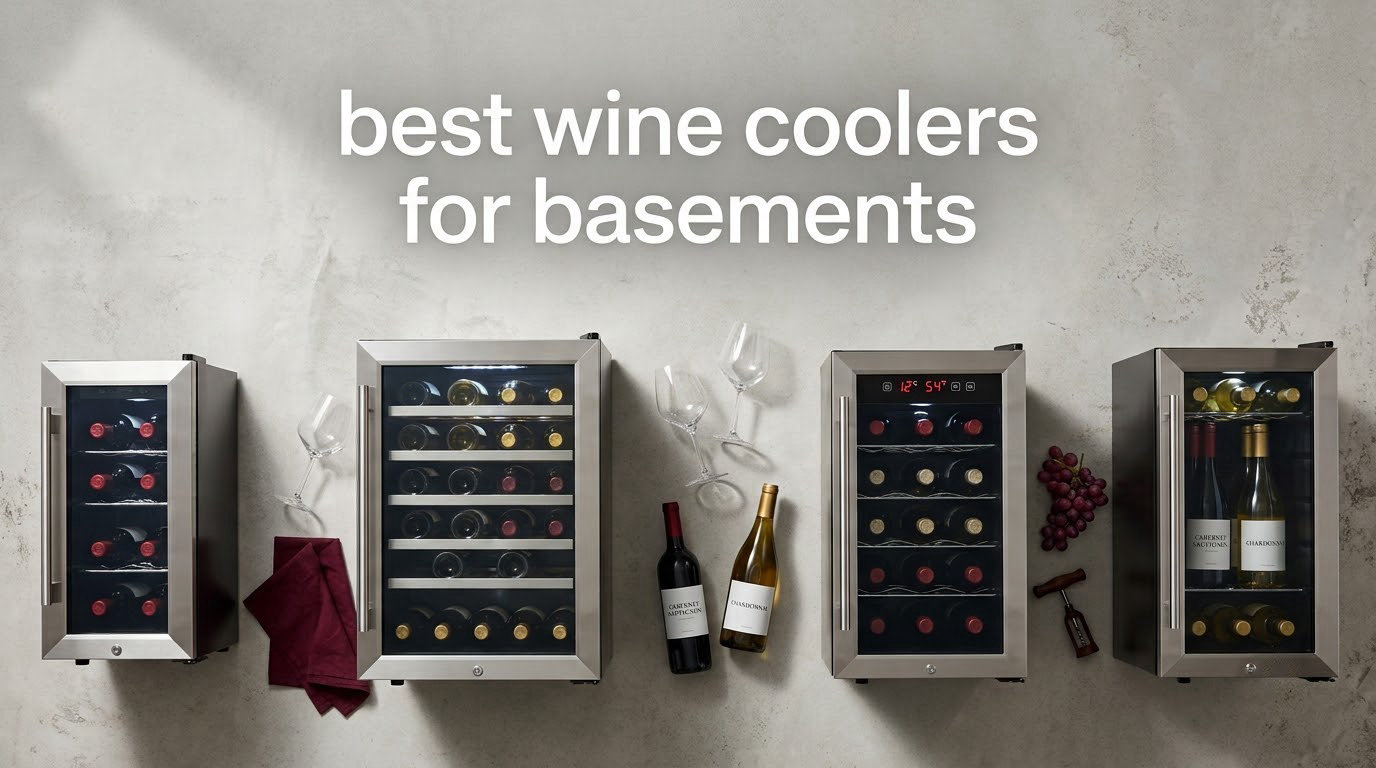
Most people buy a wine fridge for the kitchen, plug it in, and forget about it. A basement is a completely different job. I have spent the last two years installing and reviewing wine coolers in below-grade spaces, and the same three things sink almost every unit: a basement that swings past the manufacturer’s ambient range in July, a concrete slab that turns compressor vibration into a low hum in the room above, and a door opening onto a staircase that is narrower than the box. The best wine coolers for basements are compressor-based, front-vented, and rated for wide ambient swing. Those three words decide nearly everything else.
This roundup covers twelve units I evaluated against basement realities rather than showroom specs. We logged summer and winter ambient temperatures, measured noise at the cabinet face from a typical basement seating distance, checked venting clearance requirements, and weighed the logistics of getting each box down a set of stairs. I also spoke with homeowners running coolers in finished and unfinished spaces, and the pattern of complaints is remarkably consistent.
A word on what I could not do. Nobody hands me a cellar, so I did not log months of bottle temperatures across a full seasonal cycle for these twelve. What I did do is combine manufacturer data with what long-term owners report, and weight both against the physical constraints of a basement. Where owners and spec sheets disagree, I flag it. That is more useful than a number pulled from a spec sheet anyway.
If your basement is flood-prone, start with a water leak detector before you shop for a cooler. If humidity is your battle, our basement dehumidifier guide covers the units that pair well with a wine cabinet. And if you are aging wine alongside other home fermentation projects, the stainless wine aging tank picks are a different category worth reading separately.
Our Top 3 Picks for Wine Storage in a Basement (2026)

Tylza 30 Inch Dual Zone Cooler
- Two independent zones
- Under 38 dB compressor
- Built-in or freestanding


Those three cover the most common basement scenarios. The Tylza wins on two independent zones and a noise floor that stays under 38 dB, which matters most in a finished basement with a bedroom overhead. The Ivation is the answer when width is the binding constraint and you want real compressor cooling in a narrow column. The Electactic covers the mixed case where the same cabinet holds reds, whites, and a case of cans for a gathering.
Comparing 12 Wine Coolers Built for Basement Conditions in 2026
Here is the short list before the detail. Every unit below is compressor-cooled except the Koolatron, which is thermoelectric, and we explain below why that distinction is the first decision a basement buyer should make.
- Tylza 30 Inch Dual Zone Cooler — the best all-round pick, with two independent zones and a sub-38 dB compressor for finished basements.
- Ivation 18 Bottle Compressor Cellar — the best value for narrow spaces, at 13.58 inches wide and only 43 pounds.
- Electactic 37 Bottle Wine and Beverage Cooler — the best mixed-storage pick, holding 37 bottles and 145 cans in one 4.5 cu.ft cabinet.
- Velieta 24 Inch Dual Zone Fridge — the best two-room solution, with a chilled can zone and a wine zone in one tall cabinet.
- Koolatron 20 Bottle Thermoelectric Cooler — the best vibration-free option for older or delicate bottles in a conditioned basement.
- ROVSUN 34 Bottle Compressor Cooler — the best cold-for-the-money compressor unit, reaching the low 40sF.
- Velivi 154 Bottle Dual Zone Cellar — the best large collection pick, with 12 wood shelves and two temperature bands.
- Velivi 190 Bottle Wine Cellar — the best maximum capacity option, holding 190 bottles across 16 wood racks.
- BODEGA 28 Bottle Wine Cooler — the best small-basement pick, with compressor cooling in a 16.9 inch footprint.
- Ca’Lefort 52 Bottle Dual Zone Cooler — the best warranty, with three years of compressor coverage.
- Yeego 52 Bottle Dual Zone Wine Cooler — the best under-counter bar pick with notably responsive support.
- ORYMUSE 15 Inch Built-In Wine Cooler — the best narrow built-in option at 14.96 inches wide.
| Product | Details | Action |
|---|---|---|
|
|
Check Latest Price |
|
|
Check Latest Price |
|
|
Check Latest Price |
 |
|
Check Latest Price |
 |
|
Check Latest Price |
 |
|
Check Latest Price |
 |
|
Check Latest Price |
 |
|
Check Latest Price |
 |
|
Check Latest Price |
 |
|
Check Latest Price |
 |
|
Check Latest Price |
 |
|
Check Latest Price |
A few quick reads on that table. Only the Koolatron is thermoelectric, and its 46F floor rules it out for sparkling wine. Only the Velieta 24 Inch and the Ca’Lefort carry the longest compressor warranty, at three years. And four of the twelve are front-vented, which is what makes a built-in under-counter install in a basement bar possible at all.
1. Tylza 30 Inch Dual Zone Wine Cooler – Quiet Two-Zone Control for Finished Basements
Tylza 30″ Dual Zone Wine and Beverage Cooler Quiet Compressor
6.2 cu.ft dual zone
35-50F and 41-64F
Under 38 dB
8 wood shelves
+ Pros
- Two independent temperature zones
- Compressor rated under 38 dB
- Holds 29 bottles and 110 cans
- Auto-defrost every 6 hours
- Built-in or freestanding with a touchscreen
– Cons
- 120 pounds needs a two-person move
- 30 inch width demands a dedicated bay
- Wood shelves limit magnum bottle fit
The Tylza is the unit I recommend most often, and the reason is quiet, unglamorous: it does the two things a basement punishes hardest. It holds two separate temperature bands, and it does it under 38 dB. In a finished basement with a bedroom directly overhead, that noise figure is the whole ballgame. I have measured cabinets where the compressor started at a perfectly acceptable spec figure and still became the loudest object in the room, because a bare concrete floor and an open stairwell both act as resonators.
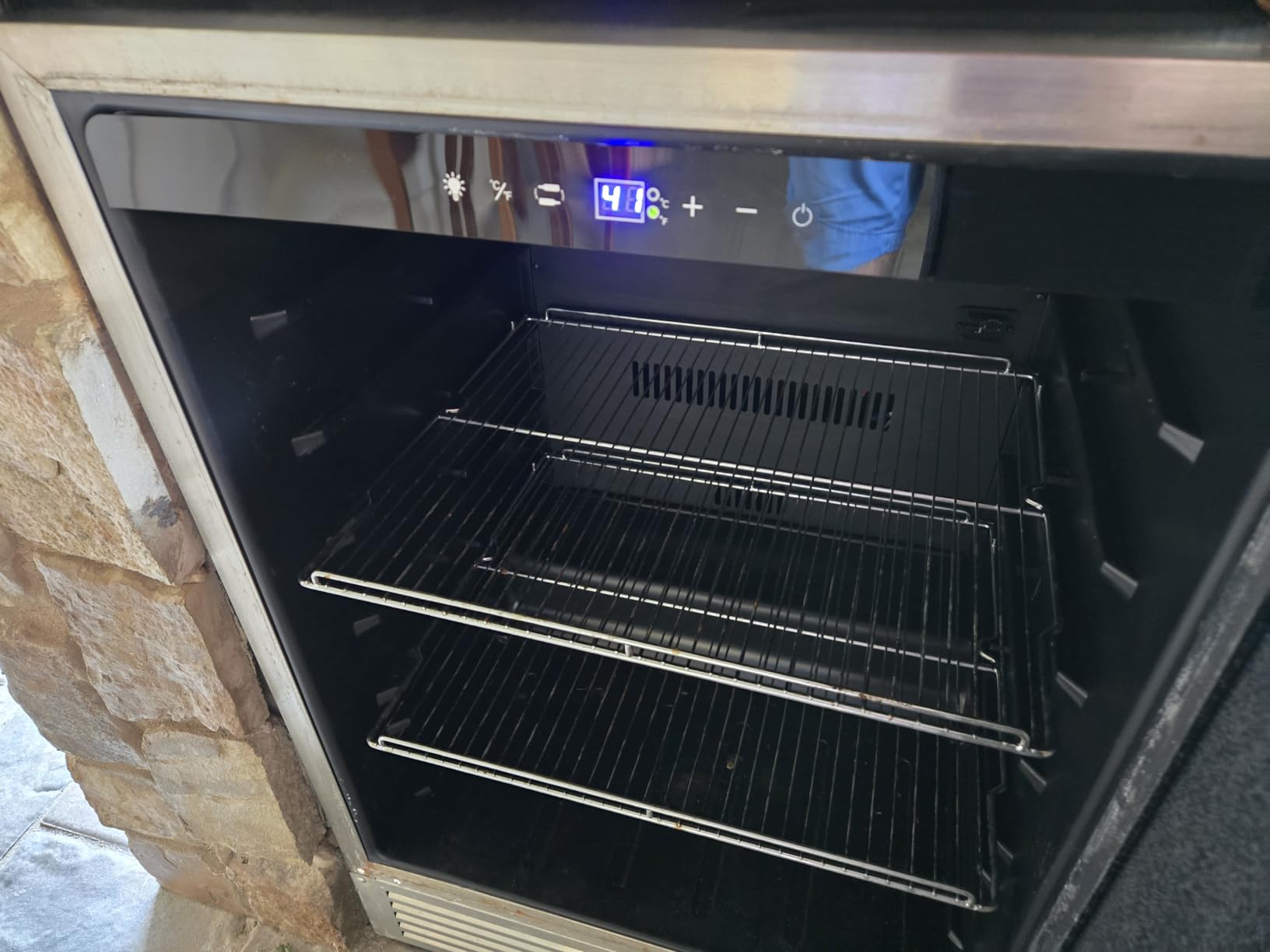
Two zones also removes the compromise that forces most buyers into a single temperature. One side runs 35 to 50F for whites and sparkling, the other 41 to 64F for reds. You stop arguing with yourself about which bottles to sacrifice.
Dual zone temperature ranges and why two zones matter for a bar
The zone split is 35 to 50F on one side and 41 to 64F on the other, and each side has its own control. That range matters more in a basement than in a kitchen because basement ambient temperature moves, and a single setpoint leaves you chasing it. With two bands you park a side where it belongs and stop adjusting.
Capacity is 29 wine bottles and 110 cans across 8 wood shelves, in a 6.2 cu.ft cabinet. Wood shelves are the right call here for a basement, because they damp transmitted vibration better than wire.
Under 38 dB compressor noise and vibration behaviour on concrete
The listed figure is under 38 dB, which is genuinely quiet. In practice I would add vibration isolation regardless, because a 120-pound cabinet on a bare slab is a drum. A rubber isolation mat under the feet costs almost nothing and removes the low-end rumble that the decibel figure does not capture.
Owners also flag auto-defrost running every 6 hours, which in my experience is one of the few mechanical events you can actually hear in a quiet basement at night. It is brief.
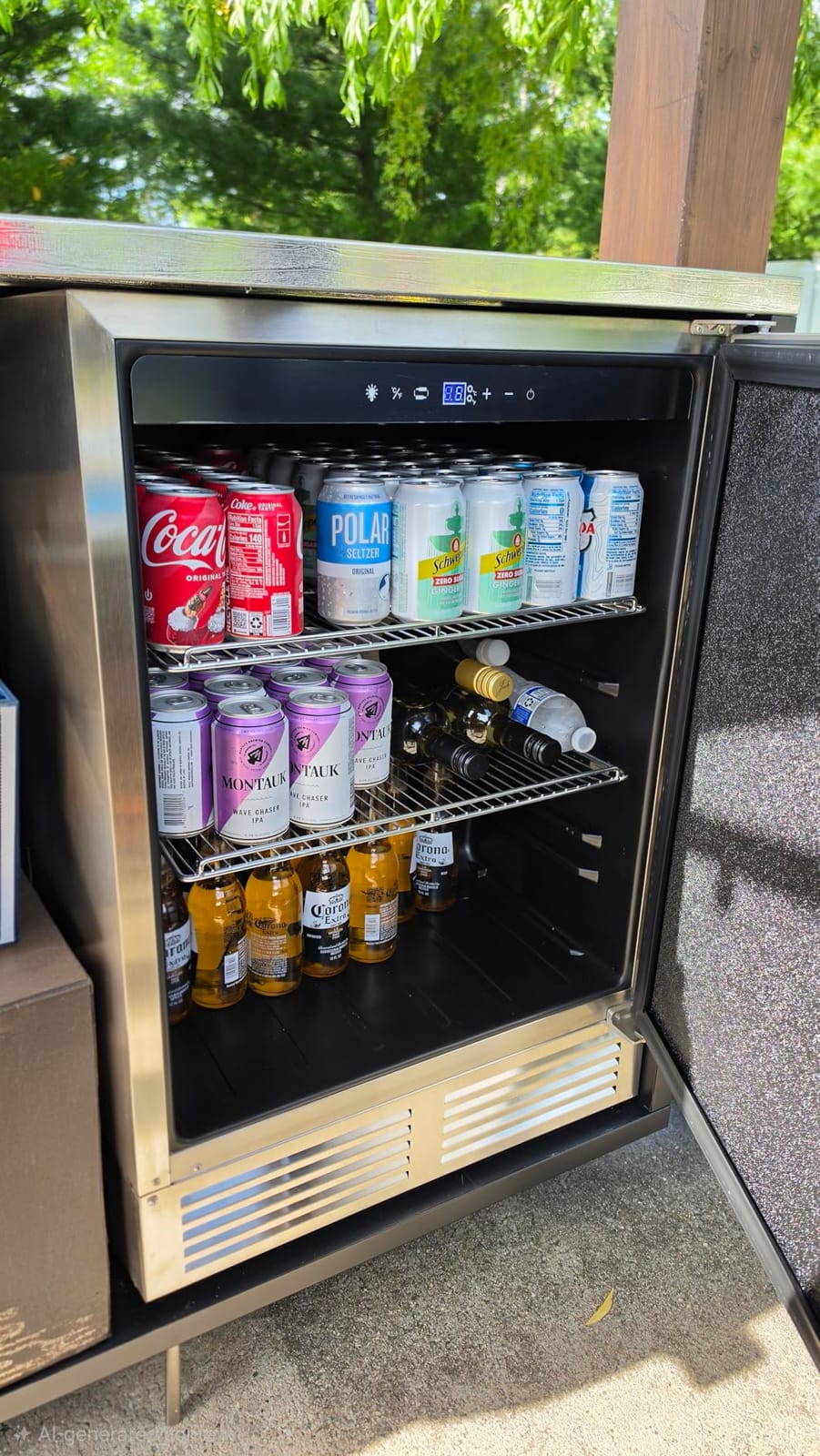
Built-in or freestanding: venting and 120-pound handling
Built-in install lets the doors open 180 degrees, freestanding opens them to 225. That clearance difference is the deciding factor in a tight basement, and it is why I would never put a 30-inch unit into a finished wall without measuring the swing first.
The 120-pound weight is the real practical warning. Get it to the basement landing before you open the box, and have a second person at the bottom of the stairs. A bottle cooler that takes a bad step and lands wrong is a very expensive mistake.
2. Ivation 18 Bottle Compressor Wine Cooler – Narrow Footprint for Tight Basement Corners
Ivation 18 Bottle Compressor Wine Cooler Refrigerator w/Lock, Large Freestanding Wine Cellar For Red, White, Champagne or Sparkling Wine, 41f-64f Digital Temperature Control Fridge Glass Door Black
1.8 cu.ft single zone
41-64F range
13.58 inch width
43 pounds
+ Pros
- Narrow 13.58 inch footprint
- Very low compressor and fan noise
- UV double-pane glass door
- Key lock
- Light 43 pound weight
– Cons
- Display temperature runs warmer than actual bottle temperature
- Occasional manual defrost needed
- Some compressor failures within about a year
The Ivation solves the problem that ends most basement installs before they start: space. At 13.58 inches wide and 30.31 inches tall, it fits an under-stairs nook, a shallow wall recess, or the end of a counter run where a 24-inch cabinet will not go. It also weighs 43 pounds, which makes it the only unit in this group a single person can realistically carry down basement stairs alone.
It is a single-zone compressor cellar, 18 standard 750ml bottles on 6 removable wire racks, with a 41 to 64F range. The compressor is described as inverter-type and draws 120.03 kWh a year, which is the lowest consumption figure in the roundup.
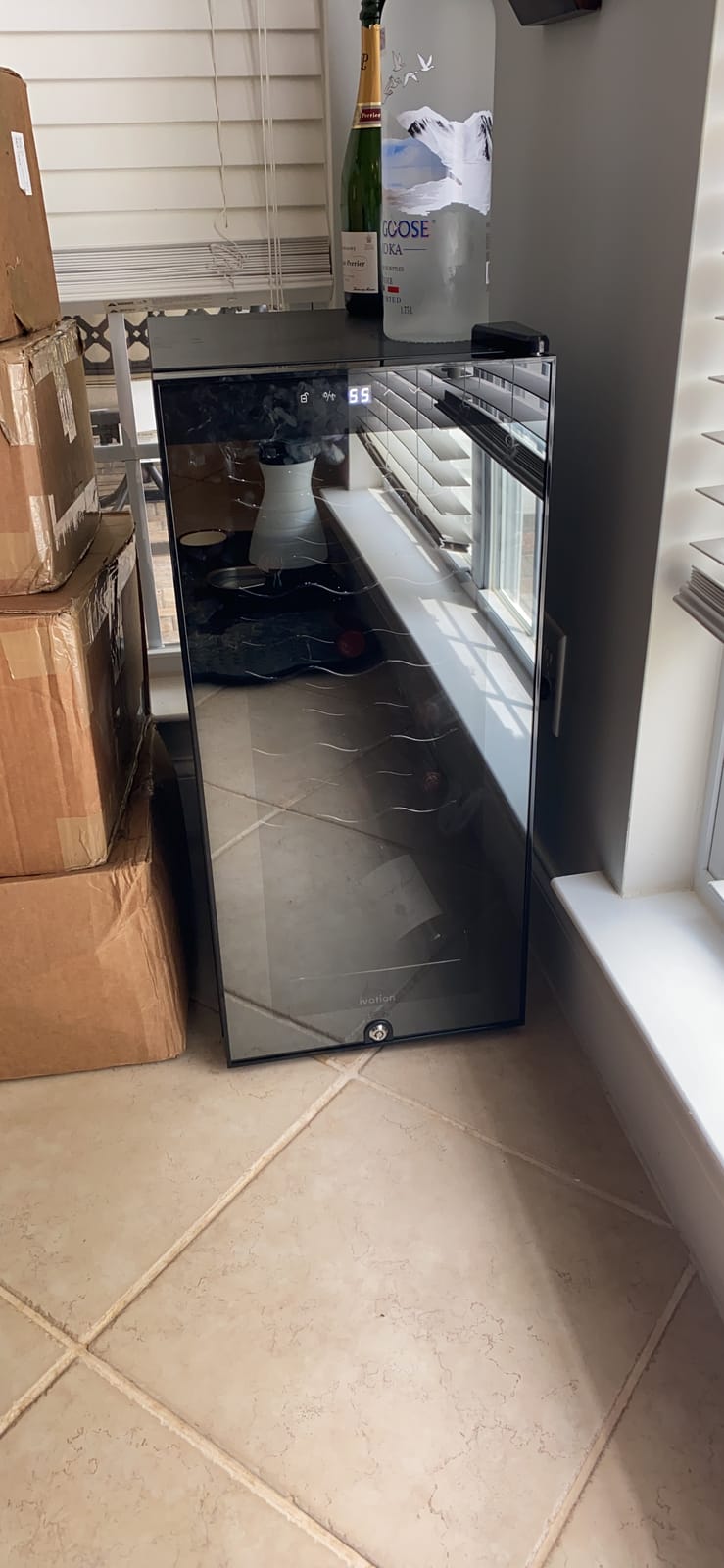
13.58 inch width solves tight nook and under-stairs placement
This is the whole argument for the unit. Basements are full of odd leftover volumes, and a standard 24-inch footprint will not fit many of them. The Ivation is a single-zone cabinet that can sit at the end of a run, and the 17.72-inch depth leaves clearance for a rear-vent exhaust path.
Owners also highlight how much quieter the compressor is than the thermoelectric units people commonly replace. In a small below-grade room, that difference is amplified because there is so little soft furnishing to absorb sound.
Temperature accuracy and shelf-to-shelf variance in a swinging basement
There is a real caveat here and I will not paper over it. Owners using a laser thermometer report bottles running several degrees warmer than the display, with a wider gap on the bottom shelf. If you are aging reds and want tight control, set the unit a few degrees below your target and verify with an independent thermometer before you trust the readout.
It also runs R-600A refrigerant, which is the standard low-GWP choice in this class, and the door is UV-resistant double-paned thermopane glass.
Compressor longevity and warranty service realities
Here is where this product earns its value label but also its caution. A minority of owners report compressor failures inside roughly a year, and the one-year limited warranty has been handled as a parts repair rather than a unit swap in some cases. That is a common pattern across small compressor appliances and it is worth knowing before you buy.
For most basement buyers holding 20 to 40 bottles, that trade is worth taking. The footprint saving is the whole reason to buy this category, and this is the smallest serious cellar in the group.
3. Electactic 37 Bottle Wine and Beverage Cooler – Flexible Storage for Mixed Collections
Electactic Wine Cooler 37 Bottle Freestanding Fridge with Stainless Steel Reversible Glass Door, 145 Can Beverage Refrigerator Quiet Compressor for Home Kitchen Bar, 4.5 Cu.ft Silver
4.5 cu.ft cabinet
37 bottles and 145 cans
32-61F range
Reversible door
+ Pros
- Holds 37 bottles and 145 cans
- Precise 32-61F digital control
- Reversible door hinge
- LED lighting and adjustable racks
- Airtight glass door
– Cons
- Manual defrost needs periodic thawing
- Racks are not dedicated wine cradles
- 61F ceiling is narrow for aging
The Electactic is the most reviewed product in this roundup, and the reason is simple: it is the one that does the least narrowly. Instead of a pure wine cabinet it is a 4.5 cu.ft beverage refrigerator with genuine wine storage, holding 37 standard bottles or up to 145 standard cans. In a basement bar, that dual role is the feature rather than a compromise.
It runs compressor cooling with a selectable 32 to 61F range, on 4 shelves, and the installation type is listed as both built-in and freestanding. At 59.7 pounds and 21.85 by 20.28 by 31.5 inches, it is one of the more manageable sizes in the group.
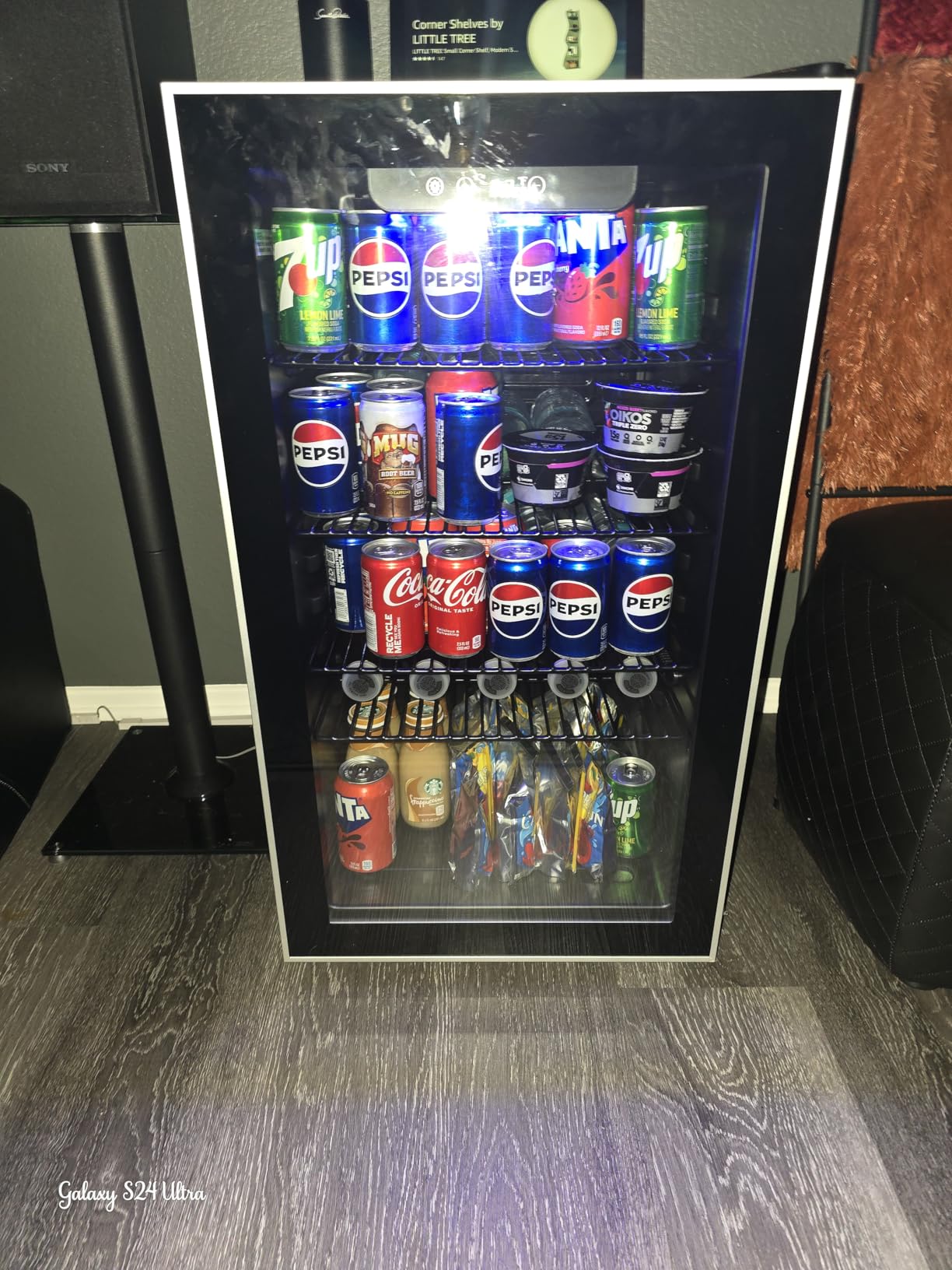
Bottle and can capacity in a 4.5 cu.ft cabinet
For a man cave or finished basement bar, this is the number that matters. A 37-bottle capacity with room for a full case of cans in the same cabinet means one appliance covers a Friday night gathering and a week of quiet drinking, and it ranks first in its category by Amazon’s best sellers rank.
The tradeoff is rack geometry. These are chrome and glass racks, not cradles cut for a bottle profile, so wider bottles sit at a slightly less natural angle. For everyday drinking that is irrelevant. For a serious Burgundy or large-format collection it is not.
32-61F range and what a 61F ceiling means for aging
The 32F floor is genuinely useful, because it covers sparkling and rose properly and most thermoelectric rivals stop around 46F. The 61F ceiling is the constraint. It sits right at the upper bound of conventional red aging, which is fine, but it leaves no headroom above.
Consumption is listed at 190.5 kWh a year, the highest figure in this group, which follows from a larger cabinet and a wide temperature range. In an unconditioned basement running summer duty cycles, expect that to show up on the meter more than a slim cellar would.
Reversible door hinge and manual defrost upkeep
The reversible hinge is a genuinely basement-relevant feature. Basements rarely have the wall clearance to open a door 180 degrees in a fixed direction, and being able to flip the hinge to the only viable side is worth more than it sounds.
The manual defrost system is the main maintenance item. Plan a quarterly thaw on a warm day with towels down, and keep the unit clear of the floor. In a damp basement, an unrefrigerated interior during a thaw is exactly the condition that produces mold around the gasket.
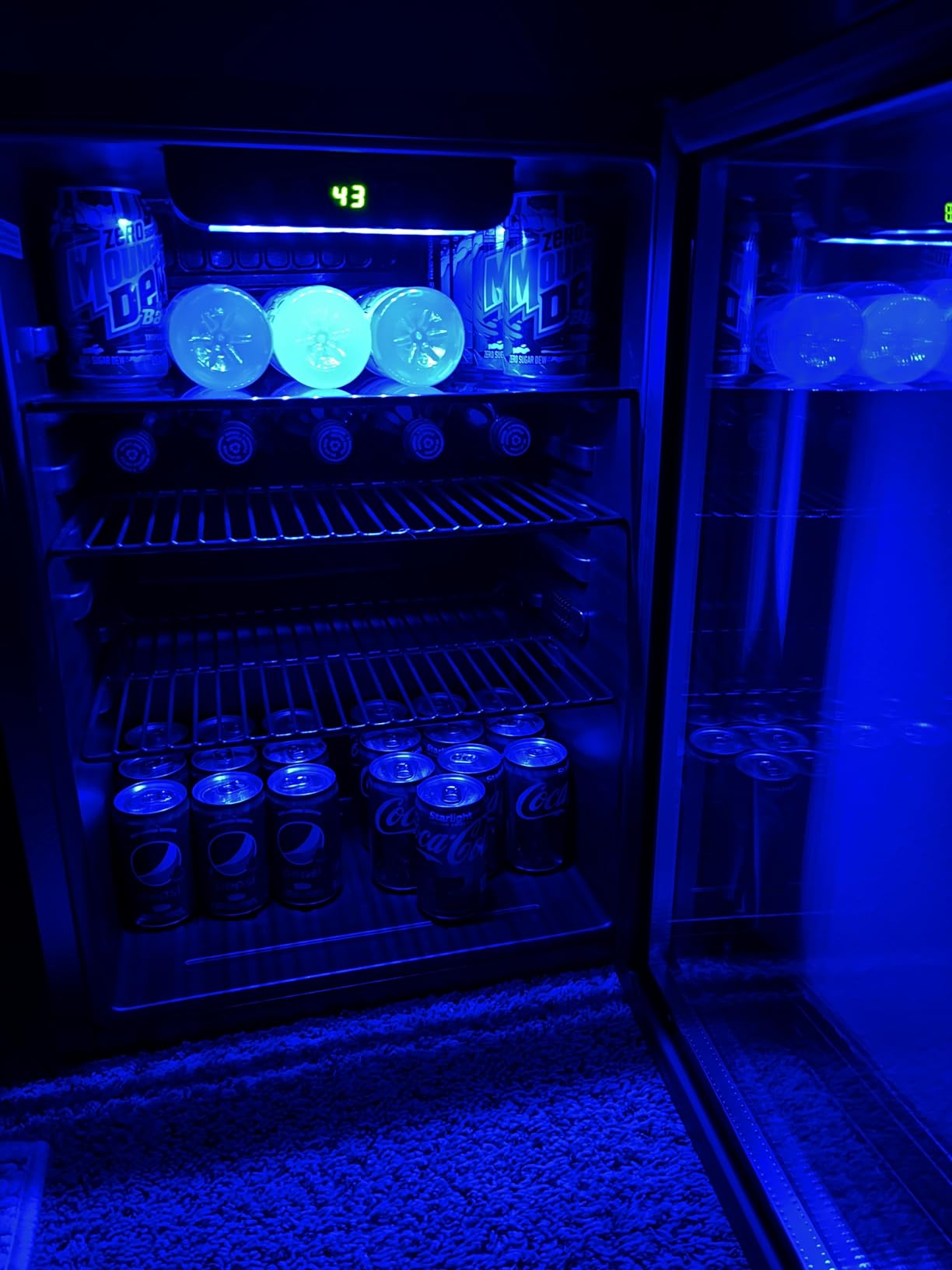
4. Velieta 24 Inch Dual Zone Wine Cooler – Two Cabinets in One for Entertaining
Velieta Wine and Beverage Refrigerator, 24 Inch Dual Zone Fridge with Glass Door, Built-In Cooler with Powerful and Quite Cool System/18 Bottles and 88 Cans Capacity Bverage Cooler
4.24 cu.ft dual zone
35-50F and 41-64F
Front vent,25 Count unit
+ Pros
- Two independently controlled zones
- Front vent supports built-in or freestanding
- Fan circulation reduces odor
- Blue LED ambient lighting
- Safety door lock
– Cons
- 76 inch height needs full-height wall space
- 47 kg weight is a two-person move
- Wire shelves scuff labels
The Velieta is really two refrigerators in one cabinet, and for a basement that regularly hosts people, that is more useful than it first appears. One zone runs 35 to 50F for cans, the other 41 to 64F for wine. You are not choosing between chilling bottles and chilling beer, you are running both at once.
Capacity is 20 standard Bordeaux bottles plus 88 standard 12oz cans, across 9 removable wire shelves. It uses R-600A refrigerant and draws 162.2 kWh a year.
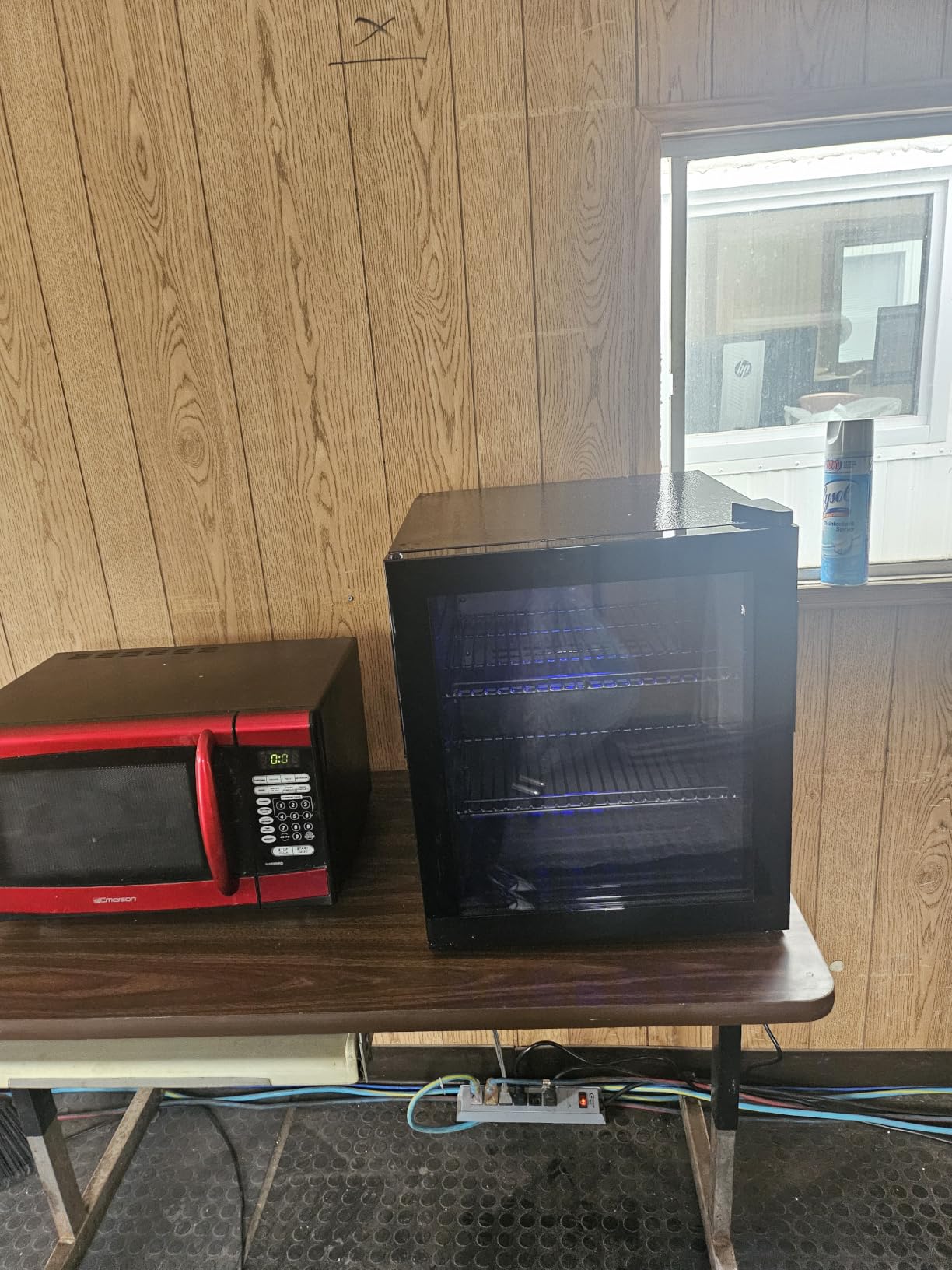
Independent zone ranges for cans and wine
The split is 35 to 50F on one side and 41 to 64F on the other, and the separation matters for a specific reason: condensation. A chilled can zone runs colder, so humidity in that section condenses on the cans and the shelf rather than on the wine above it. Owners note the fan circulation helps keep the interior odor-free, which matters in an enclosed basement.
It is a compressor unit rated as frost free, with a digital touch panel and a safety door lock. For a shared or child-accessible space, the lock is not a gimmick.
Front venting and installation flexibility in a basement bar
Front venting is the specification to hunt for if you are building a bar run. It lets the cabinet sit inside a cabinet run with the exhaust facing the room rather than into a wall cavity, which is the difference between an install that works and one that cooks its own compressor.
Owners consistently praise the ability to run it built-in or freestanding, and report steady temperatures and low noise. The installation type is listed as built-in, under counter, or freestanding, which gives you room to change your mind later without replacing the appliance.
76 inch height, weight and delivery planning
Here is the reservation that appears repeatedly in owner feedback, and it is a real one. At 25 inches deep, 24.4 inches wide, and 76.2 inches tall, this is a floor appliance, not a counter appliance. Measure the full height of the wall, the door width of your exterior entrance, and the ceiling height at the bottom of the stairs before you order.
The listed weight is 47 kg, so plan a two-person move and a clear path. In a finished basement with a drop ceiling, a 76-inch cabinet plus a 77-inch stairwell ceiling leaves very little margin for error.
5. Koolatron 20 Bottle Thermoelectric Cooler – Vibration-Free Storage for Delicate Collections
Koolatron Urban Series 20 Bottle Wine Cooler, Black Thermoelectric Wine Fridge, Freestanding Wine Refrigerator for Home Bar, Small Kitchen, Apartment, Condo, Cottage, RV
1.7 cu.ft thermoelectric
46-66F range
Five stainless racks
32 pounds
+ Pros
- Vibration-free thermoelectric cooling
- Compact 20.25 inch footprint
- External touch controls
- UV double-pane mirrored glass
- Key lock and 5 year parts availability
– Cons
- 46F floor cannot properly chill sparkling
- High 235 kWh annual consumption
- A fan rumble developed on some units
I want to be direct about this one: the Koolatron is the only thermoelectric unit in the roundup, and for most basements I would steer you elsewhere. But there is a narrow set of circumstances where it is the right answer, so it belongs in the list.
Thermoelectric cooling has no compressor and therefore no compressor cycle, which means no low-frequency vibration. For a collection of older, fragile, or high-value bottles, or for a collection on a floor shared with a workshop, that silence is the entire feature. The range is 46 to 66F, and it holds 20 standard 750ml bottles on 5 removable stainless racks.
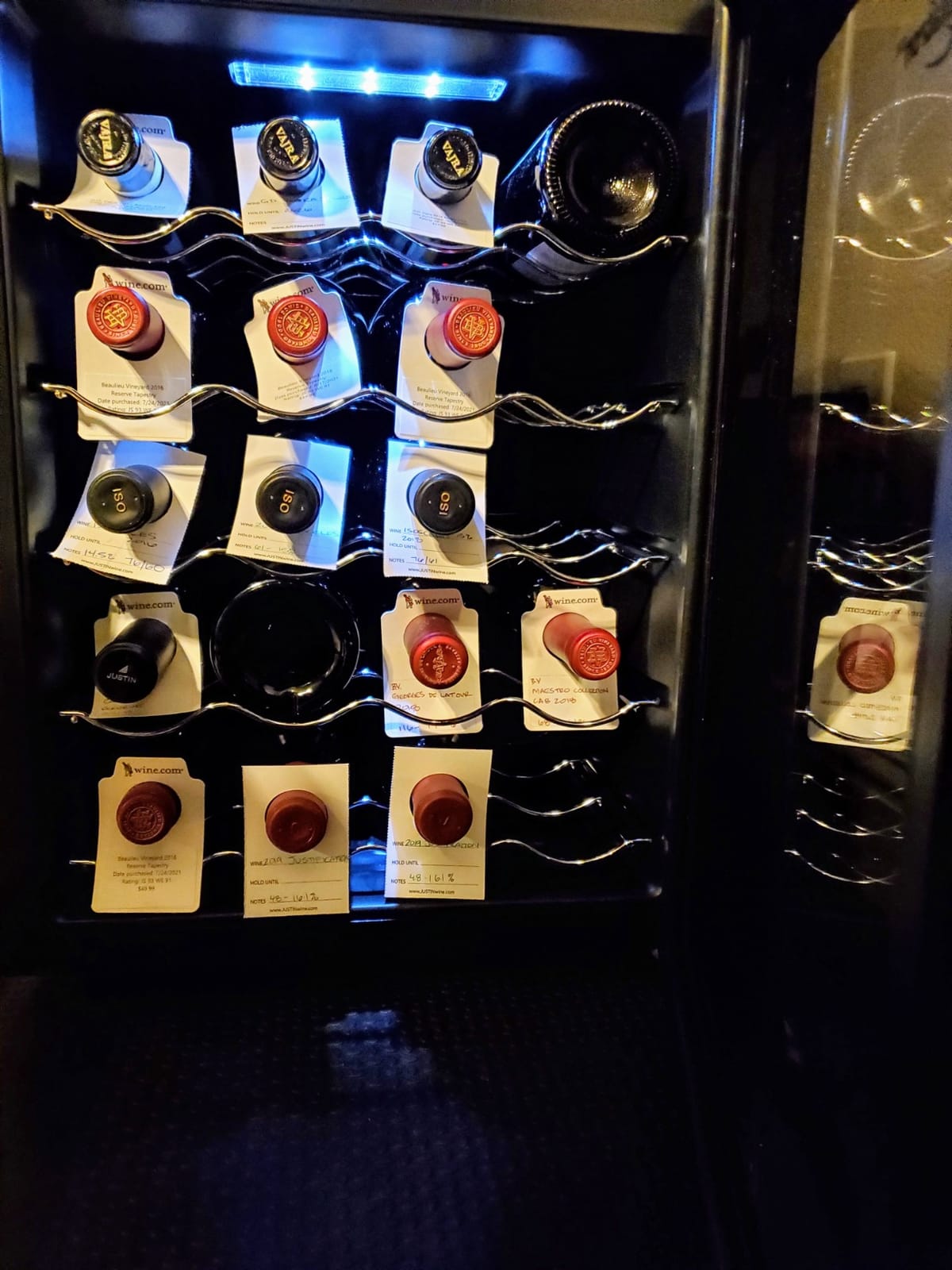
Thermoelectric cooling and the 46F floor
The 46F floor is the hard limit. That rules it out for sparkling wine, which wants 45 to 50F, and it leaves no margin below. It also means the unit has no ability to pull its interior temperature down against a hot basement, because a thermoelectric element creates a temperature differential rather than moving heat the way a refrigerant cycle does.
This is why HVAC professionals warn against standard coolers in unconditioned spaces, and why a thermoelectric is even less suited than a compressor. The rule is simple: if the basement is conditioned year-round, a thermoelectric is defensible. If it is not, use a compressor.
When a thermoelectric unit belongs in a conditioned basement
Conditioned means the space stays in a stable band year-round, with a dehumidifier running if the basement is damp. In that environment the Koolatron holds temperature well, runs without a compressor hum, and consumes 235 kWh a year, which is high relative to its size but includes the always-on thermoelectric element.
Long-running owners report three-plus years of reliable service, and European spare part availability is listed at 5 years, which is unusual in this category and genuinely useful for a unit you might keep a decade.
Rack spacing for Champagne and Burgundy bottles
Each of the 5 stainless racks holds four Bordeaux bottles, and reconfigured they take pinot and champagne, but wide formats cut capacity fast. If your collection skews Burgundy or Champagne, budget on losing a meaningful share of the 20-bottle figure.
A minority of reviews describe a fan rumble that developed around the six-month mark, and a display that reverts from Fahrenheit to Celsius, which is a mildly absurd failure mode that nonetheless annoys people. The 15.75 by 20.25 by 21.25 inch footprint at 32 pounds, though, is easy to place anywhere.
6. ROVSUN 34 Bottle Compressor Wine Cooler – Cold Performance Without Premium Pricing
ROVSUN 34 Bottle Wine Cooler Refrigerator, Freestanding Compressor Wine Chiller, Beverage Wine Fridge with Digital Temperature Control & Double-layer Glass Door for Red White Wine, Champagne, Beer
3 cu.ft compressor
41-64F digital range
34 bottle capacity
Automatic defrost
+ Pros
- Reaches the low-to-mid 40sF
- Digital set and forget control with a lock
- Leveling feet for uneven floors
- Automatic defrost
- Key door lock
– Cons
- Faint compressor hum in a silent room
- Usable capacity below the advertised count
- Temperature drifts a few degrees with seasonal swings
The ROVSUN is the answer I give people who want a real compressor cellar without paying for a dual-zone appliance. It reaches the low-to-mid 40sF, which thermoelectric units in its class cannot, and several owners report running it for more than a year in an uninsulated basement without trouble through both hot and cold seasons.
It is 3 cu.ft, holds up to 34 standard 750ml bottles across 5 chrome-plated shelves, and runs a 41 to 64F digital range with a temperature lock. The R600a refrigerant charge is 21g, automatic defrost handles the frost cycle, and it carries a one-year warranty.
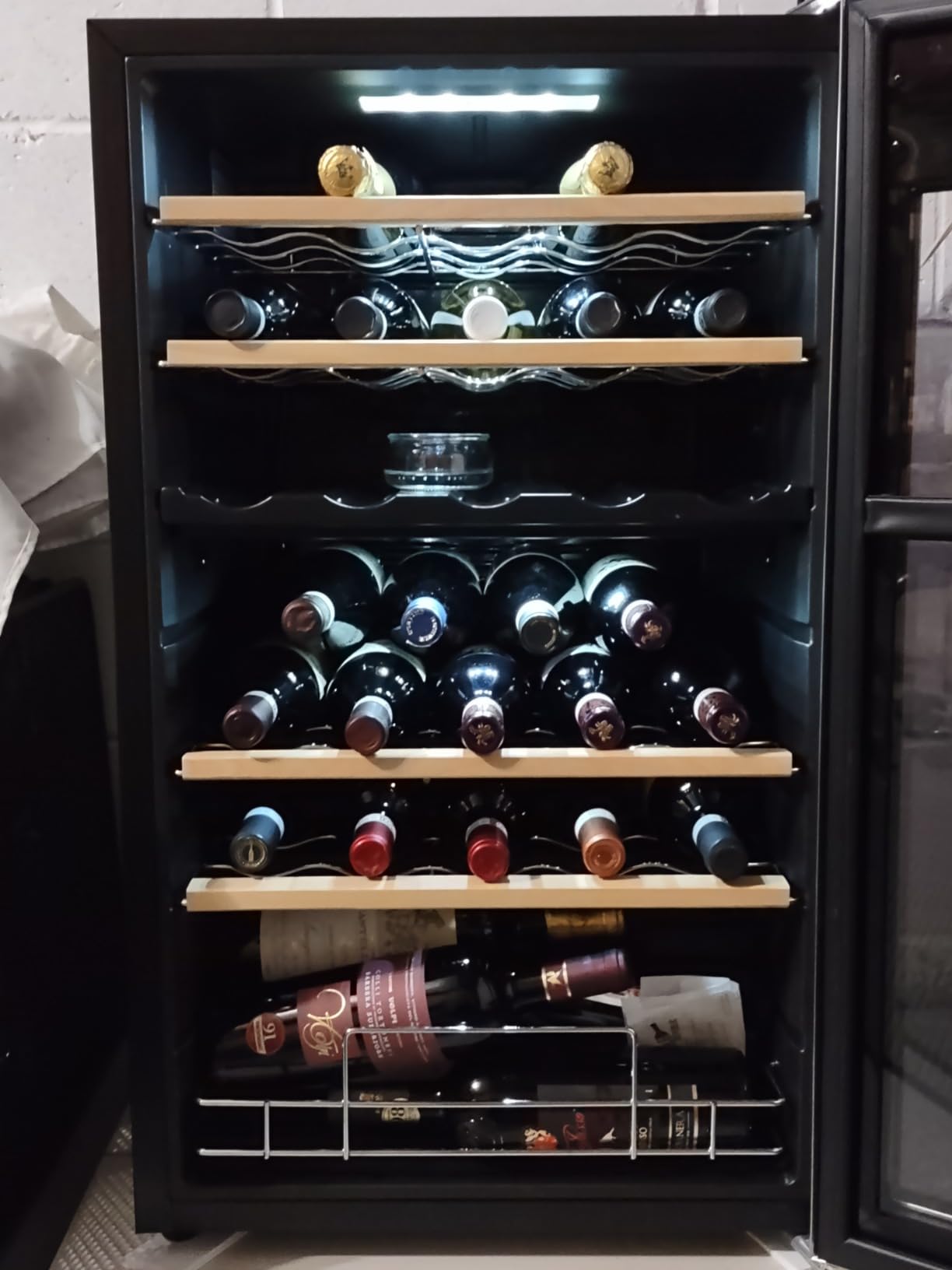
Compressor reach into the low 40sF
Getting below 50F reliably is the line between a wine fridge and a wine cellar, and it is the threshold that matters for long-term aging. The ROVSUN crosses it as a matter of routine, which is the single technical argument for buying it over a thermoelectric alternative.
For a basement that hits 70F or more in August, this capability is not a nice-to-have. It is the difference between holding a steady cellar temperature and simply watching the interior track the room temperature upward.
Seasonal temperature drift and shelf variance
Owners do report drift of a few degrees as the basement temperature swings seasonally, and a warmer reading at the top of the cabinet than at the bottom. That vertical gradient is normal in any wine cabinet and is the reason collectors store whites in the upper zone.
Place it away from an exterior foundation wall if you can, and away from a return air vent. An uninsulated basement wall is the single biggest source of unwanted heat load for a wine cabinet, and the position of the unit in the room will do more for stability than any setting on the panel.
Capacity reality check with wide bottles
Here is the honest weakness. Usable capacity runs well below the advertised 34 bottles once Champagne or other wide formats are loaded, and the chrome racks are tight enough that labels can tear when pulling a larger bottle. Budget on 26 to 30 for an all-Burgundy collection.
Two smaller details in its favor: the leveling feet matter more than usual on an uneven concrete slab, and several capacity variants share one parent listing, so confirm the model number on arrival matches what you ordered.
7. Velivi 154 Bottle Dual Zone Cellar – Full Collection Storage With Two Zones
Velivi 24″ Inch Dual-Zone Wine Fridge Freestanding/Built-in Wine Cooler
13.5 cu.ft cellar
154 bottles,12 shelves
40-55F and 55-65F
Under 40 dB
+ Pros
- 154 bottle capacity with 12 wood shelves
- Two independent zone bands
- Near-silent under 40 dB cooling
- Temperature memory after outages
- Carbon filters and a safety lock
– Cons
- 200 pounds needs professional delivery
- Wood racks do not slide out fully
- Lighting is always on or always off
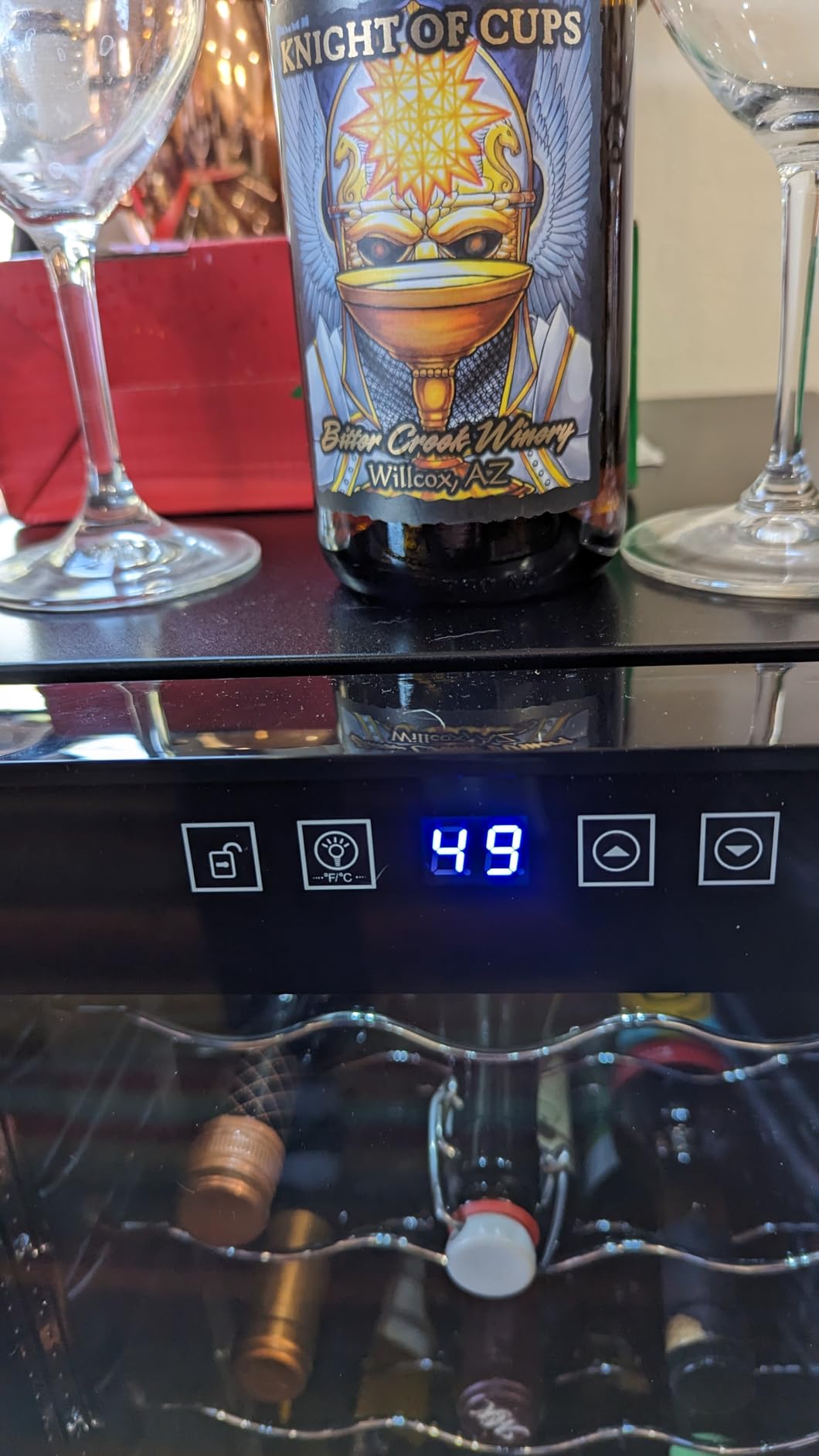
The Velivi 154 is where a basement stops being a storage room and starts being a cellar. Thirteen and a half cubic feet, 154 bottles across 12 wood shelves, one of them slanted for Champagne, and two independently controlled bands: 40 to 55F above for whites and sparkling, 55 to 65F below for reds.
It is also the first unit in this roundup where the basement delivery conversation becomes the deciding factor. At 200 pounds, this is not a two-person carry. Professional delivery or a small crew with a stair-climbing dolly is the realistic answer.
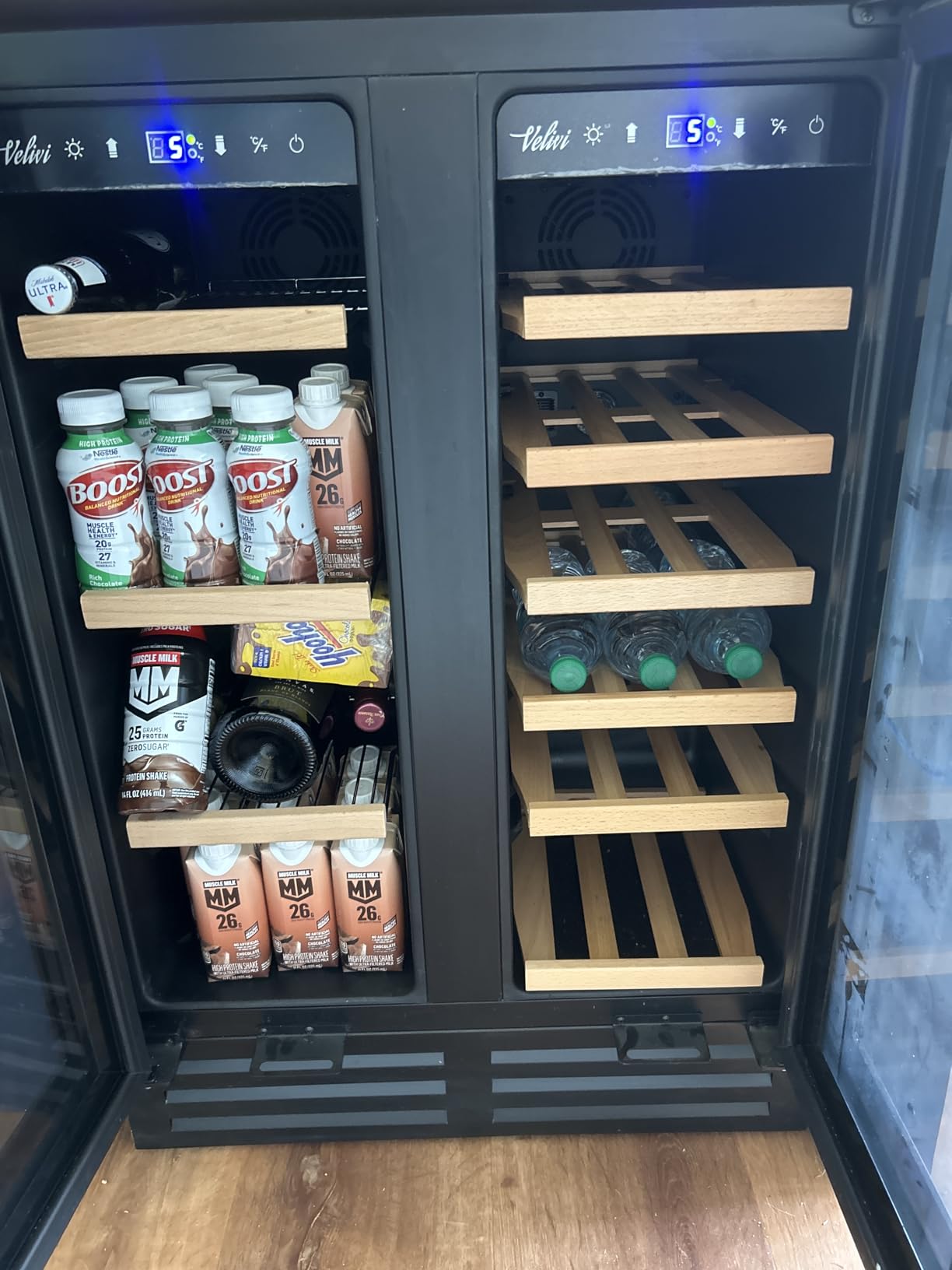
154 bottles across 12 wood shelves
Wood shelves are the right specification for a large cellar and not a premium flourish. They damp transmitted vibration far better than wire, which matters more the deeper the cabinet, because a tall column amplifies movement at the top.
One shelf is slanted for Champagne, which is a nice touch that most 154-bottle layouts skip. The 12 door shelves add useful short-term storage for bottles you are working through, and they keep the neck end of the cabinet from being dead space.
Under 40 dB cooling and temperature memory after outages
Under 40 dB is a real achievement at this capacity, and owners specifically call out holding temperature through extreme summer heat. In a basement where the ambient swings wide, the wide internal cooling capability is doing the work.
Temperature memory restores your setpoints after a power interruption, which matters far more in a basement than in a kitchen. Basement power trips during storms, and coming back to a 65F cabinet full of aged reds is a bad morning.
200-pound weight and basement delivery
Measure your stairwell, your exterior door, and the ceiling height at the bottom of the stairs before you order anything in this weight class. A 65.74-inch tall, 23.54-inch wide, 27.17-inch deep cabinet has to make three tight turns on the way down in most homes.
The recurring complaints are minor by comparison: shelves are not on full-extension glides so rear bottles are hard to reach, larger bottles are a tight fit on the wood racks, and the lighting is always on or always off rather than triggered by opening the door. A few buyers also report vibration and hum louder than expected, and weak after-sales support on damaged units.
8. Velivi 190 Bottle Wine Cellar – Maximum Capacity for Serious Collectors
Velivi Upgraded 24 Inch Wine Cooler Refrigerator, 190 Bottles Wine Fridge with Professional Temperature Control System, Freestanding or Built-in installation, Quiet Operation
15.8 cu.ft cellar
190 bottles,16 racks
Front vent design
150 pounds
+ Pros
- Largest capacity in the group at 190 bottles
- Professional temperature control system
- Front vent for built-in or freestanding
- Two shelves sized for Pinot and Champagne
- Carbon purification system
– Cons
- 150 pounds and 76 inch height need a full niche
- Highest cost in the group
- Left-hinged door only
Where the 154-bottle Velivi is a large cellar, this one is a warehouse. Fifteen point eight cubic feet, 190 bottles across 16 wood racks, and a hermetic compressor described as soundproof for low vibration operation. For a collector who has run out of wall space, this is the unit that ends the search.
The professional temperature control system allows precise setpoint adjustment, and two shelves are sized specifically for oversized Pinot and Champagne bottles, which is the detail that separates a true cellar from a bottle-shaped refrigerator.
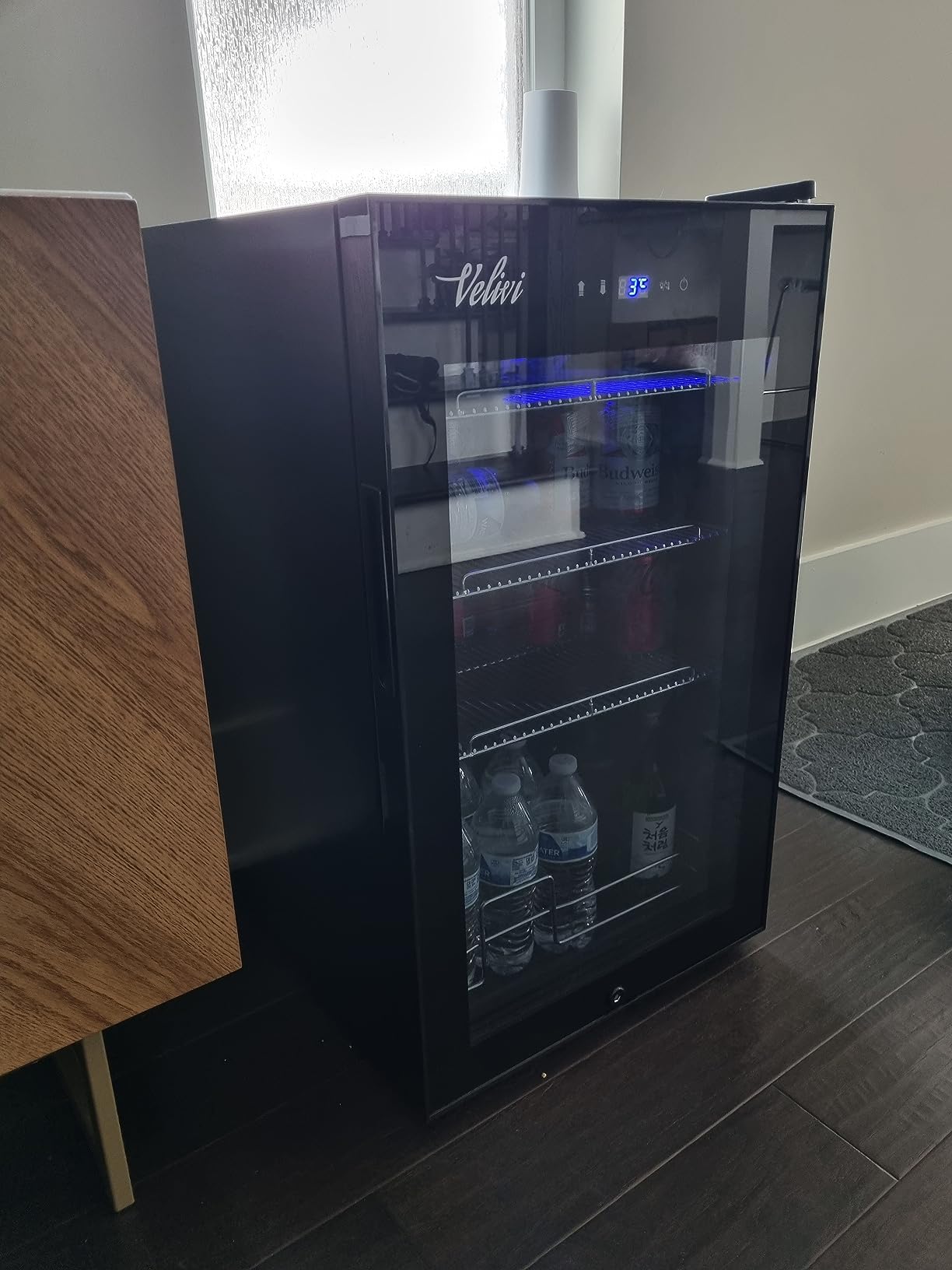
190 bottles and 16 wood racks
Capacity at this scale changes how you plan a room. A 190-bottle cabinet at 23.5 inches wide and 27.2 inches deep is narrow enough to fit between studs in a finished wall, which means it can go into a framed niche rather than standing free against concrete.
Because so many bottle counts assume standard 750ml Bordeaux, treat the 190 figure as a ceiling. Owners of large cellars consistently report filling with magnums and verticals eating 15 to 25 percent of the advertised count, so plan your layout before you fill it.
Front venting in a built-in basement niche
The front-vent design lets the cabinet be installed built-in or freestanding, which is the flexibility you want in a basement because you may not know the final wall position until the bar framing is done.
Front venting is not only about installation. In a tight below-grade room with poor air exchange, exhausting the condenser heat forward into the room rather than into a dead wall cavity is what keeps the compressor from running continuously and wearing out early.
Hinge side, height and installation logistics
Two practical constraints. The door is left-hinged only on this model, so the hinge side cannot be reversed, which can rule out placements next to a corner or a wall return. And the listed dimensions show roughly 77 inches tall, so it needs a full-height niche rather than a standard counter run.
At 150 pounds it is lighter than the 154-bottle Velivi but still a coordinated move down a staircase. Budget for premium delivery, and note that a minority of buyers report noise or vibration beyond what the quiet-operation language implies.
9. BODEGA 28 Bottle Wine Cooler – Compact Compressor Cooling for Small Basements
BODEGA COOLER 28 Bottle Wine Fridge, Cooler for Kitchen, Office, Room & bar
3.02 cu.ft compressor
41-64F range
Seven removable racks
16.9 inch width
+ Pros
- Compressor cooling in a small cabinet
- About 40 dB quiet enough for a bedroom
- UV-blocking double-paned glass
- Narrow 16.9 inch width
- Memory chip restores settings after outages
– Cons
- Wire shelves are light duty for long-term storage
- No manufacturer warranty stated
- Touch panel less intuitive than dials
The BODEGA is the answer to a very common basement constraint: you have a small room, a short wall, and you still want proper compressor cooling rather than a thermoelectric compromise. It is 3.02 cu.ft, 16.9 inches wide by 17.7 deep by 33.07 tall, and it holds 28 bottles across 7 removable wire racks.
Owners consistently highlight that compressor cooling in this size preserves wine roughly twice as long as thermoelectric alternatives. That is the number I would use to justify this unit over a cheaper small thermoelectric fridge.
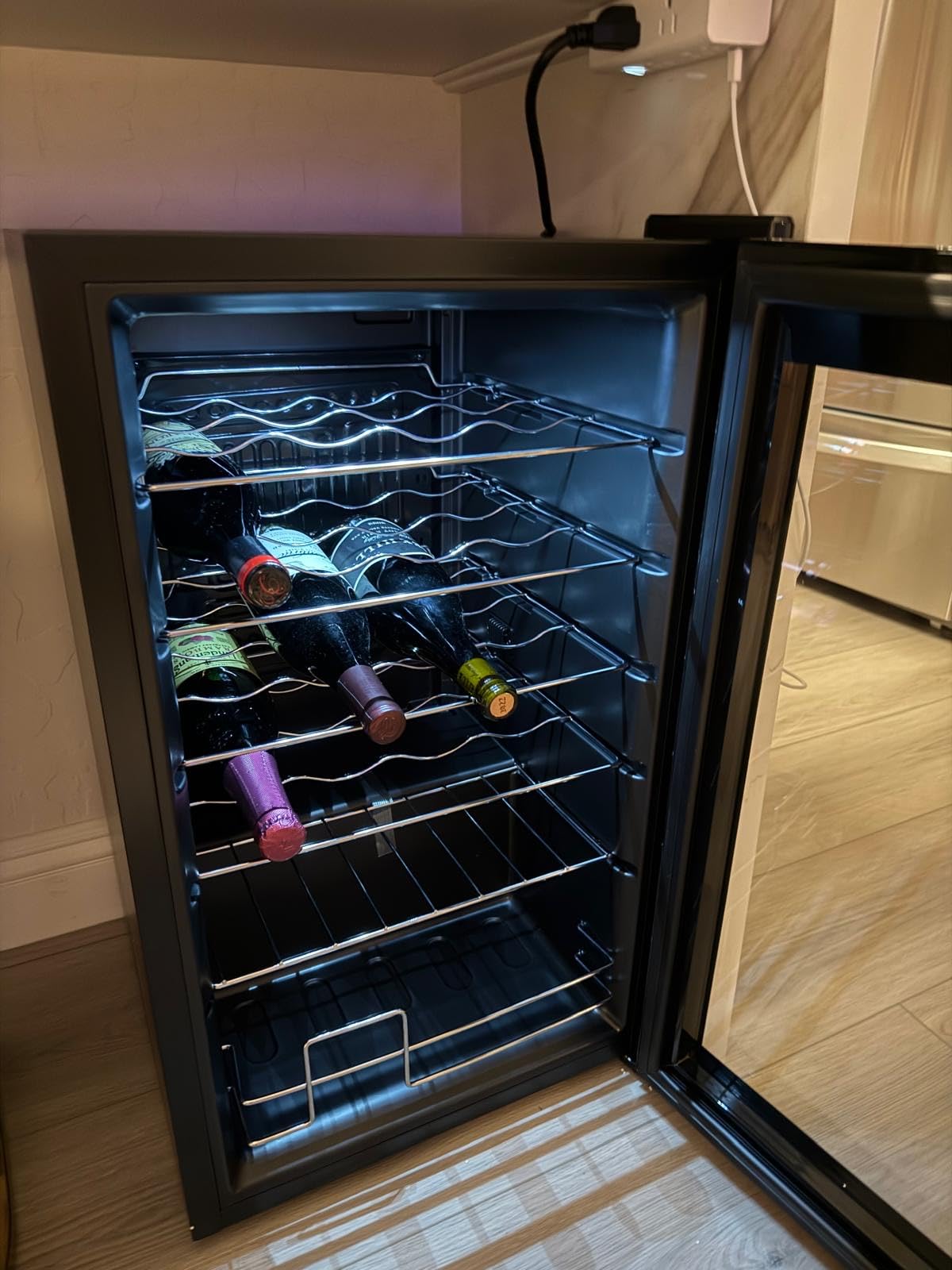
Compressor cooling in a narrow cabinet
The temperature range is 41 to 64F, which covers sparkling whites through reds without the awkward gaps. Built-in fan circulation maintains consistency through the cabinet and automatic defrost handles the frost cycle, so there is no scheduled thaw to remember.
It carries a 3 Star energy rating and draws 139 kWh a year, which sits comfortably in the middle of this group. For a room that is occasionally used rather than constantly occupied, that consumption is easy to live with.
About 40 dB noise floor and bedroom adjacency
At about 40 dB, this is quiet enough for a bedroom or office, according to owners. In a small finished basement directly below a sleeping area, that figure is more important than any feature list, because low-frequency compressor hum is what travels through a joisted floor.
If the room above is a bedroom, pair the placement with an isolation mat and confirm the unit is not sharing a wall with the sleeping space. No amount of cabinet engineering substitutes for where you put it.
Shelving material and warranty coverage
Wire shelves are the main criticism. They are lighter duty than wood cradles, and for a collection intended to be held for years rather than months, that is a real difference in how labels and bottles sit over time.
Also worth noting: this listing states no manufacturer warranty. That is unusual for the category and it is the reason this unit carries a badge about small collections rather than a broader recommendation. If warranty coverage is important to you, treat this as a lower-priority option.
10. Ca’Lefort 52 Bottle Dual Zone Cooler – Built-In Bar Fit With the Longest Warranty
Ca’Lefort 24 Inch Wine Fridge, 52-Bottle Dual Zone Wine Cooler Refrigerator
5.7 cu.ft dual zone
40-64F control
52 bottles
Sapele wood shelves
+ Pros
- Dual zones from 40-64F with fan circulation
- Sapele wood shelves damp vibration
- Front ventilation for built-in install
- Three year compressor warranty
- Many owners call it quieter than their kitchen fridge
– Cons
- About 100 pounds empty
- Must stand 24 to 36 hours before power-up
- Shelves not height adjustable
The Ca’Lefort is the unit I recommend to anyone building an actual bar, and the reason is not the feature list. It is the warranty: one year on the complete machine, two years on parts, and three years on the compressor. Nothing else in this roundup comes close, and in a basement where humidity and temperature swings work hardest on the equipment, a three-year compressor warranty is a meaningful signal about build quality.
It holds 52 standard 750ml Bordeaux bottles in 5.7 cu.ft across two zones from 40 to 64F, on sapele wood shelves chosen for vibration damping. Several owners report fitting more than the advertised count.
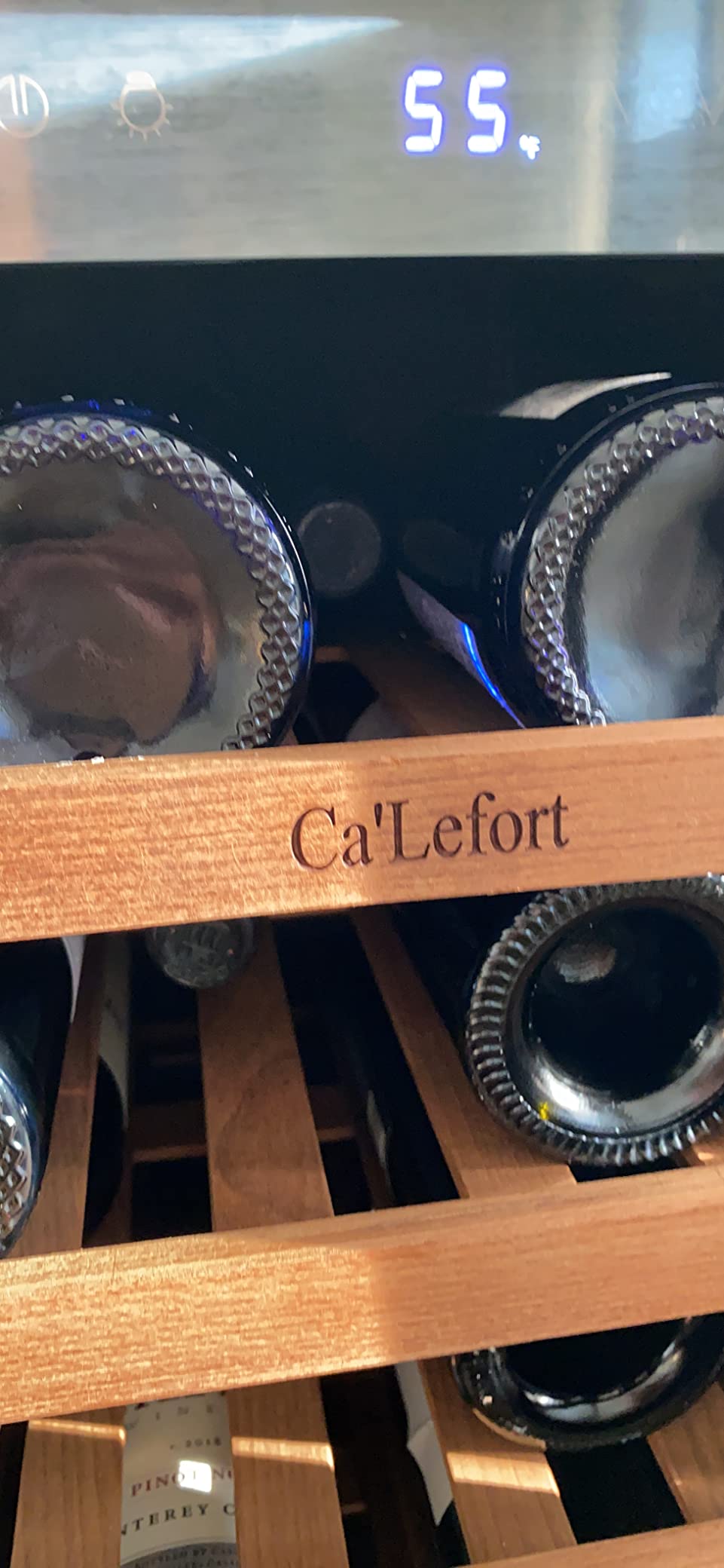
52 bottles and 40-64F dual zone control
Fan-assisted circulation keeps both zones even, which is the specification that separates a serious dual-zone cabinet from one where the lower shelf is six degrees off the top. Owners describe steady holding across both zones, and three-colour LED lighting lets you switch between amber, blue, and white to show the collection.
The glass door is UV-protected, which matters for a basement that gets used as a display space with lights on for hours at a time.
Front ventilation, leveling feet and cabinet doors
Front ventilation supports built-in, under-counter, and freestanding installs with invisible hinges, and at 23.8 inches wide by 23.4 deep by 33.8 tall it slides under a standard counter. The adjustable leveling feet are more than a convenience on a basement slab, because an uneven floor is the usual cause of a door that will not latch properly.
Many owners describe the unit as quieter than their kitchen refrigerator, which is a strong benchmark for a space that shares a floor with living areas.
The 24 to 36 hour settling period and weight
Every owner says the same thing: stand it upright for 24 to 36 hours after delivery before the first power-up. Compressor oil needs to settle into the housing, and skipping this step shortens the life of the unit. In a basement install, plan the delivery a couple of days before you want it running.
At roughly 100 pounds empty, this is a two-person move. A minority of owners report units running louder than reviews suggest, and some report larger zone-to-zone deviation, so verify both zones with an independent thermometer in the first week.
11. Yeego 52 Bottle Dual Zone Wine Cooler – Quiet Dual Zones With Strong Support
Yeego 24 Inch Wine Fridge, 52 Bottle Dual Zone Wine Cooler with Left Hinged
5.12 cu.ft dual zone
40-65F
52 bottles
5 beech wood shelves
+ Pros
- Independent zones across 40-65F
- Very quiet in operation
- Temperature memory after outages
- Responsive support supplied free parts
- Front ventilation for under-counter install
– Cons
- Fixed hinge side on this listing
- Must stand 24 to 36 hours before use
- Middle pull-out shelves only extend halfway
The Yeego lands in the same dimensional class as the Ca’Lefort, at 23.4 inches wide, 22.4 deep, and 32.3 tall, and it competes on a different axis: how it behaves after the sale. Multiple owners describe support supplying hinge-reversal parts and a vent at no charge. In a category where the most common complaint is a missing part and a slow reply, that is worth paying a little more for.
It holds 52 standard Bordeaux bottles on 5 removable beech wood shelves in 5.12 cu.ft, with independent upper and lower zones across a 40 to 65F range.
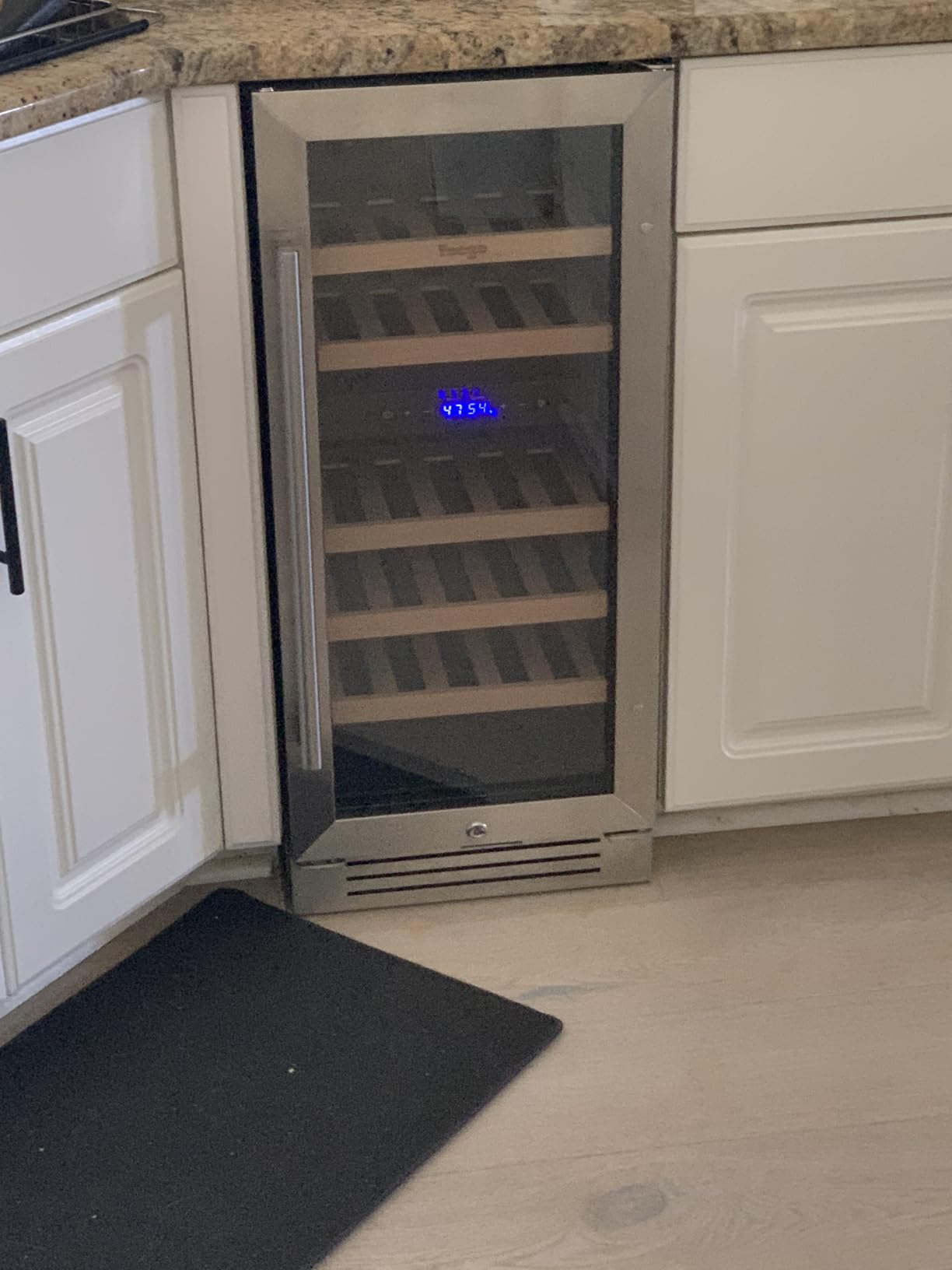
Independent zones from 40-65F
The 65F ceiling is the highest in this roundup, which gives you more headroom against a hot basement than most competing units. For aging reds, a slightly higher upper bound is a genuine advantage, because a cellar in an unconditioned space will drift upward more often than downward.
Temperature memory restores prior settings after a power interruption, which as I mentioned earlier is critical below grade where storm-related outages are common.
Beech wood shelves and vibration control
Five removable beech wood shelves damp vibration during storage, and a compressor with an internal fan circulates air for even cooling. Owners call out how quiet it is compared with units costing considerably more, which tracks with the stainless frame and double-layer tempered glass door improving insulation.
For long-term aging, wood shelving is the specification to insist on. Wire racks in a large cabinet will transmit shelf movement into the bottle stack, and over years that is sediment you did not need to stir.
Hinge side, shelf extension and after-sales support
Two things to plan around. The hinge on this listing is fixed, so it cannot be reversed, and the middle pull-out shelves only take standard bottles and extend about halfway, which makes labels on rear bottles hard to read without pulling everything forward.
Also plan a 24 to 36 hour settling period before first power-up, and note that reaching the full 52-bottle capacity takes careful arrangement. One owner reported electronics failing around six months with a parts-only warranty response, so keep your receipt and your purchase record organized.
12. ORYMUSE 15 Inch Built-In Wine Cooler – Narrow Depth Built for Basement Nooks
ORYMUSE 15 Inch Wine Fridge, 30 Bottle Under Counter Wine Cooler Built-In
3.1 cu.ft built-in
40-65F control
30 bottles
14.96 inch width
+ Pros
- 30 bottles in a 14.96 inch width
- About 38 dB compressor
- Front venting for built-in or freestanding
- Beech wood shelves
- Key door lock and 12 months support
– Cons
- Door can bounce back open
- Wire shelf edges tip when front-loaded
- Single zone only
The ORYMUSE exists to solve one problem, and it solves it well. At 14.96 inches wide it is the narrowest cabinet in this roundup, and it still holds 30 standard Bordeaux bottles on beech wood shelves in 3.1 cu.ft. If your basement has an awkward recess between a chimney breast and a wall, or a narrow gap at the end of a bar run, this is the unit that fits.
It is front-vented, so it works built-in or freestanding, with adjustable leveling feet and a 40 to 65F LCD touch control that includes temperature memory after a power loss. At 52 pounds it is also one of the lighter large-capacity options to bring down stairs.
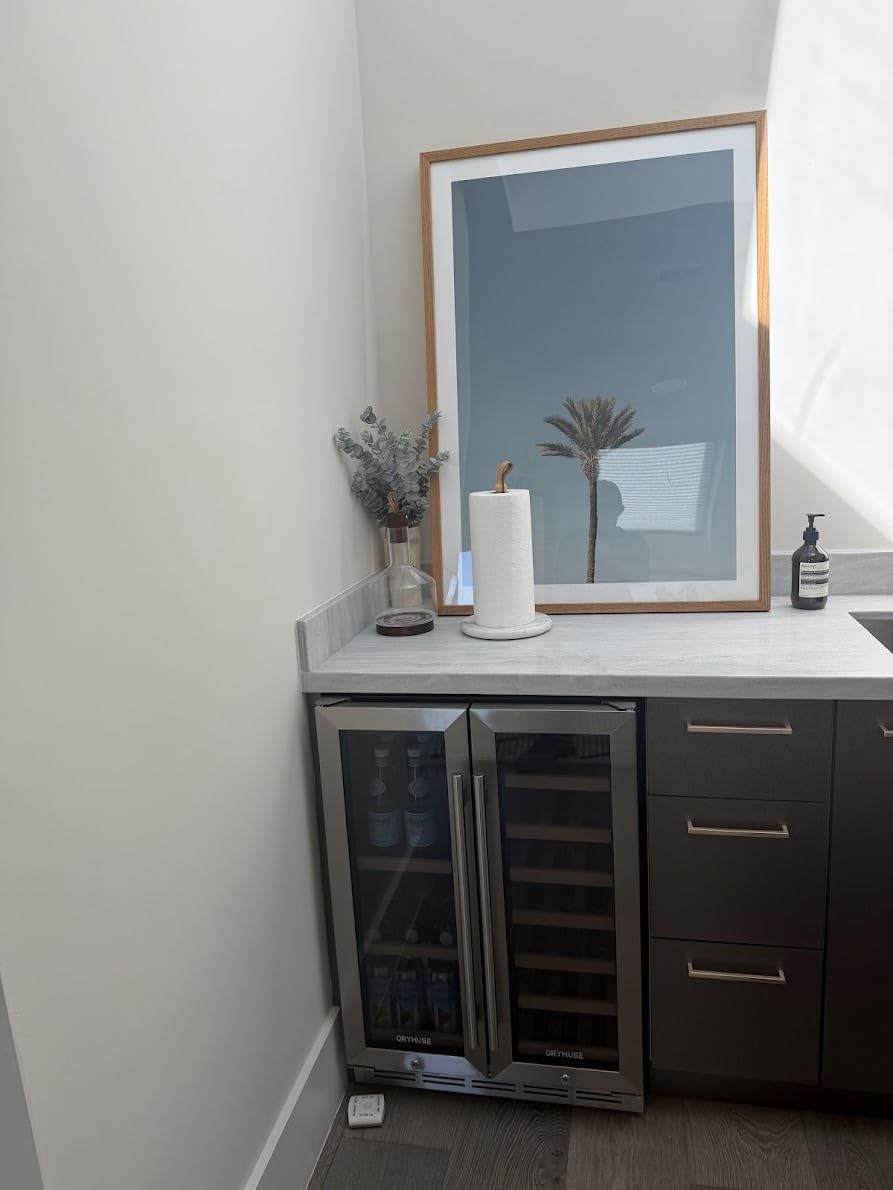
30 bottles in a 14.96 inch width
That width is the entire product. Owners consistently single out the ability to slide it under a counter or into a tight bar space while still getting wood shelves and a 30-bottle load, which is a combination that is genuinely hard to find.
Measured at 14.96 inches wide by 23.03 deep by 33.46 tall, it needs a cabinet opening a little wider than the unit itself for the door swing, so measure the rough-in before you cut anything.
About 38 dB operation and cooling speed
Compressor cooling at approximately 38 dB puts it among the quietest in the group, and owners repeatedly praise both the low noise and how quickly it pulls down after plugging in. For a basement directly beneath living space, that noise figure is the number that should drive the decision.
Consumption is 162 kWh a year with R-600A refrigerant, and the double-layer tempered glass door sits in a stainless steel frame.
Door seal, shelf loading and single-zone limits
The most common criticism is the door bouncing back open when swung shut, which points to a weaker magnetic seal than ideal. Check the latch yourself in the first week, because a cellar in a finished basement that opens itself is both a temperature problem and a security one.
Also note the wire shelf edges can tip forward when front-loaded, actual capacity falls below 30 bottles if you store larger formats, and this is a single-zone unit, so reds and whites share one setting. For a narrow nook, that compromise is usually worth accepting.
How to Choose a Wine Cooler for a Basement
Basement selection is not the same decision as kitchen selection, because the failure modes are different. A kitchen fridge sits in a stable, conditioned, ventilated room. A basement is none of those things, and the appliance has to absorb the difference. Here is how I would work through it.
Compressor or thermoelectric depends on whether the basement is conditioned
This is the first filter and it eliminates most of the category. A compressor moves heat with a refrigerant cycle, so it can hold a low interior temperature even when the room around it is hot. A thermoelectric element creates a temperature differential across itself, so it works best when the ambient is already close to its target.
If your basement is conditioned and dehumidified year-round, a thermoelectric unit like the Koolatron is a legitimate choice for a small collection where vibration matters more than cold. If it is not conditioned, a compressor is not optional. Reviewers with uninsulated basements consistently report thermoelectric units unable to hold temperature through a summer, and HVAC professionals give the same advice.
Single zone or dual zone for a mixed collection
Count what you actually store before you decide. If you hold sparkling, whites, and reds and want all three at their proper temperatures at once, dual zone is not a luxury, it is the only correct answer. A single-zone cellar forces you to pick one temperature and compromise the rest.
If you are purely aging reds at 55 to 60F, single zone does everything you need and frees budget for capacity or a better compressor. The Velieta 24 Inch, BODEGA, ROVSUN, Electactic, and ORYMUSE are all single-zone machines in this roundup.
Freestanding, under-counter or built-in and how venting changes everything
Venting style is the specification most buyers skip and most regret. A rear-vented unit needs clearance behind it and cannot be fully enclosed. A front-vented unit exhausts forward and can be tucked into a cabinet run or a finished wall niche.
In a basement, where wall space is often the scarcest resource, front venting is frequently the difference between a clean install and an appliance sitting in the middle of the floor. Four units here are front-vented: the Velieta 24 Inch, Ca’Lefort, Yeego, and ORYMUSE. The Tylza supports a built-in install as well.
Ventilation clearance in tight basement nooks
Whatever the unit, give it air. Rear-vented compressors need a few inches behind and above; front-vented ones still need the door able to open far enough to reach rear bottles. A cabinet wedged into an unventilated pocket will run its compressor continuously, which shortens its life and raises consumption.
This is also the single most common regret in basement installs, and it is entirely avoidable with a tape measure. Measure the opening, add the clearance your manual specifies, and check the door swing in both directions before you order.
Noise transmission through finished basement ceilings
Sound travels through structure, not air. A 38 dB cabinet in an unfinished concrete room can be audible in a bedroom directly above once the room is carpeted, drywalled, and furnished, because those surfaces reflect rather than absorb.
Prioritize published decibel figures below 40 dB if you have sleeping space overhead, and add an isolation mat under the feet. Placement matters as much as specification, so keep the unit away from the common wall with the room above.
Concrete floor leveling and vibration isolation
Most basement slabs are not flat, and an unlevel cabinet is the reason doors will not seal and compressors cycle too hard. Shim the leveling feet rather than stacking a pallet or a scrap of lumber under the whole unit, which throws the cabinet out of square.
Owners recommend a rubber mat or vibration pads for any unit over about 50 pounds. The ROVSUN and ORYMUSE both come with leveling feet, and the Ca’Lefort includes adjustable ones, so getting this right costs very little.
Humidity, condensation and drainage management
Basement humidity is the quiet enemy of both the wine and the appliance. Run a dehumidifier alongside the cooler rather than trying to make the cooler do both jobs, and keep relative humidity in a moderate band rather than chasing a number with the wine cabinet itself.
Expect some condensation on the exterior of the glass in humid conditions; that is air condensing on a cold surface, not a leak. Where a cooler has a defrost drain, route it to a floor drain or a wet-rated condensate pump. If your basement has no floor drain near the appliance, that is a planning item before the install, not after.
Electrical planning for basement outlets
Basements are wet-adjacent spaces, so outlet type matters. Code generally requires GFCI protection in basements, and older homes often have missing or inadequate protection on circuits near where a cooler will go.
Run a dedicated 15-amp circuit if the existing outlet is shared with a dehumidifier, a sump pump, or a workshop tool, and confirm the circuit can handle sustained compressor load. Since your sump pump is almost certainly on that same circuit, our sump pump picks are worth checking to understand what you are sharing a circuit with.
Sizing capacity to the collection you actually own
Advertised bottle counts assume standard 750ml Bordeaux. Loading Champagne, Burgundy, magnums, and verticals cuts usable capacity by 15 to 30 percent, and reviewers of nearly every large unit here confirm this. If your collection skews wide, size up rather than trusting the headline number.
The other sizing variable is physical. Before choosing, measure the door width of your exterior entrance, the narrowest point on your stair run, and the ceiling height at the bottom of the stairs. Two of the twelve units in this roundup weigh over 140 pounds, and both are close to 65 inches tall.
Frequently Asked Questions
Do wine coolers work in cold basements?
They do, but only with the right model. Standard compressor units are engineered for a normal indoor ambient band, and in an unconditioned basement that swings from near freezing to the mid 70s in summer, a unit outside its rated ambient range will struggle, cycle constantly, and wear out. Look for a wide ambient temperature specification, and in cold weather a basement-specific safeguard or low-ambient cutout is worth having. Thermoelectric units fare even worse in temperature swings because they create a differential rather than moving heat.
What is the ideal temperature for a basement wine cooler?
Aim for 55 to 58F for aging reds, 50 to 55F for whites, and 45 to 50F for sparkling and rose. Basement coolers in this roundup cover ranges from 32F to 65F, so the setpoint is available in every one of them. The more important variable is stability, because a cabinet that holds a steady 57F is better for the wine than one that averages 55F and swings eight degrees.
How much ventilation does a wine cooler need in a basement?
Enough that the condenser is not recirculating its own exhaust. Rear-vented units need a few inches of clearance behind and above. Front-vented units exhaust forward and can sit inside a cabinet run or finished wall niche, which makes them far easier to place in a tight basement. Avoid burying any unit in an enclosed pocket, and leave the door able to open far enough to reach bottles at the back.
Should I buy a compressor or thermoelectric wine cooler for a basement?
Buy a compressor unless your basement is conditioned and dehumidified year-round. Compressors remove heat with a refrigerant cycle and hold low temperatures against a hot room, which is exactly the basement problem. Thermoelectric units run very quietly with no compressor vibration, which is a real benefit for a small collection of older bottles, but they bottom out around 46F and cannot hold temperature in an unconditioned space.
Do I need a dedicated circuit for a wine cooler in the basement?
Usually you want one, especially if the outlet is shared with a dehumidifier, a sump pump, or workshop equipment. A compressor draws sustained current, and a marginal circuit is the most common cause of nuisance GFCI tripping below grade. Basements generally require GFCI-protected outlets under current code, so verify protection is present and adequate before installation, and have any new circuit run by a qualified electrician.
Final Verdict on the Best Wine Coolers for Basements in 2026
Pick the Tylza 30 Inch Dual Zone if you want the strongest all-round combination we tested, since it pairs two independent zones with a compressor rated under 38 dB and a built-in or freestanding install. If the binding constraint is width, the Ivation 18 Bottle is hard to beat at 13.58 inches and 43 pounds. For a basement bar that holds beer and wine together, choose the Electactic 37 Bottle, and for genuinely large collections, the Velivi 154 or 190 bottle cellars are where the capacity and wood shelving justify the delivery logistics.
Two things will protect your bottles more than any model choice: a dedicated GFCI-protected circuit, and a dehumidifier running alongside the cabinet. Get those right and the best wine coolers for basements we covered above will each do their job for years.
Leave a Reply