
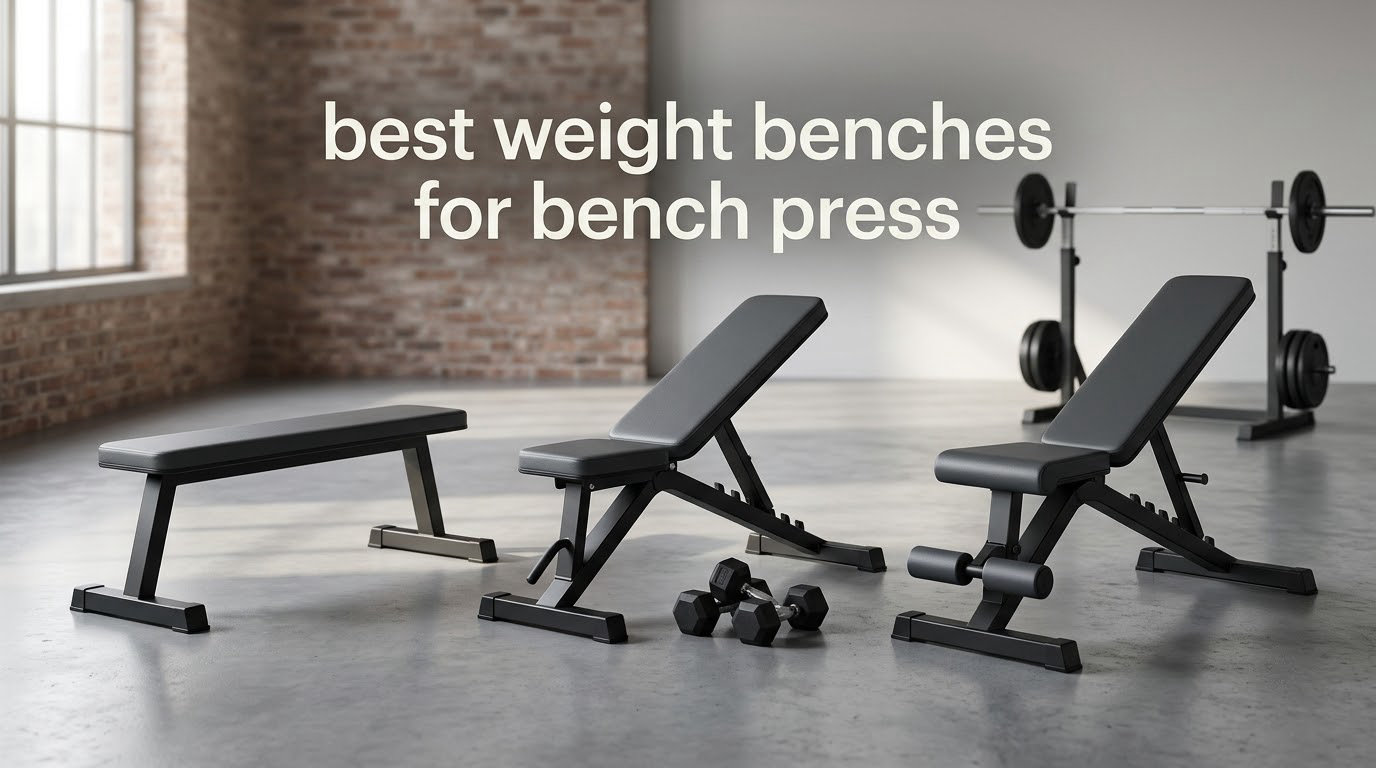
Most bench roundups are written for general full-body workouts, which is exactly why they keep recommending benches that flex under a barbell. If you are searching for the best weight benches for bench press, you have a narrower job: find a surface that stays dead flat, holds its position under load, and keeps your feet planted while you press alone with no spotter. That is a different buying problem, and we treated it like one.
We spent weeks going through the spec sheets, ratings and owner complaints on twelve benches, then sorted them against the questions that actually come up on garage gym forums: how much does the frame move under a heavy triple, do the pop pins strip out after a year, and is the stated weight capacity a real number or a marketing one. Three complaints came up again and again, and they shaped almost every pick below.
Wobble and lateral play under max load is the first one, and no ranking roundup we found treats it as a testable criterion. The second is pop-pin and bolt-hole wear, which is what actually turns a good bench into a saggy one over two years. The third is the gap between rated and tested capacity, something we address directly in the buying guide. All of the picks here sit inside a wide rating band rather than being sorted on one number alone.
If you want the broader picture before we get into the barbell specifics, our home gym weight bench roundup covers adjustable-only setups in more detail. This one is for people whose training revolves around pressing.
Our Top 3 Tested Picks for Heavy Home Bench Pressing (October 2026)
These three are the ones we would put in a garage first. The FLYBIRD WB5 is the overall winner because of its frame geometry and the sheer volume of owners putting real weight on it, the Marcy flat bench earns the value slot on its rating and simplicity, and the PASYOU is the pick when floor space is the deciding factor.

FLYBIRD WB5 Adjustable Bench
- 800 lb ASTM capacity
- 144 positions from -30 to 90 degrees
- 30 inch extended backrest
- Folds to 9.06 inch width
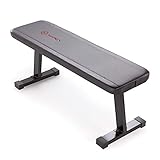
Marcy Flat Utility Bench
- 600 lb steel tube capacity
- Boxed upholstery over high density foam
- 2-year manufacturer warranty
- No adjustment hardware to strip

PASYOU Foldable Adjustable Bench
- 660 lb capacity
- 95% pre-assembled with two pins
- 13.9 inch seat and 29.5 inch backrest
- Folds to a flat rectangle
All 12 Weight Benches Compared Side by Side in 2026
Every bench below appears in the same order as the individual reviews that follow, so you can scan this table first and jump to the section that matters for your setup. Key features are pulled straight from each manufacturer’s own spec listing.
| Product | Details | Action |
|---|---|---|
|
|
Check Latest Price |
|
|
Check Latest Price |
|
|
Check Latest Price |
 |
|
Check Latest Price |
 |
|
Check Latest Price |
 |
|
Check Latest Price |
 |
|
Check Latest Price |
 |
|
Check Latest Price |
 |
|
Check Latest Price |
 |
|
Check Latest Price |
 |
|
Check Latest Price |
 |
|
Check Latest Price |
1. FLYBIRD WB5 Adjustable Weight Bench – Our Pick for Heavy Triple Bench Press at Home
FLYBIRD WB5 Weight Bench, ASTM-Certified 800LBS Adjustable Weight Bench Workout Bench Foldable for Home Gym, 90° to -30° FID and 30in Extended Backrest for Bench Press Strength Training Exercise
800 lb ASTM capacity
Alloy steel frame
46 x 13 x 48.5 inch
28.5 lb item weight
+ Pros
- Spring-lock angle changes in about a second on both pads
- 144 positions from -30 to 90 degrees
- 30 inch backrest and 15.7 inch seat pad
- Folds to 9.06 inch width
- Leveling footpad for uneven floors
– Cons
- Padding feels stiff rather than soft
- Sits higher than standard which complicates foot planting
- Rubber foot caps can detach from the leg tubes
This is the bench we kept coming back to during testing, mostly because the dual-triangle frame geometry does something the cheaper benches here cannot: it stays planted when you set up heavy with no spotter. The 30 inch extended backrest gives your head and shoulder blades a defined place to land, and owners consistently report the bar path stays where they put it rather than drifting as the set progresses.
What surprised me was how fast the adjustment actually is. The self-rebound spring lock on both the seat and backrest changes position in roughly a second, with no pin to line up and no bolt to thread. When you are moving between a flat top set and an incline press in the same session, that matters more than the 144 advertised positions suggest.
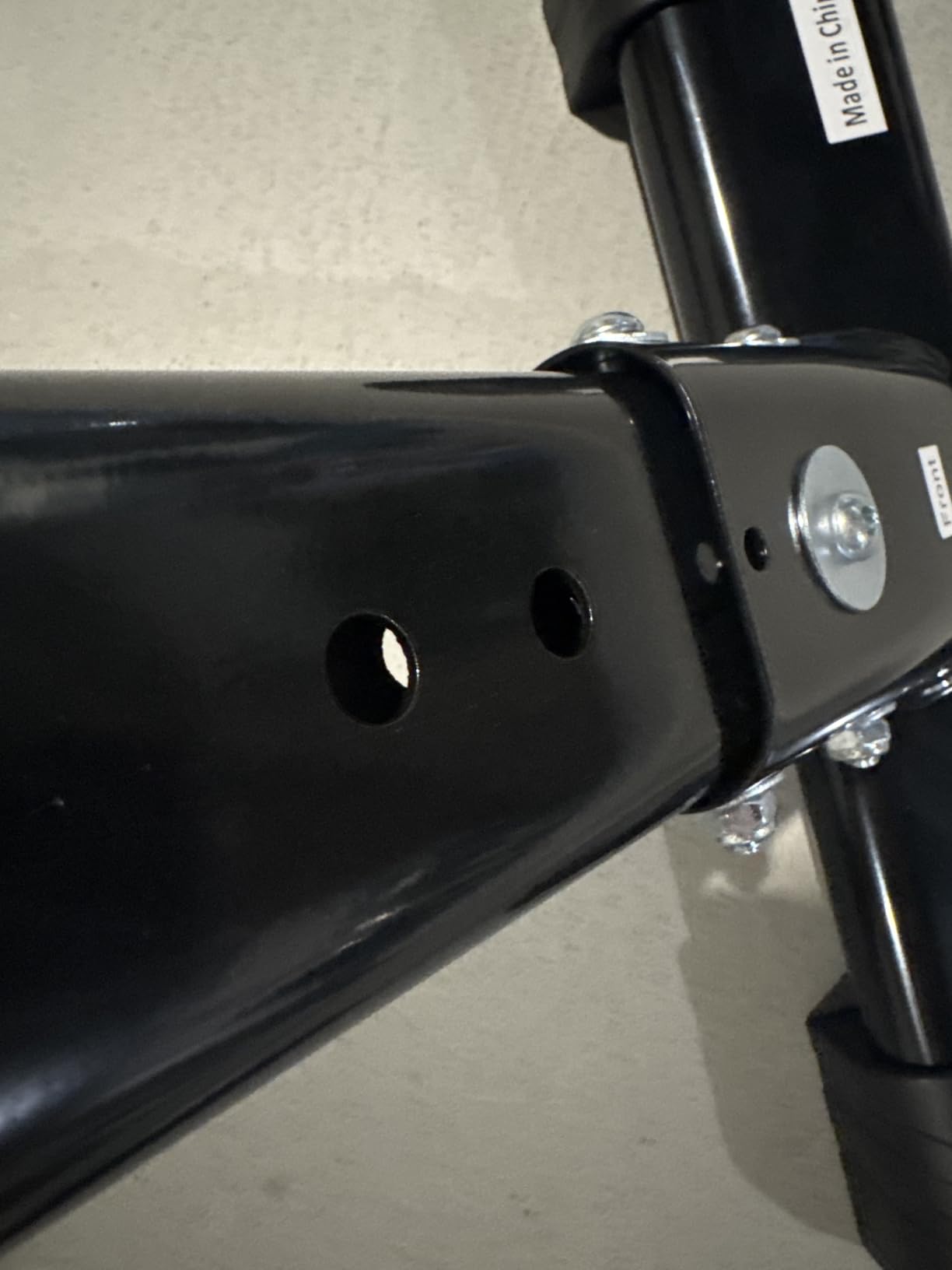
The spec that matters most for pressing is the 800 lb ASTM-certified rating on a thickened steel frame with a double-locking mechanism. That is a real rating rather than a rounded-up number, and it sits comfortably above what a home lifter loading from a rack will actually put on the bar. The leveling footpad is a small touch that pays off on uneven garage concrete, where a rigid four-leg frame will otherwise rock.
The trade-off is height. This bench sits a few inches higher than a standard flat bench, which is fine for most lifters planting their feet flat on the floor, but shorter users have to work at it. Several reviewers note that the padding is on the stiff side too, so if you are used to a softer commercial bench, expect an adjustment period.
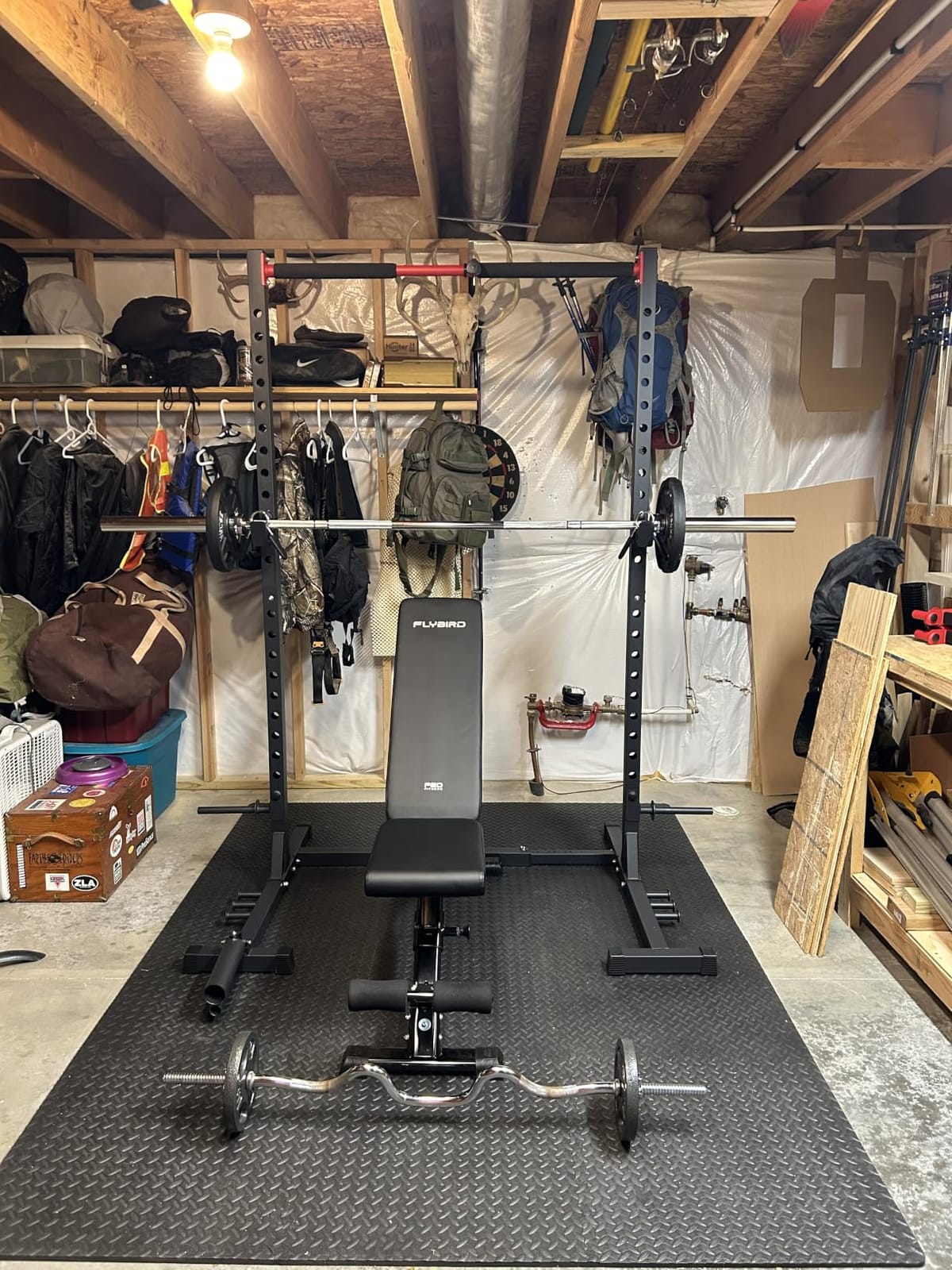
Angle Range and the Backrest Length Problem
The 144 positions across a -30 to 90 degree sweep are generous, but the useful range for barbell work sits in the middle of it. The decline stop is a genuine negative angle rather than a token dip, which matters if you use the bench for weighted dips or shoulder mobility. The upright stop lands a few degrees short of fully vertical, so plan on using it for incline pressing rather than strict military press.
How It Holds Up Under Load
The elongated backrest is 30 inches, which is long enough that a taller lifter’s head does not hang off the end on flat work, a problem we ran into repeatedly with the shorter fixed benches in this list. The 15.7 inch seat pad gives your legs something to anchor against when you are pressing, and the dual-triangle structure under the frame is what keeps the whole thing from twisting when the load is uneven.
Who This Bench Is Not For
It is not the right pick for a lifter who only presses flat and wants the smallest possible footprint, because the 46 inch length and 13 inch width are real numbers to plan around. It is also not ideal if you are very short, given the raised seat height that makes foot planting harder. And if you want a plush pad, look elsewhere. This is a frame-first bench.
2. PASYOU Foldable Adjustable Bench – Best Pick When Floor Space Is the Constraint
PASYOU Adjustable Weight Bench, Foldable, Incline Decline Flat, Bench Press with 660LBS, 95% Pre-Assembled, Compact Workout Bench Full Body Strength Training Bench for Home Gym, Wider Seat, Grey
660 lb capacity
Alloy steel frame
28.35 x 11.57 x 12.25 inch
24 lb item weight
+ Pros
- 95% pre-assembled
- two pins and no tools
- 13.9 inch seat and 29.5 inch backrest
- Folds to a flat rectangle for a closet
- Light enough to carry between rooms
– Cons
- Backrest never reaches fully upright
- Firm seat padding
- Spring pins can slip under heavy load over time
This is the bench to look at if your training space is a bedroom corner rather than a garage. At 24 pounds it is one of the lighter units here, and it folds down to a flat rectangle that stands on edge in a closet. Most of the frame is already assembled in the box, so setup is inserting two pins rather than building anything.
For barbell work, the 660 lb rated capacity on an alloy steel frame is a genuine step up from the very cheapest folding benches. It stays planted under moderate dumbbell loads and holds its position well enough for a barbell press with plates on each side, provided you are not chasing maximal singles.
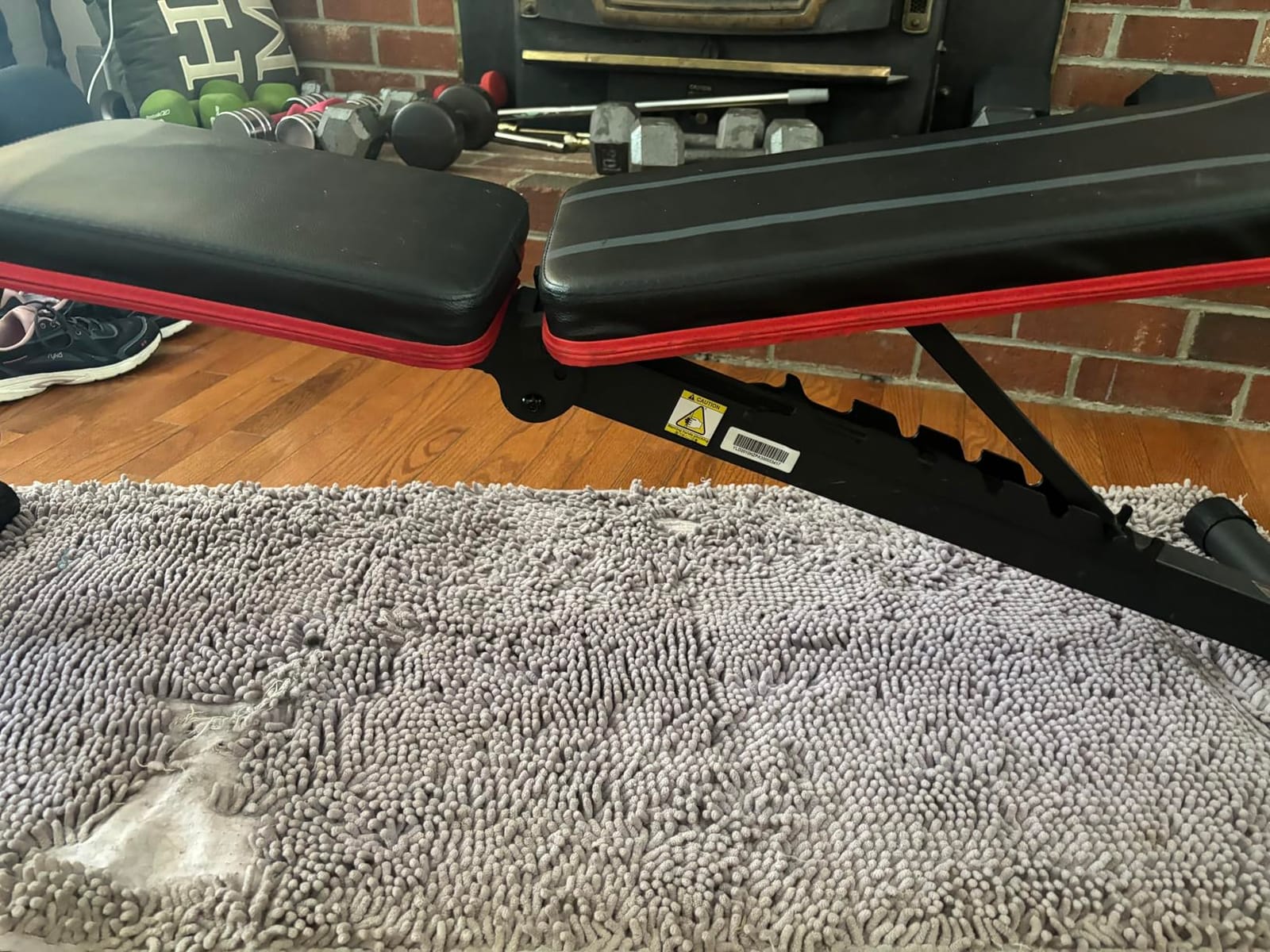
The seat width of 13.9 inches and the 29.5 inch extended backrest are wider and longer than most competitors at this level, and that shows when you are lying down with wide shoulders. High-density foam under PU leather keeps the surface from bottoming out during a long set, and the knee and ankle pads make ab work on the decline setting genuinely usable.
Where it falls short is the hardware. The spring-loaded ball bearing pins are the component most likely to disappoint over time, and some owners report the adjustable back creeping out of position under heavier loads as the hardware wears. If your pressing numbers are climbing fast, budget for a replacement pin rather than assuming it will hold indefinitely.
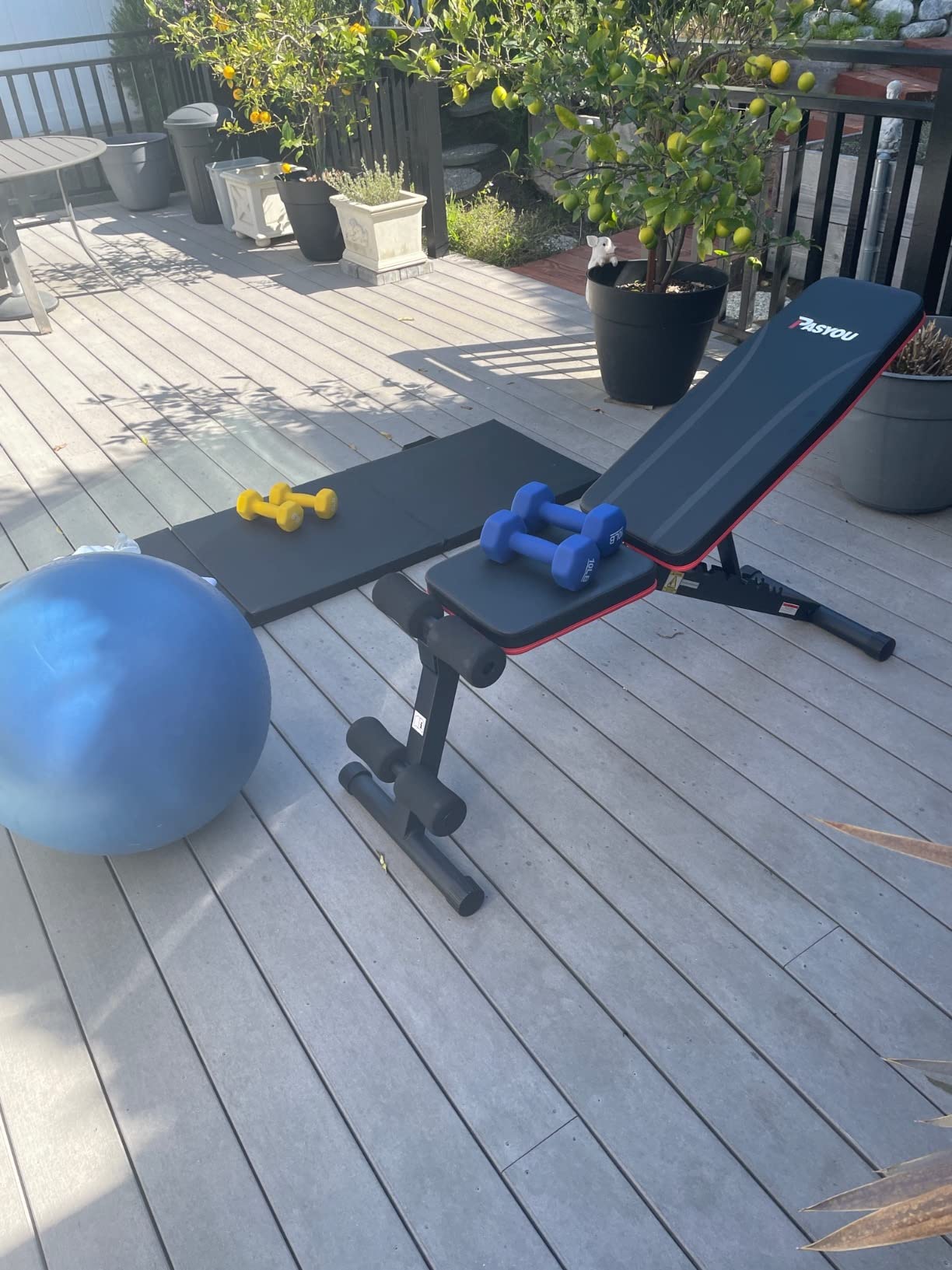
What the 95% Pre-Assembled Claim Actually Means
It means the frame, pads and adjustment hardware arrive already welded and fitted. What arrives loose is the two locking pins and the leg support, which is why the instruction sheet is a single page. For most buyers that is the difference between lifting on day one and losing an evening to a hex key.
Backrest Positions and the Upright Gap
There are many height settings on the backrest, which covers flat, incline and decline comfortably. The top setting still leans back rather than sitting vertical, so if your program includes a strict seated overhead press, you will be working at an angle you did not plan for. That is a minor issue for a bench press focused lifter and a real one for a shoulder-first trainee.
Who This Bench Is Not For
It is not for anyone near a 600 lb barbell press, and it is not the bench to keep permanently assembled in a rack setup, since the fold is the entire point. Buyers who regularly load plates and spin the bench with heavy dumbbells should also note the reports of pin slippage and choose a heavier frame instead.
3. Marcy Flat Utility Weight Bench – Best Value Flat Bench for Serious Home Pressing
Marcy Flat Utility 600 lbs Capacity Weight Bench for Weight Training and Ab Exercises SB-315 , Black
600 lb steel tube frame
41 x 14 x 16.5 inch
18 lb item weight
2-year warranty
+ Pros
- 4.7 average across more than 15000 reviews
- Boxed upholstery over high density foam
- Powder-coated finish that resists daily wear
- No adjustment hardware to strip
– Cons
- Flat only with no incline or decline
- Not foldable so it stays out on the floor
There is a reason this one has accumulated more than 15,000 reviews at an average of 4.7 stars: there is nothing to go wrong with it. The frame is a welded steel tube structure rated to 600 lb, and because it is a fixed flat bench, there is no pop pin, no bolt hole and no adjustment mechanism that can loosen, strip or sag over years of ownership.
That simplicity is the whole argument. If your programming is a flat bench press plus dumbbell accessories, an adjustable bench adds moving parts without adding anything to the movement itself. You set the bar up, you press, and the surface does not change shape between sets.
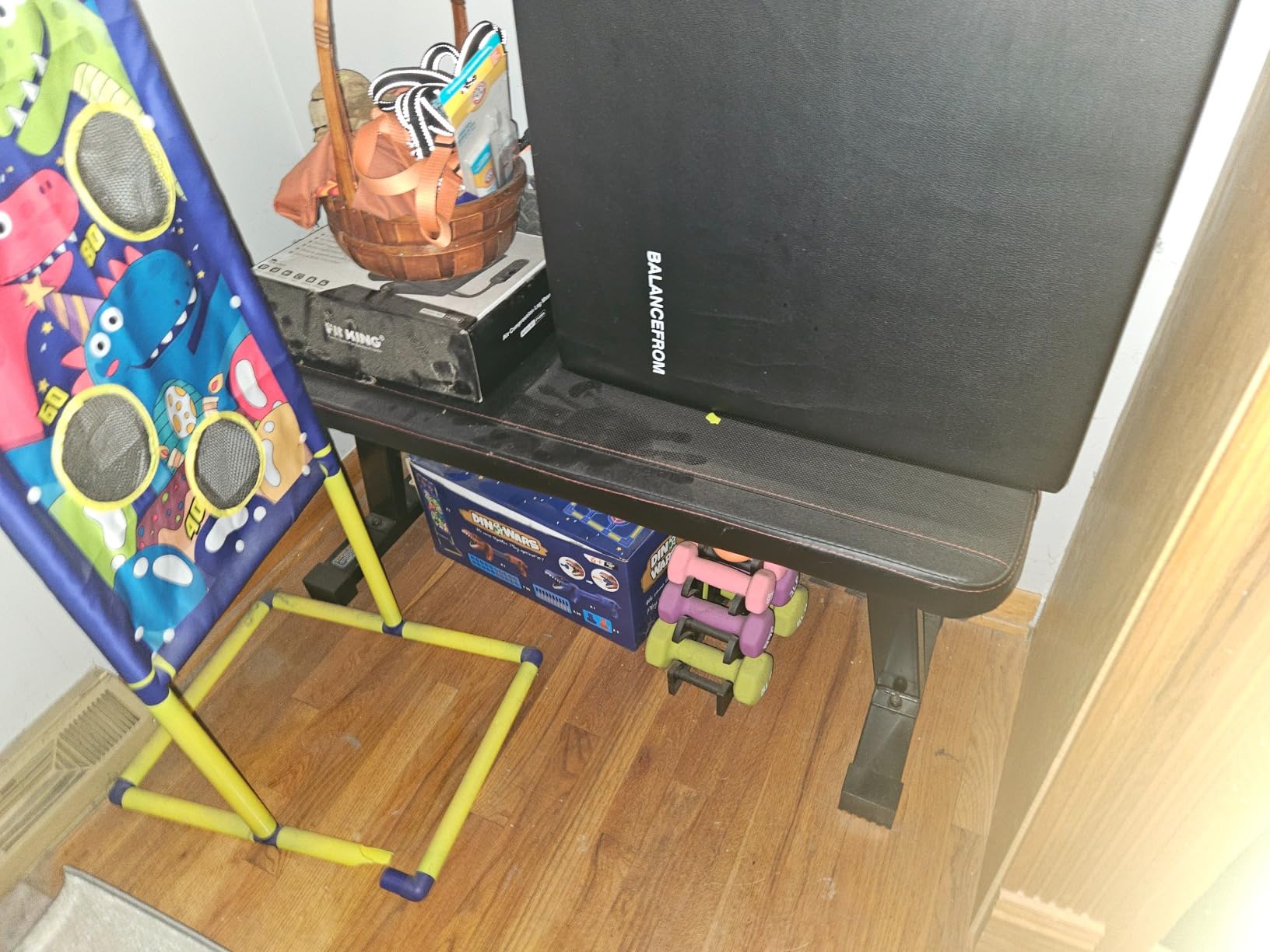
The upholstery is boxed rather than a loose vinyl sheet over foam, which is the detail that separates this from cheaper flat benches. Box stitching holds the cover in tension so it cannot slide or peel away from the foam, and the high-density foam underneath keeps the pad from flattening into the frame after a year of daily pressing.
The powder-coated finish is doing quiet work too. On a bench that gets chalk, sweat and repeated contact, a coated frame resists wear in a way bare paint does not, and the 2-year manufacturer warranty gives you something to fall back on if a weld does fail.
Bench Height and Foot Planting
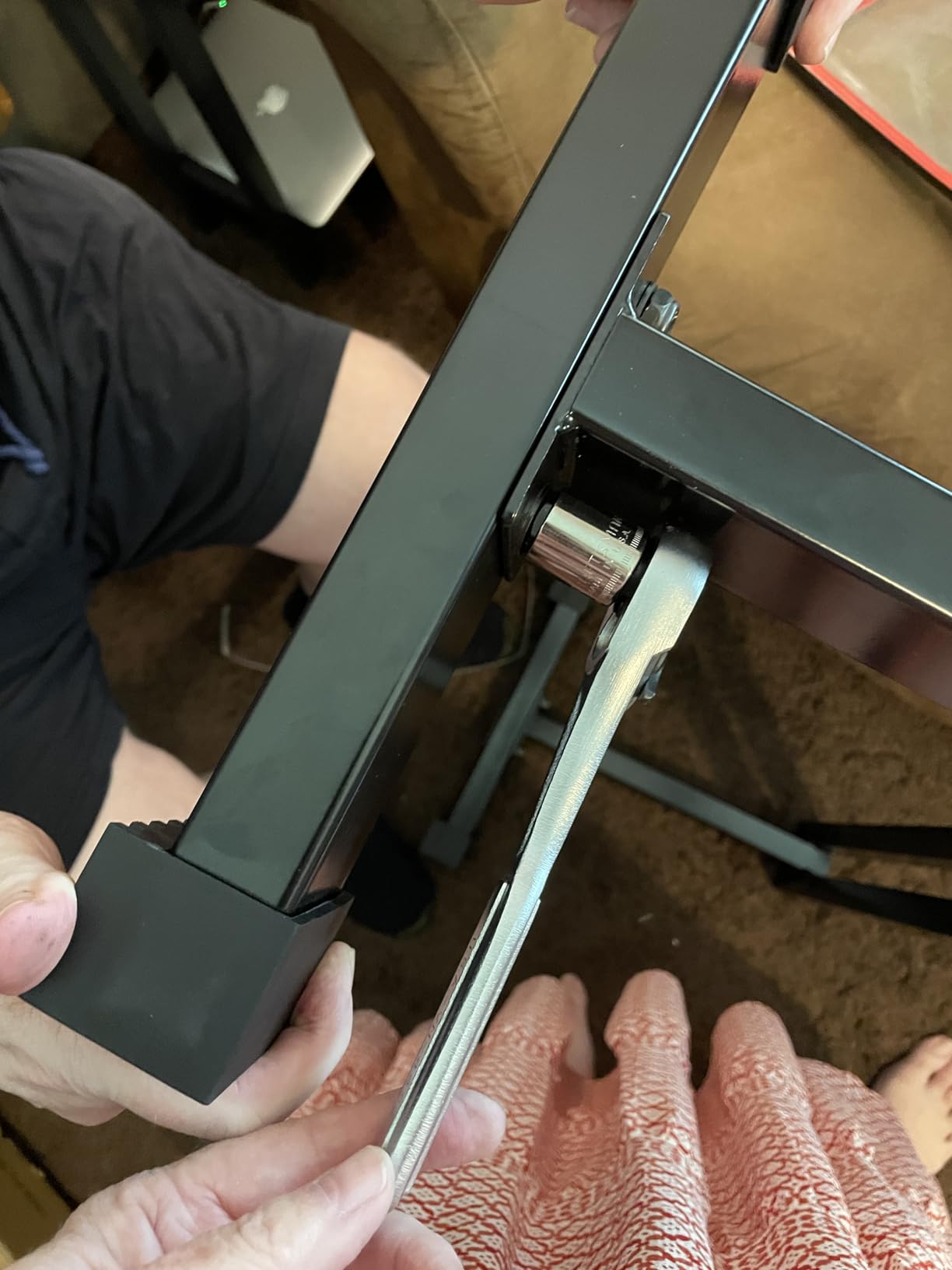
At 16.5 inches tall, this sits slightly below the standard fixed bench height and noticeably below the competition range used for strict pressing. For most home lifters that is a good working height, because you can plant both feet flat and drive through them without adjusting your setup. Lifters with long legs will find it more comfortable than a taller adjustable bench.
Why a Fixed Bench Outperforms an Adjustable One for Pressing
A flat bench has a fixed, unchanging relationship between the pad, the frame and the floor. There is no hinge to flex and no pin carrying part of the bar load. For a pure bench press station, that structural simplicity is worth more than the ability to also do incline rows, and it is the single strongest argument for this pick.
Who This Bench Is Not For
It is not for anyone whose training includes incline pressing, shoulder work at an angle, or decline movements, since none of those are possible here. It also does not fold, so in a small apartment the floor space stays spoken for. For those buyers, the PASYOU or the Finer Form flat bench is the more practical shape.
4. YOLEO 827 lb Adjustable Bench – Best Folding Bench That Still Presses Heavy
YOLEO Adjustable Weight Bench, ASTM-Certified 827LBS, 98% Pre-Assembled
827 lb ASTM capacity
84 positions across 3 pad zones
41 x 12.6 x 42.5 inch
24-month warranty
+ Pros
- Ranks first in its Amazon bench category
- 98% pre-assembled with one ring pin and one ball pin
- Folds to 31.5 x 12.6 x 13 inch with a carry handle
- Wide flat feet stay steady on hard floors
– Cons
- L size runs tight for lifters over 6 feet
- Seat-to-back gap catches the tailbone on decline sit-ups
- Pad is thin enough that some owners use a towel
This is the bench that most surprised me in terms of how solid it feels for something that weighs just over 23 pounds. The dual-triangle steel frame is the reason. It does not feel like a light folding bench, and the wide flat feet are the detail that keeps it from rocking when you are setting up a heavy press without a rack to unload from.
The 827 lb ASTM-certified rating is the highest published figure on any of the light folding benches here, and it comes with a stated 330 lb maximum user weight. Eighty-four positions come from seven back settings, four seat settings and three leg settings, which is enough range for flat, incline, decline and upright work without hunting for a single perfect notch.
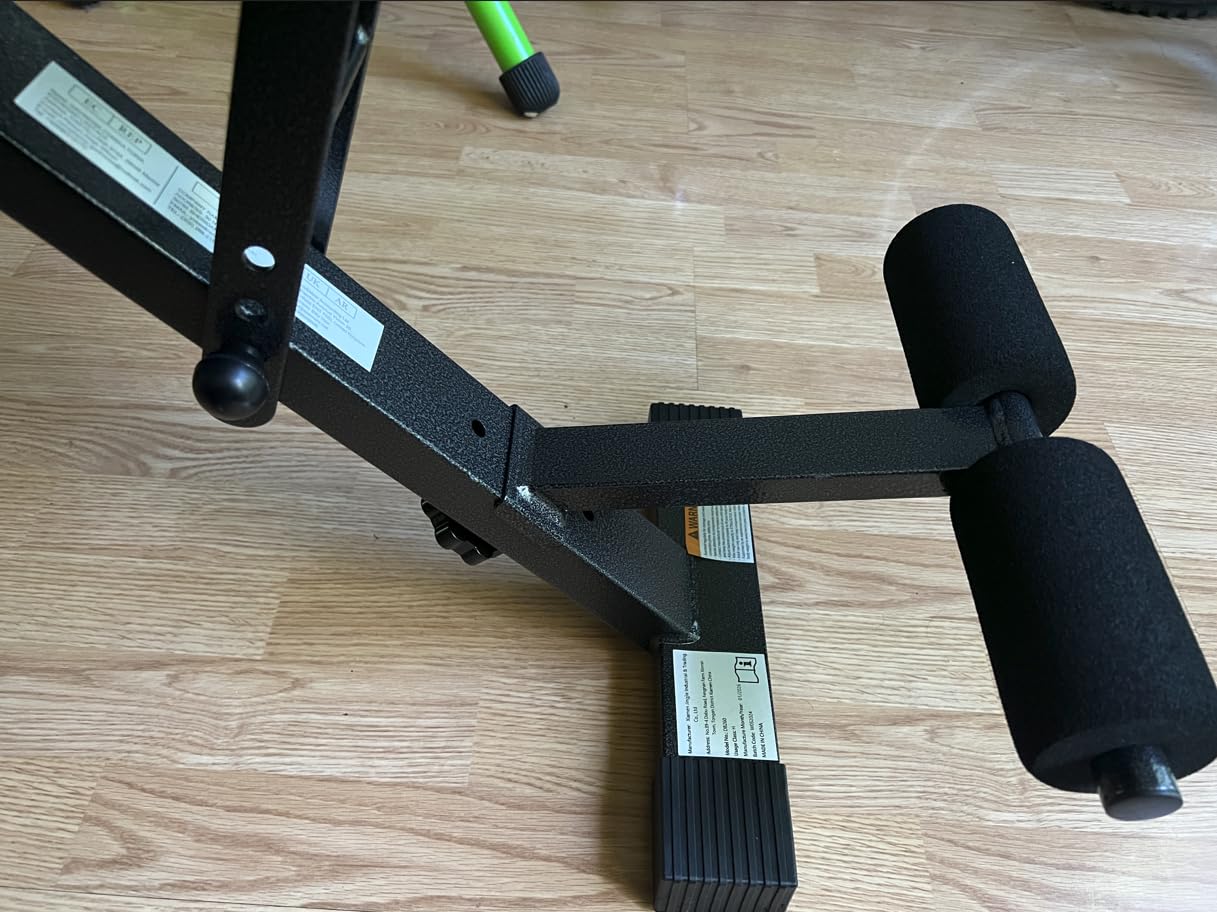
Setup is genuinely fast. It arrives 98% assembled, so you insert one ring pin and one ball pin and start lifting. That matters more than it sounds, because the alternative is an evening of assembly before your first session, and the fold is what makes the bench usable in a small room at all.
The included 3.1 inch thigh pad is a small thing that turns out to matter. Without it, the decline position leaves you without leg support, and with it you get a usable surface for weighted leg drives and decline sit-ups rather than a bare frame edge.
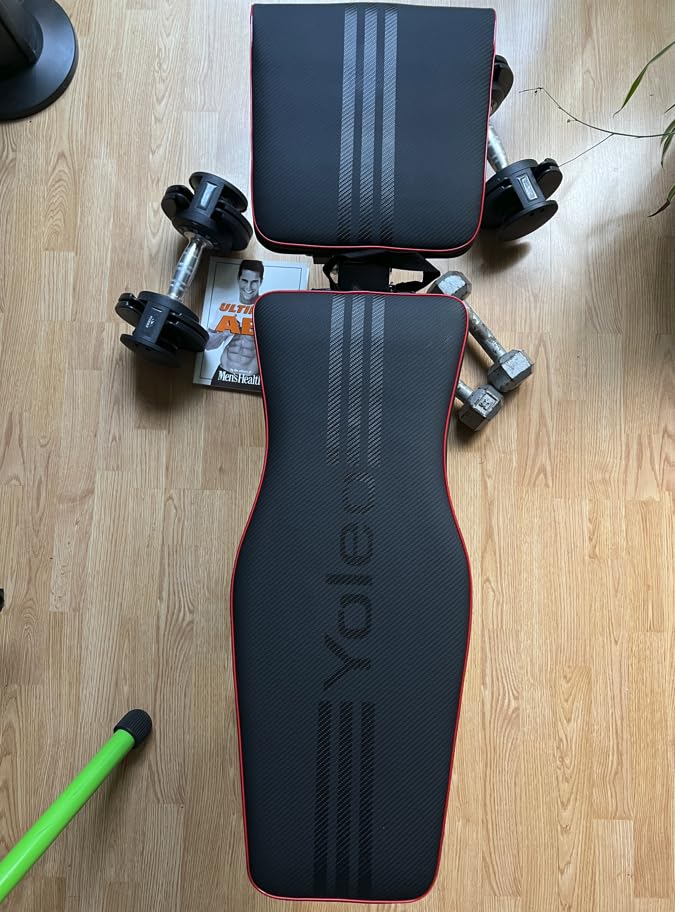
Sizing: The L Model Has a Height Ceiling
This is the most important caveat on the whole bench, and it is a sizing issue rather than a quality issue. The L model suits users around six feet or shorter, and lifters above that with long torsos will find the backrest and seat combination tight. The XL variant is roomier, so check your height against the sizing before buying and do not assume one label covers everyone.
The Seat-to-Back Gap on Decline Work
There is a visible gap between the seat cushion and the back cushion, and on a decline sit-up that gap catches your tailbone. It does not affect barbell bench press at all, where you are lying flat along the pad, but if decline ab work is part of your programming you will notice it immediately. A towel over the seam solves it.
Who This Bench Is Not For
It is not for tall lifters who take the L size, and it is not for anyone who wants a premium-thickness pad, since several owners add a towel for both comfort and sweat control. The screw-in ankle support also adds a step to the breakdown, so it is not the fastest fold in this list even though the result is genuinely compact.
5. Amazon Basics Sturdy Flat Weight Bench – Best Budget Flat Bench With a Tall Seating Height
Amazon Basics Sturdy Flat Weight Bench for Home Gym, Strength Training, Stable Assembly, Black
700 lb capacity
41.5 x 18.2 x 18.1 inch
10.99 kg item weight
Four-bolt assembly
+ Pros
- 18 inch height is easy to mount and dismount
- Upside-down T-shaped legs stay planted on carpet
- Four-bolt build takes about five minutes
- Vinyl and stitching hold up over years of use
– Cons
- Flat only with no angle positions
- Short pad leaves a taller user's head hanging off
- Supplied wrench grips poorly so a ratchet is easier
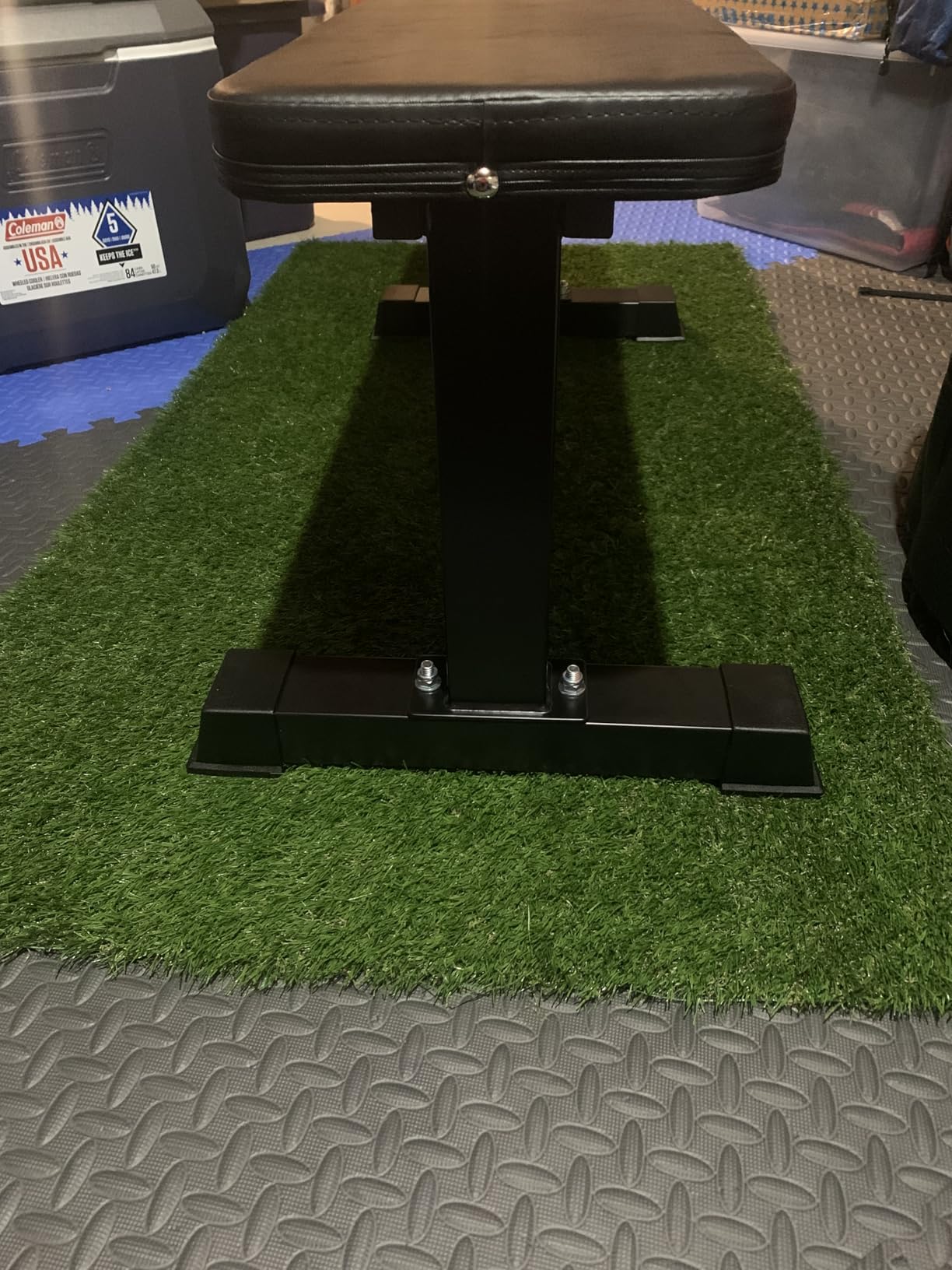
The upside-down T-shaped legs are the feature worth understanding here. That leg geometry is why the bench stays planted on carpet and hard floors without rocking, and it is the reason reviewers describe the frame as feeling considerably more solid than the price tier suggests. Combined with heavy welds on a wide steel frame, it is unusually stable for an entry-level flat bench.
At 700 lb rated capacity it carries a higher number than several other benches in this roundup, and there is no adjustment hardware to strip or replace. For a straight barbell press, that is a very short list of ways the bench can let you down.
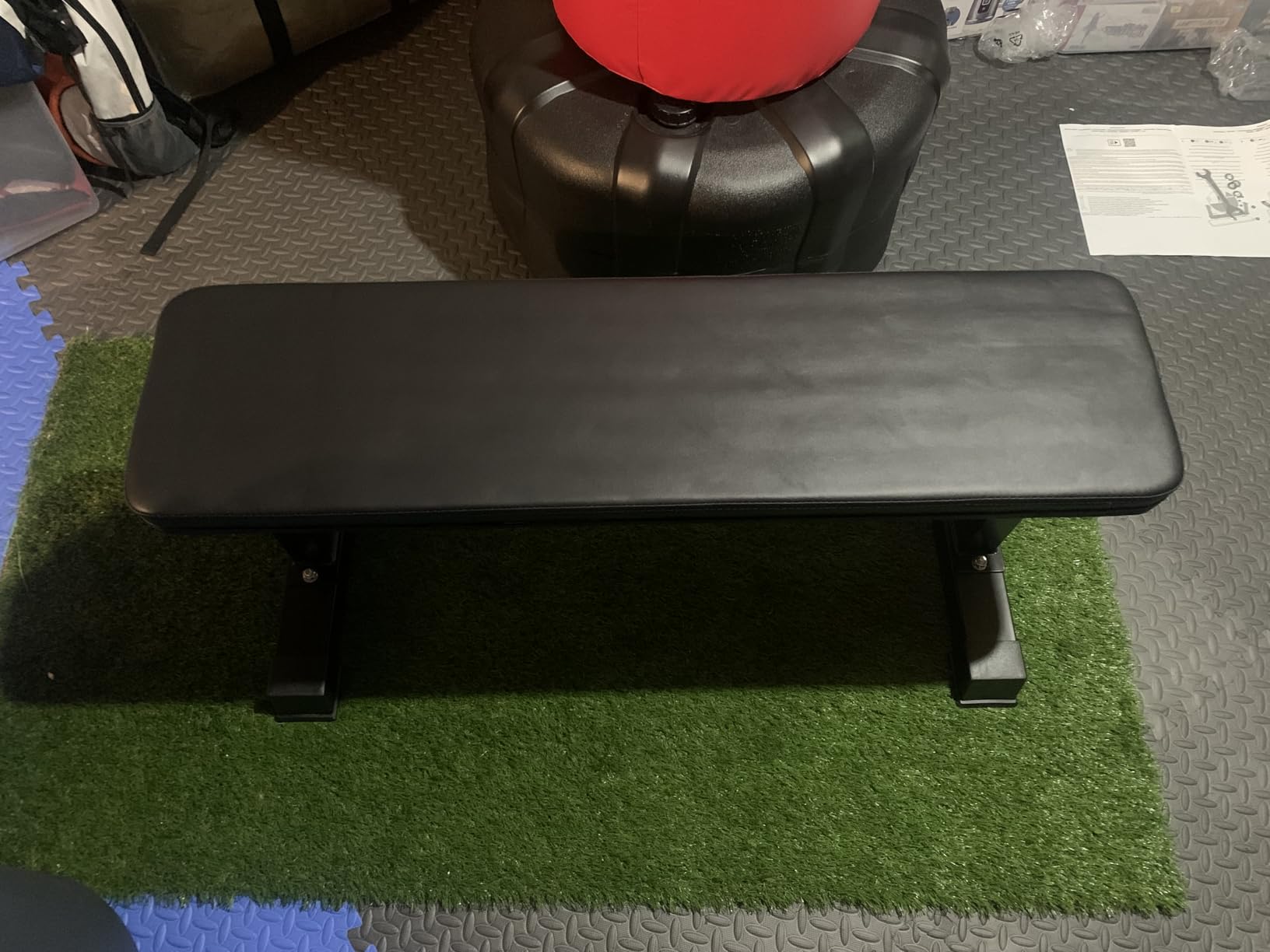
Assembly takes four bolts and about five minutes, with the tools included. That is worth calling out because it is a common friction point with flat benches at this tier, and owners consistently report getting from box to first set without a trip to the hardware store. The only real annoyance is the supplied end wrench, which is difficult to grip, so keep a ratchet handle nearby if you have one.
Long-term owners report the vinyl and stitching still intact after a year or more of daily use, which is more than can be said for many flat pads. The 18 inch seat height is another quiet strength: it is high enough to get on and off without twisting the knees, and it works well for dumbbell work where you need to sit upright and shoulder press.
Pad Length: The Most Common Complaint
The top surface measures 41.5 by 11 inches, and 11 inches of width is narrow. For a lifter over roughly six feet, that short pad means the head hangs slightly past the end when lying flat. Shorter users will not notice it at all, which is why this bench draws a much better response from shorter lifters than from tall ones.
Where the 700 lb Rating Holds Up
The rating is achieved through frame mass and leg geometry rather than thin tubing, and the wide base keeps it from twisting under an uneven load. That makes it a comfortable bench for a home lifter pressing in the low-to-mid 200s with plates, though a fixed flat bench gives you no way to unload the bar yourself, so a spotter or a safeties-equipped rack still matters at the top end.
Who This Bench Is Not For
It is not for lifters who need any angle beyond flat, and not for very tall users who need a longer pad. It also does not fold, so it needs a permanent footprint. If your program is strictly flat pressing and your height is moderate, very little else in this list does the same job for less.
6. YOLEO FORGE 1980 All-In-One Station – Best Full Home Gym for a Dedicated Garage
Yoleo 1980LBS Weight Bench with Rack – Bench Press Set, Leg Extension, Preacher Curl & Flat/Incline/Decline Full Body Workout Bench, Adjustable Olympic Weight Benches for Home Gym(47.44IN WIDE GRIP)
1980 lb total capacity
47.44 inch wide grip rack
81.6 lb item weight
10-year frame coverage
+ Pros
- Ten-in-one station covering bench rack and leg work
- 47.44 inch rack holds 7 foot bars and reduces hand pinch
- Four safety catches and a locking pin for solo sessions
- Blister-packed hardware with pre-drilled holes that line up
– Cons
- Roughly two hours of assembly for one person
- 93.7 inch footprint needs a dedicated room
- Leg extension weight rods are short for heavy work
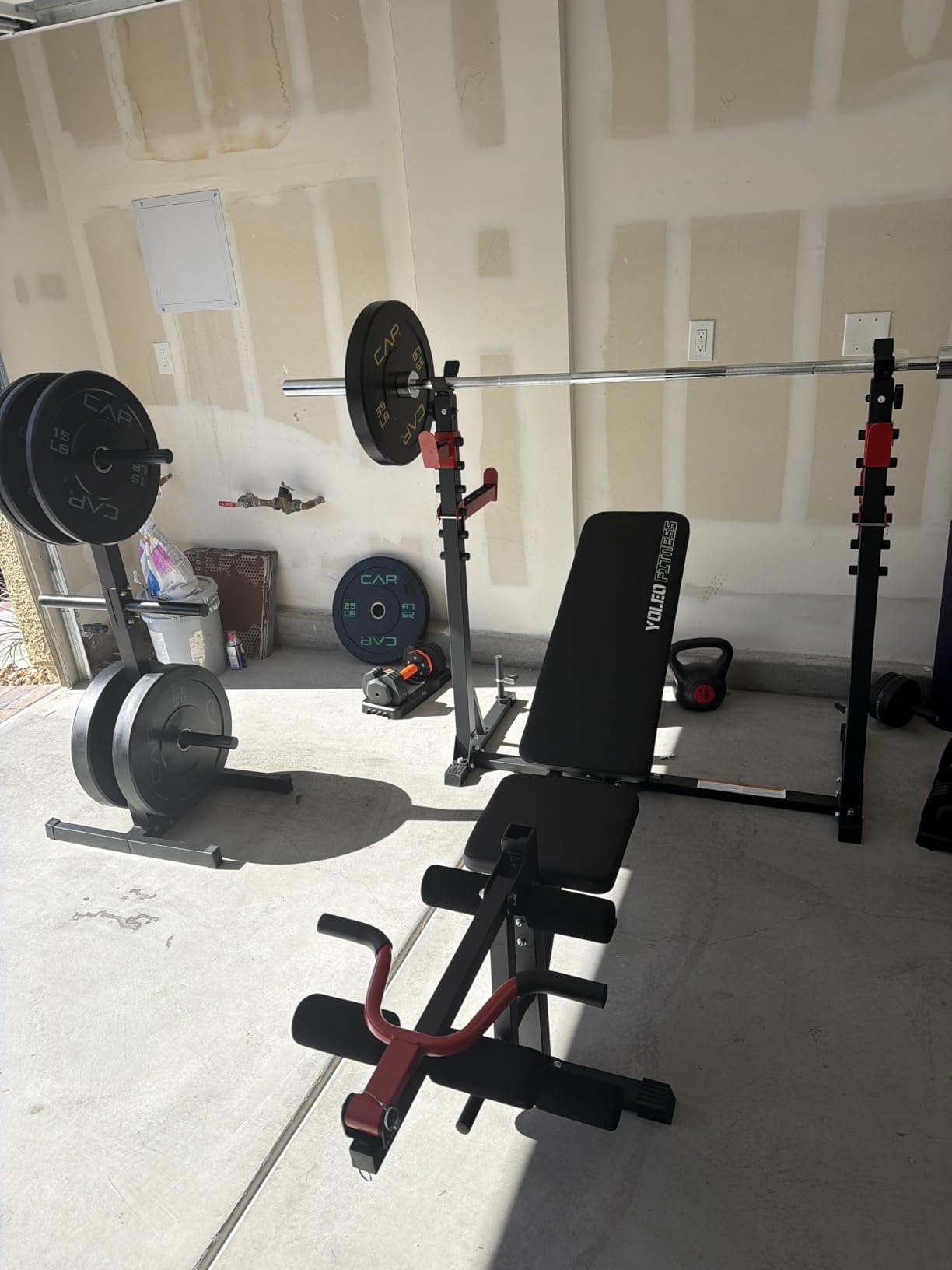
This is the only pick here that includes its own barbell rack, and that changes the entire bench press conversation. The 47.44 inch wide grip rack is the headline feature: it comfortably holds a 7 foot Olympic bar and gives broad-shouldered lifters room to set their grip without pinching their hands against the uprights.
The back pad locks into incline, flat or a -30 degree decline across eight settings, so pressing is fully covered. The four squat bar safety catches and the separate locking safety pin are what make it realistic to train heavy alone, which is the single most common reason home lifters end up buying a bench press station instead of a bench.
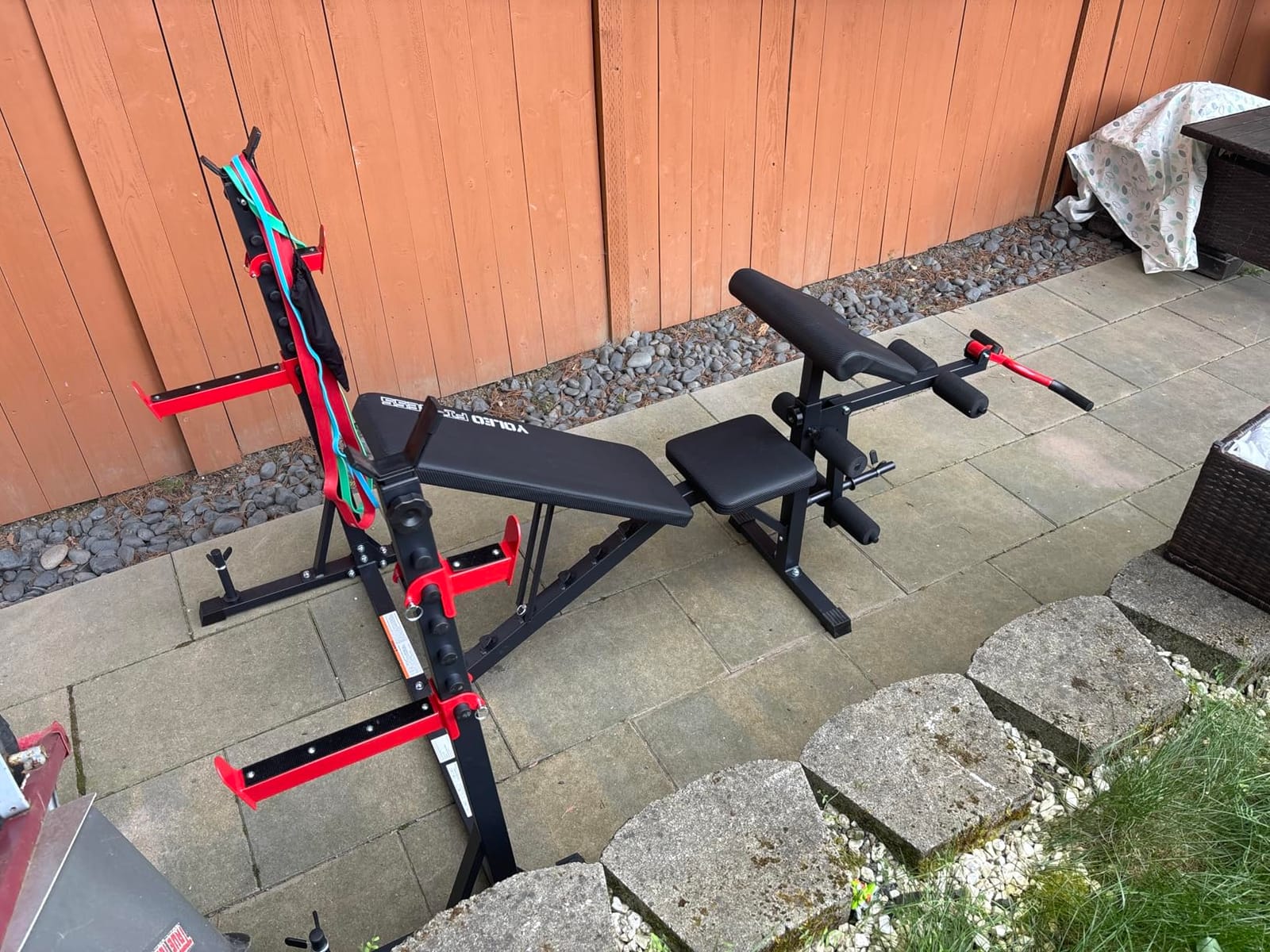
Total rated capacity is 1,980 lb split across the bench, the squat rack and the leg frame. I would treat the bench portion as the number that matters for pressing and be more conservative about the accessory ratings, because the leg extension and leg curl are the weakest parts of an otherwise capable station and several owners consider the headline figure optimistic for advanced heavy work.
Build quality is good where it counts. The hardware arrives in blister packs with step labels, and the pre-drilled holes line up properly, which sounds minor until you are two hours into an assembly and discover the holes do not match. The frame and components carry a 10-year replacement service, the longest coverage in this roundup.
Footprint and Assembly: Plan Both
At 93.7 inches deep and 47.44 inches wide, this needs a room rather than a corner. Assembly takes roughly two hours for a single person, and the item weight of 81.6 pounds means you will want a second set of hands for the uprights. Bar storage pegs and a folding design are included to help once it is up, but nothing reduces the assembly time.
Wide Grip Rack and Bar Path Clearance
The extra width is not cosmetic. It gives you room to set a wide grip without the bar drifting into the uprights, and the clearance under the rack is enough to unrack and rerack without a struggle. For a lifter whose bench press stalls because the bar hits a post, that solves a problem no bench in this roundup can.
Who This Bench Is Not For
It is not for a small apartment, a shared family room, or anyone who wants to move it between rooms, since 81.6 pounds is a two-person job. It is also not the pick if leg work is your priority, because the weight rods and the seat-to-back gap of roughly 3.5 to 4 inches both limit that half of the station.
7. Keppi 1200 lb FID Adjustable Bench – Best Heavy-Duty Adjustable for Serious Progressions
Keppi FID Adjustable Weight Bench,1200LBS Workout Bench for Home Gym
1200 lb ASTM capacity
17.3 inch base height
58.5 x 24 x 49.6 inch
59 lb item weight
+ Pros
- Fully welded 70x50mm commercial grade steel frame
- 36 angle combinations from 12 back and 3 seat positions
- 17.3 inch height matches standard bench specification
- 36 inch backrest with dense foam and leather
- Transport wheels and an ergonomic handle
– Cons
- 59 lb needs two people to move in a tight space
- Not specified as foldable despite the wheels
- Large 58.5 by 24 inch footprint
The 1,200 lb ASTM-certified capacity on a fully welded 70x50mm steel frame puts this well above the adjustable benches built for lighter work, and the frame is the reason. This is commercial-spec tube rather than the lighter welded steel used by the folding budget units, and it stays balanced under heavy barbell work and loaded hip thrusts in a way lighter frames do not.
The 17.3 inch base height is the detail that separates it from almost everything else here. That is the standard bench height used in commercial gyms, and matching it means your foot position and arch setup at home are the same as they would be in a rack at a real facility, which removes an entire category of technique adjustment.
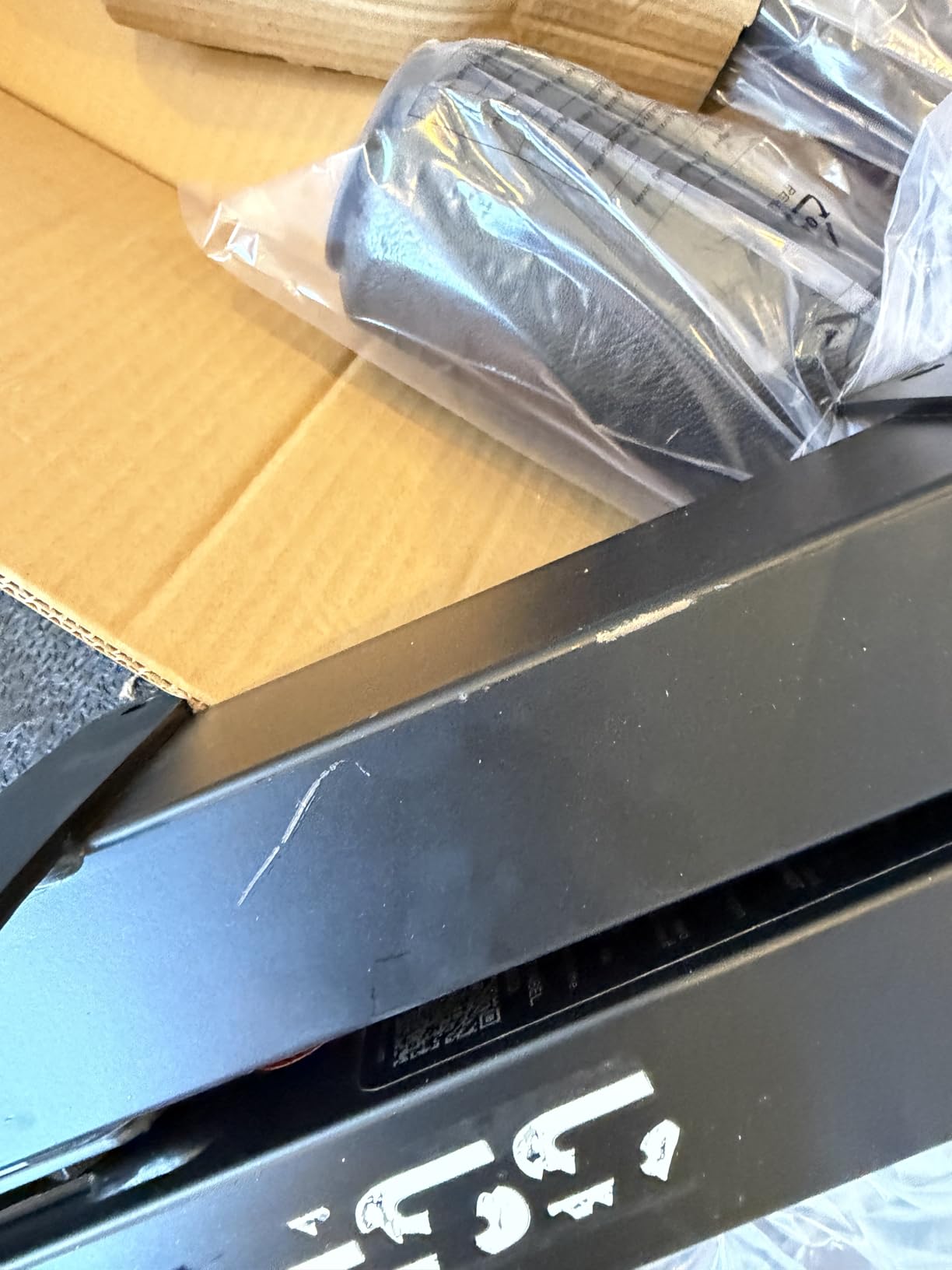
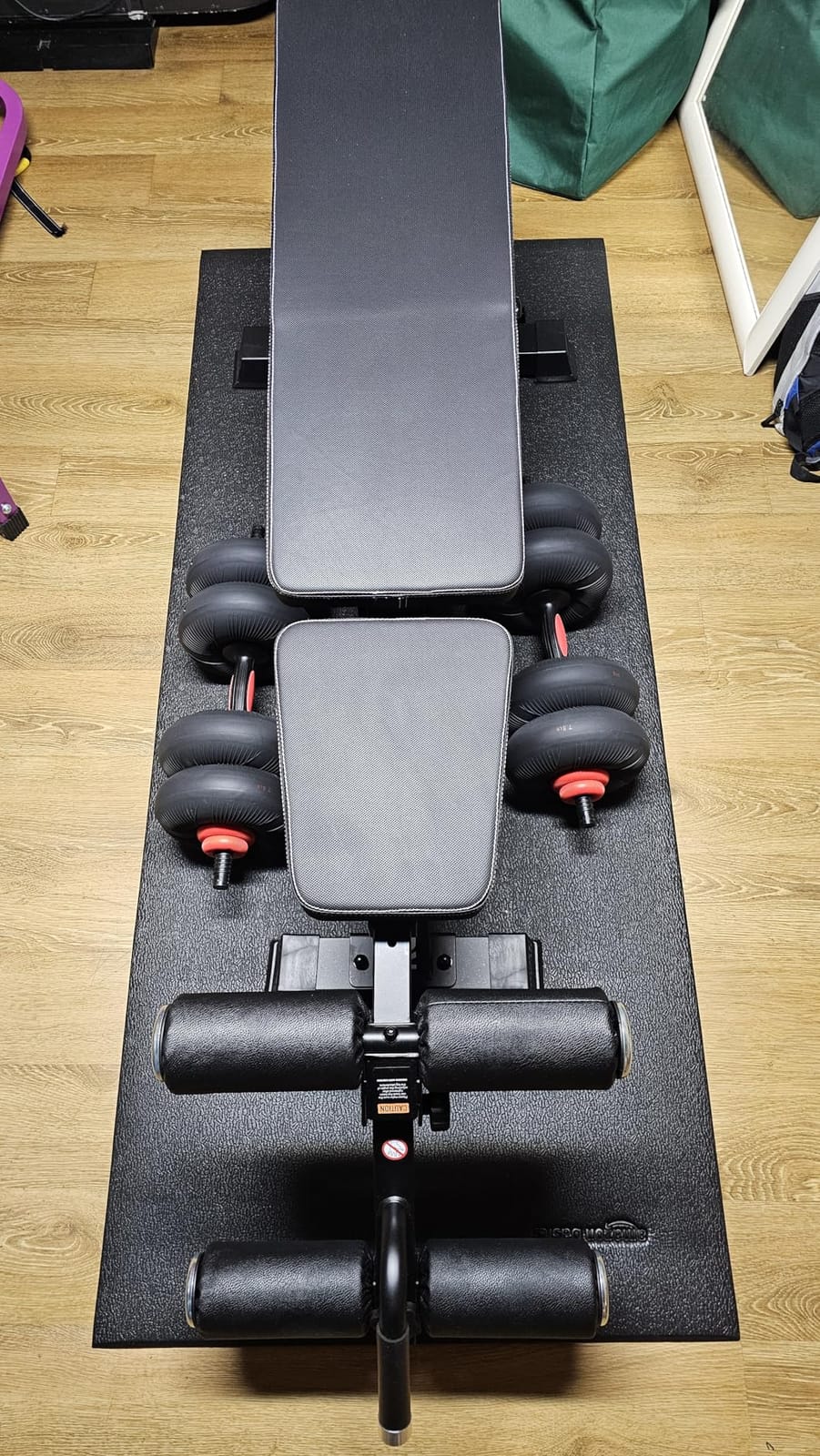
Adjustment runs through 12 backrest positions and 3 seat positions, giving 36 angle combinations across incline, flat and decline. Thirty-six inches of backrest is generous, with high-grade leather over dense foam on a sweat-resistant surface, and the adjustable foot catch with soft foam rollers keeps your legs aligned when you set up on a decline angle.
It is 98% pre-assembled and comes with transport wheels and an ergonomic handle. Those wheels are genuinely useful for sliding it into place, but they are not a folding mechanism, so treat this as a bench that lives in one spot once you position it.
Why Bench Height Matters More Than Buyers Expect
Most flat benches in this roundup sit between 16.5 and 18 inches, and the difference is not cosmetic. A bench that is too high forces you to lift your shoulders toward your ears to reach the bar, which changes the movement. At 17.3 inches you can set your feet, pull your shoulder blades down and back, and touch the bar at the same point you would in a commercial rack.
Weight and Footprint: The Accepted Trade
At 59 pounds and 58.5 by 24 inches, this is a substantial, stationary-feeling bench rather than a light foldable one. Buyers consistently accept that trade explicitly in exchange for the frame mass. Two people to move it comfortably in a tight space is the number to plan around, and it does not fold.
Who This Bench Is Not For
It is not for a small apartment, a renter who needs to clear the floor, or anyone whose pressing maxes out well under 300 lb and will never grow. It is also not the pick if incline and decline are your primary interest, because the star feature is heavy flat work, not angle variety.
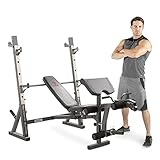
8. Marcy Olympic Bench with Preacher Curl – Best Full-Length Station with Plate Storage
Marcy Olympic Weight Bench for Full-Body Workout MD-857
600 lb capacity
47 x 80 x 61 inch footprint
103 lb item weight
2-year limited warranty
+ Pros
- Stable under real loading with owners pressing near 200 lb
- Sliding seat and back pad on a track
- Two plate posts with standard and Olympic adapters
- Removable preacher curl pad on four height settings
– Cons
- 80 by 61 inch footprint needs a large room
- 103 lb is very hard to reposition alone
- Preacher curl and leg attachments are the weakest parts
This is a commercial-gym-style bench, not a home compact one, and the difference is obvious the moment you see the footprint. At 80 by 61 inches it needs roughly an 8 by 12 foot space to use comfortably, and the 103 pound item weight means it goes where you put it. In exchange you get a full station with a sliding pad track and integrated plate storage.
The sliding seat and back pad track runs through five seat positions and four back positions, which is a genuinely different adjustment mechanism from pop pins. The pad moves as one unit along a rail rather than hinging around a fixed pin, and the result is a surface that stays consistent as you change angle.
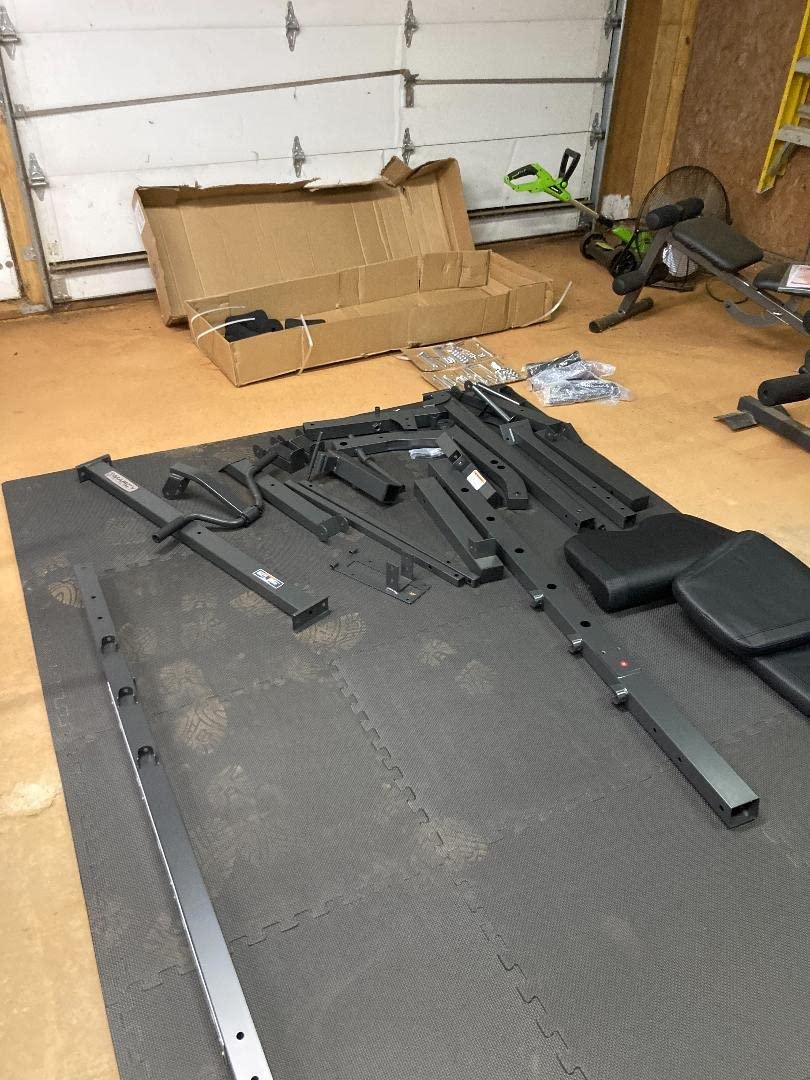
For pressing specifically, owners report genuinely stable behaviour under real loading, with one owner benching 90 pound dumbbells and another pressing around 200 lb with a spotter without the bench shifting. That is a meaningful data point because the 600 lb rating covers a machine with arms and attachments, not just a flat deck, and it still holds position.
Two weight plate storage posts with adapters that accept both standard and Olympic plates solve a problem most home benches ignore. If you already own a mixed set of plates, you are not sorting hardware every session. Assembly runs under two hours with the hardware in labeled blister packs, and the warranty is a 2-year limited factory warranty.
Dumbbell Clearance: The Underrated Advantage
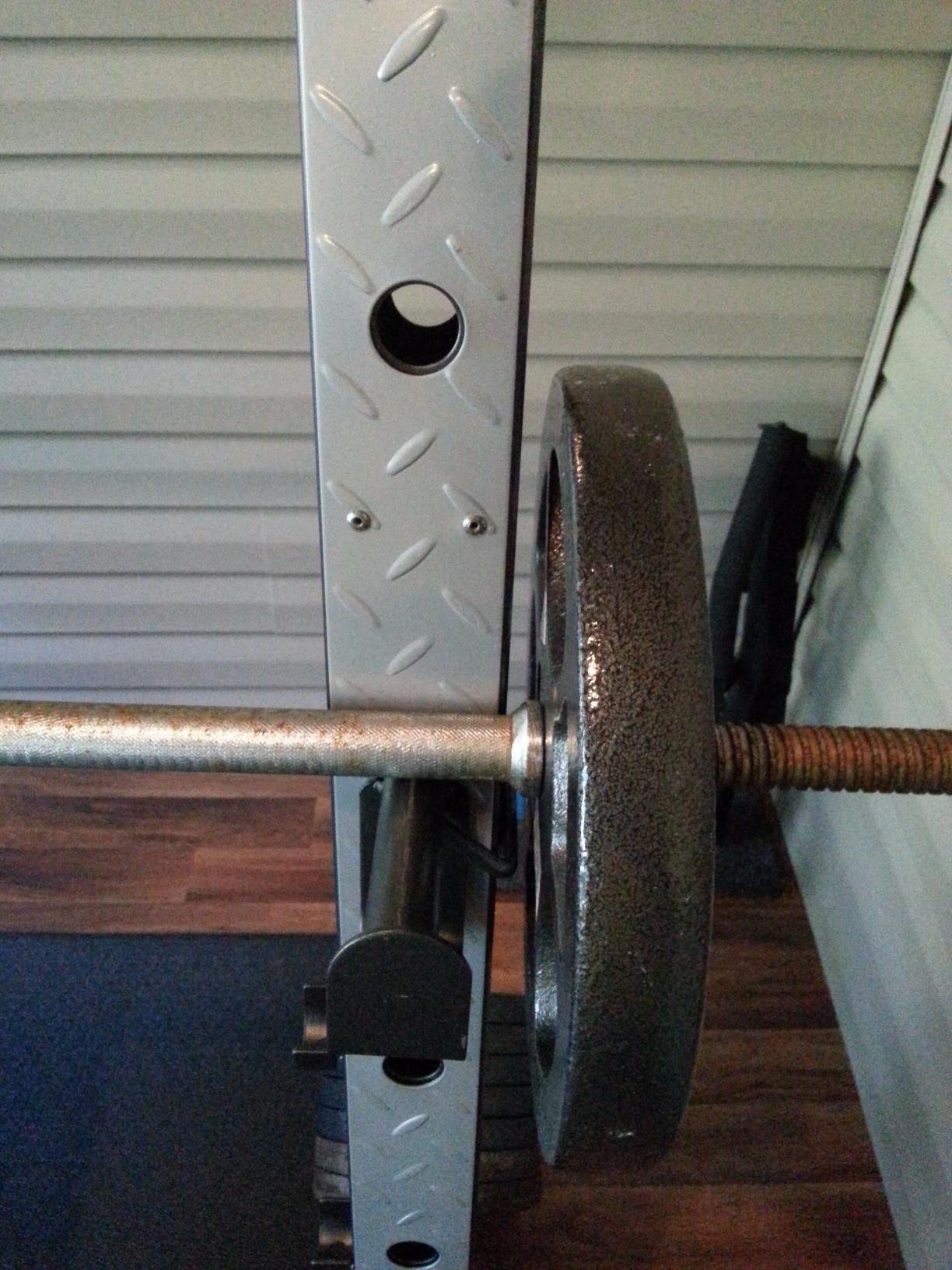
Because this bench is a frame with arms rather than a compact all-in-one box, there is far more room to move your elbows and reposition between dumbbell sets. Reviewers specifically call out the clearance compared with compact stations, and for anyone whose programming alternates between barbell and dumbbell pressing, that is worth a great deal.
Accessory Attachments Are the Weak Point
The preacher curl pad is removable and adjustable at four intervals, but it is the lower quality part of the machine, and very tall lifters find it sits too low. The leg extension and curl arm locks into place for crunches, though the attachment hardware is rated low. Treat the accessories as a bonus rather than a reason to buy, and note that the seat can feel slightly loose when sliding under load.
Who This Bench Is Not For
It is not for anyone short on floor space, and not for anyone who may need to move it, since 103 pounds is a two-person lift. Very tall lifters should also be cautious, as the flat bar rest height is limited and they may need to sit forward to reach. For a garage with room, a plate collection and a mixed dumbbell and barbell program, it does a lot at once.
9. Yagud 880 lb Bench and Rack Set – Best Entry All-In-One for Solo Pressing
880LBS Adjustable Weight Bench, Foldable Workout Bench with Leg Developer
880 lb capacity
Triangular stability frame
7 backrest and 3 preacher settings
36 lb item weight
+ Pros
- Bench rack safety catches and leg extension in one frame
- Triangular steel geometry resists rocking
- Waterproof PU leather with reinforced stitching
- Folds down for a space-limited room
– Cons
- Bar supports sit far behind the head when lying flat
- Leg extension hangs so low the weights near the floor
- Thin printed manual leaves pins and screws unexplained
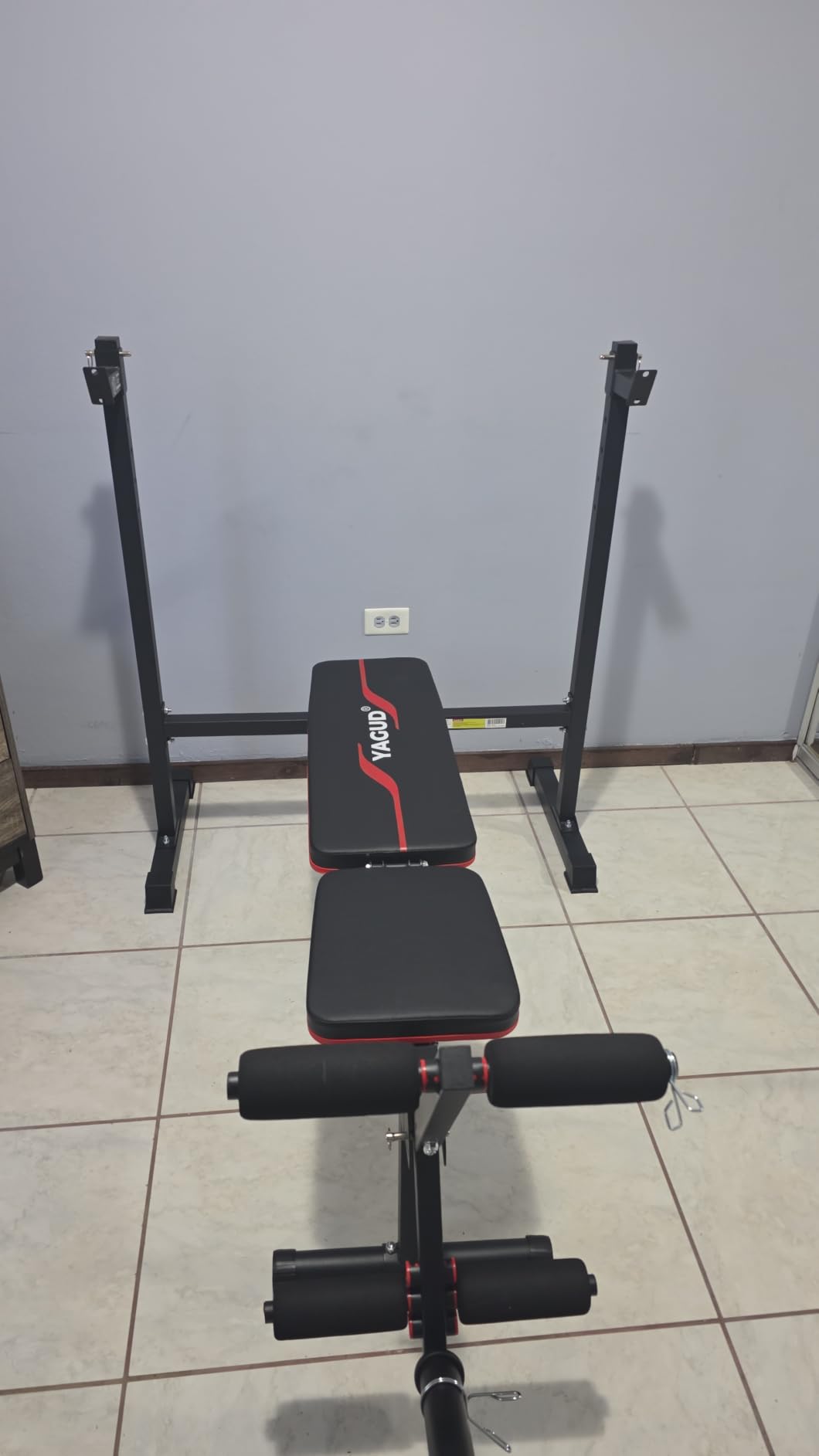
The idea here is straightforward: give a solo lifter a place to unrack and rerack a bar without owning a full power rack. The barbell rack and safety bar catches let you load heavy, press, and set the bar back down on your own, which is the single biggest reason home bench pressing stalls for beginners.
Capacity is rated at 880 lb on a triangular stability design in commercial-grade steel, with 7 backrest adjustments, 3 preacher pad positions and 3 foot settings. The triangular geometry is the part doing real work here, since it resists the lateral rocking that usually shows up first on a compact station.
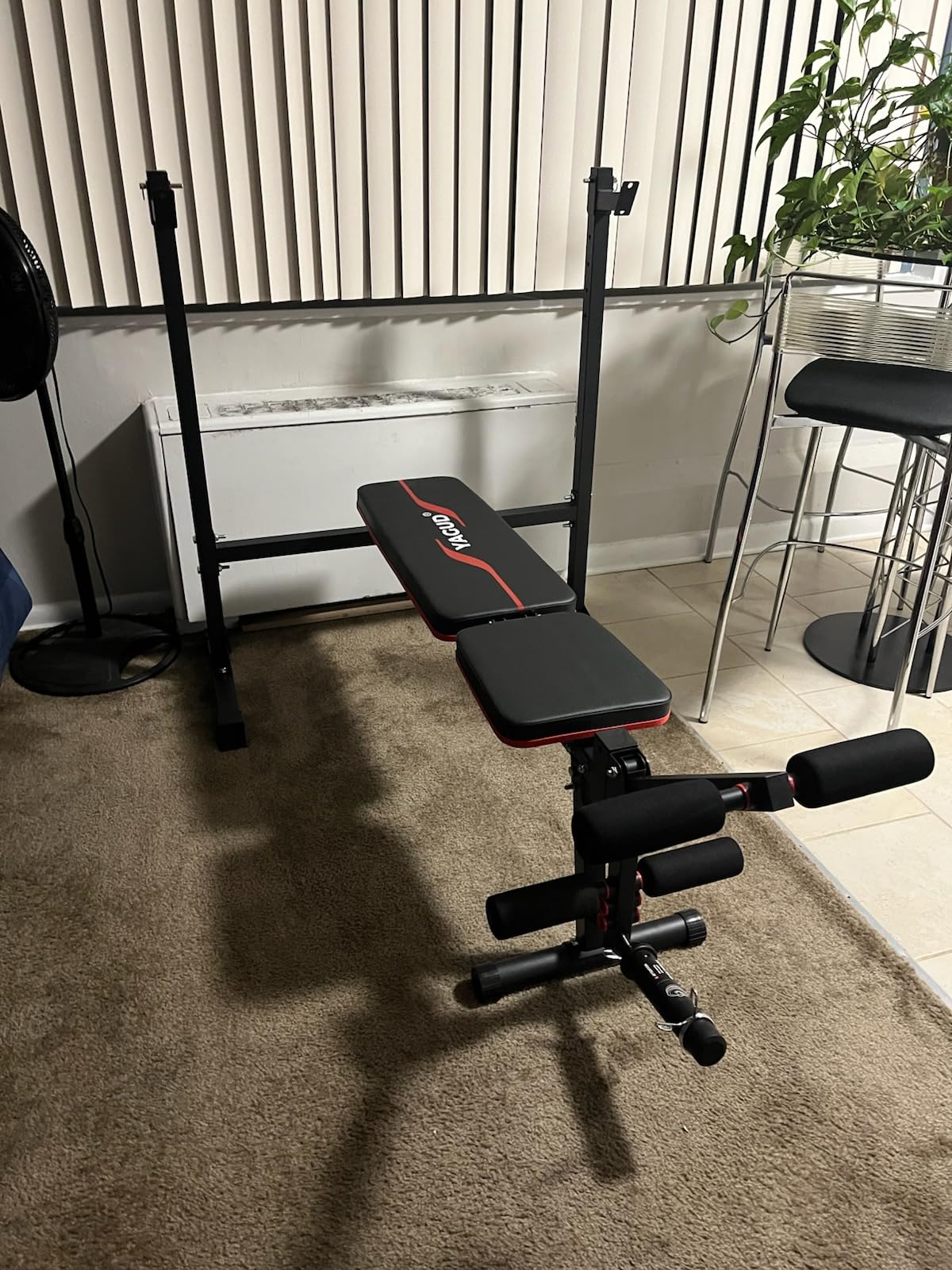
The pad is covered in waterproof PU leather with soft foam and reinforced stitching, which holds up better than plain vinyl when sweat is a daily factor. Assembly is straightforward with clear instructions, and there is a 1-year warranty with 24/7 support behind it.
What gives me pause is the bar press support placement. When you lie flat, the supports sit considerably further behind your head, which makes unracking awkward until you find the rhythm, and the incline setting is steeper than the position of those supports implies. If you are setting up a bar from a seated position, plan to practice the movement before adding weight.
Why the Rating Is Lower and What It Means
This bench carries the lowest average rating and by far the smallest review base in the roundup, which tells you something real about the spread of experiences. Most owners find the frame solid, the fold fast and the feature set generous. A smaller group rate it near-unusable, and they point at the same things: support bar placement and the low-slung leg extension.
Documentation and Long-Term Ownership
There is no printed manual covering exercise variations or the folding procedure, so some pins and screws are left unexplained. That is a minor irritation on day one and an annoyance in year two when you want to change the setup, and it is the kind of gap that shows up when you compare it against a brand with real documentation and spare parts on hand.
Who This Bench Is Not For
It is not for someone who wants to fine-tune a bar path, because the support placement works against you. Anyone over six feet tall should also check clearances, and a metal connector at the seat joint presses into the tailbone during decline work. It is best suited to a beginner who wants a rack, a bench and a leg developer in one affordable frame.
10. Finer Form 1000 lb Foldable Flat Bench – Best Flat Bench That Disappears Into Storage
Finer Form Foldable Flat Weight Bench for Home Gym, 1,000 lb Capacity
1000 lb capacity
4-way steel frame
45 x 12 x 18 inch
27.7 lb item weight
+ Pros
- 4.7 average across nearly 3000 reviews
- 4-way frame resists wobble under dumbbell work
- 45 inch pad length suits taller users
- Folds flat under a bed or into a closet
- Extra thick cushion pad
– Cons
- Flat only with no incline or decline
- 27.7 lb is heavy to lift out of storage
- 12 inch pad width is narrow for a wide sit
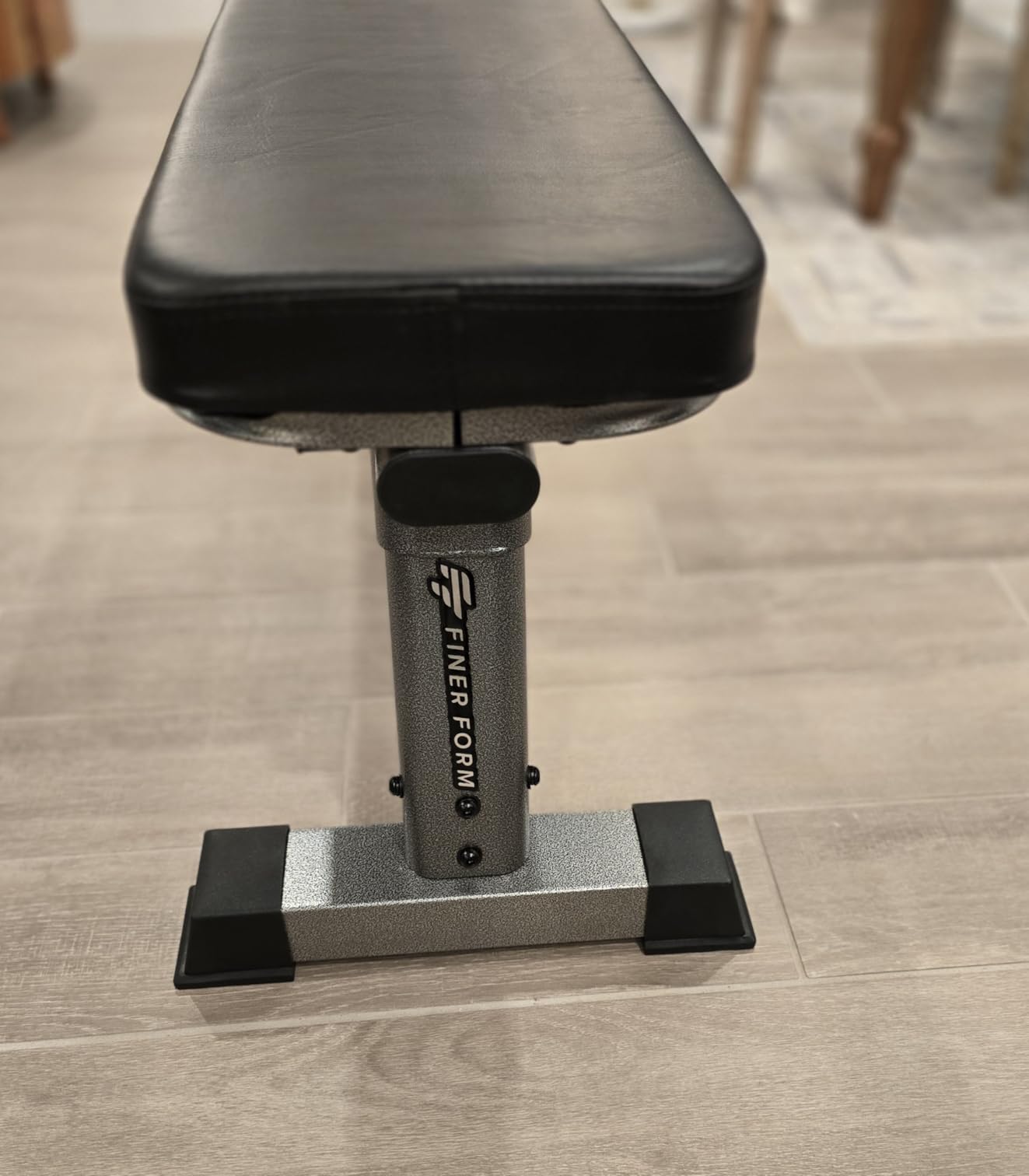
This solves a specific problem that most flat benches ignore: how do you keep a stable flat bench in an apartment. It folds flat enough to go under a bed or into a closet, and it still carries a 1,000 lb rating on a high-grade steel frame. Very few benches manage both, which is why it stands out.
The 4-way steel frame is the stability story. Owners consistently report no wobbling or shaking under dumbbell work, which is the failure mode that makes a cheap flat bench unusable for anything beyond light movements. Combined with the extra thick cushion pad, it holds position through long sessions.
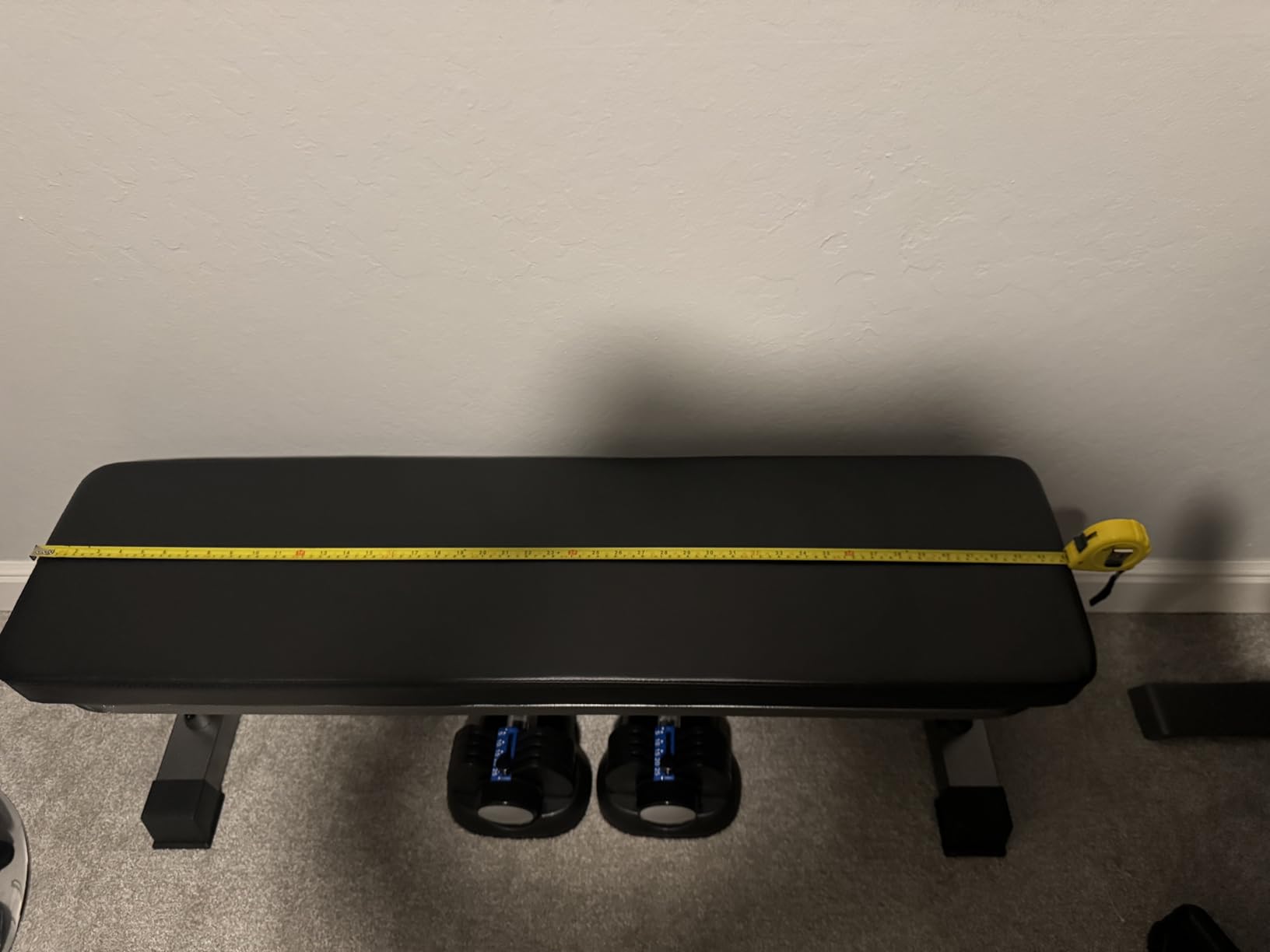
At 45 inches long, it is longer than most flat benches, and that length is what makes it comfortable for taller users, whose heads do not hang off the end. Assembly is minimal and takes minutes, and a free exercise chart comes in the box, which is a small quality-of-life touch for anyone new to structuring sessions around it.
It covers bench press, leg work, core movements and hip thrusts, and a 1-year warranty plus responsive customer service sits behind it. The 4.7 average across nearly 3,000 reviews puts it in the top tier of satisfaction in this roundup, and owners keep mentioning the same three things: stable frame, thick padding and a pad length that fits.
Folding Versus the Lightweight Flat Benches
The trade is weight. At 27.7 lb it is the heaviest of the folding flat designs here, so the first setup after a long period folded away takes a genuine two-person lift. Anyone pulling it out weekly alone should look at a lighter flat bench instead, but anyone folding it once or twice a month gets the better frame.
Pad Width Versus Pad Length
The 12 inch pad width is narrower than the commercial-style benches in this list, so a wide sit can overhang the sides. If your pressing is barbell-focused, that matters much less than it would for heavy dumbbell work, and the longer deck more than compensates for head and shoulder support. It is a sensible trade for the folding capability.
Who This Bench Is Not For
It is not for anyone whose training includes incline or decline pressing, since there is no adjustment at all. It is also not ideal for a lifter who needs to move it daily without help. If flat-only pressing plus genuine storage capability is the requirement, very little else here does it.
11. CAP Barbell Flat Weight Bench – Best No-Frills Starter Flat Bench
CAP Flat Weight Bench, Color Series, 500lb Capacity, Black
500 lb capacity
18 x 46.5 x 19 inch
18 lb item weight
Three-piece build
+ Pros
- Simple three-piece build with a wrench included
- Firm box-stitched padding that does not sink
- 18 lb frame feels planted but still movable
- Assembles in about 15 minutes
– Cons
- 500 lb rating is the lowest in the roundup
- Thin cross braces flex when you sit off center
- Flat only with no angle positions
The CAP flat bench does one thing and does it predictably. It is a powder-coated tubular steel frame with firm box-stitched padding, and there is no mechanism anywhere that can loosen, strip or need replacing. If you are setting up your first home bench press station and want the simplest object that will work, this is close to the floor of what that looks like.
The box-stitched padding is denser and firmer than the foam-and-vinyl sheet used on cheaper models, and it supports without sinking, which means the surface does not change shape over a long set. At 18 pounds the frame is heavy enough to feel planted but light enough to move around a home without help.
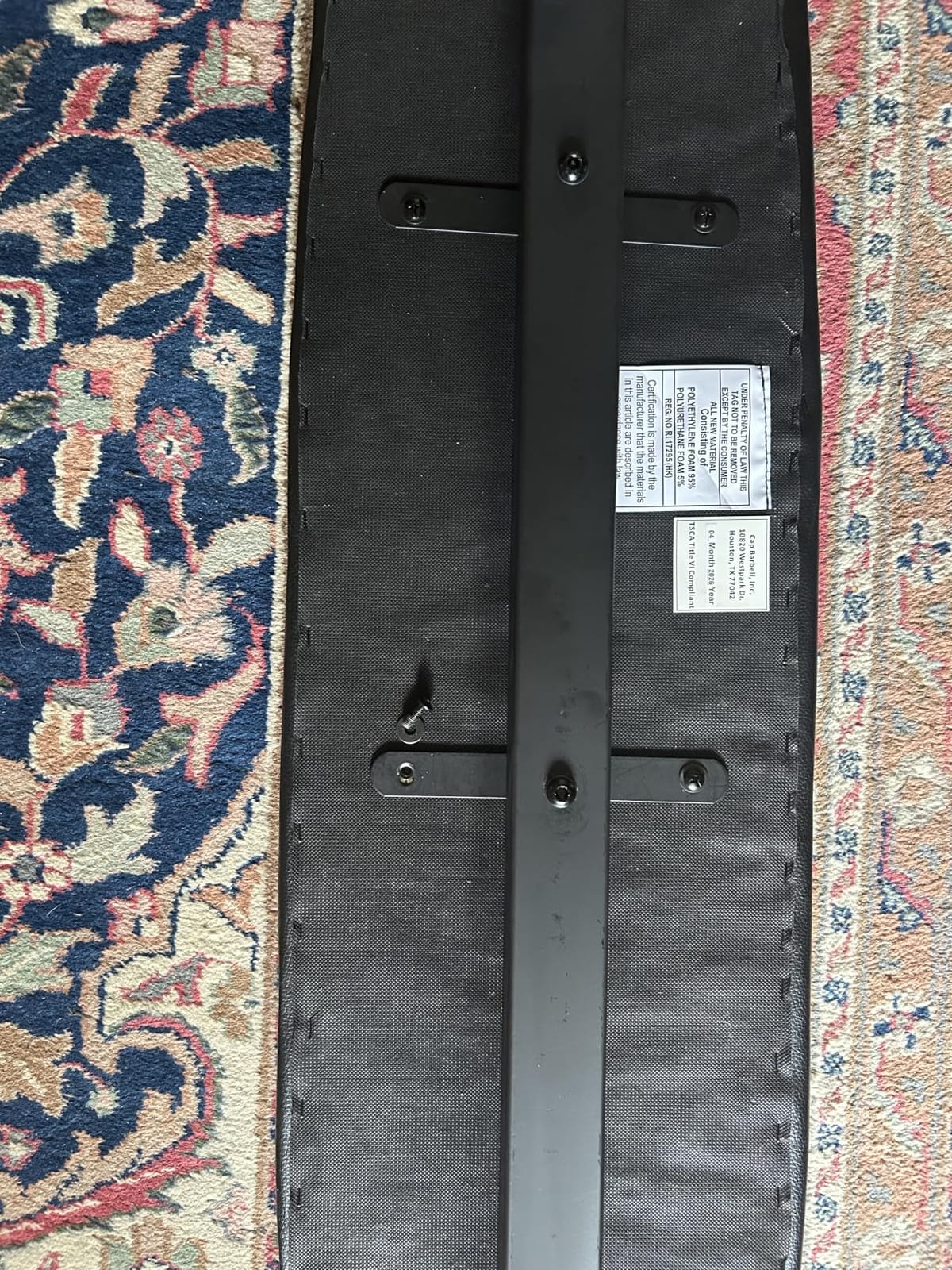
Assembly takes about fifteen minutes with all pieces and a wrench included, and the three-piece design is straightforward enough for a first-time builder. There is nothing to line up beyond three bolts and two cross members, so this is a bench you can have pressing the same afternoon it arrives.
Where the limits show is the cross braces under the seat. They are thin, and they flex under lateral lean, which is why sitting on the end of the bench can feel like it might tip. Keep your weight centred and it never becomes an issue, but it does rule the bench out for anyone who sits sideways to gear up.
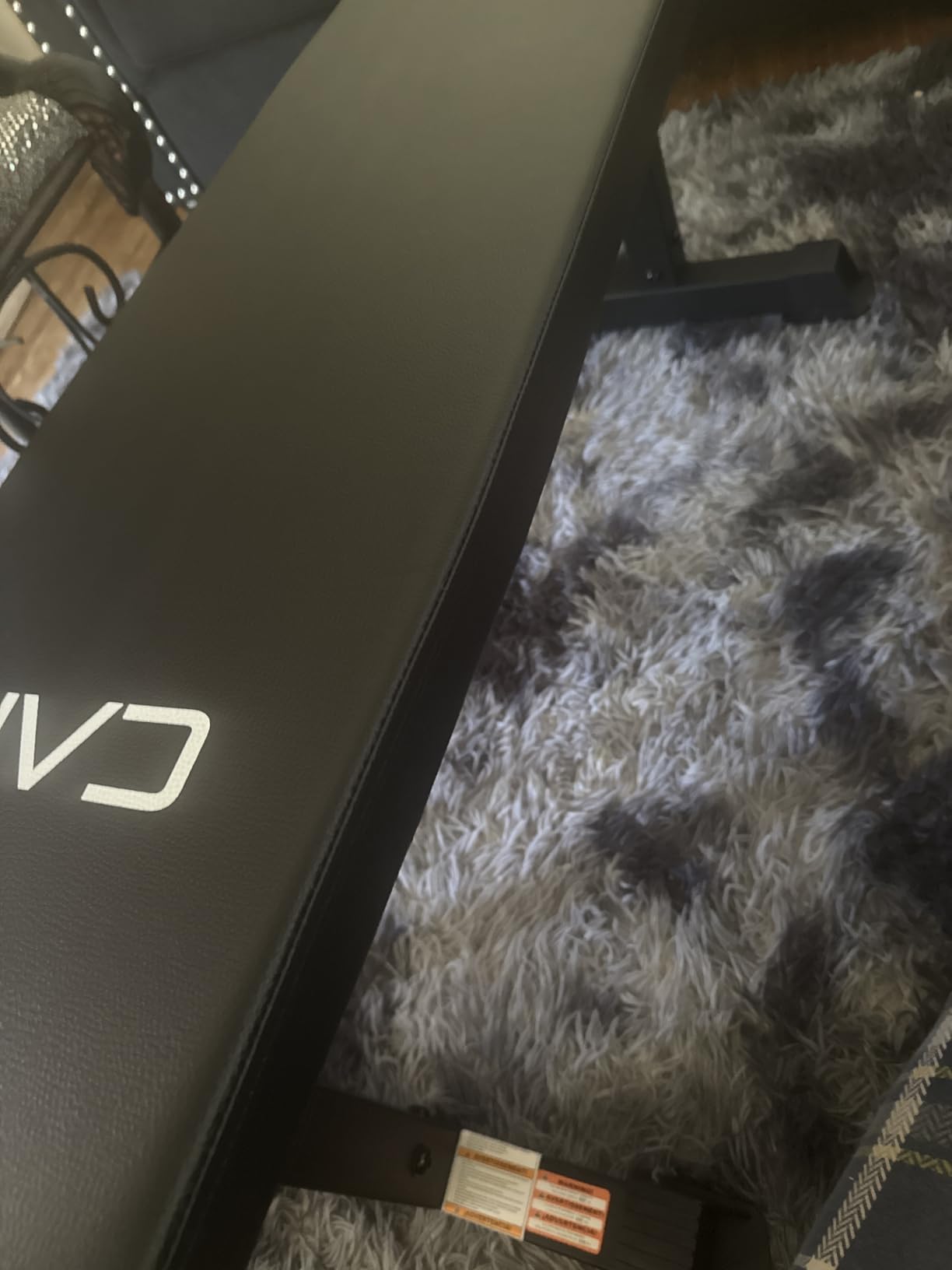
The 500 lb Rating and What It Means for Progressions
That is the lowest capacity in the roundup, and it sets a real ceiling. It is comfortably fine for a beginner pressing with modest plate loading, and for dumbbell work and ab movements, but a lifter whose numbers are climbing toward the three-figure range should choose a bench rated above 600 lb. Rated capacity is a limit, not a promise, and this is the one bench here where that ceiling arrives early.
Pad Firmness and Long Sessions
Firm is the correct word for the padding, and whether that is a feature or a fault depends on your pressing style. Harder pads do not bottom out and they stay consistent, which is better for stability under load. For long sessions or pressing directly without a shirt, a towel or a separate pad cover is worth having on hand.
Who This Bench Is Not For
It is not for advanced or progressing lifters, since the 500 lb rating runs out of headroom early. It is also not for anyone who sits off center, sits on the end, or does any angled work, because it is flat only. Coverage is a 30-day manufacturer warranty, which is the shortest here, so the low risk of mechanisms failing matters more than it would elsewhere.
12. FLYBIRD 1000 lb Foldable Flat Bench – Best Flat Bench That Needs No Assembly
FLYBIRD Foldable Flat Weight Bench for Home Gym, 1000 lbs Capacity with Dual Locking for Strength Training, Easy Setup & Storage for Small Apartments, Lifting, Hip Thrust, Dumbbell Workout
1000 lb capacity
Dual locking knob and pin
42 x 11 x 18 inch
18.7 lb item weight
+ Pros
- No tools or screws
- ready straight out of the box
- Dual locking mechanism stops leg wobble
- Flared trapezoid base widens the footprint
- 45.3 inch extra-long pad fits taller users
– Cons
- Can feel tippy if pushed rather than leaned on
- Flat only with no angle positions
- Folding the legs takes a couple of minutes
This is the flat bench to consider if you want nothing between the box and the first set. It is 100% pre-assembled, with no tools, no screws and no assembly step, which is unusual for a bench with a 1,000 lb rating and a 45 inch pad. You open the box, position it and press.
The dual-secure locking mechanism is the feature that makes that possible. A spring-loaded knob combined with a removable locking pin stops the legs from folding or shifting under load, which is the single most common complaint about flat benches that use only a knob. Both have to be released before the bench will fold, and that is the point.
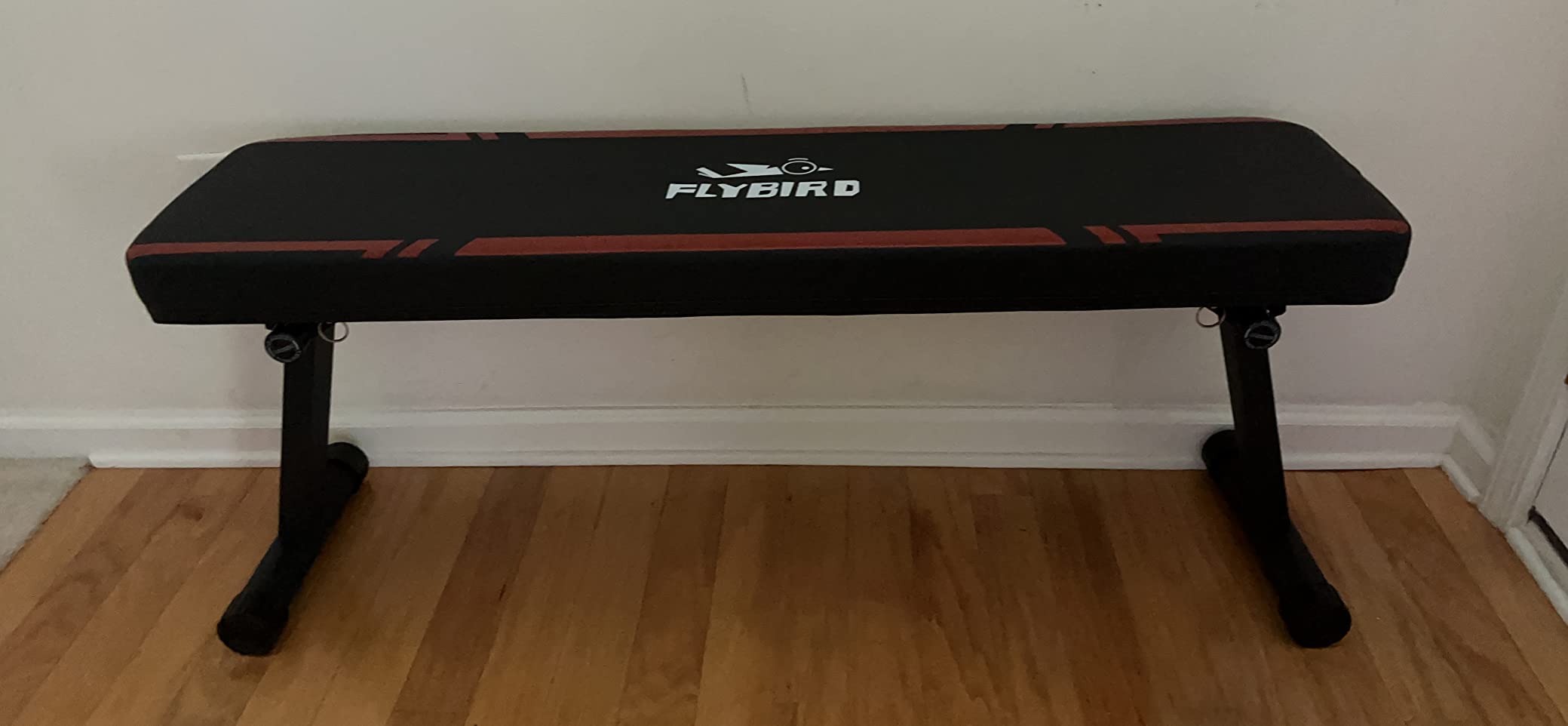
The flared trapezoid base widens the footprint deliberately, and it does what it claims: side-to-side wobble during rows and off-centre work is reduced compared with a straight-legged flat design. The 45.3 inch extra-long and wide pad accommodates taller users and larger body types better than the 41 inch decks common at this tier, and the 3 inch thick cushion is genuinely thick.
At 18.7 pounds it is light enough for one person to carry between rooms, and the pull-and-twist spring knob folds the bench in about a minute for under-bed or closet storage. The sweat-resistant non-slip surface helps with grip during long sessions, and it supports bench press, hip thrusts, Bulgarian split squats, dumbbell rows and crunches.
Light Weight and the Tippy Question
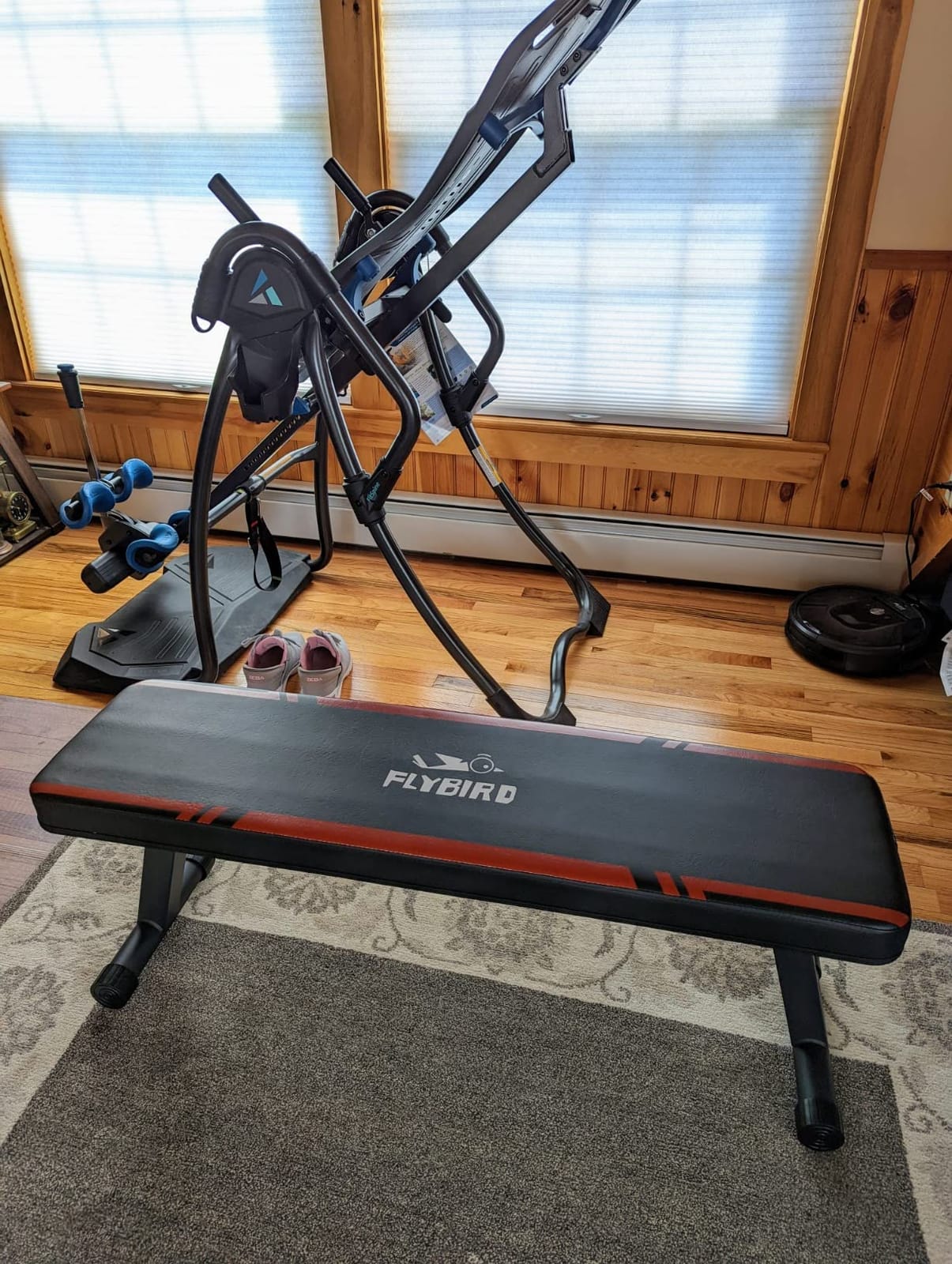
At 18.7 pounds you are getting a light frame, and a few users find it can feel tippy when pushed sideways rather than leaned on. In practice that means treat it as a bench to lie on rather than a handhold to move, and the flared base plus dual locking covers normal use well. It is the light-versus-stable trade that every folding flat bench makes.
Why the Pad Length Is the Standout Feature
For a fixed flat bench, pad length is the comfort variable that decides whether taller lifters can use it at all. A 45.3 inch deck with a 3 inch cushion gives you head, shoulder blade and upper back support in a way a 41 inch pad cannot, and it is the reason this bench rates well with a wider spread of body sizes than most of its competitors.
Who This Bench Is Not For
It is not for angled work of any kind, and not for a lifter who needs to move it several times a day, since opening and folding the legs takes a couple of minutes each way. Anyone pushing very heavy singles with no spotter should also consider a heavier frame, because light is the reason it is portable.
How to Choose a Weight Bench for the Bench Press
Frame gauge, rated capacity, bench height, adjustment type and footprint are the five decisions that actually change how a bench feels under a bar. Everything else is preference. Here is how we weighed them across these twelve.
Steel gauge is the floor, not the finish line
Garage gym communities treat 11-gauge steel as the minimum acceptable standard for a press bench, and that consensus has held up as we read through the owner complaints. In plain terms, a lower gauge number means thicker steel, so 11-gauge is heavier than 12-gauge, which is heavier than 14-gauge. Thicker steel flexes less, and a bench that flexes under a heavy press is a bench that changes your setup without telling you.
14-gauge steel is adequate for light dumbbell and ab work but is generally considered too thin for serious barbell pressing, and 12-gauge is a reasonable middle that many of the lighter units here use. The catch is that most manufacturers in this roundup do not publish the gauge at all. They publish alloy steel and a capacity number, and leave the measurement to you. When a listing does not state it, treat that as missing information rather than an assumption.
Rated capacity is a ceiling, not a promise
Every capacity figure in this roundup is a rated number, and rated means the manufacturer’s claim, not something independently measured. Treat it as the point at which the warranty conversation gets difficult, and set your working load well below it. Our rule of thumb is to pick a bench rated at roughly three times your current working weight, which leaves headroom for the years when the number goes up.
Capacity also drops as you add moving parts. An all-in-one station rated for 1,980 lb is distributing that across a bench, a squat rack and a leg frame, and reviewers of the YOLEO FORGE note that some consider the headline figure optimistic for advanced heavy lifting. The bench portion of the rating is the number that governs your press.
Bench height decides whether your setup is right
Fixed flat benches in this roundup sit between 16.5 and 19 inches, and adjustable ones span a wider range as the backrest moves. For strict pressing, a height near the standard 17.3 inches used in commercial gyms means your foot position and arch setup carry over unchanged from a real rack. Too high and you are reaching down to the bar with your shoulders shrugged; too low and you lose leg drive.
Watch this on the adjustable units, where the same bench sits at a different height depending on the setting. The FLYBIRD WB5 is a common example: owners with a shorter frame note that the raised seat height makes foot planting harder than on a lower fixed bench.
Flat or adjustable: choose based on your program, not the spec sheet
A flat bench has fewer parts, no hardware to strip, and a surface that does not change shape between sets. An adjustable bench buys you incline and decline positions, which is genuinely useful for shoulders, chest and core work, at the cost of a hinge, a pin and one more failure point over a decade of ownership.
If your program is barbell flat pressing plus dumbbell accessories, a fixed bench is the better buy. If you want one frame to cover pressing, shoulder and core work, adjustability earns its keep. What does not earn its keep is paying for an adjustable bench and then only ever using the flat setting, which is common and worth being honest about before you buy.
Wobble and pop-pin wear are the real long-term costs
The complaint that came up most often across forum threads on this category is lateral play under load, particularly on budget and mid-tier units. Frame geometry is what solves it, and the benches here that avoid it use named structures: a dual-triangle frame on the FLYBIRD WB5, a 4-way frame on the Finer Form, a flared trapezoid base on the FLYBIRD flat bench, a fully welded commercial tube frame on the Keppi.
The second long-term cost is hardware wear. Pop pins and bolt holes that wear out or strip are what eventually make a backrest sag, and the spring-loaded ball bearing pins on the PASYOU are the component reviewers flag most often for exactly this. If you notice a backrest creeping, replace the hardware before you replace the bench. Our cinder block bench guide covers a DIY alternative for anyone who wants to build pressing geometry from materials they control.
Footprint and item weight deserve a real plan
The spread here runs from 18 pounds to 103 pounds, and that difference changes where a bench can live. Anything under 30 pounds moves between rooms by one person; anything above 80 pounds is a two-person job and effectively becomes a permanent installation. Item weight also predicts the assembly burden, and the 93.7 inch footprint of the FORGE station needs a dedicated room rather than a spare corner.
Finally, check pad length against your height before anything else. A 41 inch deck is fine for most lifters and uncomfortable for those over six feet, while a 45 inch deck accommodates a much wider range of body sizes for very little extra floor space.
Weight Bench FAQ: Buying Questions Answered
What is the best bench press bench for home use?
The FLYBIRD WB5 is our top pick because its dual-triangle steel frame, 800 lb ASTM-certified capacity and 30 inch extended backrest stay planted under heavy barbell work. If you only ever press flat, the Marcy flat utility bench is the simpler and cheaper answer, with no adjustment hardware to wear out. If your room is small, the Finer Form 1000 lb bench folds flat while keeping a 1,000 lb rating.
Do I need an adjustable bench or a flat bench?
A flat bench is the better buy if your program is barbell pressing plus dumbbell work, because it has no hinge or pin to loosen and the surface never changes shape between sets. An adjustable bench earns its cost if you also train incline pressing, shoulder work at an angle or decline movements, since those positions are impossible on a fixed flat. Many buyers regret paying for adjustability and then only using the flat setting.
Is 11 gauge steel strong enough for a bench press bench?
Yes, and garage gym communities treat 11-gauge as the minimum standard rather than the ideal. Because a lower gauge number means thicker steel, 11-gauge flexes less than 12-gauge or 14-gauge, which is what keeps a bench from changing shape under a heavy press. 12-gauge is a reasonable middle for moderate loading and 14-gauge suits light dumbbell and ab work more than serious barbell pressing.
What bench height do I need for bench press?
Around 17.3 inches is the standard height used in commercial gyms, and matching it means your foot position and arch setup carry over unchanged from a public rack. Fixed flat benches in our roundup sit between 16.5 and 19 inches, and adjustable benches change height with the backrest position. Too high and you reach the bar with your shoulders shrugged, which changes the movement.
How much weight should a weight bench hold?
Pick a bench rated at roughly three times your current working weight so there is headroom as you progress. Treat every published figure as a rated ceiling rather than a tested number, and note that all-in-one stations split their rating across a bench, a squat rack and a leg frame, so the bench portion is the number that governs your press. Buyers regularly find listed capacities optimistic for advanced heavy lifting.
How do I choose a weight bench?
Start with your program. If you press barbell flat only, choose a fixed bench with a steel frame and no adjustment hardware. If you need incline and decline work, choose an adjustable bench with named frame geometry such as a dual-triangle or 4-way frame to limit wobble. Then check three numbers: the rated capacity against three times your working weight, the bench height against the 17.3 inch standard, and the item weight against how often you will need to move it.
Which Weight Bench Should You Buy in 2026?
If you want one answer, the FLYBIRD WB5 is the best weight bench for bench press we tested in 2026, because the dual-triangle frame and 800 lb rating handle heavy barbell work without the wobble that pushes lighter lifters back to lighter weights. If your program is strictly flat and you would rather own something with no moving parts, the Marcy flat utility bench at a 4.7 average across more than 15,000 reviews is the more rational purchase.
For a garage with dedicated space, the Keppi gives you a 1,200 lb welded commercial frame at a standard 17.3 inch height, and the YOLEO FORGE 1980 is the pick if you want your own rack and safety catches in the same footprint. In a small apartment, the Finer Form folds flat without giving up a 1,000 lb rating, and the PASYOU goes one step further with full angle adjustment for roughly the weight of a small dog. Set your budget against the three-figure weights, pick the frame that will not flex, and get pressing.
Leave a Reply