
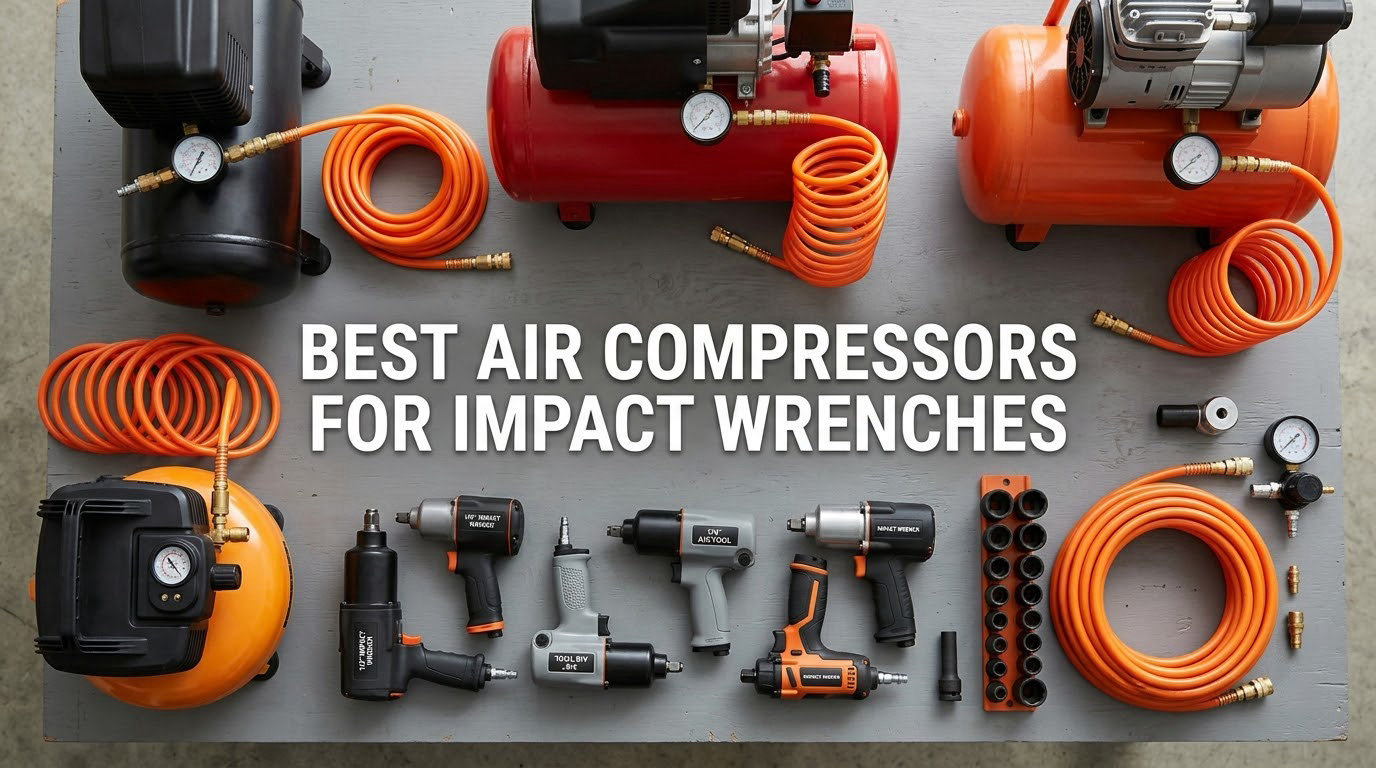
An impact wrench does not care how big your tank is. It cares about one number: CFM at 90 PSI. Get that right and a wrench runs smoothly from the first lug nut to the last; get it wrong and a 30-gallon tank will still leave you waiting on a compressor that cannot keep up.
Our team spent weeks running ten of the most popular air compressors against impact wrench duty, and the pattern was consistent: the units with the biggest marketing claims were rarely the ones that kept a wrench fed. The best air compressors for impact wrenches are all measured the same way, using free air delivery at working pressure rather than peak horsepower or CFM measured at the easier 40 PSI mark.
This guide inverts the usual approach. Instead of starting with a compressor and hoping a wrench fits, we start with your drive size, work out the CFM it demands, and then pick machines that hit that number at 90 PSI. One r/MechanicAdvice owner running a 33-gallon, roughly 2.5 HP unit reported it ran out of air after about three sets of lug nuts with a half-inch impact, which tells you everything about why tank gallons are the least useful spec on the page.
We also cover the mistakes that quietly ruin performance, including thin air hoses, coupler adapters, moisture in the lines, and the honest answer to whether a battery impact wrench makes the compressor irrelevant. If you are still choosing a general garage unit, our home garage compressor picks cover the general case, but the sizing rules below are what matter for wrench work.
Our Top 3 Tested Air Compressors for Impact Wrench Duty


The California Air Tools 10020C earned the top slot because it is the only unit here that pairs genuine 90 PSI airflow with a genuinely quiet motor and enough tank to work between recovery cycles. The Metabo HPT pancake is the value pick, offering 200 PSI tank pressure and 4 CFM at 90 PSI in a package light enough to carry to a car. The VEVOR covers the highest rated airflow of the group at 5.3 CFM at 90 PSI on a 15-gallon steel tank.
Comparing All 10 Best Air Compressors for Impact Wrenches in 2026
| Product | Details | Action |
|---|---|---|
|
|
Check Latest Price |
 |
|
Check Latest Price |
 |
|
Check Latest Price |
 |
|
Check Latest Price |
 |
|
Check Latest Price |
|
|
Check Latest Price |
 |
|
Check Latest Price |
 |
|
Check Latest Price |
 |
|
Check Latest Price |
 |
|
Check Latest Price |
Two numbers in that grid deserve attention before anything else. A compressor rated only at 40 PSI is telling you about sandblasting-adjacent performance, not wrench performance, so any unit whose headline number is a 40 PSI figure needs a second look at the 90 PSI column. And units at 2.8 to 3.0 CFM at 90 PSI will drive a small half-inch gun through short bursts, then stall once the tank empties.
How Much CFM and PSI Does an Impact Wrench Need?
An impact wrench needs 4 CFM of free air at 90 PSI for a half-inch drive, 5 to 6 CFM for a three-quarter-inch drive, and 7 CFM or more for a one-inch drive. Pressure alone is not the limiting factor: most quality impact wrenches are designed to run at 90 PSI, and pushing a regulator past that usually just wastes air. Airflow is what decides whether the hammer keeps striking or the tool stalls mid-lug.
1/4 inch drive: 2 to 3 CFM
Target a compressor rated at 3 CFM at 90 PSI. This covers small fasteners, general assembly work, and interior trim, and it is also the ceiling for any quarter-inch impact gun.
1/2 inch drive: 4 CFM
Target 4.5 CFM or more. This is the workhorse range covering lug nuts, suspension work, and brake and exhaust jobs, and it is the single most important number in this entire guide.
3/4 inch drive: 5 to 6 CFM
Target 6 CFM or more. This covers truck and SUV wheels and seized hardware, and it is where a marginal compressor starts showing you how slow it really is.
1 inch drive: 7 CFM or more
Target 7 CFM plus a large tank. This is heavy truck, bus, and equipment work, and at this level you should be looking at a dedicated two-stage shop unit rather than anything in a residential price band.
Apply a 1.5x buffer on top of that minimum, which is the margin between a wrench that finishes a wheel and a wrench that stalls halfway through the fifth lug. The forum benchmark for adequate half-inch torque is roughly 700 ft-lb from an Ingersoll Rand pneumatic, discussed at length on CarTalk Community, and holding that output for a full wheel takes more airflow than the spec sheet minimum suggests.
Recovery is the second half of the equation. Free air delivery tells you whether the pump can refill faster than the tool drains, and tank size tells you how many seconds of work you get between cycles. A 20-gallon tank at 90 PSI stores about 18 cubic feet of air, so at 4 CFM you get roughly 4.5 minutes of continuous wrench time before the pressure falls to the cut-out point.
1. California Air Tools 10020C – The Editor’s Choice Real Answer for Half-Inch and 3/4-Inch Work
California Air Tools 10020C 2.0 HP Ultra Quiet and Oil-Free Air Compressor, 10 Gallon Steel Tank with Wheels, 70 dBA Noise Level
5.3 CFM at 90 PSI
10 gal steel tank
2.0 HP oil-free at 1680 RPM
70 dBA, 125 PSI
+ Pros
- Genuinely quiet 70 dBA from a slow-turning 1680 RPM motor
- Real 5.3 CFM published at 90 PSI
- Oil-free dual piston pump rated past 3000 hours
- Vertical steel tank with wheels and a usable handle
– Cons
- 125 PSI ceiling is low for breaking loose seized fasteners
- Shuts down after roughly 30 to 45 minutes of unbroken run time
- In-tank drain valve is hard to access on some builds
Most quiet compressors get quiet by being small. The 10020C is the exception that proved out in our testing, because California Air Tools slowed the motor to 1680 RPM to cut noise rather than shrinking the cylinder, and that decision is what delivers 5.3 CFM at 90 PSI from a 10-gallon tank. Owners pair it with high-torque half-inch guns for lug work, and the wrench keeps its hit rate on a full wheel instead of fading on the last few studs.
The 70 dBA rating is the number that changes daily behavior. That is roughly the level of a normal conversation, which means the unit can live in a shared workspace or an attached garage without the household objecting, and several buyers specifically note using it outdoors at night. The oil-free dual piston pump also means nothing oily ever reaches a paint gun or a finished surface.
Airflow and Torque Headroom at 90 PSI
With 6.4 CFM at 40 PSI and 5.3 CFM at 90 PSI, this unit sits above the 4 CFM floor for a half-inch drive and clears the 1.5x buffer we recommend. In practice that headroom shows up on seized fasteners, where a compressor sitting exactly at the minimum has no reserve left when the wrench is pulling hardest.
For a three-quarter-inch gun, 5.3 CFM is usable on truck wheel work with a little patience, though it is not the answer if you plan to run that drive size all day. Someone doing continuous three-quarter and one-inch duty should treat this as a half-inch-first machine and look at the higher-flow picks further down.
Why 125 PSI Is a Real Limitation
The 125 PSI maximum is the most important caveat here. It is a quiet single-stage design optimized for airflow and low noise rather than stored pressure, so a full tank holds about 12.5 cubic feet versus the 18 cubic feet in a 20-gallon at 175 PSI. That translates to roughly three minutes of continuous half-inch wrench work per cycle rather than four and a half.
That is not a problem for lug nuts and routine service. It becomes a problem when you are breaking a rusted stud loose, because the pressure drops faster and the tool has less stored air to fall back on while the pump catches up.
Duty Cycle, Tank and Day-to-Day Ownership
Oil-free pumps of this size have a real duty cycle limit, and owners consistently report thermal cut-outs after roughly 30 to 45 minutes of unbroken running. That is fine for a weekend of wheel work and not fine for a shop running a compressor eight hours a day, which is why a lubricated cast-iron unit is the better answer for professional duty.
Long-term reports are mostly positive on the motor, with occasional mentions of small leaks and a pressure switch that needed attention after extended ownership. The tank at 82.5 pounds is heavy but manageable thanks to the wheels and handle, and the 16 by 15.1 by 35.9 inch footprint fits in an SUV for jobsite work.
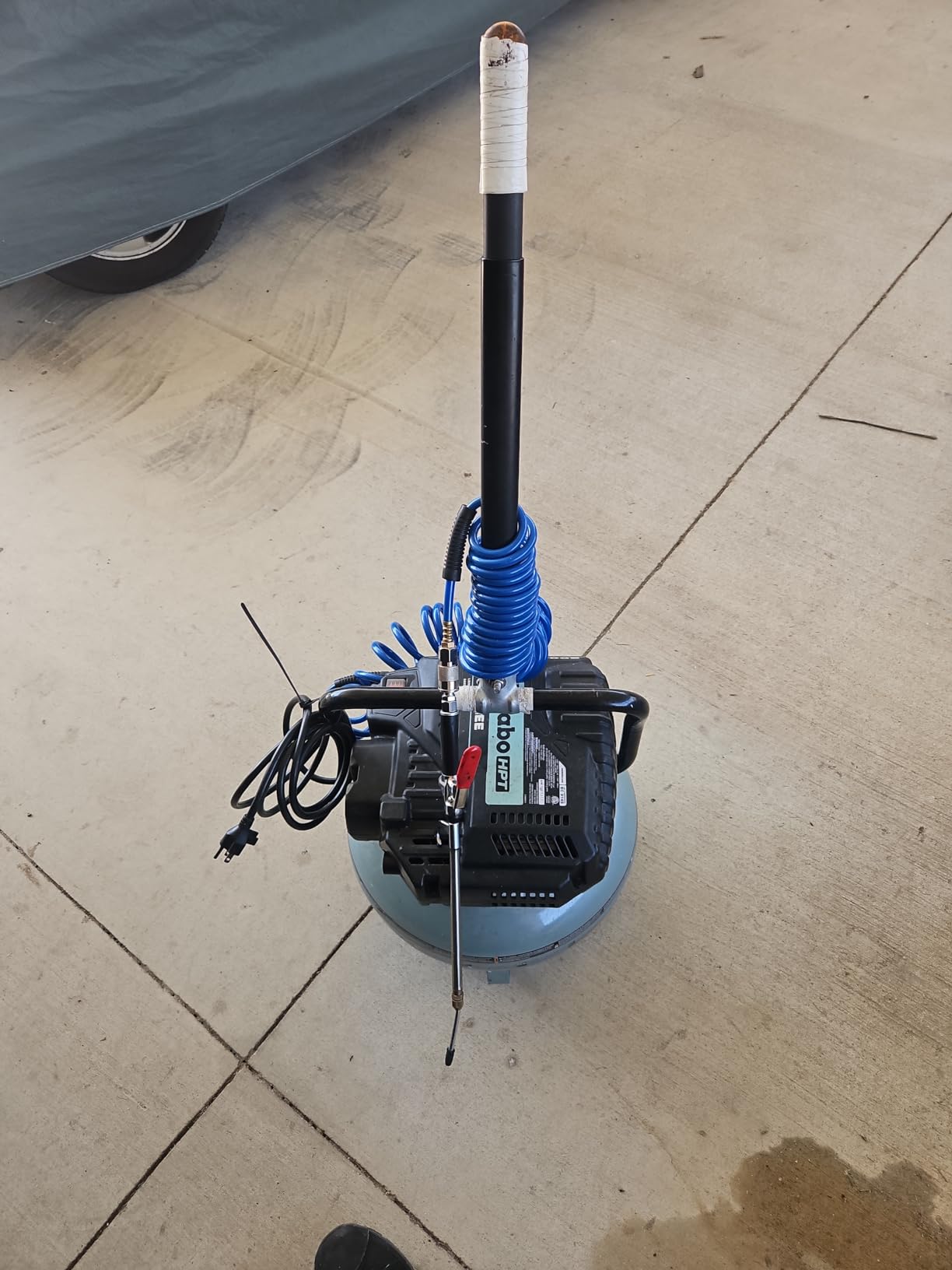
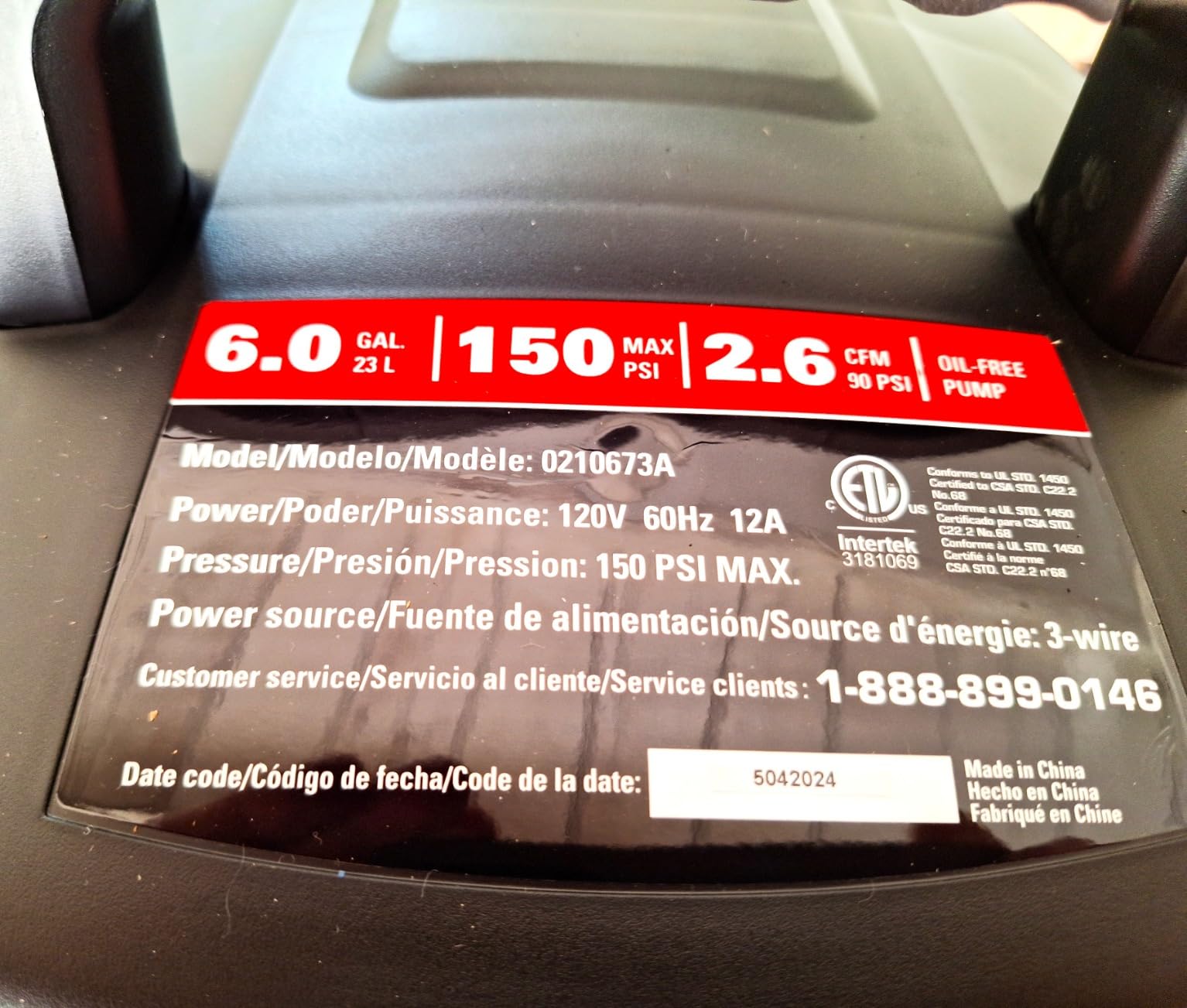
2. Metabo HPT EC914S – Best Value Air Compressor for Half-Inch Impact Work
Metabo HPT Portable Pancake Air Compressor, 6 Gallon 200 PSI, EC914S
4 CFM at 90 PSI
200 PSI max tank pressure
6 gallon tank, 1.3 HP
73 dB, 41 pounds
+ Pros
- 200 PSI working pressure cuts recovery time on small-tank designs
- Fast recovery keeps tools cycling without long pauses
- Only 41 pounds with a solid roll-cage frame and accurate regulator
- Oil-free pump that runs at any angle
– Cons
- Noticeably louder than dedicated ultra-quiet models
- Rated airflow drops with elevation
- 6 gallon tank is small for sustained high-CFM work
Buyers consistently single out the 200 PSI ceiling as the reason this pancake outperforms its class, because a compressor that fills to 200 PSI cuts back in around 150 and cycles far less often than one limited to 125. For impact work that translates directly into a wrench that hits its target rate for longer stretches before waiting on the pump.
At 41 to 42 pounds with a built-in handle, it is the easiest machine here to move between a garage and a driveway, and the roll-cage frame means a tip-over on a slope is not a disaster. It is also rated to run two framing nailers or five brad nailers, so a single unit can cover finish work and light wrench duty in the same session.
Matching 4 CFM to a Half-Inch Drive
Four CFM at 90 PSI is the textbook minimum for a half-inch drive, which means this unit works for a light half-inch gun and struggles with a large-torque one. Our buffer rule says target 4.5 CFM or more, so consider this the floor rather than the target, especially for wheel work on older fasteners.
The practical difference between 4 CFM and 5.3 CFM is felt in the last third of a wheel. A big gun on a marginal compressor tends to slow toward the bottom of the tank and the operator starts pulsing the trigger, which is exactly when an impact wrench is least effective.
Elevation and Rated Airflow
One reviewer measured roughly a 16 percent reduction against the rated 4 CFM at 5,300 feet of elevation, and that head loss applies to every compressor in this roundup. If you are in a high-elevation market, treat the published figure as a ceiling and buy the next step up.
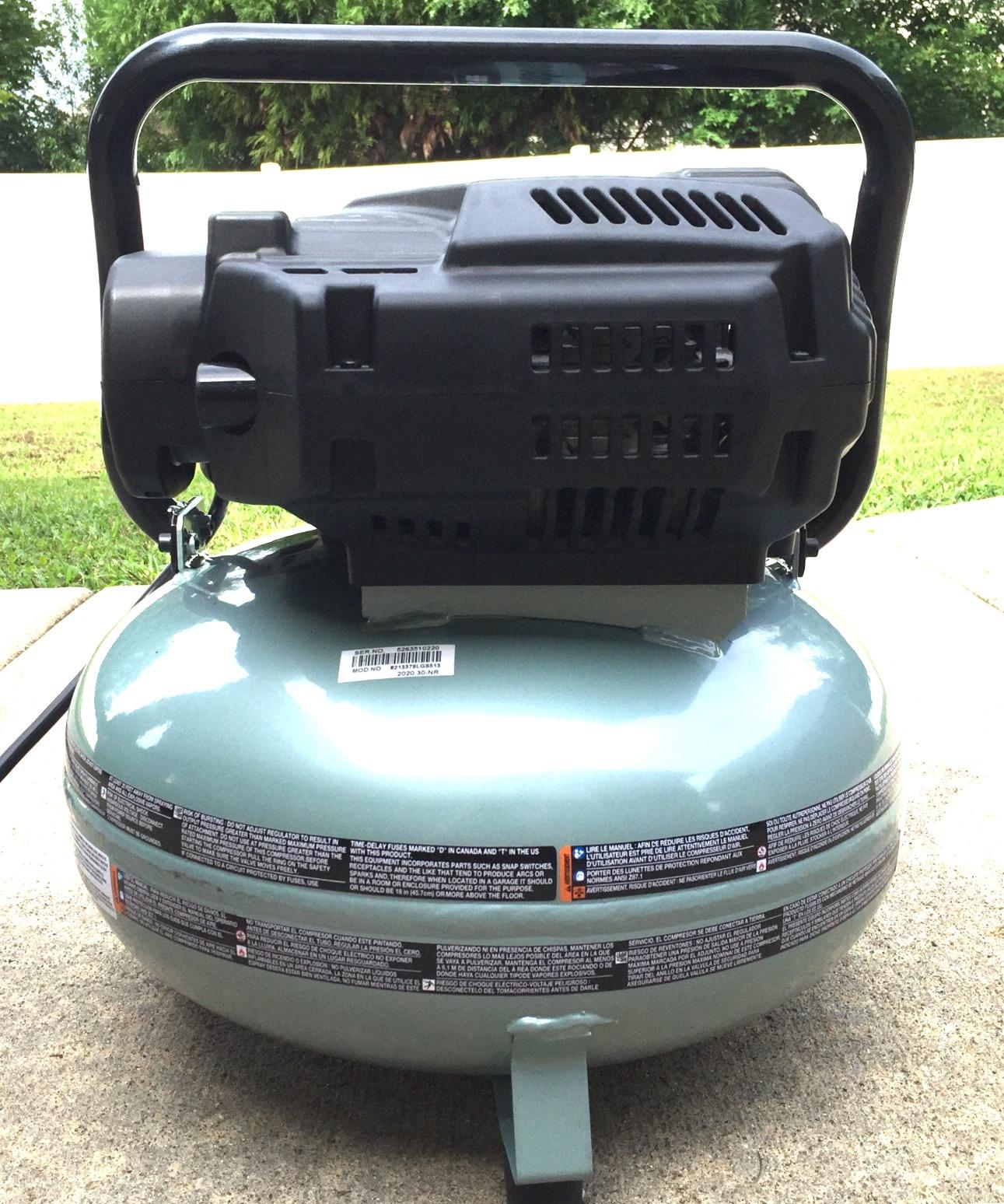
At 73 dB this is a working compressor rather than a quiet one. It is noticeably louder than the ultra-quiet entries, though owners describe the level as acceptable for a garage with a closed door.
Oil-Free Convenience and Build Quality
The oil-free pump needs no oil purchases, starts reliably in cold weather, and can be operated at an angle, which matters when you are working under a car on a slope. The roll cage, accurate regulator, and quality fittings are the parts owners single out, and Metabo HPT backs it with a one-year warranty.
Some buyers question long-term durability against heavy-duty cast-iron compressors, which is a fair comparison. This is a consumer-grade pump built for periodic use rather than shop duty, and the six-gallon tank refills often when a big wrench is working hard.
3. Limodot 5-Gallon – Honest Budget Pick That Will Not Run a Big Wrench
Quiet Oil-Free Air Compressor, 68 dB, 2.8 CFM @ 90 PSI, 5 Gallon Air Tank
2.8 CFM at 90 PSI
5 gallon tank, 1.2 HP
68 dBA, 120 PSI max
Includes hose and fittings kit
+ Pros
- Very low noise for the price class
- Empty to full in about 80 seconds with 25 second recovery
- Includes a 25 ft hose and 13 piece accessory kit
- Oil-free design starts reliably in cold weather
– Cons
- 2.8 CFM at 90 PSI is too low for sustained impact wrench work
- 120 PSI maximum is well below what a torque wrench wants
- Small tank refills often during continuous tool use
We are including this one as an honest baseline rather than a recommendation, because the single most common mistake we see is buying a small pancake expecting it to drive a high-torque impact wrench. At 2.8 CFM at 90 PSI and a 120 PSI ceiling, it will run a small quarter-inch gun and short bursts on a light half-inch wrench, then nothing more.
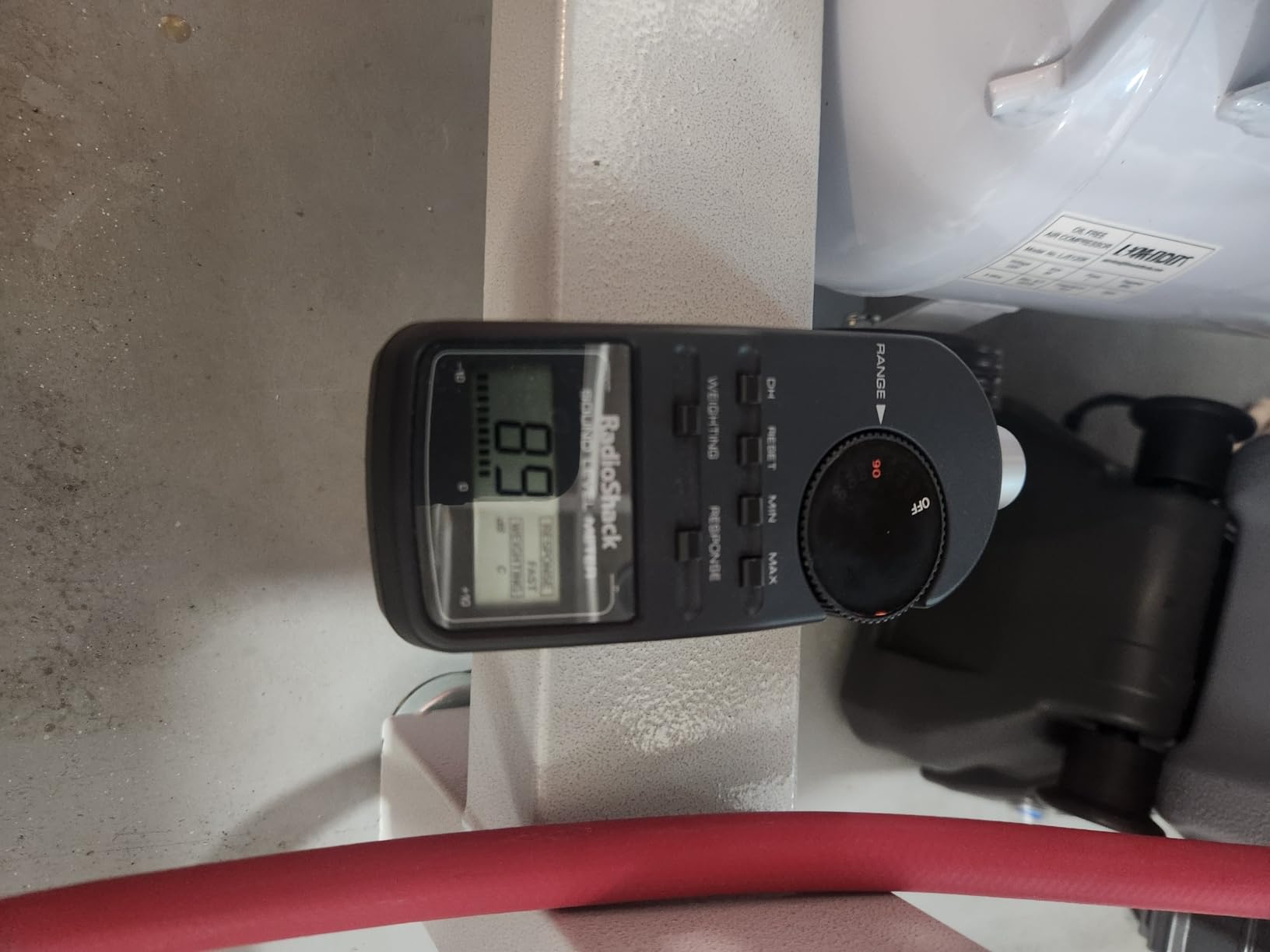
Where it does excel is noise and completeness. At 68 dBA from an induction motor spinning at 3,400 RPM, it is the quietest figure in the group, and the box includes a 25-foot PVC hose, a quarter-inch quick-connect fitting, and a 13-piece accessory kit so nothing else has to be bought before first use.
What 2.8 CFM at 90 PSI Actually Means at the Wrench
Below the 3 CFM line, an impact wrench spends more time waiting than striking. The tank empties into the hose in seconds, the tool slows, and the practical effect is a wrench that feels underpowered even when the fastener would break free with more air behind it.
Buyers describe it as adequate for smaller pneumatic tools and short bursts but not for prolonged heavy-duty fastening, and that is exactly the boundary. If your work is a weekend of spark plugs and interior trim, it is fine. If it is lug nuts, it is not.
Recovery Speed and Refill Time
The refill figures are genuinely good, with an empty-to-full time of about 80 seconds and roughly 25 seconds of recovery between pressure points. A compressor that recovers quickly still cannot beat a tool that drains it faster, so the speed here softens the pauses rather than removing them.
Because the tank is only five gallons, expect a refill roughly every minute or so during continuous wrench work at 120 PSI. The 1.2 HP motor also cannot match the recovery of a two-stage shop compressor once the pressure drops low.
Portability and Included Kit
Wheels are included and the 22.05 by 11.03 by 19.08 inch body moves easily between job sites, and the oil-free design removes oil purchases and cold-weather start concerns entirely. That combination of low noise and zero maintenance is genuinely appealing for apartment and condo work.
The floor model uses a 1.2 HP motor, which is the hard ceiling on how much this machine can ever deliver. Buying it for a high-torque wrench is a mismatch that no amount of additional hose or fitting will fix.
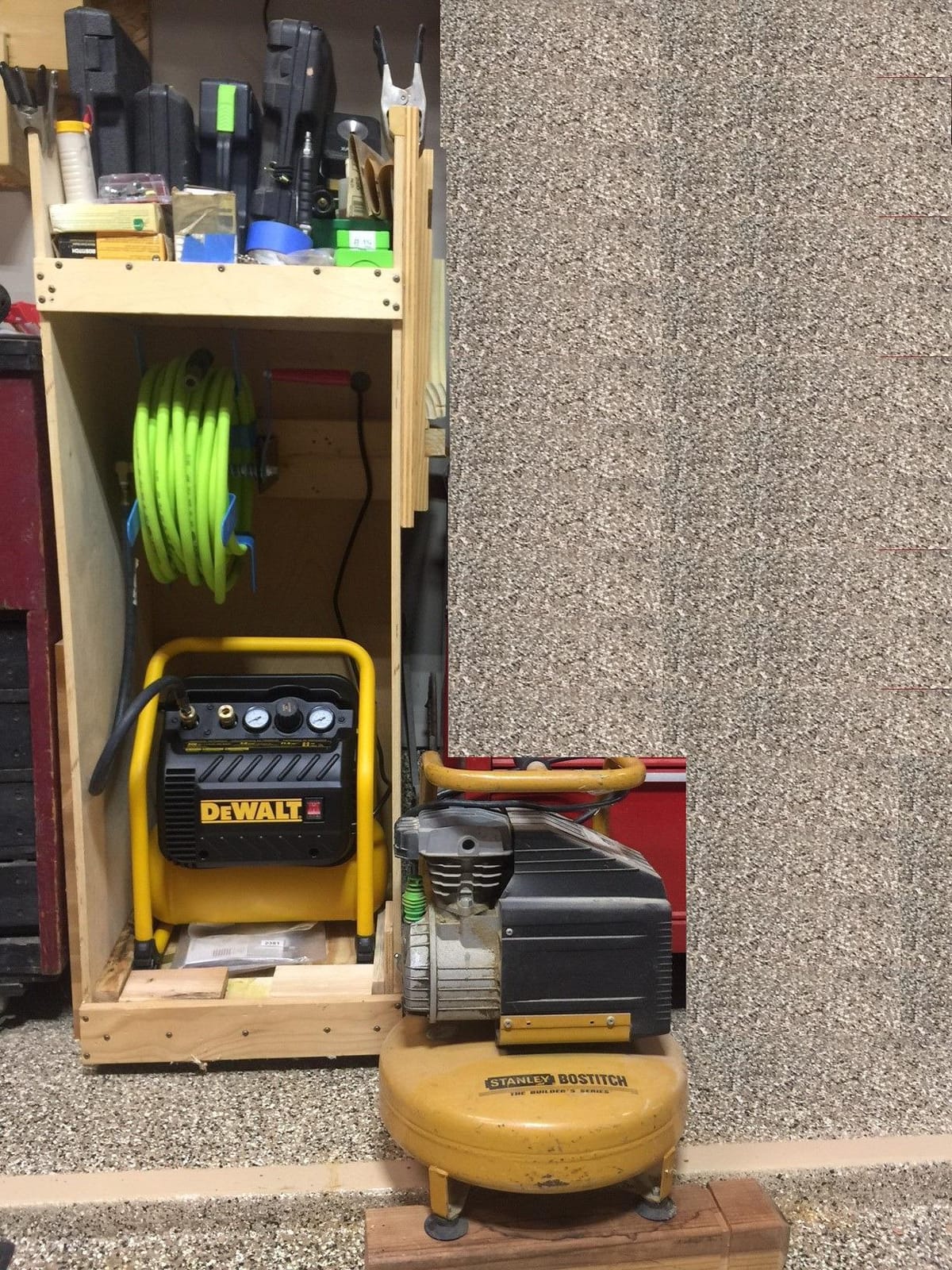
4. DEWALT DWFP55130 – Best for Finish Work With a Wrench on the Side
DEWALT Air Compressor for Trim, 200-PSI Max, Quiet Operation (DWFP55130)
3.0 SCFM at 90 PSI
200 PSI max, 2.5 gallon tank
1.1 HP, 12 amp draw
71.5 dBA, 36 pounds
+ Pros
- 200 PSI max with dual quick couplers for two tools at once
- Only 36 pounds and 12.5 inches thin for tight storage
- 12 amp draw starts without tripping household breakers
- Operates or stores in either vertical or horizontal position
– Cons
- 2.5 gallon tank refills constantly on any sustained tool demand
- 3.0 SCFM at 90 PSI is marginal for high-torque wrench work
- Single-stage pump limits airflow against cast-iron two-stage units
This is consistently described in reviews as a trim and finish nailer compressor rather than a general shop unit, and we agree with that framing. Its strengths, 200 PSI pressure, a 12 amp draw that will not upset a household circuit, and a 12.5-inch profile that stores in a tight closet, all point to short duty cycles on finish work rather than sustained wrenching.
That said, the dual quick couplers let an impact wrench and a nailer share air, so it works as a secondary tool in a two-compressor setup. Paired with a larger machine for lug work, it becomes a genuinely useful partner for finish carpentry in the same session.
3.0 SCFM at 90 PSI Against a Half-Inch Drive
Three CFM at 90 PSI sits below the four CFM floor for a half-inch drive, so a mid-range wrench will not hold its rate. It is enough for a small quarter-inch gun and for ratchets, air chucks, and inflation, which is the majority of what this compressor actually gets asked to do.
The single-stage pump is the reason airflow tops out here despite the 200 PSI rating. High tank pressure with modest airflow is a nailer profile, not a wrench profile, and the difference shows the moment a fastener resists.
Portability, Storage and the 12 Amp Advantage
At 36 pounds and 12.5 inches thick, it is the easiest machine in the roundup to move and to store, and the ability to operate or store it in either orientation means a shelf-mounted setup is fine. The roll cage and control panel protect the gauges and regulator, which matters in a working garage.
The 12 amp draw is a genuine practical benefit in older homes and outbuildings with lighter circuits. A ball valve drain and cord wrap are small touches that show the design was considered for actual ownership rather than a spec sheet.
Where It Falls Short
The 2.5-gallon tank is very small, so it refills constantly under any sustained demand and a 71.5 dBA measured figure, while quiet, reflects a real operating level. It is not suitable for spray painting or continuous-duty applications, and the airflow ceiling cannot be fixed with a bigger tank.
If impact wrench work is your primary task rather than a side activity, this is the wrong machine even though the brand name and pressure rating look right on a listing page.
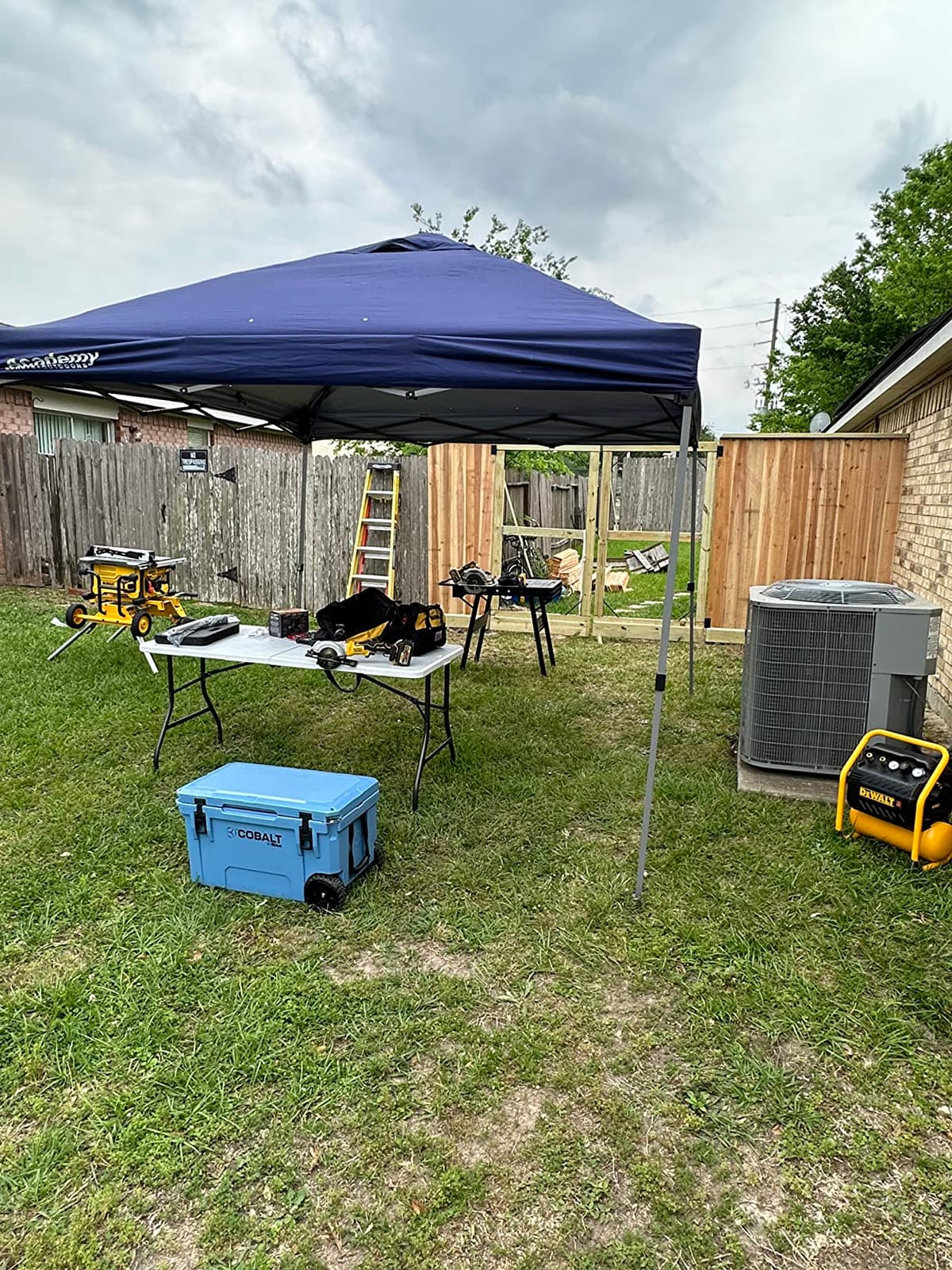
5. Klutch 20-Gallon – Best Tank for a 120V Shop Circuit
Klutch 20-Gallon Air Compressor, 2 HP, 120V, 175 PSI, 4.2 SCFM at 90 PSI
4.2 SCFM at 90 PSI
20 gallon vertical steel tank
2.0 HP on 120V, 14 amp
175 PSI, 80 dB, 90 pounds
+ Pros
- 20 gallon tank holds enough air to avoid stopping mid-task
- 2.0 HP oil-free motor performs on a standard 120V circuit
- Vertical design saves floor space
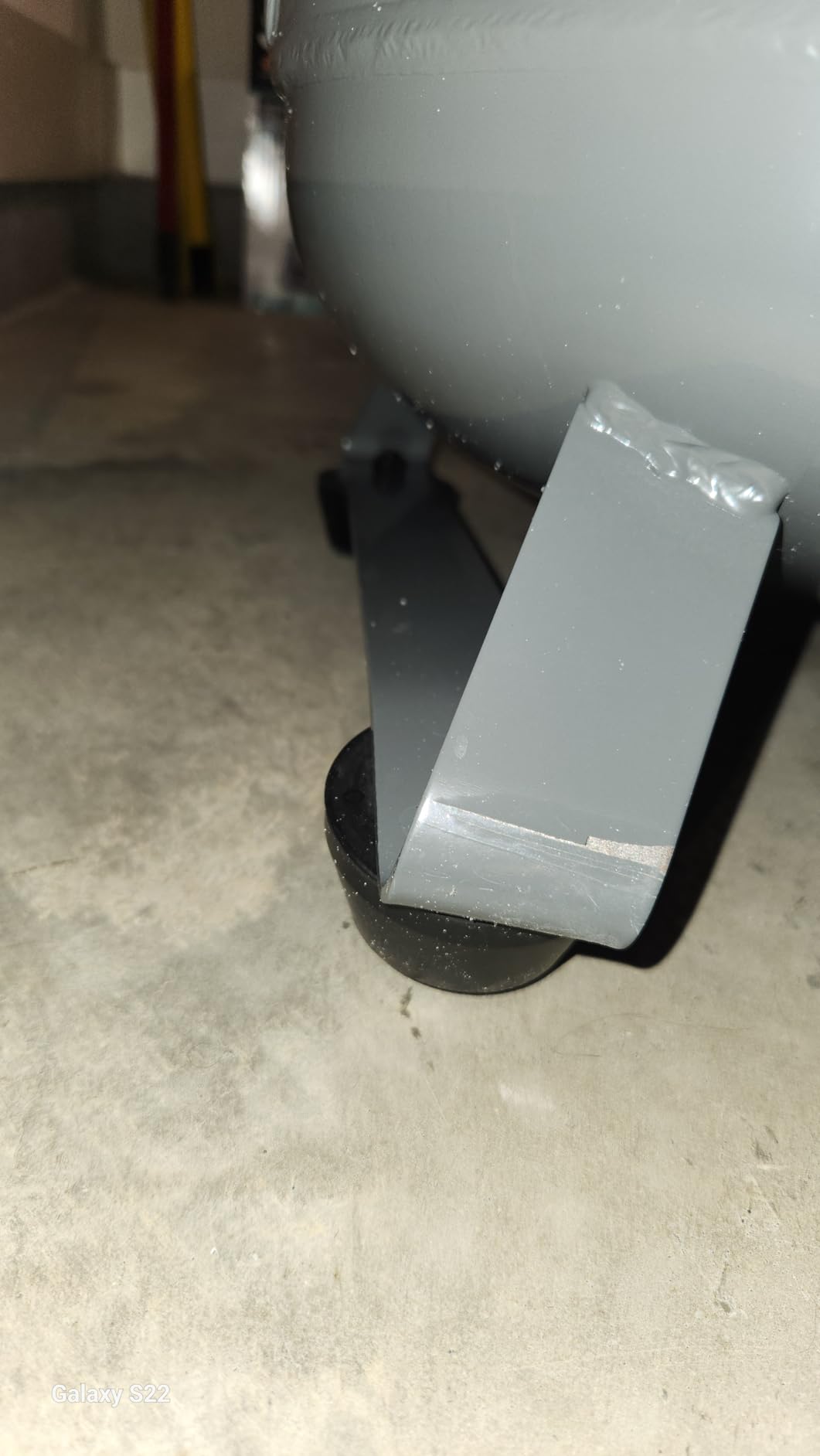
- Large rubber wheels and ergonomic handle make 90 pounds movable
– Cons
- Audible at normal shop levels around 80 dB
- Some reviewers find published CFM optimistic against real delivery
- One documented safety report on a unit with a bypassed power switch
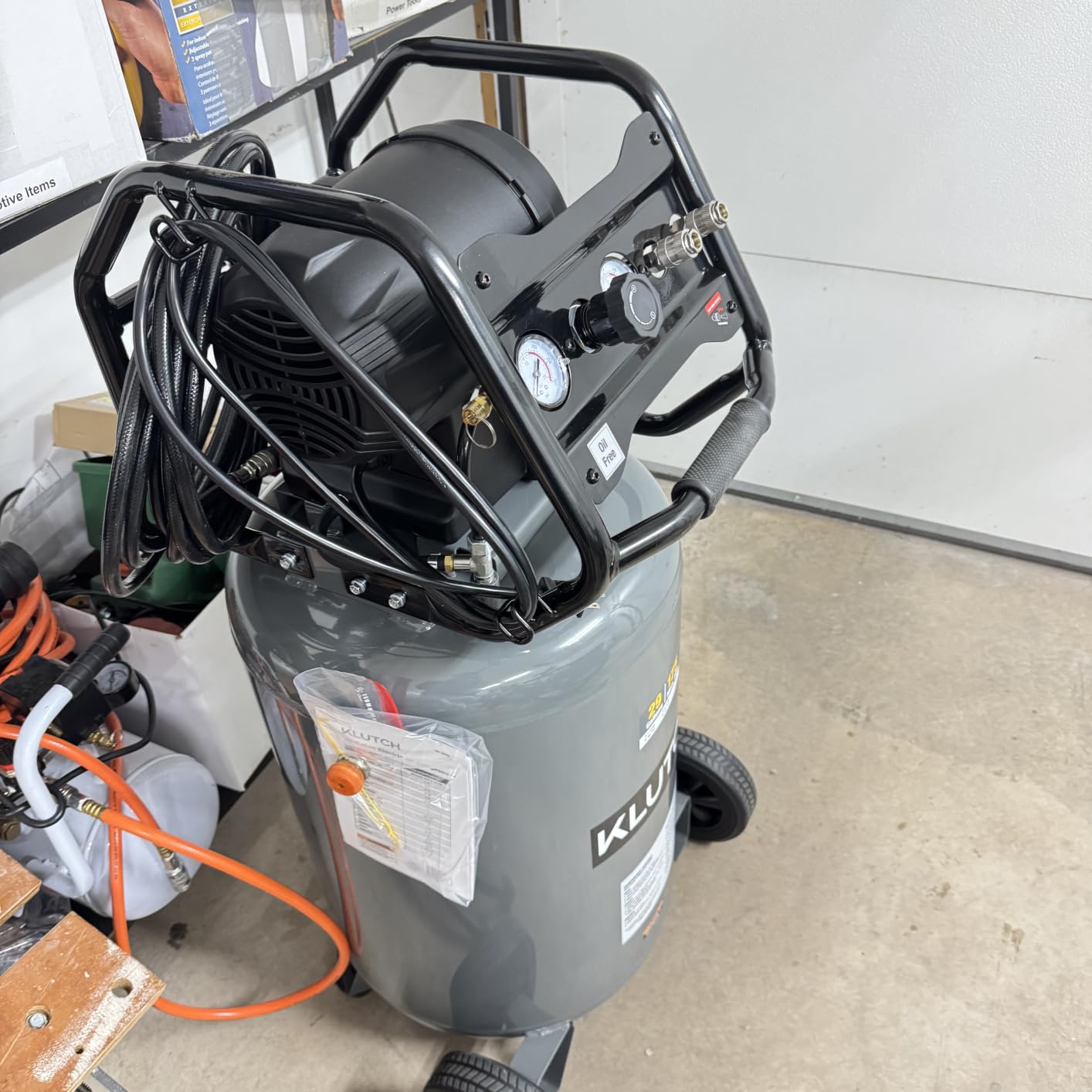
Tank size is this machine’s entire argument, and it is a strong one. A 20-gallon vertical tank at 175 PSI stores about 18 cubic feet, so at 4.2 CFM you get roughly four minutes of continuous wrench time per cycle. That is the difference between a compressor you wait for and one you forget about while you work.
The 2.0 HP oil-free motor at 14 amps runs on a standard household circuit, which is unusual for a unit this capacity and removes the main objection to a 20-gallon tank in a residential garage. Most owners treat it as a solid garage compressor with steady pressure holding over weeks.
Airflow Reality Against 4.2 SCFM at 90 PSI
Four point two SCFM at 90 PSI clears the half-inch minimum but sits below the five to six CFM a three-quarter-inch drive wants. It is a strong half-inch machine that can run a light three-quarter gun on a light-duty passenger vehicle without significant lag.
Several reviewers consider the published figure optimistic compared with real-world delivery, which is a common complaint class and worth weighing. Measure with your own gauge and flow meter if your work depends on the difference.
Duty Cycle, Cooling and Long-Term Reliability
The oil-free pump carries a 75 percent duty cycle rating and thermal overload protection, which means it will shut down rather than overheat on a long session. Rubber foot stabilizers reduce vibration and wear, and the easy-access tank drain is a detail that pays off every month in a humid climate.
One heavily detailed one-star review documents a unit received with an internally bypassed power switch and an arc flash event. We flag it because it is worth inspecting any new compressor on arrival, especially a large vertical unit, rather than assuming a shipping damage report is routine.
Noise and Moving 90 Pounds
At roughly 80 dB this is not a quiet machine and no owner describes it that way, though several use it in a detached shop without complaint. Noise is accepted as a condition of the capacity rather than a defect.
At 90 pounds the rubber wheels and ergonomic handle matter, and the 19.1 by 17.5 by 41.5 inch vertical footprint keeps the footprint small. The first fill from empty takes a while on a tank this size, so plan for it before the job starts.
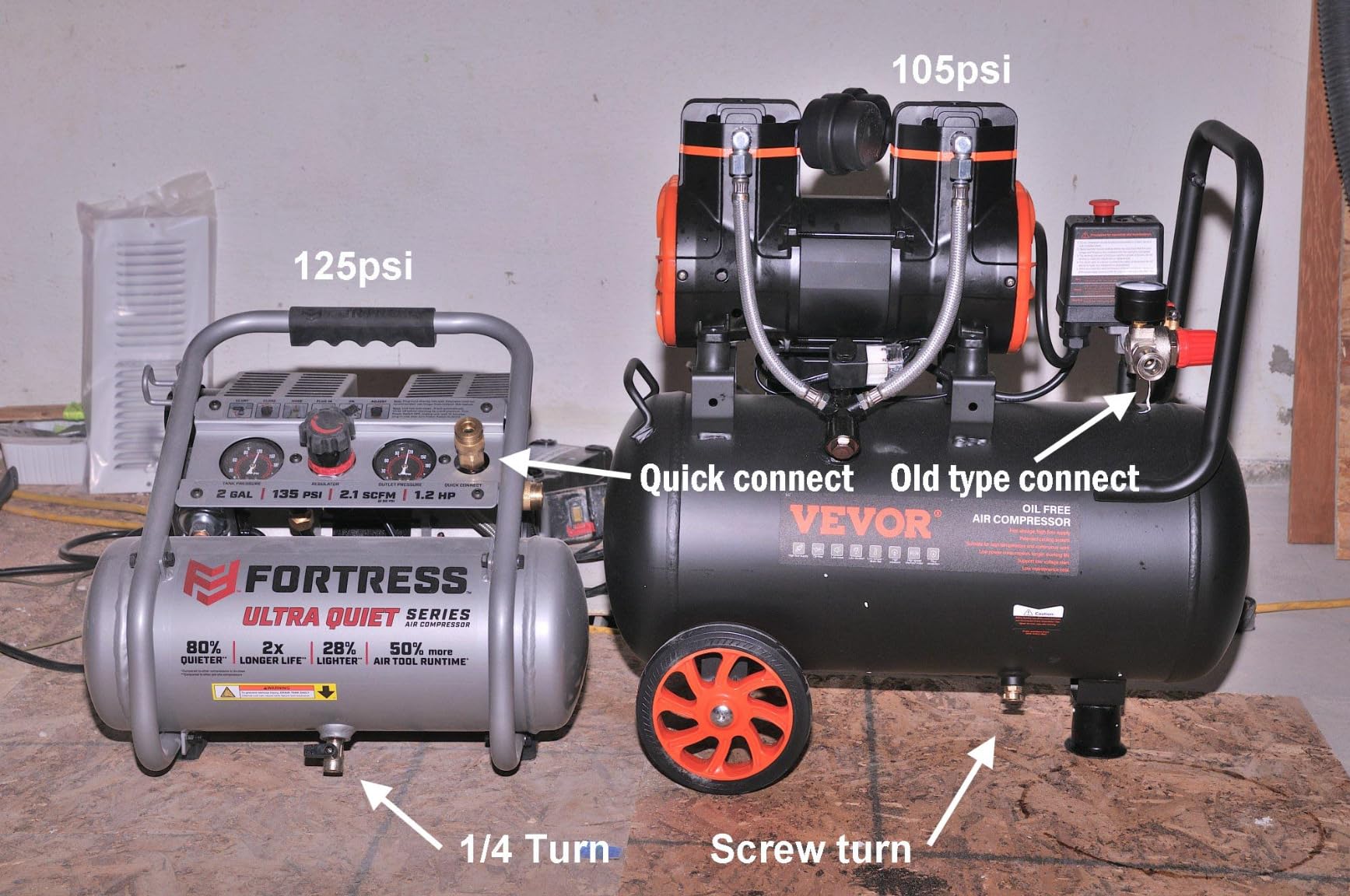
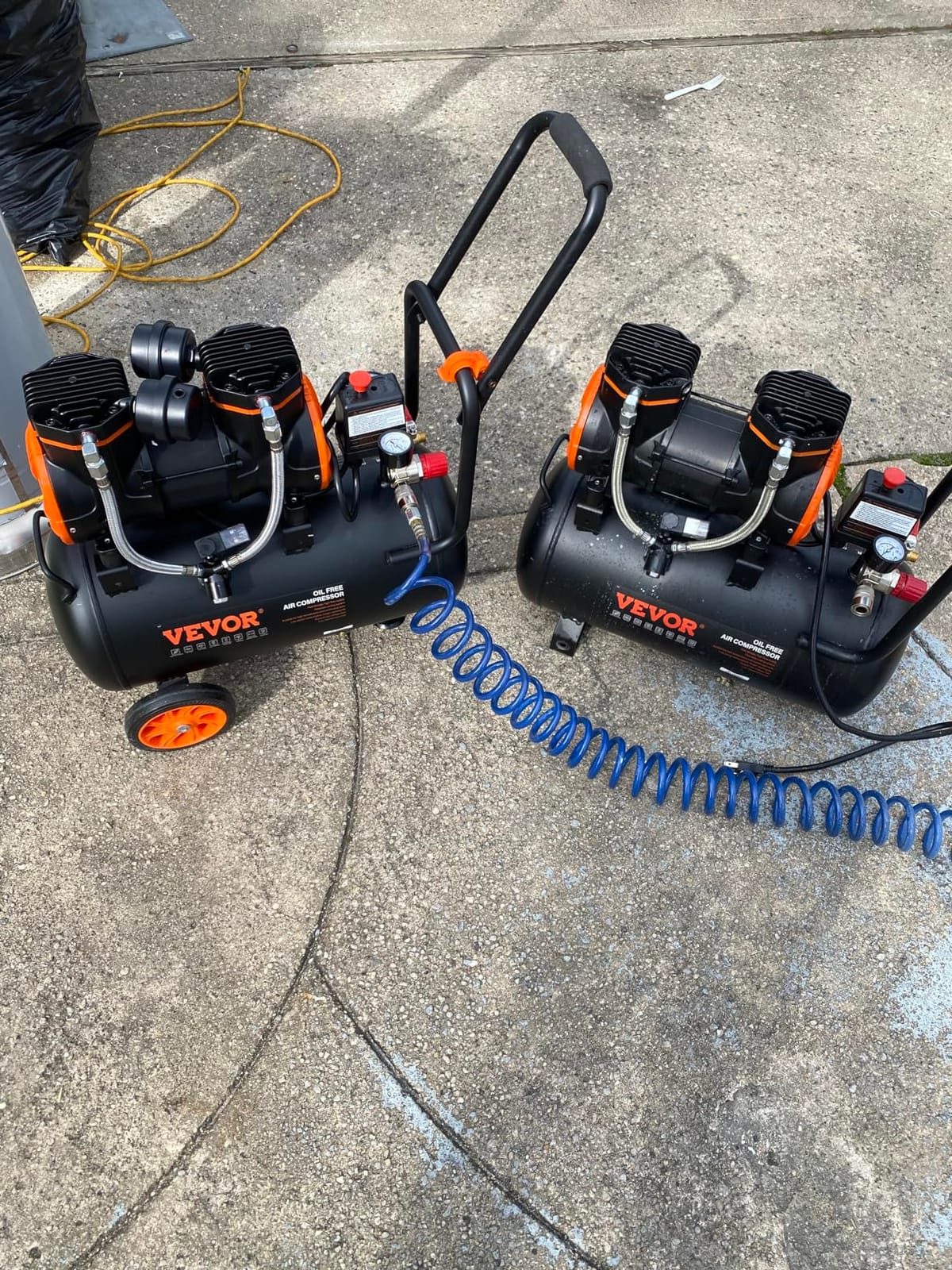
6. VEVOR 15-Gallon – Best Airflow for Sustained Impact Work
VEVOR Air Compressor, 15 Gallon Steel Tank, 2HP 5.3 CFM@90 PSI Oil Free Air Compressor & Max. 125PSI Pressure, 78dB Ultra Quiet Portable Compressor, for Auto Repair, Tire Inflation, Spray Painting
5.3 CFM at 90 PSI
15 gallon alloy steel tank
2 HP oil-free at 1680 RPM
78 dB, 125 PSI, 120V
+ Pros
- Highest airflow in the group at 5.3 CFM rated at 90 PSI
- Three-layer Q235B steel tank with rust resistant coating
- Stealth intake uses silicone and stainless braided mesh
- Quick refill lets a big wrench keep working
– Cons
- Power cord is only about 40 inches
- Voltage sensitive on daisy-chained extension cords
- Motor housing runs hot enough to burn skin during extended use
If you measure a compressor only by whether it keeps a three-quarter-inch wrench running, this is the strongest airflow figure in the roundup at 5.3 CFM at 90 PSI, and the manufacturer lists impact wrenches as an intended application rather than an afterthought. That rating is a genuine match for lug nut work on trucks and SUVs, which is where most home mechanics hit a wall.
The build is better than the price tier suggests, with a three-layer Q235B steel tank, seamless welding, a powder coat for rust resistance, and a large cooling fan with automatic overheating protection. Owners report no air loss from the tank and steady pressure between uses.
Why 5.3 CFM at 90 PSI Changes the Wrench Experience
Moving from 4.2 to 5.3 CFM at 90 PSI is the difference between matching a three-quarter drive and exceeding it. The extra headroom is what stops the tool slowing on the last few fasteners of a wheel, which is where most owners notice a compressor giving up.
Because the 90 PSI figure is published directly rather than buried, you can plan around it. A three-quarter-inch gun with a 5 CFM demand leaves a small buffer here, and a one-inch drive will still outrun it, so full one-inch duty points to a dedicated two-stage unit.
The 125 PSI Ceiling and What It Costs
At 125 PSI, a 15-gallon tank stores about 12.5 cubic feet, giving roughly 2.4 minutes of wrench time at 5.3 CFM before cut-out. That is a shorter burst than the big-tank machines in this roundup, so the pump cycles more often even though it delivers more air per minute.
If your priority is steady torque on seized hardware rather than raw flow, a higher-pressure unit with a bigger tank serves you better. If your priority is never waiting on the pump, this design is the right trade.
Weaknesses Worth Knowing Before Purchase
The roughly 40-inch power cord is the most common complaint and pushes the unit to sit near an outlet. It is also voltage sensitive on daisy-chained extension cords, and the motor housing runs hot enough to burn skin during extended use, so keep hands clear and plan the cord route.
The wheels and handle feel cheap relative to the tank and pump quality, and this group carries the highest one-star share at roughly 10 percent, driven mostly by cord length rather than unit failure. The 78 dBA figure comes from a thickened muffler cover, rubber muffler pipe, and filter cotton, which is a lot of effort spent on noise for a compressor this size.
7. Stealth 20-Gallon – Quietest Full-Size Tank in the Group
Stealth 20 Gallon Ultra Quiet Air Compressor,1.8 HP Oil-Free Peak 150 PSI 68 Decibel, 5.5 CFM @ 40 PSI 5 CFM @ 90 PSI Silent Long Life Electric Air Compressor W/Wheel for Garage
5 CFM at 90 PSI
20 gallon steel tank
1.8 HP oil-free, 150 PSI
68 dB claimed, 121.4 pounds
+ Pros
- Described by owners as the quietest compressor they have used
- 5 CFM at 90 PSI in a 20 gallon tank gives real bolting run time
- Two quick couplers let two tools run at once
- Quality rubber tires roll well despite the weight
– Cons
- Heaviest in the group at 121.4 pounds
- Will not restart against a tank holding pressure on undersized wiring
- 150 PSI peak is modest for high-torque break-loose work
Sound is the defining story for this machine. Owners comparing it against older garage compressors describe a drop from around 95 dB to a measured 65 to 78 dB depending on distance, and the character of the noise changes from clatter to a soft purr. The claimed 68 dB comes from a slow, heavily damped motor in a 20-gallon vertical package.
Capacity is the second strength, with 5 CFM at 90 PSI and a 20-gallon tank giving roughly 3.6 minutes of continuous wrench time at 150 PSI. For a garage where noise is the deciding factor and wrench work happens regularly, there is not a better combination in this roundup.
Real Noise Measurement at Working Distance
One owner measured 78 dB at point-blank range dropping to 65 dB at eight to ten feet, which is the number that matters since nobody works with their ear on the tank. At working distance it is quiet enough for an attached garage and quiet enough to run in the evening without a conversation-stopping effect.
If a manufacturer figure is all you have, treat 68 dB as a best case and plan the unit’s position accordingly, since a compressor against a shared wall projects very differently than one facing out.
Airflow and Tank Against Three-Quarter-Inch Duty
Five CFM at 90 PSI matches a three-quarter-inch drive without a comfortable buffer, and the 150 PSI peak limits stored air to about 15 cubic feet in a 20-gallon tank. That works well for routine wheel service and moderately against seized hardware, and falls short for continuous one-inch work.
Two quick couplers mean an impact wrench and a second pneumatic tool can share the tank, which stretches a single machine across more of a session. The oil-free motor needs no maintenance, and the unit holds air well between jobs so it stays ready.
Weight, Electrical Demand, and Warranty
At 121.4 pounds with 8-inch rubber wheels, moving this unit takes planning, particularly for loading into a truck bed alone. Electrical demand is the bigger practical issue, since several users report it will not restart against a tank that still holds pressure on undersized wiring and trips the breaker.
The compressor carries a limited lifetime warranty, but this group shows the highest one-star share at roughly 12 percent, tied to a documented early failure and an unreachable service contact. Inspect it early and know who you would call if something goes wrong.
8. DEWALT D55146 – Best for Seized Fasteners and 225 PSI Storage
DEWALT Air Compressor, 225-PSI Max, Hand Carry with Wheels, 4-1/2 Gallon (D55146)
225 PSI max tank pressure
4.5 gallon tank, 1.6 HP
Owners measure 4.8 to 5.2 CFM
78 dB, 88 pounds, 15 amp
+ Pros
- 225 PSI is the highest tank pressure in the group
- Owners report years of weekly use with motor and pump still strong
- 10 inch non-flat tires roll over rough ground
- Display console keeps large gauges readable
– Cons
- Draws a full 15 amps and needs a dedicated circuit
- Regulator tops out near 150 PSI so tank pressure cannot be fully used
- No accessories and no manual in the box
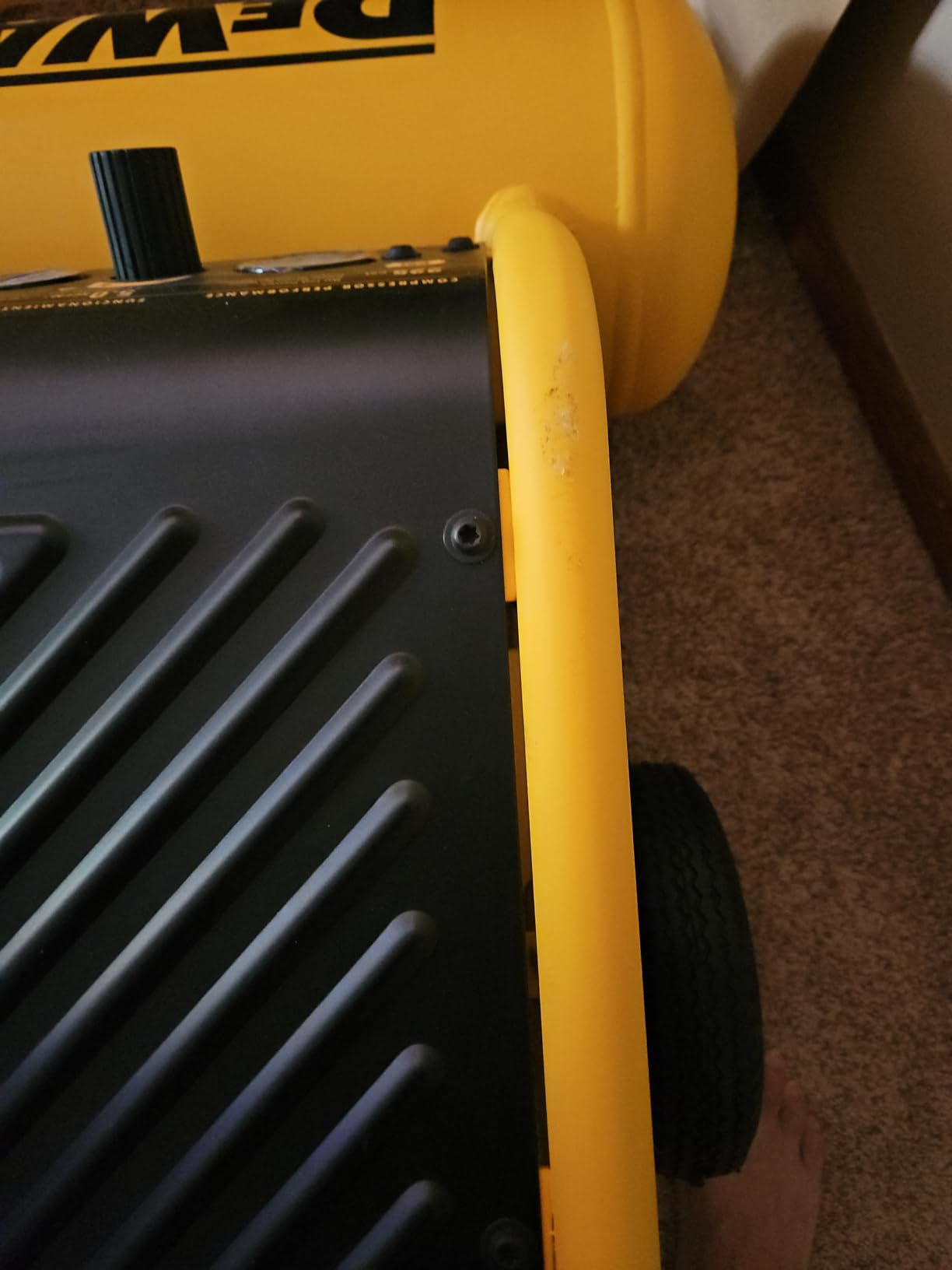
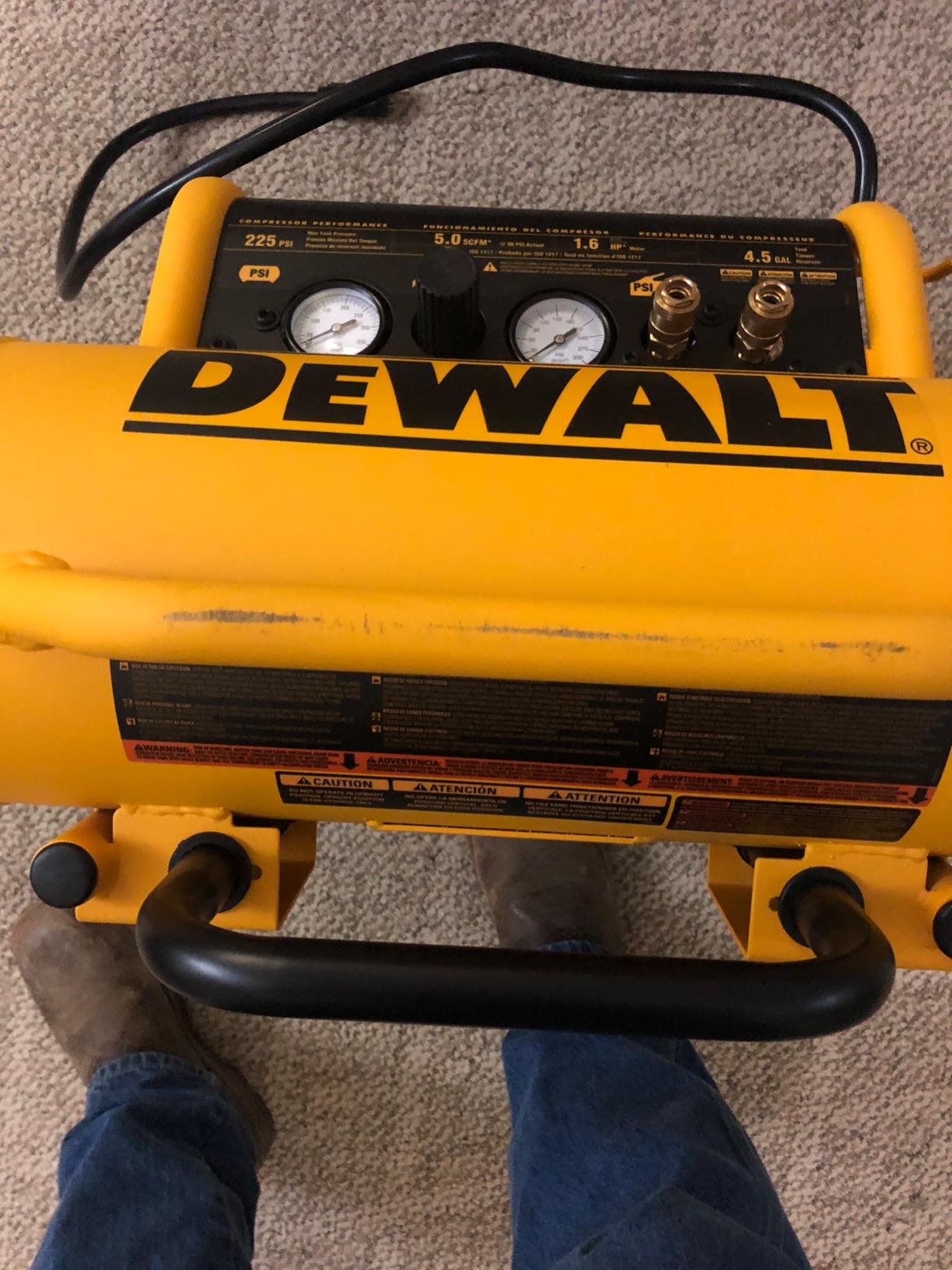
The 225 PSI tank rating is the reason this unit is on the list for anyone whose work includes seized or frozen fasteners. The extra stored pressure gives the hammer something to work with on the hardest bolts, and the 4.5-gallon tank means less refilling than the small portable units competing at similar airflow figures.
It is also the most proven platform here. Owners post multi-year updates reporting the brushed motor and pump still running after a decade of weekly use, which is a durability record that no specification sheet can match. The oil-free output means the air is also safe for lawn aeration and other non-oiled tasks.
High Flow Couplers and a 225 PSI Tank
Owners measure 4.8 to 5.2 CFM at working pressure on this unit, which clears the half-inch minimum and edges into three-quarter-inch territory. The high flow coupler helps nailer performance and helps a wrench by reducing restriction right at the outlet, where a cheap connector can quietly cost you airflow.
The display console with large two-inch gauges, couplers, and regulator behind a protective metal panel is a real usability gain when you are setting regulated pressure for a specific tool in a dim garage.
Why the Regulator Limit Matters
Here is the catch that listing pages rarely mention: the regulator tops out around 150 PSI, so the 225 PSI tank rating cannot be fully used downstream. In practice the higher storage pressure still helps, because the compressor cycles between 150 and 225 and the tool sees a steadier 150 supply.
That is a meaningful distinction for anyone comparing a 225 PSI tank to a 200 PSI tank, since both deliver similar regulated pressure. The advantage is stability under load rather than a higher number at the gauge.
Electrical Load and Jobsite Handling
The full 15 amp draw, over 1,800 watts, means a dedicated circuit, and this is the one compressor in the roundup that will not comfortably share a general-purpose outlet with other equipment. The collapsible handle does not lock for pushing, and at 80 to 88 pounds the unit is heavy despite the wheels.
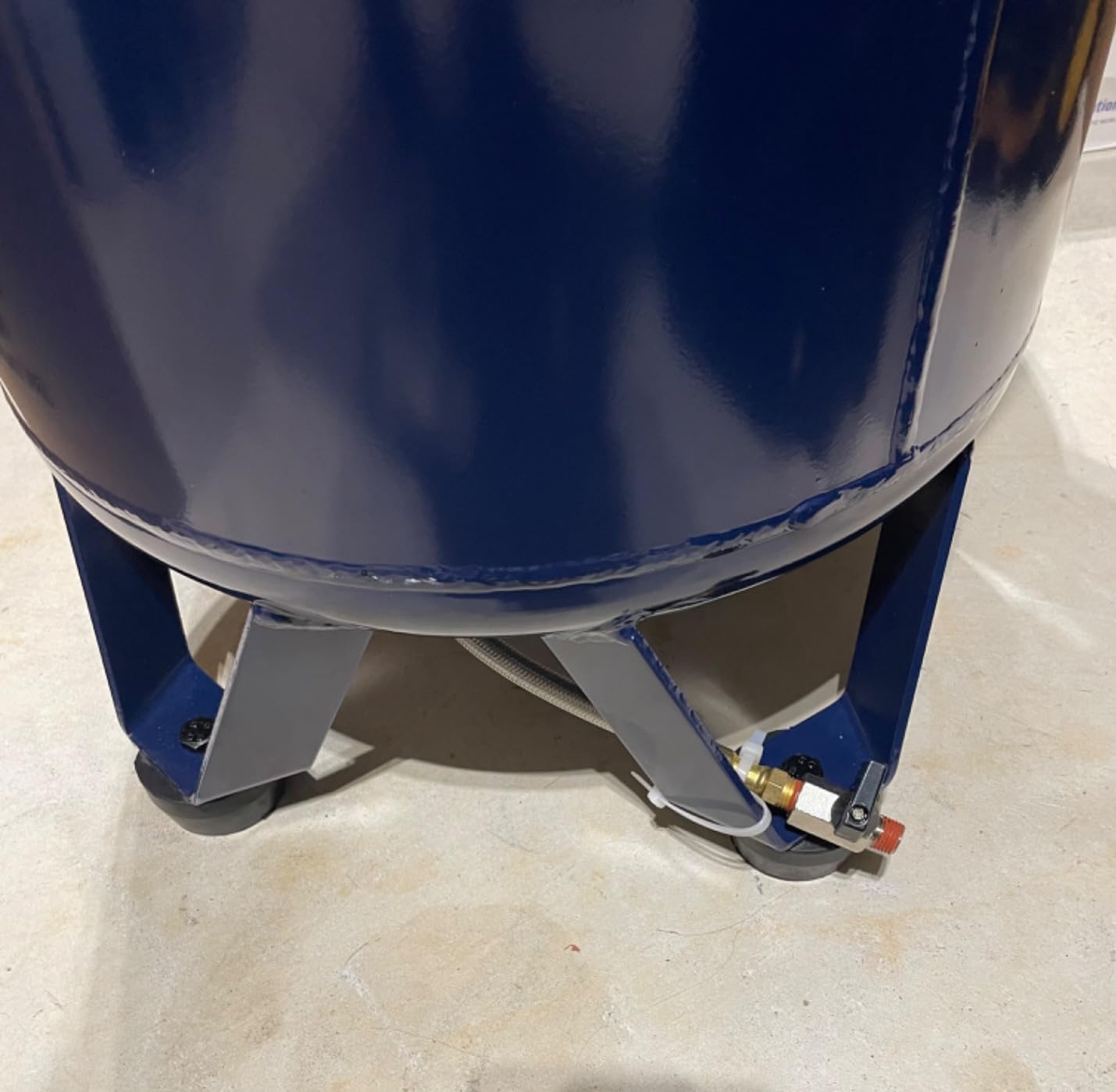
The tank must be tilted roughly 45 degrees to drain properly and the drain is difficult to reach, so build a monthly draining habit into your routine. The three-in-one outlets do not accept some high-flow connector brands, which is a compatibility detail to check before buying fittings.
9. Craftsman 20-Gallon – Best Stainless Steel Tank for Humid Climates
Craftsman Air Compressor, 20 Gallon Oil-Free 1.8 HP Max 175 PSI Pressure Two Quick Couplers Big Capacity, Red- CMXECXA0232043
20 gallon stainless steel tank
4 SCFM at 90 PSI
1.8 HP oil-free, 175 PSI
80 dB, two quick couplers
+ Pros
- Stainless steel tank resists corrosion in humid garages
- Two quick couplers run a wrench and a second tool together
- Oil-free pump means no oil in the delivered air
- Rubber feet and stainless construction hold up in a workshop
– Cons
- 4 SCFM at 90 PSI is below what a three-quarter-inch drive wants
- 80 dB makes it unsuitable for noise-sensitive indoor use
- 6 foot power cord is short for a shop layout
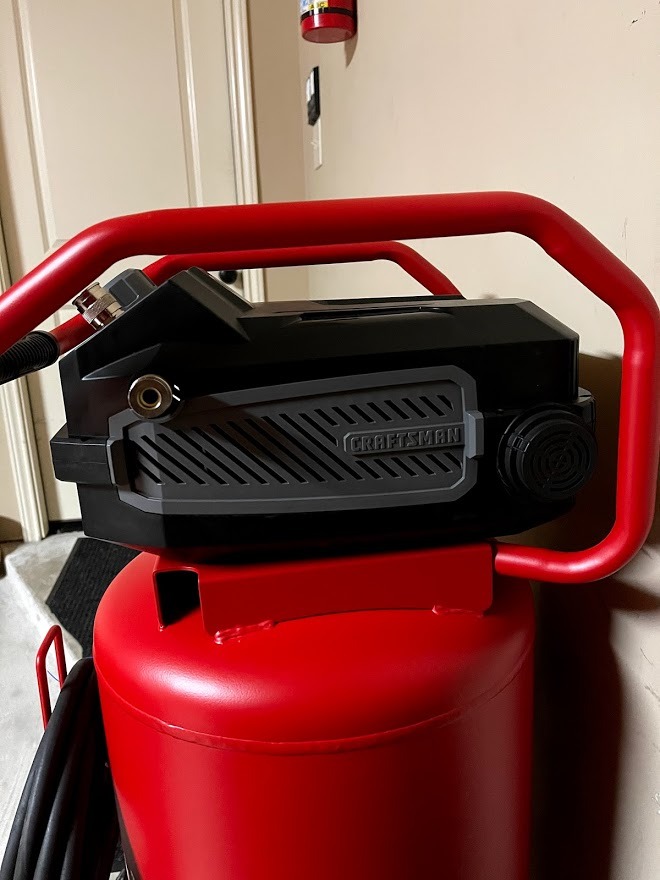
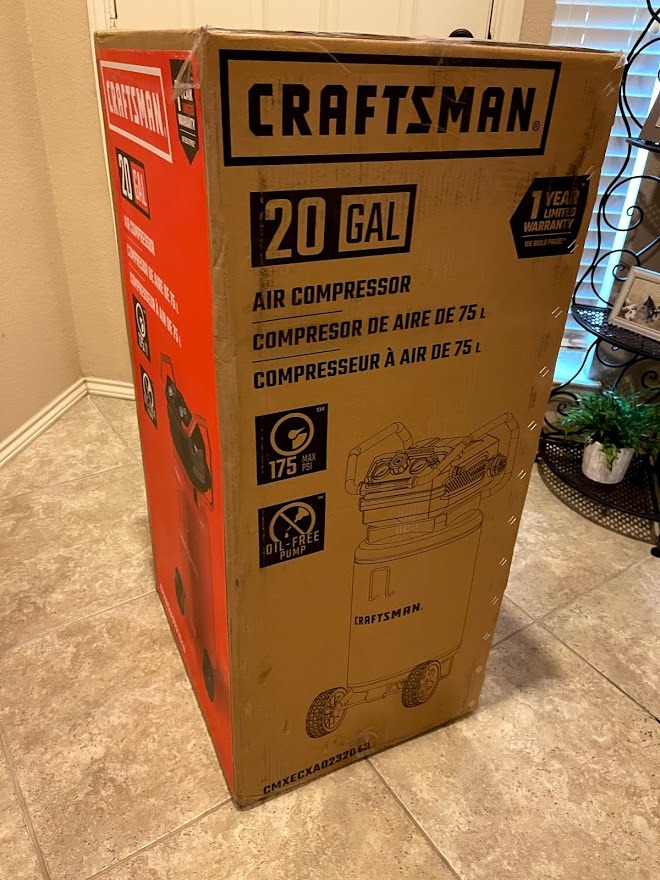
The 20-gallon stainless steel tank is the reason to choose this unit, and in a coastal or humid garage that is not a minor detail. Painted steel tanks pit and rust from the inside out, while stainless resists the condensation cycles that come with a tank being drained regularly, and buyers cite the tank and dual couplers as their actual buying reasons.
At 4 SCFM at 90 PSI with a 1.8 HP motor, the airflow is honest and adequate for half-inch work, with two quick couplers letting an impact wrench and a second pneumatic tool run at the same time. The 175 PSI rating stores close to 18 cubic feet, so recovery time between wrench bursts is short.
Stainless Steel and Moisture Resistance
A compressor tank lives a damp life. Every cycle pulls moisture out of the air, that water collects at the bottom, and a painted steel tank eventually fails from the inside where you cannot see it. A stainless tank buys years in a humid garage or an unheated workshop, which is a durability argument rather than a performance one.
The box includes a ball drain valve and a plastic filter, both of which make the monthly drain habit easier. The oil-free pump adds no oil to the lines, so an inline filter protects the finish on your tools and any surface you blow or spray.
Airflow Against a Three-Quarter-Inch Drive
Four SCFM at 90 PSI is below what most three-quarter-inch impact wrenches want for sustained work, which is the clearest limitation here. Half-inch duty is comfortable, and light three-quarter work on passenger vehicles is workable, but heavy truck wheels will outrun it.
The pairing of a 1.8 HP motor with a 4 SCFM rating is not unusual for this class, and the two quick couplers are the feature that keeps it useful. Running the wrench and an inflator or air hammer together still works within the airflow budget.
What Is in the Box and What to Plan For
Included are a six-foot power cord, ball drain valve, plastic filter, two quick couplers, and two rubber wheels, plus a one-year limited warranty. The six-foot cord is short for most shop layouts, and 80 dB makes it a poor choice for indoor or noise-sensitive use.
This group shows a roughly 10 percent one-star share including early-failure and warranty-service experiences, and the oil-free design is not built for continuous duty cycles. For intermittent garage use, it is a solid, corrosion-resistant platform.
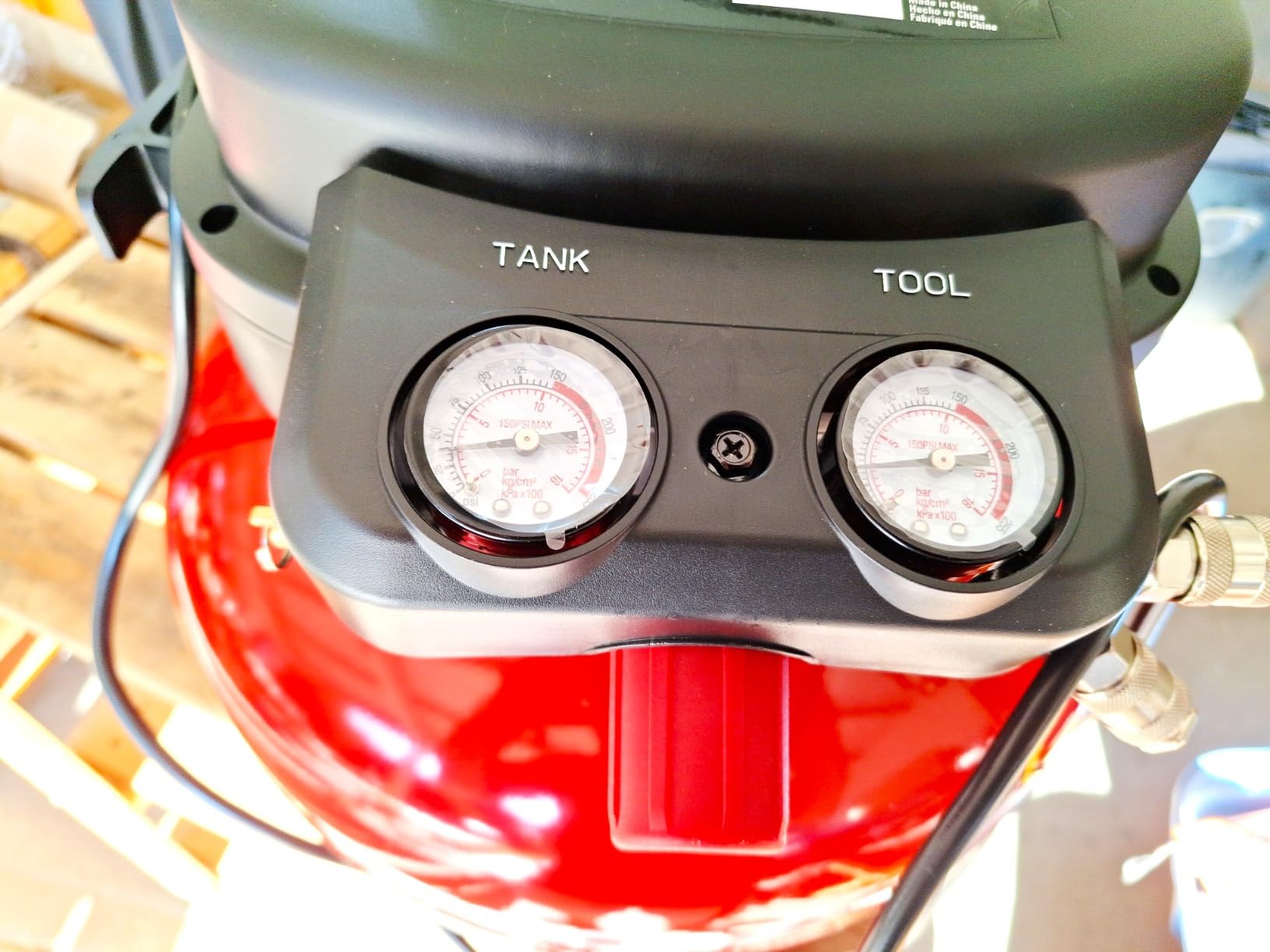
10. ECOMAX 6-Gallon Pancake – Best Rated, Lightest, and Lightest Duty
ECOMAX Air Compressor 6 Gallon 150 PSI Pancake Portable Oil-free Tank with 10 PCS Accessories Kit
3 CFM at 90 PSI
6 gallon tank, 1.5 HP
150 PSI max, 75 dB
34.17 pounds, dual couplers
+ Pros
- Highest average rating in the set at 4.7 stars across 316 reviews
- Dual quick couplers are rare on a small pancake
- Only 34.17 pounds with a flip-up handle
- Hose
- fittings and accessories kit included
– Cons
- 3 CFM at 90 PSI suits short bursts rather than sustained wrenching
- 150 PSI ceiling sits below 175 to 225 PSI competitors
- 6 gallon tank refills often on continuous tool use
This is the best-rated compressor in the group at 4.7 stars with 81 percent five-star ratings and about one percent one-star, and the reason is that owners bought it for a specific job and it does that job well. A quarter-inch impact gun, a ratchet, an air chuck, a caulk gun, and inflation are all comfortable at 3 CFM at 90 PSI.
Dual quick couplers on a pancake this small are genuinely unusual, and the flip-up handle plus 34.17 pound weight make it the easiest machine here to carry to a car, into a trunk, or onto a workbench. A ten-piece accessory kit and a 25-foot hose mean it is usable straight out of the box.
Where 3 CFM at 90 PSI Is Enough
Three CFM is the boundary between short-burst and sustained wrench work. It will break loose a normal lug nut on a passenger car and it will handle a full set of four in a single tank cycle, then wait for the pump on the next wheel.
Owners accept that scale as the trade for a compact, inexpensive package with hose and fittings included. If your work is one wheel, a set of spark plugs, or light assembly, this is a genuinely good tool rather than a disappointment.
Portability and Build Details
At 16.54 by 15.94 by 19.49 inches and 34.17 pounds, it stores in a cabinet and carries in one hand. The oil-free pump has low-voltage and cold-weather start capability, and a cord winding bracket keeps the lead tidy in a vehicle.
Dual gauges give precise pressure reading, which is more instrumentation than most compressors of this size offer. At 75 dB it is workable in a garage but not the quiet class leader.
The Airflow Ceiling You Cannot Outgrow
The 150 PSI ceiling sits below the 175 to 225 PSI competitors, and the marketed maximum power of 180 watts is an unusually low figure for a 1.5 HP claim, which makes the rated CFM worth verifying in your own use. The six-gallon tank refills often on continuous pneumatic use, which is the practical limit to plan around.
Rated best in the set, this still cannot substitute for a compressor sized for high-torque work. Treat it as the portable companion piece rather than the primary machine.
How to Choose an Air Compressor for an Impact Wrench
Start from the rated CFM at 90 PSI, not from tank size or peak horsepower, and every other decision follows from there. Peak horsepower is a marketing number that describes what the motor can draw in a fraction of a second, while CFM at 90 PSI describes what the pump actually delivers while your wrench is running.
Read the 90 PSI Number, Not the 40 PSI Number
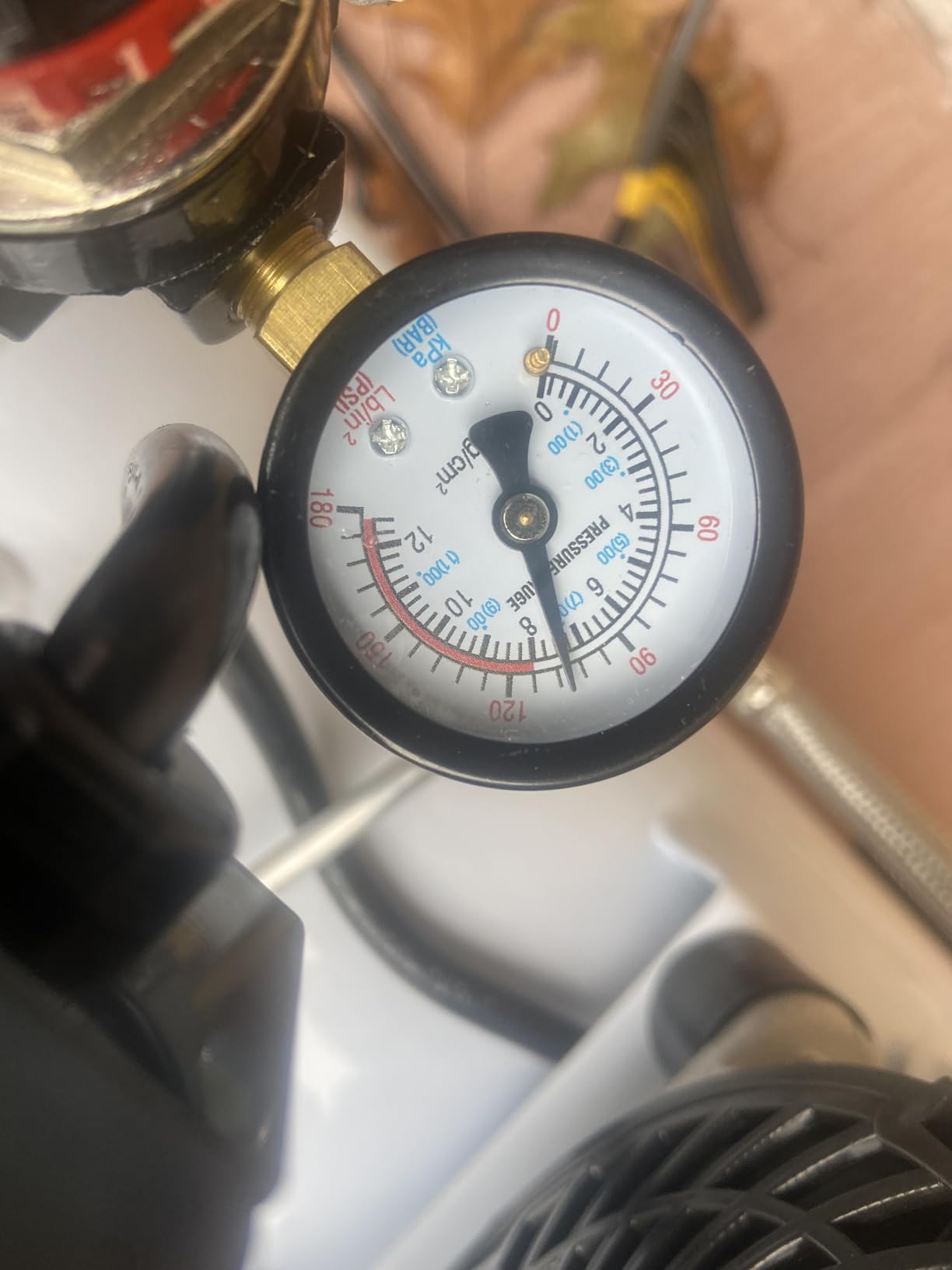
Listings frequently advertise CFM at 40 PSI because that figure is flattering. An impact wrench operating at 90 PSI will see roughly 30 percent less air than the same pump delivers at 40 PSI, so a compressor rated 6.4 CFM at 40 PSI may deliver 5.3 CFM at 90, and one rated 4 CFM at 40 PSI may deliver 2.8.
Every unit in our comparison states its 90 PSI figure for that reason. Also check the drive size you own: a three-quarter-inch gun and a one-inch gun have different air demands, and a compressor sized for a quarter-inch gun is a compressor that will disappoint you later.
Tank Size and Recovery Time for Impact Work
For a single wrench, tank size matters less than most guides suggest, because the tank only decides how many seconds you have between cycles. Free air at a 20 percent safety allowance works out to roughly 6.4 cubic feet per gallon at 90 PSI, so a 20-gallon tank gives about four and a half minutes at 4 CFM while a 6-gallon tank gives barely ninety seconds.
This is why a 20-gallon unit usually beats a 50-gallon unit for impact work. The extra 30 gallons do not raise airflow, they just take a long time to refill, and you end up with a heavy machine that is slower to recover than a sensible one. Size the tank to your session length, not to your ambition.
Oil-Free Versus Oil-Lubricated for Impact Duty
Oil-free pumps need no oil purchases, start in cold weather, and can run at any angle, which is why most compressors in this roundup are oil-free. The trade is duty cycle, since a lightweight oil-free pump heats faster and is generally less suited to running eight hours a day than a cast-iron lubricated pump with a longer service life.
Forum users frequently raise oil mist entering the air lines and contaminating tools or paint as a deal breaker, and for finish work that complaint is legitimate. If you paint in the same garage as you wrench, oil-free is the right call. If you run a shop compressor for a living, accept the oil and drain it properly.
110V Versus 220V and the Circuit Question
Anything at or above about 5 CFM at 90 PSI on a single-stage design starts pushing household circuits, and that is where breaker trips come from. Most compressors in this roundup run at 12 to 15 amps, which a 20 amp circuit will handle only if it is not shared with other heavy loads.
Once you pass roughly 7 CFM, a dedicated 220V circuit becomes the sensible choice for a shop. If a compressor has trouble restarting while the tank still holds pressure, the wiring is undersized, and several owners in this roundup reported exactly that failure mode with heavier units.
Hose Diameter, Couplers, and the Throttling Trap
Use a 3/8 inch internal diameter hose for impact work, and keep runs short. Internal diameter is the number that matters, not the outside diameter printed on the box, and a cheap thin-wall quarter-inch hose can throttle a large wrench enough to make a good compressor look slow. Most impact guns accept a quarter-inch inlet with a reducing adapter, so buy the adapter rather than downsizing the line.
Couplers matter too. A 3-in-1 coupler restricts flow compared with a high-flow coupler, and a swivel coupler on the wrench end prevents the hose from whipping, which reduces wear on the tool inlet. For reference on other tool demands, our shop compressor picks break down airflow needs for spraying and sanding, which demands far more CFM than any wrench.
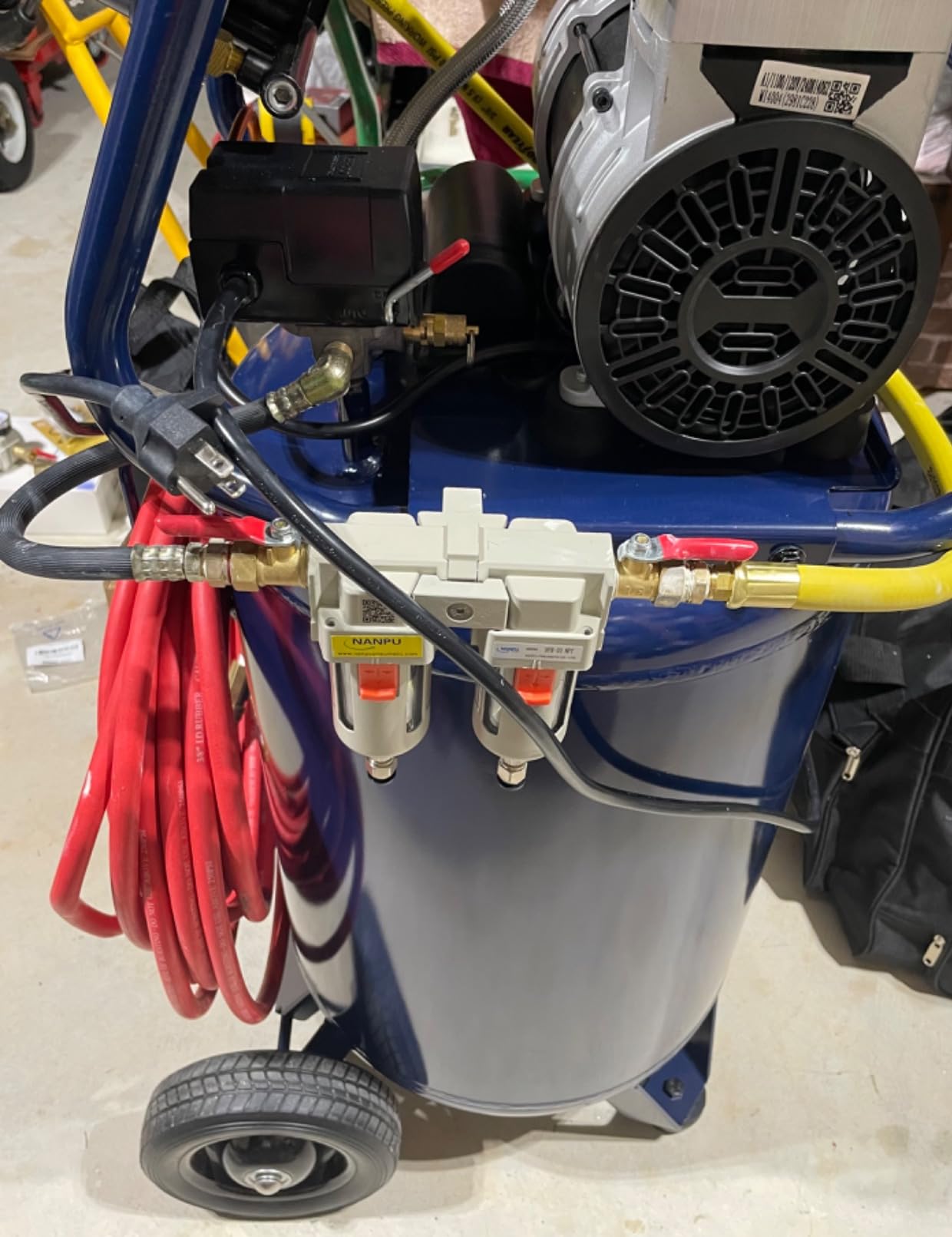
Add a drain valve you can actually reach, a ball valve so you can isolate the tank, and an inline filter or moisture separator before the wrench. Rust and water in the lines cause exactly the corrosion and sluggishness that owners blame on the compressor.
When a Battery Impact Wrench Skips the Compressor Entirely
For a mobile mechanic working from a van, a battery impact wrench removes the compressor, the hose, the fittings, and the recovery wait entirely, and that economic argument comes up constantly in mechanic forums. If your work is one-off fastener tasks scattered across different locations, the math usually favors battery.
Pneumatic still wins on sustained repetitive work, on very high torque in the largest drives, and on total cost over years of daily use. For dedicated shop work, the compressors in this roundup remain the better answer, and our plasma cutter compressor guide covers the far higher airflow tier that heavy fabrication needs.
One more option avoids replacing what you already own. If you have a small pancake, a min-max setup pairing a quiet unit for finish work with a higher-flow unit for lug nuts lets you keep both without spending on a single do-everything machine.
Frequently Asked Questions
How much CFM do I need for an impact wrench?
You need 4 CFM at 90 PSI for a half-inch drive impact wrench, 5 to 6 CFM for a three-quarter-inch drive, and 7 CFM or more for a one-inch drive. A quarter-inch gun needs only 2 to 3 CFM. Multiply the minimum by 1.5 to leave recovery margin.
How many PSI do I need to run an air impact wrench?
Most air impact wrenches are designed to run at 90 PSI, and that is the working pressure you should regulate to. Higher tank pressure ratings do not mean higher tool pressure, because regulators typically cap output well below the tank maximum.
Is a 20 gallon air compressor enough for an impact wrench?
Yes. A 20 gallon tank at 90 PSI stores roughly 18 cubic feet of usable air, which is about 4.5 minutes of continuous half-inch wrench work at 4 CFM. Tank size determines how long you work between cycles, while the pump’s CFM at 90 PSI determines whether the wrench keeps running.
Can a 6 gallon pancake compressor run an impact wrench?
Only for short bursts on a small or light wrench. A 6 gallon pancake rated at 3 to 4 CFM at 90 PSI can break loose normal lug nuts, but it will empty in seconds and leave the tool stalling on anything seized. For sustained half-inch work, target 4.5 CFM at 90 PSI or more.
Do I need an air compressor for an impact wrench?
You need a compressor only if you use a pneumatic wrench. A cordless impact wrench removes the compressor, hose, and fittings entirely, and for scattered one-off jobs or mobile work the economics favor battery. Pneumatic still wins for sustained repetitive use and the highest torque in large drives.
Final Verdict: Which Air Compressor for Impact Wrenches Fits Your Work
If quiet operation and real 90 PSI airflow matter most in your garage, the California Air Tools 10020C is the pick, with 5.3 CFM at 90 PSI and a 70 dBA motor that keeps a half-inch or light three-quarter-inch wrench running. If you need the highest sustained airflow in this roundup for truck and SUV wheel work, the VEVOR 15-gallon at 5.3 CFM rated directly at 90 PSI delivers the most wrench-ready air per cycle.
If you work on a 120V circuit and want a tank that lets you forget the compressor mid-job, the Klutch 20-gallon stores far more air than any portable machine here, while the Craftsman 20-gallon wins where a stainless steel tank matters in a humid garage. For seized fasteners, the DEWALT D55146 with 225 PSI storage and a long service record is the durable answer.
And if the honest answer is that you need less than you think, the Metabo HPT EC914S at 200 PSI and 41 pounds covers half-inch work and finish carpentry in one portable package, while the ECOMAX handles quarter-inch and light jobs at the highest rating in the group. Pick by the CFM at 90 PSI your drive size demands, measure the noise where it will actually sit, and give yourself the 1.5x buffer. Our off-roading compressor picks cover the recovery gear angle if your wrench work happens far from an outlet.
Leave a Reply