
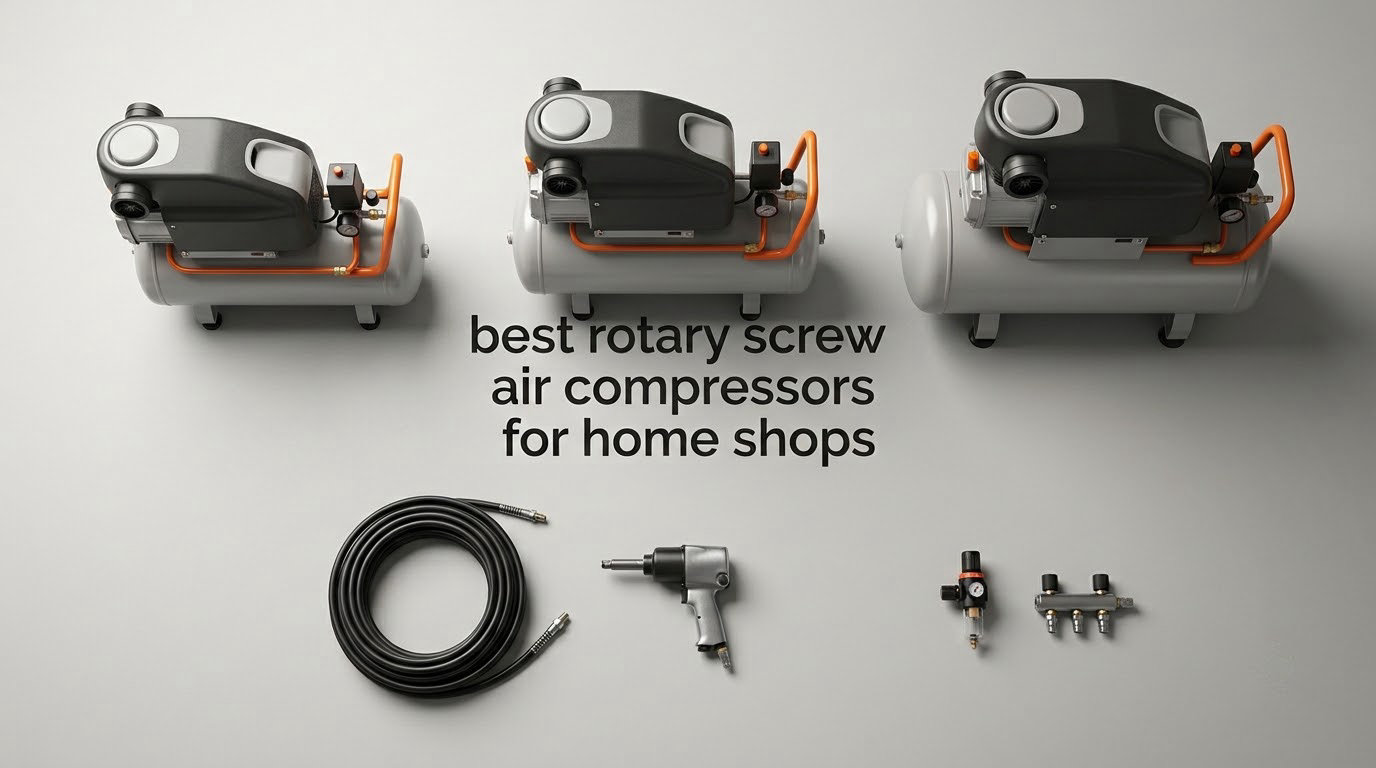
The best rotary screw air compressors for home shops sit in a narrow band of horsepower, airflow, and electrical service that most garages never think about until a piston compressor quits on a Saturday afternoon. We spent weeks reading spec sheets, service documentation, and owner feedback across ten of these units to find the ones that actually fit a residential shop rather than a factory floor.
Here is the short answer. For most home shops, the deciding factor is not horsepower. It is whether your electrical service can feed the machine and whether the airflow matches the tools you actually run.
A 10 HP single-phase screw compressor delivering around 38 CFM will handle two impact wrenches, a finish gun, or a nail gun without stalling. Three-phase units in the same class deliver comparable air but require a 208-240V three-phase circuit that most detached garages do not have.
Rotary screw design matters because of duty cycle. A piston compressor is a 50 percent duty machine by rating. It is designed to rest half the time. A screw compressor is rated for continuous running, so it can hold pressure through a sandblasting session or a weekend of body work without cooking itself.
That continuous rating also changes how you buy one. These machines cost several times what a consumer-grade piston unit costs, so the argument is never about the purchase price alone. The argument is about years of service, serviceability, and how long the airend lasts when you are not fighting thermal cycling every time you pull a trigger.
Throughout this guide I have focused on the details that decide a purchase for a home shop: electrical phase, receiver size, airflow in CFM, maximum working pressure, noise, weight, and how the machine is serviced. I have left out the marketing superlatives that every listing in this category uses and none of them prove.
Our Top 3 Best Rotary Screw Air Compressors for Home Shops (October 2026)
These three stood out after we compared electrical requirements, delivered airflow, receiver capacity, and serviceability across the full list. Each one fills a different gap in a residential shop, so the right pick depends more on your wiring than on the machine itself.


Bilowk 10HP All In One
- 36 CFM at 116 PSI
- 58 gallon tank
- Integrated refrigerated dryer
- 208-230V single-phase
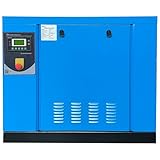
HPDAVV 10HP Base Mount
- 33 CFM at 125 PSI
- Spin-on air oil separator
- 65 dB rating
- Three-phase 230V
The DCYL unit leads because it delivers the most airflow in this group from a single-phase circuit, with casters already mounted for repositioning. The Bilowk is the strongest value for anyone who wants the tank, motor, and dryer in one package rather than three separate purchases. The HPDAVV is the pick for a three-phase shop that wants a spin-on separator and a quieter 65 dB rating.
One caveat on all three: published customer feedback on these listings is thin. Two reviews here, one there, and nothing at all on several others. Specs are verifiable; long-term owner satisfaction is not yet documented, and we treat that gap honestly throughout this guide.
Comparing All Ten Screw Compressors Side by Side
Every unit below is a genuine rotary screw design rather than a piston unit wearing a screw badge. Airflow figures are as published by each manufacturer, which means they are not measured against a single common standard. Treat them as directional numbers and size your receiver around the lower figure.
| Product | Details | Action |
|---|---|---|
|
|
Check Latest Price |
 |
|
Check Latest Price |
 |
|
Check Latest Price |
 |
|
Check Latest Price |
 |
|
Check Latest Price |
 |
|
Check Latest Price |
 |
|
Check Latest Price |
 |
|
Check Latest Price |
|
|
Check Latest Price |
|
|
Check Latest Price |
Three patterns jump out. Only four units run on residential single-phase service. Only two package an integrated dryer. And the published pressure ceilings split into a 116-125 PSI cluster with a single 150 PSI outlier, which matters if you plan to run plasma or high-pressure spray equipment.
1. DCYL 10HP Variable Speed Screw Compressor – Single-Phase Airflow Leader
Variable Speed Rotary Screw Air Compressor 10HP 230V Single Phase 30Gal
10 HP single-phase
38 CFM at 116 PSI
30 gallon tank
60 dB
VSD inverter
+ Pros
- Highest published airflow in this group at 38 CFM from single-phase power
- Variable speed inverter drive with soft start holds steadier pressure
- 60 dB rating suits a residential garage
- Casters mounted on the base for repositioning
- Annual maintenance limited to filter and oil changes
– Cons
- 116 PSI ceiling trails the 125 PSI common elsewhere in this group
- Single-phase only with no conversion path to three-phase
- Only two customer reviews recorded so far
This is the unit we would install in a home shop with ordinary 230V single-phase service and a real workload. A 10 HP screw airend pushing 38 CFM is enough air to run two 1/2 inch impact wrenches at once without the pressure falling off a cliff, which is the failure mode that makes shops reach for a bigger tank instead of a better compressor.
The inverter drive is the part that changes daily experience. A fixed-speed motor cycles between full load and unload, and every cycle is a pressure swing your tools feel. This unit adjusts motor speed in real time to match consumption, which is why the manufacturer lists both soft start and silent operation among its features.
Casters are a small detail that matters more than it sounds. Rotary screw packages are heavy, and being able to roll one out of the way for floor sweeps or vehicle work is worth more than the ten minutes of setup it saves.
Why the 38 CFM Figure Matters More Than the Tank
Receiver size smooths pressure between cycles. Airflow determines whether the compressor can refill faster than your tools consume. A 30-gallon receiver with 38 CFM behind it gives you roughly a minute of reserve at moderate draw, which covers the gap between a compressor cycling and a tool re-filling.
For most home shops the pairing works. The weakness shows up with sandblasting media blasting, where demand can exceed what a single machine delivers no matter how large the tank is. If media blasting is a regular part of your work, plan on a larger packaged unit rather than upsizing the tank.
Variable Speed Drive and What It Does to Your Energy Bill
Fixed-speed compressors draw full power whether the tank is full or empty. Variable speed units throttle the motor to match actual demand, and the savings are largest in a shop where demand is intermittent. A shop that runs air for twenty hours a week in bursts sees a much bigger gain than a shop running near-continuous load.
The trade is control electronics. Repair costs on VSD models tend to run higher than on fixed-speed machines because the drive board is a dedicated component. Over a ten-year ownership horizon this is usually still favorable, but it is worth asking any dealer you work with about drive board replacement pricing before you commit.
Where the 116 PSI Ceiling Bites
Most pneumatic tools are happy between 90 and 125 PSI. The machines in this group that reach 125 give you headroom for equipment that demands it, such as some plasma cutters and spray guns that starve below a certain pressure. This unit tops out at 116 PSI, so check the requirements of anything you plan to hang on the end of the hose.
If your list is impact wrenches, nailers, sanders, and a blow gun, the difference between 116 and 125 PSI will not register. If you are running a plasma cutter regularly, read our guide to air compressors for plasma cutters before you settle on pressure limits.
Single-Phase Limits and the Three-Phase Question
Single-phase is the reason this unit reaches so many home shops. It runs on 208-230V single-phase, which is the same supply that runs a residential electric range. Three-phase requires a service most detached garages simply do not have.
Single-phase is not free of consequences. It draws more current for the same horsepower, so the circuit and wiring need to be properly sized, and the manufacturer is explicit that this configuration cannot be converted to three-phase with a converter. Plan the electrical service before delivery.
2. LRSD 10HP Permanent Magnet VSD Compressor – Smallest Footprint in the Group
LRSD Rotary Screw Air Compressor 230V/1Ph 7.5KW/10HP 125PSI 37.5CFM Variaable Speed Frequency Screw Air Compressor
10 HP 7.5 kW single-phase
37.5 CFM at 125 PSI
29.5 x 21.2 x 32.6 in
213 lb
+ Pros
- Compact 29.5 by 21.2 by 32.6 inch footprint fits tight workshop corners
- 125 PSI ceiling exceeds several competing listings
- Permanent magnet drive trims energy use when full capacity is not needed
- Components arranged for fast filter and oil service
- Touchscreen control with thermal protection
– Cons
- 68 dB noise sits among the higher ratings in this set
- Single-phase only and not convertible to three-phase
- No customer reviews yet so long-term reliability is undocumented
Where the DCYL unit is a general recommendation, this one solves a specific problem: floor space. At 29.5 inches long by 21.2 inches wide by 32.6 inches tall and 213 pounds, it is the smallest complete machine we looked at by a wide margin, and it delivers essentially the same airflow as the leader.
That combination matters in a single-car garage or a basement workshop where a packaged 60-gallon unit simply will not turn a corner. Permanent magnet motors are also lighter than their induction equivalents, which is part of where that weight figure comes from.
The touchscreen and thermal protection are nice touches in a machine you will live with daily. Control panels that report motor temperature give you an early warning when airflow is restricted or ambient heat is climbing, which matters in an unconditioned garage in July.
Permanent Magnet Motors and Where They Earn Their Keep
A permanent magnet motor uses magnets in the rotor instead of relying purely on induced current, which raises efficiency and lets the drive control speed over a wide range. In practice the benefit is the same one described above for any variable speed machine, with a bit more torque at low speed.
The honest downside is repairability. A permanent magnet motor and its drive are generally a matched pair, and replacing one without the other is rarely a simple swap. If you are comfortable working on electronics or have a local shop that is, this is a strong feature set. If not, treat it as a sealed system.
Pressure Headroom at 125 PSI
This unit reaches 125 PSI, which is the more useful ceiling for a general shop. The difference between 116 and 125 PSI becomes obvious on equipment with a minimum operating pressure, and on tools that benefit from higher working pressure such as some spray guns and cutting equipment.
Most air tools will not tell you the difference. Aircraft-style pneumatic, sandblasting, and paint systems tend to care more. Our picks for those jobs are in our plasma cutter compressor guide and our coverage of shop compressors for woodworking.
Noise Placement Matters More Than the Rating
The published rating here is 68 dB. That figure is at the higher end of this group and lands near a sustained conversation level, so placement decides whether it is a nuisance or invisible.
Install it on a pad away from the workbench and outside sleeping quarters, and add a wall or door between it and the rest of the house. A compressor that is 65 or 68 dB in the same room as a desk is genuinely annoying. The same compressor one room away is usually background noise.
What You Give Up Compared With Packaged Units
There is no receiver tank in this package, and no dryer. You are buying a machine, not a system. That is a real advantage if you already own a properly rated ASME receiver, and a real disadvantage if you are starting from an empty garage and want dry air at the tool immediately.
Budget for a tank, a dryer or separator, and the piping between them. Shops that assemble components separately often end up with a better-matched system than an off-the-shelf package, but only if they know which dryer they actually need. An ASME-rated vertical receiver serves double duty in a home shop: it stores air and works as an auxiliary tank when you run multiple tools, smoothing pressure between compressor cycles.
3. HPDMC 7.5HP Dual-Phase Compressor – Runs on Single or Three Phase
HPDMC 5.5KW 7.5HP Rotary Screw Air Compressor 230V/1Ph or 3Ph
7.5 HP 5.5 kW
230V single-phase or three-phase
125 PSI
NPT 3/4 in outlet
IP54
+ Pros
- Runs on either single-phase or three-phase 230V service
- IP54 motor is dust protected and splash resistant
- 1.15 service factor tolerates 15 percent short-term overload
- Class B insulation caps temperature rise at 130C
- 125 PSI with an NPT 3/4 inch discharge outlet
– Cons
- Airflow figure is not published in the listing
- No receiver tank included so one must be paired separately
- No customer reviews yet
Phase flexibility is unusual enough to call out on its own. Most machines in this category lock you into one configuration, and buying the wrong one is an expensive mistake because the electrical requirement cannot be changed after delivery.
A machine that accepts either single-phase or three-phase 230V removes that risk. If your shop is on residential service today, run it single-phase. If you install a three-phase circuit later for a welder or a machine tool, the compressor follows without replacement.
At 7.5 HP this sits in the middle of the horsepower range here, which is the range most home shop operators land in. Larger machines add electrical complexity without adding usefulness unless you regularly run multiple air-hungry tools at once.
IP54 and Class B Insulation in a Working Garage
An IP54 rating means the motor is protected against dust ingress and splash resistance. In a garage with a concrete floor, a workbench grinder throwing metal fines, and a shop vac nearby, that rating is worth having.
Class B insulation limiting temperature rise to 130C is the other quiet specification here. It tells you the motor is designed for a hot ambient environment without derating, which is what keeps a shop compressor running at rated output on a hot afternoon rather than quietly losing CFM.
The Service Factor and What Overload Means
A 1.15 service factor means the motor can absorb a short-term overload up to 15 percent above rated capacity without tripping. That matters with pneumatic loads that spike briefly, such as a die grinder or a cut-off wheel starting under load.
It is not permission to oversize tools against the machine. The service factor covers transients, not a sandblaster running continuously above the compressor rating. Use it as headroom for tool startup, not as additional continuous capacity.
The Missing Airflow Figure
The listing does not publish a CFM rating, which is the single number you need most for sizing. Everything else here, pressure, phase, motor class, outlet size, is stated precisely. That gap means you are sizing this machine on horsepower alone, and horsepower alone is a poor proxy for airflow.
Ask the manufacturer for the airflow at the working pressure you care about before committing. Compare that figure against the 22 to 38 CFM range the rest of this group covers, and make sure it lands where your actual tool load needs it.
Building a System Around a Tankless Machine
No tank is included, so you will be pairing this with a receiver you choose. Think of that as a feature rather than a gap:
Match the receiver to the airflow rather than to the horsepower. A large tank on a low-airflow machine delays pressure loss but does not refill quickly, which is a common source of disappointment when shops buy a big tank to fix a flow problem.
4. HPDMC 5.5HP VSD Package with 60-Gallon ASME Receiver
HPDMC 4KW 5.5HP Rotary Screw Air Compressor 230V/1Ph or 3Ph 19CFM 125psi Variable Speed Drive with 60 Gal Vertical ASME Tank
5.5 HP 4 kW variable speed
19 CFM at 125 PSI
60 gal ASME tank
230V 1Ph or 3Ph
+ Pros
- Bundled 60 gallon ASME vertical receiver rated to 200 PSI
- Variable speed drive follows actual air demand
- 19 CFM suits moderate shop air demand
- Dual single-phase or three-phase operation
- Receiver doubles as auxiliary storage or carry tank
– Cons
- Lowest published airflow of the packaged units at 19 CFM
- Costliest of the HPDMC packages because of the included tank
- No customer reviews yet
This is the entry point into a complete packaged system, and the appeal is simplicity. The compressor, the drive, and a 60-gallon ASME receiver arrive as one unit with a 125 PSI ceiling and dual-phase capability.
That ASME receiver is rated to 200 PSI, well above the compressor working pressure. It is a properly certified vessel, which is the certification to look for on any tank in a home shop, and a vertical format that uses floor area efficiently against a wall.
The manufacturer also describes the receiver as usable as a portable carry tank, which is a practical trick when you want more stored air at a remote work location than your compressor can push through long hose.
What 19 CFM Can and Cannot Do
Nineteen CFM is enough for one air tool at a time plus leak losses. A framing nailer, a finish gun, a small sander, or one impact wrench at a time will run comfortably, and the 60-gallon tank gives it real reserve between cycles.
It is not enough for two impact wrenches, a sandblaster, or a shop where a plasma cutter overlaps with spraying. If you are currently sharing one tool at a time between several pneumatic jobs, this package is designed for exactly that pattern.
Why the Tank Comes First in the Package
Starting shops tend to over-buy tank and under-buy compressor. This package gets the balance closer to right for light-to-moderate duty: 60 gallons of ASME storage with a 5.5 HP variable speed machine feeding it.
That pairing also softens the sting of variable speed economics. The drive spends more time at partial load on a light-duty shop, and partial load is precisely where variable speed saves the most.
Variant Families and Dryer Options
The same product family includes dryer-equipped variants, listed under part numbers that combine the pack with a separator and dryer package. If you plan to run spray equipment or any finish that is sensitive to water in the line, that is the variant worth buying.
Buying the dryer at the same time as the compressor is a good idea because it avoids a second wiring run and a second wall penetration later. It also lets a single installer handle both jobs, which is usually cheaper than scheduling them separately.
Vertical Tank Placement in a Small Garage
Vertical orientation is the right call in tight shops because the footprint is essentially the tank diameter. Stand it against a wall, leave clearance for the compressor intake and cooling discharge, and keep the drain accessible.
Leave room to pull the tank for service. ASME vessels have inspection and cleaning intervals, and a tank shoved into a corner where nobody can reach the bottom fitting eventually gets skipped instead of serviced.
5. HPDMC 7.5HP VSD Package with 60-Gallon ASME Receiver
HPDMC 5.5KW 7.5HP Rotary Screw Air Compressor 230V/1Ph or 3Ph 29CFM 125psi Variable Speed Drive with 60 Gal Vertical ASME Tank
7.5 HP 5.5 kW variable speed
29 CFM at 125 PSI
60 gal ASME tank
230V 1Ph or 3Ph
+ Pros
- 29 CFM at 125 PSI covers several air tools running at once
- 60 gallon ASME vertical receiver rated to 200 PSI
- Variable speed drive reduces draw at partial demand
- Operates on single-phase or three-phase 230V
- Dryer-equipped variants exist in the same package family
– Cons
- Largest tank package here so floor space must be planned
- Costliest package in this set driven by the included receiver
- No customer reviews yet
If you want one answer for a general home shop, this is the configuration we keep coming back to. Twenty-nine CFM at 125 PSI with a 60-gallon ASME receiver and a variable speed drive covers the majority of serious home shop workloads without pushing you into three-phase-only territory.
Compare it to the 5.5 HP package that shares its receiver and you see the trade plainly. Ten more CFM of airflow buys you the ability to run two tools at once, which is the difference between a shop that waits and a shop that works.
Dual-phase operation means the purchase does not hinge on a wiring decision you make before you are ready to make it. That flexibility alone is worth a great deal for a shop that might add three-phase service for other equipment later.
Twenty-Nine CFM Covers the Common Shop Load
Two half-inch impact wrenches, or an impact wrench plus a finish gun, or a nail gun while a sander runs. Those are the loads that make a piston compressor labor and a screw unit glide, and 29 CFM handles them with headroom for leak losses in a typical hose run.
Leak losses are the quietest reason airflow ratings fall short in practice. A single weeping fitting can cost several CFM at working pressure. If your measured demand exceeds the rating, check the lines before concluding the compressor is undersized.
Variable Speed in a Real Workshop Duty Pattern
Home shop demand is rarely steady. It comes in bursts tied to a project: an afternoon of assembly, a weekend of body work, a week of finishing. Variable speed drive matches motor speed to those bursts instead of cycling full power and unloading.
The result is lower average energy draw and less pressure swing at the tool. Both matter in a residential building where compressor noise through shared walls is a real complaint rather than a theoretical concern.
Floor Space and Delivery Planning
A 60-gallon vertical receiver with the compressor mounted on top is a tall, heavy package. Manufacturers commonly ship these skid-mounted, so plan for a forklift or lift gate rather than trying to walk it through a door on casters.
Measure the ceiling height and the doorway before the delivery arrives. It is a routine and entirely avoidable problem, and the fix is a tape measure rather than a return shipment.
Which Variant to Choose
If you are running paint, primer, or clear coat, choose the dryer-equipped variant. Water in a spray line shows up as fish-eye defects, and a refrigerated dryer mounted at the factory is cheaper and tidier than bolting one on later.
If your tools are impact wrenches, nailers, and grinders with no finish work, the base package is the sensible choice and the money goes further into the machine rather than into air treatment you will not use.
6. Masia MA-5 7.5HP VSD Compressor – Highest Pressure Rating in the Group
Masia MA-5 Industrial Air Compressor, 7.5 HP VSD Rotary Screw, 220V Single Phase, 22 CFM, 26 Gal Tank,
7.5 HP permanent magnet VSD
22 CFM
150 PSI max
26 gal tank
220V single-phase
+ Pros
- Runs on standard 220V single-phase with no phase conversion
- 150 PSI is the highest pressure ceiling in this set
- Integrated 26 gallon tank keeps the package self-contained
- Permanent magnet motor with variable speed drive trims energy use
- 65 dB rating suits an indoor shop
– Cons
- 26 gallon tank is the smallest receiver among the tank-equipped models
- 22 CFM is modest for running several large tools at once
- No customer reviews yet
The MA-5 is the outlier on pressure. A 150 PSI maximum working pressure is well above the 116 to 125 PSI band the rest of this group occupies, and that single figure changes which tools you can hang on it.
Higher working pressure matters for spray equipment, some pneumatic regulators with high inlet requirements, cutting tools, and inflating applications where more pressure translates into faster volume delivery. It does nothing for a nail gun or an impact wrench that operates comfortably at 90 PSI.
Buying this machine for pressure alone in a general home shop is a mistake. You would be giving up airflow and receiver size, the two things that affect daily productivity, for headroom on equipment most shops do not own.
Twenty-Two CFM and Twenty-Six Gallons
Twenty-two CFM with an integrated 26-gallon tank is a moderate-duty pairing. It supports a single substantial air user at a time with reserve air behind it, which suits a shop doing body work, brake work, or general repair one tool at a time.
The 26-gallon receiver is the smallest among the tank-equipped machines here. That is not a defect so much as a design trade for a smaller footprint, and it suits a shop where floor area is genuinely constrained.
Permanent Magnet Motor in a Residential Setting
The permanent magnet engine pairs with the variable speed drive for the same efficiency reasons covered earlier. In an attached or residential-adjacent shop, the 65 dB rating is among the more comfortable figures in this group and pairs well with indoor placement.
Single-phase 220V operation means no electrical conversion. This is the most straightforward installation path in the roundup if your shop has standard 220V service available.
Who Should Actually Buy This One
Buy the MA-5 if you run spray equipment that wants more than 125 PSI, or if you plan to grow into equipment that does. The pressure ceiling is real headroom that none of the other units in this roundup offers.
Pass if you run impact wrenches and nailers. For that workload you would be paying for pressure capability you never use while running with less airflow and less reserve air than the leading unit delivers.
7. TEXUS 7.5HP Three-Phase System with Dryer and 80-Gallon Tank
7.5HP/5.5KW 3-Phase Air Compressor, 29 CFM, 116-145 PSI, with 80 Gallon Air Tank, Air Dryer and Filter
7.5 HP 5.5 kW three-phase
29 CFM at 116-145 PSI
80 gal tank
Dryer and 4-stage filter
+ Pros
- Cold dryer and 4-stage filter ship as part of the package
- 80 gallon receiver is the largest in this roundup
- Universal 208 to 240V three-phase input covers common shop services
- Ready to run after power-on with no installation work
- Spin-on oil separator simplifies element changes
– Cons
- Three-phase only so residential single-phase shops cannot use it
- 370 kg weight and 62.2 by 35 by 60 inch footprint demand floor planning
- 68 dB sits toward the higher end of this group
This is the most complete air package in the roundup. Compressor, cold dryer, four-stage filter, and an 80-gallon tank arrive together, and the manufacturer states it is usable after power is connected with no installation work required.
For a shop doing spray work, cabinet finishing, or any job where water in the line ruins the result, the integrated treatment package is the feature that justifies the rest of the configuration. There is nothing to add and nothing to plumb between components.
Four stages of filtration is more than most home shops install on their own. Coarse, fine, and carbon stages handle different contaminants, and having them factory-matched means the sizing is already correct for this compressor.
Three-Phase Is the Dealbreaker or the Reason to Buy
Universal 208 to 240V three-phase input covers most shop services in North America. If your building has three-phase power, this configuration is straightforward and the electrical requirement is not a compromise.
If your shop is on residential single-phase service, this unit is not a candidate. There is no converter path, and converting a compressor designed for three-phase to single-phase halves its output. Any shop considering it needs an electrician to confirm service before the machine ships.
The Eighty-Gallon Receiver and Its Pressure Range
Eighty gallons is the largest receiver in this roundup, and the machine works across a 116 to 145 PSI range rather than sitting at a single ceiling. That spread lets it hold pressure for extended tool use between compressor cycles.
Larger receivers carry a real cost beyond floor space: they take longer to fill and they do not add airflow. The benefit here is reserve air for simultaneous tools and for short bursts where demand briefly exceeds what the compressor delivers.
Weight, Footprint and Getting It Into Position
At 370 kg with a footprint of 62.2 by 35 by 60 inches, this package is heavy and large. It is not a machine you slide across a garage floor after delivery, and it needs a planned location rather than a found one.
Measure the path from the delivery point to the final position, including door clearances and turns. Lift equipment is usually part of the delivery, but confirming it in advance avoids the situation where the package arrives at the curb and cannot reach the garage.
Spin-On Separator and Service Intervals
The spin-on oil-gas separator design is a serviceability choice worth noting. Spin-on elements change the way spin-on engine oil filters do: twist off, swap, twist on. No housing disassembly and no reusable element to keep clean.
That reduces the time a compressor sits idle during maintenance, which matters in a shop where compressed air stops when the machine does. With no tank-separate plumbing to service, annual maintenance stays focused on oil and filters.
8. LRSD 10HP Three-Phase Variable Frequency Unit – Most Airflow
LRSD 10HP Rotary Screw Air Compressor 220V-230V Three Phase 7.5KW 125PSI 37.43CFM Industrial Air Compressor System for Auto Repair Shop, Spray Painting and More.
10 HP 7.5 kW three-phase
37.43 CFM at 125 PSI
35 x 29 x 34 in
420 lb
+ Pros
- 37.43 CFM airflow from a 10 HP three-phase motor
- 125 PSI working pressure matches the upper tier
- Compact 35 by 29 by 34 inch footprint for the horsepower
- Variable frequency motor reduces energy consumption in use
- Texas warehouse distribution with domestic contact support
– Cons
- Three-phase only so residential single-phase shops cannot use it
- 420 pound weight limits repositioning
- No customer reviews yet
This unit delivers more airflow than anything else on three-phase power in this roundup, and it does it from a smaller footprint than most of the packaged alternatives. That combination is unusual and it is the reason to look here first if your shop has three-phase service.
The variable frequency motor is the efficiency story. Shops with steady multi-tool demand run this machine closer to full load, which is where variable speed earns its cost, but the 37.43 CFM figure gives real headroom above typical single-tool consumption.
Stocking from a Texas warehouse with domestic contact support is a practical advantage over units shipped direct from overseas. Parts questions and warranty service go through a domestic channel rather than a long international chain.
Thirty-Seven CFM of Airflow in Real Terms
Thirty-seven CFM is enough to keep several pneumatic tools running without cycling. That covers the shop that alternates between two impact wrenches, a die grinder, and spray work, and it means the machine spends its time at steady output instead of starting and stopping.
It also means the compressor is unlikely to be your limiting factor. In a shop where output feels low, the constraint is usually lines, fittings, or tool demand rather than the machine, and this unit removes one variable from the equation.
Why Three Phase Changes the Ownership Calculation
Three-phase motors are more efficient and cheaper to run per horsepower than single-phase equivalents. For a shop already wired for three-phase, that efficiency is free, and the higher voltage means lower current on the same load.
For a residential shop it is a different story. Installing three-phase service requires a panel change and a proper disconnect, and that electrical work can approach the cost of the compressor itself. Treat this machine as a three-phase-shop purchase, not a general recommendation.
Footprint and Weight Reality
Thirty-five by 29 by 34 inches is a compact box for 37 CFM, but at 420 pounds it is not a machine you reposition casually. Plan its location against a wall with service access before the delivery, not after.
Unlike the tank-mounted packages in this roundup, this is a base-mounted machine that pairs with a receiver you choose. That is an advantage for shops that already own a properly rated tank and want the maximum airflow per square foot of floor area.
Where It Falls Short of the Leader
The single-phase DCYL unit delivers 38 CFM without requiring three-phase service. If your shop is on residential power, that machine is simpler, lighter, and it comes with a receiver and casters already fitted.
This unit earns its place when a shop has three-phase, wants the extra airflow, and prefers to assemble its own receiver and air treatment. For everyone else in this category, the electrical requirement is the deciding factor.
9. Bilowk 10HP All In One Unit – Dryer, Tank and Motor in One Box
Bilowk 10HP Rotary Screw Air Compressor All In One 230V 1 Phase
10 HP 208-230V single-phase
36 CFM at 116 PSI
58 gal tank
Integrated dryer
60 dB
+ Pros
- All-in-one module merges tank compressor and refrigerated dryer with no piping
- Runs on 208 to 230V single-phase which is the common shop supply
- 36 CFM at 116 PSI from a variable-speed inverter motor
- Automatic loading and unloading regulation reduces running cost
- Mobile wheelset and shortened internal piping cut leak points
– Cons
- 116 PSI ceiling trails 125 PSI screw competitors
- 396 pounds is heavy to move despite the wheelset
- Performance is best indoors away from humidity
- Only one customer review on record
The all-in-one concept is the appeal. Tank, screw compressor, and refrigerated dryer are cast as one module with the piping already routed, so you connect the air outlet and the power and you are running. No field piping, no separate dryer to mount, no matching a tank to a machine.
That integration is why the manufacturer describes optimized internal piping that shortens runs and reduces leakage. Every eliminated fitting is a potential leak point removed, and in a compressed air system leaks do not announce themselves. They just quietly consume CFM.
Thirty-six CFM from a 10 HP single-phase machine is a strong output figure, and the 58-gallon receiver gives real reserve air behind it. The variable-speed inverter motor with automatic loading and unloading handles demand changes without cycling the compressor hard.
Why the Refrigerated Dryer Is the Deciding Feature
A refrigerated dryer brings air temperature down until condensation forms, and that water drains away instead of entering your lines. For spray work, cabinet finishing, and anything moisture-sensitive, this is the difference between a good finish and a rework.
Factory integration also means the dryer is correctly sized to this compressor rather than guessed at. Undersized dryers cannot keep up at peak flow, which is a common failure in systems assembled from mismatched parts.
The Wheelset and the 396-Pound Reality
A mobile wheelset sounds like portability. At 396 pounds it is mobility, not portability. The unit rolls to a wall and stays there, and it is easier to move than a skid-mounted package but far from light.
The package dimensions of 55 by 28 by 52 inches tell you it needs a doorway and a floor area. Confirm both before the delivery arrives, since a package this shape rarely goes back through a tight door without a fight.
Indoor Placement Guidance From the Manufacturer
The manufacturer is explicit that the unit performs best indoors and away from humidity, and that outdoor placement requires a roof to protect it from rain and dust. That is practical guidance worth following rather than ignoring.
Humidity affects a refrigerated dryer directly. In a damp environment the unit works harder to reach dew point, the compressor behind it loads up more, and the energy cost of the air you get goes up. A roof and decent ventilation matter here.
The Sixty Decibel Rating and Single-Phase Convenience
The 60 dB rating matches the quietest figures in this roundup, which suits indoor placement in a residential building. Combined with single-phase operation, this is the most residential-friendly complete package we found.
What you give up is pressure ceiling. At 116 PSI it sits below the 125 PSI cluster, so check the minimum inlet pressure of anything you plan to run that is rated above 100 PSI before buying.
10. HPDAVV 10HP Base Mount Unit with Spin-On Separator
Rotary Screw Air Compressor 10HP 125PSI 33CFM 230V 3-Phase
10 HP 7.5 kW three-phase
33 CFM at 125 PSI
65 dB
Spin-on separator
600 lb
+ Pros
- 33 CFM at 125 PSI from a 10 HP three-phase motor
- Spin-on air oil separator with integrated housing speeds element changes
- After-cooler trims discharge temperature alongside the filter
- 65 dB rating is quieter than most machines in this group
- Twelve-month parts warranty with an after-sales service network
– Cons
- 600 pound base-mount unit needs careful floor planning
- Three-phase only so residential single-phase shops cannot use it
- Base-mount design is not portable
- Only two customer reviews on record
This is a base-mounted machine, which means it pairs with a receiver you own or choose. That is a different buying decision from the packaged units, and it suits a shop that already has a properly rated ASME tank in place.
The specification that deserves your attention is the spin-on air oil separator with an integrated element and its own housing. Air that carries oil into your lines contaminates tools, degrades seals, and makes downstream equipment a replacement item rather than a tool.
The integrated housing is what makes it genuinely faster to service. With a conventional separator you open a housing, pull a reusable element, clean it, and reassemble. A spin-on element twists off and a fresh one twists on.
After-Cooler and Why Discharge Temperature Matters
The after-cooler runs downstream of the compressor to pull discharge air temperature down before it reaches your system. Cooler air means less condensation in the lines and more stable downstream equipment behaviour.
Combined with the spin-on separator, the cooling and filtration arrangement is a coherent design. Both components are aimed at protecting what comes downstream, which is where a home shop sees the benefit.
Thirty-Three CFM at 125 PSI on Three Phase
Output sits in the middle of this roundup’s range with a 125 PSI ceiling. It is enough for two air tools at once with reserve air behind them, which covers most workshop workloads short of heavy continuous blasting.
Note the small inconsistency in the published documentation: the specification section lists 35 CFM while the product parameters list 33. The lower figure is the one to size with, and it is worth asking the manufacturer which applies to your model number.
Six Hundred Pounds and a Fixed Footprint
At 600 pounds this is among the heaviest machines in the roundup, and the base-mount design is not portable at all. Its 44 by 29 by 38 inch body needs a permanent home with service access on the panel side.
Base-mount machines are usually skid-mounted for a reason: they are built to be installed on a receiver or a stand and stay there. Planning the position before delivery is the difference between a smooth install and an awkward one.
Service Network and Parts Warranty
The manufacturer provides a twelve-month parts warranty and an after-sales service network. For a category where several brands are newer to the market, a stated parts warranty is a meaningful signal about support continuity.
Before buying any unfamiliar brand, find out where the nearest authorized service point is and how long a parts shipment typically takes. A machine that is down for six weeks waiting on a separator element is a worse investment than one with a slightly different specification sheet.
How to Size a Rotary Screw Air Compressor for Your Home Shop
Sizing starts with airflow and ends with electricity. Get the CFM requirement wrong and no amount of receiver tank will save the workflow. Get the electrical service wrong and the machine never gets turned on.
Step 1: Add Up Your Simultaneous Air Demand
List every pneumatic tool you own with its CFM requirement at working pressure. Then add them up in realistic combinations rather than theoretical ones. Two impact wrenches at once is a real pattern. A nail gun and an impact wrench is another. A plasma cutter while spraying is a third.
Add roughly 10 to 20 percent for leak losses, which accumulate in every shop and are usually underestimated. That total is your sizing figure. Compare it against the CFM ratings in this roundup, which span 19 to 38 CFM.
Step 2: Match Phase to Your Electrical Service
This is the step that decides your shortlist. Residential shops have single-phase service. Commercial and many larger workshop buildings have three-phase. Buying a three-phase machine for a single-phase shop is a return, not a purchase.
Single-phase machines here run 208-230V or 220V. Three-phase machines in this roundup specify 230V three-phase or universal 208-240V three-phase input. Dual-phase units, such as the HPDMC models, remove the risk of choosing wrong.
Single-phase motors draw more current for the same horsepower. Have an electrician size the circuit and confirm the panel has capacity before delivery day, because a compressor that trips its breaker on start is a common and avoidable surprise.
Step 3: Decide Whether You Need Variable Speed Drive
Variable speed drive costs more up front and saves energy at partial load. Shops with steady multi-tool demand benefit less. Shops with bursty project-based demand benefit more, because the machine spends a larger share of its life below full output.
Compare fixed-speed and VSD economics over a ten-year horizon rather than a one-year horizon. Also factor in repair: the drive electronics are a higher-value, higher-cost repair than a fixed-speed motor winding, and that difference shows up in year five rather than year one.
Step 4: Size the Receiver for Peak Demand
Receiver capacity stores air so the compressor has time to catch up between demand peaks. It does not create airflow. In this roundup, receivers range from 26 gallons on the Masia unit to 80 gallons on the TEXUS package, with 30, 58, and 60 gallon options between them.
Match the tank to simultaneous demand. Two tools running at once need more reserve air than one, and a small tank on a multi-tool shop shows up as pressure sag that feels like a weak compressor rather than a small tank.
Step 5: Decide on Oil-Injected Versus Oil-Free
Oil-injected screw compressors inject oil into the compression chamber to cool and seal it. That oil is recovered by the separator, but some carryover is normal and it means air quality is not suitable for applications that cannot tolerate any oil aerosol.
Oil-free designs run without lubricating oil in the air path, which suits food, medical, electronics, and clean-room work. They generally cost more and are harder to find at home shop sizes. For automotive, woodworking, and general workshop work, oil-injected is the sensible default.
Step 6: Check Noise and Placement Together
Noise ratings in this roundup run from 60 dB to 68 dB. The difference is noticeable in a room, and irrelevant through a wall. Placement matters more than the number, so decide where the machine lives before you decide which machine to buy.
Common-sense placement rules apply to every screw unit: solid level base, clearance for cooling intake and hot air discharge, access for filter changes, and a condensate drain that drains somewhere sensible. See our home garage compressor picks for the smaller-tank alternatives that suit lighter duty.
Installation and Maintenance Checklist for a Garage
Rotary screw compressors arrive heavy, hot, and thirsty for power. Planning the install before delivery is the difference between a weekend project and a week of problems.
Electrical Service
Confirm voltage and phase match the machine before it ships. Then have an electrician size the branch circuit, verify panel capacity, and install the disconnect and conductors. Compressor circuits are continuous load, which affects conductor and breaker sizing.
Keep the machine off extension cords and off any shared circuit with saws or welders. Motor starting current is what trips breakers, and a compressor sharing a circuit with a shop saw is a bad arrangement regardless of how the panel is loaded.
Placement, Ventilation and Vibration
Screw compressors need ambient air for cooling intake and hot air exhaust. In an enclosed garage, leaving several feet of clearance on the intake side is not optional. A compressor in a closed room runs hotter, derates output, and ages faster.
Vibration isolation pads under the base reduce transmitted noise through the slab and into the framing. This is cheap, takes minutes, and makes a measurable difference in how the machine sounds next to a workbench.
Air Treatment and Condensate
Run a dryer or separator when spray work, painting, or electronics are on the agenda. Route the drain to a proper disposal point, not onto the garage floor where it leaves mineral deposits and grit.
Verify receiver pressure relief valves and drain valves are accessible and unobstructed before the machine goes into its final position. A relief valve that cannot be inspected is a safety problem, and an automatic drain that cannot be serviced is a maintenance problem.
Maintenance Schedule
Oil changes and filter replacement are the core of screw compressor maintenance, and most manufacturers state annual intervals for both. Check oil level weekly if the machine is not equipped with an automatic system, and inspect the air intake filter more often in a dusty shop.
Schedule air-end service at the manufacturer’s hour interval. A screw airend is a wear component with a known service life, and replacing bearings and gears on schedule is what keeps it from failing on a critical job day.
Frequently Asked Questions
Which brand of rotary screw air compressor is considered the best?
For home shops, brand matters less than configuration. Ingersoll Rand, Quincy, Atlas Copco, and Sullair carry the deepest dealer networks, which is their real advantage when a part is needed quickly. Among the models reviewed here, DCYL leads on single-phase airflow at 38 CFM, Bilowk leads on integrated all-in-one packaging, and HPDAVV pairs a spin-on separator with a 65 dB rating. Judge any brand on local service access and parts turnaround as much as on the specification sheet.
Are rotary screw air compressors better than piston compressors?
Rotary screw compressors are better for continuous or near-continuous use, quieter operation, and longer service life in a home shop. They are rated for 100 percent duty cycle while piston compressors are typically rated at 50 percent. Screw units also run cooler and hold pressure more steadily. Piston compressors remain the better choice for very light intermittent use, where the lower purchase cost of a small consumer unit is hard to justify against.
What size air compressor is good for a home shop?
Most home shops are well served by a 7.5 to 10 HP rotary screw compressor delivering between 22 and 38 CFM, paired with a receiver of 30 to 60 gallons. Add up the CFM of the tools you run simultaneously, then add 10 to 20 percent for line leaks. That total is your sizing figure. Anything above 40 CFM is usually more than a home shop needs unless you run sandblasting or multiple air tools together.
Can I run a rotary screw compressor on single-phase power?
Yes, and for most residential shops it is the deciding factor. The single-phase units in this roundup run on 208-230V or 220V service and deliver between 22 and 38 CFM. Three-phase models deliver comparable airflow but require a service most detached garages do not have. Note that single-phase cannot be converted to three-phase with a converter, so confirm your supply before ordering and have an electrician size the circuit.
Do rotary screw compressors run constantly?
Not constantly. They can run continuously without harm, which is the point, but a variable speed drive still slows the motor to match demand rather than running flat out into a full tank. A fixed-speed model will cycle between load and unload, which is normal and not a fault. Constant run time usually means demand exceeds airflow, or that a receiver, dryer, or line is blocked and starving the machine.
What maintenance does a rotary screw air compressor need?
Core maintenance is oil changes and filter replacement on annual intervals, plus checking the intake filter more often in a dusty shop. Airend service with bearings and gears happens at a specified hour interval, and skipping it is what turns a repairable airend into a replacement. Keep the intake and cooling discharge paths clear, drain condensate properly, and use spin-on separator elements where available since they cut service time.
Which Screw Compressor Fits Your Home Shop
If your shop runs on residential single-phase service, the DCYL 10HP variable speed unit is the pick: it delivers the most airflow in this group at 38 CFM, runs quietly at 60 dB, and comes with casters already fitted for repositioning.
If you want a complete air system with dry air for spray or finishing work, the Bilowk 10HP all-in-one package puts the tank, compressor, and refrigerated dryer in one box with no field piping, and it also runs on single-phase.
If floor space is the binding constraint, the LRSD 10HP permanent magnet unit fits into a 29.5 by 21.2 by 32.6 inch footprint at 213 pounds and still reaches 37.5 CFM at 125 PSI.
If you need more than 125 PSI, the Masia MA-5 is the only machine here rated to 150 PSI, with a 26-gallon integrated tank for a compact footprint.
If you already have three-phase service, the LRSD 10HP variable frequency unit delivers 37.43 CFM from a compact frame, and the HPDAVV base mount pairs a spin-on separator with the quietest three-phase rating here at 65 dB. For a fully packaged three-phase system with air treatment, the TEXUS unit includes a cold dryer, four-stage filter, and an 80-gallon receiver.
Whichever one you choose, confirm the electrical service, measure the delivery path and final position, and plan the filter and oil schedule before the first week of use. The best rotary screw air compressors for home shops are the ones that match your wiring, your tools, and your floor, and getting those three right before the purchase is the entire decision. Our broader picks for plasma cutting equipment and portable off-roading compressors cover the cases where a stationary screw unit is not the right answer.
Leave a Reply