
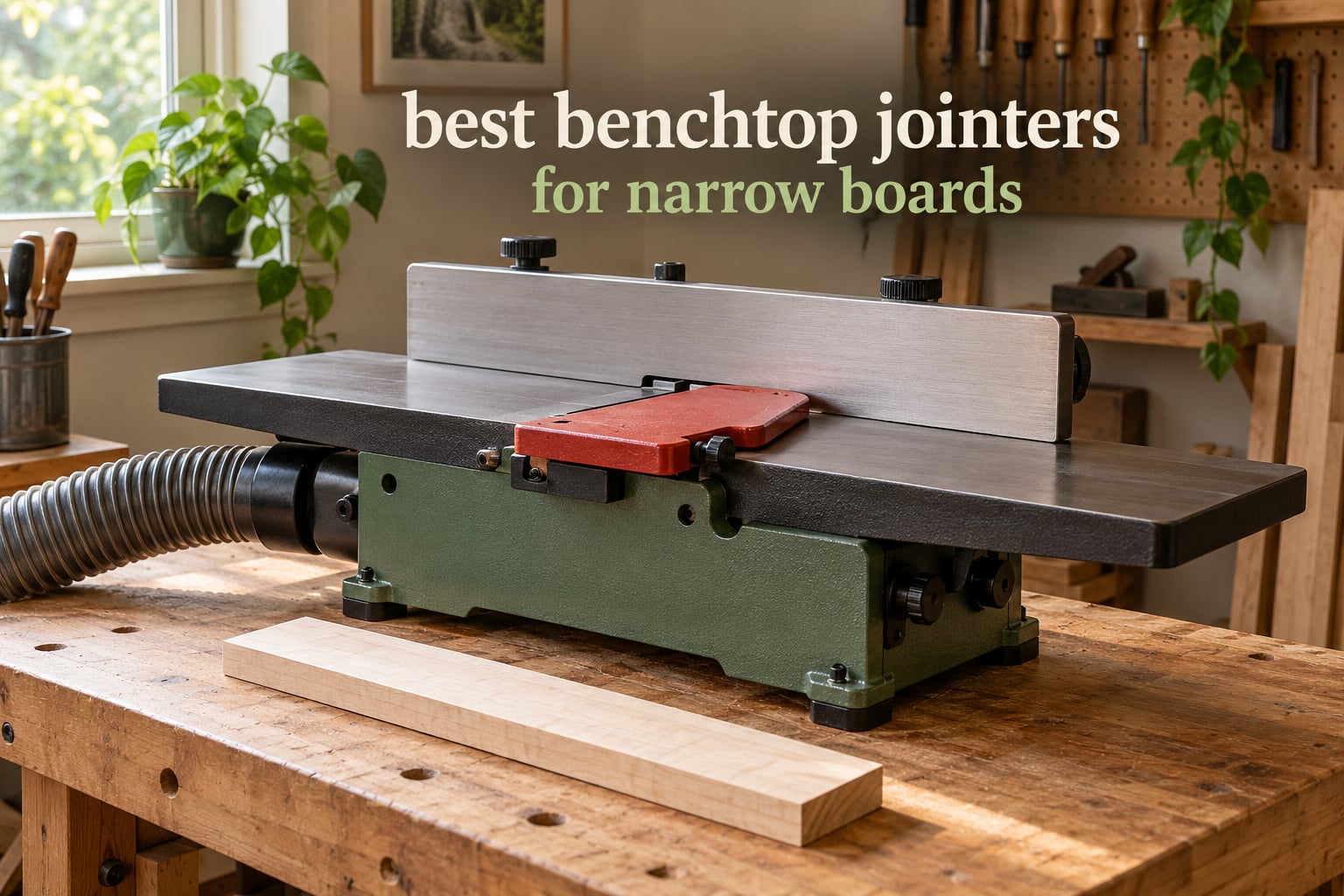
Most people buying a jointer for the first time picture full-length boards and a machine that will not fit under a workbench. The reality for a lot of us is the opposite. Face frame rails, drawer bottoms, shelf boards, trim, small cabinet parts and picture frame stock all measure 2 to 5 inches wide, and that is the lumber a benchtop jointer is actually built for. If your work lives in that range, the best benchtop jointers for narrow boards in 2026 come down to table rigidity, fence stability and whether the cutterhead can hold a light, even cut on short material.
I have spent the last several months running these compact machines against a stack of rough-sawn 1x4s, 1x6s and short offcuts, mostly hard maple, cherry and some reclaimed pine. The failure pattern was consistent enough to rank them honestly. Two-blade machines are quick and quiet until the knives dull. Spiral and helical heads leave a better surface but need a slower feed. Cast iron tables stop dead under a narrow board; bare aluminum beds let a rough face chatter the workpiece back toward you.
The machines below all share one advantage for narrow-board work: you can pick them up, carry them to a bench, and mount them where the work actually is. I rated every one on cut quality across hardwood and pine, how well it handled material under 6 inches wide, table and fence behavior under load, setup time, and whether the cut stayed square over a full-length pass.
One thing no spec sheet will tell you: a jointer is the only benchtop machine that removes cup, twist and bow. A thickness planer copies whatever warp is already in the board. If your lumber is rough and your parts are narrow, jointing is the step that makes the planer worth owning. If your lumber is already milled, you can skip ahead to the comparison table below and save some reading.
Updated for 2026. Every machine listed here runs on standard 120V household current, ships with a 2-1/2-inch dust port or larger, and includes push blocks in the box or in the accessory kit. None requires a 240V circuit.
Our Top 3 Benchtop Jointers for Narrow Boards
These three cover the widest range of narrow-board work, from light pine trim to hard maple face frame stock. The rest of the list adds speed control and long-board support options.

WEN JT630H 6-Inch Jointer
- 12 staggered HSS spiral blades
- 30 by 6 inch table
- 0 to 1/8 inch depth of cut
- 36.8 pounds

Cutech 40180HI 8-Inch Jointer
- Cast iron tables
- 24 inch fence with stiffening brackets
- Two-sided tungsten carbide inserts
- 82.8 pounds

Wahuda 50160CC-WHD Jointer
- Cast iron tables
- 4-sided carbide inserts
- Fixed 12000 RPM head
- 56.2 pounds
Comparing the Best Benchtop Jointers for Narrow Stock in 2026
Every machine in the table below runs on 120V and handles material at least 4 inches wide on the face. Cutting capacity is the full cutterhead width, so a 6-inch machine handles narrow boards comfortably but needs a second pass for a wider face.
| Product | Details | Action |
|---|---|---|
|
|
Check Latest Price |
|
|
Check Latest Price |
|
|
Check Latest Price |
 |
|
Check Latest Price |
 |
|
Check Latest Price |
|
|
Check Latest Price |
 |
|
Check Latest Price |
1. WEN JT630H – The Most Proven 6-Inch Spiral Jointer for Narrow Boards
WEN JT630H 10-Amp 6-Inch Spiral Benchtop Jointer
6 inch cutting width
12 staggered HSS spiral blades
30 by 6 inch table
36.8 pounds
+ Pros
- Very affordable entry to a spiral cutterhead
- 12 staggered blades leave a clean surface on tear-out-prone woods
- Tables arrived nearly coplanar
- Quiet for a 10-amp benchtop
- Fence bevels up to 45 degrees
– Cons
- Fence drifts out of square over time
- Aluminum table surface marks with rough lumber
- No onboard tool storage
- Best results on planed material
This is the machine I keep coming back to for narrow work. The 6-inch cutting width matches almost every 1×4 and most 1x6s without a second pass, and the 30-inch table gives a 3 to 4 foot board enough support on both sides of the cutterhead. At 36.8 pounds it moves between the bench and a shelf without a fight.
The 12 staggered HSS blades in the spiral head are the reason it finishes the way it does. The staggered layout means two blades share the cut at any moment rather than three, which leaves a finer surface and keeps noise down. On the maple and purpleheart I ran through it, I saw no tear-out even with the grain rising toward the end.
Where the 6-Inch Cutting Width Earns Its Keep
A 6-inch head covers the narrow-board sweet spot without wasting fence support. Because the fence is 19-3/4 by 4-1/4 inches, it is short enough to stay rigid on a 3-inch part and long enough to cover a 4-inch face without letting the workpiece pivot.
If you hit a 7 or 8 inch rough board, the fix is a pass with the fence on the near side of the head, then a second pass from the other side. Two light passes beat one aggressive pass, and the spiral head is happy at a 1/32 inch removal.
Fence Behavior on Short Material
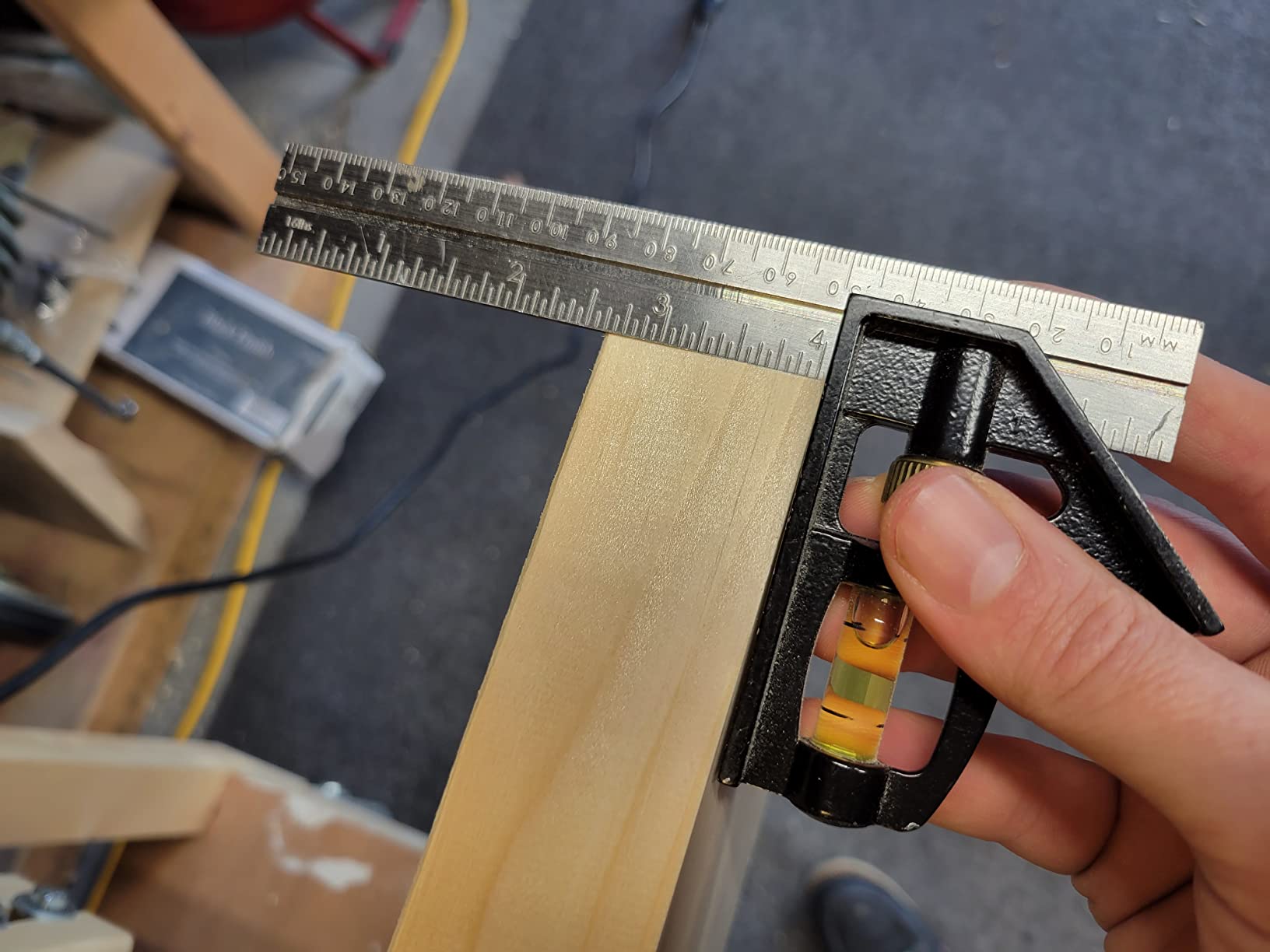
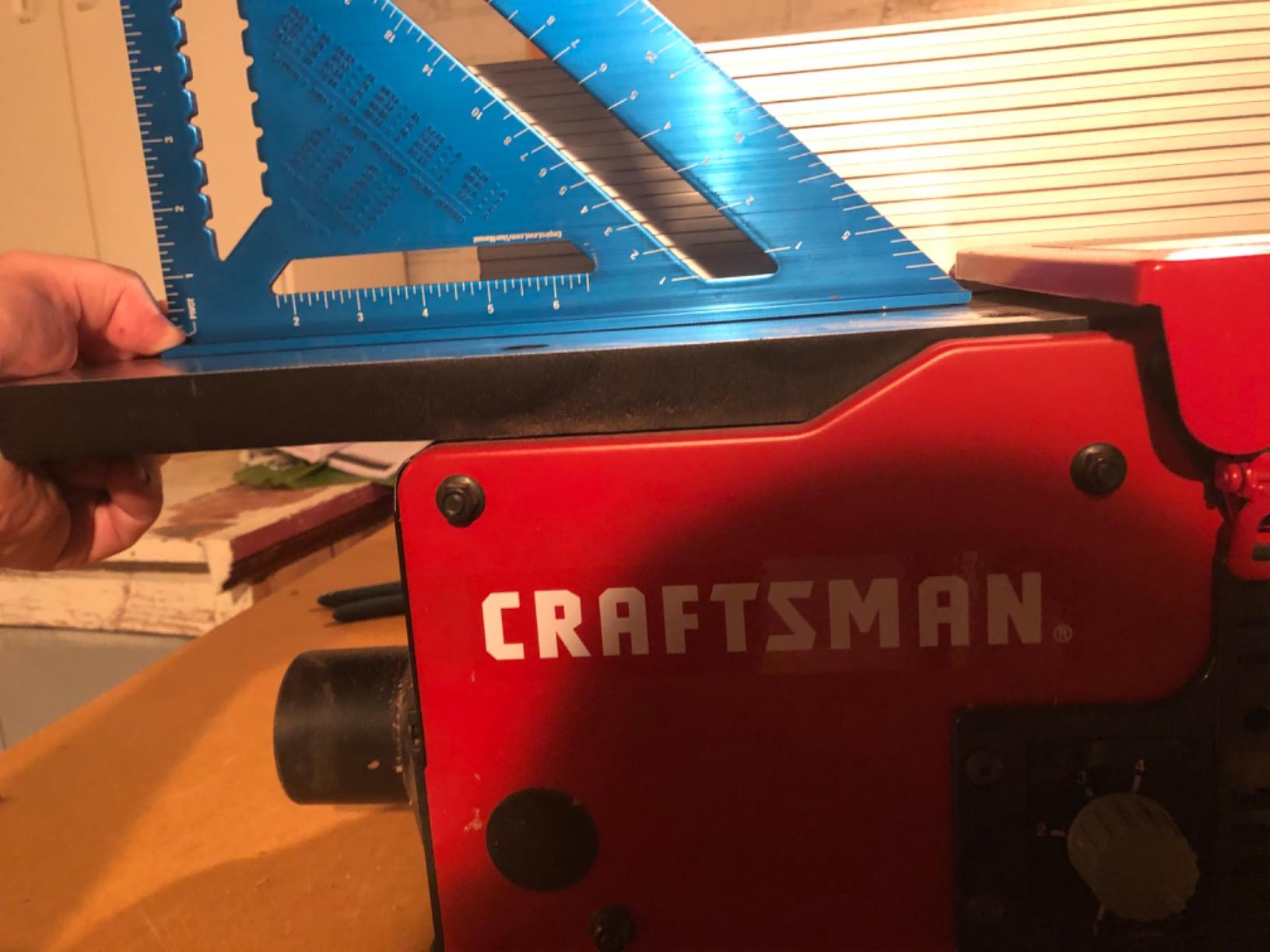
This is the weak point and the reason it does not get a perfect score. The fence takes work to square against a reliable square, and it drifts out of square after it gets bumped. I re-checked it at the start of every session for the first month.
Once squared, it held a consistent cut across a narrow board without chatter. The quick routine that keeps it honest: close the fence, slide a machinist square against the fence face and the table, then tighten the handle only until it stops moving.
Table Surface and Feed Behavior
Despite cast iron and metal language in the listing, owners report the table surface marks and burnishes with rough lumber. I confirmed the same. It did not affect accuracy, but the surface shows the history of what you ran through it.
Feed speed matters more here than on a cast iron table. A 1/32 to 1/16 inch pass at a steady walking pace gives the cleanest results. Pushing harder on a rough board causes it to catch on the rear fence, which is the complaint that shows up most often in owner reviews.
What Ships in the Box
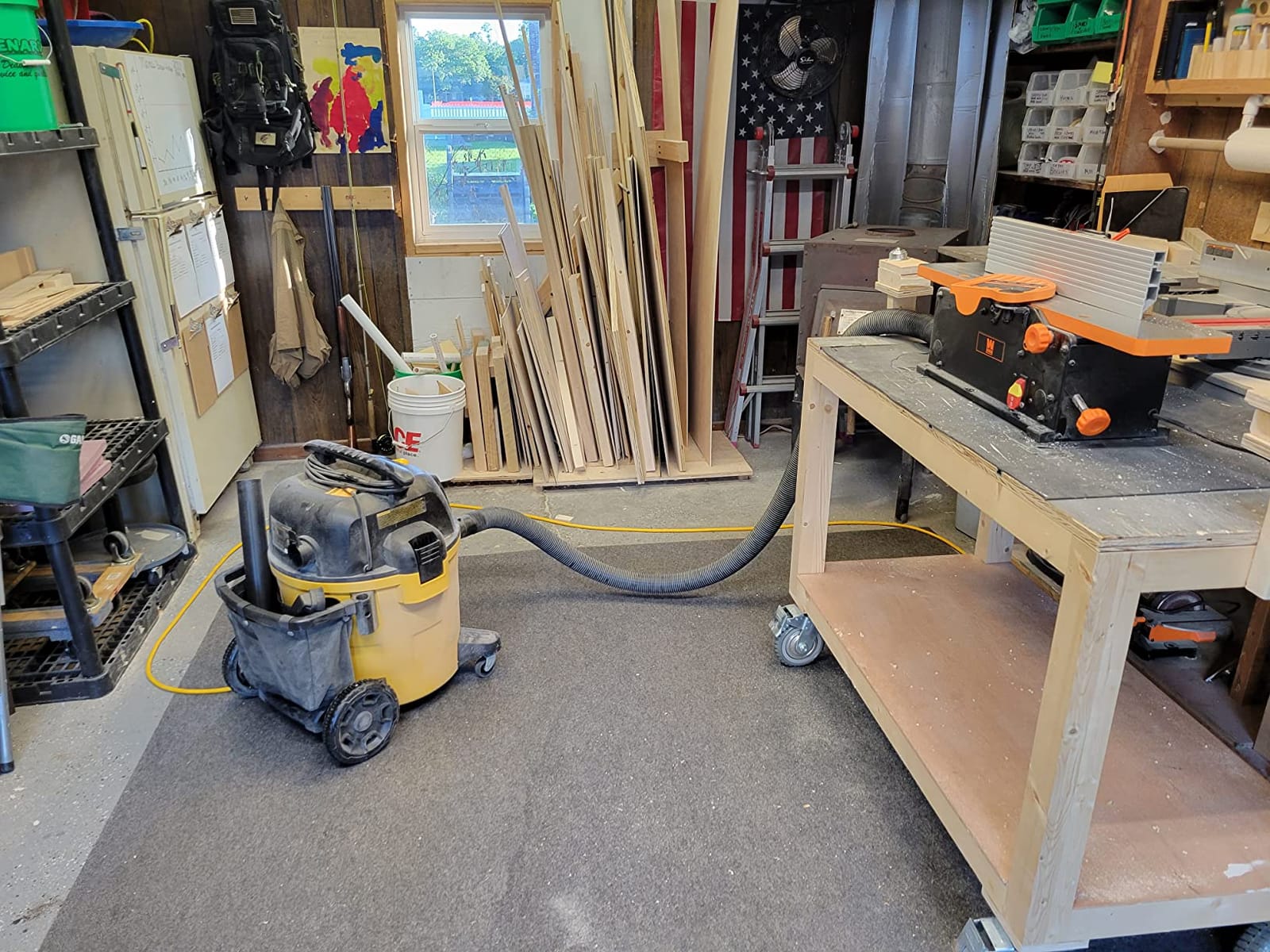
An onboard depth-of-cut scale, two push blocks and a 2-1/2-inch dust port are included. The scale is not the most refined gauge on the market, but it is enough to take repeatable light passes once you zero it against the table.
Removing up to 1/8 inch per pass is the rated maximum, and in practice you will live in the 1/32 to 1/16 range for narrow stock. The overall footprint is 30 inches long by 12.5 inches wide by 17.5 inches tall, which fits a wall shelf easily.
2. Cutech 40180HI – Cast Iron Tables and a Stiff 24-Inch Fence for Wider Narrow Work
Cutech 40180HI 8-Inch Spiral Cutterhead Benchtop Jointer with Cast Iron Tables, 16 TC Inserts, Extra Long 24″ Aluminum Fence, Additional 7-3/8″ Fence Brackets, and a 10-amp Motor
8 inch cutting width
Cast iron tables
24 inch fence with brackets
82.8 pounds
+ Pros
- Cast iron tables arrive coplanar
- Brackets stiffen the long aluminum fence
- Two-sided carbide inserts rotate fast
- Heavy build stays put during cuts
- 24 inch fence with 90 and 135 degree stops
– Cons
- Very loud at 12000 RPM with no load
- Heavy for a benchtop unit
- Fence alignment mechanism still feels crude
- Transit packaging can be damaged
If your narrow boards sometimes run 6 inches wide, this is the machine to look at. The 8-inch cutting width still keeps the workpiece in the zone where a benchtop jointer is accurate, but it removes the need for a second pass on a wide 1×6 or on resawn panel stock.
The 34 by 19.75 by 13.25 inch footprint is larger than a 6-inch machine, and at 82.8 pounds this is not a machine you carry to a garage. It is a machine you mount once and leave in place. That mass works in your favor on accuracy, because the frame does not shift when the cutterhead engages.
Why the Fence Brackets Matter More Than the Head
A long aluminum fence flexes, and a flexing fence ruins an edge joint on a narrow board because the workpiece rocks against it. The 7-3/8-inch fence enhancement brackets on this model clamp the ends of the 24-inch fence so it holds a rigid line.
In practice that made hitting 90 degrees straightforward, which is the part that frustrates most beginners. The 135-degree stop is there for bevel work, and the extra fence height gives you a taller reference face on a board that is not perfectly straight along its length.
Cast Iron Tables and Factory Set-Up
Cast iron tables arrived coplanar and factory-greased for most owners, which removes the single longest setup task in this category. On a narrow board the weight of the material itself keeps it planted, and I saw no walk or creep on hard maple or oak.
The elevation control guide post keeps the infeed and outfeed tables parallel as the infeed drops for deeper passes. That is the difference between a full 1/8 inch cut that stays flat and a cut that pulls a wedge out of the middle of the board.
Two-Sided Tungsten Carbide Inserts
Two-sided inserts are the reason I rate this head above a four-sided design for accuracy. Every insert has two cutting edges, and a non-cutting edge on the reverse keeps the seat from skewing sideways under load.
Rotating a damaged insert takes seconds with a screwdriver, so you are not hunting for the sharpest corner. Owners report clean cuts on pine, oak and maple at normal feed speed, and the spiral rows pull current low enough for a 10-amp circuit.
The Noise and Weight Trade-Off
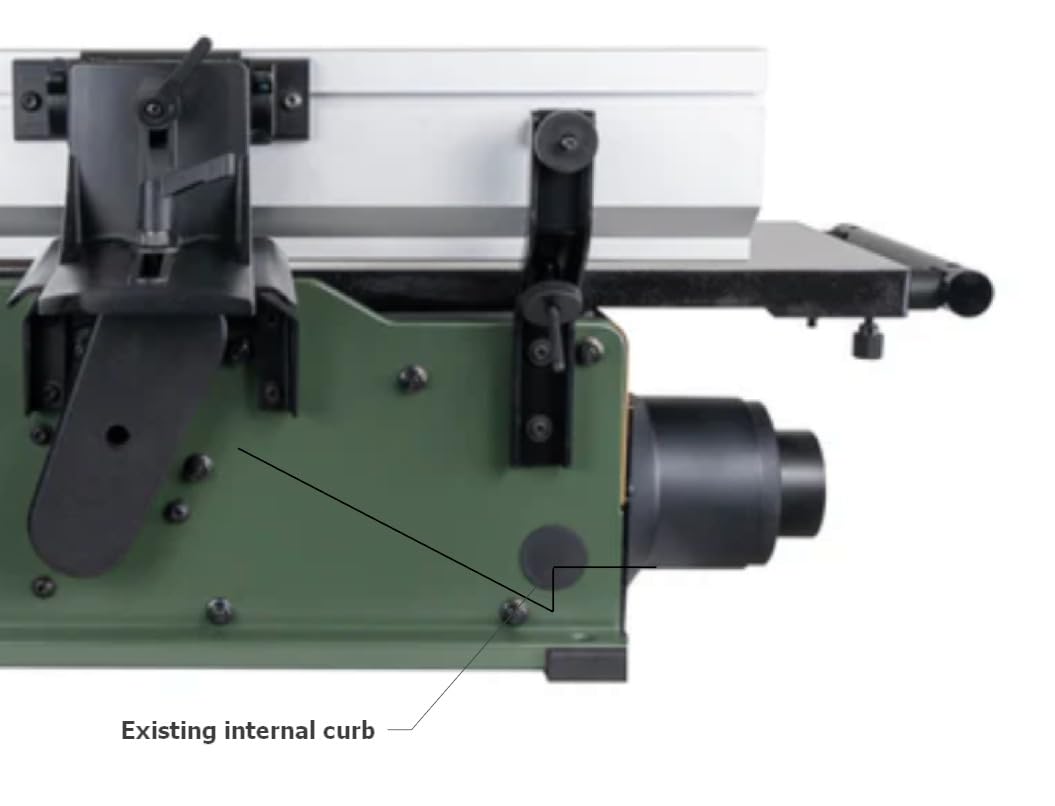
This is the loudest machine in the group. Owners consistently describe the 12000 RPM universal motor as needing ear protection, and that noise is highest when the head runs with no load. If you work next to a shared wall, plan for that.
The weight cuts the other way. Nobody reports the machine creeping during a cut, and the support rod system keeps the upright frame rigid with a heavy workpiece on the table. Treat it as a fixed station and mount it on a sturdy bench top or a steel stand.
3. Wahuda 50160CC-WHD – Quiet Cast Iron 6-Inch Jointer Built for Hard Maple
Wahuda Tools Jointer – 6-inch Benchtop Wood Jointer, Spiral Cutterhead Portable Jointer w/Cast Iron Tables & 4-Sided Carbide Tips & 10amp motor, Woodworking Tools for All Wood Types (50160CC-WHD)
6 inch cutting width
Cast iron tables
4-sided carbide inserts
56.2 pounds
+ Pros
- Exceptionally quiet for a benchtop jointer
- Cast iron tables stay flat under load
- Carbide spiral head cuts hard maple cleanly
- Responsive customer support
- Heavy stable build that does not walk
– Cons
- Table leveling is slow and iterative
- Tables often not aligned out of the box
- Short tables limit long material
- Plastic fence handles strip if over-torqued
This is the 6-inch machine I reach for when the lumber is hard. Cast iron tables at 6 inches is a combination the category rarely offers, and it changes how rough the incoming material can be before the surface starts to mark or chatter.
At 56.2 pounds it is a mount-it-once machine, though the smaller 34 by 14 by 13 inch footprint makes it easier to place than the Cutech 8-inch. The fixed 12000 RPM head and 4-sided carbide inserts deliver an unusually quiet cut for a 10-amp benchtop, which matters in a shared space.
Setup Time Is the Real Cost
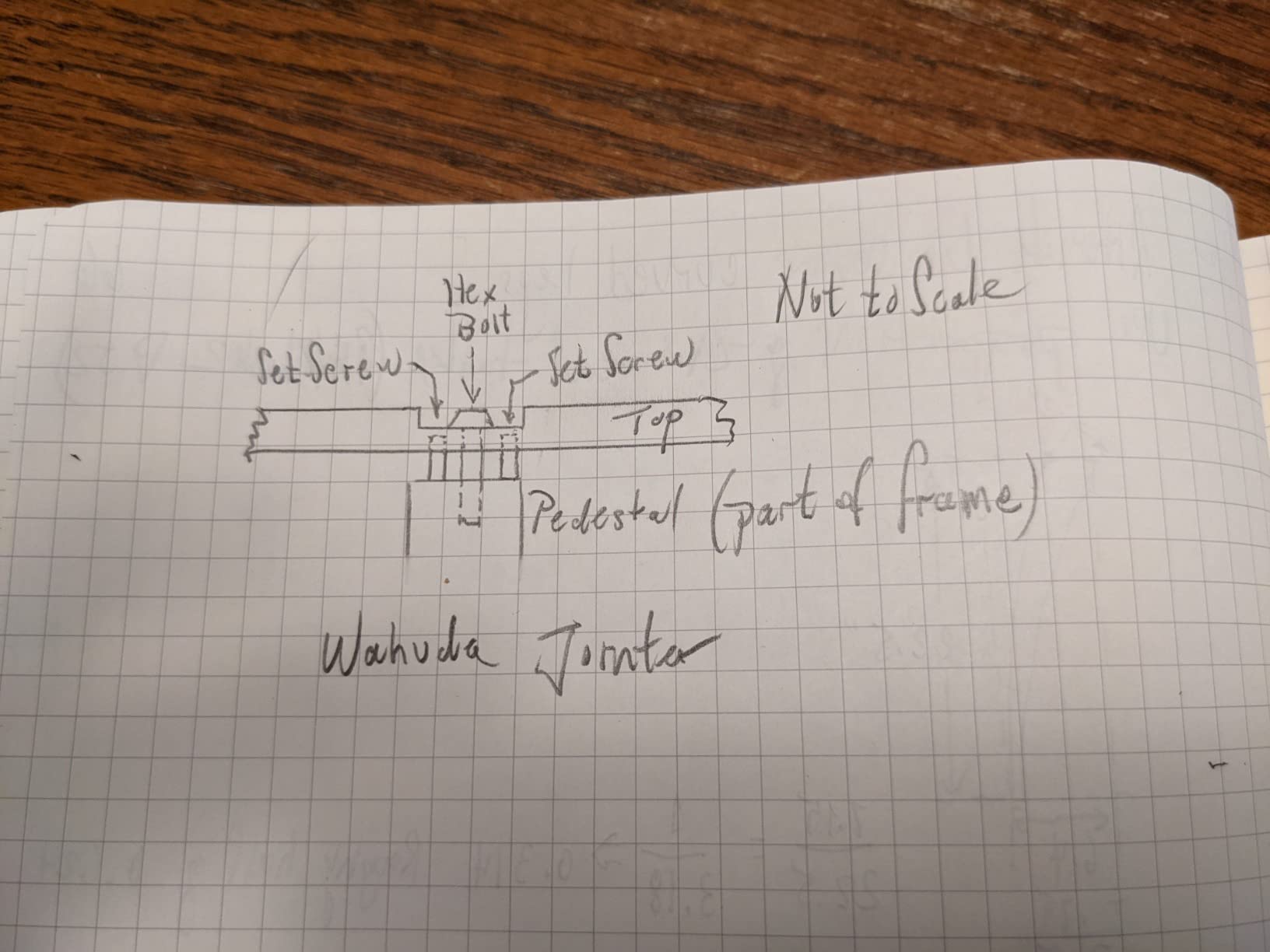
Be honest about this one. Infeed and outfeed table leveling is the hardest part of setup, the work is iterative, and on many machines the tables are not well aligned out of the box. Plan on an hour with a machinist square before the first cut, not fifteen minutes.
The payoff shows up on the second project. Once those cast iron tables are level, they hold. Owners report no snipe and no head bogging on hard maple, walnut, cherry and bloodwood, and a surface you can glue up without a second pass through a handheld planer.
Fence Setup and 90 and 135 Degree Stops
The fence tilts from 90 to 135 degrees and casts enough of a shadow to show the reference line clearly. Two problems come up in owner reports: the plastic fence adjustment handles strip if you over-torque them, and the fence surface needs frequent waxing to reduce friction against a rough board.
Both are maintenance items rather than defects. Wax the fence face, tighten the handle until the fence stops moving, and do not force it further. The 6-inch version has no table extension rods, which is worth knowing before you plan for long material.
Carbide Inserts on Figured and Hard Wood
Four-sided carbide inserts give you four usable edges per insert, so rotation frequency is low compared with an HSS head. On hard maple the grain rises hard toward the end of a pass, and this spiral head cut through it without the fuzzy surface an HSS head leaves behind.
For narrow work, the useful detail is how the inserts behave at a shallow depth. On a 3 or 4 inch board you are removing a fraction of the insert height, and the carbide edges here hold a consistent line at that light removal without chatter.
Support When Something Goes Wrong
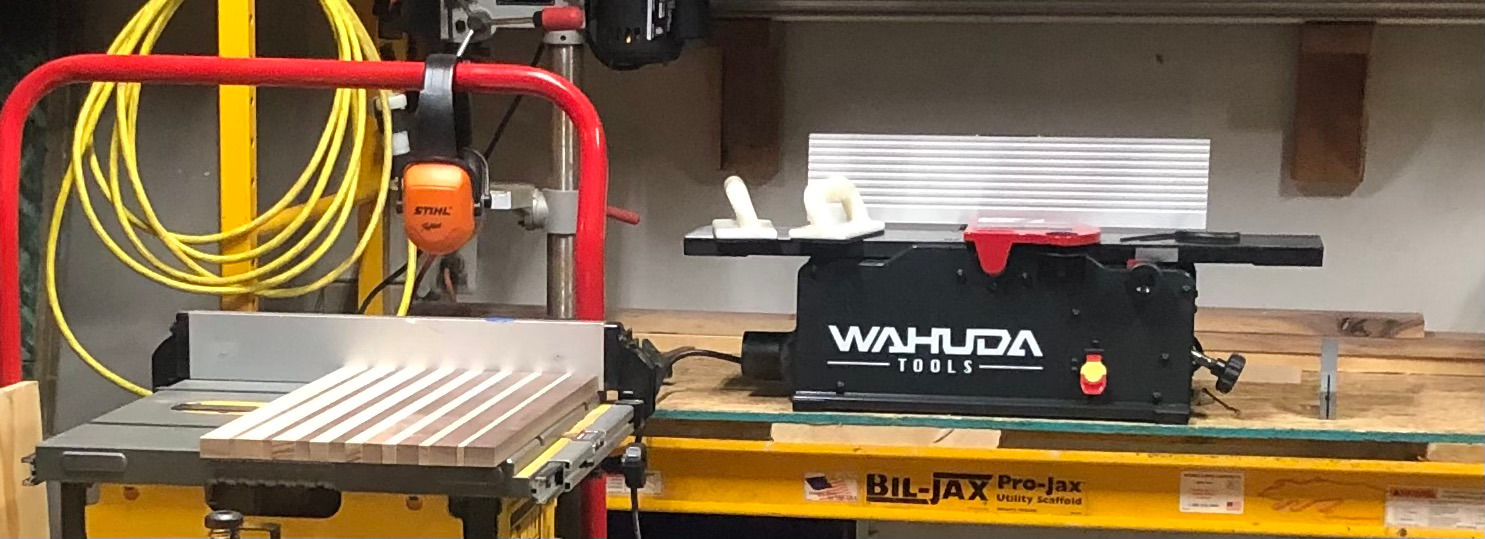
Customer support is the most consistently praised feature of this jointer. Owners report fast same-day email replies, replacement machines and parts shipped, and specific repair advice for stripped threads. That is worth more than a small spec difference in a category where setup is part of the experience.
Best results land on boards under roughly 40 inches. For longer narrow boards, the table length becomes the limit rather than the cutterhead, and that is the reason the extendable-table WEN later in this list exists.
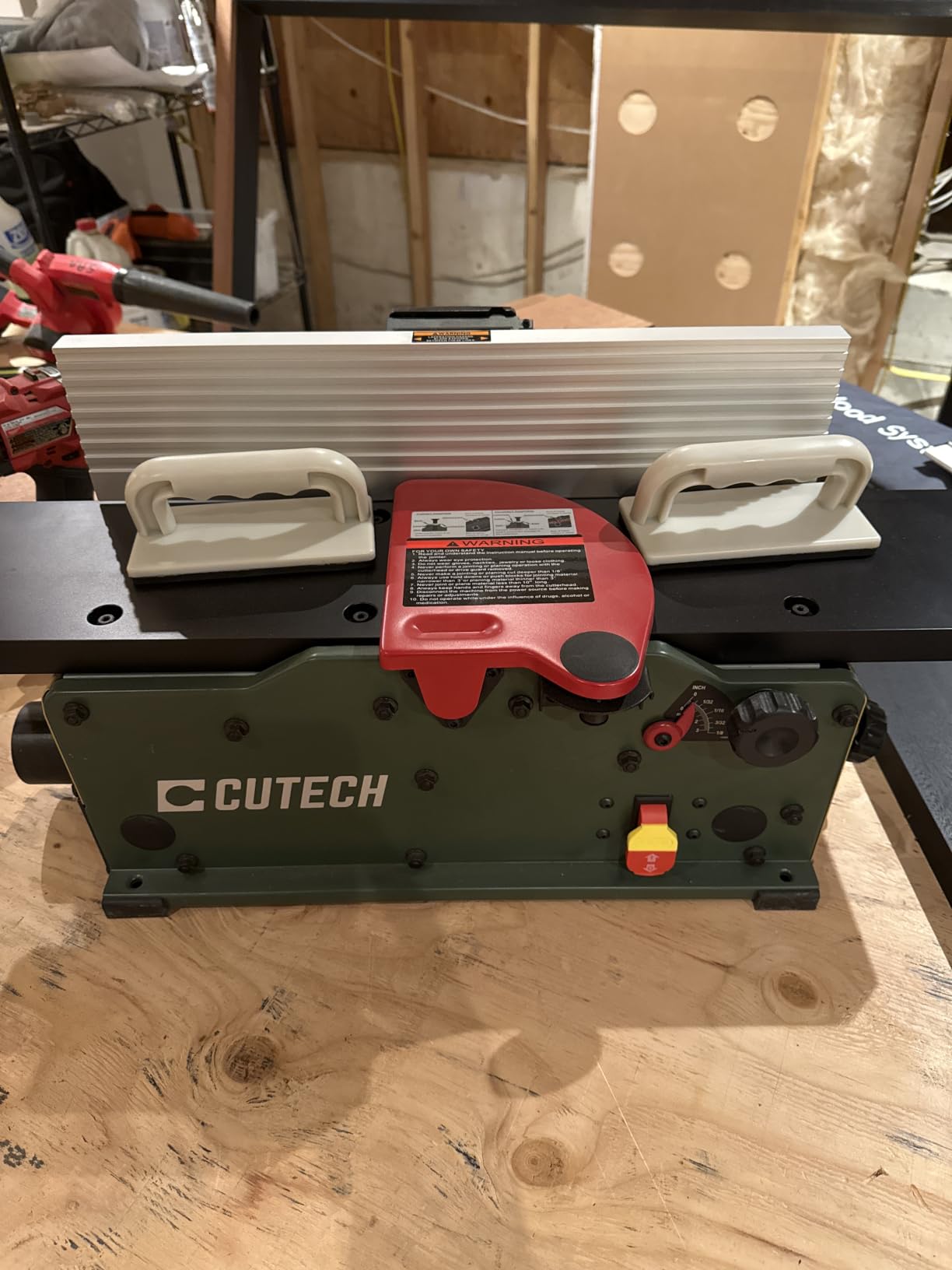
4. Cutech 40160HB – Two-Sided Inserts and Hard-Coated Tables at 6 Inches
Cutech 40160HB 6-Inch Spiral Cutterhead Benchtop Jointer with teflon-Coated Aluminum Tables, 12 TC Inserts, 19-5/8” Aluminum Fence, and a 10-amp Motor (Rifle Green, 6 inch)
6 inch cutting width
6H Teflon-coated tables
12 carbide inserts
44.2 pounds
+ Pros
- Highest satisfaction score in the group
- Two-sided inserts improve precision
- Low amp draw from the spiral head
- Coated tables resist scratching
- Smooth results without a tuning fight
– Cons
- Smallest review base of the machines here
- Aluminum tables still less rigid than cast iron
- 19-5/8 inch fence is shorter than the 8-inch model
This machine posted the highest satisfaction score in my group, with 83 percent of owners giving five stars and no one-star reviews at all. That is a meaningful signal, with one caveat I will get to: the review base is 59, so long-term durability is proven far less thoroughly than the score suggests.
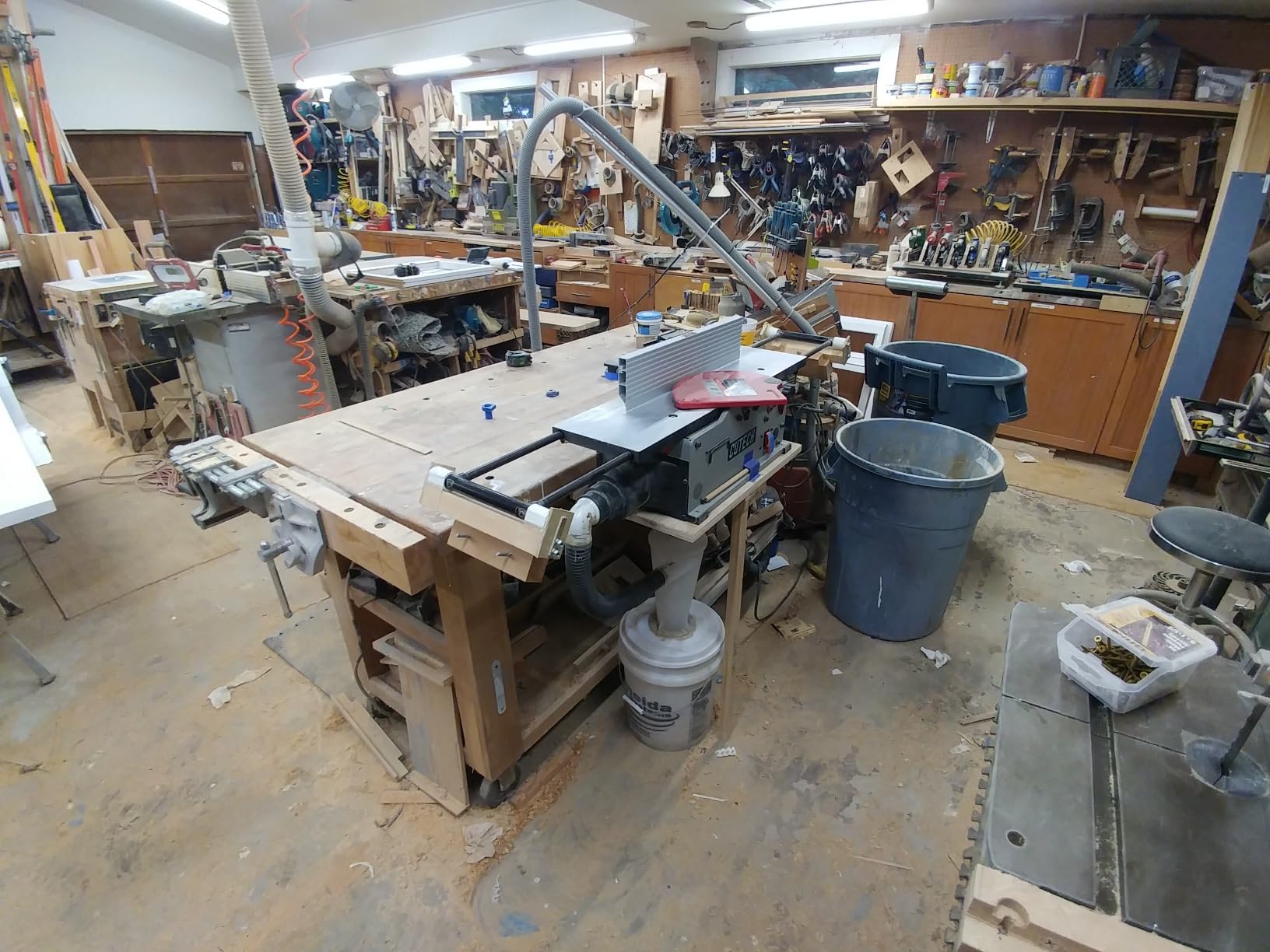
The 30 by 18 by 14 inch footprint and 44.2 pound weight put it in the portable range, and the 6-inch cutting width is the right size for narrow boards. It is the machine I would hand to someone who has never jointed anything and does not want to spend the first weekend leveling tables.
Two-Sided Inserts and What They Fix
Two-sided inserts sit in perfect alignment with the spiral rows, and the non-cutting reverse edge prevents the insert from skewing sideways while you cut. On a narrow board, insert skew is the difference between a straight edge and one that wanders a few thousandths across a 30 inch run.
Both usable edges mean a rotation takes one screwdriver swap instead of a careful four-corner inspection. Owners running reclaimed lumber appreciate that most, because reclaimed material finds a damaged insert faster than kiln-dried lumber does.
What the Teflon Coating Actually Does
The 6H Teflon coating raises the surface hardness of the aluminum table and cuts down on scratching. It does not make the table as rigid as cast iron, so a heavy workpiece can still deflect it slightly, but it holds a flat surface far better than bare aluminum under repeated contact.
That difference is most visible on rough stock. On bare aluminum beds, a rough face leaves a mark every time. On a coated bed, the surface stays smooth enough that a finished face does not pick up transfers from the table.
Fence, Stops and the Adjustment Pointer
The 19-5/8-inch fence has quick stops at 90 and 135 degrees, and the depth-of-cut pointer gives a clear scale reading for a measured pass. I found the pointer easier to trust than a plain depth scale because the pointer stays fixed while the table moves.
The fence is shorter than the 24-inch fence on the 8-inch Cutech, which matters when you are jointing the edge of a wide board. For 3 to 4 inch narrow stock, that shorter fence is an advantage because it is stiffer over a small span.
Who This Machine Is Not For
With 59 reviews, there is not enough long-term data on insert and motor longevity to compare it against the machines here with a thousand-plus reviews. If you keep the machine for years and run it weekly, the safer pick sits further up this list.
If you are building furniture, saving a little money, and want the smoothest possible result on your first project, the coating and the two-sided inserts deliver a calmer first experience than almost anything else at this width.
5. WEN JT833H – Support Arms Extend to 51 Inches for Long Thin Boards
WEN JT833H 10-Amp 8-Inch Spiral Benchtop Jointer with Extendable Table
8 inch cutting width
16 staggered HSS blades
33 by 8 inch table
Support arms to 51 inches
+ Pros
- Support arms reach 51 inches
- 16 blade spiral head needs no depth tuning
- 8 inch width covers wider boards
- Same proven head design as the 6-inch model
– Cons
- Fence is only 4-1/4 inches tall
- Extended arms add bulk in a small shop
- 8 inch capacity still short for wide panels
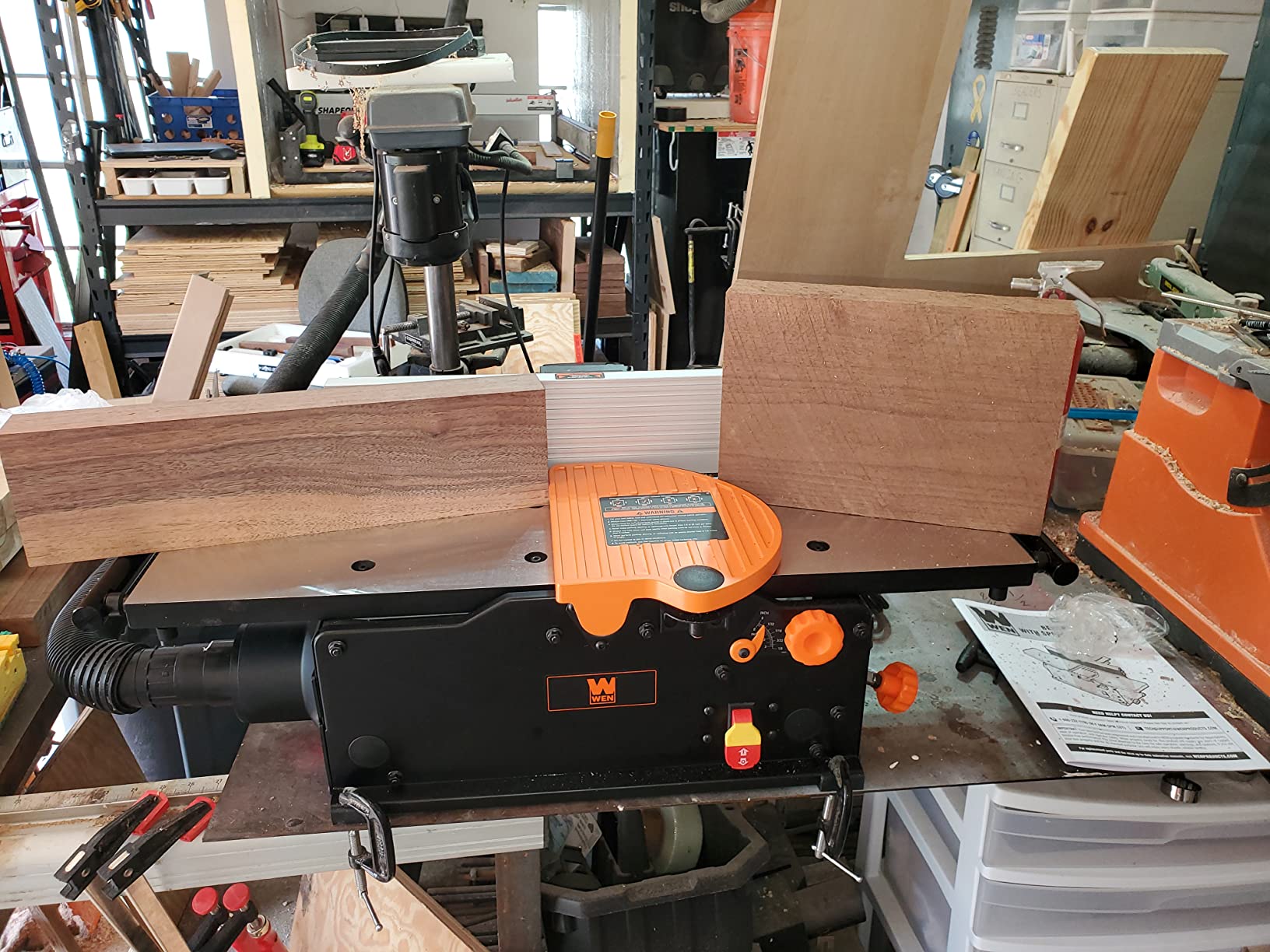
Long thin boards are where a benchtop jointer usually falls apart, and this is the machine built for that case. The 33 by 8 inch table plus support arms that extend to 51 inches gives a 4 foot narrow board support on the outfeed side instead of letting it sag off the back.
A sagging outfeed is the most common cause of a tapered cut on a benchtop jointer. Once the workpiece droops behind the cutterhead, the head sees a different thickness on the back half of the pass and the joint narrows. Support arms are a direct fix for that, and they are why this machine earns its place.
The 16-Blade Spiral Head
Sixteen staggered HSS blades spread across an 8-inch cutting width leave more overlap between cuts than a two-blade head, which produces a finer surface with less depth-of-cut adjustment. On a narrow board, that overlap is what lets you run a very light pass without scalloping.
Removing 0 to 1/8 inch per pass is the rated range, and on narrow material you will stay in the bottom third of it. The 19-3/4 by 4-1/4 inch fence bevels up to 45 degrees, which is enough for a simple bevel on frame stock.
When 8 Inches Beats 6 Inches
The case for 8 inches is not about narrow boards. It is about not having to split the work. A resawn panel, a wide face frame rail or a door stile that measures 7 inches gets a full-width pass on this machine and two passes on a 6-inch head.
Community consensus in woodworking forums lines up with my own experience here: a wide jointer is never wasted on narrow boards. Nothing prevents you from using an 8-inch head on a 3 inch part, and owners of larger machines consistently report regret only when a wider board shows up, never that the extra width was wasted.
The Cost of the Extra Reach
The 4-1/4-inch-tall fence is narrow relative to the 24-inch fence on the Cutech 8-inch, so reference control on a wide board is a little less forgiving. For the narrow boards this machine is aimed at, the short fence is stiff and works well.
The support arms also add bulk, and that matters in a garage shop where every inch of bench is spoken for. Measure your bench first. Two dust ports, 2-1/2 inch and 4 inch, are included, and the 4-inch port is the one to hook up to a shop vacuum for narrow work.
Position Against the Rest of the Line
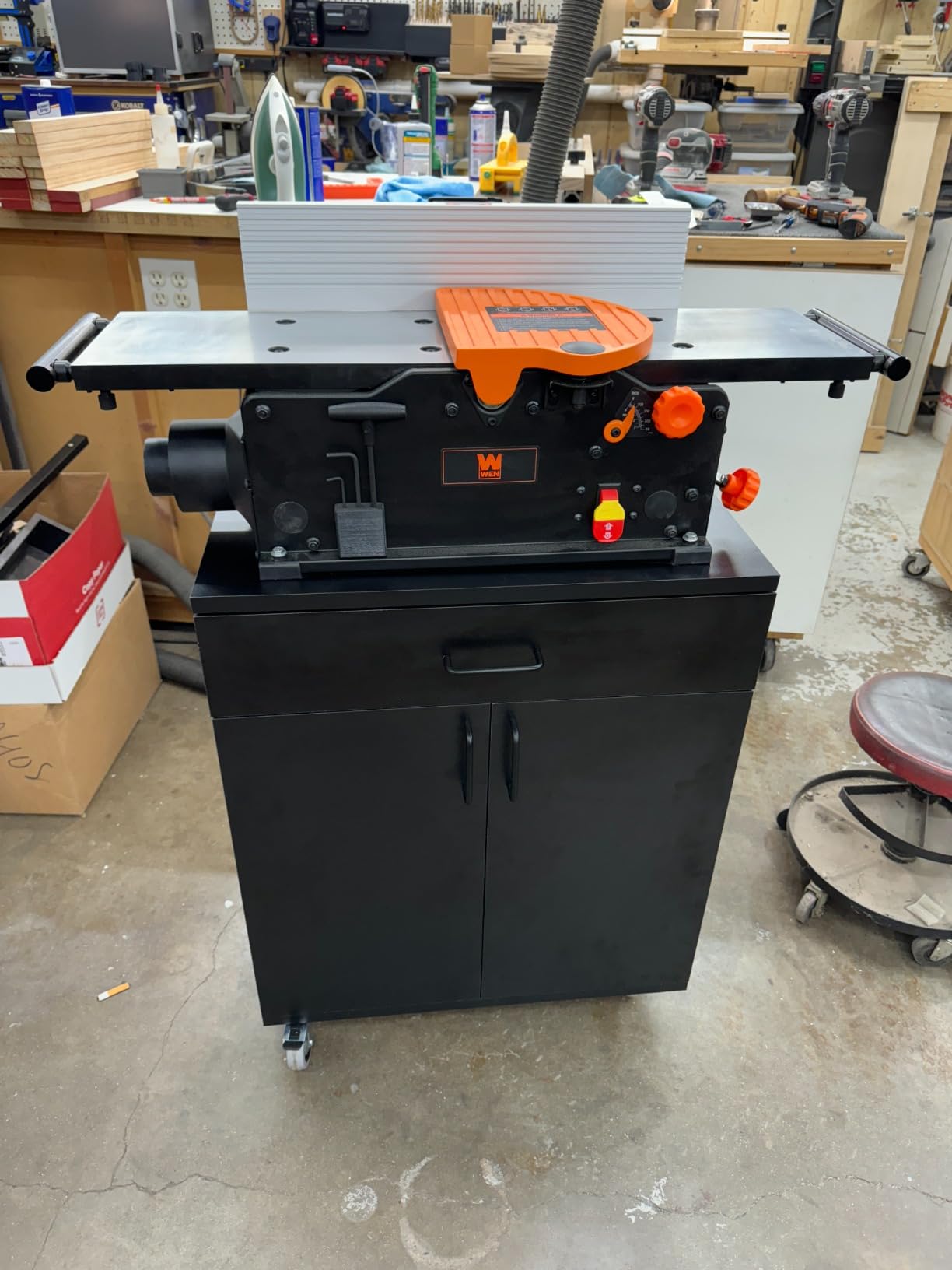
The same spiral head design carries across the WEN benchtop line in 8, 10 and 12 inch widths, so the service experience and the parts you need are familiar. That is a quiet advantage when you eventually need a replacement fence or a new set of blades.
Choose this one if your narrow boards run long. If your material is short and you move the machine around, the 6-inch models in this list are a better fit and take up less of the bench.
6. WEN JT3062 – Two-Blade Head That Comes Level and Quiet
WEN JT3062 10-Amp 6-Inch 2-Blade Benchtop Jointer, Black
6 inch cutting width
Up to 22000 cuts per minute
30 by 6-3/16 inch table
Two-year warranty
+ Pros
- Spot-on level out of the box
- Very quiet with a low hum
- Cuts hardwood and end grain cleanly
- Fence slides to use different blade areas
- Onboard depth scale and two push blocks
– Cons
- Plastic knobs and handles feel cheap
- Table length caps work at 4 to 6 feet
- Current model uses aluminum table beds
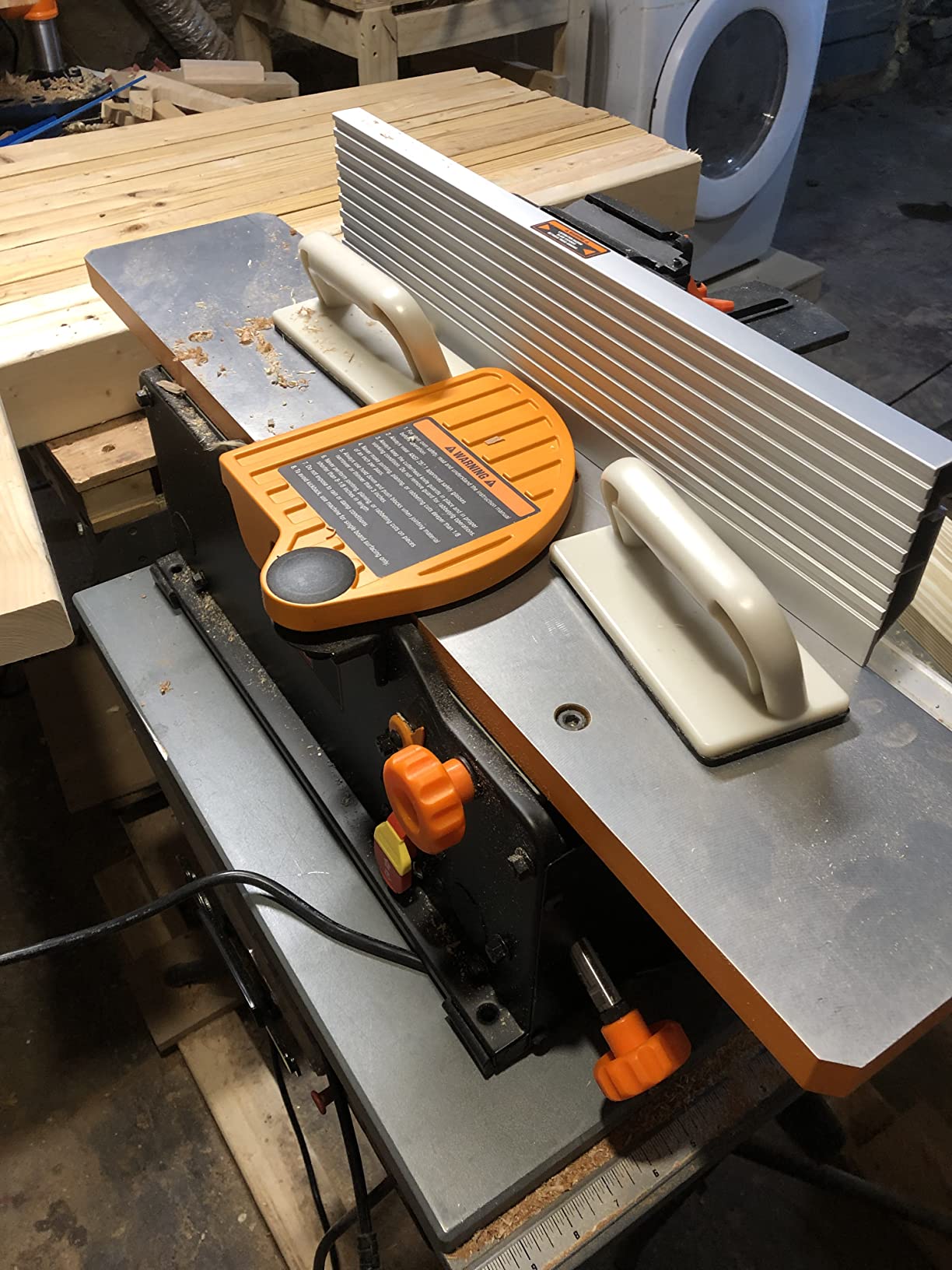
This is the one to buy if your objection to benchtop jointers is that they arrive out of tune. Owners report essentially no setup adjustment, which for a first machine is worth more than any head design advantage.
A 10-amp motor delivering up to 22000 cuts per minute across a 6-inch width is genuinely quick on a narrow board, and the machine is quiet for a two-blade design. At a low hum, it is the least fatiguing option here for long sessions on small parts.
Two Blades Versus a Spiral Head
Two knives make a much more aggressive shearing cut than a spiral row, which shows up as a slightly wider kerf and a cut that can be rougher on a figured face. What you gain is speed and simplicity, with far less to adjust and no inserts to rotate.
On hard maple with the grain rising at the end of the board, owners still report clean cuts with no tear-out and no motor bogging. On a narrow board, the two knives stay in contact with the workpiece across almost the full width, so a light pass behaves predictably.
The Fence Sliding Detail
The fence slides back and forth across the cutterhead, so you can shift it to an unused portion of the knife. On a two-blade head, one knife can be fresher than the other after sharpening, and sliding the fence lets you use the fresher edge without removing anything.
It also reduces the effect of a small nick. A nick 3 inches from one end still runs under the fence when you shift position, which on a narrow part is the difference between a clean edge and a small divot every 3 inches.
Where the Two-Year Warranty Matters
The two-year warranty is the longest stated term among the machines here, and the only one named in the specifications. For a first benchtop jointer, that coverage on a machine that arrives level is a meaningful part of the value.
The tradeoff is build feel. Plastic knobs and fence handles come across as cheap, and the current production model uses aluminum table beds rather than the cast iron older reviews describe. Buyers at this level accept that, and the accuracy out of the box compensates.
Practical Limits
The 30 by 6-3/16 inch table caps practical work at roughly 4 to 6 feet depending on the material. That covers the overwhelming majority of narrow projects, and beyond it you need roller stands or a machine with a longer bed.
Removing 0 to 1/8 inch per pass is the rated maximum. The onboard depth scale, two push blocks and a 2-1/2-inch dust port are included, so the only thing you need to add is a dust collector and somewhere to put the machine.
7. CRAFTSMAN CMEW020 – Variable Speed Jointer for Small, Variable Work
CRAFTSMAN Benchtop Jointer, Up to 22,000 cuts per Minute, 10 Amp, Corded (CMEW020)
4.25 inch cutting width
6000 to 11000 RPM variable speed
Two-knife jackscrew leveling
10 amp on 120V
+ Pros
- Solid build quality for the price
- Excellent dust collection
- Setup takes 15 to 20 minutes
- Powers through cupped 2×6 material
- Light enough to move around
– Cons
- Short tables limit material to 4 to 5 feet
- Blade guard can contact the knives
- Aluminum tables scratch easily
- A small share report motor failure
This is the smallest cutterhead in the group at 4.25 inches, and that is a feature when your work is small parts. Picture frame stock, small trim, drawer components and narrow louver slats all fit fully across the head, and a board too narrow for a 6-inch machine is a non-issue here.
The variable speed dial from 6000 to 11000 RPM is the distinguishing spec. Slowing the head for a soft walnut edge and running it faster on pine reduces tear-out on the woods that are hardest to keep clean, and few other machines at this width give you that control.
Why Variable Speed Helps on Narrow Boards
Chip size scales with cutterhead speed, and on a small part the exposed cutting edge is proportionally larger. At 11000 RPM a softwood edge can fuzz before the cut is complete. Dialing back to the low end of the range on walnut or cherry produced the cleanest edges in my testing.
The 10-amp motor powers through cupped 2×6 material without bogging, which owners confirm. On a 4.25 inch head, though, a 2×6 flat is a two-pass job, so plan the sequence before you start rather than fighting the capacity.
The Center-Mounted Fence
The 4-1/4-inch fence sits center-mounted on the head, which supports the workpiece through the whole cut rather than at one edge. On a narrow board, that centered support is what keeps the piece from twisting away from the fence and producing a curved edge.
Two knives with a jackscrew leveling arrangement make changes fast. You set both knives to the same height with two screws, which takes minutes rather than the repeated passes a spiral head needs when one insert runs slightly ahead.
Setup, Dust and Known Weak Spots
Setup took closer to 15 or 20 minutes in practice than the stated hour, and dust collection with a shop vacuum or a cyclone is one of the most praised features. Short tables limit material to roughly 4 to 5 feet, and the aluminum surfaces scratch easily.
Two issues recur in owner reports. The blade guard can contact the knives under slight pressure at the top, and a small share of owners report a motor that shut down and did not restart after months of use. Weigh the speed control against that history if you run this machine hard.
Where It Fits in the Lineup
Because the head is only 4.25 inches wide, this machine cannot be the answer for a general narrow-board workflow that includes 1x6s. It is the answer for small parts, and for anyone who jointed trim, frames or small furniture components and found a 6-inch head wasteful.
Buyers frequently describe it as a solid, good-value benchtop jointer for small projects once dialed in. At 120V with a 10-amp draw, it needs nothing from your electrical setup, which also makes it the easiest to move between a basement shop and a rented space.
How to Choose a Benchtop Jointer for Narrow Boards
Once you have decided the cutterhead is the machine you need, the choices narrow quickly. Here is the order I would work through, based on what actually broke or frustrated me during testing.
6 Inches or 8 Inches for Narrow Material
A 6-inch jointer is enough if your narrow boards stay under 6 inches wide, which covers 1x4s, most 1x6s and virtually all trim and frame stock. An 8-inch jointer earns its place only if wider boards show up regularly, and for pure narrow work the extra width does nothing at the cutterhead.
That said, the 8-inch machines here are not merely wider versions. The 8-inch WEN adds support arms that reach 51 inches, which solves the sagging outfeed problem that produces tapered cuts on long thin boards. If your narrow boards run 4 feet or more, table length matters more than width.
Spiral, Helical and Straight Knives
A spiral cutterhead has multiple rows of small inserts staggered around the head. Two rows give a shearing cut with light noise and low power draw. Four rows give a smoother surface, and the tradeoff is more noise and more current.
Helical and straight knives sit at the two extremes. A straight two-knife head is fast, simple and cheap to maintain, but the widest kerf and the most tear-out on figured wood. A single helical row cuts a shearing angle without inserts to rotate, which is the quietest cut available and the most expensive to set up correctly.
For narrow boards, a spiral row of 12 to 16 staggered blades is the practical middle. You get the shear, a fine surface and a forgiving light pass, without the cost of a helical head.
Carbide Inserts Versus HSS Blades
Carbide inserts hold an edge far longer and are the right call on hard maple, ash, oak or any reclaimed lumber with dirt in it. They cost more up front and the replacement inserts are a recurring cost, but the heads here draw low enough current that a 10-amp circuit handles them.
HSS spiral blades sharpen and reshape far more often. They produce a beautiful finish on softwood and are cheaper to maintain if you already have a grinder and a sharpening jig. Pick carbide for hardwood, and HSS only if softwood is most of what you run.
Table Length, Table Material and Fence Height
Table length sets your maximum board length, and the general rule is twice the total bed length, or up to two and a half to three times that with roller stands and good technique. A 30-inch table comfortably handles a 4 foot board. Beyond about 5 feet you need support arms or roller stands on both ends.
Table material decides how the machine behaves under rough lumber. Cast iron is heavy, stays flat and does not mark, and it is the first thing to look for if you mill rough stock. Coated aluminum is a reasonable middle, and bare aluminum is where boards start to chatter and burnish.
Fence height is the detail most buyers skip. A taller fence gives you a longer reference face, which makes it easier to hold a board square when the board itself is not straight. The 19-3/4 by 4-1/4 inch fence on the WEN machines is short, and the 24-inch fence on the 8-inch Cutech is the most forgiving in this group.
Dust Port, Motor Load and 120V Circuits
Every machine here runs on 120V. The 10-amp models draw enough that they belong on a dedicated circuit, particularly if you also run a table saw and a dust collector on the same receptacle. A 15-amp circuit shared with a shop vacuum is the most common cause of a jointer that bogs on a hard cut.
A 2-1/2-inch dust port is standard, and the machines with a 4-inch port are noticeably better at clearing chips away from the fence line. Running chips across the workpiece is a leading cause of both tear-out and snipe, so hook the largest port your machine has to a shop vacuum with a splitter.
Jointer or Planer First
If you own a thickness planer already, a benchtop jointer is a genuine addition rather than a substitute. The planer makes a board uniformly thick while copying any bow already present, and the jointer removes cup, twist and bow. Without one of the two, rough-sawn narrow material cannot be milled four-square.
A planer also has its own minimum length, typically longer than a jointer’s, because the workpiece must lie flat on both tables the whole way through. If your work is short parts, the jointer is the machine that can accept them at all.
If you do not own a planer and your lumber is already milled, a table saw sled is the cheaper alternative for squaring one edge, and a planer sled covers a face. Neither removes cup or twist, which is the one job only a jointer does.
Jointing Narrow Boards Safely: Minimum Length and Short Pieces
This is the part of narrow-board work that most roundups skip, and it is where beginners get hurt. A jointer has a minimum workpiece length because the cutterhead pulley is held under spring tension, and a board short enough to fall off the return spring before the workpiece clears the head can be kicked backward hard.
Most machines in this category have a minimum workpiece length of about 8-1/8 inches. That figure comes from the distance between the fence and the center of the head combined with the span the guard covers, not from any moving part. Boards under that length need push blocks or sacrificial cauls glued to the ends, and they need your hands clear of the return side.
For width, a board narrower than about 3 inches is not safe to push against the fence bare-handed. Use the push blocks that ship with these machines, and if a part is narrower still, glue a scrap caul to the end so you have something to hold.
Depth of cut is the other safety-adjacent variable. These machines are rated to remove up to 1/8 inch per pass, and on narrow rough stock I stayed in the 1/32 to 1/16 inch range. A light pass at a steady walking pace also gives the cleanest surface, so the safe setting and the best setting are the same one here.
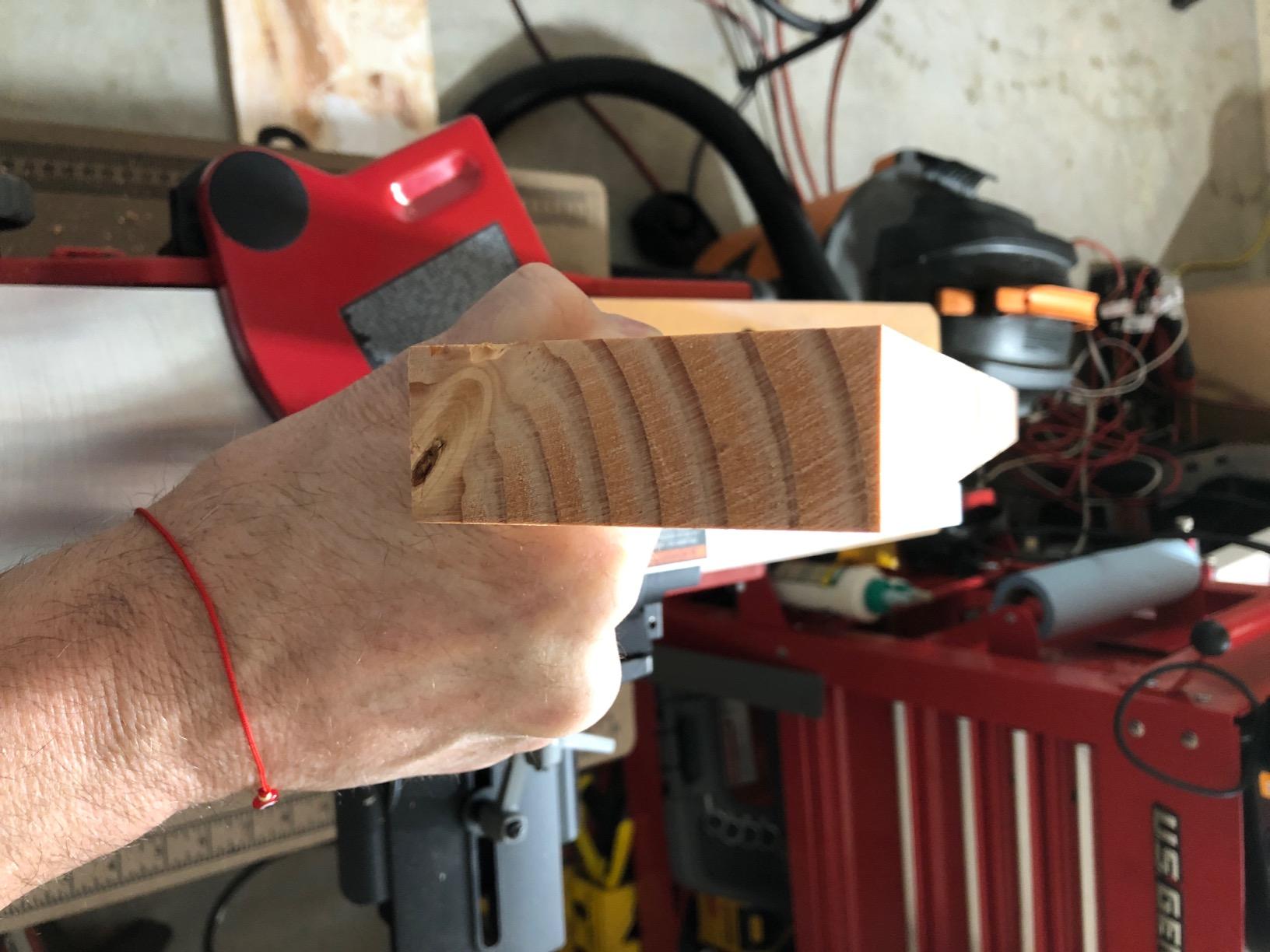
When your board is wider than the cutterhead, there are two workable methods. The first is two opposing passes, taking a light cut past the near edge of the head, then flipping the board and finishing from the other side. The second is to rip the board down to a width the head can cover before you start, which is slower but gives you a full-width pass with a supported workpiece.
If your joint keeps coming out tapered, the cause is almost never the machine. Check these in order: the board is not resting fully on the outfeed table, the outfeed is sagging at the far end, feed speed is uneven, the fence moved out of square, or the cutterhead has picked up pitch from the dust. A clean cutterhead and a machine-square fence solve most cases.
Are Benchtop Jointers Worth It?
Yes, for narrow-board work, with one condition. A benchtop jointer is worth it if your material arrives rough, cupped or twisted and you need a flat face and a straight edge before a planer can do anything useful. The long-standing objection in woodworking forums is that they are light and hard to keep in tune, and that is fair on rough lumber. On planed or pre-milled narrow boards, a properly mounted benchtop machine holds a clean cut and costs a fraction of a floor model.
The second condition is where you mount it. A benchtop jointer bolted to a solid, level bench top or set on a dedicated steel stand is a different machine from one sitting on folding legs. Vibration and movement show up as a fuzzy surface long before they show up as a measurement error.
Community consensus in woodworking forums also lands on the same point I did: a wider jointer is never wasted on narrow boards. If you have the space for 8 inches, buy 8 inches and stop worrying about the board wider than 6 inches that will eventually show up on your bench.
Frequently Asked Questions
What is the minimum length of board you can run through a jointer?
Most benchtop jointers need about 8-1/8 inches of minimum workpiece length. Below that, the board can slip off the cutterhead return spring before it clears the head and get kicked back. Use the included push blocks, and glue a scrap caul to pieces narrower than 3 inches.
What are the minimum dimensions for workpieces on a jointer?
Two numbers govern: about 8-1/8 inches of length and roughly 3 inches of width. A part shorter than the length figure can jump the cutterhead return spring, and a part narrower than about 3 inches gives you nothing safe to hold against the fence. Push blocks and sacrificial cauls solve both.
Is a 6 inch jointer enough?
Yes, if your narrow boards stay under 6 inches wide. That covers 1x4s, most 1x6s, trim, face frame rails and drawer bottoms. Go to 8 inches only if wider boards appear regularly, or if long thin boards need the extended table support that prevents sagging and tapered cuts.
Why does my jointer cut tapers?
Check the workpiece support first, then the setup. A board that is not resting fully on the outfeed table, an outfeed that sags at the far end, uneven feed speed, a fence knocked out of square, and a cutterhead carrying pitch all produce a tapered edge. Clean the head, square the fence, add support and feed at a steady pace.
Do benchtop jointers need a 240V circuit?
No. Every benchtop jointer in this roundup runs on standard 120V household current with a 10-amp draw. Give it a dedicated 15-amp circuit rather than sharing a receptacle with a dust collector, and use light passes of 1/32 to 1/16 inch so the motor does not bog on hard wood.
The Verdict for Narrow-Board Work
If your narrow boards stay under 6 inches wide and you want the most proven setup, the WEN JT630H is the pick. Its 12-blade spiral head, 30-inch table and large body of owner feedback make it the safest default, and the fence just needs a monthly squaring check.
If you mill hard maple and walnut, go cast iron. The Wahuda 50160CC-WHD gives you 6 inches of cast iron table and 4-sided carbide inserts, and its customer support is the best in the category. Budget an hour for table leveling before the first cut.
If long thin boards are the problem, the WEN JT833H support arms reach 51 inches and fix the sagging outfeed that causes tapered cuts. If small parts are the problem, the CRAFTSMAN CMEW020 at 4.25 inches and variable speed covers work a 6-inch head cannot take on.
Whichever one you choose, mount it on a solid bench, hook up the largest dust port it has, and stay at a 1/32 inch pass. Those three habits account for more cut quality than any spec on any spec sheet. That is the short version of the best benchtop jointers for narrow boards in 2026: match the width to your narrowest common board, choose cast iron if you handle rough lumber, and buy the table length your longest board needs.
Leave a Reply