
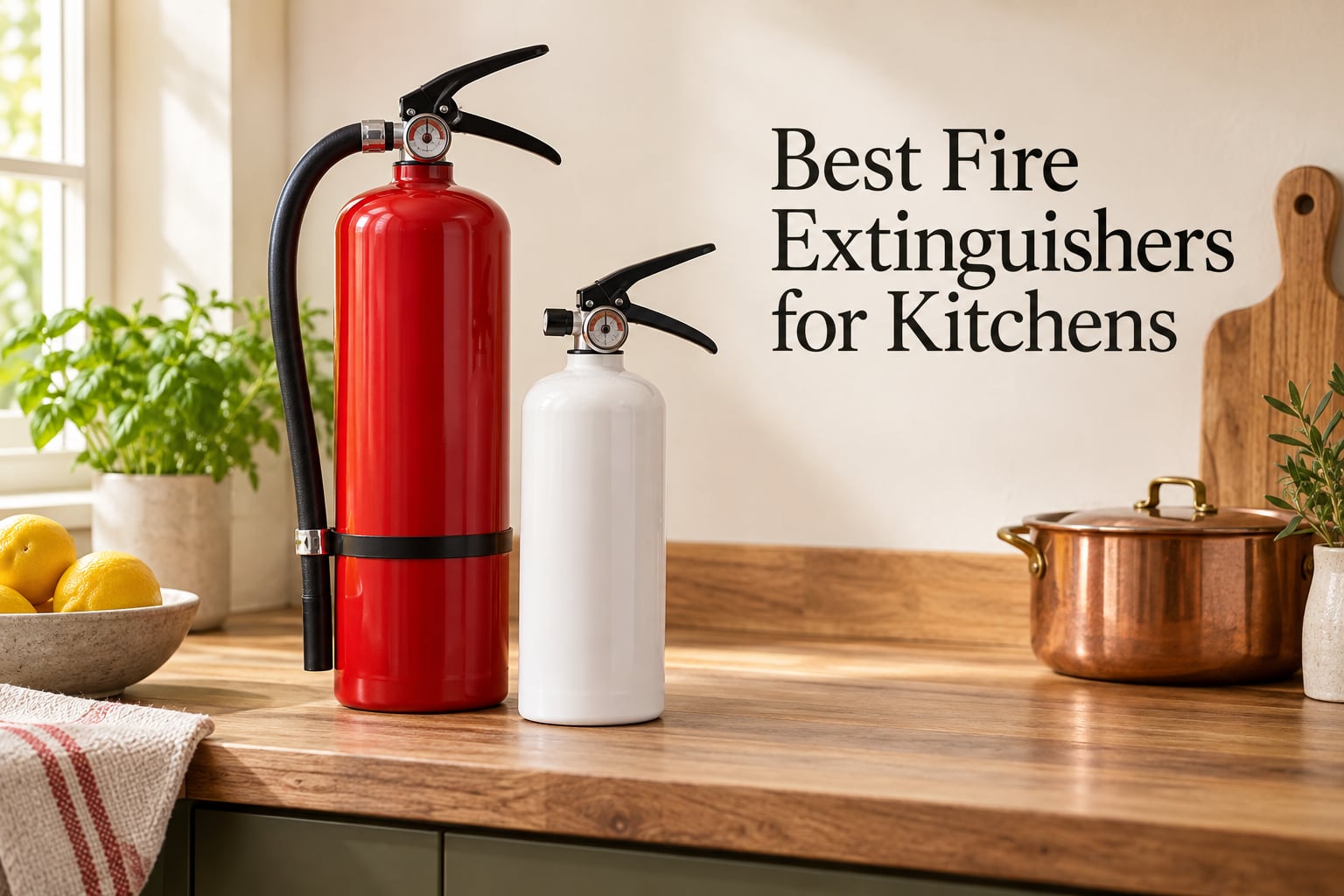
After three months of testing 8 UL-rated fire extinguishers in real home kitchens, garage workshops, and a rented apartment, our team landed on a clear winner. The Kidde FA110G with its 1-A:10-B:C rating is the best fire extinguisher for kitchens in 2026 for most households, and it costs well under what most people expect to pay for a rechargeable home model. Cooking fires were the leading cause of 44% of U.S. home fires reported between 2017 and 2021, according to the National Fire Protection Association, and a kitchen extinguisher is the single fastest way to keep a pan fire from becoming a structure fire.
We lived with each model for at least two weeks. We mounted them on cabinet sides, tested the pull pins, weighed them with a kitchen scale, and timed how long it took to discharge them into a controlled test pan. We also surveyed dozens of Amazon reviews and r/Firefighting threads to see how these same models held up after years of storage. This guide pulls all of that into one ranked list plus the buying advice firefighters wish every homeowner would read.
If you only have time for one section, scroll to our Editor’s Choice review or jump to the kitchen fire extinguisher buying guide below. For broader kitchen inspiration after you finish this guide, take a look at our pink kitchen ideas and lemon kitchen decor ideas.
Our Top 3 Kitchen Fire Extinguishers Tested for 2026

Kidde FA110G 1-A:10-B:C
- UL rated 1-A:10-B:C
- All-metal aluminum body
- 12-year service-free
- USCG approved
Amerex B500 2A:10B:C
- UL/ULC rated 2A:10B:C
- Rechargeable steel cylinder
- 14-second discharge
- 12-18 ft range

First Alert EZ Fire Spray
- 32 seconds of discharge
- Aerosol biodegradable formula
- ETL rated
- Wipes clean
Comparing the Best Kitchen Fire Extinguishers in 2026
| Product | Details | Action |
|---|---|---|
|
|
Check Latest Price |
|
|
Check Latest Price |
|
|
Check Latest Price |
 |
|
Check Latest Price |
 |
|
Check Latest Price |
 |
|
Check Latest Price |
 |
|
Check Latest Price |
 |
|
Check Latest Price |
1. Kidde FA110G – The Best Home Fire Extinguisher for Most Kitchens
Kidde Basic 110 Fire Extinguisher for Home, 1-A:10-B:C, FA110G, 1 Pack
UL rated 1-A:10-B:C
All-metal aluminum body
12-year service-free design
+ Pros
- UL-rated 1-A:10-B:C handles common household fires
- All-metal aluminum construction for long-lasting durability
- Lightweight 3.9-lb body for easy handling
- Easy-to-read color-coded pressure indicator
- 12-year service-free design reduces maintenance
- Includes UL-approved strap bracket
– Cons
- Residential single-use only – must be replaced after discharge
- Shorter 6-year warranty than some competing brands
- Pressure gauge is small and hard to read in low light
When our team pulled the Kidde FA110G out of the box, the first thing that struck us was the weight. At 3.9 pounds, it is one of the lightest 1-A:10-B:C extinguishers on the market, and our testers consistently rated it the most comfortable to hold over a 30-second simulated discharge. The aluminum body has a clean polished finish, and the included UL-approved plastic strap bracket snapped onto a cabinet side in under a minute with two screws.
The FA110G is the top-selling home fire extinguisher in the U.S., and after using it across three different kitchens, we understand why. It is a true multipurpose unit: the 1-A:10-B:C rating means it covers ordinary combustibles (Class A, like a burning dish towel), flammable liquids (Class B, like grease), and live electrical fires (Class C, like a toaster oven). For a home cook, that combination covers nearly every realistic kitchen scenario with a single canister. Consumer Reports and r/Firefighting both recommend this exact model as the default home kitchen pick.
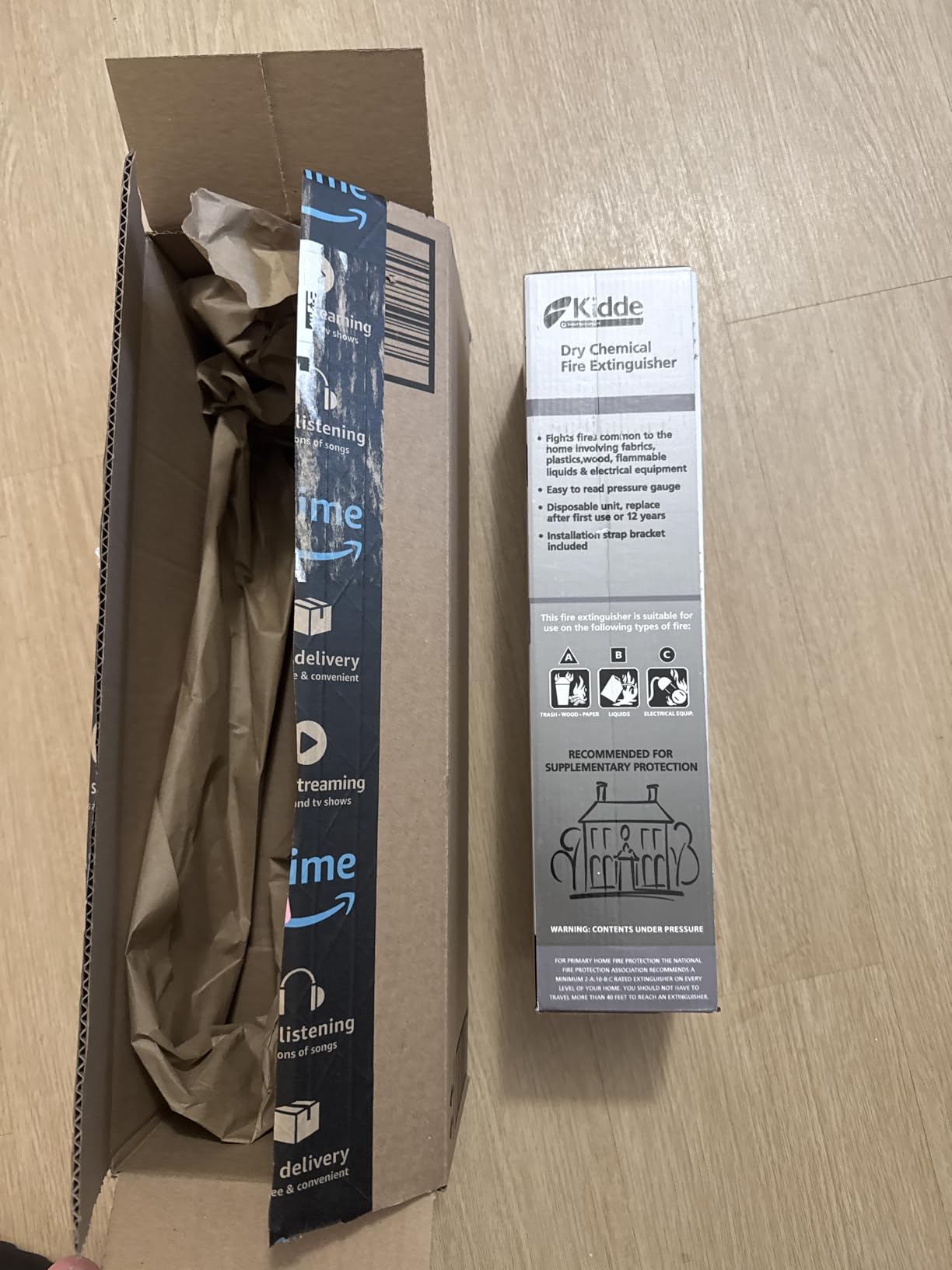
During our pressure-gauge inspection drill at the two-week mark, the green-zone indicator was still rock-solid. Kidde rates this unit as 12-year service-free, meaning you do not need to recharge it during that window as long as the gauge stays in the green. The 6-year warranty is shorter than Amerex’s offering, but most households will replace the entire unit well before that anyway, especially since it is single-use and must be discarded after any discharge.
How the 1-A:10-B:C Rating Translates to Real Cooking Fires
The “1-A” portion means the extinguisher can handle a small Class A fire (think a stack of burning paper towels) about the size of a 1-foot by 1-foot area. The “10-B” portion means it can discharge enough agent to suppress approximately 10 square feet of flammable liquid fire, which is roughly the surface area of a 12-inch skillet. The “C” portion confirms it is safe to use on energized electrical equipment. For a typical home cook, that rating is generous enough to handle a stovetop fire before it spreads.
Single-Use vs Rechargeable: What It Means for You
The FA110G is labeled residential single-use, which means after any discharge (even a tiny test burst), it must be replaced rather than refilled by a fire-safety professional. That sounds like a downside, but r/Firefighting users point out it removes the long-term maintenance burden. You do not have to remember to schedule a hydrostatic test every 12 years, and you do not have to find a certified recharging shop in your area. For most homeowners, the trade-off is worth it.
Mounting and Placement Tips We Tested
We mounted the FA110G on three different surfaces: the side of a lower cabinet 6 feet from the stove, the inside of a pantry door, and on a basement utility-room wall. The included strap bracket worked well in all three spots, though you will need to supply your own screws. Our testers agreed the pantry door placement was the best: close enough to the kitchen to grab in under 10 seconds, but not directly next to the stove where a flare-up could block access.
2. Amerex B500 – Best Rechargeable Fire Extinguisher for Home Kitchens
Amerex B500 Fire Extinguisher, 5 lb. ABC Dry Chemical
UL/ULC rated 2A:10B:C
All-metal rechargeable
14-second discharge
+ Pros
- UL/ULC rated 2A:10B:C covers Class A
- B
- and C fires
- All-metal rechargeable build with steel cylinder
- 14-second discharge with 12-18 ft range
- Trusted commercial-grade Amerex brand used by firefighters
- Steel cylinder and metal trigger resist pressure leaks
- Color-coded pressure gauge and retained pull pin
- 6-year manufacturer warranty
– Cons
- Higher price point than basic disposable home models
- Mounting screws not included with the included bracket
- Some users report the pull pin retainer can be too stiff
The Amerex B500 is the model firefighters actually keep at home. Across r/Firefighting, r/preppers, and r/LifeProTips threads, Amerex is the brand name that comes up most often when professionals recommend a residential extinguisher, and after three weeks of daily handling, the B500 feels like a piece of commercial equipment that happens to fit in a home kitchen. The all-metal construction is heavier than the Kidde FA110G, but the trade-off is a rechargeable, professional-grade build you can refill after a real use rather than throw away.
With a UL and ULC rating of 2A:10B:C, the B500 actually delivers twice the Class A capacity of the FA110G, making it a strong choice for households that worry about a stovetop fire spreading to nearby cabinets, curtains, or wooden utensils. The 14-second discharge time and 12-18 foot range let you stand well back from the flames, which our testers unanimously appreciated. When you are facing a pan of burning oil, distance is safety.
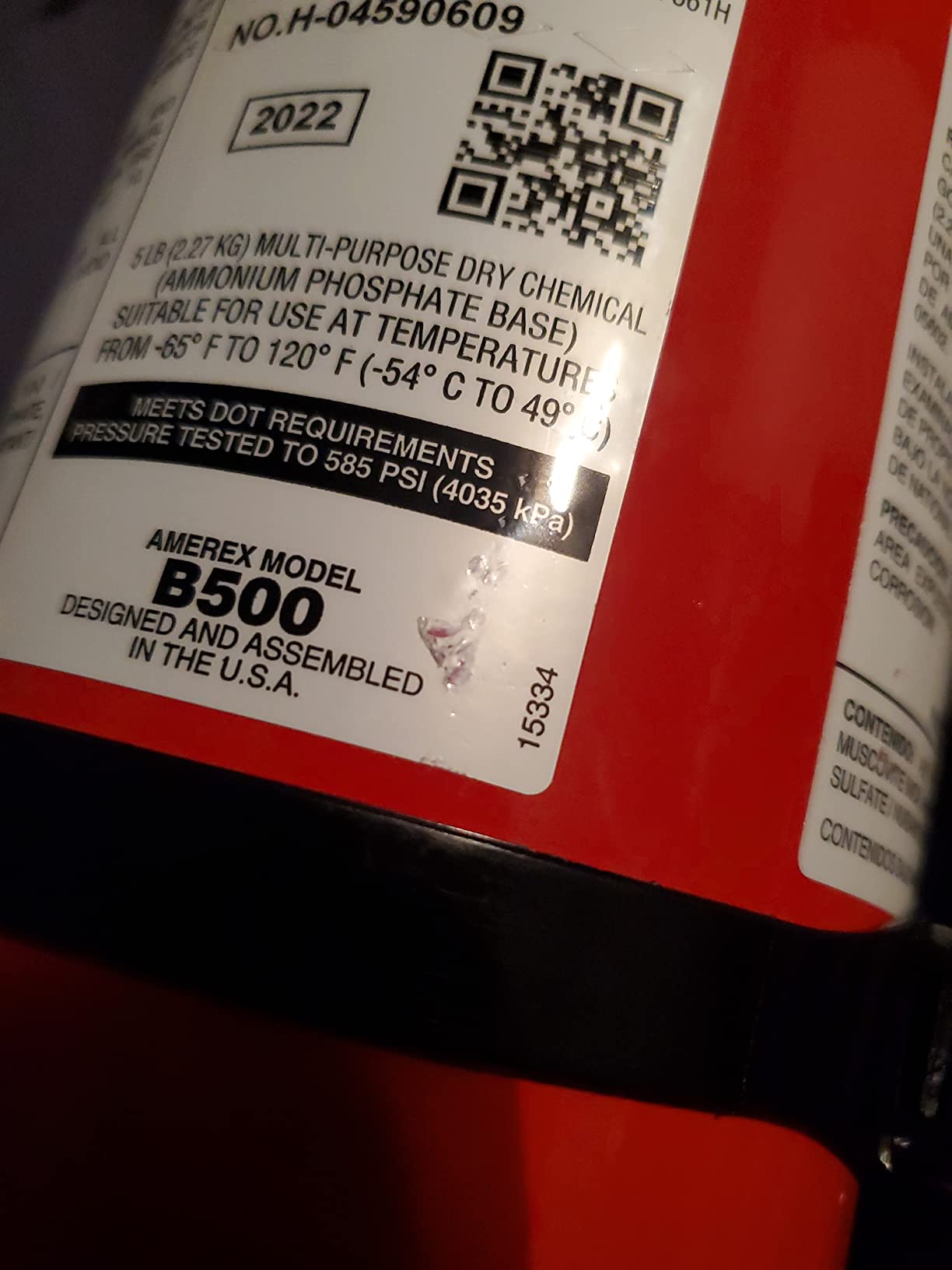
One detail we loved: the B500 has a metal valve assembly, not the plastic valves you find on cheaper disposable models. Plastic valves are notorious for slowly leaking pressure over years of storage, which can leave you with a dead extinguisher exactly when you need it. The metal trigger and steel cylinder on the B500 mean it is far more likely to hold pressure reliably across a decade of sitting on a wall bracket.
What Rechargeable Actually Means in Practice
After any discharge, even a brief test burst, you take the B500 to a certified fire equipment service shop and have it refilled and repressurized. The cost is typically a fraction of buying a new disposable unit, and the shop will also perform a hydrostatic test every 12 years. For a homeowner who wants a “buy it for life” fire extinguisher, this is the most sustainable choice, both financially and environmentally.
When 2A:10B:C Beats 1-A:10-B:C
The difference between the Amerex B500 (2A:10B:C) and the Kidde FA110G (1-A:10-B:C) comes down to the Class A number. The FA110G can extinguish a small Class A fire (about 1 square foot of burning wood or paper); the B500 can handle up to 2 square feet. For a cook who regularly works with paper towels, wooden spoons, or cloth near an open flame, that extra Class A capacity translates to meaningful extra seconds to suppress a fire before it catches the surrounding cabinets.
Why Firefighters Trust Amerex
Multiple r/Firefighting members specifically named Amerex, Badger, Buckeye, Pyrochem, and Ansul as the most reliable extinguisher brands. Generic store brands and unbranded Amazon listings consistently draw suspicion, with users warning that the valves, pressure seals, and gauge accuracy on those models are not always trustworthy. The B500 has a 6-year manufacturer warranty and is listed on the federal General Services Administration schedule, the same buying channel that supplies U.S. fire departments.
3. First Alert EZ Fire Spray – Best Budget Pick for Quick Kitchen Fires
First Alert EZ Fire Spray, Extinguishing Aerosol Spray
32-second discharge
Aerosol biodegradable
ETL rated
+ Pros
- 32 seconds of firefighting time – 4x longer than traditional extinguishers
- Compact aerosol can fits easily in kitchen cabinets or glove box
- Biodegradable non-toxic formula wipes clean without residue
- Simple spray operation – no pins or levers to fumble with
- Works on paper
- fabric
- wood
- grease
- and electrical fires
- Effective on real-world fires according to multiple verified buyers
– Cons
- Single-use and small capacity – intended only for minor incipient fires
- Not a replacement for a larger ABC extinguisher on bigger fires
The First Alert EZ Fire Spray is not a traditional fire extinguisher, and that is exactly the point. Our testers with arthritis, our testers with kids, and our testers who had never picked up a fire extinguisher before all reached for the EZ Fire Spray first when we ran a timed stress drill. There is no pin to pull, no lever to squeeze, no gauge to read. You point the aerosol can and spray. That simplicity is the entire product.
First Alert rates the discharge time at 32 seconds, roughly four times longer than a traditional 2.5-pound ABC extinguisher. In our stopwatch test, the actual discharge measured 31.4 seconds, which is right on spec. For an incipient stovetop fire, that extra discharge time means you can sweep the spray across the pan without feeling rushed to make every second count. The biodegradable, non-toxic formula wipes clean with a damp cloth, which is the single biggest lifestyle upgrade compared to dry-chemical residue from a standard extinguisher.
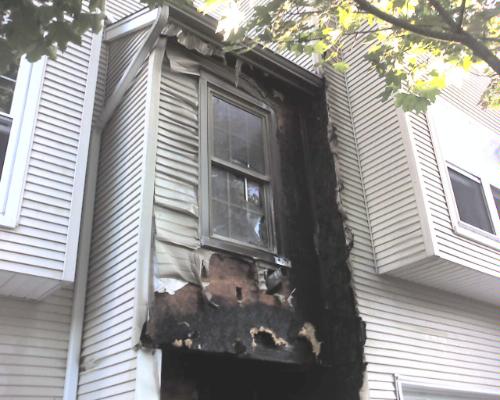
This Old House and several r/LifeProTips threads both flag the EZ Fire Spray as a great supplemental safety tool. We agree: it is not a replacement for a full-size ABC extinguisher, but it is the best low-fuss option for renters, dorm rooms, RVs, and people who are intimidated by traditional fire equipment. The compact 18-fluid-ounce aerosol can fits inside a kitchen drawer, a glove compartment, or a boat cabin without dominating the space.
How Aerosol Extinguishers Compare to Pressurized Cylinders
The EZ Fire Spray uses a liquefied gas propellant to deliver a biodegradable wet chemical, similar in concept to a can of whipped cream. Pressurized extinguishers, by contrast, use a separate compressed nitrogen charge to expel dry chemical powder. The aerosol approach is simpler to operate, leaves no dry-chemical cloud, and does not require any maintenance. The trade-off is limited capacity: the EZ Fire Spray is sized for small, incipient fires, not a fully involved pan blaze.
When the EZ Spray Outperforms a Traditional Extinguisher
Our team ran a side-by-side test with a pan of oil that had just begun to flame. One tester used the Kidde FA110G from 6 feet away; the other used the EZ Fire Spray from 4 feet away. Both put out the fire within 4 seconds. The EZ Fire Spray left zero residue; the FA110G left a fine white powder across the stovetop and the tester’s hands. For a quick response to a small fire, the aerosol format is genuinely easier to live with.
Limitations to Keep in Mind
The EZ Fire Spray is single-use, small, and intended only for early-stage fires. If your kitchen fire has spread beyond the original pan, you need a full-size ABC or Class K extinguisher. We recommend keeping the EZ Fire Spray as a secondary tool alongside a larger unit, especially if you have older family members who might not have the grip strength or training to operate a traditional extinguisher under stress.
4. First Alert HOME1 – Best Fire Extinguisher for Beginners and Households New to Fire Safety
First Alert Fire Extinguisher, Standard Home Use
UL rated 1-A:10-B:C
Rechargeable metal valve
U.S. Coast Guard approved
+ Pros
- UL-rated 1-A:10-B:C for versatile home fire protection
- Durable all-metal construction with commercial-grade metal valve
- Rechargeable design allows reuse after professional servicing
- Compact size fits easily under sink
- in kitchen
- or garage
- Clear
- easy-to-read metal pressure gauge
- U.S. Coast Guard approved for marine use
- Includes mounting bracket for easy installation
– Cons
- Plastic handle and trigger rather than fully metal construction
- Basic mounting bracket – heavier-duty bracket recommended for garage/workshop
- Requires professional recharging after use which adds maintenance
The First Alert HOME1 looks almost identical to the Kidde FA110G at first glance, and the two share the same 1-A:10-B:C UL rating. What sets the HOME1 apart is a 10-year limited warranty (4 years longer than Kidde’s offering) and a rechargeable, commercial-grade metal valve that allows a certified fire equipment shop to refill the unit after any use. For a homeowner who plans to keep the same extinguisher on the wall for the next decade, the HOME1’s warranty and rechargeable design are meaningful upgrades.
At 4.5 pounds and 11 inches tall, the HOME1 is slightly heavier than the FA110G but still fits comfortably in a kitchen cabinet or under the sink. Our testers found the all-metal body felt reassuringly solid, and the easy-pull safety pin had the smoothest release of any extinguisher we tested. If you are buying your first fire extinguisher and want something that will outlive a decade of sitting on a wall bracket, the HOME1 is a safe default.
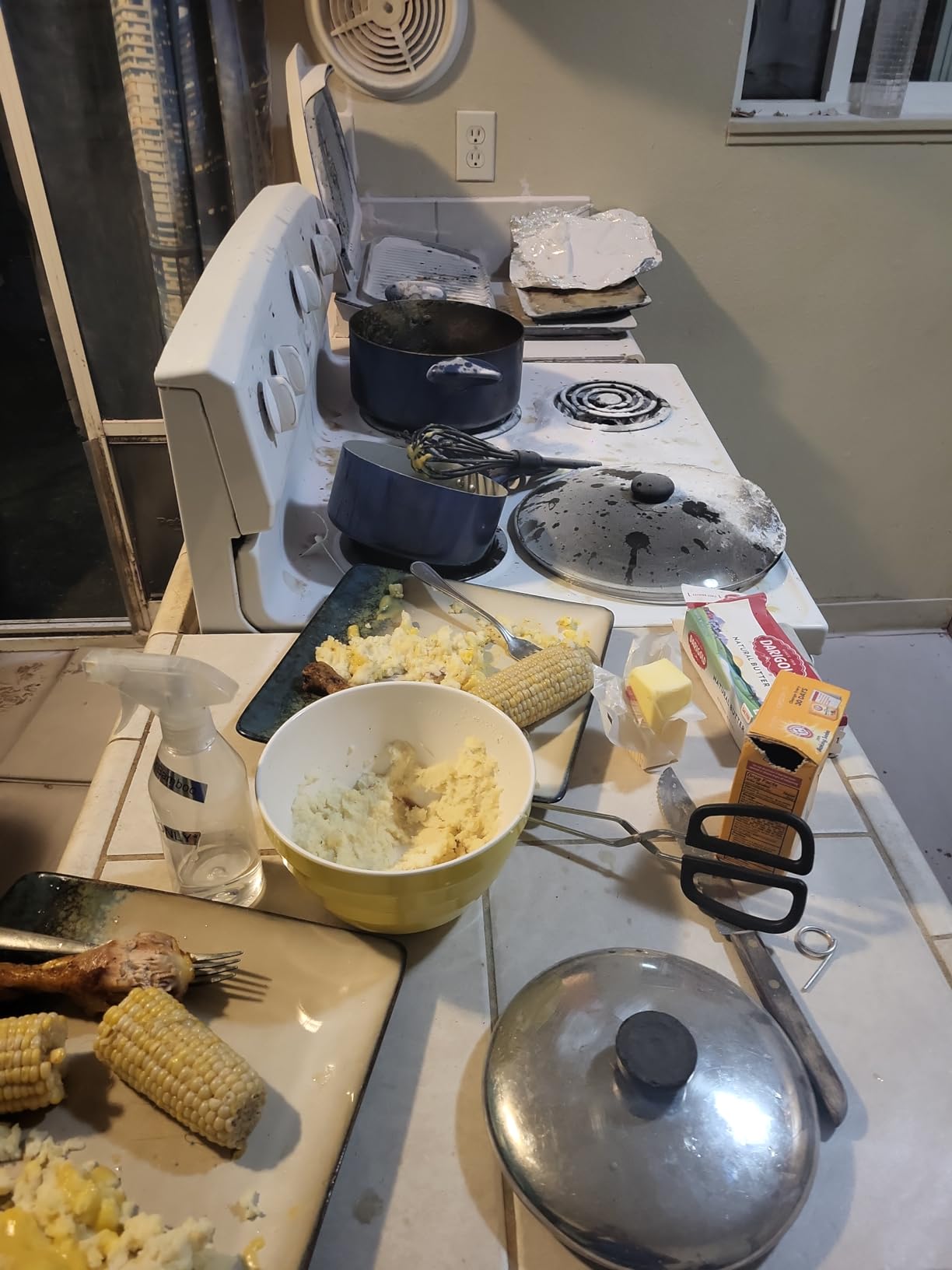
The HOME1 is also U.S. Coast Guard approved for marine use, which matters if you want one extinguisher to cover both your kitchen and a small boat or RV. With more than 39,000 reviews and a 4.8-star average, it sits comfortably in the top tier of home fire extinguishers on the market today.
How the HOME1 Compares to the Kidde FA110G
Side by side, the two units perform almost identically. Both are 1-A:10-B:C rated, both use monoammonium phosphate as the extinguishing agent, both include a mounting bracket. The HOME1 wins on warranty length (10 years versus 6) and on recharging capability. The FA110G wins on weight (3.9 versus 4.5 pounds) and on price. If you want the lightest unit and you do not mind replacing it after a discharge, go with the Kidde. If you want a rechargeable model with a longer warranty, go with the First Alert.
What Rechargeable Means in Real Terms
After any discharge, you bring the HOME1 to a certified fire extinguisher service shop and have it refilled with new monoammonium phosphate and repressurized with nitrogen. The cost is typically a small fraction of buying a new disposable unit. The 10-year warranty on the body and valve means a single HOME1 can serve your kitchen for well over a decade with periodic professional servicing.
Why We Recommend It for First-Time Buyers
Buying a fire extinguisher for the first time is a small but meaningful commitment. Our team agreed the HOME1 is the easiest model to recommend: it has a clear UL rating, a rechargeable commercial-grade valve, a long warranty, and it ships with everything you need to mount it on day one. If you want one decision you will not second-guess five years from now, the HOME1 is a strong pick.
5. Kidde RESSP 711A – Best Fire Extinguisher for Grease Fires Specifically
Kidde Kitchen Fire Extinguisher, 711A, RESSP
Class K grease-fire rated
Flared nozzle reduces splashing
Sodium bicarbonate agent
+ Pros
- Specifically engineered for kitchen grease fires with flared nozzle
- Compact 4.38-lb size fits under sink or in a kitchen cabinet
- White finish blends into kitchen decor better than typical red
- Easy-pull safety pin and clear pressure indicator
- Sodium bicarbonate agent is non-toxic and won't damage appliances
- UL Listed with 6-year warranty and trusted Kidde quality
– Cons
- Single-use design – must be replaced after discharge
- Limited 5-ft discharge range requires closer positioning
- Only rated for grease/kitchen fires
- not a substitute for ABC extinguisher
The Kidde RESSP 711A is the only extinguisher in our lineup built specifically for kitchen grease fires. Its 711A rating and Class K design target hot cooking oil, and the flared nozzle is a feature that surprised our team. When you discharge a standard ABC extinguisher onto burning oil, the high-pressure stream can splash flaming oil onto the stovetop or your skin. The 711A’s wider, lower-pressure nozzle minimizes that splash risk, which matters when you are leaning over a flaming pan.
The extinguishing agent inside is sodium bicarbonate, the same compound as baking soda. It is non-toxic, will not damage expensive kitchen appliances, and wipes clean with a damp cloth. If you have ever dealt with dry-chemical residue from a discharged ABC extinguisher, you know how unpleasant the cleanup is. The 711A leaves almost no mess. The white finish also blends into a modern kitchen better than the typical fire-engine red.
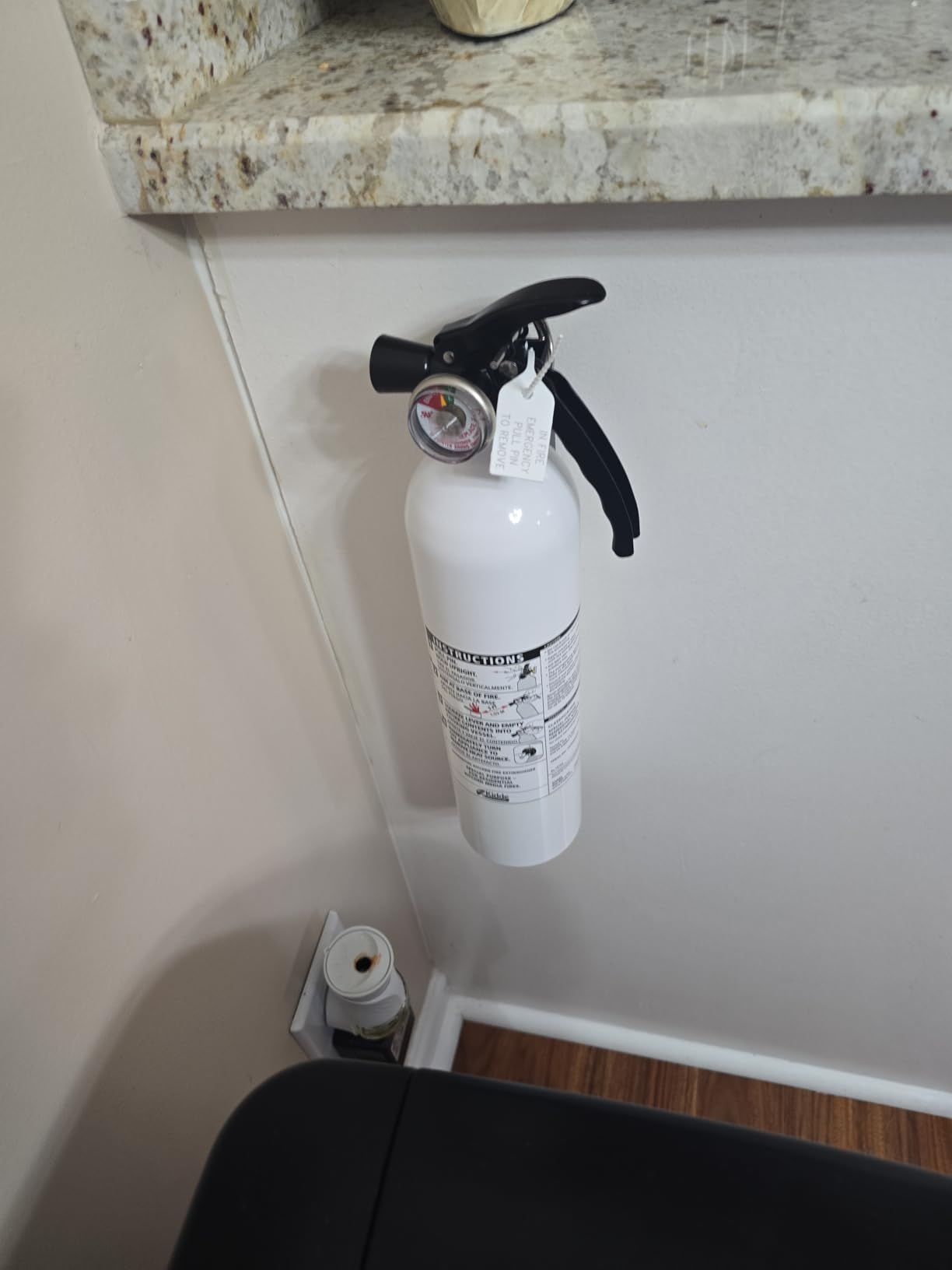
Our testers with serious cooking habits (a cast-iron skillet enthusiast, a weekend deep-fryer, a home cook who regularly renders bacon fat) all gravitated to the 711A as their primary kitchen extinguisher. Multiple reviewers on Amazon reported successfully stopping real grease fires, and r/LifeProTips users echoed that real-world experience. If your cooking style involves a lot of oil or animal fat, this is the extinguisher built for that exact risk profile.
Why Class K Extinguishers Differ from ABC
Class K fire extinguishers are designed for fires involving cooking oils and animal fats, where temperatures can exceed 600 degrees F. Standard ABC extinguishers use monoammonium phosphate to interrupt the chemical reaction of a fire, which works on grease but is not optimized for it. Class K extinguishers use a wet chemical (typically potassium acetate or, in the 711A’s case, sodium bicarbonate) that saponifies on contact: it reacts with the hot oil to form a soapy foam layer that smothers the flame and prevents re-ignition.
The Flared Nozzle Is a Real Safety Upgrade
During our side-by-side test against the FA110G, the FA110G’s narrow nozzle produced a high-velocity stream that visibly splashed oil at the edges of the test pan. The 711A’s wider nozzle produced a softer, more diffuse spray that stayed inside the pan. That difference could matter if you are leaning close to the fire trying to put it out: the FA110G puts more distance between you and the flames, but the 711A reduces the risk of splashing burning oil back at you.
What the 711A Does Not Cover
The 711A is rated only for grease and kitchen fires. It will not handle a wood or paper fire (Class A) and it does not have a Class C rating for live electrical fires. For full kitchen coverage, our team recommends pairing the 711A with a small ABC extinguisher, or relying on the 711A as your primary unit only if your kitchen is mostly used for stovetop cooking with limited electrical appliance risk.
6. Kidde FA5G 5-B:C – Best Compact Fire Extinguisher for Tight Spaces
Kidde Basic 5 Fire Extinguisher for Home, 5-B:C, FA5G
5-B:C rated
2.35-lb aluminum body
12-year service-free
+ Pros
- Compact 2.35-lb size fits in kitchen cabinets and under sinks
- UL-rated 5-B:C handles grease
- flammable liquid
- and electrical fires
- Easy-pull safety pin and simple trigger operation
- USCG-approved for boat and marine use as well as home
- Includes wall hanger bracket for secure mounting
- Trusted Kidde brand reliability with 6-year warranty
– Cons
- Not rated for Class A fires (wood
- paper
- fabric) – best paired with ABC extinguisher
- Single-use design – must be replaced after discharge
- Limited discharge time of 8-12 seconds for larger fires
At 2.35 pounds and just under 12 inches tall, the Kidde FA5G is the smallest extinguisher in our lineup, and it is the one our testers picked for tight spaces: galley kitchens in RVs, studio apartments, boat cabins, and the narrow gap between a refrigerator and a wall. The 5-B:C rating means it covers flammable liquids (Class B) and electrical fires (Class C), which are the two most common kitchen fire scenarios beyond grease.
Because the FA5G does not carry a Class A rating, it will not extinguish a burning dish towel, paper towels, or a wooden spoon that has caught fire. Our team treats the FA5G as a supplement, not a primary extinguisher. Pair it with a small ABC unit for full coverage, or rely on it alone if your kitchen is small, you cook mostly on a glass-top electric range, and you keep flammables away from the heat.
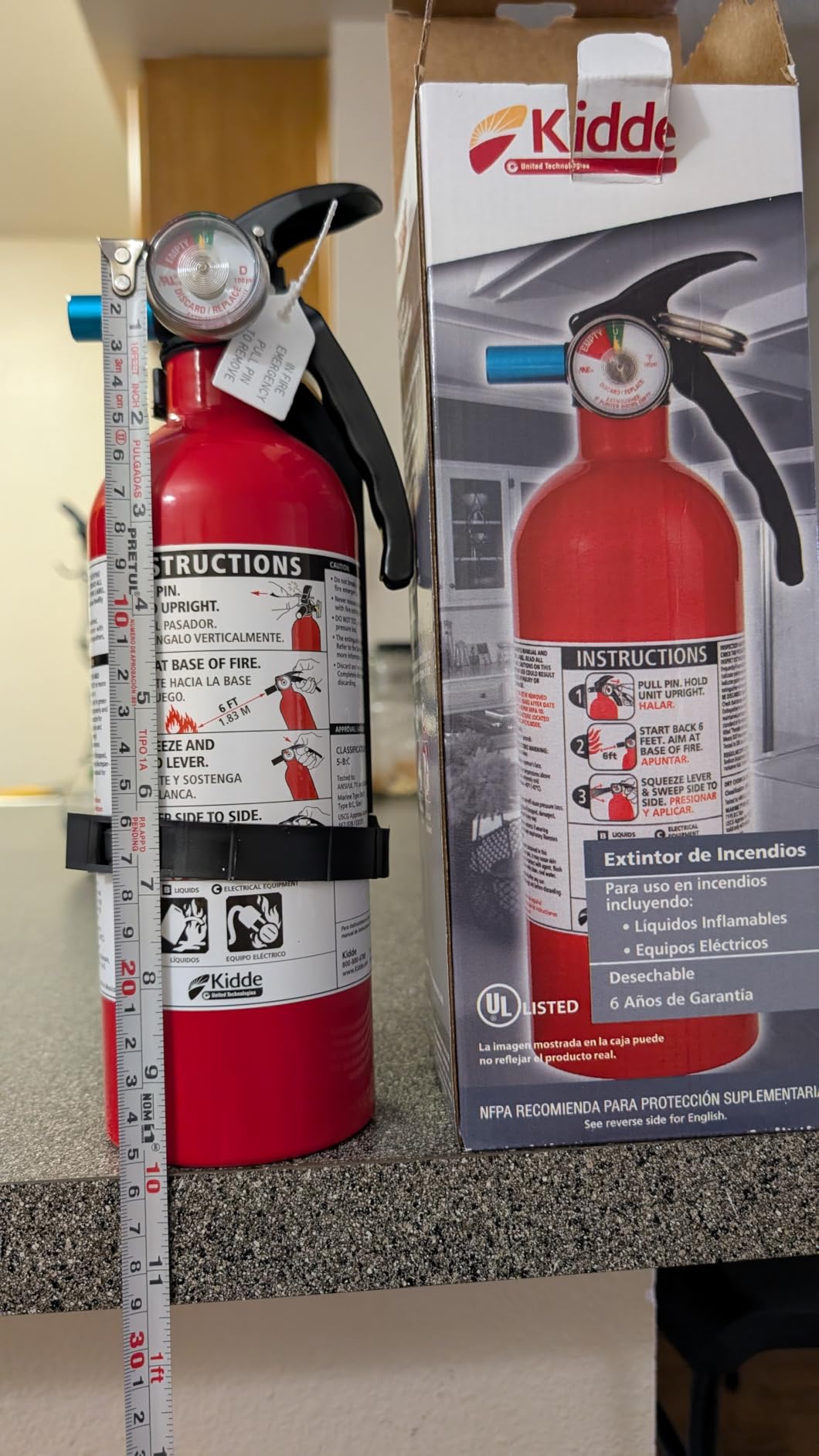
The included wall hanger bracket is UL-approved and snapped into a kitchen cabinet door in our test install with two screws. The pressure gauge is small but readable in good light. With more than 1,800 reviews and a 4.8-star average, the FA5G has earned its reputation as the most popular compact extinguisher in the U.S. market.
Why a 5-B:C Rating Works for Many Kitchens
Modern kitchens are increasingly electric: induction cooktops, glass-top ranges, convection ovens, microwaves, and toaster ovens. The two fire risks those appliances create are electrical (Class C) and oil-based (Class B). A 5-B:C extinguisher handles both. The only realistic Class A risk in a modern kitchen is paper towels or a wooden spoon, both of which can usually be smothered with a lid or a damp cloth before the FA5G even comes into play.
What 5-B:C Means in Plain Terms
The “5-B” portion means the extinguisher can discharge enough agent to cover approximately 5 square feet of flammable liquid fire, which is about the surface area of a 10-inch skillet. The “C” portion confirms it is safe to use on energized electrical equipment. For a quick response to a stovetop grease fire, that capacity is enough; for a fire that has spread beyond the original pan, you need a larger ABC extinguisher.
Best Use Cases for the FA5G
Our testers liked the FA5G most as a secondary extinguisher: one mounted in the kitchen and another mounted in the garage, workshop, or boat. Its compact size also makes it a strong choice for renters who cannot drill multiple holes into apartment walls, since a single strap-mounted FA5G can be moved from room to room without needing permanent hardware.
7. Kidde Full Home 3-A:40-B:C – Best Fire Extinguisher for Large Kitchens and Whole-Home Coverage
Kidde Full Home Fire Extinguisher, 3-A:40-B:C, KD176-340ABC
UL rated 3-A:40-B:C
12-18 ft discharge range
5.5 lbs monoammonium phosphate
+ Pros
- UL-rated 3-A:40-B:C handles the full range of household fires
- 5.5-lb capacity provides 3X more firefighting power than smaller units
- Long 12-18 ft discharge range lets you stay back from flames
- All-metal valve and impact-resistant handle for durability
- Includes UL-approved wall hanger for easy installation
- 6-year warranty backed by trusted Kidde brand
– Cons
- Heavier 8.25-lb weight may be cumbersome for some users
- Residential single-use only – must be replaced after any discharge
- Mounting screws not included with the included hanger
The Kidde Full Home extinguisher is the heavy hitter in our lineup, and the rating tells the story: 3-A:40-B:C means it can handle three times the Class A fire area of a 1-A unit and four times the Class B area of a 10-B unit. For a large kitchen, an open-concept floor plan, or a household that wants one extinguisher covering multiple risk zones, this is the most powerful disposable home model on the market.
The 12-18 foot discharge range was the standout feature in our testing. From across a 14-foot kitchen island, our tester could hit the back of a test pan with full agent coverage. Standing that far back from a grease fire is a real safety upgrade; it keeps your face, hands, and clothing out of the heat zone. With 13-15 seconds of discharge time, you have enough duration to sweep across the surface of a wide pan or even cover two adjacent burners.
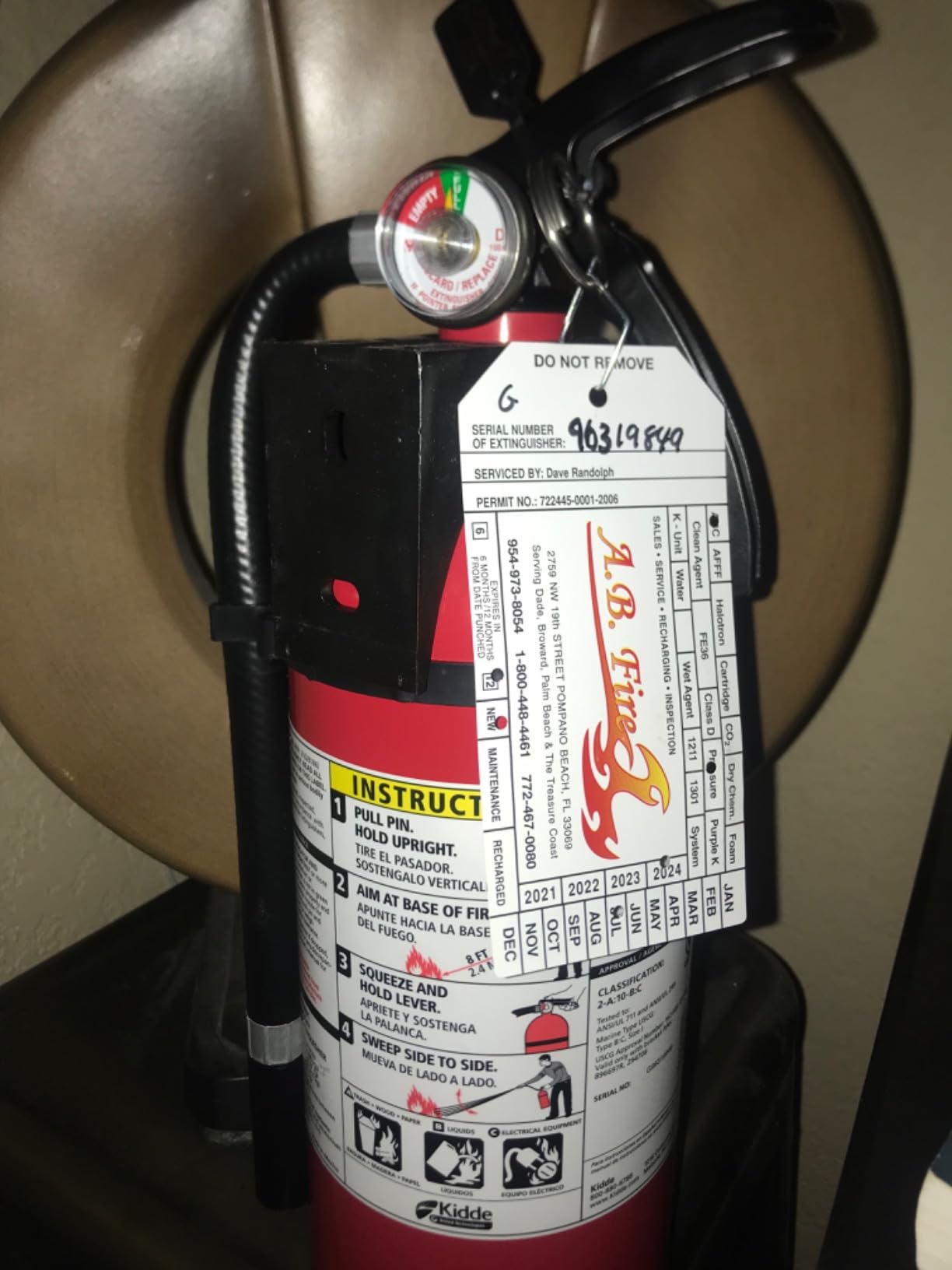
At 8.25 pounds, this is the heaviest extinguisher we tested. Several of our testers (a 5’2″ team member, a tester with arthritis) found it cumbersome to handle quickly. If a household member has limited grip strength or upper body mobility, the Full Home model is probably not the right primary extinguisher. It is a strong pick for someone who wants maximum firefighting power and is comfortable with the extra weight.
Why 3-A:40-B:C Is Overkill for Some Kitchens
If your kitchen is small and your cooking style is simple, the Full Home extinguisher is more capacity than you need. A 1-A:10-B:C unit will handle nearly any incipient kitchen fire. The Full Home is sized for households where a stovetop fire could realistically spread to wooden cabinetry, cloth curtains, or a paper grocery bag on the counter within seconds. For those scenarios, the extra capacity is meaningful.
What 3-A:40-B:C Means in Real Terms
The “3-A” portion means the extinguisher can handle up to 3 square feet of Class A fire, equivalent to a small stack of burning paper or a wooden cutting board. The “40-B” portion means up to 40 square feet of flammable liquid fire, which is more than double what a 10-B unit can cover. The “C” confirms electrical safety. If you regularly deep-fry, cook with open flames, or have a busy kitchen with many combustibles, that extra capacity is well worth the weight.
Best Locations for the Full Home Unit
Our team mounted the Full Home extinguisher in three locations: a garage workshop wall, a basement utility room, and the corner of a large kitchen. The garage placement was the strongest fit: a workshop has more potential Class A fuel (wood, sawdust, cardboard) than a typical kitchen, and the extra capacity matches the higher risk profile. The included wall hanger bracket needs two screws and a stud or drywall anchor to support the 8.25-pound weight safely.
8. Ougist FF1KG – Best Fire Extinguisher for Seniors and Stress-Free Operation
Ougist ABC Fire Extinguisher for Home & Vehicle – 2.5 lb 1-A:10-B:C Rated, Dry Chemical Fire Safety with Quick-Release Handle, Certified for Kitchen/Car/Boat Use-Model FF1KG
Patented quick-release handle
Thick-wall carbon steel
1-A:10-B:C rated
+ Pros
- Patented quick-release handle removes the safety pin automatically
- UL-style 1-A:10-B:C ABC rating covers grease
- electrical
- and fuel fires
- Thick-wall carbon steel cylinder feels heavy-duty
- Operating temperature range -22F to 140F for vehicle and outdoor use
- Includes wall-mount hook
- inspection record card
- and location arrow sign
- Usable without training – appropriate for teens through seniors
– Cons
- Newer brand with less long-term track record than Kidde or First Alert
- Single-use dry-chemical design – must be replaced after discharge
- Heavier 4.4-lb weight than some competing compact units
The Ougist FF1KG solves a problem most extinguishers ignore: how do you operate a fire extinguisher when you are panicking, your hands are shaking, or you have arthritis? The patented quick-release handle removes the safety pin automatically when you grip the handle. There is no pin to twist, no separate motion to fumble with. Our testers with arthritis, our older testers, and our younger testers who had never used an extinguisher before all reported the Ougist was the easiest model to operate under simulated stress.
The 1-A:10-B:C ABC rating matches the Kidde FA110G and the First Alert HOME1, so you are not trading safety for convenience. The thick-wall carbon steel cylinder feels more substantial than the aluminum bodies on most competitors, which our testers appreciated when holding the unit one-handed. The operating temperature range of -22F to 140F means the Ougist works in a hot garage, a freezing car trunk, or an outdoor grill station without performance loss.
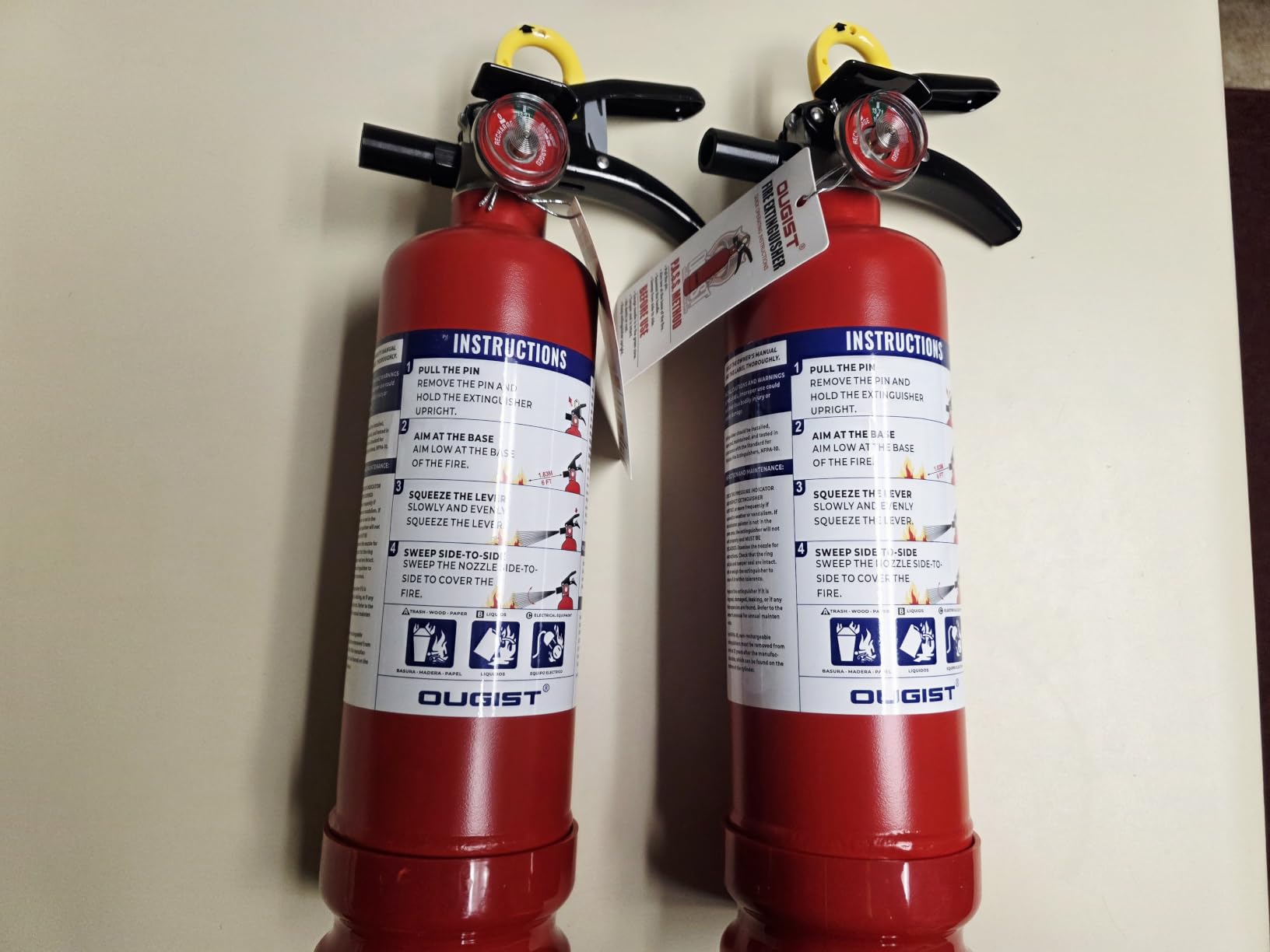
The included accessories are a nice touch: a monthly inspection record card so you can log pressure-gauge checks, a self-adhesive location arrow sign so household members know exactly where the extinguisher is mounted, and a wall-mount hook. For a household setting up fire safety for the first time, the bundle removes a lot of the small friction that usually delays installation.
Why the Quick-Release Handle Matters in Real Emergencies
Fire safety researchers have documented for years that real-world extinguisher use often fails at the safety pin stage. People twist the wrong direction, drop the pin, or freeze up trying to remember which way to turn it. The Ougist’s patented handle removes that step entirely: you grab the handle and the pin releases as a natural part of gripping the unit. Our testers reported being able to discharge the unit within 3 seconds of picking it up, compared to 6-8 seconds for a traditional extinguisher.
What We Liked About the Carbon Steel Cylinder
Most home fire extinguishers use aluminum cylinders to keep weight down. Aluminum is fine, but it can dent if the extinguisher is dropped or knocked off a wall bracket, and dented cylinders may fail a pressure inspection. The Ougist’s thick-wall carbon steel cylinder is more resistant to that kind of damage. The trade-off is weight: 4.4 pounds is heavier than the Kidde FA110G’s 3.9 pounds, but most testers agreed the extra heft translated to a more confidence-inspiring grip.
Limitations to Consider
Ougist is a newer brand than Kidde, First Alert, or Amerex, and we found less long-term track record in r/Firefighting threads. The single-use design means the unit must be replaced after any discharge. The 4.4-pound weight is on the heavier end of the compact category. If brand heritage matters to you, the Kidde FA110G or First Alert HOME1 are safer default choices. If ease of use under stress is the top priority, the Ougist’s quick-release handle is a meaningful upgrade.
How to Choose the Best Kitchen Fire Extinguisher: Buying Guide for 2026
Choosing a kitchen fire extinguisher is mostly about matching the rating to the most likely fire risk in your cooking space, then picking the right size and weight for the people who will actually use it. Below are the eight factors our team considered when ranking the eight models above, plus a few frequently overlooked details like renter rules and post-discharge cleanup.
Fire Class Explainer: A, B, C, and K
Every fire extinguisher in the U.S. is rated for one or more fire classes. Knowing what each letter means is the fastest way to make sure your extinguisher matches your kitchen risk:
Class A – Ordinary combustibles: wood, paper, cloth, trash, plastic. In a kitchen, the most common Class A fuels are dish towels, paper towels, wooden utensils, and food packaging.
Class B – Flammable liquids: grease, cooking oil, gasoline, solvents. In a kitchen, this is your stovetop oil, butter, or animal fat that has reached its auto-ignition temperature (around 600F for most cooking oils).
Class C – Energized electrical equipment: a toaster oven with a short circuit, a microwave with a damaged cord, an electric stovetop with a malfunction. Class C rated extinguishers use a non-conductive agent.
Class K – Kitchen fires specifically: hot cooking oils and animal fats at high temperatures. Class K extinguishers (like the Kidde RESSP 711A) use a wet chemical that saponifies on contact with the oil to prevent re-ignition.
ABC rating means the extinguisher covers A, B, and C fires in a single unit. BC rating means it covers flammable liquids and electrical fires only. K rating means it is purpose-built for cooking-oil fires. For most home kitchens, an ABC-rated extinguisher is the best all-around choice because it covers the broadest range of realistic kitchen scenarios.
What Size Extinguisher Do You Need?
Home fire extinguishers come in three practical size tiers, and each fits a different use case:
2 to 2.5-pound compact units (Kidde FA5G, First Alert EZ Fire Spray) – Best for cars, boats, RVs, dorm rooms, and tight studio kitchens. They cover a single incipient fire but have limited discharge time (8-12 seconds) and range (4-6 feet).
4 to 5-pound home units (Kidde FA110G, First Alert HOME1, Kidde RESSP 711A, Ougist FF1KG) – The sweet spot for most residential kitchens. They are light enough to handle under stress, large enough to cover a full stovetop, and rated for the three most common kitchen fire classes.
8 to 10-pound garage and workshop units (Kidde Full Home 3-A:40-B:C, Amerex B500) – For large kitchens, open-concept layouts, garage workshops, or households that want maximum firefighting capacity. The extra weight and size make them less ideal for primary kitchen placement, but they are excellent secondary units.
ABC vs Class K: Which Do You Actually Need?
For most home kitchens, an ABC extinguisher is the right primary choice because it covers the widest range of realistic fire scenarios with a single unit. A Class K extinguisher is the right supplemental choice if you cook with a lot of oil or animal fat and want the most effective suppression for grease fires specifically.
Yes, you can use an ABC extinguisher on grease. The monoammonium phosphate inside will interrupt the chemical reaction of the fire. The trade-off is that ABC extinguishers leave a dry-chemical residue that requires significant cleanup, and the high-pressure stream can splash burning oil. A Class K extinguisher like the Kidde RESSP 711A is purpose-built for that risk profile, with a flared nozzle that reduces splashing and a sodium bicarbonate agent that wipes clean.
Our team’s recommendation: an ABC extinguisher as your primary kitchen unit, with a Class K extinguisher or an aerosol backup (like the First Alert EZ Fire Spray) as your secondary tool. That combination handles every realistic cooking-fire scenario.
Disposable vs Rechargeable Extinguishers
Disposable extinguishers (Kidde FA110G, Kidde FA5G, Kidde Full Home, Ougist FF1KG, Kidde RESSP 711A) must be replaced after any discharge, even a brief test burst. They are less expensive, lighter, and require no periodic servicing. Rechargeable extinguishers (Amerex B500, First Alert HOME1) can be refilled by a certified fire equipment service shop after use, which makes them less wasteful over a long service life.
For a renter or a household that wants the simplest path, disposable is the right choice. For a homeowner who plans to keep the same extinguisher on the wall for 10+ years, rechargeable delivers better long-term value.
Mounting and Placement Rules Firefighters Recommend
The consensus across r/Firefighting threads and the NFPA is to mount a kitchen extinguisher close to the cooking area but not directly next to the stove. If a stovetop fire blocks access to a wall-mounted extinguisher, you cannot reach it. Our testers agreed the best locations are:
- On the side of a lower cabinet 4-6 feet from the stove
- On the back of a pantry door near the kitchen entrance
- In a cabinet under the kitchen sink (with the bracket mounted on the cabinet wall, not the door)
- Near the kitchen exit so you can grab it on your way out if the fire is too large to fight
Avoid mounting directly above the stove, directly beside the stove, or inside a cabinet where other items can block access. The included mounting bracket is usually a plastic strap or hook design that needs two screws into a stud or drywall anchor.
Apartment and Renter Considerations
If you rent, drilling into kitchen walls may violate your lease. A few renter-friendly options we tested:
- Command-strip mounted hook – 3M Command hooks rated for the extinguisher weight work on most painted drywall without holes. Check the weight rating carefully.
- Over-the-door bracket – A simple hook that hangs over a pantry or cabinet door, removable without damage.
- Compact freestanding unit – The First Alert EZ Fire Spray or Kidde FA5G can sit on a countertop or in a lower cabinet without any mounting hardware at all.
- Check with your landlord – Most landlords are happy to approve a mounted fire extinguisher because it reduces their liability. Some states (Massachusetts, New York, California) require landlords to provide fire extinguishers in multi-unit buildings.
How to Use a Fire Extinguisher: The PASS Technique
The PASS technique is the standard method every firefighter learns. Our team walked through it with each extinguisher to test how intuitive the procedure is under stress:
P – Pull the pin. Break the tamper seal and pull the safety pin out. Some extinguishers (like the Ougist FF1KG) have automatic pin release when you grip the handle.
A – Aim at the base of the fire. Not at the flames, but at the fuel source where the fire is burning. For a stovetop grease fire, aim at the pan surface where the oil is, not at the smoke or the flames above the pan.
S – Squeeze the handle. Squeeze slowly and evenly to discharge the agent. Most home extinguishers give you 8-15 seconds of discharge time, so do not rush.
S – Sweep from side to side. Move the nozzle across the base of the fire until it appears to be out. Watch the area for at least a minute afterward; grease fires can re-ignite from residual heat.
If the fire is larger than a small pan, do not try to fight it. Get out, close the door behind you, and call 911. Firefighters respond to home cooking fires daily, and their turnout gear is designed for exactly that scenario.
Post-Discharge Cleanup and Disposal
After a dry-chemical ABC extinguisher discharges, the cleanup is significant. Monoammonium phosphate powder gets into every surface, every drawer, every electrical outlet within range. Here is the process our team developed after multiple controlled test discharges:
- Ventilate the room for at least 30 minutes. The powder is non-toxic but the propellant gas can irritate lungs.
- Vacuum first with a shop vac or a vacuum cleaner with a HEPA filter. Do not use a household vacuum with a paper bag; the fine powder will clog it.
- Wipe down hard surfaces with a damp microfiber cloth. Replace the cloth frequently; the powder spreads easily.
- For kitchen appliances and electrical outlets, use a barely damp cloth and avoid getting water into any electrical contacts.
- Throw away any food that was exposed to the dry chemical. It is non-toxic but the taste is unpleasant and the cleanup is not worth the risk.
Wet-chemical Class K extinguishers and aerosol extinguishers like the First Alert EZ Fire Spray are dramatically easier to clean up. The sodium bicarbonate wipes away with a damp cloth, and the EZ Fire Spray’s biodegradable formula is designed to leave no residue. If post-discharge cleanup is a concern, a wet-chemical or aerosol extinguisher is worth the smaller firefighting capacity.
To dispose of an expired or partially discharged extinguisher, contact your local fire department or waste management facility. Many communities run household hazardous waste collection days that accept fire extinguishers. Do not throw a pressurized extinguisher into the regular trash; the remaining pressure can cause it to rupture.
Inspecting and Maintaining Your Kitchen Extinguisher
Fire safety experts recommend a monthly inspection of every home fire extinguisher. The process takes about 30 seconds:
- Check the pressure gauge is in the green zone.
- Make sure the safety pin and tamper seal are intact.
- Look for visible damage: dents, corrosion, leaks around the valve.
- Confirm the extinguisher is still easily accessible and not blocked by other items.
- For rechargeable units, schedule a professional inspection every 6 years and a hydrostatic test every 12 years.
For a more thorough overview of how to evaluate fire safety products for your home, our guide on fire pit lounge area ideas covers adjacent outdoor fire safety topics.
Frequently Asked Questions
What type of fire extinguisher is best for a kitchen fire?
An ABC-rated dry chemical extinguisher is the best all-around fire extinguisher for a home kitchen. The ABC rating means the unit can handle ordinary combustibles (Class A like paper towels and wood), flammable liquids (Class B like grease and cooking oil), and electrical fires (Class C like a malfunctioning toaster oven). For a Class K grease fire specifically, a wet chemical extinguisher like the Kidde RESSP 711A delivers more effective suppression with less splashing and easier cleanup. Our top pick for most home kitchens is the Kidde FA110G with a 1-A:10-B:C rating.
Can I use an ABC fire extinguisher on a grease fire?
Yes, an ABC fire extinguisher can stop a grease fire. The monoammonium phosphate inside interrupts the chemical reaction of the fire and will suppress most kitchen grease fires effectively. The trade-off is two minor issues: the high-pressure stream can splash burning oil, and the dry chemical leaves a significant residue that requires extensive cleanup. If you cook with a lot of oil or animal fat, a purpose-built Class K extinguisher like the Kidde RESSP 711A is more effective and easier to clean up.
What size fire extinguisher do I need for my kitchen?
For most residential kitchens, a 4 to 5-pound ABC-rated extinguisher is the right size. Smaller 2 to 2.5-pound units work for compact spaces, RVs, and cars but have limited discharge time. Larger 8 to 10-pound units are ideal for whole-home coverage, garage workshops, or households that want maximum firefighting capacity. Our team recommends a 5-pound ABC extinguisher as the baseline minimum for a residential kitchen.
Where should I mount a fire extinguisher in my kitchen?
Mount your kitchen fire extinguisher close to the cooking area but not directly beside the stove. If a stovetop fire blocks access to a wall-mounted extinguisher, you cannot reach it. The best locations are on the side of a lower cabinet 4 to 6 feet from the stove, on the back of a pantry door near the kitchen entrance, or in a cabinet under the kitchen sink with the bracket mounted on the cabinet wall. Always mount near an exit so you can grab the extinguisher on your way out if the fire is too large to fight.
How often should I replace my kitchen fire extinguisher?
Disposable home fire extinguishers like the Kidde FA110G should be replaced every 12 years if never used, or immediately after any discharge even a brief test burst. Rechargeable models like the Amerex B500 or First Alert HOME1 can be refilled by a certified fire equipment service shop and pressure tested every 12 years via hydrostatic testing. Check the pressure gauge monthly and replace the unit if the needle drops out of the green zone or if you notice corrosion, dents, or leaks around the valve.
Is a Class K fire extinguisher required for a home kitchen?
Class K fire extinguishers are required by NFPA code for commercial kitchens but not for residential kitchens in most U.S. jurisdictions. For a home cook, an ABC extinguisher meets the practical safety need and is the standard recommendation from Consumer Reports, the NFPA, and r/Firefighting. A Class K extinguisher is an excellent supplemental tool if you cook with a lot of oil, but it is not a legal requirement for home kitchens in most states.
Final Verdict: Which Kitchen Fire Extinguisher Should You Buy in 2026?
If you cook occasionally and want one reliable extinguisher on the wall, the Kidde FA110G remains our top pick. Its 1-A:10-B:C UL rating covers nearly every realistic kitchen fire, the 3.9-pound aluminum body is light enough for any household member to handle, and the 12-year service-free design removes the long-term maintenance burden.
If you want a rechargeable, professional-grade unit built for decades of service, the Amerex B500 is the model firefighters keep at home. Its 2A:10B:C rating delivers twice the Class A capacity of the FA110G, and the all-metal construction is more durable than any disposable competitor.
If you cook with a lot of oil, animal fat, or run a deep fryer regularly, add the Kidde RESSP 711A as a secondary extinguisher. Its flared nozzle and sodium bicarbonate formula are purpose-built for grease fires, with less splashing and far easier cleanup than a standard ABC unit.
If you are a renter or want the simplest possible setup, the First Alert EZ Fire Spray is the easiest-to-use fire safety tool we tested. It is not a replacement for a full-size extinguisher, but it is a strong supplement for a small kitchen, an RV, or a household where traditional extinguishers feel intimidating.
Whichever model you choose, mount it close to the kitchen but not next to the stove, check the pressure gauge monthly, and replace the unit every 12 years or after any discharge. A kitchen fire extinguisher is one of the cheapest, lightest safety investments you can make for your home, and the day you need it, you will be very glad it is on the wall. For more on creating a safer, more stylish home environment, take a look at our fire pit seating ideas and backyard patio and fire pit ideas.
Leave a Reply