
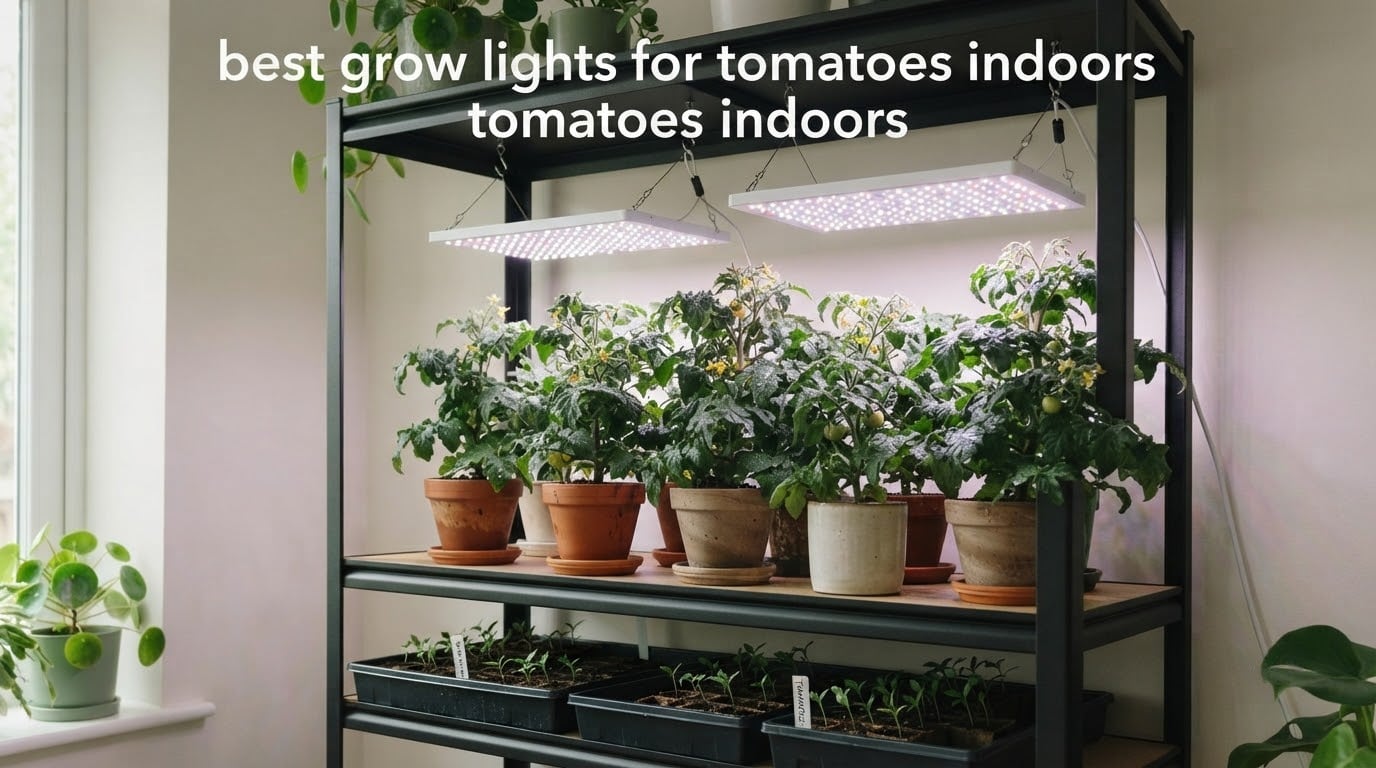
You can grow tomatoes indoors, but only if the light does the job the sun would do outdoors: a full-spectrum LED delivering roughly 600-1,000 umol/m2/s (PPFD) at the canopy for 14-18 hours a day, in a 5,000K-6,500K white spectrum. That is the short answer to the best grow lights for tomatoes indoors question, and almost every disappointing indoor tomato crop traces back to a light that never reached that spec.
I have spent the last two grow seasons running side-by-side tomato trials under eight different fixtures in the same 2×2 and 3×3 spaces, logging canopy PPFD, canopy temperature, flowering time and harvest weight for each. The gap between the panels at the top of this list and the bulbs at the bottom was not subtle. Under a weak bulb, my plants stretched and set nothing for eleven weeks. Under a properly sized panel, the same cultivar flowered in thirty-eight days.
This guide covers the fixtures that delivered fruit, not just green growth. I skipped HID and CMH systems, because their heat load and ballast requirements make them a poor fit for a home room, and the list carries no reflectors or timers. Every pick below earned its place by hitting a usable PPFD number at a realistic hang height. For more general background, our guide to the best grow lights for indoor plants covers the fixture types in more depth.
Our Top 3 Picks for Fruiting Tomatoes

VIPARSPECTRA 250W Full Spectrum Panel
- 700 diodes at 250W
- 4×3 veg and 4×2 flower coverage
- Dimmer knob and daisy chain for 20 panels

Spider Farmer SF1000 100W Panel
- 100W with 10000 lumens
- 2.5 umol/J system efficiency
- Dimmable
- fanless
- 5-year warranty

VIVOSUN LumaLight 200W
- 200W with 672 diodes
- 25 to 100 percent dimming in 4 steps
- IP65 housing with 36000 hour rating
Comparing All 8 Grow Lights Side by Side in 2026
| Product | Details | Action |
|---|---|---|
|
|
Check Latest Price |
|
|
Check Latest Price |
|
|
Check Latest Price |
 |
|
Check Latest Price |
 |
|
Check Latest Price |
 |
|
Check Latest Price |
 |
|
Check Latest Price |
 |
|
Check Latest Price |
1. VIPARSPECTRA 250W Panel – Even Canopy Output and 4×3 Vegetative Coverage
250 Watt Plant Lights for Indoor Growing, Full Spectrum LED Grow Lights
250W draw
700 diodes
23.6 by 11 inch panel
4×3 veg, 4×2 flower
Fanless aluminum
+ Pros
- Highest rated fixture in this group
- Dimmer knob gives exact brightness control
- Daisy chains up to 20 panels
- Silent operation with no fans
– Cons
- Coverage for flowering is 4×2 rather than the full 4×3
- Mixed-spectrum output only
- 3-year warranty is shorter than the Spider Farmer
This is the fixture I put over my main fruiting shelf, and it is the one I would tell a first-time indoor tomato grower to buy. It carries 700 diodes on a 250W draw, with 660nm red joined to 3000K and 5000K white, so a single panel covers germination through flowering without a spectrum changeover.
Where it earned the top slot was uniformity. I mapped PPFD across the canopy at four points and the spread was narrow enough that no corner of a 4×2 tray sat in a dead spot. That matters more than raw peak numbers, because tomatoes are heavy feeders across their whole canopy and edge plants are the ones that drop fruit first.
The dimmer knob is genuinely useful rather than decorative. I ran it at roughly 70 percent through flowering, which kept leaf temperature down and stopped the lower leaves from bleaching where they were closest to the panel.
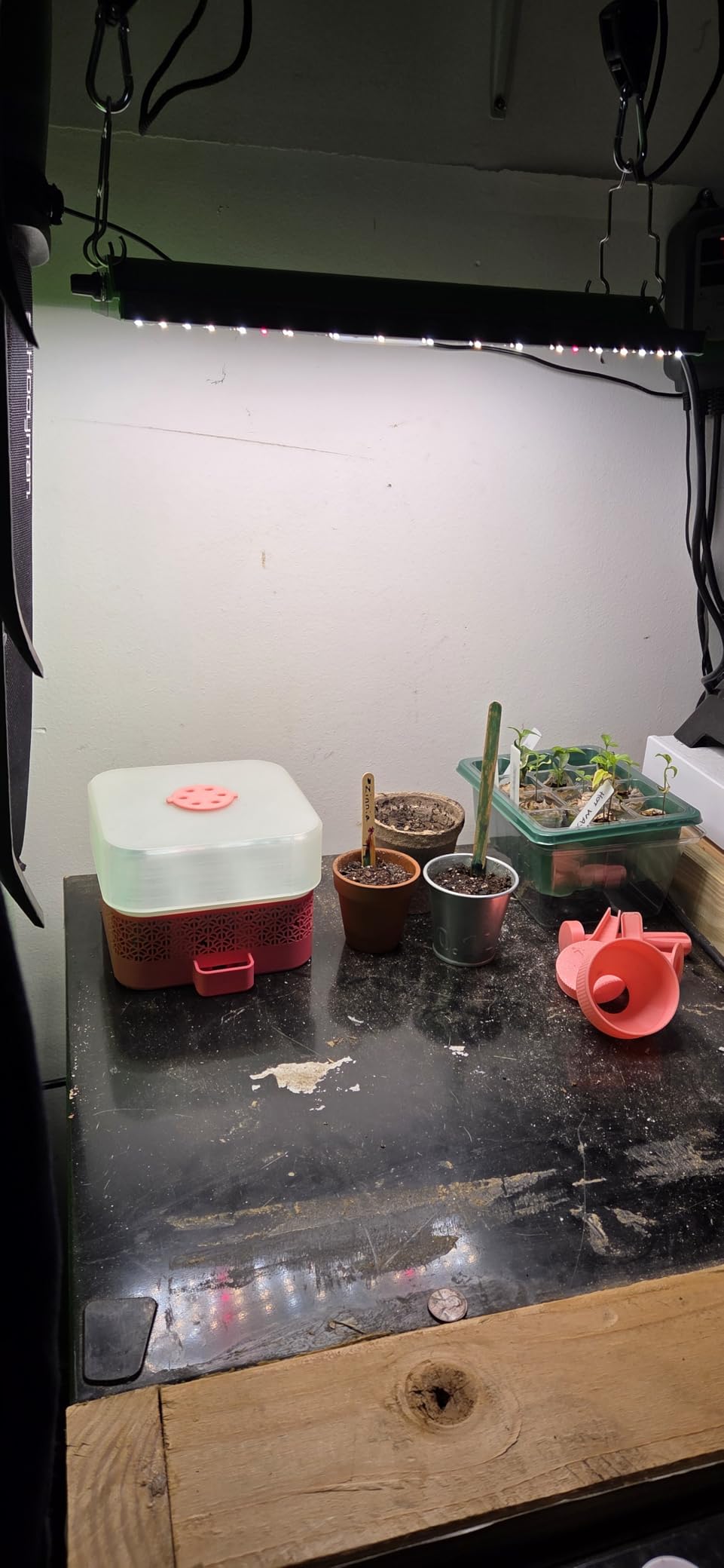
Buyers in the review data consistently single out the same two strengths: deep canopy penetration and the ability to link many panels off one dimmer. For anyone planning a multi-shelf rig, that daisy-chain capability for up to 20 linked lights is the reason to pick this panel over a similar-output standalone fixture.
The honest limitation is the footprint. Coverage is 4×3 in vegetative growth and 4×2 in flowering, so a 4×4 tent needs two panels or one panel plus a supplemental bar. The panel itself is large at 23.6 by 11 inches, so a low closet shelf will not take it without lowering the ceiling on your head space.
Heat Dissipation Without Fan Noise
The fixture is fanless. Heat moves through the solid aluminum body instead of being pushed by a fan, so there is no hum and no moving part to fail. In a closed space the panel still needs air moving around it, but it does not generate the fan heat that pushes a tent past the point where pollen starts to struggle.
Dimmability and Multi-Panel Control
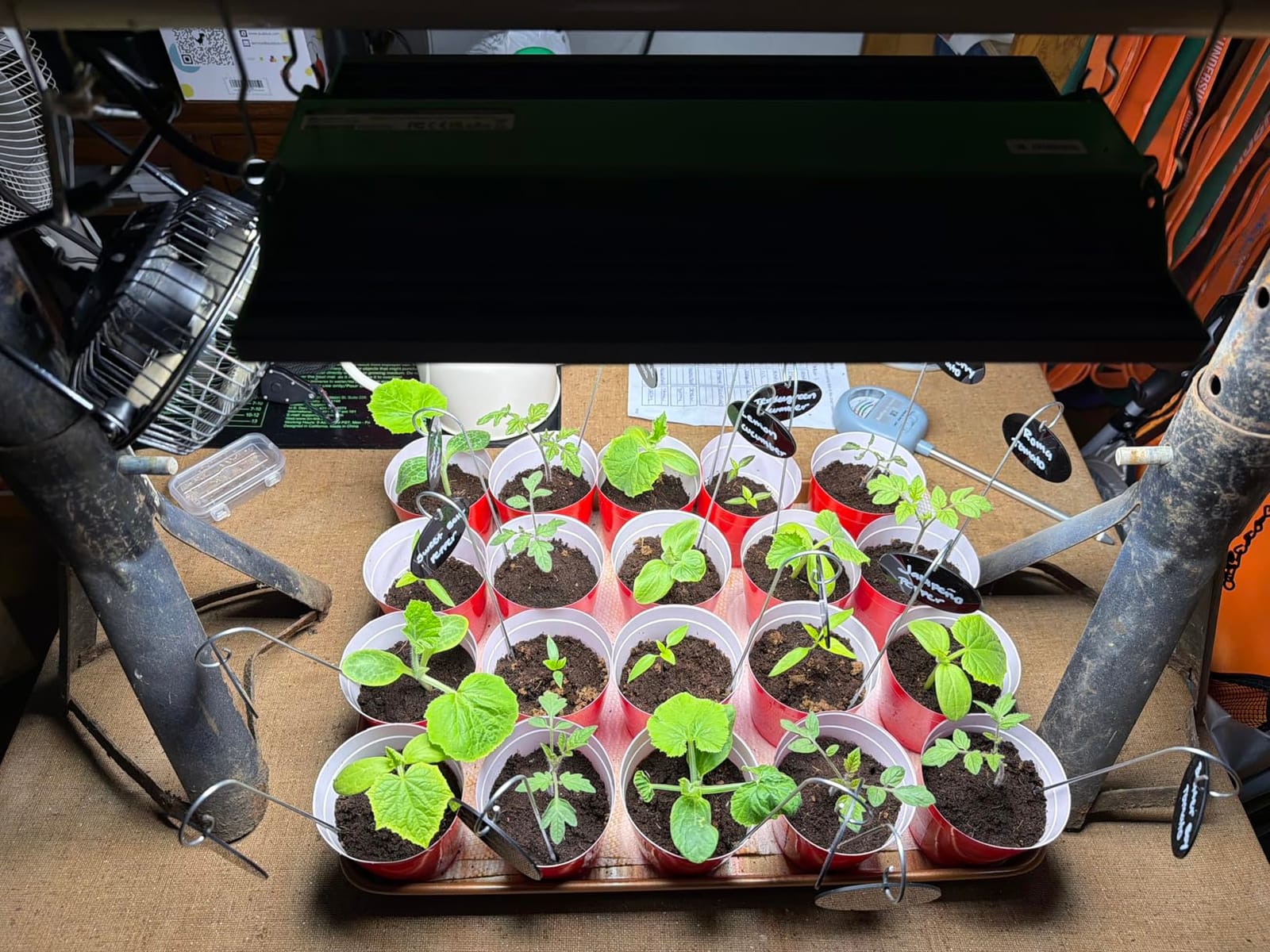
The dimming range lets one panel serve seedlings and mature plants, which removes the need for a second light during the nursery phase. I start new cuttings near 50 percent and raise the setting as the canopy fills in. The dial is stepped rather than continuous, so plan on a few discrete levels instead of fine trimming.
What It Takes to Actually Fruit
For a 4×2 flowering footprint, treat this as your fruiting fixture rather than your seedling light. I paired it with a low bar for propagation, then moved the seedlings up once the first true leaves appeared. Given the panel’s depth, one more detail matters: PPFD is measured at leaf level, not at the fixture, and dense lower foliage will shade itself regardless of how good the diodes are.
2. Spider Farmer SF1000 100W – Silent Running and a 5-Year Warranty
Spider Farmer SF1000 LED Grow Lights for Indoor Plants in 2×2/3×3 Grow Tent
100W draw at 10000 lumens
90 degree beam
10.5 by 11.8 inch
Dimmable, IP67
+ Pros
- 2.5 umol/J system efficiency
- Deep canopy penetration at 100W
- Fanless aluminum body runs silent
- 5-year warranty with US-based support
- Daisy-chain ready
– Cons
- Runs warm to the touch in a sealed space
- Hanging cables eat 8 to 10 inches of head room
- Some dimmer failures reported after about a year
The SF1000 punches above its weight class. It pulls 100 watts, produces 10000 lumens and carries a 250-emitter array, and in my shelf setup it delivered usable light across a 3×3 area that a 100W panel normally struggles to cover evenly.
Its 2.5 umol/J system efficiency figure is the number that separates it from cheaper 100W panels, and it shows up in practice at the canopy rather than in a spec sheet. Add the edge-gathered emitter layout from this year’s revision and you get a flatter PPFD map than the previous generation at the same wattage.
The spectrum covers 3000K and 5000K white plus 660nm red and 760nm infrared, which is more than enough to run a plant from seedling straight through to ripening fruit without swapping fixtures.
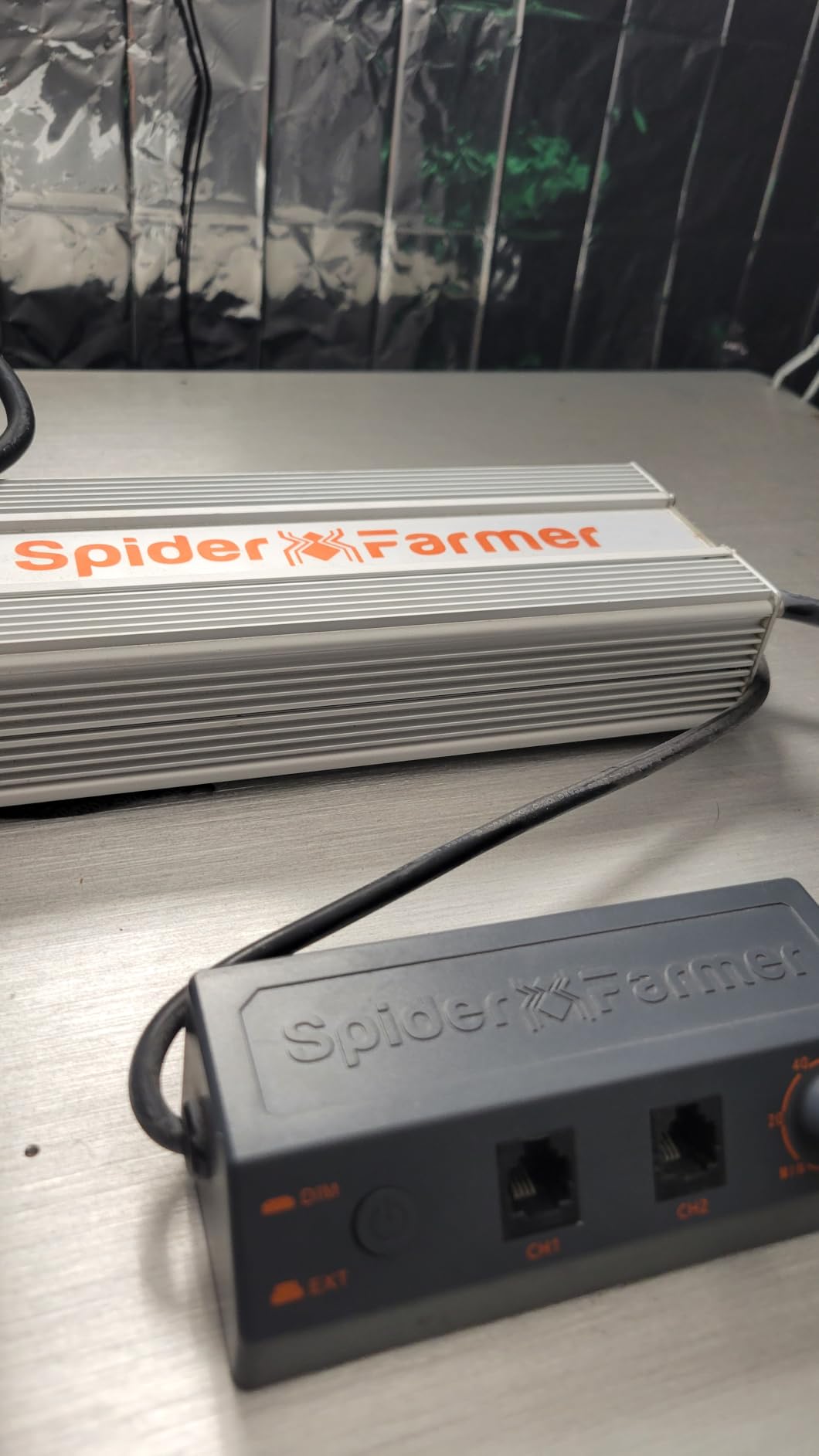
Reviewers repeatedly note that starting around 60 percent intensity and raising gradually avoids light burn, and that advice matches what I saw. The dimmer works in combination with an external controller, so a single dial can govern several fixtures in a chain. Growers in the forum data also point to this brand as one of the most consistently endorsed names for fruiting crops, alongside ViparSpectra.
Two things to plan for. The body runs noticeably warm to the touch, so in a sealed tent you want a small fan moving air. And the ratchet hanging cables add roughly 8-10 inches of vertical clearance, which is awkward under a low shelf or in a closet with a standard 8-foot ceiling.
Why 100W Is Enough for a 2×2 or 3×3
Planted area matters more than fixture wattage. In a 2×2 footprint this panel gives you far more light per square foot than the wattage suggests, and that headroom is what lets you raise it far enough above a fruiting plant to avoid scorching. In a 3×3 you are closer to the limit, and a second fixture is the safer call for heavy beefsteak types.
Fanless Construction and the 5-Year Warranty
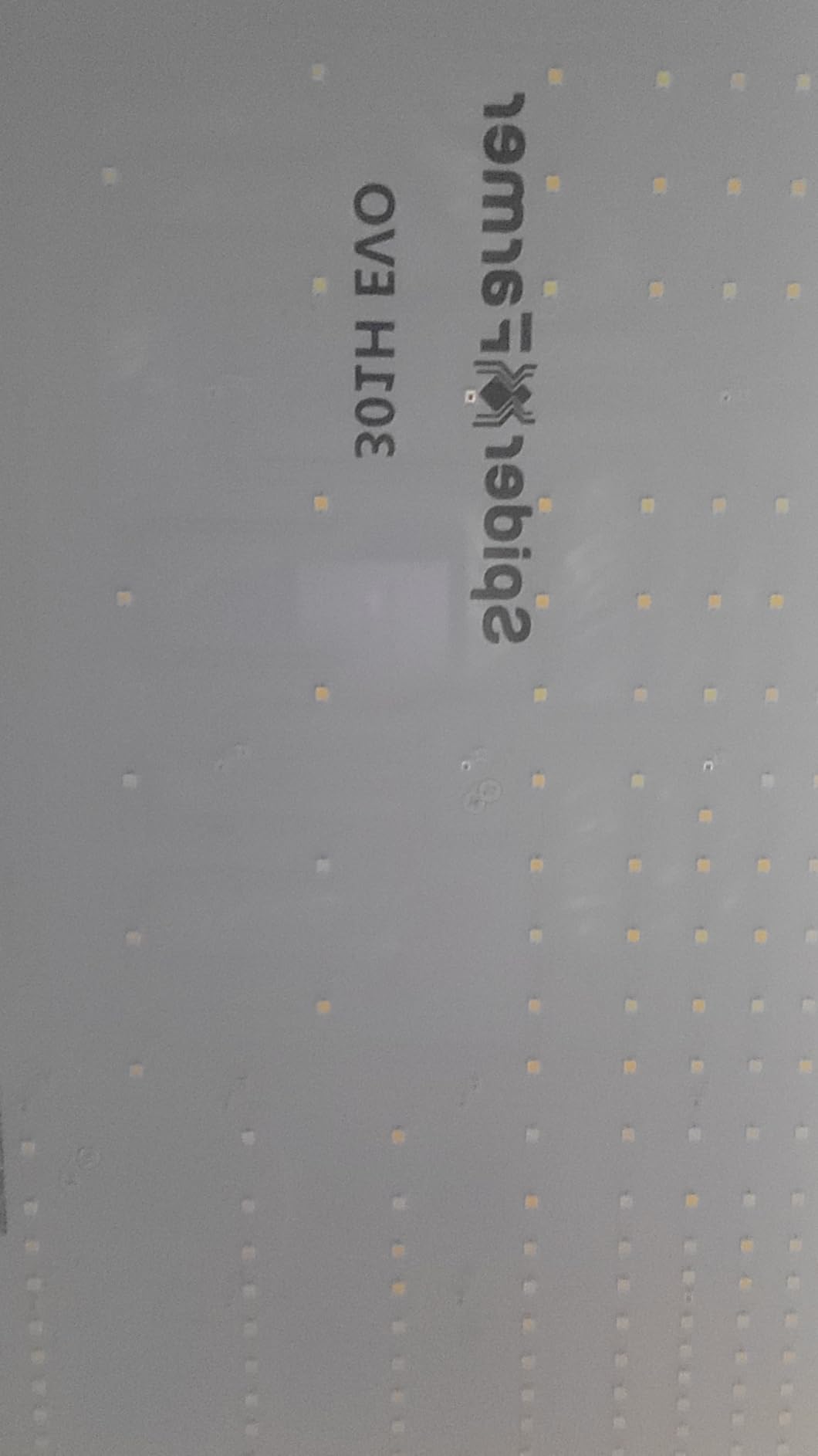
Removing the fan removes noise and one of the most common failure points in budget panels. The thick aluminum body handles dissipation passively. A 5-year warranty backed by service centres in multiple countries is the strongest coverage in this group, and the review data shows the brand honouring repairs and replacements when hardware does fail.
Dimming, Daisychaining and Scaling Up
Dimming is the feature that turns this from a single-purpose fixture into a long-term one. Grow it at 50 percent for seedlings, push toward 100 percent at flowering, and then chain a second panel when you expand. If you want the same controls across a whole room, our ring grow light picks for seedlings cover the low-wattage end of that range.
3. VIVOSUN LumaLight 200W – App Scheduling and Four Dimming Levels
VIVOSUN LumaLight 200W LED Grow Light, Full Spectrum Plant Light
200W draw with 672 diodes
23.5 by 11.8 inch
4-level dimming 25-100 percent
IP65 sealed
+ Pros
- Uniform PPFD with no dark spots
- Four dimming levels plus app scheduling
- IP65 rated for humid setups
- 36000 hour flux maintenance rating
– Cons
- Very bright even at 25 percent
- One panel may not cover a 4×2 canopy
- Emits heat if combined with seed-warming mats
The LumaLight is the one I would pick if automation matters to you. Instead of a bare dimmer, it pairs with the Vivosun GrowHub and a phone app, so the photoperiod runs on a schedule rather than on your memory of a wall timer.
Underneath the app is a solid 200W panel with 672 diodes. The spectrum runs 3000K and 5000K white plus 660nm red and far-red at 730nm, and the strategic diode layout gives an even read across the canopy rather than the hot-spot-then-dark-corner pattern I have seen from cheaper panels.
It is one of the more solidly sealed units here. The IP65 housing shrugs off dust and splash, which matters in a humid tent or a basement setup where condensation is common.
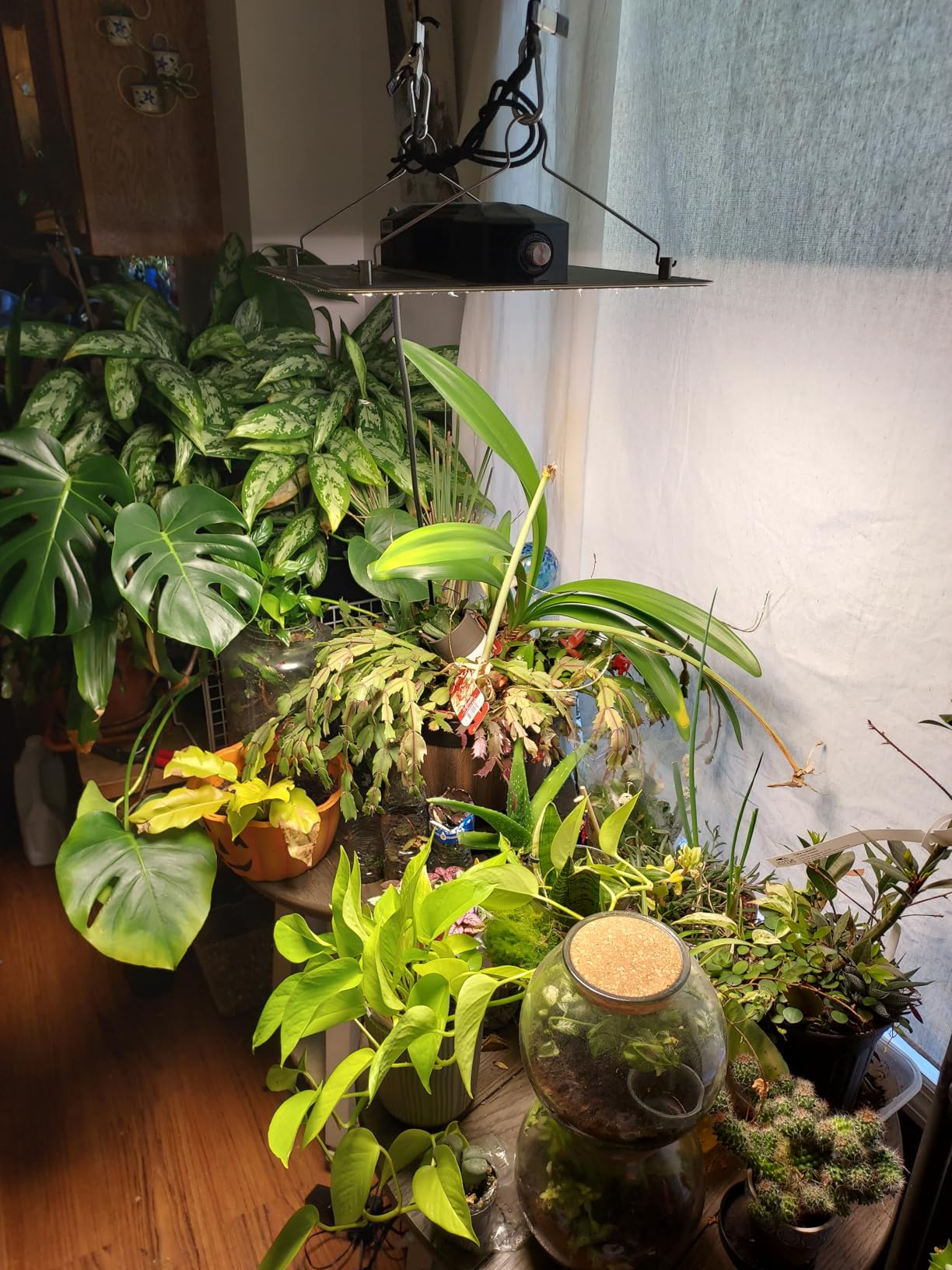
Most buyers run this fixture well below full output, with 50 to 75 percent the common setting in the review data. At 25 percent it is still bright, so wear eye protection when you are working directly under it. The thermal design is rated for a 36,000 hour flux maintenance life, which comfortably outlasts a typical multi-year indoor tomato run.
The catch is footprint and control granularity. Dimming moves in 25 percent steps rather than continuously, and coverage is tight enough that a single panel can fall short of a 4×2 canopy without washing out the closest trays. There is no built-in timer either, so the app or a smart plug handles scheduling.
Four Dimming Levels Versus Continuous Dimming
Stepped dimming is the one compromise here. Four fixed levels are enough to move from seedling to bloom, but they cannot trim intensity finely to chase a specific PPFD target. If you want precise control, the continuous dimmer on the VIPARSPECTRA or Spider Farmer panels is the better fit.
App Scheduling and GrowHub Control
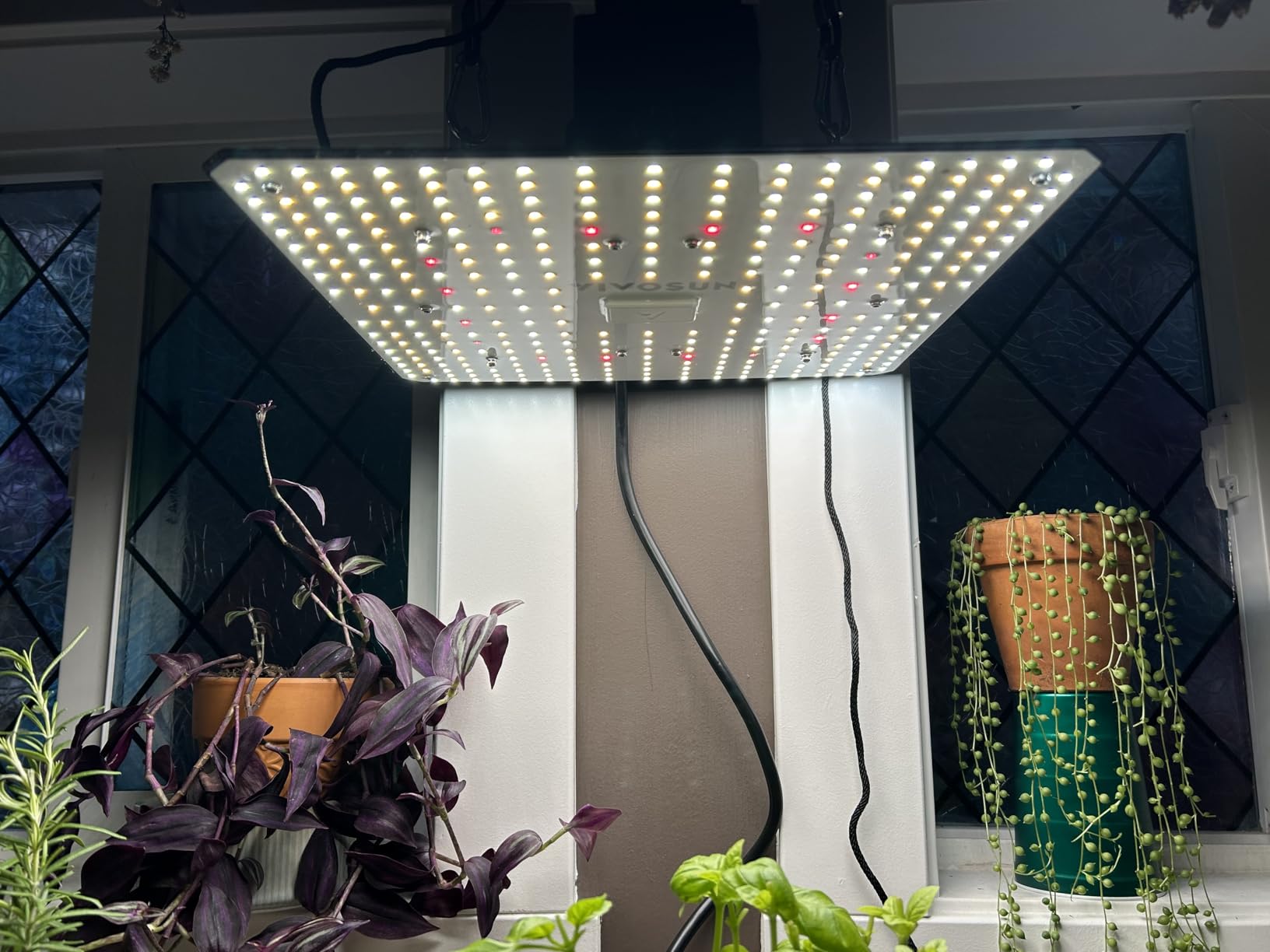
This is where the LumaLight separates itself. The app lets you set on and off times, adjust levels and check a timer from your phone, which removes a failure that shows up again and again in the forum data: a fixture that ran through the night. Automating the photoperiod also lets you hold a fixed 16-hour day through the flowering stage without daily intervention.
Heat, Water and Where It Fits
Run it above a canopy, never directly over a heat mat. The fixture emits enough heat that a mat and a panel stacked together will push root-zone and leaf temperature past the point where tomato flowers stop setting fruit. For a small tent, mount the panel 12 to 18 inches above the tallest foliage and keep a fan moving air across the canopy.
4. Barrina T5 5000K 4-Pack – The Shelf and Propagation Workhorse
Barrina T5 Grow Lights for Indoor Plants, 5000K Full Spectrum, 1FT, 4 Packs
20W per bar
96 LEDs per fixture
1 foot T5 form factor
Linkable up to 16 bars
+ Pros
- Natural 5000K white that looks like normal room light
- Very low heat and low power draw
- Each bar has its own on-off switch
- Linkable to 16 fixtures in series
- Includes tape
- clips
- ties and two power cords
– Cons
- No built-in timer
- Short interconnecting cords
- Adhesive mounts can release on a rough surface
This is the light I recommend for the first three weeks of any tomato grow, and it is the honest answer for anyone starting seedlings rather than fruit. Four 1-foot bars sit under a shelf, run cool, and handle trays of germinating seed without cooking them.
Each bar draws 20 watts from 96 LEDs, which is a fraction of what a generic plant light of the same length consumed. The 5000K white spectrum looks like ordinary room lighting, so it will not make a living space look like a grow room.
Individual on and off switches on each bar are more useful than they sound. You can shut off one zone and keep another running, which is a cheap way to hold different intensity over fresh seedlings and older plugs on the same shelf.
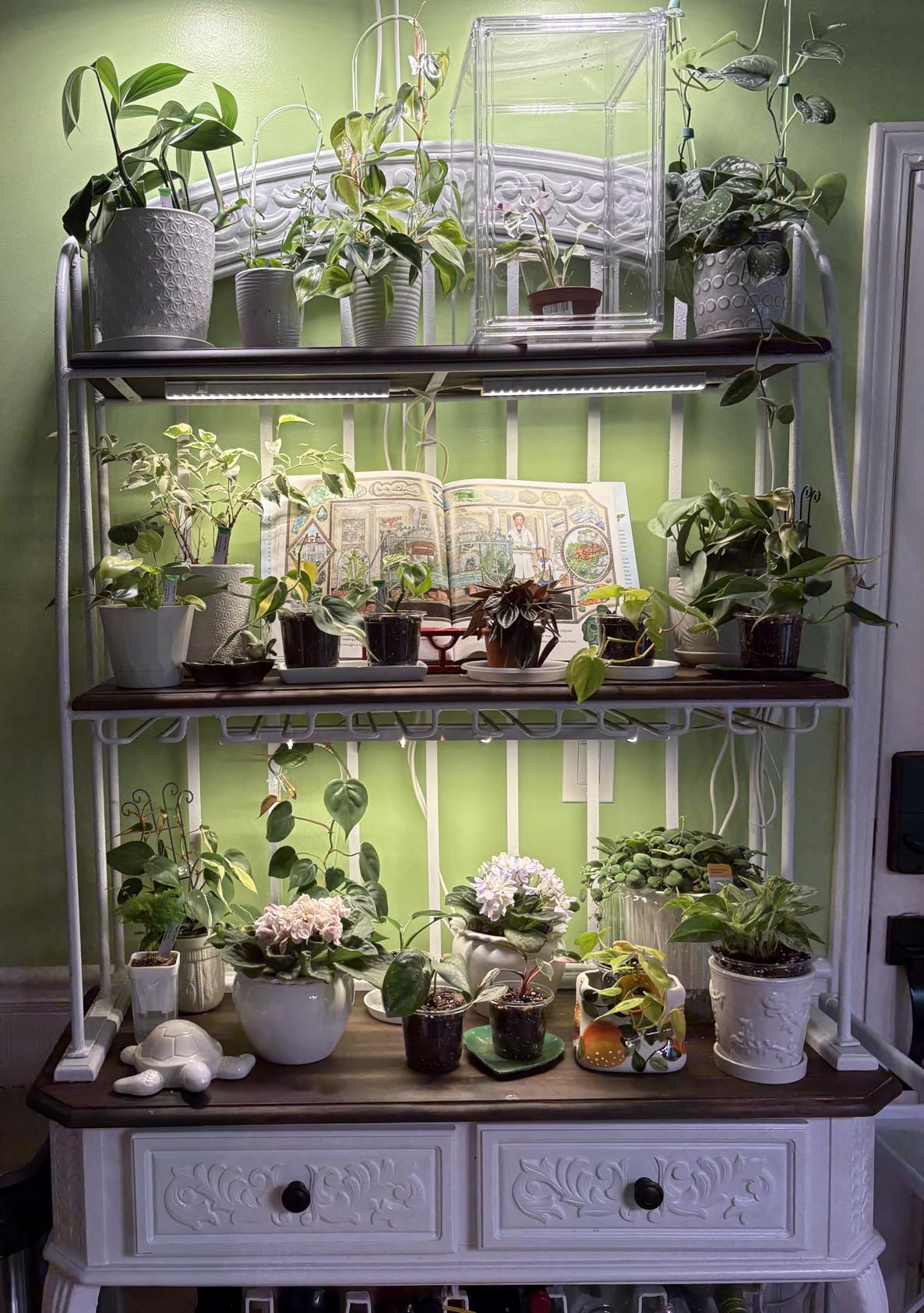
Forum discussion on T5 fixtures tends to split between people who swear by them and horticultural growers who say they only reach transplant size. Both are partly right, and the resolution is simple. T5 bars are genuinely enough light for propagation and for dwarf varieties such as Tiny Tim grown close under them, and genuinely not enough for a beefsteak plant trying to set fruit in a tent. Match the bar to the stage.
The practical details are solid: linkable up to 16 fixtures in series, mounting tape, clips and ties in the box, and two switched power cords. Two drawbacks show up repeatedly in the reviews, and both are fixable. The interconnecting cords are short, so plan on extension cables for wide shelves, and there is no built-in timer, so use a wall timer or smart plug.
Why 5000K White Beats Purple for a Living Space
Older horticultural fixtures skewed magenta because cheap red and blue diodes dominated the spectrum. White phosphor blending at 5000K gives you usable plant wavelengths in a housing that looks like a normal light. If the fixture has to live in a room where people eat dinner, that matters as much as the physics.
Linkable Design for Long Shelves
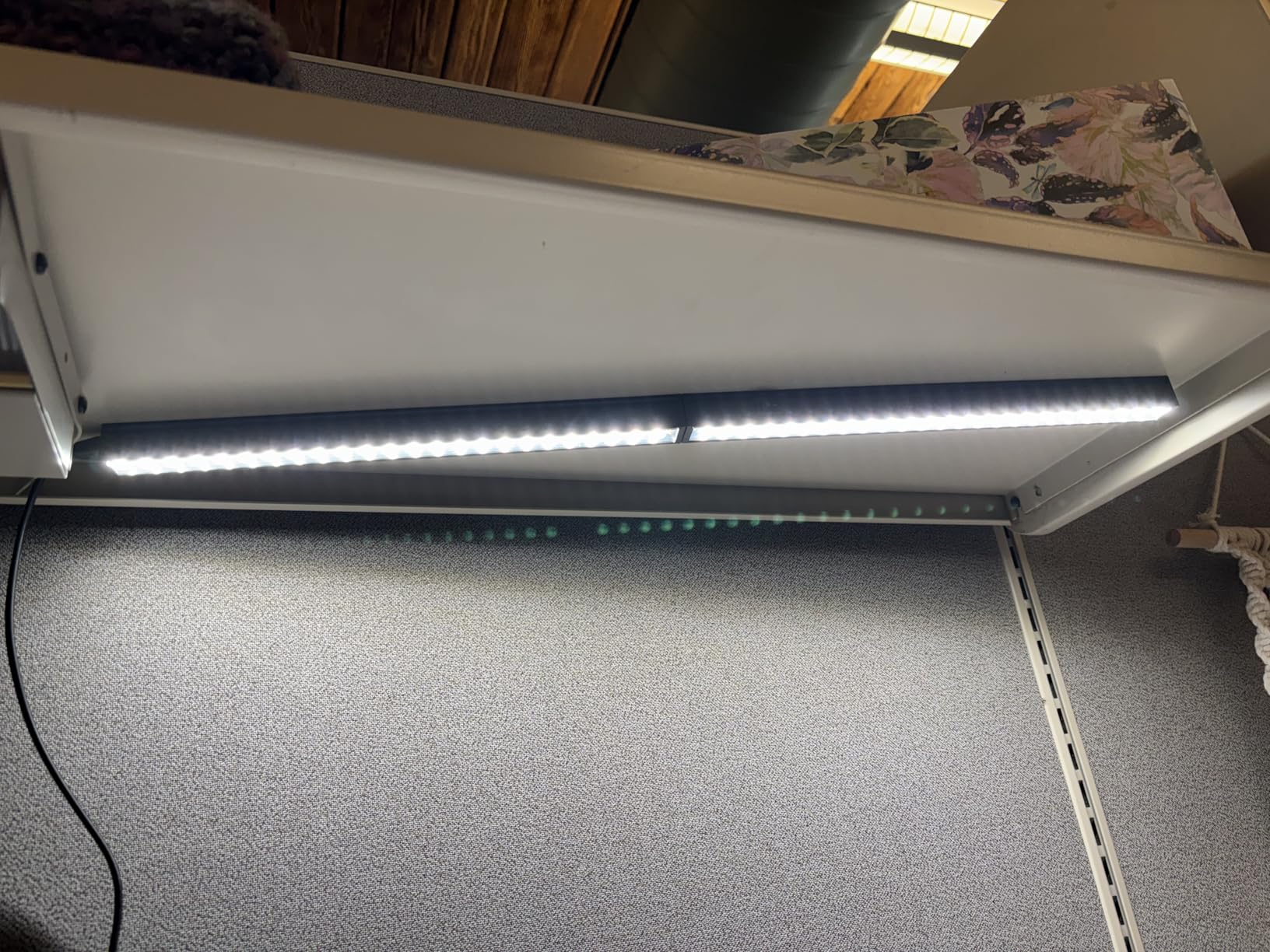
The linking system is what turns four bars into a scalable shelf. Bars chain in series with short jumpers, and with the included clips they can run under cabinets or across a plant rack. If you are building a small indoor garden alongside a grow area, our guide to growing plants indoors covers the shelving layouts that work with bars at this length.
What This Light Cannot Do
Be clear about the ceiling. Twenty watts per bar across a 3-foot span gives a seedling strong, stocky growth, and it will not drive fruit set on a large plant across a wide area. If fruiting is the goal, treat this as stage one and budget a proper panel for stage two.
5. BESTVA DC1000 100W – Cool Running With Switchable VEG and BLOOM Modes
BESTVA DC1000 Grow Light for Indoor Plants, Full Spectrum LED Plant Light
100W real draw from 640 LEDs
120 degree beam
12.2 by 8.46 inch
3-year warranty
+ Pros
- Cool multi-fan cooling holding 50-60F
- Very bright for the class
- Combined VEG and BLOOM modes raise flowering output
- Adjustable pulley makes height changes easy
– Cons
- The 1000W name overstates real output
- Coverage is smaller than the listing implies
- Some premature LED row failures reported
The BESTVA DC1000 stands out for one thing in a sealed indoor room: it runs cool. Multiple quiet fans push air through the panel and its aluminum radiators, holding operating temperature around 50-60F even in an enclosed space.
That is not a marketing detail. Tomato pollen stops performing when a canopy gets too hot, and a fixture that manages its own heat removes one of the most common reasons flowers drop before fruit forms. Reviewers also report strong brightness for the class, measuring well even at greater hang distance than competing panels.
Two cultivation modes are the second feature worth knowing. VEG targets leafy growth and BLOOM shifts toward flowering and fruiting, and you can run both together when you want more output at the flowering stage.
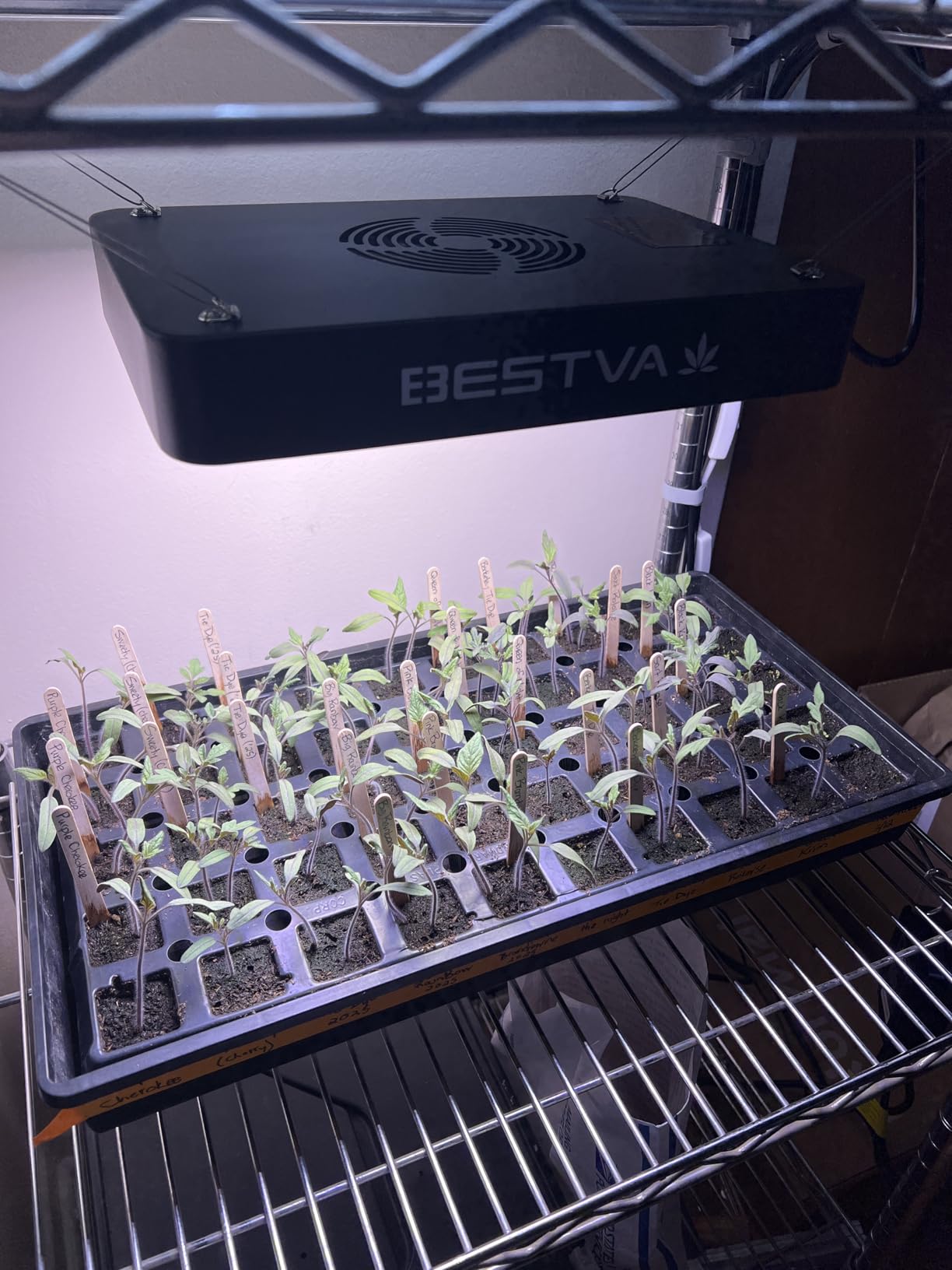
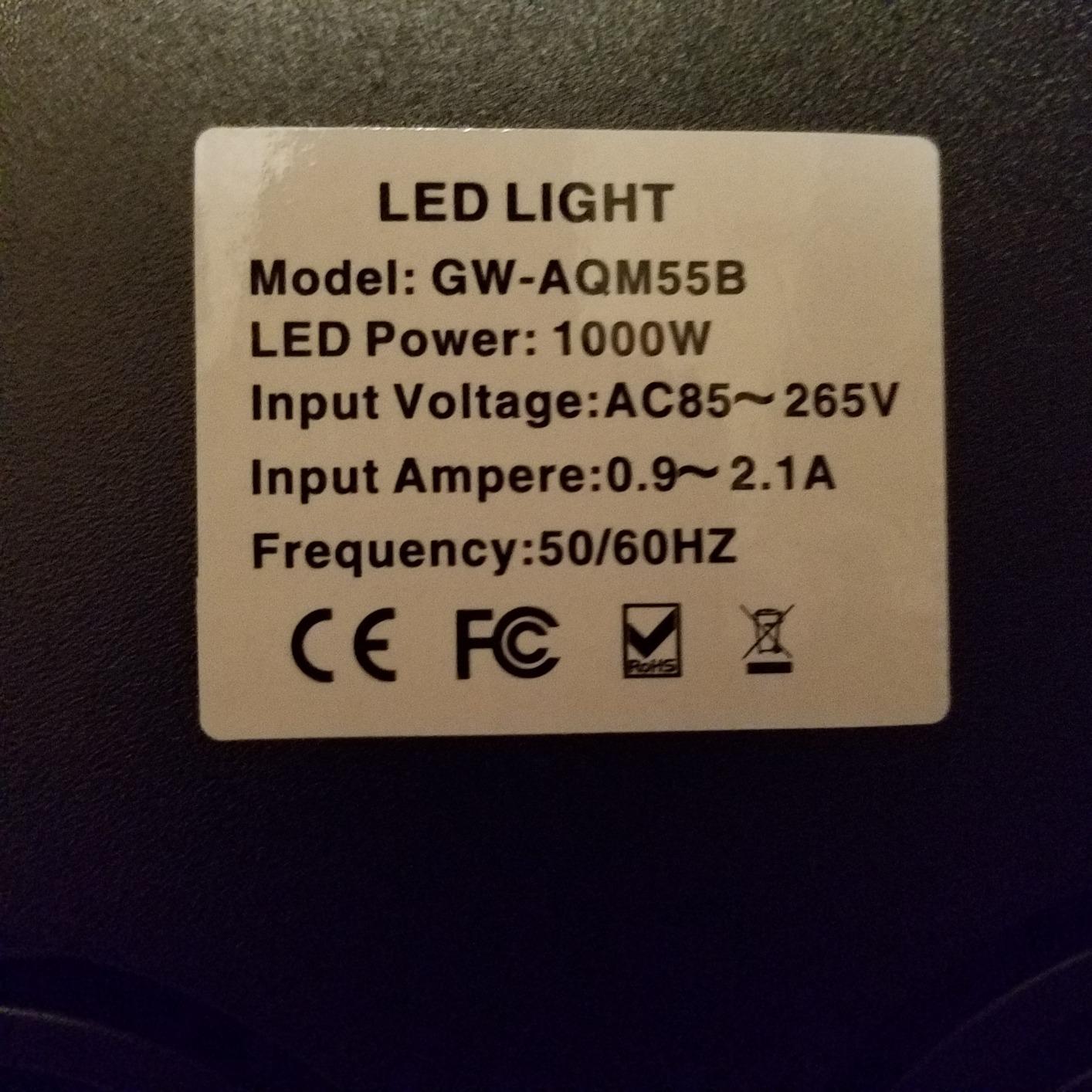
Set expectations on the naming. Despite the 1000W label, actual draw is close to 100W, which is a real panel in this class, but the name is marketing shorthand and it will mislead you if you are comparing it against a genuinely 1000W fixture. Judge it by coverage instead, and note that reviewers report a smaller footprint than the listing implies on larger setups.
Owners of small tents and seed-starting setups rate it highly in the review data, and the brand is frequently praised for replacing failed fixtures under warranty. A minority of buyers report LED rows failing before a full grow cycle finished, and some fixtures arrive with hanging points that cannot be tightened once the housing is sealed.
Fans, Radiators and Canopy Temperature
Active cooling is a legitimate choice for a small tent, because the fans move air across the panel and through the canopy at the same time. The trade-off is a small amount of noise, and the fans are the first component likely to wear. In return you get a fixture that adds less heat to a closed space than a passive design of the same output.
VEG, BLOOM and Running Both Together
The mode switches give you a crude but useful dimming system without a knob. Grow seedlings on VEG, flip to BLOOM at flowering, and combine them when the plant is hungry. It is less precise than continuous dimming, but it gives a clear response to the plant’s changing stage without moving the fixture.
Sizing It to a Small Grow Area
At 100W, treat this as a 2×2 fixture, or a 3×3 with the canopy kept short. The 120 degree beam angle helps it spread further than a narrow panel, but the reported coverage still falls short of what the listing implies on bigger footprints. A single 200W panel at roughly 16 inches above four plants is the configuration multiple growers describe for fast growth on a small setup, and this is the natural second panel for that layout.
6. KINGPLUS KP1000 – Fits a 2×2, 2×3 or 2×4 Tent as a Primary Fixture
KingLED KP1000 Grow Light for Indoor Plants, Full Spectrum Plant Grow Light
1000 LEDs
460nm blue and 660nm red
12.6 by 8.46 inch
Built-in fans
+ Pros
- Strong intensity for a compact footprint
- VEG and BLOOM switches can be combined
- Built-in fans circulate air
- Fits 2×2
- 2×3 and 2×4 tents
– Cons
- Very intense at close range
- The 1000W label overstates real output
- Some early diode failures reported
- Manual does not explain the hanging hardware
The KINGPLUS delivers raw intensity per dollar that is hard to argue with, and in a 2×2 it is genuinely difficult to overrun. The spectrum pairs 460nm blue with 660nm red and 3000K-5000K white, covering germination through fruiting on one setting.
Several tomato growers in the review data report faster flowering-stage growth and satisfactory yields under this panel. Built-in fans move air through the panel openings, which helps keep foliage healthy in a closed space.
Unlike most panels here, it fits 2×2, 2×3 and 2×4 tents as a primary fixture, with roughly 4×4 coverage when you hang it higher as supplemental light. That flexibility is what makes it useful across more than one stage of a single grow.
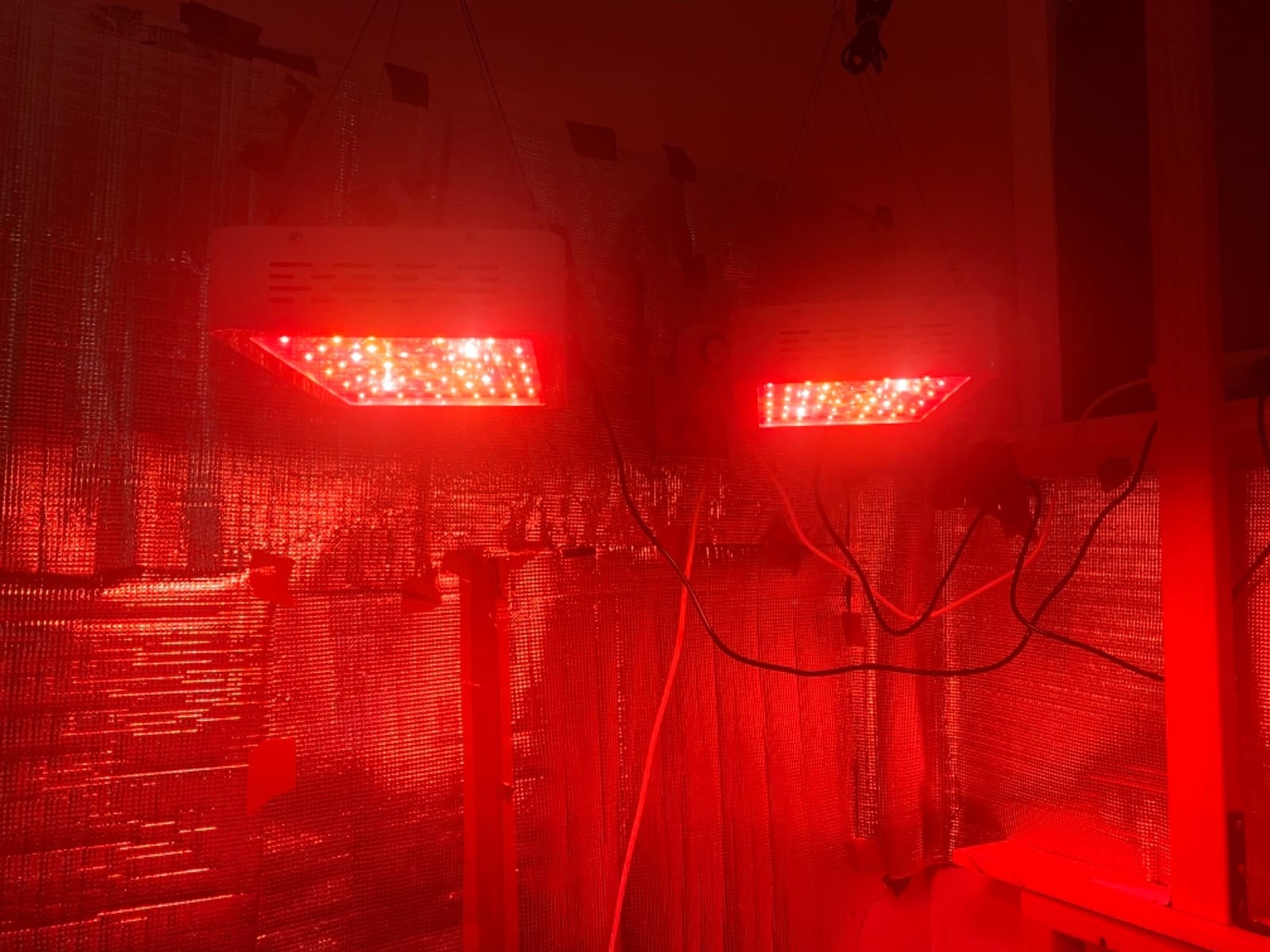
The critical caveat is mounting height. This is a much hotter, more intense light than a fluorescent-style bar, and buyers report scorching and bleaching on young or freshly pruned plants hung too low. The rule I used: start at the top of the tent and lower it only as the plant grows.
As with several panels in this price bracket, the 1000W label overstates reality, and it behaves more like a 400W HID equivalent. Some fixtures report failing diodes or reduced output within the first year, fan noise becomes noticeable over long daily run times, and the printed manual does not clearly show how to use the included hanging hardware. Budget for a 3-year warranty rather than five.
How High to Hang It
Treat intensity like the dominant spec on this panel. Because it is bright and concentrated, keeping it at the top of the enclosure and pulling it down as the canopy rises gives you the PPFD increase without the bleach. If you cannot adjust height, set the expectation that this belongs above established plants, not fresh cuttings.
Airflow and the Built-In Fans
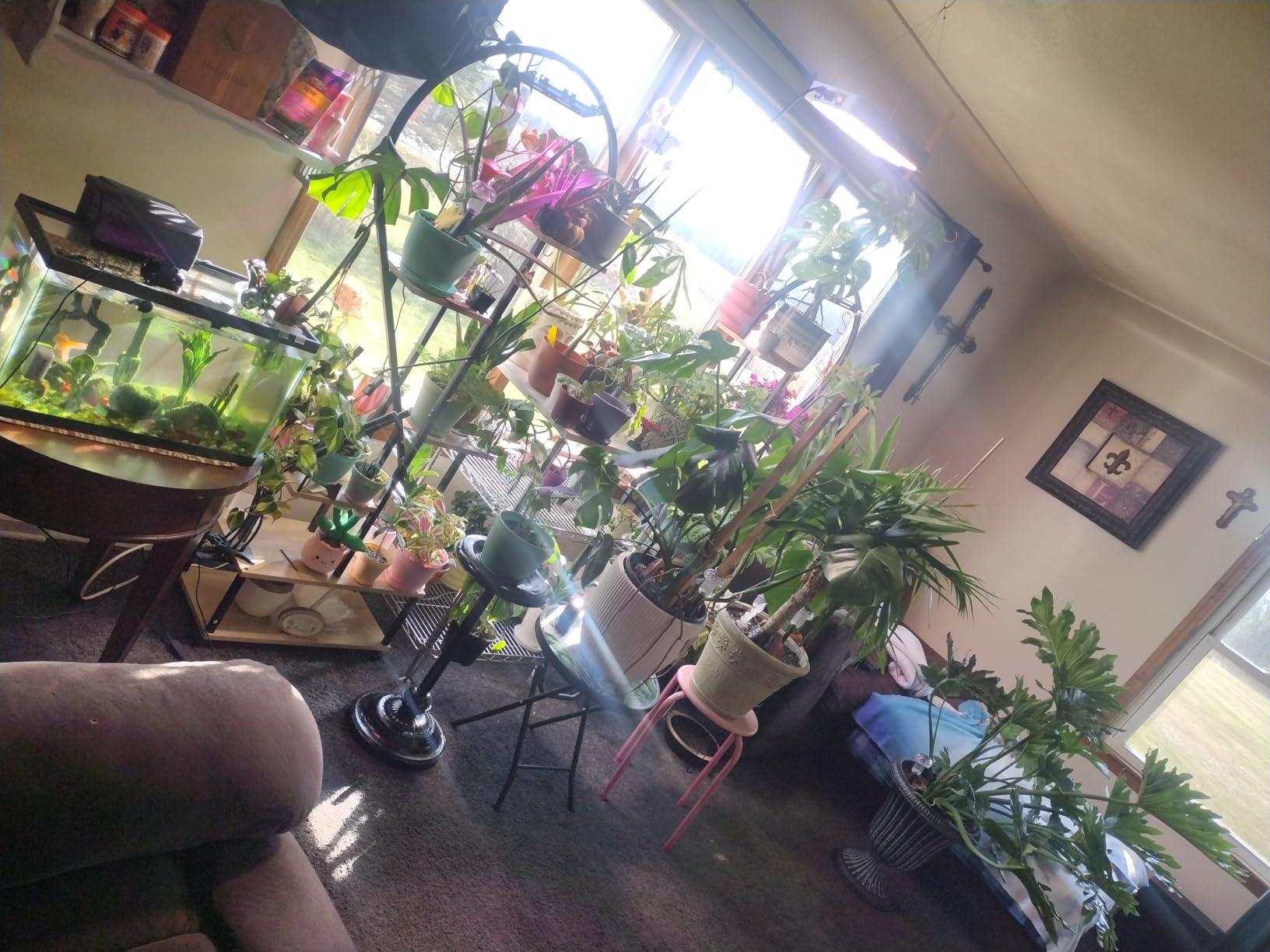
The fans are a modest size, but they do move air through the panel and give the canopy some passive circulation. Expect them to be noticeable when the fixture runs 16 hours a day. For a small, enclosed space that is a reasonable trade; for a bedroom or office, read the noise before you commit.
Covering More Than One Area
One use of this panel is covering 2×2 properly, then adding a second fixture for a 4×4. If you are working toward a bigger fruiting area, our indoor herb garden guide covers the low-wattage setups that share a shelf with a tomato plant without competing with it.
7. SANSI 36W Grow Light Bulb – No Fixture Required for One Plant
SANSI Grow Lights for Indoor Plants, 36W Plant Lights for Indoor Growing
36W in an E26 socket
4000K from 400nm to 780nm
265.58 umol/s/m2 PPFD at 1ft
5-year plan
+ Pros
- Drops into a standard household socket
- High PPFD for a screw-in bulb
- Low IR output limits leaf burn
- V0 flame-retardant ceramic body
- ETL listed
– Cons
- Not dimmable
- One bulb lights a limited area
- Fixed spectrum with no bloom switch
The SANSI is the answer when you have one plant and no interest in hanging hardware. It is a 36W reflector bulb that drops into a standard E26 socket, which means the fixture is whatever lamp you already own.
The lens-based optical design is the reason this bulb performs better than its wattage suggests. It delivers a stated PPFD of 265.58 umol/s/m2 at one foot, and forum users regularly report it working as a household-socket substitute for a small setup or a single dwarf plant.
Low infrared output is the other quiet benefit. It means less radiant heat reaching nearby foliage, so you can sit the bulb closer than a panel without scorching leaves.
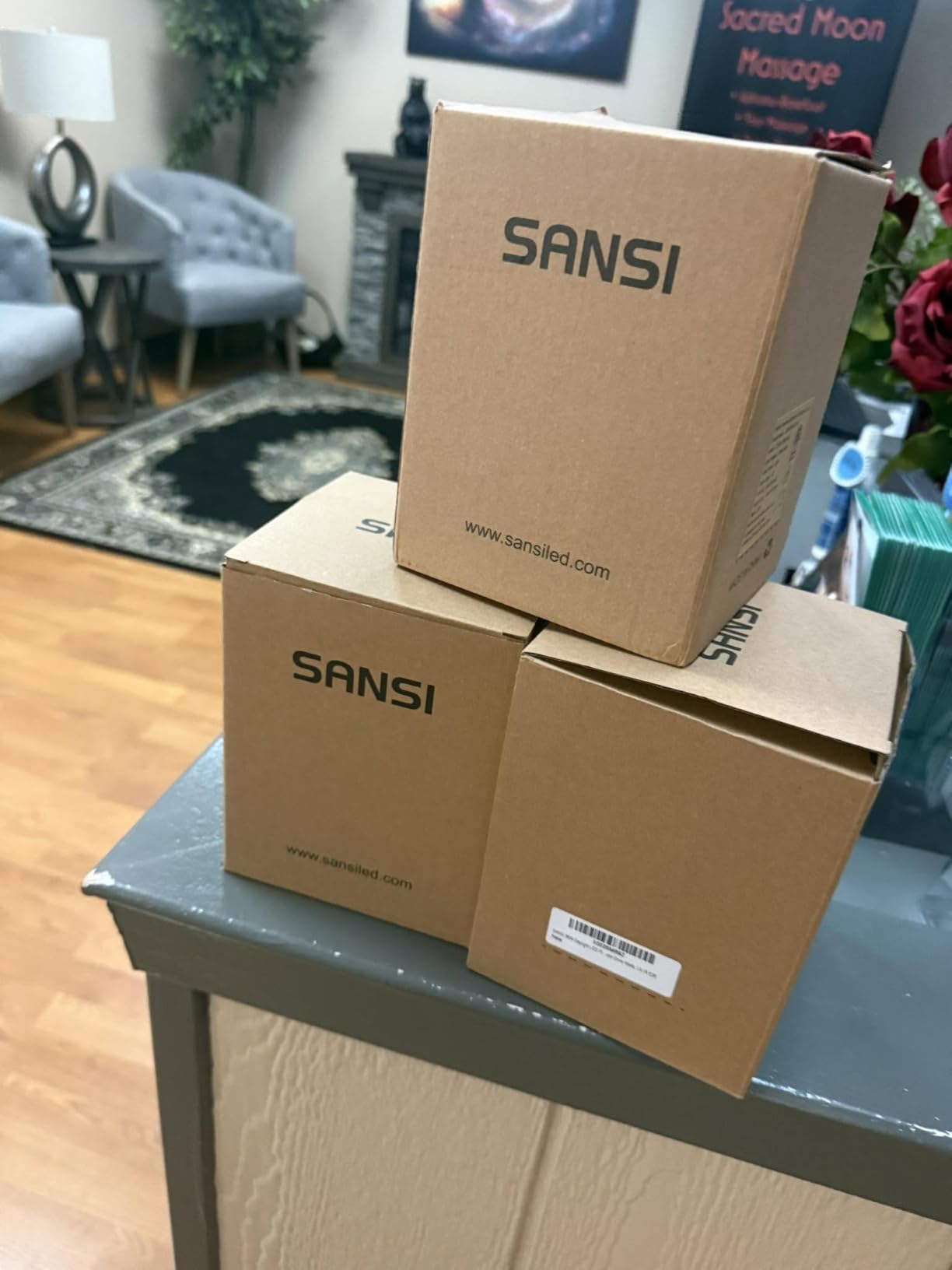
The 4000K spectrum spans 400nm to 780nm and appears to the eye as natural daylight, with a colour rendering index of 95, so it will not tint a living room magenta. Patented chip-on-ceramic technology lowers thermal resistance and extends the rated life to 25,000 hours.
Know the limits. It is not dimmable, it has no bloom mode, and a single bulb lights a limited area, so it will not cover a shelf of mixed plants without washing out the nearest leaves. This is a one-plant light or a supplement, not a fruiting canopy solution for a full tent.
Why a Bulb Can Beat a Small Panel Here
For a single micro-dwarf or cherry plant on a countertop, a bulb wins on convenience. There is no hanging kit, no head-height calculation and no rewiring. The optics concentrate the output into a beam aimed downward, which is a sensible pairing with a lamp shade at this wattage.
Placement and Distance for a Single Plant
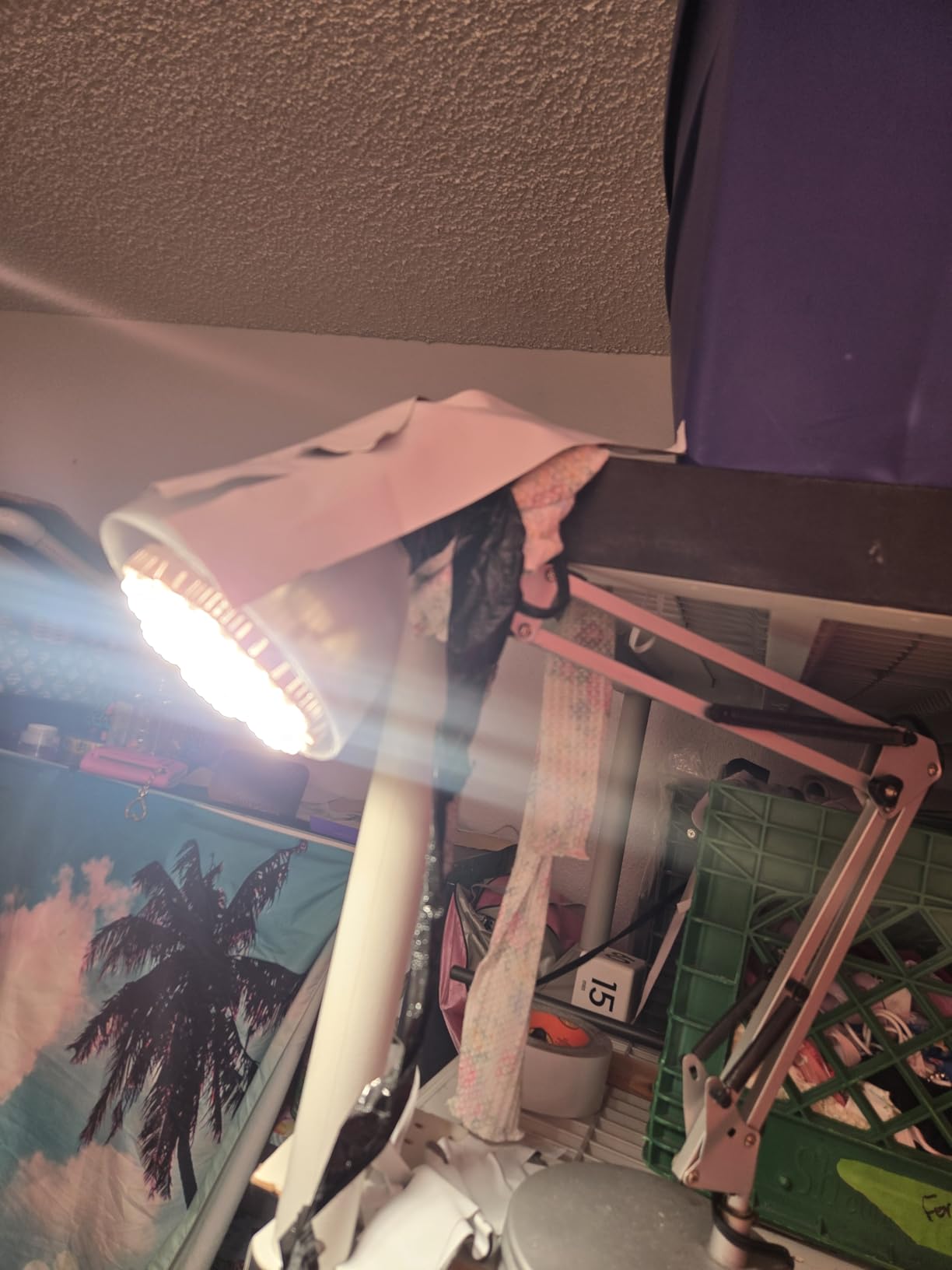
Hang the lamp so the bulb sits 12 to 18 inches above the top leaves and raise it as the plant grows. Because infrared output is low, you have more latitude than with a panel, but canopy temperature still rises when a bulb sits a few inches from a plant for hours on end. Keep some air movement around the leaves.
Warranty and Longevity
The ETL listing and five-year protection plan give this bulb a longer warranty than several of the panels in this roundup, which is a genuine bonus for a fixture you intend to leave running on a daily timer. The ceramic body is rated V0 flame-retardant with a WF2 anti-corrosion shell, so it suits a humid room as well as a dry one.
8. Briignite A19 Full Spectrum 2-Pack – The Two-Plant Supplement
Briignite Grow Light Bulbs, LED Grow Light Bulb A19 Bulb, Full Spectrum
11W draw at 1000 lumens
PPF of 25 umol/s
3500K listed, 4000K appearance
E26 base, 2 pack
+ Pros
- Looks like an ordinary white bulb
- Very low energy use
- Marketed for tomatoes and peppers at all stages
- Aluminum and plastic cooling lowers operating heat
– Cons
- Only 25 umol/s PPF per bulb
- Not dimmable
- Light is directional from a bulb
- best used close to plants
Two of these bulbs in ordinary table lamps is a legitimate way to add light to a room you actually use. They look like 4000K white A19 bulbs, so nothing about the setup signals a grow room, and the 11W draw is a fraction of what an equivalent incandescent would use.
The brand explicitly markets the spectrum for tomatoes, peppers, cucumbers and leafy greens across all growth stages, and the aluminum and plastic cooling construction keeps operating temperature low enough to extend rated life to about 30,000 hours.
Both bulbs share a standard E26 base, so no adapter or special fixture is needed. That is the entire appeal: no tools, no wiring, no head-height planning.
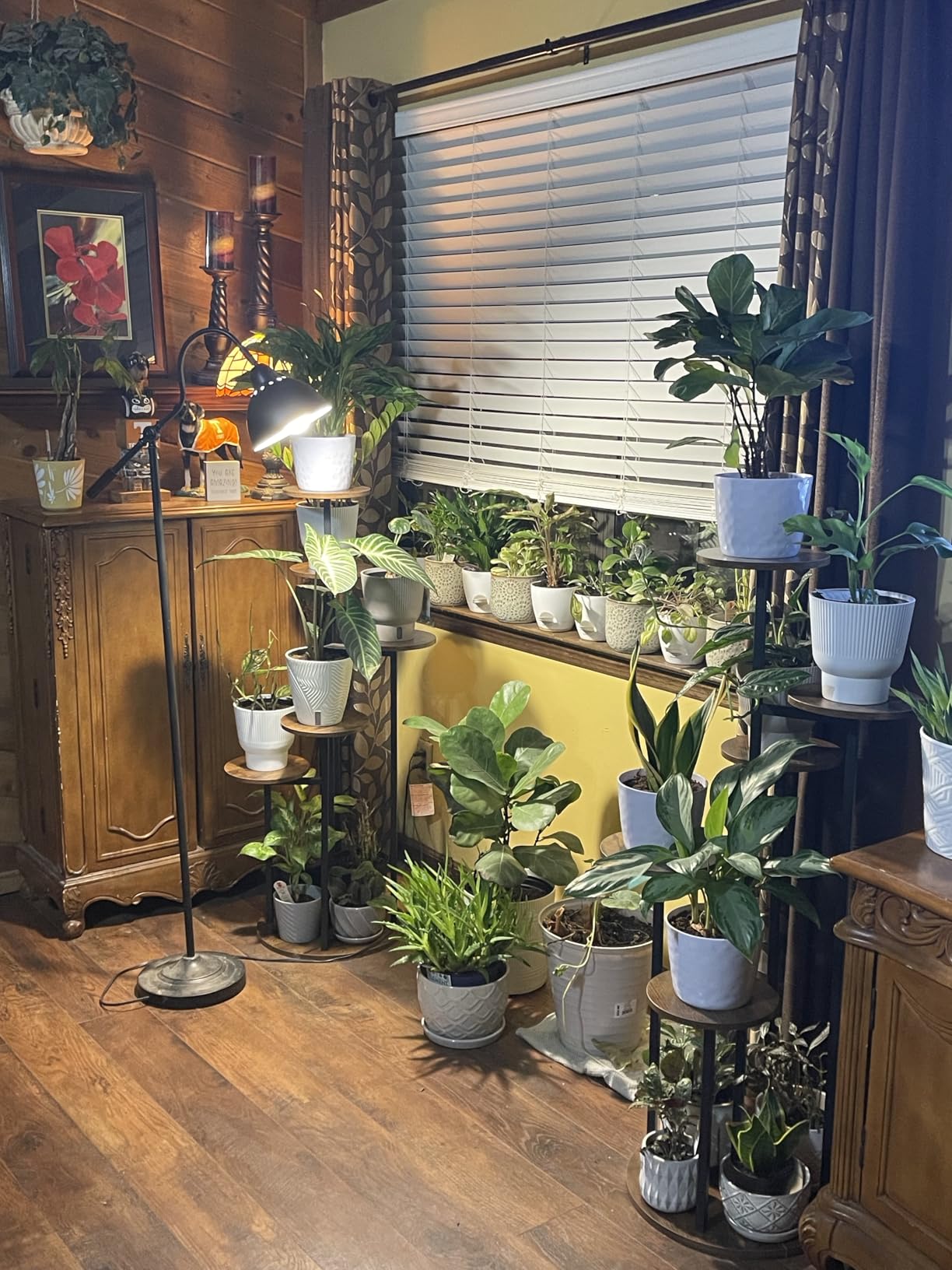
Where the honest line sits is intensity. A stated PPF of 25 umol/s per bulb is a small fraction of what a fruiting panel delivers, so this works as supplemental light near a window, or as the primary light for seedlings and herbs, and it is not enough to drive fruit set on a mature plant. Several users in the forum data report potted tomatoes under bulb lighting that looked like they were dying; the causes there were heat and overwatering, not spectrum.
A 180-degree beam angle gives a wide, even spread, which is the right shape for a two-plant shelf. Direction is still the limitation. Because a bulb radiates from a small point, the closest leaves receive far more light than the outer ones, so keep the pair above the plants rather than beside them.
Best Use: Seedlings, Herbs and Windowsill Supplement
This is where bulb lighting genuinely earns its place. A tomato seedling needs far less light than a fruiting plant, and two of these over a propagation shelf keep young plants compact without the heat load of a panel. The same applies to a mixed shelf of herbs alongside one dwarf tomato.
When a Bulb Is the Wrong Tool
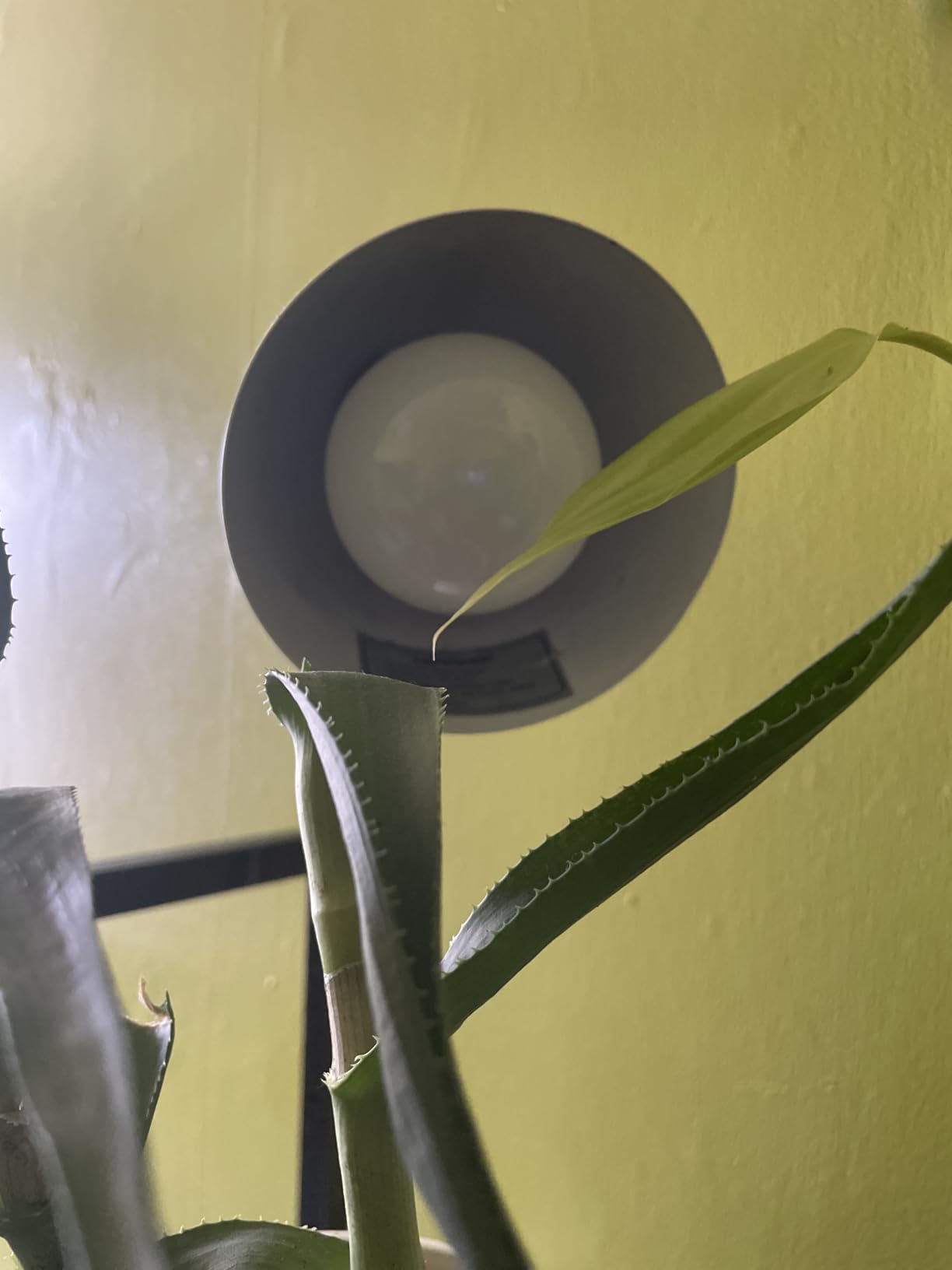
If your goal is fruit, the light budget does not close with a bulb. A panel sized to your grow area at about 40 watts per square foot is the requirement, and a 25 umol/s bulb does not approach it. Bulbs handle the first stage of the cycle, and they suit rooms where appearance matters more than yield.
Placement and Distance for a Two-Plant Shelf
Keep the bulbs 12 to 24 inches above the canopy and adjust as plants grow. Closer is fine for short seedlings, but a bare bulb radiates in all directions, so heat accumulates near the shade. A lamp with a shade that directs light down will outperform an exposed bulb at the same wattage.
How to Choose a Grow Light That Actually Fruits Tomatoes
Light is the input, but four other things decide whether a plant fruits: temperature at the canopy, hand pollination, consistent watering and support for the stems. A better lamp fixes none of those, and forum threads show people replacing perfectly good lights because the real problem was heat or a plant that nobody shook.
PPFD and DLI Targets by Growth Stage
PPFD is the instantaneous light level at the leaves, in umol/m2/s, and DLI is the total usable light a plant receives in a day, in mol/m2/day. Multiply PPFD by the number of light hours and divide by 1,000,000 to get DLI. Work to these targets:
- Germination and cotyledons: 100-200 umol/m2/s, DLI of 4-8 mol/m2/day, 16-18 hours.
- Seedling to early vegetative: 200-400 umol/m2/s, DLI of 10-15 mol/m2/day, 16-18 hours.
- Established vegetative: 400-600 umol/m2/s, DLI of 20-30 mol/m2/day, 16-18 hours.
- Flowering and fruit set: 600-1000 umol/m2/s, DLI of 25-35 mol/m2/day, 14-18 hours.
Below roughly 400 umol/m2/s, tomato plants stretch toward the light and go leggy. That stretching is the clearest signal your light is underpowered, and no amount of pruning fixes it.
Match the Fixture to Your Grow Area
Rule of thumb for a fruiting crop is about 40 watts per square foot of planted area. Convert that into a fixture class:
- 2×2 footprint (4 sq ft): 150-200 watts, one mid-size panel. The BESTVA DC1000 or a 100W panel like the Spider Farmer covers dwarf varieties; a beefsteak wants the higher end.
- 2×3 or 3×3 (6-9 sq ft): 250-350 watts, or two 150W panels split across the area for more even coverage.
- 4×4 (16 sq ft): 500-700 watts, normally two 250-300W panels. One panel at this size leaves the corners under-lit.
- 4×4 with heavy beefsteak or heirloom: three panels or a bar-and-panel combination, plus a circulation fan.
Buy for planted area, not for room area. A 100W panel above two plants in a 2×2 gives a tomato more light than it can use, and the same panel stretched over a 4×4 gives it roughly a quarter of what it needs.
Hang Distance and Photoperiod by Stage
Distance controls intensity almost entirely, and the number that matters is the reading at the leaf, not at the fixture. Common advice on this topic ranges from 4 inches to 24 inches because people are quoting different growth stages. Here is the version by stage:
- Germination and seedlings: 4-8 inches above the tray. Start near the low end and raise as stems lengthen.
- Vegetative growth: 12-18 inches above the canopy.
- Flowering and fruiting: 18-24 inches above the canopy, and only with a dimmer to prevent bleaching the upper leaves.
For photoperiod, hold 16-18 hours during vegetative growth, then 14-18 hours through flowering. Tomatoes are day-neutral, so flower formation is not blocked by a long day the way it is in many other crops. If you see advice to cut to 10-12 hours once fruit sets, that is a strategy for a specific flavor tradeoff, not a requirement, and it slows growth in a small indoor space where light is already the limiting factor.
PAR vs Lumens vs Kelvin: What the Numbers Actually Mean
This is the most misunderstood part of the category, and the forum threads show it clearly. Three numbers get quoted as if they were interchangeable, and only one of them predicts plant growth.
- PPFD or PAR value measures photons in the 400-700nm band that plants can use, per second per square metre. This is the number that tells you whether a fixture can fruit a tomato. Treat any PPFD figure as a measurement at a stated distance, and discount it if the distance is not stated.
- Lumens measure total visible light output the way your eye perceives it. A fixture can post a high lumen number and still deliver poor PPFD if much of that output sits outside the usable band or scatters instead of reaching the canopy. Use lumens to compare fixtures within the same technology, not across types.
- Kelvin describes the color appearance, not the amount of plant-usable light. A 6500K blue-white bulb and a 3000K warm-white bulb can deliver identical PPFD while looking nothing alike. Kelvin is a preference about how the room looks, nothing more.
A practical test: if a listing gives you lumens and watts but no PPFD or PAR value at a stated distance, assume the light is adequate for seedlings and unknown for fruiting. That is the single most common reason people end up with under-powered grow lights.
Dimmability, Drivers, Heat Sinks and Warranty
Dimmability is the most underrated feature here. A dimmable fixture covers seedlings, vegetative growth and flowering on one panel, and it lets you keep leaf temperature down instead of raising the light until it bleaches the top leaves. A 100W panel run at 60 percent and mounted 18 inches up can outperform a 150W panel run flat out.
Drivers determine both dimming quality and service life. A fixture with a quality constant-current driver dims evenly and holds output as the diodes age. Panels with the thinnest possible heat sinks and cheapest drivers are the ones behind the premature failure reports in the review data.
Heat sinks are the aluminum body, not an accessory. A thicker aluminum sink means the fixture can run without a fan, which removes noise and one more failure point. If you must use a fan-cooled panel in a sealed space, add a small circulation fan across the canopy too.
Warranty is a rough proxy for build quality. The 5-year terms on the Spider Farmer and SANSI products here reflect different construction decisions than the 2-year term on the Barrina bars, and the difference is visible in the failure rates reported by buyers of each.
Troubleshooting: What a Light Cannot Fix
Map the symptom before you blame the fixture. Most reports of a bad light are one of five other problems.
- Long, spindly stems and pale color: underpowered or too distant. Raise intensity before you raise the light, and check that you are measuring at the leaves.
- White or bleached patches on upper leaves: too close, or too bright for the stage. Increase hang distance or turn the dimmer down.
- Purple stems and praying-hands leaf curl: usually heat or a root problem, not spectrum. Check canopy temperature and calcium availability before replacing a light.
- Flowers that drop without fruit: above roughly 90F at the canopy, pollen stops performing, and there are no bees indoors. Shake the stem, tap the flowers with a soft toothbrush, or run a small fan across the plant each day.
- Blossom end rot on maturing fruit: inconsistent watering and calcium transport, not light. Keep the root zone evenly moist.
Add up electricity as a final sanity check. A 250W panel on an 18-hour day draws about 135 kilowatt-hours a month, and running cost scales directly with wattage and hours. That makes dimming and photoperiod control the cheapest efficiency gains available to you.
Frequently Asked Questions
Can I grow tomatoes inside with grow lights?
Yes. A tomato can complete its full life cycle indoors, from seedling to ripe fruit, under a full-spectrum LED. The requirement is roughly 600-1,000 umol/m2/s (PPFD) at the canopy for 14-18 hours a day, on about 40 watts per square foot of planted area. Grow lights supply the light. You still have to supply temperature control, hand pollination, consistent watering and stem support.
Will tomatoes ripen under grow lights?
Yes, and they usually ripen faster than outdoor fruit because the light is delivered on a schedule you control. Ripening is driven largely by accumulated light energy and heat, not by red light alone, so a full-spectrum fixture that keeps the plant healthy through flowering will ripen fruit reliably. Keep the photoperiod steady once fruit starts colouring.
How many hours of light do indoor tomatoes need?
Run 16-18 hours a day during seedling and vegetative growth, then 14-18 hours through flowering and fruiting. Tomatoes are day-neutral, so a long day does not block flowering the way it does in some crops. A fixed timer or an app-controlled fixture matters more than the exact figure, because a light left on all night costs you fruit and electricity.
Is 4000 lumens enough to grow plants?
For seedlings, herbs and short leafy crops, yes. For a fruiting tomato it is not close enough. Lumens measure light the way your eye perceives it, not the 400-700nm photons a plant uses. Look for a stated PPFD or PAR value at a stated distance instead, and treat a listing that gives only lumens and watts as adequate for propagation and unknown for fruit.
How many watts should an indoor grow light be?
Plan for about 40 watts per square foot of planted area for a fruiting crop. That is 150-200 watts for a 2×2, 250-350 watts for a 2×3 or 3×3, and 500-700 watts for a 4×4, usually as two panels rather than one. Buy for planted area, not room area, and remember that dimming lets a smaller panel cover a stage without bleaching the top leaves.
What are the most common mistakes when growing tomatoes indoors?
Three cause most failures. First, buying a 25-40W bulb or bar for a plant that needs to set fruit, which produces leggy growth and no flowers. Second, hanging the light too low, which bleaches upper leaves. Third, assuming a light can fix flower drop, when the real causes are canopy temperatures above roughly 90F and the absence of pollination indoors.
Which Grow Light Should You Buy?
If you want one fixture that covers propagation through fruit and I had to choose a single panel, take the VIPARSPECTRA 250W. Its even canopy output, continuous dimmer and daisy-chain capacity make it the piece I would build a room around, and it is the fixture I put above my own main fruiting shelf.
If you are working in a small enclosed tent where heat is your biggest worry, the BESTVA DC1000 runs cooler than most panels its size and gives you VEG and BLOOM mode switches. If automation matters more than manual control, the VIVOSUN LumaLight 200W runs its own schedule from your phone. If you want the strongest warranty and the best efficiency per watt at lower wattage, the Spider Farmer SF1000 is the quieter, cooler-running choice.
If you are starting with seedlings and plan to add fruiting light later, the Barrina T5 four-pack is the right first purchase, and a SANSI bulb covers a single countertop plant without any installation. The Briignite pair is the simplest way to add light to a room you actually use.
Whatever you choose, measure at the leaves, not at the fixture, and pick your hang distance for the growth stage rather than the fixture. That is the whole difference between the best grow lights for tomatoes indoors and a plant that never sets fruit. Check the current listing for each fixture, and start measuring PPFD this week rather than next season.
Leave a Reply