
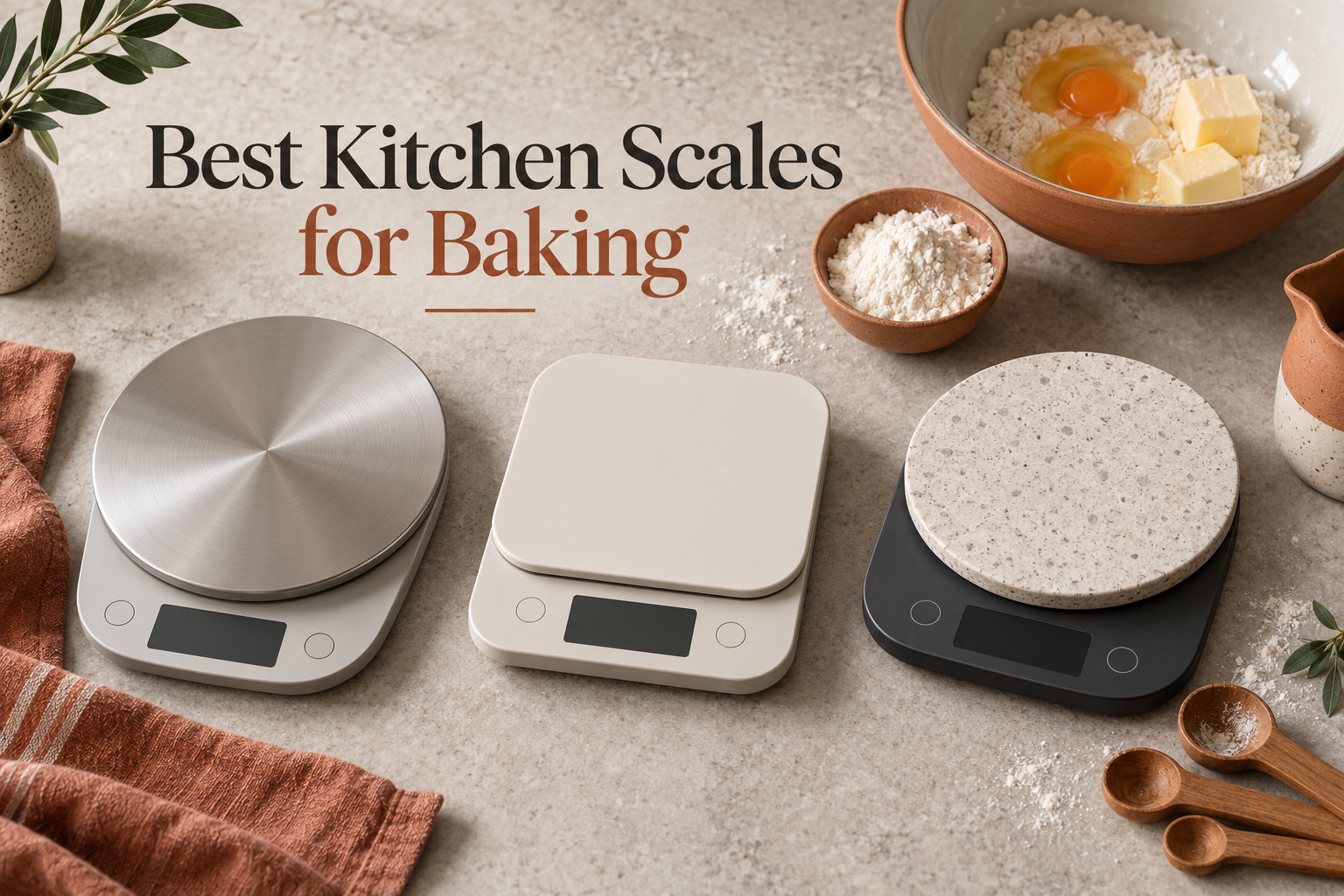
A good scale turns a recipe you followed into a recipe you can repeat. Flour packs vary in density, scoops compress or leave air behind, and measuring cups only tell you how much space an ingredient took up, not how much of it there actually is. We spent weeks weighing, pouring and re-weighing across ten popular models to find the best kitchen scales for baking in 2026, and the differences between them are much larger than the spec sheets suggest.
Every pick below was judged on the same four things: whether it holds a reading at small gram weights, whether the platform actually fits the bowl you own, whether the display stays visible during a mixing session, and whether the power source survives a long bake. If you want the short version first, here is where each one lands:
- Best overall: Amazon Basics Digital Kitchen Scale with LCD Display – 11 lb capacity, 1 g increments, tare, five measurement modes and a stainless steel platform on a compact 8.3 x 7 inch body.
- Best for small ingredients: Etekcity 0.1g Food Kitchen Scale – steps down to 0.1 g below 1000 g, then 1 g above it, with a nesting bowl that doubles as a storage cover.
- Best for big mixing bowls: Nicewell Food Scale 22lb – a 9 x 6.3 inch platform that a full-size glass bowl actually sits on without overhanging.
- Best for large dough batches: CROWNFUL Food Scale 33lb – 33 lb of capacity with a rechargeable cell and six measurement modes.
- Best for sourdough and fermentation tracking: Greater Goods Digital Food Scale 22lb – HOLD freezes the reading for up to five minutes and the display extends past the platform edge.
- Best for a sealed, flour-proof control panel: Escali Primo Digital Food Scale – a fully sealed panel, two buttons, and a four-minute auto shutoff.
- Best for baker’s percentage formulas: BOMATA Large Kitchen Scale 0.1g – percentage mode, HOLD, a counting function and a 100 g calibration weight in the box.
- Best for long baking sessions: My Weigh Bakers Math KD8000 – 8000 g capacity and an auto shutoff that can be switched off permanently.
- Best for reading a large bowl: OXO Good Grips 11 Pound Stainless Steel Food Scale with Pull-Out Display – the screen slides out from under the platform so a bowl cannot hide it.
- Best compact everyday unit: Etekcity Food Kitchen Scale 11lb – a slim 200 g body with a bright backlit display and a two-year warranty.
A note on how we worked: we weighed the same reference weights repeatedly on every model, checked whether the zero drifted between uses, and measured each platform against a standard mixing bowl to see how much overhang we could tolerate. Where a manufacturer quotes an accuracy figure, we treat it as a starting point rather than a promise, because the printed spec and the behaviour you get on a flour-dusted counter are rarely the same thing.
If you are also rebuilding your baking setup, our picks for silicone baking mats pair well with any of the scales here. If you are weighing other things entirely, our body fat scale picks use a very different accuracy standard than a flour bowl does.
Our Top 3 Picks For Serious Baking In 2026

Amazon Basics Digital Kitchen Scale
- 11 lb capacity
- 1 g increments
- Stainless steel platform
- Five measurement modes
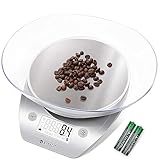
Etekcity 0.1g Food Scale with Bowl
- 0.1 g below 1000 g
- Nesting storage bowl
- Backlit display
- 2-year warranty

Nicewell Food Scale 22lb
- 9 x 6.3 inch platform
- 22 lb capacity
- Backlit LCD
- 1 g and 0.1 oz increments
Those three cover the three decisions most bakers actually face: which scale handles the whole range of a normal recipe, which one you reach for when a formula calls for four grams of instant yeast, and which one physically accepts a 5-quart glass bowl without the reading wobbling off the platform.
Comparing All 10 Kitchen Scales For Baking In 2026
| Product | Details | Action |
|---|---|---|
|
|
Check Latest Price |
 |
|
Check Latest Price |
 |
|
Check Latest Price |
|
|
Check Latest Price |
 |
|
Check Latest Price |
|
|
Check Latest Price |
 |
|
Check Latest Price |
 |
|
Check Latest Price |
 |
|
Check Latest Price |
 |
|
Check Latest Price |
1. Amazon Basics Digital Kitchen Scale – Best Overall For Everyday Baking
Amazon Basics Digital Kitchen Scale with LCD Display, Tare Function, Multiple Units, Weighs up to 11 Pounds, Batteries Included, Black and Stainless Steel
11 lb / 5 kg capacity
1 g readout accuracy
Stainless steel platform
Five measurement modes
+ Pros
- Huge review base showing consistent day-to-day accuracy
- Five measurement modes including ml and fluid ounces
- Tare button with a wide easy-to-read LCD
- Stainless steel platform wipes clean in seconds
- Batteries included and ready to use
– Cons
- 1 g increment is too coarse for yeast and salt
- Basic plastic body rather than metal
- Less durable over years of daily service
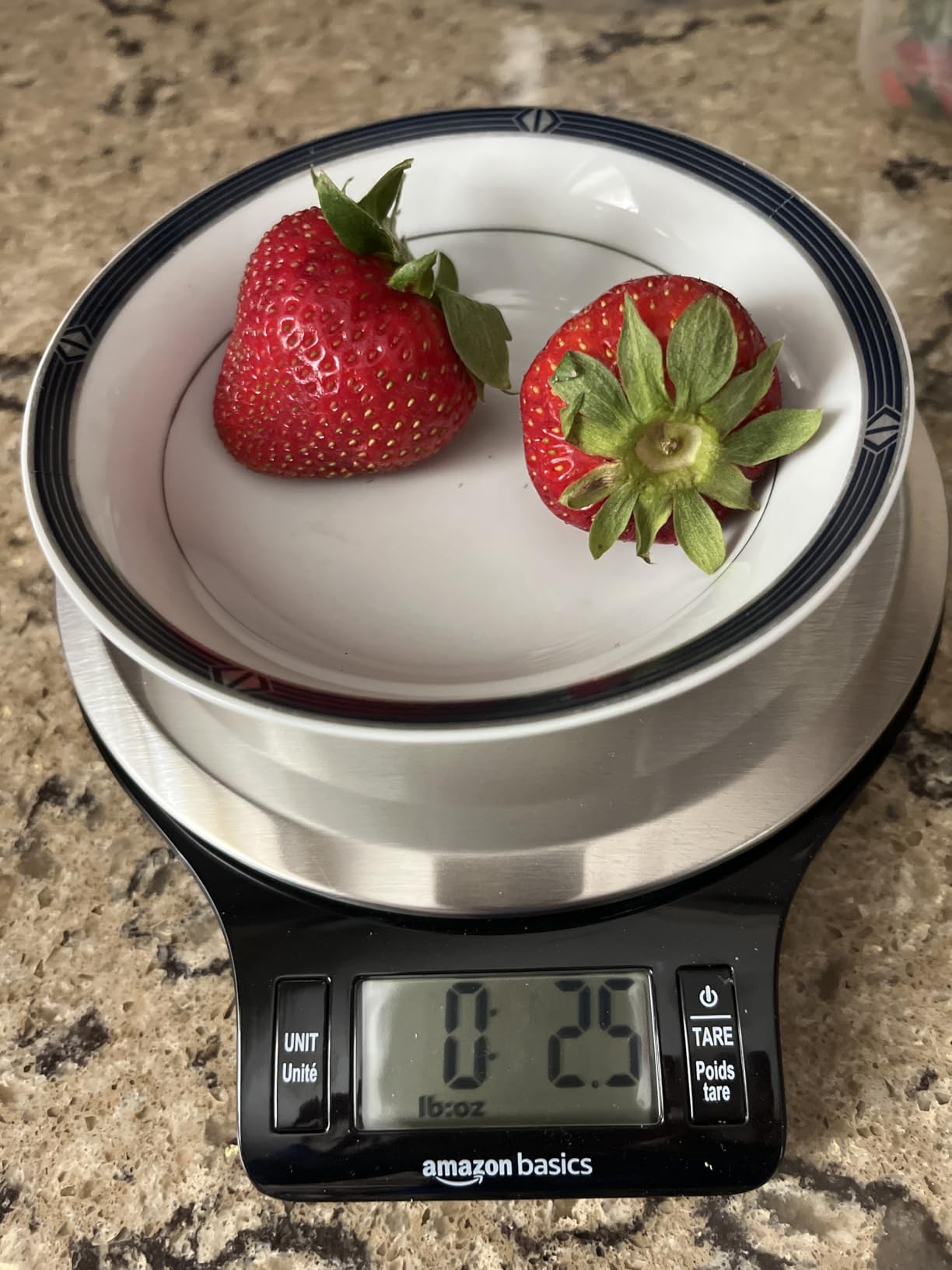
This is the scale we kept reaching for, because it does the boring things right. It holds 11 lb, steps in 1 g, converts between pounds, ounces, grams, fluid ounces and millilitres, and the wide LCD is legible from across a counter without leaning in.
The 8.3 x 7 x 1.3 inch body is the useful part. It is big enough for a mixing bowl you would actually use for a cake, small enough to slide into a deep drawer, and the stainless steel platform wipes down in one pass after a flour-heavy session.
Tare responds immediately, which matters more than it sounds when you are adding four ingredients in sequence into the same bowl. Batteries are included, so there is nothing to buy before your first bake.
Where it falls short is small weights. At a 1 g increment, four grams of yeast reads as four, but three grams reads as three and a fraction becomes an unhelpful round number. For yeast, salt and pastry work you will want a finer step, which is exactly why the Etekcity 0.1g model sits in this list too.
The plastic construction is the other trade-off. It will not survive being dropped onto a hard floor or stepped on, so give it a home on the counter rather than in a baking bin.
Resolution And Capacity In Practice
Eleven pounds covers a double batch of most cookies, cakes and muffins, and it comfortably handles a four to five pound dough. It does not cover a very large high-hydration batch, which is the gap the CROWNFUL and My Weigh models were chosen to fill.
Reviewers of this model consistently point to a steady reading across repeated weighs rather than any single measured accuracy claim. The 2 g minimum listed in the specifications is worth knowing about, since anything below that will not register meaningfully.
Display, Units And Everyday Handling
The wide LCD is the feature owners mention most, and there is no backlight, so it needs a reasonably lit counter. Units switch instantly, and because the mode is remembered in practice you are not cycling through five options each time you start.
Cleaning is the part that decides longevity for us. A flat steel platform with no recessed display well cannot trap flour, and that single design choice reduces the number of times a scale ends up in a drawer because it looks grubby.
2. Etekcity Food Kitchen Scale – Best Compact Unit For Daily Use
Etekcity Food Kitchen Scale, Digital Grams and Ounces, 11lb
11 lb / 5 kg capacity
1 g accuracy
Backlit LCD display
Compact 200 g body
+ Pros
- Slim low-profile body that stores in a drawer
- Bright backlit LCD with large numerals
- Smooth tare and instant unit switching
- 304 food-grade stainless steel surface
- Two-year warranty included
– Cons
- Auto-off timeout is short during multi-step prep
- Companion app sync is clunky
- 1 g resolution is not enough for small additions
- Some owners report accuracy fading after a year or more
At 200 g, this is the lightest scale here and the one we would actually put in a small kitchen. It disappears into a drawer between bakes and comes out for the weeknight cookies, the stir-fry vegetables and the morning yoghurt.
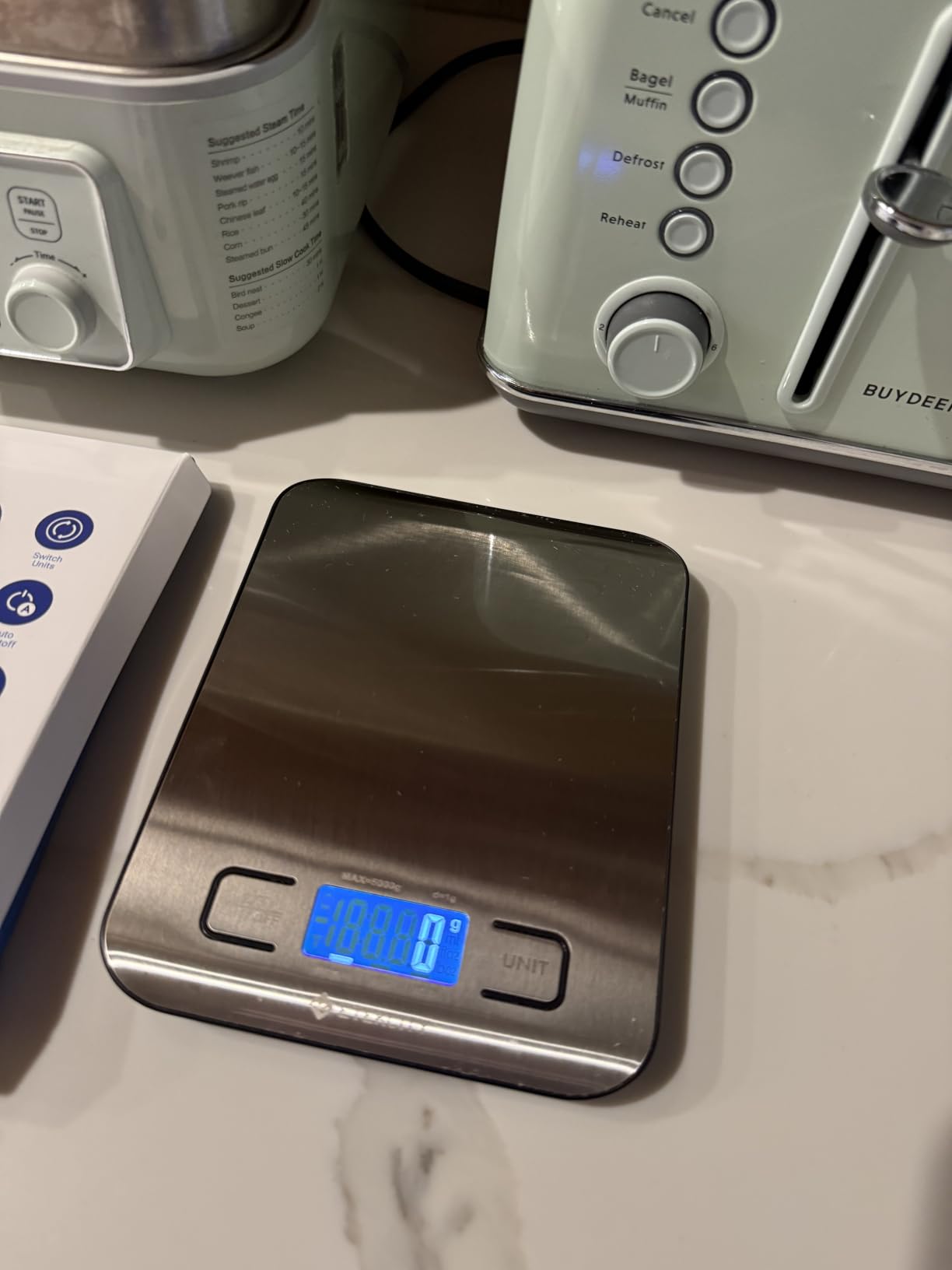
The backlit LCD is the quiet hero. Large, high-contrast numerals stay readable in a dim kitchen, which matters more than most spec lists admit because a lot of home counters are poorly lit at the point where the outlet is.
Tare is smooth and unit switching is instant across ounces, pounds and ounces, fluid ounces, grams and millilitres. A two-year warranty is attached, and the stainless steel surface wipes clean without any disassembly.
The auto-off timer is the most common complaint in the reviews, and it is the same complaint that drives bakers to search out scales without auto shutoff entirely. It is survivable, but during a long mixing session you will lose the reading more than once.
There is a companion app, and it is not doing anyone much good for baking purposes. Treat this as a straightforward kitchen scale rather than a connected one, and the software stops mattering.
Why 1 g Works For Most Home Baking
For anything measured in cups of flour, grams of sugar or ounces of chocolate, a 1 g step is invisible. You would need to be dividing a batch by a factor of more than fifty before the rounding showed up in the finished bake.
For levain feeding ratios and small salt additions it is a different story, and a baker who does both on one scale will feel the limit quickly. That is the case for owning a second, finer scale rather than for stretching this one.
Storage, Cleaning And Durability
The 304 food-grade stainless surface is the practical part. It handles sticky dough and spilled milk without absorbing anything, and it has no seams where residue collects.
Durability is the open question. A minority of long-term owners report accuracy reducing after a year or more of constant use, so if you are weighing several times a day, check it against a known weight periodically.
3. CROWNFUL Food Scale 33lb – Best For Large Dough Batches
CROWNFUL Food Scale, 33lb Rechargeable 304 Stainless Steel Digital Kitchen Scale Weight Grams and Ounces with LCD Display and Type-C Charging for Meal Prep, Baking and Cooking
33 lb / 15 kg capacity
Rechargeable Type-C or 2 AAA
1 g gradation
Six measurement modes
+ Pros
- 33 lb capacity is unusually high for the class
- Rechargeable cell with months between charges
- Stainless steel panel fits larger containers
- Slanted display stays legible
- Slim 0.7 inch profile
– Cons
- 1 g resolution only
- Zero point can drift and need resetting
- Platform is smaller than the capacity suggests
- Plastic-bodied build feels less premium
Capacity is the whole argument here. Thirty-three pounds means a double batch of bread dough, a large stock pot, or a serious session of batch cooking all land on the platform without a second weighing operation.
The rechargeable cell is the sleeper feature for anyone who bakes more than once a week. It also runs on two AAA batteries, so a flat battery never stops a bake, and the slanted screen keeps the number visible when you are looking down at it rather than straight across.
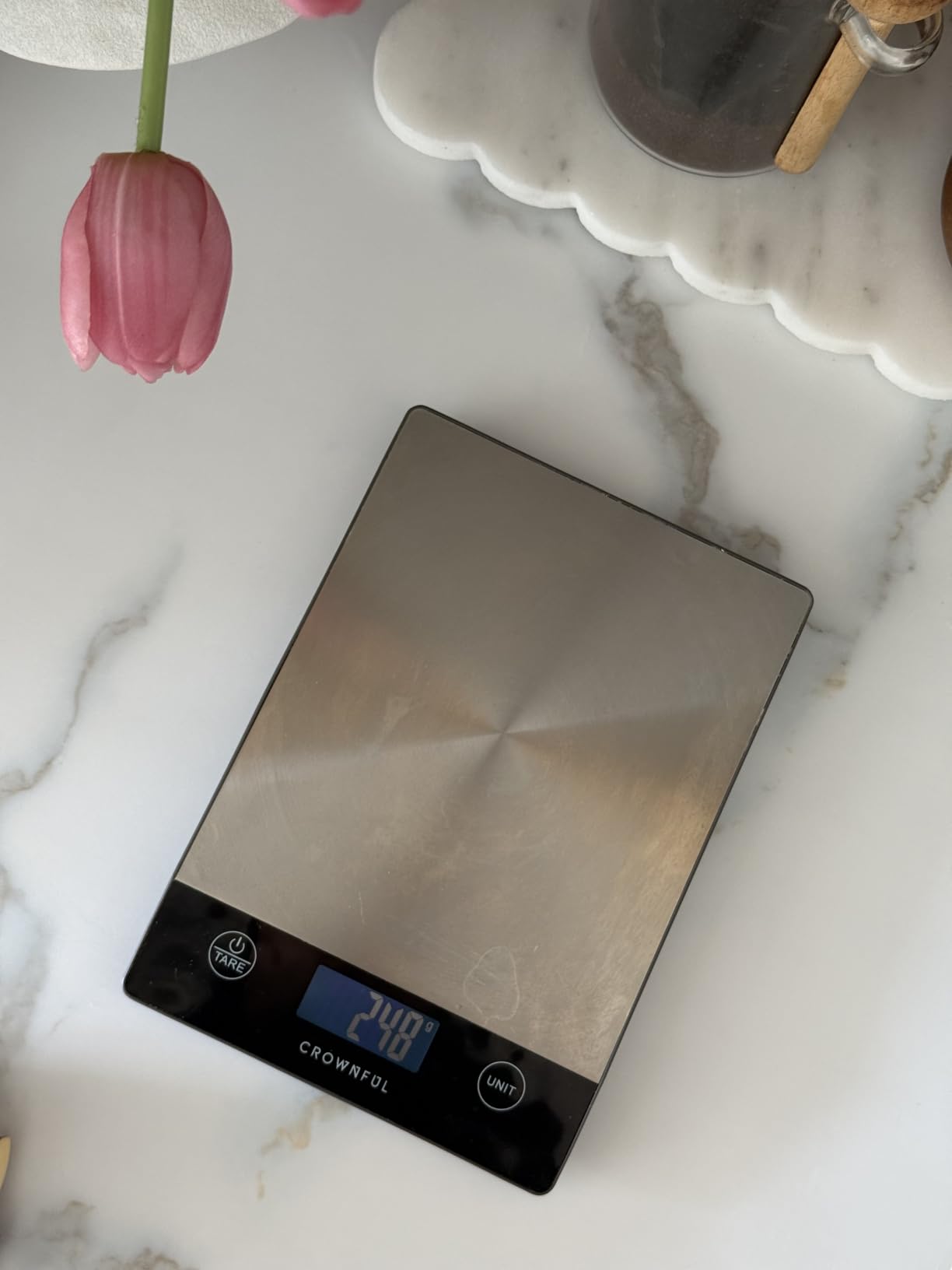
Six measurement modes cover grams, kilograms, pounds, ounces, millilitres and milk millilitres. The one-tap tare works as expected, and the 7.9 x 5.5 x 0.7 inch body is thin enough to slide anywhere.
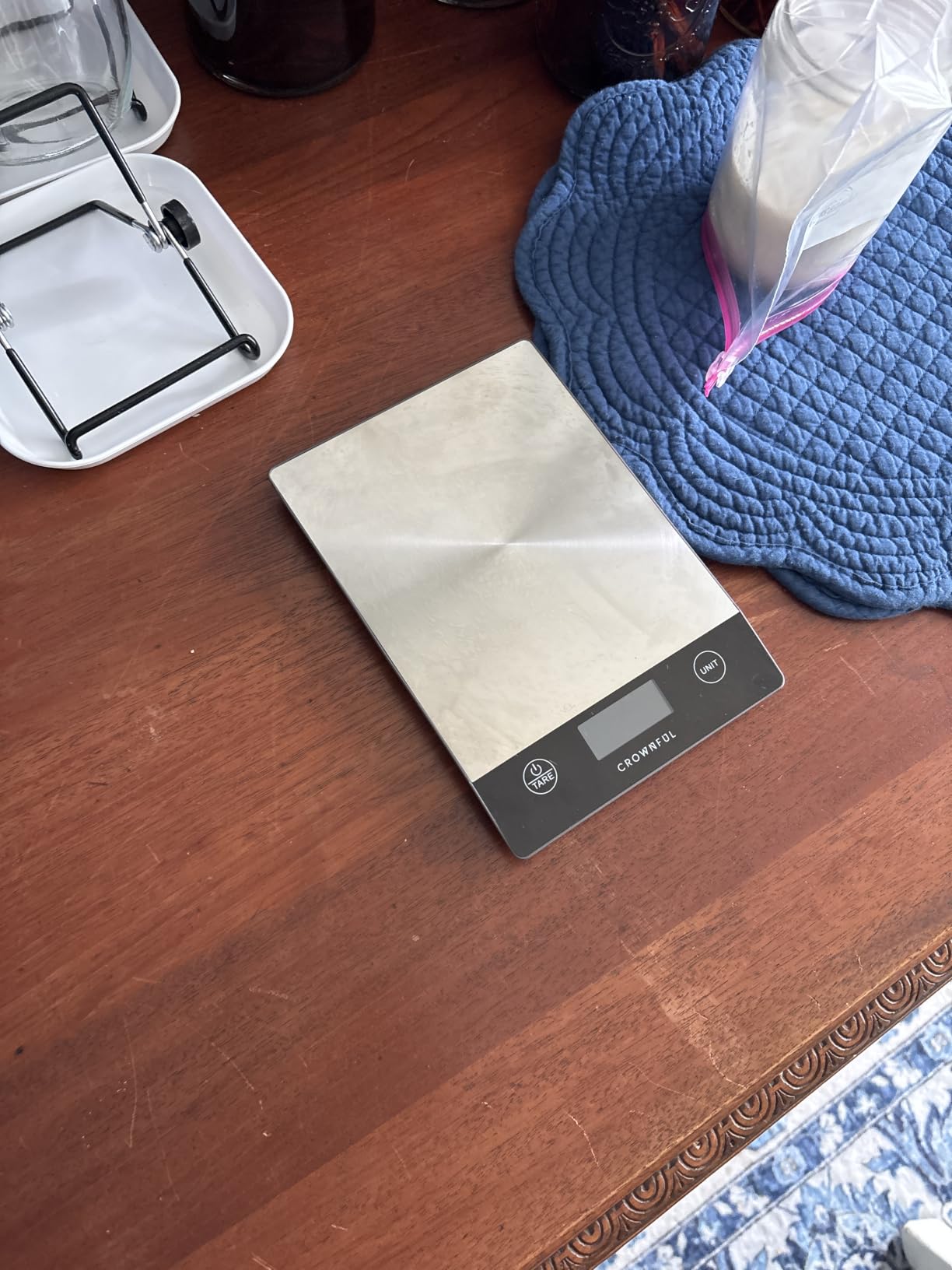
The catch is that the platform is not as large as the capacity figure implies. A wide stock pot can overhang even though the load cell can technically handle the weight, and that overhang is what produces an unstable number.
Owners also report the zero point drifting and needing a reset more often than expected. The manufacturer’s own guidance is to keep the scale on a hard, flat surface away from vibration, which is good advice for any load cell model.
Matching Capacity To Your Largest Batch
As a rule of thumb, a dough batch that feels heavy enough to be a struggle is also a batch worth weighing on something rated well above it. Thirty-three pounds gives you a full margin, so you are never guessing how close you are to the limit.
Canning, fermenting and brining all benefit from headroom too, since the container itself is consuming part of the rating before your food does.
Battery Life And Power Flexibility
Being able to choose between a rechargeable cell, two AAA batteries and that is genuinely useful. Many owners report going months between charges, which removes the low-battery error you get from scales that only run on disposable cells.
Keep the rechargeable cell topped up if you notice the Lo indicator, because a low or unstable voltage is the most common cause of readings that are inconsistent but not obviously wrong.
4. Etekcity 0.1g Food Kitchen Scale – Best For Yeast, Salt And Pastry
Etekcity 0.1g Food Kitchen Scale, Bowl, Digital Grams and Ounces for Weight Loss, Dieting, Baking, Cooking, and Meal Prep, 11lb/5kg, Stainless Steel Silver
0.1 g below 1000 g, 1 g above
11 lb / 5 kg capacity
Detachable nesting bowl
Backlit display
+ Pros
- 0.1 g precision for small dry ingredients
- Bowl flips over the platform for drawer storage
- Bright high-contrast backlit display
- Rubber feet stay stable while pouring
- Two-year warranty with batteries pre-installed
– Cons
- Auto-off after about two minutes interrupts sessions
- Unit settings sometimes reset on their own
- Real-world repeatability is nearer 1.5 g
- Accuracy can decline after heavy long-term use
- Bowl is unnecessary for many users
This is the answer to the most common question in the r/Baking thread on scale recommendations, which is whether a home baker really needs sub-gram resolution. For yeast, salt, spices and macaron shells, the honest answer is yes.
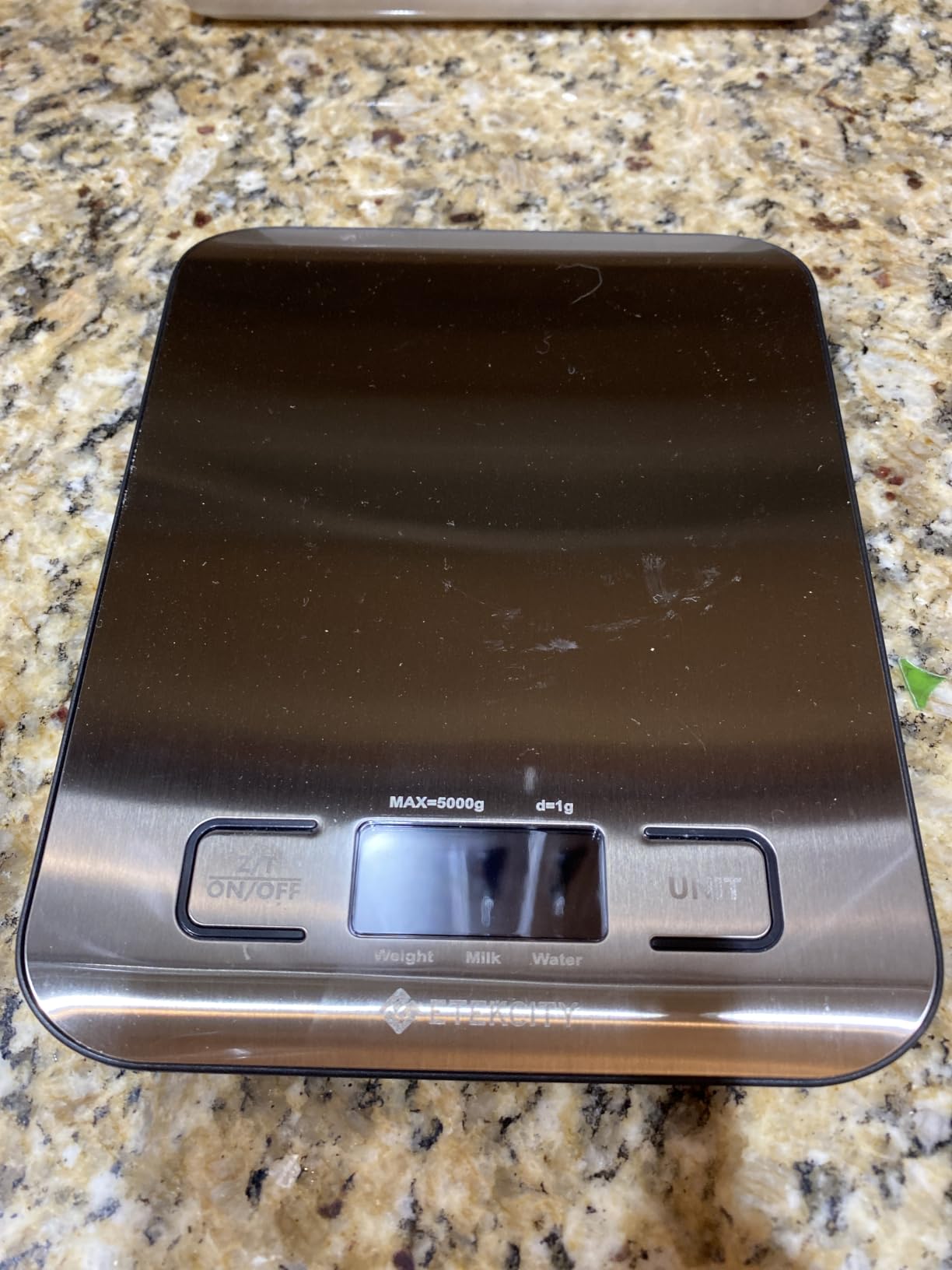
The dual increment design is the smart part. Below 1000 g the scale steps in 0.1 g, and from 1000 g to 5000 g it steps in 1 g. You get precision where it counts without paying for decimals on a two-kilo dough.
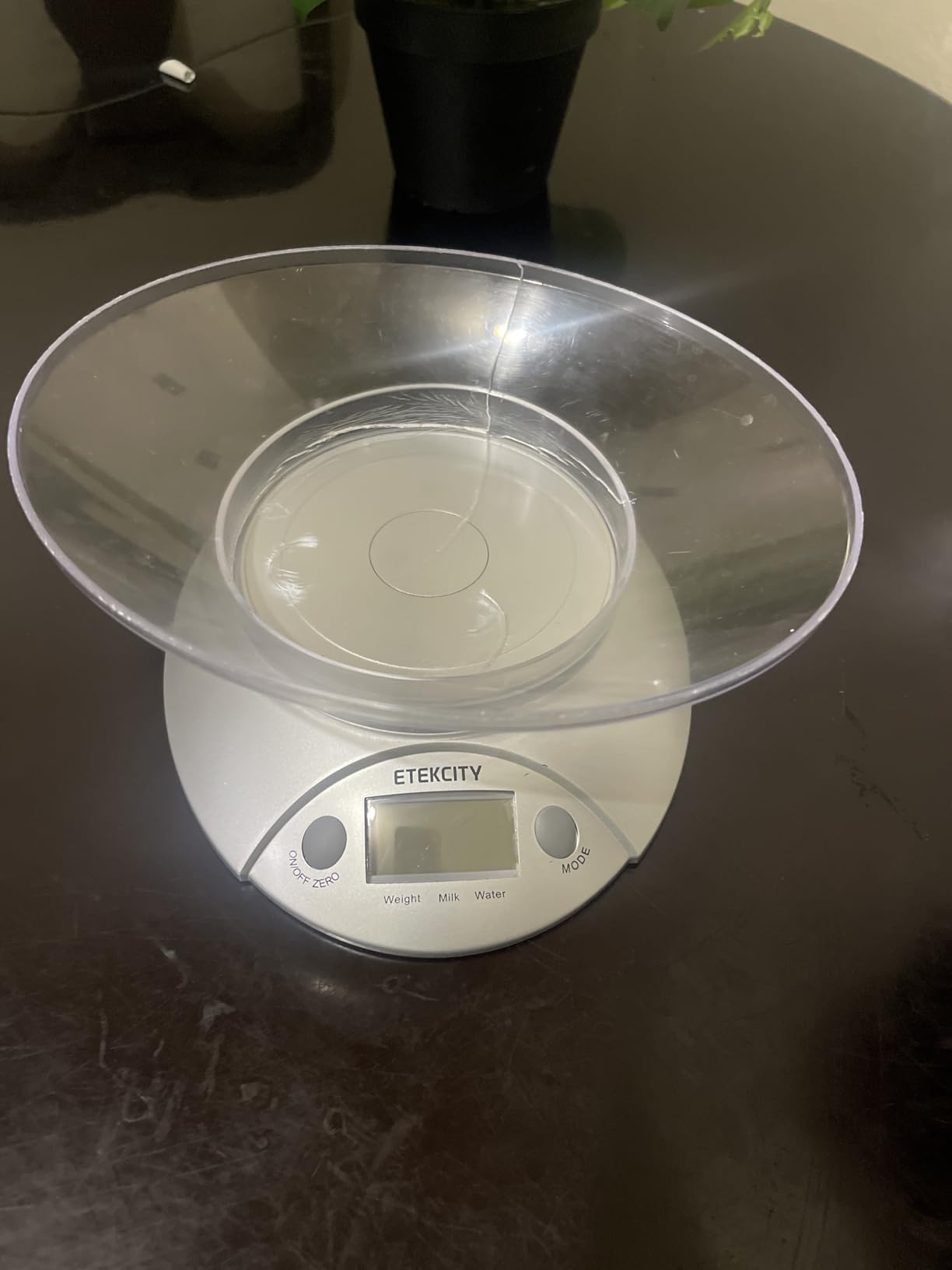
The detachable bowl nests over the platform for storage and doubles as a protective cover, which turns a precision scale from a counter-cluttering object into something you can put away. It is also genuinely useful for weighing liquids.
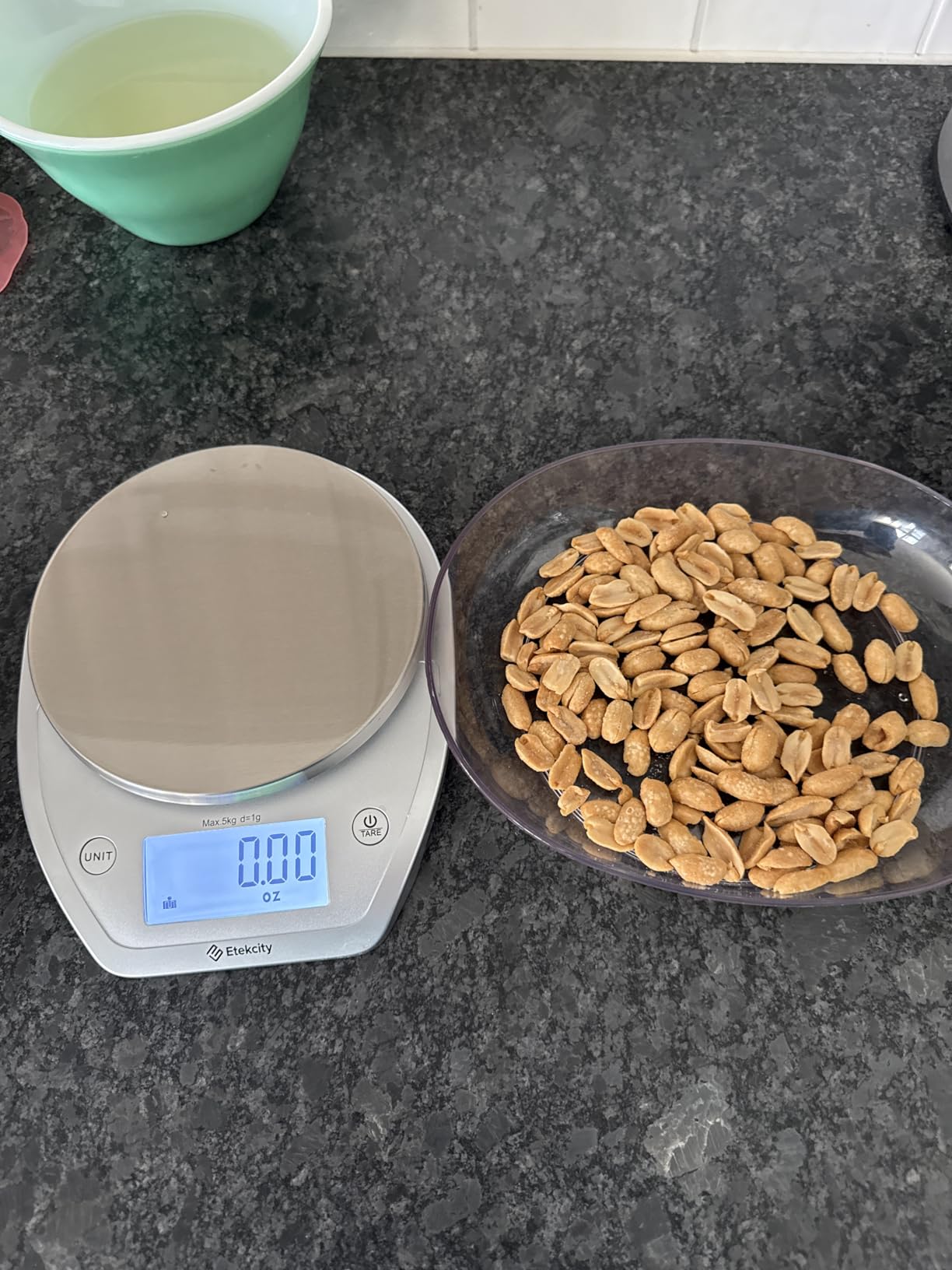
Owners do report a practical repeatability closer to 1.5 g despite the 0.1 g display, which is a fair reminder that resolution and accuracy are different things. You get a decimal point at two grams, not laboratory precision.
The roughly two-minute auto-off is aggressive and is the single most cited complaint in the reviews. The rubber feet do more good than they sound, because a scale that shifts while you pour yeast is a scale that gives you a wrong number.
Where 0.1 g Actually Changes The Result
Salt in a enriched dough, yeast in a high-sugar bake, and almond flour in a macaron are all quantities where a whole-gram step changes the outcome. That is the zone this scale was built for.
For your main flour and water weights the 1 g step is already plenty, which is why we would pair this with a larger high-capacity scale rather than expecting one device to do everything. That two-scale approach is the consensus on The Fresh Loaf forum, and for good reason.
Bowl, Display And Counter Use
The backlit display measures 2.4 x 1.1 inches with strong contrast, which reviewers single out as an easy read for ageing eyes. It is a bigger readout than most scales at this size manage.
Accuracy has been reported to decline after around seventeen months of heavy daily use, so if you are weighing several times a day, keep a known weight in a drawer and check the reading now and then.
5. Greater Goods Digital Food Scale 22lb – Best For Sourdough Tracking
Greater Goods Digital Food Scale for Kitchen & Baking, 22lb High Capacity
22 lb / 10 kg capacity
HOLD freezes readings up to 5 minutes
Display extends beyond the platform
5-year warranty
+ Pros
- 22 lb handles large bowls and Dutch ovens
- Display extends past the platform for visibility
- HOLD keeps the number while you rearrange
- Remembers the last measurement mode
- Touch buttons outlast cheaper membrane keys
– Cons
- Auto shut-off after 2 minutes is the top complaint
- 1 g resolution only
- Too coarse for yeast and salt
Twenty-two pounds of capacity and a display that extends beyond the weighing platform. That second detail is quietly the most useful thing on this scale, because a fixed screen on a 7.6 x 5.6 inch body disappears behind a large mixing bowl exactly when you need it.
HOLD freezes the reading on screen for up to five minutes. During a sourdough session that means you can set your bowl down, scrape, rest your hands and read the dough weight again without re-zeroing the whole setup.
The touch-sensitive controls feel more expensive than the membrane keys on budget models, and owners with long service histories report they stay responsive. A five-year limited warranty is longer than most of the field.
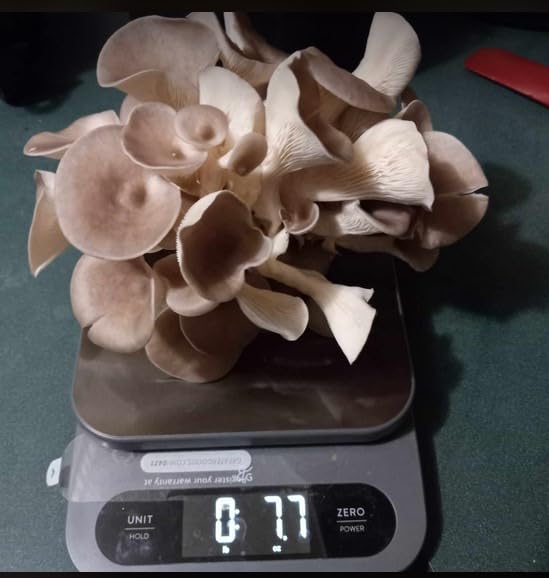
The zero function resets the scale instantly for containers and Dutch ovens, which is the version of tare that matters for bread. It also remembers the last mode you used, saving a step every session.
The two-minute auto shut-off is the most common complaint, and it is the same gripe that sends bakers hunting for models where it can be disabled. At least here, HOLD gives you a five-minute window to work in before the scale drops out.
Why Bread Bakers Care About Capacity And Hold
High-hydration dough is heavy and wet, and a 22 lb ceiling means you can scale a recipe up and still weigh the finished dough on the same machine. That removes the second-guessing that comes from moving dough between scales mid-bake.
Tracking dough weight through bulk fermentation is exactly the use HOLD was built for, since you are repeatedly setting the container down and picking it back up.
Warranty And Longevity Signals
Reviewers who compared many scales rate the buttons and build quality as noticeably better lasting than the cheapest alternatives, and the five-year warranty is backed by a responsive replacement service according to owner reports.
Battery life is long on three AAA cells, and the stainless steel platform with touch controls wipes clean without a seam. It is a working tool rather than a display piece, which suits most kitchens.
6. Nicewell Food Scale 22lb – Best For Big Mixing Bowls
Nicewell Food Scale 22lb Digital Kitchen Scale for Cooking Baking
9 x 6.3 inch platform
22 lb / 10 kg capacity
1 g and 0.1 oz increments
Backlit large LCD
+ Pros
- Platform is wide enough for a full-size glass bowl
- Four high-precision load sensors
- Flat easy-wipe stainless surface
- Backlit display is easy on aging eyes
- Slim profile stores in a drawer
– Cons
- Display well is slightly recessed and collects spills
- A hand or shadow passing over can shift the reading
- AAA batteries need periodic replacement
- Touch area is easy to hit by accident
Platform size is the feature that decides whether a scale is usable for you, and this one has the widest platform in the roundup at 9 x 6.3 inches. A full-size glass mixing bowl sits on it rather than balancing on the edge, and that single fact removes an entire category of problem.
When a bowl overhangs, the load cell picks up uneven force and the number drifts, sometimes jumping by several grams as you move. Owners who have used this model report consistent readings with a heavy bowl in place, verified within one percent against calibrated weights.
Twenty-two pounds of capacity and 1 g or 0.1 oz increments cover everything from a five-pound dough to a tray of cookies, and the backlit readout is large and clear.
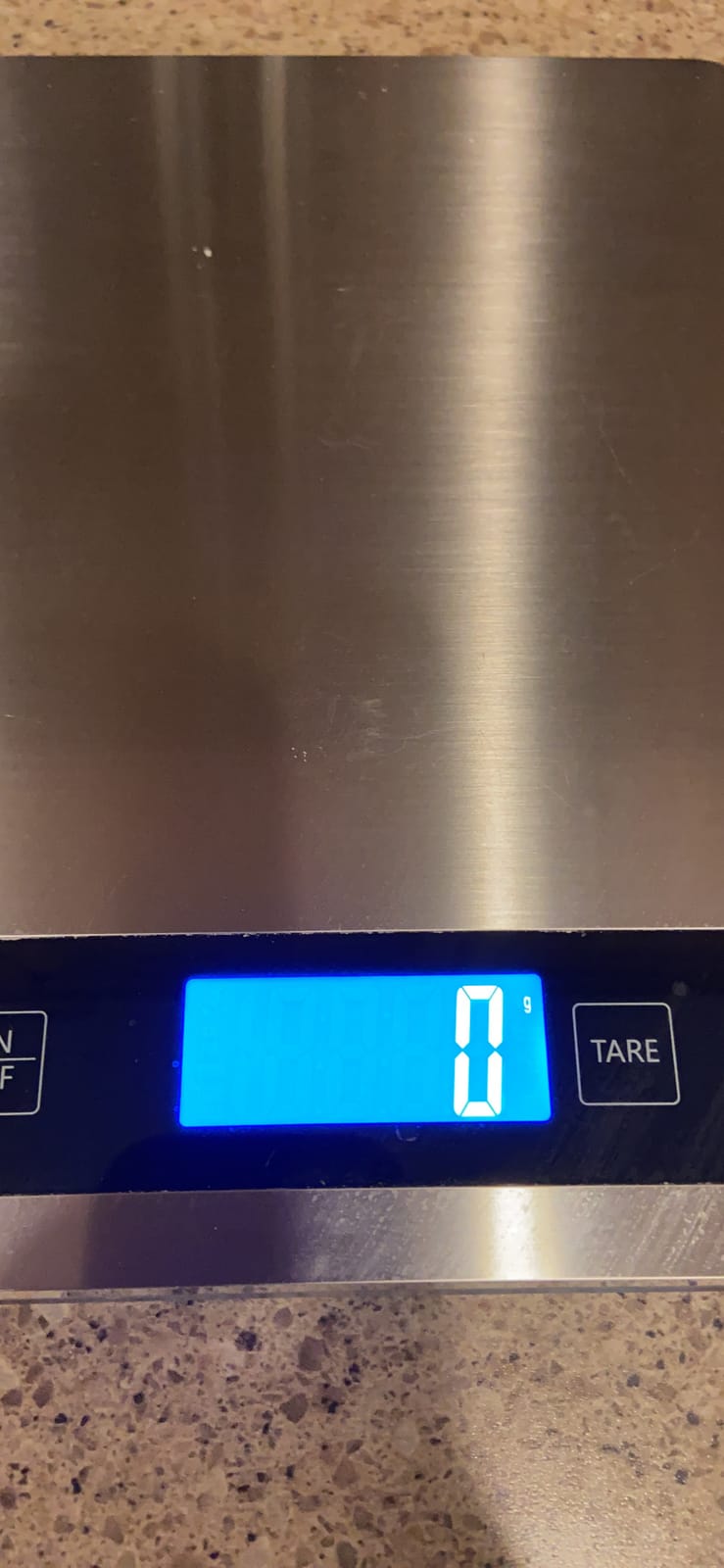
The tempered glass platform has an anti-fingerprint stainless top surface, which is the right call in a kitchen. Flat surfaces with no raised buttons wipe down in one pass, and that is what decides whether a scale stays on the counter.
The display well is slightly recessed, so spills can collect there and need a wipe rather than a shake. A small number of users also report readings shifting when a hand or shadow passes over the platform, so keep the area above it clear.
Platform Size Versus Bowl Size
Measure the widest point of your bowl before you commit to any scale. If your bowl diameter approaches the platform width, the bowl will overhang, and an overhanging bowl produces a number you cannot trust even when the scale is perfectly accurate.
This is the single most common mechanical complaint in kitchen scale reviews, and it is the one that is easiest to avoid before purchase and impossible to fix afterwards.
Cleaning, Storage And Daily Reliability
Several owners report multi-year service with a warranty replacement when the backlight dimmed, and the flat stainless surface survives sticky dough far better than raised-button designs.
A storage hook on the back keeps it out of the way, and the slim profile slides into a drawer. The one thing to remember is that the touch area is easy to hit by accident, so a stray elbow mid-pour can change your unit mode.
7. Escali Primo Digital Food Scale – Best Value With A Sealed Panel
Escali Primo Digital Food Scale Multi-Functional Kitchen Scale and Baking Scale for Precise Weight Measuring and Portion Control, 8.5 x 6 x 1.5 inches, Chrome
11 lb / 5,000 g capacity
Sealed control panel
Two-button operation
4-minute auto shutoff
+ Pros
- Sealed panel stops flour and liquid getting into the controls
- Two buttons are simple enough for anyone
- Four-minute auto shutoff is less aggressive than most
- Rounded design wipes clean easily
- Five-year limited warranty
– Cons
- 11 lb capacity is lower than several rivals here
- Plastic construction rather than stainless steel
- Only three measurement modes with no fluid volumes
- Small platform for the class
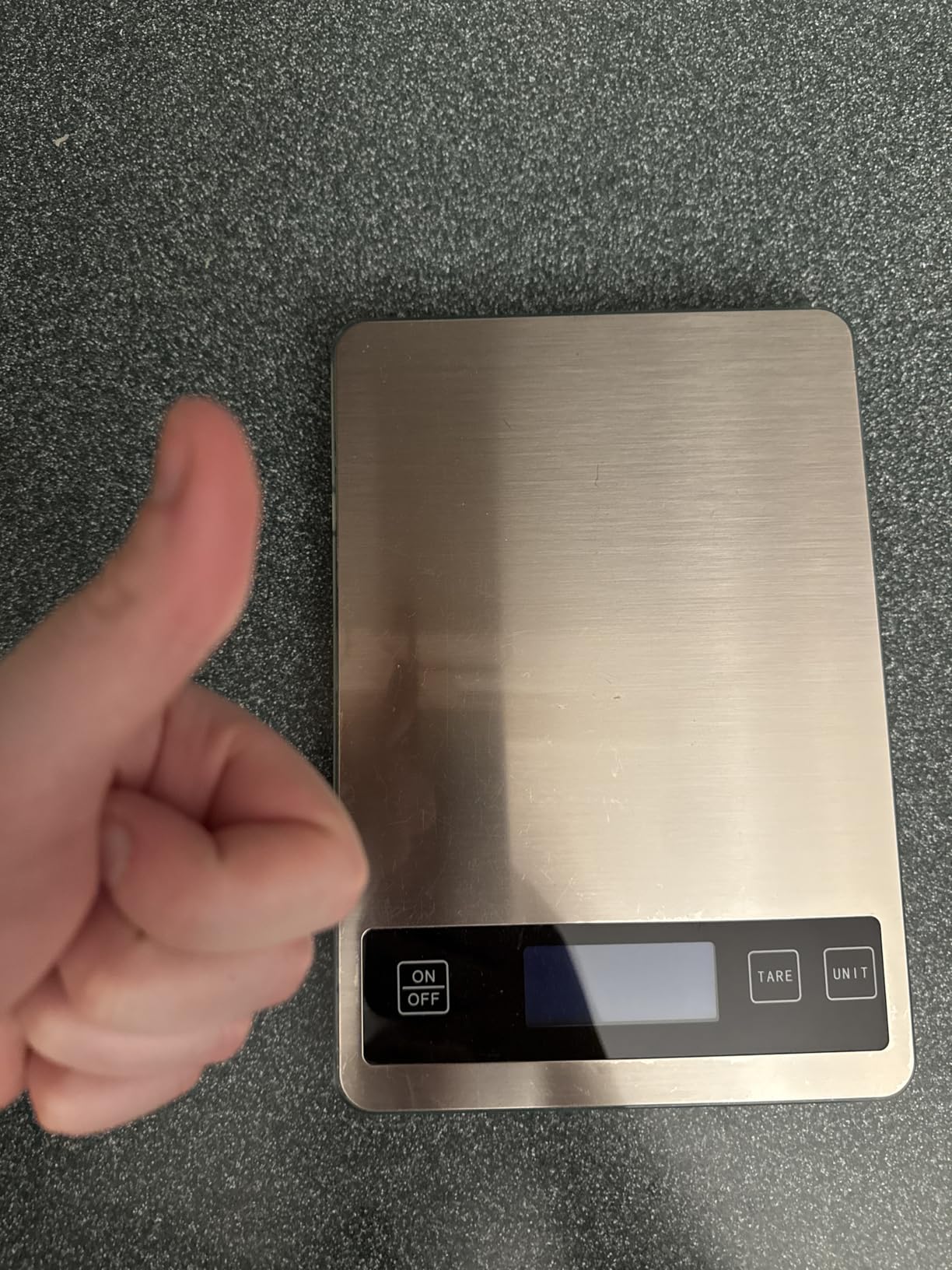
The Escali Primo has been a counter default for years, and the reason is a single design decision: the control panel is fully sealed. No seams means no flour dust, no sticky syrup and no membrane keys that stop responding after a season.
Two buttons is genuinely all you get, and for most bakers that is a feature. There is no mode to select by accident and nothing to configure, which is why reviewers describe it as a long-lasting kitchen workhorse.
The four-minute auto shutoff is longer than most budget scales allow, which matters if you are proving a dough and look away for a moment.
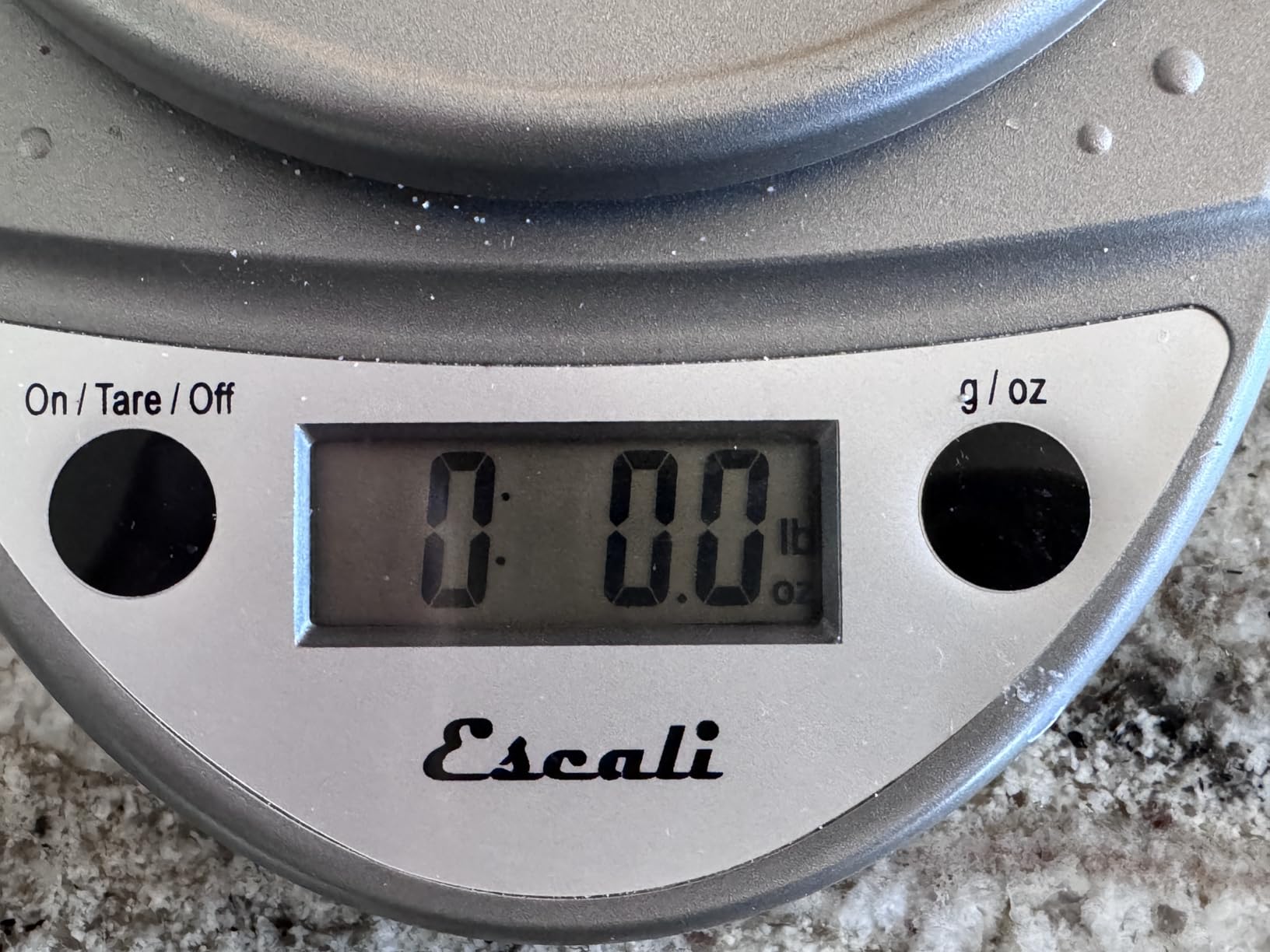
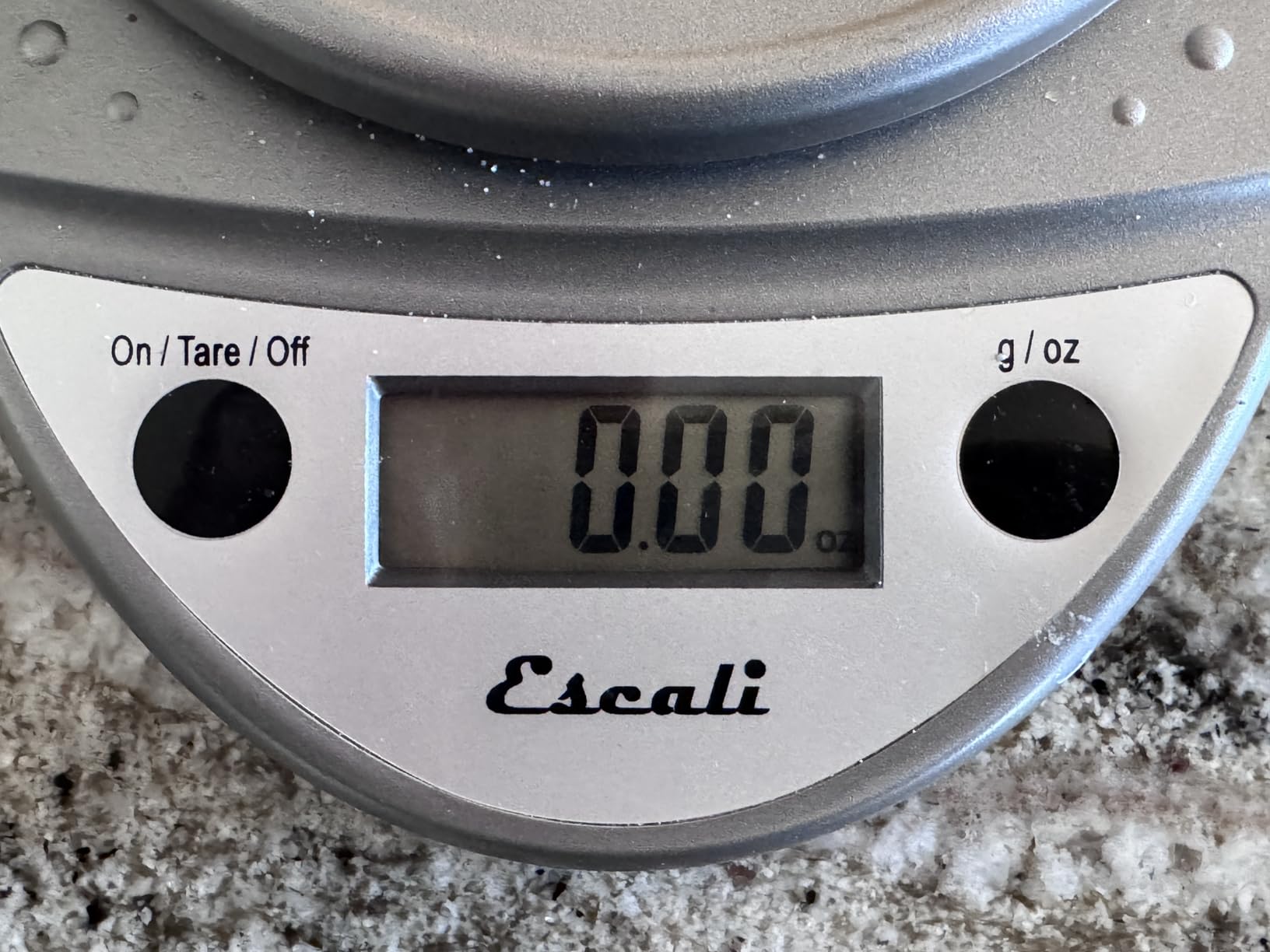
Readings come in 1 g or 0.05 oz increments across ounces, pounds and ounces, and grams. There is no fluid ounce or millilitre mode, so it is a weight scale only, which is exactly right for baking and irrelevant for liquids.
The 8.5 x 6 x 1.5 inch body holds 11 lb, which is at the lower end compared with the 22 lb models here. A very large dough batch will need a second weighing.
Why A Sealed Panel Outlasts Open Buttons
Most kitchen scale failures are not load cell failures. They are moisture and flour getting into a control membrane, which makes a scale that worked yesterday unresponsive today. Sealing the panel removes that failure mode entirely.
The rounded body has no crevices, so a wipe is the whole cleaning routine. There is no platform to remove and no seam to brush out.
Where The Capacity Limit Bites
Eleven pounds is fine for cakes, cookies, pastries and a standard loaf. It becomes tight for double batches of bread, a large stock pot, or several days of batch-cooked portions weighed at once.
If your baking skews heavily toward large bread batches, the trade here is not worth making. For everything else, the sealed panel and the five-year warranty are unusually good at this level.
8. BOMATA Large Kitchen Scale 0.1g – Best For Bakers Percentage Formulas
BOMATA Large Kitchen Scale 0.1g/0.001oz High Precision, 11lb Bakery Scale
0.1 g accuracy from 0.5 g to 5 kg
Bakers percentage function
Cancelable auto shutoff
Included 100 g calibration weight
+ Pros
- Percentage mode works straight from ingredient ratios
- HOLD handles items that overhang the pan
- Auto-off can be extended or switched off entirely
- Runs on rechargeable
- AAA or plug-in power
- Real push buttons rather than touch controls
– Cons
- Lowest rating here at 4.4 with a 9 percent one-star share
- 11 lb capacity is limited for big batches
- Some units arrive with a broken battery connector
- Printed manual is small and hard to read
- Tenths digits clutter the display for casual use
Percentage mode is the reason bread bakers pick this one. You load your flour, hit the reference, and every subsequent ingredient is shown as a percentage of it, which is the entire arithmetic behind scaling a dough formula up or down.
Accuracy is 0.1 g across a 0.5 g to 5 kg range on a 7.2 x 7.2 inch stainless steel platform. HOLD measures items that overhang the pan, which is a small touch that solves a real problem when a dough ball grows past the platform.
It also runs three ways: a built-in USB-C rechargeable lithium battery, two external AAA batteries, or a plug for continuous power. Continuous power is the direct fix for the auto shutoff problem that frustrates bakers most.
The auto shutoff can be extended or disabled with a long press on the tare button. It is buried in a small printed manual, so expect to look it up once and then forget it.
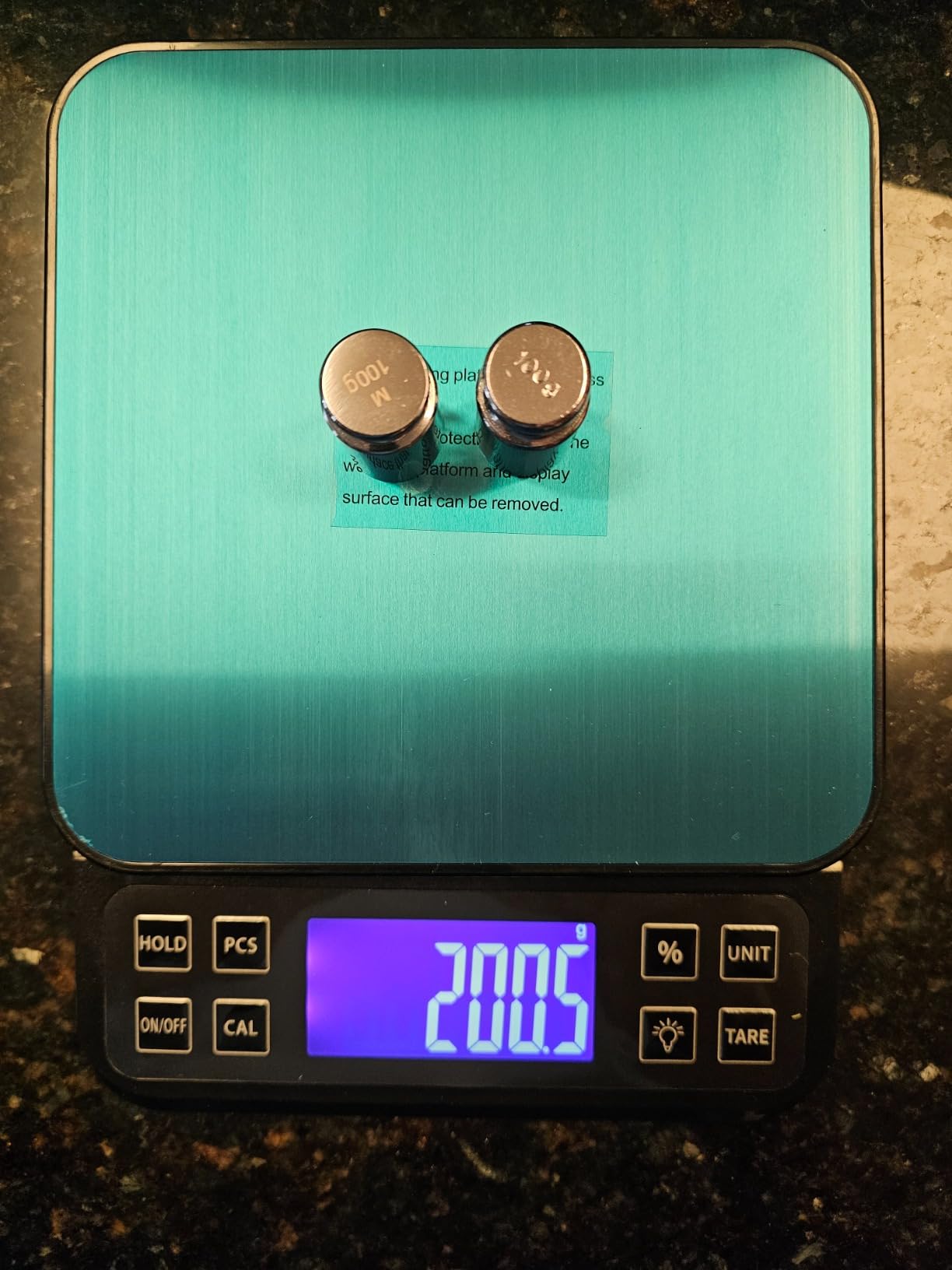
A 100 g calibration weight is stored in the unit itself, which is unusually thoughtful. You can verify the reading at any time rather than trusting that the factory calibration still holds.
The 4.4 Rating And What Drives It
This is the lowest-rated product in the roundup at 4.4, with a nine percent one-star share against one to three percent for most rivals. The complaints cluster around defective units arriving with a broken battery connector plate, plus on and off button failures.
Owners who receive a working unit rate the precision and features highly, and the company is repeatedly praised for fast warranty replacements. We would treat the percentage mode as the reason to buy and the build consistency as the thing to check on arrival.
Plug-In Power And Long Sessions
Being able to plug in and never think about the timer is the feature that separates this from every other sub-gram scale here. For long bakes that is worth more than another decimal place.
Real push buttons are another quiet win. They do not misfire when your hand passes over the platform, and they still respond after years of flour exposure.
9. My Weigh Bakers Math Kitchen Scale KD8000 – Best For Long Baking Sessions
Bakers Math Kitchen Scale by My Weight – KD8000 , Silver
8000 g / 17.6 lb capacity
Programmable auto-off can be disabled
Percentage weighing function
Stainless steel platform
+ Pros
- Auto shutoff can be fully disabled
- Calibrated accurately and verified repeatedly over years
- Percentage function suits bread and soap formulas
- Angled display stays readable with large bowls
- Owners report six-plus years of daily use
– Cons
- Plastic build feels cheap for the price
- AC power adapter is not included
- Feet are not rubberized so it can slide
- Blue backlight can fog for shorter users
- Calibration can drift and the 5 kg weight is not included
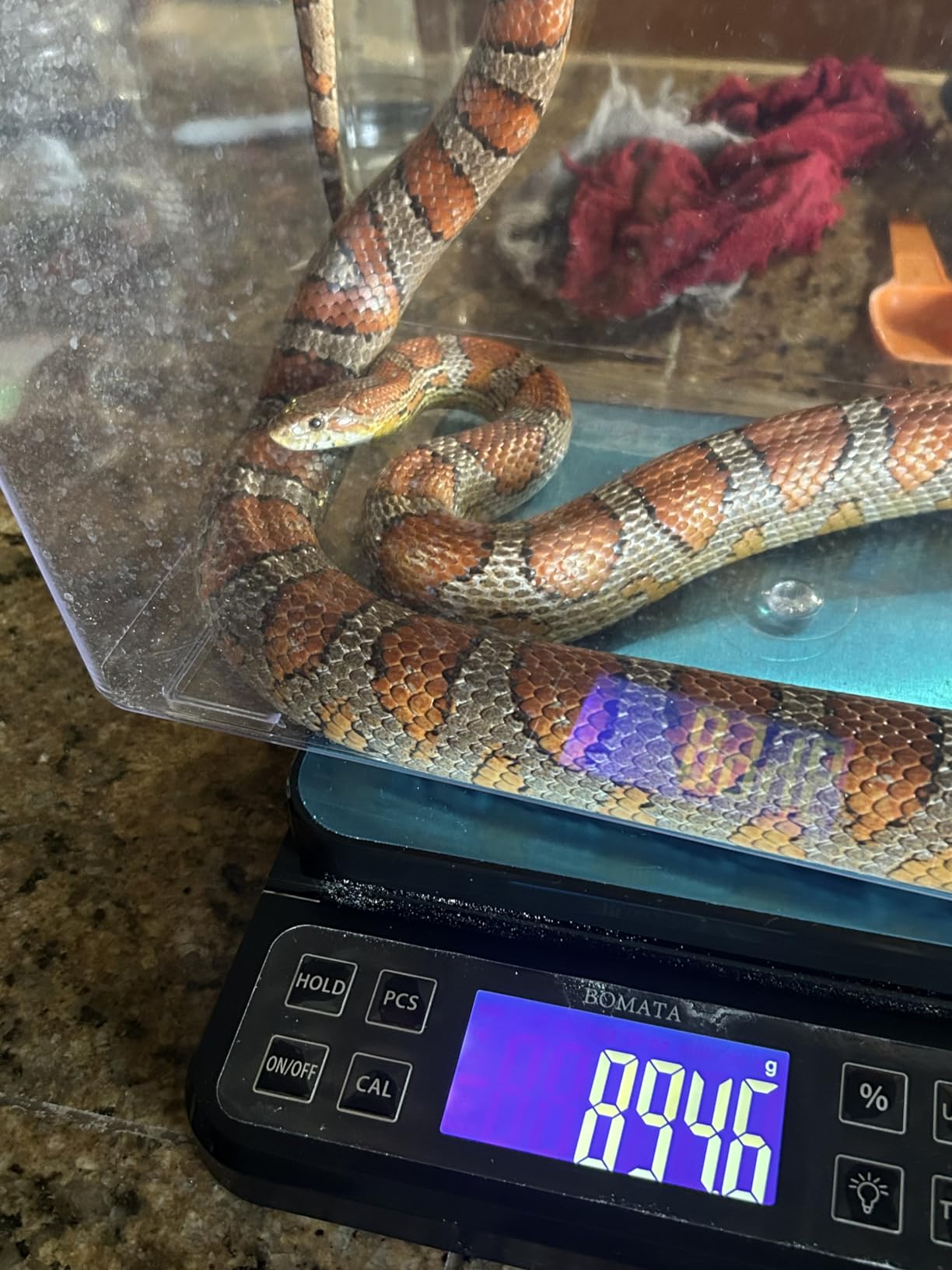
This is the scale bakers on pizza and bread forums come back to, and the reason is the auto shutoff. It is programmable and can be disabled entirely, which means the reading is still there an hour into a ferment whether you are looking at it or not.
Capacity is 8000 g or 17.6 lb with 1 g and 0.05 oz accuracy, plus a percentage weighing function for bread and soap formulas. That is genuine large-batch headroom without the footprint of a commercial platform.
Owners report five to six years of daily use with unchanged gram-level accuracy verified against a 100 g weight. The removable stainless steel platform and hinged splash shield over the controls wipe clean easily.
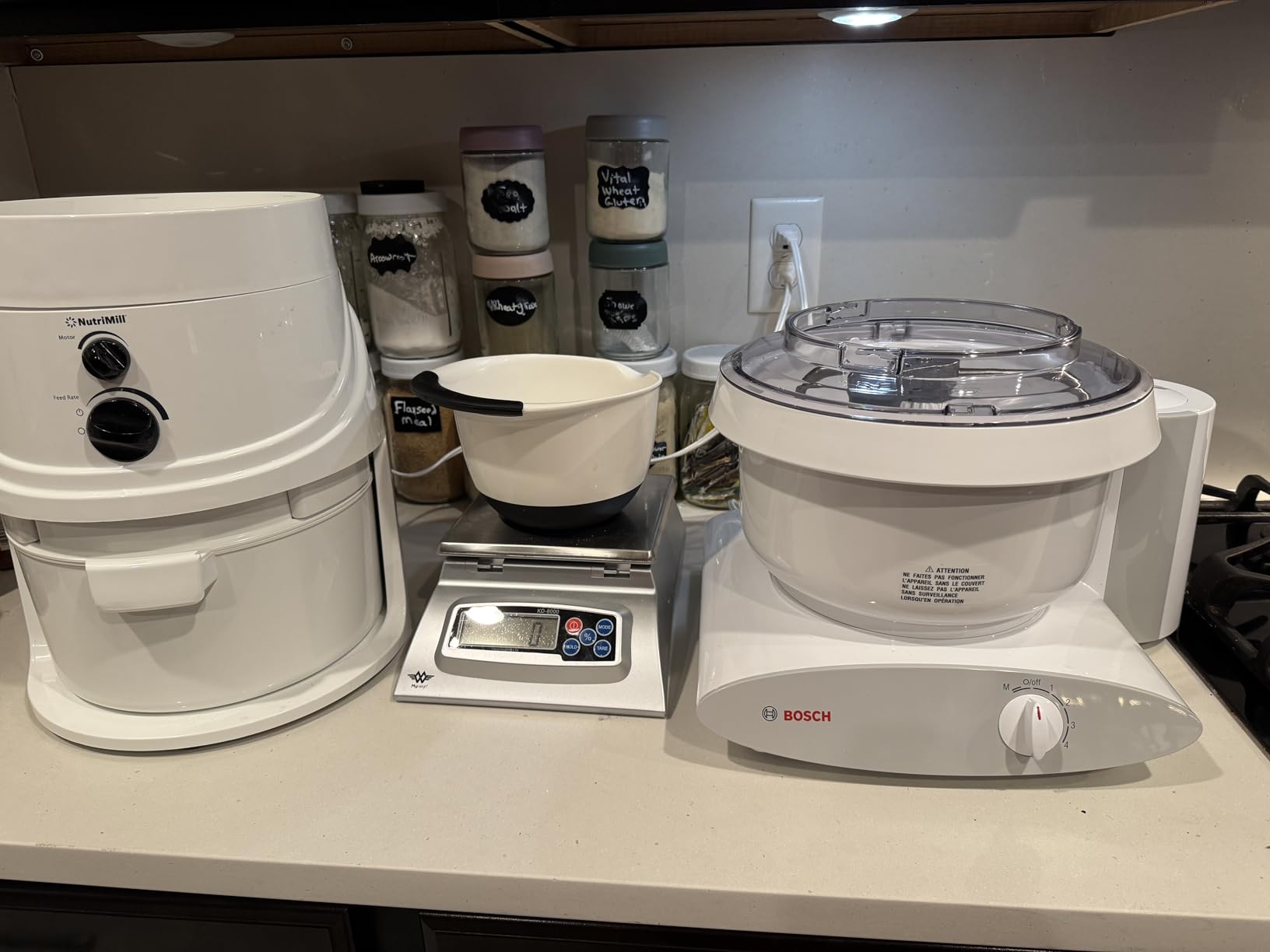
Two things to plan around. The AC power adapter is sold separately, and the disable-auto-off procedure is arcane and not explained in the manual, so search for it before you need it.
The feet are not rubberized, which means the scale can slide when you weigh a heavy container. Put it on a hard, flat surface and treat large pours as a two-handed job.
Why 8000 g Is The Bread Baker Number
Roughly 17.6 lb covers a double batch of most loaves and a large batch of rolls, and the extra headroom over 11 lb means you are never weighing something in two sessions.
That is why the perfect-loaf style workflow, which relies on baker’s percentages and continuous weighing through fermentation, works on this model. The angle of the display also keeps the number readable with a large bowl or a baking sheet on the platform.
Long-Term Ownership Notes
Factory calibration can drift slightly over time, and the 5 kg calibration weight is not included. Keep any known weight in a drawer and check the reading every few months if you bake often.
Some owners find the blue backlight creates display fog when viewed from a low angle, which is a real consideration for shorter users working at a standard counter height. The display shield hinge and button decals do wear over years of use.
10. OXO Good Grips 11 Pound Stainless Steel Scale – Best For Reading Under A Large Bowl
OXO Good Grips 11-Pound Digital Kitchen Food Scale
11 lb capacity
1 g and 0.1 oz accuracy
Pull-out display
Removable stainless steel platform
+ Pros
- Pull-out display keeps numbers visible with large bowls
- Stainless platform resists smudges and fingerprints
- Removable platform makes cleaning straightforward
- Large high-contrast backlit numbers
- Solid build from an established kitchenware maker
– Cons
- Most expensive scale in this roundup
- 11 lb capacity is low for bulk bread batches
- 1 g resolution limits very small measurements
- Fewer unit and specialty functions than the feature-rich models
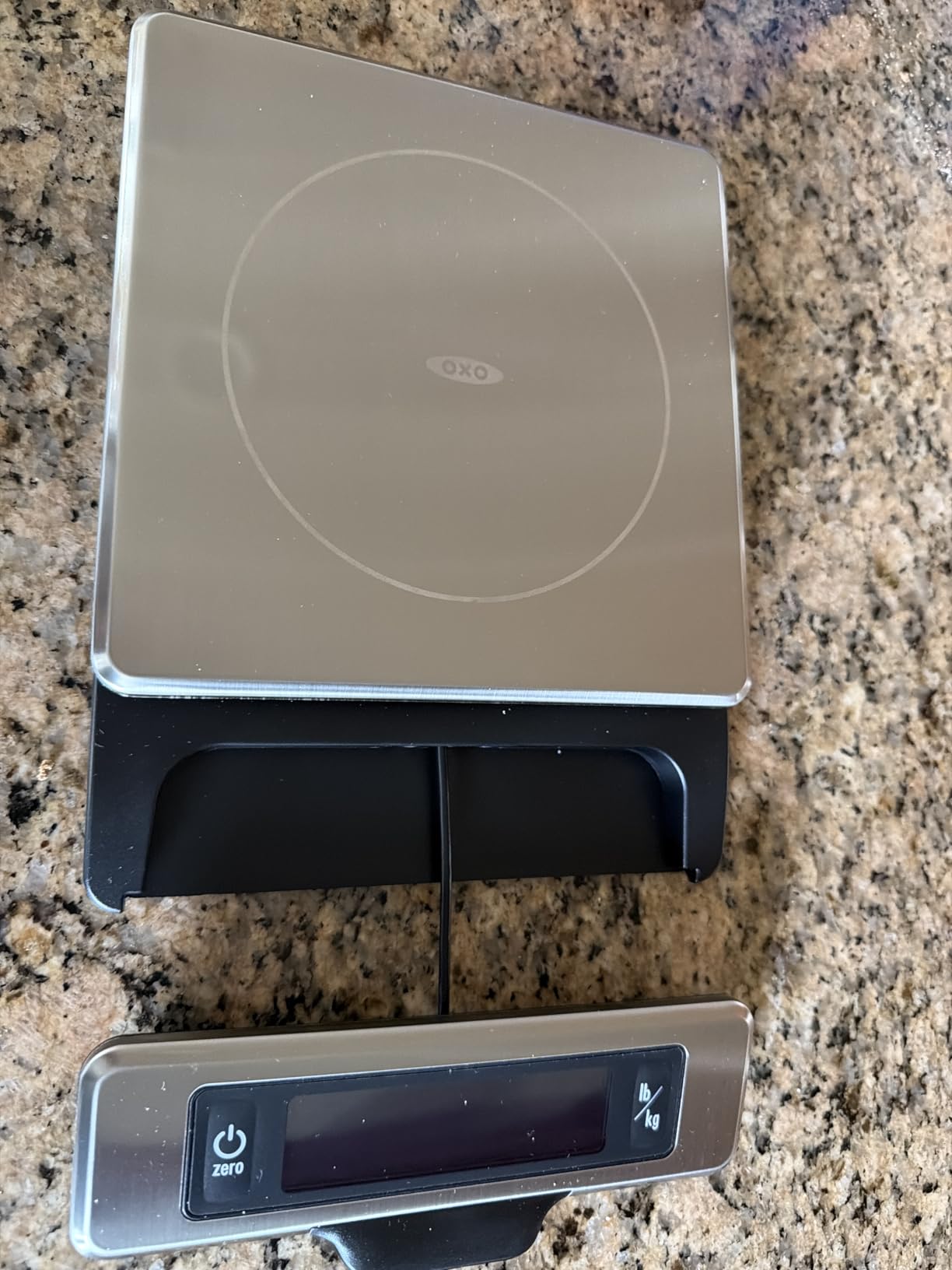
The pull-out display is the whole reason to choose this one. The screen slides out from the body so it sits beyond the edge of the platform, which means a full-size mixing bowl placed on the scale cannot hide the number. You read it without lifting anything.
Reviewers rate this model highly on the display and on the build, and it holds the largest share of five-star ratings in the roundup. The stainless steel platform is smudge and fingerprint resistant, which matters when you are cooking rather than posing with it.
The platform removes for cleaning, the zero function tars before you add ingredients, and the numbers are large and backlit for low light.
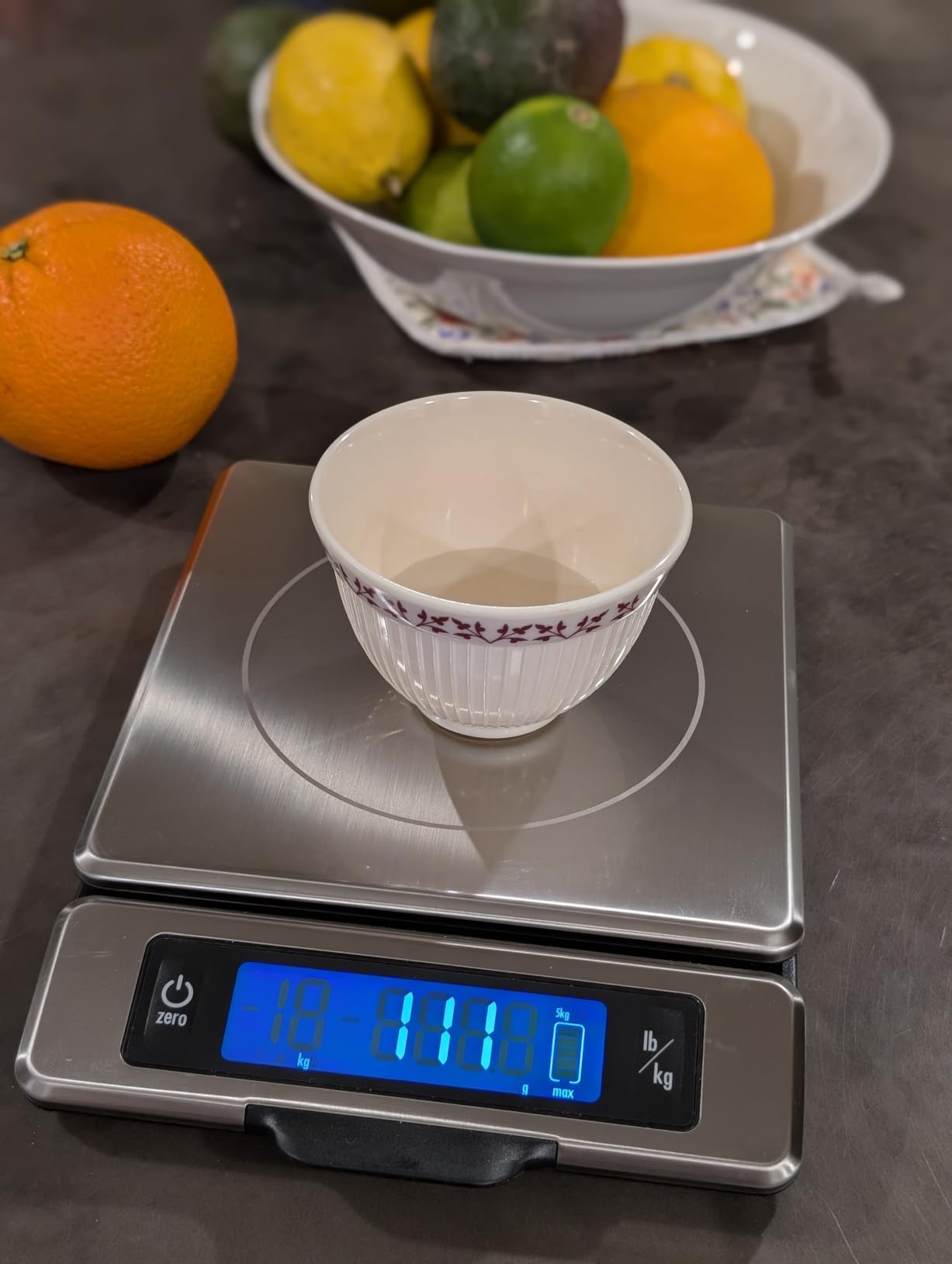
It measures 11 lb at 1 g and 0.1 oz accuracy across pounds, kilograms, ounces and grams. There is no percentage mode, no HOLD and no counting function, so if you want those you will be disappointed.
It is the most expensive option here, and that cost is really the price of the display mechanism plus a well-finished stainless platform. Buyers who do not weigh into large bowls should weigh that trade carefully.
How The Pull-Out Display Changes Technique
Weighing into the bowl rather than onto the platform saves a transfer and prevents spillage, but it only works if you can see the reading. A fixed display turns that technique into a guessing game, and a pull-out display removes the problem entirely.
That single feature is why the OXO keeps appearing in professional-adjacent recommendations, and it is the reason we would reach for it on a weeknight cake.
Build, Finish And Long-Term Value
The stainless platform is removable for cleaning and resists the smudging that makes glass platforms look grubby within a week. There is a Better Guarantee behind it for repair or replacement on any issue.
Over time the honest criticism is that feature-rich models do more for you. If you bake bread in large batches or work to baker’s percentages, the percentage functions and higher capacities elsewhere in this list are worth more than a polished platform finish.
How To Choose A Kitchen Scale For Baking
Six decisions account for almost every difference between these ten. Work through them in order and the shortlist usually drops to two models before you have finished reading the spec list.
What Resolution Do You Actually Need?
Resolution is the smallest step the display can show, and it is not the same as accuracy. A scale that shows tenths of a gram may still only be reliable to a gram or so, which is why owners of the 0.1 g models here still report roughly 1.5 g of real-world repeatability.
For cakes, cookies and bread, 1 g is genuinely enough. For yeast, salt, spices, macarons and any fine pastry, you want 0.1 g at minimum, and 0.01 g only matters if you are dosing coffee or working with very small production batches.
Note the other kind of resolution: the minimum weight a scale can register. A model that needs 2 g before it shows anything cannot be used for a quarter teaspoon of yeast at all.
How Much Capacity Is Enough?
Eleven pounds covers the majority of home baking, including a full loaf and a double batch of cookies. Twenty-two pounds is the sweet spot if you bake bread regularly, and anything above that is for large dough batches, canning and stock pots.
Do not buy capacity you will never use if the extra size comes with a larger platform you do not have room for. The widest platform in this roundup is 9 x 6.3 inches, and it is the one we would choose for a large glass bowl.
Platform Size And Bowl Fit
Measure your widest bowl and compare it to the platform, not the advertised capacity. An overhanging bowl loads the sensor unevenly, and the reading becomes unstable or the scale reports an overload it should not.
A platform that also has a raised lip or a rim is harder to clean. A flat platform with a removable or wipe-clean surface will last longer in a real kitchen.
Display Visibility And Power Source
A fixed display hidden behind a mixing bowl is the most common everyday frustration in the reviews. Pull-out, extended or remote displays exist for exactly this reason, and the two scales here that solve it best are the OXO and the Greater Goods.
On power, AAA batteries are cheap and universal, a rechargeable cell removes battery anxiety, and a plug-in option means the reading never disappears mid-proof. The My Weigh and BOMATA models can be plugged in or run on batteries, which is the most flexible arrangement available.
Auto shutoff is the other half of this decision. If you are the person who walks away from the bench for five minutes, a model with a four-minute timer or a disableable timer is worth paying for.
Two Scales Are A Legitimate Answer
The consensus on baking forums is that two scales serve a baker better than one. A sub-gram scale for yeast, salt and pastry, plus a high-capacity scale for dough, covers more than any single model here.
It is not an expensive strategy either, since the most capable units in this roundup sit at accessible price points. If you are weighing other kinds of measurements at home, our guide to digital bathroom scales explains why body composition readings follow a different accuracy standard entirely.
Care And Cleaning
Stainless steel platforms wipe clean in one pass and tolerate sticky dough. Tempered glass looks better initially but shows flour dust and fingerprints immediately, and a recessed display well will collect spills that need a cloth.
Keep the scale on a hard, flat surface away from vibration, and treat a low battery warning as a real accuracy warning rather than a nuisance. Reading your portable scale picks for a second opinion on load cell behaviour is worthwhile if yours is not behaving.
How To Test And Recalibrate A Kitchen Scale At Home
You do not need lab equipment to know whether your scale is telling the truth. A known weight and five minutes are enough, and doing it once a year catches drift before it ruins a batch.
1. Use a known reference weight. A sealed bag of sugar or rice that you have weighed on a trusted scale works. Even better, the BOMATA in this roundup ships with a 100 g calibration weight stored in the unit.
2. Check the zero first. With nothing on the platform, the display should read zero. If it sits offset, tare before you go any further, and if the offset keeps returning, the load cell is drifting.
3. Test at three weights. Check a small amount, a medium amount and close to the top of the range you actually use. A scale can be accurate at 100 g and wrong at 4000 g, and the middle range is where most baking happens.
4. Repeat each weight three times. Look at the spread rather than a single reading. Consistent results within a gram or so are fine for home baking; a number that jumps around as you resettle the bowl is not.
5. Recalibrate if the scale allows it. Models with a calibration function and a supplied weight can be reset without any tools. The rest need to be run through several cycles and dried fully, or returned.
Two environmental details change readings more often than people expect. A scale on a soft or uneven surface will not settle, and a warm or cold platform distorts the load cell, so let it sit at room temperature before you judge it.
Frequently Asked Questions
What type of scale is best for baking?
A digital kitchen scale that measures in grams, with at least 1 g resolution and an 11 lb capacity, handles most home baking. Bread bakers should step up to 22 lb or more with a percentage function, and pastry makers want 0.1 g resolution for yeast, salt and macaron shells. A sealed control panel and a platform wider than your largest bowl matter more in daily use than any extra feature.
Which kitchen scales are the most accurate?
The most accurate models in this roundup are the BOMATA Large Kitchen Scale 0.1g and the Etekcity 0.1g Food Kitchen Scale, both of which read in tenths of a gram below 1000 g. For whole-gram work, the Amazon Basics, Etekcity 11lb, Nicewell 22lb and OXO scales hold steady readings in repeated use. Accuracy at small weights is where cheap models tend to disappoint most.
Do professional bakers use scales?
Yes. Professional bakers and test kitchens weigh by weight almost universally, because flour density varies enough between bags to change hydration, and volume measurements cannot be reproduced reliably. The same reasoning applies at home, where a scale is the single biggest upgrade to consistency for bread, cakes and pastry.
What is the best kitchen scale for baking bread?
For bread, capacity and a display you can read with a bowl in place matter most. The My Weigh Bakers Math KD8000 gives you 8000 g of capacity, a percentage function and an auto shutoff that can be switched off entirely. The Greater Goods 22lb adds a HOLD function and a display that extends past the platform, which is useful when tracking dough weight through bulk fermentation.
Why does my kitchen scale keep turning off?
Most kitchen scales run an auto shutoff timer to preserve batteries, and budget models often use around two minutes. A fixed display, a short timer or a long proofing session is what causes the frustration. Workarounds include a long press on the tare button, plugging the scale in for continuous power, or choosing a model with a four-minute or disableable timer such as the Escali Primo or My Weigh KD8000.
Which Kitchen Scale Should You Buy?
If you want one scale and no decisions, the Amazon Basics Digital Kitchen Scale is the pick. It carries 11 lb at 1 g, five measurement modes, a stainless platform and enough review history behind it that the failure rate is well understood.
Work through the archetypes instead and the answer sharpens. Bread bakers who hate a scale that blanks out mid-proof want the My Weigh KD8000 or the BOMATA with plug-in power. Pastry makers measuring yeast and salt want the Etekcity 0.1g model. Large-batch cooks want the CROWNFUL 33lb or the Greater Goods 22lb. Flour-heavy kitchens want the Escali Primo for its sealed panel, and anyone who cannot read around a mixing bowl wants the OXO pull-out display.
Whichever one you land on, check it against a known weight twice a year and keep it on a hard, flat surface. That habit is worth more than any feature on the box, and it is the reason the same recipe comes out the same way twice. These are our 2026 picks for the best kitchen scales for baking, and the only way to know which one suits your counter is to weigh the same thing on two of them and see which number you trust.
Leave a Reply