
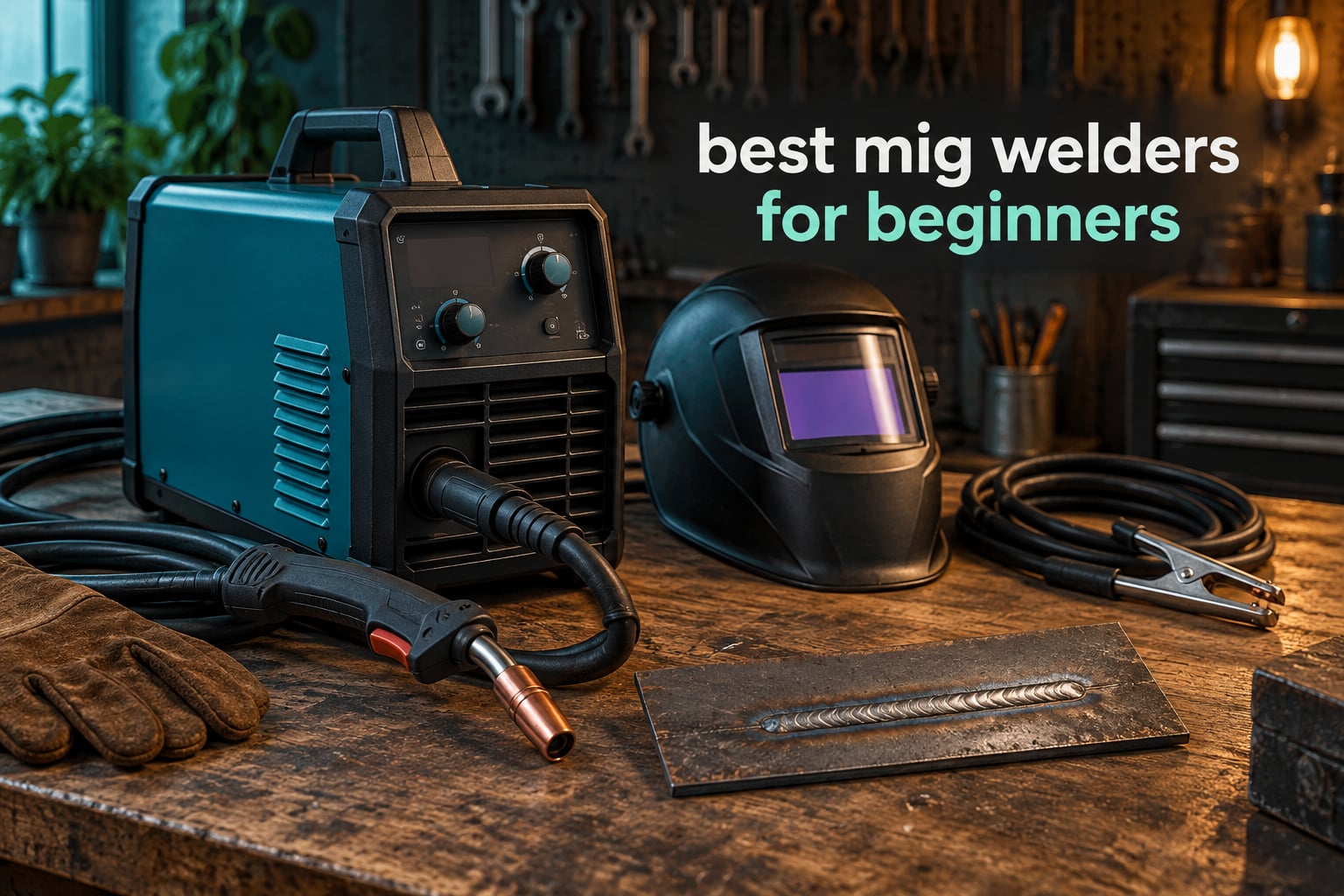
Yes, MIG welders are good for beginners. Of the four common welding processes, MIG is the fastest to learn, the most forgiving of a shaky hand, and the quickest to produce a bead you will not be embarrassed to show anyone. A wire spool feeds itself through the gun, an arc melts the metal, and the machine does the hard part of holding heat steady. The two common beginner mistakes are buying a machine that cannot reach the metal thickness you actually plan to weld, and buying a gas welder before you have decided to commit to a gas cylinder. This guide covers eight entry-level machines that avoid both traps.
What follows is a spec-driven comparison rather than a lab test. We read the manufacturer sheets, the technical listings, and thousands of owner reviews for each machine, then sorted them by the things that actually decide whether a first welder works in a home garage: input voltage, process count, material thickness ceiling, duty cycle, weight, and what happens when you try to buy a replacement part. We are not claiming we welded 50 hours on each unit. We are telling you what the owners report and what the paperwork says.
One safety note before you buy anything. MIG welding produces ultraviolet radiation that will burn your eyes and skin in seconds, metal fumes you should not breathe, and it draws serious current. You need an auto-darkening helmet, welding gloves, a jacket, leather boots, and ventilation or a fume extractor before the first spark. A machine is the smallest part of the cost. If you are still deciding between processes, read our MIG vs stick welding comparison for beginners first.
What MIG Welding Actually Is (A Two-Minute Primer)
MIG is the common name for GMAW, gas metal arc welding. A continuous wire spool acts as the electrode, the wire runs through a handheld gun, and an electric arc melts the wire tip and the workpiece together. A shielding gas — usually a mix of argon and carbon dioxide — keeps oxygen and moisture out of the molten pool, which is the single biggest reason a gas MIG bead looks smooth instead of blistered.
Self-shielded flux-core wire carries its own flux inside the tube, so it needs no gas at all. That makes it the natural choice for outdoor work in wind, and the reason most of the machines below can be useful before you ever rent a cylinder.
Key terms you will meet in every spec sheet: IGBT inverter is the modern power supply, which gives a steadier arc and lighter weight than old transformer-based machines. Duty cycle is how long the machine can weld at a given amperage before it needs to cool — 60% at 90 amps means 6 minutes on, 4 minutes off. Wire feed speed and voltage are the two knobs on almost every entry-level machine. Polarity decides whether your ground clamp goes positive or negative, and getting it wrong produces a sputtering mess. Spool gun is the extra feed unit that makes aluminum weldable, since aluminum needs a slower push and a different liner.
Our Top 3 Best MIG Welders for Beginners (October 2026)
If you want one answer instead of eight, the Forney Easy Weld 140 is the machine we would put in a beginner’s hands. It has the largest review base in the group, a genuine 1/4 inch steel rating, and 19 pounds of all-metal construction that suits a garage with no dedicated machine stand. Our second pick rewards patience: the Lincoln Electric 90i FC is the simplest interface in the roundup, with nothing on the front panel you do not need. The third, the Arccaptain MIG130, is the pick when the outlay is the deciding factor.
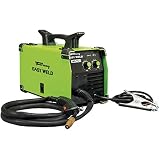
Forney Easy Weld 140
- 140A on 120V with no gas needed
- Welds mild steel up to 1/4 inch
- 19 lb all-metal case
- Infinite voltage and wire feed control
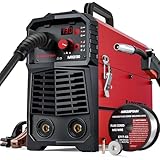
Arccaptain MIG130
- 130A on 110V gasless flux core
- Synergic auto-match of current and feed
- 11.79 lb with carry handle
- 3-in-1 with stick and Lift TIG

Lincoln Electric 90i FC
- 90i FC inverter on 120V
- Welds up to 1/4 inch
- Two-knob infinite voltage
- 15 lb with shoulder strap
- Metal case included
How These 8 Welders Compare Side by Side
The table below is the fast version of the full reviews. Every machine here is a genuine entry-level unit; none of them will replace a 250 amp shop machine, and all of them will do the small jobs that fill a first year of welding.
| Product | Details | Action |
|---|---|---|
|
|
Check Latest Price |
|
|
Check Latest Price |
|
|
Check Latest Price |
 |
|
Check Latest Price |
 |
|
Check Latest Price |
 |
|
Check Latest Price |
 |
|
Check Latest Price |
 |
|
Check Latest Price |
Three numbers decide almost everything. If your projects are 16 gauge or lighter, any 130 amp 110V machine will do. If you want to weld 1/8 inch plate and hang gate hinges, you need 140 amps or more. If you plan on 1/4 inch structural steel or trailer work, you want dual voltage and you want a 20 amp 220V circuit wired for it.
1. Forney Easy Weld 140 – The Best MIG Welder for Beginners Overall
FORNEY Easy Weld 140 Amp 120-Volt Flux-Cored Wire Feed Welder (No Gas Needed)
140A output
120V household power
1/4 in mild steel
19 lb
Flux core, no gas
+ Pros
- Welds real 1/4 inch mild steel at 140 amps
- No shielding gas required so it runs anywhere
- 19 lb all-metal case built for job-site abuse
- Infinite voltage and wire feed speed control
- Comes with MIG gun
- ground clamp and 20A-15A adapter
– Cons
- Flux core spatters more than gas MIG
- Single process with no stick or TIG mode
- Needs practice to hold a steady puddle on thin material
The Forney Easy Weld 140 is the one I would hand to someone who has never made a weld. There is no gas bottle to rent, no adapters to figure out, and the two controls that matter — infinite voltage and infinite wire feed speed — are both on the front panel with no modes to select. Owners overwhelmingly describe the first afternoon as productive rather than frustrating, and the reason is that the machine does not hide anything behind a menu.
What you give up is finish quality. Flux-core welding throws more spatter than gas MIG, and the bead is textured rather than smooth. On a trailer frame or a gate hinge that will be painted, that does not matter at all. On a coffee table top, it does. Plan on grinding or a wire brush pass before any finish work.
Two spec details matter more than the wattage number. First, it accepts both 2 pound and 10 pound wire spools, so you are not permanently tied to small wire. Second, at 19 pounds in an all-metal case it is a machine you can genuinely carry to a fence line rather than drag with a wagon. The kit includes an 8 foot MIG gun, an 8 foot ground clamp, and a 20A to 15A adapter for older outlets, which covers the two accessories most first-time buyers forget to buy.
The 3387-owner review base is the largest in this roundup, and that matters for a first purchase. With that many reports, the consensus is remarkably consistent: a straightforward machine that does exactly what the dial says. The 79 percent five-star share with only 2 percent one-star is the profile of something dependable rather than exciting.
Why 140 Amps Is the Number That Matters
Amperage is a proxy for how thick a material you can push heat into. The manufacturer’s 1/4 inch mild steel claim is the useful figure here, and it is genuinely reachable on this machine at full output. In practice most beginners end up working between 16 gauge and 1/8 inch — the thickness of vehicle brackets, gate hardware, and shelf brackets — and this machine has plenty of headroom there.
Below 1/8 inch, the challenge is not power. It is heat control. Flux core runs hot, so thin sheet needs short spot welds with pauses rather than one long drag, and that is a technique lesson rather than an equipment problem. The infinite control on both voltage and feed speed is what lets you find that middle ground instead of living with one fixed setting.
Duty Cycle and the 20 Amp Circuit Question
This welder runs on standard 120V household power through a 20A breaker, and the included adapter lets it share older 15A circuits. That is the single biggest practical reason to buy this class of machine: no electrician, no new outlet, no garage subpanel.
The trade-off is duty cycle. A 140 amp machine on a 120V circuit cannot sustain maximum output continuously without tripping or overheating, so expect to weld in bursts on heavier material. For weekend projects that is a non-issue. For someone who intends to spend eight hours a day on production work, it is the wrong machine and you should be looking at 220V instead. If you want the fuller picture on 110V machines, our guide to the best 110V MIG welders goes deeper.
What Is Missing and Why It May Not Matter
This is a single-process machine. There is no stick mode and no TIG mode, so when you eventually want to weld a 6013 rod on a gate post or do a thin stainless kitchen item, you need a second machine. Beginners routinely say this was the point at which they bought a second unit — that is normal and not a sign you chose badly.
Before your first bead, add the consumables the box does not quite cover: a spool of .030 flux-core wire, a matching contact tip, a flux-core nozzle, and a chipping hammer. The included nozzle on machines of this class is often a push-on gas nozzle that softens in flux-core service. If you want a step-by-step comparison of the budget tier, read our budget and entry-tier MIG welder roundup.
2. Lincoln Electric 90i FC Weld-Pak – The Simplest Machine for a Total Beginner
Lincoln Electric 90i FC Flux Core Wire Feed Weld-PAK Welder, 120V Welding Machine, Portable w/Shoulder Strap, Protective Metal Case, Best for Small Jobs, K5255-1
Inverter power source
120V input
Welds up to 1/4 inch
15 lb with shoulder strap
Metal case included
+ Pros
- Two-knob interface is as simple as a wire feed welder gets
- Inverter arc stays smooth once settings are dialled in
- 15 pounds with a shoulder strap for ladders and job sites
- Owners report matching larger commercial Lincoln machines
- Metal case
- gun
- nozzle
- tip
- work cable and clamp included
– Cons
- Flux core only with no stick or TIG
- Costs more than comparable 120V hobby machines
- Some owners trip a garage breaker on thicker material
The Lincoln Electric 90i FC is the least complicated machine here, and simplicity is the feature. There are exactly two knobs: wire feed speed and voltage, with infinite adjustment on the voltage side. No process selector, no mode button, no synergic menu to learn. For a first-time welder who is already intimidated by the vocabulary, removing every decision except those two is a genuine advantage.
Lincoln Electric is a brand that carries weight in this hobby in a way most budget brands do not. Owners with commercial Lincoln experience describe weld quality on 14 to 18 gauge stainless and 3/16 to 1/4 inch steel as matching their larger shop machines, and several report that the 15 pound strap-carried kit replaced a much bigger dual-voltage unit on small jobs. At 4.7 with 84 percent five-star ratings, it also has the highest average rating of the eight machines here.
The kit is self-contained in a way that is easy to underestimate. You get a protective metal case, a shoulder strap, a welding gun, a nozzle, a contact tip, a work cable, and a ground clamp. The inverter power source is the real differentiator — it means the arc stays smooth at lower amperage, which is exactly where beginners spend their first month of practice.
Two Knobs Is a Feature, Not a Compromise
Every additional process on a machine adds a button, a polarity change, and a wrong-answer opportunity. By limiting itself to flux core, the 90i FC lets Lincoln put effort into the drive system instead. The infinite voltage adjustment means you can find the sweet spot for a specific thickness and a specific wire diameter, and once you find it, the setting stays there.
For someone learning, that matters more than it sounds. A machine that produces a consistent arc on 14 gauge lets you focus on travel speed and bead placement, which are the two skills that actually determine whether your weld penetrates. Constant arc instability trains you to fight the machine instead of learning the process.
The Circuit Capacity Caveat Nobody Mentions
The most-cited caution in owner reviews is electrical. Several people report tripping a garage breaker when pushing this machine on thicker material, particularly in a garage where the welder shares a circuit with a compressor or a saw. This is a real constraint of 120V operation and it is not a defect in the machine.
Run the welder on its own circuit if you can, and never use an extension cord under about 10 feet. If your garage has no free 20A outlet, add that to your planning before you buy anything — it is a small job for an electrician and the cheapest part of the whole setup.
Why the Brand Matters for Your First Machine
Forum consensus is consistent on this point: a first welder is often a five-year tool, and consumables plus parts availability are what make year five painless. Lincoln, Hobart, Miller, and Forney parts and wire are stocked by almost any welding supply shop or hardware store in the country. If you need a contact tip at 9pm on a Saturday, that is worth paying for in the purchase.
The tradeoff is simply what you give up. This machine costs more than comparable 120V hobby units, and Forney’s Easy Weld 140 offers similar material capability on a smaller outlay. You are paying for the two-knob simplicity, the metal case, the inverter, and the counter at a real supply house. If those matter more to you than what you spend, this is the right one.
3. Arccaptain MIG130 – The Best Value Pick for a First Machine
ARCCAPTAIN 130A Flux Core Welder MIG Welder 110V Gasless MIG Stick Lift TIG
130A on 110V
Flux core, stick and Lift TIG
Synergic auto-match
11.79 lb
2 year warranty
+ Pros
- Synergic mode removes guesswork from first-time setup
- 11.79 pounds makes it easy to move around a yard
- 10-speed wire feed gives real control once you know the machine
- Includes 2 lb spool of .030 wire
- contact tips
- brush and hammer
- Two-year warranty is longer than most rivals
– Cons
- Lift TIG needs a separately purchased torch
- 110V only with no 220V path for heavier material
- Mixed metal and plastic build feels basic
The Arccaptain MIG130 wins on one specific feature: synergic control. You select your wire diameter and the machine matches current and wire feed speed for you. Beginner reports consistently say they got a usable weld on the first attempt because the machine chose the settings, and experienced hobbyists still use the 10-speed manual feed control to dial in specific setups once they know what they are doing.
That is exactly the right design for this list. Most entry-level machines hand a beginner two knobs and a manual; the Arccaptain starts in automatic and lets you graduate to manual. Nothing else in this roundup handles that progression as clearly.
The 4.6 rating with 80 percent five-star and only 4 percent one-star suggests a consistent experience from one machine to the next. It weighs under 12 pounds, which puts it among the lightest machines here, and the box includes a 2 lb spool of .030 flux-core wire, both contact tips, a wire brush and hammer, so you can start welding before a single extra purchase.
What Synergic Control Actually Does for You
Wire feed speed and voltage are coupled in a real MIG weld. Push wire faster without raising voltage and the arc sputters and the bead melts through. Raise voltage without the feed speed and you get a long, wandering, hard-to-clean bead. Beginners get this relationship wrong constantly for their first several hours.
Synergic mode removes the coupling by picking a matched pair for you based on wire size. The Arccaptain matches for .030, .035, and .040 flux-core wire. What it does not remove is the other half of welding: holding the gun steady, moving at a consistent speed, and keeping the puddle where you want it. Those still take practice.
110V Ceiling and What It Costs You
This is a 110V-only machine, and that single fact determines its ceiling. Owners say it handles mild steel, stainless, and thicker material for repairs, farm equipment, and road equipment work, but the practical limit is the 110V input, not the 130 amp label.
Compare that to the Forney at 140 amps and the Lincoln 90i FC, both also 120V. The Arccaptain sits in the middle on paper, but the added processes and synergic control are worth more than 10 amps of headline output for a beginner. If you know you will be doing 1/4 inch structural work within a year, skip this and go dual voltage.
The Parts and Accessories Reality
The mixed metal and plastic construction feels basic next to the all-metal Forney, and the included accessories are entry-grade. That is normal at this level, and it is where your first extra purchases go: a proper .030 flux-core nozzle, a spare contact tip, a chipping hammer, and a spool of wire when the included 2 lb runs out.
What you get for that trade is a 2-year manufacturer warranty, which is longer than most machines in this class. That matters more than it sounds for a first purchase, because it is the period during which you will discover what you do not know. If you are still comparing tiers, our budget and entry-tier roundup covers the surrounding price bands.
4. Bestarc MIG145 – Best Dual Voltage Machine That Can Grow With You
Bestarc 145A MIG Welder, Flux Core/Gas MIG Stick Lift TIG Welding, 110/220V
145A output
110V and 220V dual input
Gas MIG, flux core, Lift TIG, stick
13.7 lb
60 percent duty cycle
+ Pros
- Dual 110V and 220V input in an entry-level body
- Four-process list including gas MIG
- IGBT inverter with automatic voltage match and 3V trim
- Includes solid and flux wire
- gas hose and a 220V to 110V adapter
- Ground clamp and copper cable better than typical budget accessories
– Cons
- No gas regulator included
- Thin manual and an undocumented control knob function
- Drive roller type varies by production batch
- Included nozzle is not a flux core nozzle
The Bestarc MIG145 is the machine in this roundup that most directly answers the “what if I outgrow this in a year” question. Dual voltage input with automatic detection on the front panel means you can start on a 110V outlet tonight and move to a 20 amp 220V circuit when you want to weld heavier material, without buying another welder. Owners single this out consistently as the deciding feature over cheaper 110V-only machines.
It also carries a four-process list: gas MIG, gasless flux core MIG, Lift TIG, and stick in one box, plus the only 60 percent duty cycle listed among the dual-voltage machines here. The 145 amp IGBT inverter has automatic voltage matching based on selected wire plus a minus 3V to plus 3V trim.
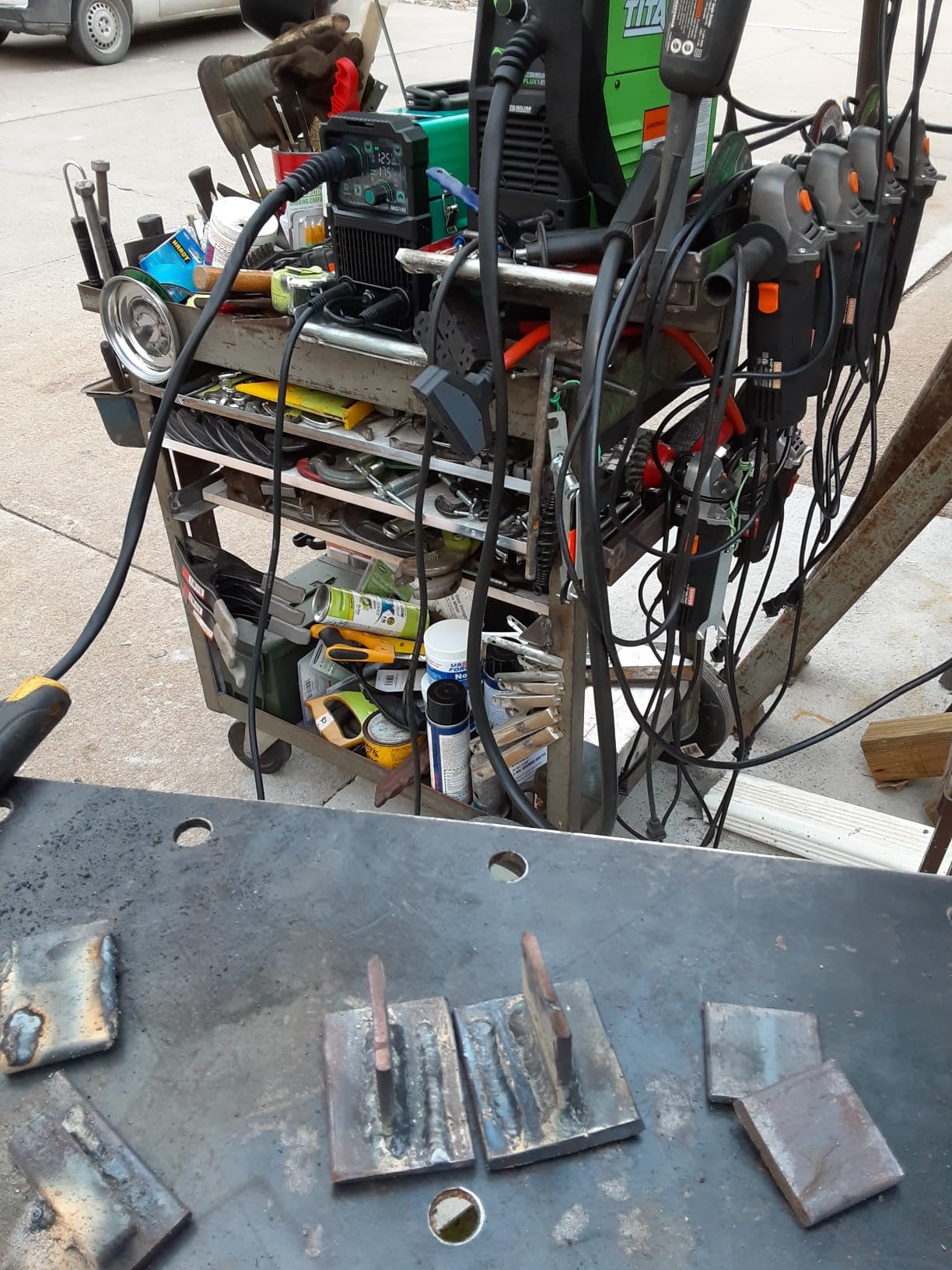
Among the owner accounts on this machine, the most useful is from a welder with a production MIG background who documented the machine methodically and later raised his own rating after the manufacturer shipped fixes. Treat his findings as a buyer’s guide, because they are accurate: verify your drive roller matches your wire, and expect to buy a gas regulator separately.
Dual Voltage Is the Feature to Pay For
Automatic input detection means the machine reads the circuit when you plug it in and switches its operating parameters. That removes a whole category of beginner error, where a 220V machine plugged into 110V runs at a fraction of its rated output or trips the breaker repeatedly.
It also changes your project ceiling. A 145 amp machine on 220V is a genuinely different tool from a 145 amp machine on 110V, and it is the difference between 1/8 inch plate work and 1/4 inch structural work. The 60 percent duty cycle at its rated output is respectable for this class, meaning you can hold a weld for roughly 6 minutes at a time.
Buying It for Gas MIG Means Buying More
This is the machine to pick if you are convinced you want gas MIG. But gas MIG requires three things the box does not contain: a shielding gas cylinder, a flow regulator, and a solid wire spool plus a gas nozzle and liner. The included 2 meter gas hose is a start, but the regulator is the piece you must add.
Budget for that, plus the ongoing cost of gas. An argon and carbon dioxide mix cylinder refill is a recurring expense, and a beginner who is not welding weekly should be honest with themselves about whether the cleaner bead is worth it. Our MIG welding aluminum guide explains when a spool gun becomes worth the extra cost.
Watch the Drive Roller and Read the Manual
Owners documented two real quality issues. Earlier production machines came with plain V-groove drive rollers instead of knurled ones, which flattened flux-core wire and hurt arc stability. Later production machines come with knurled rollers and a longer torch. Separately, the spool tension spring is not adjustable, and the push-in rotary knob that adjusts wire feed versus voltage ratio is not documented in the thin manual.
On a positive note, the ground clamp and 16 square mm copper-clad cable are better than typical budget-clone accessories, the top-loading spool and large clear LED display make setup straightforward, and low one-star and two-star shares suggest broad satisfaction. If you buy this one, check the roller on arrival and set the tension before your first weld.
5. YESWELDER YWM-160 – The Best Multi-Process Upgrade Path
YESWELDER 160A MIG Welder, 110V/220V MIG/Flux Core/Lift TIG/Stick
160A output
110V and 220V dual voltage
Gas MIG, flux core, stick, Lift TIG
19.4 lb
LED digital display
+ Pros
- Dual voltage works in a small shop and on a job site
- Synergic and manual modes let you auto-set then take full control
- Handles 2 lb and 10 lb spools of .030 and .035 solid or flux wire
- Gas hose and drive roller included so gas MIG is nearly ready
- Owners with Miller and Lincoln backgrounds rate the MIG side well for the money
– Cons
- Stick function is hard to strike an arc on at first
- Display panel is thin plastic that washes out in sunlight
- Really wants 220V and the 110V adapter can trip breakers
- Included gun liner is thin and can melt near a hot weld
The YESWELDER YWM-160 is the pick if you are buying a machine you might still be using in five years. It is 160 amps on dual voltage, it does four processes including gas MIG, and owners with two-plus years of shop use describe building an entire scrap-metal welding bench around it. That durability record is what separates it from the machines at the budget end of this list.
Its control design is the most considered here. Synergic mode auto-selects voltage and wire feed speed by material thickness and amperage, and manual mode lets you adjust the two independently once you know what you are doing. That progression from automatic to full control is the right learning curve, and the LED digital display shows settings and live current while you are in manual.
There is an important electrical caveat that reviewers raise repeatedly: this machine genuinely wants 220V, and the included 110V adapter can trip household breakers on a loaded circuit. If your only option is a 120V outlet, either install a 20 amp 220V circuit or choose one of the 110V machines above.
The Long-Term Ownership Case
Forum discussion about budget imports splits into two camps, and both are represented here. Some owners report a cheap machine ran fine for a year and then failed. Others report the opposite, with multi-year shop use and no problems. The YWM-160 belongs to the second camp: its owner base includes reports of two-plus years of continuous shop work.
Consumable support is the other half of that case. The machine accepts standard .030 and .035 wire in 2 lb and 10 lb spools, plus 6010, 6011, 6013, and 7018 stick rods, which are the four most common electrodes sold anywhere. You will not be hunting for proprietary parts.
Where the Hardware Falls Short
Three complaints recur. The stick function is difficult to strike an arc on, though once started it performs well. The display panel is thin plastic with small button labels that becomes hard to read in direct sunlight — a real problem for outdoor work. And the included gun liner is thin enough to melt if it touches a hot weld, which is a replacement within the first year.
One detailed account also documents a unit arriving unable to arc, traced to a wire drive polarity lead connection not covered in the manual. Test the machine within the return window with a short bead on scrap before you commit to keeping it.
Wire and Spool Flexibility
Handling both 2 lb and 10 lb spools of .030 and .035 in solid or flux-core gives this machine as much consumable range as any other on the list. When you run out of the included wire, you are choosing from a full shelf at any hardware store rather than ordering a specific spool online.
At 19.4 pounds it is not the lightest machine here, but the weight is a fair trade for the build. For a buyer who plans serious shop time rather than occasional brackets, that is the right place to spend the effort budget. The heavier-duty options in our upper mid-tier MIG welder roundup are worth a look if you want more amperage than this tier offers.
6. TOOLIOM 135A Kit – Gloves and Wire in the Box for a Small Outlay
TOOLIOM 135A 110V Gasless Flux Core MIG Welder Kit with Wire and Gloves
135A on 110V
Flux core, stick and Lift TIG
Large LCD with live current
Gloves and wire included
11.24 lb
+ Pros
- Beginner-oriented synergic mode recommends voltage and feed speed
- Large LCD gives live numerical current feedback for precise adjustment
- Includes welding gloves and wire in the box
- Hot Start and Arc Force reduce sticking and arc instability
- 11.24 pounds with a carry handle
– Cons
- TIG torch sold separately so Lift TIG is not usable out of the box
- Lowest five-star share in the group at 69 percent
- Wider spread of build consistency complaints between machines
- 1/6 inch steel penetration is thinner than the Lincoln and Bestarc
The TOOLIOM 135A solves a specific beginner problem: the total startup outlay. It ships with welding gloves and flux-core wire in the box, which is genuinely unusual, and several first-time buyers cite the completeness of the package as the reason they chose it over a bare machine. The synergic beginner mode and the large LCD are the two features most often singled out for making adjustments less intimidating.
Technically it is well equipped for the class. Three processes in one unit, a wire feed speed range of 120 to 420 in/min for .030 wire, Hot Start to prevent electrode sticking, and Arc Force to stabilize the arc. The multi-shield protection suite covers voltage fluctuation, over-current, overload, and thermal events.
What separates it from the roundup is consistency. Its rating distribution is the widest of the eight machines listed: 69 percent five-star, 17 percent four-star, and 7 percent one-star. That spread points at build variability and at the fact that the advertised 3-in-1 capability requires buying a TIG torch separately before Lift TIG exists as an option.
Why the Gloves in the Box Actually Matter
Cheap welding gloves are not good welding gloves. They will not protect you properly from UV exposure or spatter burns. But the ones in this box are better than nothing for the first hour while you order a real pair, and having them there means the machine is not sitting in a box waiting on a delivery.
Think of the included consumables the same way. The .030 and .035 wire gets you to the first bead. Budget for a proper auto-darkening helmet separately — that is the one purchase you should never economize on, because arc flash damage to your eyes is immediate and permanent.
Material Thickness Is the Real Limitation
The 135 amp output penetrates mild steel up to 1/6 inch, which is thinner than the Lincoln 90i FC and the Bestarc MIG145. That is a real ceiling, not a rounding error. If your project list includes 1/4 inch plate for a trailer frame or a structural bracket, this machine will not get there on 110V.
For 16 gauge through 1/8 inch work — patch panels, shelf brackets, gate hardware, exhaust repair — the difference is academic. Judge it against the project list, not the spec sheet.
The Wide Rating Spread, Honestly
We would rather tell you this plainly than round it up. A 69 percent five-star share with 7 percent one-star means more owners had a problem than with the Forney, Lincoln, or Arccaptain. The weaker reviews point at build consistency rather than welding ability — the machine can do the work when it works.
If you buy it, test it inside the return window. Run a bead on 14 gauge, then 1/8 inch, and check both the arc stability and the wire feed before you strip the packaging. That five minutes of testing is the single best protection a first-time buyer has.
7. YESWELDER FLUX-135PRO – Gasless Multi-Process with the Most Owner Feedback
YESWELDER 135A MIG Welder, 110V Flux Core Gasless MIG/Lift TIG/Stick 3-in-1
135A on 110V
Flux core, stick and Lift TIG
Synergic with 3V trim
LED display
11.4 lb
+ Pros
- One of the two most reviewed machines here with 2985 ratings
- Synergic auto-setting called foolproof for beginners by experienced welders
- 11.4 pounds with a carrying handle
- Includes both .030 and .035 wire spools plus torch and clamps
- Over-current
- over-load and thermal protection built in
– Cons
- Voltage in flux core mode is synergic only with no manual override
- Spool holder and wire tensioner are crudely made
- Included gun and clamps are entry-grade accessories
- DC only so it cannot TIG weld aluminum
With 2985 ratings, the YESWELDER FLUX-135PRO is one of the two most reviewed machines in this roundup, and its owner base skews heavily toward people replacing an older budget welder or buying a first unit. Long-time hobbyist reviewers with 20 to 30 years of experience rate it as genuinely good for the money, reporting a consistent arc, steady wire feed, a bead that beats their old machine, and no breaker trips on a 110V 20 amp circuit.
That last point matters. The 7 percent one-star share is dominated by two distinct issues: accessories that feel cheap, and occasional quality-control failures on machines received out of the box. The failures are real, but they are a minority against a large body of owners who simply welded and were happy.
One technique tip recurs enough to be worth repeating, because it will save you an afternoon of frustration. Gasless flux core wants short spot welds with pauses rather than one long pull. The higher deposition rate means the puddle builds fast, and managing that buildup is the whole skill in flux-core work.
Synergic Only in Flux Core Mode
The FLUX-135PRO matches voltage to wire feed speed automatically with plus or minus 3V of micro-adjustment available. Experienced welders call that arrangement close to foolproof for a beginner, and it does remove the voltage-feed coupling problem entirely for someone learning.
The limitation is that the voltage is synergic only. You cannot set voltage manually in flux core mode, which means you cannot compensate for a specific joint condition the way you can on the YWM-160 or the Bestarc MIG145. For a beginner this is a fair trade. For someone who wants to grow into fine control, it is a ceiling.
DC Only, and What That Rules Out
The machine is DC only, supporting both DCEP and DCEN. That covers the three processes it offers, but it rules out AC TIG entirely, which means aluminum TIG is not possible on this unit. If aluminum work is a goal, this is not the machine — and even a DC machine needs a spool gun and the right wire to weld aluminum with MIG.
Its rated capability is 3/32 inch mild steel on 110V, which is at the thin end of what a first machine should offer. If your project list is heavier than that, look at the Forney, the Bestarc, or the YESWELDER 160 instead.
Accessories Are the Weak Point
The spool holder and wire tensioner are cheap and crudely made, and the included MIG gun, stinger, electrode holder, and ground clamp are entry-grade. That is the honest trade at this level. Replace the ground clamp early — a weak clamp causes arc problems that beginners often misdiagnose as a machine fault.
There is also a documented amperage readout that appears to run roughly 10 to 15 amps high, and some machines arriving with quality-control gaps such as a missing power switch. Both are reasons to test thoroughly before the return window closes rather than after.
8. SSIMDER MIG-140S – The Lightest Machine and the Least Disruption
SSimder 140A MIG Welder 3 in 1, Dual Voltage Flux Core Lift TIG Stick
140A dual voltage
Flux core, Lift TIG and stick
7.7 lb main unit
2 year warranty
No shielding gas
+ Pros
- 7.7 lb body fits a garage shelf or a truck toolbox
- Lift TIG has no HF start so no interference with WiFi or Bluetooth
- Accepts carbon steel
- low alloy
- stainless
- titanium
- copper and cast iron
- Dual voltage 110V and 220V with an included conversion cord
- Two-year warranty honoured on a defective unit
– Cons
- Manual supplied is for a different model
- Short cord and leads force you to work close to the machine
- Supplied MIG gun tip is a gas tip not a flux core tip
- Switching to stick means purging wire from the gun
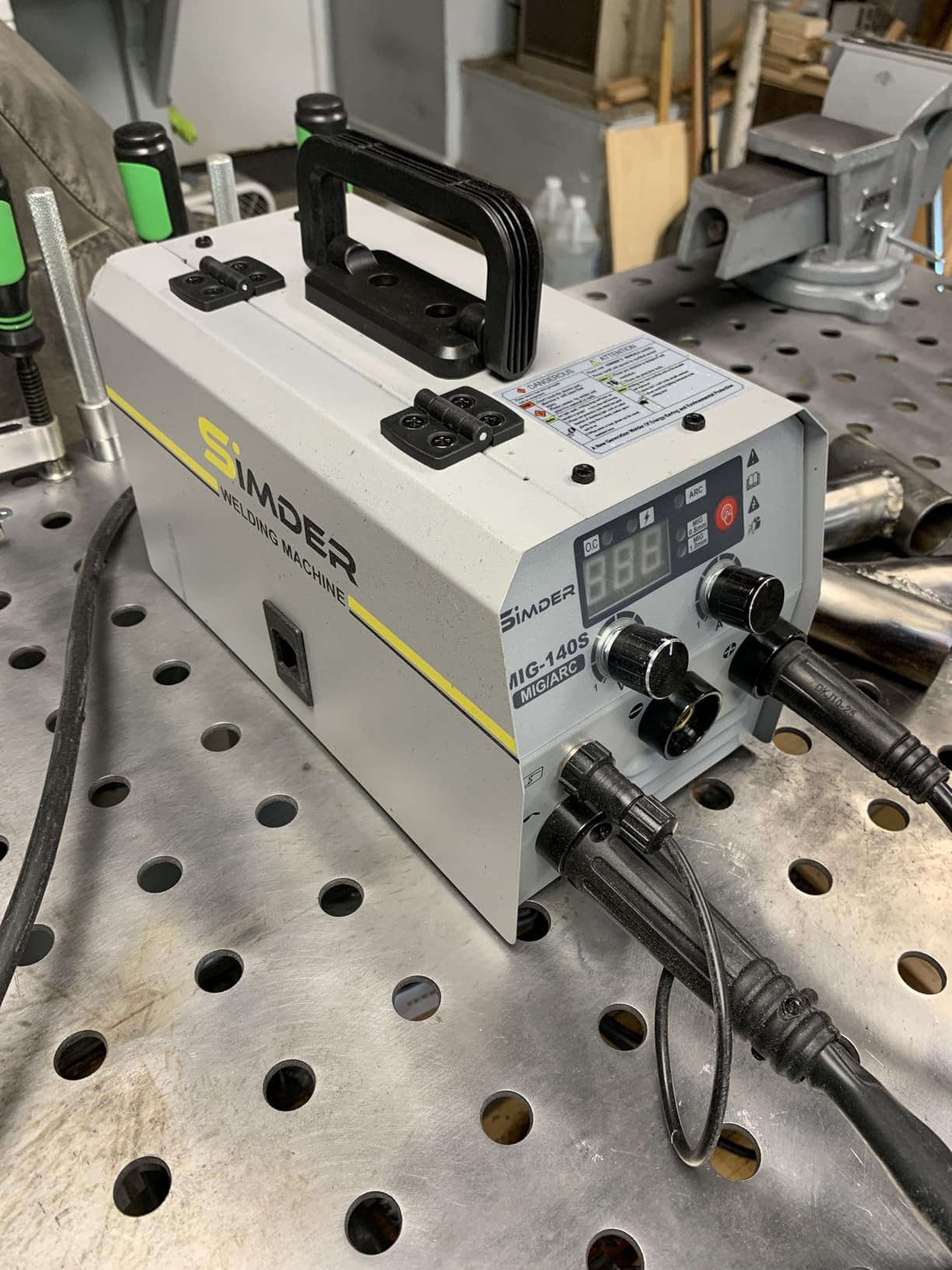
The SSIMDER MIG-140S is the smallest and lightest machine in the roundup at 7.7 pounds, and it solves a problem nobody else on this list addresses: your garage already has electronics in it. Its Lift TIG mode uses torch-tungsten contact and lift rather than a high-frequency start, so it emits no high-frequency interference that would disturb WiFi, Bluetooth, or nearby electronics. A few owners specifically sought this machine out for that reason.
The material range is also unusually wide for a flux-core-only machine. Owners weld carbon steel, low-alloy steel, stainless steel, titanium, copper, and cast iron. It does not weld aluminum and does not use shielding gas, which keeps the operating cost near zero. The dual 110V and 220V input with an included conversion cord gives you the same growth path as the more expensive dual voltage machines.
It is the entry point of the roundup on outlay, and several first-time or returning hobbyists say it does the job and is impressive for the amount. The recurring criticism is documentation and accessories rather than welding ability.
The No-High-Frequency Start Is a Real Feature
Most Lift TIG modes on budget machines use a high-frequency start to ignite the torch. That start radiates enough electromagnetic noise to disrupt WiFi routers, Bluetooth speakers, and garage door openers. It is usually a momentary disruption rather than damage, but on a machine that will live in a residential garage next to your WiFi, avoiding it entirely is worth knowing about.
The tradeoff for this design is ignition reliability on Lift TIG. Contact-and-lift starts are less forgiving than high-frequency starts, particularly on dirty or oxidized metal. If you mostly plan to use the flux core MIG mode, you will not notice.
Documentation Is the Weak Point
The manual supplied is for a different model and does not explain key setup steps. The included MIG gun tip is a gas tip rather than a flux core tip, so you will need to buy the correct one before your first weld. There is no settings chart for different metal thicknesses, and the voltage knob has no display response.
Short cord and leads are the other practical limit. With roughly a 4 foot power cord and 5 to 6 foot leads, you must work close to the machine. For a garage with an outlet near the work area, that is a non-issue. For a fence line at the far end of the yard, it is an annoyance.
Switching Processes and Warranty Service
Moving from MIG to stick requires disconnecting the MIG gun and purging several feet of wire, which is a 60 second annoyance that happens every time. The spool door also does not latch fully, and there are no consumables such as a chipping hammer included.
On the positive side, one owner reports the manufacturer honored a warranty replacement for a defective unit that would not power down, though they also noted the initial support response was slow. The 6 percent one-star share includes that defect. Budget for a replacement contact tip and nozzle on day one, and the machine will do the work its 140 amp label implies on 110V.
How to Choose Your First MIG Welder
Every machine on this list is a reasonable first welder. The wrong one for your garage is the expensive mistake, so the decision comes down to three questions: what material are you welding, what power can your electrical system provide, and are you willing to manage a gas cylinder?
Gas MIG vs Gasless Flux Core: Which Should You Start With?
Start with gasless flux core. That is the single most useful piece of advice in this guide for someone who does not yet know whether they will stick with welding. It costs almost nothing beyond the wire per hour, needs no cylinder rental or storage, works outdoors in wind, and the machines are usually less expensive. You can move to gas MIG later once you know which projects you actually do.
The gas MIG argument is real but narrower than beginners expect. You get a smoother bead, noticeably less spatter, and the ability to weld aluminum with a spool gun and thinner stainless without scorching. Those advantages matter on visible work like a coffee table, a stainless exhaust, or a trailer fender.
The disadvantages of flux core, honestly stated: more spatter and cleanup, a rougher bead that takes more finishing, limited material thickness due to the higher heat input, and no aluminum without a spool gun setup. It is also harder to control on very thin material because the deposition rate is high. For a beginner making a weld every few weeks, none of that outweighs the convenience.
If your project list is mostly structural, outdoor, or rusty metal, flux core is the correct long-term answer. If it is mostly stainless, aluminum, or visible furniture, buy a dual-voltage machine that does gas MIG and plan on the extra startup cost of a cylinder, regulator, and solid wire.
110V vs 220V: Do You Need to Change Your Electrical Setup?
Yes, and this is the question almost no roundup answers directly. A 110V welder plugs into a standard 20A household outlet. A 220V welder needs a 20A 240V circuit, which means a double-pole breaker and, in most older homes, new wire run from the panel. That is an electrician’s job, and it can cost more than the welder itself.
What 110V buys you: no electrical work, the ability to move the machine between a garage and a basement, and enough power for 16 gauge through 1/8 inch steel. What it costs you: a lower material ceiling, a duty cycle that forces you to weld in bursts on heavy material, and a real chance of tripping a breaker if the circuit is shared with a compressor, saw, or welder two.
What 220V buys you: 1/4 inch structural capability, steadier output at higher amperage, and a machine that stays productive on long sessions. If you already have a 220V outlet in your garage — many homes with a gas dryer or electric range have one — the decision is easy. If you do not, start at 110V and add the circuit when you hit the ceiling.
Two safety rules regardless of voltage. Never share a welding circuit with other power tools, and never use a long extension cord, because voltage drop along the cord causes arc instability and damage to the machine. If your machine is more than 15 feet from the outlet, this is worth solving properly rather than working around.
What You Need Besides the Welder
This is where first-time buyers get surprised, so here is the honest list. Two spools of .030 flux-core wire to start, since you will burn through the included one quickly. A wire brush and a chipping hammer for cleanup. A flux-core nozzle and matching contact tips, because the included ones on budget machines are frequently the wrong type. A proper auto-darkening welding helmet, which is the one item not to economize on. Welding gloves and a leather jacket, which the included gloves on some kits do not replace. A 20A to 15A adapter if you have older outlets. And a gas cylinder, flow regulator, and solid wire spool if you bought a gas-capable machine.
Add a better ground clamp on budget machines. Arc problems caused by a weak clamp are frequently mistaken for a defect in the welder, and a proper clamp solves them.
Inverter vs Transformer and What Duty Cycle Really Means
Most machines in this roundup are built around IGBT inverter technology, and that is the right choice. The Lincoln 90i FC is an inverter as well, while the Forney’s listing describes an AC power source. An inverter adjusts output frequency thousands of times per second, which gives a steadier arc, cleaner beads, and a machine that weighs less than a transformer of the same output. A transformer-based machine is heavier, spatters more, and is harder to control on thin material.
Duty cycle is the number buyers ignore and should not. A 60 percent duty cycle at 90 amps means six minutes of welding followed by four minutes of cooling. A 40 percent duty cycle means four on, six off. For weekend hobby work, either is fine. For someone welding all day on a trailer, only a high-duty-cycle 220V machine will keep up. Read the duty cycle and the amperage together, because 140 amps at 40 percent is a worse real-world welder than 130 amps at 60 percent.
How to Practice Before You Touch a Real Project
Buy a few pounds of scrap mild steel and make beads on it. Not joins — just beads, dozens of them, at different wire feed speeds and voltages, until you can produce a consistent one without staring at the machine. This is the single highest-return hour you will spend and it costs almost nothing in material.
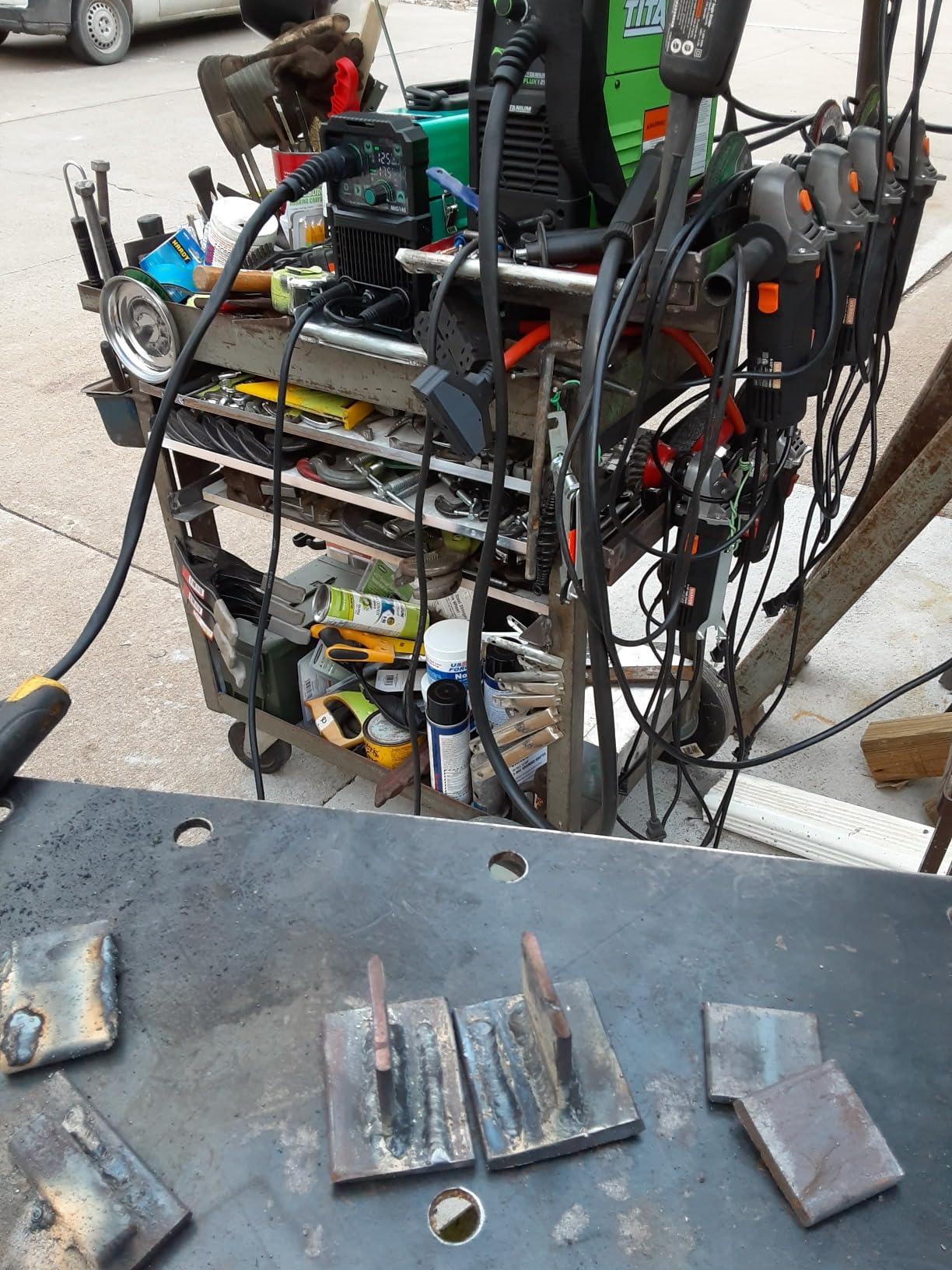
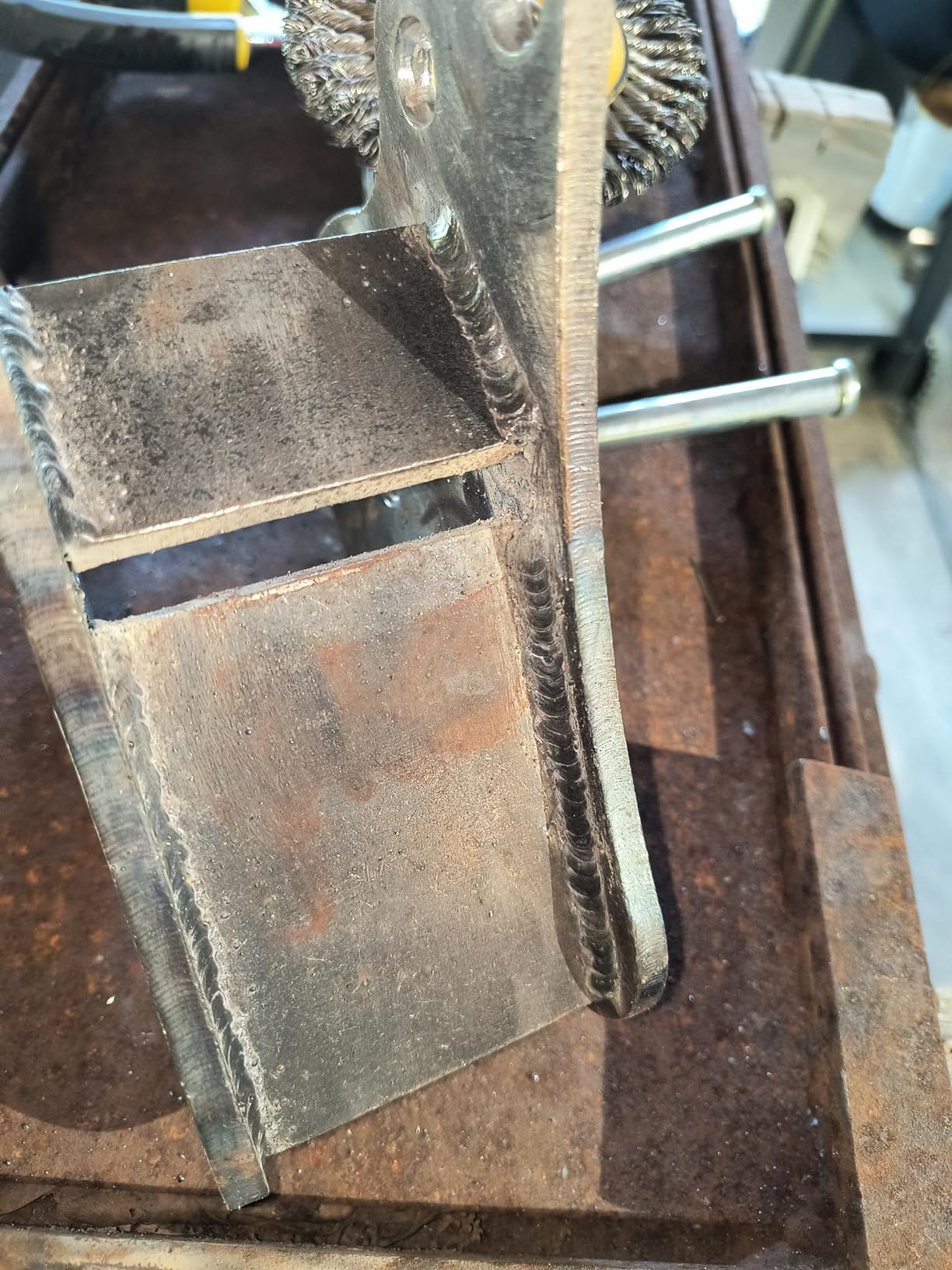
Then progress to real joints in a ladder: two pieces of 16 gauge lapped side by side, then a butt joint on 16 gauge, then a T joint on 1/8 inch plate, then a 90 degree fillet on 1/8 inch, then a 1/4 inch bracket with a gusset. Each step roughly doubles the heat input of the last. Practicing the ladder on scrap means a mistake costs a couple of dollars of steel instead of a failed part.
Ventilation matters more than beginners expect. Welding fumes contain metal oxide particles, and a garage with a closed door is worse than outdoor work. A fume extractor or a fan pulling air out of the work area is inexpensive and worth setting up before the first weld, not after you notice the headache.
Frequently Asked Questions
Are MIG welders good for beginners?
Yes. MIG welding is the most forgiving of the four common processes because the wire feeds itself, the arc does not need to be struck and maintained by hand, and the machine holds heat steady while you concentrate on travel speed and bead placement. It produces a usable weld faster than stick or TIG. The trade-off is finish quality: the bead is more textured than TIG and beginners need practice managing the puddle. For most first-year projects on mild steel, that trade is heavily in your favor.
Which welders are the easiest to use for beginners?
The easiest to use are machines with two controls and no process selector. In this roundup the Lincoln Electric 90i FC is the simplest, with only wire feed speed and infinite voltage. The easiest to learn on are the synergic machines, where you select wire size and the machine picks the settings: the Arccaptain MIG130 and the TOOLIOM 135A both do this. The best balance of the two is the Arccaptain, which starts automatic and lets you switch to manual control later.
What kind of welder should a beginner start with?
Start with a 110V flux-core machine between 130 and 145 amps unless you specifically need gas MIG or plan heavy 1/4 inch work. That combination requires no cylinder, no electrical work, and no new outlet, and it covers 16 gauge through 1/8 inch mild steel, which is most of what a first-year hobbyist welds. Add a 2 lb spool of .030 flux-core wire, a wire brush, and a proper auto-darkening helmet before the first bead. Move to a dual-voltage gas-capable machine once you know your actual project list.
Are 110V welders any good?
Yes, for most beginner work. A 110V machine on a standard 20 amp household outlet welds 16 gauge through 1/8 inch mild steel comfortably, which covers brackets, gate hardware, patch panels, and most household projects. Two limits to know: material thickness caps out lower than a 220V machine, and a shared circuit can trip a breaker under load. Run it on a dedicated circuit, avoid long extension cords, and treat the 1/4 inch rating on 120V machines as a limit you approach carefully rather than a daily working point.
Is a gasless MIG welder any good?
For structural, outdoor, and rusty metal work, gasless flux core is not a compromise. It needs no cylinder, costs only the wire per hour, works in wind, and handles thicker material than its output suggests. The disadvantages are more spatter to clean up, a rougher bead needing more finishing, and more heat on thin material, which makes it harder to control on light gauge. It cannot weld aluminum without a spool gun. For a first machine, most beginners are better served by gasless than by renting a cylinder before they know they need one.
Which is better for beginners, flux core or MIG welding?
Flux core is better for a first machine, and real gas MIG is better for the finished look. Choose flux core if your projects are outdoor, structural, automotive rust repair, fencing, or anything involving thicker plate. Choose gas MIG if you care about bead appearance, work with thin stainless, or plan to weld aluminum, since gas plus a spool gun is the only realistic home route to aluminum. A dual-voltage four-process machine such as the Bestarc MIG145 or the YESWELDER YWM-160 does both, but you still need a cylinder, regulator, and solid wire to use the gas side.
Which Beginner MIG Welder Should You Buy in 2026?
If you want one machine and one decision, buy the Forney Easy Weld 140. It has the largest owner base in the group, a real 1/4 inch mild steel rating, 19 pounds of all-metal construction, and no gas bottle to complicate your first year. The Lincoln Electric 90i FC is the choice when simplicity and long-term parts support matter more than the outlay. The Arccaptain MIG130 is the pick when budget is the deciding factor and you want synergic auto-setup.
If you have 220V available or plan heavy structural work, step up to the Bestarc MIG145 or the YESWELDER YWM-160. Both do gas MIG, both grow with a 240V circuit, and both are the machines owners still report using years later. If your garage is small and your projects are light, the SSIMDER MIG-140S at under eight pounds causes no lifting complaints and no interference with your WiFi.
Whichever one you choose, buy the wire, the helmet, and the gloves in the same week the machine arrives. A welder sitting in a box is a welder you never learn on. Check the current listings and read the most recent owner reviews before you buy, since specifications in this category shift between model years.
Leave a Reply