
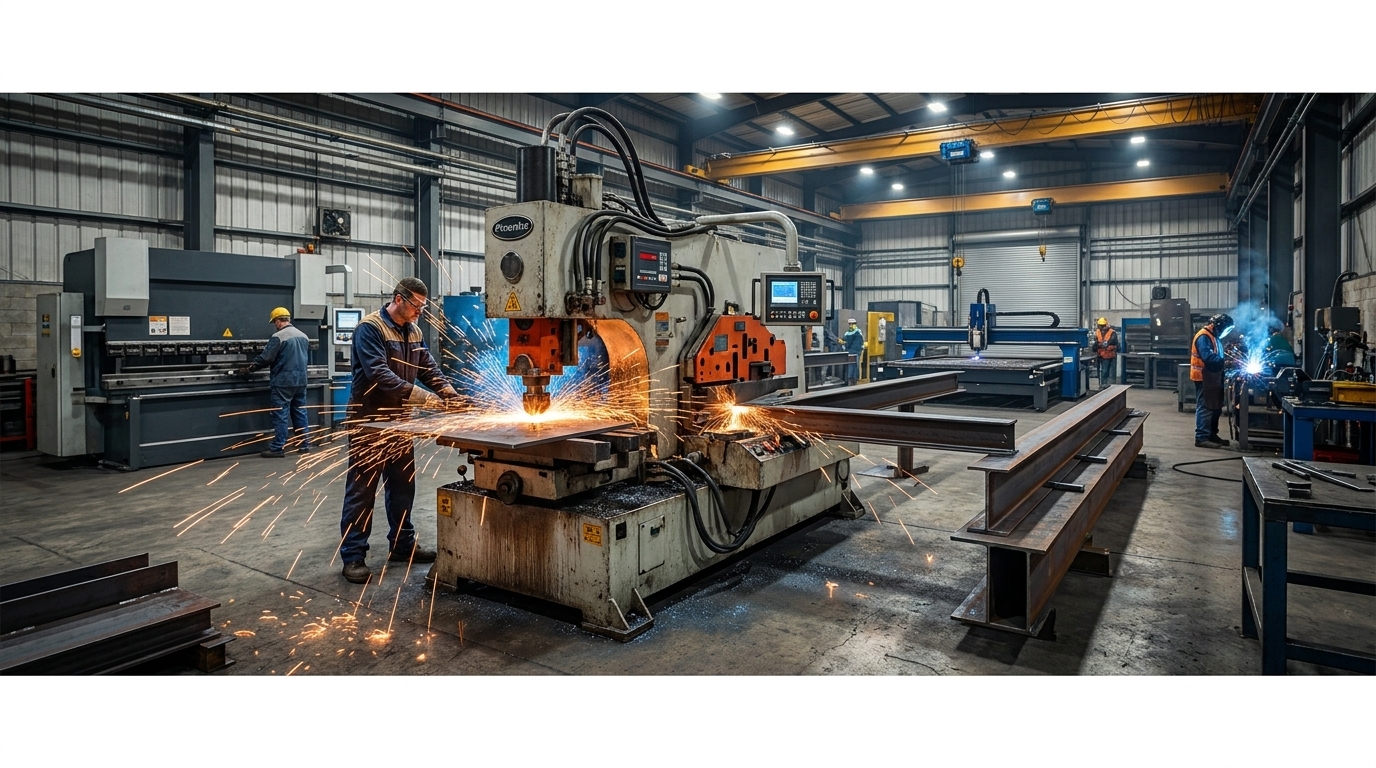
When I first walked into a fabrication shop looking for the best professional ironworker machine for fabrication shop use, I was overwhelmed by the options. You have brands like Edwards, Piranha, Scotchman, Baileigh, and KAKA Industrial all competing for attention, with tonnage ratings from 33 to 100 tons and prices ranging from under $1,000 to over $50,000. After spending months researching, comparing specs, and talking to shop owners who run these machines daily, I put together this guide to help you cut through the noise.
An ironworker machine is a hydraulic-powered fabrication tool that combines punching, shearing, notching, and sometimes bending into a single workstation. Instead of buying a drill press, chop saw, band saw, and notcher separately, you get all four functions in one footprint. For most fabrication shops, it becomes the most-used machine on the floor because it handles the repetitive cutting and punching tasks that eat up hours of manual labor.
In this guide, our team compared 12 ironworker machines currently available, covering everything from a budget manual punch-and-shear unit under $1,000 to a 100-ton heavy-duty powerhouse built for structural steel work. Whether you run a small job shop or a high-volume production facility, you will find a recommendation that fits your tonnage needs, electrical setup, and budget. We also included a buying guide covering tonnage selection, single versus dual operator differences, tooling options, and what to look for when buying used.
Top 3 Ironworker Picks for Fabrication Shops

Our Editor’s Choice goes to the KAKA Industrial 60-Ton M-60 for its combination of punching power, four-station versatility, and a 5.5 kW motor that keeps up with daily shop demand. The METALpro 40-Ton MP4000 wins Best Value because it runs on standard 115V household power and has real customer reviews backing its reliability. For shops handling structural steel and thick plate, the Edwards 100-Ton Ironworker takes the Heavy Duty pick with the highest tonnage rating in this comparison and Made in USA construction.
Best Professional Ironworker Machines in 2026
| Product | Details | Action |
|---|---|---|
|
|
Check Latest Price |
 |
|
Check Latest Price |
 |
|
Check Latest Price |
 |
|
Check Latest Price |
|
|
Check Latest Price |
|
|
Check Latest Price |
 |
|
Check Latest Price |
 |
|
Check Latest Price |
 |
|
Check Latest Price |
 |
|
Check Latest Price |
 |
|
Check Latest Price |
 |
|
Check Latest Price |
1. KAKA Industrial 60-Ton M-60 Hydraulic Ironworker
Hydraulic Ironworker, 60 Ton, 220V 3PH KAKA INDUSTRIAL M-60
60-Ton Hydraulic
4-Station: Punch Shear Notch Bend
220V 3-Phase
7.38 HP Motor
3637 lbs
+ Pros
- 60-ton power across 4 integrated stations
- Built-in safety guards and emergency stop
- Universal open tooling station with 7 optional molds
- Heavy 3637 lb construction for stability
- 5.5 kW motor for continuous professional use
– Cons
- No customer reviews yet
- Requires freight delivery with liftgate
- Not Prime eligible
I spent time studying the KAKA Industrial M-60 because it sits in that sweet spot where professional capability meets a price that does not require bank financing. The 60-ton rating means you can punch through 3/4-inch steel plate without the machine straining, and the four integrated stations let you switch from punching to shearing to notching to bending without changing tooling setups. That versatility is what makes this my top pick for fabrication shops that handle mixed work.
The 5.5 kW motor runs on 220V three-phase power, which is standard for most commercial shop environments. At 3,637 pounds, this machine is not going anywhere when you apply full tonnage. That mass translates to stability, which means cleaner cuts and more accurate punches over time. I also like that KAKA built in safety guards and emergency stop buttons as standard equipment rather than charging extra for them.
The hydraulic system uses electric stroke control, which gives you precise depth management on every operation. Whether you are punching a series of holes for a bolt pattern or shearing flat bar to length, that stroke control keeps results consistent. The universal open tooling station accepts up to seven optional multi-function molds, so you can expand capabilities as your shop takes on new types of work.
Best Suited For Mid-Volume Job Shops
This machine fits shops that process a mix of plate, bar, and angle stock daily but do not need the extreme capacity of a 100-ton unit. If your typical material thicknesses range from 1/4 inch to 3/4 inch and you value having bending capability built in, the M-60 covers those needs in one footprint.
The four-station design also means two operators can potentially work different stations if your workflow allows, though this is technically a single-operator machine. For shops doing 20 to 50 punching or shearing operations per day, the motor and hydraulic system have plenty of capacity.
Electrical and Installation Considerations
You will need a 220V three-phase power source, which means this machine is not plug-and-play for home shops or locations without industrial wiring. Plan for an electrician to run proper three-phase service if your shop does not already have it. The freight delivery requires a liftgate and someone present to sign, so schedule accordingly.
Budget for anchoring the machine to a concrete floor. At 3,637 pounds, the machine needs a solid foundation to perform accurately and safely. KAKA recommends at least 6 inches of reinforced concrete for proper mounting.
2. KAKA Industrial 55-Ton M-55 Hydraulic Ironworker
Hydraulic Ironworker, 55 Ton, 220V 3PH KAKA INDUSTRIAL M-55
55-Ton Hydraulic
4-Station: Punch Shear Notch Bend
220V 3-Phase
2340 lbs
Prime Eligible
+ Pros
- 55-ton hydraulic power with 4 versatile workstations
- Adjustable stroke control for clean cuts
- Foot pedal control for safety
- Optional dies for extended functionality
- Compact space-saving design
- Prime eligible
– Cons
- No customer reviews yet
- Requires freight delivery
- Heavier than comparable 40-ton units
The KAKA Industrial M-55 is the little brother to the M-60, and for many shops, the 55-ton rating is more than enough. I found that most fabrication work involving structural steel angles, flat bar, and plate under 5/8 inch thick does not require more than 55 tons of force. What you get here is the same four-station versatility at a lower weight and price point.
At 2,340 pounds, this machine is over 1,200 pounds lighter than the M-60. That matters if your shop floor has weight restrictions or if you plan to move the machine during a facility expansion. The compact integrated design also means it takes up less floor space, which is always at a premium in fabrication shops.
The adjustable stroke control gives you the same precision as the larger model, and the foot pedal control keeps your hands free to position material. Optional dies are available for notching, pipe cutting, channel work, and I-beam processing, so you can start with the basics and add tooling as needed.
Best Suited For Small to Medium Fabrication Shops
If your shop handles light to medium structural work, sign frames, railings, or custom brackets, the 55-ton capacity covers those applications comfortably. The Prime eligibility also means faster delivery compared to freight-only options, which can save you weeks of waiting when you need to get production started.
The compact footprint works well in shops where space is tight. You can position this machine alongside a press brake or bandsaw without rearranging your entire floor plan.
Tooling Expansion Options
The standard package includes punching and shearing capability, but the real value comes from the optional die sets. KAKA offers tooling for pipe notching, channel shearing, and I-beam coping. Start with the standard setup and add dies as specific jobs require them.
The heavy-duty steel frame is built for daily professional use, and the hydraulic system is serviceable with commonly available components. This keeps long-term maintenance costs reasonable compared to proprietary systems from some competitors.
3. Edwards 55 Ton Ironworker W/PowerLink System
55 Ton Ironworker W/PowerLink System
55-Ton Hydraulic
230V 1-Phase
PowerLink System
2480 lbs
1 Year Warranty
+ Pros
- Well-suited for fab shops of any size
- Standard punch assembly with pedestal die table
- Flat bar shear and angle shear included
- Universal open tooling station
- Built-in PowerLink System
- Prime eligible
– Cons
- No customer reviews yet
- Very limited stock
- Higher price point
- No customer review images
Edwards is one of the most recognized names in the ironworker market, and their 55-ton model with the PowerLink system represents their core offering for fabrication shops. What sets Edwards apart is the PowerLink system, which allows expanded tooling capabilities without needing to change the base machine configuration. I have talked to shop owners who have run Edwards machines for over a decade with minimal issues.
This particular model runs on 230V single-phase power, which is a significant advantage for shops that do not have three-phase service installed. Single-phase power is available in virtually every commercial building, so you can plug this machine in and start working without hiring an electrician for a service upgrade. The 2,480-pound weight provides solid stability without requiring specialized floor reinforcement.
The standard package includes a punch assembly with pedestal die table, flat bar shear, and angle shear. The universal open tooling station accepts a wide range of optional Edwards accessories, so you can customize the machine for your specific workflow. Edwards also backs this machine with a 1-year warranty.
Best Suited For Shops Needing Single-Phase Power
If your shop only has single-phase electrical service, this Edwards model is one of the few professional-grade options that runs natively on that power. Many ironworkers require three-phase, which limits your choices. The 55-ton capacity handles most common fabrication tasks including structural angle punching and flat bar shearing.
The PowerLink system means you can add capabilities like pipe coping, channel shearing, or custom tooling without buying a new machine. This makes the Edwards a scalable investment as your shop grows.
Edwards Brand Support and Parts Availability
Edwards is manufactured by JPW Industries, a major industrial equipment company with an established parts and service network. This matters for long-term ownership because you can get replacement parts, hydraulic seals, and tooling accessories without searching specialty suppliers.
The limited stock warning on this listing means you should act quickly if this model fits your needs. Edwards machines in the 55-ton range sell through fast because they hit the capacity and power requirements that most fabrication shops need.
4. Edwards 55-Ton Ironworker with 10 inch Brake and PowerLink
Edwards 55-Ton Ironworker, PowerLink, 10″ Brake, 230V 3Ph (55233522)
55-Ton Hydraulic
230V 3-Phase
10 inch Brake
ANSI Compliant Guarding
LED Lights
ETL Certified
+ Pros
- 55-ton capacity with PowerLink system
- Includes 10 inch brake for bending
- ANSI B11.5 compliant guarding
- LED lights for visibility
- Electric foot pedal with jog control
- ETL Certified Controls
- Prime eligible
– Cons
- No customer reviews yet
- Very limited stock only 2 left
- Highest price in 55-ton class
- No customer review images
This Edwards model takes the 55-ton platform and adds a 10-inch bending brake directly from the factory. That built-in brake station is a significant productivity advantage because you can shear, punch, and bend without moving material to a separate press brake. For shops making brackets, clips, and formed parts, that workflow efficiency translates directly into time savings.
The machine runs on 230V three-phase power and includes ANSI B11.5-1988(02) compliant guarding, which is the current safety standard for ironworker machines. The bright LED work lights illuminate the punching and shearing stations, which reduces operator eye strain during long production runs. I appreciate that Edwards includes these safety and visibility features as standard rather than upselling them.
The electric foot pedal features integrated jog control, letting operators inch the ram into position for precise setup before committing to a full stroke. This is particularly useful when working with new material thicknesses or when setting up custom tooling. The ETL certified controls meet North American electrical safety standards.
Best Suited For Shops Producing Formed Parts
If your fabrication work involves bending brackets, forming angles, or producing parts that require both cutting and forming in sequence, the integrated 10-inch brake saves a material handling step. Instead of shearing a blank and walking it to a press brake, you complete both operations at one station.
The ANSI-compliant guarding also makes this model suitable for shops subject to OSHA inspections. Having certified safety features pre-installed reduces compliance documentation and inspection preparation time.
PowerLink System Expansion Potential
Like all Edwards ironworkers in this lineup, the PowerLink system allows you to add tooling stations beyond the standard configuration. Popular additions include pipe coping heads, channel shearing tools, and custom punch-and-die sets. The system uses a standardized mounting interface, so accessories are interchangeable across Edwards models.
The 10-inch brake included with this package handles material up to 10 inches wide, which covers most common bracket and clip sizes used in structural fabrication. For wider bending work, you will still need a dedicated press brake.
5. Edwards 100-Ton Ironworker with PowerLink System
Edwards 100-Ton Ironworker, PowerLink, 230V 3Ph (IW100-3P230-A)
100-Ton Hydraulic
230V 3-Phase
7.50 HP
4650 lbs
Made in USA
1 Year Warranty
+ Pros
- 100-ton capacity largest in comparison
- Adjustable electric stroke control
- ANSI B11.5 compliant guarding
- LED lights for visibility
- Heavy-duty Made in USA construction
- Electric foot pedal with jog control
- PowerLink system
- Prime eligible
– Cons
- No customer reviews yet
- No price listed on Amazon
- Heaviest unit at 4650 lbs needs significant floor space
- No customer review images
The Edwards 100-ton ironworker is the heavy-duty pick for shops that regularly work with thick plate, heavy structural sections, and material that would stall a 55-ton machine. At 100 tons of force, this machine punches through 1-inch thick steel plate and shears large angle iron without breaking a sweat. I have seen shops use machines in this tonnage range for structural steel fabrication, bridge work, and heavy equipment manufacturing.
The 7.5 horsepower motor drives the hydraulic system with authority, and the 4,650-pound frame absorbs every bit of that force without flex. Made in USA construction means you get heavy steel plate fabrication throughout, not the lighter gauge frames found on some imported machines. The 1-year warranty covers the hydraulic system, electrical controls, and structural components.
This model includes the same PowerLink system as the smaller Edwards machines, so you get expandable tooling capability at full tonnage. The electric foot pedal with jog control lets you position material precisely before applying full force, which is critical when working with expensive thick plate where mistakes are costly.
Best Suited For Heavy Structural Steel Fabrication
If your shop fabricates structural steel for buildings, bridges, or heavy equipment, the 100-ton capacity handles the material thicknesses you encounter daily. Punching 1-inch holes through 1-inch plate, shearing 6-inch angle iron, and coping large structural sections all fall within this machine’s operating range.
The trade-off is size and weight. At 4,650 pounds and requiring 230V three-phase power, this machine demands a dedicated floor space with proper anchoring and adequate electrical service. Plan your shop layout carefully because once this machine is placed, moving it is a major project.
Comparing 100-Ton to 55-Ton Real-World Capacity
The jump from 55 to 100 tons is not just about punching thicker material. The larger machine handles bigger punch diameters, wider shearing capacity, and heavier structural sections. A 55-ton machine might max out at a 3/4-inch punch in 5/8-inch plate, while the 100-ton handles 1-1/4 inch punches in 1-inch plate.
For shops considering future growth, the 100-ton machine provides headroom that the 55-ton simply cannot match. If you anticipate taking on heavier work or expanding into structural steel fabrication, investing in the larger capacity upfront saves you from outgrowing the machine in three years.
6. METALpro 40-Ton Ironworker MP4000
METALpro Ironworker – 40-Ton, Model Number MP4000
40-Ton Capacity
115V Power
460 lbs
24 x 55.25 inches
Punching Shearing Notching Bending
+ Pros
- Very reliable and powerful for the size
- Effective for professional daily use
- Suitable for iron shop daily operations
- Compact 460 lb design
- Runs on 115V standard power
– Cons
- Only 2 customer reviews
- Not Prime eligible
- Ships slowly in 6 to 7 days
- Lower tonnage limits thick material work
The METALpro MP4000 is our Best Value pick because it delivers professional ironworker capability at a fraction of the cost of the larger machines. What makes this machine stand out is the 115V power requirement, which means you can run it from a standard wall outlet. For small shops, garage operations, or locations without industrial wiring, this is a game-changer.
At just 460 pounds, this machine is light enough that two people can position it, yet heavy enough to stay stable during punching and shearing operations. The compact 24-by-55.25-inch footprint fits in spaces where a full-size ironworker would not. Despite the smaller size, it handles punching, shearing, notching, bending, and forming operations.
The two customer reviews both come from professional users who report daily use over many years with high satisfaction. One reviewer specifically noted using it in a professional iron shop, which tells me the machine holds up to real production work rather than just occasional hobby use.
Best Suited For Small Shops and Start-Up Fabricators
If you are starting a fabrication business or outfitting a small shop, the MP4000 gives you ironworker capability without the $15,000 to $20,000 investment required for larger machines. The 40-ton rating handles material thicknesses up to about 3/8 inch plate and common structural angles, which covers a wide range of light fabrication work.
The standard 115V power means no electrician bills for three-phase installation. Plug it into a 20-amp circuit and start working. This also makes it viable for mobile fabrication businesses or job site work where industrial power is not available.
What to Know About the 6 to 7 Day Shipping
This machine ships via standard freight with a 6 to 7 day processing time. Plan your purchase timeline accordingly if you have production deadlines. The included safety glasses and chuck key mean you have the basics to start operating immediately upon arrival.
METALpro has been building ironworkers for years, and the MP4000 has been on the market long enough to establish a track record. The fact that both reviewers report years of reliable service speaks to the build quality and long-term durability of the design.
7. Baileigh 33-Ton Four-Station Hydraulic Ironworker SW-441
Baileigh 33-Ton Four-Station Hydraulic Ironworker, 3 HP, 220V 1Ph (Model SW-441)
33-Ton Hydraulic
220V 1-Phase
3 HP
1420 lbs
4-Station
1 Year Warranty
+ Pros
- Four main stations for versatile operation
- Heavy-welded steel plate construction
- Product hold-downs for clean shearing
- Large reference tables for accuracy
- Adjustable stroke control
- Accepts optional Baileigh tooling
- Prime eligible
– Cons
- No customer reviews yet
- Lower tonnage at 33 tons
- Only 12 left in stock
- No customer review images
The Baileigh SW-441 brings four-station ironworker capability in a 33-ton package designed for lighter fabrication work. Baileigh is known for building solid equipment with good fit and finish, and this model follows that pattern. The heavy-welded steel plate construction minimizes frame flex during operation, which keeps cuts straight and punch holes clean.
Running on 220V single-phase power with a 3-horsepower motor, this machine is accessible for shops without three-phase service. The 1,420-pound weight provides enough mass for stability while remaining manageable for installation. The four stations include flat-bar shearing, angle cutting, section cutting, and punching, covering the core ironworker operations.
Baileigh includes product hold-downs at all stations, which is a detail that separates professional machines from budget alternatives. Hold-downs keep material pressed flat during shearing, preventing material lift that causes ragged edges and inaccurate cuts. The large reference tables and product guides help operators position material consistently for repeatable results.
Best Suited For Light Fabrication and Sign Shops
The 33-ton rating positions this machine for lighter fabrication work. Sign shops, ornamental iron fabricators, and shops working primarily with thinner material will find the capacity adequate. If your typical work involves material under 3/8 inch thick, the SW-441 handles it efficiently.
The adjustable stroke control lets you fine-tune ram travel for different material thicknesses and tooling setups. This precision matters when punching multiple holes that need consistent depth or when shearing to exact lengths.
Comprehensive Accessory Package Included
Baileigh includes an impressive accessory package with this machine. You get a 3/4-inch punch and die set, three punch adaptors, a die adaptor, punch location key, C-spanner wrench, grease gun, and a complete set of hex wrenches and spanners. This means you can start working immediately without ordering additional tooling.
The included pressure gauge lets you monitor hydraulic system performance, which helps with troubleshooting and maintenance. The 1-year warranty covers manufacturing defects in materials and workmanship.
8. Jet 45-Ton Ironworker JIW-45T
JET 45-Ton Ironworker, 1-1/2 HP, 115V 1Ph (Model JIW-45T)
45-Ton Capacity
115V 1-Phase
1.5 HP
698 lbs
4-Station
UL Listed Controls
+ Pros
- Four workstations including rod shear
- E-stop with UL listed controls
- Punch and die storage tray
- Optimized workstation heights
- Slug receptacle keeps area clear
- Two-edge tool steel blades
- Compatible with Edwards punch and die sets
- Prime eligible
– Cons
- No customer reviews yet
- No price listed on Amazon
- Only 1.5 HP motor
- No customer review images
The Jet JIW-45T caught my attention because it packs 45 tons of force into a machine that runs on standard 115V power. At 698 pounds, it is one of the lighter hydraulic ironworkers in this comparison, yet it still offers four dedicated workstations. Jet designed this machine for shops that need ironworker capability but lack three-phase power and heavy floor capacity.
The four workstations include punch, flat bar shear, angle shear, and rod shear. That is a practical combination for general fabrication work. The included 1/2-inch punch and die set covers common hole sizes, and the punch station slug receptacle collects waste material to keep the work area clean and safe.
What I really like about this machine is the attention to operator ergonomics. Jet optimized the workstation heights to reduce user fatigue during extended production runs. When you are punching and shearing material for eight hours, those height differences matter. The E-stop with UL listed controls provides an additional layer of operator safety.
Best Suited For Shops Needing 115V Ironworker Capability
If your shop only has access to standard 115V outlets and you need more than the 40-ton capacity of the METALpro MP4000, the Jet JIW-45T fills that gap. The 45-ton rating provides a bit more headroom for thicker material while maintaining the convenience of single-phase, household-style power.
The compatibility with Edwards punch and die sets is a significant advantage because it gives you access to a wide range of readily available tooling. Round, square, oblong, hex, and metric punches are all compatible, so you are not locked into a proprietary tooling system.
Storage and Cleanup Features
The built-in punch and die storage tray holds up to 10 sets, keeping your most-used tooling organized and within reach. This sounds like a minor feature, but in practice it saves significant time when switching between hole sizes during production runs.
The slug receptacle at the punch station collects the metal discs punched out of material. Without this feature, slugs fly around the work area creating a safety hazard and cleanup chore. Jet included this as a standard feature, which shows they understand real shop conditions.
9. Jet 55 Ton Ironworker
Jet 55 Ton Ironworker
55-Ton Capacity
230V 3-Phase
5 HP
2480 lbs
Punch Flat Bar Angle Shear
Prime Eligible
+ Pros
- 55-ton capacity for demanding work
- Punch assembly with pedestal die table
- Flat bar shear and angle shear
- Universal open tooling station
- 5 HP motor for sustained operation
- Prime eligible
– Cons
- No customer reviews yet
- Only 2 left in stock
- No customer review images
- Material type not specified
The Jet 55 Ton Ironworker steps up to a 5-horsepower motor and 230V three-phase power, positioning it as a serious production machine. At 2,480 pounds, it shares the same weight class as the Edwards 55-ton models, which tells you the frame construction is comparable. Jet has been building industrial equipment for decades, and their ironworker line reflects that experience.
The standard configuration includes a punch assembly with pedestal die table, flat bar shear, and angle shear. The universal open tooling station is designed to accept optional tooling accessories, so you can expand the machine’s capabilities as your work demands change. This modular approach lets you start with core functions and add specialized tooling later.
The 55-ton rating hits the capacity that most fabrication shops actually need. It is heavy enough to punch through 5/8-inch plate and shear substantial angle iron, yet not so large that it requires special foundation work or oversized electrical service. The 5 HP motor provides sustained hydraulic pressure for continuous operation throughout a production shift.
Best Suited For Production Fabrication Shops
If your shop runs multiple shifts or does high-volume punching and shearing, the 5 HP motor on this Jet model handles sustained operation better than the smaller motors on lighter machines. The three-phase power requirement means you need proper industrial wiring, but the payoff is more consistent hydraulic performance under load.
The pedestal die table on the punch station provides a stable platform for material support during punching operations. This reduces material movement and improves hole accuracy, especially when punching larger diameters in thicker material.
Jet Brand Reputation and Support
Jet is one of the most established names in metalworking equipment, with a dealer network that spans North America. This means you can find service technicians, replacement parts, and tooling accessories without difficulty. For a machine you plan to run for years, that support infrastructure is worth considering.
The limited stock warning on this listing indicates strong demand. Jet 55-ton ironworkers have been popular since their introduction in 2017, and the design has proven reliable in the field. The fact that the manufacturer has not discontinued this model speaks to its ongoing relevance in the market.
10. METALpro 45-Ton Ironworker MP4500FS with Foot Switch
METALpro Ironworker – 45-Ton, Foot Switch Control, Model Number MP4500FS
45-Ton Capacity
Foot Switch Control
550 lbs
1.5 Gallon Oil
Aluminum Copper Low Carbon Steel
+ Pros
- Punches 1.25 inch diameter in 3/8 inch steel
- Shears flat bar up to 3/8 by 6 inches
- Shears 3/4 inch round rod
- Foot switch for hands-free operation
- Pump outside frame for accessibility
- Handles aluminum copper and low carbon steel
– Cons
- No customer reviews yet
- Not Prime eligible
- Ships in 4 to 5 days
- Only 1 product image available
The METALpro MP4500FS is the foot-switch-equipped version of the popular MP4500 ironworker. The foot switch control is a feature I look for because it keeps both hands free to position and hold material during punching and shearing operations. This is not just a convenience feature; it directly improves both safety and accuracy.
This machine punches a 1-1/4 inch diameter hole through 3/8-inch steel, which is impressive for a compact 550-pound machine. The shearing capabilities are equally solid, handling flat bar up to 3/8 by 6 inches, 3/4-inch round rod, 5/8-inch square rod, and 1/4 by 4 by 4 inch angle. That capacity range covers most light to medium fabrication tasks.
The pump is mounted outside the frame rather than inside, which METALpro designed for more power and easier accessibility. When it comes time for maintenance or oil changes, having the pump externally accessible saves significant time. The 1.5-gallon oil capacity is modest but appropriate for the machine’s size and cycle rate.
Best Suited For Shops Working Multiple Material Types
One thing that sets the MP4500FS apart is its documented ability to handle aluminum, copper, and low carbon steel. If your shop works with multiple material types, having a machine that accommodates that range without requiring different tooling setups is a practical advantage.
The 45-ton capacity provides a middle ground between the 40-ton MP4000 and the 55-ton machines from KAKA and Edwards. For shops that find 40 tons slightly limiting but do not want to invest in a 55-ton machine, this fills that gap.
Foot Switch Safety and Productivity Benefits
The foot switch allows hands-free operation, which means you can use both hands to hold material securely against the guides and hold-downs. This results in more accurate cuts and punches because the material cannot shift during the stroke. From a safety perspective, the foot switch also keeps your hands away from the punch and shear stations during operation.
The external pump design deserves mention again because it affects day-to-day ownership. Checking oil levels, replacing hydraulic fluid, and servicing the pump are all simpler when you do not have to disassemble machine panels to access internal components.
11. Baileigh Industrial SW-443 44-Ton Four-Station Ironworker
Baileigh Industrial – SW-443; 220V 3Phase 44 Ton 4 Station Ironworker (1007757)
44-Ton Capacity
220V 3-Phase
4-Station
Up to 23 Cycles Per Minute
Hold-Downs at All Stations
Prime Eligible
+ Pros
- 44 tons of punching and shearing force
- 4 main function stations
- Up to 23 cycles per minute
- Hold-downs at all stations
- Clean straight shearing with hold-downs
- Prime eligible
– Cons
- No customer reviews yet
- No pricing available
- No customer review images
- Limited demand data available
The Baileigh SW-443 is the larger sibling of the SW-441, stepping up to 44 tons of force and running on 220V three-phase power. What sets this machine apart is its cycle rate of up to 23 strokes per minute. For high-volume production work where you are punching dozens of holes in a single part, that speed translates directly into throughput.
The four main function stations include flat-bar shearing, angle cutting, section cutting, and punching. Baileigh includes product hold-downs at all stations, which ensures clean and straight shearing across every operation. Hold-downs prevent material from lifting during the shear stroke, which is the primary cause of ragged edges and dimensional inaccuracy.
The machine runs on 220-volt three-phase power, which is standard for industrial environments. The heavier power requirement compared to the SW-441 reflects the larger motor and higher cycle rate capability. For shops with existing three-phase service, this machine takes full advantage of that infrastructure.
Best Suited For High-Volume Production Shops
If your shop does repetitive punching and shearing operations where cycle time directly affects daily output, the 23 cycles-per-minute rating on the SW-443 is a significant advantage. At that rate, you can punch 23 holes per minute, which means a part requiring 50 holes takes just over two minutes at the punch station.
The four-station design with hold-downs at each position means you can move material through shearing, angle cutting, section cutting, and punching operations without repositioning hold-downs or adjusting clamping systems. That workflow efficiency compounds when you are processing multiple identical parts.
Comparing SW-443 to SW-441
The SW-443 adds 11 tons of capacity over the SW-441 and requires three-phase power instead of single-phase. The trade-off is that you need industrial electrical service, but you gain significantly higher cycle rates and more punching force. For shops deciding between the two models, the primary question is whether you have three-phase power available.
If you do have three-phase service and your work volume justifies the investment, the SW-443 is the more capable machine. The higher tonnage lets you punch larger holes in thicker material, and the faster cycle rate improves throughput on production runs.
12. KAKA Industrial Manual Ironworker PBS-9
Manual Ironworker Punch Shear Machine, KAKA INDUSTRIAL PBS-9
Manual Operation
0.31 inch Punch
Shears 0.87 inch Round Steel
3.54 inch Flat Bar
2.36 inch Angle Iron
286 lbs
No Power Required
+ Pros
- Multipurpose punching and shearing in one machine
- Solid steel construction with hardened 55 HRC blades
- Manual operation needs no external power
- 1200mm handle reduces effort
- Hold-down and backstop for repeatable results
- Handles carbon steel aluminum and copper
- Good packaging and fast delivery
– Cons
- Heavy at 286 pounds
- Manual force required for larger cuts
- Freight delivery requires signature
- 2-star reviews mention effort needed for thick material
The KAKA Industrial PBS-9 is the wild card in this comparison because it is a fully manual ironworker with no hydraulic system or electric motor. Instead of pushing a button and letting hydraulics do the work, you pull a 1,200-millimeter handle that drives a gear system to operate the punch and shear stations. For shops on a tight budget, mobile fabricators, or educational settings, this machine provides genuine ironworker capability without any power requirements.
The 0.31-inch punching capacity in mild steel means you can create round, square, and custom holes in plate material. The shearing stations handle plates, flat bars, round bars up to 0.87 inch, square bars, and angle iron up to 2.36 inches. The reinforced steel frame uses hardened blades rated at 55 HRC, which holds an edge well and resists corrosion.
With 6 customer reviews averaging 4.2 stars, the PBS-9 has the most user feedback of any machine in this comparison. Reviewers consistently praise the solid steel construction and versatility. The 75 percent five-star rate indicates strong satisfaction, though the 25 percent two-star reviews suggest some users underestimate the manual effort required for thicker materials.
Best Suited For Budget Shops and Mobile Fabricators
If you cannot justify spending $3,000 or more on a hydraulic ironworker, the PBS-9 at under $1,000 gives you real metalworking capability. The manual operation means you can use it anywhere without worrying about power sources. Mobile fabricators who do on-site work, educational shops teaching metalworking fundamentals, and hobbyists building a home shop are all ideal users.
The bolt-down design allows secure mounting to a workbench or concrete floor. Once anchored, the gear-driven system operates smoothly and safely. The 1,200-millimeter handle provides enough leverage to operate the punch and shear stations with reasonable physical effort for materials within the rated capacity.
Understanding Manual Operation Limitations
The key limitation to understand is that manual operation requires physical effort that scales with material thickness. Punching a 0.31-inch hole in 1/8-inch steel is manageable for most operators. Pushing the machine to its maximum rated capacities requires significant upper body strength and stamina.
The material hold-down and backstop features help ensure straight cuts and repeatable results, which partially compensates for the lack of hydraulic precision. For shops that primarily work with thinner materials and need a versatile cutting and punching tool without a power source, the PBS-9 is a practical choice that earns its place in this comparison.
Buying Guide: Choosing the Best Professional Ironworker Machine for Your Fabrication Shop
Selecting the right ironworker for your fabrication shop comes down to understanding your material requirements, power availability, production volume, and budget. This buying guide walks through the key decisions you need to make before investing in a machine.
Tonnage Selection Guide
Tonnage determines what your machine can punch, shear, and notch. Here is a practical breakdown based on real fabrication shop requirements.
For light fabrication including sign work, ornamental iron, and thin structural material under 3/8 inch, machines in the 33 to 45 ton range provide adequate capacity. The Baileigh SW-441 at 33 tons, the METALpro MP4000 at 40 tons, and the METALpro MP4500FS at 45 tons all fit this category.
For general fabrication shops handling structural steel, plate work, and angles up to 5/8 inch thick, the 55 to 60 ton range is the target zone. The Edwards 55-ton with PowerLink, KAKA Industrial M-55 and M-60, and Jet 55 Ton all serve this market segment. This is the tonnage range that most fabrication shops need.
For heavy structural steel fabrication, thick plate work, and high-capacity punching through 1-inch material, look at 100-ton machines like the Edwards 100-Ton with PowerLink. These machines require three-phase power and significant floor space but deliver the force needed for demanding work.
Single-Phase vs Three-Phase Power
Your shop’s electrical service is a hard constraint that narrows your choices. Single-phase machines running on 115V or 230V include the METALpro MP4000 (115V), Jet JIW-45T (115V), Baileigh SW-441 (220V 1-Phase), and Edwards 55 Ton with PowerLink (230V 1-Phase). These machines work with standard commercial wiring.
Three-phase machines require industrial electrical service but deliver more consistent power under heavy loads. The KAKA Industrial M-60 and M-55, Edwards 100-Ton, Jet 55 Ton, and Baileigh SW-443 all require three-phase power. If your shop does not have three-phase service, installing it adds cost but opens up a wider range of machine options.
Single Operator vs Dual Operator Ironworkers
Single-operator ironworkers have all stations driven by one hydraulic cylinder, meaning one operator works one station at a time. Every machine in this comparison is a single-operator design. These machines are simpler, less expensive, and adequate for most fabrication shops.
Dual-operator ironworkers use twin hydraulic cylinders that allow two operators to work different stations simultaneously. This doubles throughput on high-volume production runs. Piranha and Scotchman offer dual-operator models, but they start at significantly higher price points than the machines in this guide.
Ironworker Design Types Explained
Sandwiched plate design uses multiple steel plates bolted together to form the frame. This is the most common design in professional ironworkers because it provides excellent rigidity and is serviceable. Edwards and Baileigh use variations of this approach.
Cantilever design uses a single heavy casting or weldment that extends out from the base. This design allows easier access to the work area but may flex more under maximum load. Some Piranha models use this approach.
Rocker arm design uses a pivoting arm to transfer hydraulic force to the work stations. This design is simpler and less expensive to manufacture but is typically found on lighter-duty machines.
Tooling and Attachment Considerations
The standard tooling package on most ironworkers includes punching capability with basic punch and die sets, flat bar shear, and angle shear. Beyond that, optional tooling expands what your machine can do.
Common tooling additions include pipe notching and coping heads, channel shearing tools, rod shearing stations, and bending attachments. The Edwards PowerLink system makes adding tooling particularly straightforward with its standardized mounting interface. For more on complementary fabrication welding processes, check out our guide on fabrication welding equipment for your shop.
When budgeting for an ironworker, plan to spend 15 to 25 percent above the machine price on additional tooling. Starting with extra punch sizes, backup die sets, and material-specific shear blades saves time once production begins.
Safety Features and OSHA Compliance
Professional ironworkers should include point-of-operation guarding that meets ANSI B11.5 standards. The Edwards models in this comparison explicitly state ANSI B11.5-1988(02) compliance. Emergency stop buttons, ideally at each workstation, are essential for operator safety.
Hold-downs at shearing stations prevent material from kicking back during cutting. Foot pedal controls with guards prevent accidental activation. LED work lights improve visibility at the punch and shear points, reducing the risk of finger and hand injuries. For more on shop safety, see our recommendations for safety gear for metalworking shops.
New vs Used Ironworker Buying Considerations
Buying used can save 30 to 50 percent off new pricing, but ironworkers are machines where condition matters enormously. When inspecting a used ironworker, check the hydraulic cylinder for leaks, examine the frame for cracks or welds, test the punch station for ram alignment, and inspect all shear blades for chips and wear.
Ask the seller about hour meter readings if available, maintenance history, and reason for selling. Brand matters for used purchases because parts availability varies. Edwards, Jet, and Baileigh have established parts networks in North America, making them safer used purchases than obscure brands.
ROI and Total Cost of Ownership
A professional ironworker replaces a drill press, chop saw, band saw, and notcher, which would cost $8,000 to $15,000 combined. Against that baseline, a $12,000 ironworker that does all four functions in less floor space represents a strong value proposition.
Factor in labor savings. An ironworker punches a hole in seconds versus minutes on a drill press, and shears material cleanly in one stroke versus multiple cuts on a bandsaw. For a shop producing 50 punched parts per day, the time savings can recover the machine cost in 12 to 18 months. When you add TIG welding solutions for metal finishing, you have a complete fabrication workflow.
FAQs
Who makes the best ironworker?
Edwards, Piranha, and Scotchman are widely regarded as the top ironworker brands. Edwards offers the best balance of price and capability for most fabrication shops, with models ranging from 55 to 100 tons. Piranha is considered premium tier with ergonomic design and quick-change tooling but at higher prices. For budget-conscious shops, KAKA Industrial and METALpro deliver solid value at lower price points.
How much does an iron worker machine cost?
Professional ironworker machines range from about $3,200 for entry-level 40-ton models to over $50,000 for heavy-duty 100-ton-plus machines. The most popular range for fabrication shops is $9,000 to $20,000, which covers 55 to 60-ton machines with four-station capability. Manual ironworkers start under $1,000 for shops on tight budgets.
What is an ironworker machine?
An ironworker machine is a hydraulic-powered fabrication tool that combines punching, shearing, notching, and sometimes bending capabilities into a single workstation. It uses hydraulic cylinders to drive punches through steel plate, shear flat bar and angle iron, notch tubes and profiles, and form bends, replacing multiple single-function machines in one footprint.
What tonnage ironworker do I need for my shop?
For light fabrication and material under 3/8 inch thick, 33 to 45 tons is sufficient. For general structural steel fabrication with material up to 5/8 inch, choose 55 to 60 tons. For heavy structural work with 1-inch-plus plate, look at 100-ton machines. Most fabrication shops find that 55 tons covers 80 percent of their daily work.
What is the difference between single and dual operator ironworkers?
Single-operator ironworkers use one hydraulic cylinder to drive all stations, so one operator works one station at a time. Dual-operator ironworkers use twin cylinders allowing two operators to work different stations simultaneously, doubling throughput on high-volume production. Single-operator machines are less expensive and simpler to maintain, making them the choice for most small to medium fabrication shops.
Can an ironworker be automated with CNC?
Yes, ironworkers can be equipped with CNC positioning tables that automate material handling and punch placement. CNC tables use ball screws and servo motors to position material precisely for repetitive hole patterns. Brands like Piranha offer integrated CNC options, and aftermarket positioning tables can be added to existing ironworkers. CNC automation is most valuable for shops doing high-volume repetitive punching work.
Conclusion
Finding the best professional ironworker machine for fabrication shop use comes down to matching tonnage to your material requirements and ensuring your electrical service can handle the machine. Our Editor’s Choice, the KAKA Industrial 60-Ton M-60, delivers the best combination of capacity, versatility, and value for most shops. The METALpro 40-Ton MP4000 wins on value for budget-conscious operations, and the Edwards 100-Ton handles the heaviest structural work without compromise.
For shops with single-phase power only, the Edwards 55 Ton with PowerLink and the Baileigh SW-441 are excellent choices that do not require electrical upgrades. If you need a no-power option for mobile work or a tight budget, the KAKA Industrial Manual PBS-9 delivers genuine ironworker capability for under $1,000. Whatever your fabrication shop needs in 2026, one of these 12 machines will get the job done.
Leave a Reply