

A cabin with no grid connection has three realistic options: run a gas generator and live with noise, fuel cans and exhaust; wire a fixed solar array with a battery bank and inverter; or set a battery-based solar generator in the corner and charge it from panels. That third option is what most people mean when they search for the best solar generators for cabins, and it is the one we spent the most time with.
We worked through twelve current units, logged the specifications that actually change how long a cabin stays powered, and read owner feedback on what spec sheets never mention: what happens below freezing, whether one person can move the unit, and how long the battery really lasts on a refrigerator.
One correction first. A solar generator does not generate solar. It is a lithium battery with an inverter, a charge controller and outlets in a case. Panels charge the battery, the inverter turns stored DC power into household AC power, and nothing is burned. That is the appeal for a cabin: no exhaust, no fuel run, and quiet enough to sleep beside.
If you are still working out the brand landscape, our guide to the best solar generators for off grid living covers the fixed-system-versus-portable-station decision in more depth. The combustion side is covered in propane vs gas generators, worth reading before committing to battery-only power.
Our Top 3 Best Solar Generators for Cabins (October 2026)
After comparing capacity, inverter headroom, recharge speed and behaviour with real cabin loads, three units stand out. The Jackery Explorer 1000 v2 is the balanced all-round choice at 23.8 pounds. The BLUETTI AC180 is the value pick, with the highest continuous output in its class and a 500W solar ceiling. The Anker SOLIX C1000 Gen 2 is the fastest to recharge and the strongest on surge loads.


Comparing 12 Solar Generators for Cabin Living in 2026
Every unit below stores power in a lithium iron phosphate battery, inverts it to 120V AC and recharges from solar. The differences that matter at a cabin are continuous output, solar input ceiling, weight and whether the battery can grow later. Full detail on each appears in its own section below.
| Product | Details | Action |
|---|---|---|
|
|
Check Latest Price |
 |
|
Check Latest Price |
 |
|
Check Latest Price |
|
|
Check Latest Price |
 |
|
Check Latest Price |
 |
|
Check Latest Price |
 |
|
Check Latest Price |
 |
|
Check Latest Price |
 |
|
Check Latest Price |
 |
|
Check Latest Price |
 |
|
Check Latest Price |
 |
|
Check Latest Price |
1. Jackery Explorer 1000 v2 – The Lightest Full-Size Unit for a Weekend Cabin
Jackery Explorer 1000 v2 Portable Power Station,1070Wh,1500W
1070Wh LiFePO4
1500W AC and 3000W surge
23.8 lb
7 outputs
+ Pros
- Lightest full-size unit at 23.8 lb
- 1070Wh capacity with 1500W continuous output
- Emergency charging takes 0-100% in about 1 hour
- Seven outputs including two USB-C and three pure sine wave AC outlets
- Over 70 percent capacity retained after 4000 cycles
– Cons
- Solar charging limited to Jackery panels
- One-hour charging must be enabled in the app each session
- No solar panel included
This is the unit we kept reaching for, because carrying it never became the problem. At 23.8 pounds with a foldable handle, one person can move it from a sleeping loft to the kitchen without a second trip.
Under that light frame sits 1070Wh of lithium iron phosphate chemistry, a 1500W inverter and 3000W of surge headroom. That combination covers the loads that actually appear in a weekend cabin: a small refrigerator, a router, LED lighting, a laptop and a kettle, all at once, without the inverter browning out.
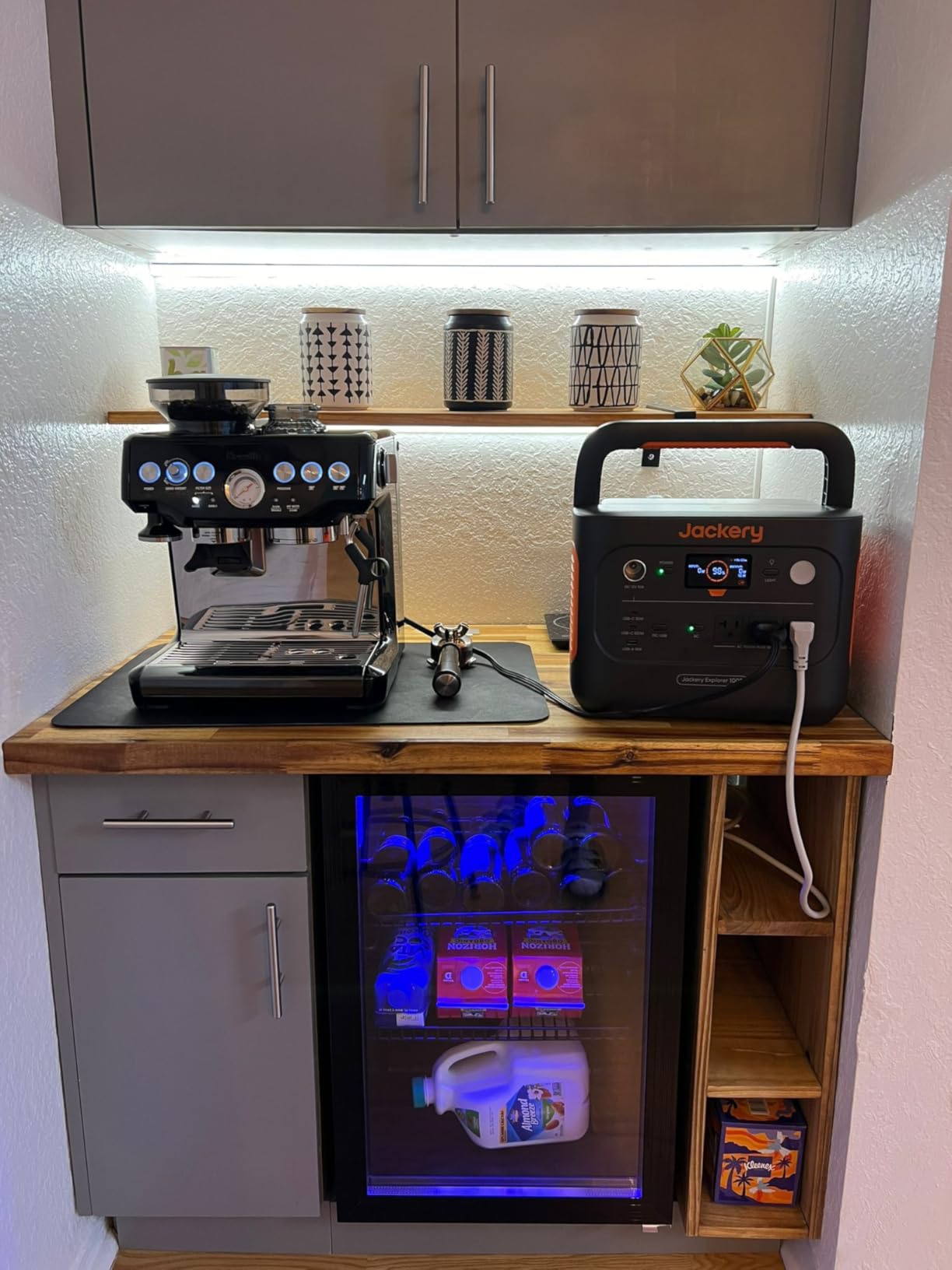
Owners rate it 4.7 out of 5 across more than 3,600 reviews, with roughly 85 percent five-star. The common praise is compactness and pure sine wave output. The common complaint is that it will only take solar from Jackery’s own panels, and users on r/solar raise that point repeatedly.
Battery Chemistry and Cycle Life for Long-Term Use
The cell is rated to hold more than 70 percent of original capacity after 4,000 cycles, which Jackery translates to roughly a ten-year service life. For an owner cycling the battery most weekends, that is the difference between a unit that outlasts the panels on the roof and one that does not.
Charging Speed and the App-Dependent Fast Mode
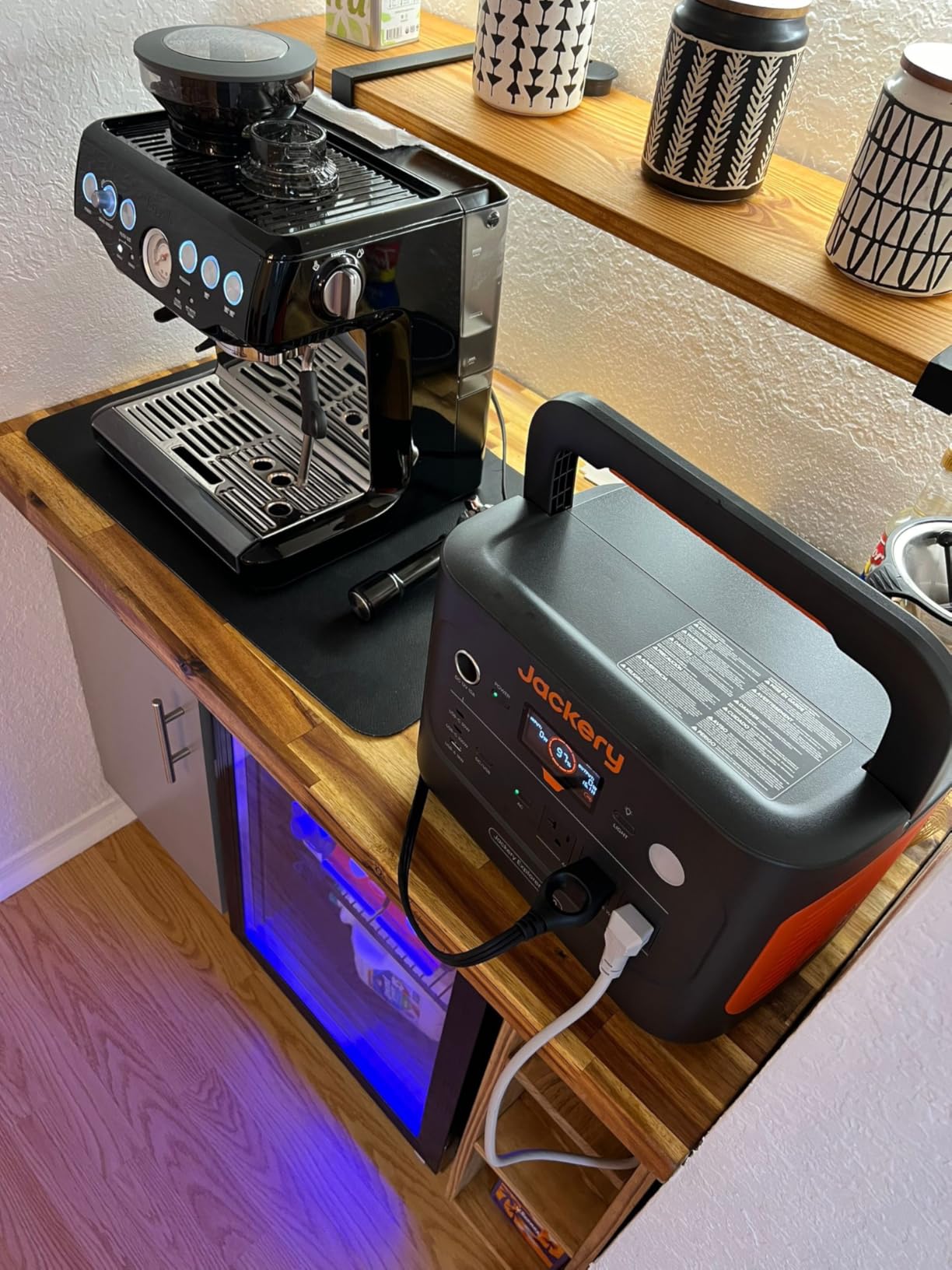
Standard AC charging takes about 1.7 hours. Enabling emergency charging in the app cuts that to roughly one hour, which is genuinely useful when you arrive Friday evening with a low battery and little daylight left. The catch is that it must be switched on manually each time, and it is what pushes the real cost of a solar setup above the unit price alone.
Who This Suits and Where It Falls Short
This suits a seasonal or weekend cabin where someone is present to manage charging and moving the battery between rooms is normal. Seven outputs including two USB-C ports mean phones, cameras and a laptop all charge without adapters.
It is the wrong choice for a full-time homestead running a well pump, and for anyone who already owns rigid solar panels. For a fixed array, the 100W panel options we compared would need an adapter to work with it.
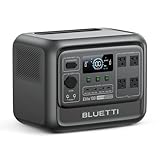
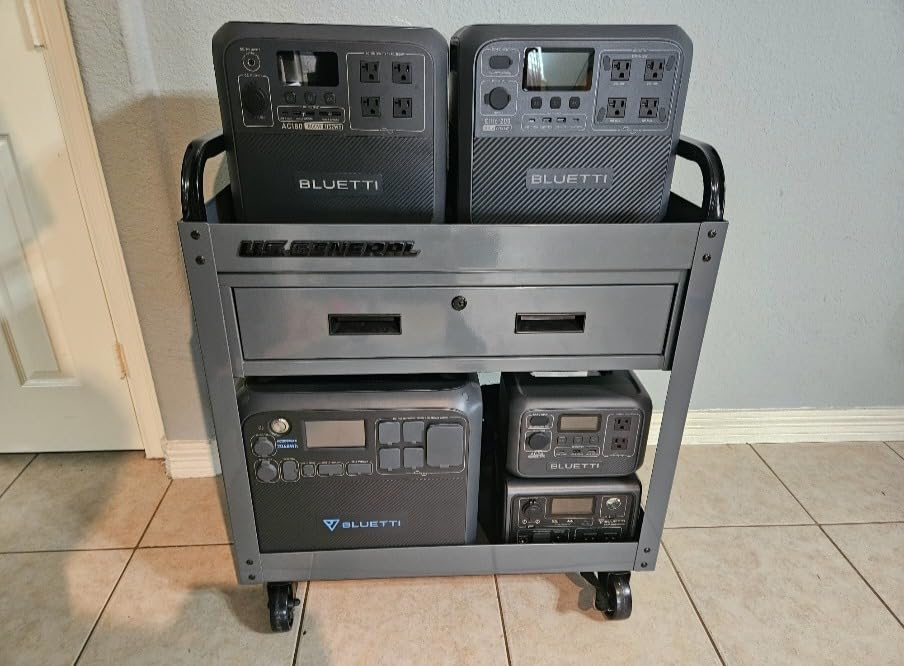
2. BLUETTI AC180 – Highest Continuous Output and Solar Input in the 1kWh Class
BLUETTI AC180 Portable Power Station 1152Wh 1800W LiFePO4 Solar Generator
1152Wh LiFePO4
1800W rated and 2700W lifted
500W solar input
37.4 lb
+ Pros
- 1800W continuous output with app-enabled lifting to 2700W
- 500W solar ceiling recharges in 2.8 to 3.3 hours
- 20 ms UPS switchover for home essentials
- Eleven outlets covering AC
- USB and wireless charging
- Five-year warranty
– Cons
- Heaviest 1kWh unit at 37.4 lb
- Wireless charging pad frequently fails
- Around 20W idle draw plus a 10 percent capacity reserve cuts usable capacity
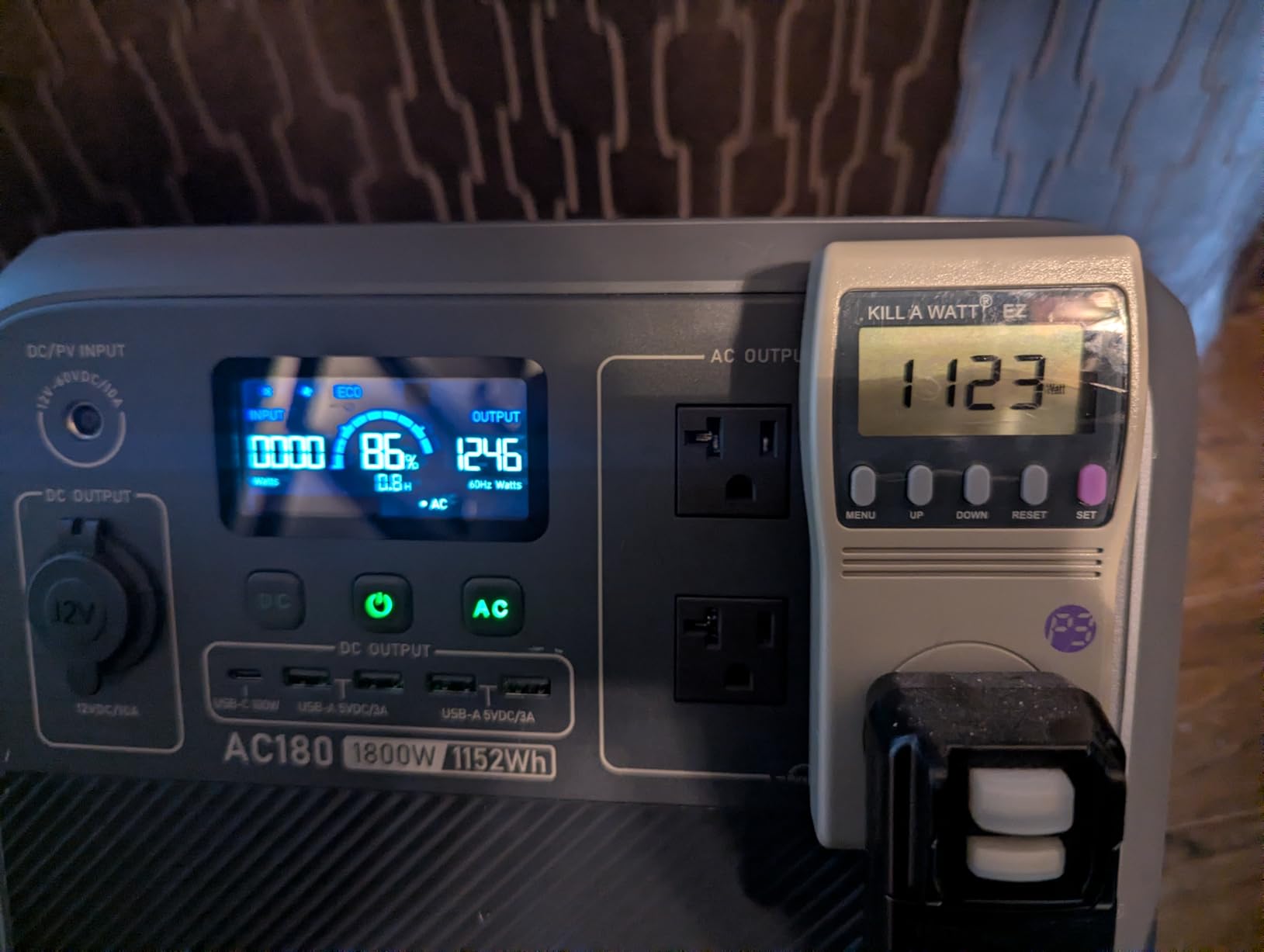
The AC180 answers the question heard most on off-grid forums: what can I switch on at once. Its 1800W rated inverter sits well above the 1500W class most 1kWh units occupy, and 2700W is available through power lifting in the app.
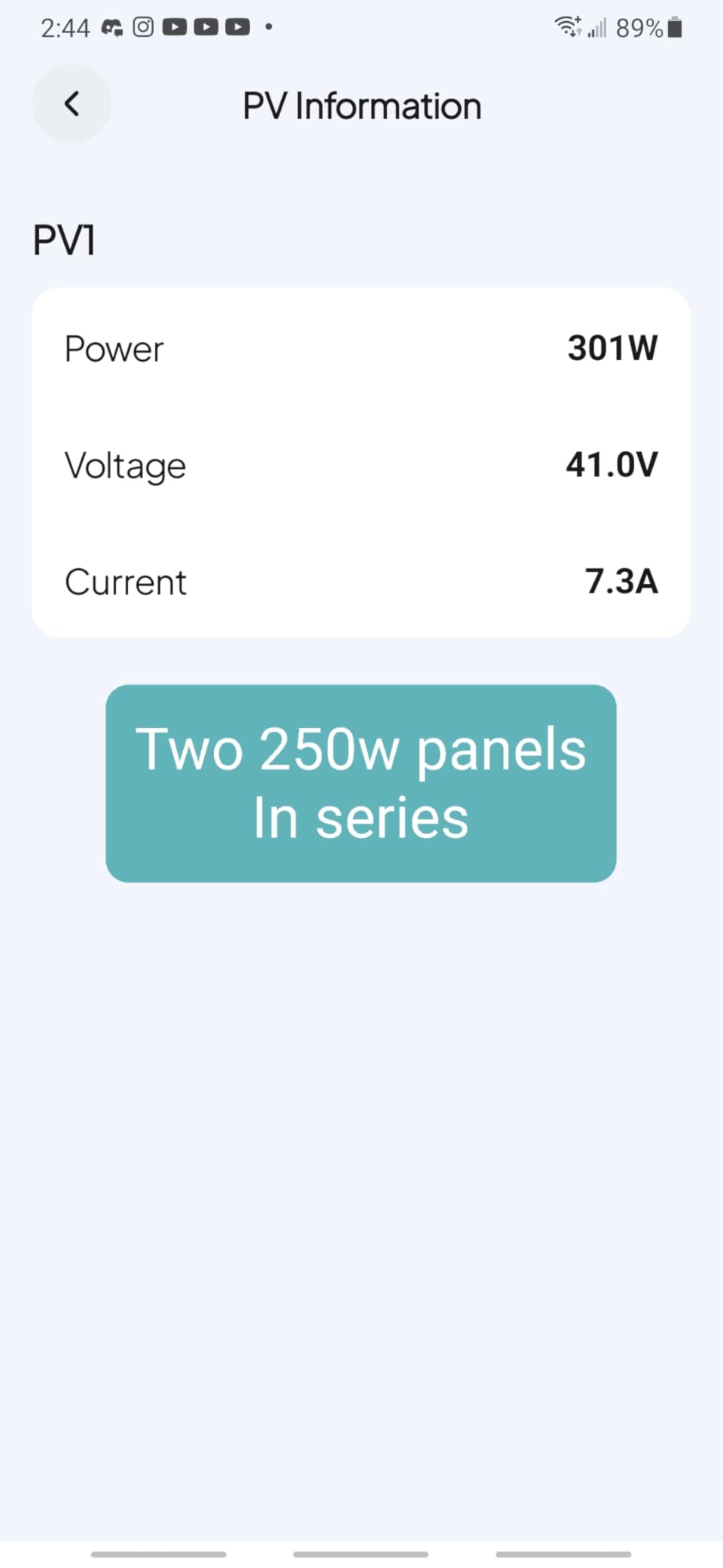
The second thing that sets it apart at a cabin is the 500W solar input ceiling. Owners with a fixed array refill the battery from 500W of panels in roughly 2.8 to 3.3 hours, far faster than any other 1kWh unit here manages with portable panels.
At 4.6 stars across more than 2,600 reviews, it is well liked. The recurring gripes are physical rather than electrical: 37.4 pounds is heavy for a battery you may want to move, the wireless charging pad on top is unreliable, and the unit draws about 20W while idle before your devices take anything.
Why 1800W Matters for Motorized Loads
Compressor-based appliances draw a spike when they start, and that spike is what kills undersized inverters. A refrigerator compressor, a small water pump and a microwave all pull well above running draw for a second or two at startup. With 1800W continuous and 2700W lifted, the AC180 starts those loads without cutting out mid-cycle, which is why we rate it above lighter units for a cabin with a well pump on the same circuit as the fridge.
Solar Recharge Speed and the 500W Ceiling
A 500W solar input means the battery can absorb roughly a full day of good summer sun in under four hours. That ceiling is the number to match your array against, and it is the most overlooked specification in this category. Most competing 1kWh units top out between 200W and 300W, so half your panels do nothing once the input saturates.
Who This Suits and Where It Falls Short
Pick the AC180 for a cabin with a real solar array and motor loads on the panel, and for anyone who wants transfer-style backup rather than a plug-in unit. Twenty millisecond switchover is fast enough to keep a router and a medical device running through an outage.
Skip it if weight matters, if you rely on the top wireless pad, or if you are on a tight schedule. The 10 percent reserve and 20W idle draw together mean the 1152Wh label understates what you will actually use, and BLUETTI’s customer service has drawn mixed reports on firmware and calibration.
3. BLUETTI Elite 100 V2 – Smallest Footprint With a 45-Minute Recharge
BLUETTI Elite 100 V2 Portable Power Station for Camping 1024Wh 1800W
1024Wh LiFePO4
1800W AC and 3600W surge
25 lb
11 ports
+ Pros
- Compact 17-liter body at 25 lb with a hidden carry handle
- 0-80 percent in about 45 minutes on 1200W AC
- 10 ms UPS switchover and 30 dB silent mode
- Eleven ports for simultaneous device charging
- Rated for 4000-plus cycles
– Cons
- Heavier than the 1kWh class suggests
- 12V car outlet runs warm above roughly 12W
- Slow 12V car charging without the optional BLUETTI Charger 1
When floor space is the constraint, this is the one. At roughly 17 liters and 25 pounds it packs more capacity per cubic foot than anything else we tested, and the hidden handle keeps the profile clean rather than adding a bulky frame.
Charging is the other headline: zero to 80 percent in about 45 minutes on a 1200W wall outlet, the fastest figure in the 1kWh group. For a cabin with a generator-backed wall outlet, a full day of power is back before you unpack the car.
Reviewers give it 4.6 stars over roughly 1,780 ratings, with 84 percent at five stars. Owners like the recharge speed and quiet running, and the complaints cluster around the 12V car socket running warm and small display quirks on low-draw devices.
Output and Surge for Tools and Small Appliances
The inverter delivers 1800W continuous with 2700W power lifting and 3600W surge, enough headroom for a fridge, router, lighting and a kettle together. One practical note: the 12V car outlet runs warm above roughly 12W, and low-draw devices may not register on the wattage readout at all, so test a 12V cooler before depending on it.
UPS Behavior for Medical and Network Devices
Switchover happens in 10 milliseconds, quick enough to keep a CPAP machine, router or small server running through a transfer, and the 30 dB silent mode makes it the quietest option here for a bedroom. App control works over both Wi-Fi and Bluetooth, so you can check state of charge without a cellular signal.

Who This Suits and Where It Falls Short
This is our recommendation for a small cabin where interior volume is precious and someone sleeps inside while the battery recharges. Medical device backup is handled as well as anywhere in the 1kWh class outside the sub-10ms EcoFlow units.
It is not the choice for 12V accessory use, for crowded DC barrel wiring, or for a household carrying heavy gear over long distances. At 25 pounds it is not the lightest option either; the Jackery Explorer 1000 v2 is.
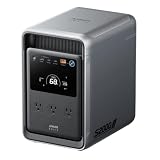
4. Anker SOLIX C1000 Gen 2 – Fastest Recharge and Strong Surge Headroom
Anker SOLIX C1000 Gen 2 Portable Power Station
1024Wh LiFePO4
2000W output and 3000W peak
49-minute full recharge
10 ms UPS
+ Pros
- Full recharge in about 49 minutes on 1600W
- 2000W output and 3000W peak across 10 ports
- 600W solar input recharges fully in about 1.8 hours
- Sub-10 ms UPS kept a fridge and router running through a five-hour outage
- 14 percent smaller and 11 percent lighter than comparable models
– Cons
- Gen 2 removed the expansion battery option from Gen 1
- Output measured 15-20 percent harmonic distortion on a microwave
- No protective case or cable pouch included
Roughly 49 minutes on a 1600W wall outlet is the fastest full recharge of any unit in this group, and the 600W solar input ceiling is the second highest among the 1kWh models. Owners describe it as the unit that saved them during multi-day ice storms, which is exactly what a northern cabin faces in winter.
With 2000W continuous and 3000W peak from a 1024Wh battery, it has the highest output-to-capacity ratio here. That ratio is what lets it run a kettle and a coffee maker plus a refrigerator, which several smaller inverters refuse to attempt.
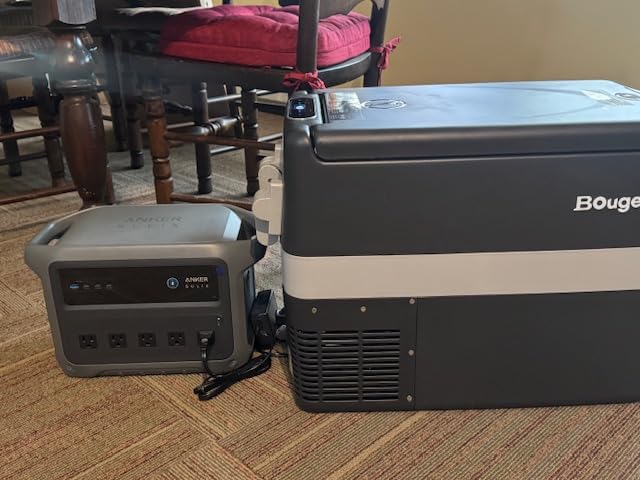
It holds 4.7 stars across more than 1,600 reviews, with 86 percent five-star. Reviewers mention Bluetooth monitoring, recharge speed and small size, and the two consistent criticisms are the loss of expandability and measured harmonic distortion on a microwave.
Solar Input and Recharge Headroom for Fixed Arrays
The 600W solar input recharges the full battery in about 1.8 hours under good conditions, which is what allows a weekend cabin to recover from a cloudy Friday and be back to full by Saturday afternoon. Because the input accepts 600W, pairing it with a 400W to 600W array uses your panels efficiently instead of leaving headroom idle.
UPS Mode and Waveform Quality
Switchover in under 10 milliseconds kept a refrigerator and a router running through a five-hour outage without a hiccup, which for sensitive electronics and medical equipment is the number that decides whether you need a transfer switch at all. The waveform is the weak point: one reviewer measured 15 to 20 percent harmonic distortion on a microwave, more than a well-filtered inverter should produce. Sensitive audio gear, some medical devices and variable-speed motors are the loads most likely to object.
Who This Suits and Where It Falls Short
Choose it for a northern cabin where winter recharge speed matters more than future expansion, or for a site where you plan to grow the array but not the battery. It is compact, quiet and app-controlled with time-of-use scheduling.
Do not choose it if you want to add capacity later, since Gen 2 dropped the expansion battery option found on Gen 1. Check the measured distortion against your specific loads, and note that no case or cable pouch is included.
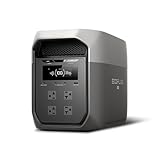
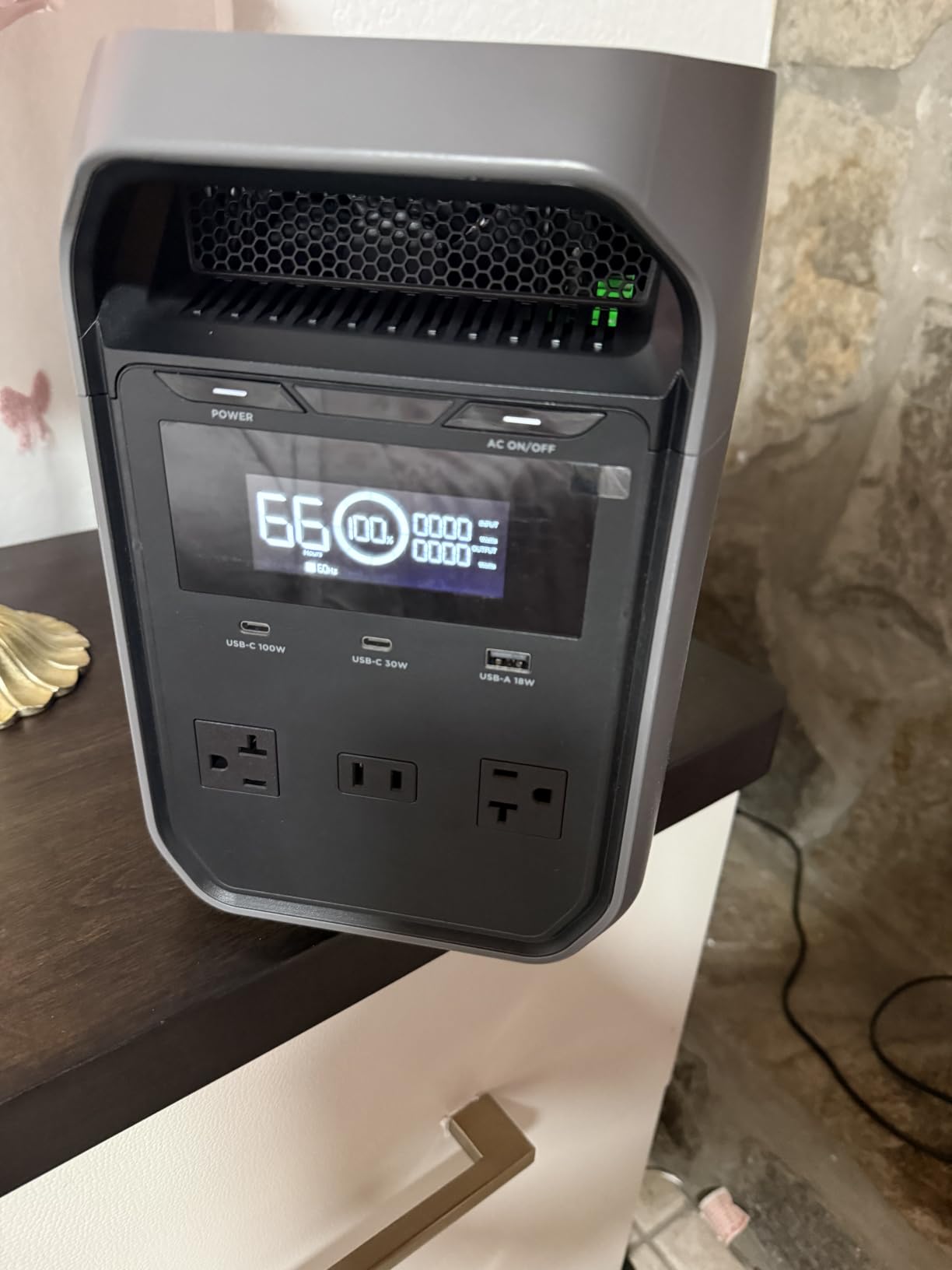
5. EcoFlow Delta 3 Classic – Best 5-Star Share and Near-Instant Transfer
EF ECOFLOW Portable Power Station Delta 3 Classic, 1024Wh 1800W AC
1024Wh capacity
1800W AC and 3600W surge
X-Boost to 2600W
26.7 lb
+ Pros
- 90 percent five-star share
- the highest in this group
- Zero to 80 percent in about 45 minutes on X-Stream AC
- Under 10 ms UPS protects routers and medical devices
- Full solar recharge in about 2.5 hours with a 500W panel
– Cons
- Weighs 26.7 lb
- Cannot be expanded with DELTA series Smart Extra Batteries
- A small number of buyers received used or faulty units
Ninety percent of its ratings are five-star, the highest share we found across the twelve units. That consistency is not a marketing artifact. It is a pattern across van-life and event-power owners running the same fast recharge cycle week after week.
The inverter gives 1800W continuous with 3600W surge, and X-Boost lifts the ceiling to 2600W for resistive loads like a space heater or hot plate. The 500W solar input refills the battery in roughly 2.5 hours, matching the AC180 in the same class.
Cell construction is the quiet strength. EV-grade lithium iron phosphate cells with a cell-to-case design are rated for over ten years behind a smart battery management system, with a five-year manufacturer warranty. Reviewers consistently praise the display clarity, which matters when reading power draw in a dim room with no Wi-Fi.
X-Boost Mode and What It Costs You
X-Boost briefly interrupts power to measure an appliance’s resistive draw, converting a 2600W ceiling out of a 1800W inverter. The trade-off is runtime: because the mode draws more current than the appliance’s rating implies, a lift-enabled load drains the battery faster than the display suggests. If you plan to run a heater on solar alone, budget for it.
Storm Alert and Scheduling for Cabin Use
The app schedules charging windows, monitors remotely and includes a Storm Alert mode that pre-charges ahead of forecast outages. For a seasonal cabin, scheduling is how you tell the unit to top up during the sunniest hours and hold back for the evening. Two side handles and non-skid base pads make the 26.7 pounds more manageable than the number suggests.
Who This Suits and Where It Falls Short
This is the pick for an owner who wants a single app handling scheduling, monitoring and storm pre-charging, and who runs resistive loads as well as electronics. Near-instant transfer covers CPAP machines and network gear without a transfer switch.
It is not expandable with DELTA series Smart Extra Batteries, so capacity growth means buying a different unit. A small number of buyers received used or faulty units with no workable refund path, which is worth weighing against an otherwise excellent review profile.
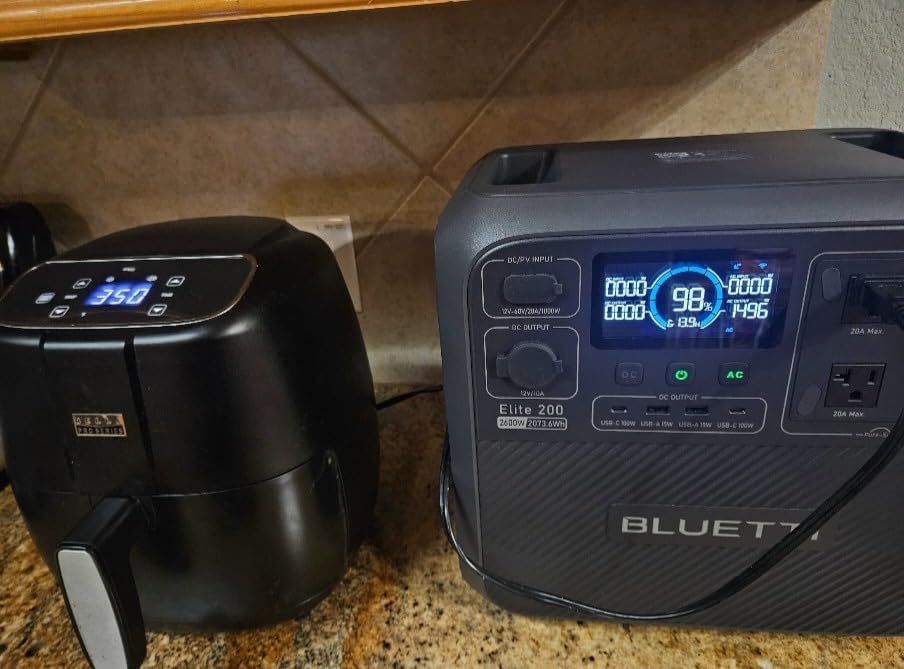
6. BLUETTI Elite 200 V2 – Battery and Two Solar Panels in One Purchase
BLUETTI Elite 200 V2 Solar Generator & 2x200W Solar Panel Included 2073.6Wh
2073.6Wh LiFePO4
2600W continuous and 3900W lifting
Two 200W panels
53.4 lb
+ Pros
- Two 200W solar panels included with a full solar recharge in about 5.5 hours
- CNAS-certified automotive-grade cells rated 6000-plus cycles
- Standby draw of about 10W
- roughly a third of comparable 2kWh units
- Zero to 80 percent in about 50 minutes on dual charging
– Cons
- Too heavy at 53.4 lb to carry any real distance
- Not expandable with BLUETTI extra battery modules
- Solar input capped at 1000W and 60V
- Included panels are too light for strong wind
This is the only bundle that arrives with solar attached, and for a first-time cabin owner it removes the most common early mistake: buying a battery and a panel that cannot talk to each other.
Two 200W panels refill the 2073.6Wh battery in about 5.5 hours, and the inverter delivers 2600W continuous with 3900W in power lifting mode. That output is enough for two freezers, an air fryer or a small microwave, according to owners running exactly that combination.
The cycle rating is the standout number: 6,000-plus cycles from CNAS-certified automotive-grade cells, which the manufacturer translates into a claimed 17-year life. At 4.7 stars across more than 900 reviews, 86 percent of ratings sit at five stars.
Standby Draw and Why It Decides Winter Runtime
At roughly 10W of standby consumption, this unit draws about a third of what comparable 2kWh machines pull. In an unheated cabin over a long weekend, that difference is the difference between waking up with a full battery and reaching for the car charger. Idle draw is the least discussed specification in this category and arguably the most important for seasonal use, since a unit sipping 30W while empty can lose a quarter of a 2kWh battery overnight without running anything.
Solar Ceiling Limits and the Included Panels
Solar input is capped at 1000W and 60V, generous on paper but hard to reach with portable folding panels. The two included 200W panels fill only 40 percent of that ceiling, so the bundle charges in 5.5 hours rather than the roughly 2.4 hours a 1000W fixed array could deliver. The included panels are also too light for strong wind and come with short cables, both of which show up immediately on an exposed roof.
Who This Suits and Where It Falls Short
Pick this if you are starting from nothing and want a working solar setup in one box, especially for a seasonal cabin where a small freezer and a coffee maker are the main loads. Dual handles make 53.4 pounds manageable for a short carry to the porch.
It is not the choice if you need to add capacity later, because the battery takes no BLUETTI modules. The app also lacks low AC charging rates, real-time temperature monitoring and charge priority settings that matter for winter planning. Once installed, this is a stationary unit.
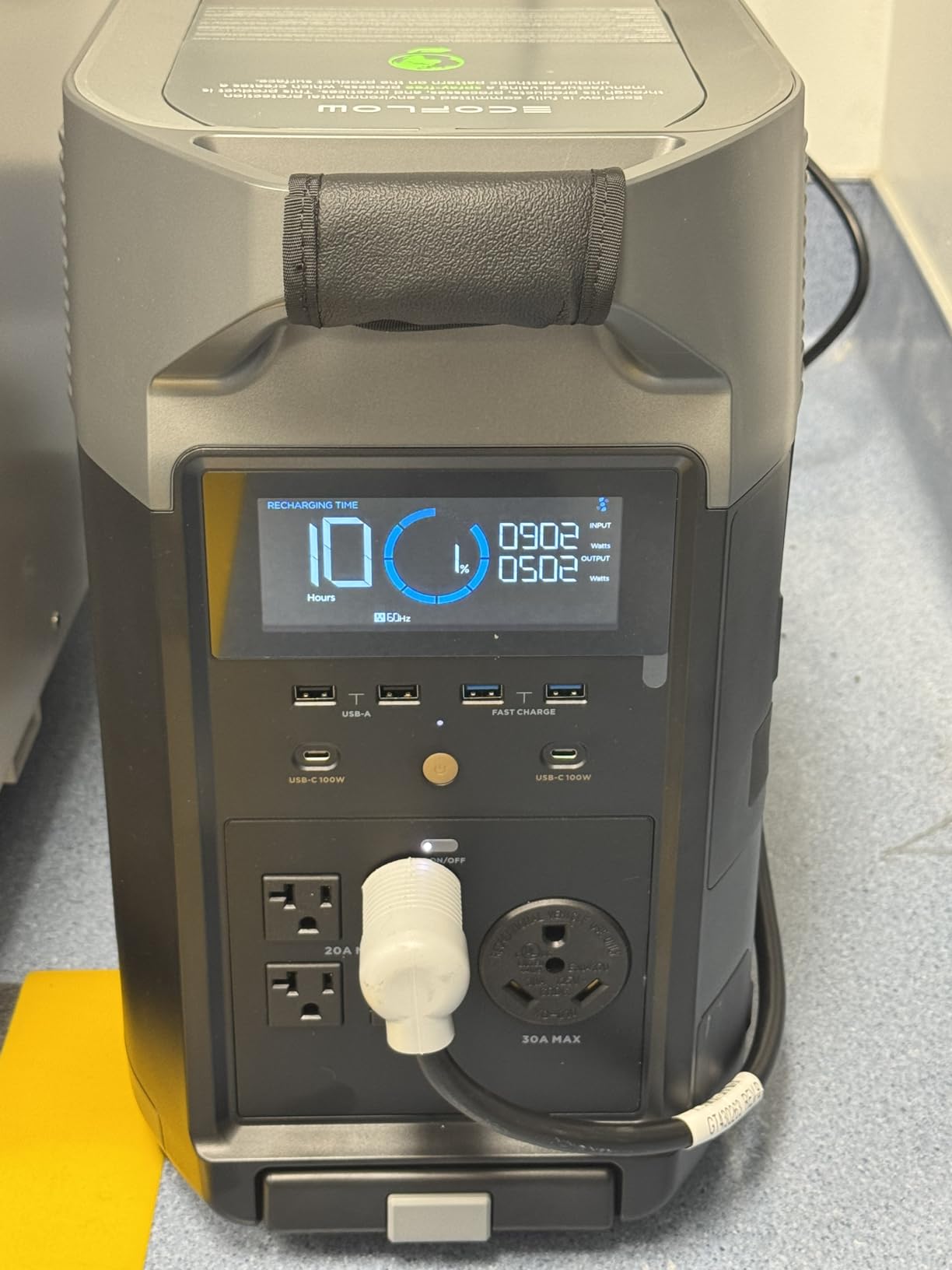
7. EcoFlow DELTA Pro – Expandable to 25kWh for Full-Time Off-Grid Living
EF ECOFLOW Portable Power Station 3600Wh DELTA Pro, 120V 3600W AC Output
3600Wh LFP expandable to 25kWh
3600W AC
7200W paired
15 outlets
+ Pros
- Capacity expands to 25kWh with extra batteries and Smart Generators
- 3600W continuous
- 4500W with X-Boost and 7200W when two units are paired
- Fifteen outputs including two 100W USB-C ports and five AC outlets
- Five charging paths including EV and generator input
– Cons
- Weighs 99 lb and needs the trolley handle
- Solar input limited to 15 amps
- Some buyers reported error 121 overload faults and poor support resolution
This is the only unit here that scales into a genuine off-grid system. The 3600Wh lithium iron phosphate battery expands with extra batteries and Smart Generators up to 25kWh, which is a full-time homestead’s worth of storage rather than a weekend cabin’s.
At 3600W continuous, 4500W with X-Boost and 7200W when two units are paired, it will start a heat press, a sump pump and a refrigerator through the same outage. One owner replaced a noisy gas generator with it during a week-long power cut and never went back.
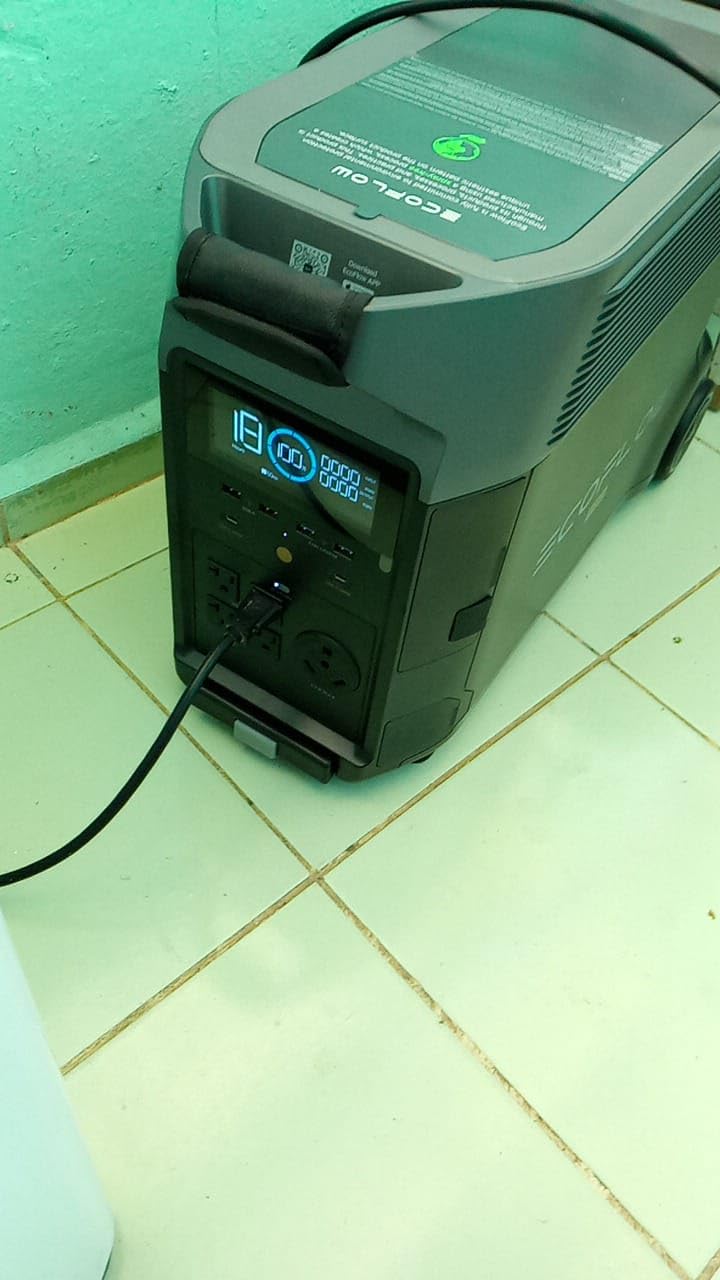
Fifteen outputs including two 100W USB-C ports and five AC outlets make it a full household distribution point. The app handles remote monitoring over Wi-Fi or Bluetooth, and a five-year manufacturer warranty covers the unit.
X-Stream Charging and Five Ways to Recharge
Recharge speed is where this machine separates itself. X-Stream takes it from empty to full in 1.8 hours on a 3000W 240V outlet, 2.7 hours on an 1800W wall connection, or 2.8 hours on four 400W panels. Five paths are supported: EV, solar, wall, Smart Generator and car outlet, so a truck parked fifty feet away is not sitting idle.
Expansion, Weight and the 15 Amp Solar Limit
Expandability is both the reason to buy and the reason to think twice. Scaling to 25kWh means stacking multiple large batteries, and each addition needs floor space, ventilation and a mounting plan a cabin may not have. At 99 pounds the unit needs the extendable trolley handle, an honest signal that it belongs in a fixed location. The 15-amp solar input cap also limits refill speed no matter how many panels you hang, and a handful of buyers reported error 121 overload faults and a blown fuse button with poor support resolution.
Who This Suits and Where It Falls Short
Choose it for full-time or near-full-time occupancy, a cabin with a well pump and water heater, or anyone expecting to grow capacity over the next decade. It handles heat presses and other surge-heavy tools without hesitation.
Skip it for a weekend cabin. The 99-pound weight, the 15-amp solar cap and sheer capacity make it the wrong shape of product unless you genuinely intend to run a household from it. Experienced builders on r/OffGrid argue that a fixed solar and battery bank system beats an all-in-one portable station on total cost, and at this capacity they are usually right.
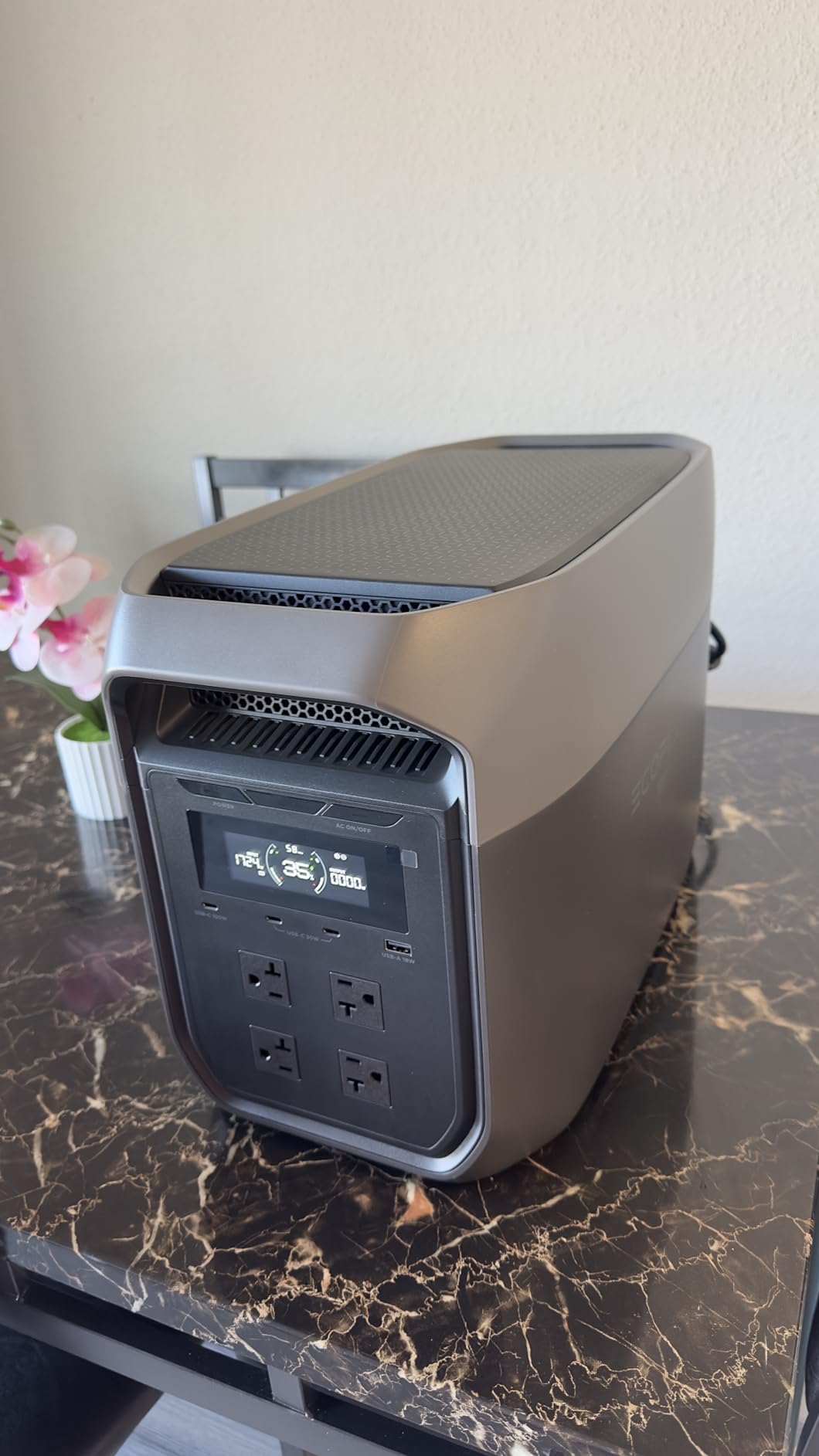
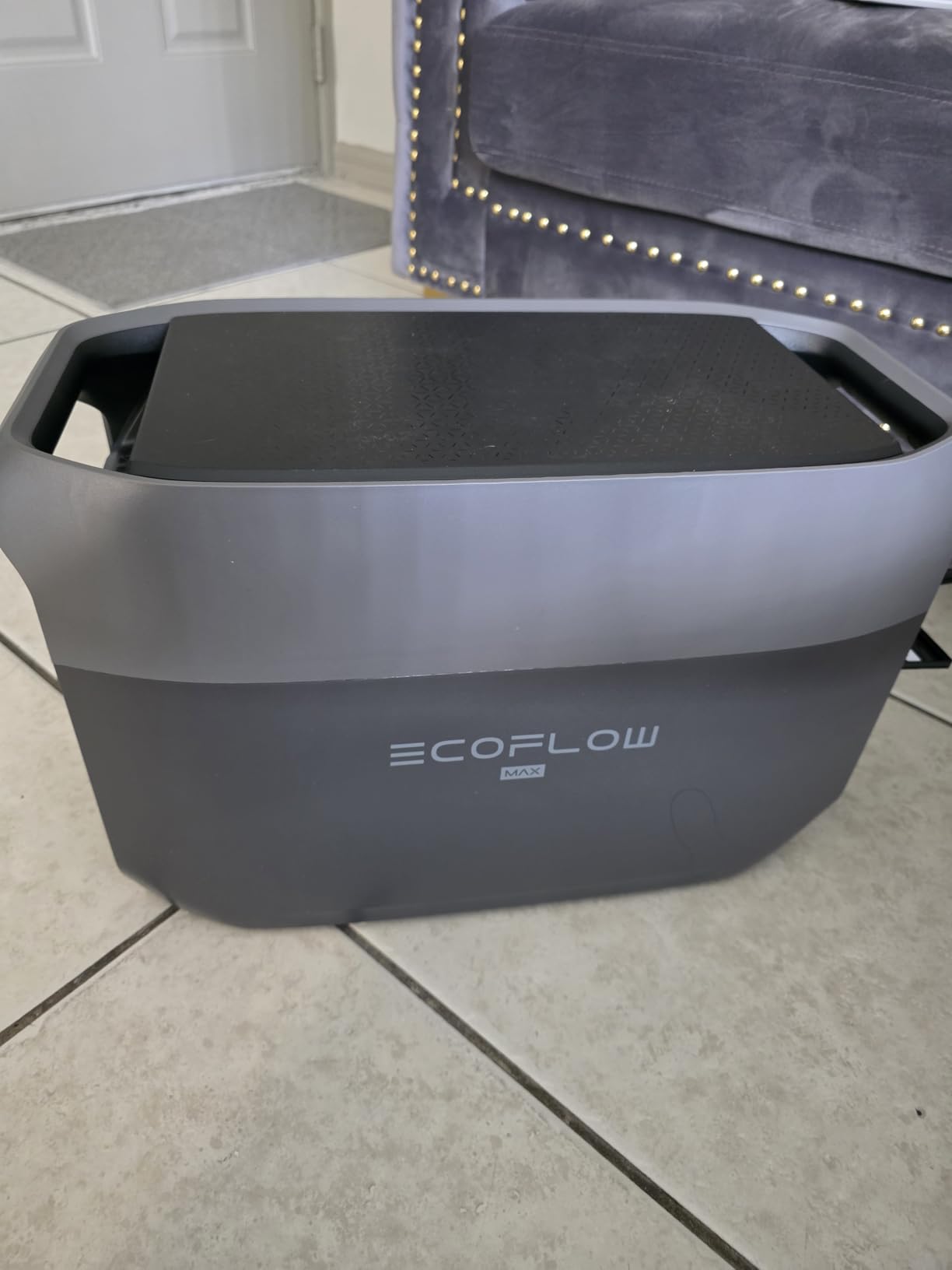
8. EcoFlow DELTA 3 Max – Quiet 2kWh Unit With a 1.13-Hour Recharge
EF ECOFLOW DELTA 3 Max Portable Power Station, 2048Wh LFP Battery, 2400W
2048Wh LiFePO4
2400W rated and 3400W lifted
0-80 percent in 1.13 hours
Under 10 ms UPS
+ Pros
- Zero to 80 percent recharge in about 1.13 hours with X-Stream
- Under 10 ms UPS transfer keeps computers and medical devices running
- Ultra-quiet operation suited to indoor and overnight use
- EcoFlow app with real-time monitoring
- charge priority and scheduling
– Cons
- Battery is not expandable with extra modules
- X-Boost mode shortens runtime on high-draw appliances
- Only three AC outlets for a 2kWh-class unit
The DELTA 3 Max is the one to consider when the cabin is your primary residence and the unit will live indoors near where you sleep. Ultra-quiet operation with under 10ms transfer makes it the least intrusive 2kWh option in this group.
Its 2048Wh lithium iron phosphate battery delivers 2400W rated output and 3400W continuous in X-Boost mode, going from zero to 80 percent in about 1.13 hours. That assumes a wall outlet capable of supplying the current, which is the part most people overlook.
Owners rate it 4.7 stars across roughly 580 reviews, with 88 percent at five stars, though a good share of the review text is marketing-led rather than hands-on. The genuine themes are fast charging, quiet running and inverter headroom for home backup and RV use.
Inverter Headroom for Home Backup Loads
3400W continuous in X-Boost mode is the second highest ceiling of any 2kWh unit here. That headroom is what lets it run a window air unit or an induction cooking load alongside a refrigerator without the inverter shedding, though the mode draws more current than an appliance’s rating implies, so a lift-enabled load drains the battery faster than the display suggests. For solar-only operation, size your array against the rated output rather than the boosted number.
Port Layout and App-Based Load Management
Three AC outlets is thin for a 2kWh-class machine, particularly with a refrigerator, a router and a CPAP machine running at once. The compensating features are the fast USB-C options and the app’s real-time energy monitoring. Charge priority and scheduling are genuinely useful at a cabin: set the unit to top up during peak sun, hold a reserve for the evening, and set a discharge floor so a low draw never takes the battery to zero.
Who This Suits and Where It Falls Short
Best for a primary-residence cabin where silence matters, where electronics must survive an outage without a hiccup, and where the owner wants fine control over charge limits from a phone. The extended five-year service plan adds real value for a permanent install.
It is the wrong choice if you plan to add capacity later, since the battery takes no expansion modules, and three AC outlets will feel cramped for a household running multiple rooms at once.
9. Jackery Explorer 2000 v2 – The Lightest 2kWh Unit at 39.5 Pounds
Jackery Explorer 2000 v2 Portable Power Station, 2042Wh, 2200W AC Output
2042Wh LiFePO4
2200W AC output
39.5 lb
0-80 percent in 66 minutes
+ Pros
- 41 percent lighter and 34 percent smaller than typical 2kWh units
- Zero to 80 percent in 66 minutes with a full charge in 102 minutes
- Solar recharge in as little as 6 hours with 400W panels
- Silent charging mode under 30 dB
- 20 ms UL1778-certified UPS switching
– Cons
- Solar charging limited to Jackery panels
- 20 ms switchover is slower than the 10 ms class
- Emergency super charging must be enabled in the app each session
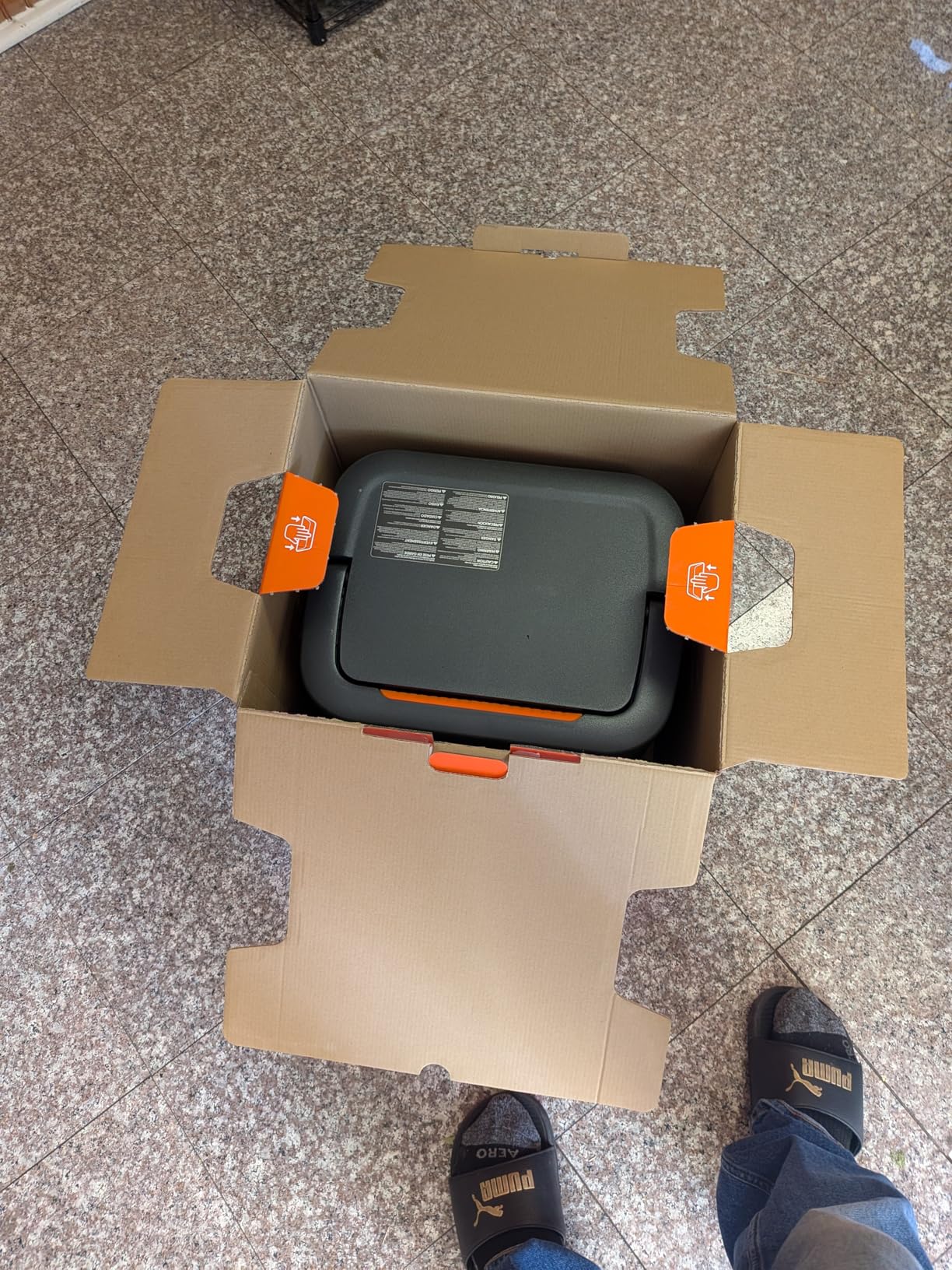
Weight is the reason to look at this one. At 39.5 pounds using EV-derived cell-to-body construction, it is dramatically lighter and smaller than the average 2kWh power station, and that changes whether you install it once or drag it around every visit.
The 2042Wh lithium iron phosphate battery supplies 2200W across three AC outlets plus a 100W USB-C port. Recharge runs from zero to 80 percent in 66 minutes, or a full charge in 102 minutes with emergency super charging enabled.
Its 4.4 stars from about 870 reviews is the second-lowest average here, and the spread is unusually wide: 79 percent five-star but 8 percent one-star. Owners value the weight, silent mode and ten-year cell life, while criticising panel compatibility and switchover speed.
Cell-to-Body Construction and What It Buys You
Packing cells directly into the enclosure rather than a separate module removes the casing and mounting hardware between cells and case walls. The result is a smaller body with better heat transfer, and it is why the weight lands where it does for a 2kWh unit. Solar recharge in as little as six hours with 400W panels means a full day of good sun returns the battery to usable capacity, though the panels must be Jackery units.
UPS Timing Against the 10ms Class
Twenty millisecond switchover is certified to UL1778 and keeps most household electronics running through a transfer, but it is measurably slower than the sub-10ms class offered by EcoFlow, BLUETTI and Anker, and sensitive medical equipment may notice. Silent charging mode runs under 30 dB with smart fan speed control, which matters in a cabin with a sleeping loft directly above.
Who This Suits and Where It Falls Short
This suits a cabin where the battery must be moved between porch, kitchen and workshop, and where the owner is already committed to Jackery panels. The 39.5-pound figure makes single-person handling realistic across a long property.
It is the weakest choice here for medical device backup because of the 20ms transfer, and it cannot use non-Jackery solar. Emergency super charging has to be re-enabled in the app each session, an easy mistake to make on arrival at a dark cabin.
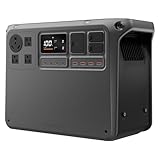
10. DJI Power 2000 – 3000W Output for Power Tools and Camp Cookers
DJI Power 2000 Portable Power Station, 2048Wh LFP Battery
2048Wh LFP
3000W stable output
55-minute 80 percent recharge
10 ms switchover
+ Pros
- 3000W stable output drives kettles
- cookers
- saws and drills
- Recharges to 80 percent in 55 minutes
- Runs as low as 30 dB for quiet indoor use
- Expands to 22.5kWh with expansion batteries
- Smart BMS
- sub-nano coating and flame-retardant housing
– Cons
- MPPT and car charging modules not built in
- solar and car charging need add-on adapters
- Only a 1-year manufacturer warranty
- At 21.72 kg it is heavy to load unaided
No other 2kWh unit here matches 3000W of steady output, and that is the whole argument for this one. If your cabin work involves a saw, a drill, a kettle or a camp cooker, output is the number that decides whether the tool runs or the inverter refuses.
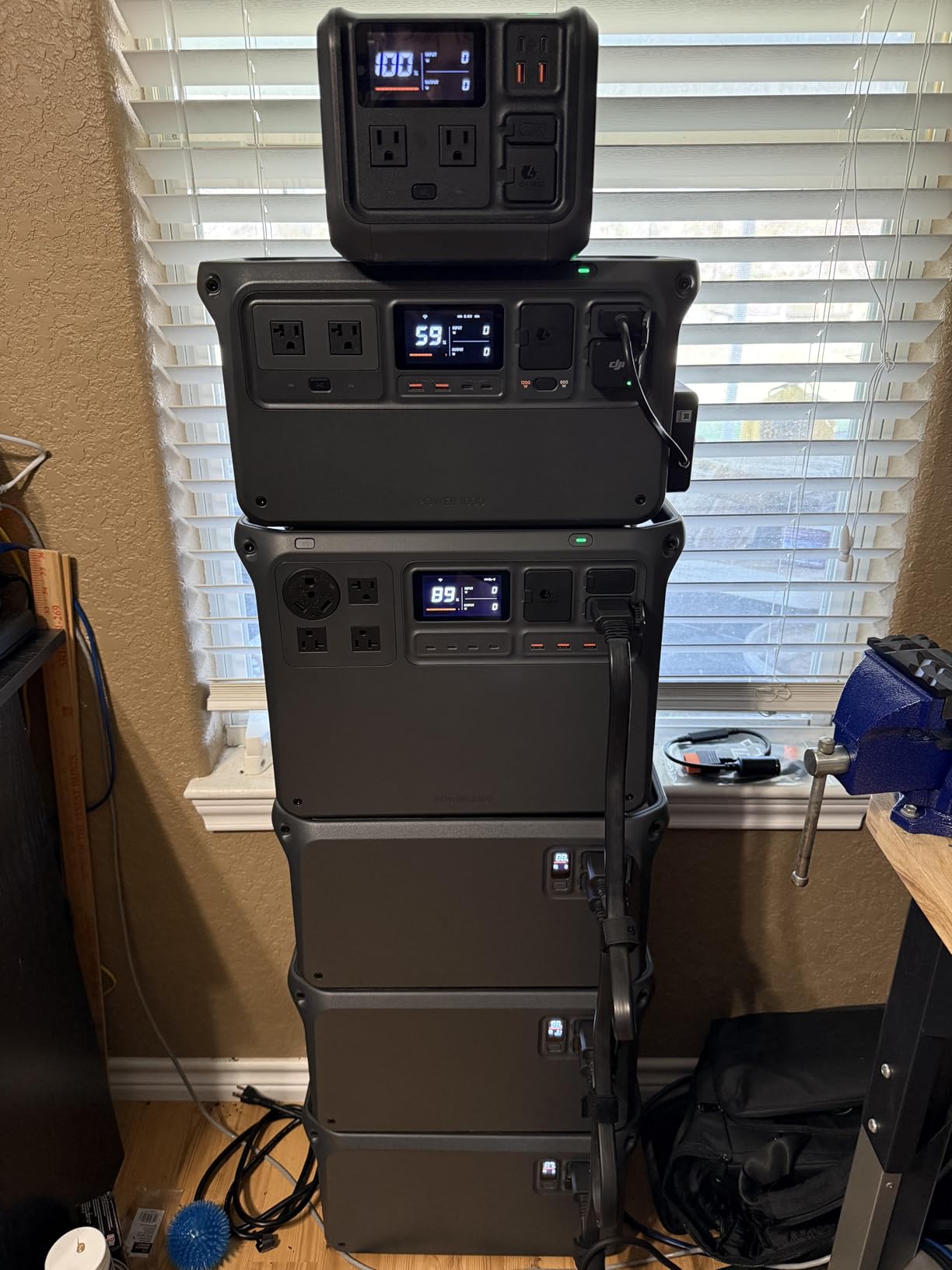
It also expands to 22.5kWh with expansion batteries, making it the second most scalable option here after the DELTA Pro. Fifteen ports including dual full-function SDC ports let a group charge from one unit.
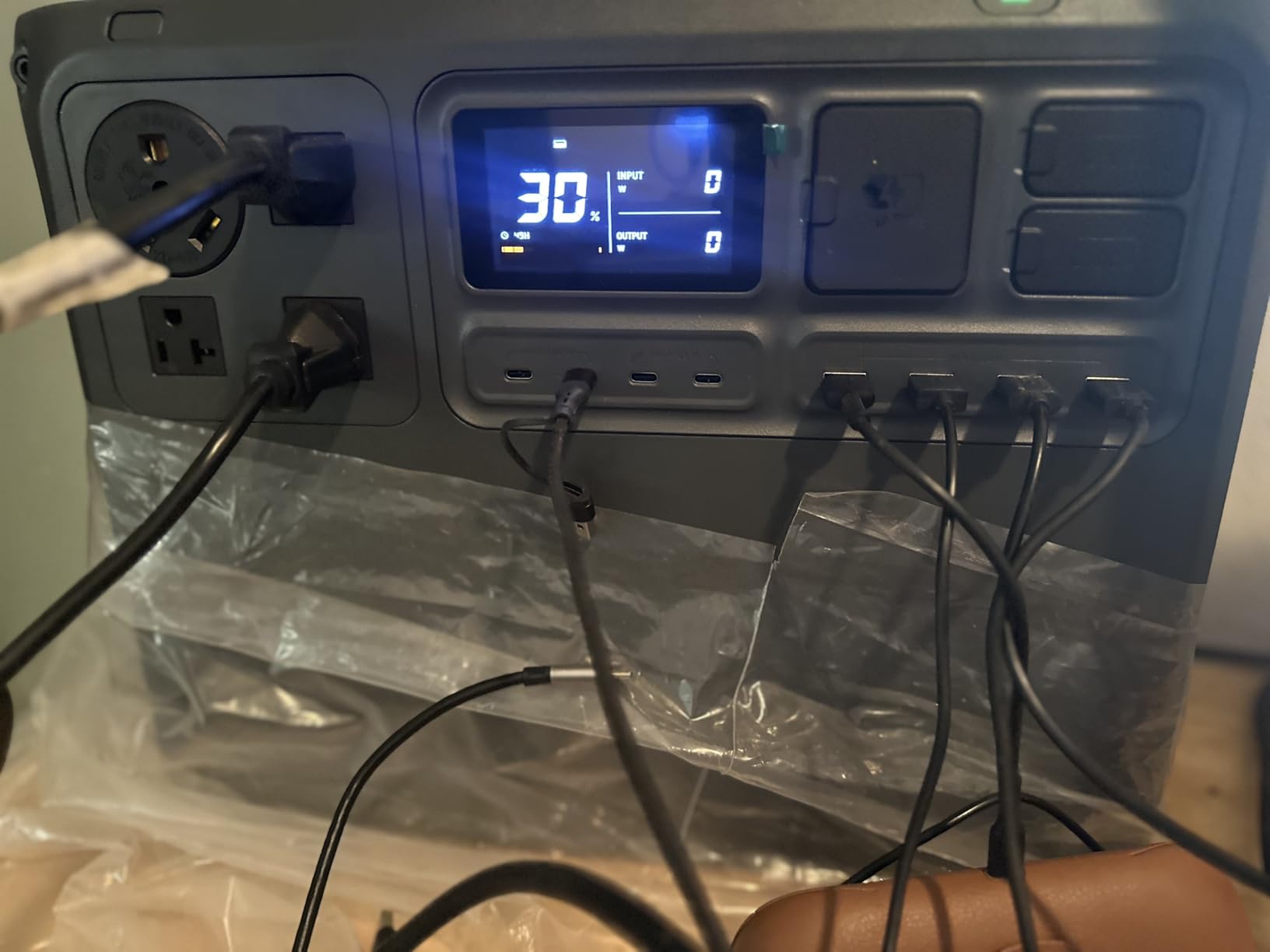
Recharge to 80 percent takes 55 minutes, switchover is 10 milliseconds, and idle noise sits around 30 dB. The safety package is unusually thorough: a smart battery management system, sub-nano coating and a flame-retardant housing.
Output Versus Capacity: The Ratio That Matters for Tools
Most 2kWh units output between 1500W and 2400W. This one runs 3000W continuously, and that headroom is what lets a resistive kettle or power tool start and hold without the inverter stepping down. Builders who framed a cabin on the property describe it as the only unit that avoided constant resets. The trade-off is depletion speed: a 3000W kettle used for twenty minutes consumes a full kilowatt-hour, half the battery.
Missing Native Solar and Car Charging
The MPPT and car charging modules are not built in, so both work through separate add-on adapters rather than native ports, which means extra hardware, extra cost and one more failure point in a system that has to run unattended. That limitation sits against a one-year warranty, the shortest in this group while rivals offer five years, and on a unit intended for permanent installation a four-year coverage gap is not small.
Who This Suits and Where It Falls Short
Choose the Power 2000 for a working cabin, a remote property where you run tools and cook on battery, or a build site needing real surge capability. Expansion to 22.5kWh keeps full-time use open later.
Skip it for a plug-and-play solar setup, since the charging adapters are extra purchases. At 21.72 kilograms it is heavy to load into a vehicle unaided, and the one-year warranty is thin for a permanent install.
11. Anker SOLIX S2000 – Longest Measured Refrigerator Runtime
Anker SOLIX S2 Portable Power Station, 2,010Wh, 1,500W
2010Wh LiFePO4
1500W continuous and 3000W peak
Up to 35 hours fridge runtime
35.7 lb
+ Pros
- Owners confirm 33 to 35 hours of full-size refrigerator runtime on a single charge
- 314Ah LFP cells rated for 10000 cycles and a 15-year lifespan
- Compact 8.2 by 11.1 by 12.7 inch body at 35.7 lb
- Sub-10 ms UPS switching
- Charges from 33 to 100 percent in about 1.5 hours
– Cons
- Cooling fan drones loudly during 1200W charging
- No 12V DC port
- 35.7 lb is too heavy for one-handed carrying
- Strong chemical smell during the first charge cycle
The number that defines this unit is 35 hours of refrigerator runtime, confirmed by multiple owners running full-size fridges. The 6W idle draw is what makes it possible, since most 2kWh units lose capacity to their own electronics before your fridge draws anything.
At 2010Wh with 1500W continuous and 3000W peak output, it handles a refrigerator, a freezer, network rack equipment and induction cooking loads off grid. Reviewers frame it as a home backup unit rather than a camping one, and that framing is accurate.
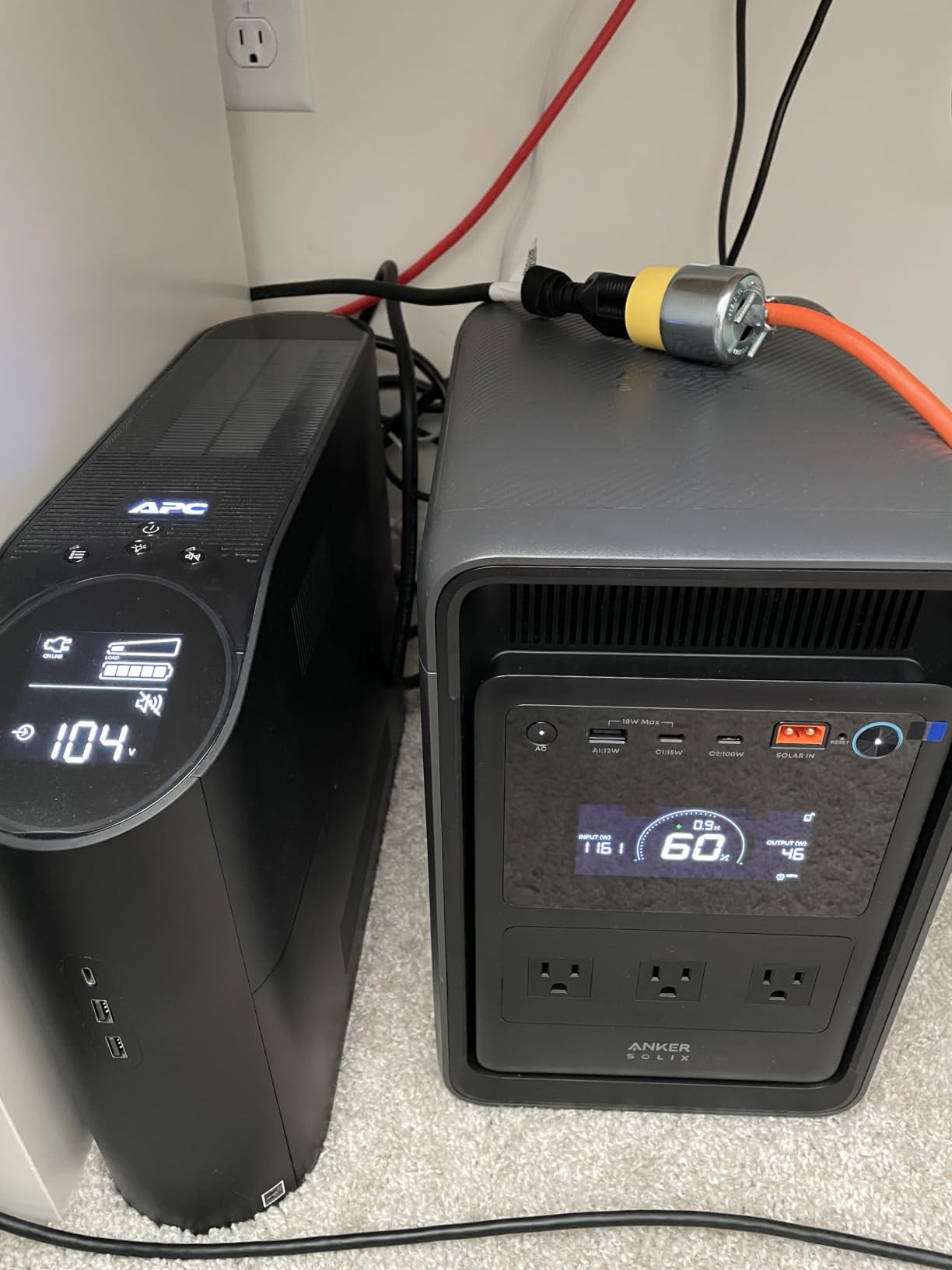
Owners power window air units, sump pumps and induction hobs from it and recharge with 400W solar input. The 314Ah cells are rated for roughly 10,000 cycles and a 15-year lifespan, backed by a five-year warranty.
Why Idle Draw Decides Refrigerator Runtime
A refrigerator is not a fixed load. Its compressor runs on a duty cycle, so the real question is how much energy disappears before the compressor ever starts. At 6W idle draw, this unit’s overhead is low enough that 33 to 35 hours is achievable on a full charge, roughly a day and a half of keeping food cold with no grid. That is what turns a two-hour outage into a manageable one, and units idling at 20W cover a noticeably shorter window.
Solar Input, Port Layout and Missing 12V
Up to 400W of solar input recharges the battery, and six recharge paths are supported including AC plus solar, wall outlet, generator, alternator charger and car outlet. Eight outlets are split across front and rear panels, making it easy to keep the fridge circuit dedicated. There is no 12V DC port, several ports are not symmetrically powered so output varies by socket, and pass-through mode can pass a low input voltage through to the outputs.
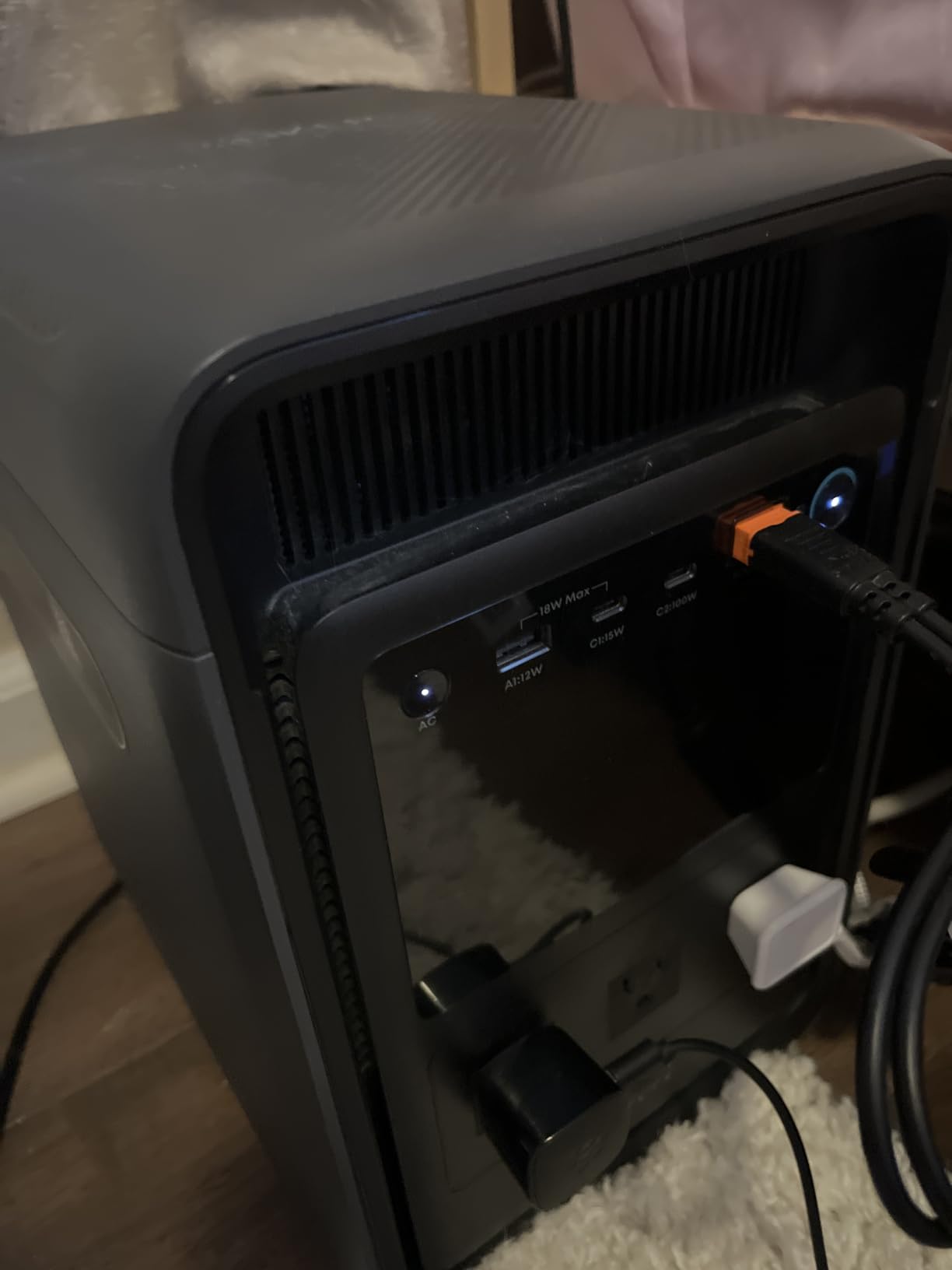
Who This Suits and Where It Falls Short
This is the recommendation for a cabin whose single most important load is a refrigerator, especially a full-size one in a hot summer where the compressor works hard. The 35.7-pound enclosure is small for its class, and the app gives granular control of charge and discharge limits.
It is the wrong choice for a bedroom-adjacent install while charging at 1200W, because the cooling fan becomes an audible drone. Expect a strong burn-off smell on the first charge cycle, firmware updates that briefly cut the outputs, and 35.7 pounds that is more than one person should carry regularly.
12. Jackery Explorer 300 – The Lightest Pick for CPAP Machines and Light Loads
Jackery Explorer 300 Portable Power Station,292Wh
292Wh LiFePO4
300W output and 600W surge
7.5 lb
Pure sine wave
+ Pros
- Only 7.5 lb with an integrated carry handle
- Pure sine wave 300W output for sensitive electronics
- LiFePO4 chemistry rated for 4000-plus cycles and 11-plus years
- Solar charging to 80 percent in about 2.8 hours with a 100W panel
- Compact body that fits in a small cabin closet
– Cons
- 292Wh capacity limits it to phones
- laptops
- cameras and small CPAP use
- No solar panel included
- 300W ceiling cannot run a refrigerator or window air unit
- Only 2 AC outlets and a 2-year warranty
Not every cabin needs two kilowatt-hours. For a place used only in summer, or as an emergency lighting and communications station, this 292Wh unit at 7.5 pounds covers the essentials and can be carried by anyone.
It ships with a lithium iron phosphate cell rated for over 4,000 cycles and an 11-plus year service life, so the battery will outlive most of the use it gets. Output is 300W rated with 600W peak surge on a pure sine wave, the safest waveform for sensitive electronics.
What 300W Can and Cannot Do at a Cabin
Pure sine wave output covers phones, laptops, cameras, drones and a CPAP machine without waveform concerns. Two AC outlets, a 100W USB-C port, two USB-A ports and a 120W car port handle six devices at once. What it cannot do is run anything with a compressor or a motor above 300W, and the 292Wh capacity disappears in a few hours once a CPAP machine and lights are running.
Solar Charging, Battery Life and the Missing Panel
Solar charging reaches 80 percent in about 2.8 hours with a 100W panel, or about 7.5 hours with a 40W panel, which is fast enough to recover a weekend of small loads from a single folding panel on a picnic table. The panel is not included, full recharge from a wall outlet takes about four hours, and the two-year manufacturer warranty is the shortest we would accept for a primary cabin device.
Who This Suits and Where It Falls Short
Buy it as a secondary unit, not a primary one. A CPAP machine, a router, LED lighting and phone charging through a weekend outage is exactly what this does well, and 7.5 pounds means it can be moved to wherever power is needed in seconds.
It cannot serve as a cabin’s only power source, and the two AC outlets become a bottleneck as soon as a second person needs to plug in. If your cabin needs a refrigerator, choose a 2kWh unit instead.
What Size Solar Generator Does a Cabin Need?
The right size is the smallest battery that covers your cabin’s daily watt-hour consumption plus a safety margin, paired with enough solar input wattage to refill it. A weekend cabin running a refrigerator, lights, a router and a coffee maker needs a 1kWh unit. Full-time occupancy with a well pump, a water heater and power tools wants 2kWh or more and an expandable battery.
Start by listing every load and multiplying running watts by hours per day. The sum is your daily watt-hour demand. Divide by 0.85 for inverter and conversion losses, and you have the number to size against. A typical weekend cabin lands around 300 to 500Wh per day, and a refrigerator alone contributes 150 to 400Wh depending on its size and how warm the cabin gets.
Capacity (Wh) Is a Runtime Number, Not an Output Number
Watt-hours measure stored energy and determine how long the battery lasts at a given draw. They say nothing about what you can plug in. A 2000Wh battery with a 1500W inverter and a 1000Wh battery with a 2000W inverter are both legitimate, and they suit different cabins. Buying far more capacity than you need is the most common sizing error on off-grid forums: it costs money, adds weight, and does nothing if your array cannot refill it.
Inverter Output and Surge Decide What Switches On
Inverter output in watts is the ceiling on what runs simultaneously, and surge watts is the short burst a compressor or motor draws at startup. A refrigerator can pull three to four times its running wattage for a second, which is where an undersized inverter fails. Match continuous output to your largest simultaneous load rather than your single largest appliance, then confirm surge covers the startup spike of anything motor-based. Units in this roundup range from 300W to 3600W continuous.
LiFePO4 Versus NMC for a Cold Cabin
Every unit here uses lithium iron phosphate chemistry. It is heavier per watt-hour than nickel manganese cobalt, but it tolerates thousands of deep cycles and accepts a wider discharge temperature range. Owner experience on r/solar is consistent on one point: older Jackery models with fixed solid handles use legacy chemistry, and modern units are the ones worth buying. Cycle life figures here range from 4,000 to 10,000, which is a longevity question rather than a buying decision.
Solar Input Wattage Sets Your Recharge Ceiling
Solar input wattage is the maximum rate at which an array can refill the battery, and it is the most ignored specification. A 1000W battery paired with a 200W panel cannot be refilled in a day no matter how long you leave it out. Ceilings here range from 400W on the Anker SOLIX S2000 to 1000W on the BLUETTI Elite 200 V2, with a 15-amp limit on the DELTA Pro.
Expandability, UPS Timing and the Weight Question
Expandability matters if occupancy will grow. The DELTA Pro expands to 25kWh and the DJI Power 2000 to 22.5kWh, while the Anker SOLIX C1000 Gen 2, the EcoFlow Delta 3 Classic and the DELTA 3 Max take no extra battery modules. UPS switchover timing decides whether sensitive electronics survive a transfer without rebooting: anything under 10ms covers routers, computers and most medical equipment, while the Jackery units at 20ms are adequate for household loads but marginal for clinical devices. Weight is the last and most honest filter. Anything above 50 pounds is a stationary installation; anything under 30 pounds can genuinely be moved by one person between rooms.
When a Portable Power Station Is the Wrong Buy
If you expect to run a water heater, a well pump and a refrigeration load for full-time occupancy, a fixed solar array with a battery bank and a proper inverter is the better system, and experienced builders on r/OffGrid reach that conclusion consistently. A portable station is also wrong if you have no real solar array and no way to charge on site. A 2kWh battery refilled from a car once a week is not an off-grid power system, and buyers who skip the array are the ones disappointed by runtime rather than by the unit.
How Many Solar Panels Do You Need to Power a Small Cabin?
Take your cabin’s daily watt-hour demand, add 30 percent for winter losses and cloudy days, then divide by the average peak sun hours for your region. In the northern United States, plan on three to four peak sun hours per day in winter. That gives the panel wattage to size your array.
Worked example: a weekend cabin using 500Wh per day needs 650Wh after the winter margin. At three peak sun hours that is roughly 220W of panels as a bare minimum, and we would size up to 400W to 600W so the battery recovers on a partly cloudy day. Owner reports on r/SolarDIY support the lower figure, with 1800Wh units and two 195W panels working well for typical cabin loads provided the load stays modest. If a well pump is involved, subtract 30 percent again for motor starting losses.
Jackery vs EcoFlow vs Bluetti vs Anker SOLIX for a Cabin
Jackery versus EcoFlow comes down to panel ecosystem and app control. Jackery locks solar charging to its own panels, while EcoFlow accepts more universal input and gives finer charging control. Bluetti versus EcoFlow is a question of expansion: the Bluetti models here take no extra battery modules, while the EcoFlow DELTA Pro scales to 25kWh.
Anker SOLIX is the quiet compromise, accepting 600W of solar, switching over in under 10 milliseconds and offering the fastest recharge in the 1kWh class, but dropping the expansion option its predecessor had. Owners on r/SolarDIY summarise it as EcoFlow leading on user experience, then Jackery, then Bluetti, though they consider none of the three perfect, and inconsistent Bluetti customer service response is the most common complaint in that ranking.
Cold-Weather and Winter Cabin Operation
Lithium iron phosphate batteries cannot be safely charged below freezing, because charging a frozen cell can plate lithium internally and permanently damage it. Models with an internal heater draw power to warm the pack first, and models without one simply refuse to charge in the cold.
The consequence for a northern cabin is that a battery stored in an unheated building will not accept solar in January. Options run from bringing the unit indoors to warm it, to using self-heating models, to accepting a recharge window of spring through autumn. Standby draw matters more in winter than summer, since longer dark stretches mean longer idle periods, and the Anker SOLIX S2000 at roughly 6W and the BLUETTI Elite 200 V2 at about 10W both idle considerably lower than units drawing 20W.
Can You Run a Solar Generator Inside a Cabin?
Yes, and that is a genuine safety advantage over a gas generator. There is no combustion, so no carbon monoxide, no exhaust port and no fuel storage. A battery power station can sit in a living space where a gas unit legally cannot.
You still need to handle the physical environment. Lithium packs should be kept away from direct heat sources, so not immediately above a wood stove, and the unit needs airflow on the intake and exhaust sides; both the AC180 and the Delta 3 Classic carry a Super Quiet mode for overnight charging. Never connect a power station directly to a cabin’s breaker panel without a transfer switch and correctly sized protection. Interconnection is where off-grid DIY projects go wrong, and anything touching panel wiring belongs with a licensed electrician. For other self-sufficient upgrades, our guide to atmospheric water generators covers a common cabin addition.
Frequently Asked Questions
What is the best solar generator for an off-grid cabin?
The Jackery Explorer 1000 v2 is our top pick for an off-grid cabin because 1070Wh of LiFePO4 capacity, 1500W continuous output and 3000W of surge cover a refrigerator, router, lighting and small appliances at 23.8 pounds. Full-time occupants wanting more capacity should consider the EcoFlow DELTA Pro.
How many solar panels do I need to power a small cabin?
Add 30 percent to your cabin’s daily watt-hour demand for winter losses, then divide by your region’s peak sun hours. A 500Wh daily load in a region with three peak sun hours needs roughly 220W of panels as a minimum, and 400W to 600W gives you recovery on cloudy days.
What size solar generator do I need to run my house?
A weekend cabin running a refrigerator, lights and a router needs roughly 300 to 500Wh per day, so a 1kWh unit covers about a day. Full-time occupancy with a well pump, water heater and tools needs 2kWh or more, plus an expandable battery. Size to one to one and a half days of stored energy.
Which is better, Jackery or EcoFlow for a cabin?
EcoFlow accepts more universal solar input and offers finer charging control through its app, while Jackery locks solar charging to its own panels. Jackery units are often lighter. For full-time living, EcoFlow’s expandability to 25kWh decides it; for a weekend cabin with Jackery panels already, Jackery is simpler.
Can you run a solar generator inside a cabin?
Yes. A solar generator has no combustion, so it produces no carbon monoxide and needs no exhaust port, unlike a gas generator. Keep the unit away from direct heat sources, leave airflow around its intake and exhaust, and never connect it to a breaker panel without a transfer switch and correct protection.
Which Solar Generator Should You Buy for Your Cabin?
If you want one unit balancing weight, capacity and surge headroom for a weekend or seasonal cabin, the Jackery Explorer 1000 v2 is the pick. If your array is 500W or larger and you run motor loads like a well pump, the BLUETTI AC180 gives more continuous output and a faster solar ceiling. For full-time occupancy, the EcoFlow DELTA Pro is the only one here that scales to a real household system.
Match the unit to your daily watt-hour demand rather than to the biggest battery available, and size your panels to the unit’s solar input rating. Measuring your loads takes an hour and prevents the most expensive mistake in this category. Our wider roundup of the best solar generators for off grid living is a good next step, and for anyone still comparing combustion options, who makes Predator generators covers the conventional side of the market.
Leave a Reply