
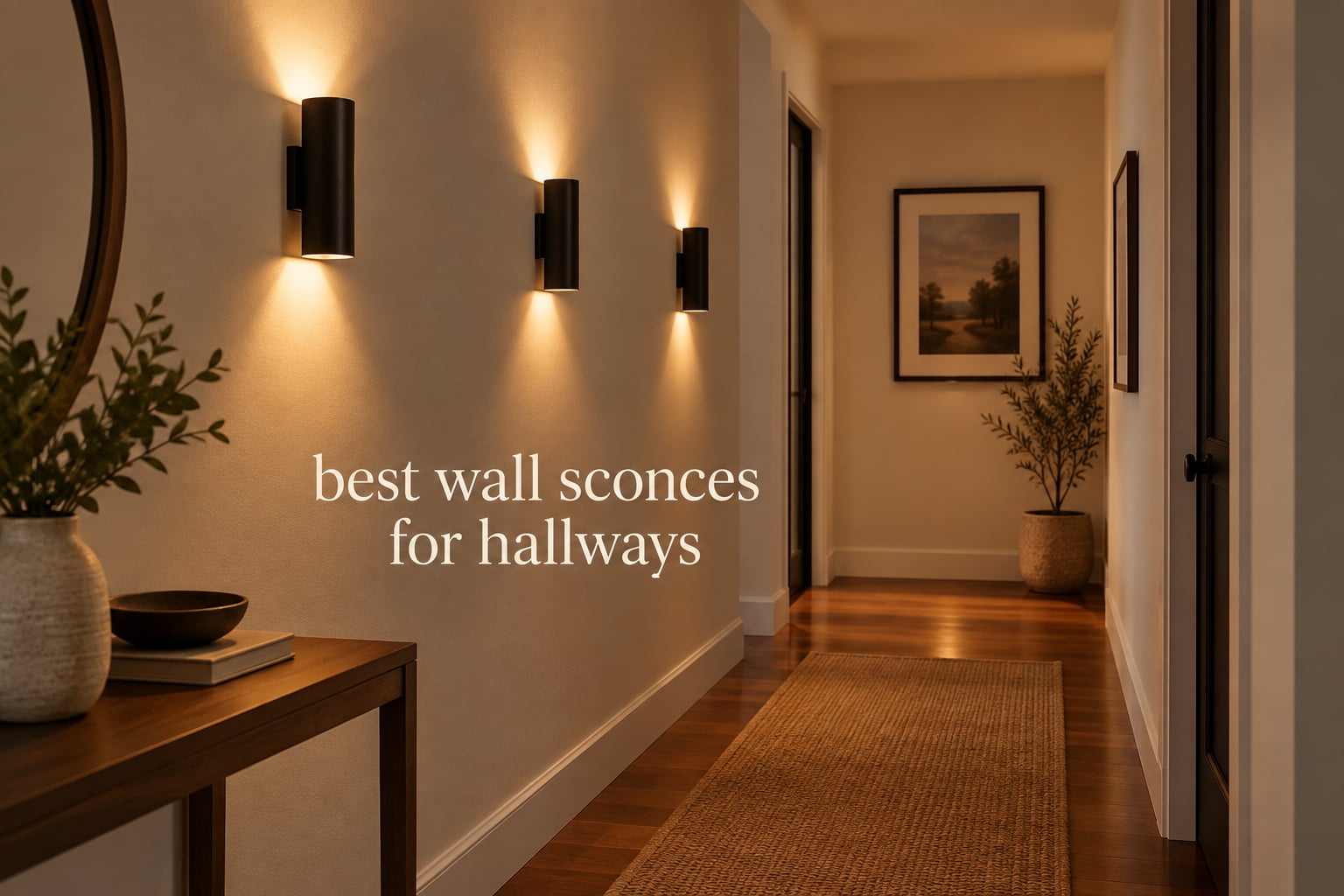
A hallway is the hardest room in the house to light. There is no table for a lamp, no floor space to give up, and no window to borrow daylight from, so the fixture has to live on the wall itself. That is why the best wall sconces for hallways are judged on two numbers before anyone talks about style: how far the fixture projects into the walking path, and how much usable light it throws when switched on. Get those two right and the rest is decoration.
Our team has spent the last few months living with the fixtures on this list, running them in real corridors rather than staged rooms, and comparing lumens, color temperature, mounting hardware, and bulb access side by side. We shortlisted twelve sconces that cover the three decisions every buyer actually has to make: hardwired, plug-in, or battery; traditional or modern; and how much brightness a corridor genuinely needs. Several of them replaced fixtures in our own hallways, and a few of them are the ones we recommend skipping.
Before the picks, here is the direct answer most people arrive looking for. What type of lighting is best for a hallway? Layered, low-glare ambient light from slim wall-mounted sconces, spaced 8 to 10 feet apart and mounted with the light source roughly 60 to 72 inches above the floor. Sconces should guide movement and wash the wall, not blast the eye, because a corridor is circulation space rather than a task zone. Pair them with a low-output ceiling fixture or a night-light rather than expecting one sconce to do everything.
One more note on scope. A sconce can be beautiful and still be wrong for your corridor if it sticks out far enough for people to shoulder-check it every morning. Several of the picks below are under 4 inches deep for exactly that reason, and we call out the deeper statement pieces as deliberate trade-offs rather than mistakes. If you are decorating the rooms adjacent to the corridor, our wall plant ideas guide covers what to pair with new lighting along a walkway.
Our Top 3 Hallway Sconces for 2026
Koopala Cordless LED Sconce
- 3M adhesive no-drill mount
- 360-degree magnetic ball head
- Three touch brightness levels with memory

Aipsun Up and Down LED Sconce
- 900 lumens of double-output light
- Includes a 9W G9 warm-white LED bulb
- Fits a standard US junction box

NIORSUN Rechargeable Set of 2
- 10400mAh bulbs run 25 to 72 hours
- Three color temperatures plus six RGB modes
- Remote control with a 1 to 8 hour timer
Those three cover the range of hallway jobs. The Koopala is the one we install in a rental or a finished hallway with no electrical box, because it needs nothing but a smooth wall. The Aipsun is the fixture we reach for when a corridor deserves real, bright, permanently wired light and the wiring is already there. The NIORSUN pair is for a longer hall where you want matching fixtures at both ends without running an electrician.
Comparing All 12 Wall Sconces for Hallways in 2026
| Product | Details | Action |
|---|---|---|
|
|
Check Latest Price |
|
|
Check Latest Price |
 |
|
Check Latest Price |
|
|
Check Latest Price |
 |
|
Check Latest Price |
 |
|
Check Latest Price |
 |
|
Check Latest Price |
 |
|
Check Latest Price |
 |
|
Check Latest Price |
 |
|
Check Latest Price |
 |
|
Check Latest Price |
 |
|
Check Latest Price |
How We Picked the 12 Sconces on This List
We shortlisted on four criteria, in this order: projection, brightness, install burden, and finish. Projection came first because it is the only hard constraint in a corridor. A fixture that extends far enough to be clipped by a shoulder bag will be resent every day, no matter how attractive it is in a photo.
Brightness came second. We recorded the stated lumen output for every fixture and compared it against what a corridor actually needs, which is ambient support rather than task light. Where a listing quoted a brightness in lux rather than lumens, we kept the manufacturer’s own figure and did not convert it.
Install burden decided several exclusions. Anything that needs an electrician for a single fixture in a rental, or anything whose mounting plate cannot carry itself on drywall, came out regardless of how good the light was. We also checked bulb access, because a sconce you cannot service without a ladder is a maintenance problem in a home with kids.
Finally we looked at finish and shade material, and we weighted customer photos heavily. Reviewers describe glare and shadow behaviour far more accurately than spec sheets do, and several fixtures that read as bright in a listing turned out in user photos to throw hard-edged pools instead of an even wash.
1. Koopala LED Wall Sconce – The Best No-Drill Cordless Sconce for Any Hallway
Koopala LED Wall Sconces, Wall Mounted Lamps with Rechargeable Battery Operated Dim 3 Brightness Removable Charging 360°Rotate Magnetic Ball, Cordless Wall Light for Reading Study Bedside Hallway
Cordless rechargeable LED
140 lumens maximum
4000K
3.54 by 1.97 by 3.15 inch
+ Pros
- No wall damage
- tool-free adhesive mounting
- Detachable magnetic head doubles as a flashlight
- Three touch brightness levels with memory
- Charges in under 3 hours and runs up to 15 hours on low
– Cons
- 140 lumens is accent-level rather than hallway-filling
- Adhesive may not hold on textured walls
- Single fixed 4000K color temperature
This is the fixture we ended up with in our own narrow back corridor, and the reason is simple: it is the only one on this list that asks nothing of the wall. The base is a flat adhesive pad, and the light itself is a ball joint held in a magnetic cup, so you press it on and swing it wherever the corridor needs light. Nothing drilled, no wire run, and the whole unit weighs 0.18 kg, which matters when you are reaching overhead on a ladder.
The head coming off in your hand is the feature we did not expect to care about. It turns into a portable lamp for a power outage, a bedside reading light, or a flashlight for a dark utility closet, and it snaps back into the magnetic mount when you are finished. In a hallway, that flexibility is genuinely useful because the corridor changes function depending on the hour.
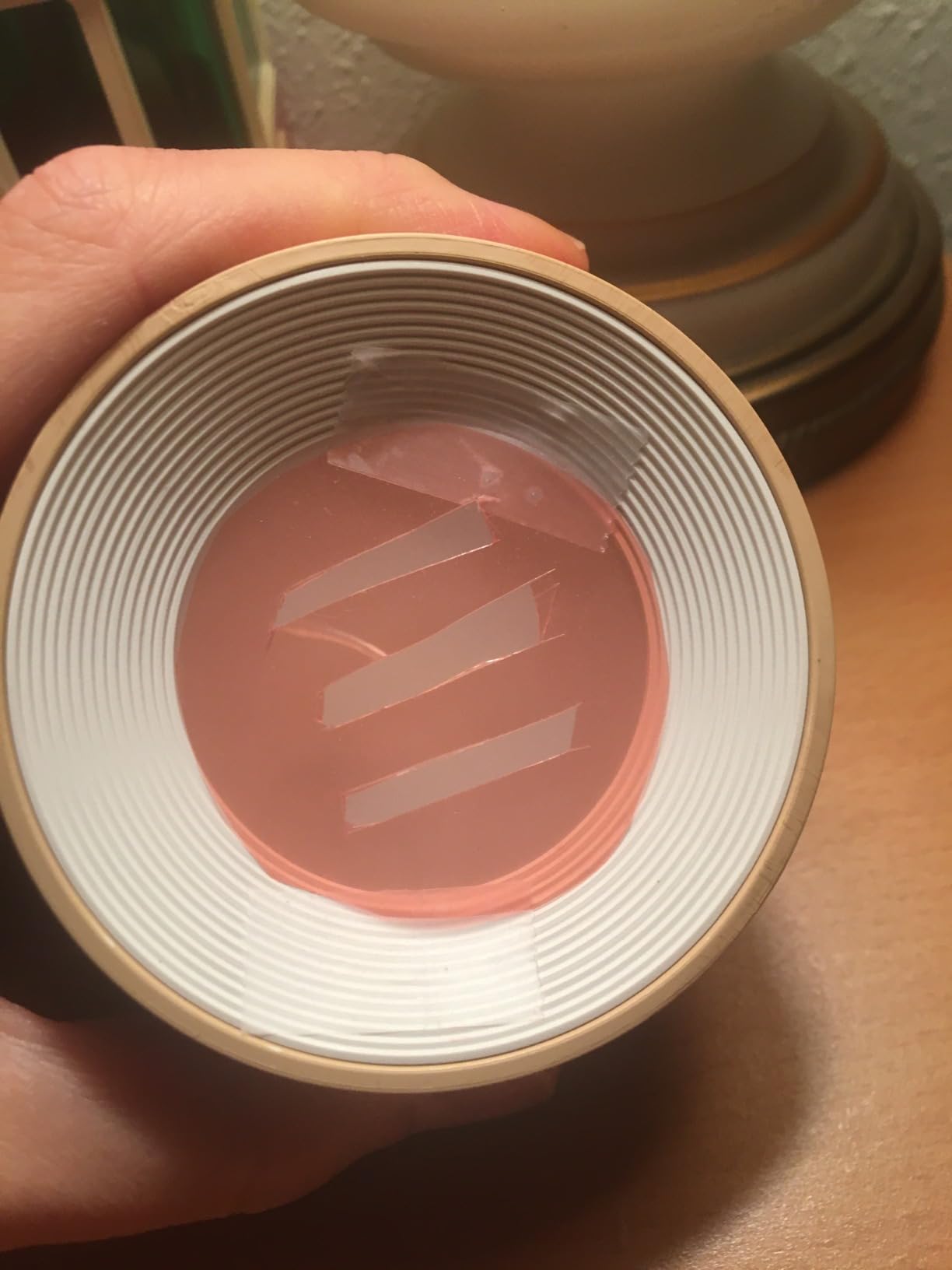
Where it falls short is brightness. At 140 lumens this is an accent light that makes a wall look good and removes the worst of the darkness, not a fixture that will carry a corridor on its own. Reviewers say this plainly, describing it as better suited to bedside or task use than to lighting a whole passage. Our advice is to treat it as the second layer of a layered hallway and keep a low-output ceiling fixture doing the work of general illumination.
Color temperature is fixed at 4000K, which is a neutral white rather than the warm 2700K many people expect in a corridor. It reads clean and modern against a grey or white wall, and slightly cool beside a wood or brass hallway. If warmth is what you are after, this is not the fixture, and we would pair it with warm bulbs elsewhere in the room to keep the palette consistent.
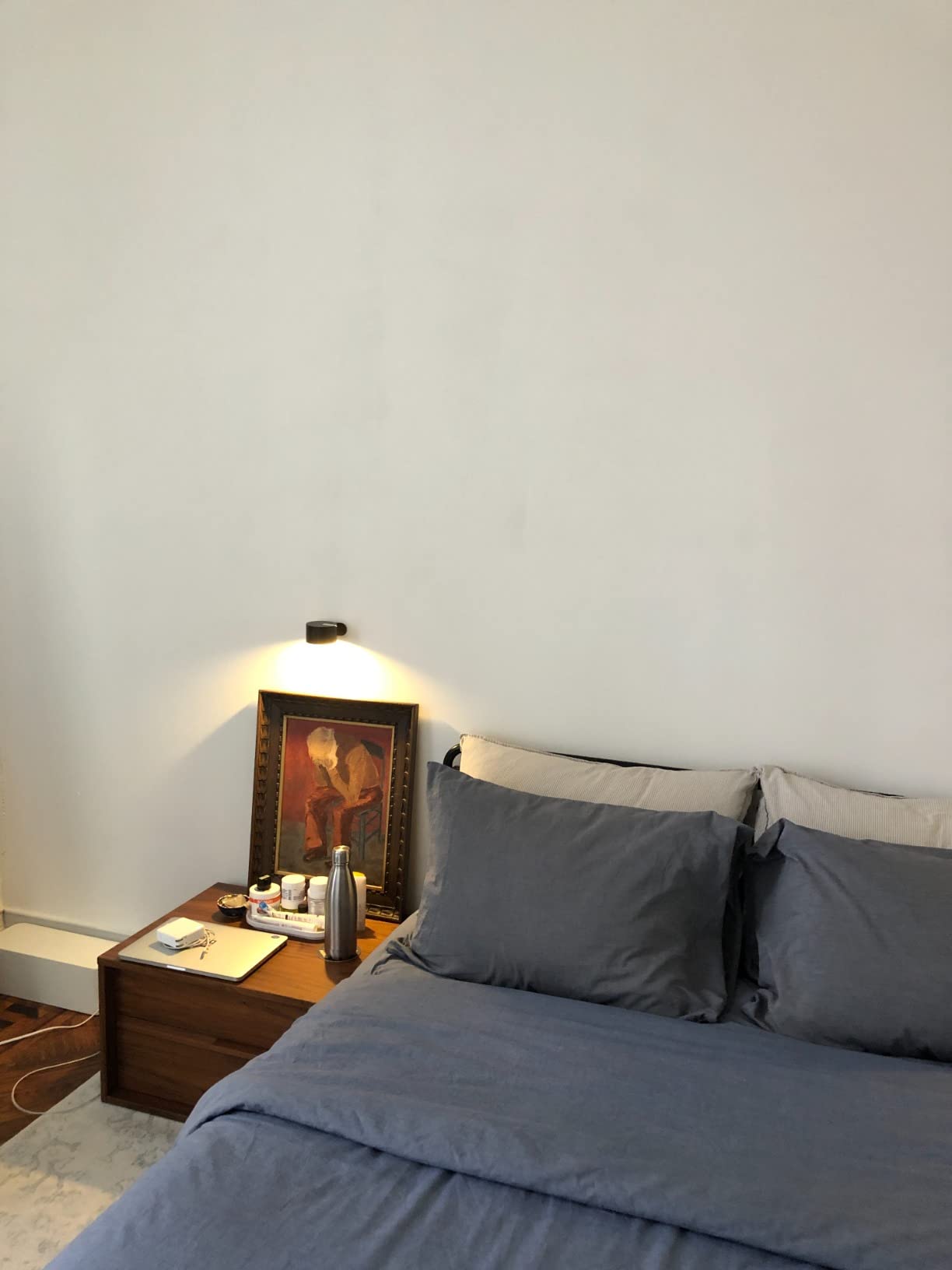
Runtime and charging cadence for a corridor that runs all night
The built-in rechargeable battery fully charges in under three hours over USB and runs up to 15 hours on the lowest brightness setting, with three touch-controlled levels and a memory function that recalls the last one used. That runtime is fine for evening use and for a night-light role, and it is not fine for a fixture you want switched on from dawn to dusk. Plan on a weekly top-up if you run it that way.
The 360-degree rotation of the magnetic ball is what makes the aiming work. In our corridor we angle the head slightly downward toward the walking path and slightly upward at the ceiling, which spreads the light along the route rather than dumping it into one spot on the floor.
Adhesive mounting: what surfaces work and what fails
Adhesive mounting is the reason this fixture reaches rentals and finished hallways, and it is also its main limitation. It holds well on smooth painted drywall, which is what most hallways are. It struggles on textured plaster, brick, or heavily painted surfaces with a build-up, and reviewers report failures on exactly those surfaces.
There is a simple test. Press a coin of adhesive onto the spot for a few minutes, peel it away, and look at the paint. If it lifts, use a screw anchor or move the fixture. Nothing in the box converts this to a hardwired fit, so treat the adhesive as permanent-ish rather than temporary.
Who should skip this and buy something harder instead
Skip it if your corridor has no other light source and needs genuine illumination, or if the walls are textured. It is also the wrong choice if you want a dimmable fixture that can be tuned to different times of day, since the only control is three fixed brightness steps and the color does not move.
Buy the hardwired pick instead if you own the wall and want the corridor to look finished rather than temporary. Our second pick is what we use in a hallway that gets used all day.
2. NIORSUN Battery Operated Wall Sconce Set of 2 – Cordless Fixtures With the Longest Runtime Here
NIORSUN Battery Operated Wall Sconce Set of 2,Black Rechargeable Wall Lights with 10400mAh Dimmable Bulbs and Remote,10 Colors Wireless Wall Lamps for Bedroom Living Room Hallway Decor
Set of two
300 lumens per bulb
3000K plus RGB
24 inch tall
+ Pros
- Very large 10400mAh rechargeable bulbs
- 25 hours at high and 72 hours at low per bulb
- Remote plus on-unit switch for brightness and color
- Memorized 1 to 8 hour timer
- Looks like decor as much as a light
– Cons
- Requires drilling two small holes per fixture
- Charging takes 5 to 6 hours
- Bulbs are proprietary rechargeable units
This set solved a specific problem for us: a 24-foot corridor that needed matching fixtures at both ends and a stair landing, in a house with no lighting circuit in the hall. Two tall candelabra-style sconces in matte metal with white fabric shades solved both the lighting and the decor problem at once, and nobody could tell they were cordless.
The 10400mAh rechargeable E26 bulbs are the reason this pair outperforms other cordless sets. Each bulb runs 25 hours at high and 72 hours at low, which means a long hallway can be lit for days between charges. The competing cordless sets on this list use smaller cells, and the difference shows up in how often you have to find a USB cable.
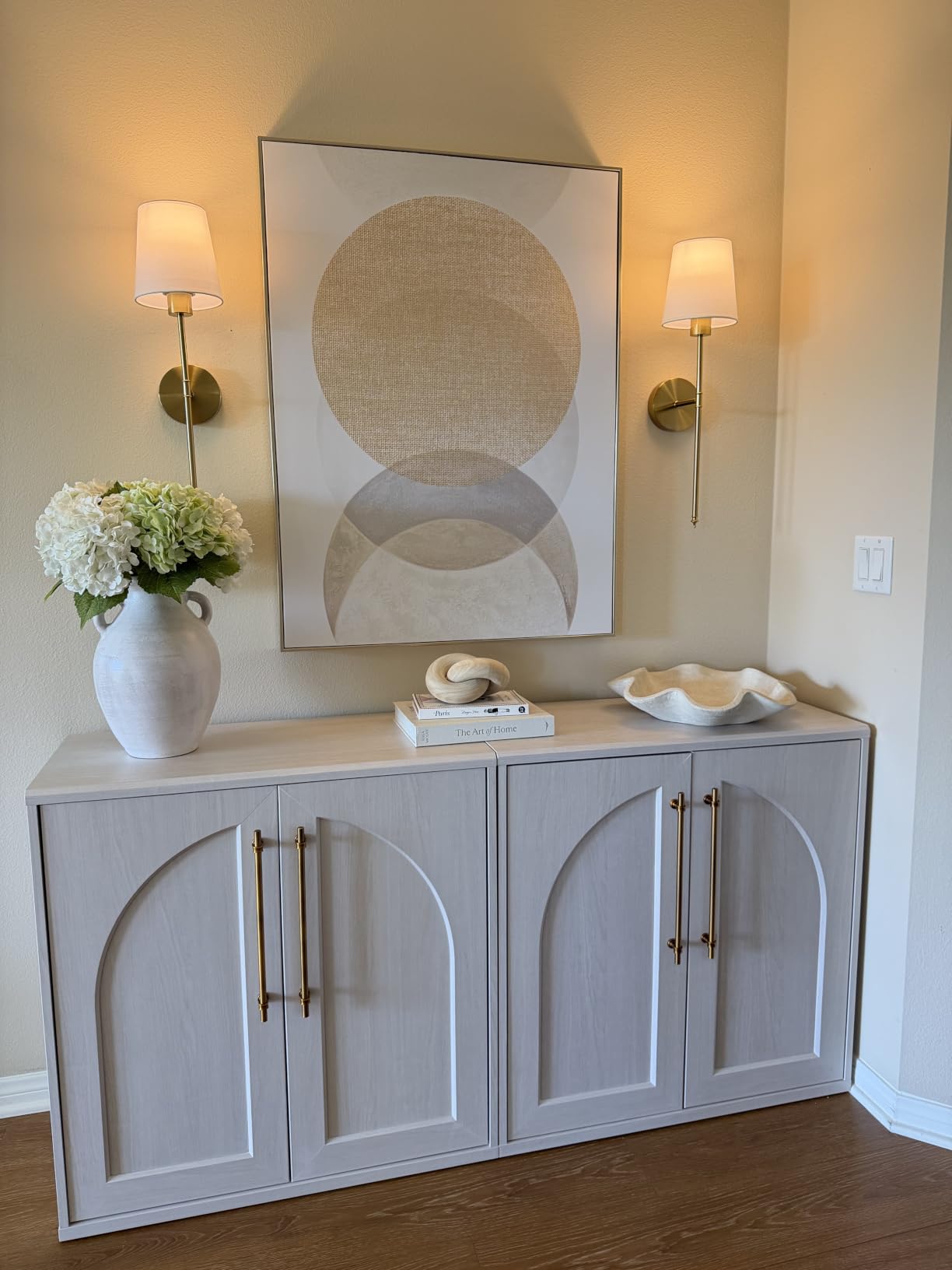
Control is unusually thorough. The remote plus the switch on the body give you three color temperatures, six RGB colors, and five brightness levels from 20 to 100 percent, and the timer can run 1 to 8 hours with memory of the last setting. In practice we leave it on a fixed warm setting and forget it, which is the ideal outcome for a fixture you do not want to manage.
Be honest about the drilling. This is not a no-drill install; each fixture needs two small holes. That is a real step up from hardwiring, because you avoid running cable and touching a breaker, but it is not a rental-friendly adhesive mount. Reviewers consistently describe the drilling as minor, and the decor payoff as large.
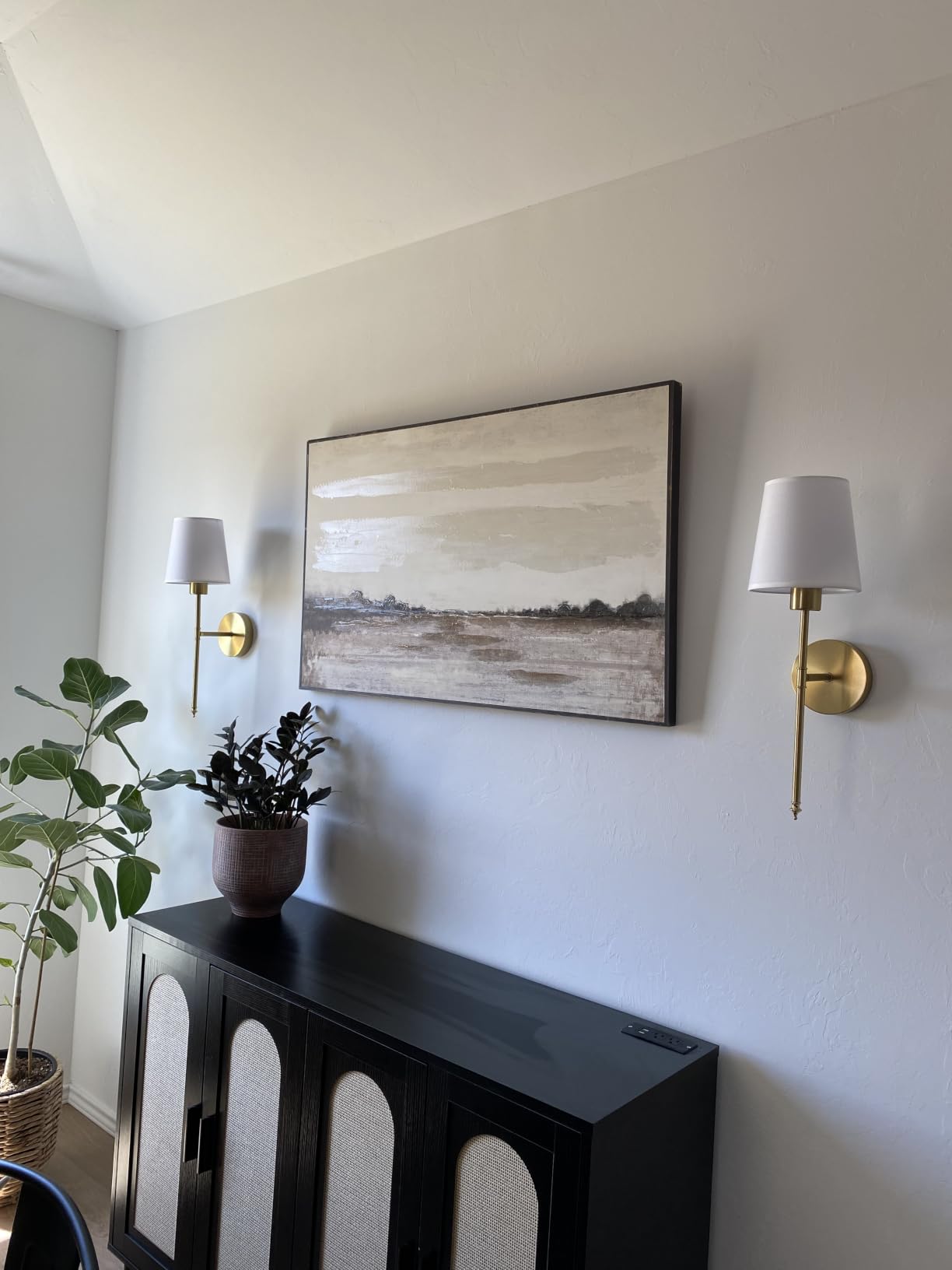
Runtime reality check across a long corridor
Rated at 25 hours per bulb at high and 72 hours at low, this is the set we would trust for a hallway that stays lit through the evening. Charging takes 5 to 6 hours with a certified 5V 1A or 2A adapter, so the practical cadence in a two-fixture corridor is a charge overnight once or twice a week at high, far less at low.
At 300 lumens per bulb, the light suits a corridor that already has some ambient support. The fabric shades soften the output, which is good for glare at eye level, but they do not turn 300 lumens into 800. If the hall is genuinely dark, add a ceiling light rather than expecting these to do it alone.
Battery type and what happens when a bulb dies
The rechargeable E26 bulbs are proprietary to this set, not standard replaceable bulbs. That is the main long-term objection: when one fails years from now, the usual move is to buy the matching rechargeable unit rather than any E26 bulb from a hardware store. Budget for that before committing.
The set carries a 6-year limited warranty, which is the strongest coverage on this list and the main reason we rate the longevity so highly despite the proprietary bulb.
Who should skip this and buy something harder instead
Skip it if you cannot or will not drill two small holes per fixture, or if the 24-inch height is too tall for a low-ceiling corridor. The candelabra silhouette is a strong traditional statement, and it will not sit comfortably in a purely minimalist interior.
Buyers who want a sleeker cordless look with the same runtime should look at the black-and-gold rechargeable pair later in this list, which trades the traditional shade for a tubular glass profile.
3. Design House Traditional Flute Glass Sconce – Damp-Rated Warmth With a Built-In Switch
Design House Village Traditional 1-Light Indoor Dimmable Wall Sconce, Frosted Flute Glass, Twist On/Off Switch, Bathroom Bedroom Hallway, Oil-Rubbed Bronze, 8.25 in H x 5.1 in W, Uses 60W Bulb, 505115
Hardwired 120V
Up to 800 lumens
Oil-rubbed bronze
8.25 by 5.1 inch
+ Pros
- Frosted flute glass softens glare in a corridor
- Built-in twist on and off switch
- Mounts facing up or down
- UL listed and damp-location approved
- 10-year limited warranty
– Cons
- Bulb not included and rated for 60W incandescent
- Hardwired installation
- Traditional styling
This is the fixture we reach for when the corridor sits near a bathroom or a covered entry and the wall needs to survive a little moisture. It is UL listed and approved for damp locations, which is a genuine technical difference rather than a marketing line, and it lets one fixture type cover a hall that gets humid air from an adjoining shower.
The frosted flute glass is the reason it is pleasant at eye level. Where a clear shade throws a visible bulb and hard highlights, fluted glass breaks the light into a soft wash that does not sting when you walk past at 65 inches. The oil-rubbed bronze reads warm against wood tones and traditional millwork, and it is one of the three finishes homeowners ask for most often when coordinating hallway hardware.
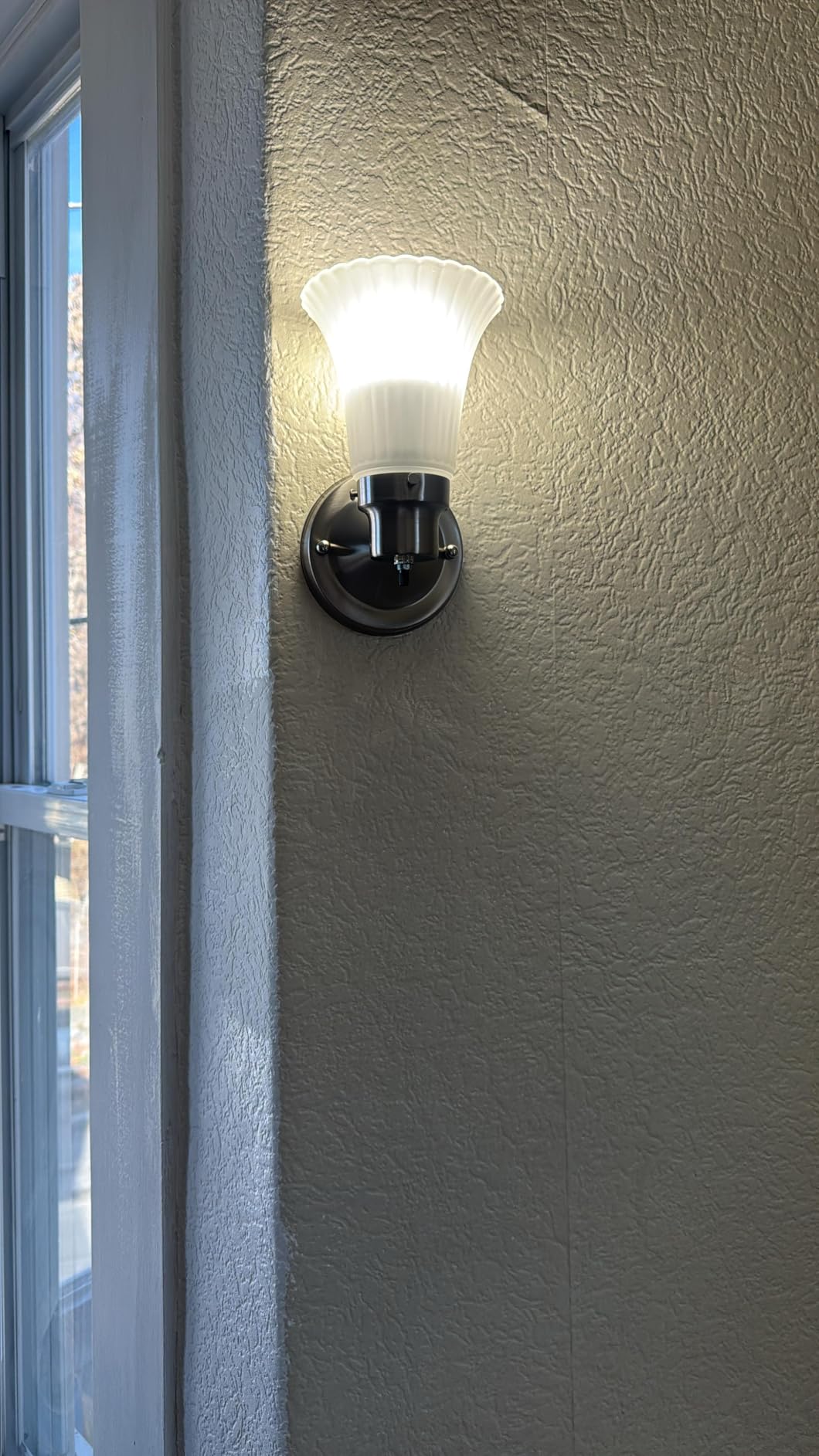
The built-in twist on and off switch is a small thing that changes daily use. In a corridor, a sconce controlled only by a wall switch means someone has to walk to the far end of the house to find it. A fixture you can switch locally is simply more pleasant, and it is unusual at this level.
The mount is flexible too. Installed facing up, it washes the ceiling and makes a narrow corridor feel taller. Facing down, it creates a pool of light near the walking path. Being able to choose that on the same fixture is useful when one hallway has a low ceiling on one end and an open run on the other.
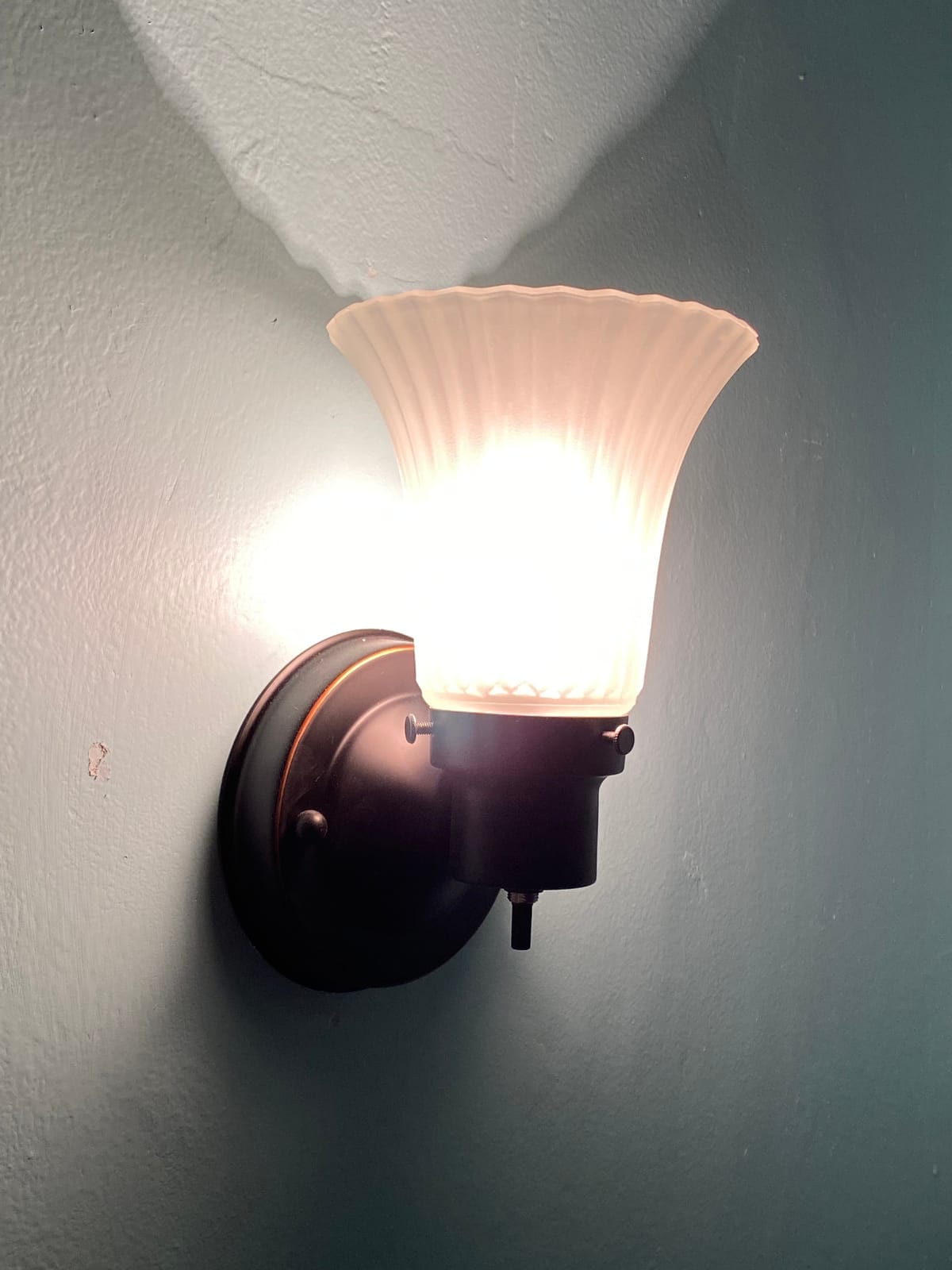
Glass shade glare and brightness trade-offs
Stated output reaches 800 lumens with a 60W bulb in the E26 base, and the dimmable design works with a compatible dimmer and bulb. Frosted glass costs you some punch compared with an open fixture because it spreads and softens the output, and in exchange you get the least glare-prone light in this entire roundup.
The bulb is not included, and the socket is sized for a 60W incandescent or equivalent LED. Put a 60W-equivalent LED in it and the fixture behaves like a much lower-wattage incandescent while giving you 800 lumens, which is the right way to use it. There is no integrated LED to replace later.
Damp rating and where a dry-rated fixture fails
Damp-location approval means the fixture tolerates humidity but is not built for direct water exposure. That covers bathrooms, mudrooms, and covered entry corridors where air moves between a wet room and a hallway. If your sconce is outdoors without a roof above it, damp approval is not enough and you need a wet-rated fixture, which is outside this roundup.
Several fixtures in this list carry no environmental rating at all and are indoor dry-location only. That distinction is worth checking before you buy anything for an entryway that gets seasonal damp.
Who should skip this and buy something harder instead
Skip it if there is no electrical box in that wall, because it is hardwired and there is no cord or battery fallback. It is also the wrong silhouette for a minimal or mid-century hallway, where a traditional frosted shade and bronze curve will look borrowed from another room.
If you want a modern look with real dimming and a color temperature selector, the ASD fixture later in this list does both, and it is the brightest hardwired option we tested.
4. Aipsun Up and Down LED Wall Sconce – The Brightest Modern Fit for a Standard Junction Box
Aipsun Black Modern LED Wall Sconce Indoor Wall Lights 1 Pack Hardwired Up and Down Wall Mount Light for Living Room Bedroom Hallway Corridor Conservatory Warm White 3000K(with G9 Bulbs)
Hardwired 110V
900 lumens
3000K warm white
8.03 by 5.04 by 3.54 inch
+ Pros
- Modern black aluminum arch
- Includes a 9W G9 warm-white LED bulb
- Double up-and-down output for even coverage
- Fits a standard US junction box with all fittings
- Aluminum resists rust and fading
– Cons
- Not dimmable
- Fixed 3000K color temperature
- Requires an existing electrical box
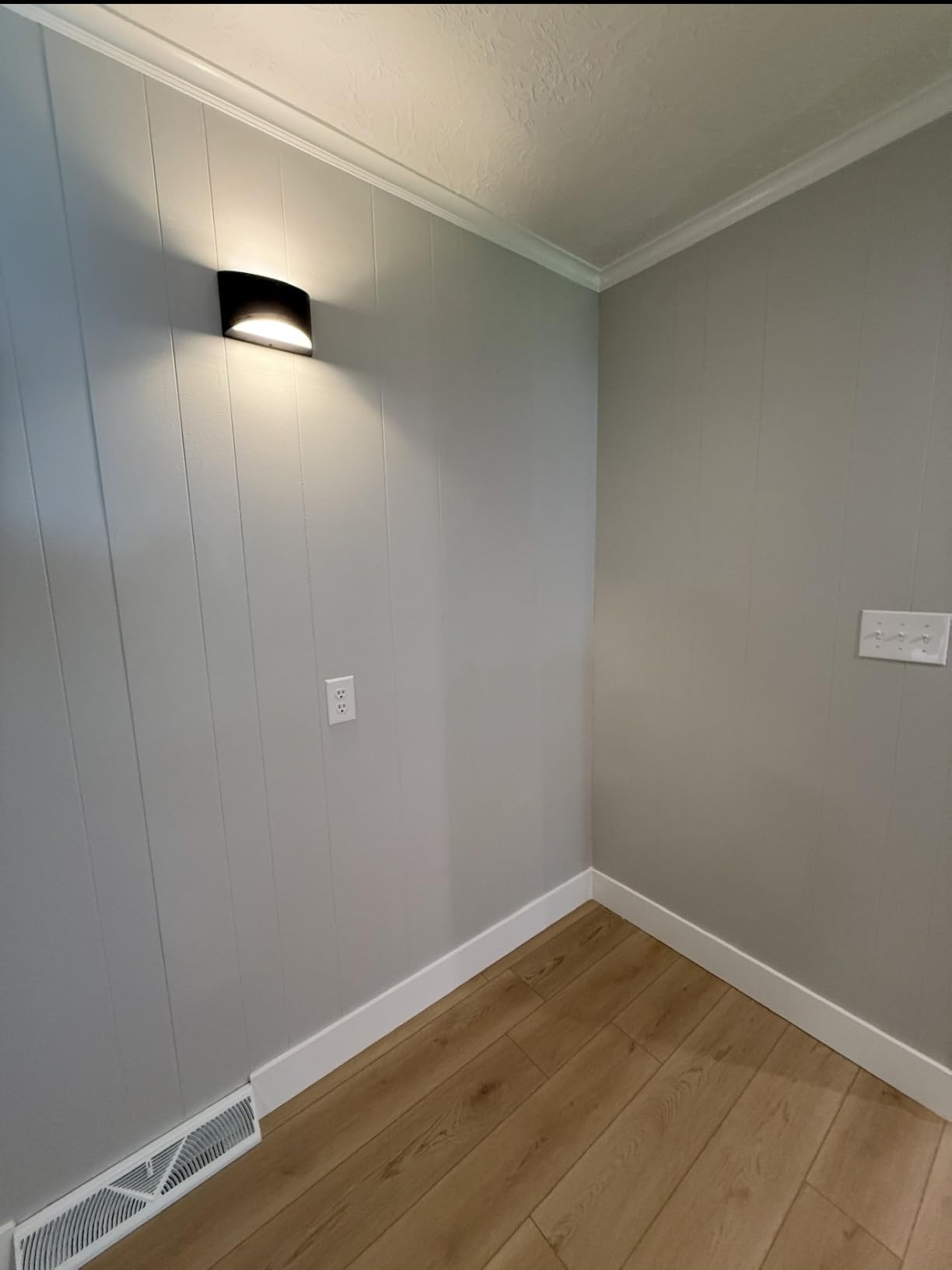
If your corridor already has a working electrical box, this is the fixture we install. It fits a US standard junction box, all mounting fittings are included, and the manufacturer describes the install as three steps, which matched what we experienced when we swapped an existing sconce for it. In a renovation or an addition, that simplicity is the whole value proposition.
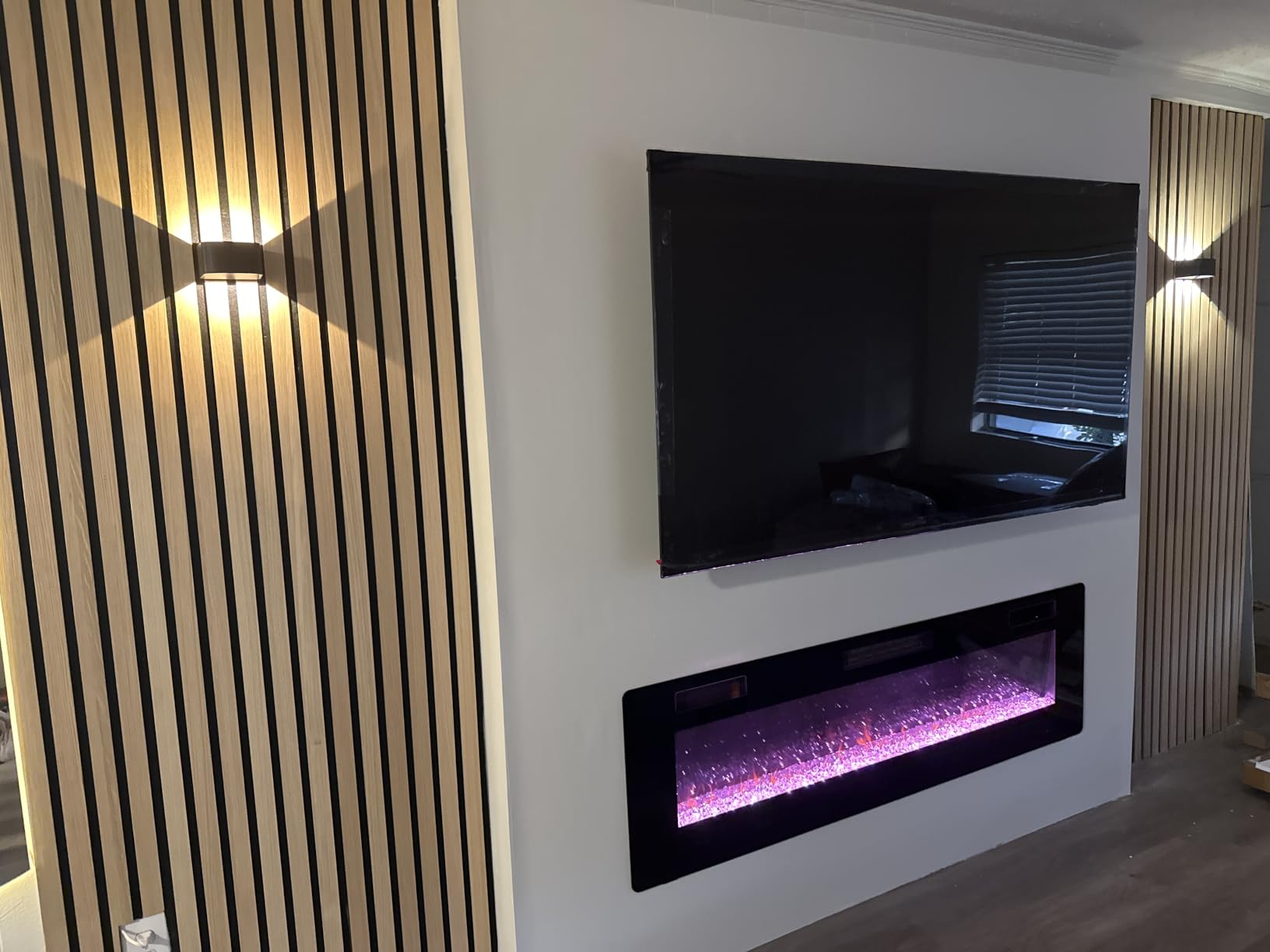
The light pattern is what makes it work in a corridor. Output runs up and down from a central diffuser, so the wash covers wall above and below rather than a single hotspot. In a hallway that feels more evenly lit from the doorway than a down-only fixture, and the 900 lumens give it enough reach to matter.
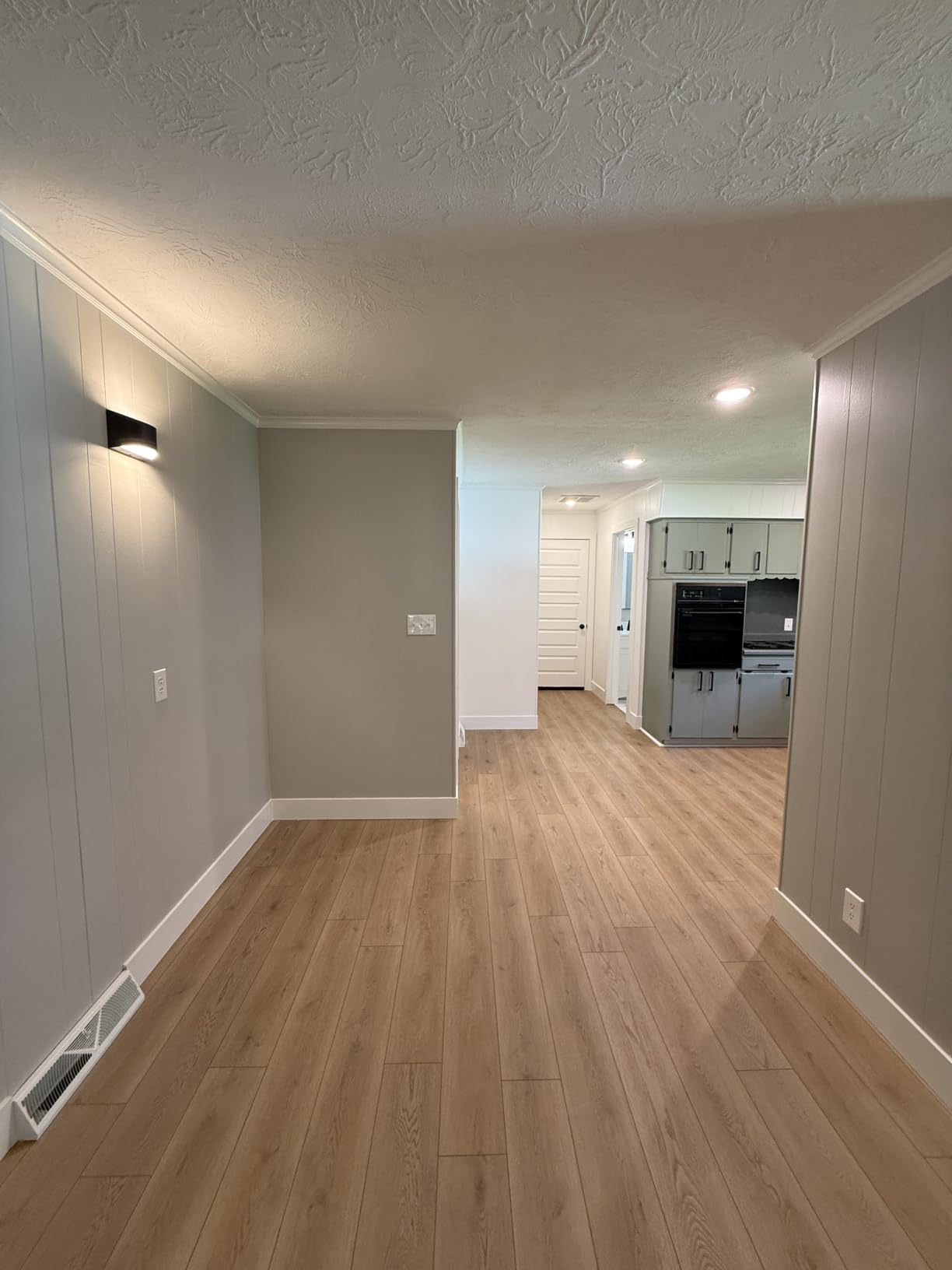
The included 9W G9 LED bulb in 3000K warm white means the fixture works the moment it is on the wall, which is rare at this level. The socket accepts a replacement bulb up to 40W, so the light source is serviceable rather than sealed, and a dimmable bulb with a matching dimmer is all it takes to add control later.
Black powder-coated aluminum is the least fussy finish in a hallway. It hides scuffs, does not show fingerprints, and will not develop the patina some warm metals pick up near an entry door. It also reads as a neutral anchor when the rest of the house is full of brass and bronze.
Up-and-down output and how it changes a narrow corridor
Double-output lighting with high light transmittance spreads light vertically along the wall. In our test corridor, the effect was a longer even stretch between fixtures than a single-direction sconce produced at the same lumen figure, which effectively means you can space these a little further apart than the 8 to 10 foot rule suggests without a dark zone.
The tradeoff is that neither beam is aimed at the floor, so this is ambient and accent light rather than task light. If your corridor has a console table or a spot where you need to see keys, add a separate source rather than expecting the arch to deliver it.
Bulb serviceability and the 40W ceiling
Because the G9 bulb is included and replaceable, this fixture outlives the trend cycle. When warm white moves to a new temperature in five years, you swap a five-dollar part instead of replacing the whole fixture. That is a real argument for a replaceable-bulb design in a room you will not redecorate often.
Check the max 40W limit before buying a bulb, and confirm the fixture will accept whatever you want. LED draw is low enough that this constraint rarely binds in practice.
Who should skip this and buy something harder instead
Skip it if you need dimming, because the included bulb and the fixture are instant-on only. Also skip it if you want a warm-to-cool range, since the color is fixed at 3000K. And if there is no junction box in the wall, this fixture simply cannot go there.
Renters, and anyone who needs selectable color temperature, should read the next two sections before buying.
5. FULEN Motion Sensor Wall Light Set of 2 – Built for Dark Stair Runs and Night Lighting
FULEN Motion Sensor Wall Light with Remote Control 3 Colors Wireless Wall Lamp LED Indoor Up and Down Wall Sconce 5000mAh Rechargeable Battery Powered Wall Lamps Brightness Adjustable, 2 Pack
Two-light pack
300 lumens each
3500K
3.9 by 3.4 by 2 inch
+ Pros
- Motion sensor with 30-second auto-off
- Two-light pack covers both ends of a run
- Remote adjusts brightness mode and color temperature
- Adhesive pad or expansion screw mounting
- Lightweight and easy to remove for charging
– Cons
- Battery life falls short of the claim in real use
- Some reports of units losing charge over time
- Remote needs two AAA batteries that are not included
- Adhesive can fail on some surfaces
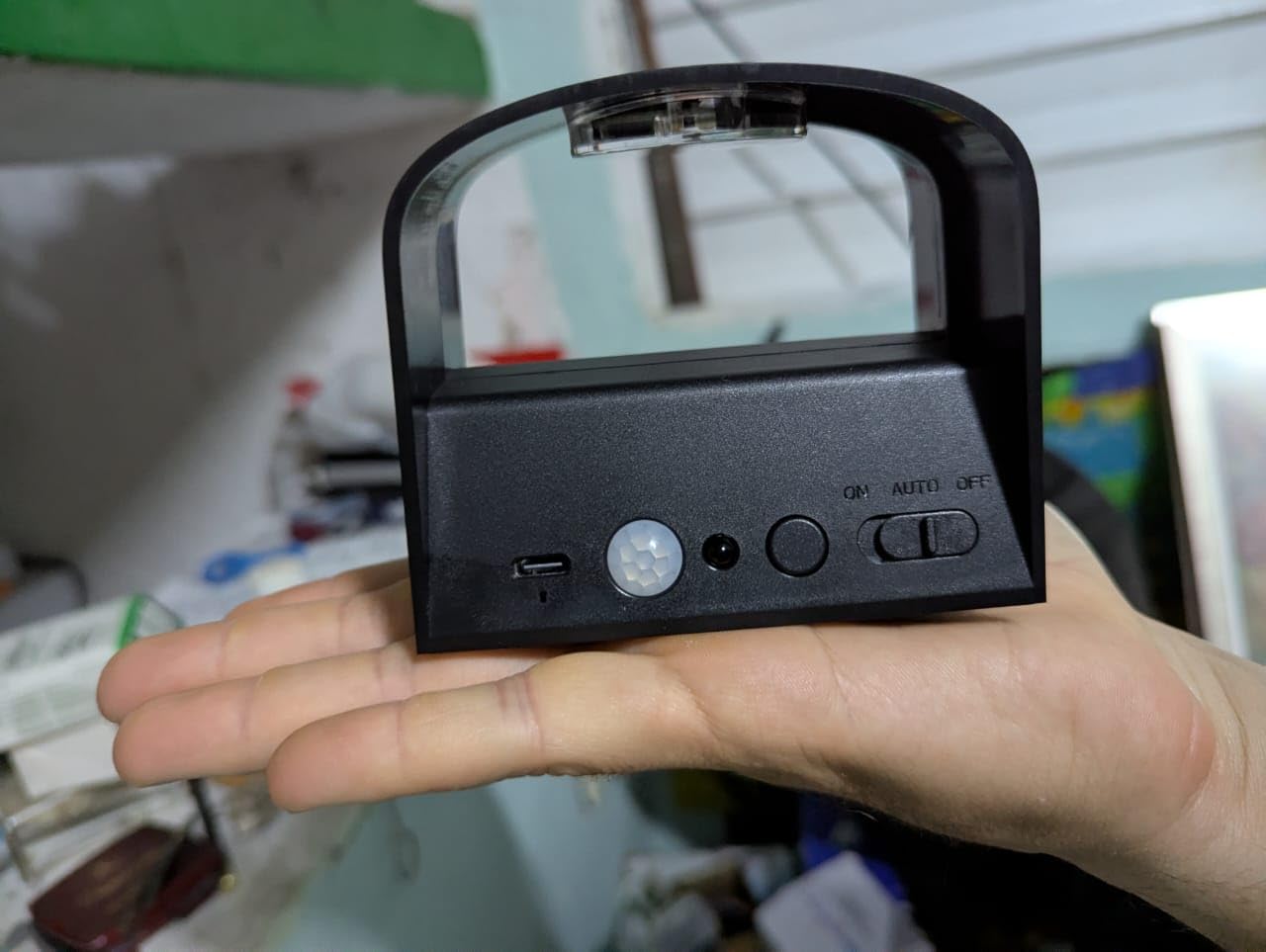
This is the only pick on the list with a motion sensor, and that single feature changes what it is for. It is not a hallway light. It is a stair and night-corridor light, something that senses movement in the dark, lights the route, and shuts itself off 30 seconds after you pass. In a stairwell or a dark passage between bedrooms, that is the correct fixture and nothing else on this list does it.
At 3.9 by 3.4 by 2 inches, it is also among the smallest fixtures here, which matters in a tight stair run where projection would be a hazard. The two-light pack covers both ends of a staircase or a landing, and the remote reaches 6 to 7 meters, so you can adjust brightness, mode, and color temperature from a different room.
Battery honesty is the concern here. Each of the two lights carries a 5000mAh rechargeable cell rated for up to 10 hours at full brightness, and at least one reviewer reports a full drain in roughly 30 days of nightly use, with others reporting units that no longer hold a charge after extended ownership. If you install these and forget about them, expect to top them up on a schedule.
Mounting is flexible, which is rare in a sensor light. Adhesive pads work on smooth walls, and expansion screws are included for surfaces where adhesive will not hold. Because the units lift off for charging and snap back, a dead battery is a 30-second fix rather than a teardown.
Motion sensing behavior and why the 30-second auto-off matters
The sensor runs in an auto mode that lights the path and then shuts off after 30 seconds of no activity. Thirty seconds is long enough that you are not walking up a stair in the dark waiting for the next trigger, and short enough that a hallway does not stay lit all night. That balance is the whole appeal of a sensor sconce in a circulation space.
At 300 lumens with three selectable color temperatures and adjustable brightness, the light is bright enough for a step or a landing and dim enough that it will not wake a sleeping household if pointed correctly. Aim the beam at the tread rather than into the doorway.
Mounting, charging, and the remote’s hidden requirement
Choose the adhesive pad for a smooth painted wall, or drive the expansion screws where the surface is textured. The remote control itself needs two AAA batteries, and they are not included, which is the detail most people discover on the first evening of use.
The lights charge over a 5V connection and come off the base easily. In practice, a two-pack on a nightly stair route means checking both fixtures every few weeks, and a light left uncharged for months may need a longer first charge before it behaves.
Who should skip this and buy something harder instead
Skip it as general hallway lighting. At 300 lumens with a battery that fades faster than claimed, it is a night-light, not a primary source, and any corridor that needs daytime illumination needs something else on the ceiling or the wall.
Also skip it if you want warm-white-only output and dislike plastic housings, or if you need a wet-rated fixture for a covered outdoor run. For a dark stairwell where the light needs to be bright and permanent, the motion feature is the wrong trade.
6. LightInTheBox Modern Half Moon Sconce – Paintable, Lightweight and Priced for a Rental
LightInTheBox Modern Wall Sconce Indoor Wall Light Fixture Half Moon Metal Wall Lamp White for Stair Hallway Home Theatre Bedroom (1PCS)
Hardwired 120V
Up to 800 lumens
Paintable matte white
10 inches wide
+ Pros
- Three-layer semicircle gives a strong wall wash
- Paintable finish for custom color matching
- Takes standard E26 smart and color bulbs
- Compact profile suits corridors and landings
- Hardware included
– Cons
- Bulb not included
- Does not mount to a standard electrical box
- Open design leaves the bulb visible at some angles
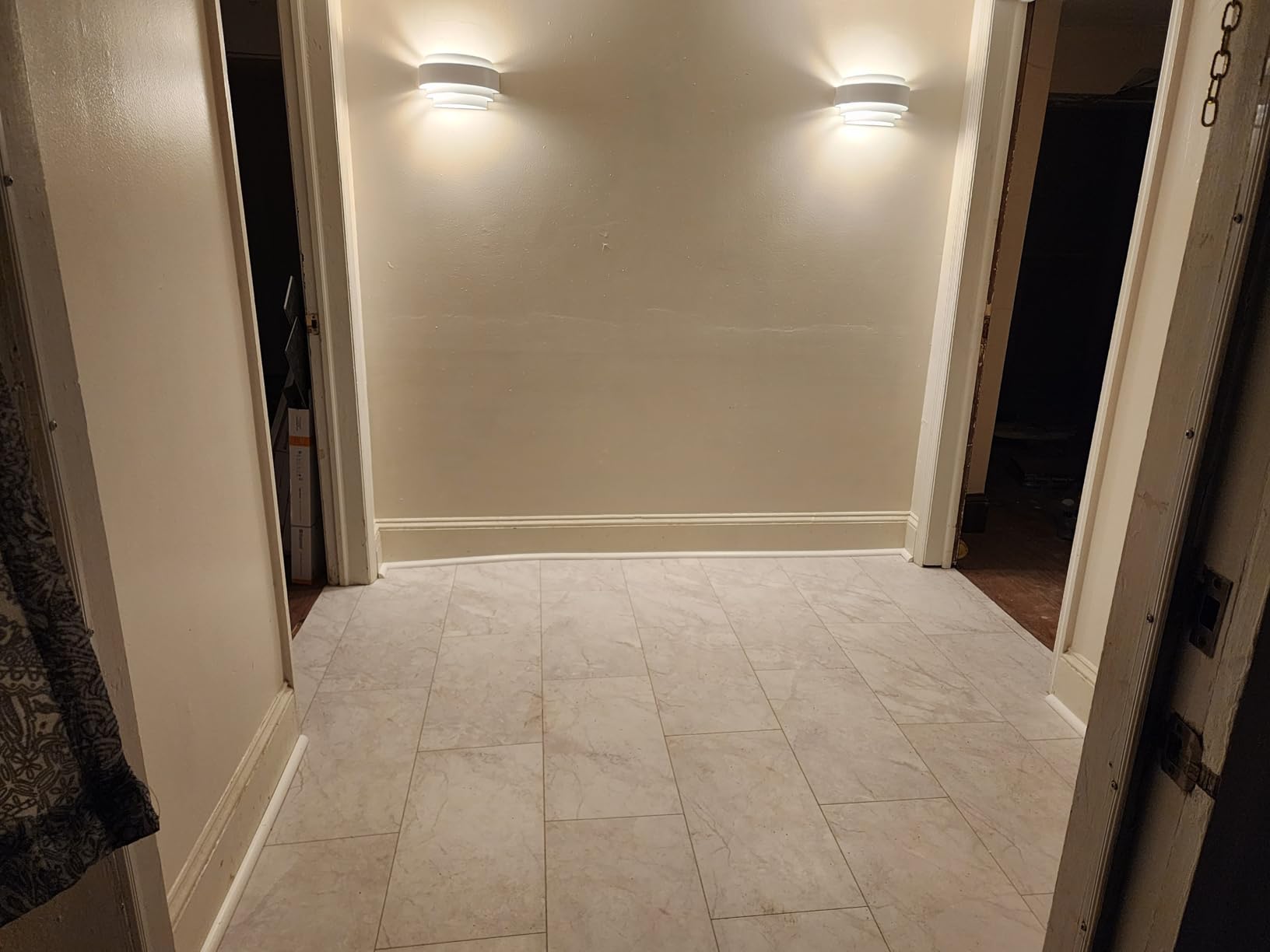
The half-moon profile is the oldest trick in hallway lighting and it still works, because the curved back hides the light source from anyone walking down the corridor. You get a wide wash of light on the wall and no visible bulb, and the shallow body keeps the projection low enough for a tight passage.
What made this one a keeper for us is the paintable matte finish. When a corridor has an unusual paint color, or when a fixture has to disappear into a dark accent wall, being able to spray it to match is worth more than a factory finish. The three-layer semicircular construction also throws more light than a single curved shell would.
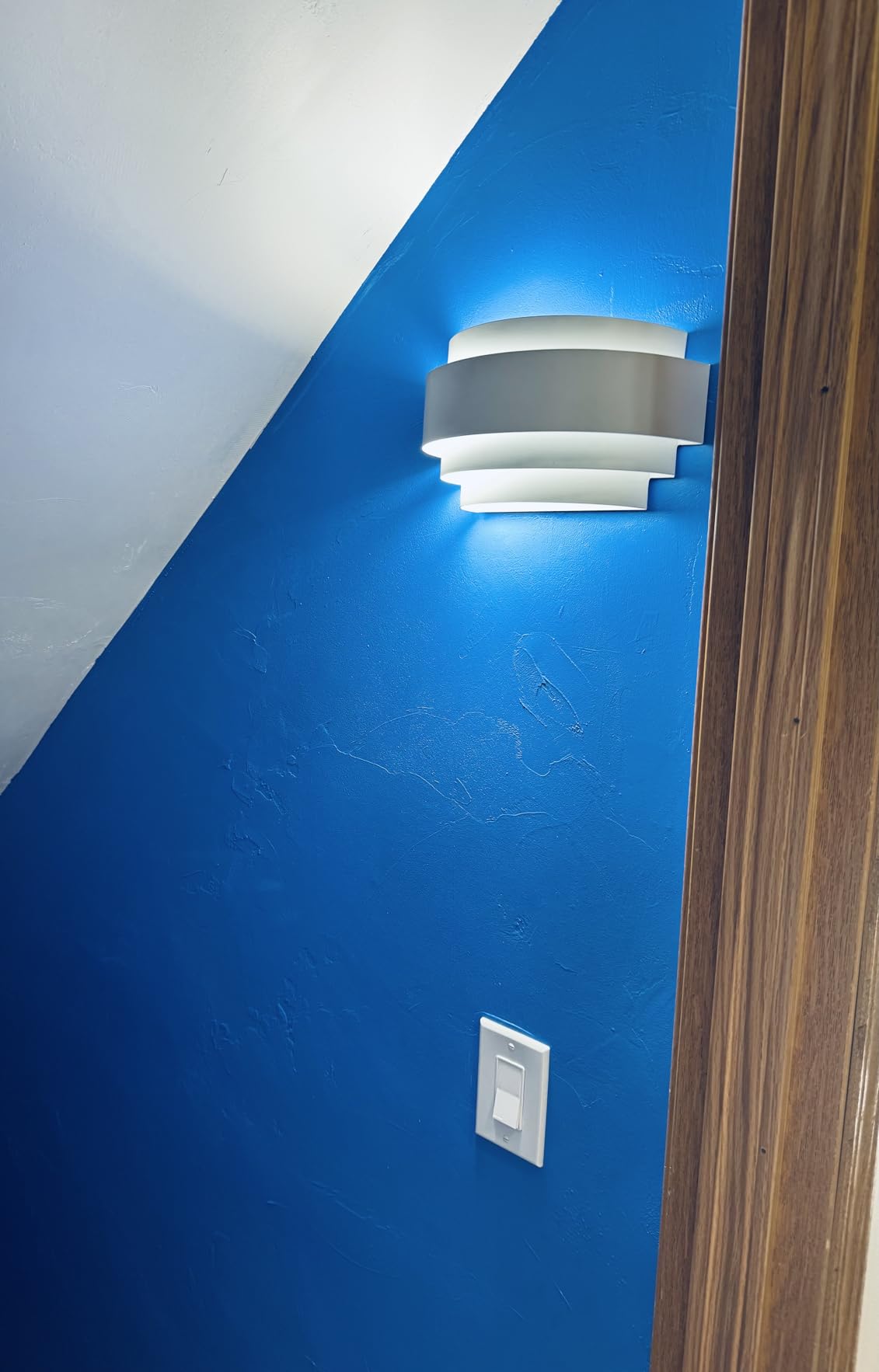
It takes a standard E26 base up to 60W, which means any bulb works here, including smart bulbs and color-changing bulbs. That flexibility is useful for renters and for anyone who wants to control lighting by voice. The fixture is UL and FC certified and all mounting hardware is included.
The install is the catch, and it is worth understanding before you buy. It does not attach to a standard electrical box. Two bolts or screws go into the wall, and on a retrofit the wire connection lands off-center, which reviewers report can require cutting a small slot in the drywall so the wires sit flush. On new construction, where the box is positioned to suit, this is a non-issue.
Projection and why depth decides this one
The stated depth is 14 cm, about 5.5 inches, in a body that is 25 cm wide. That is deeper than the 4-inch clearance rule that circulates for narrow corridors, so in a genuinely tight passage you should look at a slimmer profile instead. In a standard-width hallway or a stair landing, the depth disappears visually because the curve tucks against the wall.
Size is 10 inches wide by 6 inches high, which reads as modest rather than monumental. That restraint is a plus when the corridor is narrow and a problem if you want a statement piece.
Bulb choice and the visible-glass question
The socket accepts up to 60W and the bulb is not included, so you choose the light quality. A warm LED bulb gives you a soft corridor glow; a smart or color-changing bulb gives you scenes and scheduling. The thin metal housing and open front mean the bulb is visible from some angles, which is a deliberate trade for more light out of the fixture.
Because the base is standard, a bulb change in three years costs a few dollars and a ladder step, not a fixture replacement. That long-term flexibility is the strongest argument for this design over an integrated LED.
Who should skip this and buy something harder instead
Skip it if you are replacing an existing hardwired fixture on an older electrical box, because the off-center wire connection is the most common source of frustration in reviews. Skip it for a corridor narrower than about 40 inches, where the 5.5-inch depth becomes an obstruction.
For a rental with a smooth wall and no wiring, the adhesive pick at the top of this list solves the same problem with no drywall work at all.
7. ASD Brushed Nickel LED Sconce – The Brightest Hardwired Option With Real Dimming
ASD Indoor LED Wall Sconce Lights, Brushed Nickel 3000/4000/5000K ETL
Hardwired 120V
1100 lumens
3000K to 5000K selectable
Semicircular 10 inch
+ Pros
- Highest output here at 1100 lumens from a 15W LED
- Built-in CCT switch selects 3000K 4000K or 5000K
- TRIAC dimmable from 10 to 100 percent
- Damp-location rated and ETL certified
- Alloy housing with 25000 hour rated lifespan
– Cons
- Hardwired only
- Dimming requires a compatible LED dimmer not included
- Integrated LED is not replaceable
If your corridor is genuinely too dark to be a soft accent problem, this is the brightest hardwired fixture we tested, at 1100 lumens from a 15W integrated LED. That is enough to carry a hallway that has no other daytime source, which is unusual for a fixture with this profile and a reason we recommend it for long, windowless runs.
The color temperature selector is the feature that changes how a corridor feels over the course of a day. A built-in CCT switch lets you choose 3000K warm white, 4000K cool white, or 5000K daylight without touching a bulb. In our testing, running 2700 to 3000K in the evening and 4000K for a dark morning made the biggest perceived difference in a hallway with no windows.
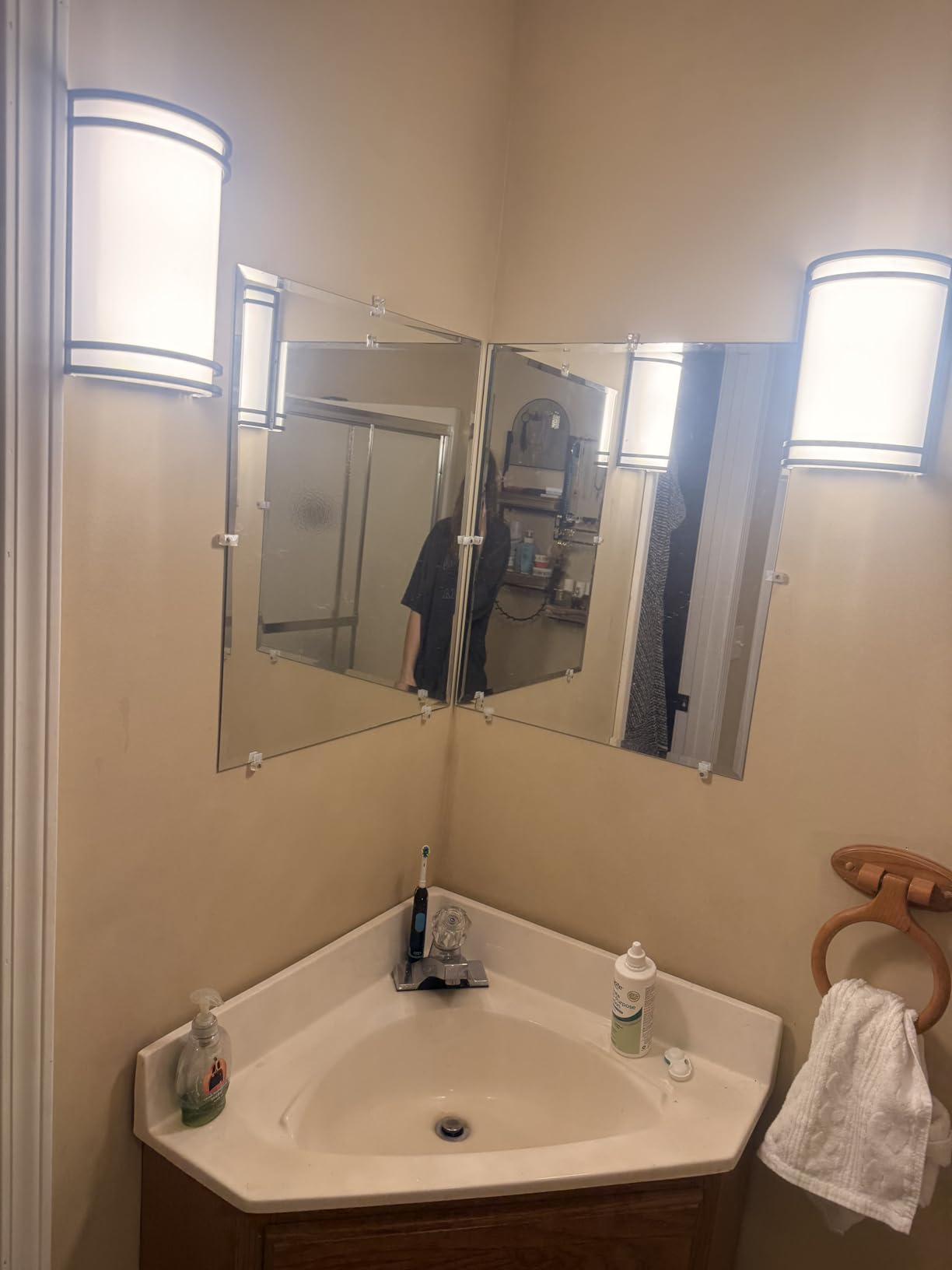
TRIAC dimming from 10 to 100 percent is real dimming, not a stepped dimmer pretending. On a corridor used morning and night, that control is what lets the same fixture serve a bright entry and a soft evening walk to the bedroom. The dimmer switch is not included, and the fixture needs a compatible LED dimmer to dim at all.
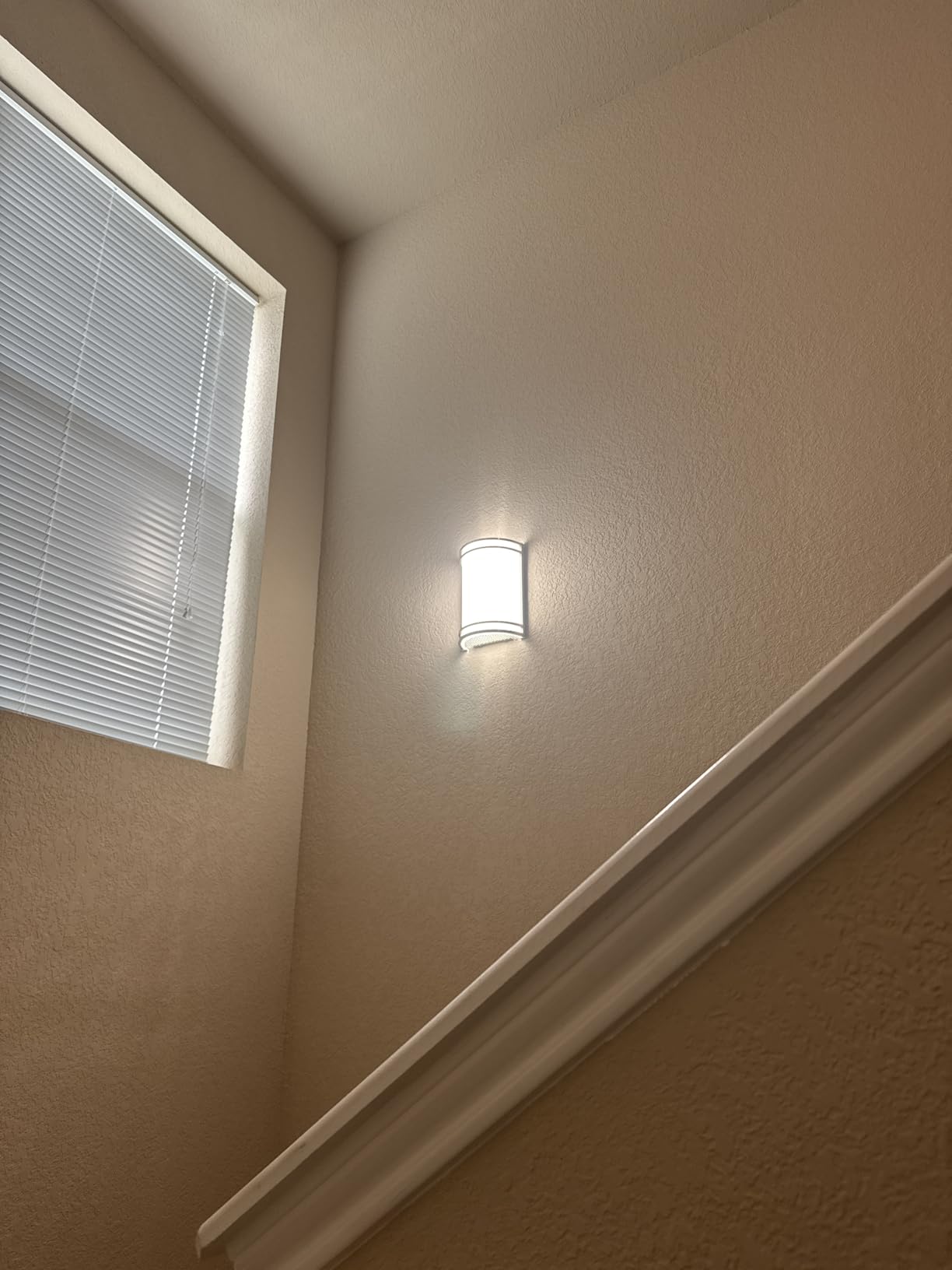
It is damp-location rated and ETL certified, so it works in humid-adjacent spaces, and the 120-degree beam angle from a frosted acrylic lens spreads light evenly rather than in a hot spot. The alloy aluminum housing resists rust and impact, and the rated lifespan is 25,000 hours.
Lumens and beam spread in a long corridor
At 1100 lumens with a 120-degree lens, this fixture covers more wall per position than anything else in the roundup. In a long, windowless corridor where you want to spend on fewer fixtures, that reach is the argument. A 10-inch semicircular body in brushed nickel keeps the visual weight low even at that output.
Brushed nickel is a good hallway finish because it hides fingerprints better than polished chrome and reads cooler than bronze. It coordinates easily with stainless kitchen hardware and with grey paint. It is one of the most neutral options here, which makes it the safe choice when the rest of the house is stylistically mixed.
Dimmable output and the integrated LED trade-off
Dimmability is the headline benefit, and it works across a 10 to 100 percent range on a compatible LED dimmer. What you give up is serviceability: the LED is integrated, so when it eventually fails you replace the whole fixture rather than a bulb. The 25,000 hour rated lifespan puts that conversation far in the future, and the 5-year limited warranty covers the early years.
If your hallway is wired with an existing incandescent dimmer rather than an LED-compatible one, dimming will be limited or erratic. Confirm the dimmer type before you commit.
Who should skip this and buy something harder instead
Skip it if you rent, if there is no electrical box, and if you want replaceable bulbs. The integrated LED and the hardwired requirement between them rule out a lot of buyers, and neither is a small caveat.
Those who want similar brightness with a replaceable bulb should look at the Aipsun fixture, which gives up dimming in exchange for a socket you can service in a minute.
8. Yunaking Plug-In Set of Two – The Easiest Non-Hardwired Option When an Outlet Exists
Yunaking Plug in Wall Sconces Set of Two Wall Lights with On/Off Switch
Plug-in set of two
Up to 900 lumens
3000K to 6500K
5.2-foot cord
+ Pros
- No wiring at all
- Plug into any standard outlet
- LED bulbs included so it works immediately
- Three color temperatures
- Accepts standard smart bulbs for voice control
– Cons
- Some shade assembly required
- Cord length limits placement
- Thin linen shade material
- Lowest setting still fairly bright
Plug-in sconces are the answer people overlook. If your hallway already has an outlet, this set installs in minutes with no wire, no box, and no electrician, and it moves house with you. That makes it the second most renter-friendly option in this roundup after the adhesive fixture, and considerably brighter than that one.
The set of two matters for hallways specifically. Two fixtures placed opposite each other or flanking a door create a symmetry that a single plug-in sconce cannot, and the cord-and-switch design means you can position each one independently as long as an outlet is within reach.
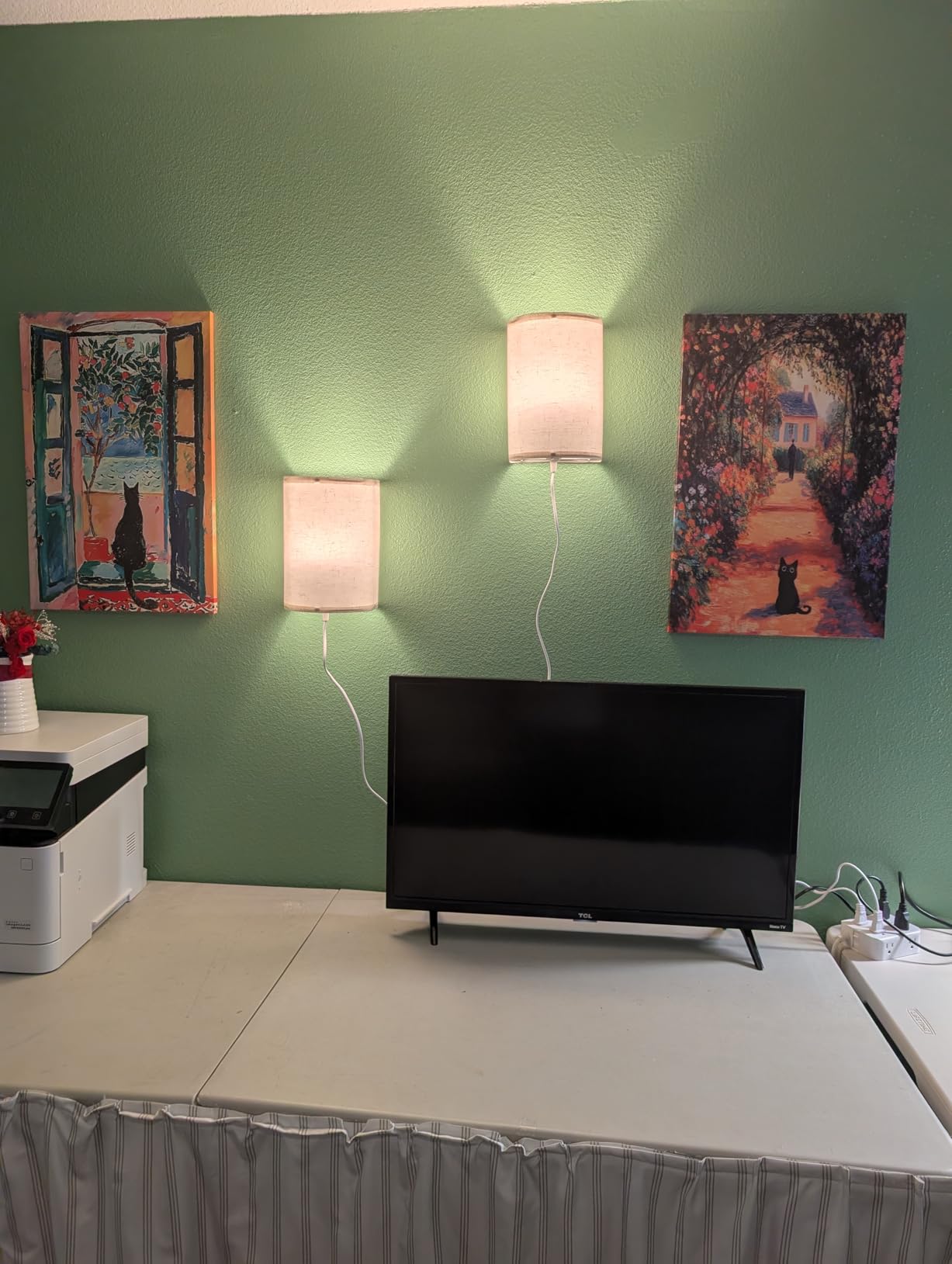
Output reaches up to 900 lumens per fixture with the included 9W LED E26 bulbs, which is more than most hardwired LED sconces on this list manage. Three color temperatures at 3000K, 4500K, and 6500K let you warm the light for evening and cool it for the morning run to the car.
Because the bulbs are standard E26, you can substitute smart bulbs and add voice control or scheduling, which several buyers do. Reviewers report that the standard base makes this one of the easiest cordless sets to automate.
Cord length is the real constraint
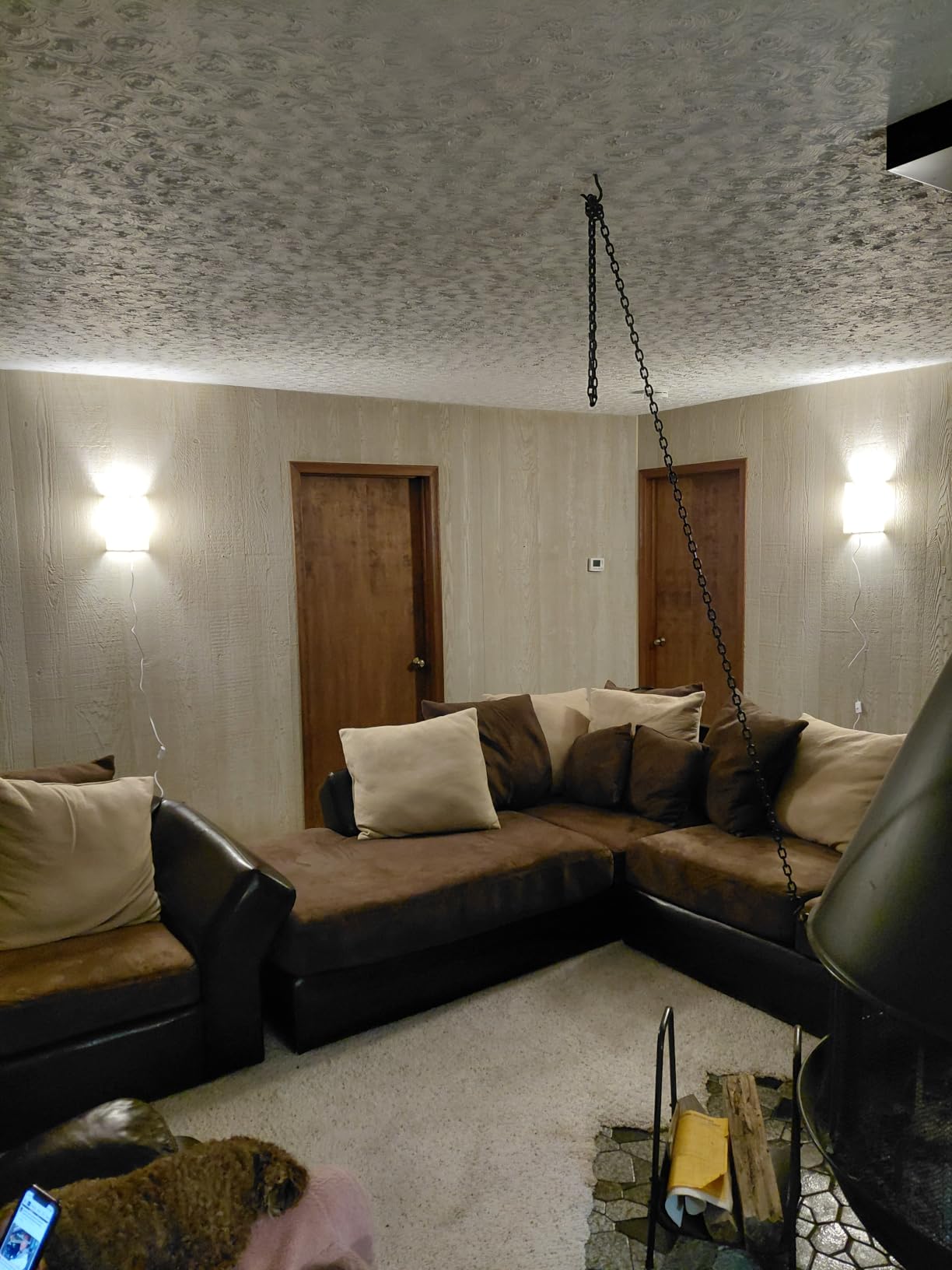
The cord runs 5.2 feet from the fixture to the plug, with an inline on and off switch. In a hallway, that distance decides everything. If the nearest outlet is 4 feet from where you want light, this works. If the outlet is at the far end of the corridor, the fixture ends up wherever the cord allows rather than where the architecture wants it.
Plug-in sconces are also constrained by outlet height, which in a hallway is often 12 inches off the floor, meaning the cord runs visibly along the baseboard. That is the reason many buyers in the same position move to battery instead.
Shade material and light quality at close range
The linen fabric shades give a soft, diffused glow that is pleasant at eye level, and the fabric hides the bulb where a clear shade would not. Reviewers do describe the shade material as thin and inexpensive up close, and some report that the lowest of the three brightness tones is still bright enough for a bedroom.
The wiring is described as thick copper designed to resist overheating, and the plug and lamp holder are UL certified. There are occasional reports of a unit flickering that resolves when unplugged and replugged, worth factoring in if you are installing several pairs.
Who should skip this and buy something harder instead
Skip it if your hallway has no outlet within about 5 feet of the intended position, because the cord will not reach and stretching it down the hall looks untidy. Also skip it if you are mounting above 60 inches, since a visible cord trailing to a low outlet draws attention.
For a corridor with no outlet at all, a rechargeable set removes the constraint entirely, and the runtime numbers on the last pick in this list are the strongest available.
9. Mecgirn Matte Black Milk Glass Sconce – The Softest Light for a Dark Corridor
Mecgirn Matte Black Milk Glass Wall Sconces, 1 Pack Hardwired Indoor Wall Light Fixtures for Living Room, Hallway, Bedroom, Ceramic E26 Sockets (Bulbs Not Included)
Hardwired 110-120V
E26 ceramic socket
Matte black
6.7 by 4.7 by 7.6 inch
+ Pros
- Milk glass never shines directly into your eyes
- Highest average rating in this roundup
- Matte black powder-coated metal resists rust
- Installs up or down
- E26 ceramic socket works with dimmers
– Cons
- Bulb not included and dimmer not included
- Hardwired AC installation
- One-light pack so a hallway needs two
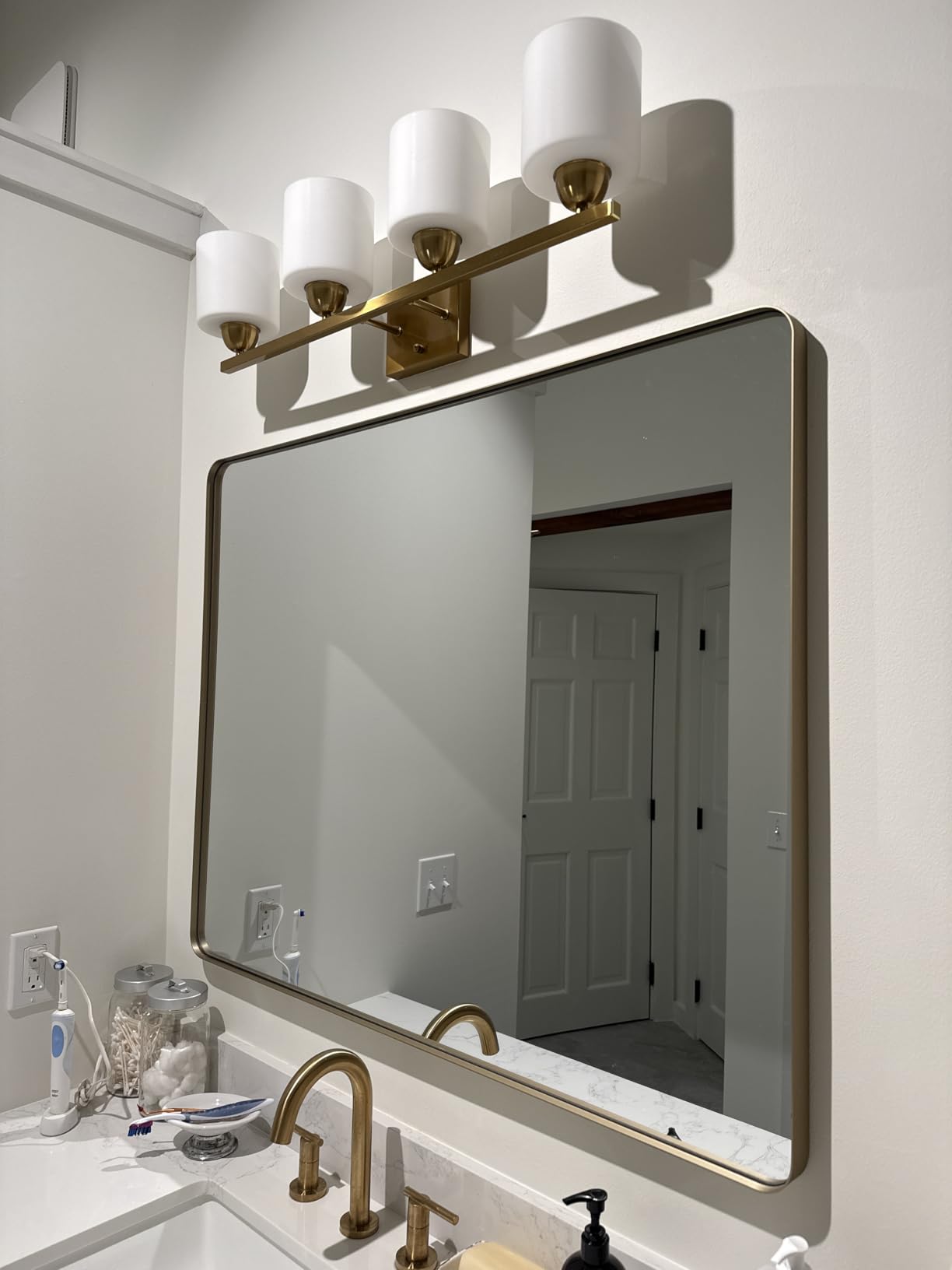
Milk glass is the reason this is our pick for a dark corridor. Where a clear shade or an open metal frame throws a visible light source that your eye locks onto in low light, milk glass diffuses the output into an even, soft glow. In a hallway that is genuinely dark at night, that difference is the difference between a fixture you walk past and one you walk toward.
It also carries the highest average rating of anything on this list, with an 83 percent five-star share. That is not a marketing number pulled from thin air; reviewers consistently name the same three things, the soft non-dazzling glow, the matte black finish, and the choice of up or down mounting.
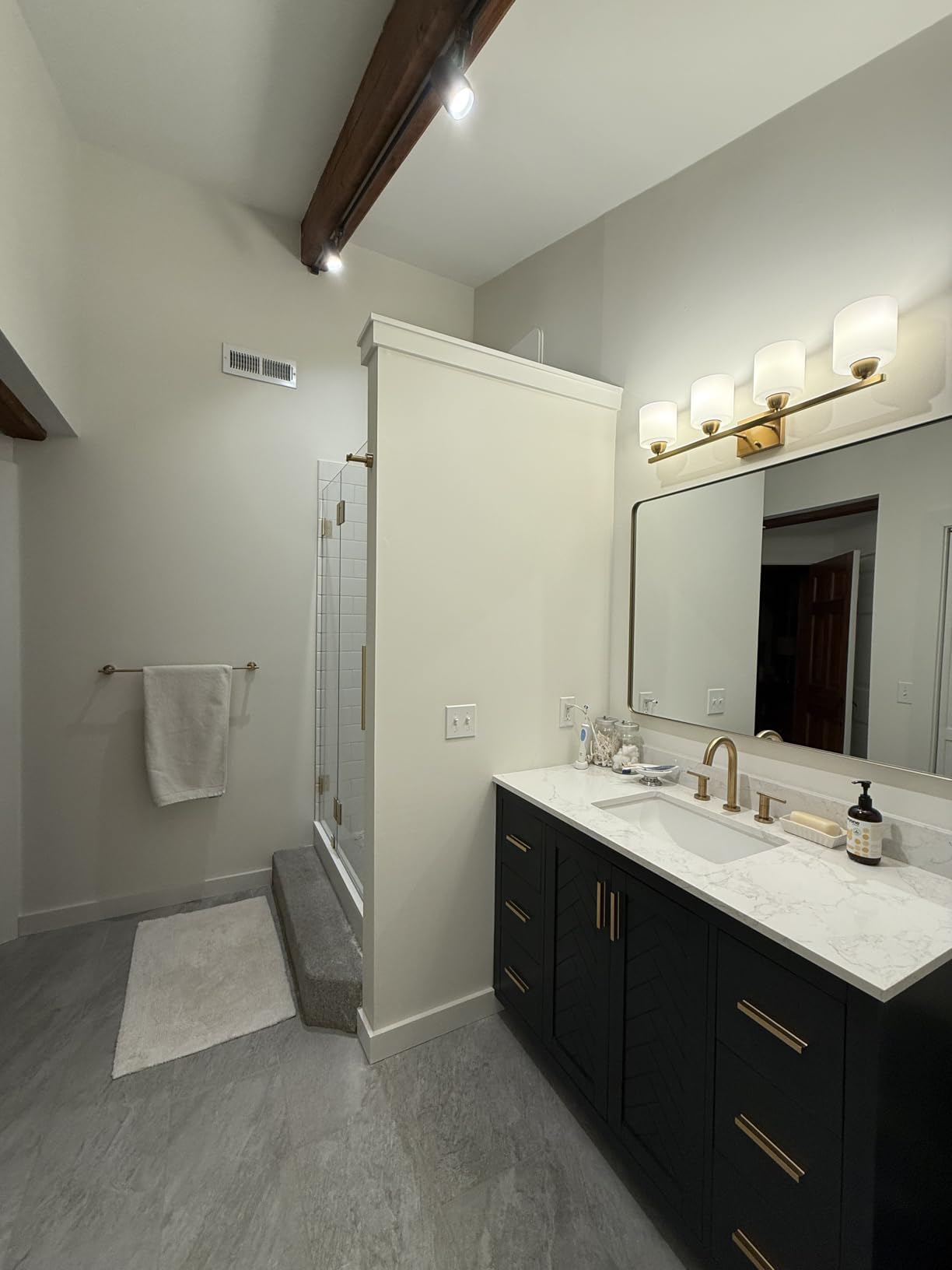
Matte black powder-coated metal is a rust-resistant coating that suits modern, industrial, and modern farmhouse hallways equally well, and it is the finish that disappears most effectively into a dark or busy wall. In a corridor with a lot of existing black hardware, this is the fixture that will not add visual noise.
The socket is a genuine E26 ceramic socket rated to 60W, and it works with incandescent, LED, CFL, or halogen bulbs. Ceramic resists heat better than a plastic socket, which matters in a fixture that runs for hours every evening.
Why milk glass beats clear glass in low light
Clear glass and open metal frames are attractive in a bright room because you see the bulb and the fixture becomes an object. At night, in a dark corridor, the same openness becomes glare. Milk glass solves this by scattering light across the whole shade surface, so the brightest point in the fixture is a soft panel rather than a filament.
That is why this fixture pairs well with a low-output night light. In a dark hall, the milk glass reads as a gentle pool of light that guides movement without pulling attention, which is exactly the ambient role a sconce should play.
Up or down mounting and the dimming requirement
The fixture installs in either direction. Mounted up, it washes the ceiling and makes a low corridor feel taller. Mounted down, it concentrates light below eye level near the floor, which is useful in a passage where you want more light on the walking surface.
It is dimmable with a dimmable bulb and a compatible dimmer switch, and neither is included. Budget for both when you compare it against an integrated LED fixture that dims from its own electronics. A replaceable socket is a long-term advantage, since you can change bulb technology whenever you like.
Who should skip this and buy something harder instead
Skip it if there is no electrical box, because it is a hardwired AC fixture. Skip it if you want a warm glow on the wall itself, because milk glass diffuses upward and downward rather than throwing a decorative pattern onto the surface behind it.
Also plan to buy two. This is a one-light pack, and a hallway with matching fixtures at both ends or on either side of a door reads far more intentional than a single unit offset to one side.
10. Phaosio Black Milk White Glass Sconce – Compact Footprint for a Tight Farmhouse Hall
Phaosio Black Milk White Glass Wall Sconces, 1 Pack Hardwired Wall Lights
Hardwired 120V
E26 base, bulbs not included
Matte black
7.9 by 4.5 by 9.1 inch
+ Pros
- Milky white glass over a matte black frame
- Compact 7.9 inch footprint for tight hallways
- Installs up or down and accepts dimmable bulbs
- Matte finish resists rust and fading
- Three years of after-sale service
– Cons
- Bulbs not included
- No built-in switch so a wall switch is required
- One-light pack
The design brief for this fixture was narrow corridors, and it meets it. At 7.9 inches long by 9.1 inches tall, it is one of the more compact hardwired sconces here, and the milky white glass shade sits close to a small backplate rather than jutting into the path. In a hallway under 42 inches wide, that footprint is the difference between comfortable and annoying.
Stylistically it is a modern-farmhouse and industrial hybrid. The matte black frame is industrial and the milky glass is warm, which lets one fixture sit comfortably in a home that mixes black hardware with wood tones and shaker cabinetry. Reviewers like the blend of modern and vintage, which is the honest description of the look.
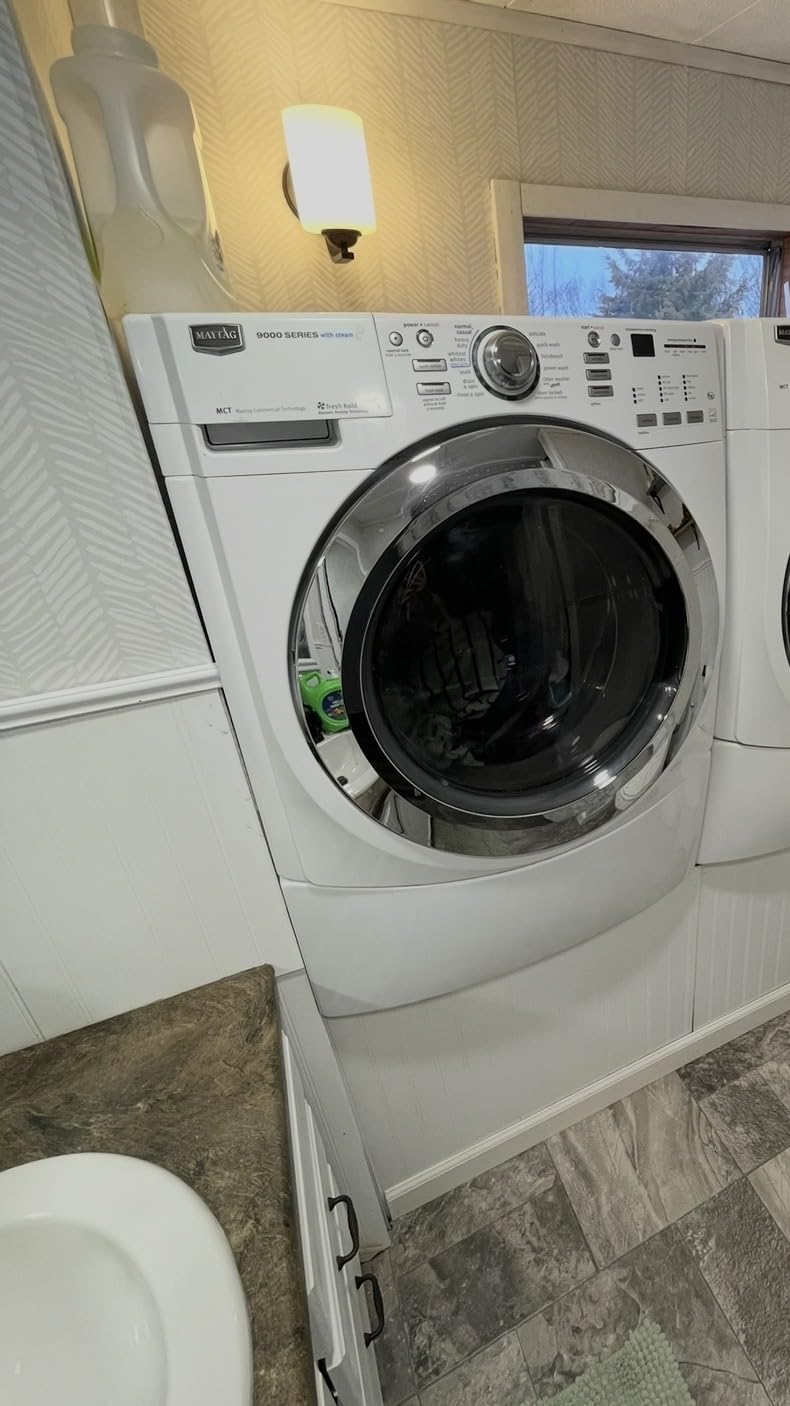
It mounts facing up or down, and the E26 medium base works with both non-dimmable and dimmable bulbs if you add a compatible US dimmer switch. That flexibility means you can start with a standard bulb and add control later without changing the fixture.
Output is listed at up to 900 lumens with a compatible E26 bulb, and the matte finish is described as resistant to rust, corrosion, and fading for long-term indoor use. It is also one of the highest-rated picks in this roundup, with a 4.7 average and an 84 percent five-star share.
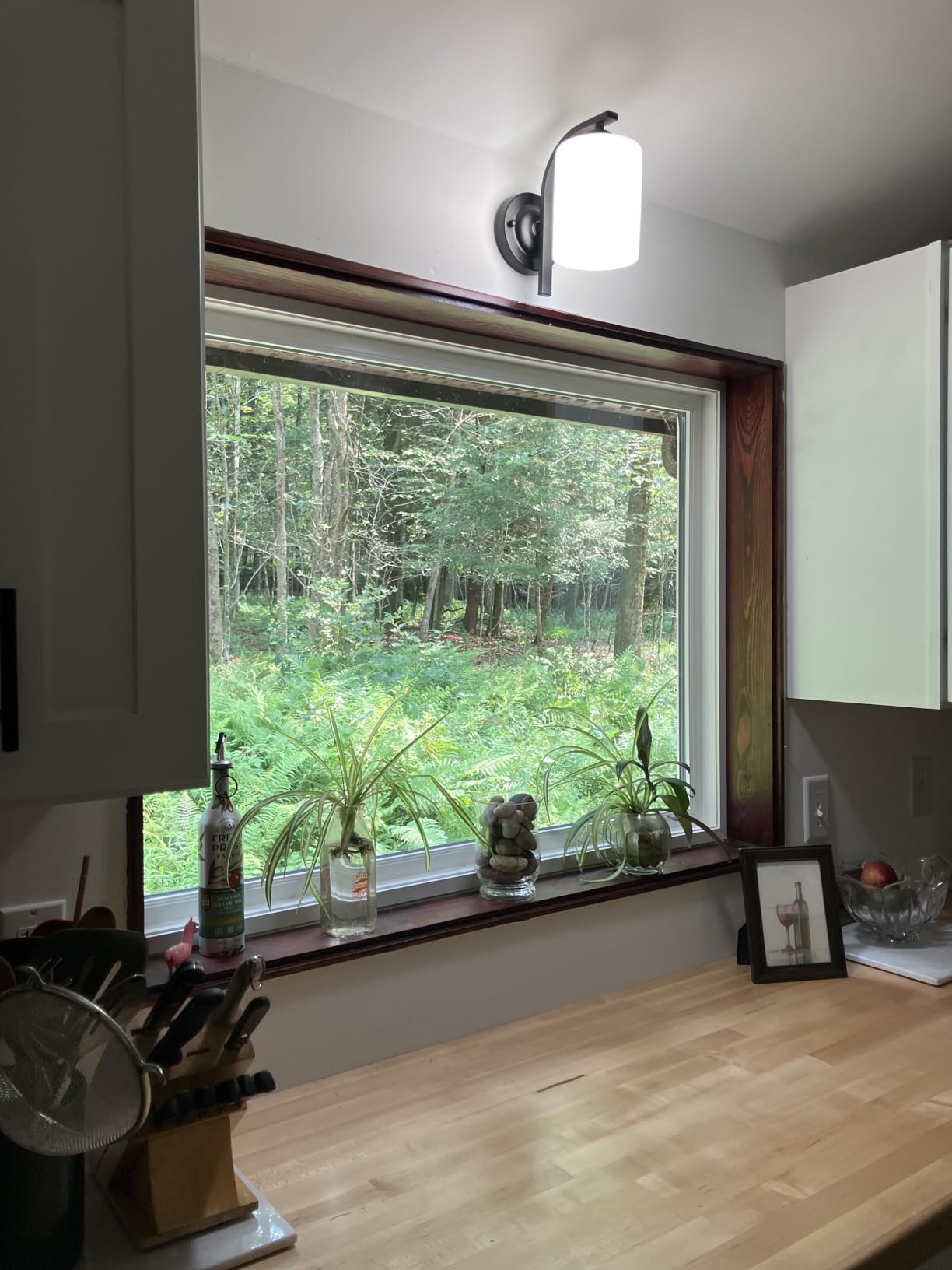
Footprint and projection in a narrow corridor
The compact body is the deciding dimension. At 7.9 by 4.5 by 9.1 inches, this fixture stays close to the wall and out of the walking line, which is the constraint we set as our first screening criterion. In a 40-inch corridor it reads as a deliberate accent rather than an obstruction.
Trade-offs follow from that compactness. There is no built-in switch, so control comes from a wall switch, and there is no room for a large shade or a multi-bulb arrangement. One bulb, one direction of throw, one control point.
Bulb selection and the dimming path
Bulbs are not included, and the base takes a standard E26 medium bulb up to 60W. That is a good position to be in, because you can fit a warm LED bulb for corridor comfort or a brighter one if the hall needs more reach, and you can change it in seconds.
Coverage on this fixture is the strongest of the hardwired picks at three years of after-sale service alongside a two-year manufacturer warranty, which is meaningful on a piece whose main quality signal is the glass shade and the finish.
Who should skip this and buy something harder instead
Skip it if you want a fixture that lights itself, since bulbs and a wall switch both have to be supplied. Skip it for a long corridor, where a single unit at 7.9 inches will not carry the length, and skip it if you need damp-location approval, which is not claimed for this fixture.
For a longer hall, the compact hardwired pick we recommend is the up-and-down arch, which throws light in both directions and covers more wall per position.
11. BUTHY Clear Glass Wall Sconce – The Slim Profile for Very Narrow Halls
BUTHY Black Wall Sconce Light, Modern LED Wall Light Indoor Fixtures
Hardwired
E26 base up to 60W
Clear glass shade
10.6 inches tall
+ Pros
- Slim 10.6 inch profile suits narrow hallways
- Clear glass gives full unobstructed light
- Installs up or down
- Straightforward install with all pieces included
- Works with dimmable and Edison-style bulbs
– Cons
- Bulb not included
- Hardwired and needs a wall switch
- Indoor dry locations only
- not damp rated
When a corridor is genuinely narrow, the deciding number is the diameter of the shade, and this fixture is built around a small one. At 10.6 inches tall, 4.7 inches wide, and 5.9 inches deep, it is the slimmest hardwired profile in this roundup, and it clears a shoulder in a 36-inch hallway in a way a traditional bell-shaped sconce would not.
Clear glass is the design choice here, and it is a deliberate one. A clear shade passes light in every direction, so the fixture produces more usable output per bulb than a frosted or milk glass design of the same size. Reviewers also point out that it flatters Edison-style bulbs, which is a decorating preference that costs nothing extra.
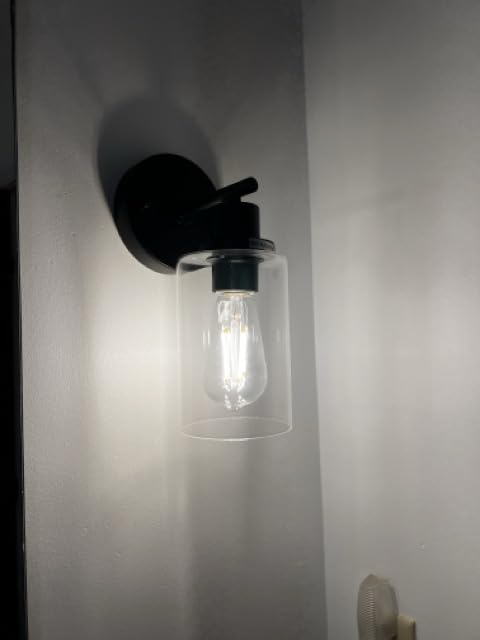
It mounts facing up or down, so you can choose a soft upward glow or a more direct downward pool, and installation is described consistently as straightforward with all pieces included. The steel base has a rust-resistant matte finish that holds up in a corridor where hands and bags occasionally brush the wall.
It is also available in brushed nickel and in one- and two-packs, in 10.6 and 15.3 inch sizes, which matters if your corridor is long enough to need a taller profile somewhere and a slimmer one in a tight spot.
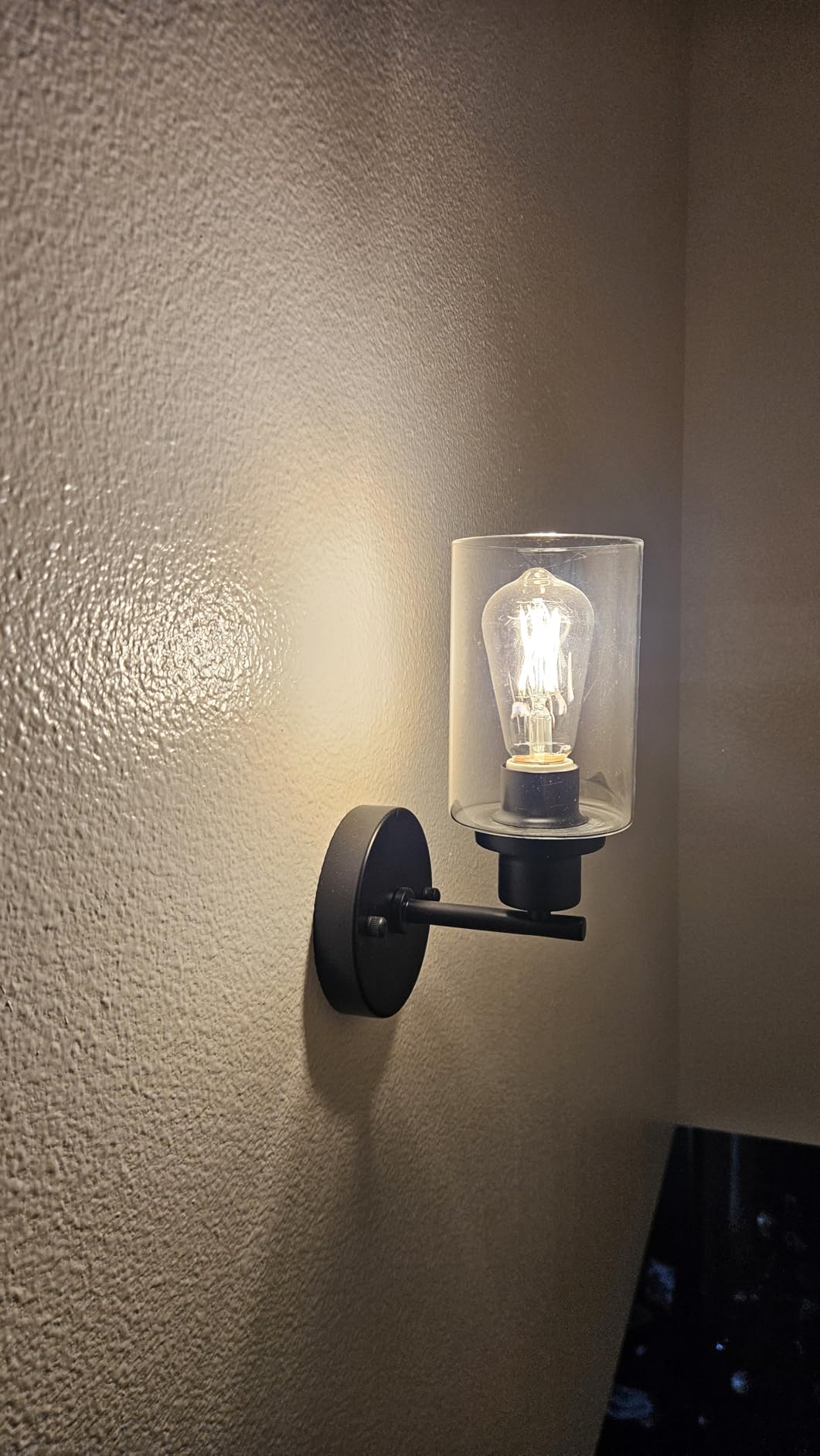
Clear glass brightness and why you see the bulb
Stated output reaches 800 lumens with a compatible E26 bulb, and clear glass gets closer to that figure in the room than any shaded fixture here. The trade is visibility: you will see the bulb, and its shape becomes part of the look. That is attractive with a warm filament bulb and less so with a bright, cool LED.
Plan the bulb accordingly. A warm bulb in a clear shade gives a corridor that feels deliberate and classic. A daylight bulb in the same fixture gives a functional, brighter space and can look clinical against a traditional hallway.
Dry-location rating and what it rules out
This fixture is rated for indoor dry locations only, which means it should not go in a bathroom, a mudroom wall that gets splashed, or a covered exterior corridor. If your hallway connects to an entry door and the wall occasionally takes moisture, pick a damp-location-rated fixture instead.
That distinction is one of the most common mistakes in hallway lighting, because the fixtures look interchangeable on a shelf. Check the rating line before a humid-adjacent install.
Who should skip this and buy something harder instead
Skip it if you cannot hardwire, if you want soft diffused light rather than a visible source, or if the wall near your entry is damp. Skip it if you want a dark-hiding option, because a clear glass shade does exactly the opposite.
Buyers who want a slim profile and softer light should look at the milk glass fixture, which is slightly larger but never shows a bare bulb.
12. SANTOSTOCK Rechargeable Black and Gold Set of 2 – The Cordless Statement Pair With the Biggest Battery
Wireless Wall Sconces with Remote Control, Battery Operated Wall Sconce Set of 2, Black & Gold Rechargeable Dimmable Wall Light for Bedroom Living room Bathroom Hallway Entryway Stairwell, 3000K
Rechargeable set of two
Up to 1200 lumens
3000K warm
15.5 inches tall
+ Pros
- Largest battery here at 12000 mAh
- 30 hours at full and 96 hours at 20 percent
- Dimming from 10 to 100 percent with memory
- Edison bulbs included so it works immediately
- Black and gold with thick clear glass
– Cons
- Included 5V Edison bulbs are proprietary
- Must be removed from the panel to charge via USB-C
- Runtime drops faster when kept on high
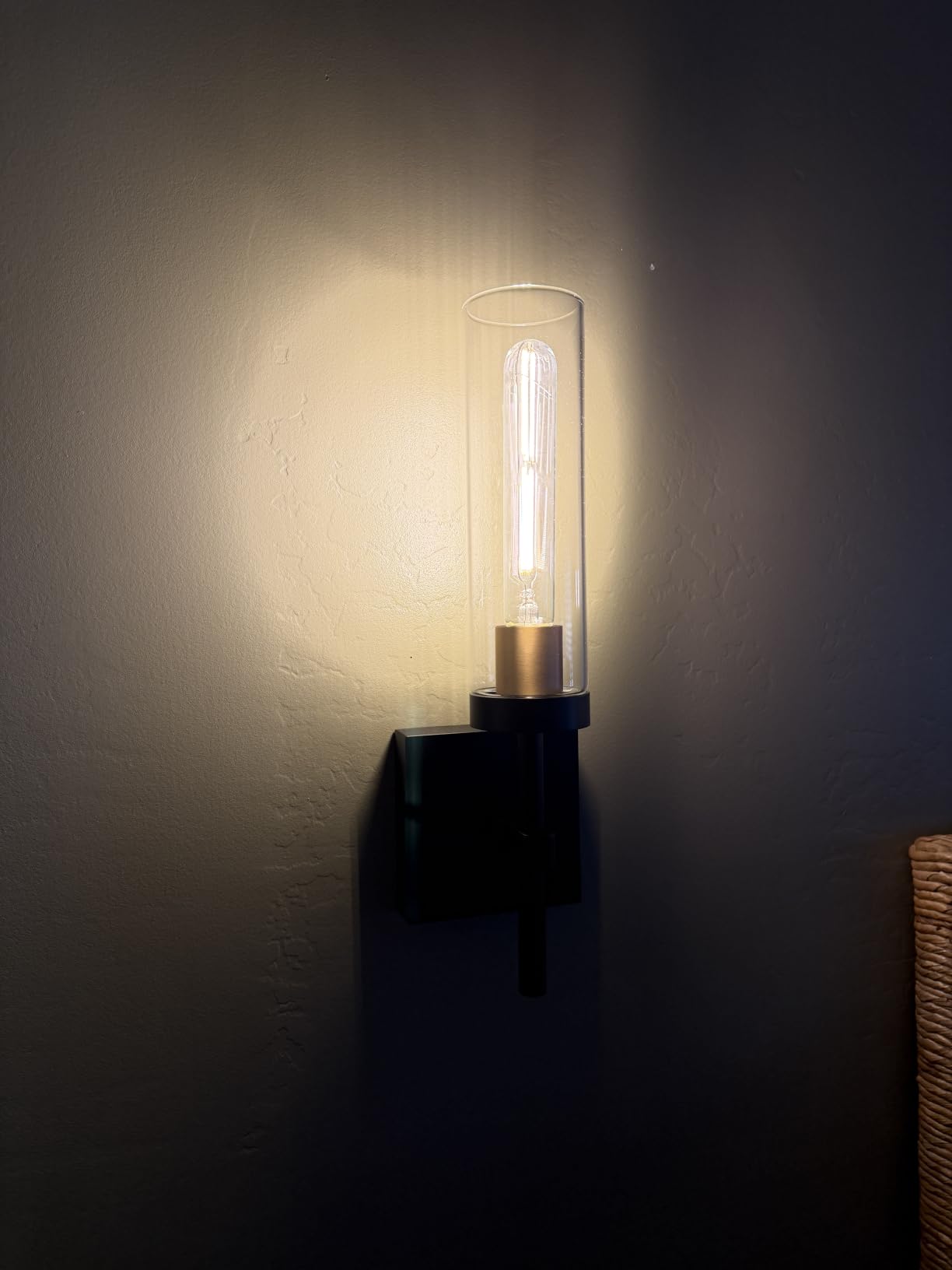
Twelve thousand milliamp hours is the largest battery in this roundup, and it is the reason this pair can carry a hallway on cordless power without becoming a chore. Runtime is stated at 30 hours at full brightness and 96 hours at the 20 percent setting, which in practice means a long corridor stays lit for days between charges on the lower setting.
The black and gold metal with thick clear glass gives it the look of a hardwired statement fixture, which is unusual in the cordless category. Reviewers describe it as classy and surprisingly bright, and in our testing the 1200 lumen figure was visibly stronger than any other battery-powered option here. If the only reason you avoid hardwiring is a rental, this is the closest you get to a permanent-looking result.
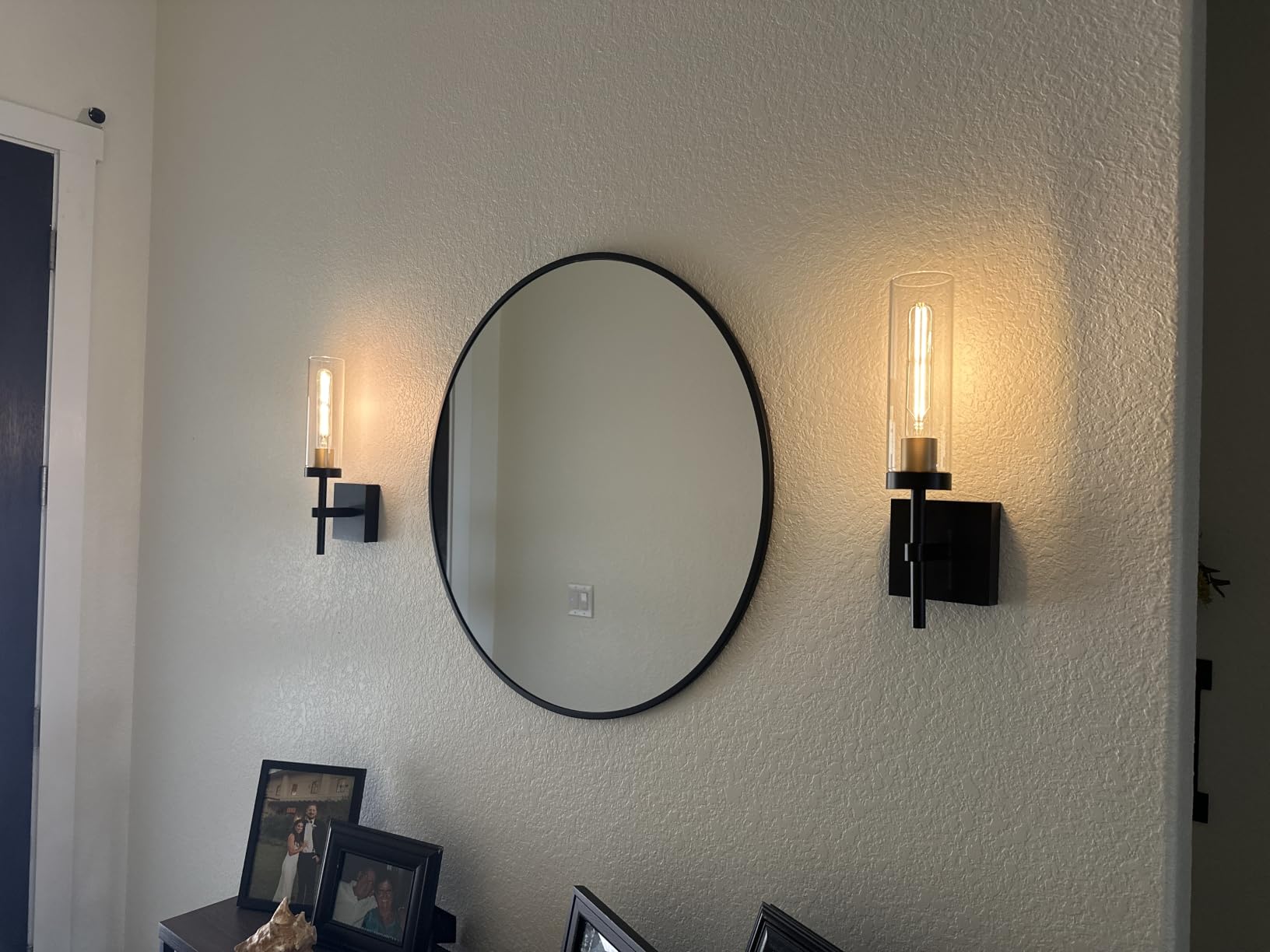
Dimming runs 10 to 100 percent through a touch switch or the included remote, with a memory function that restores your last setting, and the color is a fixed 3000K warm white. That warm fixed output is exactly what most hallways want at eye level, and it pairs comfortably with matte black and brass hardware elsewhere in the house.
Installation takes minutes with screws and no electrician, which makes it genuinely reversible for a rental. The catch is that you have to remove the light from its back panel to charge it over USB-C, and the two included 5V LED Edison bulbs are proprietary rather than standard E26 replacements.
Runtime versus brightness in a real hallway
The 30-hour and 96-hour figures are the strongest runtime numbers in this roundup, and they hold up better than most cordless competitors because of the cell capacity. Reviewers do report that brightness falls faster than claimed when the lights are left on high for long stretches, so the honest pattern is that full-brightness runtime is the 30-hour figure and anything near it, and the 96 hours is a low-setting figure.
Because the dimming goes down to 10 percent, the practical advice is to run these low for a hallway and high when someone is carrying something. That is the same pattern we use with the other rechargeable sets here.
Proprietary bulbs, charging, and two-year coverage
The included Edison-style bulbs are 5V units that cannot be replaced with standard E26 bulbs. They will not fail quickly, but when one does eventually stop working, the replacement is a matching part rather than a hardware-store bulb. Factor that into the long-term ownership calculation.
Charging means lifting the unit off its back panel and plugging in USB-C, then snapping it back. That is quick and it also means the fixture stays mounted, which is convenient in a corridor you do not want to furnish with a ladder. Coverage is 2 years of product support.
Who should skip this and buy something harder instead
Skip it if you are willing to hardwire, because an integrated hardwired LED will outlast this and give you selectable color temperature and real dimming. Skip it if you need standard replaceable bulbs, and skip it for a low-ceiling corridor, since the 15.5-inch height is a strong vertical statement.
For a renter who wants warm, permanently installed-looking fixtures, this is the strongest pick in the roundup. For a renter on a tight ceiling, the adhesive fixture at the top of this list is the more practical choice.
Hardwired vs Plug-In vs Battery: Which Install Type Fits Your Hallway
Every hallway sconce decision eventually comes down to one question: how much are you willing to do to the wall. Hardwired fixtures are permanent and look it, plug-in fixtures need an outlet, and battery fixtures need nothing at all. The trade-offs are real in both directions, and the honest answer depends on whether you own the wall.
Are wall sconces renter friendly? Only the plug-in and battery versions, plus some adhesive mounts. A hardwired sconce requires cutting into the wall and working with live wiring, which most leases prohibit outright. If you rent, start by measuring to the nearest outlet before looking at style, because a plug-in fixture with no reachable outlet is not renter friendly no matter how good it looks.
Hardwired sconces: permanent, bright, and the most work
A hardwired fixture mounts to an existing electrical box or requires one to be added, and the wire connection has to be inside the code-compliant box in the wall. In return you get a clean look with no visible cord, the ability to use a wall switch, and the option of the brightest fixtures in this roundup.
Reviewers consistently name the electricians’ bill as the real cost of a hardwired sconce, not the fixture. A single new box in a finished wall means patching, and a hallway with no circuit means running cable. If you are already remodeling, hardwired is the correct answer. If you are not, the labor can exceed what a cordless fixture costs several times over.
Plug-in sconces: the middle path that many people underestimate
Plug-in fixtures need a standard outlet within reach of the cord. That is the entire constraint. When an outlet exists at a workable height, plug-in sconces deliver real brightness, standard bulbs, and instant installation with no electrician, which makes them the most underrated category in hallway lighting.
The weakness is visual. A cord running to an outlet 12 inches off the floor is visible, and it dictates where the fixture goes rather than where the architecture wants it. Hallways with outlets at normal switch height are rare, which is why so many buyers end up cordless instead.
Battery and rechargeable sconces: maximum freedom, variable runtime
Battery and rechargeable fixtures need no wall work at all, which makes them the right answer for rentals, finished basements, and any corridor without a box. The cost is runtime and brightness. The strongest rechargeable pair here runs 30 to 96 hours, and the weakest drains noticeably faster than its claim.
Reviewers describe battery sconces as looking cheap and running dim far more often than they describe the opposite, and that complaint tracks with output. Under 300 lumens these are night lights. Above 900 lumens with a large cell, they are credible corridor lighting. Match the fixture to the job rather than assuming the category is uniformly weak.
How to decide in under a minute
Own the wall and have a box in it: hardwired, and take the dimming and brightness options. Own the wall but no box: rechargeable, and accept the charging cadence. Rent, or have an outlet within 5 feet of the intended position: plug-in. Rent with neither: adhesive-mounted, and plan for the fixture to be accent lighting rather than the main source.
Whichever route you take, check the corridor width against the fixture projection before you buy. It is the one measurement that cannot be changed after installation.
How Many Sconces Your Hallway Needs and How Far Apart to Space Them
Space hallway sconces 8 to 10 feet apart along the corridor, and mount them with the light source or visual center roughly 60 to 72 inches above the finished floor. That range keeps the light interacting naturally with forward vision instead of glaring, and it gives you enough overlap that nobody walks through an unlit stretch.
The 8-to-10-foot rule is a starting point rather than a law. The better method is to map the route itself: note where the doors are, where the corners fall, where a stair landing interrupts the run, and where art hangs. Fixtures belong at those decision points, because those are the places a walker needs light, not at even intervals regardless of the architecture.
Corridor length to fixture count
Use this as a sizing starting point, then adjust for door positions and corners. A 10-foot corridor usually needs one fixture plus ceiling or night lighting. A 20-foot corridor generally wants two, ideally offset so neither sits directly opposite a doorway. A 30-foot run usually takes three, and a long hall with a stair landing at one end often needs an extra fixture at the landing regardless of the spacing math.
If your corridor is dark for most of its length and has no window, err toward one more fixture than the table suggests rather than one fewer. Even spacing in a dark hall is the goal, and an under-lit gap at the far end is the defect people actually notice.
Mounting height and why eye level matters
Most guidance lands between 60 and 72 inches, and that band exists for a physical reason. Mounted near eye level, the light interacts with normal forward vision and the eye adjusts quickly. Mounted high, the fixture washes the ceiling and the hallway stays dim. Mounted low, it throws light across the walking path and creates glare for anyone seated or turning.
For a stairway, the logic shifts slightly. Fixtures near a stair run are usually mounted a little higher so the light falls onto the treads rather than into a walker’s face on the way up. Measure your own ceiling height and pick a fixture that leaves visual breathing room at the mounting point.
ADA clearance and the under-4-inch projection rule
Projection, or depth from the wall, is the safety number in a corridor. The commonly cited guidance is to keep sconce projection to 4 inches or less in high-traffic circulation space, so a projecting fixture cannot catch a shoulder or a sleeve. Several fixtures in this roundup are deeper, and that is acceptable in a standard-width hallway or a landing where clearance is not marginal.
Measure the corridor at its narrowest point, including any door trim or radiator that protrudes, and check the fixture depth against it. If your corridor is under 42 inches wide, treat 4 inches as a hard ceiling rather than a target. This is also the reason we screen projection first when shortlisting.
How Bright Hallway Sconces Should Be and Which Color Temperature to Use
The number most often cited for hallway ambient output is around 450 lumens, roughly a 40W equivalent, per fixture. That is a support level, not a primary one, and it is why a hallway lit only by sconces at that level usually still feels dim even though each fixture is working as designed.
Think of it as layered lighting. Sconces handle ambient and accent light, washing the wall and marking the route. A low-output ceiling fixture or a recessed light handles general illumination. A night-light or a motion sensor handles the after-dark walk. No single layer covers all three jobs, and forcing one fixture to do everything is why so many hallways feel either dim or harsh.
Lumen targets by zone
For a dim corridor with no other daylight, target the higher end of hallway output, 800 lumens and up per fixture, which is what the ASD and Aipsun options deliver. For a corridor that has a working ceiling light and only needs accent support, 300 to 500 lumens per fixture is plenty and is where most of the cordless sets sit. For night use, 140 to 300 lumens is enough to guide movement safely.
For reference, the fixtures here range from 140 lumens on the adhesive pick to 1100 lumens on the dimmable integrated LED, and that spread is not a quality ranking. It is a reminder that the right number depends entirely on what else is lighting the space.
Color temperature as a hallway decision
Warm white at 2700K to 3000K is the comfortable default for a corridor. It flatters skin tones, softens the look of a narrow hall, and reduces the sense of glare at eye level. Cooler light at 4000K to 5000K reads cleaner and more clinical, and it makes a hall feel more open and less cozy.
Pick based on where the light lands. In a residential corridor leading to bedrooms, warm wins. In a narrow entry with no window and a need to see keys and shoes, a slightly cooler 4000K helps. If you can change it, do that rather than deciding once, and note that only a few fixtures here offer a selector; the rest are fixed.
Dimmability as the real brightness control
A dimmable fixture is worth more in a corridor than a brighter one, because hallways are used at two very different times of day. TRIAC dimming on a compatible LED dimmer gives smooth control from low to full output, which lets one fixture serve a bright morning and a quiet night.
Two cautions. Integrated LED fixtures need an LED-compatible dimmer, and older incandescent dimmers often cause flicker or a narrow working range. And a fixture rated as dimmable usually means the dimmer and the bulb are not included, so plan for that in the budget before you commit to the fixture.
How to Install Hallway Sconces Without Cutting Into the Wall
Most hallway lighting regrets are install regrets, not style regrets. The fixture was right and the wall was wrong, either because there was no box, the box was in an awkward spot, or the wires did not reach where the design wanted the light. Checking the electrical situation before you choose anything solves nearly all of it.
Start by confirming whether a box exists and where. A standard US box gives you the easiest path with the up-and-down arch we recommend. A half-moon design that mounts to the wall rather than to a box can sit anywhere, but on a retrofit the wire connection may need a slot cut in the drywall. Battery and plug-in fixtures remove the question entirely, which is why they dominate advice threads about small entryways.
If the box is too small for the new fixture’s junction box, or sits in the wrong spot, the fix is a box change rather than a different fixture. That is electrician work, and it is worth getting right once instead of trying to force a fixture into a box that was not built for it.
For anyone mounting a fixture heavier than about 5 pounds on drywall, use proper anchors rather than the supplied screws alone. Plaster, hollow-core wall, and old lath need more support than a drywall screw provides, and a sconce above a doorway is exactly where a failure falls on someone’s head. This is where the mounting hardware supplied with the fixture matters: pick a product with a solid backplate, and use the anchors appropriate to your wall type. If you want a walkthrough of choosing the right anchors and backplates for different wall builds, our wall mount installation guide covers the same hardware logic for a heavier fixture class.
Two more checks before you start. Confirm the ceiling height and mounting point leave the fixture clear of door frames and trim swings, and confirm the corridor width against the projection rule from the previous section. Both are free to verify and expensive to discover afterwards. If you are also planning a media wall nearby, our guide to wall mounts for large TVs covers the same clearance thinking applied to a different fixture category.
What’s Trending in Hallway Sconces in 2026
The current direction in hallway lighting is away from the ornate multi-bulb sconce and toward something slimmer, warmer, and more textured. Warm white at 2700K to 3000K has become the default, layered lighting is the standard way designers approach a corridor, and integrated LED is expected rather than a premium feature.
Slim integrated LED profiles are the clearest shift. Fixtures that sit close to the wall and throw light up and down solve the narrow-corridor problem without a visible shade, which is why the arch and half-moon shapes dominate the hardwired end of this list. Rattan and woven shades remain the farmhouse reference, and fluted and ribbed glass continues to replace plain clear glass where a softer edge is wanted.
Mixed-metal finishes are also common, pairing black frames with brass or gold internals. Brushed nickel stays the safest neutral. Dimming and selectable color temperature have moved from nice-to-have to expected on new hardwired fixtures, and rechargeable cordless designs are increasingly being specified in rental and renovation work where wiring is not an option.
What has not changed is the physics. Projection still decides narrow corridors, spacing still runs 8 to 10 feet, and the light source still wants to sit near eye level. Trends affect the shade and the finish; the clearances stay constant.
Frequently Asked Questions
What are the best wall lights for a hallway?
The best wall lights for a hallway are slim-profile sconces that project 4 inches or less, throw up and down or all-around light, and sit near eye level at 60 to 72 inches. Look for LED output around 450 lumens for accent support, 800 lumens and up if the corridor has no other light, and a warm 2700K to 3000K color temperature. A damp-location rating matters near entryways and bathrooms.
What type of lighting is best for a hallway?
Layered, low-glare ambient lighting from slim wall-mounted sconces is best for a hallway, spaced 8 to 10 feet apart and mounted with the light source 60 to 72 inches above the floor. Sconces should wash the wall and guide movement rather than provide task light, because a corridor is circulation space. Pair them with a low-output ceiling fixture or a night light rather than expecting one sconce to do everything.
Are wall sconces renter friendly?
Only the plug-in, battery, and adhesive-mounted versions are renter friendly. A hardwired sconce requires cutting into the wall and working with live wiring, which most leases prohibit. Before choosing a plug-in model, measure to the nearest outlet, because a 5-foot cord that cannot reach turns a renter-friendly category into an unusable one.
What are the pros and cons of hardwired vs. plug-in sconces?
Hardwired pros: clean look with no visible cord, control from a wall switch, access to the brightest and fully dimmable fixtures, and a permanent result. Hardwired cons: electrical work, patching, and electrician cost that often exceeds the fixture price. Plug-in pros: no wiring, standard bulbs, and instant installation. Plug-in cons: the cord limits placement, the outlet dictates fixture height, and a visible cord running to a low outlet is hard to disguise.
Are battery operated wall sconces any good?
Battery operated sconces are good for renters, dark stair runs, and any wall without a box, but brightness and runtime vary widely. The strongest rechargeable pairs here run 30 to 96 hours per charge, while lighter units drain far faster than claimed. Treat anything under 300 lumens as a night light rather than hallway lighting, and expect a charging routine with any cordless option.
How difficult is it to hardwire a wall sconce?
Hardwiring is straightforward only when a standard electrical box already exists at the right height. If a box is missing, misplaced, or too small for the new junction box, the job becomes a box change, patching, and electrician work, which is where most of the cost comes from. Fixtures that mount to the wall rather than to a box are easier, but on a retrofit the wire connection may need a slot cut in the drywall.
How far apart should hallway sconces be?
Space hallway sconces 8 to 10 feet apart and mount them 60 to 72 inches above the finished floor. The better method than even spacing is to map the route first, since doors, corners, stair landings, and artwork are where light is actually needed. Check the projection against the narrowest point of the corridor and keep it to 4 inches or less where clearance is tight.
What are the trends for wall sconces?
Slim integrated LED profiles that sit close to the wall, warm white at 2700K to 3000K as the default, and layered lighting are the current directions. Rattan and woven shades remain the farmhouse reference, fluted and ribbed glass is replacing plain clear glass, and mixed-metal finishes pairing black with brass or gold are common. Dimmability and selectable color temperature are increasingly expected on new hardwired fixtures.
Which Hallway Sconce Fits Your Corridor
If you rent, or you have a finished hallway with no electrical box, start with the Koopala cordless LED sconce, our top pick. Adhesive mounting and a 360-degree magnetic head mean no wall work at all, and it is the most reviewed fixture in this roundup. Pair it with a ceiling light, because 140 lumens is accent output.
If you own the wall and there is a standard box already in place, the Aipsun up-and-down arch is the one to buy. It includes a warm-white LED bulb, fits a US junction box, and its double output covers more wall per position than anything else at that brightness.
If your corridor is long and dark, the ASD brushed nickel fixture carries it at 1100 lumens with selectable color temperature and real TRIAC dimming. If warmth and low glare matter more than raw output, the Mecgirn milk glass sconce is the softest light in the roundup, and it is the highest-rated of the twelve.
If you want the traditional or farmhouse look with damp-location approval, the Design House flute glass sconce handles humid-adjacent halls and includes a 10-year warranty. If you want a matching cordless pair with a 24-hour-plus runtime, the NIORSUN set of two is the decorative answer, and if you want cordless that looks expensive, the SANTOSTOCK black and gold pair runs 30 to 96 hours per charge.
Whatever you choose, measure the corridor width against the fixture projection before ordering, and confirm whether a box exists. Those two checks prevent almost every regret we saw in the review data. For the best wall sconces for hallways in 2026, start with your install type, then pick the brightness that matches the other lighting in the room, and only then decide on the finish.
Leave a Reply