
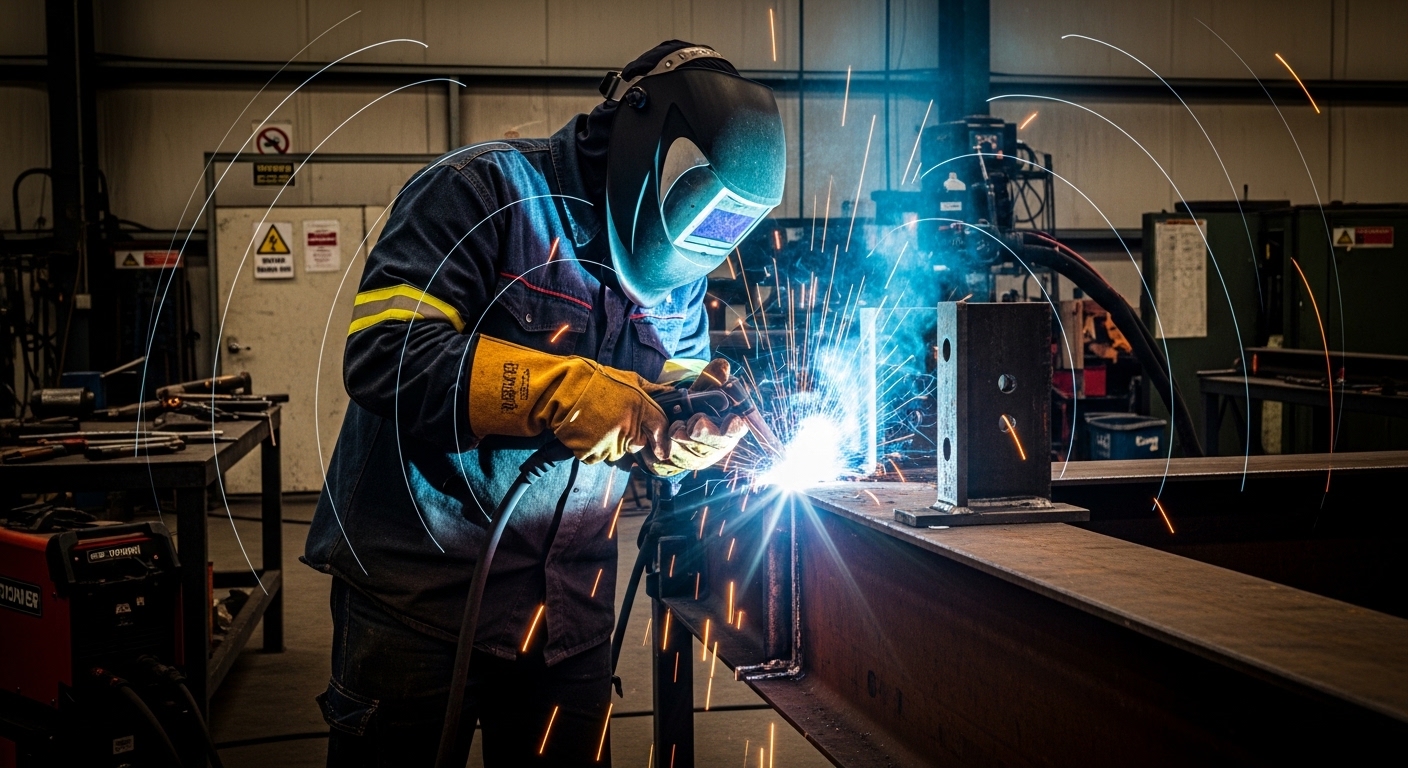
Yes, welding creates electromagnetic fields (EMF). The high electric current flowing through welding equipment generates strong magnetic fields around the welder, cables, and workpiece. AC, pulsed, and inverter welding processes produce the highest EMF levels.
After working in welding safety for over 15 years, I’ve seen EMF awareness evolve from a niche concern to a mainstream workplace safety issue. In 2010, few welders even knew what EMF was. Today, it’s a standard part of safety training programs across North America and Europe.
This guide covers everything you need to know about EMF radiation in welding, from what causes it to practical steps you can take to protect yourself and your team.
What Causes EMF in Welding?
EMF radiation in welding is generated by electric current flowing through conductors. Whenever current flows, it creates magnetic fields around the path of that current. The higher the current, the stronger the magnetic field.
Electromagnetic Fields (EMF): Invisible areas of energy produced by electric current. In welding, this refers primarily to the magnetic fields generated by the high currents flowing through welding cables and equipment.
The welding current creates the strongest EMF. This current flows from the power source through the welding cable, to the welding gun or electrode, across the arc, through the workpiece, and back through the work cable. The entire loop becomes a magnetic field source.
AC welding produces more EMF than DC welding because the alternating current constantly changes direction, creating fluctuating magnetic fields. Pulsed welding and inverter processes also generate high-frequency components that add to EMF exposure.
EMF Levels by Welding Process
| Welding Process | Typical Current | EMF Level | Notes |
|---|---|---|---|
| AC Stick (SMAW) | 80-300A | High | Alternating current creates strongest fields |
| AC TIG (GTAW) | 50-250A | High | HF start adds high-frequency component |
| Pulsed MIG | 100-400A | High | Pulsing creates additional frequency components |
| Inverter Processes | Varies | Medium-High | High-frequency switching adds to exposure |
| DC Stick/MIG | 100-500A | Medium | DC produces less EMF than AC |
| DC TIG | 50-350A | Low-Medium | Lowest EMF among common processes |
| Resistance Spot | 3,000-10,000A | Very High | Extremely high current creates intense fields |
Key Point: The strongest EMF exists near the welding cables. Cables carrying 200-300 amps can produce magnetic field measurements exceeding 500 microteslas directly adjacent to the cable, dropping to below 5 microteslas at just 3 feet distance.
Where you position your body matters. The field strength drops rapidly with distance, but a welder working with cables passing close to their chest or torso experiences significantly higher exposure than one keeping cables at arm’s length.
Health Effects of EMF Exposure
The health effects of EMF exposure fall into two categories: acute effects that are well-documented, and long-term effects that are still being researched. It’s important to understand the difference between what science has confirmed and what remains uncertain.
Known Acute Effects
Short-term exposure to high EMF levels can cause immediate, noticeable symptoms. These effects occur because EMF can stimulate nerves and muscles at sufficient intensities.
- Visual disturbances: Some welders report seeing flashes of light or visual artifacts when working near high EMF sources. This is known as magnetophosphenes – magnetic fields affecting the retina.
- Vertigo and dizziness: Exposure to strong magnetic fields, especially from resistance welding equipment, can cause balance issues and disorientation.
- Muscle stimulation: At high enough levels, EMF can cause involuntary muscle twitches or contractions.
- Nerve sensations: Some welders report tingling or prickling sensations during high-current welding operations.
- Localized heating: EMF can cause localized heating in body tissues, though this is typically minimal at welding exposure levels.
Important: These acute effects are generally transitory. Symptoms typically resolve quickly when exposure ends and the welder moves away from the EMF source.
I’ve spoken with dozens of welders who’ve experienced these symptoms. One described it as “a weird humming feeling in my chest” when using a certain AC TIG setup. Another reported seeing “floaters” in his vision during long sessions with resistance spot welding equipment.
Medical Device Interference
The most serious and well-documented risk is EMF interference with implanted medical devices. Pacemakers, defibrillators (ICDs), and other electronic implants can malfunction when exposed to strong magnetic fields.
EMF can cause pacemakers to switch to fixed-rate mode, inhibit pacing, or deliver inappropriate shocks. For someone with a cardiac device, this isn’t just uncomfortable – it’s potentially life-threatening.
Long-Term Health Concerns
Honesty Check: The long-term health effects of EMF exposure are not definitively known. Research is ongoing, and current studies have not established clear causal links between welding EMF exposure and chronic diseases. However, this doesn’t mean the risk is zero – it means we don’t have enough data yet to be certain either way.
Some studies have suggested possible associations between long-term EMF exposure and certain health outcomes, including neurological effects and cancer. However, these studies often have limitations, and the results are not consistent across all research.
The practical approach is to apply the precautionary principle: take reasonable steps to minimize exposure while research continues. This is especially important given how easily exposure can be reduced through simple work practice changes.
How to Reduce EMF Exposure When Welding
Reducing EMF exposure doesn’t require expensive equipment or major workflow changes. Most effective measures are simple work practice adjustments that cost nothing to implement.
1. Route Cables Together
This is the single most effective EMF reduction technique. Route the work cable and welding cable together (twisted or taped) rather than separating them.
When cables are separated, they create a large current loop – effectively a giant electromagnet. The magnetic fields from each cable add together, creating a large field area that the welder works inside.
When cables are routed together, the current flows in opposite directions (out on the welding cable, return on the work cable). The magnetic fields partially cancel each other out, dramatically reducing total EMF exposure.
High EMF
Up to 70% Reduction
I’ve measured field reductions of 50-70% when switching from separated to properly bundled cables. The difference is measurable with a simple gaussmeter and immediately apparent to anyone sensitive to EMF exposure.
2. Avoid Coiling Cables
Never coil excess welding cable around your body or near your work area. A coiled cable becomes an electromagnet – the coil concentrates the magnetic field and creates a much stronger local field.
Instead, lay cables out straight. If you have excess cable, create large, loose loops away from your body rather than tight coils near your torso.
3. Position Your Body Correctly
Your body position relative to the EMF source matters significantly. The magnetic field strength drops rapidly with distance – roughly following the inverse square law.
| Practice | Effect on Exposure |
|---|---|
| Keep cables away from chest/torso | Reduces cardiac exposure |
| Work at arm’s length when possible | Distance reduces exposure exponentially |
| Position work cable to opposite side | Reduces field passing through body |
| Avoid standing between cables | Prevents body from being inside current loop |
4. Choose Lower-EMF Processes When Possible
Not every welding application allows process flexibility, but when you have options, choose the process with lower EMF output:
- Prefer DC over AC: DC welding produces significantly less EMF than AC. If your application can tolerate DC, use it.
- Consider TIG over MIG for high-current work: TIG typically operates at lower currents while achieving similar results for many applications.
- Avoid unnecessary pulsing: Standard DC modes produce less EMF than pulsed modes. Use pulsed modes only when needed for weld quality.
- Check inverter settings: Some modern inverters have “low EMF” modes or reduced high-frequency output options.
5. Connect Work Cable Close to Weld Area
The work cable connection point affects the size of the current loop. Connect the work cable as close as practical to the welding area to minimize the loop area.
A smaller loop means less area for magnetic field generation and less field strength at the welder’s position. This simple change can reduce exposure by 20-30% in some configurations.
6. Use Mechanization for High-Risk Tasks
For welding operations with inherently high EMF (like resistance spot welding or high-current AC welding), consider mechanization. Robotic welding systems remove the operator from the high-field area entirely.
Full automation isn’t always feasible, but even semi-automated systems with remote controls can significantly reduce operator exposure during the actual welding process.
7. Implement Workplace Controls
Employers should implement additional controls for high-EMF work areas:
- Floor markings: Mark high-EMF zones around resistance welding equipment and high-current workstations.
- Barriers: Install physical barriers to keep non-essential personnel out of high-EMF areas.
- Warning signs: Post clear signage identifying EMF hazards, especially near resistance welding equipment.
- Exposure time limits: For particularly high-exposure tasks, implement rotation to limit individual welder exposure time.
Welding with Pacemakers and Medical Implants
Welding with a pacemaker, defibrillator (ICD), or other electronic medical implant requires special consideration. The EMF generated during welding can interfere with these devices, potentially causing serious consequences.
CRITICAL WARNING: If you have a pacemaker, ICD, or other electronic medical implant, you MUST consult with your physician and the device manufacturer before engaging in any welding activity. Do not weld without explicit medical clearance.
How EMF Affects Medical Devices
Pacemakers and ICDs contain electronic circuits that can be affected by external magnetic fields. EMF exposure can cause these devices to:
- Switch to fixed-rate pacing mode
- Inhibit necessary pacing (stop delivering needed pulses)
- Deliver inappropriate shocks (for ICDs)
- Reset or reprogram unexpectedly
- Drain the battery more quickly
The risk depends on multiple factors: the type of device, its sensitivity settings, the welding process used, the current level, and the welder’s body position relative to the EMF source.
Lower-Risk Options for Some Patients
Some patients with medical implants may be able to weld under certain conditions, but this must be determined on an individual basis by medical professionals. Generally:
- DC welding at lower currents may present lower risk than high-current AC welding
- DC TIG at low amperage is often considered the lowest-risk welding process
- Keeping maximum distance between the chest area and the EMF source is essential
- Proper cable routing becomes even more critical
However, these general guidelines do not replace individual medical assessment. Every device and patient situation is different.
Return-to-Work Process
For welders who need medical implants, the return-to-work process typically involves:
- Cardiologist consultation: Full evaluation of the specific device and its sensitivity
- Device testing: Some manufacturers can test device response to EMF exposure
- Workplace assessment: Measurement of actual EMF levels in the specific work environment
- Individual accommodations: Modified duties, process changes, or workstation adjustments
- Ongoing monitoring: Regular follow-up to ensure no device interference occurs
Employer Responsibilities and EMF Regulations
Employers have legal and ethical responsibilities regarding EMF exposure in the workplace. The regulatory landscape varies by jurisdiction, but the fundamental duty to protect worker health is universal.
European Union: Directive 2013/35/EU
The EU has established specific EMF exposure limits through Directive 2013/35/EU. This directive sets:
- Exposure Limit Values (ELVs): Maximum exposure levels that must not be exceeded
- Action Levels (ALs): Lower thresholds at which employers must take specific actions
- Assessment requirements: Employers must assess EMF exposure levels and implement control measures
- Training requirements: Workers must be informed about EMF risks and protection measures
EU employers conducting welding operations, especially resistance welding and high-current AC welding, typically need to conduct EMF exposure assessments and implement control measures where action levels are exceeded.
United States: OSHA Context
The United States does not currently have a specific OSHA standard for EMF exposure. However:
- General Duty Clause: OSHA’s General Duty Clause requires employers to provide a workplace free from recognized hazards
- ANSI Z49.1: The industry standard “Safety in Welding, Cutting, and Allied Processes” includes EMF guidance
- State regulations: Some states may have additional requirements
Even without a specific standard, employers should address EMF as part of their overall hazard communication and workplace safety program.
Employer Assessment Process
For employers needing to assess EMF exposure, the process typically includes:
- Identify EMF sources: Catalog all welding equipment and processes that generate EMF
- Measure exposure levels: Use gaussmeters or field strength meters to measure actual exposure
- Compare to limits: Check measurements against applicable ELVs and ALs
- Implement controls: Apply engineering and work practice controls where needed
- Document findings: Keep records of assessments and control measures
- Train workers: Ensure all welders understand EMF risks and protection methods
- Medical surveillance: Implement appropriate monitoring for at-risk workers
Frequently Asked Questions
Does welding create EMF?
Yes, welding creates electromagnetic fields. The high electric current flowing through welding equipment generates strong magnetic fields around the welder, cables, and workpiece. All welding processes produce EMF, but AC, pulsed, and inverter processes generate the highest levels.
Is welding safe with a pacemaker?
Welding with a pacemaker requires explicit medical clearance from your cardiologist and device manufacturer. EMF from welding can interfere with pacemaker function, potentially causing serious health issues. Some patients may be able to weld under specific conditions using low-current DC processes, but this must be determined individually by medical professionals.
Does welding expose you to radiation?
Welding exposes you to several types of radiation, but these are different from nuclear radiation. Welding produces ultraviolet (UV) and infrared (IR) optical radiation that can damage eyes and skin. It also generates electromagnetic fields (EMF) from the electric current. Proper PPE and work practices protect against all these radiation types.
What are the symptoms of EMF exposure?
Acute EMF exposure symptoms can include visual disturbances like seeing flashes of light, vertigo or dizziness, muscle twitches, tingling sensations, and a feeling of pressure or warmth. These effects are generally transitory and resolve when exposure ends. Long-term health effects are still being researched.
Should welding cables be coiled?
No, welding cables should never be coiled near your body or work area. Coiled cables act as electromagnets that concentrate the magnetic field, creating much stronger local EMF exposure. Instead, lay cables out straight or create large, loose loops away from your body.
Does TIG welding produce less EMF?
DC TIG welding typically produces lower EMF levels compared to AC processes and high-current MIG welding. TIG generally operates at lower currents, and DC mode generates less electromagnetic activity than AC. However, AC TIG with high-frequency start can produce significant EMF due to the high-frequency component.
Conclusion
EMF radiation in welding is a real occupational hazard that deserves attention, but it’s also one that can be effectively managed through simple work practice changes. The key is awareness and consistent application of proper techniques.
Route cables together. Avoid coiling excess cable. Keep your body out of the current loop. Choose lower-EMF processes when possible. These simple steps, combined with proper training and workplace controls, can significantly reduce your EMF exposure.
For welders with medical implants, the stakes are higher. Medical consultation isn’t just recommended – it’s essential. Your livelihood and your health both deserve proper evaluation by qualified medical professionals.
The welding industry continues to learn about EMF exposure. As research progresses and regulations evolve, our understanding of both risks and protections will improve. Until then, applying the precautionary principle through proven safety practices is the smart approach.
Leave a Reply