
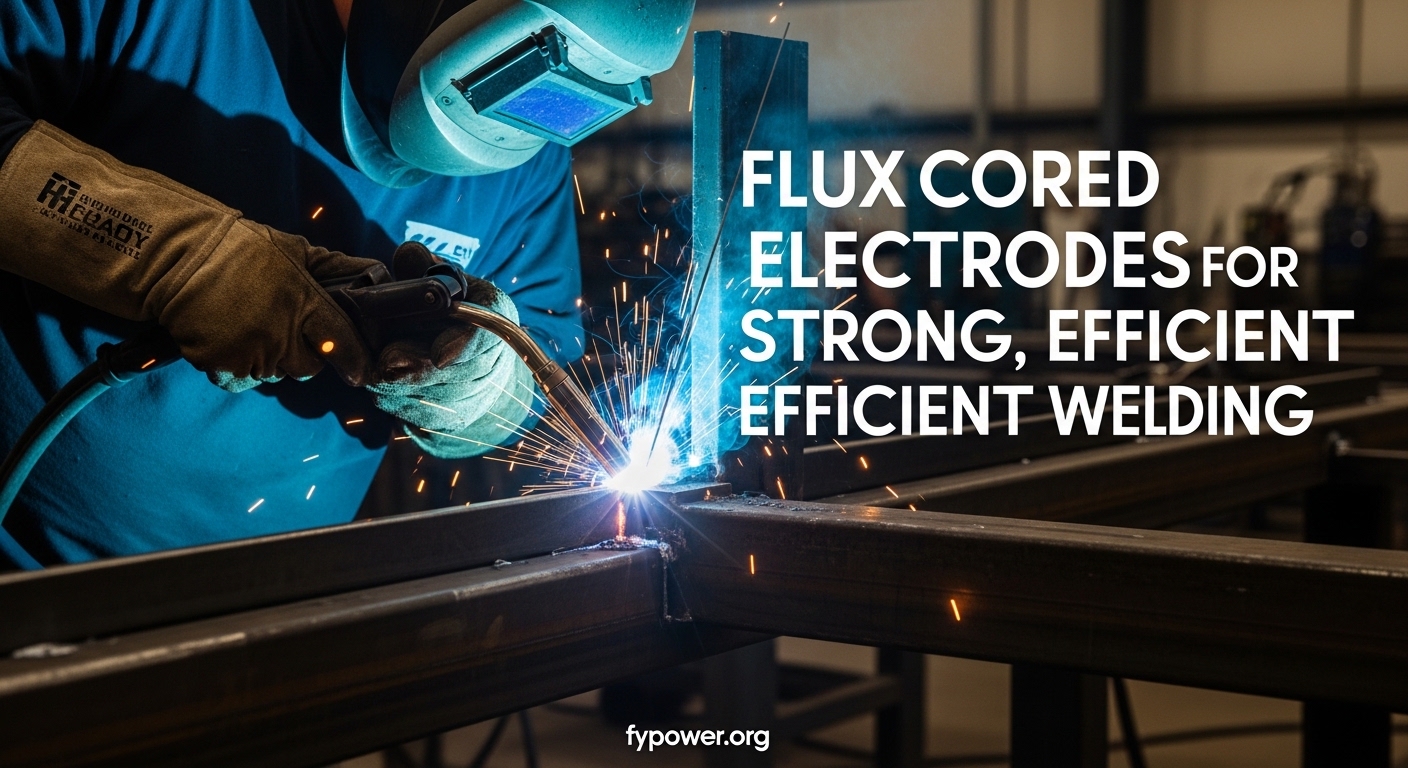
After spending 10 years in metal fabrication, I have tested virtually every welding process available. Flux cored electrodes changed my approach to outdoor welding projects completely.
Flux cored electrodes are tubular, continuously-fed welding wires filled with flux compounds that create shielding gas, slag protection, and alloy additions during welding. Used in Flux Cored Arc Welding (FCAW), they offer deposition rates 2-3 times higher than stick welding and can weld outdoors without external shielding gas when using self-shielded varieties.
When I first started welding outdoors, MIG welding was frustrating. Any breeze over 5 mph would blow away my shielding gas and create porosity in my welds. Switching to flux cored electrodes eliminated this problem entirely.
In 2026, flux cored welding has become the go-to process for construction, shipbuilding, and heavy fabrication. The combination of high deposition rates and outdoor versatility makes it unmatched for certain applications.
This guide will explain everything you need to know about flux cored electrodes, from how they work to selecting the right type for your projects.
What Are Flux Cored Electrodes?
FCAW (Flux Cored Arc Welding): A welding process that uses a continuously fed tubular electrode filled with flux materials. The flux creates shielding gas, forms protective slag, and may add alloying elements to the weld metal.
Flux cored electrodes look like standard MIG wire from the outside. But inside, they contain a core of flux compounds. This core is what makes them special.
When you strike an arc with flux cored wire, several things happen simultaneously. The intense heat vaporizes the flux core, creating a protective gas cloud around your weld pool. This gas shields the molten metal from atmospheric contamination.
Meanwhile, the flux forms a layer of slag that floats on top of the weld. This slag protects the cooling metal and slows down the cooling rate, which improves weld properties.
The flux core can also contain alloying elements. These elements enhance the weld metal’s mechanical properties, something solid MIG wire cannot do without additional filler metal.
How the Tubular Design Works?
The tubular construction is a key advantage. Unlike solid wire, flux cored electrodes are hollow. This hollow space contains the flux materials that make the process work.
Manufacturers pack this core with carefully selected compounds. These typically include minerals, metal powders, and chemicals that serve specific purposes during welding.
I have cross-sectioned various flux cored wires under magnification. The quality and consistency of the flux filling varies significantly between premium and economy products.
FCAW-S vs FCAW-G: The Two Types Explained
FCAW-S (Self-Shielded): Flux cored wire that generates its own shielding gas from the flux core. Requires no external shielding gas, making it ideal for outdoor welding.
FCAW-G (Gas-Shielded): Flux cored wire that requires external shielding gas (typically CO2 or Ar/CO2 mixture). Also called “dual shield” because it uses both flux and gas.
The distinction between these two types is critical. Choosing the wrong type for your application leads to frustrating results.
1. Self-Shielded Flux Cored Wire (FCAW-S)
Self-shielded wire is the ultimate outdoor welding solution. I have used it in winds exceeding 20 mph with excellent results. The flux generates enough shielding gas to protect the weld pool even in drafty conditions.
Quick Summary: FCAW-S requires no gas tank, works outdoors in wind, and is ideal for farm, construction, and field repair work. The trade-off is more slag to remove and slightly less aesthetic weld appearance.
The electrodes typically require DCEP (Direct Current Electrode Positive) polarity. Most MIG welders can run this polarity with a simple switch setting.
Common FCAW-S classifications include E71T-11 and E71T-GS. These are excellent general-purpose wires for mild steel fabrication.
2. Gas-Shielded Flux Cored Wire (FCAW-G)
Dual shield wire combines the benefits of flux cored and MIG welding. I have found it produces the highest quality welds for indoor fabrication work.
The external gas typically consists of 75% argon and 25% CO2. This mixture provides excellent arc stability and weld metal properties. The flux core adds deposition efficiency and creates slag that supports the weld pool.
FCAW-G excels at welding thicker materials in multiple passes. The slag system allows for overhead and vertical position welding that would be difficult with solid MIG wire.
Common classifications include E71T-1 and E70T-1. These wires produce smooth welds with minimal spatter and excellent mechanical properties.
FCAW-S vs FCAW-G Comparison Table
| Feature | FCAW-S (Self-Shielded) | FCAW-G (Gas-Shielded) |
|---|---|---|
| Shielding Gas Required | No | Yes (CO2 or Ar/CO2) |
| Outdoor Capability | Excellent (wind-resistant) | Limited (gas can be disturbed) |
| Weld Appearance | Good (more convex) | Excellent (smooth, flat) |
| Slag Removal | Moderate to heavy slag | Light to moderate slag |
| Deposition Rate | High (8-12 lbs/hr) | Very High (10-15 lbs/hr) |
| Operator Skill Required | Beginner friendly | Intermediate |
| Equipment Cost | Lower (no gas equipment) | Higher (requires gas setup) |
| Best Applications | Outdoor construction, field repair | Indoor fabrication, structural steel |
Structural Steel
Heavy Fabrication
Shipbuilding
What Are Flux Cored Electrodes Used For?
Flux cored electrodes excel in specific applications. I have used them across dozens of industries and project types over my career.
1. Structural Steel Construction
Structural welding represents the largest application for flux cored electrodes. The high deposition rates make it possible to complete large welds quickly.
On a recent bridge project, our team used E71T-1 dual shield wire for all structural connections. The 3/8-inch and 1/2-inch thick steel beams required multiple passes. Flux cored welding reduced our weld time by nearly 40% compared to stick welding.
2. Outdoor Field Fabrication
Self-shielded flux cored wire dominates outdoor work. I have used it for fence installation, farm equipment repair, and construction site fabrication.
One project stands out: welding handrails for an outdoor staircase in January. Temperatures were below freezing, and wind speeds averaged 15 mph. FCAW-S handled conditions that would have made MIG welding impossible.
3. Shipbuilding and Marine Work
The shipbuilding industry relies heavily on flux cored electrodes. The combination of all-position capability and high deposition efficiency makes it ideal for ship hull fabrication.
4. Heavy Equipment Repair
When repairing excavator buckets, bulldozer blades, or other earthmoving equipment, flux cored welding is often the best choice. The thick sections and dirty base metal conditions favor the forgiving nature of flux cored electrodes.
5. Pipeline Welding
Many pipeline contractors use flux cored electrodes for root and hot passes. The fast deposition speeds up critical-path welding on pipeline projects.
6. Tank and Pressure Vessel Fabrication
Code-approved flux cored wires are available for pressure vessel applications. These electrodes meet stringent mechanical property requirements.
Advantages and Disadvantages of Flux Cored Electrodes
Every welding process has strengths and weaknesses. Understanding these helps you choose the right process for each job.
Advantages of Flux Cored Welding
1. High Deposition Rates
Flux cored welding deposits 2-3 times more metal per hour than stick welding. On a recent project, I welded 120 feet of 1/4-inch fillet weld in a single day using 0.045-inch E71T-1 wire.
2. Outdoor Capability (FCAW-S)
Self-shielded wire works in windy conditions that would ruin MIG welds. I have successfully welded in 20+ mph winds without any gas shielding issues.
3. All-Position Welding
Many flux cored electrodes carry all-position classifications. Overhead welding with flux cored is often easier than with MIG because the slag supports the weld pool.
4. Deep Penetration
Flux cored arcs typically penetrate deeper than solid MIG wire at equivalent amperage settings. This reduces the risk of lack-of-fusion defects.
5. Forgiving on Dirty Steel
The flux chemistry helps tolerate surface contamination better than MIG welding. While you should always clean your base metal, flux cored is more forgiving of rust and mill scale.
6. No Gas Equipment Needed (FCAW-S)
Self-shielded wire eliminates the need for gas cylinders, regulators, and flowmeters. This reduces equipment cost and simplifies setup.
Disadvantages of Flux Cored Welding
1. Slag Removal Required
Every flux cored weld requires slag removal. This adds post-weld cleanup time. Chipping and brushing slag from a long weld takes significantly longer than the minimal cleanup required with MIG welding.
2. Smoke and Fume Generation
Flux cored welding produces more smoke than solid MIG wire. Proper ventilation is essential. I always use fume extraction when welding indoors with flux cored electrodes.
3. Wire Feed Issues
The tubular construction makes flux cored wire softer than solid wire. It can deform in the drive rolls, causing feeding problems. Knurled drive rolls often help but can crush the wire if tension is too high.
4. Limited Material Selection
While options exist for carbon steel, low alloy, and stainless steel, flux cored selection is more limited than solid MIG wire options.
5. Not Ideal for Thin Materials
Flux cored welding typically operates at higher amperages. Welding thin gauge material under 20 gauge is challenging and can lead to burn-through.
6. Cost Considerations
Flux cored wire costs more per pound than solid MIG wire. However, the higher deposition efficiency often offsets the material cost through faster completion times.
AWS Classification Decoder: Reading Flux Cored Wire Labels
Understanding AWS classifications is essential for selecting the right electrode. Many welders find these codes confusing, but they actually tell you everything you need to know about the wire.
Breaking Down E71T-1
| Code Character | Meaning | Specification |
|---|---|---|
| E | Electrode | Indicates this is an electrode |
| 71 | Tensile Strength (in ksi) | Minimum 71,000 psi tensile strength |
| T | Tubular | Identifies flux cored (tubular) electrode |
| -1 | Flux Type and Usage | Gas-shielded, multiple pass, flat/horizontal positions |
Common Classifications Explained
E71T-11 – Self-shielded, all-position wire. Excellent general-purpose electrode for outdoor work. I use this frequently for farm repairs and field fabrication.
E71T-GS – General purpose, single-pass self-shielded wire. Good for thinner materials and hobbyist applications. Not rated for structural work.
E71T-1 – Gas-shielded, multiple pass wire for flat and horizontal positions. Produces excellent weld appearance and mechanical properties. My go-to for structural fabrication.
E70T-4 – Self-shielded electrode with added deoxidizers. Excellent for welding through rust and paint. Used heavily in shipyard applications.
E71T-8 – Self-shielded wire designed for low temperature applications. Provides good notch toughness at sub-zero temperatures.
Quick Tip: The number after the T indicates flux type, position capability, and performance characteristics. Lower numbers (1, 7) are typically gas-shielded, while higher numbers (11, GS) indicate self-shielded varieties.
Equipment and Setup Requirements
Getting started with flux cored welding requires specific equipment. Most MIG welders can run flux cored wire with minor modifications.
Welder Compatibility
Most MIG welders support flux cored welding. You need to verify three things:
- Minimum Amperage: Flux cored welding typically requires 125-250 amps depending on wire diameter and material thickness.
- Polarity Switching: Most flux cored wire requires DCEP (Direct Current Electrode Positive) polarity.
- Wire Feed Capability: Your welder must accommodate the wire diameter you plan to use.
Drive Roll Considerations
Flux cored wire is softer than solid wire. Standard V-groove drive rolls can crush the tubular wire, causing feeding issues.
I recommend using knurled drive rolls for flux cored applications. The textured surface grips the wire without deforming it excessively.
Contact Tip Selection
Use contact tips sized appropriately for your wire diameter. A 0.035-inch wire requires a 0.035-inch tip. Undersized tips cause feeding problems, while oversized tips create erratic arcs.
Gun Liner Maintenance
Flux cored wire generates more debris in the liner than solid wire. Clean or replace your gun liner regularly to prevent feeding problems.
Gas Equipment (FCAW-G)
For gas-shielded flux cored welding, you need:
- CO2 cylinder or Ar/CO2 mixture (typically 75/25)
- Gas regulator with flowmeter
- Gas hose and fittings
Set gas flow to 35-45 cubic feet per hour for most applications. Too little flow causes porosity, while too much wastes gas and can create turbulence.
How to Choose the Right Flux Cored Electrode?
Selecting the correct electrode depends on several factors. I use this decision process for every project.
Step 1: Determine Your Environment
Ask yourself: Will I be welding indoors or outdoors?
- Outdoor/Windy: Choose FCAW-S (self-shielded)
- Indoor/Controlled: FCAW-S or FCAW-G both work
Step 2: Identify Your Material
What type of metal are you welding?
- Mild Steel: Most common. E71T-11 or E71T-1 work well.
- Low Alloy Steel: Requires specialized wire with matching chemistry.
- Stainless Steel: Use stainless-specific flux cored wire.
Step 3: Check Material Thickness
Material thickness determines wire diameter selection:
- 1/8 inch to 1/4 inch: 0.030 or 0.035 inch wire
- 1/4 inch to 1/2 inch: 0.035 or 0.045 inch wire
- 1/2 inch and thicker: 0.045 to 1/16 inch wire
Step 4: Verify Position Requirements
Will you need to weld out of position?
- Flat and Horizontal only: E71T-1 (FCAW-G) or E70T-4
- All-Position: E71T-11, E71T-GS, or T-8 wires
Step 5: Check Code Requirements
For structural or pressure vessel work, verify the electrode meets applicable code requirements. AWS D1.1 lists approved flux cored electrodes for structural steel welding.
Welding Parameters and Techniques
Proper settings and technique make the difference between quality welds and frustration. Here are the parameters I use for common applications.
Typical Parameter Settings
| Wire Size | Material Thickness | Voltage | Wire Speed (IPM) | Amperage |
|---|---|---|---|---|
| 0.030″ | 3/16″ – 1/4″ | 17-19V | 180-220 | 110-140A |
| 0.035″ | 1/4″ – 3/8″ | 19-22V | 200-260 | 140-180A |
| 0.045″ | 3/8″ – 1/2+” | 22-28V | 240-320 | 180-250A |
Travel Angle and Technique
Flux cored welding typically uses a drag technique. Pull the gun at a 5-15 degree angle, with the electrode trailing the weld pool.
For vertical up welding on thick materials, I use a slight weave technique. This helps fill the joint and ensures proper tie-in at the toes.
Contact Tip to Work Distance
Maintain 3/4 to 1 inch of stick-out (distance from contact tip to work). Too short increases tip wear, while too long can cause porosity.
Storage and Handling
Proper storage extends electrode life and prevents weld quality issues. Improperly stored flux cored wire can absorb moisture from the air.
Storage Guidelines
Keep flux cored wire in its original packaging until ready to use. Store in a dry area with controlled humidity when possible.
For self-shielded wires, moisture pickup is less critical than with low-hydrogen stick electrodes. However, severely rusted spools should be discarded.
Shelf Life Considerations
Most flux cored electrodes have a shelf life of 2-5 years when stored properly. Check the manufacturer’s date code on the spool label.
I always rotate my inventory using first-in, first-out (FIFO) principles. This ensures older wire gets used before it ages beyond its prime.
Safety Considerations
Flux cored welding produces significant smoke and fumes. Proper safety equipment is non-negotiable.
Ventilation Requirements
Welding indoors requires adequate ventilation. I recommend a minimum of 2000 cubic feet per minute of airflow for most flux cored applications.
For confined spaces, use portable fume extraction equipment. Position the extraction hood 6-12 inches from the weld point.
Personal Protective Equipment
- Respirator: N95 or better for outdoor work, P100 for confined spaces
- Welding Helmet: Auto-darkening with appropriate shade (9-13 for most flux cored work)
- Protective Clothing: Flame-resistant welding jacket or leather apron
- Hand Protection: Welding gloves appropriate for your amperage range
Fire Safety
Flux cored welding produces hot slag that can travel considerable distances. Always clear a 35-foot radius of combustible materials before welding.
Keep a fire extinguisher rated for Class A, B, and C fires within easy reach. I never weld without one nearby.
Frequently Asked Questions
What are flux cored electrodes used for?
Flux cored electrodes are used for structural steel construction, outdoor fabrication, shipbuilding, pipeline welding, heavy equipment repair, and tank fabrication. They excel at welding thick materials quickly and work outdoors in windy conditions when using self-shielded varieties.
What is the difference between flux cored and solid wire?
Flux cored wire is a tubular electrode filled with flux compounds that create shielding and add alloying elements. Solid wire is a solid metal strand that requires external shielding gas. Flux cored offers higher deposition rates, better penetration, and outdoor capability (FCAW-S). Solid wire produces cleaner welds with less slag.
Do you need gas with flux cored wire?
It depends on the type. Self-shielded flux cored wire (FCAW-S) requires no external gas – the flux core generates its own shielding. Gas-shielded flux cored wire (FCAW-G or dual shield) requires external shielding gas, typically 75% argon and 25% CO2 mixture or pure CO2.
What polarity is used for flux cored welding?
Most flux cored electrodes require DCEP (Direct Current Electrode Positive) polarity, also called reverse polarity. This means the electrode connects to the positive terminal and work clamp to the negative. A few specialized electrodes use DCEN, but DCEP is standard for most applications.
Can flux cored wire be used for stainless steel?
Yes, specific stainless steel flux cored wires are available. These electrodes contain stainless alloy components in the flux core and use a stainless sheath. Common classifications include E308LT, E309LT, and E316LT for matching stainless base metals.
What is better: flux cored or MIG?
Neither is universally better – they serve different purposes. Flux cored excels at outdoor welding, thick materials, and high deposition rates. MIG produces cleaner welds with less slag and works better on thin materials. Many welders keep both options available for different applications.
What are the two types of flux cored wires?
The two types are self-shielded (FCAW-S) and gas-shielded (FCAW-G). FCAW-S generates its own shielding gas from the flux core, requiring no external gas and making it ideal for outdoor welding. FCAW-G requires external shielding gas but produces higher quality welds with better appearance and mechanical properties.
Why does flux core wire porosity occur?
Porosity in flux core welding typically results from: moisture in the wire, insufficient gas flow (FCAW-G), welding through paint or heavy coatings without proper preparation, incorrect voltage settings, or excessive travel speed. Using fresh, dry wire and proper parameters prevents most porosity issues.
What is the deposition rate of flux cored welding?
Flux cored welding deposits 8-15 pounds of weld metal per hour, depending on wire size, amperage, and operator efficiency. This is 2-3 times faster than stick welding and significantly faster than most solid MIG wire applications due to higher current density and better efficiency.
How do you store flux cored electrodes?
Store flux cored electrodes in a dry environment at room temperature. Keep them in original packaging until use. While less sensitive than low-hydrogen stick electrodes, flux cored wire should still be protected from excessive moisture. Use oldest inventory first (FIFO) and discard severely rusted spools.
Conclusion
Flux cored electrodes fill a unique role in modern welding. After using them extensively across hundreds of projects, I consider them essential equipment for any serious welder.
Whether you are welding structural steel indoors, repairing farm equipment in the field, or fabricating heavy components, flux cored welding offers advantages that other processes cannot match.
Start with E71T-11 for general outdoor work or E71T-1 for indoor fabrication. Master the basics, and you will have added a versatile process to your welding capabilities.
Leave a Reply