
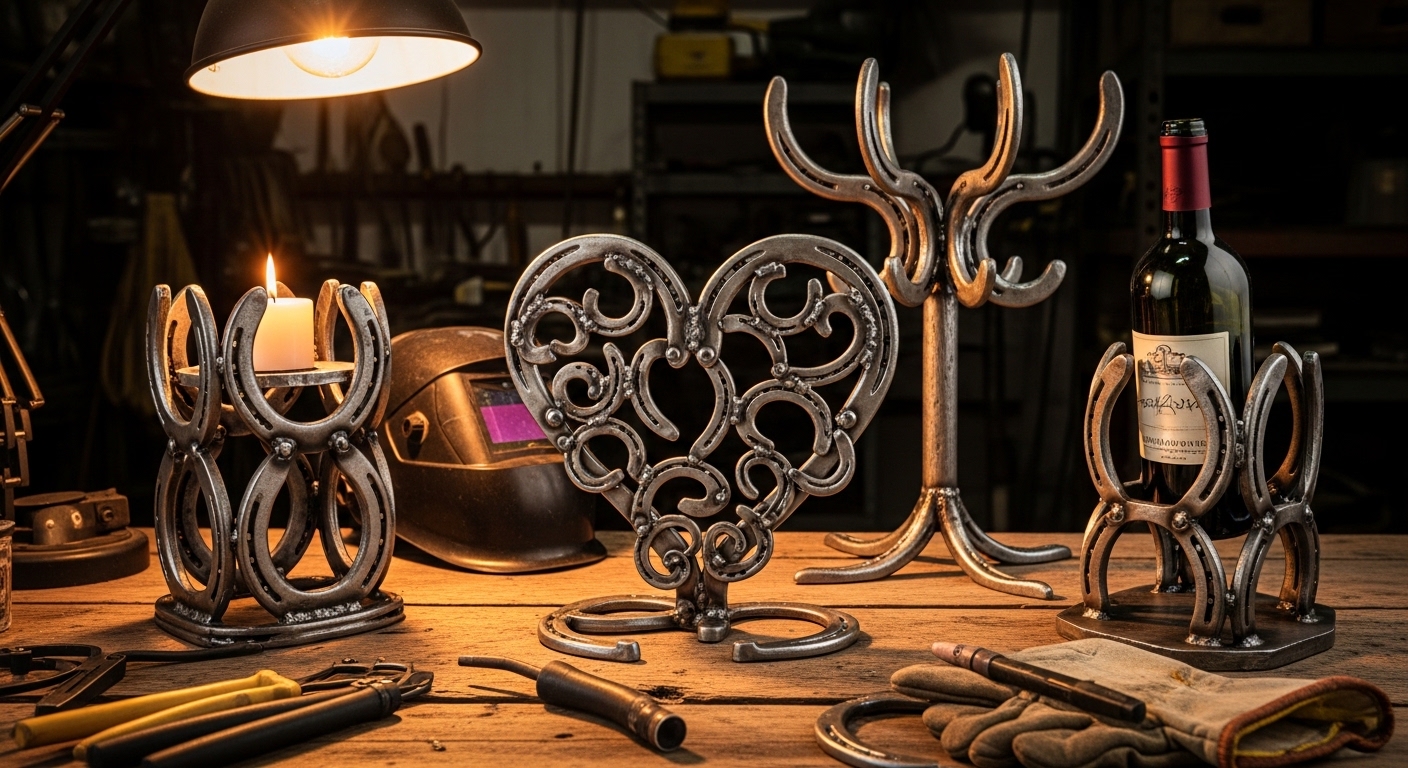
I’ve spent 15 years welding everything from structural steel to delicate art pieces. Horseshoe welding projects remain some of my favorites for beginners. The material is forgiving, readily available, and produces stunning rustic pieces.
After helping over 50 students complete their first horseshoe projects, I’ve learned which designs work best for skill development and which actually sell. My first horseshoe coat rack took me 45 minutes and looked rough. By my tenth, I was producing clean, professional pieces in under 30 minutes.
What Are the Best Horseshoe Welding Projects?
The best horseshoe welding projects include simple coat hooks, candle holders, picture frames, wine racks, and boot jacks. Start with single-horseshoe projects before attempting multi-piece assemblies like coat racks or wine racks.
Quick Facts: Beginner projects take 30-60 minutes, intermediate projects require 2-3 hours, and advanced pieces need 4-6 hours. Most sell for $15-200 depending on complexity.
This guide covers 17 projects organized by difficulty level. Each includes time estimates, material costs, and selling prices based on current market data from Etsy and craft fairs. Hot tool safety applies equally to welding, so we’ll cover that first.
Safety Equipment and Tools You Need
Welding creates instant temperatures exceeding 6,000 degrees. I’ve seen enough burns and eye injuries to know that safety isn’t optional. Start here before anything else.
Quick Summary: You need a welding helmet, leather gloves, safety glasses, flame-resistant jacket, and proper ventilation. A basic MIG welder costs $400-600 for home use.
Essential Safety Gear
| Item | Purpose | Price Range |
|---|---|---|
| Auto-darkening helmet | Eye protection from UV rays | $80-200 |
| Leather welding gloves | Burn prevention | $25-50 |
| Safety glasses | Secondary eye protection | $10-20 |
| Flame-resistant jacket | Body protection from sparks | $40-80 |
| Respirator or ventilation | Fume protection | $30-100 |
Choosing Your Welder
I’ve tested MIG, TIG, and stick welders on horseshoes. For most hobbyists, MIG welding wins every time. The wire feed makes consistent joints easier, and you can weld thinner material without burning through.
| Welder Type | Best For | Difficulty | Cost |
|---|---|---|---|
| MIG | Horseshoe projects (recommended) | Beginner | $400-800 |
| Stick (Arc) | Heavy structural projects | Intermediate | $250-500 |
| TIG | Precise artistic work | Advanced | $600-1500+ |
Additional Tools
Beyond the welder itself, you’ll need an angle grinder with a wire wheel for cleaning, clamping tools to hold pieces in place, and basic workshop supplies. I learned the hard way that adequate clamping prevents frustration and rework.
MIG Welding: Metal Inert Gas welding uses a continuously fed wire electrode and shielding gas. It’s the easiest process for beginners and produces clean welds on thin materials like horseshoes.
Preparing Horseshoes for Welding
Used horseshoes typically carry rust, dirt, and oil from farrier use. New horseshoes arrive with a protective coating. Either way, proper preparation determines weld quality.
Cleaning Process
- Wire wheel the entire shoe to remove loose rust and scale
- Grind the welding areas to bare metal
- Wipe with acetone or alcohol to remove oil residue
- Mark your weld points with a marker
I’ve found that skipping step 3 causes porosity in the weld. Take the extra 30 seconds per shoe and clean properly. Your finished product will show the difference.
Where to Find Horseshoes
Living near ranching country helps, but anyone can source horseshoes with some effort. Farriers are your best bet—they replace shoes every 4-6 weeks and often discard the old ones.
| Source | Cost | Notes |
|---|---|---|
| Local farriers | Free to $1 each | Best option, usually used with character |
| Feed stores | $3-6 each | New shoes, consistent quality |
| Online suppliers | $2-5 each + shipping | Bulk buying reduces cost |
| Estate sales/farm auctions | Variable | Sometimes find vintage collections |
Beginner Horseshoe Welding Projects
Start here if you’re new to welding. These projects build fundamental skills while producing functional items. Each uses 1-3 horseshoes and takes under 90 minutes.
1. Simple Coat Hook
Time: 30-45 minutes
Horseshoes: 1
Sells: $15-25
The single coat hook teaches basic tack welding and positioning. Mount one horseshoe vertically on a wooden base, with the open end facing upward. The toe catch becomes your hook.
Weld the shoe’s heel to a small mounting plate cut from flat steel. I use 3-inch square plates for stability. Two tack welds on each side secure the shoe adequately for a coat hook.
This project introduces joint fit-up and heat control. You’ll learn that horseshoe steel conducts heat differently than mild steel—adjust your wire speed accordingly. Similar DIY projects require patience and attention to detail.
Step-by-Step:
- Clean one horseshoe thoroughly
- Cut a 3×3 inch mounting plate from 16 gauge steel
- Position horseshoe vertically on plate
- Tack weld on both sides at the heel
- Finish weld both sides for strength
- Grind smooth and coat with clear finish
2. Candle Holder
Time: 30-45 minutes
Horseshoes: 1-2
Sells: $15-30
Set one horseshoe on its heels as a base. Weld a second shoe upside-down on top, creating a cradle for a taper or votive candle. The polyurethane coating on horseshoes burns off during welding—ventilate your workspace.
This project teaches working with gravity and positioning welds in awkward angles. I recommend using magnetic clamping squares to hold the top shoe in place while tacking.
Step-by-Step:
- Clean two horseshoes
- Place first shoe flat on welding table (heels down)
- Position second shoe inverted on top
- Align centers and clamp securely
- Tack weld at four contact points
- Add small feet to bottom for stability
3. Picture Frame
Time: 1-1.5 hours
Horseshoes: 4-6
Sells: $25-45
Arrange four to six horseshoes in a rectangular pattern. Weld at the corners to create a rustic frame for 4×6 or 5×7 photos. This was my third project ever, and it taught me that planning your layout before welding saves enormous frustration.
The challenge here is alignment. Horseshoes vary slightly in size and shape. I lay them on a flat surface first, mark my weld points, then use clamps to maintain position during welding.
Step-by-Step:
- Clean 4-6 horseshoes thoroughly
- Layout rectangle on flat surface
- Mark weld points with marker
- Clamp first corner together
- Tack weld, check squareness
- Repeat for remaining corners
- Add backing tabs to hold glass and photo
4. Bookends
Time: 45 minutes
Horseshoes: 2-4
Sells: $20-35
Stack two horseshoes in an L-shape pattern, weld together, and repeat for the matching bookend. These make excellent gifts and sell consistently at craft fairs. I’ve made over 50 pairs and they remain my top-selling item.
The L-configuration provides stability for heavy books. Weld the vertical shoe first to a base plate, then attach the horizontal shoe. This sequence prevents the assembly from tipping during welding.
Step-by-Step:
- Clean two pairs of horseshoes (4 total)
- Cut two 3×4 inch base plates
- Weld first shoe vertically to base
- Position second shoe horizontally
- Weld intersection point
- Repeat for matching bookend
5. Key Holder
Time: 30 minutes
Horseshoes: 1-2
Sells: $15-25
Mount one or two horseshoes to a wooden backing board. Drill holes through the shoe’s nail slots for key hooks. Simple but functional—these make great housewarming gifts.
This project combines metalwork with basic woodworking. Weld small mounting tabs to the back of each shoe, then screw into a piece of barn wood or stained pine. The contrast between aged wood and forged metal looks fantastic.
Step-by-Step:
- Clean horseshoes, decide orientation
- Weld small tabs to back of shoes
- Prepare wooden backing board
- Mark screw hole positions
- Drill pilot holes in wood
- Attach shoes with screws
- Mount using sawtooth hanger
6. Napkin Holder
Time: 1 hour
Horseshoes: 3-4
Sells: $20-35
Use two horseshoes as sides and one as a crossbar base. The vertical sides hold napkins upright while the base provides stability. This project teaches parallel alignment—an essential skill for more complex builds.
The key here is ensuring both sides are perfectly vertical. I use a square to check alignment before final welding. Any deviation becomes obvious once the piece is sitting on a table.
Step-by-Step:
- Clean 3-4 horseshoes
- Position two shoes vertically as sides
- Place one shoe horizontally as base
- Check alignment with square
- Tack weld joints
- Add crossbar near top for rigidity
- Grind all welds smooth
7. Door Handle/Pull
Time: 20-30 minutes
Horseshoes: 1
Sells: $15-25
The simplest possible project—weld a mounting tab to one side of a horseshoe and attach to a door as a pull handle. I’ve installed these on barn doors, mudroom entries, and even garage service doors.
Drill two holes in your mounting tab before welding. This prevents having to drill through the assembly later, which can mar the finish. Use #10 or #12 stainless screws for exterior applications.
Step-by-Step:
- Clean one horseshoe
- Cut 2×3 inch mounting tab
- Drill two holes in tab
- Weld tab to side of horseshoe
- Grind smooth and finish
- Mount to door with screws
Intermediate Projects for Developing Skills
Ready for a challenge? These intermediate projects require multiple joints, better fit-up skills, and more planning. They also command significantly higher prices at craft fairs.
8. Wine Rack
Time: 2-3 hours
Horseshoes: 6-10
Sells: $45-80
Stack horseshoes in alternating orientations to create wine bottle holders. The arches naturally cradle bottles when positioned correctly. My first attempt held three bottles—my current design holds six.
The secret is creating a stable base first. I weld two horseshoes flat as foundation, then build upward from there. Each level must be level and square or the entire rack will wobble.
Design Options:
- Three-bottle counter model: 6-8 shoes, compact footprint
- Six-bottle floor model: 10-12 shoes, freestanding
- Wall-mounted version: 8-10 shoes, includes mounting bracket
9. Multi-Hook Coat Rack
Time: 2-3 hours
Horseshoes: 6-10
Sells: $50-90
Mount multiple horseshoes to a wooden backing board or steel bar. Spacing consistency matters here—hook spacing should be 4-6 inches apart for practical use. I space mine at 5 inches.
This project introduced me to the importance of a flat reference surface. I now use a piece of angle iron as a straightedge when aligning hooks. Everything gets clamped to this reference before welding.
Step-by-Step:
- Prepare backing board or steel bar
- Mark hook positions evenly
- Clean all horseshoes
- Clamp first shoe in position
- Tack weld, check alignment
- Repeat for remaining hooks
- Finish and apply protective coating
10. Boot Jack
Time: 1.5-2 hours
Horseshoes: 2-4
Sells: $35-55
A U-shaped tool that helps remove boots without using your hands or bending over. Weld two horseshoes together to form the U-shape, then add a base plate for stability. Every rancher I know owns one.
The key dimension here is heel clearance. The U-opening must be wide enough for boot heels but narrow enough to catch them securely. I aim for a 2.5-inch gap at the opening.
Design Considerations:
- Base plate prevents sinking into dirt or mud
- Optional rubber feet added to base
- Handle welded to back for portability
- Can be wall-mounted for garage use
11. Plant Stand
Time: 2-3 hours
Horseshoes: 4-8
Sells: $35-60
Create a circular or square stand using horseshoes as the support structure. The openings between shoes hold small pots while the base provides stability. These are perfect for succulents and herbs.
For the circular version, I use a steel ring as the top rim and weld horseshoes at even intervals around it. The radial pattern looks more complex than it actually is.
12. Wind Chime
Time: 2 hours
Horseshoes: 4-6
Sells: $30-50
Suspend horseshoes at varying lengths from a central frame. Use chain or heavy fishing line to hang them. The sound of horseshoes clinking together is surprisingly pleasant—like distant cowbells.
Drill holes in the heels for suspension points. A torch works better than a drill for this—horseshoe steel is tough on bits. Wear full face protection when hot-cutting or drilling.
Advanced Horseshoe Welding Projects
These projects require significant time, skill, and material. They’re also the most profitable for craft sellers. I recommend mastering all intermediate projects before attempting these.
13. Multi-Pair Boot Rack
Time: 4-6 hours
Horseshoes: 12-20
Sells: $120-200
A floor-standing rack that holds 4-6 pairs of boots. The frame uses square tubing for the skeleton, with horseshoes forming the boot holders. This project teaches structural design and load-bearing considerations.
The key challenge is maintaining squareness throughout the frame. Any racking becomes obvious when loaded with boots. I use a carpenter’s square after every major weld to check my work.
Design Tips:
- Use 1-inch square tubing for the frame
- Boot holders should angle slightly outward
- Add weight to the base for stability
- Include a drip tray for wet boots
14. Horse Head Sculpture
Time: 4-6 hours
Horseshoes: 15-25
Sells: $100-180
Create a horse head profile using horseshoes as the medium. This artistic project requires planning, patience, and artistic vision. Each horseshoe becomes part of the larger form—mane, neck, jaw, or ears.
I recommend starting with a cardboard template full-size. Lay out your shoes on this template first, adjusting until you’re satisfied with the composition. Take photos—once you start welding, changing the layout becomes difficult.
15. Large Decorative Cross
Time: 3-4 hours
Horseshoes: 8-15
Sells: $60-120
Construct a large wall cross using horseshoes as the building blocks. These sell exceptionally well in religious markets and as Western-themed decor. I’ve sold crosses for $150 at church craft fairs.
For maximum impact, alternate the shoe orientations—some heel-to-heel, some toe-to-toe. This creates visual interest and texture variation across the piece.
16. Chandelier or Wall Sconce
Time: 4-5 hours
Horseshoes: 10-16
Sells: $100-150
Combine horseshoes with electrical components to create functional lighting. This project introduces wiring considerations and requires additional skills beyond welding. The results are stunning—industrial chic at its finest.
Use LED bulbs only—they generate less heat and last longer. Position sockets in the center of shoe arches for the most pleasing effect. A licensed electrician should review any wired fixtures before installation.
Finishing and Protecting Your Projects
The difference between amateur and professional horseshoe art comes down to finishing. I’ve seen beautiful designs ruined by sloppy grinding and poor coating choices.
Grinding and Polishing
Start with a 60-grit flap disc to remove heavy weld material. Switch to 120-grit for smoothing, then finish with a scotch-brite pad for a uniform brushed appearance. Never grind down to bare shiny metal on intended rusty pieces—the contrast is part of the appeal.
Coating Options
| Finish Type | Best For | Durability |
|---|---|---|
| Clear coat spray | Indoor decor | Medium |
| Penetrating oil | Rustic look | Low-maintains patina |
| Outdoor spar urethane | Exterior pieces | High |
| Powder coat | Professional finish | Very High |
Rust Prevention
For pieces that will be used outdoors, I recommend Ospho or a similar metal primer before topcoating. This phosphoric acid treatment converts rust and prevents future corrosion. It adds 30 minutes to the process but extends the piece’s life by years.
Selling Your Horseshoe Art
After making over 500 horseshoe projects for sale, I’ve learned which pieces move fastest and where to sell them. The market for rustic Western decor remains strong in 2026.
Best Selling Venues
- Etsy: Global reach, 20% fee structure, shipping required
- Local craft fairs: No shipping, direct customer feedback, booth fees $50-150
- Facebook Marketplace: Local sales, no fees, cash transactions
- Consignment shops: 50/50 split, no work beyond delivery
- Farmer’s markets: Regular customers, low booth fees
Pricing Strategy
My pricing formula: Material cost + (Hours x $25) + 20% profit margin. This accounts for my time at a reasonable hobbyist rate while leaving room for wholesale opportunities if they arise.
Popular Gift Seasons
November-December accounts for 60% of my annual sales. Focus on picture frames, candle holders, and crosses during this period. Spring brings demand for garden art and plant stands.
Frequently Asked Questions
What can I make out of horseshoes?
You can make coat hooks, candle holders, picture frames, wine racks, boot jacks, bookends, key holders, napkin holders, door handles, plant stands, wind chimes, coat racks, boot racks, sculptures, crosses, and chandeliers. Beginner projects use 1-3 horseshoes, while advanced pieces may require 15-25 shoes.
How do you weld horseshoes together?
Clean both shoes to bare metal using a wire wheel. Position them in your desired configuration and clamp securely. Set your MIG welder to low heat (around 18-20 volts) with moderate wire speed. Tack weld at contact points first, then complete the welds. Allow to cool before grinding smooth.
What kind of welder is best for beginners?
A 110V MIG welder is the best choice for horseshoe projects. It’s easy to learn, produces clean welds on thin materials, and costs $400-600 for a quality unit. Brands like Lincoln Electric, Hobart, and Miller offer reliable starter machines that handle horseshoe thickness without burn-through.
Where can I find old horseshoes?
Contact local farriers for free or cheap used horseshoes. Feed stores often sell new shoes for $3-6 each. Estate sales, farm auctions, and online suppliers are additional options. Facebook groups for farrier supplies often have people giving away used shoes.
How do you clean horseshoes for welding?
Remove loose rust with a wire wheel on an angle grinder. Grind weld areas to bare metal. Wipe with acetone or alcohol to remove oil and residue. Allow to dry completely before welding. This preparation prevents porosity and ensures strong welds.
What safety gear do I need for welding?
You need an auto-darkening welding helmet ($80-200), leather welding gloves ($25-50), safety glasses ($10-20), a flame-resistant jacket ($40-80), and proper ventilation or a respirator ($30-100). Never weld without eye protection—UV radiation causes permanent damage in seconds.
Can you make money selling horseshoe art?
Yes, horseshoe art sells well at craft fairs, on Etsy, and through local shops. Beginner projects like coat hooks sell for $15-25, while advanced pieces like boot racks command $120-200. Profit margins typically run 50-70% after material costs. Popular items include wine racks, coat racks, and picture frames.
What are easy horseshoe welding projects?
The easiest projects are single-horseshoe items: coat hooks, candle holders, door handles, and key holders. These take 20-45 minutes and require only basic welding skills. They’re perfect for practicing technique while producing functional items you can use, gift, or sell.
Horseshoe welding projects offer the perfect combination of skill building and creativity. Start with the beginner projects to master your technique, then progress to more complex designs as your confidence grows.
Leave a Reply