
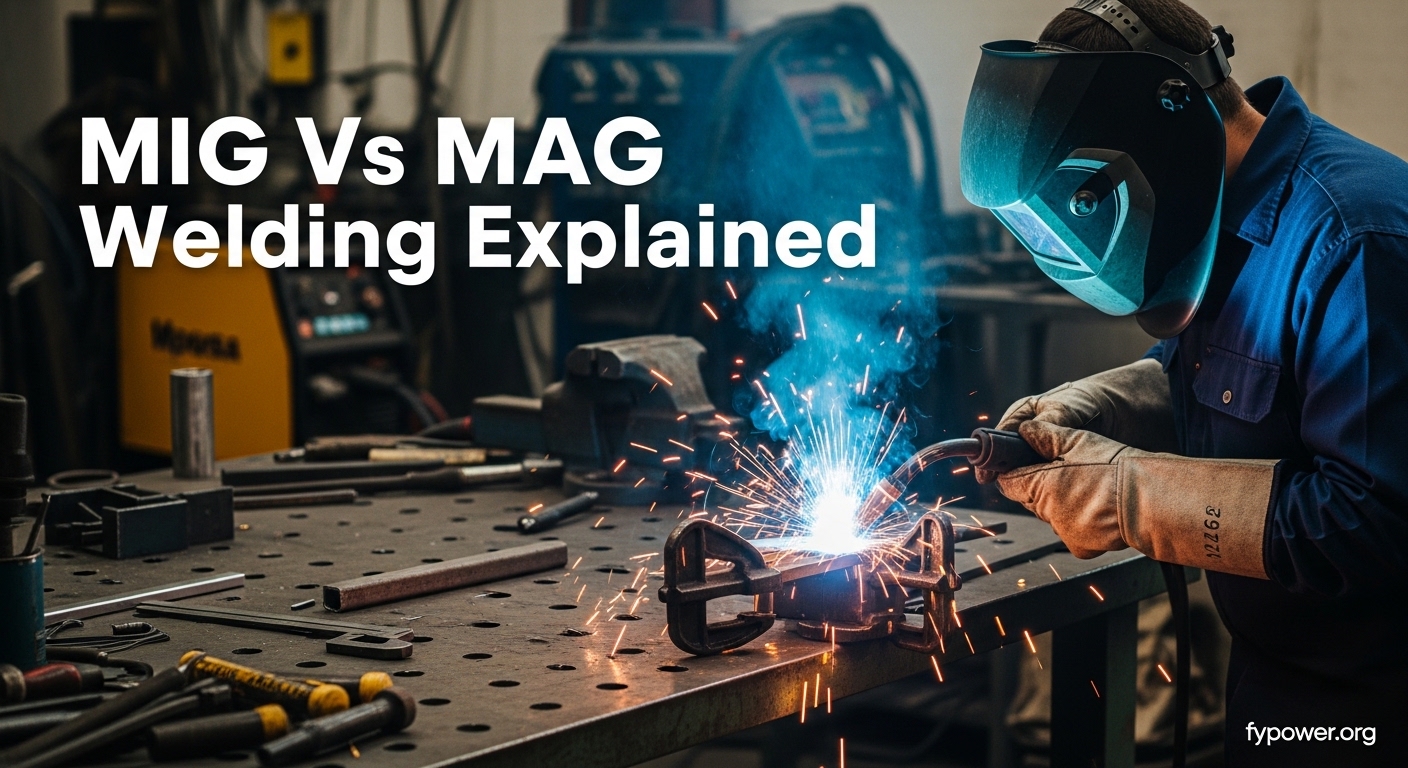
If you have been confused by welding terminology, you are not alone. I have encountered countless beginners and even experienced welders who get mixed up when someone mentions “MAG welding” – they nod along while secretly wondering if it is a typo for MIG.
Here is the straightforward answer: MIG and MAG welding are the exact same process. Both are GMAW (Gas Metal Arc Welding). The only difference is the type of shielding gas used. MIG uses inert gases like argon or helium, while MAG uses active gases like CO2 or gas mixtures.
This confusion comes from regional terminology differences. In Europe, welders carefully distinguish between MIG (for aluminum) and MAG (for steel). In North America, most people just say “MIG welding” for everything, regardless of what gas is actually in the tank.
MIG and MAG are both GMAW (Gas Metal Arc Welding) – the same wire-feed welding process using different shielding gases. MIG = Metal Inert Gas (argon, helium) for aluminum and non-ferrous metals. MAG = Metal Active Gas (CO2, mixed) for steel and ferrous metals.
After working with welders from different countries, I have seen this terminology mismatch cause real confusion. A European welder might ask for a “MAG machine” while an American assumes they mean a standard MIG welder – they are talking about the same equipment.
This guide will clear up the confusion once and for all. You will learn exactly when to use each gas type, which materials require which shielding, and why the terminology differs depending on where you learned to weld.
Understanding GMAW: The Parent Process
Before diving into MIG versus MAG, it helps to understand what both processes actually are. GMAW stands for Gas Metal Arc Welding – the official technical term that encompasses both MIG and MAG.
GMAW is a wire-feed welding process that uses a continuously fed consumable electrode. The arc between the wire and the workpiece melts both metals, creating a weld pool. Meanwhile, shielding gas flows through the welding gun to protect the molten metal from atmospheric contamination.
GMAW (Gas Metal Arc Welding): A welding process that uses a continuously fed consumable electrode wire and shielding gas to protect the weld pool from atmospheric contamination. Commonly referred to as MIG welding in North America.
The equipment is identical whether you are doing MIG or MAG welding. Your welder does not know the difference – it simply feeds wire and creates an arc. The gas regulator and flowmeter are also the same. Only the gas cylinder contents change.
I have set up hundreds of welding machines over the years, and the process is always the same: connect the power unit, ground clamp, and welding gun. Then attach your gas cylinder. The welder operates identically whether that cylinder contains pure argon for aluminum or CO2 for steel.
The American Welding Society classifies all GMAW variations the same way technically. The distinction between MIG and MAG is primarily a terminology difference, not a different process altogether.
What is MIG Welding?
MIG stands for Metal Inert Gas. The “inert” part is key – inert gases do not react chemically with the weld pool. They simply shield the molten metal from oxygen and nitrogen in the atmosphere, which would cause defects if allowed in.
The primary inert gases used in welding are argon and helium. Both are noble gases that do not form compounds with other elements under normal welding conditions. This makes them ideal for reactive metals like aluminum that would oxidize if exposed to active gases.
I have welded plenty of aluminum projects using pure argon, and the difference is immediately apparent. The arc is smooth and stable, the weld bead is clean, and spatter is minimal. Switch to CO2 on aluminum, and you will immediately see problems – porosity, black oxide deposits, and weak welds.
MIG Welding Applications
MIG welding with inert gases is primarily used for:
Copper
Stainless Steel
Magnesium
Nickel Alloys
When welding aluminum, you must use 100% argon. Helium can be mixed in for thicker sections to increase heat input, but pure helium is rarely used alone due to cost. For stainless steel, you can use tri-mix blends (argon, helium, CO2) or high argon mixtures with small amounts of oxygen.
When I work with aluminum, I always keep extra argon on hand. It is not forgiving – you cannot substitute CO2 or mixed gas and expect decent results. I have seen beginners make this mistake, and the resulting welds look like black Swiss cheese due to oxidation and porosity.
For more information on workshop tools and equipment, check out our detailed reviews covering various workshop setups.
Pros and Cons of MIG (Inert Gas)
Advantages:
- Cleaner weld appearance with less oxidation
- Minimal spatter for easier cleanup
- Smoother arc characteristics
- Required for aluminum and non-ferrous metals
- Better for thin materials where heat control matters
Disadvantages:
- Higher gas cost compared to CO2
- Less penetration on thick steel compared to active gases
- Can be overkill for simple mild steel fabrication
What is MAG Welding?
MAG stands for Metal Active Gas. The “active” refers to gases that do react with the weld pool. Carbon dioxide (CO2) and oxygen-containing gas mixtures actively participate in the welding process, affecting penetration, bead shape, and metallurgical properties.
CO2 is the most common active gas. It dissociates in the welding arc, releasing oxygen that affects how the metal melts and solidifies. This creates deeper penetration compared to inert gases, but also more spatter and a rougher weld appearance.
I have used straight CO2 for countless steel projects, especially when budget was a concern. The penetration is impressive – you can weld through rust, paint, and mill scale better than with argon blends. But the trade-off is noticeable: more spatter to clean up and a darker weld bead.
Mixed gases combine argon with CO2 or oxygen. The most common is C25 (75% argon, 25% CO2), which balances the benefits of both. I find C25 produces cleaner welds than straight CO2 while maintaining good penetration and keeping costs reasonable.
MAG Welding Applications
MAG welding with active gases is primarily used for:
Mild Steel
Low Alloy Steel
For general fabrication and repair work on steel, MAG welding with C25 or straight CO2 is the standard. The active gases help burn through contaminants and provide excellent penetration into the base metal.
When I am welding thick steel plate or doing structural work, I prefer active gases for the penetration advantage. The slightly rougher appearance is a worthwhile trade-off for knowing the weld has penetrated fully into the joint.
Pros and Cons of MAG (Active Gas)
Advantages:
- Lower cost compared to inert gases
- Deeper penetration for thicker materials
- Better tolerance for surface contaminants
- Faster travel speeds possible
- Ideal for steel fabrication
Disadvantages:
- More spatter requires cleanup
- Darker weld appearance from oxidation
- Cannot be used for aluminum
- Rougher arc characteristics
- More fumes produced during welding
Shielding Gas Comparison Table
Quick Summary: Use pure argon for aluminum, C25 blend for most steel welding, and straight CO2 when budget is the priority. Never use CO2 on aluminum – it will cause severe oxidation and porosity.
| Gas Type | Classification | Best For | Characteristics | Cost |
|---|---|---|---|---|
| 100% Argon | Inert (MIG) | Aluminum, stainless, non-ferrous | Smooth arc, clean weld, less spatter | $$ |
| 100% CO2 | Active (MAG) | Carbon steel, mild steel | Deep penetration, more spatter, cheap | $ |
| C25 (75% Ar / 25% CO2) | Mixed (MAG) | Mild steel, general fabrication | Balanced penetration and appearance | $$ |
| Tri-Mix (Ar/He/CO2) | Mixed (MIG/MAG) | Stainless steel | Excellent stainless wetting and appearance | $$$ |
| Helium / Argon-Helium | Inert (MIG) | Thick aluminum, copper | Hotter arc, faster travel, deep penetration | $$$$ |
| Argon + 2% Oxygen | Mixed (MAG) | Stainless steel | Wider bead, smoother flow | $$ |
Understanding C25 Blend
C25 is the most popular shielding gas in North America for general MIG/MAG welding. It consists of 75% argon and 25% CO2, offering a balance between the clean welding characteristics of argon and the penetration benefits of CO2.
I have found C25 to be an excellent all-around choice for mild steel fabrication. The welds come out cleaner than with straight CO2, with noticeably less spatter. The arc feels smoother and more controllable, especially for beginners still developing their technique.
The argon in C25 provides arc stability and reduces spatter. The CO2 contributes to penetration and helps burn through light surface contamination. For most hobby welders and small fabrication shops, C25 hits the sweet spot between quality and cost.
Which Gas for Which Material?
Choosing the right shielding gas depends entirely on what you are welding. Use the wrong combination, and you will end up with porosity, poor penetration, or welds that fail under stress.
Aluminum
Aluminum requires pure argon. There is no workaround here. I have tested various gas mixtures on aluminum over the years, and anything containing CO2 or oxygen causes immediate problems.
The reason is chemical: active gases react with aluminum during welding, creating aluminum oxide. This oxide has a much higher melting point than aluminum itself, creating inclusions in the weld. The result is porous, weak welds that look black and crusty.
For thicker aluminum sections (over 1/4 inch), I add helium to the argon. Helium increases heat input and penetration. Common mixtures are 50/50 argon-helium or 75/25 argon-helium. But for most aluminum work under 1/4 inch, pure argon works perfectly.
Carbon Steel and Mild Steel
Steel offers the most flexibility in gas selection. Your choice depends on balancing cost, appearance, and penetration requirements.
For most steel welding, C25 is my go-to recommendation. It produces attractive welds with good penetration and manageable spatter. If appearance matters – like on ornamental ironwork or visible structural joints – C25 gives the cleanest results.
Straight CO2 excels when you need maximum penetration or are working with thick materials. I use CO2 for heavy structural welding, farm equipment repair, and any time I need to weld through surface contaminants. The weld appearance is rougher, but the penetration is superior.
Stainless Steel
Stainless steel requires careful gas selection to maintain corrosion resistance. Tri-mix blends containing argon, helium, and small amounts of CO2 are specifically formulated for stainless applications.
Alternatively, high-argon mixtures with 1-2% oxygen work well for stainless. The oxygen helps wetting and bead shape while the argon maintains oxidation protection. I generally use a tri-mix for the best results, though these specialty gases can be expensive and harder to source.
Material Reference Guide
| Material | Recommended Gas | Alternative | Avoid |
|---|---|---|---|
| Aluminum | 100% Argon | Argon/Helium mix (thick sections) | CO2, oxygen-containing mixes |
| Mild Steel | C25 (75% Ar / 25% CO2) | 100% CO2 (budget option) | None – all work |
| Carbon Steel | C25 | CO2 for thick materials | None – all work |
| Stainless Steel | Tri-mix (Ar/He/CO2) | 98% Ar / 2% O2 | Pure CO2 (excess oxidation) |
| Copper | Argon/Helium mix | 100% Helium | CO2 |
Regional Terminology: Europe vs North America
The confusion between MIG and MAG largely stems from regional differences in welding terminology. Understanding these differences can prevent miscommunication, especially when working with international teams or reading technical documentation from different countries.
North American Terminology
In the United States and Canada, “MIG welding” is used generically. Most welders say MIG regardless of whether they are using argon for aluminum or C25 for steel. The equipment is labeled as MIG welders, and the process is universally referred to as MIG.
I have noticed that even professional welders in North America rarely use the term MAG. It is primarily an academic distinction taught in welding classes but rarely used in shop conversations. If you ask for a “MAG welder” at an American welding supply store, you will likely get a confused look.
European Terminology
European welders are more precise with terminology. MIG specifically refers to welding with inert gases (aluminum, stainless). MAG specifically refers to welding with active gases (steel with CO2 or mixed gases).
This distinction matters in Europe because welding procedures and qualifications often specify the exact gas type. A welding procedure might be qualified as either MIG or MAG, and using the wrong gas would technically be a deviation from the qualified procedure.
I have worked with European-trained welders who find the American terminology confusing. To them, saying “MIG welding steel” sounds wrong because steel is typically welded with active gases (MAG). They see a clear distinction that Americans blur together.
Why the Difference?
The terminology difference reflects historical and practical factors. European welding standards (EN standards) have always distinguished between inert and active gas processes. American standards (AWS) historically used MIG as a catch-all term.
Additionally, aluminum welding has been more common in European manufacturing, making the distinction between MIG and MAG practically relevant. In North America, steel fabrication dominated for decades, and most welding used CO2-based active gases anyway – so everything got called MIG.
Cost Comparison: Which Gas is Most Economical?
Gas cost is a real consideration, especially for beginners and hobby welders on a budget. The price difference between inert and active gases can be substantial, affecting which process you choose for different projects.
Gas Pricing Overview
CO2 is by far the most economical shielding gas. A standard 20-cubic-foot CO2 cylinder typically costs one-third to one-half the price of the same size argon cylinder. For high-volume production welding, this difference adds up quickly.
Argon sits in the middle price range. It costs more than CO2 but is reasonably affordable for most hobby applications. Cylinder exchange programs make it accessible without requiring huge upfront investment.
Helium and specialty gas blends are where costs escalate dramatically. Helium has become increasingly expensive due to global supply issues. Tri-mix stainless blends can cost 2-3 times as much as standard argon.
Budget Recommendations
For beginners starting out, I recommend CO2 or C25. Both are reasonably priced and work well for steel fabrication, which is what most new welders start with. CO2 offers the lowest entry cost, while C25 provides noticeably better results for a modest price increase.
Wait until you actually need to weld aluminum before investing in argon. There is no point buying expensive gas if you only work with mild steel. I have seen beginners spend hundreds on gas they never use because they think they “need” argon for general welding.
For hobby welders doing general fabrication and repair, C25 is the sweet spot. The price difference versus CO2 is minimal when considering cylinder exchange, and the improved weld quality is worth it. Less cleanup time and better-looking welds make the small extra cost worthwhile.
Safety equipment is essential regardless of which gas you choose. Proper ventilation, respiratory protection, and protective gear are non-negotiable. Check out our hot tool safety guide for general safety principles that apply to welding and other hot work processes.
Long-Term Cost Considerations
While gas cost matters, do not let it be your only consideration. The cost of grinding and reworking bad welds quickly exceeds any savings from cheaper gas. I have seen shops switch to straight CO2 to save money, only to spend more in labor fixing weld defects and cleaning up excessive spatter.
Consider your application. For production welding where appearance matters, C25 or argon blends reduce post-weld cleanup. For rough structural work where appearance is irrelevant, CO2 makes economic sense.
Gas cylinder size also affects long-term costs. Larger cylinders have better gas value per cubic foot. If you weld regularly, investing in larger cylinders (80 or 125 cubic feet) pays off over time versus constantly exchanging smaller 20-cubic-foot bottles.
Frequently Asked Questions
Is MAG welding the same as MIG?
Yes, MAG and MIG are both GMAW (Gas Metal Arc Welding) – the same wire-feed welding process. The only difference is the type of shielding gas used. MIG uses inert gases (argon, helium) while MAG uses active gases (CO2, gas mixtures).
What is the difference between MIG and MAG welding?
The main difference is the shielding gas. MIG (Metal Inert Gas) uses non-reactive inert gases like argon or helium for aluminum and non-ferrous metals. MAG (Metal Active Gas) uses reactive gases like CO2 or gas mixtures for steel and ferrous metals.
What gas does MAG welding use?
MAG welding uses active gases, primarily carbon dioxide (CO2) or argon-CO2 mixtures like C25 (75% argon, 25% CO2). These reactive gases provide deeper penetration and are ideal for welding steel and other ferrous metals.
Can I use CO2 for MIG welding aluminum?
No, you should never use CO2 or any active gas for aluminum welding. CO2 reacts with aluminum during welding, creating aluminum oxide inclusions that cause porosity and weak welds. Aluminum requires 100% argon or argon-helium mixtures.
What is C25 welding gas?
C25 is a shielding gas blend containing 75% argon and 25% CO2. It is the most commonly used gas for MIG/MAG welding of mild steel, offering a balance between the smooth arc characteristics of argon and the deep penetration of CO2.
Why is it called MAG welding in Europe?
European welding standards distinguish between processes based on shielding gas type. MIG refers specifically to welding with inert gases (aluminum, stainless) while MAG refers to welding with active gases (steel with CO2). This precise terminology reflects European welding certification requirements.
For more information on safety equipment and beginner tool guides, explore our other workshop safety articles to ensure you are properly protected for any hot work or fabrication projects.
Conclusion
MIG and MAG welding are not different processes – they are the same GMAW process using different shielding gases. MIG uses inert gases (argon, helium) for aluminum and non-ferrous metals. MAG uses active gases (CO2, gas mixtures) for steel and ferrous metals.
The terminology confusion comes from regional differences. European welders carefully distinguish between MIG and MAG based on gas type. North American welders typically say “MIG” for everything, regardless of which gas is actually in the cylinder.
For most welding applications, focus on matching your gas to your material rather than worrying about the terminology. Use pure argon for aluminum, C25 for most steel welding, and straight CO2 when budget is the priority or you need maximum penetration.
Understanding these differences helps you select the right gas for each job, communicate clearly with other welders, and avoid common mistakes that lead to poor weld quality. Whether you call it MIG or MAG, the key is using the appropriate shielding gas for your specific application.
Leave a Reply