
The wrong MIG welding wire can turn a simple project into a frustrating mess of porosity, weak welds, and constant rework.
I learned this the hard way when I tried welding rusty trailer steel with premium ER70S-6 wire meant for clean metal. The welds looked decent until I stress-tested them and found cracks running through what should have been solid joints.
MIG Welding Wire Types: The Complete Guide
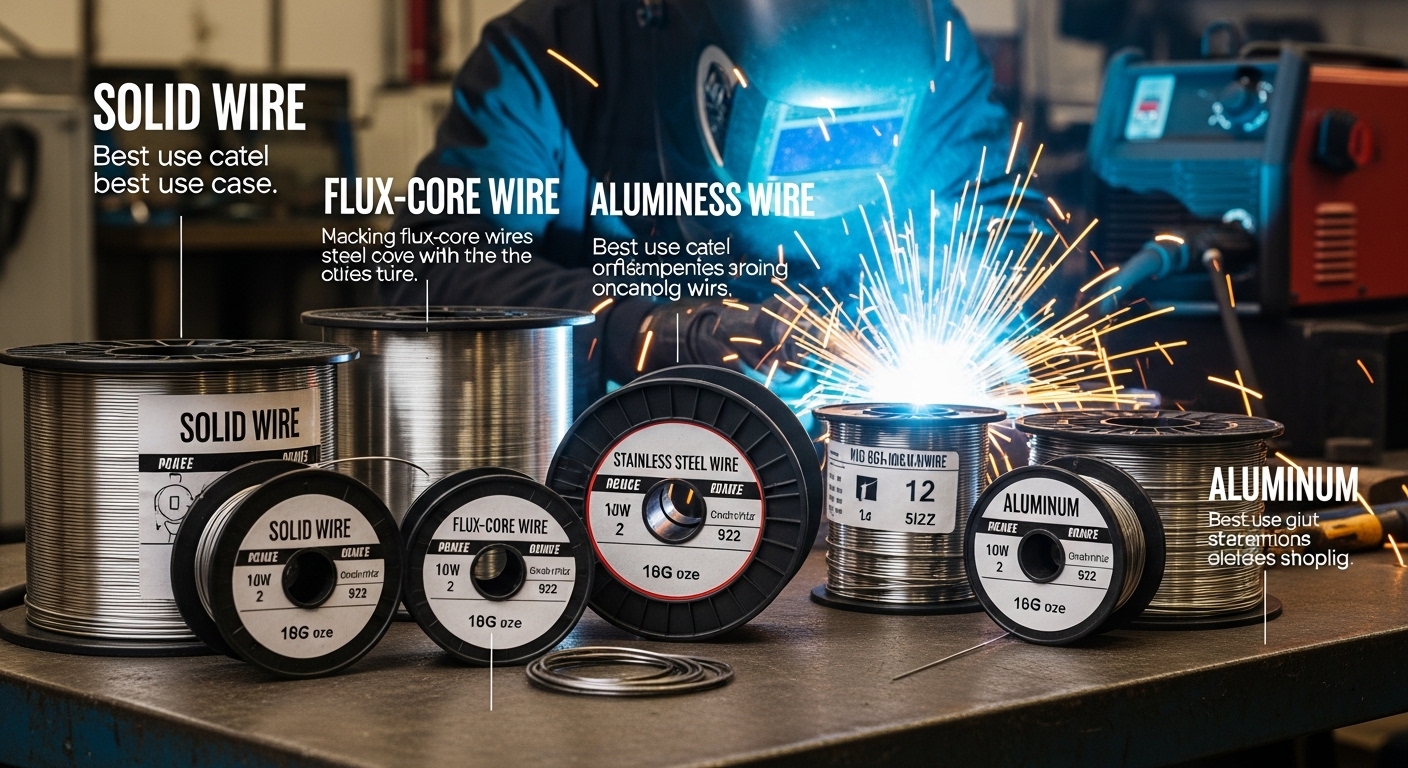
MIG welding wire types are classified by base metal and application. Solid wires like ER70S-6 (mild steel) require shielding gas and work best on clean materials. Flux-cored wires like E71T-GS contain their own shielding, making them ideal for outdoor or dirty metal welding. Aluminum uses ER4043 or ER5356, while stainless steel requires ER308L or ER316 depending on the alloy.
- Key Point: Match wire type to your base metal
- Most Common: ER70S-6 for general mild steel fabrication
- Gasless Option: E71T-GS flux-cored for outdoor work
After testing dozens of wire types across countless projects, I can tell you that understanding MIG welding wire types separates frustrated beginners from capable welders who get consistent results every time.
This guide covers every major wire type, what those AWS classification codes actually mean, and which wire belongs in your machine for specific projects.
Solid Wire vs Flux-Cored Wire: The Fundamental Difference
Quick Summary: Solid MIG wire requires external shielding gas (typically 75/25 argon/CO2) to protect the weld pool from atmosphere. Flux-cored wire contains flux compounds inside the wire that create its own shielding when burned, allowing welding without gas or in windy conditions.
The first decision every welder faces is choosing between solid and flux-cored wire. These aren’t minor variations—they’re fundamentally different approaches to MIG welding.
Solid MIG wire is exactly what it sounds like: a solid metal strand drawn to a specific diameter. It’s clean, feeds smoothly through drive rolls, and produces minimal spatter when set up correctly. But solid wire cannot function without shielding gas.
The gas displaces oxygen and nitrogen from the weld area, preventing contamination that would ruin your weld. I’ve seen plenty of beginners try to run solid wire without gas, confused why their welds look like porous Swiss cheese.
Flux-cored wire contains a hollow center filled with flux compounds—deoxidizers, arc stabilizers, and shielding agents. When you weld, this flux burns off, creating a protective gas cloud around the weld pool. Some flux-cored wires are “self-shielding” (gasless), while others still require external gas for optimal results.
| Feature | Solid Wire | Flux-Cored Wire |
|---|---|---|
| Shielding Gas Required | Yes, mandatory | Self-shielding types: No | Gas-shielded types: Yes |
| Best Environment | Indoor, low wind | Outdoor, windy conditions |
| Surface Condition | Clean metal only | Tolerates rust, mill scale, paint |
| Spatter Level | Low with proper gas | Moderate to high |
| Slag Removal | None required | Required between passes |
| Penetration | Moderate | Deep |
I keep both types in my shop because they serve different purposes. For fabrication with clean materials inside my shop, solid wire produces cleaner, more professional welds. For field repairs or outdoor projects where wind would blow away shielding gas, flux-cored is the only practical choice.
Shielding Gas: A mixture of gases (typically 75% argon / 25% CO2 for steel) that flows through the MIG gun nozzle to protect the molten weld pool from atmospheric contamination. Without shielding, oxygen and nitrogen react with the weld metal, causing porosity and weakness.
Understanding AWS Wire Classifications
Those cryptic codes like ER70S-6 and ER4043 aren’t random—they’re standardized classifications from the American Welding Society that tell you exactly what you’re getting. Once you learn to decode them, you’ll never buy the wrong wire again.
Let’s break down ER70S-6, the most common MIG welding wire:
70
S
6
| ER | Electrode or Rod (indicates filler metal) |
| 70 | Minimum tensile strength = 70,000 PSI |
| S | Solid wire |
| 6 | Specific chemical composition variant |
That “70” is crucial—it means welds made with this wire have a minimum tensile strength of 70,000 pounds per square inch. That’s plenty strong for nearly any structural application.
The “S” tells us this is solid wire, while flux-cored wires use “T” (tubular) in their designations.
That final number represents specific chemical variations. In the ER70S series, each suffix number indicates different levels of deoxidizers and alloying elements:
- ER70S-2: Lower deoxidizers, for very clean steel
- ER70S-3: General purpose, moderate deoxidizers
- ER70S-6: High deoxidizers, excellent on dirty or rusty steel
- ER70S-7: Similar to S-6 but formulated for better wetting
MIG Welding Wire for Mild Steel: ER70S Series
Mild steel welding represents about 80% of what most welders actually do. Auto body work, fabrication, trailer repair, general construction—it’s all mild steel. That’s why the ER70S series dominates the market.
ER70S-6: The General-Purpose Champion
ER70S-6 is the workhorse of MIG welding wire. It contains higher levels of silicon and manganese deoxidizers, which means it tolerates less-than-perfect surface conditions better than other wires.
I’ve used ER70S-6 on everything from pristine sheet metal to rusty farm equipment that hadn’t been cleaned in decades. The high deoxidizer content “floats out” contaminants, producing sound welds even on questionable base metal.
Deoxidizers: Chemical elements (typically silicon, manganese, and aluminum) added to welding wire that chemically bind with oxygen in the weld pool. They prevent porosity and inclusions by removing oxygen before it can cause defects in the solidified weld metal.
ER70S-6 vs ER70S-3: Which Should You Choose?
| Characteristic | ER70S-3 | ER70S-6 |
|---|---|---|
| Silicon Content | 0.5-0.8% | 0.8-1.1% |
| Manganese Content | 1.0-1.5% | 1.4-1.8% |
| Surface Tolerance | Clean to moderately clean | Dirty, rusty, mill scale |
| Wetout/Flow | Good | Excellent |
| Best Applications | Auto body, clean fabrication | General fabrication, repair work |
After years of testing both in various conditions, I recommend ER70S-6 as your default wire unless you know you’ll always be welding pristine materials. The price difference is minimal, and the added forgiveness is worth it.
For auto body work where appearance matters and you’re welding clean sheet metal, ER70S-3 produces slightly less silicon “fingerprint” discoloration and requires less cleanup. But honestly, I’ve used ER70S-6 for plenty of auto body work with excellent results.
Aluminum MIG Welding Wire: ER4043 vs ER5356
Aluminum welding requires different equipment considerations (you’ll typically need a spool gun or push-pull system) and specifically formulated aluminum wire. The two most common types are ER4043 and ER5356.
ER4043: The Aluminum All-Rounder
ER4043 is a 5% silicon aluminum alloy that most welders use as their default aluminum wire. It flows well, produces a clean weld bead, and is more forgiving to weld than pure aluminum.
I’ve found ER4043 easier to feed through MIG systems because it’s slightly stiffer than 5356. It also produces welds that match well after anodizing, which matters for certain applications.
ER5356: When Strength Matters
ER5356 contains 5% magnesium and produces stronger welds than 4043. It’s the go-to choice for structural aluminum applications, marine environments, and situations where maximum strength is critical.
The tradeoff? ER5356 is softer and can be more challenging to feed. It also darkens more during anodizing, which might matter for appearance-critical work.
| Factor | ER4043 | ER5356 |
|---|---|---|
| Alloy Type | 5% Silicon | 5% Magnesium |
| Tensile Strength | ~35,000 PSI | ~45,000 PSI |
| Feedability | Good (stiffer) | Fair (softer, birdnests) |
| Post-Anodizing Color | Matches well | Darkens noticeably |
| Best For | General fabrication, automotive | Structural, marine, high-stress |
Stainless Steel MIG Wire Types
Stainless steel requires specific filler metals that match or complement the base metal alloy. Using the wrong wire can cause corrosion issues or metallurgical problems down the line.
ER308L: For 304 Stainless Steel
ER308L is the standard wire for welding 304 stainless steel, which is the most common stainless alloy you’ll encounter. The “L” stands for low carbon, which helps prevent carbide precipitation during welding.
Carbide precipitation occurs when high heat causes chromium to combine with carbon, reducing the chromium available to protect against corrosion. Low-carbon electrodes minimize this problem.
ER316: For Marine and Chemical Environments
ER316 contains molybdenum for enhanced corrosion resistance, especially against chloride environments like marine applications or chemical processing. Use it to weld 316 stainless steel.
I’ve used ER316 when building equipment for coastal environments where salt exposure is constant. The extra cost is worth it when corrosion resistance is critical.
ER309: For Dissimilar Metal Welding
ER309 is designed specifically for welding stainless steel to mild steel or other dissimilar metals. It creates a transition zone that accommodates the different metallurgical properties of both metals.
I’ve relied on ER309 when fabricating equipment that combines stainless surfaces with carbon steel structural components. Without this specialized wire, the weld zone becomes a weak point prone to cracking.
Flux-Cored Wire Types
Flux-cored wires deserve their own category because they’re fundamentally different from solid wires. They contain flux compounds that provide shielding, alloying, and slag formation.
E71T-GS: The Gasless Standard
E71T-GS is the most common self-shielding flux-cored wire. The “GS” designation means “General Single-pass”—it’s designed for single-pass welds, not multi-pass applications.
This is my go-to wire for field repairs, fence work, and outdoor projects where dragging gas bottles is impractical. The welds aren’t as pretty as solid wire welds, but they get the job done.
Shielding gas creates cleaner welds, but flux-cored wire works without it. That’s invaluable when you’re welding in a breezy yard or on a job site without gas access.
E71T-11: Similar to E71T-GS
E71T-11 is essentially the same wire with slightly different specification formatting. Both are self-shielding, general-purpose flux-cored wires for mild steel.
Gas-Shielded Flux-Core (E70T-1, E71T-1)
These flux-cored wires still require shielding gas but offer advantages over solid wire: higher deposition rates, deeper penetration, and better bridgeability over gaps.
I’ve used gas-shielded flux-core when building heavy structural components where I wanted the high deposition rate and deep penetration. The welds require slag removal between passes, but the productivity gain is worth it for thick materials.
Specialty MIG Welding Wires
Beyond the standard wire types, specialty wires exist for specific applications that most hobbyists rarely encounter but that professional welders should know about.
Cast Iron MIG Wire
Welding cast iron requires special nickel-based wires like ENi55 or ENiFe-CI. These wires accommodate cast iron’s high carbon content and prevent cracking in the heat-affected zone.
I’ve successfully repaired cracked engine blocks and cast iron machinery using these wires, but cast iron welding requires preheating and careful heat control. The wire alone won’t guarantee success.
Copper and Nickel Alloy Wires
ERCu and ERCuSi-A wires exist for copper welding, while various nickel alloys (ERNi, ERNiCr) handle high-temperature and corrosion-resistant applications. These are specialized wires for specific industries rather than general fabrication.
Metal-Cored Wire
Metal-cored wires look like flux-cored but contain metal powder rather than flux. They offer high deposition rates like flux-cored but produce minimal slag like solid wire. They’re expensive but increasingly popular in high-production environments.
Choosing the Right MIG Wire Size
Wire diameter selection matters just as much as wire type. The wrong size leads to poor weld quality, feeding problems, or unnecessary expense.
| Wire Diameter | Material Thickness | Typical Applications | Amperage Range |
|---|---|---|---|
| .023″ (0.6mm) | 22-24 gauge | Auto body, thin sheet metal | 30-90 amps |
| .030″ (0.8mm) | 18-22 gauge | General fabrication (most common) | 40-145 amps |
| .035″ (0.9mm) | 16 gauge to 1/4″ | Heavier fabrication, structural | 55-180 amps |
| .045″ (1.2mm) | 1/8″ and thicker | Heavy plate, high deposition | 130+ amps |
.030 vs .035: Which Should You Use?
This is one of the most common questions I get, and the answer depends on your typical material thickness. After welding with both sizes extensively, here’s my practical guidance:
Choose .030 wire if: You mostly work with 18-22 gauge material, do auto body work, or have a smaller 110V welder. The .030 diameter provides better control on thin materials and runs well on lower-amperage machines.
Choose .035 wire if: You regularly weld 1/8″ to 1/4″ material, have a 220V welder, or want higher deposition rates. The .035 diameter handles thicker material better and deposits more metal per hour.
For most general fabrication shops, .035 is the sweet spot. For auto body or light sheet metal work, .030 is superior. Many welders keep both sizes on hand.
Troubleshooting Common Wire-Related Problems
Understanding wire types helps, but knowing what goes wrong saves countless hours of frustration. Here are the most common wire-related issues I’ve encountered and how to fix them:
Birdnesting at the Drive Rolls
Wire bunching up between the spool and drive rolls usually means incorrect drive roll tension or the wrong drive roll type. For solid wire, use V-groove drive rolls. For flux-cored, use knurled drive rolls. Adjust tension until the wire feeds smoothly without slipping.
Porosity in the Weld
Porous welds often trace back to wire condition or shielding issues. Rusty or contaminated wire causes porosity. So does insufficient gas flow or wind blowing away your shielding. Check your wire condition first—it should be clean and bright, not rusty or dull.
Poor Feed with Aluminum Wire
Aluminum’s soft nature makes it notorious for feeding problems. Use a spool gun or push-pull system, U-groove drive rolls (not V-groove), and keep the cable as straight as possible. Minimal bend radius matters more with aluminum than any other wire type.
Wire Storage and Maintenance
Proper wire storage extends wire life and prevents feeding issues. I’ve seen perfectly good wire ruined by improper storage.
Keep wire in its original packaging until ready to use. Store spools in a dry area—humidity causes rust on steel wire that leads to feeding problems and porosity. Aluminum wire doesn’t rust but can oxidize, so keep it sealed.
Once opened, use wire within about 6 months for best results. Steel wire stored longer than this may develop surface rust even in decent conditions.
Shielding Gas Requirements by Wire Type
Shielding Gas Reference
| Wire Type | Recommended Gas |
| Steel (ER70S series) | 75% Argon / 25% CO2 (most common) or 100% CO2 (deeper penetration, more spatter) |
| Stainless Steel (ER308L, ER316) | 98% Argon / 2% CO2 or 90% Helium / 7.5% Argon / 2.5% CO2 |
| Aluminum (ER4043, ER5356) | 100% Argon (DO NOT use CO2 with aluminum) |
| Flux-Cored (Self-Shielding) | None required |
Frequently Asked Questions
What are the different types of MIG wire?
The main types of MIG welding wire are classified by base metal and application. Solid wires like ER70S-6 for mild steel require shielding gas. Flux-cored wires like E71T-GS contain their own shielding for outdoor use. Aluminum wires include ER4043 (general purpose) and ER5356 (structural). Stainless steel uses ER308L (304 stainless) or ER316 (marine environments).
What is the difference between an ER70S-6 and an ER70S-3?
ER70S-6 contains higher levels of silicon and manganese deoxidizers than ER70S-3, making it more forgiving on dirty, rusty, or mill-scale-covered steel. ER70S-3 works well on cleaner materials and produces slightly less discoloration on auto body work. For general fabrication and repair work, ER70S-6 is the better choice due to its tolerance for less-than-perfect surface conditions.
Should I use .030 or .035 welding wire?
Use .030 wire for 18-22 gauge materials, auto body work, and 110V welders. Choose .035 wire for 1/8 to 1/4 inch materials, 220V welders, and general fabrication where higher deposition rates are beneficial. For most home shops doing varied work, .035 is the more versatile choice, while auto body specialists should stick with .030 for better thin-metal control.
What is the best all-around MIG welding wire?
ER70S-6 .035 diameter solid wire is the best all-around choice for most mild steel welding applications. It tolerates dirty metal, works with common 75/25 shielding gas, handles material thicknesses from 16 gauge to 1/4 inch, and produces quality welds in almost any fabrication or repair scenario. Keep a spool of ER70S-6 in your shop and you’ll be covered for 90% of projects.
Is MIG solid wire the same as flux cored wire?
No, they are fundamentally different. Solid MIG wire is a continuous metal strand that requires external shielding gas to protect the weld pool from atmospheric contamination. Flux-cored wire contains flux compounds inside a hollow tube that create shielding when burned. Self-shielding flux-cored wire (E71T-GS) works without gas, making it ideal for outdoor welding where wind would disperse external shielding gas.
Choosing the right MIG welding wire might seem overwhelming with all the codes and classifications, but it boils down to matching wire to base metal and application. Start with ER70S-6 .035 for general steel work, add E71T-GS for outdoor repairs, and expand into aluminum or stainless wires as your projects demand.
Leave a Reply