
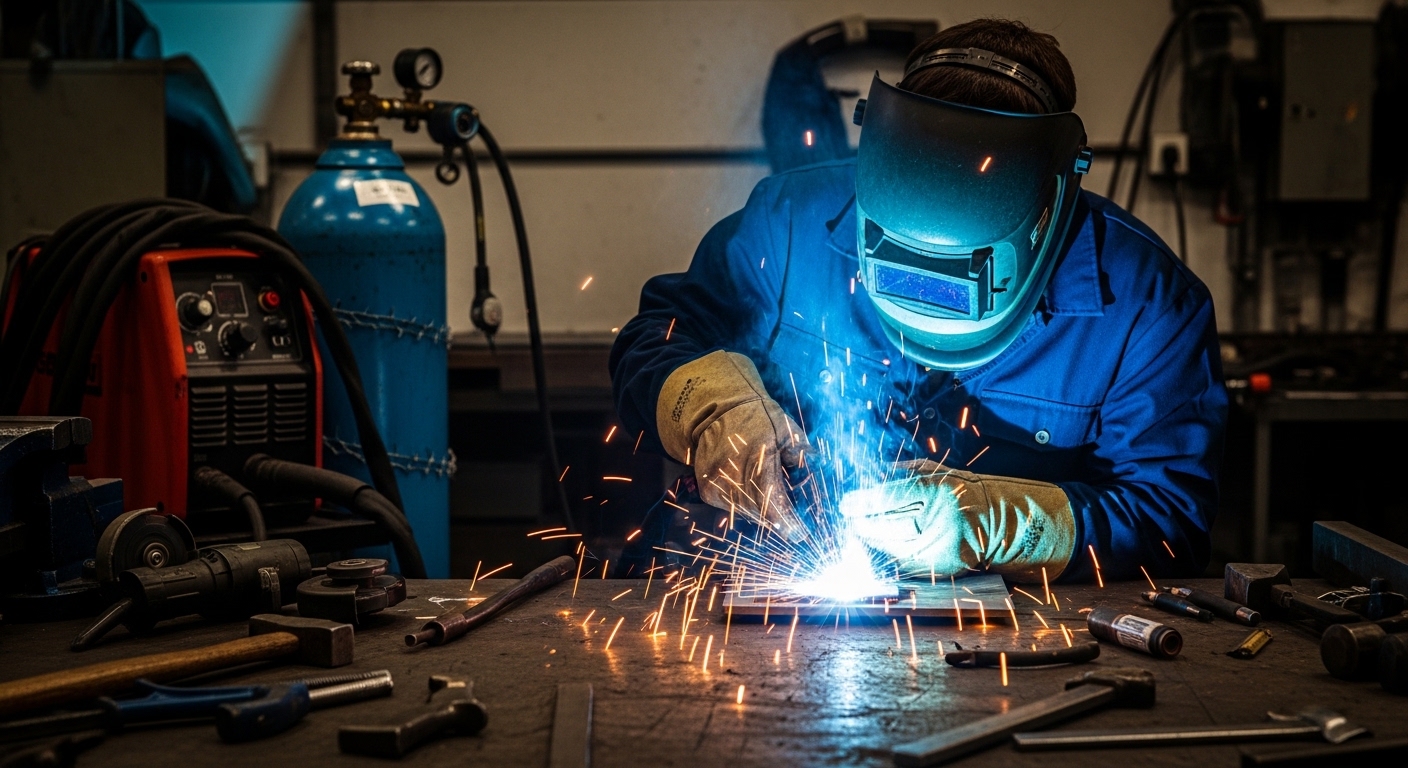
I remember my first attempt at MIG welding. I’d watched countless YouTube videos, read forums until my eyes hurt, and spent $450 on a welder that sat in my garage for three months. The intimidation factor was real. But once I finally struck that first arc and laid down a decent bead, I realized something: MIG welding is actually the easiest welding process to learn.
What is MIG Welding?
MIG welding (Metal Inert Gas welding), also known as GMAW (Gas Metal Arc Welding), is an arc welding process that uses a continuously fed wire electrode and shielding gas to join metals. The wire acts as both filler metal and electrode, creating an electric arc that melts the base metals while the shielding gas protects the weld pool from atmospheric contamination.
- Key Feature: Continuously fed wire eliminates constant electrode changes
- Best For: Beginners, automotive work, and thin metal projects
- Alternate Name: GMAW (Gas Metal Arc Welding)
After teaching three friends to weld in 2026, I’ve noticed they all become comfortable within about 2-3 hours of practice. Compare that to stick welding, which can take weeks to feel confident. The continuous wire feed means you focus on technique rather than changing electrodes every minute.
This guide covers everything you need to go from complete beginner to laying down solid welds. I’ll explain the equipment, settings, techniques, and troubleshooting tips that took me years to learn through trial and error.
GMAW: Gas Metal Arc Welding is the technical term for MIG welding. The “Gas” refers to the shielding gas, “Metal” refers to the wire electrode, and “Arc Welding” describes the electric arc process.
What is MIG Welding and How Does It Work?
MIG welding works through a deceptively simple process. A continuously fed wire electrode passes through a contact tip in the welding gun. When you pull the trigger, an electric arc forms between the wire and your workpiece. This arc generates intense heat (up to 11,000F at the core), melting both the wire and the base metal.
Quick Summary: MIG welding uses electricity to create an arc that melts wire and metal together while shielding gas protects the molten pool from air contamination. The continuous wire feed makes it much faster and easier than other welding methods.
Simultaneously, shielding gas flows through the nozzle surrounding the wire. This gas is crucial because it displaces oxygen and nitrogen from the weld area. Without it, these atmospheric gases would react with the molten metal, causing porosity, weak welds, and other defects.
The wire melts into the weld pool at a controlled rate determined by your wire speed setting. As you move the gun along the joint, the weld pool solidifies behind you, creating a fused bond between the two pieces of metal.
Unlike stick welding where the electrode gets consumed and you need to stop and change it, MIG welding can run continuously. This is why production shops love it. I’ve welded 20-foot seams without stopping, which would be impossible with stick welding.
Why MIG is Easier for Beginners
The learning curve difference between MIG and other welding processes is significant. Here’s why:
1. No electrode changes. The wire feeds automatically, so you focus entirely on technique.
2. One-handed operation. Your dominant hand controls the gun while your other hand steadies it. Compare this to TIG where you need one hand for the torch, another for filler rod, and a foot pedal for amperage.
3. Cleaner process. Minimal slag means less cleanup and better visibility of your weld pool.
4. Forgiving on thin metal. With proper settings, you can weld sheet metal as thin as 22 gauge without burning through.
Essential MIG Welding Equipment and Tools
Setting up your first MIG welding station doesn’t require a fortune. When I started, I spent about $800 total including the welder, gas, helmet, and safety gear. Let me break down what you actually need.
The MIG Welder Power Source
Your welder is the heart of your setup. For beginners, I recommend starting with a 115V input machine. These plug into standard household outlets and handle materials up to 3/16 inch thick.
Up to 3/16″
Up to 1/2″
20-30%
Essential
230V machines offer more power for thicker materials (up to 1/2 inch), but require special outlets. Unless you know you need to weld thick plate regularly, start with 115V and upgrade later.
Duty cycle matters more than most beginners realize. This rating tells you how long you can weld before the machine needs to cool down. A 20% duty cycle at 90 amps means you can weld for 2 minutes, then must let it rest for 8 minutes. Cheap welders often have terrible duty cycles that frustrate beginners.
Welding Gun Components
The welding gun houses several critical components that work together to feed wire and deliver gas to your weld area:
Contact Tip: This brass tip transfers electricity to the wire and guides it into the weld pool. It wears out periodically and costs about $2-4 to replace. I keep a spare in my toolbox.
Nozzle: The outer cup that directs shielding gas flow around the weld area. It gets spatter buildup and needs periodic cleaning or replacement.
Diffuser/Retainer: Sits between the tip and nozzle, helping distribute gas evenly. Cheap to replace but important for gas coverage.
Drive Roll System: Located inside the machine, these motorized rollers push the wire from the spool through the liner to the gun. Proper tension is crucial. Too tight and the wire deforms. Too loose and you get erratic feeding.
Gas Cylinder and Regulator
Most beginners start with C25 gas (75% argon, 25% CO2) in an 80 cubic foot cylinder. This size costs about $180 filled and lasts me about 3-4 months of moderate hobby use.
The regulator attaches to the cylinder and has two gauges. One shows remaining tank pressure, the other regulates flow to your gun. For most MIG welding, set your flow between 25-35 CFH (cubic feet per hour).
Safety Equipment Checklist
Safety isn’t optional. I’ve seen enough welder’s flash (sunburn on your eyes from UV exposure) to know better. Here’s what you need:
Leather gloves: $15-30
Welding jacket: $40-80
Safety glasses: $10-20
Leather boots: $60-100
Auto-darkening helmets are worth every penny. Old fixed-shade helmets required you to nod your head to drop the lens, then find your position blind. Modern helmets darken in 1/20,000 of a second when you strike an arc. You can see exactly where you’re pointing before you start welding.
Understanding Shielding Gas and Welding Wire
The combination of shielding gas and welding wire determines your weld quality more than any other factor. Let me break down your options.
Shielding Gas Types
The right shielding gas depends on what you’re welding and the results you want. I’ve tried all of these in my shop:
| Gas Type | Best For | Pros | Cons |
|---|---|---|---|
| 75% Argon / 25% CO2 (C25) | All-purpose steel welding | Clean welds, less spatter, good arc stability | More expensive than pure CO2 |
| 100% CO2 | Budget option, thicker steel | Cheapest option, deeper penetration | More spatter, less attractive welds |
| Tri-Mix (He/Ar/CO2) | Stainless steel | Prevents oxidation, better bead appearance | Expensive, specialty use |
| 100% Argon | Aluminum only | Required for aluminum welding | Won’t work on steel |
For beginners starting with mild steel, I recommend C25. It’s the most forgiving and produces the cleanest results. The difference in cost between C25 and pure CO2 is about $15 per cylinder fill, but the reduction in frustration is priceless.
Welding Wire Selection
The most common welding wire for mild steel is ER70S-6. The numbers mean something specific: ER stands for electrode/rod, 70 indicates 70,000 PSI tensile strength, S indicates solid wire, and 6 specifies the chemical composition with added deoxidizers.
DCEP Polarity: Direct Current Electrode Positive is the standard polarity for MIG welding. The electrode (wire) is positive, the workpiece is negative. This produces better penetration and less spatter than DCEN. Your welder should have clearly marked terminals showing this configuration.
ER70S-3 is another option with slightly different chemistry but similar performance. The S-6 is more common and works better on slightly rusty or dirty metal due to higher deoxidizer content.
Wire diameter matters more than most beginners realize. Use .023 inch wire for 22-18 gauge metal, .030 inch for 16 gauge to 1/8 inch, and .035 inch for anything thicker. Using wire that’s too thick on thin metal causes burn-through no matter how low you set your voltage.
How to Set Up Your MIG Welder: Step-by-Step
Proper setup eliminates 80% of beginner problems. I spent my first month fighting with bad welds until an experienced welder showed me I’d assembled my gun incorrectly. Here’s the right way:
Step 1: Install the Wire Spool
Open the wire drive compartment and place your spool on the hub. The spool should unwind counterclockwise. Secure it with the retaining nut, but don’t overtighten. The spool should rotate freely with slight resistance.
Step 2: Thread the Wire
Feed the wire end through the inlet guide, between the drive rolls, and into the inlet hole of the welding gun liner. You may need to remove the contact tip and nozzle to make this easier. Once the wire is past the liner, reattach the tip and nozzle.
Step 3: Set Drive Roll Tension
Press the gun trigger briefly to feed wire. The drive rolls should grip the wire firmly without deforming it. Too loose and the wire slips. Too tight and you’ll notice flattening or kinking in the wire.
Step 4: Connect Ground Clamp
Attach the ground clamp to clean, bare metal. This is more important than beginners realize. I once spent an hour trying to weld through paint before realizing my ground wasn’t making good contact.
Step 5: Connect Gas and Set Flow Rate
Attach your gas regulator to the cylinder (carefully! The cylinder is pressurized to 2000+ PSI). Open the cylinder valve slowly, then adjust the flow meter to 25-35 CFH. Check for leaks by spraying soapy water on connections. Bubbles mean you need to tighten something.
Step 6: Set Your Initial Parameters
Most welders have a reference chart inside the wire compartment door. Start with their recommendation for your metal thickness. You’ll fine-tune from there based on your actual weld results.
MIG Welding Settings Chart: Metal Thickness Guide
Finding the right settings takes practice, but this starting point chart will get you in the ballpark. I’ve refined these numbers through years of trial and error:
| Metal Thickness | Wire Diameter | Voltage | Wire Speed (IPM) | Gas Flow (CFH) |
|---|---|---|---|---|
| 22 gauge (.030″) | .023 | 14-16V | 100-130 | 20-25 |
| 20 gauge (.036″) | .023 | 16-18V | 130-160 | 20-25 |
| 18 gauge (.048″) | .023-.030 | 17-19V | 160-190 | 25-30 |
| 16 gauge (.060″) | .030 | 18-20V | 190-220 | 25-30 |
| 1/8″ (.125″) | .030-.035 | 21-23V | 220-260 | 25-30 |
| 3/16″ (.187″) | .035 | 24-26V | 260-300 | 30-35 |
| 1/4″ (.250″) | .035 | 26-28V | 300-350 | 30-35 |
Pro Tip: These are starting points. Fine-tune based on the sound of your arc. You want a steady crackling sound like bacon frying. Popping indicates wire speed is too high. A slow, smooth hiss means wire speed is too low.
MIG Welding Techniques: Push vs Pull and Beyond
Technique is where beginners struggle most. The right settings won’t help if your gun movement is wrong. Let me break down the fundamentals I’ve learned through thousands of welds.
Push vs Pull: Which is Better?
This question sparks endless debate in welding forums. Let me settle it based on experience rather than opinion.
| Technique | Description | When to Use | Results |
|---|---|---|---|
| Push (Forehand) | Gun angled forward, pushing the weld pool ahead | Thin metal, auto body, aesthetic welds | Wider bead, less penetration, smoother finish |
| Pull (Backhand) | Gun angled backward, dragging the weld pool | Thicker metal, structural welds, deep penetration | Narrower bead, deeper penetration, more convex |
For most beginner projects on steel under 1/8 inch, I recommend pushing. It gives you better visibility of the weld pool and produces flatter, more attractive beads. Pulling is better for thick structural steel where penetration matters more than appearance.
Gun Angle and Position
Your gun angle affects penetration and bead shape significantly. The general rule is a 10-15 degree angle from perpendicular. Too much angle reduces penetration and causes poor fusion.
Travel angle is the angle relative to the direction of travel. Pushing angles the gun forward. Pulling angles it backward. Perpendicular (90 degrees) is rarely ideal except for vertical-up welding on certain materials.
Work angle is the angle relative to the joint. For a T-joint, aim 45 degrees into the corner. For a lap joint, aim more toward the bottom piece to ensure fusion on both.
Stickout Distance
Stickout is the length of wire extending from your contact tip to the arc. The ideal stickout is 3/8 to 1/2 inch. Too much stickout causes unstable arc, increased spatter, and poor gas coverage. Too little increases the risk of contact tip damage from the arc.
Movement Techniques
For most beginner welds, a steady straight line works best. As you advance, you can try patterns:
Straight line: Best for butt joints and thin metal. Move steadily without weaving.
Small circles: Helps fill gaps and ensures good edge fusion. Keep circles tight.
Cursive E pattern: Named because it resembles handwriting cursive E letters. Good for wider beads on thicker material.
Whip technique: Rapid forward and back motion. Helps control heat input and prevents burn-through on thin metal.
Trigger Control
For most welds, hold the trigger continuously. For intermittent welds or tack welds, release the trigger at each stopping point. For extremely thin metal prone to burn-through, try pulsing the trigger rhythmically to control heat input.
Common MIG Welding Problems and Solutions
Every welder struggles with these problems at some point. I’ve dealt with each of them multiple times. Let me save you some troubleshooting time.
Porosity: Those Pesky Holes
Porosity shows up as small holes in your weld, making it weak and ugly. In my experience, these are the main causes:
Porosity Causes and Solutions
| Cause 1: Gas flow too low | Increase flow to 25-35 CFH and check for blockages in the nozzle |
| Cause 2: Drafts or wind | Block air currents with tarps or weld indoors. Even a light breeze disrupts shielding |
| Cause 3: Dirty or rusty metal | Grind surfaces to clean metal within 1 inch of the weld area |
| Cause 4: Too much stickout | Reduce stickout to 3/8-1/2 inch maximum |
| Cause 5: Moisture in gas line | Purge gas line before welding or check for water in cylinder |
| Cause 6: Contaminated wire | Replace wire if rusty or dirty. Keep spool covered when not in use |
Lack of Fusion: The Invisible Danger
This is the most dangerous defect because your weld looks fine but isn’t actually fused to the base metal. It typically happens when your settings are too cold or your travel speed is too fast.
Solutions: Increase voltage, slow down your travel speed, reduce stickout, and ensure proper joint fitup. I’ve found that most beginners move too fast. Slow down and let the weld pool do the work.
Burn Through: When Metal Disappears
Common on thin sheet metal, burn-through happens when you apply too much heat. The melted metal blows through, creating a hole.
Solutions: Reduce voltage and wire speed, use smaller diameter wire, try the push technique, increase travel speed, or use a heat sink like a copper backing bar behind the weld.
Excessive Spatter
Spatter consists of tiny droplets of metal that scatter around your weld. Some is normal, but excessive spatter wastes material and requires cleanup.
Solutions: Check your stickout length, adjust voltage/wire speed balance, ensure good ground connection, try C25 gas instead of pure CO2, and replace worn contact tips. I reduced my spatter by 70% just by switching from CO2 to C25.
Crater Cracks
These small cracks form at the end of your weld when you release the trigger too abruptly. The weld pool cools too quickly, causing stress cracks.
Solutions: Fill the crater by pausing briefly at the end of the weld, then backstep slightly into the finished weld before releasing the trigger. This simple technique eliminated all my crater crack problems.
What Can You MIG Weld? Materials and Projects
MIG welding is incredibly versatile once you understand its capabilities and limitations. Let me share what I’ve learned about different materials.
Carbon Steel
This is where MIG shines. Mild steel is the most forgiving material to learn on and produces excellent results with ER70S-6 wire and C25 gas. I’ve welded everything from 22 gauge sheet metal to 1/2 inch plate with great success.
Stainless Steel
MIG welding stainless requires specific considerations. You’ll need ER308 or ER309 wire and tri-mix shielding gas (helium, argon, CO2). The key challenge is heat input. Too much causes carbide precipitation and rust issues.
For thin stainless, use lower heat settings and faster travel speeds. I also recommend back-purging with argon gas when welding stainless pipe to prevent oxidation on the inside.
Aluminum
Aluminum MIG welding is more advanced. You need 100% argon gas (not C25), a spool gun or push-pull feeder to prevent wire birdnesting, and aluminum-specific wire (ER4043 or ER5356).
Aluminum conducts heat away from the weld zone quickly, requiring higher amperage but also faster travel speeds. Cleanliness is critical. Any oxide or contamination causes immediate problems.
Beginner Project Ideas
Start with these projects to build your skills progressively:
1. Butt joints on scrap: Practice on different thicknesses until you can lay consistent beads.
2. T-joints: Learn to weld perpendicular pieces. Focus on penetration into the corner.
3. Lap joints: Overlap two pieces and weld along the edge. Great for sheet metal work.
4. Simple stool: Square tubing with a flat seat. Introduces multiple joints and positioning challenges.
5. Welding table: Build your own welding table. It’s the perfect first major project and you’ll use it constantly.
MIG Welding Safety Essentials
I cannot overstate how important proper safety is. In 2026, I treated a minor burn from a hot workpiece that could have been prevented with proper gloves. Don’t learn the hard way.
Personal Protective Equipment
Your helmet is your most important safety investment. Auto-darkening lenses should meet ANSI Z87.1 standards and have a variable shade 9-13. Most welding happens around shade 10-11.
Welding generates intense UV radiation that reflects off walls and floors. Always wear safety glasses under your helmet. I’ve seen “sunburn” on eyelids from welding without adequate eye protection.
Leather gloves specifically designed for welding protect your hands from UV burns, sparks, and heat. Cheap work gloves won’t cut it. Invest in proper welding gloves.
Ventilation and Fumes
Welding fumes contain metal oxides and gases that can be harmful. Always weld in well-ventilated areas. For indoor welding, consider a fume extractor or at minimum position a fan to draw fumes away from your breathing zone.
Never weld on galvanized steel without removing the zinc coating first. Galvanized metal produces toxic fumes when welded that cause metal fume fever. I learned this the hard way with a night of flu-like symptoms after welding a galvanized trailer frame.
Fire Safety
Welding throws sparks up to 35 feet. Always clear your work area of flammable materials and keep a fire extinguisher nearby. Check behind your work area for hidden combustibles.
I once started a small fire in a trash can 20 feet away. The sparks had bounced off concrete and landed on paper. Now I always do a thorough 360-degree check before striking an arc.
Electrical Safety
MIG welders use significant amperage. Inspect your cables regularly for damage. Never touch the electrode with bare skin when the machine is powered. Ensure your work area is dry and your ground clamp makes solid contact.
Frequently Asked Questions
Is MIG welding easy to learn?
MIG welding is considered the easiest welding process to learn. Most beginners can lay decent beads within 2-3 hours of practice. The continuous wire feed eliminates electrode changes, and the one-handed operation lets you focus entirely on technique. With proper settings and some practice, complete beginners often achieve competency within a week of regular practice.
What is the difference between MIG and TIG welding?
MIG uses a continuously fed wire electrode and is faster, easier, and better for beginners. TIG uses a non-consumable tungsten electrode and requires you to manually feed filler rod with your other hand. MIG is ideal for production and thicker materials. TIG produces cleaner, more precise welds on thinner materials and is preferred for aluminum and stainless steel work requiring high cosmetic quality.
Can you MIG weld aluminum?
Yes, but aluminum MIG welding requires specific equipment and knowledge. You need 100% argon shielding gas (not C25), a spool gun or push-pull feeder to prevent wire feeding problems, and aluminum-specific welding wire. Aluminum also requires higher heat settings but faster travel speed due to its high thermal conductivity. It’s more challenging than steel welding and recommended after you’ve mastered steel.
Can you MIG weld stainless steel?
Yes, stainless steel MIG welding requires specific wire (ER308 or ER309) and tri-mix shielding gas containing helium, argon, and CO2. The main challenge is controlling heat input to prevent carbide precipitation, which can cause corrosion. Use lower amperage and faster travel speeds than with carbon steel. For critical applications, back-purging with argon gas prevents oxidation on the inside of pipe welds.
What polarity for MIG welding?
MIG welding uses DCEP (Direct Current Electrode Positive) polarity, also called reverse polarity. This means the electrode (wire) is positive and the workpiece is negative. DCEP provides better penetration and less spatter than DCEN (Direct Current Electrode Negative). Most MIG welders are preset for DCEP, but always verify your connections match the machine’s polarity diagram. Using the wrong polarity causes poor welds and excessive spatter.
Is MIG welding stronger than stick welding?
When done correctly, MIG welds are equally as strong as stick welds. Strength comes from proper penetration and fusion, not the welding process. MIG can actually produce stronger welds on thinner materials where stick welding is prone to burn-through. However, stick welding handles dirty, rusty, or painted surfaces better than MIG. For critical structural applications, proper technique and inspection matter more than the process used.
Can you teach yourself to MIG weld?
Yes, MIG welding is very teachable through self-study. Start with quality safety equipment and practice on scrap mild steel. Watch instructional videos, read guides like this one, and practice consistently. Focus on proper settings, gun angle, and steady travel speed. Most self-taught welders achieve basic competency within 1-2 weeks of regular practice. Consider taking a class if possible, but many successful welders are entirely self-taught.
How much does MIG welding equipment cost?
A complete beginner MIG welding setup costs $600-1000. This includes a 115V MIG welder ($300-500), 80 cubic foot gas cylinder filled with C25 ($180), auto-darkening helmet ($80-200), welding gloves ($15-30), and miscellaneous supplies ($50-100). Used equipment can reduce initial costs. Budget-conscious beginners can start with a basic fixed-shade helmet and upgrade later. Operating costs run $30-50 per month for wire and gas refills with moderate hobby use.
Leave a Reply