
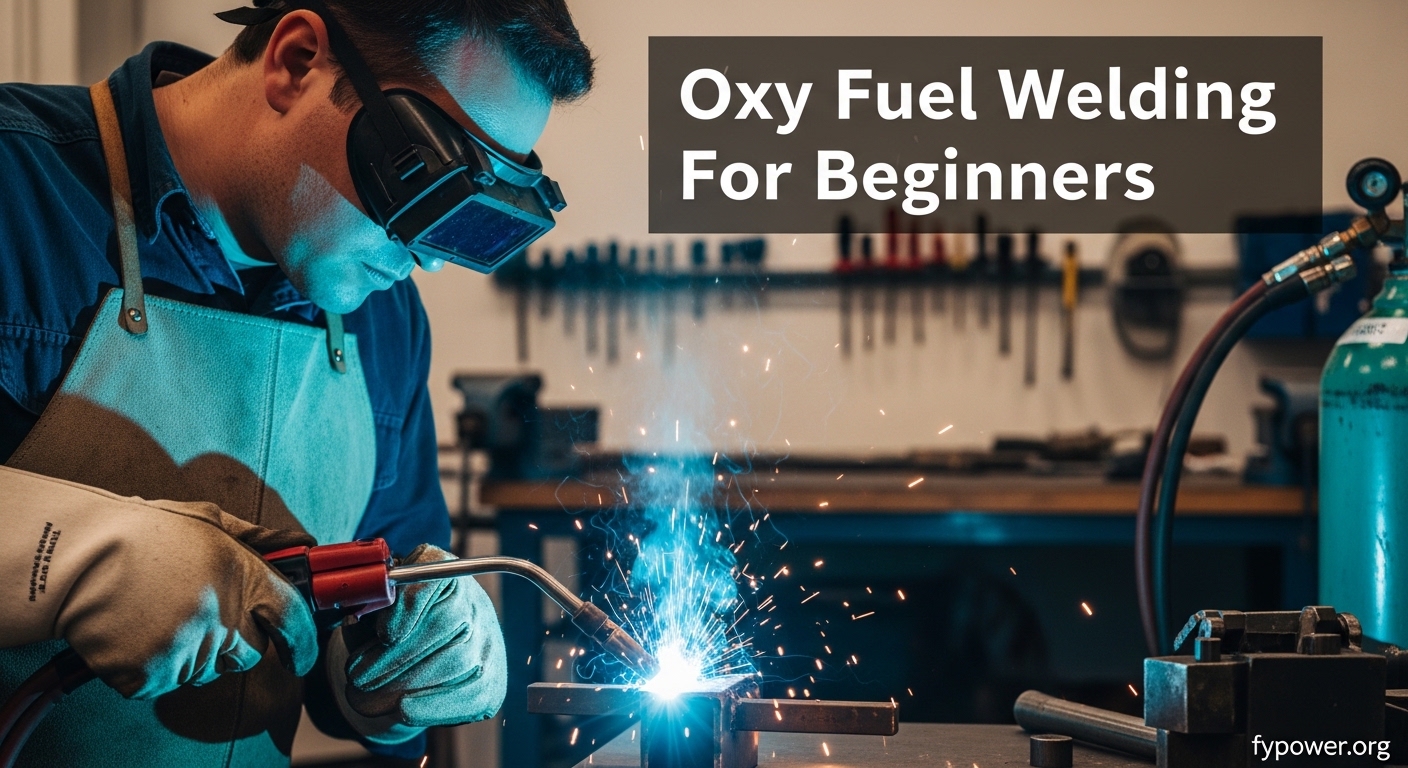
Looking for a welding method that doesn’t require electricity and can handle everything from joining metal to cutting through thick steel plates? Oxy fuel welding might be exactly what you need.
What is Oxy Fuel Welding?
Oxy-fuel welding (also called oxyacetylene welding, oxy welding, or gas welding) is a welding process that uses fuel gases combined with pure oxygen to weld and cut metals. The most common fuel is acetylene, which produces a flame reaching 3,500degC (6,330degF) when mixed with oxygen. This versatile process is used for welding, brazing, cutting, and heating applications in metal fabrication, automotive repair, and industrial maintenance.
Unlike electric welding methods that require a power source, oxy fuel welding relies on the combustion of fuel gases. This makes it incredibly portable and useful in locations without electrical access.
I’ve worked with various welding methods over the years, and oxy fuel remains one of the most versatile tools in any metalworker’s arsenal. When you’re out in the field working on farm equipment or need to heat a rusty bolt without dragging around a heavy MIG welder, nothing beats the simplicity of a gas torch.
Quick Summary: Oxy fuel welding uses oxygen and fuel gas (usually acetylene) to create an ultra-hot flame for welding, cutting, and heating metal. It’s portable, versatile, and still widely used in 2026 for applications ranging from automotive repair to scrap metal cutting.
How Oxy Fuel Welding Works?
The science behind oxy fuel welding is straightforward: fuel gas combines with pure oxygen and burns at extreme temperatures. When this flame contacts metal, it creates a molten pool that allows you to join pieces together or cut through them entirely.
Think of it like a controlled camp fire that burns hot enough to melt steel. By adjusting the ratio of oxygen to fuel, you can change the flame characteristics for different tasks. More oxygen gives you a cutting flame. Less oxygen creates a welding or brazing flame.
What makes oxy fuel unique is the use of pure oxygen instead of ambient air. Regular air is only about 21% oxygen. By using 100% oxygen, the flame burns much hotter and more efficiently. This is why oxy-acetylene reaches temperatures over 3,000degC while a standard propane torch tops out around 1,900degC.
Combustion: The chemical reaction between fuel gas and oxygen that produces heat. In oxy fuel welding, we maximize this reaction by using pure oxygen instead of air.
Oxy-Fuel Welding Equipment You Need
Setting up for oxy fuel welding requires several key components. Each piece serves a specific purpose in the system.
| Equipment | Purpose | Typical Cost Range |
|---|---|---|
| Oxygen Cylinder | Stores pure oxygen at high pressure | $100-$300 (full) |
| Fuel Cylinder | Stores acetylene or other fuel gas | $150-$400 (full) |
| Pressure Regulators | Controls gas pressure from cylinders | $50-$150 each |
| Welding Torch Handle | Mixes gases and controls flame | $80-$250 |
| Gas Hoses | Delivers gases from regulators to torch | $30-$80 per pair |
| Flashback Arrestors | Safety device preventing flame backfire | $30-$60 each |
| Welding/Cutting Tips | Interchangeable tips for different tasks | $15-$50 each |
| Complete Starter Kit | All components except cylinders | $200-$600 |
Oxygen and Fuel Cylinders
The oxygen cylinder stores pure oxygen at pressures up to 2,200 PSI. These cylinders are color-coded green in the United States. The fuel cylinder (usually acetylene) stores fuel gas at much lower pressures since acetylene becomes unstable above 15 PSI.
I learned the hard way that cylinder positioning matters. Oxygen cylinders should always be secured upright. Acetylene cylinders contain a porous material and acetone to stabilize the gas. They must also be kept upright or the acetone can enter the regulator and cause damage.
Pressure Regulators
Regulators reduce the high pressure in the cylinders to working pressure. Oxygen typically operates at 10-40 PSI for welding. Acetylene runs at 3-15 PSI depending on the tip size and application.
Quality regulators make a difference. After going through three cheap sets in five years, I invested in Victor regulators and haven’t looked back. They maintain consistent pressure and the gauges are actually readable.
The Welding Torch
The torch is where gases mix and combustion happens. Most torches have two control valves: one for oxygen and one for fuel. The mixture happens in the torch body or at the tip, depending on the design.
Injector torches use high-pressure oxygen to draw in fuel gas. This design allows the use of any fuel gas. Equal-pressure torches require both gases at similar pressures and work best with acetylene.
Safety Devices
Flashback arrestors are non-negotiable safety equipment. They prevent flame from traveling back into the hoses and cylinders. Flashback can cause catastrophic cylinder failure. Install arrestors at both the regulator and torch ends.
Check valves serve a similar purpose, preventing gas from flowing backward through the system. Many modern torches have built-in check valves, but external flashback arrestors provide additional protection.
Types of Fuel Gases Explained
While acetylene is the traditional choice, several fuel gases work for oxy fuel applications. Each has advantages and limitations.
| Fuel Gas | Flame Temp | Best For | Cost (Relative) |
|---|---|---|---|
| Acetylene | 3,160degC in oxygen | Welding steel up to 1/4 inch | High |
| Propane | 2,820degC in oxygen | Cutting, heating, brazing | Low |
| MAPP Gas | 2,930degC in oxygen | Heating, brazing, light cutting | Medium |
| Propylene | 2,900degC in oxygen | Cutting, heating | Medium |
| Natural Gas | 2,740degC in oxygen | Heating large areas | Very Low |
Acetylene: The Traditional Choice
Acetylene produces the hottest flame among common fuel gases and is the only fuel suitable for welding steel. Its concentrated heat creates a small, intense flame ideal for precise work.
However, acetylene has limitations. It’s unstable above 15 PSI and requires special handling. The cylinders are expensive to refill. For cutting and heating applications, cheaper alternatives often make more sense.
Propane: The Budget-Friendly Alternative
Propane costs about one-third as much as acetylene and is readily available at any hardware store. It excels at heating and cutting applications where the lower flame temperature isn’t a disadvantage.
For scrap yards doing primarily cutting work, propane is the economic choice. I’ve seen operations save thousands annually by switching from acetylene to propane for cutting tasks.
MAPP and Propylene
MAPP gas (methylacetylene-propadiene propane) offers a middle ground between acetylene and propane. It burns hotter than propane but costs more. Production of true MAPP gas ended in 2008, but similar propylene blends are sold under the same name.
Propylene provides excellent heat for brazing and heating. It’s a common choice for HVAC technicians and HVAC repair work where heating larger areas is necessary.
Understanding Flame Types
The appearance and characteristics of your oxy fuel flame depend on the oxygen-to-fuel ratio. Mastering flame identification is fundamental to successful oxy fuel welding.
Quick Summary: There are three types of oxy fuel flames: neutral (balanced), carburizing (fuel-rich), and oxidizing (oxygen-rich). The neutral flame is used for most welding. Carburizing flames add carbon to metal. Oxidizing flames oxidize the weld pool.
- Neutral Flame: Equal parts oxygen and fuel. The inner cone is bright blue with a well-defined tip. This is the standard welding flame for most applications. It produces clean welds without adding or removing elements from the metal.
- Carburizing Flame: Excess fuel. The inner cone has a feathery edge and appears bluish-white with an acetylene “feather” extending from the tip. This flame adds carbon to the weld pool. It’s used for welding high-carbon steels and for certain brazing applications.
- Oxidizing Flame: Excess oxygen. The inner cone is shorter, sharper, and paler blue than a neutral flame. The flame makes a hissing sound. This flame removes carbon from metal and is used for welding copper, brass, and bronze.
Identifying Your Flame
Start with more fuel than oxygen and gradually increase oxygen until you achieve the desired flame. A neutral flame should have a clearly defined inner cone about 1/8 to 1/4 inch long depending on tip size.
I spent weeks practicing flame adjustment before attempting my first real weld. The difference between a nearly-neutral and truly neutral flame is subtle but affects weld quality significantly. Take the time to learn this skill.
Setting Up Your Oxy-Acetylene Torch
Proper setup is critical for safety and performance. Follow these steps in order.
- Position Cylinders: Secure cylinders upright. Chain them to a wall or cylinder cart. Oxygen cylinders should be at least 20 feet from combustible materials.
- Check Connections: Ensure all hose connections are tight. Check that regulator threads match the cylinder valves (oxygen is right-hand thread, fuel is left-hand thread to prevent cross-connection).
- Open Cylinder Valves Slowly: Stand to the side of the cylinder. Open oxygen valve fully against the backseat. Open fuel valve only 1/4 to 1/2 turn (acetylene valves should never be fully opened).
- Set Working Pressures: With torch valves closed, adjust each regulator to the recommended pressure for your tip size. Typical welding pressures: 3-5 PSI acetylene, 10-20 PSI oxygen.
- Check for Leaks: Use a soap solution or leak detection fluid on all connections. Bubbles indicate leaks that must be fixed before proceeding.
- Purge Hoses: Briefly open torch valves to clear air from hoses. Do this separately for each gas.
- Light the Torch: Open fuel valve slightly and ignite with a striker. Adjust fuel until flame leaves tip but doesn’t separate.
- Add Oxygen: Gradually open oxygen valve until you achieve desired flame type.
Shutdown Procedure
Proper shutdown prevents equipment damage and ensures safety. Close oxygen valve first, then fuel valve. Close cylinder valves. Drain remaining gas by opening torch valves until gauges read zero. Back off regulator adjustment screws. Coil hoses neatly.
Basic Oxy Fuel Welding Techniques
Welding with oxy fuel requires coordination between torch movement and filler rod addition. The learning curve is steeper than MIG welding but more forgiving than TIG.
Preparing the Metal
Clean the weld area thoroughly. Remove paint, rust, and oil. Bevel thick materials (over 1/8 inch) to ensure full penetration. Proper joint preparation accounts for about 50% of weld quality.
The Welding Process
Hold the torch at a 45-degree angle to the workpiece. The flame should be directed at the joint. Move the torch in a circular or slight weaving motion to distribute heat evenly.
When the metal forms a shiny puddle, introduce the filler rod. The rod should melt into the puddle, not be directly melted by the flame. Continue moving along the joint, maintaining a consistent puddle size.
Quick Summary: Basic oxy fuel welding technique involves heating the metal with a neutral flame until molten, then adding filler rod while moving along the joint. Maintain consistent torch speed and puddle size for even welds.
Common Joint Types
- Butt Joint: Two pieces placed edge-to-edge. Best for material up to 1/8 inch.
- Lap Joint: Pieces overlap. Easier for beginners and provides more surface area.
- T-Joint: One piece perpendicular to another. Common in structural applications.
- Corner Joint: Pieces meet at an edge. Used for box and frame construction.
Beginner Mistakes to Avoid
After teaching dozens of people to weld, I see the same mistakes repeatedly. Moving too fast is number one. Let the puddle develop before adding filler. Another common error is holding the torch too far from the work. The flame inner cone should nearly touch the metal.
Using the wrong filler rod causes many failures. Match the filler material to your base metal. For mild steel, use RG-45 or RG-60 rods. They’re designed specifically for gas welding.
Oxy Fuel Cutting Guide
Cutting with oxy fuel is fundamentally different from welding. The process heats steel to ignition temperature, then a pure oxygen stream burns through the material. It’s called “oxidation cutting” rather than true cutting.
Only ferrous metals can be cut with oxy fuel. You cannot cut aluminum, stainless steel, or copper with this process. For those materials, consider plasma cutting or abrasive methods.
The Cutting Process
- Mark Your Cut Line: Use soapstone or marker to clearly identify where to cut.
- Preheat the Edge: Hold the torch perpendicular to the metal. Heat the starting point until it’s cherry red (approximately 1,600degF).
- Activate Cutting Oxygen: Press the cutting oxygen lever. A stream of pure oxygen will pierce the metal.
- Move Along the Path: Once through, move the torch along your cut line. The kerf (cut width) should be uniform.
- Finish the Cut: Slow at corners. Let the cut fully complete before moving away.
Cutting Tips and Techniques
Tip size determines thickness capacity. A general rule: tip number equals material thickness in sixteenths of an inch. A #3 tip handles 3/16 inch material. A #6 tip cuts through 3/8 inch plate.
For thick material, bevel the edge before starting. This gives the preheat flame more surface area to work with. When cutting thick plate, I bevel the start point about 45 degrees. This reduces preheat time by nearly half.
Safety Procedures and Equipment
Oxy fuel welding involves high-pressure gases, extreme heat, and potential explosion hazards. Proper safety procedures are non-negotiable.
| Safety Equipment | Purpose | Essential? |
|---|---|---|
| Welding Goggles #5 Shade | Eye protection from UV/IR | Yes |
| Flame-Resistant Clothing | Burn prevention | Yes |
| Leather Gloves | Hand protection | Yes |
| Flashback Arrestors | Prevents cylinder explosion | Yes |
| Fire Extinguisher | Emergency fire response | Yes |
| Respirator (if needed) | Fume protection | Sometimes |
Eye Protection
Oxy fuel welding produces ultraviolet and infrared radiation. Standard safety glasses are not adequate. Use #3 to #5 shade goggles for welding. #5 shade is recommended for most applications. For cutting, lighter shades (#3-4) improve visibility while still providing protection.
Cylinder Safety
Oxygen under pressure can cause spontaneous combustion of oil and grease. Never use oil-based lubricants on oxygen fittings. Oxygen cylinders must be stored separately from fuel cylinders or separated by a firewall at minimum.
Acetylene cylinders require special handling. Never draw acetylene above 15 PSI. Never lay an acetylene cylinder on its side. If a cylinder has been laid down, stand it upright for at least 30 minutes before use.
Flashback Prevention
Flashback occurs when flame travels backward into the equipment. It’s caused by incorrect pressure settings, blocked tips, or allowing the flame to burn the tip. Signs of flashback include a popping sound, flame at the torch body, or sudden hissing.
If flashback occurs: immediately close both torch valves. Close cylinder valves. Check equipment for damage before resuming. Flashback arrestors are your last line of defense and should be inspected regularly.
Ventilation
Welding produces fumes that can be harmful. Work in well-ventilated areas. When working indoors, use exhaust fans or local exhaust ventilation. Certain materials (galvanized steel, painted metals) produce particularly toxic fumes when heated.
Flashback: A dangerous condition where the flame travels back through the torch into the hoses or cylinders. Flashback arrestors are safety devices designed to prevent this by extinguishing backfire.
Common Applications and Uses
Despite the rise of electric welding methods, oxy fuel remains relevant in 2026 for specific applications where it excels.
Automotive Repair
Older vehicles with steel bodies respond well to gas welding. Sheet metal can be welded or brazed without the heat distortion common with other methods. Oxy fuel is also ideal for heating rusty bolts and seized parts for removal.
Metal Fabrication
For light fabrication and repair work, oxy fuel offers versatility that single-purpose electric welders cannot match. One setup handles welding, cutting, heating, and brazing. This versatility makes it popular in small fabrication shops.
Scrap and Salvage
Scrap yards rely on oxy fuel cutting for dismantling equipment and processing scrap metal. The portability of gas torches allows cutting anywhere without electrical access. Propane is commonly used here due to its low cost.
Heating Applications
Sometimes the goal isn’t to weld but to heat. Oxy fuel excels at bending metal, heat treating, freeing frozen bolts, and preheating thick materials before welding with other methods. A rosebud tip attachment spreads heat over a larger area for heating applications.
Brazing and Soldering
Oxy fuel produces precise heat control ideal for brazing and soldering. The ability to adjust flame characteristics makes it suitable for various filler metals and fluxes. Plumbing, HVAC, and refrigeration work all rely on gas torches for brazing copper tubing.
Oxy-Fuel vs Electric Welding
Understanding when oxy fuel is the right choice versus when electric welding makes more sense helps you select the appropriate method for your projects.
| Factor | Oxy-Fuel Welding | Electric Welding (MIG/TIG/Stick) |
|---|---|---|
| Power Requirement | None – works anywhere | Requires electricity (110V/220V) |
| Initial Equipment Cost | $200-$600 | $300-$1,500+ |
| Operating Cost | Higher – ongoing fuel cost | Lower – electricity and consumables |
| Welding Speed | Slower | Faster |
| Metal Thickness Range | Up to 1/4 inch welding (thicker cutting) | Wide range – sheet to thick plate |
| Portability | Excellent – cylinders are portable | Limited by power access |
| Versatility | Welds, cuts, heats, brazes | Primarily welding |
| Learning Curve | Moderate to steep | MIG easiest, TIG steepest |
| Best Applications | Field work, heating, cutting, repair | Production, fabrication, thick materials |
Advantages of Oxy Fuel Welding
The portability of oxy fuel equipment cannot be overstated. I’ve welded fence posts in the middle of a pasture and cut steel beams at construction sites without power access. The equipment rides in the back of a pickup truck and goes anywhere.
Multi-function capability is another strength. One outfit handles welding, cutting, brazing, soldering, and heating. For hobbyists and small shops, this versatility eliminates the need for multiple specialized tools.
Disadvantages of Oxy Fuel Welding
Operating costs add up over time. Gas refills are expensive compared to electricity. For high-volume welding, electric methods are more economical.
Speed is another limitation. Oxy fuel welding is significantly slower than MIG welding. Production environments favor electric methods for this reason.
When to Choose Oxy Fuel?
Choose oxy fuel when you need portability, versatility, or lack electrical access. Field repair work, automotive hobbyists, and scrap processing are ideal applications. For production welding or thick material fabrication, electric welding typically makes more sense.
Frequently Asked Questions
What is oxy fuel welding?
Oxy fuel welding is a welding process that uses fuel gases combined with oxygen to weld and cut metals. The most common fuel is acetylene, which creates a flame reaching 3,500degC when mixed with pure oxygen. This process can weld, cut, braze, and heat metal.
How hot is an oxy acetylene flame?
An oxy-acetylene flame reaches approximately 3,160degC (5,720degF) in oxygen. This makes it the hottest common fuel gas flame available. For comparison, propane burns at approximately 2,820degC in oxygen.
What are the three types of oxy fuel flames?
The three types are neutral flame (balanced oxygen and fuel, used for most welding), carburizing flame (excess fuel with a feathery inner cone, adds carbon to metal), and oxidizing flame (excess oxygen with a short pale inner cone, removes carbon from metal).
Is oxy fuel welding still used today?
Yes, oxy fuel welding remains widely used in 2026 for specific applications. While electric welding has replaced it for many production tasks, oxy fuel excels in field work, automotive repair, scrap cutting, and heating applications where portability and versatility are valued.
What gas is used in oxy fuel welding?
Acetylene is the most common fuel gas for welding because it produces the hottest flame and a concentrated heat pattern. Other fuels include propane (popular for cutting and heating due to low cost), MAPP gas, propylene, and natural gas. Propane cannot be used for welding steel but works well for cutting.
What is the difference between oxy fuel and arc welding?
Oxy fuel welding uses combustion of fuel gas and oxygen to create heat, while arc welding uses electrical current to create an electric arc. Oxy fuel doesn’t require electricity and can also cut and heat metal. Arc welding is generally faster, more economical for high-volume work, and produces welds on thicker materials more easily.
Can you weld aluminum with oxy fuel?
Welding aluminum with oxy fuel is difficult and not recommended for most applications. Aluminum has a low melting point and high thermal conductivity, making it challenging to weld with oxy fuel. TIG welding is the preferred method for aluminum. Oxy fuel can be used for aluminum brazing with appropriate filler rods.
How much does oxy fuel welding equipment cost?
A complete starter kit (excluding cylinders) costs between $200 and $600 depending on quality and brand. Full cylinders cost an additional $250-$700. Budget setups from home center stores start around $200, while professional-grade equipment from brands like Victor or Smith ranges from $500-$800 for the torch outfit alone.
Leave a Reply