
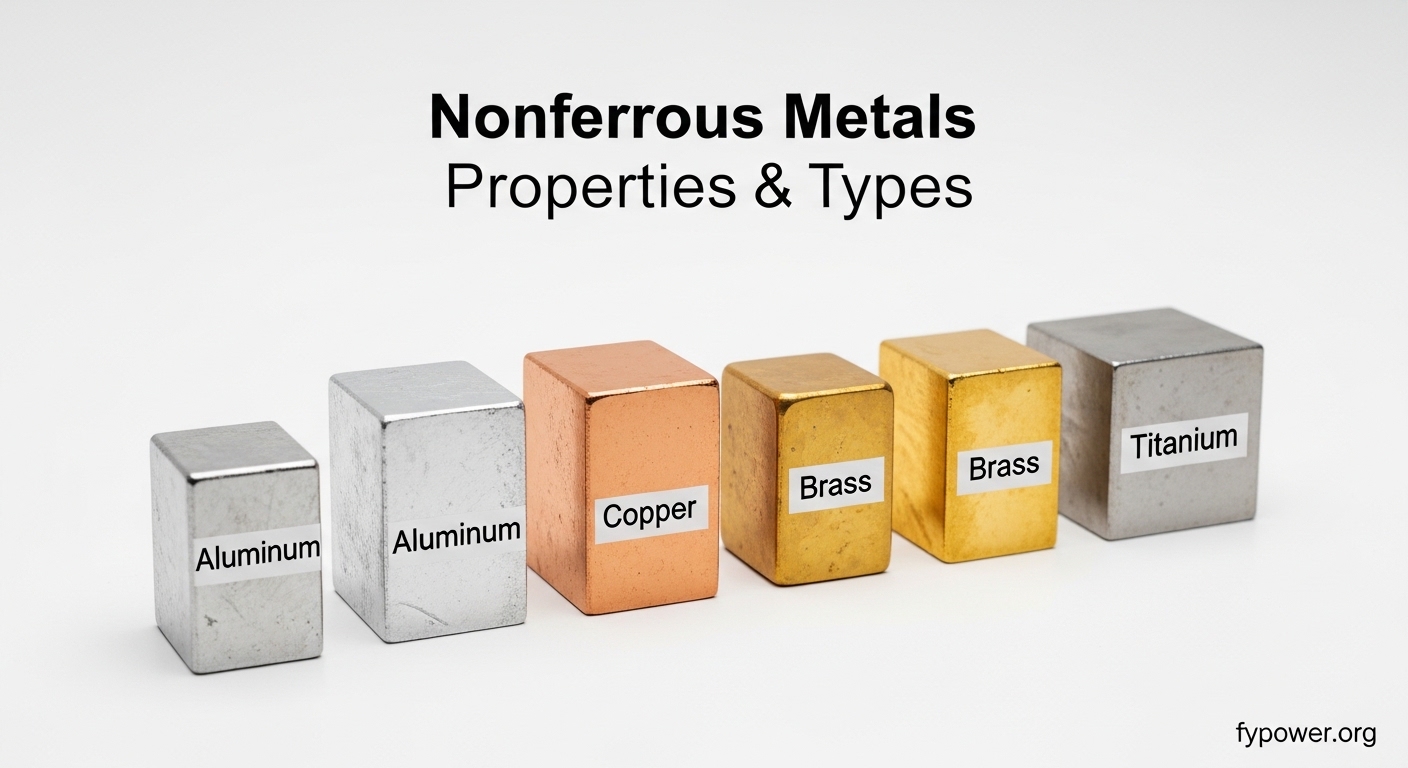
After 15 years working in fabrication and manufacturing, I have seen how material selection can make or break a project. Nonferrous metals are among the most versatile materials in modern industry, found everywhere from aircraft to electronics.
Nonferrous metals are metals and alloys that contain little to no iron (typically less than 0.1%). Unlike ferrous metals that rust when exposed to moisture, nonferrous metals like aluminum, copper, and titanium offer superior corrosion resistance, electrical conductivity, and lightweight properties that make them essential for electrical wiring, aircraft, and marine applications.
Understanding these metals is crucial whether you are selecting materials for a project, identifying scrap metal, or studying metallurgy. Let me break down everything you need to know.
What Are Nonferrous Metals?
Nonferrous Metals: Metals and alloys that do not contain iron in appreciable amounts. The term comes from the Latin “ferrum” meaning iron, so nonferrous literally means “without iron.”
The iron content threshold is typically less than 0.1%. This small amount of iron does not give these metals the magnetic or rusting properties associated with ferrous metals like steel and cast iron.
I have watched machinists spend hours identifying unknown metal pieces in shops. The magnet test is usually the first step. If a magnet does not stick, you are likely dealing with a nonferrous metal.
Common Types of Nonferrous Metals
Nonferrous metals encompass a wide range of elements. Here are the most common ones you will encounter:
Quick Summary: Aluminum is the most widely used nonferrous metal due to its lightweight properties. Copper dominates electrical applications. Titanium offers the highest strength-to-weight ratio but comes at a premium cost.
1. Aluminum
Aluminum is the most common nonferrous metal in the world. I have seen it transform industries from automotive to aerospace.
Key properties include a density of 2.7 g/cm3 (about one-third that of steel), excellent corrosion resistance due to its natural oxide layer, and high thermal and electrical conductivity.
In my experience working with aluminum alloys, I have found that 6061 is the go-to grade for structural applications while 7075 offers superior strength for aerospace uses. The difference matters. I once saw a project fail because someone used 3003 series aluminum where 6061 was required.
Common Uses:
- Aircraft and spacecraft structures
- Automotive body panels and engine components
- Window frames and doors
- Aluminum cans and packaging
- Electrical transmission lines
2. Copper
Copper has been used for thousands of years. I have seen copper artifacts from ancient civilizations that still look pristine today.
Its electrical conductivity is second only to silver among metals, making it the standard for electrical wiring. Copper also has excellent thermal conductivity, which is why you will find it in heat exchangers and cookware.
Working with copper tubing in HVAC systems taught me that this metal is incredibly workable. You can bend it, flare it, and solder it without special equipment. However, copper prices fluctuate wildly. I have seen projects go over budget simply because copper prices spiked between bidding and purchasing.
Common Uses:
- Electrical wiring and motors
- Plumbing pipes and fittings
- Roofing and architectural applications
- Heat exchangers and radiators
- Coins and musical instruments
3. Zinc
Zinc is primarily known for its corrosion protection properties. Galvanizing steel with zinc extends its life dramatically.
The metal has a relatively low melting point of 419.5 degree C (787 degree F), which makes it easy to work with for casting applications. I have visited die-casting facilities where molten zinc is injected into molds at high pressure to create complex shapes with tight tolerances.
Zinc also forms the basis for brass when alloyed with copper. The distinction matters for scrap identification. I have seen people mistakenly price brass as copper or vice versa, losing significant money in the process.
Common Uses:
- Galvanizing steel for corrosion protection
- Die-casting for hardware and toys
- Bronze and brass alloys
- Batteries (as an anode material)
- Rain gutters and roofing
4. Lead
Lead is dense, soft, and highly malleable. Its high density (11.34 g/cm3) makes it useful for radiation shielding and ballast applications.
However, lead has fallen out of favor due to toxicity concerns. I remember when lead-based solder was standard for plumbing. Now we use lead-free alternatives for potable water systems.
Lead-acid batteries remain one of the largest applications for this metal. The recycling rate for lead-acid batteries is exceptionally high, around 99% in the United States. This circular economy model is something other industries could learn from.
Common Uses:
- Lead-acid batteries for vehicles
- Radiation shielding in medical facilities
- Weights and ballast
- Ammunition
- Roofing flashing (in some regions)
5. Nickel
Nickel offers excellent corrosion resistance and high-temperature strength. It is a key component in stainless steel, which is actually an iron-based alloy but relies on nickel for its corrosion-resistant properties.
Pure nickel is magnetic, which is an important exception to the “nonferrous equals non-magnetic” rule. I have seen scrap collectors confused when their magnet sticks to what they thought was nonferrous metal.
Nickel alloys like Inconel and Monel are used in extreme environments. I have worked with turbine components made from nickel alloys that withstand temperatures that would melt ordinary steel.
Common Uses:
- Stainless steel production
- Batteries (nickel-cadmium, nickel-metal hydride, lithium-ion)
- Coins
- High-temperature applications (turbines, exhaust systems)
- Chemical processing equipment
6. Titanium
Titanium is the premium choice when weight savings matter. It has the highest strength-to-weight ratio of any metal.
The aerospace industry relies heavily on titanium. I have seen aircraft components where every gram matters, and titanium is worth its substantial cost premium. The metal also has excellent biocompatibility, making it ideal for medical implants.
Working with titanium is challenging. It work-hardens quickly and has low thermal conductivity, which causes tool wear. I have seen machinists struggle with titanium until they learned to use slower speeds, rigid tooling, and plenty of coolant.
Common Uses:
- Aircraft and spacecraft components
- Medical implants (hips, knees, dental)
- Chemical processing equipment
- High-performance automotive parts
- Sports equipment (golf clubs, bicycle frames)
7. Magnesium
Magnesium is the lightest structural metal, with a density of only 1.74 g/cm3. It is about two-thirds the weight of aluminum.
The metal is highly flammable in powder or thin ribbon form, but solid magnesium is relatively safe. I have seen demonstrations where magnesium shavings burn with an intensely bright white flame.
Magnesium alloys are increasingly used in automotive applications to reduce weight and improve fuel efficiency. Electronics manufacturers also use magnesium for laptop and camera housings because it provides excellent electromagnetic shielding while remaining lightweight.
Common Uses:
- Automotive components (wheels, transmission cases)
- Electronics housings
- Aerospace applications
- Portable tools
- Pyrotechnics and flares
8. Tin
Tin is soft, malleable, and highly corrosion-resistant. It has been used since ancient times, most famously in bronze (copper + tin).
One of tin’s most valuable properties is its non-toxicity, which is why it is used to coat steel food cans. Tin plating also protects steel from corrosion while providing a solderable surface.
Solder is perhaps the most common application of tin today. Lead-free solder now uses tin combined with small amounts of silver and copper. Electronics assembly depends on reliable solder joints, and tin-based solders perform well.
Common Uses:
- Solder for electronics assembly
- Tin plating for steel cans
- Bronze alloys (copper + tin)
- Pewter
- Coatings for other metals
Ferrous vs Nonferrous Metals: Key Differences
Understanding the distinction between ferrous and nonferrous metals is fundamental to material selection. Here is a comparison that highlights the key differences:
| Property | Ferrous Metals | Nonferrous Metals |
|---|---|---|
| Iron Content | High (primary element) | Low to none (typically less than 0.1%) |
| Magnetic | Generally magnetic | Generally non-magnetic (exceptions exist) |
| Corrosion | Rusts (iron oxide) | Does not rust; may oxidize differently |
| Weight | Generally heavier | Often lighter |
| Cost | Generally less expensive | Generally more expensive |
| Recyclability | Highly recyclable | Highly recyclable |
I have seen projects fail because someone selected the wrong category. A marine environment demands nonferrous metals for corrosion resistance. Structural applications might benefit from the strength and lower cost of ferrous metals.
Properties That Make Nonferrous Metals Valuable
Nonferrous metals possess specific properties that make them indispensable for certain applications. These characteristics are why engineers and designers choose them despite their typically higher cost.
Corrosion Resistance
Nonferrous metals do not rust like iron and steel. Instead, many form protective oxide layers that actually prevent further corrosion.
Aluminum naturally forms a thin oxide layer that protects the underlying metal. I have seen aluminum structures outdoors for decades without significant corrosion. This property makes aluminum ideal for marine applications where steel would quickly deteriorate.
Copper develops a patina over time, which actually protects the metal. You can see this on old copper roofs and statues. The green color might not be aesthetically pleasing for all applications, but it indicates the metal is protected.
Electrical and Thermal Conductivity
Copper is the standard for electrical conductivity, but aluminum also conducts electricity well at about 61% of copper’s conductivity with only 30% of the weight.
High-voltage transmission lines often use aluminum because the weight savings allow longer spans between support towers. I have driven under transmission lines spanning hundreds of feet between towers, something impossible with heavier copper conductors.
Thermal conductivity is equally important. Heat sinks in computers typically use aluminum or copper. Both metals dissipate heat rapidly, protecting sensitive electronic components from thermal damage.
Lightweight
Weight reduction is critical in transportation applications. Every pound saved improves fuel efficiency and payload capacity.
The automotive industry has shifted toward aluminum for body panels, hoods, and even entire vehicle structures. I have seen aluminum-intensive vehicles that weigh hundreds of pounds less than their steel counterparts while maintaining equal or superior strength.
In aerospace, weight savings are even more critical. Every kilogram saved reduces fuel consumption and increases range. Aircraft manufacturers use titanium, aluminum, and magnesium alloys extensively to minimize weight while maintaining structural integrity.
Non-Magnetic Properties
Most nonferrous metals are non-magnetic, which is essential for certain applications. Electronic devices near MRI machines cannot use ferrous metals. Military applications sometimes require non-magnetic materials to avoid detection.
However, remember that nickel is magnetic. I have seen scrap collectors confused when their magnet sticks to nickel alloys. Always verify metal identity with multiple tests.
Malleability and Ductility
Many nonferrous metals are highly workable. Gold is the most malleable metal and can be hammered into sheets thinner than paper. Copper can be drawn into wires finer than human hair.
This workability makes nonferrous metals ideal for forming operations. Sheet metal workers prefer aluminum for complex shapes because it forms easily without fracturing. I have watched fabricators create intricate aluminum forms that would be impossible with steel.
Applications Across Industries
Nonferrous metals serve critical functions across numerous industries. Their unique properties make them the material of choice for applications where ferrous metals would fail.
Construction Industry
Modern construction relies heavily on nonferrous metals. Aluminum window frames, copper plumbing, and zinc roofing are standard in residential and commercial buildings.
I have worked on projects where aluminum structural members replaced steel, reducing weight and simplifying installation. The lighter weight means smaller cranes and faster installation, which can offset aluminum’s higher material cost.
Copper plumbing has been standard for decades. Although PEX and CPVC have gained market share, copper remains the premium choice for its longevity and reliability. I have seen copper plumbing systems still functioning after 50 years.
Automotive Industry
Vehicle manufacturers increasingly use nonferrous metals to reduce weight and improve fuel efficiency. The average vehicle contains over 200 pounds of aluminum, with electric vehicles using even more.
Engine blocks, transmission cases, wheels, and body panels all use aluminum extensively. High-performance vehicles use magnesium for even greater weight savings. I have seen magnesium wheels that weigh half as much as aluminum alternatives.
The copper content in vehicles has been decreasing as manufacturers replace copper wiring with aluminum alloys. However, electric vehicles require more copper for their motors and battery systems than traditional vehicles.
Aerospace Industry
Weight is everything in aerospace. Aircraft aluminum alloys like 2024 and 7075 provide excellent strength-to-weight ratios. Titanium offers even higher performance for critical components.
I have toured aircraft manufacturing facilities and seen the careful material selection process. Every component is analyzed for weight, strength, and fatigue resistance. Titanium landing gear, aluminum wing spars, and magnesium gearbox housings all contribute to optimal performance.
Electronics Industry
Copper wiring connects the world. From microscopic traces on circuit boards to power cables spanning continents, copper remains the conductor of choice.
Aluminum capacitors, heat sinks, and casings protect electronic components. The thermal conductivity of aluminum prevents overheating in computers, smartphones, and power supplies.
Marine Industry
Saltwater is extremely corrosive to ferrous metals. Nonferrous metals dominate marine applications for this reason.
Boat hulls use aluminum alloys exclusively. Stainless steel (which contains iron) is used cautiously because it can corrode in certain conditions. Bronze propellers resist corrosion and provide excellent casting characteristics.
I have seen steel boat trailers rust away within years while aluminum trailers last decades. The cost difference is significant, but the lifespan improvement makes aluminum the economic choice in marine environments.
Packaging Industry
Aluminum cans dominate the beverage industry. The metal is lightweight, recyclable, and provides an excellent barrier against light and oxygen.
Tin-plated steel cans preserve food for years. The tin coating prevents corrosion while the steel provides strength. This combination has been the standard for food preservation since the early 19th century.
How to Identify Nonferrous Metals?
Identifying unknown metals is a valuable skill. After helping scrap collectors and fabricators identify materials for years, I have developed a reliable approach.
1. Magnet Test
The magnet test is the quickest identification method. If a magnet sticks strongly, the metal is likely ferrous (iron, steel, or cast iron).
If the magnet does not stick, you probably have a nonferrous metal. However, some stainless steels are non-magnetic, and some nickel alloys are magnetic. Use additional tests to confirm.
2. Visual Inspection
Color provides important clues. Copper has a distinct reddish-orange color. Aluminum is silvery-white with a slight blue tint. Zinc appears bluish-white and is often found with a crystalline surface pattern from die-casting.
Surface condition also matters. Rust indicates ferrous metal. White oxide deposits suggest aluminum corrosion. Green patina indicates copper or bronze.
3. Weight Test
Nonferrous metals often weigh less than ferrous metals of the same size. Aluminum feels noticeably light when lifted. Lead feels surprisingly heavy for its size.
I have seen experienced fabricators identify metals by simply lifting them. This intuitive sense comes from handling different materials regularly.
4. Spark Test
When grinding ferrous metals, they produce sparks. Nonferrous metals do not spark when ground. This test requires a grinder and proper safety equipment.
Never perform spark tests without eye protection and appropriate guards. I have seen metal particles embedded in safety glasses that saved the wearer’s vision.
Visual Inspection
Weight Test
Spark Test
Recycling Nonferrous Metals
Nonferrous metals are infinitely recyclable without loss of properties. Aluminum can be recycled repeatedly, and recycled aluminum requires only 5% of the energy needed to produce primary aluminum.
Copper recycling is equally efficient. Approximately 80% of all copper ever mined is still in use today. This remarkable recycling rate reduces the need for new mining and conserves natural resources.
The economic value of nonferrous scrap encourages recycling. Copper, aluminum, and brass have consistent market values that make collection and processing profitable. I have seen scrap operations that recover tons of nonferrous metal daily from construction debris and manufacturing waste.
Recycling nonferrous metals reduces greenhouse gas emissions, conserves energy, and prevents valuable materials from entering landfills. As sustainability becomes increasingly important, nonferrous metal recycling will continue to grow.
Frequently Asked Questions
What are nonferrous metals examples?
Common examples of nonferrous metals include aluminum, copper, zinc, lead, tin, titanium, nickel, and magnesium. Precious metals like gold, silver, and platinum are also nonferrous. Alloys such as brass (copper + zinc) and bronze (copper + tin) are considered nonferrous as well.
What is the difference between ferrous and nonferrous metals?
The primary difference is iron content. Ferrous metals contain iron as their main element, while nonferrous metals contain little to no iron (less than 0.1%). Ferrous metals are generally magnetic and prone to rusting. Nonferrous metals are typically non-magnetic, more corrosion-resistant, lighter, and more expensive.
Are nonferrous metals magnetic?
Most nonferrous metals are non-magnetic. Aluminum, copper, zinc, lead, and magnesium will not attract a magnet. However, nickel is a notable exception. Some nickel alloys are magnetic. Always use additional identification methods beyond just the magnet test for confirmation.
Do nonferrous metals rust?
Nonferrous metals do not rust because rust is iron oxide. However, they can corrode or oxidize in different ways. Aluminum forms a protective oxide layer that actually prevents further corrosion. Copper develops a green patina called verdigris. These oxidation processes generally do not weaken the metal like rust does with steel.
What are nonferrous metals used for?
Nonferrous metals are used across numerous industries. Aluminum is used in aircraft, vehicles, and packaging. Copper is essential for electrical wiring and plumbing. Titanium is used in aerospace and medical implants. Zinc is used for galvanizing steel. Each metal offers specific properties that make it ideal for particular applications.
Which nonferrous metal is best for electrical wiring?
Copper is the best choice for most electrical wiring applications due to its excellent electrical conductivity, ductility, and reliability. Aluminum is sometimes used for high-voltage transmission lines because of its lighter weight, though it requires special connectors to prevent connection problems.
What is the most common nonferrous metal?
Aluminum is the most commonly used nonferrous metal. It accounts for approximately 25% of all metal production globally. Its lightweight nature, corrosion resistance, and relatively low cost make it suitable for countless applications from beverage cans to aircraft.
How can you identify nonferrous metals?
Start with the magnet test. If a magnet does not stick, the metal is likely nonferrous. Then examine the color and appearance. Copper is reddish, aluminum is silvery-white, and zinc is bluish-white. Consider weight as well. Aluminum feels light for its size while lead feels heavy. When in doubt, consult an expert or use chemical testing.
Leave a Reply