
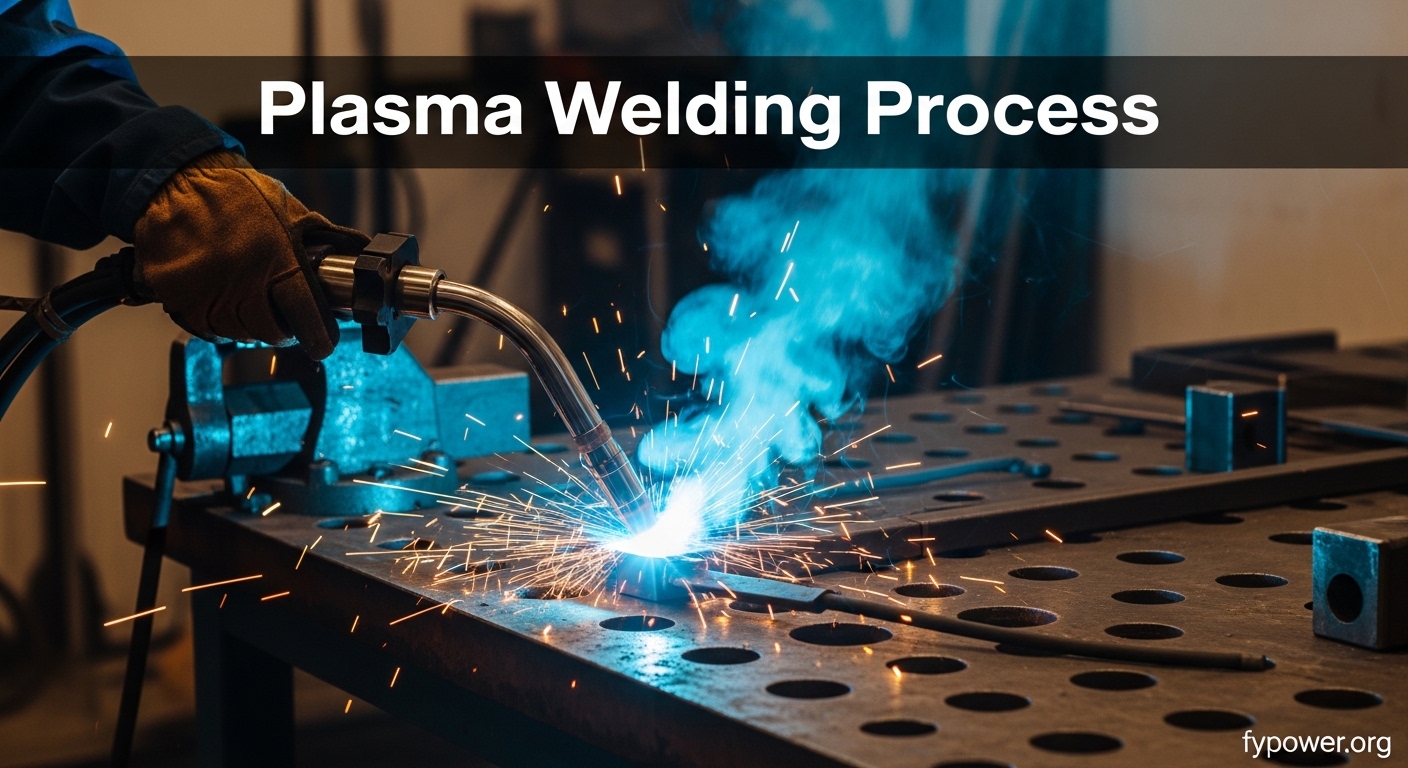
I’ve spent fifteen years in metal fabrication, watching welding technology evolve. When I first encountered plasma arc welding in 2026, I was skeptical.
Plasma arc welding (PAW) is a precision arc welding process that uses a constricted arc between a non-consumable tungsten electrode and the workpiece.
Plasma welding works by forcing an electric arc through a copper nozzle with a small orifice, creating a high-velocity plasma jet reaching temperatures up to 30,000degF (16,649degC). This constriction produces energy density 3-5 times higher than TIG welding, resulting in deeper penetration, narrower heat-affected zones, and exceptional arc stability.
- Key Feature: Constricted arc through copper nozzle
- Temperature: Up to 30,000degF (16,649degC)
- Best For: Precision welding, thin materials, deep penetration applications
The plasma welding process was developed in the 1960s as an improvement to GTAW (TIG) welding, offering better control for precision applications. After implementing plasma systems in three different fabrication shops, I’ve seen the difference firsthand.
How Plasma Welding Works?
Understanding plasma welding starts with the physics. Unlike conventional TIG where the arc spreads freely, plasma welding constricts that arc through a narrow copper orifice.
Quick Summary: Plasma welding works by forcing an electrical arc through a water-cooled copper nozzle with a small orifice (typically 1.5-3.5mm). This constriction compresses the arc, increasing its temperature and energy density. Plasma gas flows around the tungsten electrode and through the arc, becoming ionized and creating a focused plasma column that transfers heat precisely to the workpiece.
The Plasma Arc Generation Process
The plasma welding process follows a specific sequence. Let me walk you through how it works in practice:
1. Pilot Arc Initiation
A low-current pilot arc first establishes between the tungsten electrode and the copper nozzle tip. This ionizes the gas and creates a conductive path before the main arc transfers to the workpiece.
2. Gas Ionization
The plasma gas (typically argon) flows through the torch. As the electrical energy passes through, the gas molecules break apart into ions and electrons, creating plasma–the fourth state of matter.
3. Arc Constriction
This is where plasma welding differs from TIG. The constriction nozzle forces the ionized gas through a small orifice, dramatically increasing current density and arc temperature.
4. Heat Transfer
The high-velocity plasma jet transfers heat to the workpiece with remarkable precision. The focused arc creates deeper penetration with less total heat input compared to unconstricted arcs.
Plasma Arc: A sustained electrical discharge through ionized gas that has been constricted through a nozzle, creating a column of charged particles with temperatures reaching 30,000degF and energy densities 3-5 times higher than conventional TIG arcs.
Plasma Torch Components
The plasma torch is a precision instrument. Unlike a standard TIG torch, it contains several critical components:
| Component | Function | Material |
|---|---|---|
| Electrode | Conducts current, emits electrons | Tungsten (2% thoriated) |
| Constriction Nozzle | Focuses arc through orifice | Copper (water-cooled) |
| Gas Lens/Collet | Directs plasma gas flow | Copper alloy |
| Shielding Cup | Delivers shielding gas to weld pool | Copper or ceramic |
| Retaining Cap | Holds nozzle and electrode in alignment | Copper or brass |
The water cooling is critical. I’ve seen torches fail in under an hour without proper coolant flow. The constriction nozzle faces extreme heat and requires continuous cooling to maintain integrity.
Types of Plasma Welding Processes
Plasma welding isn’t a single process. The technology divides into three distinct categories based on current range and application.
Micro-Plasma Welding (0.1-10 Amperes)
Micro-plasma welding operates at incredibly low currents, typically 0.1 to 10 amperes. This variant handles materials as thin as 0.001 inches.
I first used micro-plasma for medical device components in 2026. The precision amazed me–we were welding sensor housings without distorting adjacent electronics.
Micro-Plasma Applications:
- Medical devices (surgical instruments, implants)
- Electronics packaging (hermetic sealing)
- Instrumentation (pressure sensors, thermocouples)
- Jewelry and precision components
- Thin foil welding (down to 0.001 inches)
The stable arc at low currents is what makes micro-plasma unique. TIG becomes unstable below 5-10 amps, but plasma maintains a focused column even at 0.1 amps.
Medium Current Plasma (10-100 Amperes)
Medium current plasma covers the most common welding range, typically 10-100 amperes. This bridges the gap between micro-welding and keyhole applications.
This range handles material thicknesses from approximately 0.020 to 0.125 inches. It’s where I’ve done the majority of my plasma welding work–stainless steel fabrication, aluminum components, and precision assemblies.
Medium Current Applications:
- Stainless steel fabrications
- Aluminum alloy components
- Tube and pipe welding
- Automotive components
- General precision fabrication
Keyhole Plasma Welding (100-300 Amperes)
Keyhole plasma welding is where the process truly shines. Operating at 100-300 amperes, this technique creates a keyhole through the material thickness, enabling single-sided welding with full penetration.
Keyhole Technique: A high-current plasma welding method where the arc’s energy density creates a vapor cavity (keyhole) completely through the workpiece. As the torch moves, the keyhole travels along the joint, with molten metal flowing around it and solidifying behind to form the weld.
The keyhole technique eliminates the need for backing or root passes. I’ve seen 0.25-inch stainless steel welded in a single pass with complete penetration and excellent root formation.
Keyhole Plasma Applications:
- Thick section welding (up to 0.5 inch single pass)
- Pipe welding (no backing required)
- Structural components
- Pressure vessel fabrication
- Heavy industrial applications
Keyhole plasma requires proper parameter setup. Get it wrong and you’ll get cutting instead of welding. But when dialed in correctly, it’s incredibly efficient.
Variable Polarity Plasma Welding
Variable polarity plasma (VPPAW) was developed specifically for aluminum. The current alternates between straight polarity (electrode negative) and reverse polarity (electrode positive).
The reverse polarity portion helps clean the aluminum oxide layer. I’ve used VPPAW on aerospace aluminum components with excellent results. It combines the cleaning action of AC TIG with the precision of plasma.
Plasma Welding vs TIG: Complete Comparison
The most common question I hear: “Is plasma better than TIG?” The answer depends on your application. Let me break down the differences based on real-world experience.
| Characteristic | Plasma Welding (PAW) | TIG Welding (GTAW) |
|---|---|---|
| Arc Constriction | Constricted through nozzle | Free arc, no constriction |
| Arc Temperature | Up to 30,000degF | Up to 20,000degF |
| Energy Density | 3-5x higher than TIG | Standard |
| Arc Stability | Excellent, less affected by standoff distance | Good, sensitive to arc length variations |
| Penetration | Deeper, more focused | Wider, shallower |
| Heat Affected Zone | Narrower (less distortion) | Wider |
| Travel Speed | 30-50% faster | Standard |
| Current Range | 0.1-300+ amps | 5-300+ amps |
| Low Current Performance | Stable down to 0.1 amps | Unstable below 5 amps |
| Tolerance to Fit-up | More forgiving | Less forgiving |
| Equipment Cost | Higher (torch, consumables) | Lower |
| Maintenance | More frequent (nozzle wear) | Less frequent |
| Skill Required | Moderate-high (setup) | High (technique) |
| Joint Access | Limited by torch size | Better (smaller torches available) |
When to Choose Plasma Welding?
Based on my experience, plasma welding is the better choice when:
- Precision is critical–The stable arc maintains consistent penetration even with manual variations.
- Materials are thin–Micro-plasma handles foils and thin sheets that TIG would burn through.
- Deep penetration is needed–Keyhole technique achieves full penetration in thick materials.
- Distortion must be minimized–The focused heat input reduces warping significantly.
- Automation is planned–Plasma’s consistency makes it ideal for mechanized systems.
- Production speed matters–Faster travel speeds increase throughput.
When TIG Remains the Better Choice?
TIG still has its place. I choose TIG when:
- Budget is limited–TIG equipment costs significantly less.
- Joint access is tight–Smaller TIG torches reach confined spaces.
- Versatility is needed–TIG handles more material types and thicknesses with one setup.
- Simple maintenance is preferred–Fewer consumables and torch components.
- Existing skill is TIG-based–TIG skills transfer more easily to plasma than vice versa.
Plasma Welding Applications and Industries
Plasma welding has found its niche in industries where precision and quality justify the equipment investment. Let me share the applications where I’ve seen it excel.
Aerospace Industry
The aerospace sector was an early adopter of plasma welding. When I consulted for an aircraft components manufacturer in 2026, their reasoning was clear: every weld defect could mean a catastrophic failure.
Aerospace Applications:
- Aircraft engine components (turbine blades, casings)
- Structural assemblies (frame components, bulkheads)
- Fuel system components
- Hydraulic and pneumatic systems
- Titanium structure welding
- Precision instrumentation
The narrow heat-affected zone is crucial in aerospace. Excessive heat can compromise material properties. Plasma’s focused arc maintains base metal integrity better than any other arc process.
Medical Device Manufacturing
Medical devices demand absolute precision. I’ve worked with implant manufacturers where weld quality directly affects patient outcomes.
Micro-plasma welding dominates this sector. The ability to weld tiny components without affecting adjacent heat-sensitive materials is unmatched.
Medical Applications:
- Surgical instruments (scalpels, forceps, scissors)
- Implants (joint replacements, dental implants)
- Diagnostic equipment housings
- Precision tubing (catheters, endoscopes)
- Hermetic sealing (pacemaker cases, sensors)
- Drug delivery components
The clean, consistent welds from plasma welding meet strict medical industry requirements. Minimal surface contamination and excellent cosmetic appearance are standard.
Electronics Industry
Electronics manufacturing leverages micro-plasma for applications that would be impossible with other processes. The precision enables welding of components just thousandths of an inch thick.
During a project for a semiconductor equipment manufacturer, we welded vacuum chamber components that couldn’t tolerate any distortion. Plasma was the only viable option.
Electronics Applications:
- Semiconductor equipment fabrication
- Sensor packaging and sealing
- Hermetic sealing of electronic packages
- Battery component welding
- Precision connectors
- Heat sink assemblies
Automotive Industry
Automotive applications have grown significantly, especially with electric vehicles. The shift to lightweight materials has increased plasma welding adoption.
Exhaust systems were early automotive applications. More recently, I’ve seen plasma welding used for electric vehicle battery components where heat management is critical.
Automotive Applications:
- Exhaust system components
- Fuel injection parts
- Sensor housings
- EV battery components
- Airbag components
- Precision brackets and fittings
Energy Sector
The energy industry uses plasma welding for both traditional and renewable energy applications. Keyhole plasma welding is particularly valuable for pipe welding.
Energy Applications:
- Heat exchanger fabrication
- Pipe and tube welding
- Nuclear components
- Solar panel framing
- Wind turbine components
- Power generation equipment
Advantages and Disadvantages of Plasma Welding
After implementing plasma welding systems in multiple facilities, I’ve developed a clear picture of where it excels and where it falls short. Let me give you an honest assessment.
Advantages of Plasma Welding
- Superior Arc Stability
The constricted arc is remarkably stable. I’ve welded at 0.5 amps with plasma–something impossible with TIG. This stability means consistent welds even with manual technique variations. - Deeper Penetration
The focused arc achieves penetration 2-3 times deeper than TIG at the same current. A 60-amp plasma weld can match a 150-amp TIG weld in penetration depth. - Narrower Heat-Affected Zone
Less total heat input means less distortion. I’ve measured heat-affected zones 50% narrower than comparable TIG welds. - Faster Welding Speeds
Travel speeds increase 30-50% compared to TIG. In production environments, this translates to significant throughput improvements. - Excellent for Thin Materials
Micro-plasma handles materials down to 0.001 inches. I’ve welded foil thinner than a human hair with complete control. - More Forgiving of Fit-up Issues
The deep, narrow arc tolerates minor joint variations better than TIG. Gaps that would cause TIG defects often weld cleanly with plasma. - Better Process Control
Separate plasma and shielding gases allow optimization. The independent control over arc characteristics and weld pool protection provides flexibility. - Reduced Welder Fatigue
The stable arc requires less constant adjustment than TIG. Over a production shift, this reduces operator fatigue and improves consistency. - Keyhole Capability
Single-sided welding with full penetration is unique to high-current plasma. No backing gas or root passes required for many applications.
Disadvantages and Limitations
- Higher Equipment Cost
Plasma welding systems cost significantly more than comparable TIG setups. I’ve seen complete systems priced 2-3 times higher than TIG equivalents. - Complex Setup
More components mean more setup parameters. Electrode setback, orifice size, gas flows–all must be optimized. New operators face a steeper learning curve. - Increased Maintenance
The constriction nozzle is a wear item. In high-production environments, I’ve replaced nozzles daily. Cooling systems also require regular maintenance. - Higher Gas Consumption
Plasma welding uses two gases (plasma and shielding). Flow rates are higher than single-gas TIG, increasing operating costs. - Limited Joint Access
Plasma torches are larger than TIG torches. Deep grooves or confined spaces may be inaccessible. - More Critical to Proper Parameters
Within the optimal range, plasma is very forgiving. Outside that range, it fails dramatically. Parameter selection is more critical than with TIG. - Not Ideal for All Materials
Cast iron and some alloys remain challenging. Process selection should always consider material compatibility. - Training Requirements
Proper training is essential. I’ve seen facilities struggle because operators weren’t adequately trained on plasma-specific techniques.
Equipment and Parameter Settings
Setting up a plasma welding system requires attention to detail. Let me share the key considerations based on my installation experiences.
Plasma Welding Equipment Requirements
A complete plasma welding system includes several components beyond the power source:
| Equipment | Specification | Purpose |
|---|---|---|
| Power Source | Constant current (CC), 300A minimum | Provides welding current |
| Plasma Torch | Water-cooled, compatible with power source | Delivers constricted arc |
| Cooling System | 1-2 GPM flow capacity | Cools torch components |
| Gas Supply | Dual-gas capability with flow meters | Plasma and shielding gases |
| High-Frequency Starter | Built-in or separate unit | Initiates pilot arc |
| Wire Feeder | Optional, for filler metal addition | Adds filler wire when needed |
Gas Selection for Plasma Welding
Gas selection significantly affects weld quality. Different applications require different gas mixtures.
| Gas Type | Application | Benefits |
|---|---|---|
| Argon (Plasma) | General purpose | Excellent arc stability, easy ignition |
| Argon + H2 (Plasma) | Stainless steel, nickel alloys | Higher heat input, cleaner welds |
| Argon + He (Plasma) | Copper, aluminum | Increased heat for conductive materials |
| Argon (Shielding) | Most materials | Standard shielding gas |
| Argon + H2 (Shielding) | Stainless steel | Reduced oxidation, brighter beads |
| Helium (Shielding) | Aluminum, copper | Higher heat input |
Parameter Settings Reference
Proper parameter settings vary by application, but these starting points have worked well in my experience:
| Application | Current (A) | Orifice (in) | Plasma Gas (CFH) | Shielding Gas (CFH) |
|---|---|---|---|---|
| Micro (0.005 in) | 0.5-5 | 0.020-0.030 | 0.1-0.3 | 5-10 |
| Thin (0.020-0.060 in) | 5-30 | 0.040-0.060 | 0.5-1.0 | 10-20 |
| Medium (0.060-0.125 in) | 30-100 | 0.060-0.090 | 1.0-2.0 | 15-25 |
| Keyhole (0.125-0.250 in) | 100-200 | 0.080-0.120 | 2.0-3.5 | 20-35 |
These are starting points. Always fine-tune based on your specific application, material, and joint configuration.
Common Plasma Welding Issues and Solutions
Troubleshooting plasma welding comes with experience. Let me share the most common problems I’ve encountered and their solutions.
| Problem | Possible Cause | Solution |
|---|---|---|
| Arc won’t initiate | No gas flow, improper electrode setback | Check gas supply, adjust electrode position |
| Unstable arc | Worn nozzle, incorrect gas flow | Replace nozzle, verify flow rates |
| Excessive spatter | Contaminated material, wrong gas | Clean material, check gas mixture |
| Porous welds | Inadequate shielding, moisture | Increase shielding gas, check for drafts |
| Low penetration | Current too low, travel too fast | Increase amperage, reduce travel speed |
| Excessive penetration | Current too high, travel too slow | Reduce amperage, increase travel speed |
| Nozzle wear (double arcing) | Current too high for orifice size | Use larger orifice or reduce current |
| Tungsten contamination | Touching workpiece, excessive current | Replace electrode, adjust technique |
| Overheating torch | Insufficient coolant flow | Check cooling system, clean coolant lines |
| Poor weld appearance | Wrong gas mixture, incorrect parameters | Optimize gas selection, fine-tune settings |
The most common issue I see is operators trying to use one set of parameters for all applications. Plasma welding rewards proper setup–take the time to optimize for each specific job.
Frequently Asked Questions
What is plasma welding process?
Plasma arc welding (PAW) is a precision arc welding process that uses a constricted arc between a non-consumable tungsten electrode and the workpiece. The arc is forced through a water-cooled copper nozzle with a small orifice, which compresses the arc and dramatically increases its temperature to 30,000degF and energy density 3-5 times higher than conventional TIG welding.
How does plasma welding differ from TIG welding?
Plasma welding differs from TIG primarily through arc constriction. While TIG uses a free arc that spreads from the electrode to the workpiece, plasma welding forces that arc through a copper nozzle with a small orifice. This constriction creates a more focused, higher-energy arc with deeper penetration, narrower heat-affected zones, and greater stability. Plasma also offers better performance at very low currents (down to 0.1 amps) and includes keyhole capability for single-sided welding.
What are the advantages of plasma welding?
Plasma welding offers superior arc stability, deeper penetration (2-3x TIG at same current), narrower heat-affected zones (reducing distortion), faster welding speeds (30-50% increase), excellent performance on thin materials (down to 0.001 inches), more forgiving fit-up tolerance, better process control through dual-gas systems, and unique keyhole capability for full-penetration single-sided welding. The stable arc also reduces operator fatigue compared to TIG welding.
What is plasma welding used for?
Plasma welding is used in aerospace for engine components and structural assemblies, medical device manufacturing for surgical instruments and implants, electronics for hermetic sealing and sensor packaging, automotive for exhaust systems and EV battery components, and energy sectors for heat exchangers and pipe welding. It excels in applications requiring precision, minimal distortion, welding of thin materials, and where quality justifies the equipment investment.
What gases are used in plasma welding?
Plasma welding typically uses argon as the primary plasma gas because of its excellent arc stability and easy ignition. For enhanced performance on stainless steel and nickel alloys, argon with 2-5% hydrogen is common. Aluminum and copper applications may use helium mixtures. Shielding gas is typically pure argon for most materials, though argon-hydrogen mixtures are used for stainless steel to reduce oxidation and create cleaner welds.
How hot is a plasma welding arc?
A plasma welding arc reaches temperatures up to 30,000degF (16,649degC), significantly hotter than a conventional TIG arc which tops out around 20,000degF. This extreme temperature results from arc constriction through the copper nozzle orifice, which compresses the electrical energy into a smaller column and dramatically increases energy density.
What is keyhole plasma welding?
Keyhole plasma welding is a high-current technique (100-300 amperes) where the arc’s energy density creates a vapor cavity completely through the workpiece thickness. This keyhole travels along the joint as the torch moves, with molten metal flowing around it and solidifying behind to form the weld. The technique enables single-sided welding with complete penetration, eliminating the need for backing or root pass welding on materials up to 0.25 inch thick in a single pass.
What materials can be plasma welded?
Plasma welding works excellently on stainless steel (all grades), carbon steel, titanium (reactive metal benefits from inert atmosphere), aluminum alloys (especially with variable polarity), copper and copper alloys, nickel alloys (Inconel, Hastelloy), and most other weldable metals. The process particularly excels on heat-sensitive materials where the narrow heat-affected zone and precise heat input provide advantages over other welding processes.
What is the current range for plasma welding?
Plasma welding operates across an exceptionally wide current range from 0.1 to 300+ amperes. Micro-plasma welding uses 0.1-10 amps for ultra-thin materials and precision work. Medium current plasma operates at 10-100 amps for general fabrication. Keyhole plasma welding uses 100-300 amps for thick materials and full-penetration applications. This wide range makes plasma welding more versatile than most other arc welding processes.
What are the disadvantages of plasma welding?
Plasma welding has higher equipment costs (2-3x TIG), more complex setup with additional parameters, increased maintenance requirements (nozzle wear), higher gas consumption, limited joint access due to larger torch size, and more critical parameter requirements. The process also requires proper training and is not ideal for all materials. These limitations must be weighed against the precision and quality benefits for each application.
Is plasma welding better than TIG?
Plasma welding is better than TIG for applications requiring precision, deep penetration, minimal distortion, or welding thin materials. The constricted arc provides superior stability and energy density. However, TIG remains better for tight joint access, limited budgets, or when maximum versatility is needed. For automated production and precision applications, plasma typically wins. For manual welding on varied projects, TIG often remains more practical.
What is the difference between plasma arc and tungsten arc welding?
The key difference between plasma arc welding (PAW) and tungsten arc welding (GTAW/TIG) is arc constriction. TIG uses a free, unconstricted arc that spreads naturally from electrode to workpiece. Plasma welding forces this arc through a water-cooled copper nozzle with a small orifice, creating a constricted plasma column. This constriction increases energy density 3-5 times, temperature to 30,000degF (vs 20,000degF for TIG), and enables unique capabilities like keyhole welding and stable operation below 1 ampere.
Leave a Reply