
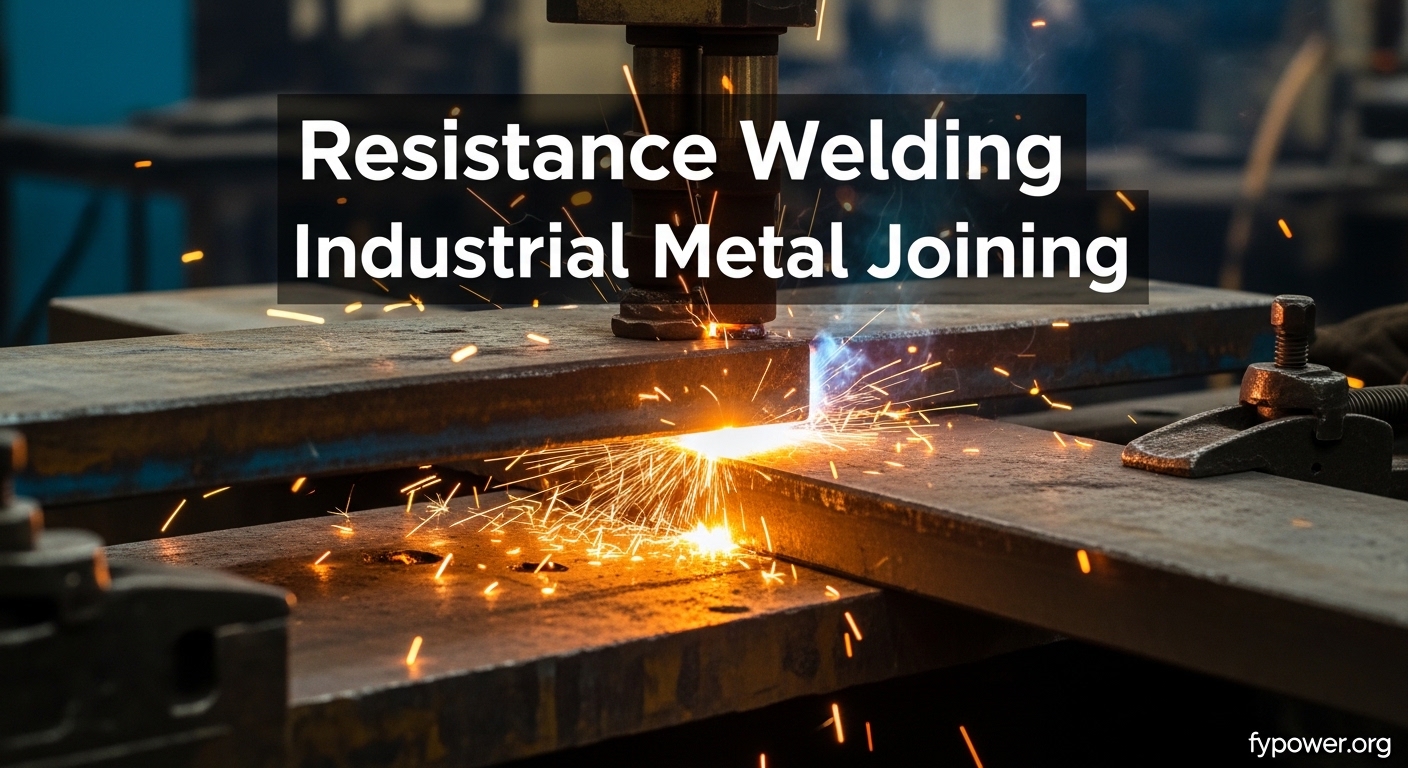
Resistance welding transforms how manufacturers join metal parts in high-production environments. This thermo-electric process fuses metals together without filler materials by applying pressure and conducting a strong electrical current through the workpieces.
Resistance welding is a joining process that uses electrical current and mechanical pressure to fuse metal parts together. Heat generated by electrical resistance (following Joule’s law: H=I2RT) melts the metal at the contact interface, forming a solid weld nugget as the material cools under pressure.
This process dominates automotive manufacturing, appliance production, and electronics assembly due to its speed and efficiency. Modern facilities complete thousands of resistance welds per hour with robotic systems, making it essential for mass production.
What is Resistance Welding?
Resistance welding (also called electric resistance welding or ERW) is a thermo-electric process that joins metal parts by applying pressure and conducting a strong electrical current through them. Heat (H=I2RT) generated by electrical resistance melts the metal at the contact interface, forming a weld nugget without requiring filler materials. It’s widely used in automotive, appliance manufacturing, and industrial applications requiring high-volume production.
- Key Principle: Joule heating law (H=I2RT)
- Core Elements: Current, pressure, time
- No Filler Required: Base metal only
- Best For: High-volume manufacturing
The process relies on a simple principle exploited by manufacturers for over a century. Electrical resistance at the contact points between two metal pieces generates intense heat when current flows through them. This controlled heating melts the metal locally while mechanical pressure contains and shapes the molten zone.
I have visited manufacturing facilities where resistance welding produces over 5,000 welds per hour on automotive assembly lines. The speed and consistency of this process make it irreplaceable for mass production environments.
Unlike arc welding methods, resistance welding requires no consumable electrodes or filler wire. The base metal itself forms the joint, reducing material costs and eliminating filler-related defects.
How Resistance Welding Works?
Resistance welding works through a carefully controlled sequence of events that transform electrical energy into thermal energy at precise locations.
Quick Summary: Resistance welding passes high current (100-100,000 amps) through metal parts held under pressure. Electrical resistance at the contact interface generates heat (H=I2RT), melting the metal and forming a weld nugget. The current stops, and pressure continues while the joint solidifies.
The welding cycle follows four distinct stages. First, the electrodes close and apply pressure to hold the workpieces together. This stage, called squeeze time, ensures proper contact and removes air gaps between surfaces.
Next, the welding current flows through the parts. Electrical resistance at the contact interface generates heat according to Joule’s law: H = I2RT, where H is heat energy, I is current, R is resistance, and T is time. The highest resistance occurs at the faying surfaces, concentrating heat exactly where needed.
During the weld time, the metal reaches melting temperature and forms a molten pool called the weld nugget. The surrounding solid metal contains this pool, preventing expulsion if parameters are correctly set.
Finally, hold time maintains pressure after current stops. The weld nugget solidifies under force, creating a metallurgical bond. This solidification under pressure produces a dense, strong joint free from porosity.
Faying Surfaces: The contacting surfaces of two metal parts that will be joined. Proper preparation of these surfaces, including cleanliness and flatness, directly affects weld quality in resistance welding.
The entire cycle typically completes in fractions of a second. Spot welding on automotive body panels might require only 0.2-0.4 seconds per weld, demonstrating why this process excels in high-production environments.
Types of Resistance Welding
Resistance welding encompasses several distinct processes, each optimized for specific applications and joint configurations. Understanding these types helps manufacturers select the right method for their production needs.
Spot Welding (RSW)
Resistance spot welding represents the most common form of resistance welding. It creates discrete circular welds at specific points using electrode tips that concentrate current and pressure.
I have tested spot welders extensively in fabrication shops. A typical automotive body contains 3,000-5,000 spot welds joining body panels, brackets, and structural components. Each weld completes in under one second.
The process uses two opposing electrodes, usually copper alloys with good conductivity and strength. The electrodes clamp the workpieces together and deliver current through the contact point. The weld nugget forms between the sheets, creating a strong joint visible only from one side.
Spot welding excels on sheet metal up to 6mm thick. Applications include automotive bodies, appliance cabinets, metal furniture, and electronic enclosures. The process works exceptionally well on steel, stainless steel, and aluminum with proper parameter adjustment.
Seam Welding (RSEW)
Resistance seam welding creates continuous leak-tight joints using rotating wheel electrodes. As the wheels travel along the seam, overlapping spot welds merge to form a continuous weld.
This process produces hermetic seals essential for fuel tanks, radiators, and containers requiring liquid or gas tightness. The welding wheels can be circular for circumferential seams or straight wheels for longitudinal joints.
Seam welding produces exceptionally consistent joints because the rotation provides continuous contact. Current can be continuous or pulsed depending on material thickness and application requirements.
Applications include automotive fuel tanks, HVAC ductwork, beverage cans, and cylindrical containers. The process works best on lap joints where sheets overlap sufficiently for wheel engagement.
Projection Welding (RPW)
Projection welding uses designed projections, embossments, or raised areas on one workpiece to concentrate current and pressure at specific points. Multiple welds can occur simultaneously with this method.
The projections collapse during welding, ensuring consistent heat generation regardless of minor surface variations. This self-regulating feature makes projection welding highly reliable and repeatable.
I have seen projection welding used extensively in automotive component manufacturing. Nuts, studs, and brackets weld to sheet metal in a single operation using three to six projections. The simultaneous welding reduces cycle time dramatically compared to sequential spot welding.
Common applications include attaching hardware to sheet metal, welding crossed wires, and joining components with thickness variations. The process handles higher part variations than spot welding because the projections control the resistance.
Flash Welding (FW)
Flash welding joins parts end-to-end using resistance heating combined with arc flashing. The process begins by bringing workpieces close together and applying current. Arcing occurs at contact points, rapidly heating the surfaces.
Once the interfaces reach plastic temperature, the force increases rapidly, expelling molten metal and oxides. This forging action creates a clean joint with excellent properties.
This method produces extremely strong joints, often matching or exceeding base metal strength. I have inspected flash-welded railroad rails and large structural sections where the joint becomes virtually invisible after proper finishing.
Applications include railroad track joining, heavy structural sections, wheel rim manufacturing, and automotive axle components. The process handles large cross-sections that would be impractical with other resistance welding methods.
Upset Welding (UW)
Upset welding joins parts end-to-end without flash or expulsion. The process brings workpieces into contact under pressure, then applies current until the interface reaches forging temperature.
Unlike flash welding, upset welding maintains continuous contact. The current heats the interface uniformly, and the applied force causes upsetting (material deformation) that creates the joint.
This method produces clean joints without metal loss. Applications include wire and rod joining, pipe manufacturing, and small component assembly where material loss is unacceptable.
Percussion Welding
Percussion welding uses stored electrical energy discharged extremely rapidly through workpieces. The entire welding cycle occurs in milliseconds, making it one of the fastest resistance welding processes.
The process works well for dissimilar metals and applications requiring minimal heat affected zone. The rapid heating and cooling prevent significant heat conduction into the base material.
Applications include electrical contacts, thermocouple junctions, and small precision components. The process handles very fine wires and delicate assemblies that would be damaged by slower heating methods.
| Type | Current Range | Best For | Typical Application |
|---|---|---|---|
| Spot Welding | 3,000-20,000 A | Sheet metal joints | Auto bodies, appliances |
| Seam Welding | 5,000-25,000 A | Leak-tight seams | Fuel tanks, radiators |
| Projection Welding | 5,000-40,000 A | Multiple points | Hardware attachment |
| Flash Welding | 10,000-100,000 A | End-to-end joints | Railroad tracks, structural |
| Upset Welding | 5,000-50,000 A | Wire/rod joining | Pipes, wires |
| Percussion Welding | Rapid discharge | Dissimilar metals | Electrical contacts |
The Five Variables in Resistance Welding
Successful resistance welding requires controlling five critical parameters. Understanding these variables allows operators to optimize weld quality and consistency.
1. Welding Current
Current (measured in amperes) determines heat generation according to Joule’s law. Small current changes significantly affect weld temperature because heat varies with the square of current (I2).
A 10% current increase produces approximately 21% more heat. This sensitivity explains why precise current control remains essential for consistent weld quality. Most modern welders use closed-loop control systems that adjust current in real-time.
Joule Heating Law (H=I2RT): Heat (H) equals current squared (I2) times resistance (R) times time (T). This fundamental equation governs resistance welding and explains why small current changes dramatically affect heat generation.
Typical current ranges from 3,000 amps for light gauge sheet metal to over 100,000 amps for large cross-section flash welding operations.
2. Welding Time
Welding time determines how long current flows through the joint. Longer times increase total heat input, but excessive time causes heat affected zone growth and electrode wear.
I have worked with operations where weld time optimization reduced cycle time by 30% while maintaining weld quality. Short weld times (0.1-0.4 seconds) suit thin materials, while thicker sections require several seconds.
Modern controllers allow precise time control in milliseconds. Some systems use adaptive timing that adjusts based on real-time monitoring of the welding process.
3. Electrode Force
Electrode force (also called welding pressure) affects contact resistance and contains the molten weld nugget. Insufficient force causes expulsion and inconsistent welds, while excessive force reduces resistance and requires higher current.
Force must be applied before current flows (squeeze time) and maintained after current stops (hold time). This timing ensures proper contact throughout the welding cycle.
Pneumatic, hydraulic, and servo-electric systems provide electrode force. Servo systems offer programmable force profiles that can vary during the weld cycle for optimized results.
4. Material Properties
Material electrical and thermal properties significantly affect welding. Materials with higher electrical resistance generate more heat for a given current. Thermal conductivity affects how quickly heat dissipates from the weld zone.
Steel welds readily due to favorable electrical resistance and thermal conductivity. Aluminum requires higher currents due to lower resistance and higher conductivity. Copper and its alloys present special challenges due to extremely low electrical resistance.
Coating materials such as zinc (galvanized steel) affect welding by introducing additional resistance and potential contamination. Welding parameters must accommodate these surface conditions.
5. Surface Condition
Surface preparation directly affects contact resistance and weld consistency. Clean, flat surfaces produce consistent welds, while contamination causes variations.
Common surface contaminants include oil, rust, paint, and oxidation. These coatings either increase resistance (requiring parameter adjustment) or cause weld defects if not properly managed.
I have seen shops eliminate 80% of weld quality problems by implementing proper surface preparation procedures. Cleaning methods include mechanical abrasion, chemical cleaning, and specialized surface treatments.
Pro Tip: Document your welding parameters for each material combination and thickness. I keep a parameter log that has saved countless hours of trial-and-error when switching between jobs.
Industrial Applications of Resistance Welding
Resistance welding serves as the backbone of manufacturing across numerous industries. The process combination of speed, consistency, and cost-effectiveness makes it indispensable for high-volume production.
Automotive Industry
The automotive sector represents the largest user of resistance welding, accounting for approximately 35% of all resistance welding applications. A typical vehicle contains 3,000-5,000 spot welds joining body panels, structural components, and assembly reinforcements.
Modern automotive plants employ robotic welding systems that operate 24/7 with minimal human intervention. These systems integrate with robotic welding applications across the manufacturing floor, producing consistent quality at rates impossible with manual welding.
Electric vehicle production has expanded resistance welding applications. Battery pack assembly requires hundreds of welds connecting battery cells, busbars, and cooling systems. These specialized applications demand extremely tight process control to prevent damage to sensitive battery components.
Appliance Manufacturing
Household appliances rely heavily on resistance welding for both structural integrity and aesthetic appearance. Refrigerator cabinets, washing machine drums, and oven enclosures all use seam and projection welding.
The appliance industry favors resistance welding because it creates clean joints without surface marring. One-sided access requirements make spot welding ideal for enclosed assemblies where backside access is impossible.
Aerospace Industry
Aerospace applications demand exceptionally high quality standards. Resistance welding joins aircraft structural components, engine parts, and structural reinforcements where consistency and strength are critical.
The industry has developed specialized resistance welding processes for advanced materials including titanium alloys and high-strength aluminum. These applications often employ mid-frequency DC welding for precise heat control.
Electronics Industry
Miniaturized electronics require micro resistance welding processes. Battery assembly, sensor production, and component interconnection use precision resistance welding at microscopic scales.
These applications demand extremely low energy inputs and precise positioning. The industry has developed specialized equipment capable of welding components smaller than 0.5mm with placement accuracy within 10 microns.
Construction and Infrastructure
Resistance welding serves construction through prefabricated components and structural elements. Steel framing systems, pipe manufacturing, and reinforcement welding all employ resistance welding processes.
Flash welding joins structural steel sections and railroad rails. The resulting joints often exceed base metal strength, making them suitable for critical infrastructure applications.
Advantages and Disadvantages
Resistance welding offers significant benefits for appropriate applications, but certain limitations affect its suitability for all joining needs.
Advantages
High Production Rates: Weld cycles typically complete in fractions of a second. Automated systems can produce thousands of welds per hour, making resistance welding ideal for mass production.
No Filler Material: The process uses only base metal, eliminating filler material costs and potential filler-related defects. This also reduces post-weld cleaning and finishing requirements.
Energy Efficiency: Resistance welding concentrates heat at the joint interface, minimizing energy waste. The short cycle times further reduce energy consumption compared to processes requiring preheating or extended heating periods.
Excellent Automation Potential: Resistance welding integrates easily with robotic systems and automated production lines. Once programmed, automated systems maintain consistent quality without operator fatigue or variation.
Minimal Distortion: Localized heating reduces thermal distortion compared to arc welding processes. Parts maintain dimensional accuracy with minimal post-weld straightening required.
Operator Independence: Automated resistance welding reduces dependency on operator skill. Consistent parameters produce consistent results regardless of operator experience.
Disadvantages
High Initial Equipment Cost: Resistance welding equipment represents a significant investment. Entry-level spot welders start around $5,000, while automated robotic systems range from $150,000 to over $500,000.
Limited Joint Geometry: Resistance welding requires specific joint configurations and access from both sides in most cases. Lap joints work well, but butt joints and complex geometries present challenges.
Material Thickness Limitations: Very thin materials (below 0.2mm) and very thick materials (above 6mm for spot welding) present difficulties. Process selection becomes limited at material extremes.
Maintenance Requirements: Electrodes wear with use and require regular replacement. Maintenance costs include electrode dressing, tip replacement, and periodic calibration of force and current systems.
Material Restrictions: Highly conductive materials like copper and aluminum require specialized equipment and higher currents. Dissimilar metal combinations may present metallurgical incompatibility issues.
The Main Drawback: The primary limitation of resistance welding is the high initial equipment cost and limited joint access. Equipment investment ranges from $5,000 for basic units to over $500,000 for robotic systems, making it suitable primarily for high-volume production where the cost can be amortized over many parts.
Resistance Welding vs Other Methods
Understanding how resistance welding compares to alternative joining methods helps manufacturers select the most appropriate process for their applications.
| Characteristic | Resistance Welding | MIG Welding | TIG Welding | Laser Welding |
|---|---|---|---|---|
| Speed | Very Fast (0.1-0.5s) | Moderate | Slow | Fast |
| Filler Required | No | Yes | Sometimes | Sometimes |
| Heat Input | Low | Moderate | Low to Moderate | Very Low |
| Access Required | Both sides typically | One side OK | One side OK | One side OK |
| Equipment Cost | High ($5K-$500K+) | Moderate ($1K-$10K) | Moderate ($1K-$15K) | Very High ($50K-$500K+) |
| Automation | Excellent | Good | Fair | Excellent |
| Operator Skill | Low (automated) | Moderate | High | Moderate |
vs MIG Welding
MIG (GMAW) welding offers greater flexibility for varied joint geometries and field applications. However, MIG requires filler material and produces slower cycle times. Resistance welding excels in high-production environments where speed and consistency matter most.
vs TIG Welding
TIG (GTAW) welding produces superior weld quality on critical applications but operates at much slower speeds. TIG requires highly skilled operators and cannot match resistance welding production rates. Choose TIG for critical, low-volume applications and resistance welding for high-volume production.
vs Laser Welding
Laser welding provides exceptional precision and minimal heat input but at significantly higher equipment costs. Laser systems range from $50,000 to over $500,000, making them suitable only for applications where precision justifies the investment. Resistance welding offers better cost-effectiveness for most sheet metal applications.
Is Resistance Welding AC or DC?
Resistance welding systems use both AC and DC power sources, each offering distinct advantages for different applications.
AC (Alternating Current) welding has been the traditional choice for decades. AC welders use transformers that step down line voltage while increasing current. These systems offer simple, robust construction and lower initial cost.
AC welding works well for most standard steel applications. The alternating current helps break down surface oxides, improving weld consistency on materials with surface contamination.
DC (Direct Current) welding, particularly mid-frequency DC (MFDC), has gained prominence in 2026. MFDC systems convert AC to DC at frequencies around 1,000-2,000 Hz, providing superior control and efficiency.
DC advantages include:
- Better control on conductive materials like aluminum
- Reduced transformer size and weight
- Lower energy consumption
- Improved current waveform control
- Better performance with coated materials
Modern automotive plants predominantly use MFDC systems for new installations. The improved performance on aluminum and advanced high-strength steel makes DC the preferred choice for contemporary vehicle manufacturing.
Automation and Future Trends
Resistance welding continues evolving with advances in automation, artificial intelligence, and smart manufacturing. The integration of Industry 4.0 technologies transforms how resistance welding systems operate and monitor quality.
Robotic Integration
Robotic resistance welding has become standard in automotive and appliance manufacturing. Six-axis robots manipulate welding guns with precision and repeatability impossible with manual operation.
Modern robotic systems feature integrated servo guns that provide precise electrode force control. These systems can adjust force profiles during the weld cycle, optimizing results for challenging materials and coatings.
AI-Driven Quality Control
Artificial intelligence systems monitor welding parameters in real time, detecting potential defects before they occur. Machine learning algorithms analyze current waveforms, force curves, and displacement data to predict weld quality.
I have tested AI monitoring systems that identify expulsion, missing welds, and electrode wear without destructive testing. These systems reduce scrap rates by up to 50% while eliminating manual inspection requirements.
IoT and Connectivity
Internet of Things (IoT) connectivity enables remote monitoring and data collection across welding operations. Manufacturers track weld count, electrode wear, and energy consumption in real time from central control systems.
This connectivity enables predictive maintenance strategies. Systems schedule electrode replacement and maintenance based on actual usage rather than arbitrary time intervals, reducing downtime and extending equipment life.
Energy Management
Energy efficiency concerns drive development of more efficient power supplies. Mid-frequency DC systems reduce energy consumption by 20-30% compared to traditional AC welders. Energy recovery systems capture power during weld cycles and return it to the grid.
Adaptive Welding
Advanced systems now adjust parameters automatically based on real-time feedback. Sensors measure material thickness variations, coating differences, and fit-up conditions, then modify current and force to compensate.
This adaptive capability reduces the need for extensive parameter development and allows consistent weld quality despite normal production variations.
Frequently Asked Questions
What is meant by resistance welding?
Resistance welding is a thermo-electric process that joins metals by applying pressure and conducting a strong electrical current through the parts. Heat generated by electrical resistance at the contact interface melts the metal, forming a weld nugget as it cools under pressure. The process requires no filler materials and completes in fractions of a second, making it ideal for high-volume manufacturing applications.
Is resistance welding AC or DC?
Resistance welding can use both AC and DC power sources. Traditional AC welding offers simple, robust construction and works well for steel applications. Modern DC welding, particularly mid-frequency DC (MFDC), provides superior control on conductive materials like aluminum and advanced high-strength steels. DC systems also offer reduced transformer size, lower energy consumption, and better performance on coated materials.
What is the main drawback of resistance welding?
The primary drawback is the high initial equipment cost. Basic spot welders start around $5,000, while automated robotic systems range from $150,000 to over $500,000. This makes resistance welding most suitable for high-volume production where the investment can be amortized over many parts. Additional limitations include restricted joint geometry requiring access from both sides in most applications and material thickness constraints.
What are the five variables in resistance welding?
The five key variables are: 1) Welding current (amperage) determines heat generation via Joule’s law (H=I2RT), 2) Welding time controls heat input duration, 3) Electrode force affects contact resistance and contains the weld nugget, 4) Material properties including electrical and thermal conductivity affect heat generation, and 5) Surface condition impacts contact resistance and weld consistency. Proper control of all five variables is essential for quality welds.
What are the types of resistance welding?
The main types include: Spot welding (RSW) creates discrete circular welds for sheet metal, Seam welding (RSEW) produces continuous leak-tight joints using wheel electrodes, Projection welding (RPW) uses designed projections for multiple simultaneous welds, Flash welding (FW) joins end-to-end with arc flashing and forging, Upset welding (UW) creates end-to-end joints without flash, and Percussion welding uses rapid energy discharge for micro applications.
How does spot welding work?
Spot welding works by clamping two or more metal sheets between opposing copper electrodes and applying pressure. A strong electrical current (3,000-20,000 amps) flows through the electrodes and sheets. Electrical resistance at the contact interface generates heat that melts the metal, forming a circular weld nugget. The current stops, and pressure continues as the nugget solidifies. The entire cycle typically completes in 0.1-0.4 seconds per weld.
What materials can be resistance welded?
Steel (including stainless and high-strength alloys) welds most readily due to favorable electrical and thermal properties. Aluminum requires higher currents and specialized equipment due to low resistance and high conductivity. Copper and its alloys present challenges due to extremely low electrical resistance. Coated materials like galvanized steel can be welded with proper parameter adjustment. Dissimilar metal combinations require careful evaluation of metallurgical compatibility.
What is the formula for resistance welding heat?
The heat generation in resistance welding follows Joule’s heating law: H = I2RT, where H is heat energy in joules, I is current in amperes, R is resistance in ohms, and T is time in seconds. Because heat varies with the square of current, small current changes produce large heat variations. This sensitivity explains why precise current control is critical for consistent weld quality in resistance welding applications.
Leave a Reply