
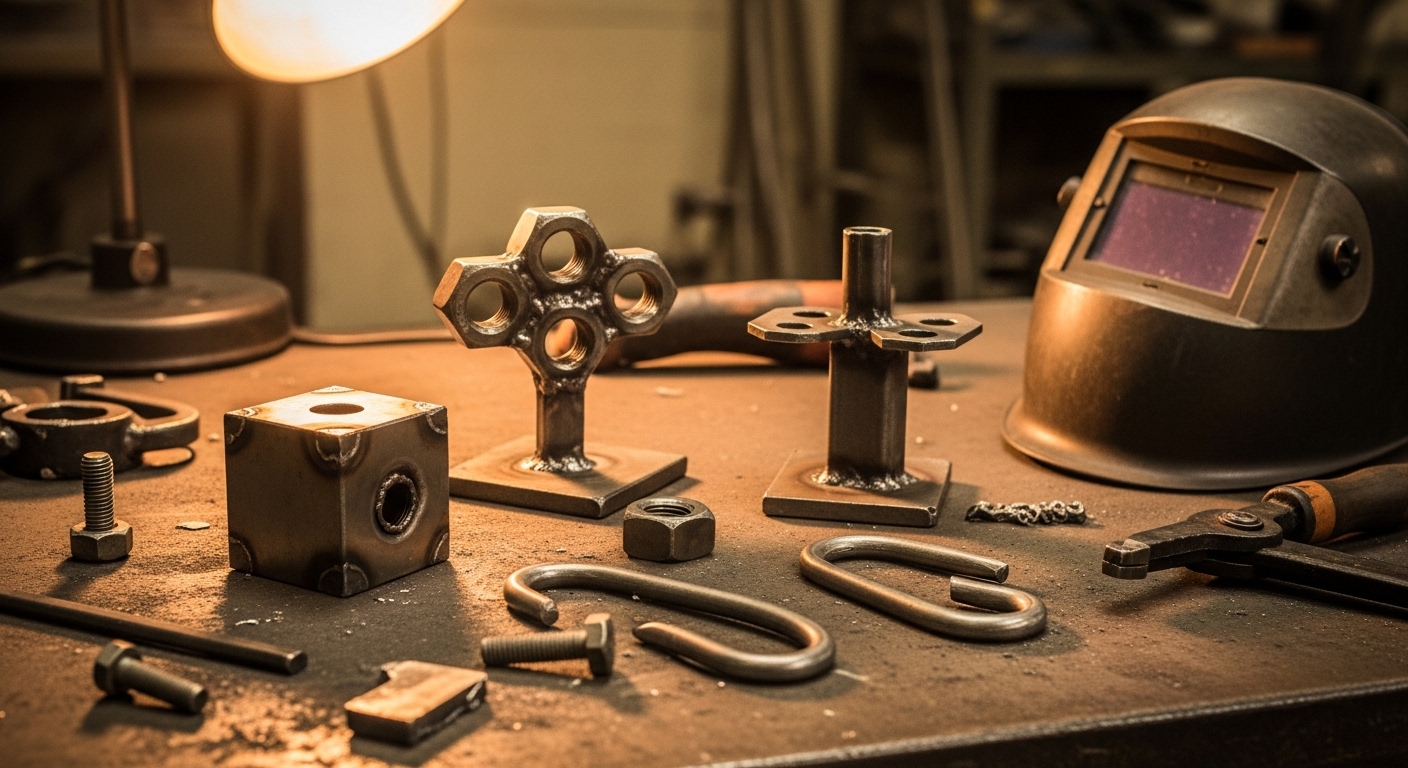
When I started welding in my garage 15 years ago, I burned through nearly $400 in new steel stock before making anything worth keeping. The learning curve felt expensive and every mistake cost me money in materials I ruined. Then a local fabricator told me something that changed everything: practice on scrap first, master the basics, then buy nice materials for projects that matter.
Small welding projects from scrap are the perfect way to build welding skills without wasting money on new materials. You can make functional tools, shop accessories, garden art, and home decor items using metal that would otherwise end up in recycling bins. The best scrap welding projects for beginners include shop stools, tool holders, fire pits, garden stakes, welding carts, practice joints, small tables, and decorative yard art.
Why Start with Scrap Metal Projects?
Scrap metal projects cost almost nothing besides your time. I’ve built entire shop setups using materials I found for free or traded for. Every mistake becomes a learning opportunity rather than an expensive setback.
Beyond the savings, scrap projects teach you valuable fabrication skills. You learn to work with imperfect materials, adapt designs based on what’s available, and solve creative problems. These are exactly the skills that separate decent welders from great fabricators.
8 Best Scrap Welding Projects for Beginners
These projects progress from simplest to more challenging. Each one builds specific skills that transfer to more complex fabrication work.
- Practice Joint Samples – Master basic welds without pressure
- Welding Magnet Holder – Learn clamping and square alignment
- Simple Tool Hanger – Practice consistent weld spacing
- Shop Stool – Build structural strength and seating comfort
- Fire Pit Ring – Work with thicker materials and circles
- Garden Art Stake – Explore creative fabrication
- Welding Cart – Combine multiple skills into one project
- Small Side Table – Practice finish-quality welding
Safety First: Essential Gear Before You Start
Welding scrap metal carries the same hazards as working with new materials. In fact, scrap can be more dangerous because you’re dealing with unknown coatings, rust, and contaminants.
Non-Negotiable Safety Equipment
| Equipment | Purpose | Budget Tip |
|---|---|---|
| Auto-Darkening Helmet | Protects eyes from UV radiation | Start around $80-100 |
| Leather Gloves | Heat and spark protection | $15-25 for basic pair |
| Fire-Resistant Jacket | Prevents burns from sparks | Welding sleeves work too ($20) |
| Safety Glasses | Secondary eye protection | Wear under helmet at all times |
| Leather Boots | Foot protection from falling metal | Steel-toe recommended |
| Respirator | Filter fumes from coatings | Essential for painted/scrap metal |
| Fire Extinguisher | Emergency fire suppression | Keep within 10 feet of welding area |
Scrap Metal: Discarded or recycled metal pieces from various sources including old machinery, construction leftovers, manufacturing offcuts, and consumer scrap. Ideal for welding practice because it’s low-cost or free.
Essential Tools for Scrap Welding Projects
For small scrap projects, you don’t need a fully-equipped fabrication shop. I started with just four tools and built dozens of useful items.
Minimum Tool List
Core Equipment:
- Welder: MIG is easiest for beginners. A 140-amp unit handles most scrap projects up to 3/16 inch thick.
- Angle Grinder: Cuts metal, removes rust, cleans welds. Get a 4-1/2 inch model with cutoff wheels and grinding discs.
- Wire Brush/Wheel: Removes paint, rust, and scale before welding. Clean metal welds better.
- C-Clamps or Vise Grips: Holds pieces in position while you weld. You can never have too many clamps.
- Square: Speed square or combination square keeps joints at 90 degrees. Essential for square projects.
- Tape Measure/Marking Tools: Soapstone or permanent marker for layout. Measure twice, cut once.
Helpful but Not Essential
As you progress, these tools make projects faster and easier:
- Magnetic welding squares – Hold pieces at 45, 90, and 135 degrees automatically
- Plasma cutter – Faster cutting than grinder for thicker materials
- Welding table – Flat magnetic surface for layout. Can be your first scrap project
- Drill press – Accurate holes for bolted connections
Identifying and Preparing Scrap Metal
This is where most beginners struggle. Not all scrap is weldable, and mixing the wrong metals creates weak joints or impossible welds.
Common Weldable Scrap Metals
| Metal Type | Identification | Weldability |
|---|---|---|
| Mild Steel | Magnetic, gray surface, most common scrap | Excellent – easiest for beginners |
| Angle Iron | L-shaped cross-section, found in bed frames | Excellent – great for structural projects |
| Square/Rect Tube | Hollow structural steel, furniture frames | Excellent – professional-looking results |
| Round Bar/Rod | Solid round stock, various diameters | Good – practice rod-to-flat welds |
| Sheet Metal | Thin flat pieces, body panels, ductwork | Fair – requires heat control to avoid warping |
| Rebar | Ridged concrete reinforcement, magnetic | Poor – high carbon content, cracks when welded |
| Cast Iron | Rough texture, non-magnetic usually, heavy | Very Poor – requires special technique, avoid as beginner |
Metal Preparation Steps
Clean metal welds better. Every surface that will receive a weld needs preparation:
- Remove paint and coatings – Grind or wire wheel to bare metal at least 1/2 inch from weld area
- Remove heavy rust – Light surface rust is okay with MIG, but deep pitting needs grinding
- Remove oil and grease – Wipe with acetone or degreaser. Oil causes porosity in welds
- Check thickness – Match your welder settings to the thinnest material in the joint
- Fit-up check – Pieces should sit flush with minimal gaps. Large gaps require filling and skill
Project 1: Practice Joint Samples (Difficulty: Beginner)
Time: 1-2 hours | Materials: Various scrap pieces, 1/8 to 1/4 inch thick
Before building anything functional, practice the five basic weld joints. I wish I had spent more time on this before trying actual projects.
Materials Needed:
- 4 pieces of 1/8 inch plate, 2×2 inches (for butt joint practice)
- 2 pieces of 1/8 inch plate, 3×3 inches (for lap joint practice)
- 2 pieces of 1×1 inch square tube, 3 inches long (for T-joint practice)
- 2 pieces of angle iron, 3 inches long (for corner joint practice)
- 2 pieces of 1/8 inch plate, 2×4 inches (for edge joint practice)
What You’ll Learn:
- Proper machine settings for different material thicknesses
- Travel speed and gun angle control
- How different joint types require different techniques
- What good penetration looks like
Practice Process:
- Clean all surfaces to bare metal
- Tack weld pieces in position
- Run practice beads along each joint type
- Let cool, then break joints apart to check penetration
- Adjust settings and repeat until you get consistent results
Don’t move on until your welds break in the weld metal, not the heat-affected zone. This proves you’re getting proper penetration.
Project 2: Welding Magnet Holder (Difficulty: Beginner)
Time: 1 hour | Materials: Scrap plate, 2-3 strong magnets
This simple project creates a tool you’ll use constantly. Magnetic welding squares are expensive but you can make a basic holder for pennies.
Materials Needed:
- 1 piece of mild steel plate, 4×4 inches, 1/8 inch thick
- 2-3 strong magnets (neodymium or ceramic)
- Welding rod or small scrap for a handle (optional)
Step-by-Step:
- Clean the plate surface to bare metal
- Position magnets on one side of the plate
- Tack weld around the magnets to secure them
- Add a small handle if desired using scrap rod
- Test by sticking to a vertical surface and using as a holder
Skills Built:
- Tack weld placement
- Welding thin materials without burn-through
- Working with small, precise pieces
Project 3: Simple Tool Hanger (Difficulty: Beginner)
Time: 1-2 hours | Materials: Angle iron, flat bar
Every shop needs tool storage. This simple hanger mounts to a wall and holds wrenches, pliers, or other tools with hanging holes.
Materials Needed:
- 2 feet of angle iron (1-1/2 to 2 inches wide)
- 1 foot of flat bar (1/4 inch thick, 1 inch wide)
- Mounting screws (for wall attachment)
Step-by-Step:
- Cut angle iron to desired length (typically 18-24 inches)
- Cut flat bar into 2-inch pieces for tool pegs
- Mark peg spacing on angle iron (3-4 inch spacing works well)
- Tack weld each peg perpendicular to the angle
- Check alignment, then finish weld each peg
- Grind smooth and paint if desired
Skills Built:
- T-joint welding
- Consistent spacing and layout
- Welding perpendicular joints square
Project 4: Basic Shop Stool (Difficulty: Beginner-Intermediate)
Time: 3-4 hours | Materials: Angle iron, square tube, flat bar for seat
A simple three-legged shop stool teaches structural welding and creates something genuinely useful. I’ve made several of these over the years.
Materials Needed:
- 3 pieces of 1×1 inch square tube, 24 inches long (legs)
- 1 piece of angle iron, 12 inches long (seat frame)
- 1 piece of flat bar or expanded metal, 12×12 inches (seat)
- Scrap for bracing if desired
Step-by-Step:
- Cut three legs to equal length (height depends on your preference)
- Cut angle iron into a triangle or square for seat frame
- Layout legs in a tripod pattern, splayed slightly for stability
- Tack weld legs to seat frame at even spacing
- Check for level and adjust as needed
- Add bracing between legs for stability
- Finish weld all joints
- Attach seat material to frame
Skills Built:
- Structural welding for weight-bearing applications
- Working with angles beyond 90 degrees
- Project planning and layout
Project 5: Fire Pit Ring (Difficulty: Intermediate)
Time: 2-3 hours | Materials: Steel ring or drum, angle iron
Fire pits are excellent scrap projects because you can use materials that are too thin or rusty for other applications. The fire doesn’t care about surface imperfections.
Materials Needed:
- Steel ring, barrel, or tank (30-36 inch diameter ideal)
- Angle iron for legs (4 pieces, 12-18 inches long)
- Mesh or grate (for spark screen if desired)
Step-by-Step:
- Find or cut a steel ring/barrel. Old propane tanks work well but MUST be fully vented before cutting
- Cut four legs from angle iron at equal lengths
- Space legs evenly around the ring
- Tack weld in place
- Test for stability on level ground
- Finish weld legs to ring
- Add a rim or handles if desired
Skills Built:
- Welding thicker materials
- Working with circular forms
- Project planning for outdoor use
Project 6: Garden Art Stake (Difficulty: Beginner)
Time: 1-2 hours | Materials: Various scrap pieces, rod for stake
Let creativity take over with this project. Garden art is forgiving because it doesn’t need to be perfect or functional.
Materials Needed:
- 1/4 to 1/2 inch rod for stake (24-36 inches long)
- Various scrap pieces for design (gears, washers, bolts, flat bar shapes)
- Anything that strikes your artistic vision
Step-by-Step:
- Sketch or plan a simple design
- Collect scrap pieces that fit your vision
- Layout pieces on your work surface
- Begin tacking from the bottom up
- Check alignment frequently
- Finish weld visible joints
- Grind rough edges if desired
- Paint with outdoor-rated paint to prevent rust
Skills Built:
- Creative design and planning
- Welding dissimilar thicknesses
- Aesthetic welding (appearance matters)
Project 7: Basic Welding Cart (Difficulty: Intermediate)
Time: 4-6 hours | Materials: Square tube, angle iron, sheet metal
A welding cart is a rite of passage for fabricators. This project combines multiple skills and creates something you’ll use every time you weld.
Materials Needed:
- Square tube 1×1 inch (about 20 feet total)
- Angle iron for top shelf frame
- Sheet metal for shelves (two shelves)
- 4 caster wheels (scrap or new)
- Chain or cable for tank securement
Step-by-Step:
- Design dimensions based on your welder and tank size
- Build frame from square tube – typically 18×24 footprint, 40-48 inches tall
- Construct top and middle shelves from angle iron frames with sheet metal
- Attach caster wheels to bottom of frame
- Add back bumper or tank bracket at top
- Install chain for securing gas tank
- Finish all structural welds
- Grind smooth and paint if desired
Skills Built:
- Complete project planning and layout
- Multiple joint types in one project
- Structural design for load-bearing
- Integrating purchased components (casters)
Project 8: Small Side Table (Difficulty: Intermediate)
Time: 3-4 hours | Materials: Square tube, flat bar
Furniture projects require cleaner welds and better fitment since the finished product is visible and up close.
Materials Needed:
- Square tube for frame (1×1 inch, about 12 feet total)
- Flat bar or expanded metal for tabletop
- Optional: wood for table surface inset
Step-by-Step:
- Determine table dimensions (20×20 inch top is standard)
- Build table frame from square tube
- Construct legs and attach to frame corners
- Add lower shelf or cross-bracing for stability
- Attach table surface material
- Grind all welds smooth
- Fill any imperfections with body filler if painting
- Prime and paint or clear coat finish
Skills Built:
- Finish-quality welding
- Surface preparation and finishing
- Precision fitment and squareness
Where to Find Free Scrap Metal
Scrap metal is everywhere once you start looking. I’ve accumulated hundreds of pounds of useful material from these sources:
Best Sources for Scrap:
- Construction sites – Ask foreman about cutoffs. Always ask first – never take.
- Local fabrication shops – They often have bins of drops they’ll give away rather than recycle.
- Auto repair shops – Exhaust pieces, brackets, and suspension components are useful.
- Farm equipment repair – Broken implements yield excellent structural steel.
- Demolition sites – Structural steel, beams, and plates often available.
- Craigslist/Facebook Marketplace – Search “free scrap metal” or “free steel.”
- Industrial areas – Drive through on trash day – many businesses toss usable cutoffs.
Scrap Collection Etiquette:
- Always ask permission before taking anything
- Don’t create messes or make more work for people
- Offer to help clean up in exchange for scrap
- Bring your own cutting tools if needed
- Sort materials at home by type for easier use
Common Beginner Mistakes to Avoid
I made all these mistakes when starting. Learn from them rather than repeating them:
- Skipping metal prep – Welding over paint or rust creates weak, porous joints.
- Not tack welding first – Pieces move when you weld. Tacks hold alignment.
- Wrong machine settings – Test scrap pieces before welding your project.
- Insufficient clamping – You can never have too many clamps.
- Rushing fitment – Time spent aligning pieces saves rework later.
- Starting too big – Practice on small pieces before attempting large projects.
- Ignoring safety – One accident can end your welding hobby permanently.
Frequently Asked Questions
What can I make with scrap metal and a welder?
You can make shop tools like welding carts, tool holders, and workbenches. Home decor items including fire pits, garden art, and furniture are popular. Practice pieces help build fundamental skills before tackling larger projects. Functional items like stools, tables, and storage racks work well for scrap materials.
What are easy welding projects for beginners?
Start with practice joint samples to master basic welds without pressure. Simple tool hangers teach consistent weld spacing. Shop stools use basic structural welding. Garden art projects allow creativity without precision requirements. Fire pits work well because appearance doesn’t matter as much.
How do you weld scrap metal together?
Clean surfaces to bare metal by removing paint, rust, and coatings. Sort pieces by metal type to ensure compatibility. Set your welder for the thinnest material in the joint. Tack pieces in position before welding fully. Check alignment and complete final welds once satisfied with fitment.
What should a beginner welder make first?
Start with practice joint samples on scrap pieces of similar thickness. Master the five basic joints: butt, lap, T-joint, corner, and edge. Once comfortable, progress to a simple tool hanger or shop stool. These projects build essential skills without requiring perfect appearance.
Can you weld rusty metal?
Light surface rust can be welded through with MIG welding using adequate heat. Heavy rust should be removed with a wire wheel or grinder before welding. Deep pitting creates weak welds and should be ground clean. Always clean at least one inch from the weld area for best results.
Where can I find scrap metal for welding?
Local fabrication shops often give away drop pieces. Construction sites may have usable cutoffs with permission. Auto repair shops yield exhaust and bracket material. Check Craigslist and Facebook Marketplace for free scrap listings. Industrial areas on trash day can yield usable materials.
Start Building Skills Today
Small welding projects from scrap provide the perfect training ground for beginners. You’ll build real skills, create useful items, and develop fabricator instincts without spending hundreds on materials. Every project teaches lessons that transfer to more complex builds.
Start with practice joints, then progress through these eight projects at your own pace. The stool you build today from scrap becomes the foundation for the furniture you’ll fabricate from premium materials tomorrow. That’s how real welding skills develop – one project at a time, learning from every bead.
Leave a Reply