
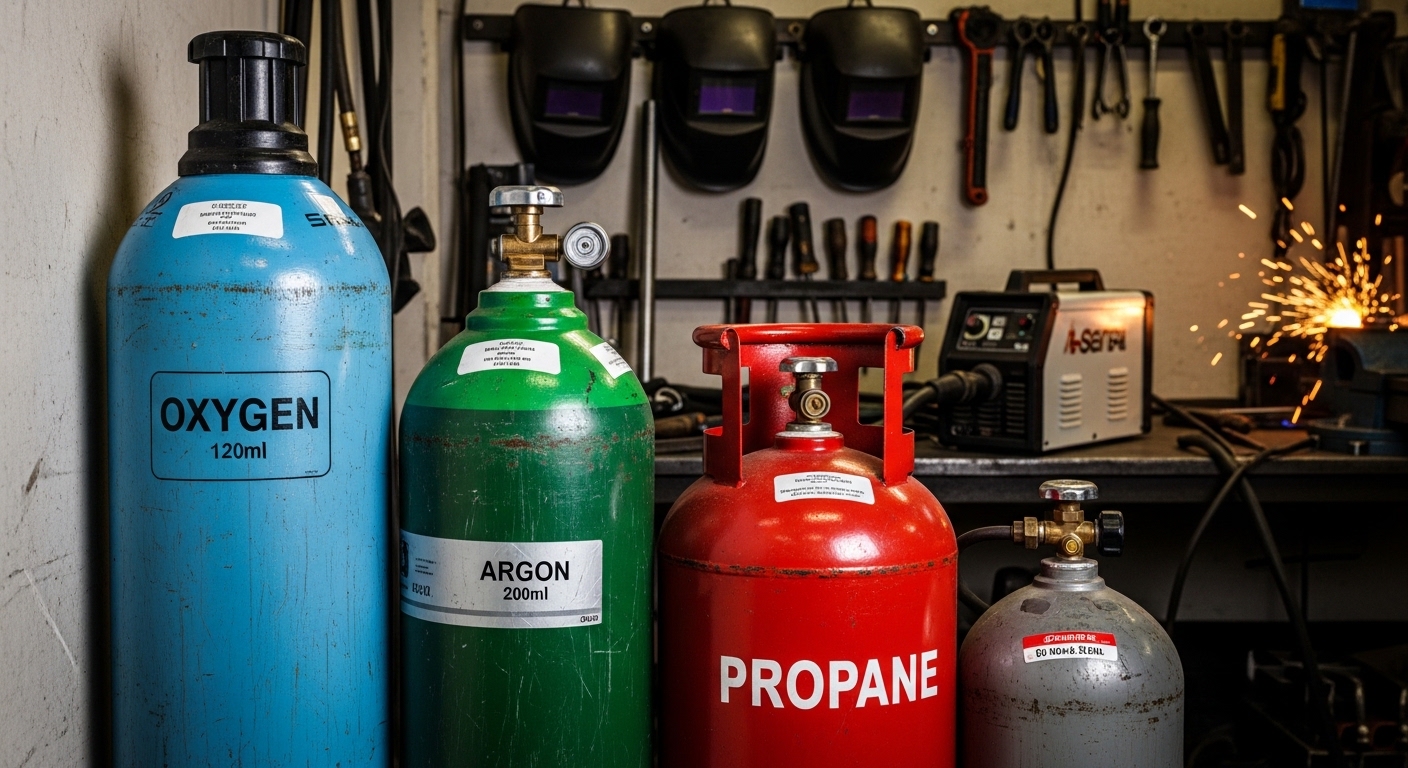
Choosing the right gas cylinder size can be confusing with so many options available. The wrong size means either running out of gas mid-project or lugging around unnecessary weight. After working with gas cylinders for over 15 years across welding, grilling, and industrial applications, I’ve seen how proper sizing saves both time and money.
Gas cylinders come in standardized sizes ranging from portable 1-pound containers to industrial 300+ cubic foot tanks. The right size depends on your application, duration needs, and portability requirements. Propane tanks are measured in pounds, welding gases in cubic feet, and medical gases in liters.
This guide breaks down every standard gas cylinder size with real-world applications, capacity calculations, and selection criteria. You’ll find comprehensive charts, duration estimates, and expert recommendations based on actual usage scenarios.
Understanding Gas Cylinder Size Standards
Gas cylinder sizes follow industry standards based on gas type and application. Propane tanks use pounds (20 lb, 40 lb, 100 lb), welding gases use cubic feet (80 cf, 125 cf, 250 cf), and medical gases use liters. These standardized sizes ensure compatibility across regulators and equipment.
Gas cylinder sizing follows established standards from organizations like the DOT (Department of Transportation) and ISO (International Organization for Standardization). These standards dictate dimensions, pressure ratings, and capacity based on the compressed gas type.
Different measurement systems exist because gases are stored differently. Propane is stored as a liquid under pressure, measured by the liquid weight in pounds. Welding gases like oxygen and argon are compressed gases, measured by the expanded volume in cubic feet at atmospheric pressure.
Cubic Feet (cf): The volume of gas when expanded to standard atmospheric pressure. A 80 cf cylinder contains 80 cubic feet of gas at sea level pressure, regardless of the compressed volume inside the tank.
The cylinder name often reflects its capacity. A “20 lb propane tank” holds approximately 20 pounds of propane liquid. An “80 cf welding cylinder” holds 80 cubic feet of expanded gas. However, the actual physical size varies between manufacturers.
Working pressure also affects sizing. Higher pressure cylinders require thicker walls and larger dimensions for the same capacity. This is why acetylene cylinders (low pressure) look different from oxygen cylinders (high pressure) even at similar capacities.
Propane Tank Sizes Complete Guide
Propane tanks are the most common gas cylinders for consumers. Used for grilling, RVs, heating, and outdoor cooking, these tanks are measured by the weight of liquid propane they hold.
Quick Summary: Standard propane tank sizes range from 1 lb (camping) to 100+ lb (residential heating). The 20 lb tank is the most common for grilling, while 30 lb and 40 lb tanks power RVs and outdoor heaters.
| Tank Size | Propane Capacity | Dimensions (H x D) | Empty Weight | BTU Capacity | Common Uses |
|---|---|---|---|---|---|
| 1 lb (disposable) | 1 lb (0.24 gallons) | 8″ x 4″ | 1 lb | 21,600 BTU | Camping stoves, torches |
| 14 oz (disposable) | 0.875 lb | 7″ x 3.5″ | 0.8 lb | 18,900 BTU | Small camping stoves |
| 20 lb (standard grill) | 20 lb (4.6 gallons) | 18″ x 12″ | 17 lbs | 432,000 BTU | Gas grills, smokers |
| 30 lb | 30 lb (7 gallons) | 24″ x 12.5″ | 22 lbs | 648,000 BTU | RVs, travel trailers |
| 40 lb | 40 lb (9.4 gallons) | 29″ x 12.5″ | 26 lbs | 864,000 BTU | RVs, large heaters |
| 100 lb | 100 lb (23.6 gallons) | 48″ x 14.5″ | 67 lbs | 2,160,000 BTU | Home heating, backup power |
| 420 lb (100 gallon) | 420 lb (100 gallons) | 48″ x 30″ | 290 lbs | 9,072,000 BTU | Whole-home propane |
| 500 gallon (residential) | 2,100 lb (500 gallons) | 10′ x 38″ | 950 lbs | 45,360,000 BTU | Whole-home heating |
The 20 lb propane tank is the most familiar size. Also called the “grill tank,” it powers millions of gas grills across the country. At 18 inches tall and 12 inches in diameter, it’s portable yet holds enough propane for 10-20 hours of grilling depending on your grill’s BTU output.
For RV owners, the choice typically comes down to 30 lb vs 40 lb tanks. Both mount horizontally in RV compartments. The 30 lb tank weighs about 50 pounds full and provides roughly 14 gallons of propane when combined in pairs. Many RVs use two 30 lb tanks for extended travel.
Propane Tank Duration Estimates
Understanding how long a propane tank lasts depends on your appliance’s BTU rating. Propane produces approximately 91,500 BTU per gallon. This calculation helps estimate runtime:
Duration Formula: (Total BTU Capacity) / (Appliance BTU/hr) = Hours of Use
Example: A 20 lb tank (432,000 BTU) on a 30,000 BTU grill = 14.4 hours
| Application | Typical BTU | 20 lb Tank | 30 lb Tank | 40 lb Tank |
|---|---|---|---|---|
| Gas Grill (typical) | 30,000 BTU/hr | 14-15 hours | 21-22 hours | 28-29 hours |
| High-End Grill | 50,000 BTU/hr | 8-9 hours | 13-14 hours | 17-18 hours |
| Patio Heater | 40,000 BTU/hr | 10-11 hours | 16-17 hours | 21-22 hours |
| RV Furnace | 25,000 BTU/hr | 17-18 hours | 26-27 hours | 34-35 hours |
| Portable Generator | 15,000 BTU/hr | 28-29 hours | 43-44 hours | 57-58 hours |
These estimates assume continuous operation at full output. Real-world usage varies based on temperature, duty cycle, and appliance efficiency. Cold weather reduces propane pressure and effective runtime.
Welding Gas Cylinder Sizes Explained
Welding gas cylinders follow a different sizing system than propane. These cylinders contain compressed gases measured in cubic feet, with common sizes ranging from 20 cubic feet for portable setups to 300+ cubic feet for industrial applications.
Quick Summary: The most common welding gas sizes are 40 cf (hobby), 80 cf (standard), 125 cf (popular), and 250 cf (production). Larger cylinders offer better gas value per cubic foot but reduce portability.
| Cylinder Size | Gas Capacity | Dimensions (H x D) | Empty Weight | Pressure | Best For |
|---|---|---|---|---|---|
| R (20 cf) | 20 cubic feet | 18″ x 4″ | 6 lbs | 2,015 PSI | Portable welding, tight spaces |
| QR (40 cf) | 40 cubic feet | 21″ x 6″ | 24 lbs | 2,015 PSI | Hobby welding, occasional use |
| Q (80 cf) | 80 cubic feet | 32″ x 6.5″ | 38 lbs | 2,015 PSI | Standard home/shop use |
| S (125 cf) | 125 cubic feet | 42″ x 7″ | 55 lbs | 2,265 PSI | Serious DIY, light fabrication |
| K (250 cf) | 250 cubic feet | 51″ x 8″ | 105 lbs | 2,265 PSI | Production welding, fabrication shop |
| T (300 cf) | 300 cubic feet | 55″ x 9″ | 145 lbs | 2,265 PSI | Heavy industrial, production |
Welding Gas Types by Cylinder Size
Different welding gases use the same cylinder sizes but have different capacities and properties. The most common welding gases include:
| Gas Type | 80 cf Contents | 125 cf Contents | Pressure | Primary Uses |
|---|---|---|---|---|
| Argon | 80 cf argon | 125 cf argon | 2,015-2,265 PSI | TIG welding aluminum, stainless |
| CO2 | 80 cf CO2 | 125 cf CO2 | 1,800-2,015 PSI | MIG welding steel (short circuit) |
| 75/25 Argon/CO2 | 80 cf blend | 125 cf blend | 2,015 PSI | MIG welding steel (general purpose) |
| Oxygen | 80 cf oxygen | 125 cf oxygen | 2,265 PSI | Oxy-fuel cutting, welding support |
| Acetylene | 80 cf acetylene | 130 cf acetylene | 250 PSI | Oxy-acetylene welding, cutting |
Acetylene Note: Acetylene cylinders are filled with a porous material and acetone. The gas dissolves in the acetone, allowing safe storage at much lower pressure (250 PSI) than other compressed gases. Never use acetylene above 15 PSI flow rate.
Welding Gas Duration Calculations
Estimating welding gas consumption depends on your flow rate settings and actual arc time. Most MIG welding uses 25-35 CFH (cubic feet per hour), while TIG typically uses 15-25 CFH.
For a 125 cf cylinder at 30 CFH flow rate:
125 cf / 30 CFH = 4.2 hours of continuous welding
Real-world welding typically involves 30-50% arc time. So a 125 cf cylinder might last 8-14 hours of actual project work depending on your welding style and joint preparation.
Industrial and Medical Gas Cylinder Sizes
Industrial and medical applications use specialized cylinder sizes designed for specific gases and usage patterns. These cylinders often feature different valve connections and color coding for identification.
| Cylinder Designation | Water Volume | Typical Gases | Dimensions | Applications |
|---|---|---|---|---|
| E Cylinder | 4.7 liters (24 cf O2) | Oxygen, medical air | 26″ x 4″ | Portable medical O2, EMS |
| D Cylinder | 2.4 liters (12 cf O2) | Oxygen, medical air | 19″ x 4″ | Patient transport, home O2 |
| M Cylinder | 3.1 liters (30 cf O2) | Oxygen | 22″ x 4.5″ | Backup medical O2 |
| G Cylinder | 10.4 liters (165 cf O2) | Oxygen, nitrogen | 51″ x 8″ | Medical manifold systems |
| H Cylinder | 43.5 liters (244 cf O2) | Oxygen, nitrogen, helium | 51″ x 9″ | Hospital central supply |
Medical oxygen cylinders are sized by patient needs. An E cylinder provides approximately 24 cubic feet of oxygen at 2,000 PSI. At 2 liters per minute flow, an E cylinder lasts about 5.5 hours. At higher flow rates of 5 LPM, runtime drops to roughly 2.2 hours.
Gas Cylinder Capacity and Duration Calculations
To calculate gas cylinder duration, divide total capacity by consumption rate. For propane: (Gallons x 91,500) / BTU/hr = hours. For welding gases: Cubic feet / CFH flow rate = hours. Always factor in real-world conditions like temperature and duty cycle.
Accurately estimating gas duration requires understanding your consumption rate and total available capacity. These calculations vary by gas type and application.
Propane Duration Formula
Propane contains approximately 91,500 BTU per gallon. To calculate runtime:
- Convert tank size to gallons (20 lb = 4.6 gallons, 30 lb = 7 gallons)
- Multiply gallons by 91,500 BTU
- Divide by your appliance’s BTU/hr rating
- Apply a 20% safety margin for real-world conditions
Example for a 20 lb tank (4.6 gallons) on a 40,000 BTU patio heater:
4.6 x 91,500 = 420,900 BTU total capacity
420,900 / 40,000 = 10.5 hours theoretical runtime
10.5 x 0.8 = 8.4 hours realistic runtime
Welding Gas Duration Formula
Welding gas duration is simpler to calculate but depends heavily on your flow rate:
- Check your regulator flow rate setting (CFH – cubic feet per hour)
- Divide cylinder capacity (cf) by flow rate
- Apply duty cycle factor (30-50% for typical welding)
Example for a 125 cf cylinder at 25 CFH flow rate:
125 cf / 25 CFH = 5 hours continuous flow
5 hours / 0.4 duty cycle = 12.5 hours actual welding time
Factors Affecting Actual Duration
Several factors reduce actual gas duration compared to theoretical calculations:
- Temperature: Cold weather reduces propane pressure and effective output. Below 20 degrees F, propane output drops significantly.
- Altitude: Higher altitude affects combustion efficiency and gas expansion.
- Regulator efficiency: Some regulators waste gas during flow adjustments.
- Post-flow time: Welding machines continue gas flow after arc stops to protect the weld pool.
- Leaks: Small connections leaks can waste significant gas over time.
In my experience welding professionally, I’ve found that actual gas usage typically runs 20-30% higher than calculations suggest. Factor this buffer when planning projects.
How to Choose the Right Gas Cylinder Size
Choose gas cylinder size based on your application, duration needs, and portability requirements. For grilling, 20 lb propane tanks work best. For RV use, 30-40 lb tanks provide extended runtime. For welding, 80-125 cf cylinders balance cost and portability for most users.
Selecting the right cylinder size involves balancing multiple factors. Consider these key questions when choosing:
1. What’s Your Application?
Different applications have optimal cylinder sizes:
| Application | Recommended Size | Why |
|---|---|---|
| Gas Grilling | 20 lb propane tank | Standard size, easy exchange, 10-15 hours cook time |
| RV Travel | 30-40 lb propane tanks | Extended runtime, fits RV compartments |
| Camping/Backpacking | 1 lb disposable or 16 oz | Ultra-portable, lightweight |
| Patio Heating | 20-40 lb propane tank | 8-20 hours heat depending on output |
| Home Hobby Welding | 80-125 cf welding gas | Good balance of value vs portability |
| Professional Welding | 250+ cf welding gas | Best value, fewer tank changes |
| Portable Welding | 40-80 cf welding gas | Lightweight for field work |
2. How Long Do You Need It To Last?
Match your cylinder size to your usage duration:
- Single-day events: 20 lb propane (grilling), 80 cf welding gas (light projects)
- Weekend trips: 30-40 lb propane (RV), 125 cf welding gas (multiple projects)
- Extended use: 100 lb propane (heating), 250+ cf welding gas (production work)
3. Portability Considerations
Larger cylinders offer better value but become difficult to transport:
- Under 30 lbs: Easy to carry, one-handed transport possible
- 30-60 lbs: Two-handed lift, requires careful handling
- 60-100 lbs: Requires cart or two people, vehicle transport only
- 100+ lbs: Fixed installation or forklift required
4. Cost Per Unit Analysis
Larger cylinders almost always provide better value per unit of gas. This is especially true for welding gases where refill costs remain relatively consistent across cylinder sizes. A 250 cf cylinder might cost 30% more to fill than an 80 cf cylinder while providing three times the gas.
For propane, the difference is less dramatic but still significant. Per-gallon costs drop noticeably when moving from 20 lb to 100 lb tanks. This explains why many grill owners eventually upgrade to larger tanks with refill stations rather than exchange programs.
Common Cylinder Selection Mistakes
After helping hundreds of customers select cylinders over the years, I see these mistakes repeatedly:
- Underestimating consumption: People assume they’ll use less gas than reality. Always add a 20% buffer.
- Over-prioritizing portability: Choosing smaller cylinders to save weight, then running out mid-project.
- Ignoring exchange availability: Buying tank sizes that local suppliers don’t support.
- Valve incompatibility: Not checking regulator fitment before purchasing.
- Storage constraints: Buying cylinders that don’t fit available storage spaces.
Gas Cylinder Safety and Handling
Regardless of size, all gas cylinders require proper handling and safety precautions:
- Secure cylinders: Always chain or strap cylinders to prevent tipping.
- Cap valves: Keep protective caps in place when cylinders aren’t in use.
- Store upright: Never lay cylinders on their side, especially propane.
- Check for leaks: Use soap solution on connections – bubbles indicate leaks.
- Avoid heat: Keep cylinders away from flames and temperatures above 125 degrees F.
- Ventilate spaces: Never use gas cylinders in enclosed spaces without ventilation.
- Transport properly: Keep cylinders upright and secured during vehicle transport.
- Inspect regularly: Check for damage, corrosion, or expired certification dates.
DOT requires periodic retesting of cylinders. The test date is stamped on the cylinder collar. Most cylinders require recertification every 5-10 years depending on service and construction.
Frequently Asked Questions
What are standard gas cylinder sizes?
Standard gas cylinder sizes vary by gas type. For propane: 1 lb, 20 lb, 30 lb, 40 lb, 100 lb, and 420 lb tanks. For welding gases: 20 cf, 40 cf, 80 cf, 125 cf, 250 cf, and 300 cf cylinders. Medical oxygen comes in D (12 cf), E (24 cf), and H (244 cf) sizes.
How do I choose the right gas cylinder size?
Consider your application, duration needs, and portability requirements. For grilling, a 20 lb propane tank works well. For RVs, choose 30-40 lb tanks. For welding hobbyists, 80-125 cf cylinders provide good balance. Match cylinder size to your typical usage time and add a 20% buffer.
What size propane tank do I need for a grill?
The standard 20 lb propane tank is ideal for most gas grills. It provides approximately 432,000 BTU or 10-15 hours of grilling time depending on your grill’s BTU rating. The 20 lb tank is widely available through exchange programs and fits standard grill compartments.
How long will a 20 lb propane tank last?
A 20 lb propane tank lasts 10-15 hours on a typical 30,000 BTU grill. On high-end grills with 50,000 BTU output, expect 8-9 hours. For patio heaters (40,000 BTU), plan for 10-11 hours. Cold weather reduces runtime by 20-30% due to decreased propane pressure.
What size gas cylinder for welding?
Hobby welders typically use 80 cf (cubic foot) cylinders for portability and value. Serious DIY and light fabrication benefit from 125 cf cylinders. Production shops prefer 250 cf or larger cylinders for better gas value and fewer changeovers. Choose size based on project duration and portability needs.
What’s the difference between gas cylinder sizes?
Larger cylinders hold more gas and offer better value per unit but weigh more and are less portable. Small cylinders (1 lb propane, 40 cf welding gas) are portable but require frequent replacement. Medium cylinders (20-40 lb propane, 80-125 cf welding gas) balance portability and capacity. Large cylinders (100+ lb propane, 250+ cf welding gas) maximize value but require handling equipment.
How much gas is in a 20 lb cylinder?
A 20 lb propane cylinder contains approximately 4.6 gallons of liquid propane, which provides about 432,000 BTU of energy. When full, the tank weighs approximately 37 pounds (20 lbs of propane plus 17 lbs of empty tank weight). This size is the standard for gas grills and patio heaters.
What size gas cylinder for RV?
RVs typically use horizontal-mount 30 lb or 40 lb propane tanks. The 30 lb tank holds 7 gallons of propane and weighs about 52 pounds full. The 40 lb tank holds 9.4 gallons and weighs approximately 66 pounds full. Many RVs use two 30 lb tanks in parallel for extended travel capacity
Leave a Reply