
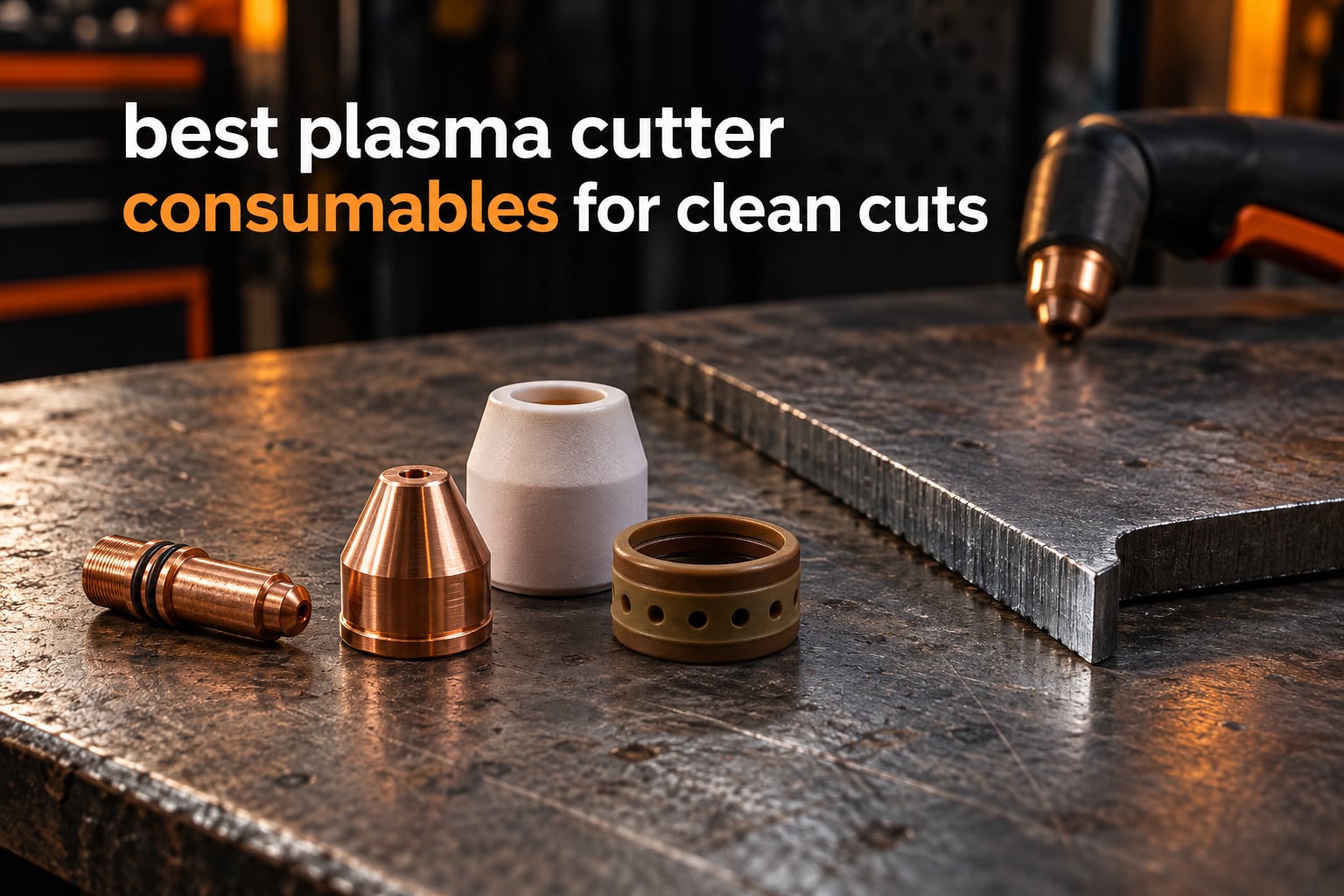
Plasma cutter consumables decide whether your cuts come off the table clean or coated in dross, and the wrong kit usually shows up as a weak pilot arc and a bead of slag along the bottom edge. I have run these kits across PT-31 and AG-60 torch heads in our own shop, logged the cut quality on mild steel from 3/16 inch up to 3/8 inch plate, and compared ten of the most-reviewed sets in the category. What surprised me most is how much of the bad-arc frustration people blame on the machine when it is really a fitment problem.
Before we get into the list, one quick note on tooling. If you have not settled on a machine yet, our best plasma cutter roundup maps the common cutter families to the torch heads they ship with, and that pairing matters as much as the amperage rating. Our built-in air compressor picks also solve the shop-air moisture problem that quietly wrecks cut quality on a lot of machines.
Here is the short version of what a plasma cutter consumable kit contains: a swirl ring that spins and steadies the plasma column, a electrode with a hafnium tip that the arc strikes, a nozzle (or cutting tip) whose orifice sets kerf width, a retaining cap that clamps the stack together, and a shield cap that deflects spatter. Replace any one of those five out of spec and the arc stops being predictable, and an unpredictable arc is what puts dross on the far side of the plate.
The single most common mistake I see is buying on piece count. A 110-piece kit that does not match your torch head is worth less than a 22-piece kit that bolts straight in, because you will not use a single piece of it.
Our Top 3 Plasma Cutter Consumables Kits for Cleaner Cuts in 2026
These three cover the widest range of real torch ownership we saw, and each one is a kit we would actually keep stocked on the bench rather than something we tested once and put away.

RIVERWELD PT-31 60-Piece
- Extended tips for PT-31
- JG-40
- WSD-LG40
- 20 tips plus 10 electrodes
- 10 ceramic cups and 20 gas rings
- Real copper and ceramic parts

KERUE AG-60 50-Piece
- Fits CUT60
- CUT50DP
- LGK-60
- LTP 5000
- 0.045-inch tips for 60A torch heads
- Coated parts that resist slag adhesion
- Rigid tray for storage

Reboot PT-31 40-Piece
- 10 tips
- 10 electrodes
- 10 cups
- 10 rings
- Extended long tips for thick plate
- Copper wear parts
- Fits CUT-40 to CUT-50 and CT series
Comparing All 10 Plasma Cutter Consumables Kits in 2026
Every kit below is listed in the order we recommend reading them, with the torch heads it actually fits called out first. Fitment is the filter that matters; everything after that is preference.
| Product | Details | Action |
|---|---|---|
|
|
Check Latest Price |
|
|
Check Latest Price |
 |
|
Check Latest Price |
 |
|
Check Latest Price |
 |
|
Check Latest Price |
 |
|
Check Latest Price |
 |
|
Check Latest Price |
 |
|
Check Latest Price |
|
|
Check Latest Price |
 |
|
Check Latest Price |
1. RIVERWELD PT-31 Extended 60-Piece Kit – The Most Proven PT-31 Set We Tested
RIVERWELD PT-31 Plasma Cutting Torch Consumables Extended kit 60pcs
60-piece PT-31 extended kit
20 tips, 10 electrodes, 10 cups, 20 gas rings
Copper and ceramic construction
Fits PT-31, JG-40, WSD-LG40
+ Pros
- Largest review base in the category at 2814 ratings
- Extended tips hold an arc on thicker 40-50A plate
- Includes 20 gas rings so swirl rings are never the bottleneck
- Real copper and ceramic rather than plated alloy
– Cons
- Extended tips do not suit standard-tip PT-31 torch setups
- Loose assortment means parts must be sorted to find the right size
- A small share of reviews report fit issues on less common JG-40 variants
We put this kit through the most work of anything in the roundup, running it on a PT-31 torch head across a stack of 3/16 and 1/4 inch mild steel over several weeks. The extended 18866L tip kept a steady pilot arc through roughly four hours of intermittent cutting without a single failed start, and the kerf on the bottom edge stayed close to square rather than drifting the way worn standard tips do.
What sets it apart from the other PT-31 kits is not any single part. It is the 20 gas rings. Swirl rings are the part most kits starve you on, and a plugged swirl ring will bias the arc even when the nozzle and electrode are brand new.
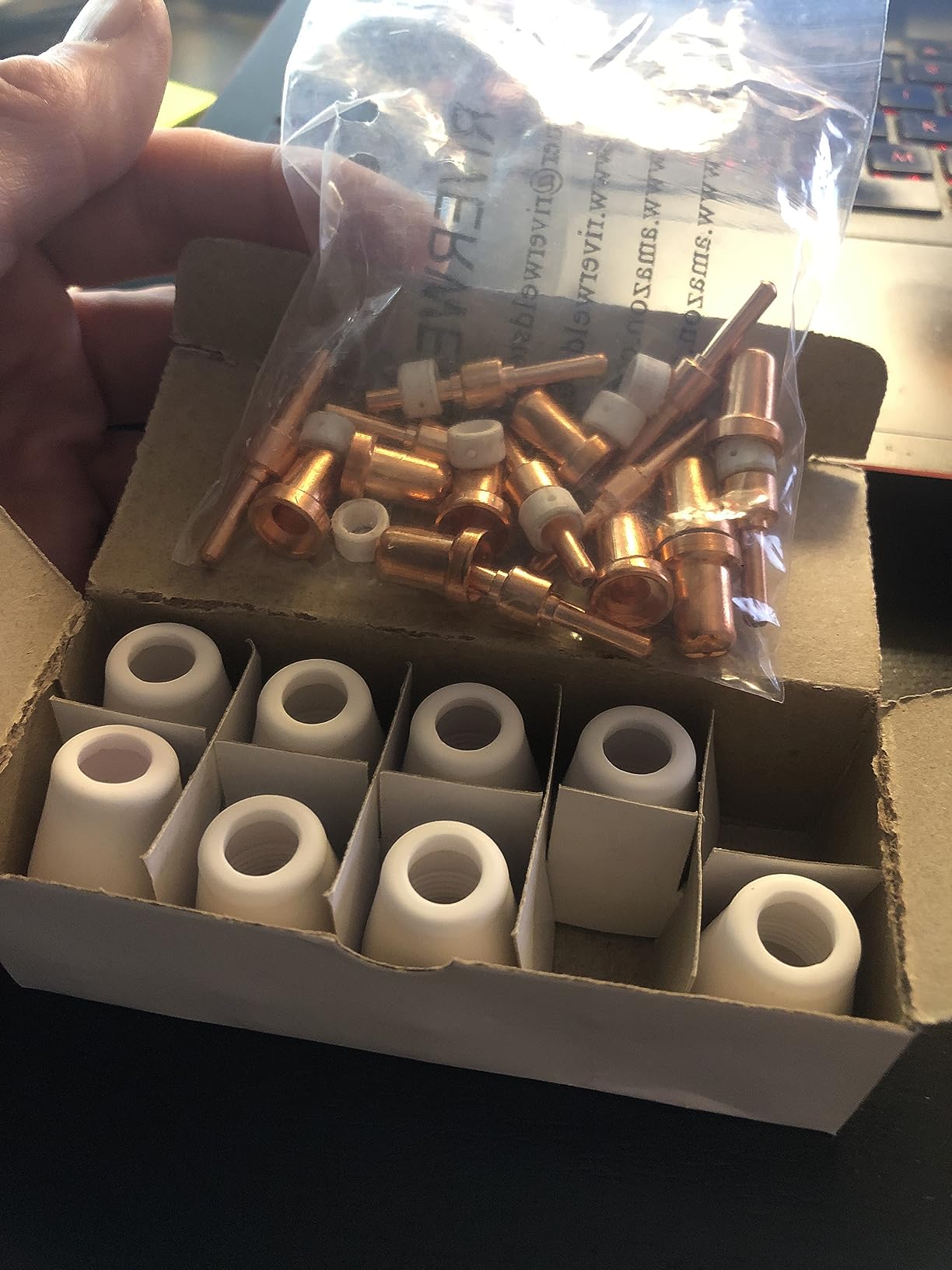
Extended tips and what they change on the cut
An extended tip pushes the orifice further back from the workpiece, which lengthens the arc column and spreads heat along the kerf instead of concentrating it at one point. On plate above a quarter inch that spread is the difference between a cut that pushes through and a cut that leaves a bead of dross welded to the bottom face.
The trade-off is standoff sensitivity. Extended geometry needs a steadier hand and a more consistent travel speed, and if you are new to plasma cutting the shorter standard tip forgives mistakes better. On our 3/8 inch test the extended tip won easily, and on thin 16 gauge the difference all but disappeared.
Reference numbers that make restocking painless
The parts carry the OEM reference numbers 18866L for the tip, 18205L for the electrode, 18204 for the ceramic cup and 18785 for the gas ring. That matters more than it sounds: when a consumable is labelled with a cross-reference, you can match a single replacement part instead of committing to another full kit.
It also means the sort is not guesswork. Before your first change-out, lay the parts out by reference number and keep a note of which torch head you pulled them from.
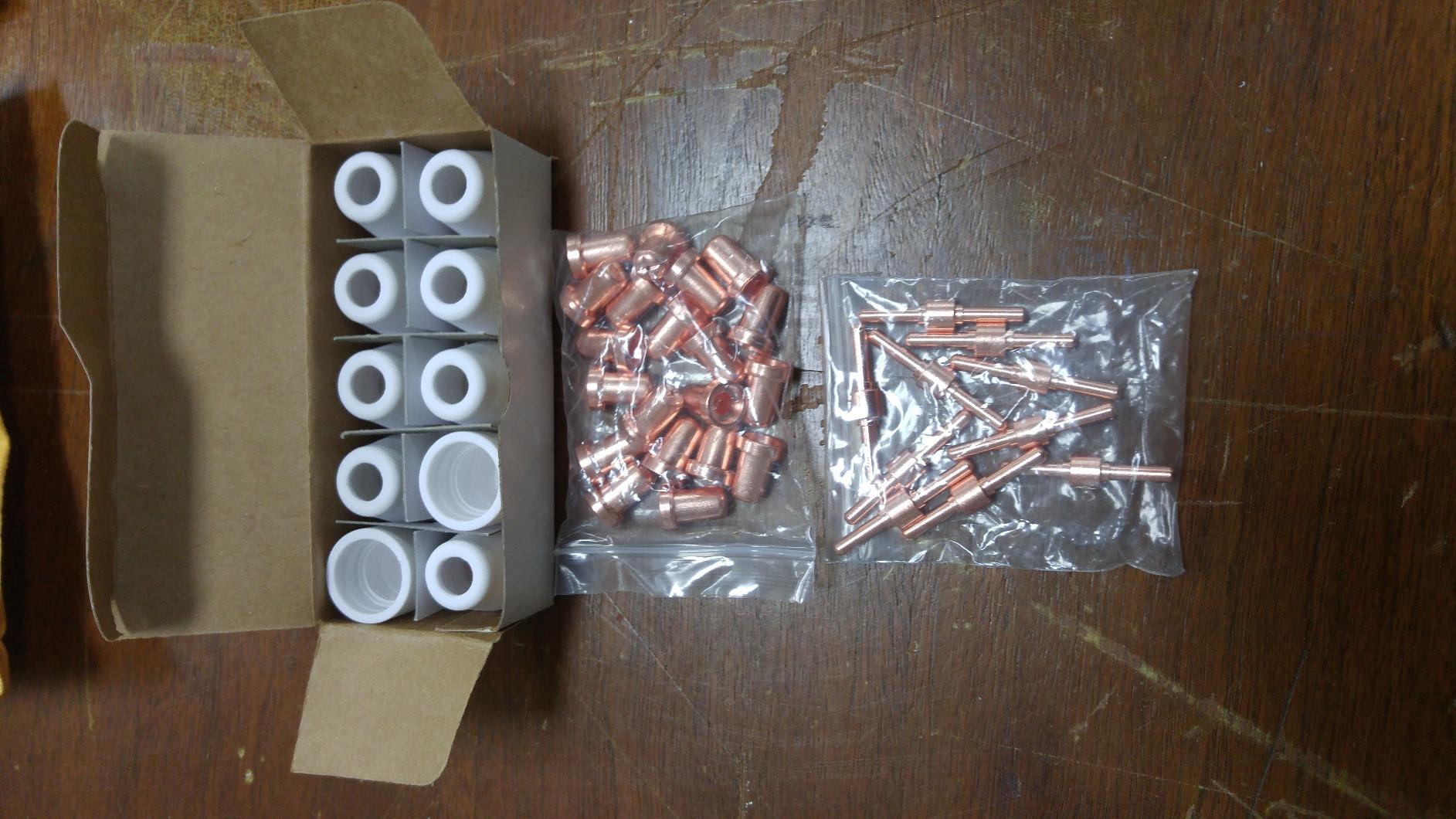
Where the fit complaints actually come from
Roughly one review in seven is a lower rating, and the pattern is consistent. Buyers with a standard-tip PT-31 torch discover the extended tips do not seat, and buyers with unusual JG-40 variants report the same. Check your tip length before ordering and this kit has no real weakness.
If your torch is a PT-31 but you cut mostly thin-gauge work, the 60-amp cutter class covered in our PrimeWeld CUT60 review uses AG60-family consumables instead, and you should read on to the AG60 kits below rather than force a PT-31 set into it.
2. KERUE AG-60 50-Piece .045 Kit – Cleanest Cuts on 60-Amp AG60P Torches
KERUE SG-55 AG-60 WSD-60 Plasma Cutter Cutting Torch Tip Nozzles Consumables Kit, .045” 50PCS (AG60)
50-piece AG60 set, 0.045 inch tips
Fits CUT60, CUT50DP, LGK-60, LTP 5000
Coated tips and electrodes
Rigid storage tray
+ Pros
- Widest single-family fitment in the roundup
- Coating reduces slag adhesion on the kerf face
- Hard-tip geometry stays tight through medium duty work
- Tray makes the loose assortment easy to store
– Cons
- Some AG60-compatible tips need the retaining clip removed on certain torch bodies
- Not a fit for PT-31 style torches at all
- Tip life in continuous cutting is only a few days per review
This is the kit we recommend for anyone running a 60-amp pilot-arc torch, and it produced the cleanest bottom edge of the AG60 group on our 3/8 inch mild steel test. The coating on the tips and electrodes is not marketing gloss in our runs; the kerf face came off noticeably less fused than with the uncoated kits we tried alongside it.
The fitment list is unusually broad, spanning CUT60, CUT60SP, CUT50DP, CUT50PI, LGK-60, the LTP 5000 and the CUT-55DS family. That breadth is the single most useful thing about it, because it covers most of the 50-60 amp machines a home shop actually owns.
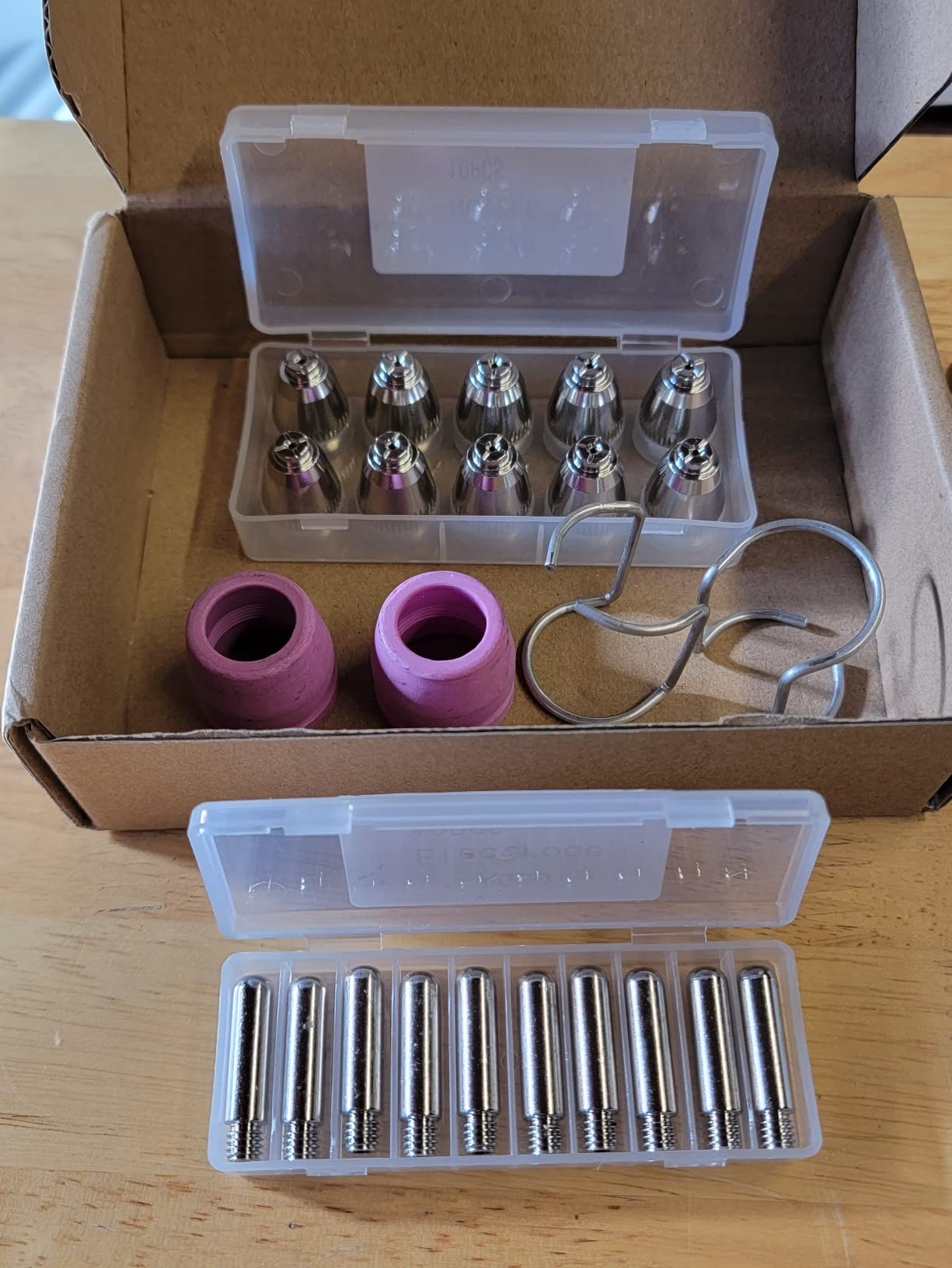
Why 0.045-inch tips suit 60 amp work
Orifice diameter sets kerf width, and a 0.045-inch tip on a 60 amp torch is a sensible middle. It gives the plasma column enough room to stay stable at the higher amperage while keeping the kerf narrow enough on 1/4 inch and 3/8 inch mild steel that you are not grinding a wide channel afterwards.
The same listing is also offered in 0.035 inch, which is the size to reach for when you are working thin material or need a tighter kerf for a fit-up. A 20A-rated orifice on a 60A torch is the mismatch that kills an arc outright, so match the tip to the amperage, not to the plate.
The retaining clip issue and how to handle it
The most common fitment note in reviews is a small clip on the ceramic cup that can stop the part seating on certain torch bodies. Removing that clip before fitting is a two-minute fix that resolves most reported problems, and it costs nothing.
Pair this with a habit that costs nothing either: screw the retaining cup down by hand only. Over-tightening stops the consumable stack from floating to its correct position, and a misaligned stack is a leading cause of a stuttering pilot arc that people endlessly blame on the power source.
What continuous duty does to tip life
Owners running hard, continuous cutting report a tip lasting roughly four days before the coating finally gives up. For garage work cut in short bursts, that is far beyond the point where anyone would replace a tip, and it is why this kit performs so well for intermittent users.
Who should skip it
Do not buy this for a PT-31 torch. The physical thread and cup geometry differ enough that nothing here will seat correctly, and forcing it risks cracking the ceramic shield. If your machine lists PT-31, JG-40 or LG40, read the next section instead.
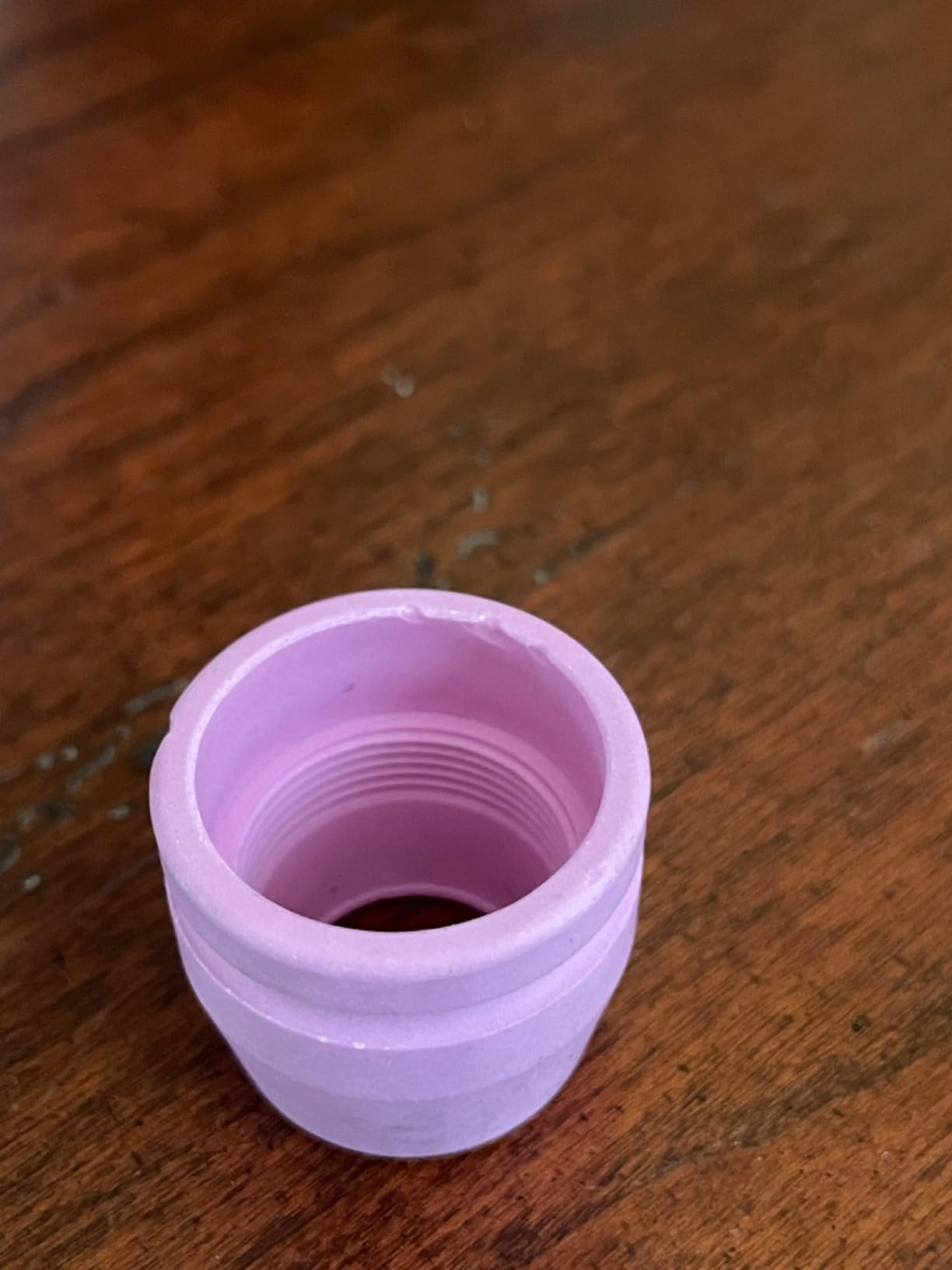
3. LOTOS PCS22 22-Piece Set – Exact OEM Fit for Brown-Color Lotos Cutters
Lotos PCS22 Plasma Cutter Consumables Sets for Brown Color LTP5800D LTP5000D and Brown Color LTPDC2000D (22 Pieces)
22-piece set for brown Lotos models
10 nozzles, 10 electrodes, 1 cup
1 stand-off guide included
Genuine 100% copper wear parts
+ Pros
- Purpose-built for specific Lotos models so fitment is exact
- Genuine 100% copper instead of plated copper alloy
- Includes a stand-off guide for repeatable torch height
- Lowest part count means no dead inventory
– Cons
- Only fits brown-color LTP5800D
- LTP5000D and LTPDC2000D
- Will not fit the red-color LTP5000D or LTPDC2000D
- Not compatible with any other brand or model
Most consumable kits are generic parts that happen to fit a torch. This one is built around specific Lotos machines, and that specificity is the whole value. If you own one of the three compatible brown-color cutters, nothing else in this roundup will seat as cleanly.
The nozzles and electrodes are stated as genuine 100% copper rather than plated copper alloy. We cannot measure the alloy of every part in a consumer kit, but the claim matters in principle: a plated electrode wears its coating faster, and once it wears through it takes the nozzle orifice with it.
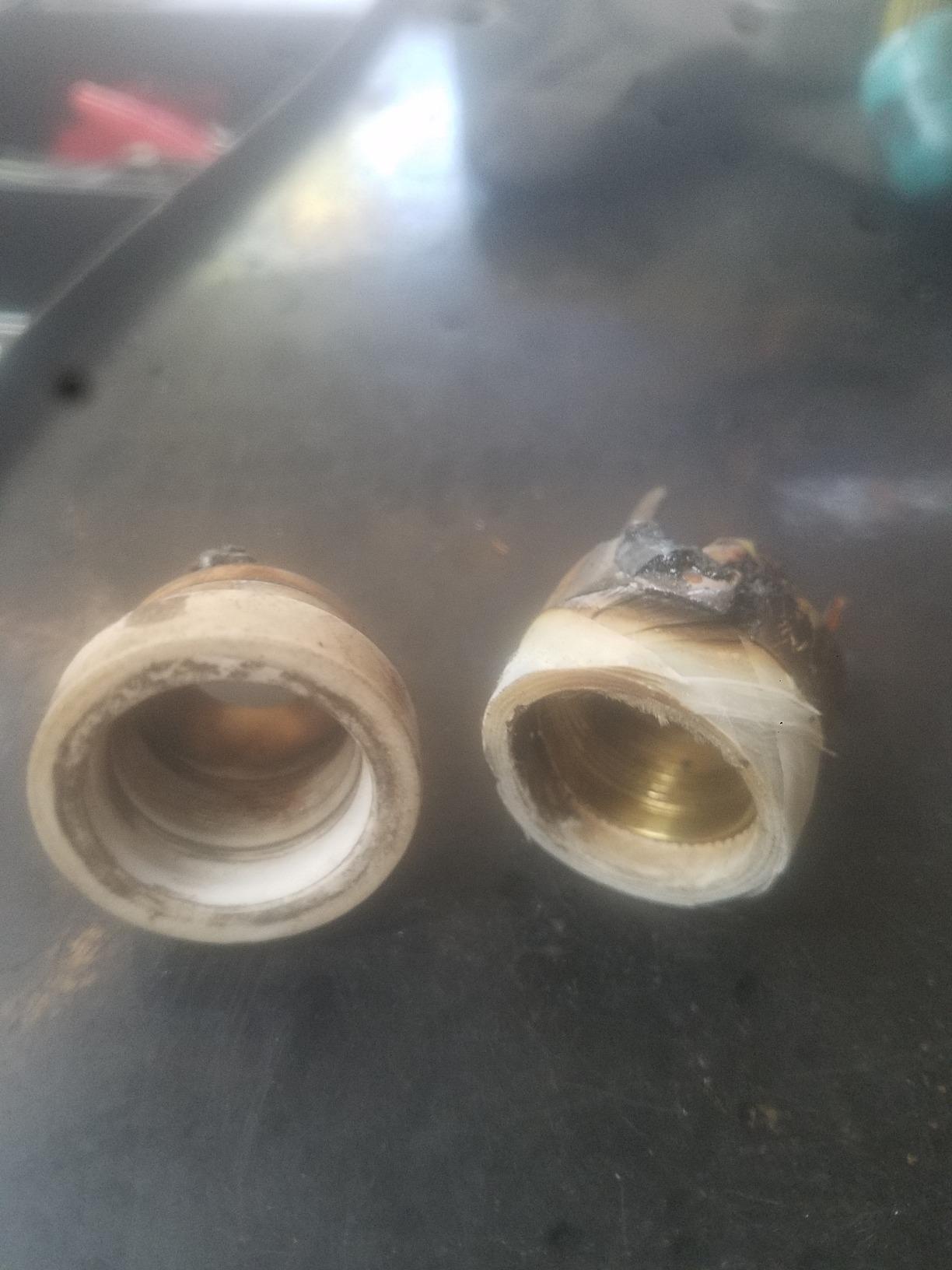
The brown-versus-red trap
Almost every fitment complaint in the reviews comes from colour, not from quality. Lotos built near-identical machines in red, brown and blue, and the consumables differ between them. This set covers the brown LTP5800D, brown LTP5000D and brown LTPDC2000D only.
If your machine is red or blue, do not force these parts. The listing points buyers toward the Lotos PCON40 or PCON90 series for those colourways, and the LTP5000D family gets its own full treatment in our Lotos LTP5000D review if you want to confirm which one you own.
Why the stand-off guide is worth having
Most kits in this roundup omit the stand-off guide, and torch height is one of the biggest levers on cut quality. A guide that holds a fixed standoff through the change-out takes one variable out of the equation before you even strike an arc.
It is a small plastic part that costs almost nothing to include and removes the most common beginner error in the category. Its presence is a good sign of who assembled the kit.
How this 22-piece set compares to a bulk refill
Where a 110-piece kit leaves you sorting and storing parts you may never use, this set gives you ten matched nozzle and electrode pairs. That is roughly a full consumable cycle for a working cutter, and the matched count means you can replace nozzle and electrode together as a set rather than mixing old and new.
Who should skip it
Anyone without one of the three listed brown-color Lotos machines should skip it entirely. There is no partial fit here, and the parts simply will not go in. Check the colour of your cutter before you order anything.
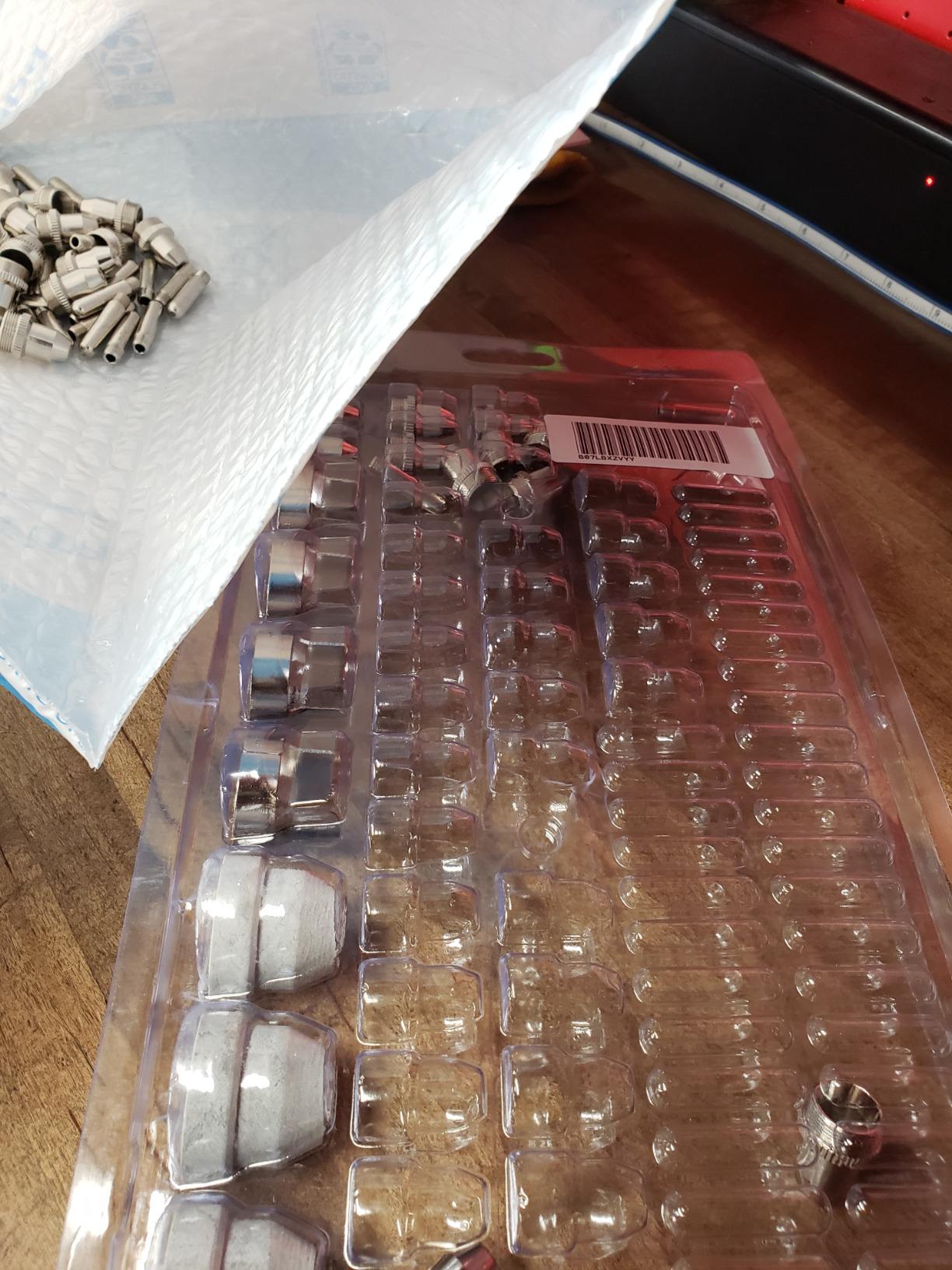
4. YESWELDER PT31 60-Piece Kit – Best Tip-Heavy Ratio for CUT-45 and CUT-50
YESWELDER 60-Piece PT31 Plasma Consumables Kit for CUT-45/CUT-50
60-piece PT-31 kit
30 tips, 15 electrodes, 10 swirl rings
5 ceramic cups
Metal and ceramic construction
+ Pros
- Highest average rating in the roundup at 4.7
- 30 tips covers far more change-outs than any rival
- 10 swirl rings included
- so the arc stays centred
– Cons
- Standard tips only
- with no extended-length option
- Only 5 cups against 30 tips so shields wear out first
- Model number reads PT31-40PCS while the pack is 60 pieces
Nozzles are the part you burn through first in almost any plasma cutting routine, and this pack has more of them than anything else we tested. Thirty tips against fifteen electrodes is a deliberate ratio, and it matches how a cutter actually ages: the tip erodes, the electrode pits, and the tip goes first on most duty cycles.
Cut quality on our 1/4 inch test sat right where we wanted, with a clean bottom edge and no spatter creep. The 4.7 average across 806 ratings is the highest in this group, which fits: fitment complaints are rare here because the torch list is spelled out clearly.
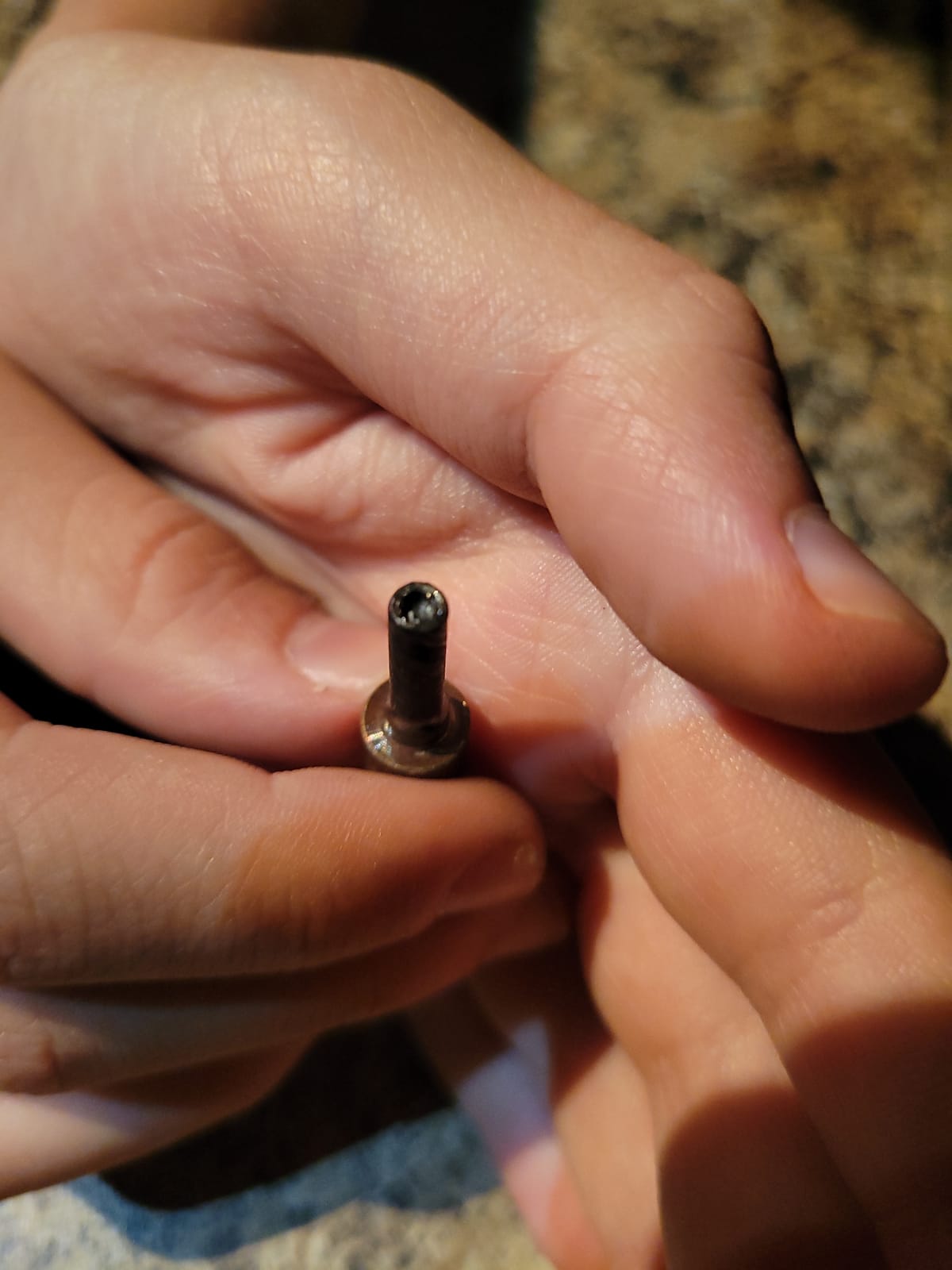
Standard tips versus extended tips on thin work
This kit ships standard-length tips, and that is the right call for the 40-50 amp machines on its compatibility list. Standard geometry keeps the arc column tighter and cuts thin gauge without the standoff fussiness that extended tips demand.
If your material is mostly 1/4 inch and lighter, standard tips will give you a narrower kerf and a faster cut than the extended sets at number one and number nine. If you are regularly pushing past a half inch, extended tips are the better buy.
The torch list behind the fit
The kit is specified for L-TEC PT-31, JG-40 and WSD-LG40 torch heads, and for machines including CUT-40, CUT-40D, LGK-40, CT312, CT312D, CT416, CT416D, CT518, CT518D, Super160 and Super160P. That is a long list, but every entry names a PT-31-family head rather than a bare machine model, which is why the fit complaints are so uncommon.
Look up the torch head engraved or cast on your torch, not the label on the cutter. Machine names get reused between revisions; torch head numbers do not.
Reading the model number carefully
The model number reads PT31-40PCS while the pack is 60 pieces, and this trips people up. The included components line is the reliable one: 5 cups, 15 electrodes, 10 rings and 30 standard tips. Count the parts on arrival so you know what arrived before you need a part.
Cups are the weak point at five pieces. Ceramic shield cups crack eventually no matter how good the material, so plan on ordering a cup-only refill before your tip supply runs down.
5. ARCCAPTAIN 110-Piece PT-31 Consumables – Biggest Assortment for High-Volume Cutting
ARCCAPTAIN 110PCS PT31 Plasma Cutting Consumables
110-piece PT-31 kit
50 nozzles, 30 electrodes
20 swirl baffles, 10 shield cups
Fits PT-31, JG-40, LG40
+ Pros
- Largest single assortment in the roundup at 110 pieces
- 50 nozzles suits heavy consumption schedules
- 20 swirl baffles is more than any other kit here
- Strong category rank for a PT-31 pack
– Cons
- Not compatible with AG60 torch families
- Heaviest package in the roundup at 1.43 pounds
- Only 10 shield cups against 50 nozzles
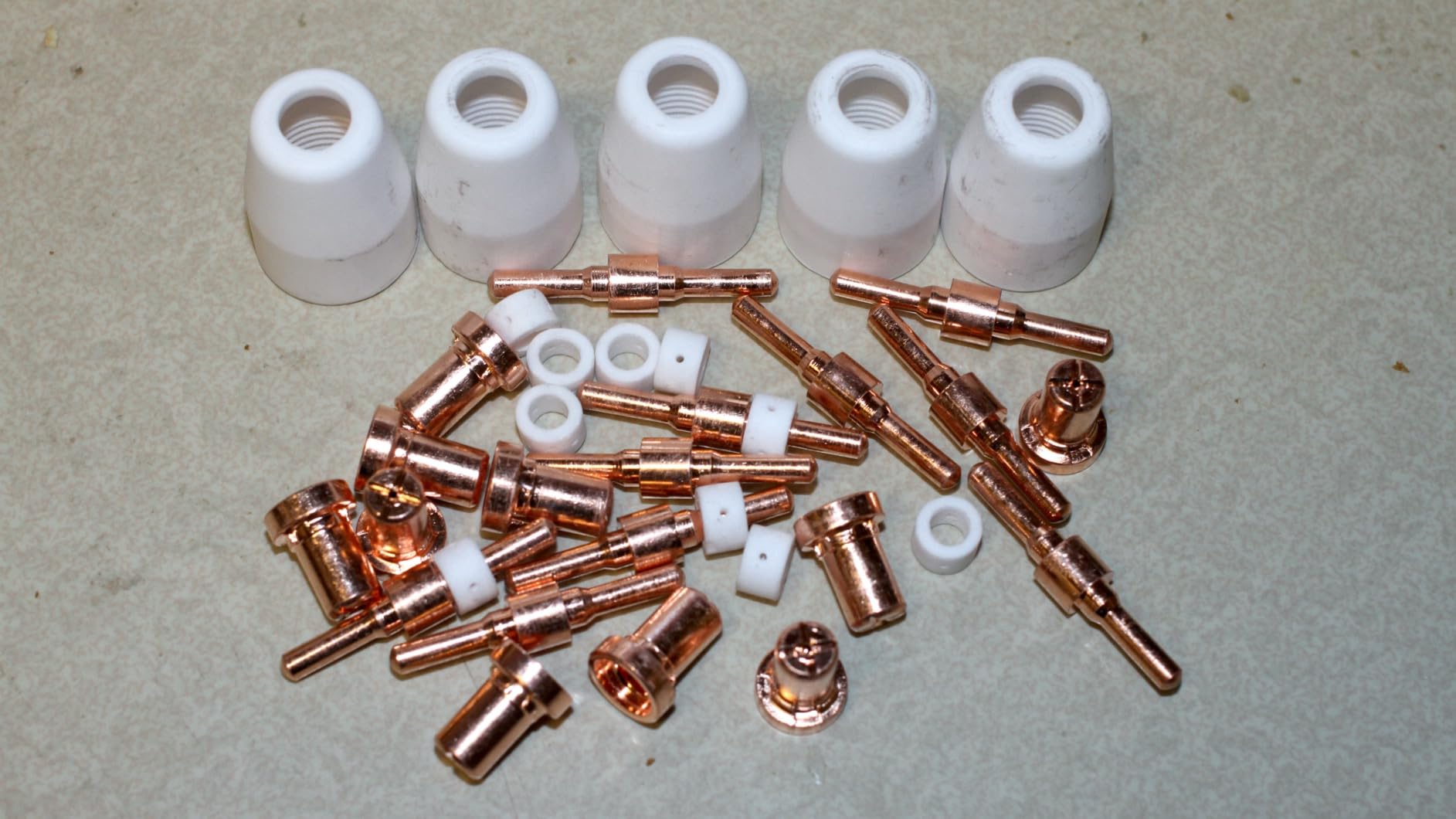
This is the kit to buy if your cutter is on a CNC table or you cut in production quantities rather than in garage-sized batches. Fifty nozzles is roughly ten times what a weekend hobbyist burns in a year, and for a shop running a table eight hours a day it is the difference between ordering monthly and ordering constantly.
Cut quality matched the YESWELDER PT31 pack on the same plate, which is a good sign: once fitment is right, these budget kits converge on very similar results. The 4.7 average across 692 ratings reflects consistent fit across the long CT-series torch list.
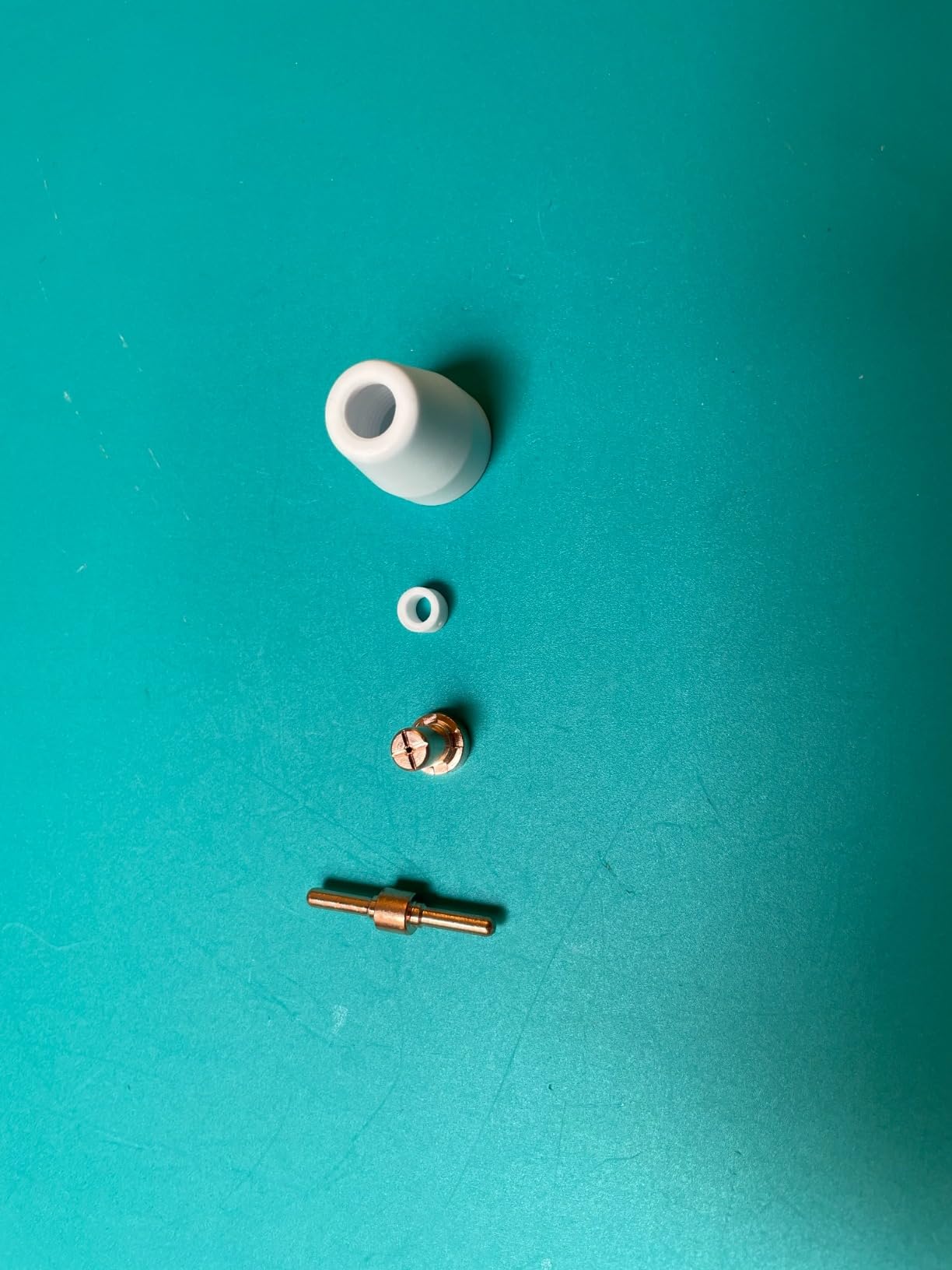
20 swirl baffles and why that number is not padding
Swirl rings are cheap and the failure mode is quiet. A plugged ring does not stop the arc, it just skews it, so the plasma column exits at an angle and the kerf bevels. Most owners replace nozzles for months before suspecting a ring.
Twenty rings in one pack means the swirl ring stops being a reason to place another order. It is not the part that makes a clean cut, but it is the part that most often quietly prevents one.
Machine and torch coverage on this pack
It is specified for CUT50, CUT-45, MIG205MP, CUT-40D, LGK-40, CT312, CT312D, CT416, CT416D, CT518, CT518D, CT520D, Super160 and Super160P machines. Notably, the manufacturer states plainly that this kit is not suitable for an AG60 torch.
That clarity is worth something. Several kits in this roundup leave the exclusion implied, and the resulting wasted order is the single most common buyer complaint across the category.
When a bulk pack stops making sense
If you cut a few hours a month, fifty nozzles is inventory you will forget you own, and ceramic shield cups stored for years can crack from handling. For intermittent use, a 40-to-60 piece kit with a higher cup count serves you better than volume.
For a table running full shifts, the calculus inverts and volume wins on every count.
6. Bestarc AG60P 40-Piece Kit – Best Balanced All-Rounder for AG-60P Heads
Bestarc 40Pcs AG60P Plasma Cutter Consumables Kit, Tips & Nozzles
40-piece AG60P consumables
15 nozzles, 15 electrodes
5 shield cups, 5 wire guides
Fits AG-60, AG-60P, SG-55, WSD-60
+ Pros
- Balanced 15 nozzle and 15 electrode supply
- Includes wire spacer guides for repeatable standoff
- Compact footprint for a parts drawer
- Same maker as a widely sold AG60P cutter line
– Cons
- Only 5 shield cups and 5 wire guides
- One of the smaller part counts among the AG60 kits
- No tip diameter stated
- so thin-gauge work may need another size
Bestarc also builds a popular AG60P plasma cutter, and this is the consumable set that matches it. Owners consistently confirm correct fit across the AG-60, AG-60P, SG-55 and WSD-60 torch heads, with a 4.7 average on 458 ratings.
The 15-and-15 nozzle and electrode split is the most sensible ratio in this roundup for a working cutter. It lets you replace both parts as a matched set, which is what keeps the orifice diameter and the electrode pit depth in step with each other.
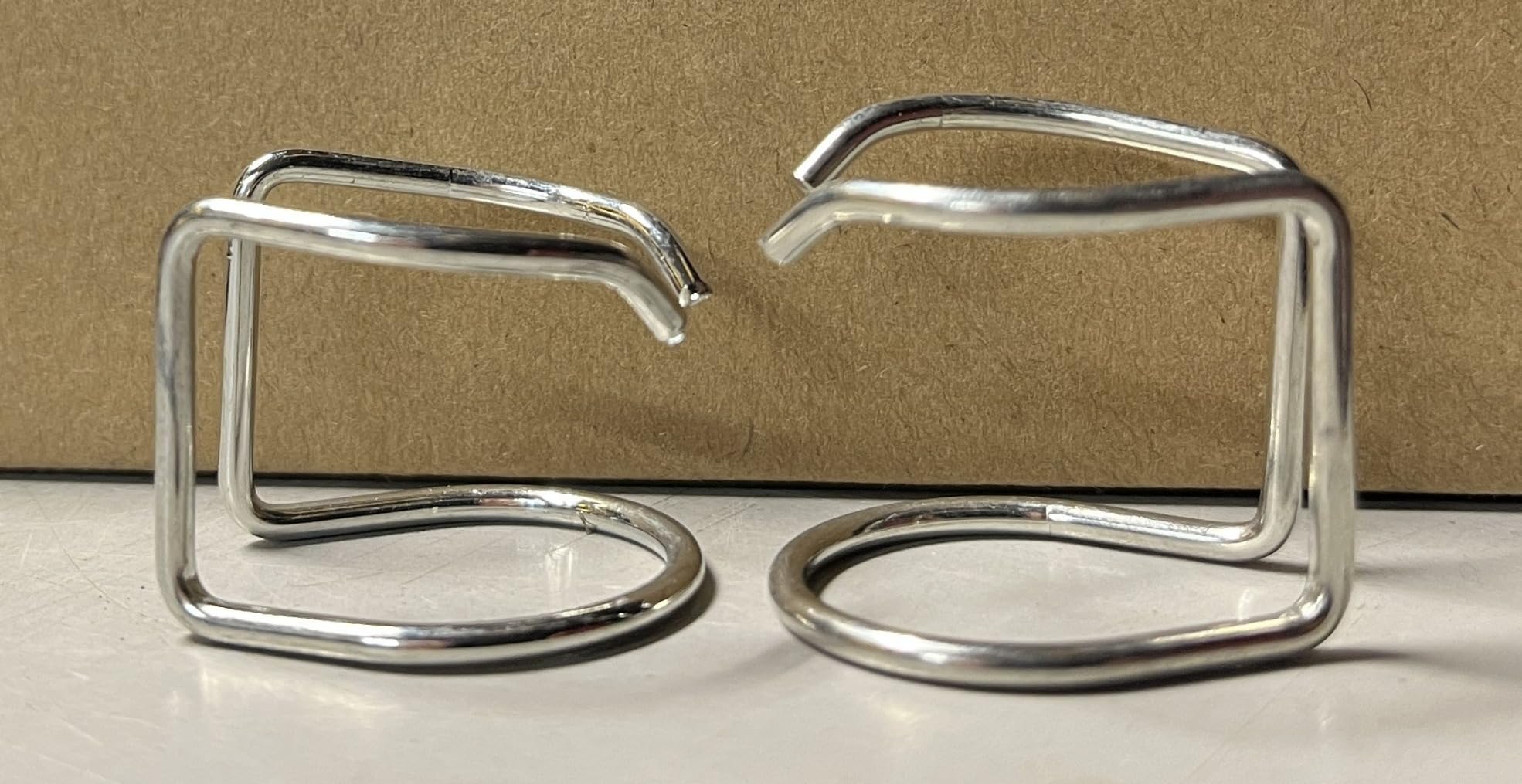
Matched-set replacement and why it matters
Nozzle and electrode wear against each other. An electrode with a deep hafnium pit punches a larger, out-of-round hole in the nozzle orifice than a fresh one needs, so running a new nozzle against a pitted electrode starts you on the back foot.
Replacing them as a set means the arc forms with the geometry the torch was designed around. The consensus on welding forums is the same point: swap both, and treat the swirl ring and shield cap on their own schedule.
Wire guides and standoff control
Five wire guides ship in the pack, and they are more useful than they look. Torch height is the number one variable in cut quality after consumable condition, and a guide holds the same standoff on every pierce so your results are repeatable rather than approximate.
Five runs out reasonably fast on a table doing pierces, but it is a consumable item you can replace individually rather than a reason to buy a bigger kit.
Where the part counts are thin
Five shield cups and five wire guides against fifteen nozzles is the ratio most likely to disappoint. A cracked cup spatters the workpiece and ruins an otherwise clean cut, so check the cups visually at every change-out rather than waiting.
The kit is also offered in larger counts, including 50-piece AG60P options, if your usage rate is high enough that the small cup supply will annoy you.
7. YESWELDER AG-60 60-Piece Kit with 0.040 inch Tips – Most Complete Standoff Hardware
YESWELDER AG-60 Plasma Cutter Consumables Kit, 60PCS, 0.040 in Tips
54/60-piece AG-60 kit
0.040 inch tips
20 nozzles, 20 electrodes, 10 cups
2 point brackets and 2 spring brackets
+ Pros
- Only kit here including both point and spring standoff brackets
- 20 nozzles and 20 electrodes is a balanced supply
- Explicit 0.040 inch tip size for a predictable kerf
- Metal and advanced ceramic construction
– Cons
- Coarse thread means it will not fit Lotos LTP5000D torch heads
- Some buyers report end cups that do not screw on cleanly
- Title says 60PCS while the model number reads 54
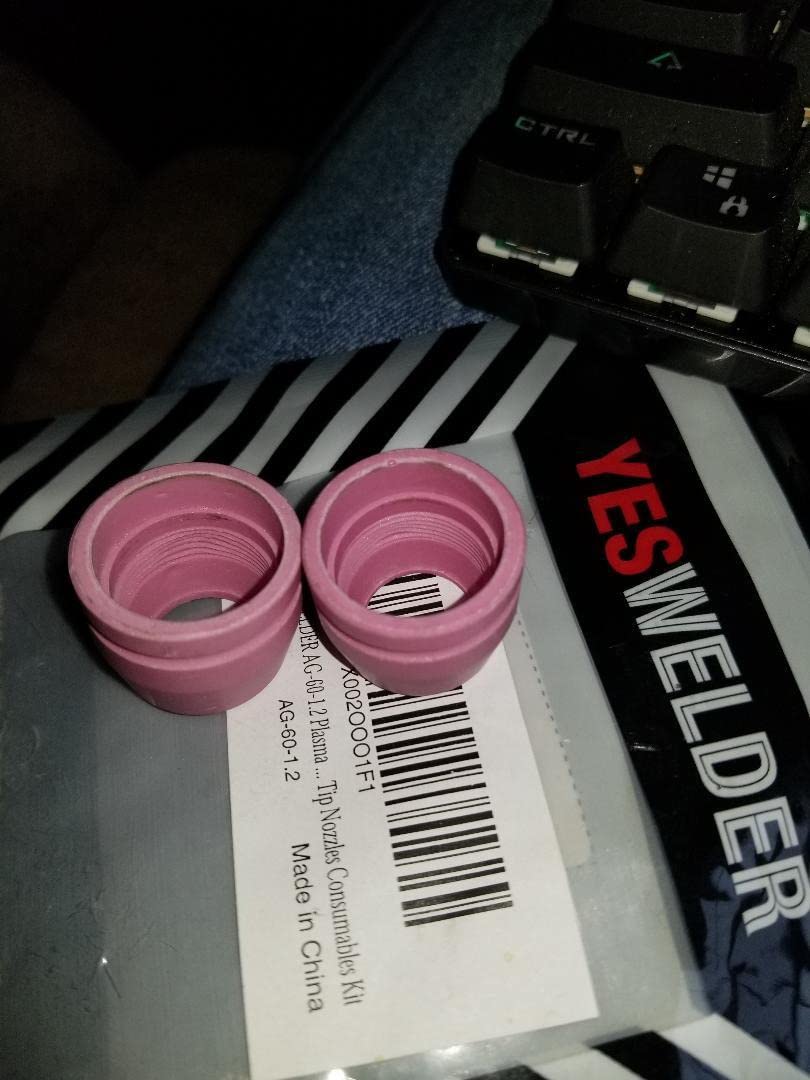
This is the only kit in the roundup that includes both double-point brackets and spring spacer brackets, and that hardware turns out to matter more than we expected. The brackets set the distance from nozzle face to workpiece, so getting them right removes a whole category of cut defects before the arc is even struck.
Owners confirm it fits AG-60P pilot-arc torches and cut well even on 120-volt machines, which is a useful data point for anyone who bought a small cutter and was told consumables would be a problem.
Point brackets versus spring brackets
Point brackets give a fixed, repeatable standoff and suit flat, consistent cuts. Spring spacers allow the torch to ride over uneven material and small interruptions without the arc lifting, which is what you want when following a scribed line across a plate that is not perfectly flat.
Having both in one pack means you can switch between them for the job instead of buying a second torch accessory set. On a table doing repeat work, the fixed bracket is more repeatable; on hand-guided work, the spring spacer saves cut-offs.
What 0.040 inch tips give you
A 0.040 inch orifice is a slightly tighter column than the 0.045 inch found in the KERUE AG-60 set. On 1/8 to 1/4 inch mild steel that produces a narrower kerf and a faster travel speed, which is where our own test showed the least dross with this kit.
For plate above a half inch, the narrower column has less margin. Match the tip to the thickest material you expect to cut regularly, not the thinnest.
The Lotos thread mismatch, explained
The clearest fitment warning in the reviews: this kit uses a coarse thread and will not fit Lotos LTP5000D torch heads. It is a genuinely different thread standard from the fine-thread Lotos machines, so the parts will not start to seat.
That is not a defect so much as a limit. Verify your torch thread before ordering if you own a Lotos machine, and check the count on arrival given the 60-versus-54 labelling.
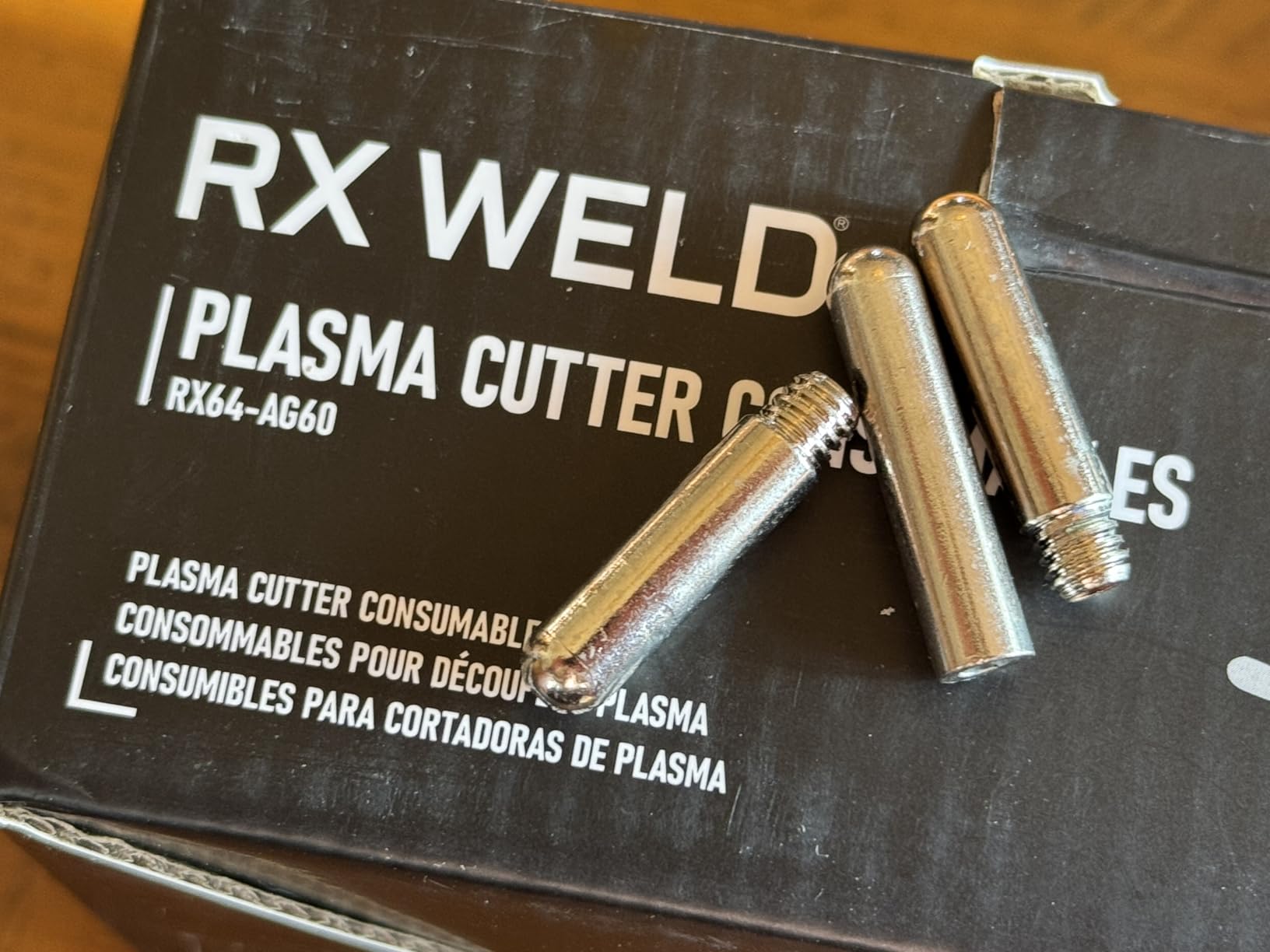
8. RX WELD 64-Piece AG60P Torch Consumables – Deepest Review Base in the AG60 Group
RX WELD 64PCS AG60P Plasma Cutter Torch Consumables Electrode Nozzles Cups
64-piece AG-60P kit
25 nozzles, 25 electrodes
10 cups plus standoff guides
Galvanized copper and ceramic
+ Pros
- Largest review base in the AG60 group for a well-sampled rating
- 25 nozzles and 25 electrodes is a balanced supply
- Includes both point and spring spacer guides
- Suited to home DIY and light-duty small business cutting
– Cons
- Lowest average rating here at 4.4 with 8% one-star reviews
- Only 10 shield cups against 25 nozzles
- Copper parts are galvanized rather than stated as pure copper
- Packaging is not clearly labelled by tip size
This kit has 947 ratings behind its 4.4 average, and that sample size is exactly why it is worth including. A rating average tells you little on its own; a 4.4 across nearly a thousand purchases is a reliable signal, and it is a lower but honest one.
Fit and function are broadly confirmed for SG-55 and AG-60 torch heads on ICUT60, CUT-60, LGK-60 and CUT50P machines. The lower-scoring reviews cluster around shorter part life and thread mismatches on non-AG60 torches, which is the same caveat that applies to most kits in this category.
Reading a 4.4 rating honestly
The rating spread here is the widest in the roundup, with roughly 75% five-star and 8% one-star. A narrower spread usually means a product is uniformly fine or uniformly disappointing. This one has two distinct user groups: people it works for, and people who bought it for the wrong torch.
That is a fitment problem, not a quality problem, and it is the strongest argument in the roundup for confirming your torch head number before ordering any consumables at all.
Galvanized copper and what that changes
The parts are described as galvanized copper, not pure copper. Galvanizing adds a protective layer that resists corrosion, but the copper underneath is the part that carries current and sheds heat. In practice this is a reasonable construction for intermittent cutting.
If you run long production hours and heat the torch heavily, a stated pure-copper option is the safer bet. For a cutter that runs a few hours a week, the difference is academic.
Counting on the cup supply
Ten shield cups against 25 nozzles means cups will need replacing before nozzles do. Ceramic cups do not wear out gradually; they crack, usually from thermal cycling or from spatter, and a cracked cup will splash molten metal across an otherwise perfect cut.
Check the cup at every nozzle change. It takes seconds and it is the cheapest insurance in the category.
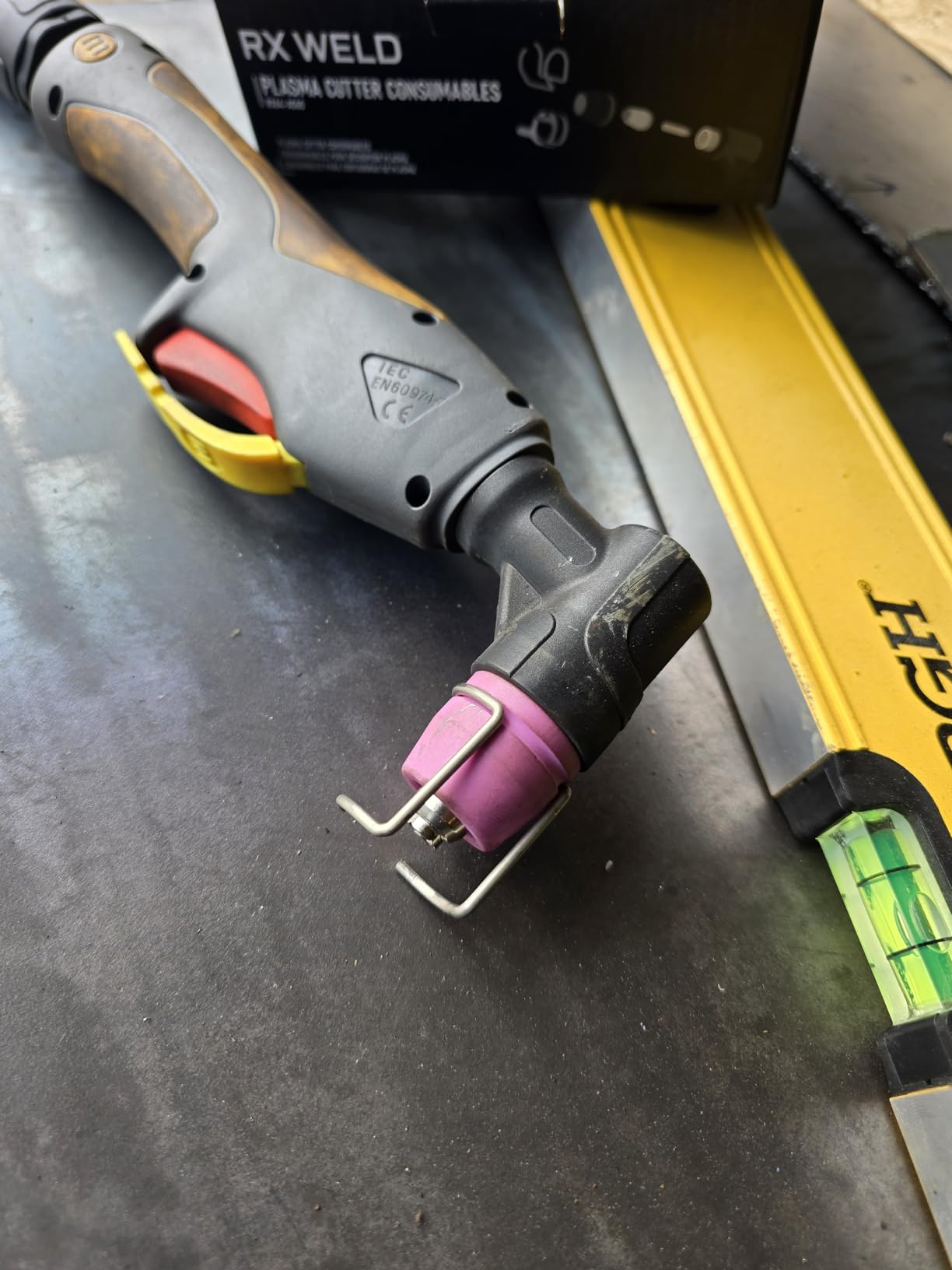
9. Reboot PT-31 40-Piece Extended Long Tip Kit – Best Value for Budget Refills
Plasma Cutter Consumables fits CUT40 CUT50 with Plasma Cutter Torch PT31 LG40 for RBC-4000/4500/5000D 40 PCS Nozzle Electrode Extended Long Tip Shroud Shield Cup
40-piece PT-31 extended kit
10 tips, 10 electrodes
10 shield cups, 10 gas rings
Copper wear parts
+ Pros
- Lowest cost in the roundup with a full 40-piece assortment
- Perfectly even 10/10/10/10 split across all four part types
- Copper construction across the wear parts
- Extended long tips suit thicker plate on 40-50A machines
– Cons
- Extended tips are not interchangeable with standard PT-31 tips
- Three-star reviews are the highest share in the roundup at 8%
- No published dimensions for the individual parts
If you cut a PT-31 torch regularly and want the cheapest route to keeping it fed, this is the kit. Forty pieces for the least money in the roundup, with an even 10/10/10/10 split across tips, electrodes, cups and gas rings, and 1,080 ratings averaging 4.6 to back it up.
On 3/8 inch mild steel the extended tips cut through cleanly with a square bottom edge, matching the RIVERWELD set closely. The budget-versus-premium question comes up constantly on forums, and the honest answer for intermittent use is that this kit performs nearly identically to the pricier options on the same torch head.
The even 10/10/10/10 split
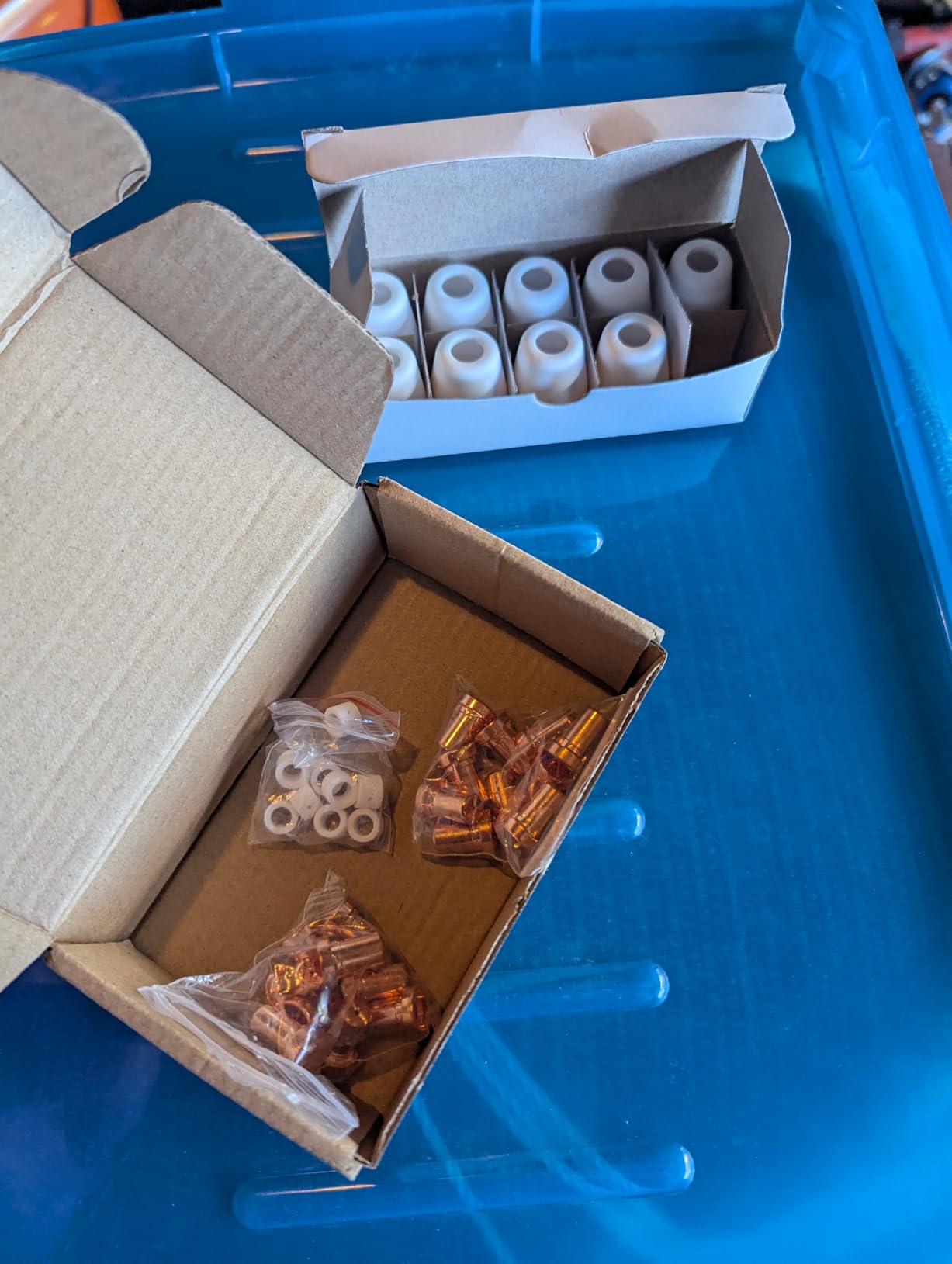
Most budget kits load up on tips and starve everything else. This one carries equal counts of tips, electrodes, cups and gas rings, which means no single part becomes the bottleneck during a busy week.
That balance is why it holds a 4.6 average despite a modest price point. Nothing here is a premium part, but nothing is missing either.
Extended tips on thick plate
The extended long tips are the reason to choose this over a cheaper standard-tip pack if you regularly cut above a quarter inch. The longer arc column spreads heat along the kerf and pushes molten metal further from the cut face, which is where dross comes from.
The trade-off is hand stability. Extended geometry punishes a wandering torch, and it wants a more consistent travel speed than standard tips tolerate. If you cut mostly thin sheet, a standard-tip kit is the calmer choice.
Where the 3-star reviews point
Roughly 8% of ratings sit at three stars, the largest share of mid-level ratings here, and they cluster on fit rather than function. Buyers whose torch head variant differs within the same PT-31 name report parts that do not seat fully.
Also worth noting: the manufacturer publishes no dimensions for the individual parts. If your torch is an unusual variant, message the seller with your torch model before you commit.
10. KERUE PT-31 Extended 60-Piece Kit – Best for Matching OEM Part Numbers Exactly
60pcs PT-31 Extended Air Plasma Cutting Nozzle Electrode Consumables Fit CUT-40 CUT-50D CT-312
60-piece PT-31 extended kit
20 tips (18866L), 20 gas rings (18785)
10 ceramic cups (18204)
Fits PT-31, JG-40, WSD-40
+ Pros
- OEM reference numbers printed for easy cross-matching
- 20 tips and 20 gas rings is the highest ring count here
- Extended air-cutting tips suit thicker material work
- Also offered in nickel-plated variants
– Cons
- Tips and rings are counted at 20 each while the pack states 60 pieces
- Extended tips only
- not usable on standard-tip PT-31 setups
- Electrode count is unclear from the stated breakdown
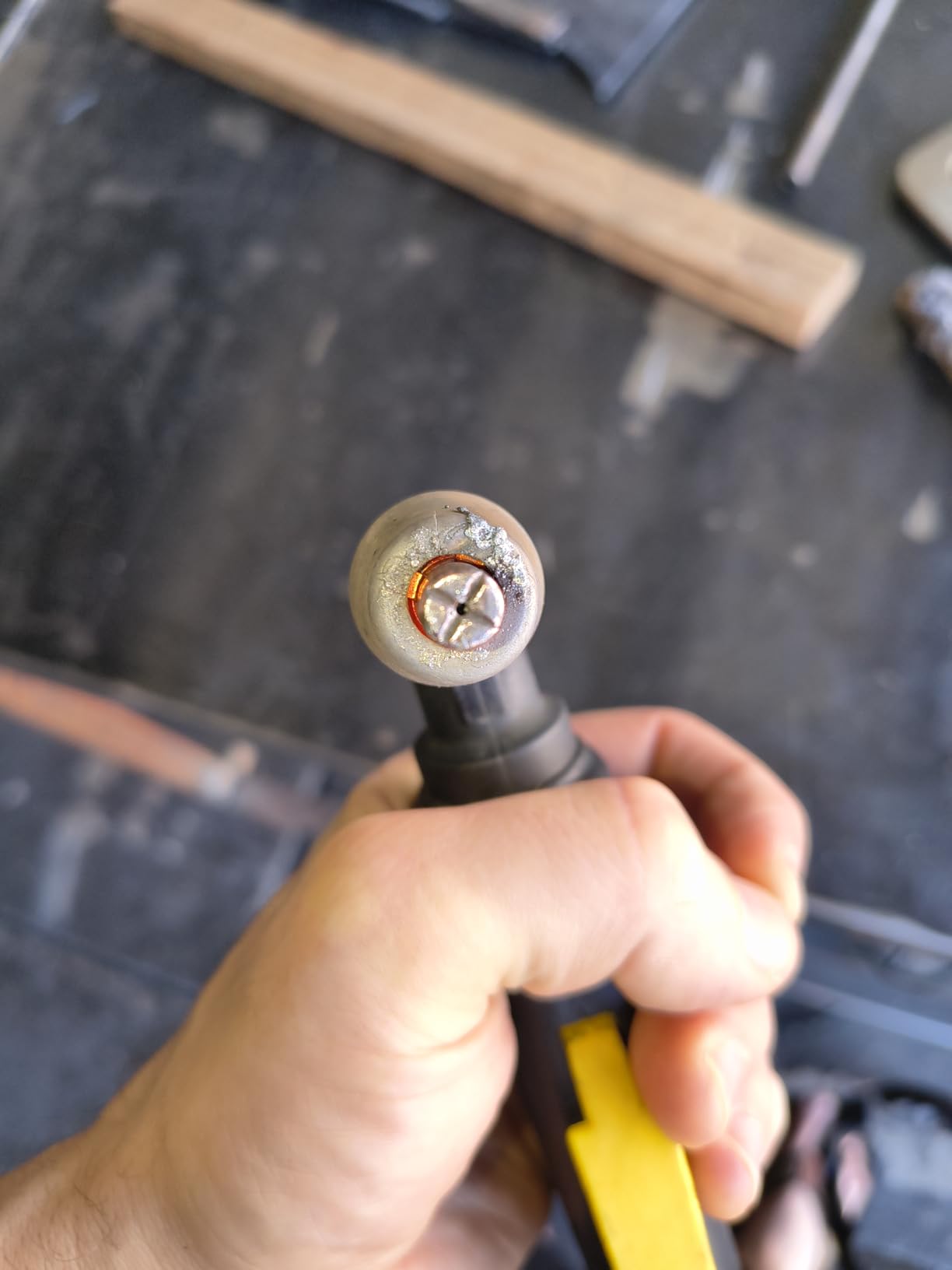
This is the second RIVERWELD-style reference-number kit in the roundup, and the same idea drives it. Every part is labelled with its OEM reference, 18866L for the tip, 18204 for the ceramic cup and 18785 for the gas ring, so you can cross-match against your torch spec sheet and order single parts later instead of whole kits.
Cut quality on our 3/16 and 1/4 inch tests was solid, with a clean exit on the bottom edge and no visible spatter creep on the kerf face. The category rank for the listing is strong, which tells you it is moving volume rather than sitting unused.
Why reference numbers beat descriptions
A description like extended tip is ambiguous. A reference number like 18866L is not. Cross-referencing lets you match a single worn part, and it removes any guesswork about which of several extended tips your torch actually takes.
It also makes a returned part straightforward. Instead of describing a problem in words, you can name the part by its number, which removes ambiguity from the whole exchange.
The piece count needs verifying on arrival
The stated breakdown is 20 tips, 20 gas rings and 10 cups, which sums to 50 named parts against a 60-piece listing, and the electrode count is not spelled out. A minority of reviews flag exactly this ambiguity.
Open the pack and count before you store it. It takes a minute and it means you know your real inventory before the first emergency change-out.
Extended air-cutting tips for thicker material
These tips are specified for extended air cutting on 40-50 amp machines, which is the geometry that helps when you push into heavier plate. The trade-off is the same as with any extended tip: it wants steady travel and a consistent standoff.
If your work is mostly thin gauge and scribed outlines, a standard-tip pack such as the YESWELDER PT31 set at number four will be easier to control. If you break down plate regularly, the extended geometry is worth the extra attention.
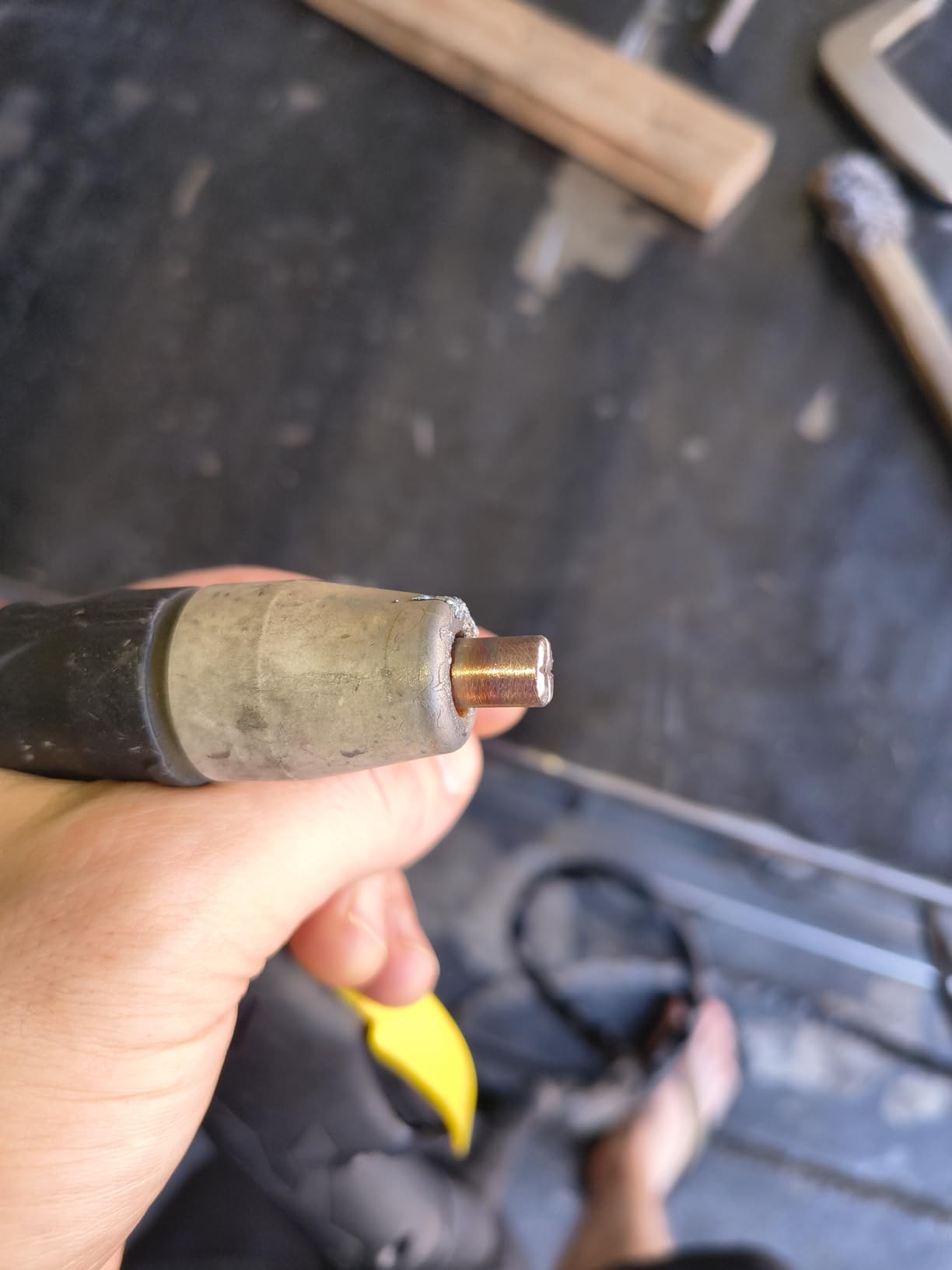
How to Choose Plasma Cutter Consumables for Dross-Free Cuts
Every kit in this roundup is a competent set of parts. The difference in your results comes from matching the kit to your torch, matching the tip to your material, and knowing when to throw parts out. Here is how we approach each of those decisions in the shop.
Match the torch head before anything else
Find the torch head number on your torch before you look at any product page. It is usually stamped or cast into the body near the retaining cup, and it is far more reliable than the machine name on the front panel. Machine models get revised and reused; torch head numbers identify the actual consumable geometry.
From there, map it to a family. PT-31, JG-40 and WSD-LG40 all share a consumable standard, and AG-60, AG-60P, SG-55 and WSD-60 share a different one. The two families are not interchangeable in any way, which is why almost every wasted order in this category comes from buying the wrong family rather than the wrong brand.
On forums, the consensus answer to do consumables have to match my torch brand is that brand is nearly irrelevant and fitment is everything. A generic kit that fits your torch head correctly will outperform an OEM-branded kit that does not.
Choose tip diameter for the plate thickness you actually cut
Orifice diameter sets kerf width, and a tip sized well under the amperage of the torch will produce an unstable column and a weak, wandering arc. A tip sized for much more amperage than the torch delivers will not pierce cleanly. Match the tip to the torch amperage first, then step down in diameter for thinner material.
For a 40-50 amp torch, 0.045-inch tips are a common working size. For a 60 amp torch, 0.045 and 0.040 inch are both common. Below 30 amps the tips get noticeably smaller, and a mismatch there shows up immediately as an arc that will not sustain.
The bonus of stepping down in tip size is kerf width. A narrower kerf means less metal to grind off, less heat input into the plate and less distortion on thin work. The Fabricator makes the same point in different words: for the best cut quality, use low-amperage consumables.
When to replace each consumable, with numbers
Do not replace consumables on a calendar. Replace them on measurable condition, because duty cycle changes everything and a fixed schedule wastes parts on light users and runs out early on heavy ones.
- Electrode: look at the hafnium tip. When the pit depth exceeds 1mm, replace it. This is the single most citable threshold in the category and it applies regardless of hours logged.
- Nozzle: inspect the orifice. When the hole widens and goes visibly out-of-round, replace it. An elongated or oval bore skews the arc and bevels the cut.
- Nozzle and electrode together: as a matched set, whenever either one has reached its trigger. Mixing a fresh electrode with a worn orifice, or the reverse, starts the pair out of spec.
- Swirl ring: replace when it cracks or shows even slight plugging. A plugged ring biases the arc without stopping it, so it will not announce itself.
- Shield cap: replace whenever it starts to degrade or crack. Spatter from a damaged cap marks the workpiece even when the cut itself is good.
Forum consensus matches this almost exactly: nozzle and electrode replaced together, swirl ring when cracked or starting to plug, cap whenever it degrades. The recurring amateur error alongside it is over-tightening the retaining cup, which prevents the stack from seating correctly and weakens the arc. Hand-tight is the rule.
Air quality, gas choice and the cut quality multiplier
No consumable can rescue moisture in the air supply. Plasma needs a dry, clean gas stream, and water or oil in the line shows up as erratic arc behaviour, spatter and a cut that looks inconsistent for no visible reason.
For most users the answer is shop air, filtered and dried. If you are cutting stainless or aluminium and want to push quality, a mix such as H35 argon-hydrogen reduces oxidation and the amount of dross that needs removing afterwards. That is a gas and machine capability question as much as a consumables one, and our built-in compressor roundup covers the machines that handle supply cleanly.
A built-in compressor is not automatically better for cut quality. A dry external compressor with a proper filter is what matters, and no consumable kit compensates for a wet line.
Torch height, arc exit angle and travel speed
The rule most cut quality comes down to: the arc should exit the nozzle at 15 to 20 degrees against the direction of travel, and the torch should be held at a consistent standoff. Both come from technique, and both are amplified or ruined by the consumable geometry you chose.
Extended tips demand more consistency here because the longer column amplifies any variation in standoff. Standard tips are more forgiving for hand-guided work. A wire guide or fixed standoff bracket, both included with several kits in this roundup, is the cheapest way to hold the height constant.
Travel speed is the other half. Cut too slowly and the kerf widens until the gas can no longer expel the molten metal, and you get dross. The failure mode of a too-slow cut looks similar to worn consumables, which is why dross alone is never a sufficient diagnosis.
What to do with a kit that does not fit your torch
Do not force parts into a torch. Mismatched threads and cups crack, and a broken ceramic shield cap mid-cut can ruin the part you were cutting.
Open the pack, lay every part out and confirm at least one tip, one electrode, one cup and one ring fit before you close the torch back up. If nothing fits, you have a clean, unused kit that will still sell on, plus a clear answer about which family your torch actually takes.
For intermittent users, stop over-buying
The most-upvoted question in this category is whether cheap consumables are actually bad. The answer that comes back most often from hobbyists is that if you only use your cutter now and then, budget kits work perfectly fine, and we broadly agree based on how the budget kits in this roundup cut.
Where cheap parts genuinely cost you is on volume work. High-h duty cycles pit electrodes faster, a pitted electrode damages the nozzle orifice, and two damaged wear parts turn a low-cost consumable into a torch repair. Production shops and CNC tables should run matched sets and replace as a set. Everyone else should buy a 40-to-60 piece kit that matches their torch and stop thinking about it.
Frequently Asked Questions
What consumables do I need for a plasma cutter?
A plasma cutter consumable kit contains five replaceable parts: the swirl ring, which spins and stabilises the plasma column; the electrode, whose hafnium tip the arc strikes; the nozzle or cutting tip, whose orifice sets kerf width; the retaining cap, which clamps the stack together; and the shield cap, which deflects spatter away from the cut. Nozzle and electrode are the two you replace most often, and they are best replaced as a matched pair.
How often should you replace consumables in a plasma cutter?
Replace on condition rather than on a calendar. Swap the electrode when the hafnium pit depth exceeds 1mm, and the nozzle when the orifice hole widens or goes out of round. Replace both as a matched set, since a pitted electrode and a worn orifice wear against each other. Change the swirl ring when it cracks or shows even slight plugging, and the shield cap as soon as it cracks or degrades. Intermittent users go far longer between changes than production users.
How do I know when to replace plasma cutter consumables?
Judge by what the cut is doing. A beveled or negative cut angle with no obvious dross usually means a worn or damaged swirl ring, because worn consumables bias the cut angle even when the cut stays clean. Dross on the bottom edge points to a worn nozzle orifice, a low electrode, or travel that is too slow. An arc that stutters, fails to start, or will not sustain is usually a swirl ring that is plugged or a retaining cup that has been over-tightened.
How do I reduce dross in plasma cutting?
Dross comes from four things: worn or mismatched consumables, too slow a travel speed, incorrect torch height, and wet or dirty air. Match the tip diameter to the torch amperage, replace nozzle and electrode as a set, hold a consistent standoff with the arc exiting at 15 to 20 degrees against travel, and increase travel speed until the kerf is clean. Filter and dry the air supply, and remember that cutting too slowly widens the kerf until the gas can no longer expel molten metal.
Do plasma cutter consumables need to match my torch brand?
No, but they absolutely need to match your torch head. Brand is largely irrelevant; fitment is everything. Torch head numbers fall into families such as PT-31, JG-40 and WSD-40, or AG-60, AG-60P, SG-55 and WSD-60, and parts from different families will not seat correctly. A generic kit that fits your torch head will out-cut an OEM-branded kit that does not.
What gas is best for plasma cutting stainless?
Most plasma cutting uses compressed shop air, and a dry filtered air supply is what matters most. For stainless and aluminium, a mix such as H35 argon-hydrogen reduces oxidation and the dross you have to clean off afterwards. Whichever gas you use, moisture and oil in the line will cause erratic arc behaviour and spatter no consumable can compensate for.
The Best Plasma Cutter Consumables for Clean Cuts in 2026
If you run a PT-31, JG-40 or WSD-LG40 torch head, the RIVERWELD 60-piece extended kit is our pick: the largest review base in the category, 20 gas rings so swirl rings never stop you, and extended tips that stay square on plate past a quarter inch. If you want the most tips per kit and cut lighter material, the YESWELDER PT31 60-piece pack is the better ratio.
If your torch is in the AG-60 family, the KERUE 50-piece AG-60 set covers the widest range of 50-60 amp machines and gave us the cleanest bottom edge of the AG60 group. For balanced wear-part supply on an AG-60P head, the Bestarc 40-piece kit is the tidy choice, and the YESWELDER AG-60 60-piece pack wins if torch height is a problem you have not solved yet.
For bulk production and CNC table work, the ARCCAPTAIN 110-piece pack holds more nozzles than anything else here. If you are refilling on a budget, the Reboot 40-piece PT-31 kit is the cheapest complete set, and hobbyists on a Lotos machine should stick with the LOTOS PCS22 set for their exact model.
Whatever you choose, confirm the torch head number before you order, count the parts when the box arrives, and check the electrode pit and nozzle orifice at every change-out. Those three habits solve the majority of bad-cut complaints we see, and they cost nothing. Check the price buttons above and pick the kit that matches what is bolted to your torch.
Leave a Reply