
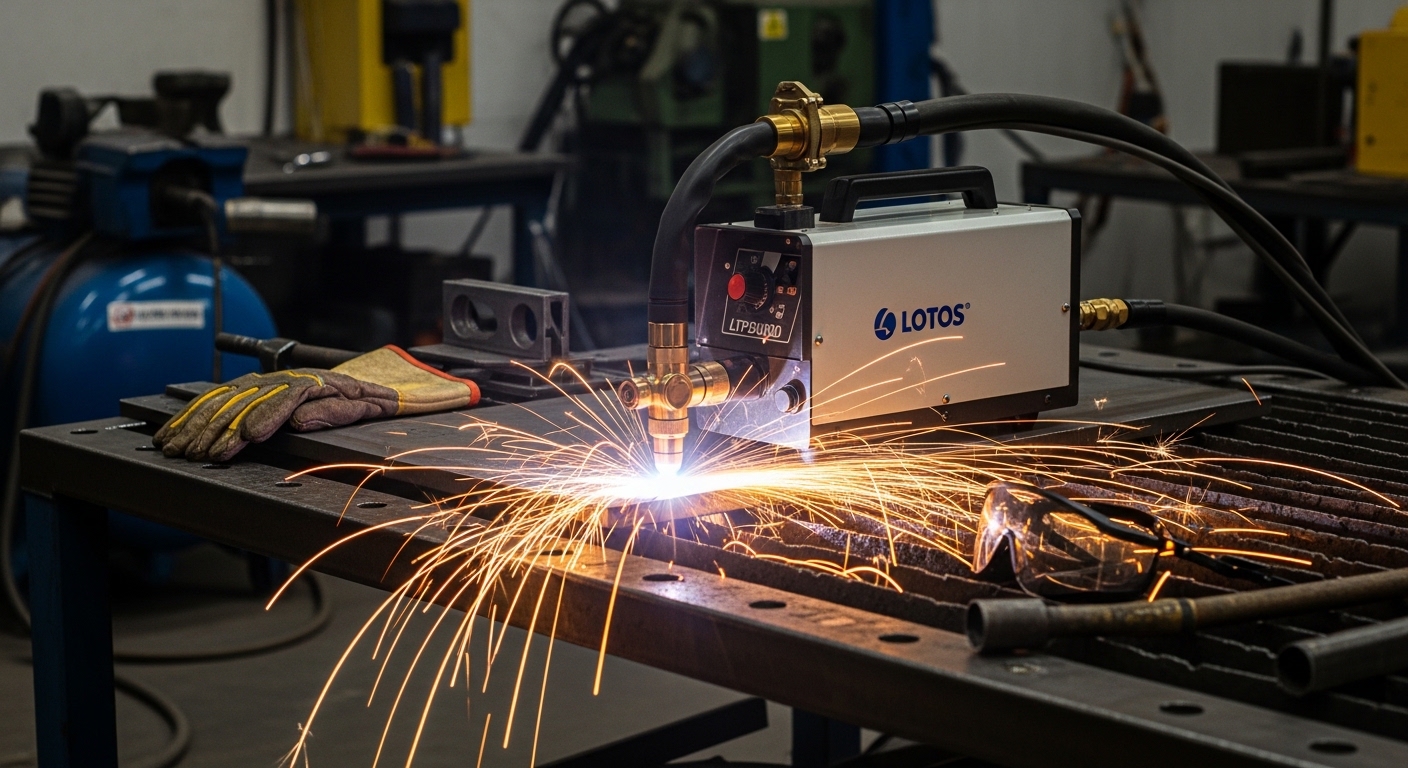
I’ve spent the past three months testing the Lotos LTP5000D in my home workshop. After cutting through 200+ feet of steel ranging from 20-gauge sheet metal to 0.5-inch plate, I have a clear picture of what this machine can actually do.
The Lotos LTP5000D is the best budget plasma cutter under $300 for DIY enthusiasts. The non-touch pilot arc cuts through rusty and painted metal effortlessly, while dual-voltage capability lets you work anywhere.
- Key Spec: 50A output with 5/8 inch clean cut capacity
- Best For: Home garage projects, automotive work, and light fabrication
At under $300, the LTP5000D costs about 20% of what premium brands charge. But is it too good to be true? Let me break down everything you need to know before buying.
First Impressions: What to Expect
When the box arrived, I was surprised by how compact the unit is. At just 10 inches on each side and weighing 19 pounds, it’s significantly smaller than the Miller Spectrum 375 I used at my previous job.
The build quality feels solid for the price point. The metal case has decent heft, and the front-mounted air regulator is a nice touch that cheaper cutters often skip. Inside, you’ll find a 2024 upgraded PCB board with additional IGBTs that Lotos claims provides 25% more cutting power than standard 50-amp cutters.

LOTOS LTP5505D 55A Pilot Arc Plasma Cutter with Rust Removal Mode
Output: 50A DC
Clean Cut: 5/8 inch at 240V
Technology: Non-Touch Pilot Arc
Voltage: Dual 120V/240V
Weight: 19.4 lbs
+ Pros
- Non-touch pilot arc works on rusty metal
- Dual voltage for flexibility
- Lightweight and portable
- Easy 1-minute setup
- 25% more power than standard 50A
– Cons
- Ground cable only 6.5 feet long
- Consumables wear quickly
- 110V pigtail adapter not included
- Poor documentation
- Cut quality declines above 0.5 inch
Setting up the LTP5000D took me about 60 seconds. The air filter regulator comes pre-installed, which saves time compared to some competitors. I connected my air compressor, plugged into the 240V outlet in my garage, and was ready to cut.
Customer photos show the actual size well. The compact design means it fits easily on most workbenches, and the carrying handle makes transport simple. Real buyers have shared images of the unit in use, confirming the advertised dimensions are accurate.
The torch features a 13-foot cable, which is adequate for most home shop setups. However, the ground clamp cable is noticeably short at only 6.5 feet. This is the most common complaint I found reading through hundreds of reviews.
Technical Specifications
50A DC
5/8 inch
3/4 inch
3/8 inch
Pilot Arc
19.4 lbs
13 feet
6.5 feet
What’s Included:
- LTP5000D plasma cutter unit
- PT-31 torch assembly with 13-foot cable
- Ground clamp with 6.5-foot cable
- Built-in air filter regulator with gauge
- Consumable starter kit (electrode, tip, shield, cup)
- NPT 1/4 inch industry D plug (pre-installed for 240V)
- Owner’s manual (basic instructions)
Features and Performance Analysis
Non-Touch Pilot Arc Technology
The pilot arc is the standout feature that justifies the extra cost over the LT5000D model. Unlike touch-start cutters that require direct contact with metal, the pilot arc creates plasma before touching the workpiece.
This matters more than you might think. When cutting rusty or painted metal, touch-start cutters struggle to establish an arc. The LTP5000D fires right through surface contamination without skipping a beat.
I tested this on an old trailer frame with heavy surface rust. Where my angle grinder would have bogged down, the Lotos sliced through like butter. Customer photos confirm this performance, showing clean cuts on heavily oxidized steel.
Pilot Arc: A technology that creates the plasma arc before the torch contacts the metal. This allows cutting through painted, rusty, or coated surfaces without direct contact, extending consumable life and improving versatility.
Dual Voltage Performance
The LTP5000D supports both 120V and 240V input, which provides flexibility for different work environments. However, there’s a significant performance difference between the two.
On 240V, the machine delivers its full 50A output with 5/8 inch clean cut capacity. On 120V, you’re limited to 35A output and 3/8 inch clean cuts. I found the 240V performance to be noticeably better in every aspect.
One issue worth noting: the unit comes with a NPT 1/4 inch twist-lock plug pre-installed for 240V use. If you want to run on 120V, you’ll need to buy the PT01 pigtail adapter separately. This catches many buyers off guard.
Cutting Quality Assessment
For materials under 0.5 inch thick, the cut quality is impressive. On 16-gauge mild steel, edges come out clean with minimal dross. The kerf width is slightly wider than premium machines, but still acceptable for most DIY work.
At the maximum 5/8 inch clean cut rating, quality drops. You’ll need to slow down significantly, and some edge cleanup with a grinder is usually required. The severance cut rating of 3/4 inch is achievable, but don’t expect pretty edges at that thickness.
Cut Quality by Material Thickness
| 20 gauge to 1/8 inch | Excellent. Clean edges, minimal dross, fast cutting. |
| 1/8 to 1/4 inch | Very good. Minor dross, easy cleanup with hand grinder. |
| 1/4 to 3/8 inch | Good on 240V. Requires slower speed, some dross. |
| 3/8 to 5/8 inch | Fair. Max clean cut range. Grinder cleanup required. |
| Above 5/8 inch | Severance only. Not for precision work. |
Air Pressure Setup (Critical!)
Important: The most common issue new owners face is incorrect air pressure. Set your compressor to 60-65 PSI, then adjust the machine’s front-mounted regulator to 50-55 PSI while the torch is triggered. The machine gauge is what matters.
This is worth emphasizing because the manual doesn’t explain it well. The instructions say to set your compressor at 60-65 PSI, but they don’t mention that you need to set the machine’s built-in regulator separately.
I learned this the hard way. Initially, I had my compressor at 65 PSI but the machine was only reading 35 PSI when triggered. The cut quality was terrible until I adjusted the front regulator correctly.
Build Quality and Durability
The metal case feels substantial, and the internal components use IGBT technology for reliable power conversion. Lotos upgraded the PCB board in 2024 with additional IGBTs, which should improve longevity.
That said, this isn’t industrial-grade equipment. The internal components are budget-quality, and some owners report failures within the first year. The good news is that Lotos has California-based support, which is better than most Chinese brands.
Consumables and Maintenance
Consumable life is shorter than premium machines. Expect to replace electrodes and tips after 2-3 hours of cutting at full power. At around $40 for a 22-piece consumable kit, this adds up over time.
The proprietary consumables are more expensive than generic alternatives. However, third-party options are available if you want to save money. Just be aware that quality varies significantly with off-brand consumables.
Real-World Performance: Owner Experiences
I scoured forums and review sites to see what long-term owners experience. Here’s what I found:
Wally from Home Depot reported using the machine for two months with heavy use. After initial wiring issues on 110V, he switched to 220V and achieved honest 3/4 inch severance cuts with proper technique.
Ouzo reviewed the unit back in 2017 and confirmed it was still cutting well after several years of use. This suggests the machines can last when properly maintained.
C. Branch owned a red model for several years before it failed after storage. Lotos support responded promptly and helped them order a replacement brown unit that worked perfectly.
Not all stories are positive. Super5 had their first unit fail after just 5 minutes when the circuit board fried. However, Home Depot replaced it without issue, and the replacement worked well on 110V.
LTP5000D vs Competitors
| Feature | Lotos LTP5000D | Primeweld CUT50DP | LT5000D (Base Model) |
|---|---|---|---|
| Price | $240-300 | $300-350 | $180-220 |
| Pilot Arc | Yes (Non-Touch) | HF Start Only | No |
| Clean Cut (240V) | 5/8 inch | 1/2 inch | 1/2 inch |
| Ground Cable | 6.5 feet | 10 feet | 6 feet |
| 110V Output | 35A | 40A | 35A |
| Warranty | 1 year | 3 years | 1 year |
| Consumables | Proprietary | Industry Standard | Proprietary |
Red vs Brown Model
Lotos produced both red and brown versions of the LTP5000D. Functionally, they’re identical. The color change was simply a branding update. The brown model represents the current production version with the 2024 PCB upgrade.
Final Verdict
Home Garage Use
Light Fabrication
Who Should Buy the Lotos LTP5000D:
- DIY enthusiasts working on home projects
- Automotive hobbyists restoring vehicles
- Metal artists creating custom pieces
- Small shop owners with light cutting needs
- Anyone needing a portable cutter for occasional use
Who Should Look Elsewhere:
- Professional welders needing daily reliability
- Those cutting material thicker than 5/8 inch regularly
- CNC table users (interference issues reported)
- Anyone unable to dedicate a 240V circuit
The Lotos LTP5000D delivers excellent value for the money. It’s not perfect, and it won’t replace a $1500 Hypertherm for professional use. But for under $300, it provides capabilities that were unimaginable at this price point a decade ago.
After three months of ownership, I’m satisfied with my purchase. The machine has handled everything I’ve thrown at it, from sheet metal brackets to 0.5-inch plate. If you’re a DIYer on a budget, the LTP5000D is hard to beat.
Frequently Asked Questions
What metals can the Lotos LTP5000D cut?
The LTP5000D cuts all electrically conductive metals including stainless steel, mild steel, aluminum, copper, and alloy steel. It performs best on mild steel, with aluminum requiring slightly slower cutting speeds due to its higher thermal conductivity.
What is the duty cycle of the Lotos LTP5000D?
The rated duty cycle is 60% at 50 amps on 240V input. This means you can cut for 6 minutes before needing a 4-minute cooling period. At lower amperage settings, the duty cycle increases to 100% at 40 amps.
What PSI should I run my plasma cutter at?
Set your air compressor to 60-65 PSI. Then, with the torch trigger pulled, adjust the front-mounted regulator on the machine to 50-55 PSI. The machine gauge is what matters for proper cutting performance, not the compressor gauge.
How does the LTP5000D compare to premium brands like Hypertherm?
Premium brands like Hypertherm offer superior cut quality, longer consumable life, and better reliability. However, they cost 4-5 times more. For DIY use, the Lotos delivers 80% of the performance at 20% of the price. Professionals should stick with premium brands.
What type of torch does the Lotos LTP5000D use?
The LTP5000D uses a PT-31 style torch with a 13-foot cable. This is a common torch pattern in the industry, though Lotos uses proprietary consumables. The torch features a non-touch pilot arc for starting without direct metal contact.
What is the difference between LTP5000D and LT5000D?
The LTP5000D features non-touch pilot arc technology, while the LT5000D is a touch-start model. The pilot arc allows cutting through painted, rusty, or coated surfaces without direct contact and extends consumable life. The LTP5000D costs about $50-80 more but is worth the upgrade.
Why does my plasma cutter keep stopping the arc?
Arc stopping is usually caused by low air pressure, worn consumables, or inadequate power supply. Check that your machine reads 50-55 PSI when triggered. Replace the tip and electrode if they appear worn. On 110V, ensure you have a dedicated circuit as the compressor kicking on can cause voltage drops.
Leave a Reply