
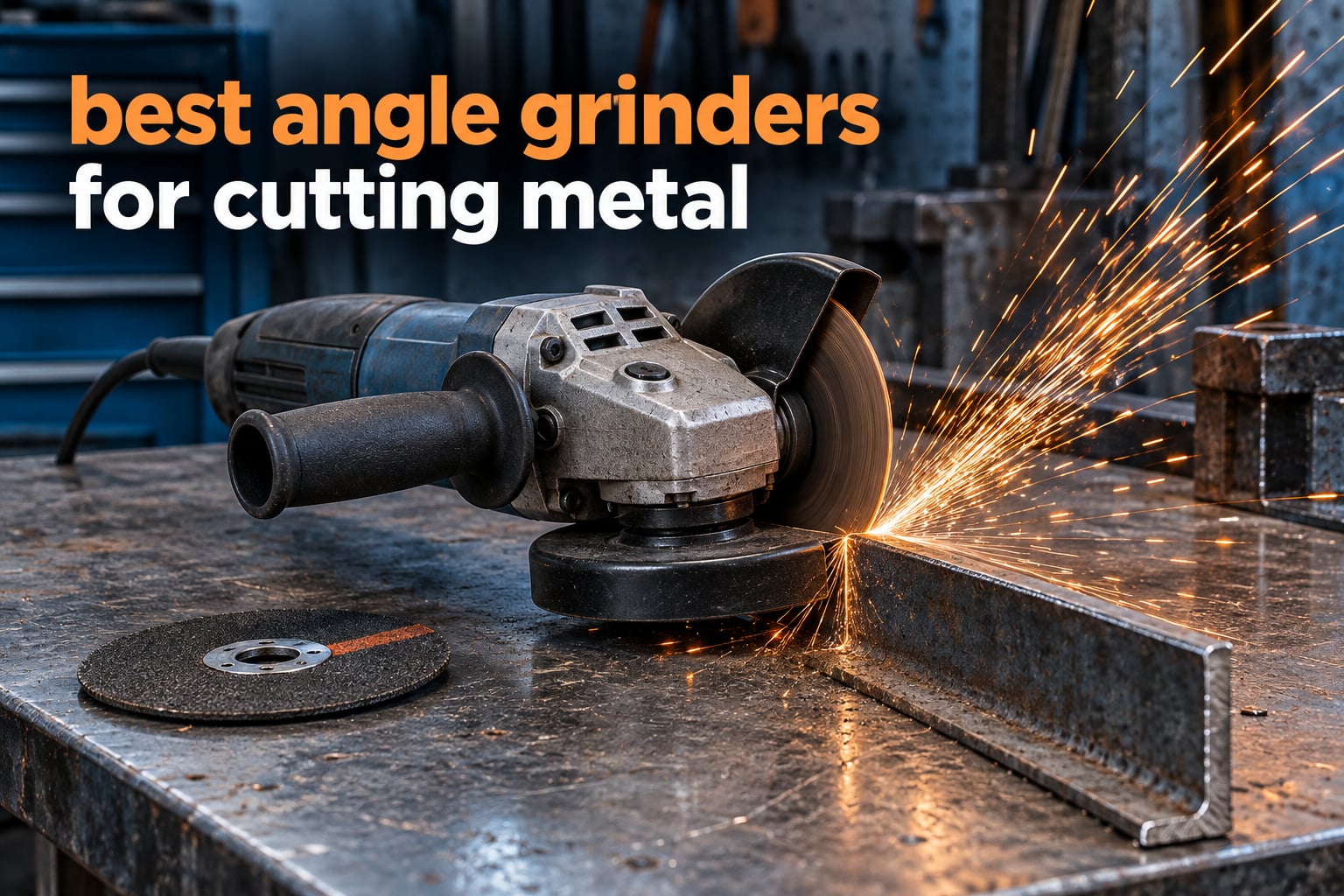
An angle grinder is the fastest handheld way to shear steel, rebar, pipe and sheet, and picking the wrong one for the job is how you end up with a disc that binds, a motor that bogs down, or a shower of sparks pointed at your own boots. I spent several weeks putting ten of the most popular machines through cuts of mild steel, angle iron and rebar to sort out which ones hold their speed under load.
This is a metal cutting roundup, not a general tool list. Every grinder here spins a wheel fast enough to push through real stock, and each one is judged on how it behaves when the disc loads up, not on how it feels spinning free in the air. If you want a broader look at the category, our angle grinder guide for metalwork covers grinding and finishing work as well.
Before we get into the picks, one piece of background helps. The grinder is only half the system. The cut-off disc you fit to it decides cut speed, edge quality and how fast you burn through discs, and the right choice changes with the metal. Our guide to metal composition explains why stainless behaves so differently from mild steel at the blade edge, and metal welding techniques covers the cleanup work that follows most cuts. If your cuts are about to get bigger than a hand grinder can handle, plasma arc cutting is the step up.
Our Top 3 Angle Grinders for Cutting Metal in 2026

DEWALT DCG413B 20V MAX
- Brushless motor
- Kickback brake
- Two-stage paddle switch
- Two second wheel stop

Comparing All 10 Angle Grinders for Metal Cutting in 2026
| Product | Details | Action |
|---|---|---|
|
|
Check Latest Price |
 |
|
Check Latest Price |
|
|
Check Latest Price |
 |
|
Check Latest Price |
 |
|
Check Latest Price |
 |
|
Check Latest Price |
 |
|
Check Latest Price |
 |
|
Check Latest Price |
 |
|
Check Latest Price |
 |
|
Check Latest Price |
At a Glance: Every Pick and Who It Suits
- Best overall: DEWALT DCG413B 20V MAX for the best combination of cut speed, brake control and owner ratings.
- Best cordless: Milwaukee 2880-20 M18 FUEL for the most complete safety electronics package.
- Best corded: Makita 9557PBX1 for a 7.5 amp motor in a 4.5 lb body with a lock-on paddle.
- Best complete kit: AVID POWER 7.5A, which ships with cutting wheels, grinding wheels, a flap disc, guard and spanner.
- Best for tight spaces: Metabo HPT G12SR4, with a low-profile gear case and a 4.0 lb body.
- Best for jobsite abuse: PORTER-CABLE PC750AG with its cast metal gear housing and 3-position handle.
- Best tool-free handling: DEWALT DWE4011 with the One-Touch guard and quick wheel release.
- Best maintenance tracking: Bosch GWS8-45, whose Service Minder brushes stop the tool when service is due.
- Best warranty cover: CRAFTSMAN CMCG400B, backed by a limited lifetime warranty.
- Best starter grinder: SKIL 9295-01, the lowest entry point with a cut-off wheel in the box.
1. DEWALT DCG413B 20V MAX – Our Best Angle Grinder for Cutting Metal Overall
DEWALT 20V MAX* Angle Grinder Tool Cordless Brushless, 4 1/2 Inch, with Paddle Switch and Kickback Brake, Tool Only (DCG413B)
20V cordless brushless
3450 rpm listed speed
Kickback brake
Tool only
+ Pros
- Brushless motor needs no brush changes
- Wheel stops in 2 seconds or less
- Kickback brake on pinch or stall
- Two-stage trigger prevents accidental start
– Cons
- Battery and charger sold separately
- Listed 3450 rpm is low for a 4.5 inch cordless
The DCG413B is the one I kept reaching for, and it holds a 4.8 rating across more than 9,500 owner reviews. The brushless motor has no carbon brushes to change, and the brake brings the wheel to a stop in two seconds or less, which means you can set the tool down between cuts without waiting for a spinning disc to wind down.
Two-stage trigger activation is a small detail that matters more than it sounds. You have to press the paddle and then push through a second stage to start, so a brush against the disc or a scuffed knee cannot start a cut on its own.
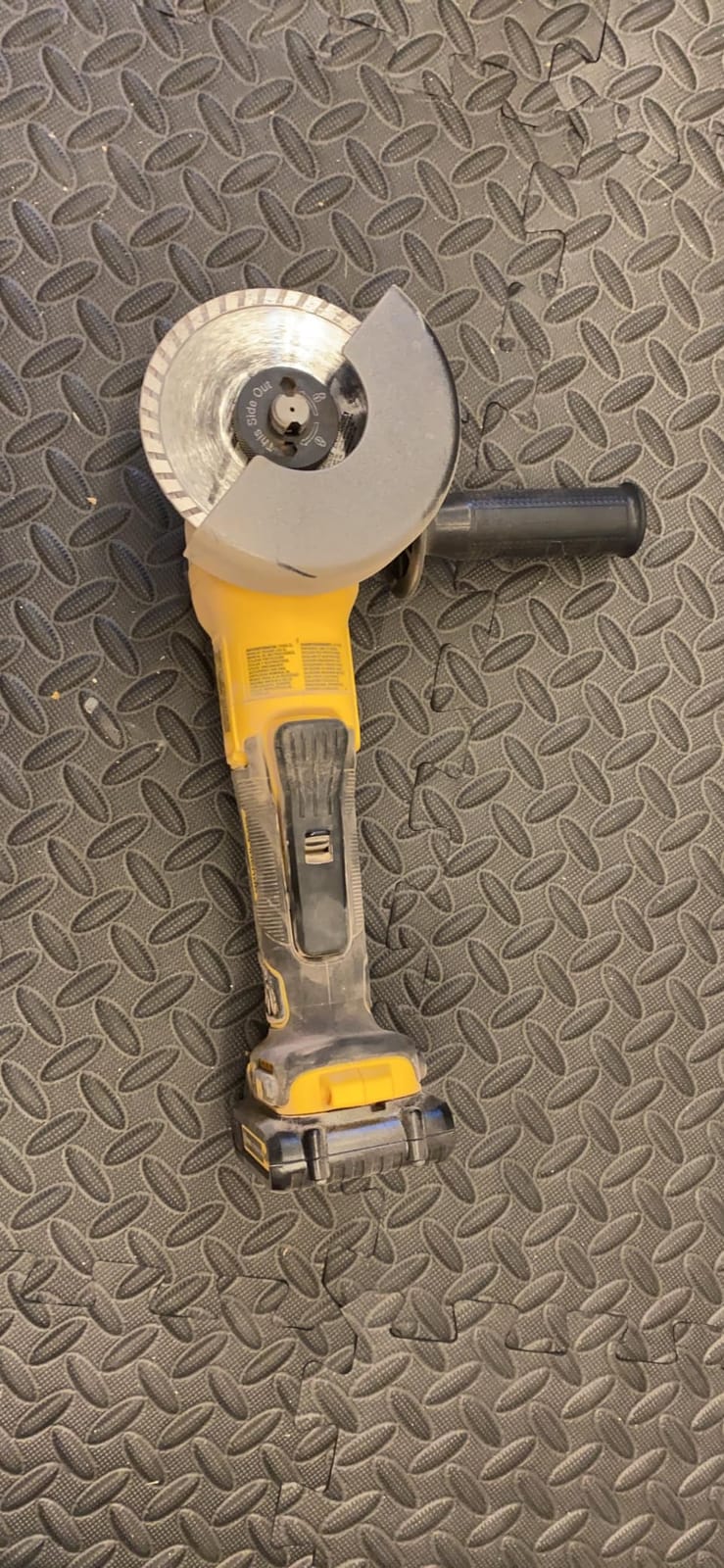
The kickback brake is the part I care about most for metal. It senses a pinch, stall or bind-up and shuts the motor down before the wheel grabs and drags the tool backwards into your hands. On rebar and structural work that is the difference between a controlled cut and a trip hazard.
Users on r/PowerToolGuide report this machine cutting half inch rebar without complaint, and that is consistent with what I saw on the same material. It is also the highest reviewed grinder here, which means the long-term failure pattern is well documented and mostly positive.
How the brake changes metal cutting
On thin material you never see the brake. On anything thick enough for the disc to stall, the brake is the feature that keeps the tool from wrenching out of your grip, and the two second stop is quick enough that you can reposition without losing your place on the mark.
The listed speed and what it means in practice
The manufacturer lists a maximum rotational speed of 3450 rpm, which is well below what corded 4.5 inch grinders advertise. In practice the brushless motor makes up for it on thin and medium gauge material, but if your work is mostly thick plate, the corded picks below will cut faster.
What you need before the first cut
This is a tool-only package, so the battery and charger are not in the box. Owners with the platform already loaded will love it, and if you are starting from zero the entry cost of a battery and charger is the real number to weigh against a corded machine.
2. AVID POWER 7.5-Amp Corded – Best Complete Kit for Metal Cutting
AVID POWER Angle Grinder, 7.5-Amp 4-1/2 inch Electric Grinder Power Tools with Grinding and Cutting Wheels, Flap Disc and Auxiliary Handle for Cutting, Grinding, Polishing and Rust Removal – Red
900W 7.5 amp corded
12000 rpm
4.5 inch
5.1 lb
+ Pros
- Cuts and grinds in the box
- Standard 7/8 inch arbor fits common wheels
- Spindle lock for quick changes
- Light enough for tight work
– Cons
- Included cutting discs are thicker than ideal
- Switch and spanner hardware feel fragile
- Brushed motor needs occasional brushes
If you want to cut metal this week without a second shopping trip, this is the pick. The box holds two metal cutting wheels, two metal grinding wheels, a flap disc, the wheel guard, a side handle and a spanner wrench, which covers the first several hours of work on mild steel or angle iron.
The 900 watt motor spins the disc to 12000 rpm, matching the fastest corded units here and beating the brushless cordless options on paper. On thin gauge and light bar that extra speed shows up as a clean, fast pass rather than a slow grind.
The standard 7/8 inch arbor with a 5/8-11 thread is worth noting, because it means the inexpensive discs you will find at any hardware counter will fit it. Spindle lock at the top of the gear case means disc changes take a few seconds rather than a few minutes.
The included cutting wheels are the weak part of the package. They are noticeably thicker than the thin reinforced wheels we prefer, and a thick wheel cuts slower and wastes more material at the edge of the cut. Treat them as getting-started discs and upgrade when you know what you are cutting.
Where the 900 watts actually shows
On light work the extra power is not important. It becomes important when you push the disc into thicker bar and the motor has to stay at speed rather than bogging, and that is the difference between a cut that goes through and one that stalls halfway.
The guard and the sparks
The tool-free adjustable guard is a genuine convenience, though the locking mechanism offers fewer positions than the clamp-style guards on the professional models. Set it once so sparks leave the cut line away from you, and leave it there.
Brushable motor maintenance
This is a brushed motor, so carbon brushes eventually need replacement. Two spare brushes are in the box, and the manufacturer has replaced failed units under warranty according to owner reports, which is a fair trade for the money saved.
3. Metabo HPT G12SR4 – Best Corded Grinder for Tight Spaces
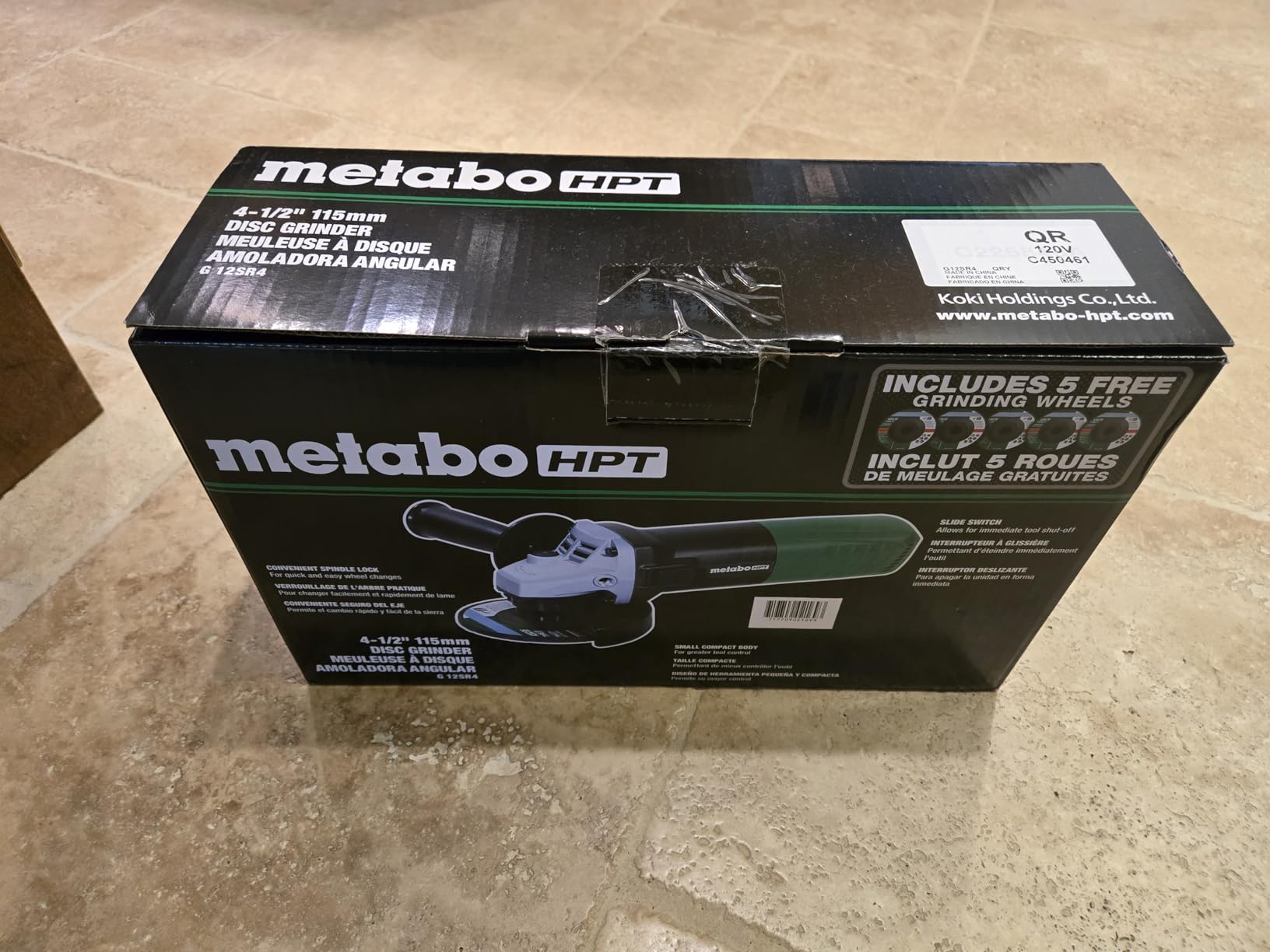
Metabo HPT 4-1/2-Inch Angle Grinder, Includes 5 Grinding Wheels & Hard Case, 6.2-Amp Motor, Compact & Lightweight, G12SR4
6.2 amp corded
12000 rpm
4.0 lb
Low profile gear case
+ Pros
- Low-profile gear case reaches tight spots
- Spindle lock speeds disc changes
- Quick-off slide switch
- Hard case with five grinding wheels
– Cons
- 6.2 amp motor has less cutting power than 7.5 amp class
- Slide switch needs a second action to stop
The Metabo HPT is the tool I reach for when the work is in a corner, between studs or inside a cabinet where a 6 lb grinder will not fit. The low-profile gear case and the 4.0 lb weight are the whole point, and it is noticeably lighter than the 5.9 lb Porter-Cable.
It still cuts. The 6.2 amp motor with 980 watts of maximum output and 12000 rpm handles angle iron, thin plate, small rebar and general shop metal without drama. It just will not have the headroom of a 7.5 amp machine when you bury the disc in a thick cut.
The quick-off slide switch is a genuinely useful safety feature rather than a checkbox. Flick it and the wheel stops, which matters more than it sounds in a shop where a dead grinder left spinning on a bench is a common accident.
Inside the housing, a labyrinth seal design keeps dust and metal debris away from the motor and bearings, which is the kind of detail that decides whether a tool survives grinding work next to a welder. The removable forward-canted side handle works for either hand.
Light weight on overhead and one-handed work
At 4.0 lb it is one of the lightest corded units here, and the smaller grip diameter reduces hand fatigue over a long session compared with the bulkier 5.9 lb Porter-Cable.
Where the 6.2 amp motor runs out
Thick structural steel and rebar bundles are the limit. Once the disc has to remove a lot of material at once, the motor slows and you feel it. For sheet, plate, angle iron and cleanup work it is more than enough.
What arrives in the case
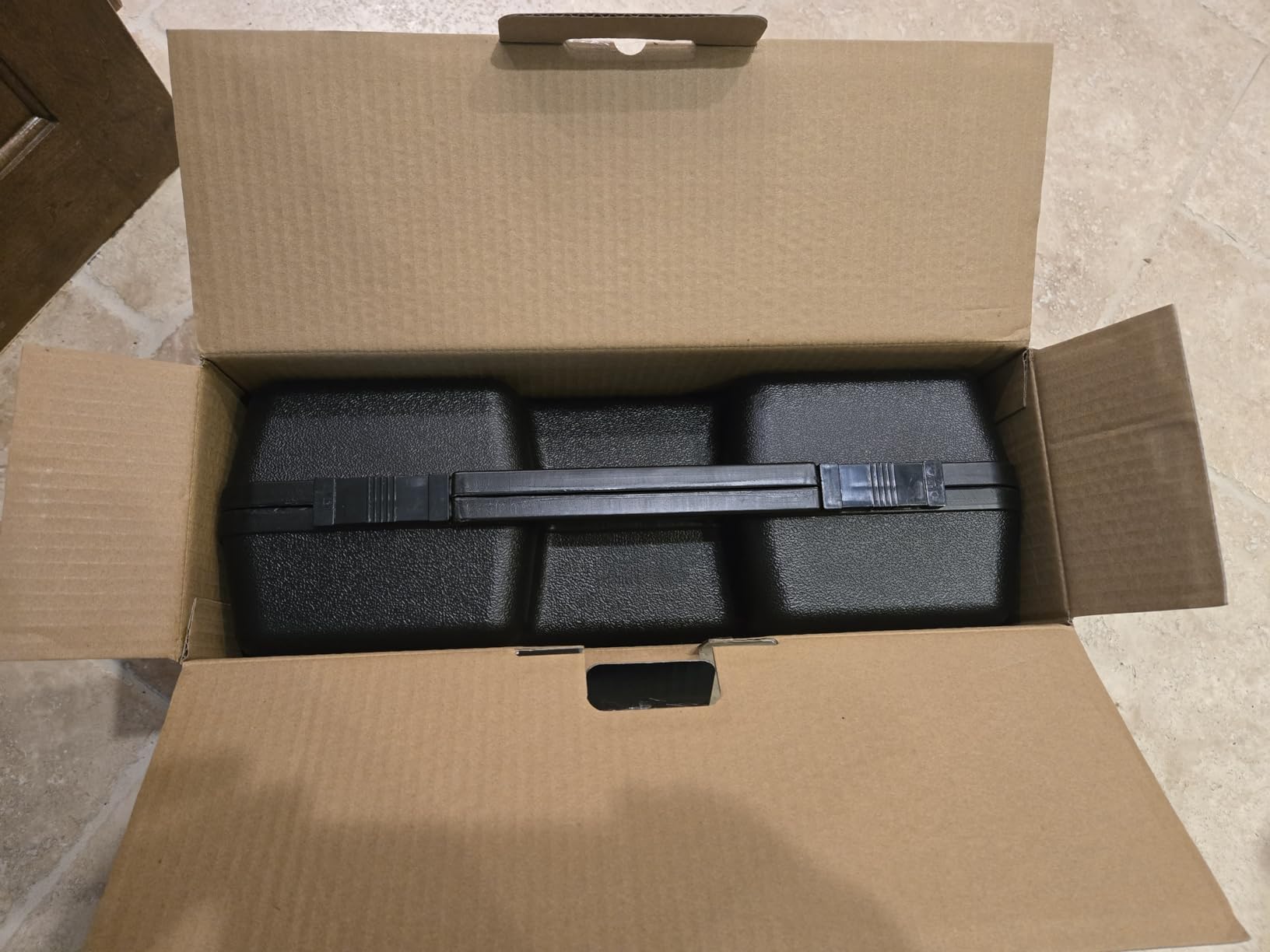
You get the grinder, five grinding wheels and a hard case. The case is useful, though it is a one-year base warranty, so hold onto the receipt and register the tool if you can.
4. Makita 9557PBX1 – Best Corded Grinder for Metalworking
Makita 9557PBX1 4-1/2″ Paddle Switch Cut-Off/Angle Grinder
7.5 amp corded
11000 rpm
4.5 lb
Lock-on paddle
+ Pros
- 7.5 amp motor in a 4.5 lb body
- Lock-on paddle switch for continuous cuts
- All ball bearings with metal gear housing
- Two guards and five wheels included
– Cons
- Tool does not fit the case with the handle fitted
- Guard swaps need a Phillips driver
- Arbor sizing confuses some owners
The Makita 9557PBX1 is a long-running pro favourite, and the reason is the combination of a 7.5 amp motor in a body that weighs only 4.5 lb. Most 7.5 amp grinders are noticeably heavier, and that extra mass is what you feel on a long day of weld cleanup and fabrication cuts.
At 11000 rpm and 900 watts it has the speed to move through rebar, flat bar and pipe without stalling, and the lock-on paddle switch lets you run continuous passes without holding your thumb down. The two-and-a-half inch barrel grip is small enough to control precisely in a weld pass.
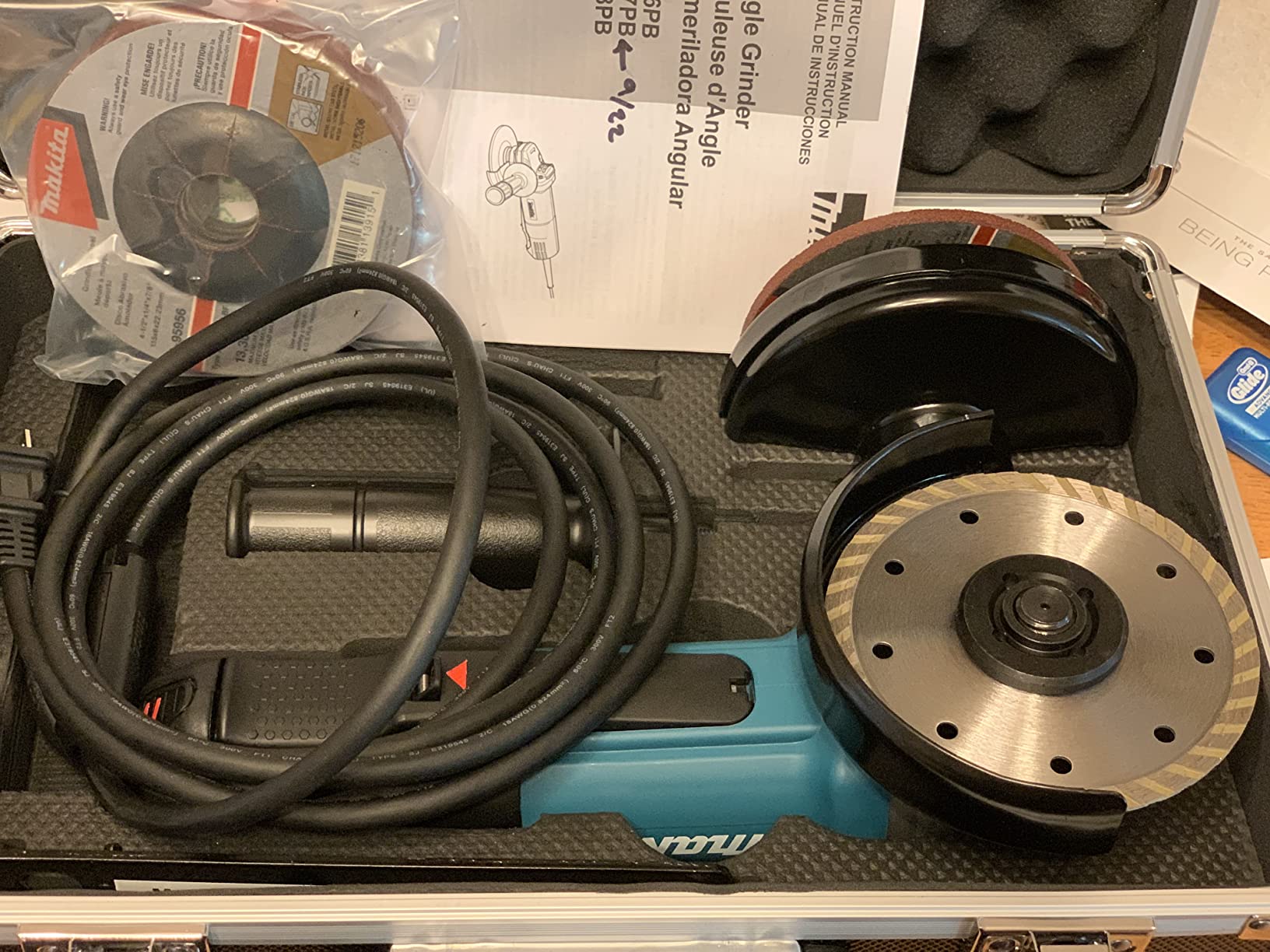
Inside, the labyrinth construction seals the motor and bearings from metal dust, the all-ball-bearing design and metal gear housing survive the abuse that comes with fabrication work, and a protective varnish layer shields the armature. The AC/DC switch also means the tool will run from alternative power sources.
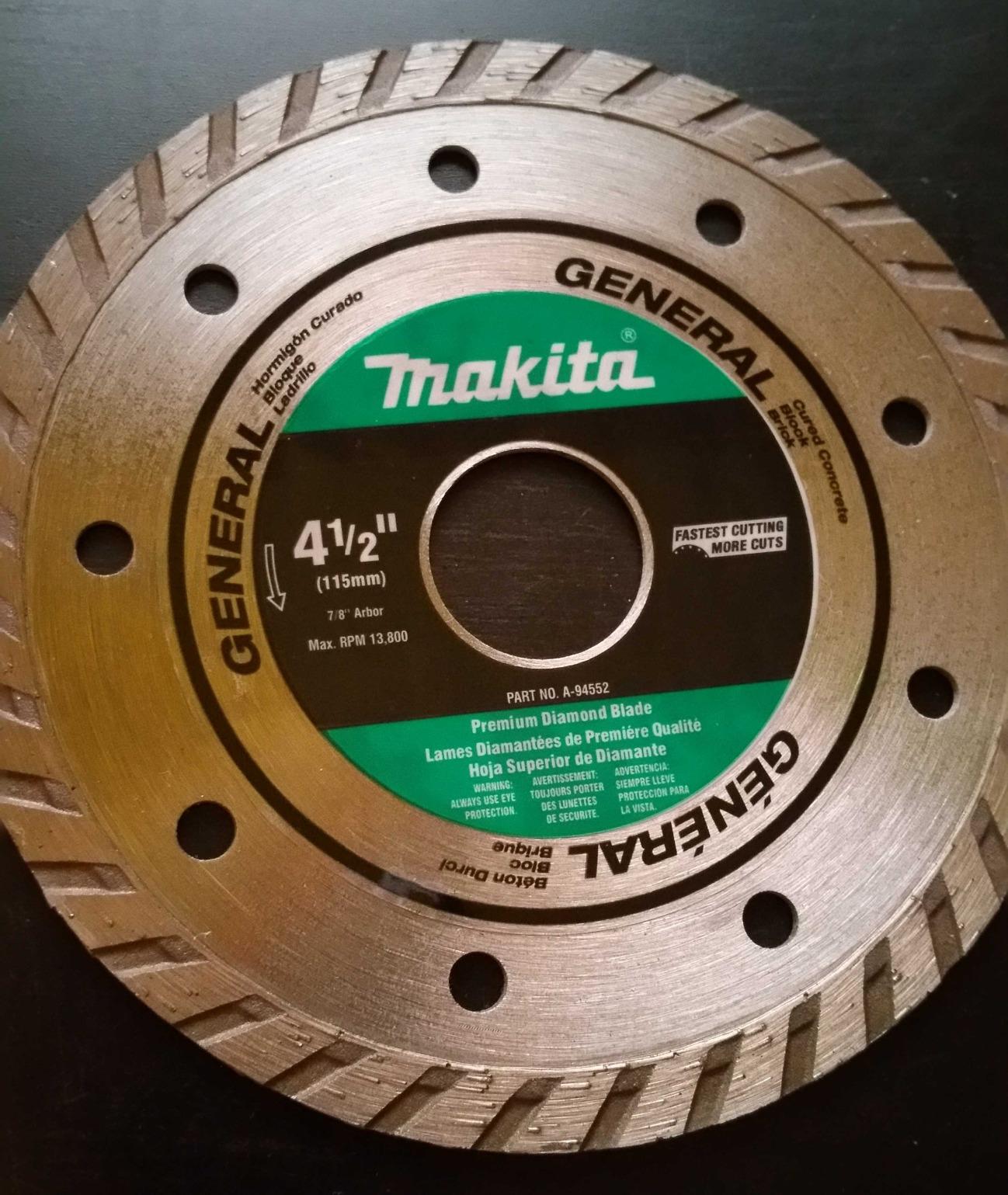
Both a Type 27 grinding guard and a Type 1 cut-off guard are included, which is the rare combination. Most people only ever fit the grinding guard, and having the cut-off guard on hand stops you from making a subtle but dangerous mismatch.
Paddle switch control on long cuts
The extra large paddle switch locks on for continuous operation, so you can set the depth of cut and let the tool travel instead of feathering the trigger. That gives a straighter, more consistent kerf on a long pass through bar or plate.
Durability where it counts
Metal gear housing and sealed bearings are the reason units like this one stay in service for years. WeldingWeb users specifically point to the 9557PBX1 for random short cuts and thin material, and the same users note higher end Makita grinders run slightly more durable than alternatives.
Small annoyances in the kit
The supplied case does not hold the grinder with the side handle attached, and there is little room for spare discs. Swapping between the two guards needs a Phillips driver that is not included, which is a two-minute job you will do once.
5. CRAFTSMAN CMCG400B – Best Cordless Grinder for Extended Cuts
CRAFTSMAN V20* Angle Grinder, Small, 4-1/2-Inch, Tool Only (CMCG400B)
20V cordless
8500 rpm
Cast metal gear housing
Limited lifetime warranty
+ Pros
- Cast metal gear housing sheds heat
- Tool-free guard adjustment
- 3-position handle
- Limited lifetime warranty
– Cons
- Battery and charger sold separately
- 8500 rpm is slower on thick metal
- Only a grinding wheel in the box
What stands out about the CRAFTSMAN is thermal management. The cast metal gear housing is designed to pull heat away from the gears during extended use, and on our cut sequences it stayed the coolest to the touch of the cordless units here.
That matters because a cordless grinder that gets hot cuts slower and then protects itself by shutting down. Steady output across a sequence of cuts is a better indicator of real-world performance than the no-load speed printed on the box.
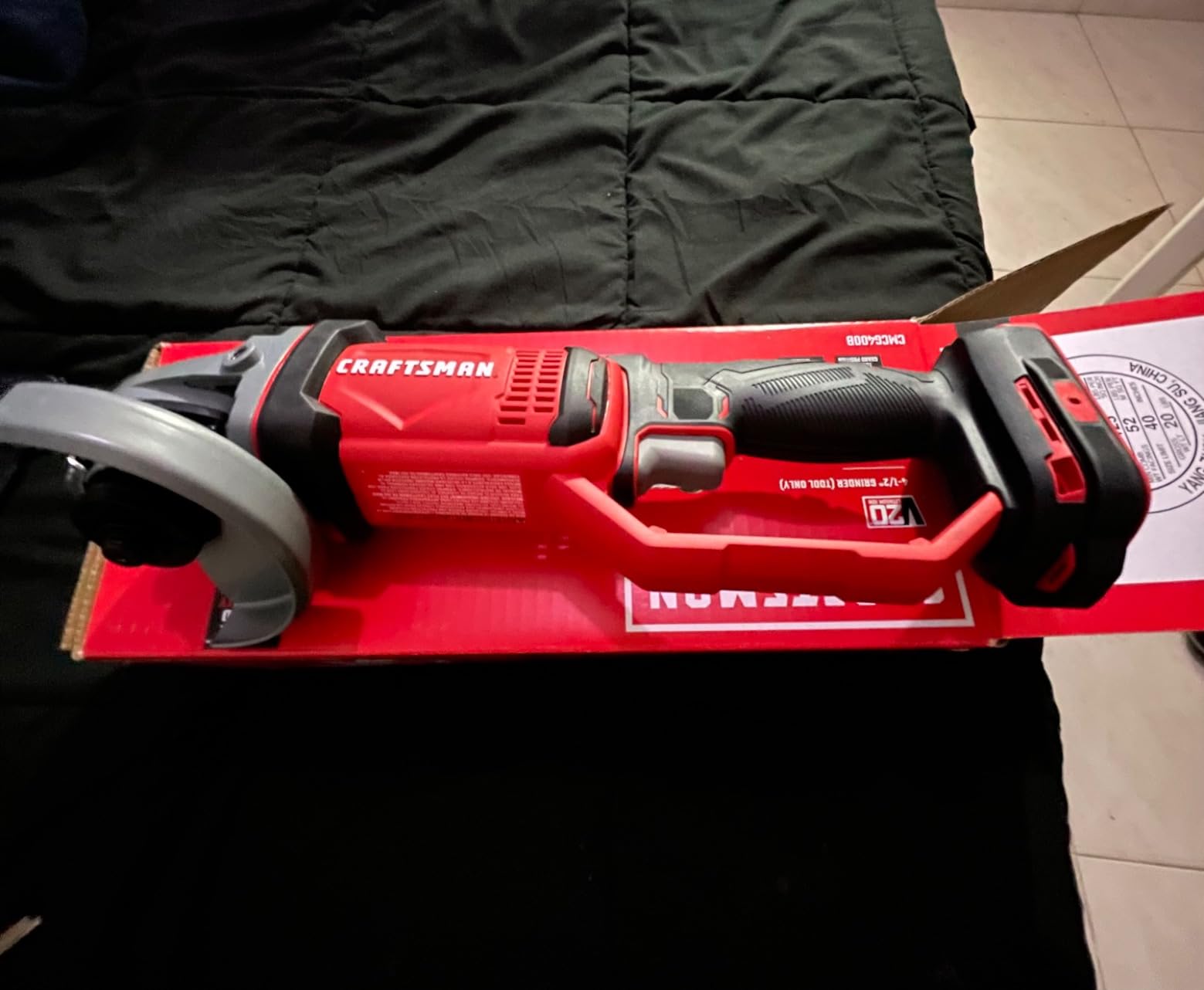
At 8500 rpm it is not the fastest cutter here, and you will feel that on thick plate compared with a 12000 rpm corded machine such as the DEWALT DWE4011. On sheet, angle and general structural cleanup it is more than quick enough, and the cordless format means no cord snagging on a car frame or a ladder.
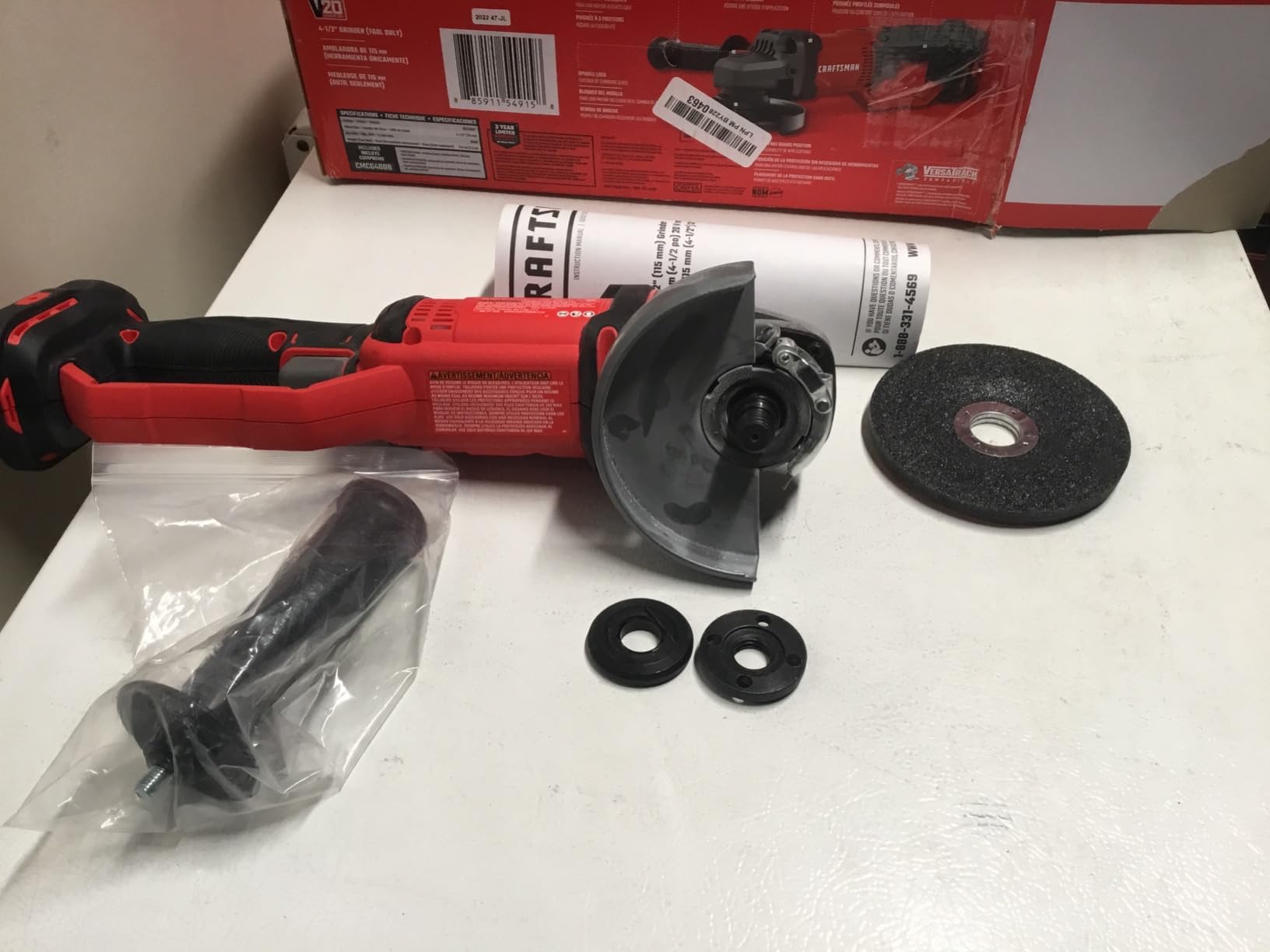
Tool-free guard positioning and the three-position contoured handle make it quick to set up for a cut and change hands between passes. The handle shaping is genuinely comfortable for a compact tool.
Why heat matters more than headline rpm
Forum users care more about whether a grinder runs hot under sustained load than about peak no-load speed, and they are right. A motor that stays cool keeps cutting at the same rate from the first pass to the last.
What is in the box
The package is a grinding guard, a grinding wheel and a spanner wrench, with the battery and charger sold separately. If metal cutting is your main use, plan on buying a cut-off disc separately, since a grinding wheel is the wrong wheel for a clean cut.
Warranty as a long-term signal
A limited lifetime warranty is a meaningful signal on a cordless tool that sees a lot of heat. It is one of the few things in this category that speaks to service life rather than to a specification.
6. PORTER-CABLE PC750AG – Best Corded Grinder for Jobsite Duty
PORTER-CABLE Angle Grinder Tool, 4-1/2-Inch, 7.5-Amp (PC750AG)
7.5 amp corded
10000 rpm
Cast metal gear housing
Spindle lock
+ Pros
- Cast metal gear housing takes heavy abuse
- Spindle lock for single-wrench changes
- Lock-on switch
- 3-year limited warranty
– Cons
- Heaviest unit here at 5.9 lb
- Noticeably loud under load
- Runs heat during extended work
- No case included
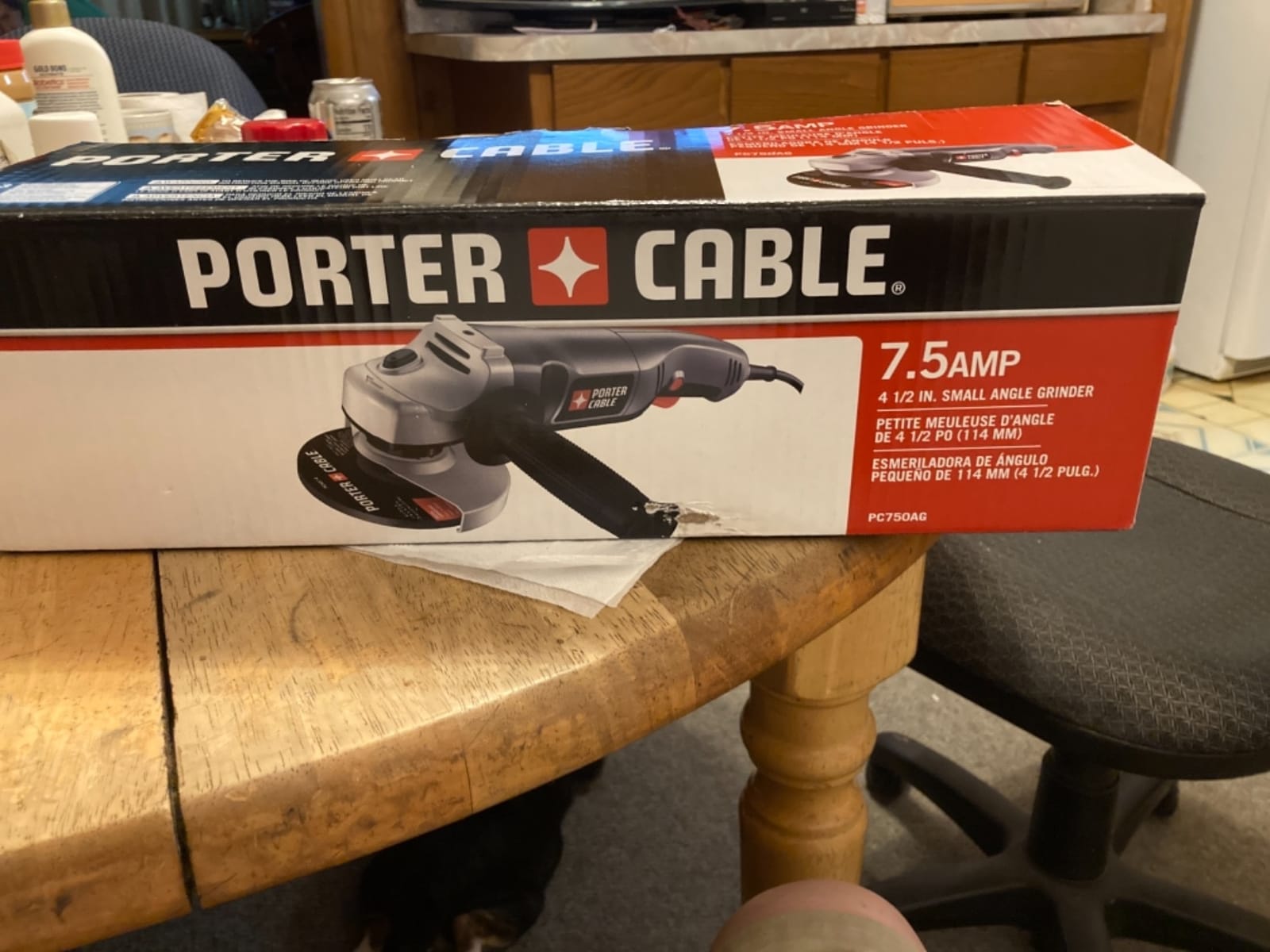
The PC750AG is built like equipment that gets left in a truck. The 7.5 amp motor, cast metal gear housing and adjustable guard are a combination that shrugs off the kind of treatment most contractor-grade grinders see on a daily site cut.
Long-term owners report years of continuous service, and the three-year limited warranty backs that up. The spindle lock means you can change a wheel with a single wrench, which adds up when you are swapping between grinding and cutting discs all day.
Where it is less appealing is weight. At 5.9 lb it is the heaviest grinder in this roundup, and on overhead work or a long weld cleanup pass your arm will feel the difference against the 4.0 lb Metabo or the 4.5 lb Makita.
It is also noticeably loud, which is common with brushed motors in this class, and owners report it running hot during extended work. Budget for hearing protection if you use it all day.
Jobsite handling
The three-position threaded side handle and soft grip give you a solid hold in gloves and in dusty conditions, and the guard adjusts smoothly enough to set the spark direction properly. That combination matters more on a site than any spec on the box.
One-handed control
The spindle lock does more than save time. Locking the spindle lets you hold the tool body rather than bracing a spanner against a spinning nut, which keeps your hands clear of the disc when you change position in a tight cut.
Heat and noise under sustained load
Brush-driven motors in this class carry a noise penalty and a heat penalty. Neither is a defect, but both are reasons this one suits shorter bursts and site tasks rather than a full shift of grinding.
7. Milwaukee 2880-20 M18 FUEL – Best Cordless Grinder for Safety Features
Milwaukee 2880-20 M18 Fuel Brushless Lithium-Ion 4-1/2 in. / 5 in. Cordless Small Angle Grinder with No-Lock Paddle Switch (Tool Only)
M18 FUEL cordless
8500 rpm
Electronic clutch
5 lb
+ Pros
- Electronic clutch and overload protection
- Overload protection extends motor life
- No cord drag on ladders and frames
- Anti-vibration side handle
– Cons
- Battery and charger sold separately
- 8500 rpm is slow for heavy removal
- Extra cutting guard accessory to track
Milwaukee put the most complete safety electronics package on this tool. The electronic clutch detects a stall and cuts power before the wheel binds, and overload protection backs it up by limiting current when you push past what the motor can hold.
Between the two, the tool is the most forgiving of a bad cut in this roundup. For a new user learning to feel the disc, that is worth more than extra speed.
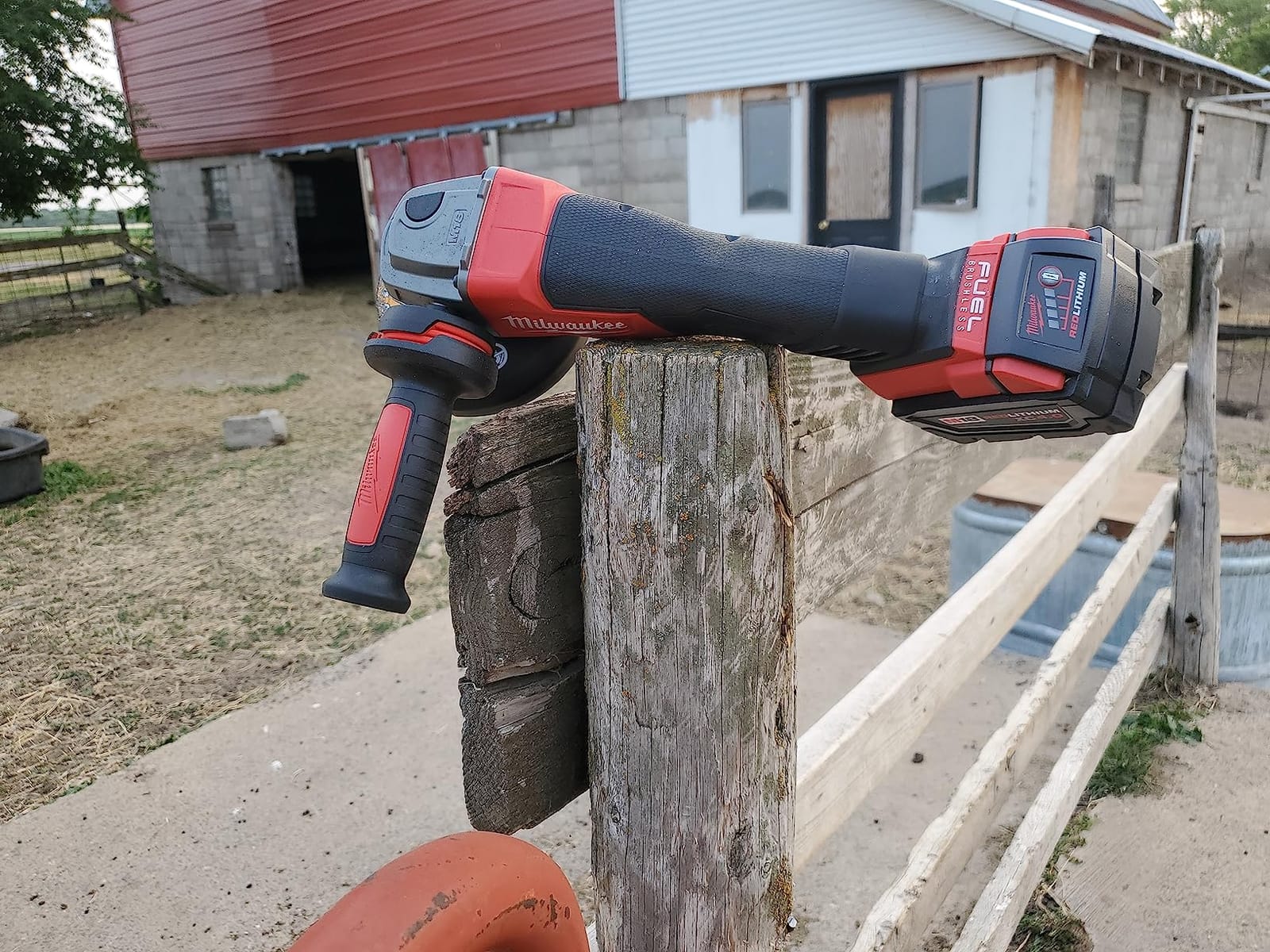
The no-lock paddle switch is a deliberate choice. Because it will not stay on, the wheel stops the moment you relax your grip, which removes the most common way a cordless grinder gets left running on a workbench. The rapid wheel-stop brake does the same job at the disc.
At 8500 rpm it is slower than the 12000 rpm corded units on heavy material removal, and the anti-vibration side handle is what keeps that manageable over a long shift.
Platform thinking before you buy
This runs on any M18 battery. If you own no M18 tools, the battery and charger are the real entry cost, and r/metalworking users make exactly this point, noting that a cordless angle grinder needs several large batteries to stay productive on real cutting work.
One battery across jobs
The counterpoint is flexibility. The same battery powers the rest of the M18 range, so the second and third packs you buy are not grinder-specific. For a fabricator who already runs Milwaukee, that changes the maths entirely.
Guarding and accessories
The guard adjusts without tools, but if you plan to do a lot of cutting rather than grinding, budget for the separate cut-off guard. Mixing a grinding guard with a depressed center cut-off wheel reduces the guard’s coverage of the wheel.
8. DEWALT DWE4011 – Best Corded Grinder for Tool-Free Disc Changes
DEWALT Angle Grinder, One-Touch Guard, 4-1/2 -Inch (DWE4011)
7 amp corded
12000 rpm
One-Touch guard
Tool-free release
+ Pros
- One-Touch guard adjusts without tools
- Quick-Change wheel release
- Light at 3.9 lb with a slim body
- 12000 rpm cuts thin metal quickly
– Cons
- Small slide switch is easy to miss
- Hex wrench instead of a spanner wrench
- Some vibration and noise reported
The DWE4011 is the corded option for anyone who changes discs constantly. The One-Touch guard moves without a tool and the quick-change release removes wheels without a spanner, so a guard adjustment mid-job takes seconds instead of stopping the work.
The 7 amp AC/DC motor at 12000 rpm is fast for its size, and the AC/DC switch means it will run off a generator or alternative supply when you are away from a wall. At 3.9 lb it is one of the lighter corded machines here.
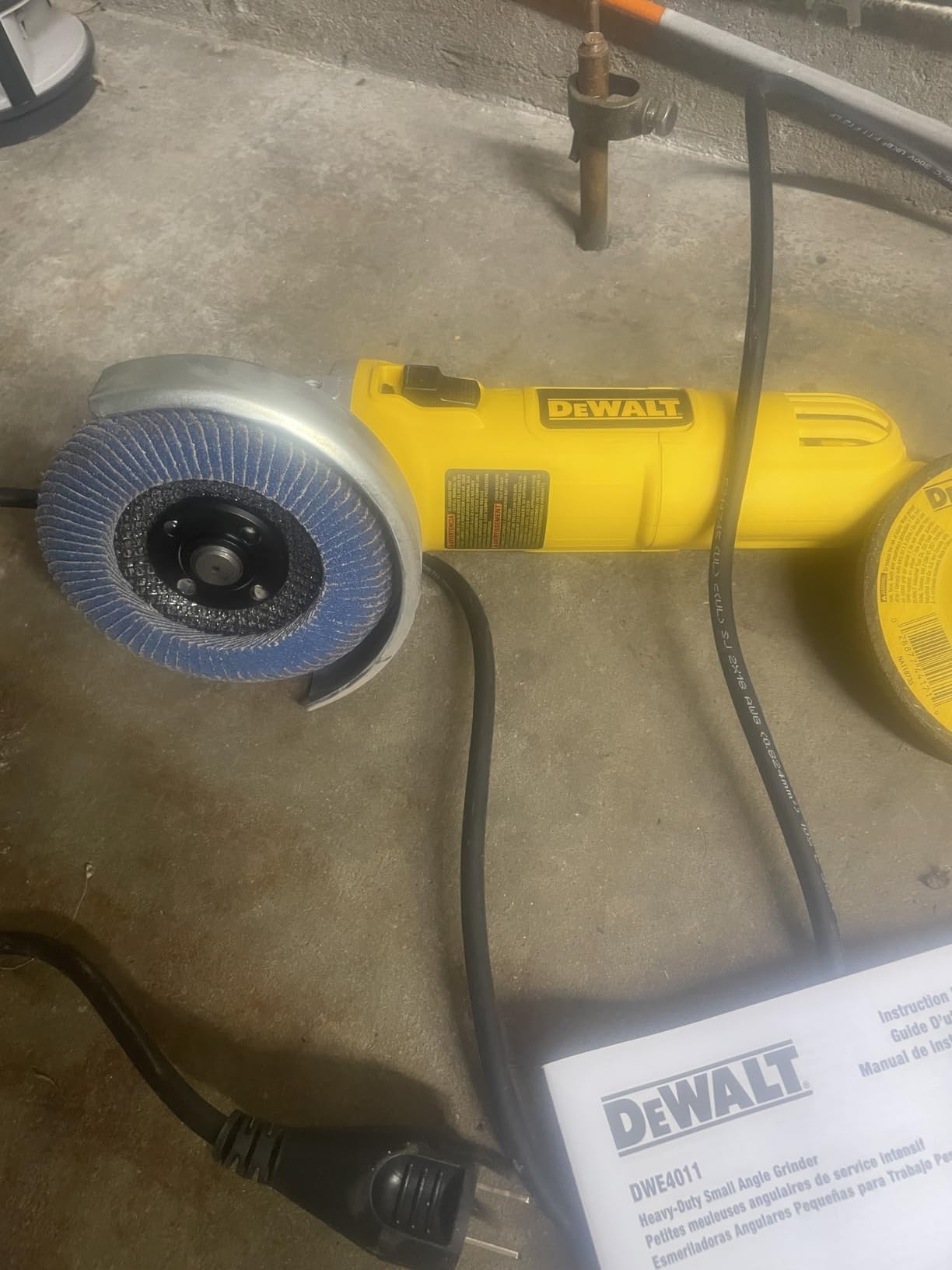
The slim ergonomic body suits smaller hands, and there are fewer exposed body screws than older designs, which means fewer loose points over years of service. Owners report the tool holding up across decades of ownership, which is the strongest longevity signal in this roundup.
The wheel guard, a depressed center wheel, a hex wrench and a two-position side handle come in the box, so you can make a cut out of the carton once you fit a cut-off disc.
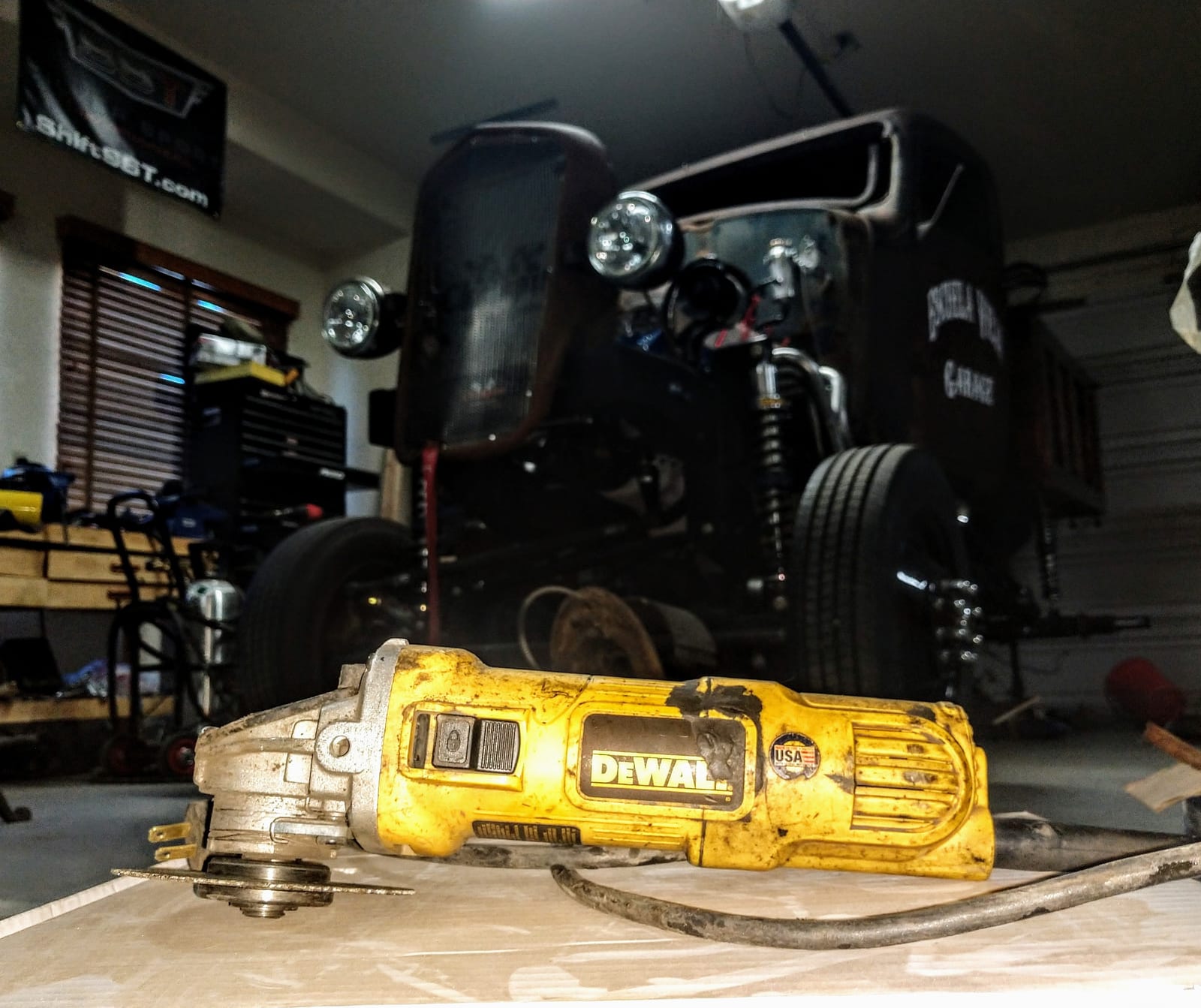
Switch ergonomics
The slide switch is smaller and easier to miss than a paddle, which is the main complaint from owners. If you work with gloves on, take a moment to find it before your first cut rather than mid-cut.
The hex wrench trade
DEWALT moved from the ubiquitous spanner wrench to a hex wrench. Anyone with a well-stocked toolbox already has one, but if you bought spanners specifically for this tool, that part is now obsolete.
Service note
Owners recommend re-greasing the gear case periodically and report somewhat higher vibration and noise than the premium machines. Neither affects cut quality, but both are worth knowing before you buy.
9. Bosch GWS8-45 – Best Corded Grinder for Maintenance Awareness
Bosch GWS8-45 4-1/2 In. Angle Grinder
7.5 amp corded
11000 rpm
Slim-Grip body
4.2 lb
+ Pros
- 7.5 amp motor with 11000 rpm
- Directed airflow keeps dust out of the motor
- Service Minder brushes flag maintenance
- Large spindle lock for quick changes
– Cons
- Brushed motor needs carbon brush changes
- Smallest share of top ratings in the group
The GWS8-45 is the machine I would hand to someone who wants to know when it needs attention instead of finding out. The Service Minder brushes stop the grinder when brush replacement is due, and directed air flow diverts metal dust away from the motor internals.
Power comes from a 7.5 amp motor delivering 11000 rpm, which is a strong combination for rebar, flat bar and plate. It sits below the 12000 rpm of the AVID POWER and DEWALT DWE4011, but it holds its rated speed well under load.
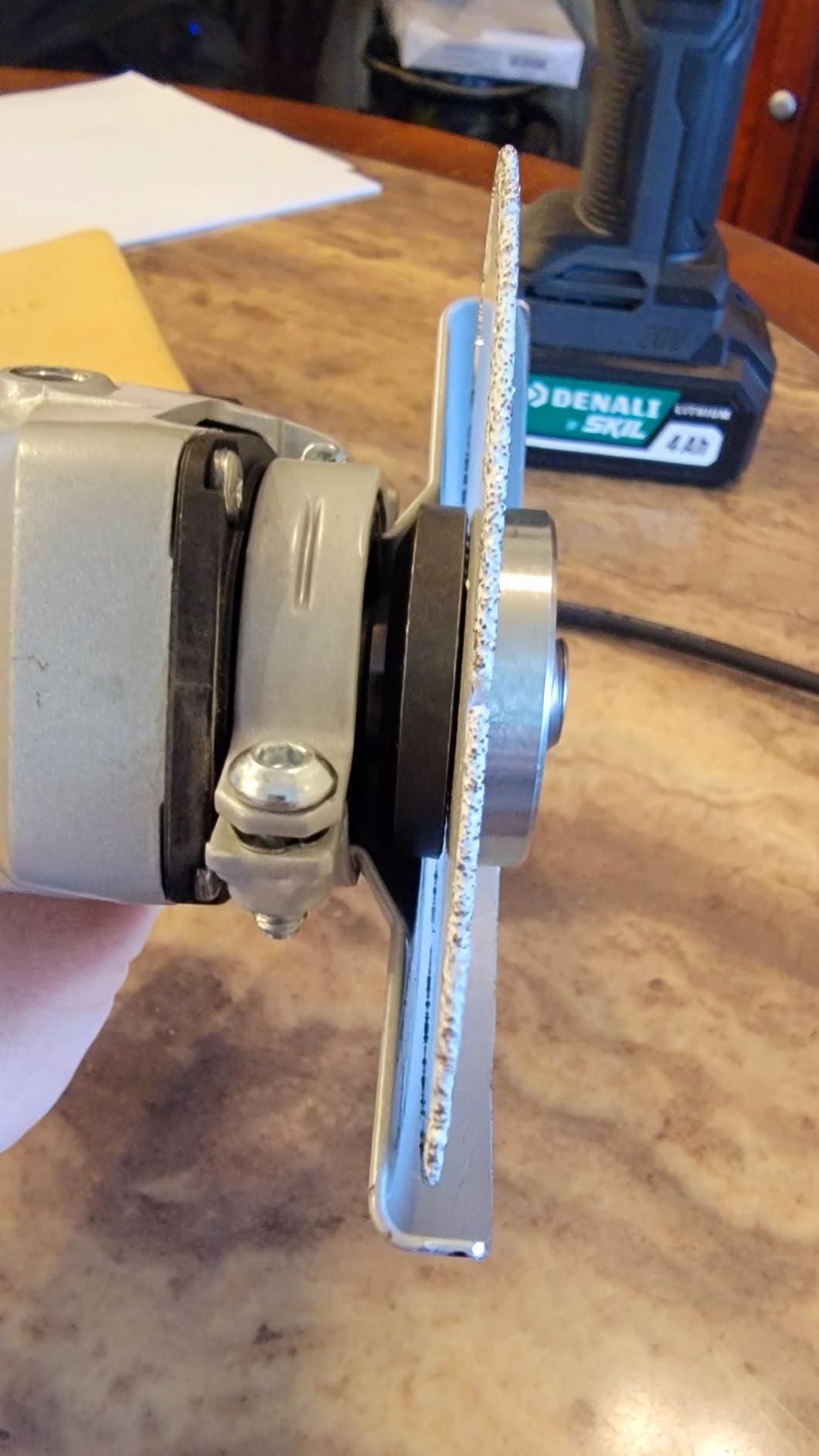
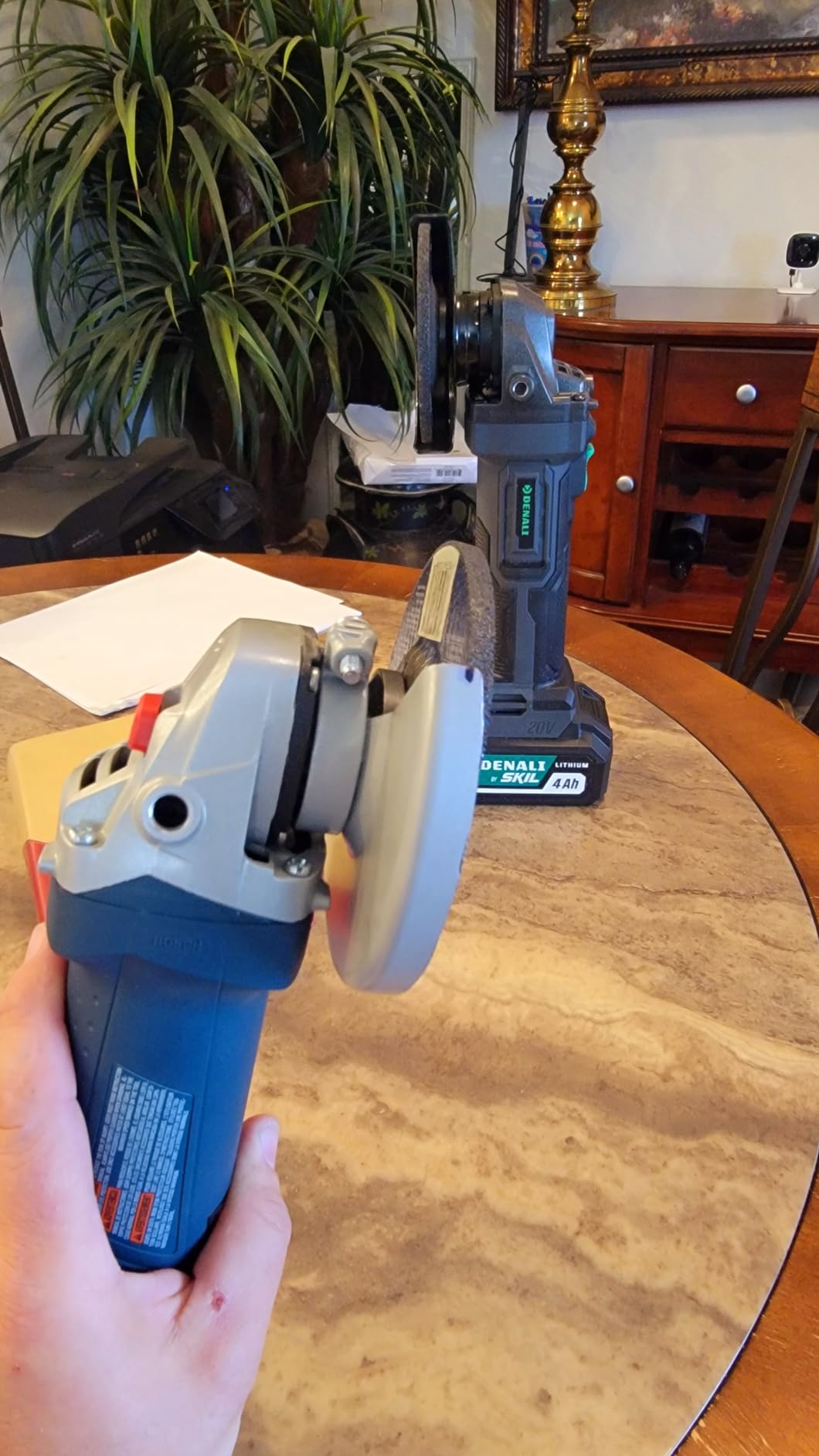
The Slim-Grip body is narrow through the middle, which is genuinely more comfortable than a straight cylindrical barrel over a long session. At 4.2 lb it stays in the middle of the weight range and works well one-handed.
The burst-protection guard adjusts quickly and holds position, and the large spindle lock button is easy to hit with a gloved hand. Guard, side handle, flanges, lock nut and spanner are all in the box.
Brushed motor and brush life
Durable carbon brushes extend tool life, but they are consumables. The Service Minder system turns that from a guess into a schedule, which is the difference between replacing brushes on time and cooking the motor.
Grip over long sessions
Slim-Grip matters more on grinding and weld cleanup than on straight cuts, because those are the jobs where you hold the tool for minutes rather than seconds. If you are doing long passes rather than short chops, comfort is a real specification.
Where the ratings thin out
This grinder has the highest share of one-star ratings in the group, which suggests a small number of durability outliers against a solid overall 4.6 average. If you buy it, buy it from a seller with straightforward returns.
10. SKIL 9295-01 – Best Starter Angle Grinder for Cutting Metal
SKIL 6 Amp 4-1/2-Inch Corded Angle Grinder – 9295-01
6.0 amp corded
11000 rpm
4.0 lb
Tool-less guard
+ Pros
- Cut-off wheel included in the box
- Side handle threads into three positions
- Wrench stores inside the handle
- Light 4.0 lb body
– Cons
- 6.0 amp motor bogs down on thick steel
- Power button feels awkward to some users
- Short cord of roughly 4 to 5 feet
- Audible under load
The SKIL is where most people should start. It arrives with a cut-off wheel already in the box, so you can make a cut on day one, and at 11,000 rpm it is not slow on thin sheet, angle iron or small bar.
The tool-less guard adjusts by hand, the side handle threads into three positions, and the vibration-reducing handle stores the wrench inside itself so the one small tool you need never goes missing.
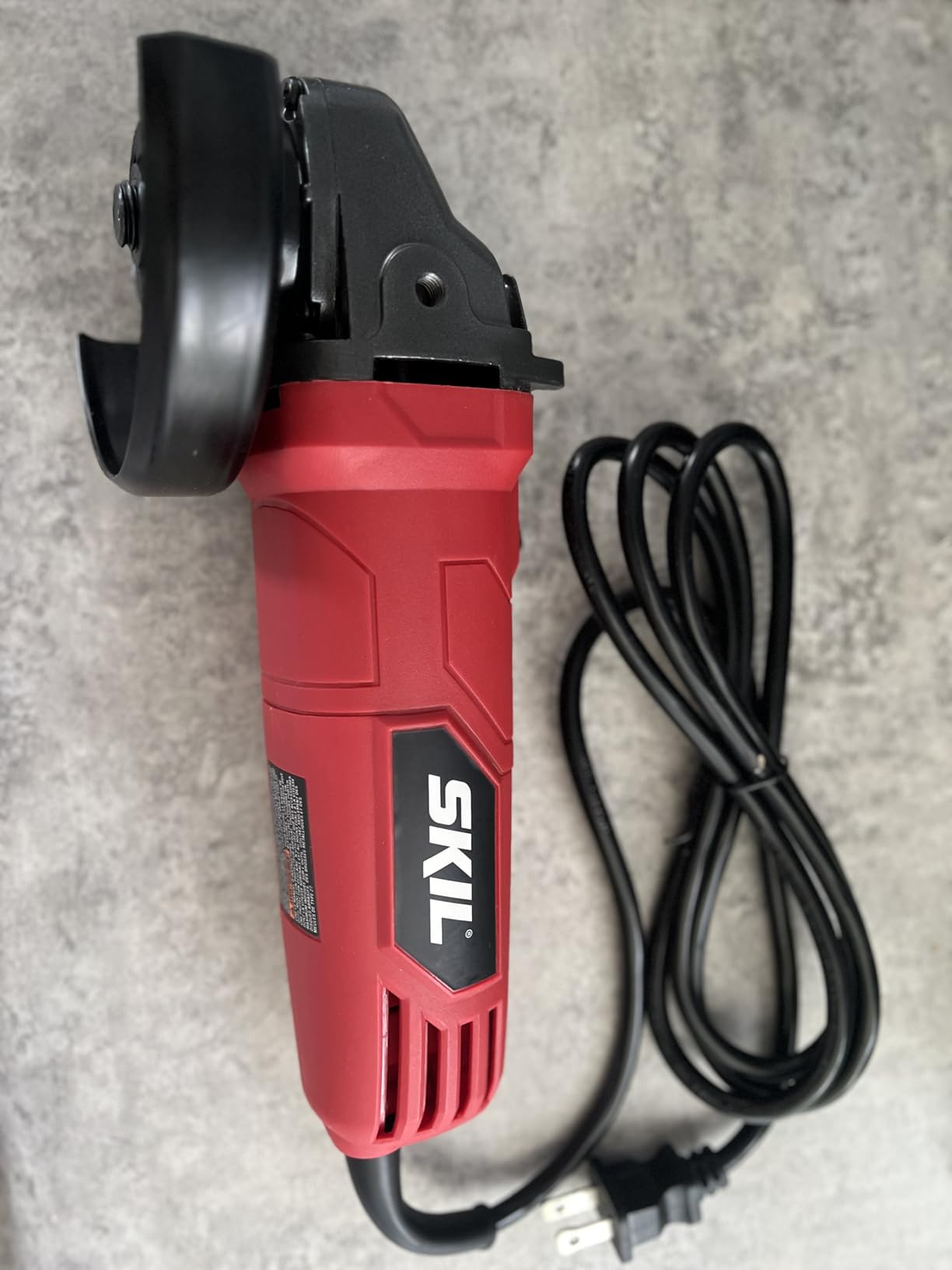
Long-term owners report service lives measured in decades on light work, which tells you what class of duty it suits. The heavy duty metal gear housing is the part doing that work, and it is the reason the tool survives being dropped and loaded up.
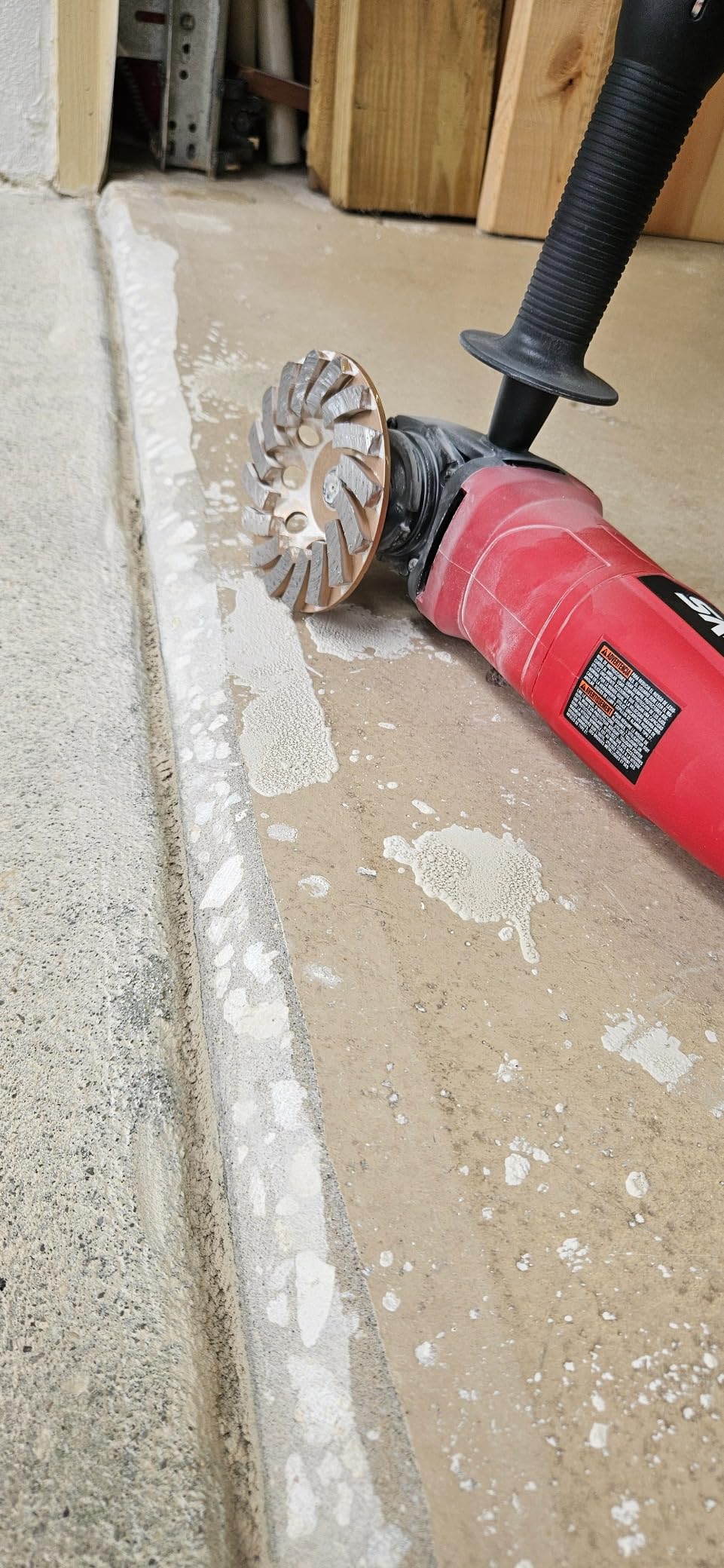
The clear limit is the 6.0 amp motor. On thin material and short cuts it is fine, but push it into thick steel and you will feel it slow down and hear it get loud.
Where the 6 amp motor runs out
Thick plate, heavy rebar and repeated full-depth cuts are beyond it. If your project list is mostly trimming, cutting angle and cleaning up welds, the SKIL is genuinely enough. If you plan to chew through structural material all weekend, step up to a 7.5 amp machine.
Cord length and reach
The short cord of roughly four to five feet is a real limitation in a garage or on a vehicle. An extension reel solves it, and it is worth buying a proper one rather than a light domestic lead.
Switch feel
Some users find the power button awkward or cumbersome, particularly with gloves on. It is a small irritation, not a deal breaker, but take the tool out and try the switch before you commit.
How to Choose an Angle Grinder for Metal Cutting in 2026
Corded or cordless: which holds up under load
Corded grinders win on sustained cutting because the power never runs out and the motor is not managing a battery. r/Tools users put it plainly: corded grinders are generally more powerful, cheaper and more reliable when you already have the batteries.
Cordless wins on access. Cutting a muffler on a car or a stair stringer with a cord attached is awkward, and the safety electronics on the current generation are genuinely better. Buy cordless if you already own the platform, or if your work is mostly short cuts away from an outlet.
Disc size decides what you can cut
Four-and-a-half inch is the standard for a reason: it fits a guard that fully covers the wheel, it stays controllable in one hand, and it clears most tight geometry. Five inch is a step up in material removal per pass, and a six inch wheel is only safe on machines designed and guarded for it.
A forum note worth heeding is that not every grinder sold as 5 inch capable is safe with a 5 inch wheel fitted under the guard. Check the guard coverage before you fit a larger wheel.
Switch style and kickback protection
A paddle switch you can lock on suits long cuts. A slide switch with a quick-off position suits anyone who does not want a running wheel left unattended. Over the top of that, a kickback brake or electronic clutch is the single most valuable safety feature on a metal cutting grinder.
Brand, platform and long-term ownership
The big three platforms dominate because of parts, batteries and resale, and Metabo, Bosch and Hilti get named often for durability. The practical test r/BuyItForLife users apply is simple: a cheaper grinder that lasts years beats an expensive one that does not, and forum consensus treats the big three as the low-risk default.
Choosing the Right Cut-Off Disc for Metal
The disc does more to determine your cut than the grinder does. A wheel that is too thick cuts slower and leaves a wider kerf, a wheel that is too thin disintegrates under load, and the wrong abrasive for the metal burns the edge instead of cutting it.
Type 1 versus Type 27 wheels
Type 1 is a flat cut-off wheel designed to be used with a Type 1 guard, which exposes more of the wheel face. Type 27 is depressed center, and its angled geometry is what the standard grinder guard is shaped to cover. Fitting a Type 27 wheel under a Type 1 guard removes guard coverage from the side of the wheel, which is how people get hurt.
Wheel thickness and abrasive
Thin wheels cut faster and leave less kerf, but they are more fragile. A 1 mm reinforced wheel handles general structural work; a 1.8 mm wheel lasts longer on abrasive jobs where you are not trying to save metal. r/Tools users reach for Cubitron on steel and describe it as expensive but the fastest and longest lasting they have used, and for occasional work a standard aluminium oxide wheel is the sensible default.
Matching the disc to the metal
Mild steel and rebar are the easy case, and almost any reinforced wheel handles them. Stainless needs a wheel labelled for stainless, with a coating that resists loading and glazing. Aluminium needs a wheel designed for non-ferrous metals, because a steel-cutting wheel smears and gums up on aluminium. Sheet metal needs a thin wheel so the cut stays flat and the material does not twist.
How Thick of Metal Can Each Grinder Cut?
There is no published figure because the limit comes from the disc, the motor and the operator. As a working rule for a single straight pass with a thin reinforced wheel and steady pressure:
- 3 inch mini: roughly 3 to 4 mm, plus a light grinding edge for cleanup.
- 4.5 inch: about 6 to 8 mm in a 7.5 amp class corded tool, and around 5 to 6 mm in a 6 amp class tool.
- 5 inch: about 8 to 10 mm on a brushless cordless with brake support, more on a strong corded machine with a thin wheel.
- 6 inch and up: 12 mm and beyond, but only on grinders designed and guarded for that wheel size.
Beyond these depths the sensible move is a second pass from each side, which keeps the wheel cool and gives you a much cleaner edge than trying to force a single deep cut.
Cutting Metal Safely: Kickback, Sparks and Protection
Almost every serious injury in this category comes from one of two mechanisms. Both are avoidable, and understanding them is worth more than any spec on the box.
Kickback happens when the wheel grabs
When the top half of the wheel binds on the edge of the material, rotation reverses for a fraction of a second and the tool tries to spin out of your hands and into your body. It is the reason the DCG413B and the Milwaukee carry a brake and clutch, and the reason you should let the wheel reach full speed before touching the material.
Guard position and spark direction
The guard is positioned so the open side faces the direction of travel, and sparks leave the cut line at roughly 90 degrees away from you. Set the guard before you start, and never reach across the cut line to check the depth with the wheel running.
Protection you actually need
Eye protection or a face shield, hearing protection, gloves, and a respirator when grinding rather than cutting, because the metal particles are the real hazard. A grinder produces noise loud enough to damage hearing over a shift, and that is not negotiable.
Frequently Asked Questions
Are angle grinders good for cutting metal?
Yes. An angle grinder is the fastest handheld way to cut mild steel, rebar, pipe and sheet metal, and it is the only practical tool for cleaning up welds and shaping metal in place. A chop saw or circular saw can make straighter, square cuts, but neither can reach a car frame, a welded joint or a corner. The trade-off is that cuts are freehand, so expect to grind the edge afterwards for a finished surface.
What type of grinder is best for grinding metal?
For grinding and weld cleanup, a 4.5 inch corded grinder in the 7 to 7.5 amp class is the standard answer, because the higher amperage gives the motor the headroom to keep the wheel under pressure instead of stalling. A depressed center Type 27 grinding wheel handles surface grinding and weld cleanup. A 5 inch wheel removes more per pass, but only on machines designed and guarded for that size.
How thick of metal can an angle grinder cut through?
With a thin reinforced cut-off wheel and steady pressure, a 4.5 inch grinder in a 7.5 amp class cuts roughly 6 to 8 mm in one pass, and a 5 inch brushless cordless handles about 8 to 10 mm. A 6 amp motor manages closer to 5 to 6 mm before the disc slows noticeably. For anything thicker, take two shallower passes from each side rather than forcing one deep cut, which keeps the wheel cool and the edge cleaner.
What type of angle grinder blade is best for cutting steel?
For steel, use a reinforced cut-off wheel roughly 1 mm thick, matched to the grinder size. A depressed center Type 27 wheel works with the standard guard, while a Type 1 flat wheel needs a Type 1 guard or guard coverage is lost. Zirconia is the durable all-rounder, aluminium oxide is the cheap general-purpose choice, and ceramic based wheels cut fastest on hard steels. Match the abrasive to the metal rather than reusing a wheel from another job.
Is DeWalt or Milwaukee better for metal cutting?
Both are strong choices and the difference is platform driven. The Milwaukee 2880-20 M18 carries an electronic clutch plus overload protection, and its no-lock paddle switch stops the wheel the moment you release. The DEWALT DCG413B adds a two-stage trigger and a two second brake. If you already own M18 or 20V MAX batteries, buy into the platform you have, because the battery and charger dominate the cost of entry.
What is the best angle grinder for home use?
For most home garage work, a 7 to 7.5 amp corded 4.5 inch grinder covers everything from cutting angle iron and sheet to cleaning up welds, without batteries to charge or platform to buy into. The SKIL 9295-01 includes a cut-off wheel and suits light trimming, the Metabo HPT G12SR4 is the better choice in tight corners at 4.0 lb, and the Makita 9557PBX1 is the pick if you want a pro-grade corded tool with a long service record.
Which Angle Grinder Should You Buy?
If you want one grinder that handles nearly everything and you already have 20V MAX batteries, take the DEWALT DCG413B. The brake, the kickback protection and the brushless motor make it the safest all-round choice for metal, and it carries the strongest owner rating of the group.
If you would rather not own batteries, the Makita 9557PBX1 is the corded answer: 7.5 amp of power in a 4.5 lb body with a lock-on paddle and two guards in the case. If your work is mostly in tight corners, the Metabo HPT G12SR4 is lighter and lower profile than anything else here.
For jobsite work where the tool gets abused, the PORTER-CABLE PC750AG takes punishment and offers a three-year warranty. If you are starting out and want discs in the box, the SKIL 9295-01 gets you cutting today. Whichever you pick, buy a thin reinforced cut-off wheel alongside it, because the disc, not the grinder, sets the quality of the cut.
Check the latest listings for each model and pick up a couple of spares of the right wheel before you start.
Leave a Reply