
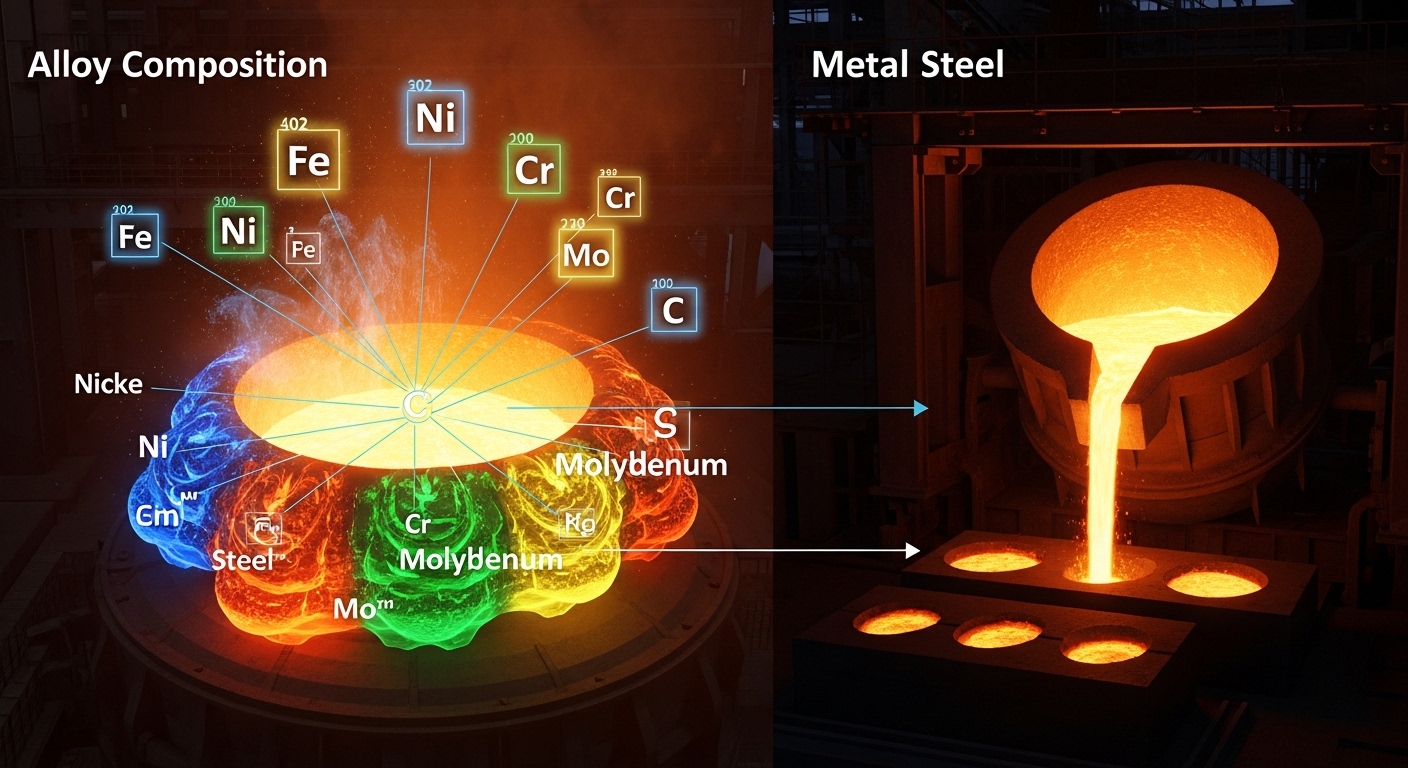
Metal composition determines whether a skyscraper stands tall for a century or an aircraft can safely fly at 35,000 feet. The difference between pure iron and the steel that builds our world comes down to carefully controlled chemical makeup.
What Is Metal Composition?
Metal composition refers to the chemical makeup of metallic substances, specifically alloys which are mixtures of two or more elements where at least one is a metal. The composition determines the alloy’s properties such as strength, hardness, ductility, and corrosion resistance.
- Key Principle: Combining elements creates superior properties
- Primary Use: Engineering materials for specific applications
Pure metals rarely meet industrial demands. Gold is too soft for jewelry without alloying. Pure iron corrodes rapidly. Copper alone lacks the strength for electrical connectors.
By controlling composition at the atomic level, metallurgists create materials that exceed the sum of their parts. This has driven human civilization from the Bronze Age to today’s advanced aerospace alloys.
I’ve spent years studying metallurgy, and what fascinates me most is how tiny changes in composition—sometimes less than 1%—can transform a material’s behavior completely.
Alloy: A mixture of chemical elements of which at least one is a metal. Unlike chemical compounds, the constituent elements in alloys retain their individual identities and can be separated by physical means.
What Is an Alloy?
An alloy is a metallic substance made by combining two or more elements. At least one element must be a metal, and the resulting material exhibits metallic properties such as electrical conductivity, luster, and malleability.
- Examples: Steel (iron + carbon), Brass (copper + zinc), Bronze (copper + tin)
- Why Make Alloys: Pure metals are typically too soft, weak, or reactive for practical use
Alloys dominate our material world. Over 90% of metal used in manufacturing exists as alloy rather than pure element.
The atoms in alloys arrange themselves in specific patterns. These atomic arrangements—called crystal structures—determine the material’s fundamental properties.
Think of alloys like recipes. Just as a pinch of salt transforms a dish, a fraction of a percent of carbon transforms iron into steel.
Types of Alloys: How Atoms Arrange
Alloys form through two primary mechanisms at the atomic level. Understanding these reveals why composition matters so profoundly.
Substitutional Alloys
In substitutional alloys, atoms of similar size replace each other in the crystal lattice. The guest atoms substitute for host atoms like swapping players in a formation.
Brass works this way. Zinc atoms (similar size to copper) replace some copper atoms in the lattice structure. This substitution increases strength while maintaining electrical conductivity.
Quick Summary: Substitutional alloys form when component atoms have similar atomic radii (within 15%). The atoms replace each other in crystal lattice positions, creating a homogeneous solid solution.
Common substitutional alloys include:
| Alloy | Base Metal | Alloying Element | Key Property Change |
|---|---|---|---|
| Brass | Copper | Zinc (5-40%) | Increased strength, lower cost |
| Bronze | Copper | Tin (up to 12%) | Improved corrosion resistance |
| Sterling Silver | Silver | Copper (7.5%) | Hardness for durability |
| Jewelry Gold | Gold | Copper, Silver, Zinc | Wear resistance |
Interstitial Alloys
Interstitial alloys form when smaller atoms fit into the spaces (interstices) between larger atoms in the crystal lattice.
Steel is the most important interstitial alloy. Carbon atoms (much smaller than iron) occupy gaps in the iron lattice. This simple addition—usually less than 2% carbon—transforms soft, pure iron into one of humanity’s most versatile materials.
Interstitial Alloy: An alloy where smaller atoms occupy spaces between larger atoms in the crystal structure. This creates lattice strain that significantly increases hardness and strength.
The strain from these interstitial atoms prevents layers of metal from sliding past each other easily. This resistance to slip is what makes steel hard and strong.
Key interstitial alloys include:
- Steel: Iron with carbon (0.02-2.1%)
- Cast Iron: Iron with higher carbon content (2-4%)
Homogeneous vs Heterogeneous Alloys
Homogeneous alloys consist of a single phase throughout. The components are uniformly distributed at the atomic level. Most substitutional alloys fall into this category.
Heterogeneous alloys contain multiple distinct phases. You might see different compositions under a microscope, even though they appear uniform to the naked eye.
Many high-strength steels are heterogeneous. They combine hard, brittle phases with soft, ductile phases to achieve an optimal balance of properties.
Ferrous vs Non-Ferrous Metals: The Fundamental Division
The primary difference between ferrous and non-ferrous metals is iron content. Ferrous metals contain iron as the primary component; non-ferrous metals do not contain iron (or only trace amounts).
This simple distinction creates two vast families of alloys with distinct properties and applications.
| Property | Ferrous Metals | Non-Ferrous Metals |
|---|---|---|
| Iron Content | Primary component | No significant iron |
| Magnetic | Generally magnetic | Non-magnetic (exceptions exist) |
| Corrosion Resistance | Poor (except stainless steel) | Generally excellent |
| Weight | Heavier (higher density) | Lighter options available |
| Cost | Generally economical | Varies widely |
| Recycling | Highly recyclable | Recyclable, value varies |
Ferrous Alloys
Steel is the ferrous alloy that built modern civilization. Its versatility comes from carbon content and additional alloying elements.
Carbon steel contains primarily iron and carbon. Small carbon increases make a huge difference:
- Low carbon (0.05-0.25%): Formable, used for car bodies
- Medium carbon (0.25-0.60%): Stronger, used for machinery
- High carbon (0.60-1.00%): Very hard, used for cutting tools
Alloy steels add other elements for specific properties:
- Chromium: Hardness, wear resistance
- Nickel: Toughness, corrosion resistance
- Manganese: Strength, hot working characteristics
- Molybdenum: High-temperature strength
- Vanadium: Grain refinement, strength
Non-Ferrous Alloys
Non-ferrous alloys excel where weight, corrosion resistance, or conductivity matter most.
Aluminum alloys power the aerospace industry. Aluminum itself is light and corrosion-resistant, but alloying adds strength. Common additions include:
- Copper: Strength
- Magnesium: Strength without weight penalty
- Silicon: Castability
- Zinc: Strength (7000-series aircraft alloys)
Copper alloys serve where conductivity or aesthetics matter. Bronze and brass dominate this category.
Titanium alloys offer the ultimate strength-to-weight ratio with excellent corrosion resistance. These properties make titanium essential for aerospace, medical implants, and chemical processing.
Common Alloy Systems and Their Applications
Steel Alloys: The Workhorse Materials
Steel production exceeds 1.8 billion tons annually worldwide. This staggering demand reflects steel’s unmatched versatility.
Carbon Steel
Carbon steel forms the backbone of construction and manufacturing. Its properties scale directly with carbon content.
| Type | Carbon Content | Properties | Typical Uses |
|---|---|---|---|
| Low Carbon | 0.05-0.25% | Soft, ductile, easily formed | Auto bodies, pipe, wire |
| Medium Carbon | 0.25-0.60% | Stronger, less ductile | Gears, rails, machinery |
| High Carbon | 0.60-1.00% | Hard, wear-resistant | Cutting tools, springs |
Steel Composition: Iron is the primary element (98-99.5%). Carbon content ranges from 0.02% to just over 2%. Additional elements such as manganese, silicon, phosphorus, and sulfur are present in small amounts.
Stainless Steel
Stainless steel contains at least 10.5% chromium. This chromium forms a thin, invisible oxide layer that protects the underlying metal from corrosion.
Common stainless steel compositions include:
- 304 (18-8 stainless): 18% chromium, 8% nickel. The most common grade for general use
- 316: Adds molybdenum for superior corrosion resistance
- 410: Lower chromium, heat-treatable for cutlery
- 17-4 PH: Precipitation hardening for high strength
Stainless steel’s self-healing oxide layer makes it ideal for food processing, medical instruments, architecture, and marine environments.
Tool Steels
Tool steels contain tungsten, molybdenum, cobalt, and vanadium in various combinations. These elements create hard, wear-resistant materials that retain their edges at high temperatures.
I’ve worked with tool steel in machining applications. The difference between cheap carbon steel drill bits and proper tool steel bits becomes obvious within minutes of use. Good tool steel stays sharp through hundreds of holes where cheaper steel dulls quickly.
Aluminum Alloys: Lightweight Champions
Pure aluminum is too soft for structural use, but alloying creates materials that are both light and strong.
The Aluminum Association uses a four-digit numbering system:
| Series | Primary Alloy | Characteristics | Applications |
|---|---|---|---|
| 1xxx | None (99%+ Al) | Excellent conductivity | Electrical conductors |
| 2xxx | Copper | High strength | Aircraft structures |
| 3xxx | Manganese | Good workability | Cooking utensils, roofing |
| 5xxx | Magnesium | Excellent corrosion resistance | Marine, cryogenic tanks |
| 6xxx | Magnesium + Silicon | Formable, extrudable | Structural extrusions |
| 7xxx | Zinc | Highest strength | Aircraft, military |
Alloy 7075 contains zinc, magnesium, and copper. It develops tensile strength comparable to some steels at one-third the weight. This alloy makes modern commercial aviation possible.
Copper Alloys: Conductive and Aesthetic
Copper has served humanity for over 10,000 years. Its excellent conductivity and distinctive appearance keep it relevant today.
Bronze vs Brass: Understanding the Difference
Bronze is primarily copper alloyed with tin, while brass is copper alloyed with zinc. This compositional difference creates distinct properties and applications.
| Characteristic | Bronze | Brass |
|---|---|---|
| Primary Alloying Element | Tin (typically 5-12%) | Zinc (5-40%) |
| Color | Reddish-brown | Yellow-gold |
| Hardness | Harder | Softer |
| Corrosion Resistance | Excellent (especially saltwater) | Good (can dezincify) |
| Typical Uses | Bearings, marine hardware, statues | Plumbing, musical instruments, fittings |
Bronze traditionally defined the Bronze Age (3300-1200 BCE). Its lower melting point compared to pure copper made it accessible to ancient metalworkers.
Brass became prominent later, valued for its gold-like appearance at a fraction of the cost. The addition of zinc lowers the melting point further and increases malleability.
Titanium Alloys: High-Performance Materials
Titanium offers an exceptional combination of properties: low density (45% lighter than steel), high strength, and outstanding corrosion resistance.
Commercially pure titanium (grades 1-4) serves chemical processing and marine applications where corrosion resistance is paramount.
Titanium alloys (grades 5 and above) provide higher strength for aerospace use:
- Ti-6Al-4V (Grade 5): The workhorse titanium alloy. 6% aluminum, 4% vanadium. Used in aircraft engines, frames, and fasteners
- Ti-6Al-4V ELI: Extra low interstitial version for medical implants
- Ti-3Al-8V-6Cr-4Mo-4Zr: Deep hardening for high-strength applications
Titanium’s biocompatibility makes it ideal for medical implants. Hip replacements, dental implants, and pacemaker cases commonly use titanium alloys.
Nickel-Based Superalloys
Superalloys maintain strength at extreme temperatures. They make jet turbine engines possible.
Typical compositions include:
- Nickel: 50-60% (base metal)
- Chromium: 10-20% (corrosion resistance)
- Cobalt: 5-15% (high-temperature strength)
- Aluminum + Titanium: 3-6% (precipitation hardening)
- Tungsten, Molybdenum, Rhenium: solid solution strengthening
Inconel 718, a common superalloy, operates continuously at temperatures up to 1300degF (700degC). This performance enables modern jet engines and rocket motors.
Heat Treatment: Transforming Properties Through Temperature
Heat treatment uses controlled heating and cooling to alter the internal structure of metals, changing their mechanical properties without changing their composition.
The same steel can be soft, brittle, or tough depending entirely on heat treatment. This versatility explains why steel remains indispensable after thousands of years.
Heat Treatment Processes
Annealing
Heating metal above its critical temperature, holding it, then cooling slowly. This softens the metal, relieves internal stresses, and increases ductility.
I anneal steel before machining complex parts. The softer material cuts more cleanly and produces less tool wear. After machining, I can heat-treat again for hardness.
Normalizing
Similar to annealing but with faster cooling (air cooling). This creates a more uniform grain structure and relieves stresses from forging or rolling.
Quenching
Rapid cooling from high temperature, typically in water, oil, or polymer solutions. The rapid cooling “freezes” the high-temperature crystal structure, creating martensite—an extremely hard but brittle phase in steel.
Quenching creates maximum hardness. The tradeoff is brittleness. Most quenched parts require tempering.
Tempering
Reheating quenched steel to a lower temperature (300-1300degF) to reduce brittleness while retaining most of the hardness. Tempering time and temperature determine the final balance of properties.
Quick Summary: Quenching makes steel hard but brittle. Tempering trades some hardness for toughness. Higher tempering temperatures produce softer but tougher steel.
Precipitation Hardening
Also called age hardening. This process forms tiny particles (precipitates) within the metal that impede dislocation movement.
Aluminum alloys like 2024 and 7075 gain their strength through precipitation hardening. The alloy is solution-treated, quenched, then aged at moderate temperature for hours.
This process can double or triple the strength of aluminum without adding weight.
How Composition Affects Mechanical Properties
Understanding the relationship between composition and properties lets engineers select the right material for any application.
Strength
Strength increases through several mechanisms:
- Solid solution strengthening: Adding atoms that differ in size from the base metal creates lattice strain
- Grain size reduction: Smaller grains mean more grain boundaries, which block dislocation movement
- Precipitation hardening: Fine particles impede dislocation motion
- Work hardening: Deforming the metal creates more dislocations that tangle with each other
Hardness
Hardness relates closely to strength but specifically measures resistance to surface deformation. Carbon is the most effective hardness enhancer for iron-based alloys.
Carbon content determines steel’s maximum attainable hardness. Higher carbon allows higher hardness after proper heat treatment.
Ductility
Ductility measures how much a material can deform before breaking. Pure metals are typically very ductile. Alloying generally reduces ductility while increasing strength.
This tradeoff between strength and ductility forms one of metallurgy’s fundamental challenges. Engineers balance these competing demands based on application requirements.
Corrosion Resistance
Chromium creates the most effective corrosion resistance in iron alloys. At least 10.5% chromium enables the protective oxide layer that defines stainless steel.
For non-ferrous metals, alloying can improve or reduce corrosion resistance. Bronze’s tin addition improves corrosion resistance compared to pure copper.
Modern Alloys: The Cutting Edge
Metallurgy continues advancing rapidly. New compositions enable technologies that were impossible just decades ago.
High-Entropy Alloys
Traditional alloys contain one primary element with small amounts of others. High-entropy alloys flip this model completely.
HEAs contain five or more elements in roughly equal proportions (typically 5-35% each). This unusual composition creates unique properties:
- Exceptional strength at high temperatures
- Excellent wear resistance
- Enhanced corrosion resistance
- Stable microstructure
These properties make HEAs promising for turbine engines, nuclear reactors, and cutting tools.
High-Entropy Alloy: An alloy containing multiple principal elements in roughly equal proportions. The high configurational entropy stabilizes solid solutions rather than forming intermetallic compounds.
Nanostructured Alloys
Reducing grain size to the nanometer scale creates extraordinary properties. Nanostructured metals can be several times stronger than their conventional counterparts.
These materials are produced through severe plastic deformation, electrodeposition, or powder consolidation techniques.
Amorphous Metals (Metallic Glasses)
Most metals have orderly crystal structures. Amorphous metals lack this long-range order, more like frozen liquid than crystal.
This unusual structure provides:
- Exceptional strength and hardness
- High elasticity (elastic limit ~2%)
- Excellent corrosion resistance
- Soft magnetic properties
Metallic glasses find applications in electronics, medical devices, and sports equipment.
Shape Memory Alloys
Nitinol (nickel-titanium alloy) remembers its original shape. After deformation, heating returns it to the predetermined shape.
This property enables stents that expand at body temperature, medical guidewires that navigate complex anatomy, and actuators in aerospace systems.
Sustainability and Metal Recycling
Metals are infinitely recyclable without losing their properties. This recyclability makes metals central to a circular economy.
Steel is the most recycled material on Earth. Over 650 million tons are recycled annually worldwide. Recycled steel requires 60% less energy than primary production.
Aluminum recycling saves even more energy—95% compared to primary production. An aluminum can recycled today can be back on shelves as a new can in just 60 days.
Alloy composition affects recyclability. Mixed alloy scrap creates challenges because different alloys have different melting points and processing requirements.
The industry addresses this through:
- Improved sorting technology (X-ray fluorescence, laser-induced breakdown spectroscopy)
- Alloy design for recyclability
- Better labeling and tracking of alloy grades
Modern alloy development increasingly considers life cycle impact. Sustainable metallurgy aims to minimize energy use, emissions, and waste while maintaining performance.
Frequently Asked Questions
What is metal composition?
Metal composition refers to the chemical makeup of metallic substances, specifically the combination of elements in alloys. This composition determines properties such as strength, hardness, ductility, and corrosion resistance.
What is an alloy?
An alloy is a metallic substance made by combining two or more elements, with at least one being a metal. The resulting material exhibits metallic properties while often having enhanced characteristics compared to its constituent elements.
What is the difference between ferrous and non-ferrous metals?
Ferrous metals contain iron as the primary component and are generally magnetic. Non-ferrous metals do not contain significant amounts of iron and are typically non-magnetic. Ferrous metals tend to be heavier and less corrosion-resistant than non-ferrous alternatives.
What elements are in steel?
Steel is primarily iron (98-99.5%) with carbon content ranging from 0.02% to just over 2%. Additional elements may include manganese, silicon, phosphorus, sulfur, and various alloying elements like chromium, nickel, and molybdenum depending on the steel grade.
How does carbon affect steel properties?
Carbon is the most critical alloying element in steel. Higher carbon content increases hardness and strength but reduces ductility and weldability. Low carbon steel is soft and formable, while high carbon steel is hard and wear-resistant.
What is stainless steel made of?
Stainless steel must contain at least 10.5% chromium, which forms a protective oxide layer. Common grades also contain nickel, molybdenum, and other elements. The 304 grade, most common for general use, contains approximately 18% chromium and 8% nickel.
What is the difference between bronze and brass?
Bronze is primarily copper alloyed with tin (typically 5-12%), while brass is copper alloyed with zinc (5-40%). Bronze has a reddish-brown color, is harder, and offers superior corrosion resistance, especially in marine environments. Brass has a yellow-gold color and is more malleable.
What are the types of alloys?
Alloys are classified by atomic structure into substitutional alloys (similar-sized atoms replace each other in the crystal lattice) and interstitial alloys (smaller atoms fit into spaces between larger atoms). They are also classified by composition into ferrous alloys (containing iron) and non-ferrous alloys (all other metals).
Leave a Reply