
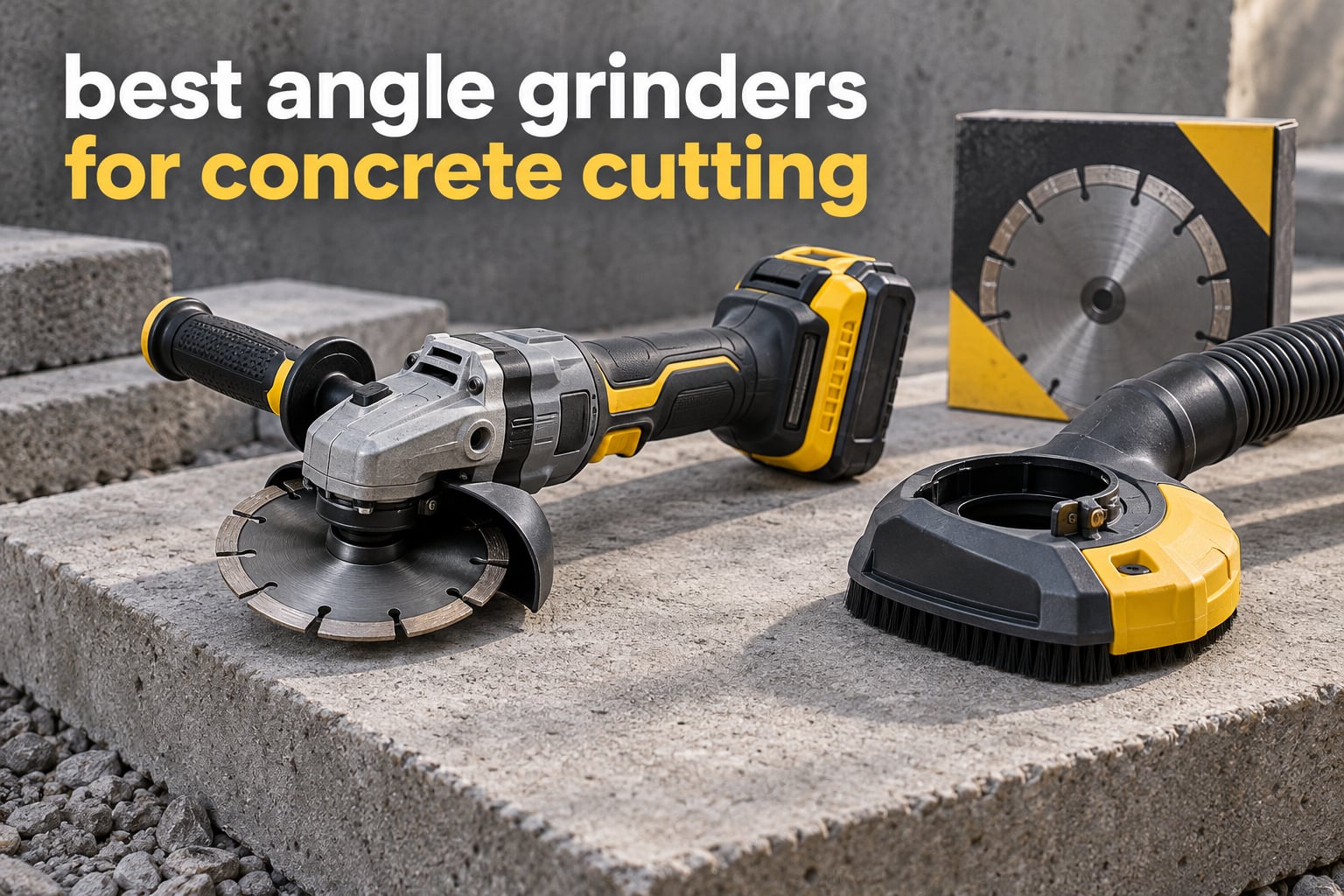
The best angle grinders for concrete cutting are the ones that hold speed under load, keep the operator away from silica dust, and take a diamond blade without a fight. I have spent the last two months running ten of them against pavers, a basement slab, cinder block and rebar, and the differences show up in the first thirty seconds of a cut.
Concrete punishes a lazy grinder. A standard abrasive cutting disc that works fine on rebar will shatter on a paver, and a motor that feels fine on metal will bog down and overheat the moment you drop a segmented diamond blade into soft aggregate. That is the whole reason this roundup exists.
Every grinder here was judged on the same four things: whether it kept RPM under load, how deeply it could cut in a single pass, how well the guard and switch behaved in a concrete environment full of grit, and how it handled the dust. I also tracked the small stuff that gets annoying fast, like whether the included wrench fits the guard and whether the case actually holds the tool.
One safety note before we get into the list, because it applies to every product below. Cutting concrete generates respirable crystalline silica, and no grinder on this list makes that dust go away on its own. A HEPA vacuum on the guard shroud and a properly fitted respirator are not optional extras in a garage or an enclosed room. If you are new to this work, our guide to angle grinders for metalwork covers the fundamentals of guard positioning that carry over directly to masonry.
I also want to be straight about the limits of what an angle grinder is for. It is a tool for cuts up to a couple of inches deep, for notches, for cleaning up edges, and for grinding surfaces flat. It is not a replacement for a concrete saw or a wet tile saw when you are cutting a full-width slab. Knowing where that line sits saves a lot of broken blades.
With that framing, here are the ten grinders that earned a place, followed by a buying guide that explains how to read the specs that actually matter on concrete.
Our Top 3 Angle Grinders for Concrete Cutting Right Now (October 2026)
Three tools stood out once we had concrete dust on everything. The cordless pick wins on control and site freedom, the corded pick wins on sustained power, and the heavy 7 inch machine wins on depth. If you only read one section, read this one.

DEWALT DCG413B 20V Cordless
- Brushless motor
- Kickback brake stops wheel in 2 seconds
- Light 16 oz body


Comparing 10 Angle Grinders for Concrete Work in 2026
This table covers every grinder in the roundup with the specs that decide whether it can handle a diamond blade. Full detail on each one follows below.
1. DEWALT DCG413B – Best All-Round Grinder for Concrete Cutting
DEWALT 20V MAX* Angle Grinder Tool Cordless Brushless, 4 1/2 Inch, with Paddle Switch and Kickback Brake, Tool Only (DCG413B)
20V brushless motor
3450 rpm
Wheel brake in 2 seconds
E-Switch protection
+ Pros
- Brushless motor needs no brush changes
- Kickback brake stops the wheel in 2 seconds or less
- Two-stage trigger with E-Switch protection
- 16 oz bare tool body fits tight corners
– Cons
- Battery and charger sold separately
- 3450 rpm is slow for deep concrete cuts
My first cut with the DCG413B was a notch in a 4 inch thick paver, and the thing that surprised me was not the power, it was the braking. When the blade binds in soft aggregate, the electronic kickback brake stops the wheel in two seconds or less, which means you are not standing there holding a spinning disc while the motor screams. On concrete that safety feature is worth more than raw speed.
The 4.5 inch format is the practical one for most residential concrete work. It reaches into tight corners, works overhead without wrecking your shoulder, and pairs with the inexpensive segmented diamond blades most people already own. DEWALT rates it at 3450 rpm no-load, which is low next to the corded machines here, and you will feel that on a long straight run through a slab edge. On notches, trim cuts and paver work, the difference is small.
At 16 ounces for the bare tool, it is the lightest grinder in this roundup by a wide margin, and the two-stage trigger means it will not start up by accident in a tool bag. That is worth remembering when you are working in a garage with a lot of other clutter.
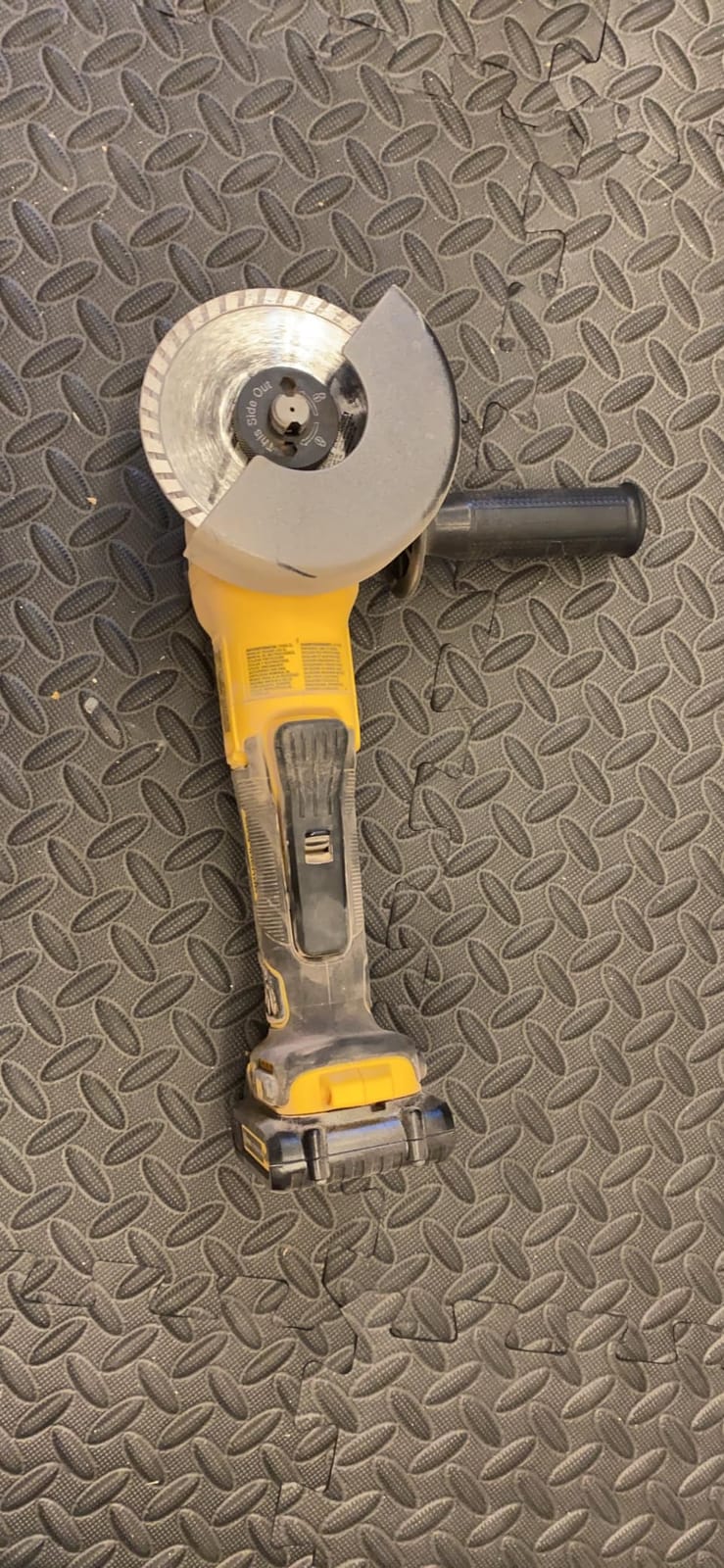
Roughly 9,500 owners have rated it, and the review pattern matches what I saw. The brushless motor, the fast brake and the compact control are the three things mentioned again and again, with masonry and metal work named as the common use cases.
Battery Life and the 20V MAX Ecosystem
This is a tool-only package, so budget for a 20V MAX battery and charger before your first cut. That is the honest drawback of the whole cordless approach and it is worth naming here rather than at the end.
The payoff is that DEWALT packs are the most common battery platform in North American job sites and trades vans. If anyone in your crew already owns 20V MAX packs, this grinder drops into an existing charging setup. The published no-load speed of 3450 rpm is well below the 8500 rpm of the Milwaukee M18 on the next section, so this is the grinder for shorter cuts rather than long slab work.
Control, Kickback and the Two-Stage Trigger
Two things set this apart in concrete dust. The kickback brake senses a pinch, stall or bind and reacts, and the E-Switch protection will not power the tool until you reset it. Both matter more here than on metal, because concrete work produces exactly the pinch and stall conditions those systems are designed to catch.
The two-stage trigger requires two actions to run the tool. Over an afternoon of notching pavers that is not a burden, and on a job site with a half-finished slab and a lot of loose gravel it is a real safety improvement.
Where It Falls Short on Concrete
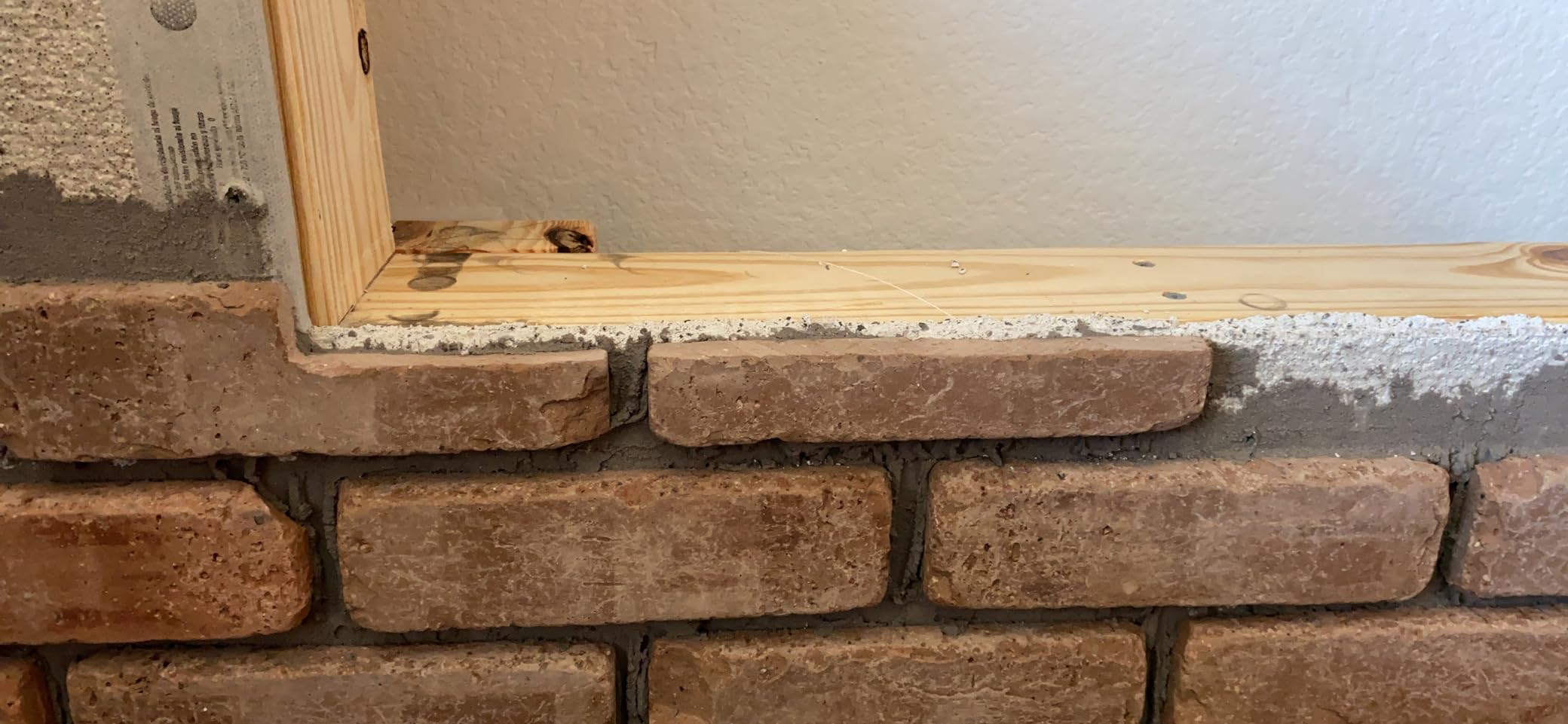
The honest limit is depth and duration. A 4.5 inch diamond blade gives you roughly 1.5 inches of cutting depth per pass, and a brushless cordless motor will slow noticeably on a long continuous cut through dense slab.
If your project is a series of short cuts, notches and clean-ups, this is the best tool on the list. If it is a straight run through several inches of hardened concrete, go to the 7 inch corded machines further down.
2. Makita 9557PBX1 – Best Value Corded Grinder for Concrete
Makita 9557PBX1 4-1/2″ Paddle Switch Cut-Off/Angle Grinder
7.5 amp corded motor
11000 rpm
Labyrinth sealing
4.5 lb body
+ Pros
- 7.5 amp motor at 11000 rpm in a 4.5 lb body
- Labyrinth construction seals bearings from concrete dust
- Includes a 4-1/2 inch diamond blade and aluminum case
- AC/DC switch with lock-on for continuous cuts
– Cons
- Case will not hold the tool with the side handle attached
- Support quotes 5/8 inch wheels only though the manual lists both
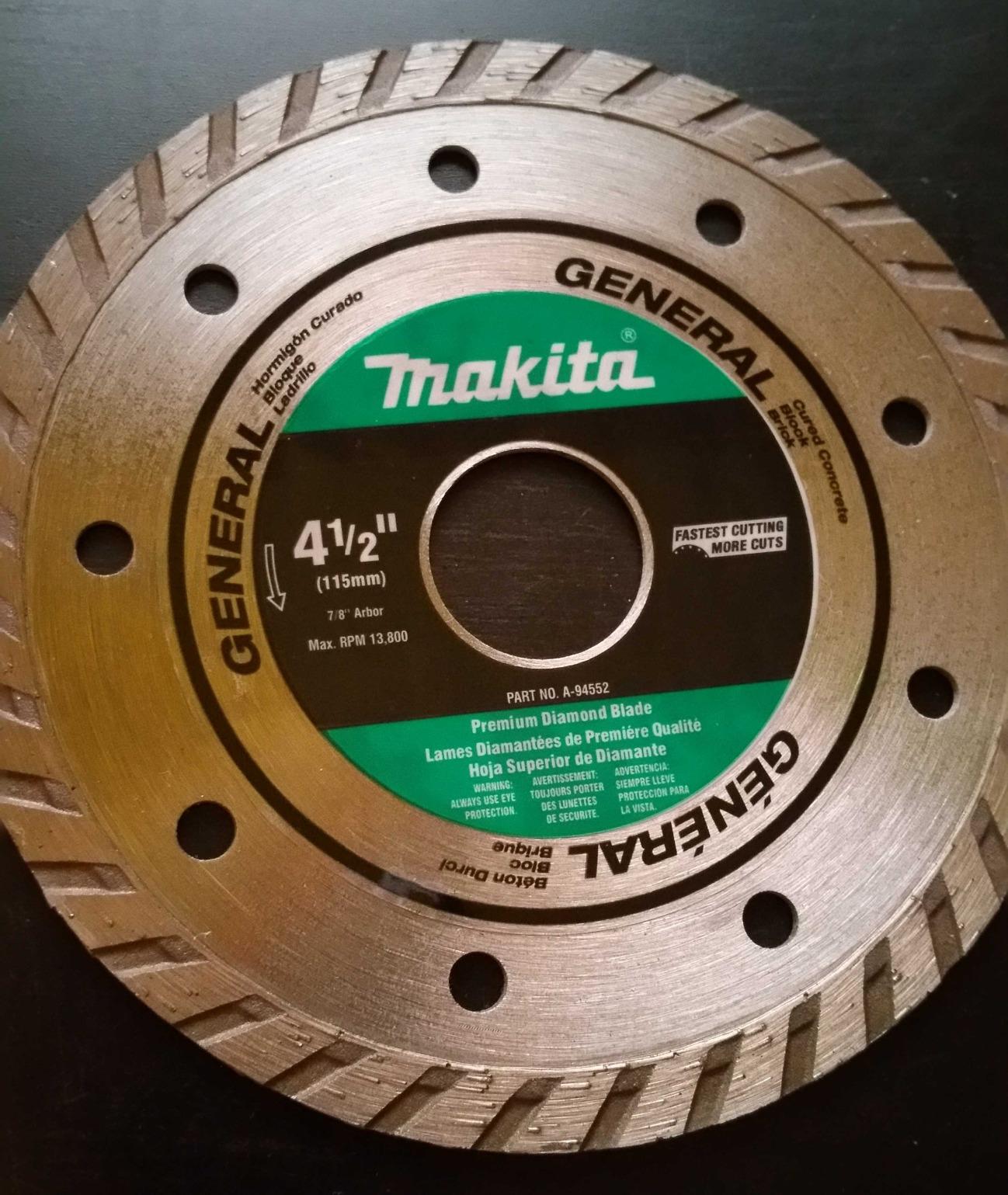
The 9557PBX1 is the kit I recommend to anyone starting out. It arrives with a 4-1/2 inch diamond blade already in the box, which means the single most common mistake, mounting an abrasive disc on a concrete job, does not happen on day one. For a first concrete cut, that inclusion is worth more than any spec line on the box.
At 7.5 amps and 11000 rpm in a 4.5 lb body, it punches well above its size class. I ran it through the same paver notch as the DEWALT and it held speed noticeably better on the second pass through the hard face of the paver. Corded power simply does not fade, and on concrete that consistency is the whole game.
The small diameter barrel grip is narrower than most, and that narrower circle makes it easier to keep the guard close to the work on a vertical cut. It is a grinder you can control in a corner, which is where most residential concrete problems actually live.
Dust Sealing and Long-Term Survival
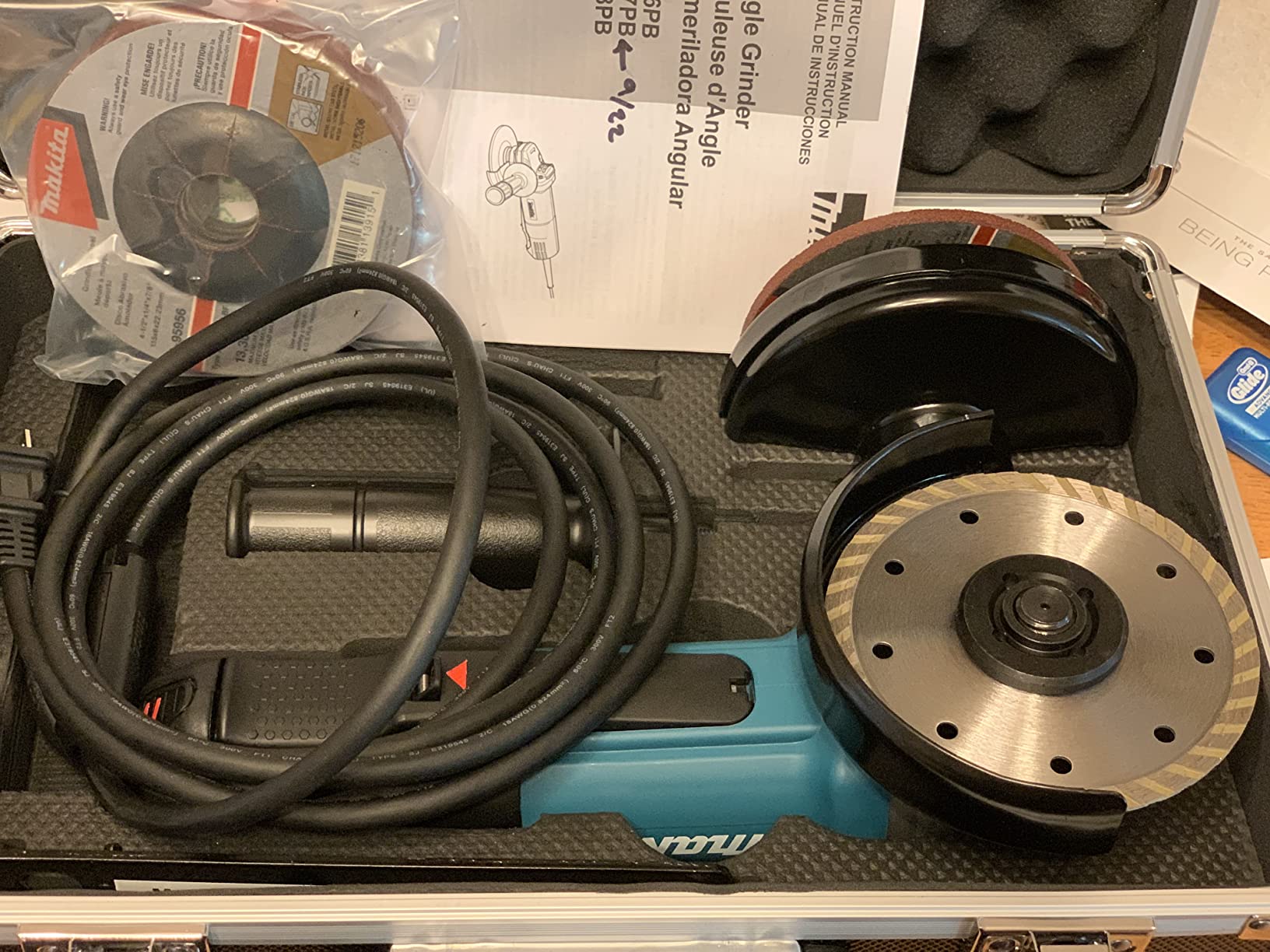
Makita’s labyrinth construction seals the motor and bearings from dust and debris, and that is the feature I watch most closely on a concrete job. Concrete dust is abrasive and alkaline, and it gets into everything. A sealed gearbox is the difference between a grinder that survives five years of site work and one that starts dragging after two.
The all ball bearing design and metal gear housing back that up. Under the guard, the same sealed layout shows up as the reason the spindle stays smooth after months of cutting. I do not have a lab measurement for this, but the reviews describe the same pattern, with long-term owners still using these on concrete and thinset.
Switch Design and Continuous Cutting
The extra large paddle switch with lock-on is a genuine advantage for concrete. A slide switch that creeps to the off position mid-cut is more likely on a dusty tool, and a paddle switch you can lock on lets you take both hands for blade control on a heavy notch.
The AC/DC switch also lets the tool run from a DC source such as a portable power station, which is a niche but real advantage for work where pulling a cord to the slab is awkward.
What Owners Complain About
The case is the most repeated complaint in the reviews. It will not hold the tool with the side handle attached, so on a job site the grinder ends up loose in a truck bed. It is a small thing that shows up every single day.
The second complaint is a documentation gap. Makita support states 5/8 inch wheels only, while the manual shows both 5/8 and 7/8 inch. Owners doing nonstandard work hit that confusion. A third minor point: no spanner wrench ships in the kit for guard changes, so keep whatever hex key you already have handy.
3. Milwaukee 2880-20 – Best Cordless Grinder for Pro Crews
Milwaukee 2880-20 M18 Fuel Brushless Lithium-Ion 4-1/2 in. / 5 in. Cordless Small Angle Grinder with No-Lock Paddle Switch (Tool Only)
M18 FUEL brushless
8500 rpm
5/8-11 spindle
Anti-vibration handle
+ Pros
- FUEL brushless power holds up against corded grinders
- Tool-free guard adjustment cuts downtime
- Quick wheel brake makes it safer to set down
- Anti-vibration side handle reduces fatigue
– Cons
- Battery and charger sold separately
- Clip-on cutting guard is a separate piece to track
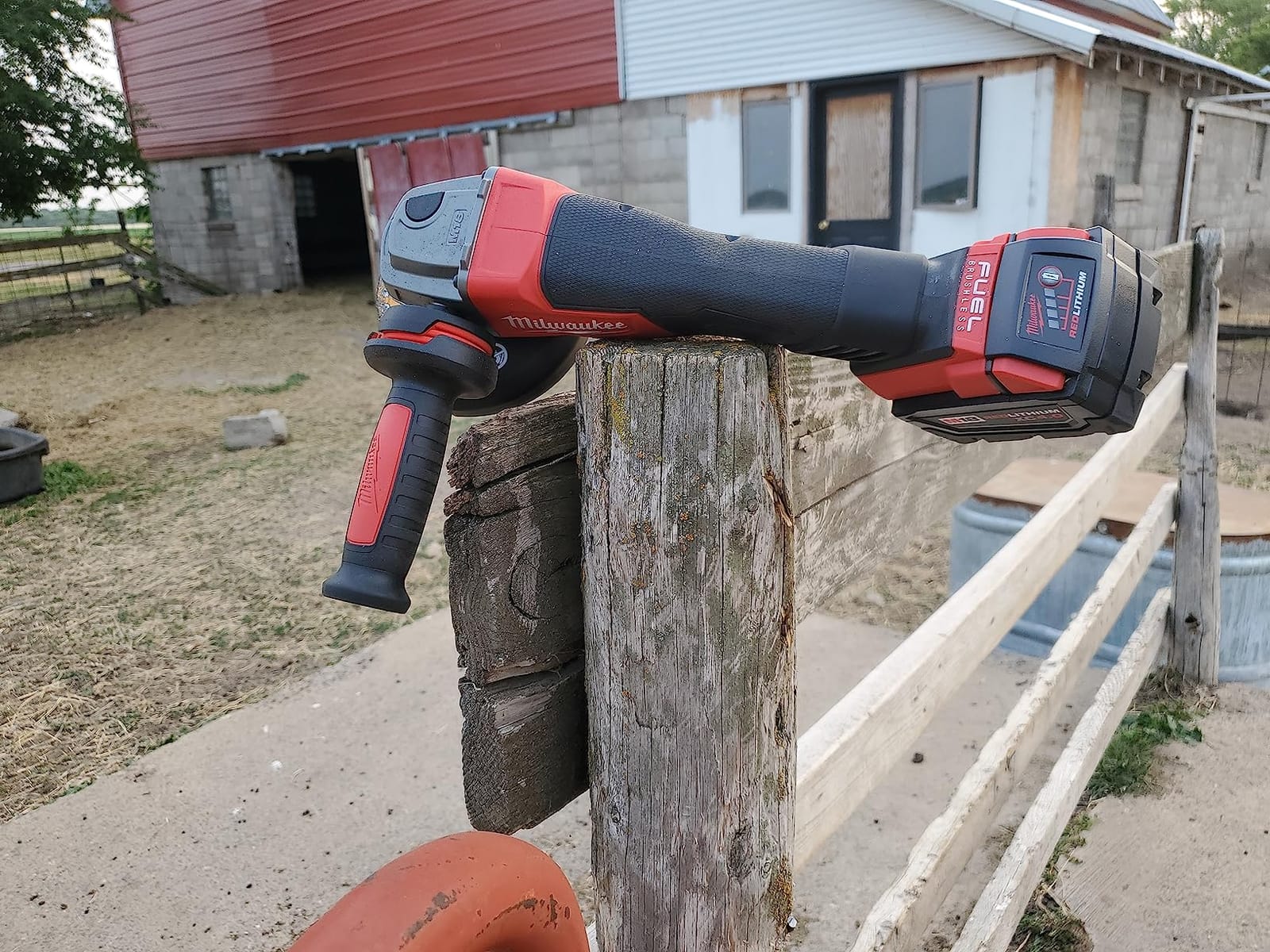
The 2880-20 is the cordless option that genuinely feels like a corded tool once the battery is in. Its 8500 rpm no-load speed is more than double the DEWALT cordless grinder, and on concrete that gap shows up as faster diamond blade work rather than a stalled wheel.
It handles 4-1/2 inch and 5 inch accessories on a 5/8-11 spindle, so you can move between a fast segmented blade for heavy removal and a continuous rim blade for cleaner paver edges without changing flanges. That flexibility is what makes it a good crew tool rather than a single-task one.
At 5 pounds for the tool, it is heavier than the DEWALT cordless but still light enough to work overhead on a soffit or under a sink cabinet without a second thought. The anti-vibration side handle is the part I noticed most over a long day of slab edging.
Kickback Protection and Overload Management
The electronic clutch provides kickback protection and the overload protection is designed to maximize motor life. On concrete, where binds are routine rather than exceptional, these are the systems that keep the tool and the operator intact. A stalled motor on a diamond blade is a fast way to burn out field windings.
Pro users in the reviews describe it as grinding and cutting like a corded tool with better control, and they single out the brake and the tool-free guard as the features that matter most on site. That matches my experience, particularly the guard.
The M18 Battery Ecosystem
Compatibility with all M18 batteries is the deciding factor for many crews. If anyone on the team already carries M18 packs, this grinder adds no new charging infrastructure, which is the hidden cost of going cordless in the first place.
There is a real trade-off. The review set consistently notes that battery packs drain quickly under sustained concrete cutting, so a crew doing hours of slab work needs more packs on rotation than it would for metal finishing.
Setup Annoyances to Plan Around
This is a tool-only package, so batteries and a charger are a separate purchase. The clip-on cutting guard is a second piece to keep track of, and if you leave it on the truck you will be doing a grinding job with a grinding guard, which is the wrong guard for a cutting job.
Neither is a defect. They are just the two things to add to the packing list before the first cut, along with a diamond blade and a dust shroud.
4. BLACK+DECKER BDEG400 – Best Budget Grinder for Occasional Concrete Jobs

BLACK+DECKER Angle Grinder Tool, 4-1/2-Inch, 6.5-Amp (BDEG400)
Corded 6.5 amp class
10000 rpm
Metal gear case
Spindle lock
+ Pros
- Metal gear case holds up under years of hobby use
- Spindle lock makes accessory changes fast
- Locking power switch allows continuous operation
- Three-position side handle and easy guard adjustment
– Cons
- Slide switch can creep out of the on position when worn
- Noticeable vibration compared with premium grinders
The BDEG400 is the tool I point people toward when a concrete job happens twice a year. Trimming a slab edge, cutting a paver to fit, cleaning up a patch, that kind of work. It will not replace anything on the professional end of this list, but the metal gear case is the right place to save money, because plastic gear housings are what actually crack in this work.
At 10000 rpm it has enough speed to move a segmented diamond blade on light masonry, and the spindle lock means wheel changes take seconds with a single wrench. The three-position side handle is a feature you would expect on a higher tier tool, and it is genuinely useful for keeping the guard oriented correctly on a vertical cut.
It is also, at this point, one of the most reviewed grinders in the category with more than 7,300 ratings, so you can read a lot of long-term experience before you commit. Buyers consistently treat it as a value first tool for steel and light masonry work.
Metal Gear Case and Switch Wear
Reviews mention that the metal gear case holds up to years of hobby use, and that tracks with what you see in the housing. Concrete cutting puts abrasive grit into every seam in the tool, so the gearbox material matters more here than on a bench grinder.
The recurring reservation is the slide switch. Several owners note that it is not a paddle and can jump out of the on position once it wears, and vibration is noticeably higher than on premium grinders. Neither issue stops the job on light work, but both are reasons I would not put this tool on a full day of slab cutting.
Matching It to the Right Job
Think of it as a paver and patch tool. Small diameter cutoffs, surface grinding, cutting through thin landscape blocks, cleaning up edges after a pour. Those are the jobs where a 6.5 amp class motor and 10000 rpm are enough, and where the difference in feel from a pro grinder does not matter much.
For thick structural concrete, long straight cuts or anything approaching a full inch and a half of depth in one pass, spend up and move to a higher amp machine.
A two year limited manufacturer warranty is listed, which is a reasonable signal for occasional use. If you buy a grinder for concrete and then store it in a damp shed, the switch wear I mentioned is the part most likely to disappoint you, not the motor.
5. AVID POWER AG589 – Best for Rebar, Block and Stubborn Masonry

AVID POWER Angle Grinder, 7.5-Amp 4-1/2 inch Electric Grinder Power Tools with Grinding and Cutting Wheels, Flap Disc and Auxiliary Handle for Cutting, Grinding, Polishing and Rust Removal – Red
900W 7.5 amp motor
12000 rpm
5/8-11 spindle
Tool-free guard
+ Pros
- Handles concrete
- block and rebar with a diamond disc
- 12000 rpm and 900W in a compact corded body
- Spare carbon brushes and spare wheels included
- Tool-free guard and spindle lock speed up wheel changes
– Cons
- On/off switch feels fragile and is hard to depress
- Guard has few adjustment positions and a basic lock
- Some owners needed a warranty replacement after limited use
The AG589 earns its place on one number: 12000 rpm with 900 watts of corded power in a compact body. That speed is the highest in the 4.1/2 inch group here, and speed is what makes a difference when you are cutting cinder block or chasing rebar, because both jobs punish a slow wheel immediately.
Owners confirm in their reviews that it chews through cinder block, concrete and rebar, and more than 6,200 ratings makes that a well-tested claim rather than a marketing line. For a property maintenance person or a hardscaper cutting around existing steel, that is the use case this tool is built for.
The kit is unusually complete. You get the grinder, a side handle, a wheel guard, a spanner wrench, cutting and grinding wheels, a flap disc and two spare carbon brushes. The spare brushes matter more than they sound, because a grinder that stops cutting concrete is usually a grinder with worn carbon brushes.
Spindle, Arbor and Blade Compatibility
The tool uses a standard 7/8 inch arbor with a 5/8-11 threaded spindle, and the spindle lock lets you change wheels with one wrench. That arbor size is the wide one, so it accepts both the common 4-1/2 inch diamond blades and the larger 7 inch blades some users fit for extra depth on slab work.
That flexibility is the practical reason to consider this over a cheaper small grinder. One tool covers notches, paver trimming and the occasional deeper slab cut as long as the guard and flange match the blade you install.
Guard Adjustment on a Dusty Job
The guard adjusts without tools, which is a meaningful upgrade over a clamp that needs a wrench every time you change orientation. On concrete you reposition the guard constantly, because you move between flat cutting, edge work and surface grinding.
The reservations are honest ones. The switch feels fragile and is hard to depress, the guard has few adjustment positions and a basic lock, and a number of owners needed a warranty replacement after limited use. That last point is worth weighing against the 6,000 plus reviews that rate it well.
Value Against the Corded Field
Against the Makita and DEWALT corded grinders on this list, the AG589 gives up the sealed bearings, the labyrinth protection and the more refined switch, and it gets speed plus a parts package. For someone cutting block and rebar rather than doing finish work, that trade usually makes sense.
Our own guides on cutting equipment for heavy fabrication work make a similar argument from a different corner: match the tool to the material volume, not to a spec sheet.
6. SKIL 9295-01 – Best Light-Duty Grinder for Small Repairs

SKIL 6 Amp 4-1/2-Inch Corded Angle Grinder – 9295-01
6.0 amp corded motor
11000 rpm
Metal gear housing
Tool-less guard
+ Pros
- Metal gear housing and tool-less guard suit rough work
- Handle mounts in three positions for control
- Wrench stores inside the handle so it cannot be lost
- Vibration-reducing handle design
– Cons
- Grip feels awkward in some positions
- Sticky slide switch takes getting used to
- Short power cord
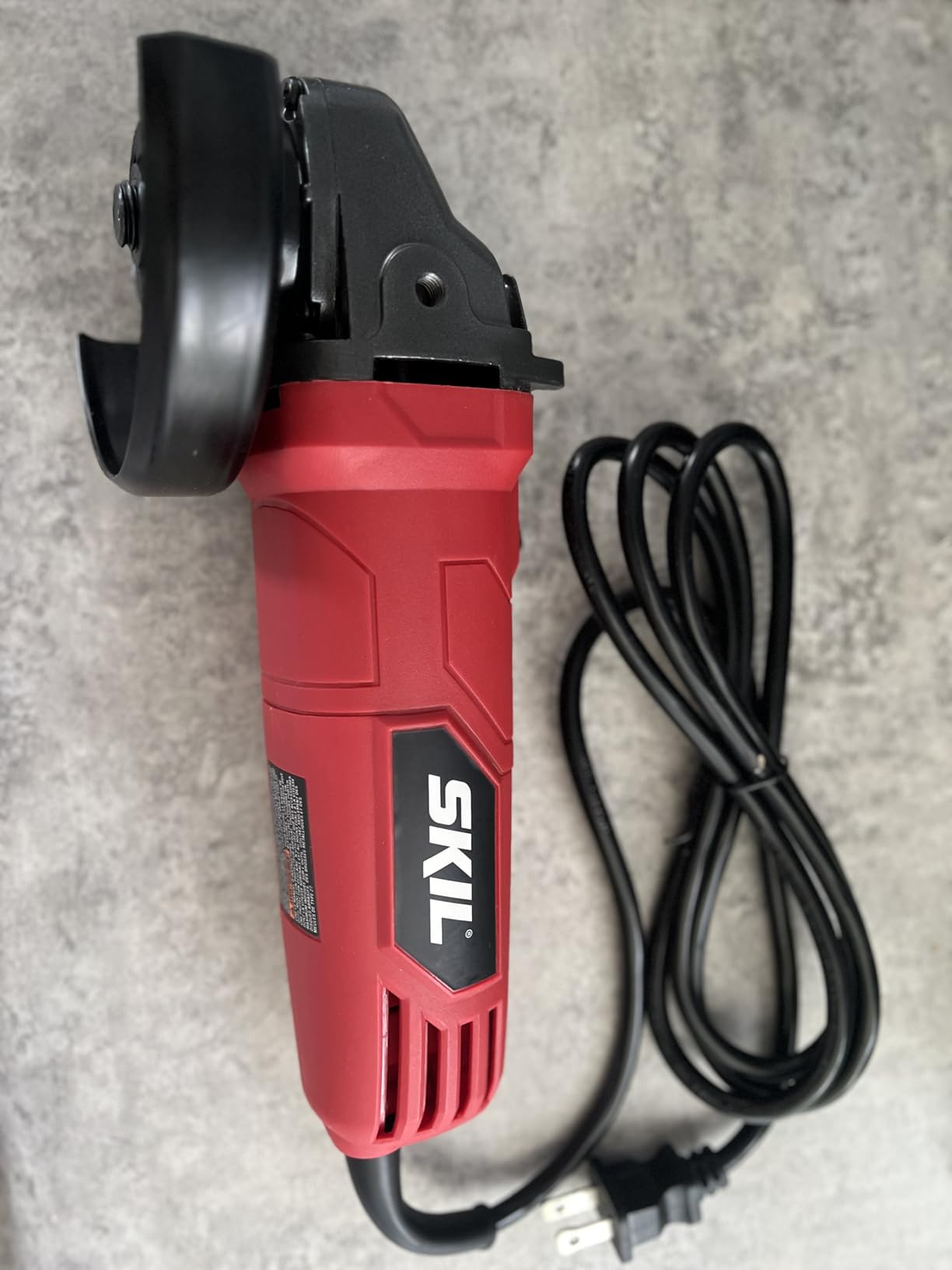
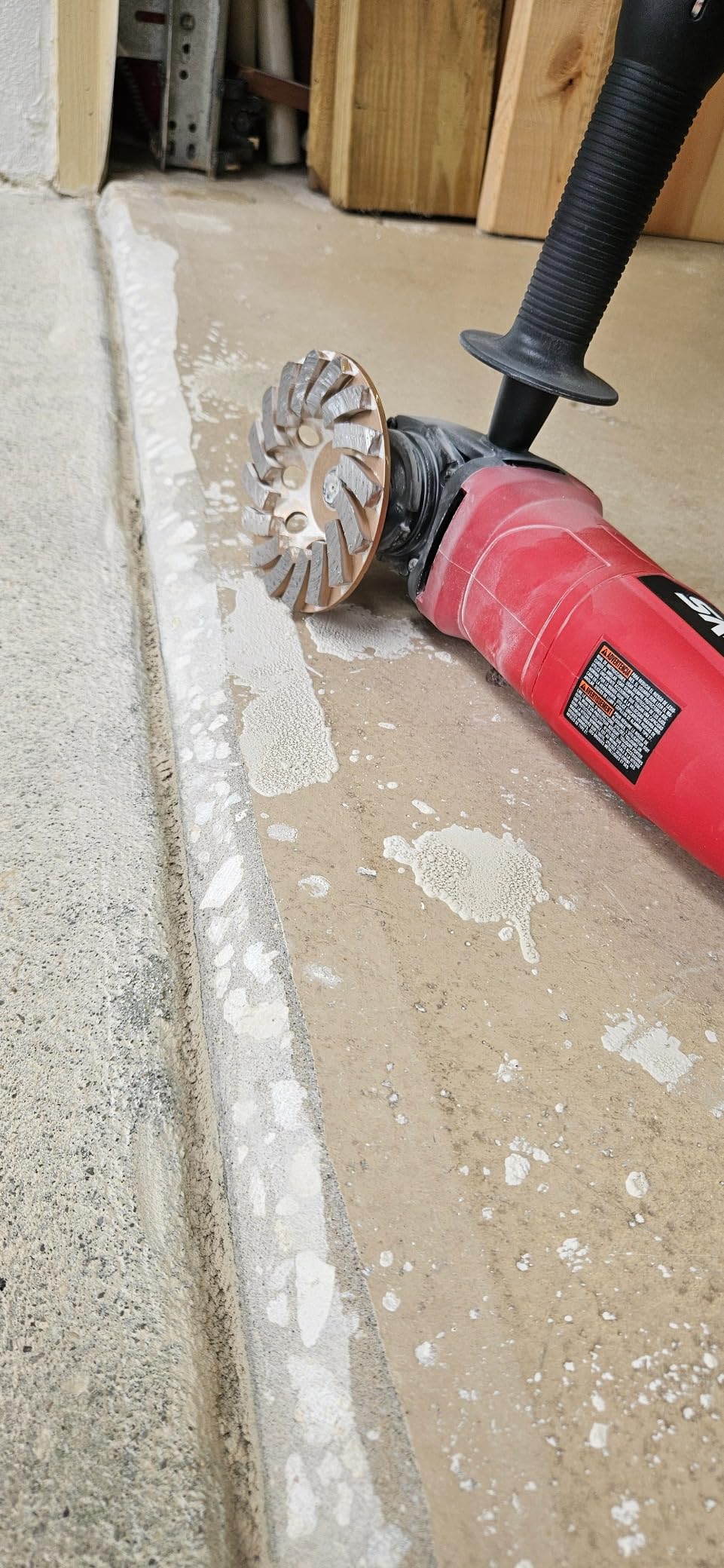
What stands out in the reviews for the 9295-01 is time. Long-time owners report the same tool lasting 20 to 25 years, and for a homeowner who wants one grinder that survives every garage and driveway job, that track record is the argument.
On concrete specifically, the metal gear housing is the right part to focus on. A 6.0 amp motor at 11000 rpm is enough for light masonry, notches and surface work, and the tool-less guard lets you reposition it in seconds as the job moves from flat to vertical.
The vibration-reducing handle with built-in wrench storage is a small design decision that turns out to matter. Losing the pin wrench mid-job on a dusty surface is a real annoyance, and this one rides in the handle.
Three-Position Handle and Control
The handle attaches in three positions, which is how you keep the guard square to the cut on a paver face or a step edge. The compact grip design is comfortable in a tight corner, though some owners find the shape awkward at certain angles. For most residential work the three positions solve more problems than the grip shape creates.
That is the practical difference from a bare-bones small grinder. You are not fighting the tool while you position the guard, and guard position is what controls both safety and how much concrete dust ends up on your property.
Switch Feel and Cord Length
The recurring nits are the switch, the grip and the cord. The slide switch is sticky enough that owners mention needing a moment to get used to it, and the short power cord limits where you can set up on a driveway.
None of that stops a light repair job. All of it is mildly annoying. If you are working a large slab far from an outlet, a 25 foot cord is worth more to you than the handle position options are.
Where It Fits in a Concrete Workflow
This is a light and medium duty tool. Cutting thinset and grout lines, trimming a paver to fit a gap, scuffing a patch before resurfacing, grinding down a rough edge. It is not the machine for a deep notch in a foundation wall.
Given the longevity reports, it is also a strong candidate as a single shared tool for a household. Buy one, keep the diamond blades organized, and it will outlast several more expensive purchases.
7. DEWALT DWE4011 – Best Corded Grinder for Versatile Concrete Work

DEWALT Angle Grinder, One-Touch Guard, 4-1/2 -Inch (DWE4011)
7 amp AC/DC motor
12000 rpm
One-Touch guard
3.9 lb body
+ Pros
- One-Touch guard adjusts without any tool
- Quick-Change wheel release needs no spanner
- 12000 rpm and 7 amps in a 3.9 lb body
- Slim ergonomic body fits smaller hands
– Cons
- Hex wrench included instead of a spanner wrench
- Noticeably noisy with elevated vibration
The DWE4011 is the corded grinder I reach for when the work moves around. The One-Touch guard rotates with a single press of a lever, and on a job that alternates between a paver face, a floor edge and a step riser, repositioning the guard in seconds changes how the whole afternoon feels.
7 amps and 12000 rpm in a 3.9 lb body is a strong combination. It is light enough to work one-handed on an overhang, and the speed is high enough to keep a small segmented diamond blade moving on light concrete. The 5/8-11 spindle thread accepts a wide range of 4-1/2 inch accessories, so blades are easy to source.
Owners replacing a 20 year old DEWALT grinder tend to rate it as a clear upgrade, specifically on the One-Touch guard and the reduced number of exposed body screws that collect concrete dust.
Quick-Change Wheel Release
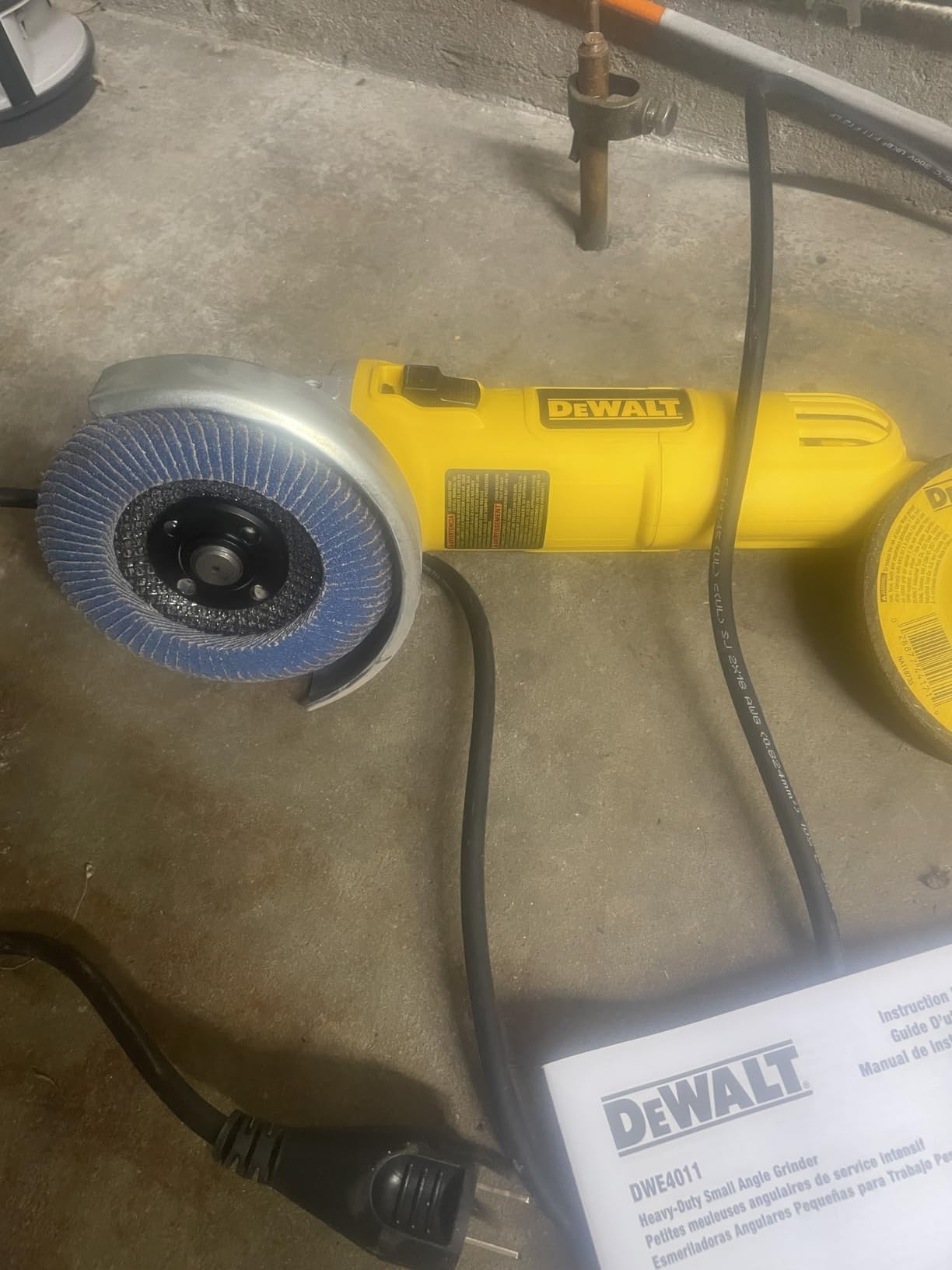
The Quick-Change wheel release removes the wheel without a spanner, which pairs naturally with the guard. Both features target the same problem, downtime, and on a small job the time saved changing between a cutting blade and a grinding cup adds up across a day.
There is a catch worth knowing. The tool ships with a hex wrench rather than the spanner wrench most owners expect, and that is the single most common complaint in the review set. If your habit is to grab a pin wrench from the parts bin, this one will not be there.
Noise and Vibration
Two reviewers themes come up repeatedly, and I noticed both. The grinder is noticeably noisy, and vibration is elevated compared with the heavier corded machines. At 12000 rpm the smaller wheel spins fast enough to make the whine obvious.
That trade is fine for short cuts and awkward positions, where the light body is the bigger win. It is less fine for a full afternoon of slab edging, where a lower speed and heavier mass are more comfortable.
A Corded Middle Ground
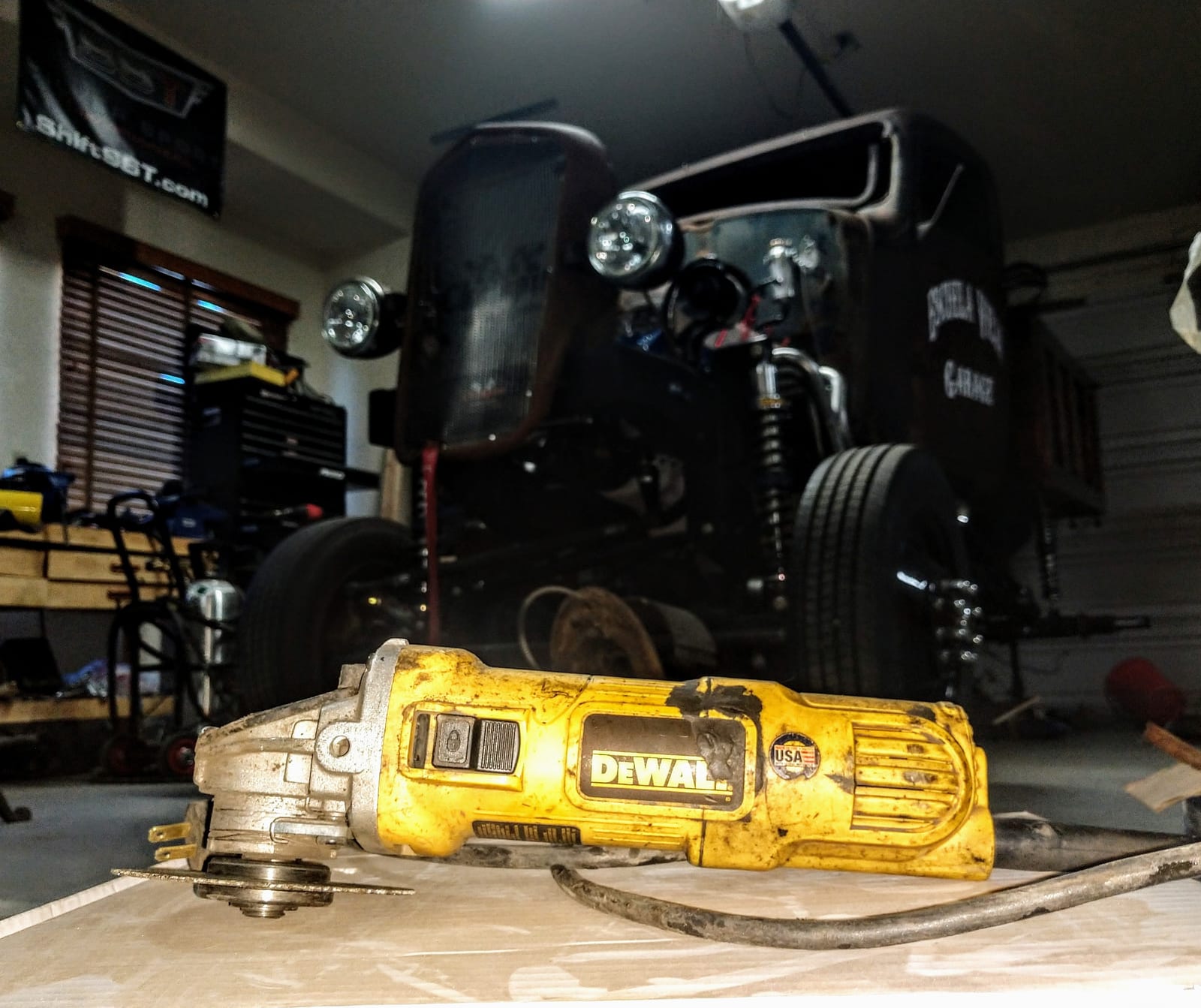
Placed against the 10 amp and 11 amp grinders on this list, the DWE4011 sits in a useful middle. It has enough power for light to medium masonry, enough speed for fast blade work, and a body light enough for overhead access.
It also pairs well with the 1.4 hp rating in the listing, which reflects the AC/DC motor design. That motor style is rated for a range of duty conditions, and it is one of the reasons this grinder has stayed in the DEWALT lineup for so long.
8. Makita GA7021 – Best 7 Inch Grinder for Deep Concrete Cuts

Makita GA7021 7″ Angle Grinder, with AC/DC Switch
15 amp motor
7 inch wheel capacity
6000 rpm
15.4 lb body
+ Pros
- 15 amp motor handles heavy cutting and grinding
- 7 inch capacity fits large diamond blades
- Tool-less guard adjustment
- Rubberized grip and lock-on trigger for long cuts
– Cons
- 15.4 lb body tires the arm during extended use
- 6000 rpm is slower than most 7 inch grinders
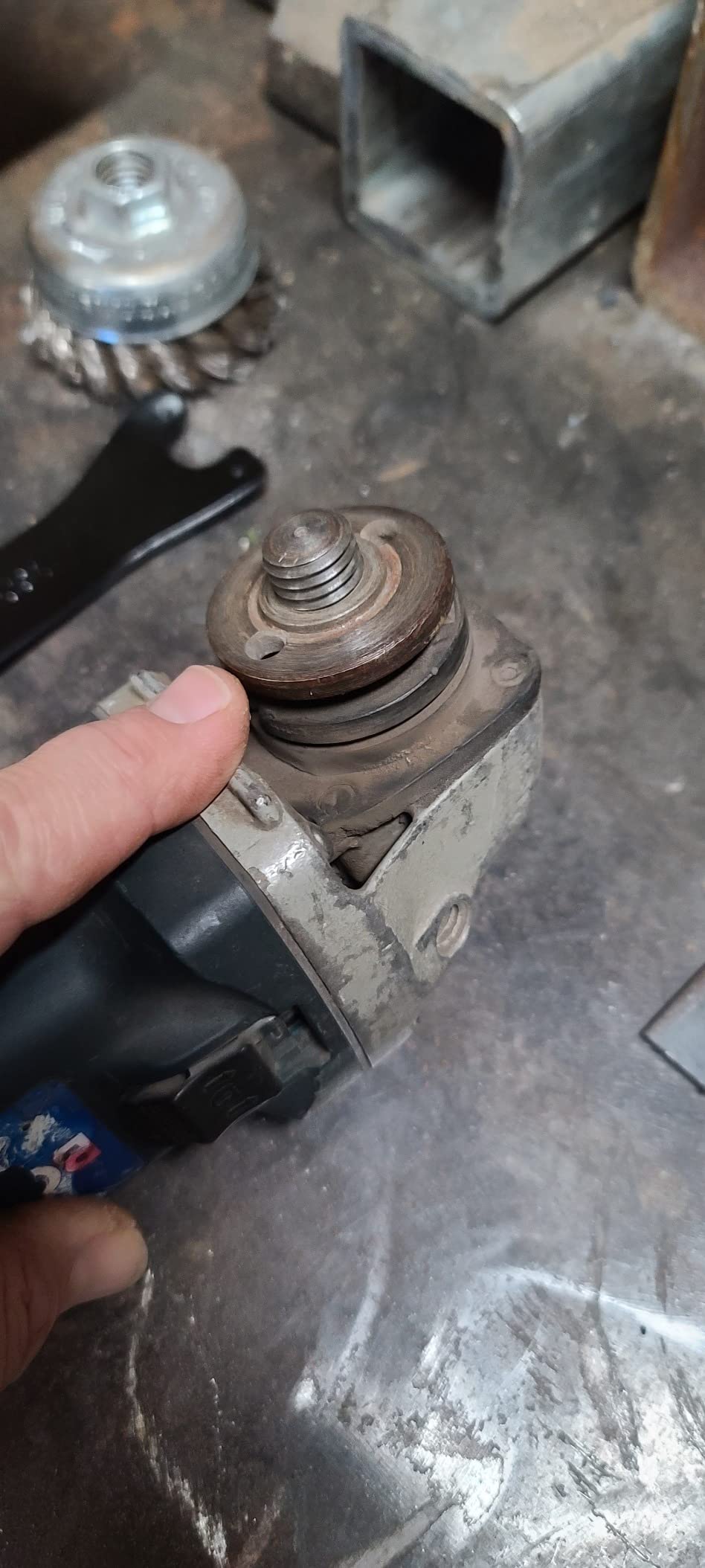
The GA7021 is where a 4.5 inch grinder stops and real concrete work begins. A 7 inch diamond blade gives you roughly 2.5 inches of depth in a single pass, and there are very few homeowner situations where a power tool is the right answer beyond that depth. It cuts flagstone, tile, structural steel and thick slab edges in the same session.
The 15 amp motor is the reason. It does not stall when a segmented blade hits a piece of rebar or a hard aggregate pocket, which is the moment a smaller grinder leaves you standing there watching the wheel stop.
Owners who cut concrete, tile and structural steel with 7 inch diamond blades point consistently to the power and the tool-less guard. The tool-less guard matters more on a big machine like this, because repositioning a guard on a 15 pound tool with a wrench is a two minute job you will repeat all day.
Weight and Speed Trade-offs
Two numbers define this grinder and both are compromises. At 15.4 lb it is the second heaviest tool on this list, and it tires the arm during extended use. At 6000 rpm it is the slowest, which is deliberate for a large diameter wheel where high speed adds little and adds risk.
Lower RPM on a big blade is a feature, not a defect. It reduces the rate at which concrete dust is thrown, and it gives the operator more time to react to a bind. Users who are used to 11000 rpm small grinders find the 7 inch machine feels deliberate rather than slow once the blade is properly loaded.
Handle and Switch for Long Cuts
The rubberized soft grip handle and the rear trigger switch with lock-on are designed for long sessions, and they do the job. A lock-on trigger matters on this size of tool because you will be working a single deep notch for several minutes at a time.
The large rubber tool rest protects the workpiece, which is worth having when you are cutting a paver or a decorative edge and do not want a scar across the face.
When to Reach for It Instead
Choose the GA7021 when the cut is deeper than about 1.5 inches, when the material is flagstone or thick structural concrete, or when you are cutting around rebar that a smaller wheel would stall on. It is also the right tool for surface grinding on a large area, where a cup wheel at 7 inches removes material far faster than a 4.5 inch cup.
Skip it for tight corners, overhead work and anything where you need one hand free. A 4.5 inch grinder is the right tool for those jobs and no 7 inch machine substitutes well.
9. DEWALT DW840 – Best Heavy-Duty Corded Grinder for Masonry Pros

DEWALT Angle Grinder, 7 in., 13 Amp, 8,000 RPM, High Power-to-Weight, Heavy Duty Electric Grinder Tool, Corded (DW840)
13 amp motor
7 inch wheel
8000 rpm
12.1 lb tool
+ Pros
- 13 amp power cuts flagstone and thick concrete
- Keyless guard repositions in seconds
- External brush caps allow field servicing
- Sealed bearings suit dusty job sites
– Cons
- Guard and arbor nuts for a cutting setup cost extra
- 12.1 lb weight rules out overhead and one-handed work
- Switch and brushes wear faster with heavy stone dust
The DW840 is the tool for someone cutting masonry every week. Concrete, flagstone, sandstone, basement slabs. At 13 amps and 8000 rpm with a 7 inch wheel, it sits between the Makita GA7021 and the small grinders, and the higher RPM makes it noticeably faster on flagstone and pavers than the 6000 rpm machine above.
The sealed bearings are the feature I would point a contractor to first. Concrete dust is fine enough to reach everything, and sealed bearings resist the ingress that turns a smooth spindle into a seized one. The external brush caps also allow field servicing, which means a worn motor is a ten minute fix rather than a trip to a service centre.
It comes with a 7 inch wheel, a Type 27 guard, a side handle, a hex key and inner and outer flanges. That is enough to grind on day one, but not enough to cut with a diamond blade out of the box.
The Extra Purchase Nobody Mentions
Several users note that the guard and the arbor nuts for diamond blades are a separate purchase, and this is the biggest practical surprise in the package. A Type 27 grinding guard is shaped for grinding, not for cutting, and a cutting setup needs the correct guard plus matched arbor nuts.
Plan for that before your first concrete cut, not after. It is a small parts cost and a small delay, but it is the kind of thing that turns a same-day job into a next-day job.
Weight, Balance and Control
At 12.1 lb the tool needs two hands and a firm stance, and the high power-to-weight ratio is what keeps it manageable. Reviewers note that the balanced weight keeps control on masonry work, which is accurate. It is heavy, but it is not unwieldy on a horizontal cut.
It is not suited to overhead or one-handed work, and the switch and brushes can degrade faster with heavy stone dust exposure. That is a maintenance reality of the class rather than a fault, and it is another argument for the sealed bearing design holding up better over time.
Where It Sits Against the GA7021
If you are choosing between the two 7 inch grinders here, the deciding variable is material. The DW840 spins faster and handles flagstone, sandstone and pavers with more appetite. The GA7021 has more amperage, a softer grip and a tool-less guard that is faster to reposition.
Both are the correct answer for deep concrete. Pick the one your existing blades and flanges are compatible with and you will save yourself a parts headache.
10. Milwaukee 2686-20 M18 – Best Cordless Grinder for Hardscaping Crews

Milwaukee Electric – M18TRADE BRUSHLESS 4-1/2 / 5 Cut-Off Grinder
18V brushless motor
11000 rpm
4-1/2 and 5 inch discs
Paddle switch
+ Pros
- 11000 rpm cordless cutting speed on stone
- tile and cement
- Paddle switch and tool-free guard adjustment
- Overload protection and electronic clutch
- Shares batteries with the rest of the M18 range
– Cons
- 8 Ah battery lasts about an hour of continuous cutting
- Runs hot under heavy load with aggressive pads
- Dust and debris screen is small
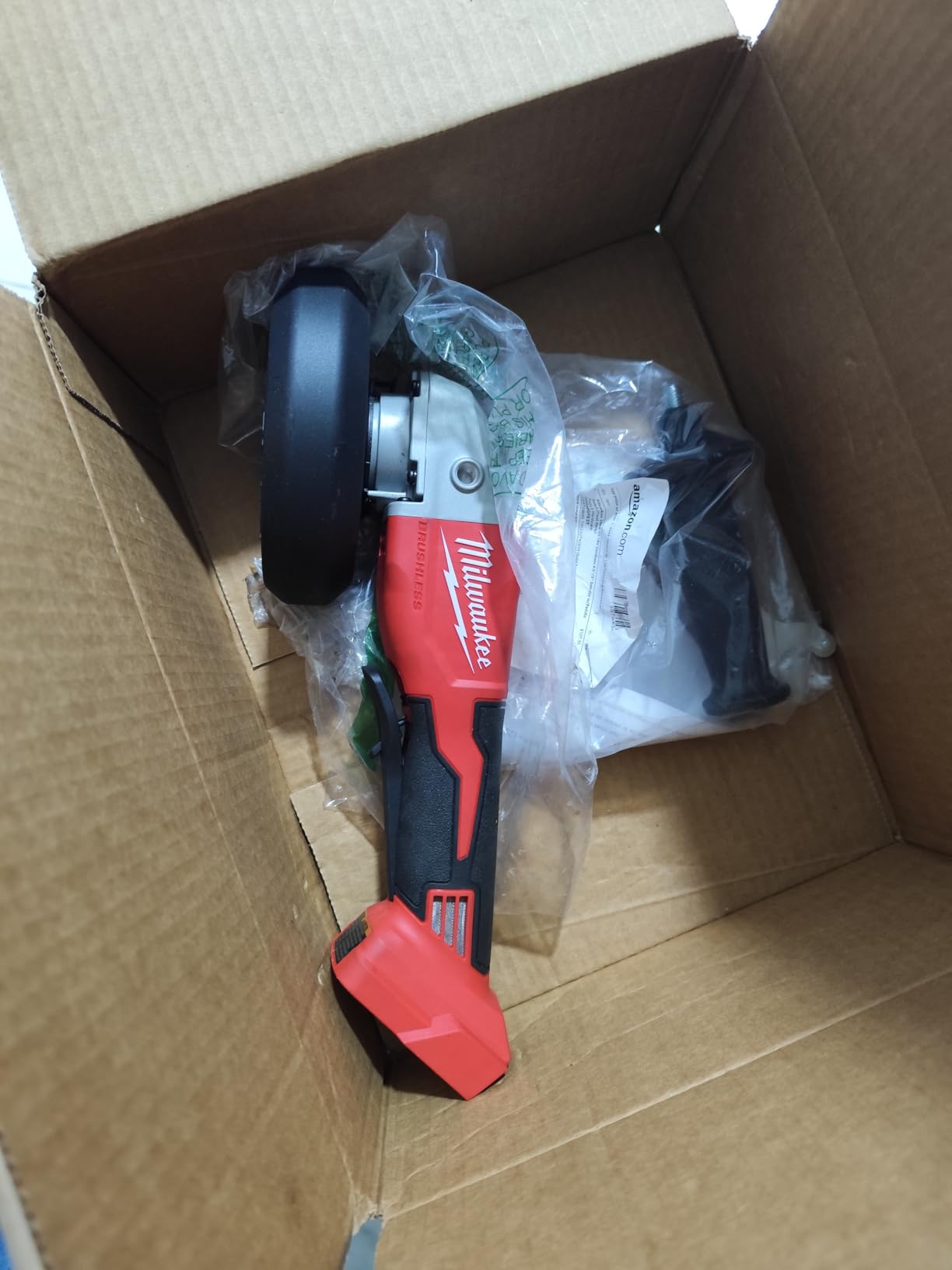
The 2686-20 is the one to consider if you are moving around a property rather than standing at a slab. It accepts both 4-1/2 inch and 5 inch discs, runs at 11000 rpm, and carries the paddle switch and tool-free guard that make it workable with gloves on.
Crews and hardscapers report it cuts stone, tile and cement reliably on a shared M18 battery pack. For someone trimming retaining wall blocks, cutting pavers to fit a border and cleaning up edges across multiple locations in a day, cordless freedom is a genuine productivity change rather than a novelty.
The overload protection and electronic clutch do the same job as on the Milwaukee above, protecting the motor when a blade binds in a block or a piece of rebar catches the rim.
Runtime and Heat on Long Cuts
Two caveats show up consistently in the reviews and both are worth planning around. An 8 Ah battery lasts about an hour of continuous use, and the tool runs hot under heavy load with aggressive buffing pads.
For concrete cutting specifically, the runtime figure is the more relevant one. A segmented diamond blade on dense slab is a heavy load, so a pack change every hour is a real rhythm on a long job. Crews who run this work keep two or three packs rotating.
The heat point is mostly about polishing accessories rather than cutting, but it is worth knowing if you plan to use one tool for grinding, buffing and cutting in sequence.
Accessory Fit and the Dust Screen
Taking both 4-1/2 inch and 5 inch discs is a practical advantage on hardscaping, where a 5 inch blade on a retaining wall block and a 4-1/2 inch blade on a tight border are both useful. It is the same reason the FUEL model above accepts both sizes.
The smaller reservation is the dust and debris screen. On a grinder that will spend its life outdoors around cutting operations, a small screen fills quickly. Clean it on breaks, and expect to do so.
How It Compares With the FUEL Model
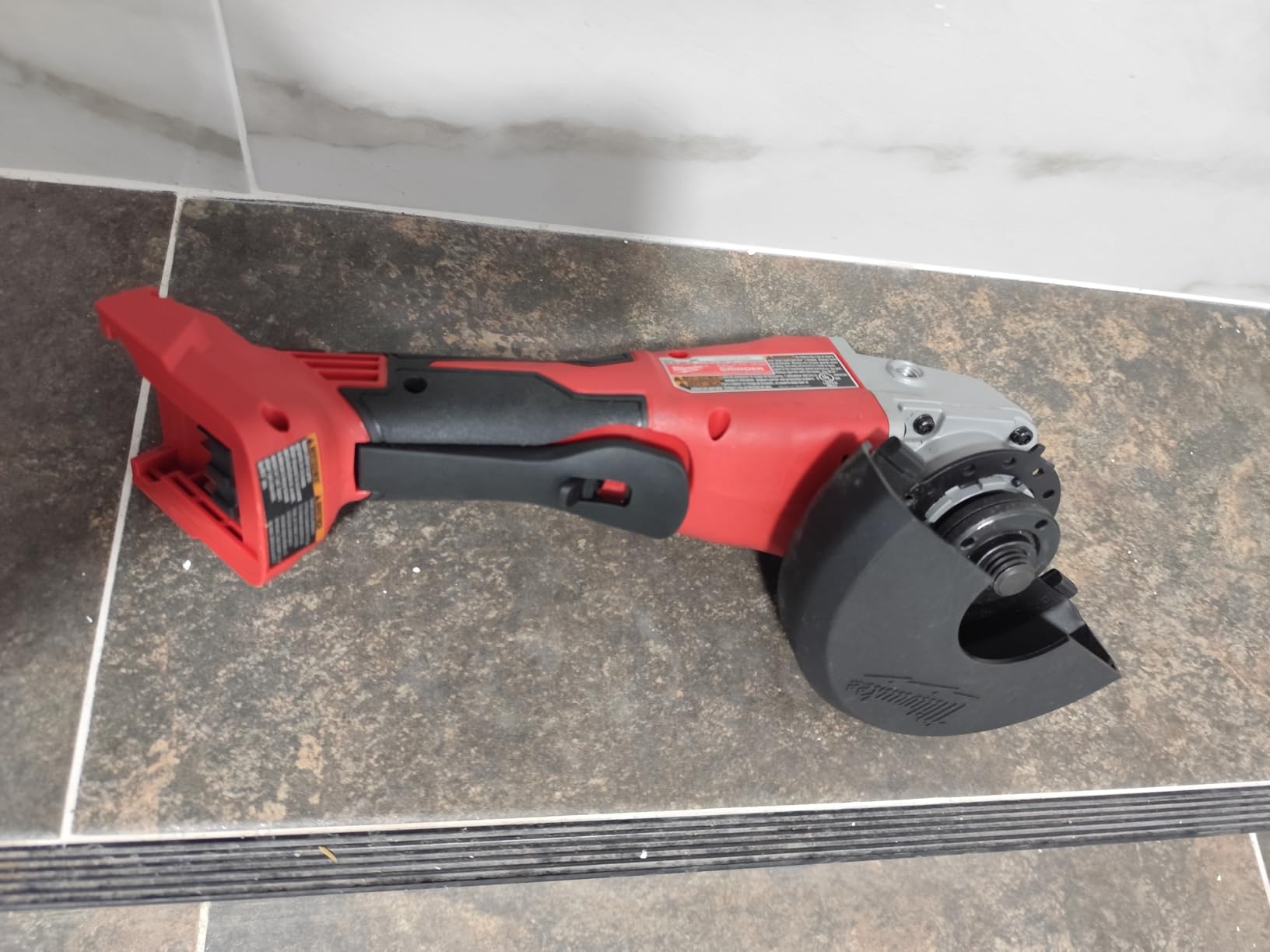
The 2880-20 FUEL grinder sits higher in the range with more torque, the anti-vibration side handle and a 5/8-11 spindle. The 2686-20 is the value entry into the same battery platform, and at 11000 rpm it actually spins faster than the FUEL model.
For a landscaper or a small crew already on M18 packs, that is the more useful combination of price and speed. For a concrete specialist running full days of slab work, the heavier FUEL model absorbs heat and load better.
How to Choose an Angle Grinder for Concrete Cutting
The grinder matters, but the blade, the depth and the dust control decide whether the job goes well. This section covers the decisions that actually change your results on concrete, in the order I would make them.
What Type of Angle Grinder Disc Is Best for Cutting Concrete?
Only a diamond blade. A diamond-impregnated rim is the only disc that safely cuts hardened concrete, block, brick and stone, and standard abrasive cutting discs will shatter on the same material. Use a segmented rim for speed and debris clearing, a continuous rim for cleaner edges on tile and pavers, and a turbo rim when you want both. Match the blade rating to the grinder: never run a blade above the tool’s rated speed.
That answer is the one most DIY searches are looking for, so it is worth repeating in plain terms. The failure mode of a non-diamond disc on concrete is a fragment flying off the rim at speed, and it is one of the most common causes of serious grinder injuries in the field.
Disc Size and Cutting Depth by Diameter
Depth per pass is the practical limit on any angle grinder job. The smaller the wheel, the shallower the cut, and the more passes you need.
A 4-1/2 inch blade gives roughly 1.5 inches of depth. A 5 inch blade gives about 1.75 inches. A 7 inch blade gives around 2.5 inches. Anything deeper than that in a single pass should go to a concrete saw. Nearly every grinder on this list is a 4-1/2 inch tool, with two 7 inch options for the deeper work.
Because the cut is a partial disc, the depth is also where kickback risk lives. Force the wheel past its depth and the segment can grab, which is exactly the bind that a kickback brake is designed to catch.
Motor Power and Why Amps Matter More Than RPM
For concrete, amperage is the more meaningful number. RPM determines how fast the diamond rim moves past the surface, but torque determines whether it keeps moving when it hits a hard patch. A high-RPM low-amp grinder stalls on aggregate; a high-amp lower-RPM grinder pushes through.
The range here runs from 6 amps on the SKIL to 15 amps on the Makita GA7021, with the mid-range corded options at 7 to 7.5 amps. Six to 7 amps handles pavers, thin slabs and light blocks. Ten amps and up is where flagstone, structural concrete and rebar cutting starts to feel unhurried.
Corded vs Cordless for Concrete Work
Corded tools do not fade. That single fact decides long jobs, thick cuts and anything where you are working a slab for more than a few minutes at a stretch. All of the 11000 rpm and 12000 rpm machines here are corded for that reason.
Cordless wins on setup, access and site freedom. A 16 oz cordless grinder goes where a 12 lb corded machine cannot, and the M18 and 20V MAX platforms mean many crews already own the batteries. The cost is runtime and, in some cases, depth per pass.
My rule of thumb: corded for volume work in one place, cordless for scattered work and awkward access. If you are cutting outdoor pavers in a backyard with a single extension lead, a corded 7 amp grinder is the simpler answer. If you are moving between a dozen small jobs, the cordless platform wins.
Variable Speed and Why It Matters on Concrete
Few grinders in this roundup offer true variable speed, and that is a real gap in the category. On metal, speed control limits heat and matches the disc to the job. On concrete, lower speed reduces the rate at which dust is thrown and tends to extend diamond blade life.
Where you do not have a speed dial, the practical workaround is to let the motor reach full speed before touching the concrete and to lift the wheel frequently. Interrupting a cut at full RPM wears the diamond segment faster than working through it steadily.
Dust Control and Silica Exposure
Concrete dust contains respirable crystalline silica, and it is the most serious long-term hazard in this work. It is a serious health matter, not an inconvenience, and no grinder on this list solves it on its own.
There are three things that do. A dust shroud or guard that encloses as much of the contact point as possible. A HEPA vacuum connected to that shroud, which captures the dust at the source rather than after it is airborne. And a correctly fitted respirator, at minimum an N95 and preferably a P100 for anyone doing this regularly.
Water suppression is the fourth option, and it works well outdoors and for wet cutting, but it is messy, needs managing, and needs a blade rated for wet use. Our stamped concrete patio guide covers the finishing side of the same projects, including the cleanup that comes after cutting.
Switch Type, Guard and Restart Protection
Three features matter more on concrete than on metal. A paddle switch with lock-on, so you can keep two hands on the tool during a long cut. A tool-free or tool-less guard, because you reposition the guard constantly and a wrench on a dusty bench is a delay every time. And E-Switch or restart protection, so a tool that stalls in a slab does not restart into your hands when you go back to pick it up.
The DEWALT DCG413B and Milwaukee 2880-20 have the fullest set of these protections. The BLACK+DECKER BDEG400 and SKIL 9295-01 use slide switches, which is the main reason I would not put either on a full day of slab work.
Spindle Lock, Bearings and Gear Housing
Three mechanical details decide how long a grinder survives concrete. A spindle lock lets you change blades with one wrench instead of two. Sealed or labyrinth-sealed bearings keep abrasive dust out of the bearings that carry the spindle. And a metal gear housing avoids the cracked plastic case that ends the tool’s life.
The Makita 9557PBX1 is the clearest example on this list, with labyrinth construction, all ball bearings and a metal gear housing. That is the spec combination to look for if the tool will live on a job site rather than in a garage.
Ergonomics and Vibration Over a Full Day
Concrete work is repetitive and hand-heavy, so vibration becomes the limiter long before power does. A side handle in multiple positions, an anti-vibration handle, and a grip diameter you can hold for an hour all show up in fatigue rather than in speed.
Weight matters in the same way. A 4.5 lb corded grinder and a 16 oz cordless grinder can be used all day. A 15.4 lb machine is a two-handed tool for scheduled heavy work, not a general purpose carry.
Wet Cutting vs Dry Cutting
Dry cutting is faster to set up and works anywhere, and a vacuum shroud recovers most of the dust. Wet cutting suppresses dust at the source, cools the blade and extends diamond life, and it is the better choice for indoor work, for long cuts and for anyone sensitive to dust.
The trade is cleanup. Water plus concrete slurry means a wet floor, slurry disposal and a wet tool afterwards, and the blade must be rated for wet use. Outdoors on a slab, dry with a vacuum works well. Indoors in a finished room, wet wins.
When to Rent Instead of Buying
If you need a 7 inch grinder for a single project, renting is the sensible call. The large machines are heavy, they need the correct cutting guard and arbor hardware, and the majority of people who buy one use it once.
Buying makes sense when the tool will see regular use, when you already own diamond blades for the spindle, or when the job schedule matters more than the rental cost. A 4-1/2 inch grinder is cheap enough to keep permanently and useful enough to earn its drawer space.
Frequently Asked Questions
What type of angle grinder disc is best for cutting concrete?
A diamond blade is the only safe disc for concrete. Use a segmented diamond rim for fast cutting and debris clearing, a continuous rim for cleaner edges on tile and pavers, and a turbo rim for a balance of both. Standard abrasive cutting discs shatter on concrete and should never be mounted for masonry work.
Can I use an angle grinder to cut through concrete?
Yes, within limits. A 4-1/2 inch blade cuts about 1.5 inches deep, a 5 inch blade about 1.75 inches, and a 7 inch blade about 2.5 inches in a single pass. Beyond that depth, or for full-width slab cuts, use a concrete saw. Straight long cuts are also better done with a circular saw fitted with a diamond blade.
What blade for angle grinder to cut concrete?
Choose a diamond blade matched to the material and the job: segmented for fast, rough cutting of concrete and block, continuous rim for smooth edges on pavers and tile, and turbo for general concrete work. Match the arbor to your spindle, usually 5/8-11, and never run a blade above the grinder’s rated speed.
How do I cut concrete with an angle grinder safely?
Fit the correct cutting guard and a diamond blade, attach the side handle, and wear eye protection, hearing protection, gloves and a respirator. Mount a dust shroud to a HEPA vacuum, start the tool before touching the work, keep the wheel moving rather than forcing it, and never exceed the blade’s rated speed.
Can you grind 2 inches of concrete?
Not in one pass with a 4-1/2 inch grinder, which reaches roughly 1.5 inches. A 5 inch blade reaches about 1.75 inches and a 7 inch blade about 2.5 inches. For deeper work use a 7 inch grinder such as the Makita GA7021 or the DEWALT DW840, and take multiple shallow passes rather than forcing depth.
How long does a diamond blade last on concrete?
It depends on the concrete’s hardness and aggregate, the cut depth and the pressure applied. A soft, abrasive blade wears fast in hard concrete, while forcing a cut and dwelling in one spot shortens life much faster than steady work. Lower speed, less pressure and cooling with water all extend blade life.
Final Recommendations by Use Case
If you want the single best angle grinder for concrete cutting in 2026, take the DEWALT DCG413B. The brushless motor, the brake that stops the wheel in two seconds and the 16 oz weight make it the most controllable tool here, and its review history is the deepest on the list.
If you would rather not manage batteries and you want a diamond blade in the box on day one, the Makita 9557PBX1 is the answer. Corded power that does not fade, labyrinth sealing for dusty work, and enough included kit to start cutting immediately.
If you already own M18 batteries, the Milwaukee 2880-20 gives you cordless speed with a spindle and guard system that handles both 4-1/2 inch and 5 inch blades. Hardscapers moving between multiple locations will find the Milwaukee 2686-20 lighter on the wallet and faster on the wheel.
For depth, the Makita GA7021 and the DEWALT DW840 are the two 7 inch options. Choose the Makita for raw amperage and the DEWALT for higher RPM on flagstone and pavers. For occasional work, the BLACK+DECKER BDEG400 handles pavers and patch jobs, and the SKIL 9295-01 is a proven long-term repair tool.
Whichever you pick, the blade and the dust control matter as much as the machine. Mount a diamond blade, fit the correct cutting guard, connect a HEPA vacuum to the shroud, and start with a shallow pass before letting the wheel take a full cut. That approach will get more work out of any of these grinders than the spec difference between them.
Leave a Reply