
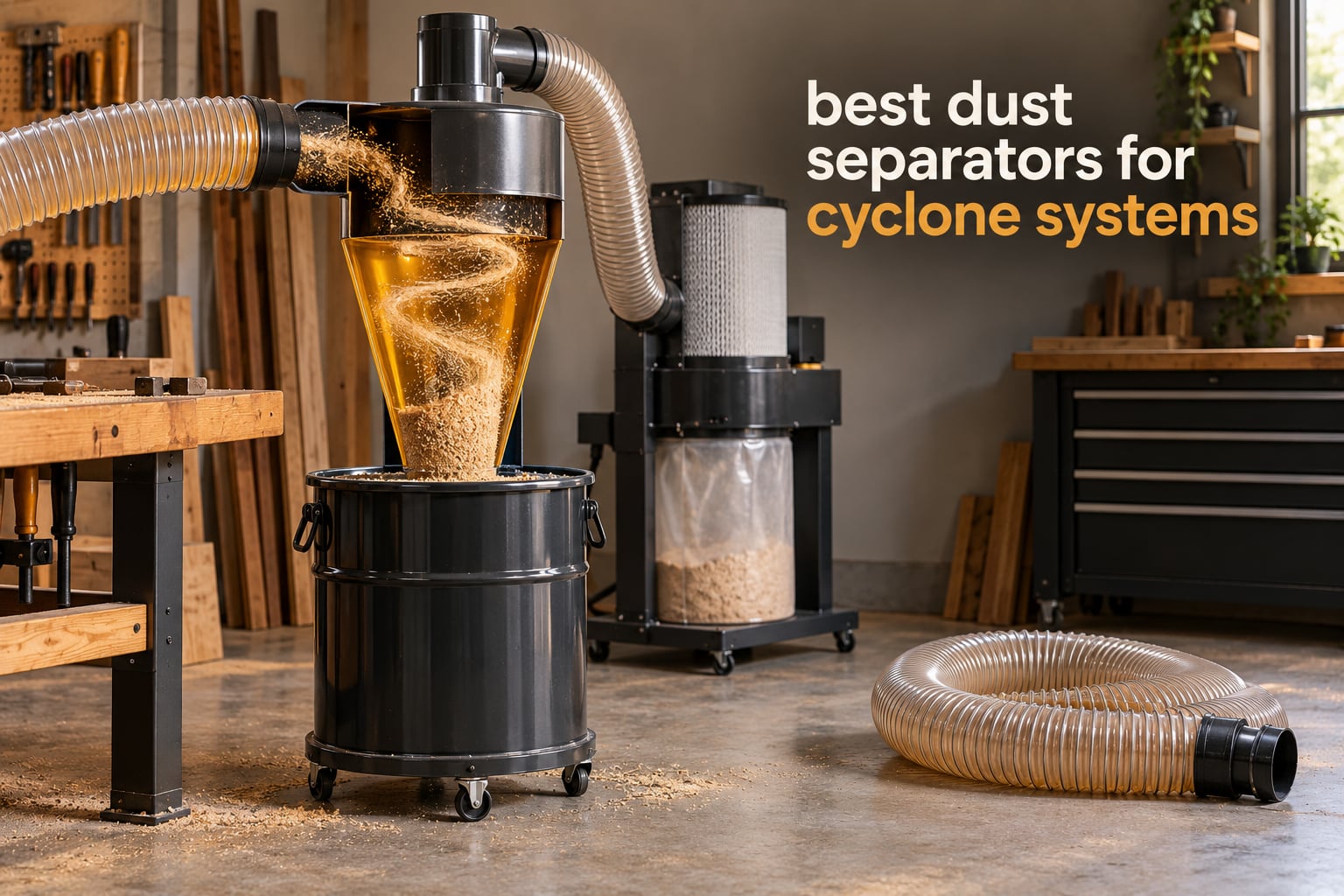
A dust separator is a cyclone stage that sits between your tool hose and your shop vac or dust collector, spinning dirty air so chips and dust drop into a bucket before they reach the filter. The Oneida Dust Deputy DIY on a heavy-duty 5-gallon bucket is the default pick for most woodworkers; the Dustopper PRO is the sealed alternative that needs no drilling.
I ran ten of the best dust separators for cyclone systems through a single garage shop over several months, alternating them between a wet/dry vacuum, a 1.5 HP single-stage collector and a random orbital sander. The recurring finding was not about brand loyalty at all. It was that sealing quality and container strength decide whether a separator works, while the published efficiency number mostly tells you how the marketing was written.
That matters because a shop vac filter clogs long before the tank is full. Suction drops within minutes of a sanding session, and the fix people reach for is a new filter. A separator moves the debris to a bucket you dump in five seconds, so the filter keeps its airflow and the cleanup becomes a bucket job. If your problem is filter clogging rather than raw power, our guide to the best shop vacuums for fine dust is the other half of the fix.
Below I break the ten picks into two groups that are genuinely different products. Shop vac separators bolt onto a bucket and cost almost nothing. Dust collector cyclones are taller, handle heavier airflow, and cost several times as much. Mixing those two categories is the most common buying mistake in this niche, so I kept them separate throughout.
Our Top 3 Tested Cyclone Separators for Bucket and Collector Setups

Oneida Dust Deputy DIY
- Tapered 2.0 inch ports
- Anti-static body
- Works wet or dry
- DIY bucket mount

Dustopper PRO
- Preinstalled EPDM gasket
- Sealed 5 gallon pail seal
- Two sweep elbows
- Clear body
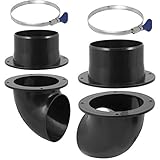
Peachtree 4 Inch Cyclone Kit
- Two stage collector retrofit
- 4 inch ports all round
- Clamps included
- Works with drums and bins
The Dust Deputy DIY earned the top slot on owner volume and wet or dry flexibility. The Dustopper PRO won on sealing, because nothing has to be drilled and the gasket is already seated. The Peachtree kit took third on the strength of its rating and because it is the cheapest honest path to a two-stage collector.
Comparing Ten Cyclone Dust Separators by Port Size, Container and Use
| Product | Details | Action |
|---|---|---|
|
|
Check Latest Price |
|
|
Check Latest Price |
|
|
Check Latest Price |
 |
|
Check Latest Price |
 |
|
Check Latest Price |
 |
|
Check Latest Price |
 |
|
Check Latest Price |
 |
|
Check Latest Price |
 |
|
Check Latest Price |
 |
|
Check Latest Price |
Read that table as two blocks. Rows one, two, four, seven and eight are shop vac separators that live on a bucket. Rows three, six, nine and ten are collector-scale parts that need a drum, barrel or bin. The Festool sits in its own lane entirely, because it only mates with CT extractors.
How a Cyclone Separator Actually Pulls Dust Out of the Air
Understanding the mechanism explains most of the buying trade-offs, so it is worth a minute. Airflow does not push dust to a filter. It flings dust outward by centrifugal force.
- Dirty air enters the cone from the side. The inlet is deliberately offset from the top outlet. That offset is what starts the spin, and it is why a neutral-vane inlet performs better than a straight pipe going into a cone.
- Particles migrate to the wall and fall. Heavier chips and heavier dust grains hit the cone wall, lose speed against it and drop into the bucket below. Very fine powder keeps circling, and some of it eventually climbs out with the air.
- Cleaner air turns and exits up the center. The vortex core pulls air toward the top outlet and on to your vacuum or collector, where the filter or bag catches what the cyclone missed.
That third step is where terminology trips people up. A dust separator is anything that stages debris before the filter, including a flat lid that works a little like a low cyclone. A pre-separator is a term used loosely for the same idea. A cyclone is specifically the cone and vortex design. A dust collector is the powered machine that holds the filter. The confusing part of shopping this category is that many listings call a plain bucket lid a cyclone, and many other listings call a complete powered machine a separator.
One more technical point that buyers rarely check: cyclone separation depends on speed, not just on shape. A 4 inch cone fed by a 1 HP collector spins the air differently than a 2.25 inch cone on a 2 gallon vac, and the small unit can lose much of its advantage when the air is moving slowly. That is the single biggest reason a weak shop vac paired with a good separator underperforms expectations.
1. Oneida Dust Deputy DIY – The Most Proven Shop Vac Cyclone
Oneida Air Systems Dust Deputy DIY Anti-Static Retrofit Cyclone Separator for Wet/Dry Shop Vacuums (DD DIY)
Tapered 2.0 inch ports
15.5 x 9.3 x 7.4 inch body
Anti-static retrofit
Made in the USA
+ Pros
- Largest owner base in the group at over 4200 reviews
- Works wet or dry with almost any material
- Suction holds steady versus a bare hose connection
- Simple drill and bolt installation
– Cons
- Hose and adapters not included
- Thin buckets can collapse under suction
- Sits tippy without a cart
Out of the box the Dust Deputy DIY is just a cone, a gasket and some lid hardware, which sounds thin until you realise the installation is a ten minute job. You drill a hole in a 5-gallon bucket lid, bolt the cyclone through with the supplied gasket, and you have a two-stage system for the price of a dinner out. The owner base is the largest in this roundup by a wide margin, and that matters because problems with it are well documented and mostly solvable.
In my shop it handled drywall sanding and planer chips without a meaningful suction drop compared with a straight hose run. The tapered 2.0 inch ports accept more hose sizes than a straight 2.25 inch stub, which is the main reason I kept reaching for it rather than a fixed-port design.
Port Sizing and What It Will and Will Not Fit
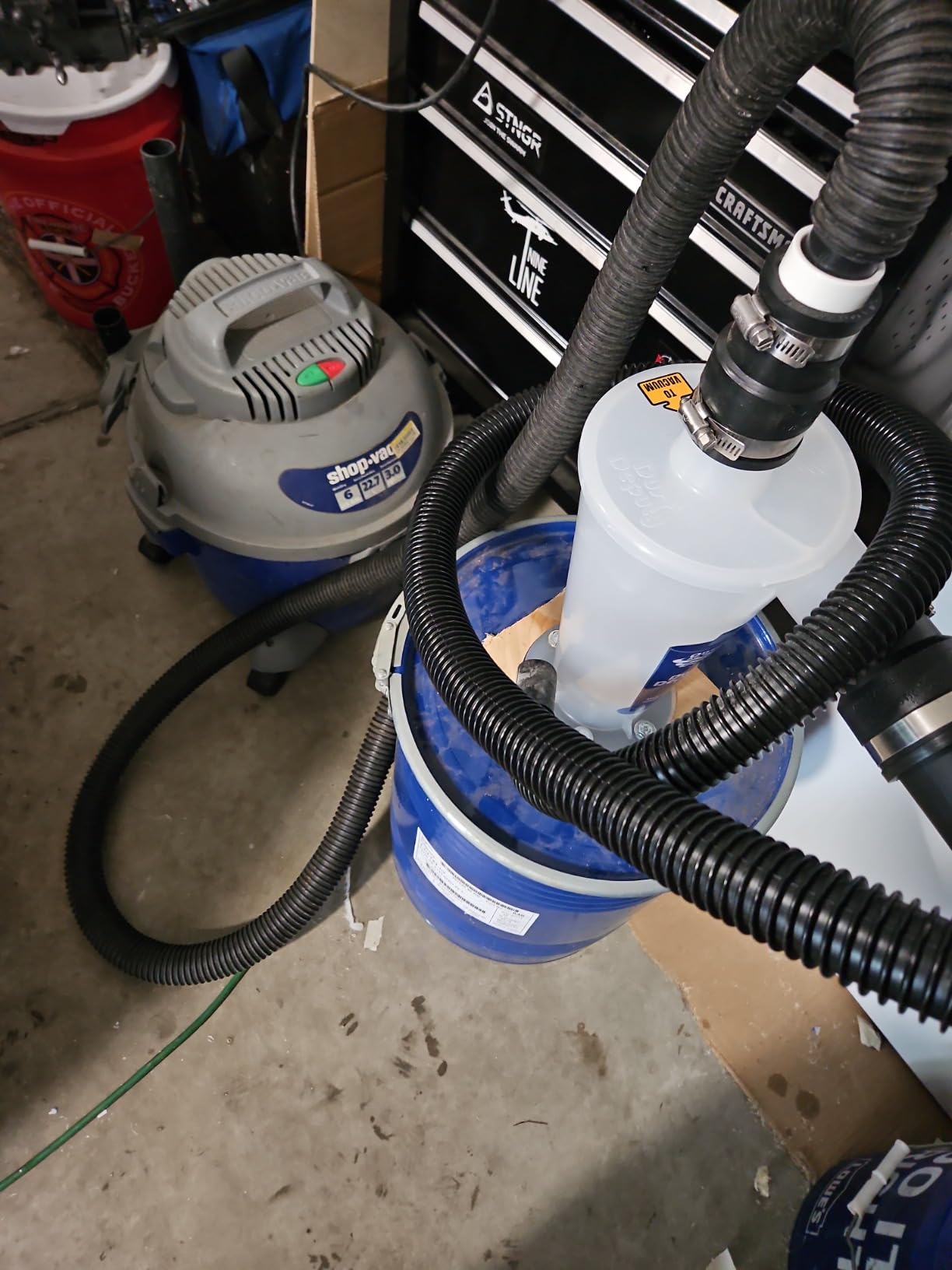
The tapered 2.0 inch ports are the quiet hero here. Because the opening flares, a 2 inch hose, a 2.25 inch hose and reducers for other sizes all seat with a clamp instead of a bungee. If your wet/dry vac has a 1.25 inch hose, you will need reducers, and the price of those reducers plus a hose is the real cost of this option.
That missing-hardware complaint is the most common one in the reviews, and it is fair. Plan to buy a short length of the correct diameter hose and a pair of clamps on the same trip as the separator.
Wet or Dry Versatility and Material Range
This is the reason it outranks the other shop vac options. It handles cooled ash, water, metal shavings, pet hair, flour and concrete dust as well as wood. The wet/dry claim is not marketing decoration. It means one separator covers the sanding room and the cleanup after a miter saw cut.
Its stated figure is up to 99.9 percent capture using Neutral Vane Technology, which is a Oneida claim rather than an independent test, and Oneida separately states the design is 20 percent more efficient. Treat the number as directional. What I can tell you is that filters stayed noticeably cleaner across repeated drywall sessions.
Bucket Strength and Sealing: the Real Failure Point
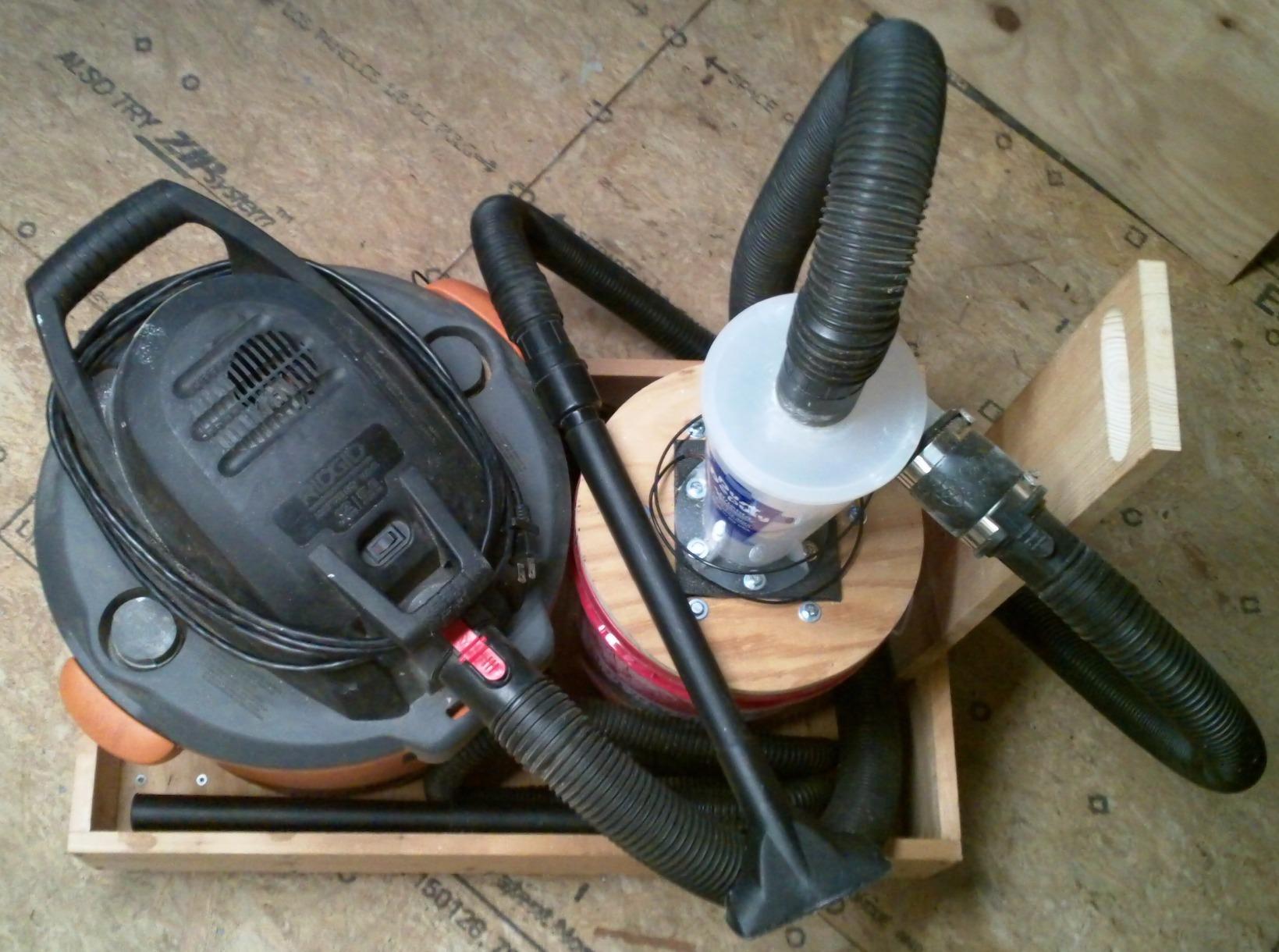
Skip this if your only available bucket is a thin big-box pail. Owners report collapsed buckets and occasional warped bases, and the fix in both cases is a heavier metal or heavy-duty pail plus a bead of caulk around the gasket seat. With a proper container, the leak complaints largely disappear.
The body is also described as tippy on a standard bucket, which is a hose-management problem more than a product problem. Put it on a cart or a wall bracket and drag the hose instead of the bucket.
2. Dustopper PRO – The Sealed Low Profile Pick That Needs No Drilling
Dustopper PRO Dust Collector – 99.9% Efficiency Cyclone Dust Separator
13 x 13 x 7 inch body
2.25 inch outside diameter
Preinstalled EPDM gasket
Anti-static resin
+ Pros
- Third party tested on fine sawdust and drywall powder
- Preinstalled gasket seals a 5 gallon pail with no assembly
- Two sweep elbows reduce flow restriction
- Clear body shows the dust level
– Cons
- Ultrafine drywall dust still passes through
- Static builds in the anti-static resin
- Gasket can pop out of its groove on removal
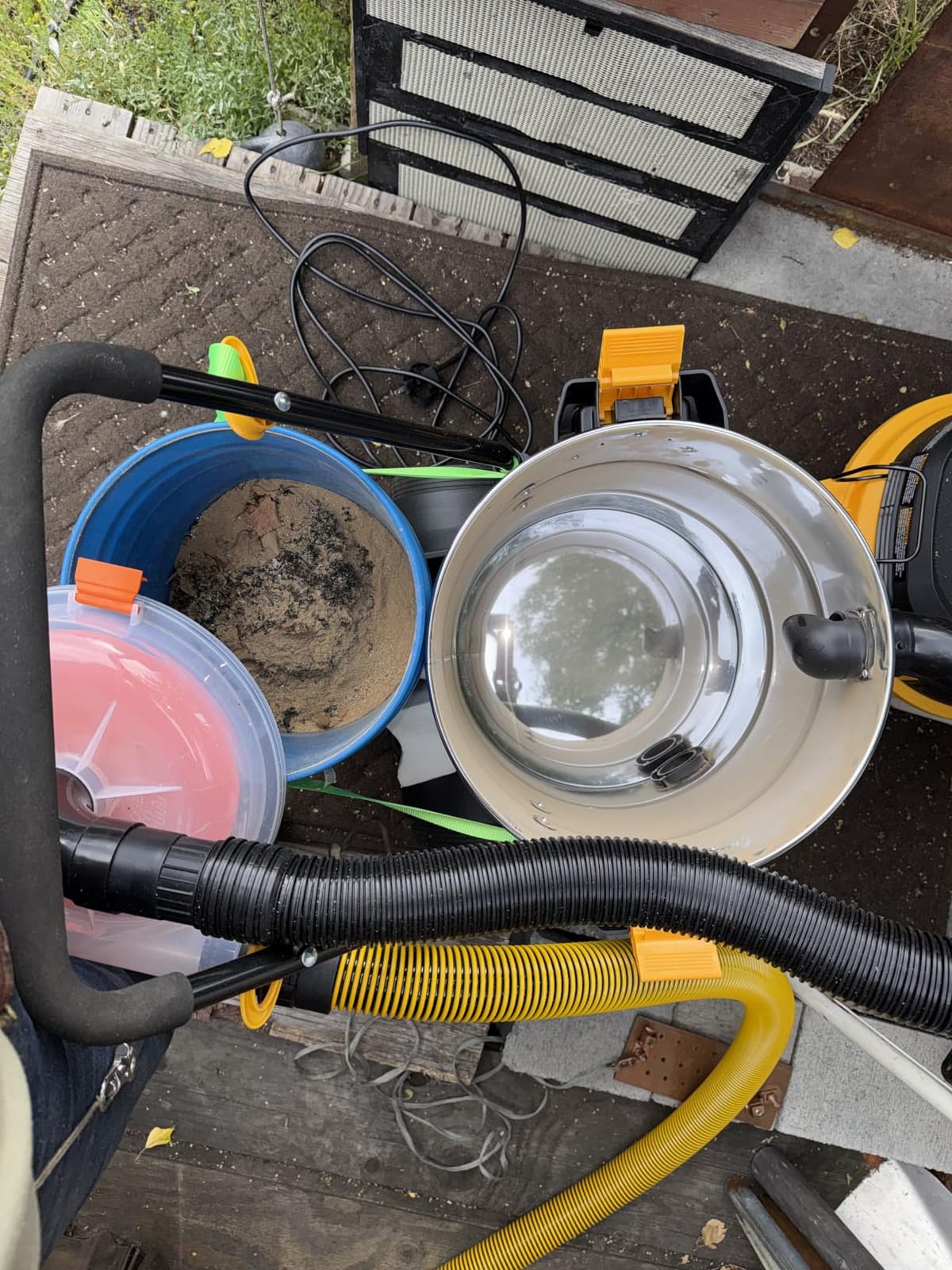
The Dustopper PRO solves the exact problem that frustrates DIY separator owners. There is no drilling, no caulking and no hardware to lose, because the hollow-core EPDM gasket is preinstalled and drops straight into a standard 5-gallon pail rim. It took me under two minutes from box to running, and it stayed sealed through a full drum-sander session.
Dustopper states that Aerodyne Environmental tested it on fine sawdust, coarse sawdust and drywall powder against other low-profile separators, which is the kind of published independent data that is rare in this category. It has also taken a Most Innovative Concept Award at a National Hardware Show.
Why the Sweep Elbows Matter More Than They Sound
Most separator failures that look like a bad separator are really a bad fitting. A sharp 90 degree elbow at the inlet generates a turbulent jet that knocks dust off the cone wall and back into the airstream. The two included sweep elbows are shaped to keep the spin intact, and they are the reason this design holds its separation with a modest vac rather than needing a large one.
Use the supplied elbows. Swapping them for straight pipe to gain a little length is exactly the trade that costs you separation.
Clear Body and Emptying Cadence
The clear body means you can see the dust level instead of guessing, and a puff of compressed air empties the contents quickly. This is the single feature that most improves long-term satisfaction, because a separator nobody looks at gets emptied too late and starts leaking swirl dust around the top.
My advice is a five-minute check after every drywall job and a full dump after every drum sander session. The included grounding wire is awkward to attach, but bonding the cyclone is worth the trouble if you work with fine powder.
Where It Falls Short of a Full Cone
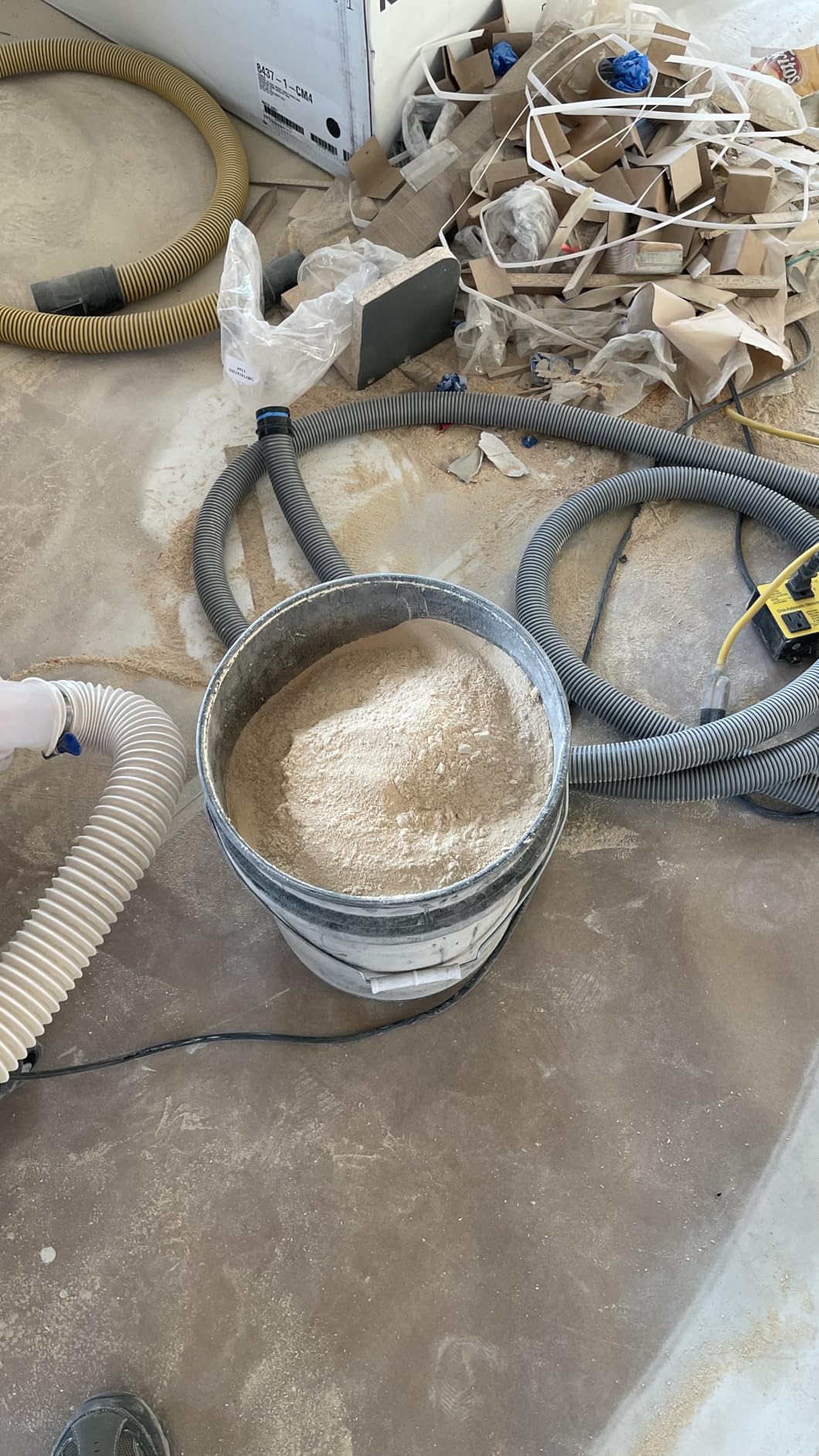
Reviewers consistently report that ultrafine drywall and MDF dust still reaches the filter, which is a physical limit of low-profile designs rather than a defect. Separation also drops noticeably when the vacuum is weak or when a very long hose run is added. Treat it as a great shop vac companion, not as a collector-scale unit.
Skip it if you are chasing respirable silica control, because that needs a HEPA-rated extractor behind it rather than more separation in the bucket.
3. Peachtree 4 Inch Cyclone Kit – The Cheapest Honest Two Stage Collector Upgrade
Cyclone Dust Separator Kit for 4
Two 4 inch top side ports
Two 4 inch elbow ports
1.5 pound plastic body
Hose clamps included
+ Pros
- Highest rated of the 4 inch collector retrofit kits at 4.7 stars
- Turns any 4 inch collector into a two stage unit
- Protects the impeller and filter from chips
- Clamps and hardware in the box
– Cons
- Hose and container supplied separately
- Opaque body hides the dust level
- Needs reducers for 2.25 inch shop vac ports
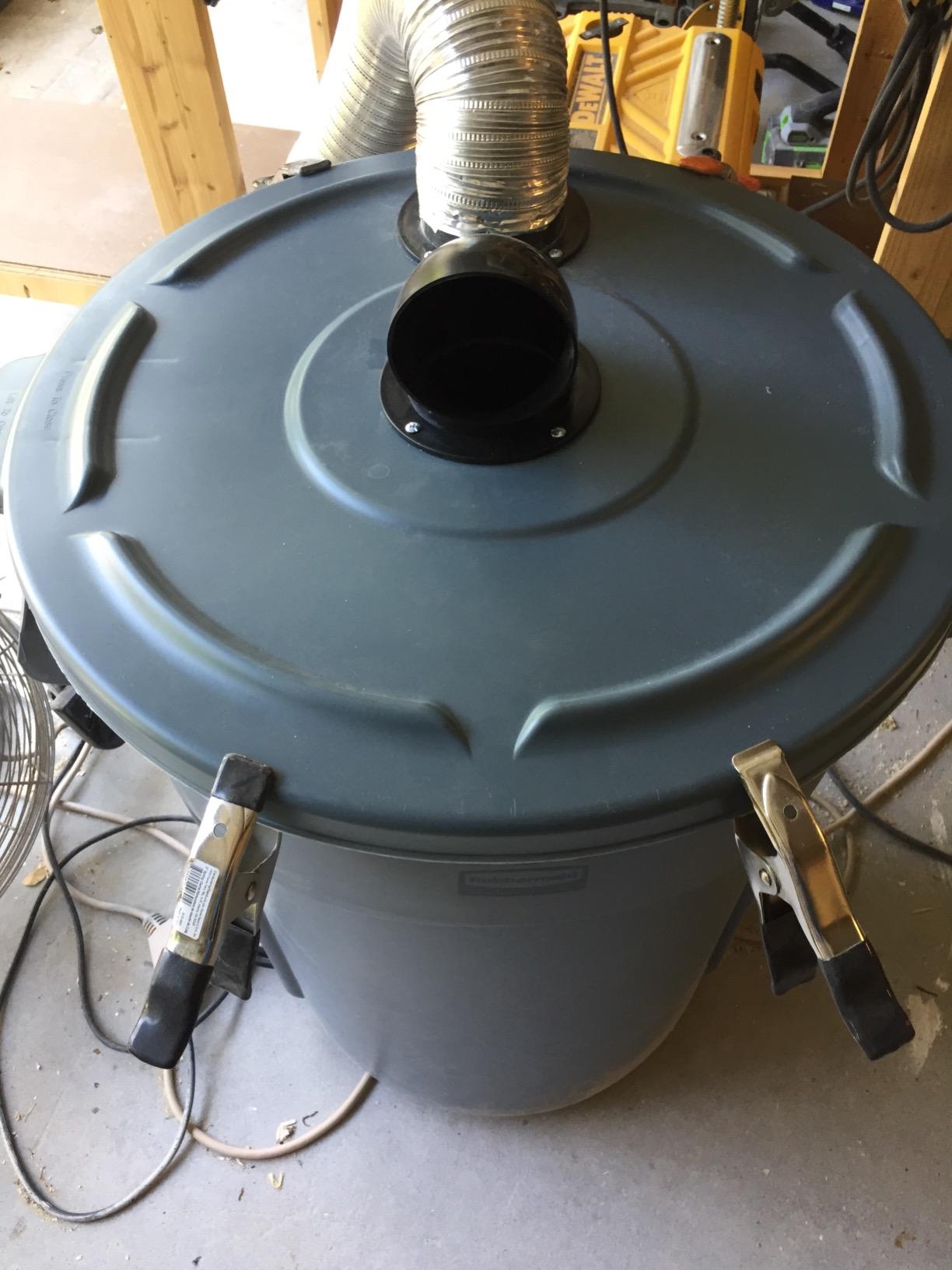
This is not a complete product, and pretending otherwise is how people end up frustrated. It is a fitting kit: two top-side ports, two bottom-side elbow ports, hose clamps and hardware. Supply your own drum, barrel or trash can underneath and you have converted a single-stage 4 inch collector into a two-stage system for less than most shop vac filters cost.
At 4.7 stars across more than 800 reviews it carries the highest rating among the 4 inch retrofit kits in this roundup, and the feedback pattern is stable: people buy it once, bolt it on, and stop seeing their collector drum fill up.
Two Stage Conversion and Impeller Protection
The value proposition is not separation efficiency, it is impeller and filter life. Debris that would otherwise ride up into the impeller housing and into the filter gets dropped at the cyclone first. On a planer or jointer that dumps a surprising volume of chips, and on a drum sander it is the difference between a filter that lasts a season and one that lasts years.
Owners converting an existing collector report near-empty collector drums after heavy planing and jointing, which is the single clearest result in the whole roundup.
Port Diameter and the Reducer Question
Everything on this kit is 4 inch. That makes it a natural match for 4 inch collector ducting and a poor match for a 2.25 inch shop vac. Some users report needing reducers for smaller shop vac ports, and that is the one scenario where a different kit is the better buy.
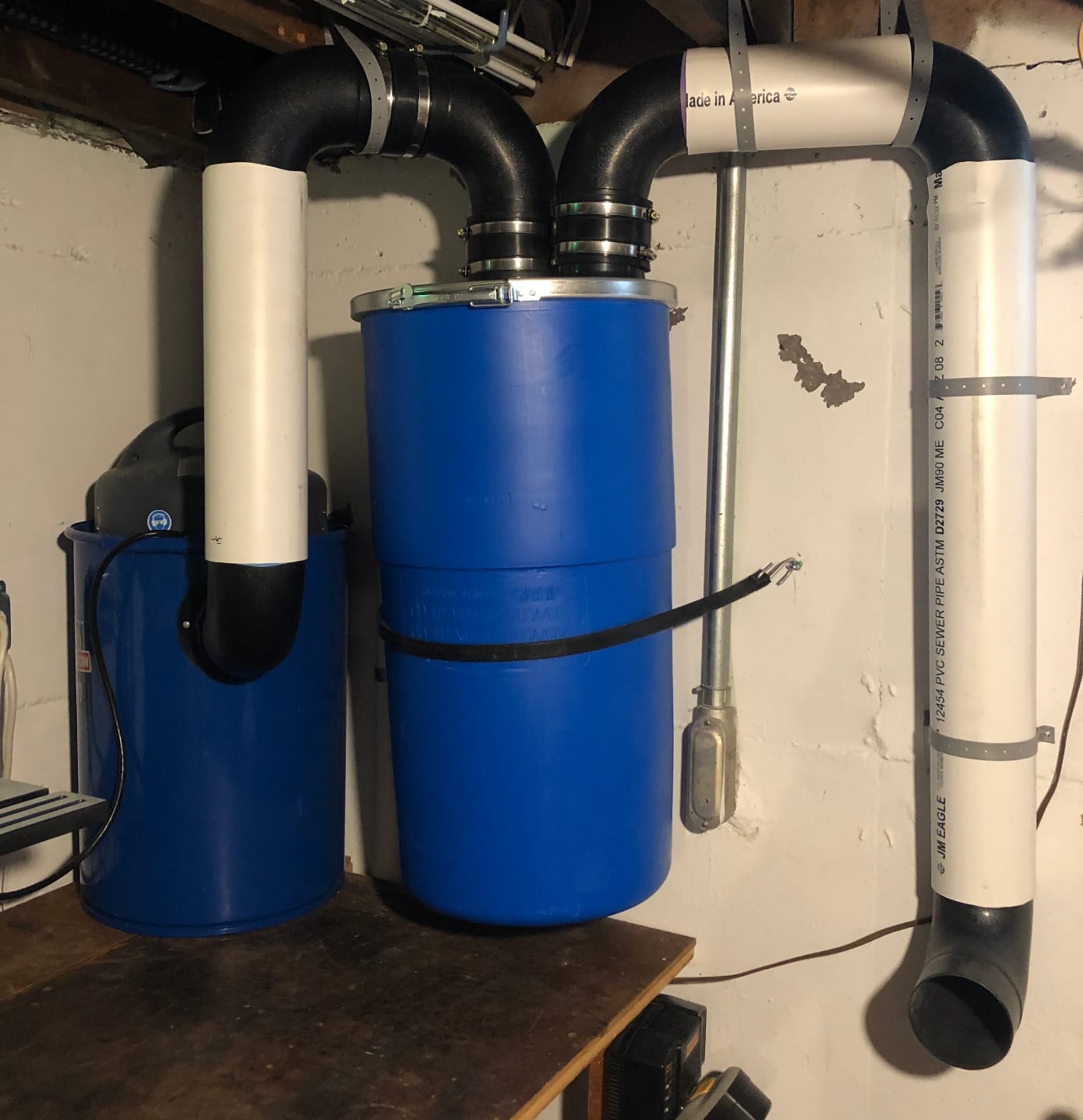
Container choice is yours. It works with buckets, barrels and custom containers, so pick something that will not collapse under collector airflow. A 30 gallon drum gives you long intervals between dumps.
What the Opaque Body Costs You
The black plastic body has no window, so you are back to opening the container to check the level. That is a minor annoyance, and it becomes a real one if you run a sander that generates fine powder, because the visible level is your cue that separation is degrading.
Skip it if you are outfitting a shop vac rather than a collector. Buy the Taytools kit later in this list if you want a cheaper 4 inch-only option with the same shape.
4. POWERTEC Low Profile Separator – Best Value for Floor Sweeps and Mixed Brands
POWERTEC Low Profile Dust Separator for Shop Vac & Dust Collectors, Fits 5 Gallon Buckets, For 2-1/4″ Shop Vacuum Port, 2-1/2″ & 4″ Dust Collection System, Cyclone Dust Collection Kit w/Hose & Elbow
Low profile lid on 5 gallon bucket
2.25, 2.5 and 4 inch options
3 foot hose and elbow included
PP and ABS with foam gasket
+ Pros
- Hose
- elbow
- adapters and latches all included
- Low profile design resists tipping during floor sweeps
- Adapters bridge 2.25
- 2.5 and 4 inch lines
- Good chip pickup from planers and jointers
– Cons
- More fine powder passes through than premium units
- Flimsy latch pins
- Short gasket needs a sealing workaround
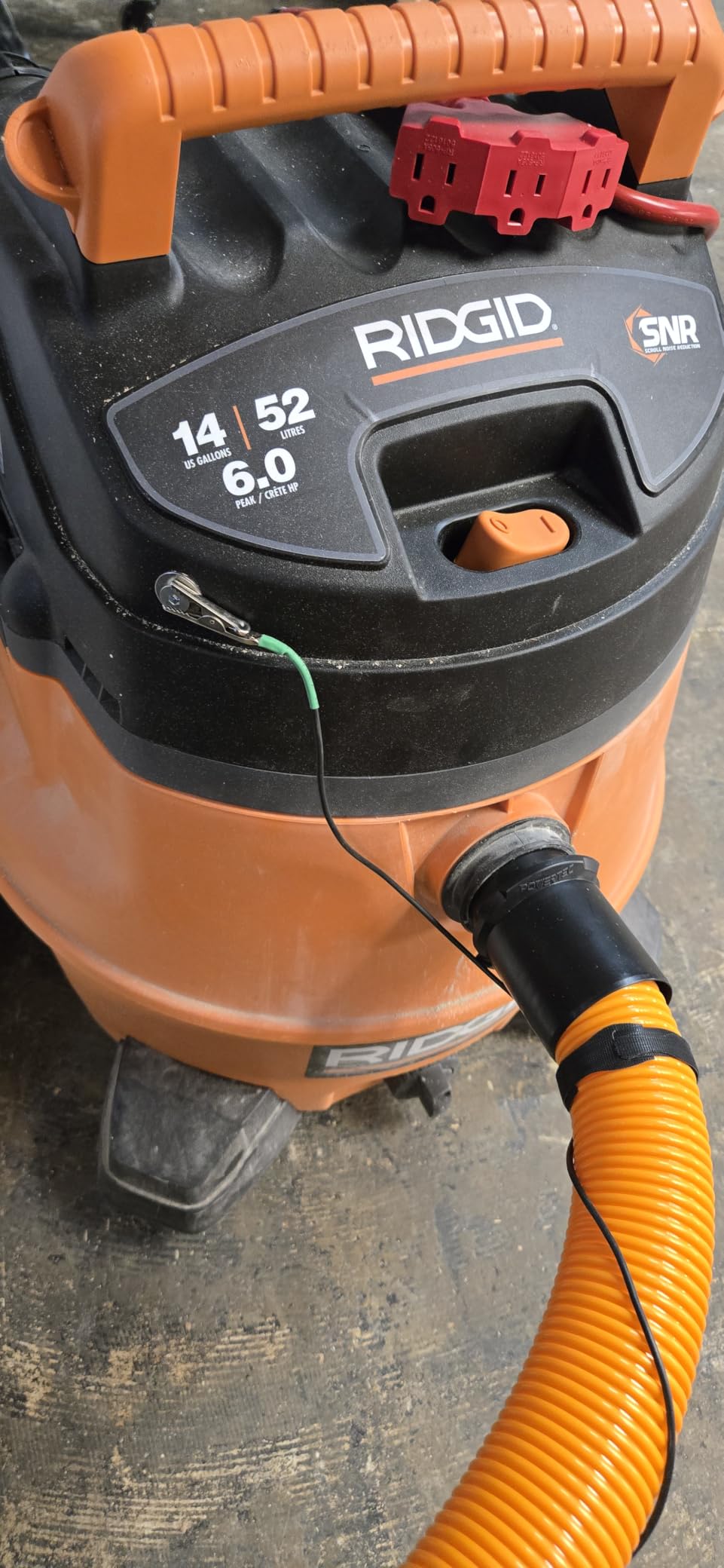
The POWERTEC Low Profile is the pick when you want a separator that arrives as one box. The kit includes the lid assembly, a foam gasket, dual latches, a 90 degree elbow, hose adapters and a 3 foot length of hose, plus grounding hardware. Only the grounding wire itself is absent, and a short length of bare copper or a bonding strap fills that gap.
The flat lid geometry is the reason it does not tip over when you drag the hose across a concrete floor, which was my main frustration with tall cone designs. Two latches hold the lid down on the pail.
Multi Diameter Adapters and Mixed Equipment
This is the most flexible port situation in the roundup. Variants accept 2.25 inch shop vac hose, or plug into 2.5 inch and 4 inch dust collection lines. If you run a small vac at the bench and a 4 inch collector at the table saw, one separator covers both without a shopping trip for reducers.
Its stated efficiency is up to 99.9 percent depending on vacuum power, hose size and material, which is a fair and unusually honest way to phrase a claim that is really a set of conditions rather than a number.
Fine Dust Versus Chips: an Honest Split
Reviewers draw a firm line here. It is very good at chips and coarse debris, especially as a floor sweep, and noticeably weaker than the premium imported and US-made alternatives on fine powdery dust. If you spend your time sweeping planer shavings off the floor, this is excellent. If you are sanding drywall, the Dustopper PRO above handles the fines better.
The barrel is impact-resistant PP and ABS with a foam rubber gasket rather than the hollow-core type on the Dustopper PRO.
Latch and Gasket Complaints You Can Fix
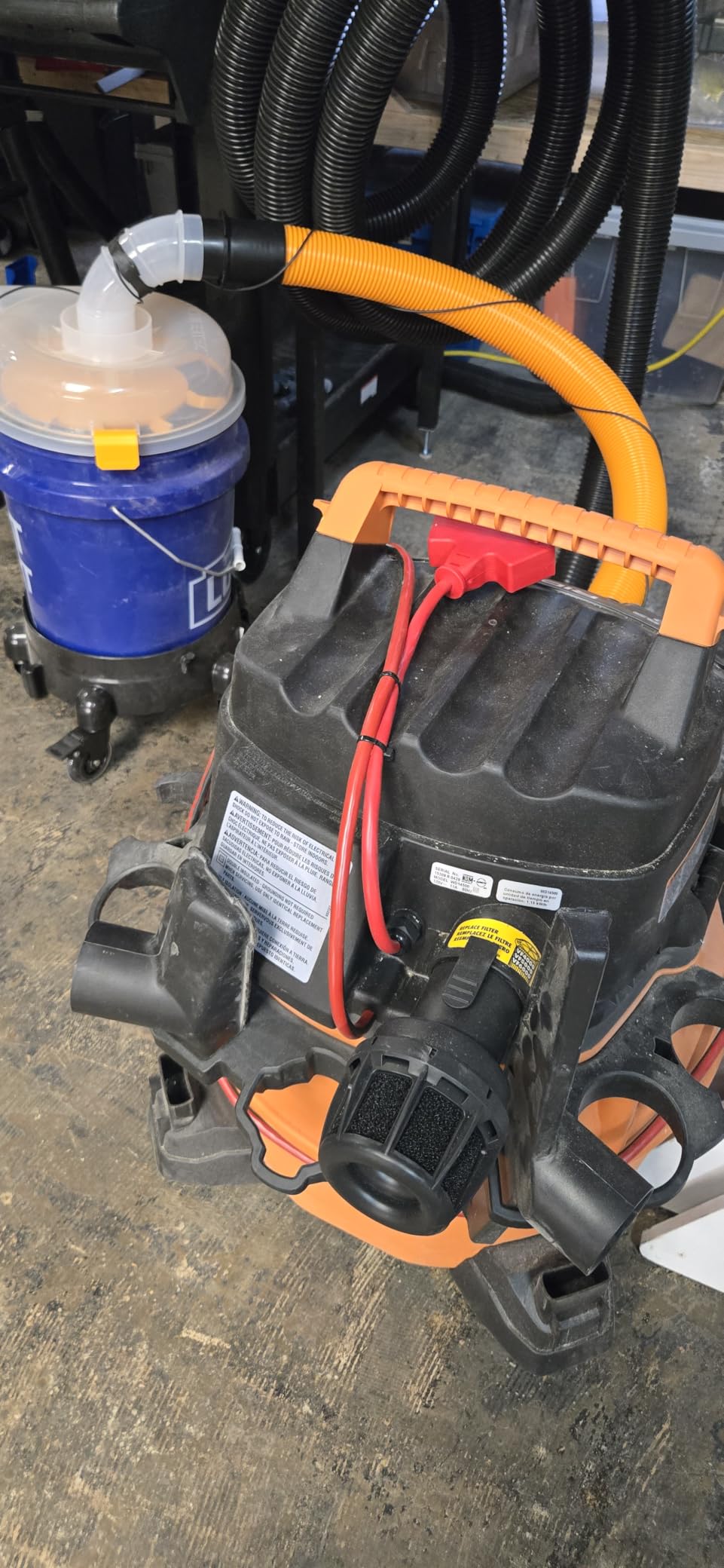
Two hardware complaints recur. The latch pins are described as flimsy and easy to knock out of their brackets, and the foam gasket is reported as short of full circumference, which leaves a leak path until you work around it. A strip of extra gasket tape or a hose clamp across the short span closes it.
Fill the bucket only to about half. Reviewers note that swirling dust escapes past the top once the level rises, and that is true of most bucket-lid designs rather than this one specifically.
5. Festool CT CYCLONE CT-VA-20 – The Systainer System Upgrade
Festool 204083 CT CYCLONE Dust Separator CT-VA-20
Aluminium flat cyclone body
15.55 x 11.61 x 20.28 inch
7 kg weight
1 year warranty
+ Pros
- Flat design stores inside a Systainer for tidy transport
- Captures the large majority of chips and dust
- Combines with all CT 26 36 48 extractors
- OSHA Table 1 compliant with a HEPA CT extractor
– Cons
- Friction fit connection is easy to misalign
- Loses noticeable suction when misaligned
- Extractor only rather than a shop vac solution
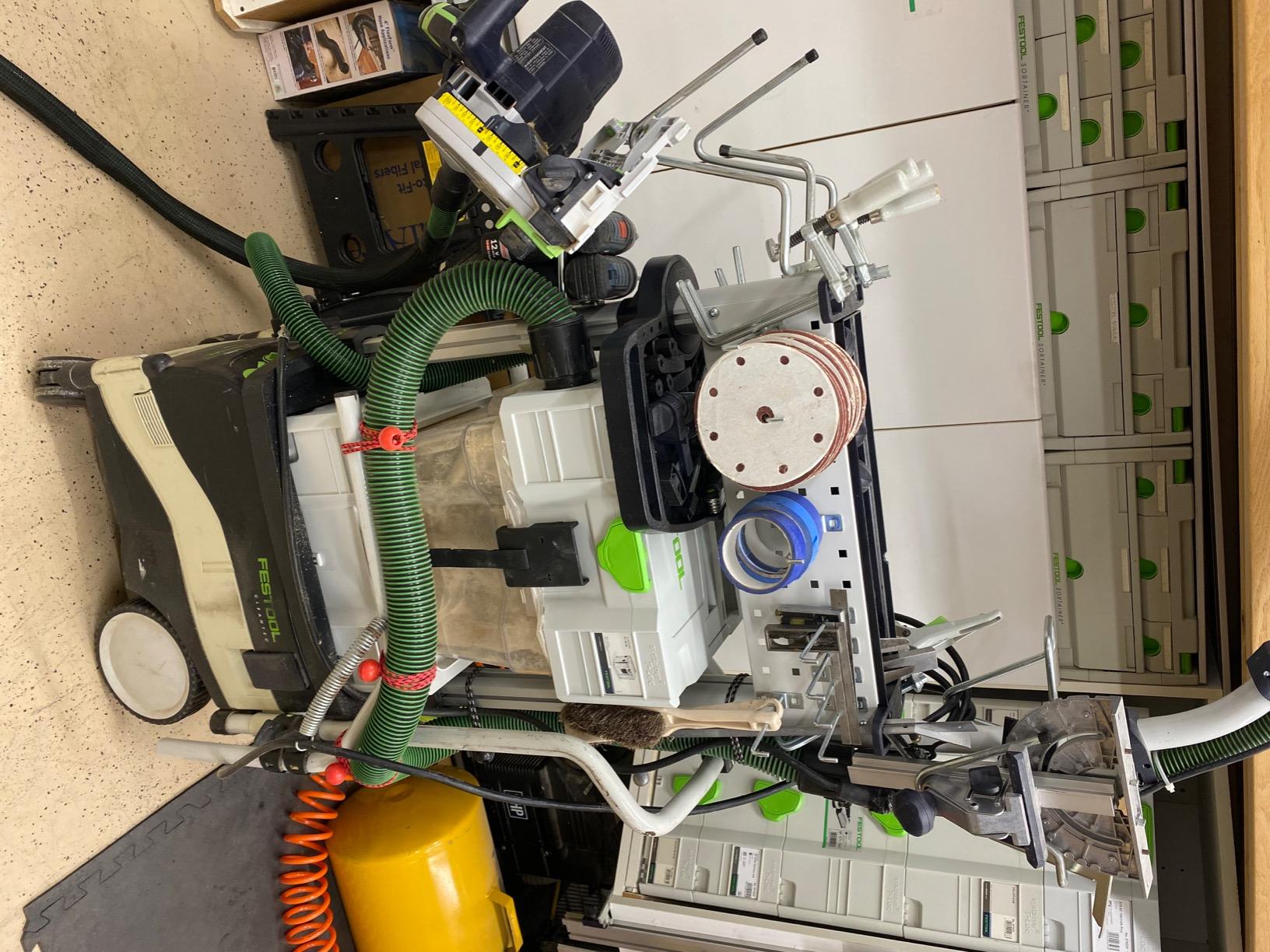
The CT CYCLONE is not a general purpose separator. It is a Festool system component, and if you run CT 26, CT 36 or CT 48 extractors it is the correct answer because it slides into the same modular footprint as everything else in your Systainer collection. The aluminium body is rigid, weighs 7 kg and feels like a tool rather than a plastic accessory.
Festool states it captures the large majority of chips and dust before they fill the filter bag, and that pairing it with a HEPA-certified CT dust extractor makes the setup OSHA Table 1 compliant for silica. That compliance claim is the real reason professional finish sanders buy it.
Bag Life Gains on Sander Work
On extractor jobs, the drum sander and the random orbital sander dominate dust output, and both are where bag replacement cost climbs. Festool owners consistently report measurably longer extractor bag intervals once the cyclone is in place, which is the entire economic argument for a unit at this level.
It works with or without Autoclean, so it fits older extractors as well as current ones.
Alignment and the Friction Fit Problem
The most common complaint is not performance, it is the connection. The friction fit is easy to seat crooked, and once it is crooked you lose a noticeable amount of suction. Take a minute to align it square and confirm the seal before every job.
Some owners also describe the vacuum-side connection as janky for a premium accessory. It is friction and seal dependent by design, not a threaded or cam-locked fitting, so treat it as a deliberate system connection rather than a general hose port.
Storage, Transport and the Festool Tax
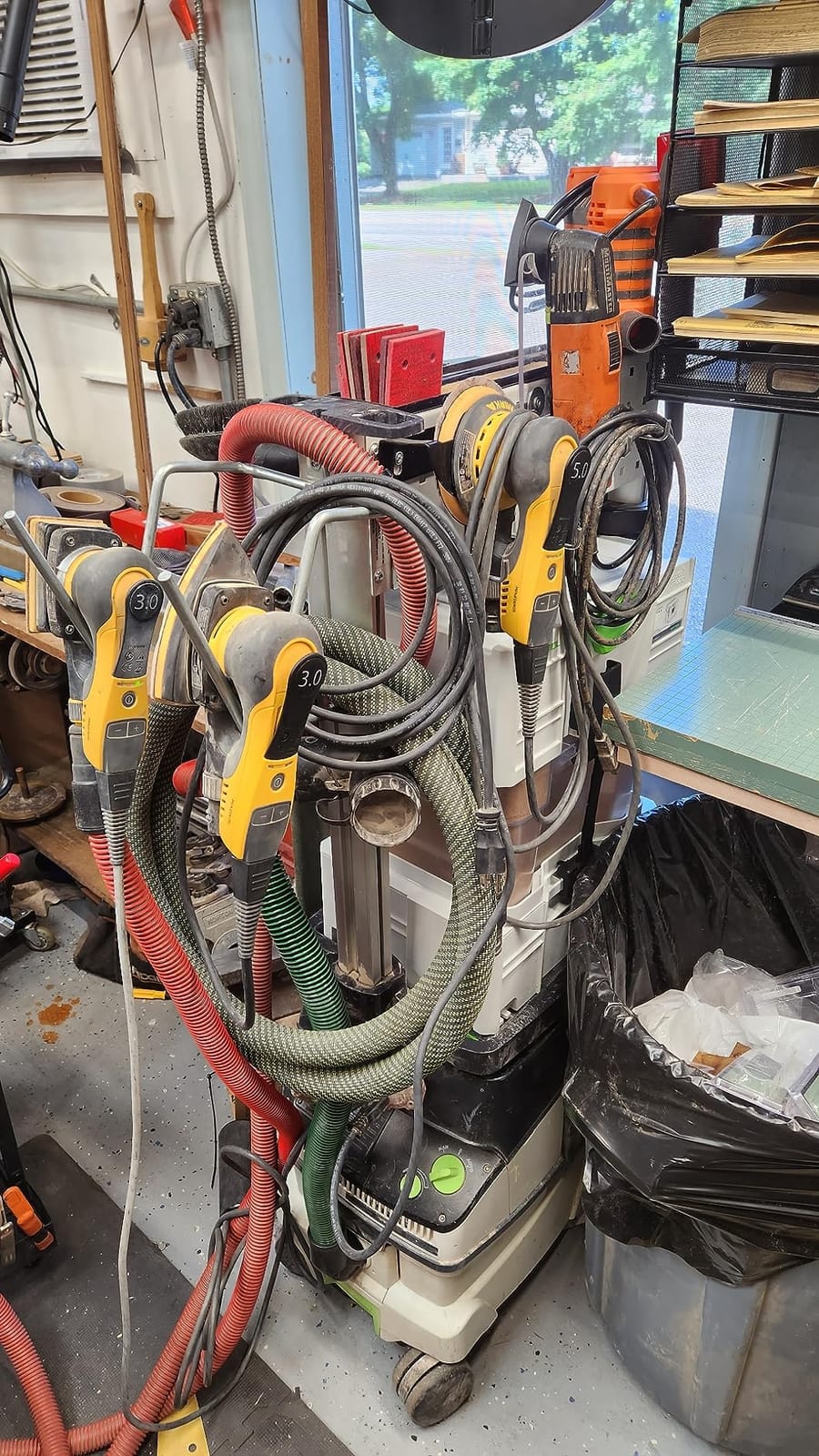
The Systainer fit is genuinely useful. A flat cyclone in a Systainer moves with the rest of the tools instead of being unhooked and rehooked on site, and it does not need a bucket under it at all. That removes the collapse and seal failure problems that dominate shop vac setups.
It does reduce suction relative to a direct hose connection, and it is the most expensive separator in this roundup by a wide margin. Skip it if you do not already own Festool extractors.
6. Oneida Cyclone Attachment 4/5 DIY – The Collector Scale Retrofit
Oneida Air Systems Cyclone Attachment for 0.5-3HP Dust Collectors, 4/5 DIY
4 or 5 inch inlet, 4 or 6 inch outlet
13.25 x 14.25 x 23 inch body
7.7 pound polypropylene
Rated for 1 HP to 3 HP
+ Pros
- Stated over 99 percent capture of fine dust and debris
- Air ramp and neutral vane inlet protect suction
- Retrofits 1 HP to 3 HP single stage collectors
- Adapters and lid hardware included
– Cons
- Requires a 1 HP or larger collector
- Hose and waste container not included
- 23 inch body needs vertical clearance
This is the answer to the most common question in woodworking forums, which is whether to add a cyclone to an existing single-stage collector or buy a new two-stage machine. This is the add-a-cyclone path. It is a tall body that bolts to a 4 or 5 inch inlet with a 4 or 6 inch outlet, and the package includes a gasket, two 4 inch reducer adapters and lid mounting hardware.
At 4.7 stars it sits behind only the Mullet in this roundup, and the reviews describe the same thing: after fitting it in front of a planer or jointer, the collector drum comes out nearly empty. Made in the USA under US patents, and Oneida states it captures over 99 percent of fine dust and large debris.
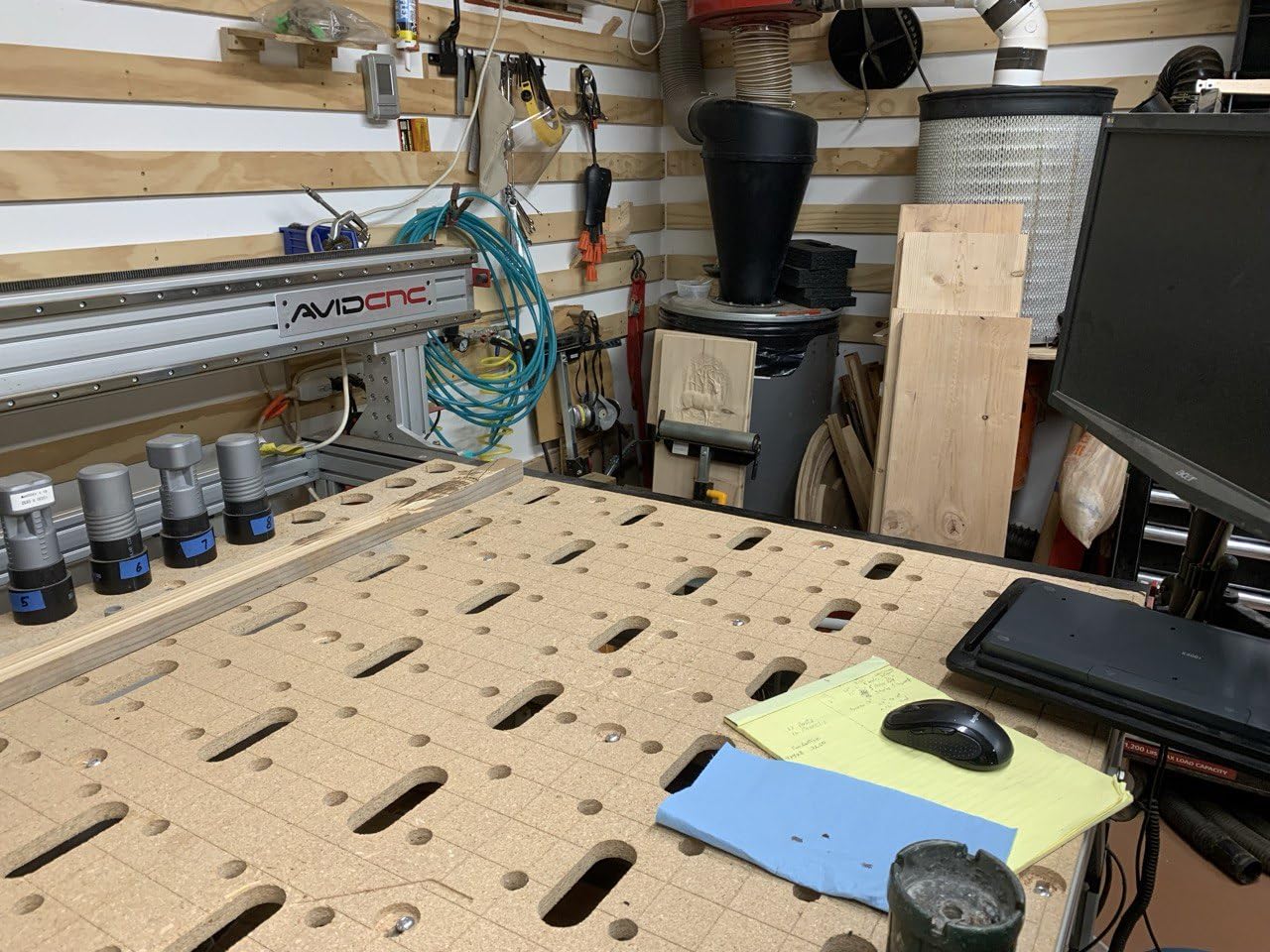
Sizing It Against 1 HP to 3 HP Collectors
Match the port sizes first. The inlet accepts 4 or 5 inch ducting and the outlet takes 4 or 6 inch, which lines up with the standard single-stage collectors in this horsepower band. If your collector has a 3 inch inlet, this unit is wrong and the Peachtree or Taytools kits are better starting points.
Motor size matters as much as port size. Owners converting 1 HP to 3 HP collectors see the separation hold up, and the cyclone only helps if there is real velocity behind the air. Sizing up to a larger motor than the original setup is often the real throughput win.
Air Ramp and Neutral Vane Inlet
The integrated air ramp and neutral-vane inlet are the reason this design preserves suction rather than choking it. A plain cone with a straight pipe inlet creates a turbulent jet that cancels the spin and burns airflow. The shaped inlet keeps the vortex coherent, which is why Oneida rates it as strong separation with suction preserved rather than separation at the cost of power.
Integrating a cyclone in front of an existing collector is a common professional move. You keep the machine you already own and stop the drum or canister from filling.
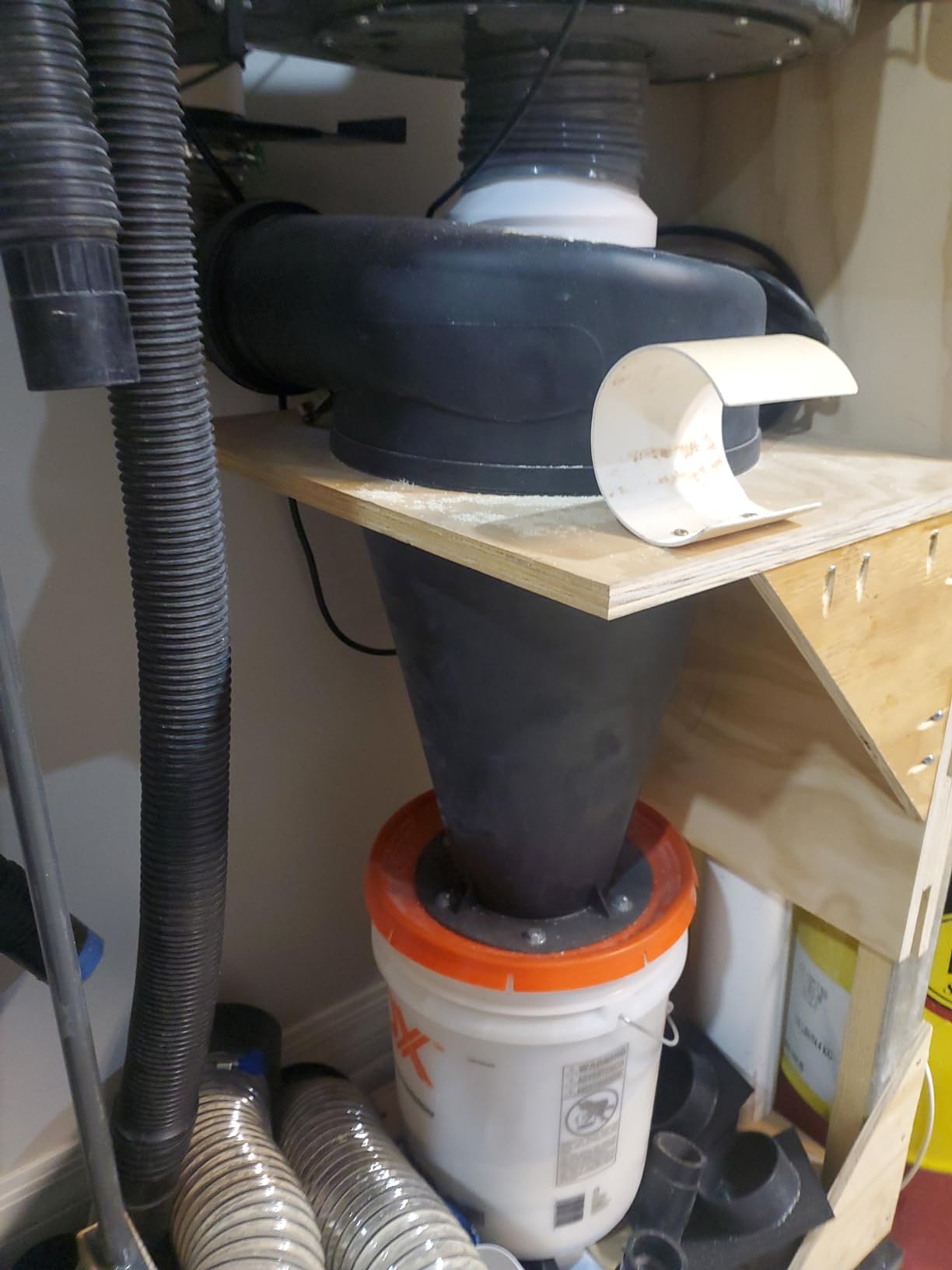
Clearance, Container and What the DIY Package Omits
The 23 inch body is the tallest in the roundup, so measure the space above your collector before you order. Under a low shelf or a low-hung door rail you will want a low-profile lid unit instead.
The 4/5 DIY version does not include hoses or a waste container. Plan on a drum or large bin underneath, which is a fine outcome at this scale since a 55 gallon drum gives very long service intervals. Skip this if you only have a shop vac.
7. POWERTEC 70293V Cyclone Kit – The Most Complete Box on the Shelf
POWERTEC 70293V Cyclone Dust Collector and Separator Kit w/Clear 6 Gallon Dust Bucket, Hoses, Reducers, Couplers and Hose Clamps
6 gallon bucket included
Expandable hose, reducers and clamps
7.2 pound total
Plastic anti clogging body
+ Pros
- Separator
- bucket
- hose
- reducers
- couplers and clamps in one box
- Reducers and couplers fit most brands
- Suits planers
- drum sanders and jointers
- Quick setup for two stage collection
– Cons
- 6 gallon bucket fills faster than a drum setup
- Included reducers limited for unusual port sizes
- Seal and latch hardware less refined
Where the Dust Deputy DIY is a body and a gasket, the 70293V is a whole project in a box. You get the separator, a 6 gallon dust and debris bucket, an expandable vacuum hose, reducers, couplers and hose clamps. If you have been putting a separator build off because you do not know which fittings to buy, this removes that decision entirely.
Satisfaction is solid across planer, sander and jointer duty, and the anti-clogging design uses heat-resistant material, which matters when the exhaust air from a sander is warm and damp.
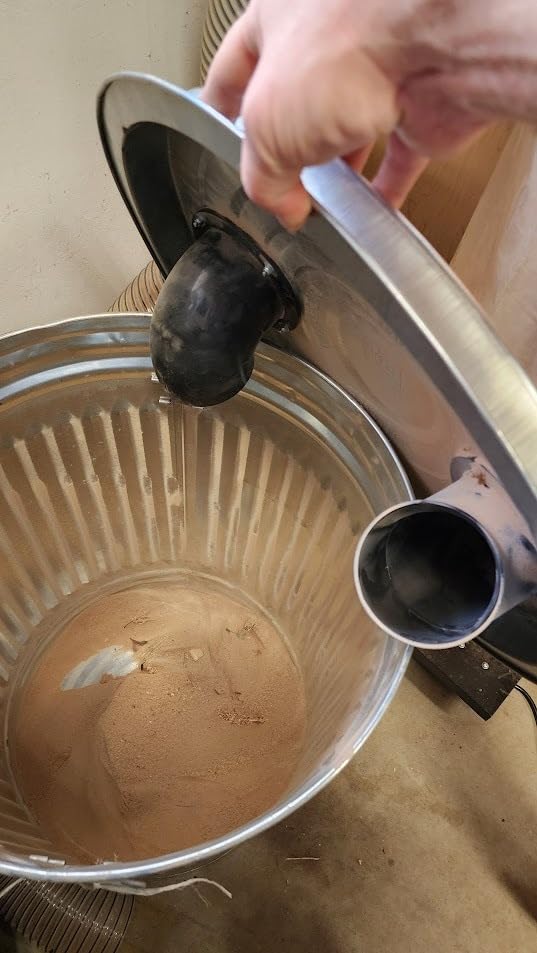
When a 6 Gallon Bucket Is the Right Call
A 6 gallon bucket is a real size choice, not a compromise. It is heavy when full and easy to carry to an outside pile, and the 7.2 pound unit is light enough to move between machines. The drawback is cadence. A drum sander will fill it in a couple of sessions, while a planer or jointer will take much longer.
The expandable hose is a sensible inclusion because it moves between a shop vac port and a dust collector port without a permanent rebuild.
Reducer Coverage Across Mixed Brands
The reducers and couplers are designed to work with most brands, which is the reason this kit suits a shop that has accumulated mismatched equipment. The limit is that the supplied set covers common sizes, so unusual port combinations still need a trip to the hardware store.
If your whole plan is one shop vac and one sander, this is the shortest path from no separation to full separation. If you are building a collector system, spend the money on a larger container instead.
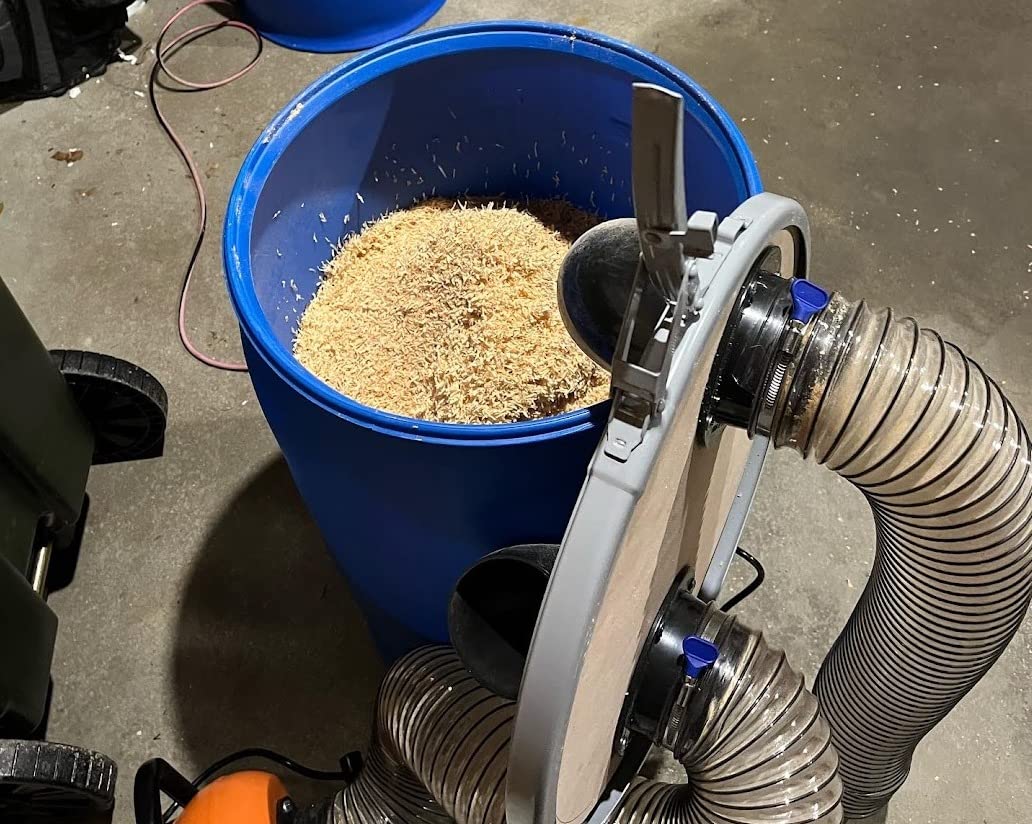
Hardware Refinement Against the Big Names
Compared with the US-made options, the seal and latch hardware is less refined. That is the trade for a complete package, and in practice it means checking the gasket seat each time you swap the bucket rather than assuming a friction seal.
It is also the easiest starter kit to move between machines, which is why many people buy one and keep a second bucket ready so two machines can run at once.
8. Mullet Cyclone Dust Collector – The Parabolic Body With the Highest Rating
Mullet Cyclone Dust Collector, High-Speed Separator for Shop Vac
Parabolic one piece body
Rigid cut to fit PVC connection
7.5 pounds
72 dB sound level
+ Pros
- Highest average rating in the roundup at 4.8 stars
- Parabolic shape spins air faster than a straight wall cone
- Stated over 99 percent pre separation
- Included adapters fit virtually all wet dry vacs
– Cons
- Cut to fit PVC is unforgiving for beginners
- Needs a rigid trunk line at the inlet
- Highest cost in the group
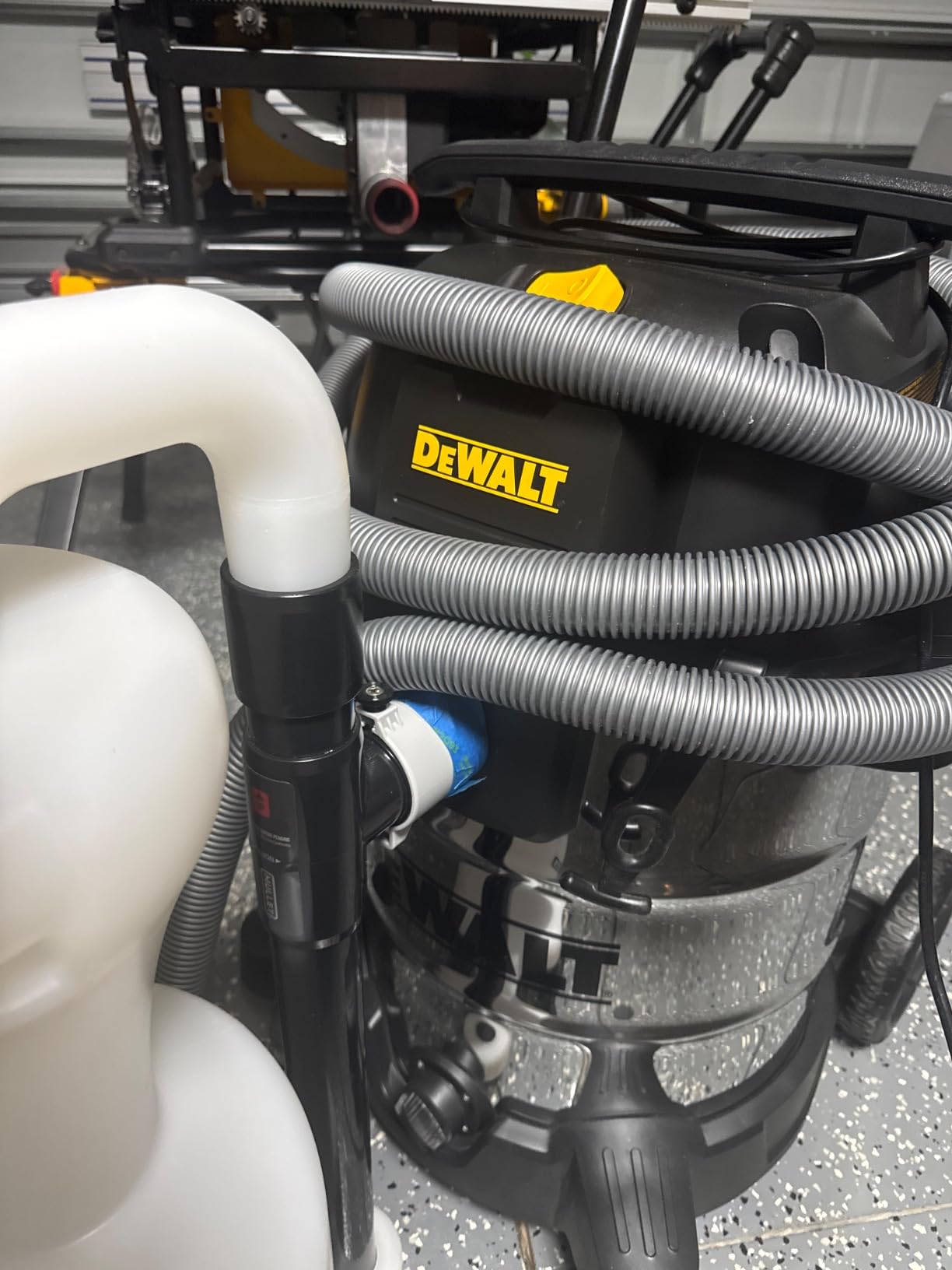
The Mullet is the only genuinely different shape in this roundup. Instead of a straight cone bolted to a bucket, it is a one-piece parabolic body that spins the airstream faster, and it connects with rigid cut-to-fit PVC rather than a flex hose. Made in the USA and headquartered in Dripping Springs, Texas, it carries a 4.8 star average, the highest in the group.
Buyers describe the visible swirl of dust through the body as satisfying in a way that has nothing to do with performance, and the sealed rigid connection is genuinely more airtight than a hose-and-clamp assembly. Two wet/dry vac hose adapters are included.
Why Parabolic Geometry Beats a Straight Cone
A straight cone slows air as it climbs. A parabolic body keeps accelerating it toward the top, which raises the centrifugal force doing the separating and means more dust hits the wall. Mullet states over 99 percent of debris is pre-separated before the air reaches the shop vac or extractor filter.
The one-piece construction also removes the gasket joints that are the most common leak path in bucket-top designs. There is no lid seal to fail, because there is no lid.
The Rigid PVC Commitment
Cut-to-fit PVC is the honest trade-off. It produces the best seal and the least restriction of anything here, and it is also permanent. You measure, you cut, you cement, and changing the layout means new pipe. Beginners who want to unbolt and move the setup on weekends will find it frustrating.
The inlet needs a rigid trunk line rather than a flex hose, so plan the run before you assemble anything.
Noise, Footprint and Who Should Buy It
The listed sound level is 72 dB, which is in the range of the vacuum it feeds rather than an added source, so you should not expect the separator to change your shop noise profile. If noise is a concern, the next layer up is dedicated air filtration rather than a louder separator.
Skip it if you want a weekend-removable bucket setup or if you are on a tight budget. Buy it if you are building a permanent shop install and want the best seal and the strongest geometry on the list.
9. VEVOR Cyclone Dust Separator with Metal Tank – Built for Larger Collectors
VEVOR Cyclone Dust Separator with Metal Tank, 4″ Retrofit Cyclone Separator for Dust Collectors, ABS Material With 2″ Hole O.D. Connector & Hose for Wet/Dry Shop Vacuums, Fits 13.21 Gallon Tank
13.21 gallon metal tank
3.81 inch ports plus 2 inch adapter
99.61 percent stated separation
17.86 pounds on casters
+ Pros
- Metal tank avoids thin plastic collapse entirely
- Transparent body and tank sight window for fill level
- Stated to handle 4 HP collectors
- Wrench and accessory kit included
– Cons
- Only three casters fitted and unstable when full
- Short ports leave little clamp room
- 2.5 inch reducers do not fit properly
This is the only unit here that arrives with a real steel container, and that single fact changes the durability math. A 13.21 gallon metal tank will not collapse when the collector pulls hard, which is the failure that ruins plastic-bucket separators over time. VEVOR states a separation rate of up to 99.61 percent and says it stands up to a 4 HP high-pressure collector.
It is aimed at workshops, woodworking studios, CNC routing and slab work rather than a benchtop shop vac, and it weighs 17.86 pounds. The tank sits on casters, so you can roll the whole assembly to the machine you are working.
Metal Tank and the Collapse Problem Solved
Bucket collapse is the most common complaint in this whole category. Suction inside a 5 gallon pail pulls the walls inward, and a thin retail pail eventually folds. A 13.21 gallon steel tank simply does not have that failure mode, and it also handles chips that would cut a plastic liner.
The trade is capacity versus convenience. This is a comfortable size for a hobbyist shop and easier to dump than a full 90 litre drum, but it fills faster than a drum and it is a two-hand lift once it has weight in it.
Port Diameter, Adapters and Fit Issues
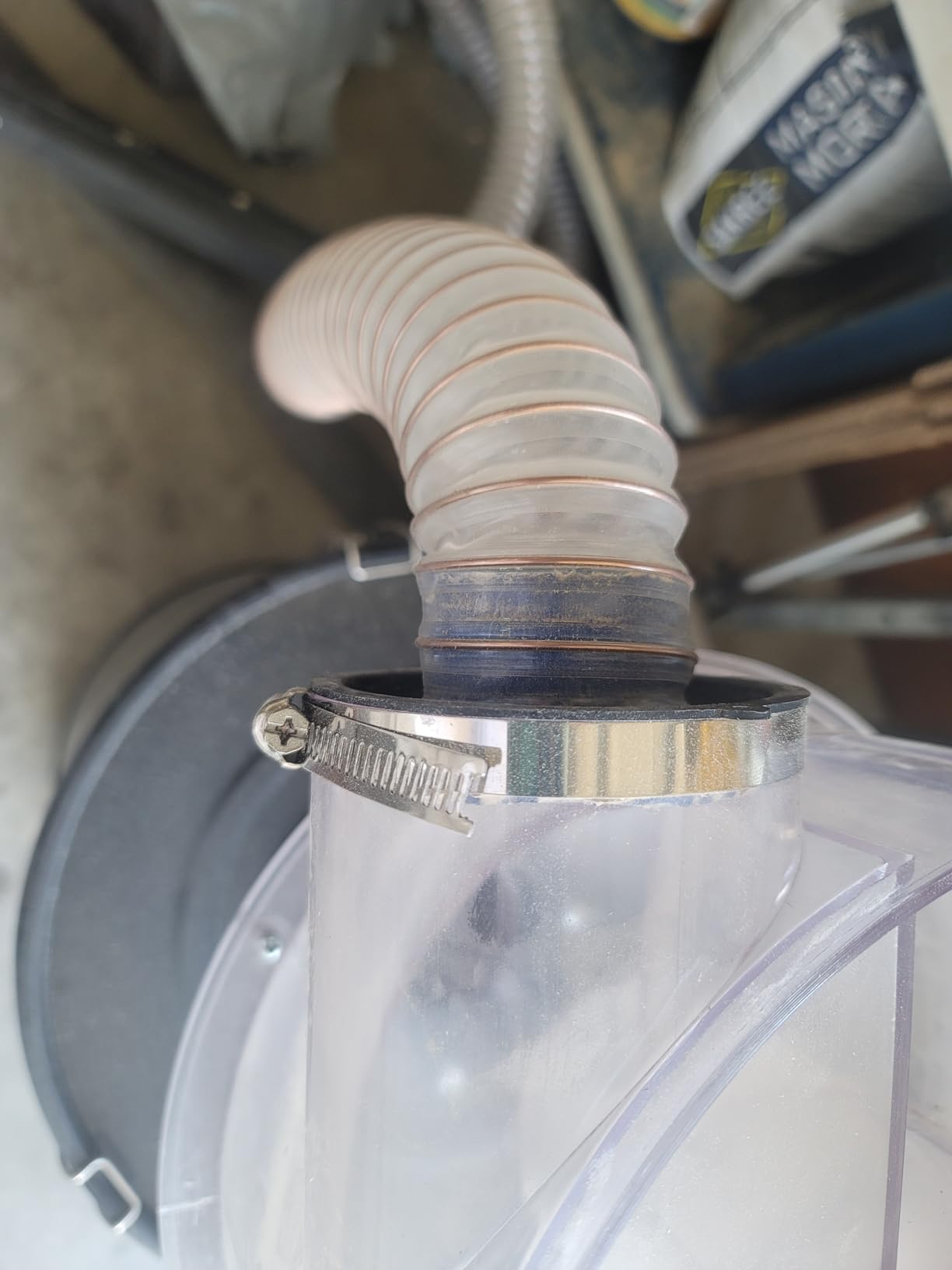
Inlet and outlet are sized at 3.81 inches, which lines up with 4 inch hose, and a 1.97 inch adapter is included for 2 inch hose lines. Owners report the supplied reducers for other sizes do not fit properly and that a foam strip is used as a workaround, so plan to source reducers yourself if you are on an unusual port size.
The ports are also short, which leaves a hose clamp little room to seat. Fixed installations suit this unit far better than setups you break down and rebuild regularly.
Visibility, Casters and Static
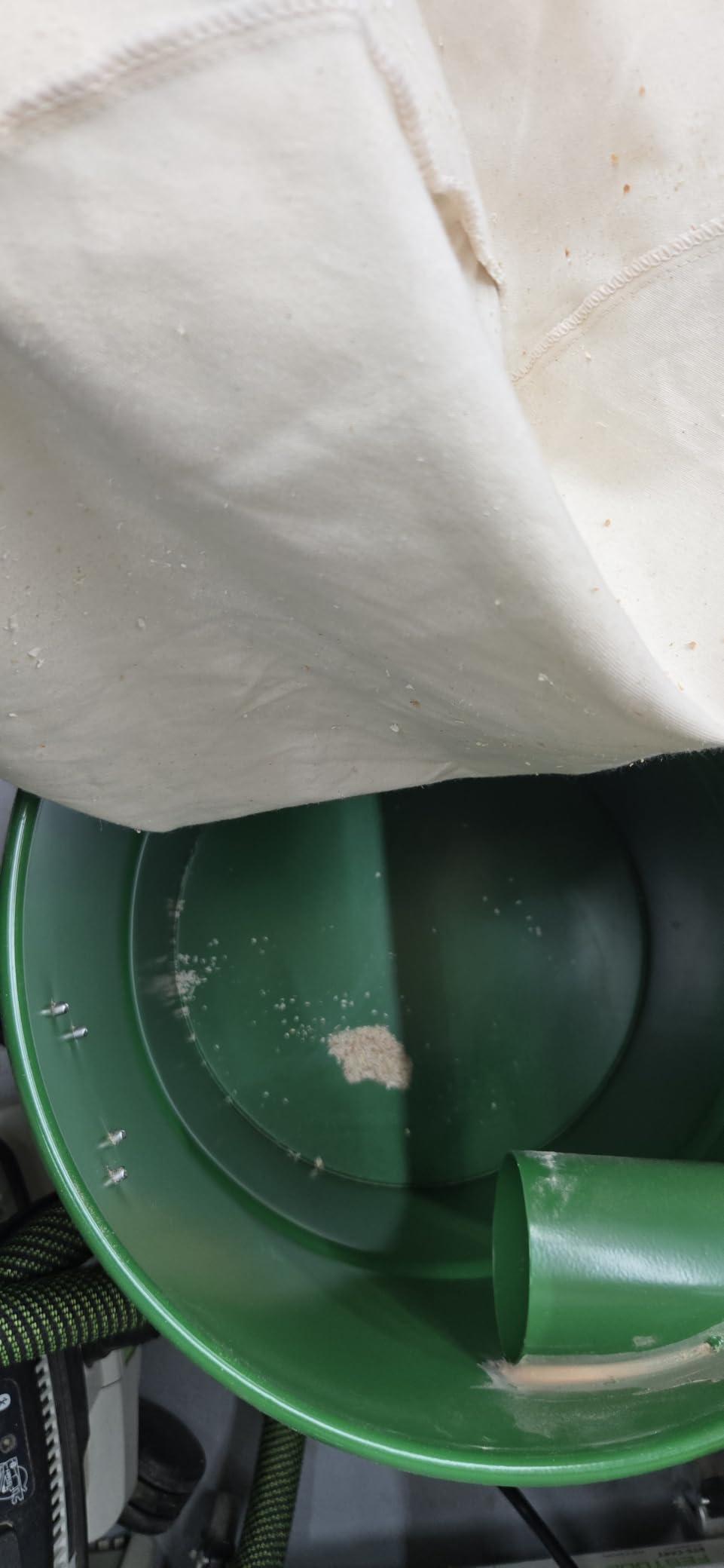
The transparent body plus a sight window on the tank let you monitor fill level without opening anything, though the clear body clouds with fine dust and needs wiping out periodically. The listed feature set mentions four casters while owners report three being fitted and instability when full, so check the count on arrival and add a caster if it is short.
Owners also report static making chips cling to the plastic cyclone body. That is a common complaint across plastic cyclone designs and the reason bonding the cyclone is worth doing on any unit in this roundup.
10. Taytools 4 Inch Cyclone Kit – The Inexpensive Collector Retrofit
Taytools 114971 4 Inch Dust Collection Cyclone Separator Kit for Trash Cans, Barrels or Custom Built Containers
4 inch inlet and outlet
6 x 6 x 9.75 inch ABS body
1.52 pounds
Elbows, couplers and clamps included
+ Pros
- Lowest cost path to a two stage collector
- Complete fitting kit with two clamps and hardware
- Accepts standard 4 inch collector hose
- Compact footprint suits small shops
– Cons
- 4 inch ports only with no shop vac fit without reducers
- No waste container included
- Opaque ABS hides the dust level
The Taytools kit is the same idea as the Peachtree kit at a lower price, packaged for 4 inch dust collector hose. You get two elbows, two couplers, two hose clamps and all the hardware, and you bring your own trash can, barrel or custom bin. At 1.52 pounds and 6 by 6 by 9.75 inches it is compact enough for a one-car garage shop.
Buyers treat it as one component of a build rather than a finished product, and that is exactly right. Its purpose is keeping debris away from the impeller and filter on a table saw, jointer, planer or router table line.
Component Thinking and Container Choice
Because no container is included, you get to choose the dump volume. A 20 gallon trash can is fine for a planer. A 30 or 55 gallon drum is better if you run a drum sander. Just remember that any container here is working under collector airflow, so avoid thin single-wall plastic.
The ABS body is not transparent, so you check the level by opening the container. On a jointer that is once a week, which is tolerable.
Where It Fits and Where It Does Not
Both ports are 4 inch, which is its whole identity. It does not fit smaller shop vac connections without reducers, so if your plan is a benchtop vacuum setup, choose the Dust Deputy DIY or the POWERTEC Low Profile instead.
Skip it if you want something that works out of the box. Pick it if you already have 4 inch ducting, a drum waiting to be used and a limited budget, because it is the cheapest honest conversion available.
How We Picked and What We Checked
For this roundup I compared port diameter against the equipment each unit is meant to serve, checked whether the container and hose were included or implied, and read the negative reviews as closely as the positive ones. I paid particular attention to sealing complaints, bucket collapse reports and static issues, because those three cause most of the disappointment in this category.
Published efficiency figures were treated as manufacturer claims unless the maker named an independent test. Only the Dustopper PRO in this list points to third-party testing, which is worth knowing when you are comparing 99 percent against 99.9 percent against 99.61 percent.
How to Choose the Right Cyclone Separator for Your Setup
Size the Cyclone to Your Airflow, Not Your Bucket
Sizing is the question most pages dodge. The rule that matters is simple: the cyclone has to sit in a duct line sized to the airflow, and a separator that is too small for the air volume will not spin it fast enough to separate. A separator that is too large wastes suction on turbulence.
The practical starting point is to match the separator inlet to your collector inlet, then keep the inlet and outlet diameters within one size of each other. An increase in outlet diameter slows the air leaving the cyclone, which is usually good, while a decrease costs you airflow. Every rapid transition, tight elbow and extra length of flex hose is drag you are spending your suction on.
Count your elbows before you buy. A clean build is a straight run from machine to cyclone, a short rise into the cone, and a straight run out to the collector. Each 90 degree elbow added to save a few inches of routing can cost more airflow than the separator gains. Where you must turn, use wide-radius sweep elbows rather than standard plumbing elbows.
Shop Vac Separator or Dust Collector Cyclone?
These are different products and they are not interchangeable. A shop vac separator uses 2 inch or 2.25 inch ports, mounts on a 5 or 6 gallon bucket and needs a wet/dry vacuum or small extractor. A dust collector cyclone uses 4 inch ports and up, needs a 1 HP or larger powered collector, and drops debris into a drum or barrel.
You can connect a shop vac separator to a small dust extractor, which many people do for portability. You cannot meaningfully run a 2 inch shop vac separator on a 4 inch collector line, because the velocity collapses and separation with it.
Metal Tank or Plastic Bucket?
Plastic buckets are lighter, cheaper and easier to carry, and they are the right answer for a shop vac because the airflow is modest. The risk is collapse: thin retail pails fold inward under suction, and a folded bucket leaks at the gasket. Use a heavy-duty pail or a metal can if you go this route, and add a bead of caulk.
Metal tanks are heavier and more expensive, and they are the right answer for collector-scale airflow and for chip-heavy machine work. The VEVOR unit in this roundup is the clearest example. Metal also dissipates static better than plastic, which is a secondary but real advantage when you are moving conductive dust.
Tall Cyclone or Low Profile Lid?
Tall cone bodies separate better because the air has more vertical distance to spin in, and they hold more debris before it needs emptying. They also need clearance, and a tall body on a bucket is easier to tip when a hose gets dragged.
Low profile lid designs sit almost flat on the pail, so they are stable, cheap and easy to move. The trade is less vertical spin distance, which shows up as more fine powder reaching the filter. Choose a tall body if you sand a lot. Choose a low profile if stability and portability matter more.
What a Separator Cannot Fix
A cyclone does not replace a filter. It removes bulk material, and the fine powder that keeps loading your filter is exactly what a cyclone is worst at capturing. You still need a filter, a bag or a cartridge behind the separator, and for silica or respirable dust you need a properly rated one.
It also will not fix an undersized collector, an over-long hose run or a leaky duct connection. Track-out from an open floor sweep and ambient dust in the room are also out of scope, because a separator filters the air it is given, not the air around the machine. If your problem is room-level dust rather than machine-level dust, an air scrubber solves a different problem. Our guide to the best air scrubbers for home renovation dust covers that side.
Set It Up in the Right Order
Connect in this sequence: tool to hose, hose to the separator inlet, separator outlet to the vacuum or collector inlet, container underneath, then finish the air path at the vacuum exhaust as your system requires. Most leaks happen at the transition you assembled first and checked last.
Seal every joint. Seat the gasket fully, add a hose clamp on any port with more than a few pounds of suction behind it, and run a bead of caulk on a drilled lid if the fit is not perfect. Bond the cyclone with a grounding wire where static is a problem. Finally, put the whole assembly on a cart or a wall bracket and let the hose take the load, then empty the container before swirling dust escapes past the top rather than after.
Frequently Asked Questions
Is a cyclone dust separator worth it?
Yes, if your shop vac filter clogs before the tank is full. A separator drops chips and dust into a bucket before the air reaches the filter, so suction holds steady longer, filters and bags last far longer, and cleanup becomes a bucket dump. It does not replace a filter, and it will not fix an undersized collector or a leaking duct.
How do you size a cyclone separator?
Match the separator inlet to your collector inlet, then keep the outlet within one diameter of the inlet, since a larger outlet slows exiting air while a smaller one costs airflow. Minimum roughly 400 CFM per 4 inch duct, 700 CFM per 5 inch, 1000 CFM per 6 inch. Use wide sweep elbows, minimise every extra foot of hose, and remember that cyclone separation depends on air speed, so a weak vacuum or a very long hose run will not separate well at any size.
What are the different types of cyclone separators?
Four types cover almost everything. A full cone separator bolts to a bucket lid and spins air through a tall cone. A low profile lid design is flatter and more stable but captures less fine powder. A collector retrofit kit adds a cyclone to an existing single-stage dust collector. A dedicated drum system uses a rigid ducted body with a metal tank. Shop vac separators use 2 inch or 2.25 inch ports, while collector cyclones use 4 inch ports and up.
What is the difference between a cyclone separator and a dust collector?
A dust separator is a passive cone or lid that relies on airflow alone to spin dust out, and it has no motor and no filter of its own. A dust collector is a powered machine with a motor, a filter or bag, and its own intake. A separator bolts onto the intake of a collector or a shop vac to extend bag life and hold the bulk debris, so the two are complementary rather than competing.
What are the disadvantages of using a cyclone dust collector?
Five real drawbacks. It costs more than a bucket lid. It does not capture the finest powder, so you still need a filter and you will still replace it. Each extra elbow and foot of hose costs airflow. A tall body on a bucket can tip when the hose is dragged. And it only helps if your source airflow is strong, because separation depends on speed.
The Best Dust Separator for Each Kind of Shop
For a benchtop shop vac setup, the Oneida Dust Deputy DIY is the pick. It has the largest owner base in the roundup, works wet or dry, and the tapered 2.0 inch ports fit more hose than anything else at this level. Pair it with a heavy-duty 5-gallon pail and you have the reference setup for most home shops. If you refuse to drill a bucket lid, the Dustopper PRO is the next choice, because the preinstalled gasket seals on the first try and the clear body tells you when to empty it.
For a small shop vacuum where you want chips off the floor more than you want fines out of the air, the POWERTEC Low Profile is the value pick with everything included in the box. For owners of 1 HP to 3 HP single-stage collectors, the Oneida 4/5 DIY attachment converts what you already own into two-stage collection, and the Peachtree or Taytools kits are the cheaper route when your ducting is 4 inch throughout. If collapse-proof storage matters, the VEVOR metal tank is the durable answer, and the Mullet is the one to build into a permanent install.
Whichever route you take, the three things that decide whether it works are a proper container, a sealed gasket joint and a straight, elbow-light air path. Get those right and the efficiency percentage barely matters.
One last practical note for 2026 buyers: a lot of hobbyists run a dusty hobby like an indoor hydroponic garden in the same rooms as the shop. Keeping the machine that makes the mess and the machine that holds the fines in separate spaces is easier than cleaning both at once.
Leave a Reply