
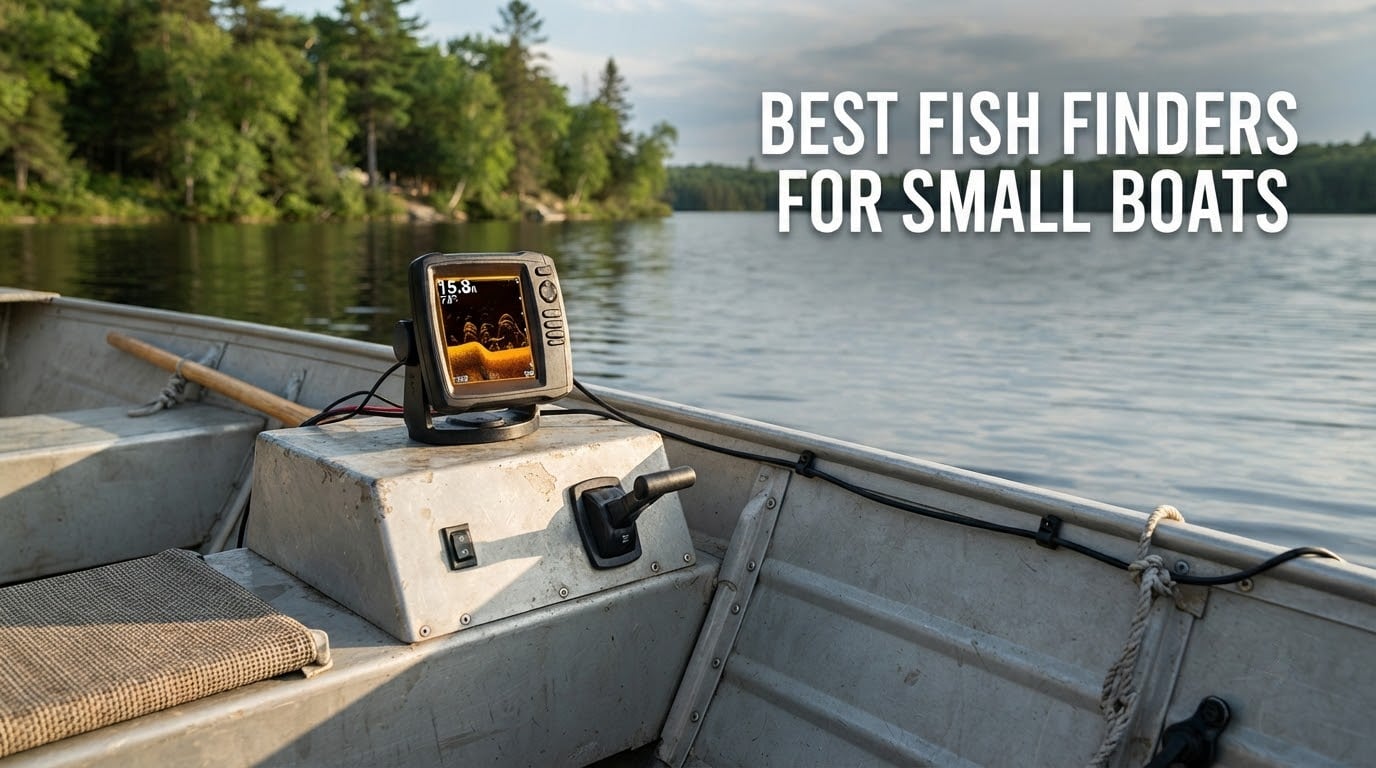
Small boats rarely have a console, a clean 12V circuit or room for a nine inch screen, and those happen to be the three things most fish finder marketing quietly assumes you already have. That mismatch is why the best fish finders for small boats are a genuinely different shortlist than the biggest sellers in the category. We pulled the specs, the mounting hardware and thousands of owner reviews for ten units and ranked them by how well they solve the small hull problem rather than by feature count.
My rule for this list was simple: a unit has to be mountable on a boat under about 16 feet, powered by something smaller than a full house bank, and readable by a seated angler wearing polarized sunglasses in open sun. Anything that needed a binnacle, a through-hull core or a second battery got cut. The ten that survived are grouped by the kind of boat you actually own, from a 12 foot jon boat with no electrical system to a pontoon with room for a five inch screen.
Here is the honest caveat before we start. We did not run controlled sonar accuracy tests in identical water, and we did not measure battery endurance on a bench. Every number below comes from the manufacturer spec sheet and from the aggregated owner review record for each unit, including the recurring complaints. Where owners are divided, we say so instead of picking the flattering side. Last checked for 2026 against current model generations.
If your boat has no battery at all, read the castable sections first. If you want waypoints and contours, start with the Garmin and Humminbird units. If you just need to know the depth under the boat before you cast, the basic handhelds do that job and nothing more.
Our Top 3 Best Fish Finder Picks for Small Boats in 2026
These three are the units we would put on our own hulls. The STRIKER 4 wins on owner satisfaction and a published current draw that makes battery life almost a non-issue. The STRIKER Vivid 4cv has the highest average rating in the group and comes with contour mapping already built in. The STRIKER Plus 4 bundles the same mapping idea and a dual beam transducer in a similar compact box.

Garmin STRIKER 4
- CHIRP traditional and ClearVu sonar
- 3.5 inch color LCD
- Built-in GPS with waypoints
- 0.23 amp draw at 12V

Garmin STRIKER Vivid 4cv
- CHIRP ClearVu scanning sonar
- 4 inch color display with Vivid palettes
- Quickdraw Contours included
- 2 year warranty

Garmin STRIKER Plus 4
- Dual beam CHIRP transducer
- 4.3 inch sunlight readable screen
- Quickdraw contours and built-in GPS
- Transom and motor mounts included
Comparing 10 Small Boat Fish Finders Side by Side in 2026
The table below carries every unit in this roundup with the features that actually decide whether a fish finder belongs on a small boat: sonar type, screen size, whether mapping is included, and the depth range. Two picks here are castable wireless sensors with no screen of their own worth speaking of, because the display lives on your phone. Two more have no GPS at all, which is a deliberate choice for anglers who fish one lake and never need to return to a waypoint.
| Product | Details | Action |
|---|---|---|
|
|
Check Latest Price |
|
|
Check Latest Price |
 |
|
Check Latest Price |
 |
|
Check Latest Price |
 |
|
Check Latest Price |
 |
|
Check Latest Price |
 |
|
Check Latest Price |
 |
|
Check Latest Price |
|
|
Check Latest Price |
 |
|
Check Latest Price |
Three of these models share the same physical footprint category, and the difference between them is the sonar, not the box. Read the individual reviews below before you pick, because the same 4 inch screen can mean very different things depending on whether the transducer sends CHIRP traditional, a scanning beam, or both.
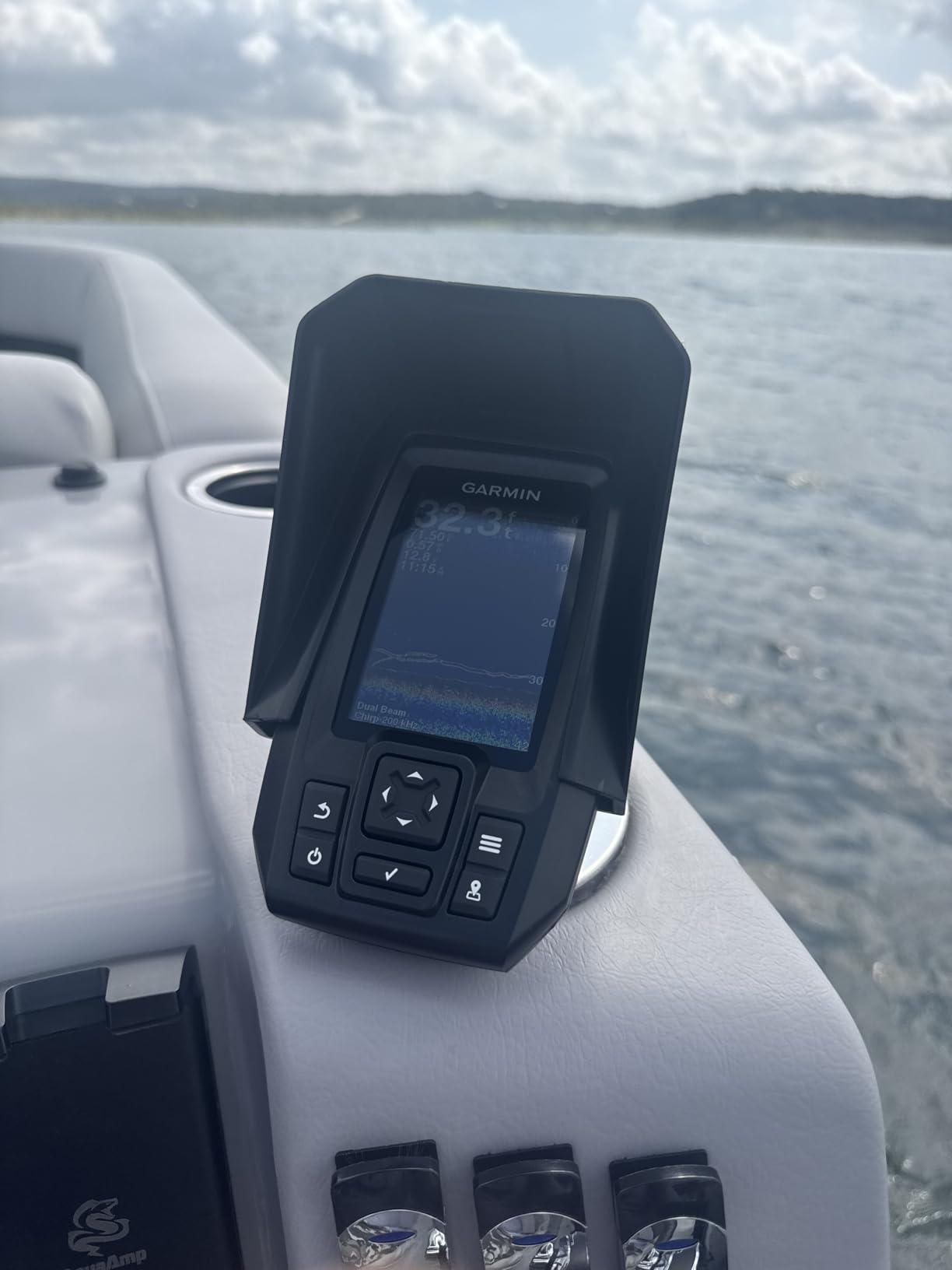
1. Garmin STRIKER 4 – The Compact Unit That Solves Small Boat Problems
Garmin 010-01550-00 Striker 4 with Transducer, 3.5″ GPS Fishfinder with Chirp
3.5 inch color LCD
CHIRP traditional and ClearVu
Built-in GPS and waypoints
0.23 amp draw at 12V
+ Pros
- Over 9000 owner reviews and a 4.6 star average
- Built-in GPS marks waypoints and shows boat speed
- Clicks straight into the included tilt and swivel bracket
- Transom and trolling motor mounts in the box
- Draws 0.23 amp at 12V
– Cons
- 3.5 inch screen gets cramped when zoomed
- Supplied power lead is thin and fragile
- No onboard charts or contour mapping
This is the unit I keep coming back to for hulls under 16 feet. It weighs 8 ounces, mounts on the transom or clamps to a trolling motor shaft without drilling, and the whole head unit lifts out of its bracket in one motion when you want the console clear. Owners on small jon boats and kayaks consistently report the same thing: it installs in an afternoon and works immediately.
The sonar is the reason it outranks its size. CHIRP traditional sweeps a range of frequencies for cleaner arches and better target separation, and the same head unit adds ClearVu scanning sonar for near photographic views of structure. On 1600 feet of freshwater depth rating and 750 feet in saltwater, that is far more range than a small boat will ever ask of it.
Battery draw of 0.23 amp is the quiet advantage
Almost every small boat owner asks the same battery life question, and this is the only unit in the roundup where the manufacturer publishes a current draw. At 0.23 amp on 12V it consumes roughly 2.8 watts, which means the fish finder is rarely the reason a deep cycle battery runs flat on a day of trolling. On paper, ignoring conversion losses, a 10 amp hour battery would cover a very long day and a 20 amp hour battery is effectively unlimited for a sonar head unit.
Where the 3.5 inch screen gets in the way
The honest weakness is screen real estate. Zoomed in on a brush pile, a 3.5 inch panel shows you less detail than the 4.3 inch units, and the A-scope view is cramped. Anglers who wear polarized sunglasses report that readability holds up well in direct sun, but you will notice the difference if you move up a size.
Power lead and charting gaps
Two recurring complaints in the reviews are worth planning around. The supplied power cable is thin and fragile, so secure the run with clips or heat shrink rather than leaving it loose, and the documentation is thin on hookup details. There are also no preloaded charts and no Quickdraw style contour mapping on this model, so it is a sonar and waypoint tool rather than a mapping tool.
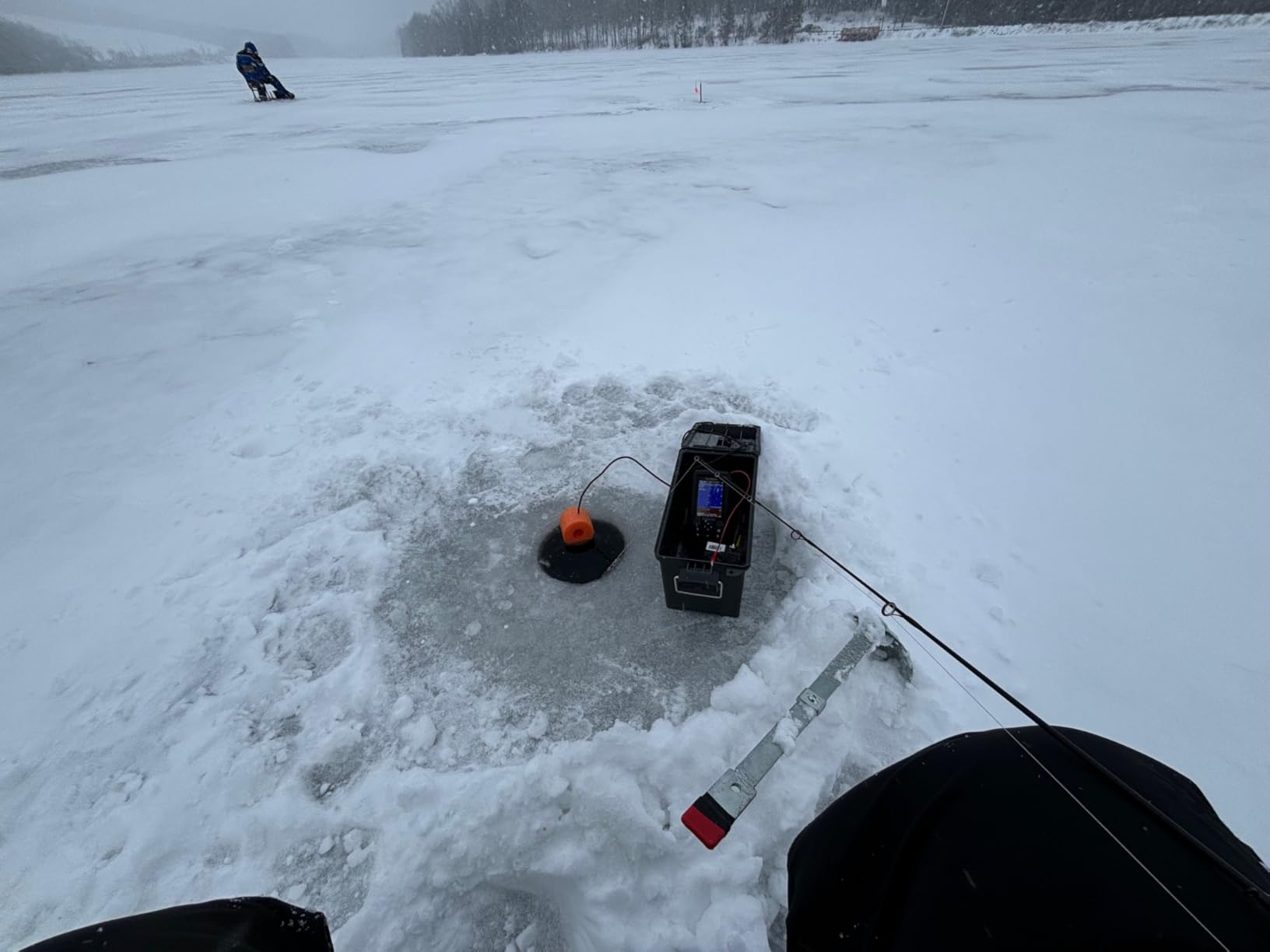
Owners also report that the sonar signal degrades at higher boat speeds, which is normal for a transom mounted transducer. Troll at a moderate pace, and it reads arches clearly. There is a built in flasher mode too, so the same unit works for ice fishing and vertical jigging in winter.
2. Garmin STRIKER Vivid 4cv – Highest Rated Pick With Color Scanning Sonar
Garmin Striker Vivid 4cv Fishfinder with Transducer – 4-inch LCD Display – Easy-to-Use Scanning Sonar – Color Palettes, 11.2 Ounces (010-02550-00)
4 inch color LCD
GT20 CHIRP ClearVu transducer
Quickdraw Contours included
2 year warranty
+ Pros
- Highest average rating in the roundup at 4.7 stars
- Color palettes separate fish from structure clearly
- Quickdraw Contours mapping is standard on this model
- Tilt and swivel bailmount bracket in the box
- GPS waypoint route and boat speed functions
– Cons
- Quickdraw maps cannot be uploaded or downloaded
- Base model has no premium chart support
- GT20 transducer is the only one that carries both sonar types
This is the pick for anyone who wants a small boat fish finder that still looks like a modern chartplotter. The 4 inch color display runs Vivid color palettes, which is a small thing that makes a large difference when you are trying to tell a school of shad apart from a stump at 20 feet. Owners describe setup as close to plug and play once the battery is connected.
The GT20 transducer in the box is the reason I rate it above the other Garmin units here. It sends both CHIRP traditional and CHIRP ClearVu scanning sonar from a single element, so you get reliable arches and a picture-like view of structure without buying a second transducer. On a shallow flatbottom, the ClearVu image is what finds weed edges and rock shelves.
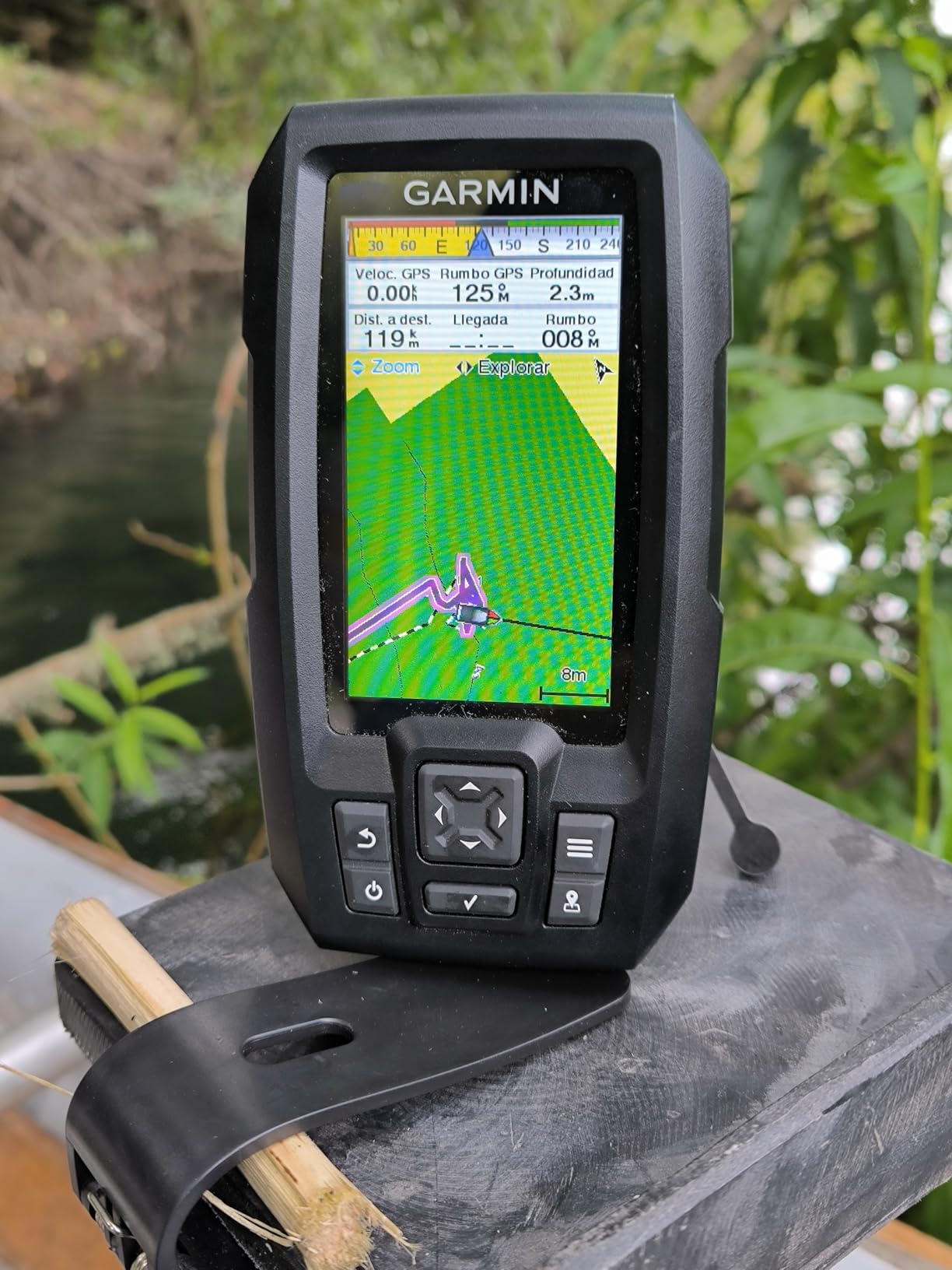
Quickdraw Contours is the feature that justifies the step up
Quickdraw Contours records your own depth map as you run, with one foot contours across a huge usable area, and the software is built in rather than an add-on. For a small boat angler who found a productive ledge, that map is the difference between finding it again and burning a tank of fuel looking for it. Garmin also supports side scan and down imaging through the same family of transducers if you later want to add them.
Mapping limits to plan around
Two limits are named repeatedly in owner feedback. Quickdraw maps cannot be uploaded or downloaded on this model, and there is no support for preloaded LakeMaster or Navionics charts. If you need premium cartography rather than your own recorded contours, step up to the HELIX 5 covered later in this list.
Warranty length as a tiebreaker
Garmin backs this one with a 2 year limited warranty, which is longer than the 1 year on the STRIKER 4 and the PiranhaMAX 4. On a unit that will live in a wet cockpit in direct sun, that extra year of coverage is worth something when you are choosing between two similar four inch boxes.
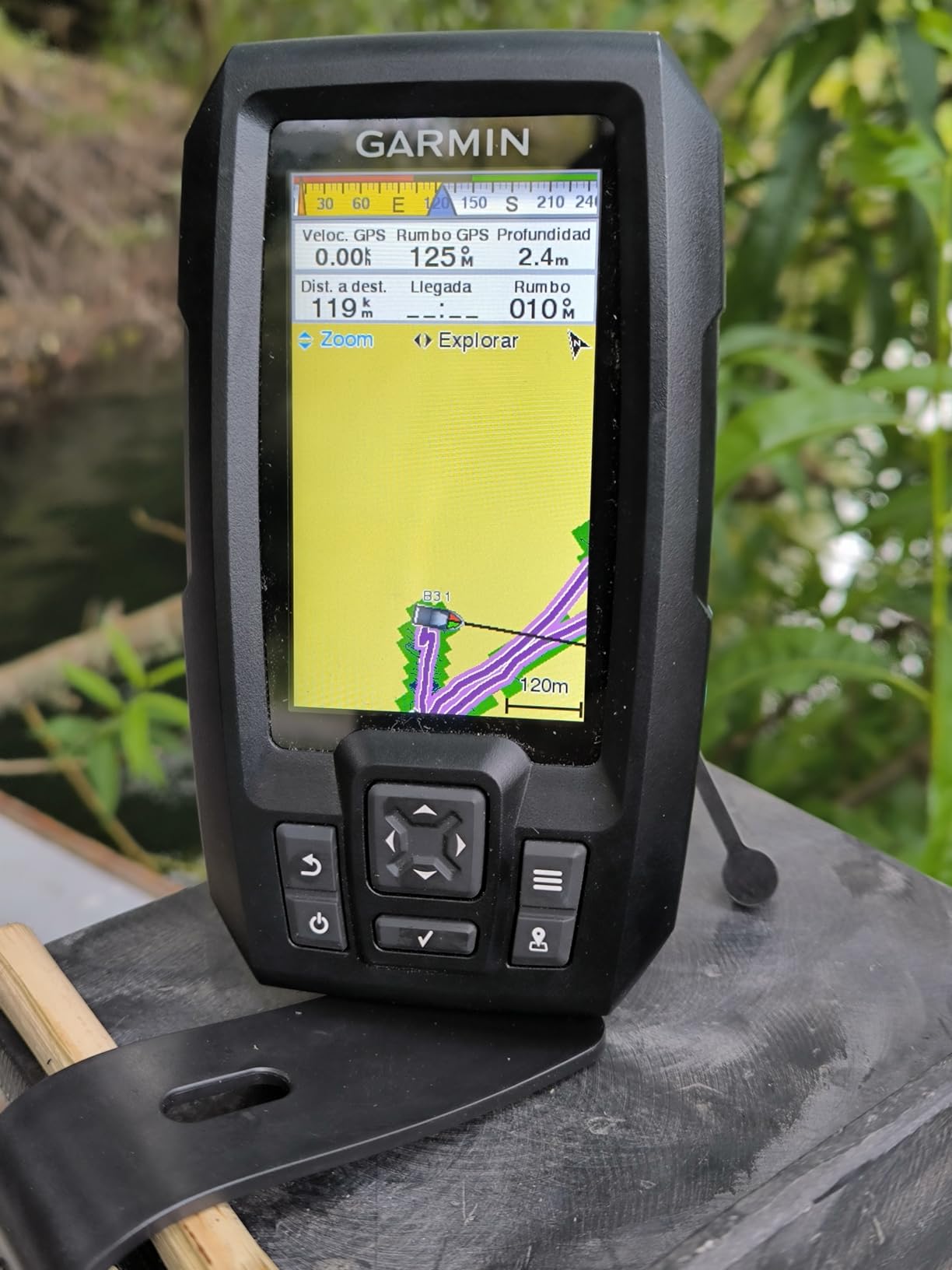
At 11.2 ounces and with a bailmount bracket that tilts to kill glare, it stays out of the way on a tiller steered boat where you are constantly moving around the hull. It is also the unit I recommend to anyone moving up from a handheld and wanting real structure imaging on a small budget.
3. Humminbird PiranhaMAX 4 – Simple Dual Beam Sonar With No Mapping Complexity
Humminbird PiranhaMAX 4 Fish Finder with Transducer, Dual Beam Sonar
4.3 inch LCD
Dual Beam narrow and wide modes
XNT transom transducer included
600 foot maximum depth
+ Pros
- Dual beam lets you trade detail against coverage
- Tilt and swivel mount angles well against glare
- Transducer is in the box
- No menus to learn
- Dependable fish and bottom structure reading
– Cons
- No GPS or charting on this model
- 600 foot depth limit is closer to the surface than the STRIKER 4
- Bulkier and heavier than the slim Garmin four inch units
Some anglers do not want waypoints, routes or a basemap, and for them this is the cleanest small boat fish finder in the group. Dual Beam sonar gives you a narrow beam for detail and a wide beam for coverage, and you switch between them with one button. The included tilt and swivel mount holds any angle you need against low sun or glare off calm water.
It is also the most honest no frills unit here. There is no fish ID clutter, no auto charted mapping, no menu tree. You turn it on, you pick a beam, you fish. For a jon boat where the angler is sitting low and looking at a screen angled up, fewer things on that display is a real advantage rather than a compromise.
Depth rating and where it actually matters
The 600 foot maximum depth is worth checking against your water, and on a river, reservoir or inland lake you will never approach it. Coastal anglers should note that the effective saltwater range is a smaller fraction of that number, and the STRIKER Plus 4’s 20 meter rating is shallower again. For a small boat working shallow structure, none of this is a practical limit, and reviewers consistently report accurate contours and bottom readings.
What you give up by skipping GPS
Reviewers who bought this unit for a rental boat or a single lake do not miss the GPS. Reviewers who wanted to mark a productive spot do. If you fish new water every trip, add a handheld GPS or a phone mount instead of stretching for a bigger unit, since the PiranhaMAX has no way to add mapping later.
Build and mount quality
At 2 pounds this is one of the heavier head units in the list, and it is noticeably bulkier than the slim Garmin four inch models. On a small hull with a narrow mounting surface, check that the bracket footprint fits before you commit. The transom mount and the transducer are both included, so there is nothing extra to buy to get it on the water.
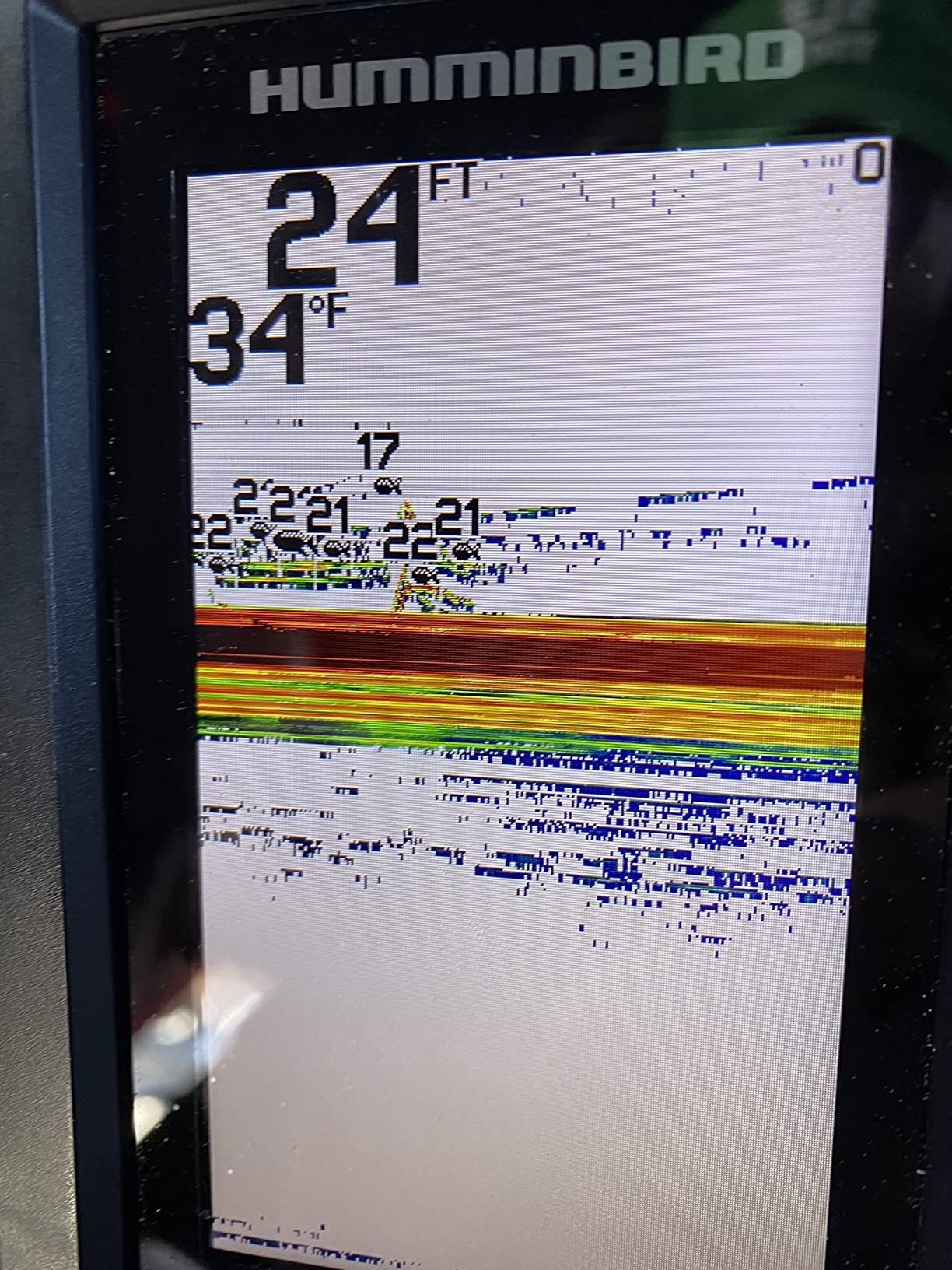
Sonar types matter more than people expect here. Dual Beam traditional sonar produces classic arches, which is exactly what you want when you are watching a weed edge or drifting over a point. If your priority is seeing structure in photographic detail, compare it against the ClearVu models rather than expecting a menu to provide it.
4. Humminbird HELIX 5 CHIRP GPS G3 – Best Mapping Head Unit for a Pontoon
Humminbird Helix 5 G3 GPS Fish Finder with Transducer & Dual Spectrum Chirp Sonar
5 inch color TFT
Dual Spectrum CHIRP with Wide and Narrow modes
Humminbird Basemap
AutoChart Live contour recording
+ Pros
- 5 inch color TFT screen is easy to read in bright sun
- AutoChart Live records contours as you fish
- Basemap covers more than 10000 lakes and the continental coast
- Works with LakeMaster CoastMaster and Navionics charts
- Keypad control stays usable in rough weather
– Cons
- The most involved install in the group
- Supplied power cable runs short on small boats and no 3 amp fuse is included
- Lowest star average among the Garmin and Humminbird models here
The 5 inch color TFT is the biggest panel in the group, and on a pontoon or a small runabout with a console it is the size that makes a split layout practical. You can put the sonar on one half and your speed, route and waypoint data on the other. Dual Spectrum CHIRP with Wide and Narrow modes handles both the coverage and the detail question in one transducer.
AutoChart Live is the standout. It records depth contours, bottom hardness and vegetation as you run, with eight hours of built in recording, and it accepts AutoChart Zero Line SD cards when you want more storage. Owners who fish new water every weekend describe the resulting maps as the reason the unit earned its place on the boat.
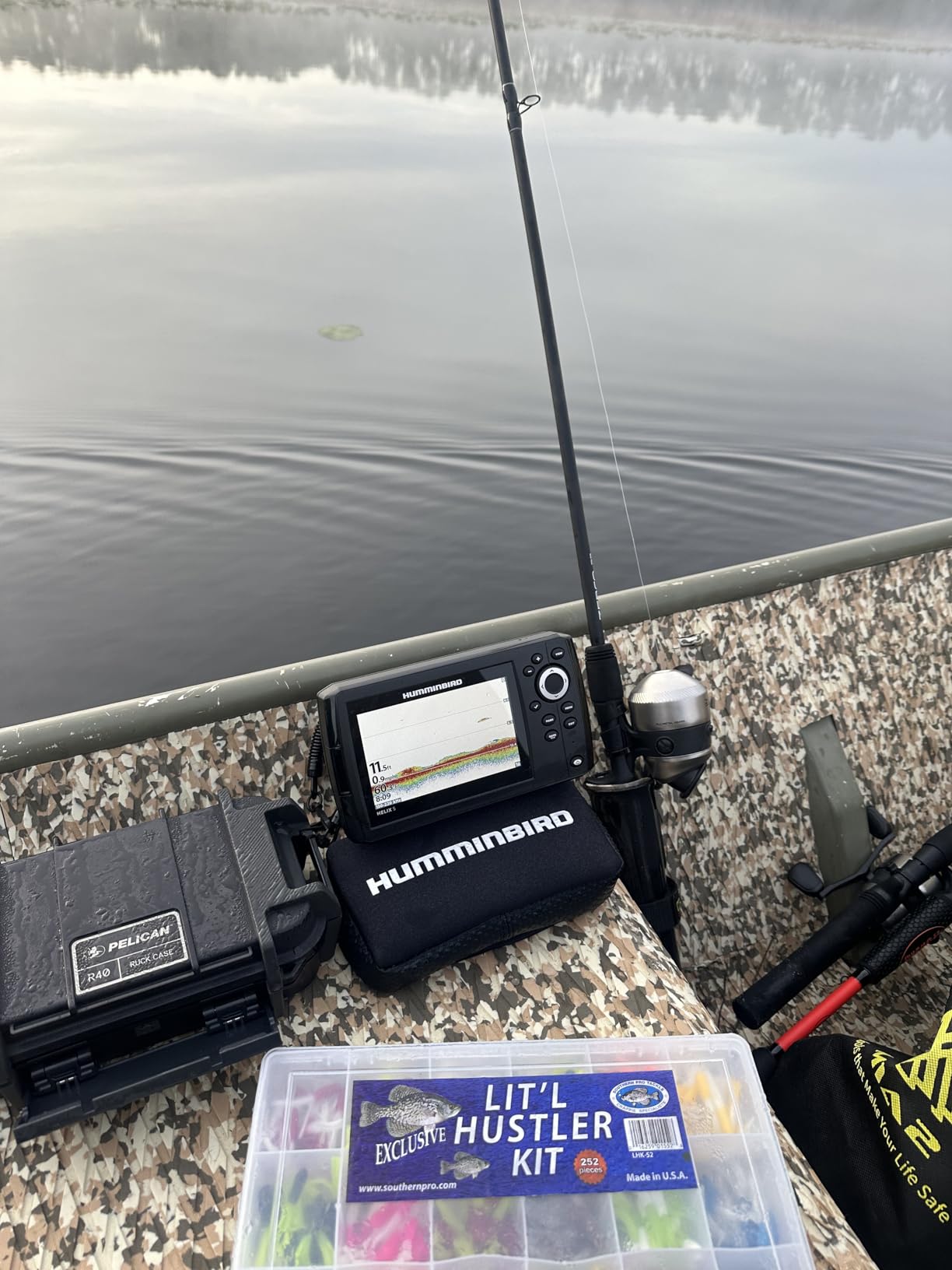
Install it with the cable length in mind
The most repeated complaint in the reviews is installation, not performance. Owners report that the supplied power cable is too short for a typical battery run on a small boat and that the 3 amp fuse it needs is not in the box. Plan for a short extension, an inline fuse holder and heat shrunk connections before you start, and the unit itself performs well once wired.
Cartography versus recorded contours
Unlike the Garmin units here, the HELIX 5 accepts premium charts including LakeMaster, CoastMaster and Navionics on top of its own AutoChart recording. That matters for coastal and multi lake fishing where a built in basemap will not carry the detail you need. The Humminbird Basemap ships with coverage of more than 10000 lakes and the continental US coastline.
Who should not buy the biggest screen
Five inches is wonderful on a pontoon and wrong on a 12 foot jon boat with a tiller. There is nowhere to mount it, it needs a clean 12V circuit, and a seated angler has to look up at a screen above eye level. If your hull has no console, the smaller Garmin units deliver most of the sonar benefit for a fraction of the physical bulk.
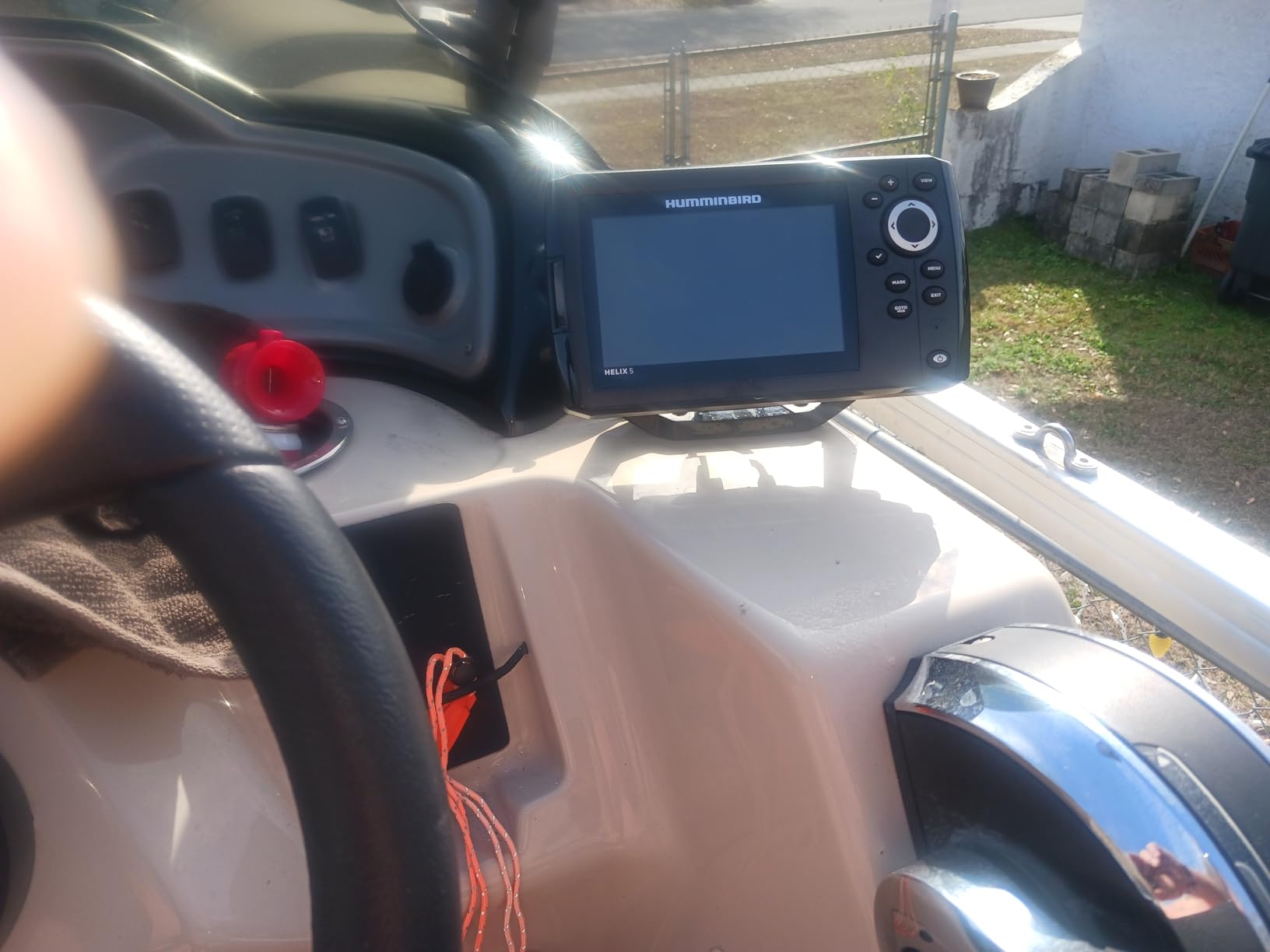
The keypad control is a genuine advantage in rough water, where touchscreen units are frustrating with wet hands or gloves. The 1 year manufacturer warranty is shorter than the 2 years on the STRIKER Vivid 4cv, and a small number of owners reported units arriving non functional, so test it on the dock before you rely on it.
5. Lowrance EAGLE 4 inch Sonar – The Smallest Footprint On the Console
Lowrance Eagle 4X Fish Finder with Bullet Transducer
4 inch IPS portrait display
Auto-Tuning Sonar
200 kHz Bullet Skimmer with 44 degree beam
500 foot maximum depth
+ Pros
- IPS portrait screen reads through polarized sunglasses
- Tiny physical footprint suits a limited console
- Auto-Tuning sonar removes the setup menu
- Twist-lock connector makes display removal fast
- Retrofit friendly with older Lowrance mount patterns
– Cons
- Standard 2D sonar only with no live scope
- Base 4 inch version has no charting or GPS
- Smallest review base in the roundup so long term data is thin
The EAGLE solves a problem no other unit here addresses: fitting a readable display into a space that is barely a console. The portrait orientation and IPS panel stay clear at wide viewing angles and through polarized sunglasses, which is the whole point when the screen sits below eye level on a skiff or a kayak deck. Multiple owners report dropping it straight into the mount pattern of an older Lowrance CHIRP 4 unit.
Auto-Tuning Sonar handles the settings for you on power up, so there is no menu to learn before the boat is launched. The included 200 kHz Bullet Skimmer transducer throws a broad 44 degree beam, a sensible match for a small boat where you want coverage more than pinpoint target separation.
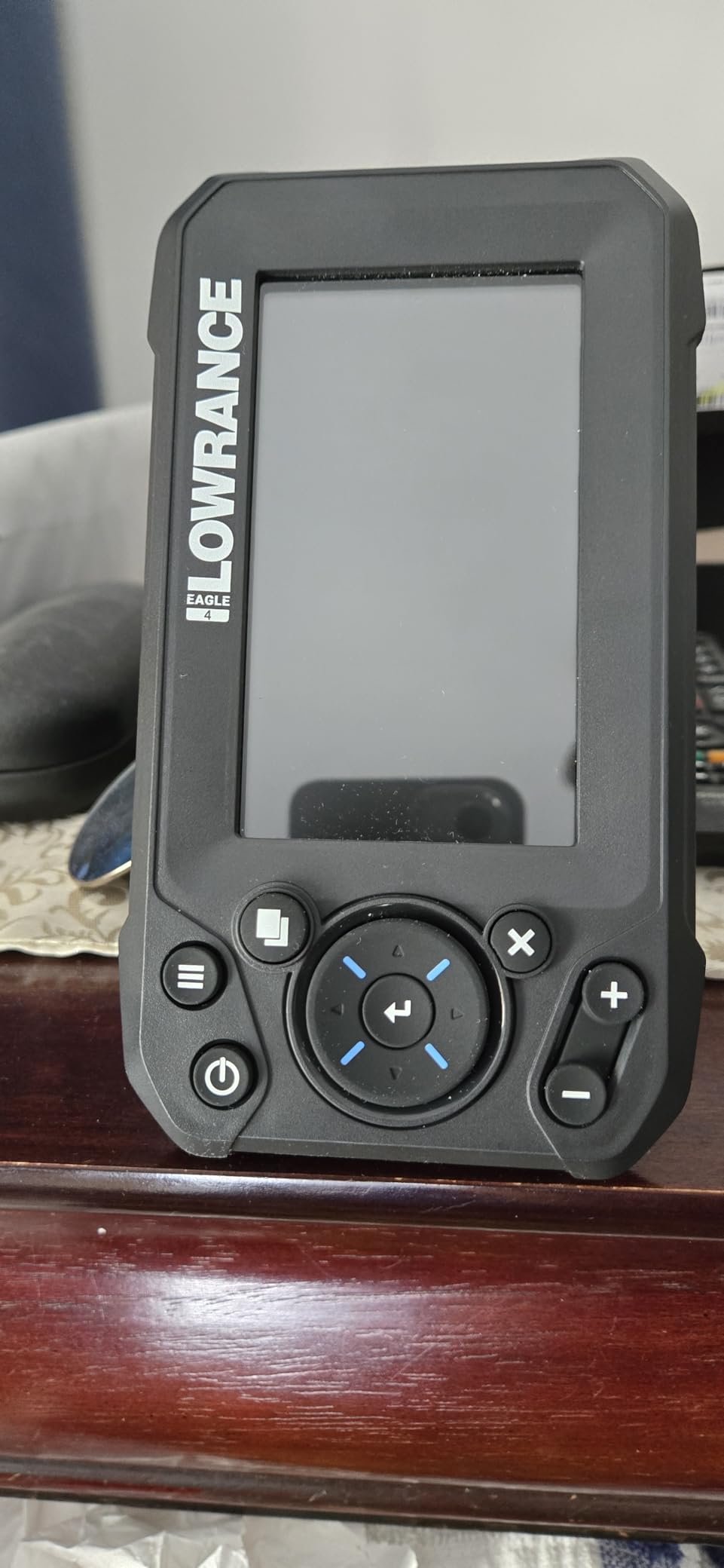
Why the portrait screen beats a landscape one in a small cockpit
A 4 inch horizontal panel mounted on a narrow console forces you to choose between blocking a hatch and sitting at an awkward angle. The portrait form factor is tall and narrow, which suits the vertical space between a console lip and a windshield frame. The IPS panel is also the reason reviewers rate it so highly for sunlight readability at a modest screen size.
What the base model does not have
This is standard 2D sonar, which means traditional arches and bottom contours rather than live scope or scanning imagery. There is also no GPS or charting on the 4 inch Sonar variant, though Lowrance offers C-MAP and SplitShot or TripleShot versions in larger sizes. Several owners questioned the accuracy of the fish size icons, so treat them as a rough guide.
Lowrance mounting and retrofit notes
The twist-lock connector lets you pull the display off in seconds and stow it, and the unit supports surface, panel and flush mounting. The included 500 foot maximum depth suits inland and coastal work. The small review base means long term reliability data is thinner than the big sellers, which is worth factoring into a purchase.
For cross shopping the three big brands, our [kayak fish finder picks](/best-fish-finders-for-kayaks/) cover the same units from the mounting side, and the head to head between Garmin, Humminbird and Lowrance sits in the buying guide below.
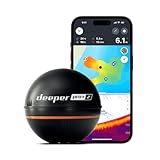
6. Deeper PRO+ 2 – Castable Sonar That Builds Its Own Maps
Deeper PRO+ 2 Sonar Fish Finder – Portable Fish Finder and Depth Finder For Kayaks, Boats and Ice Fishing with GPS Enabled | Castable Deeper Fish Finder with FREE User Friendly App
Castable wireless sonar
Built-in GPS with bathymetric map creation
Wide mid and narrow beam modes
Up to 330 ft range
+ Pros
- No drilling wiring or permanent mounting
- Built-in GPS records bathymetric maps from shore or dock
- Three beam modes for coverage or detail
- Narrow beam gives 0.4 inch target separation
- Two year limited warranty
– Cons
- Relies on a phone or tablet for the display
- Wi-Fi dropouts can end a session
- High one star share points to mixed durability and support
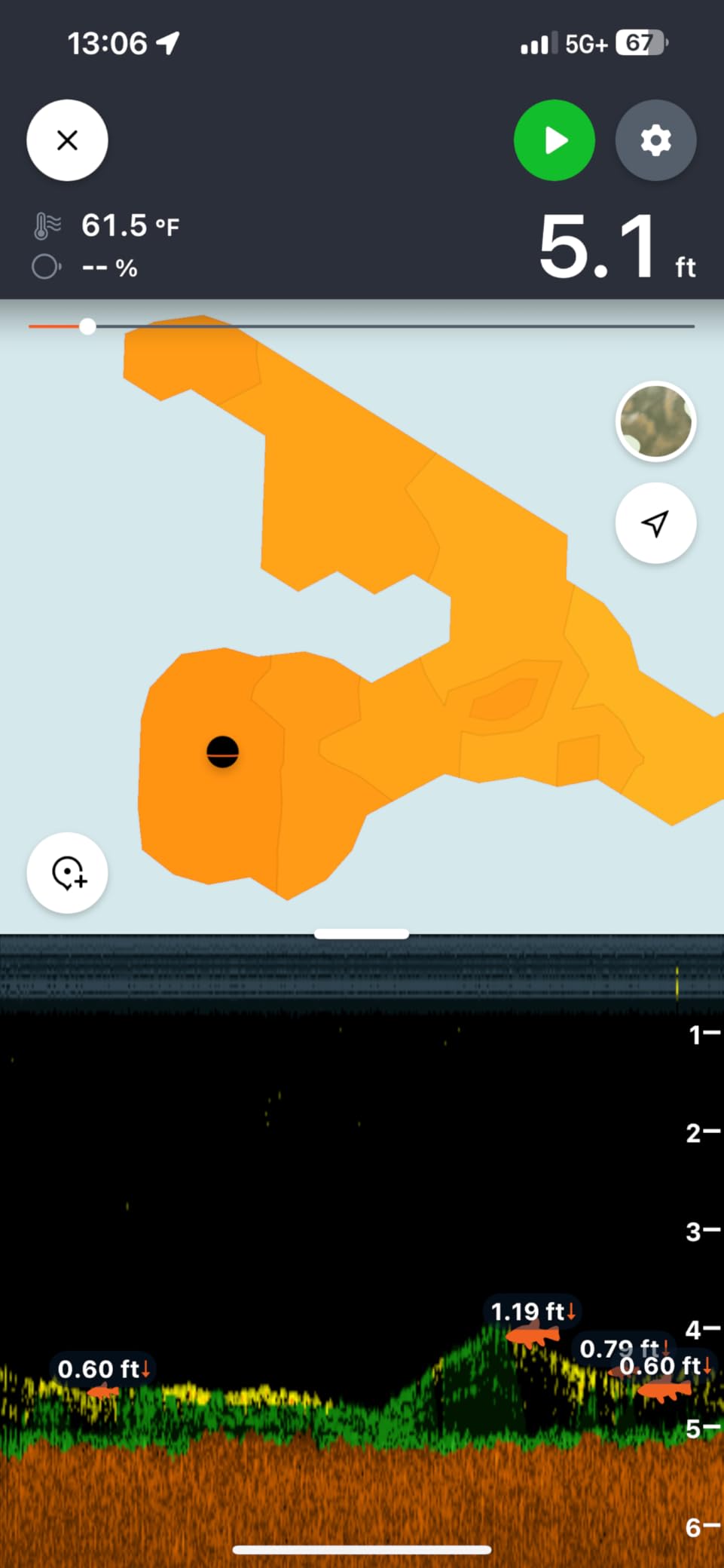
This is the answer for a boat with no battery, no wiring and no appetite for drilling, and it is one of the few portable fish finders that actually does mapping rather than just depth. The sensor is 3.2 ounces, casts on fishing line, and its built-in GPS records where you cast so the free Fish Deeper app can build bathymetric maps of a shoreline, a dock or a weed bed.
Three beam modes is unusual in a portable unit. The wide beam for coverage, mid for balance and narrow for drilling into a specific spot, with target separation down to 0.4 inch on narrow, which is good enough to follow a lure vertical or watch a fish hold near structure. Accuracy holds to around 330 feet.
Castable wireless versus a fixed mount
A fixed mount reads continuously as you move, which is what makes it better for finding a ledge while trolling. A castable sensor is better for precision work at a specific spot, for shore fishing, and for any boat where drilling is not allowed. Anglers who asked this question on fishing forums generally land on castable for kayaks and rentals, and fixed mount for anything they own outright.
Where connectivity bites
The recurring complaint is not accuracy, it is the connection. Owners report that Wi-Fi must hold up at range or the session is effectively lost, and roughly 12 percent of reviews are 1 star, which points to mixed durability and support experiences rather than a sonar problem. Keep the sensor on a short line, and treat the connection as the thing to plan around if you fish far from shore.
What you get for a phone based display
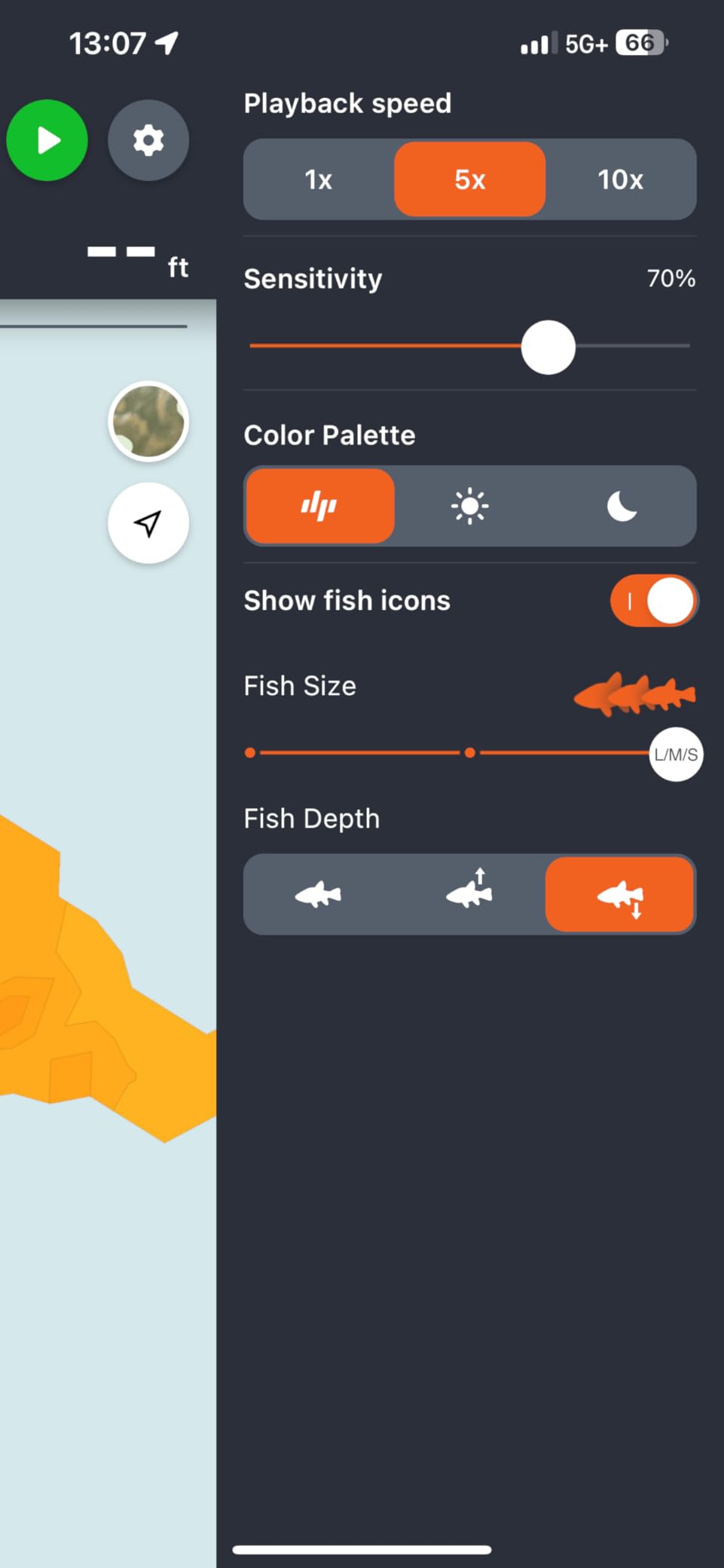
Everything renders on your phone or tablet through the Fish Deeper app, which is free for iOS and Android. The upside is a large color screen you already own and a night mode. The downside is that a phone in a waterproof case is one more thing to charge, mount and keep dry, and screen glare in direct sun can be worse than a dedicated sunlight readable unit.
If your main question is whether a portable unit belongs on a kayak at all, the answer is yes, with a caveat: mounted units read continuously while you paddle, and castable ones need a cast to give you data. We cover the trade in the buying guide, and our dedicated [kayak fish finder picks](/best-fish-finders-for-kayaks/) goes deeper on the mounting side.
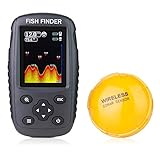
7. Venterior VT-FF005 – Handheld Unit That Works Out of the Box
Venterior Portable Rechargeable Fish Finder Wireless Sonar Sensor Fishfinder Depth Locator with Fish Size, Temperature, Bottom Contour, Color Display
2.6 inch color TFT
Wireless castable sensor with 262 ft range
Rechargeable sensor running 3 to 4 hours
105 degree sonar beam
+ Pros
- Works immediately with no calibration
- Color screen readable in sun and at night
- Tether the sensor and fish it like a lure
- Rechargeable sensor runs about 3 to 4 hours
- Small and light enough for kayaks and inflatables
– Cons
- Unusable while trolling because chop causes false readings
- 105 degree beam bounces badly off ice hole walls
- Fish size categories are rough guesses
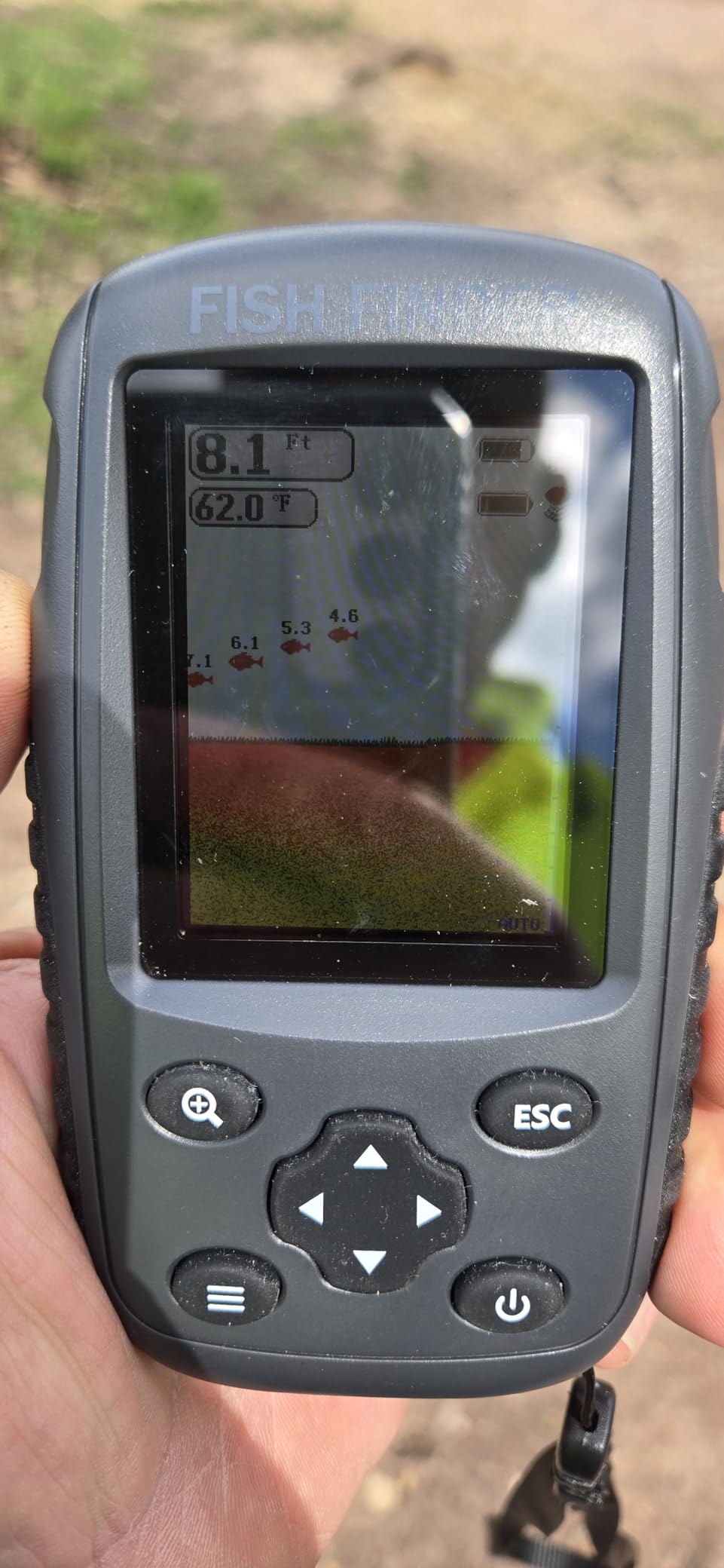
What draws people to this unit is how fast it works. You charge the sensor, pair it with the handheld, and it runs without calibration or a mounting project, which makes it a strong fit for an inflatable, a rented boat or a first unit for a kid. The 2.6 inch color TFT screen has selectable black and white backgrounds for daylight and night use, and it reports depth, temperature, bottom contour and fish depth.
Two small holes in the sensor let you tether it with fishing line and fish it like a lure ahead of the boat, which turns the sonar into a search tool for a specific target rather than a passive readout of what is under the hull. Maximum sensor range is 262 feet, and it carries a 2 year warranty with responsive brand support.
Where false readings come from
The clearest limit in the owner record is that this is not a trolling unit. Wave action and prop wash cause false readings when the sensor is dragged behind a moving boat, so slow down or fish it stationary. The 105 degree beam is also very wide, which is forgiving on open water but bounces off the walls of an ice hole and gives unreliable results on ice.
Temperature, depth and cold weather reality
Cold conditions drain the rechargeable sensor quickly, and reviewers report reduced runtime in winter alongside the ice beam problem. The depth readout itself is accurate down to about 2.6 feet minimum and 164 feet maximum, which covers most shallow lake and river work. The fish size categories of small, medium and big are subjective and should not drive decisions.
Who buys this one
Inflatable owners, shore anglers and anyone who fishes from a kayak without a console. It also works from a dock or bank as long as the sensor is in the water, which separates it from the pure handheld depth readers at the entry end of this list. The tradeoff is a small screen and a rechargeable sensor to remember, and 15 ounces is heavier than the LUCKY unit but far more capable.
For anyone weighing the bigger picture of structure imaging on a small budget, our notes on [forward-facing sonar setups](/best-forward-facing-sonar-fish-finders/) explain which units can grow into that later and which stay traditional sonar only.
8. LUCKY FFC1108 – A Straightforward Depth Finder for a Kayak
LUCKY Kayak Portable Fish Depth Finder Water Handheld Fish Finder Sonar Castable Kayak Boat Fishfinder Transducer Fishing LCD Display FFC1108
2 inch handheld LCD
3 to 328 ft depth range
5 level sensitivity adjustment
Fish and fish school alarm
+ Pros
- Easy way to add a depth readout to a kayak
- Reads correctly through a kayak hull when mounted to it
- Backlight works in sun and darkness
- Five sensitivity levels for clear or turbid water
- 4 to 5 hours of runtime on fresh cells
– Cons
- No fish size discrimination so minnows register like larger fish
- Cannot be used from shore
- Will not read through a fiberglass hull
Be clear about what this is. The FFC1108 is a depth and bottom type finder, not a fish finding machine in the sense the rest of this list uses that phrase. It displays approximate fish location, depth, and whether the bottom is weeds, sand or rock, with a fish and school alarm and a backlit screen. Most owners use it as a first sonar unit for a kayak and it does that job reliably.
The transducer can be stuck to the hull of a kayak or small boat so readings track the changing depth as you move, and several owners report matching the hull mounted reading against the same sensor held in the water. Five levels of sensitivity adjustment let you clean up the picture in clear or turbid water, and it runs at least 4 to 5 hours on fresh cells, longer in battery save mode.
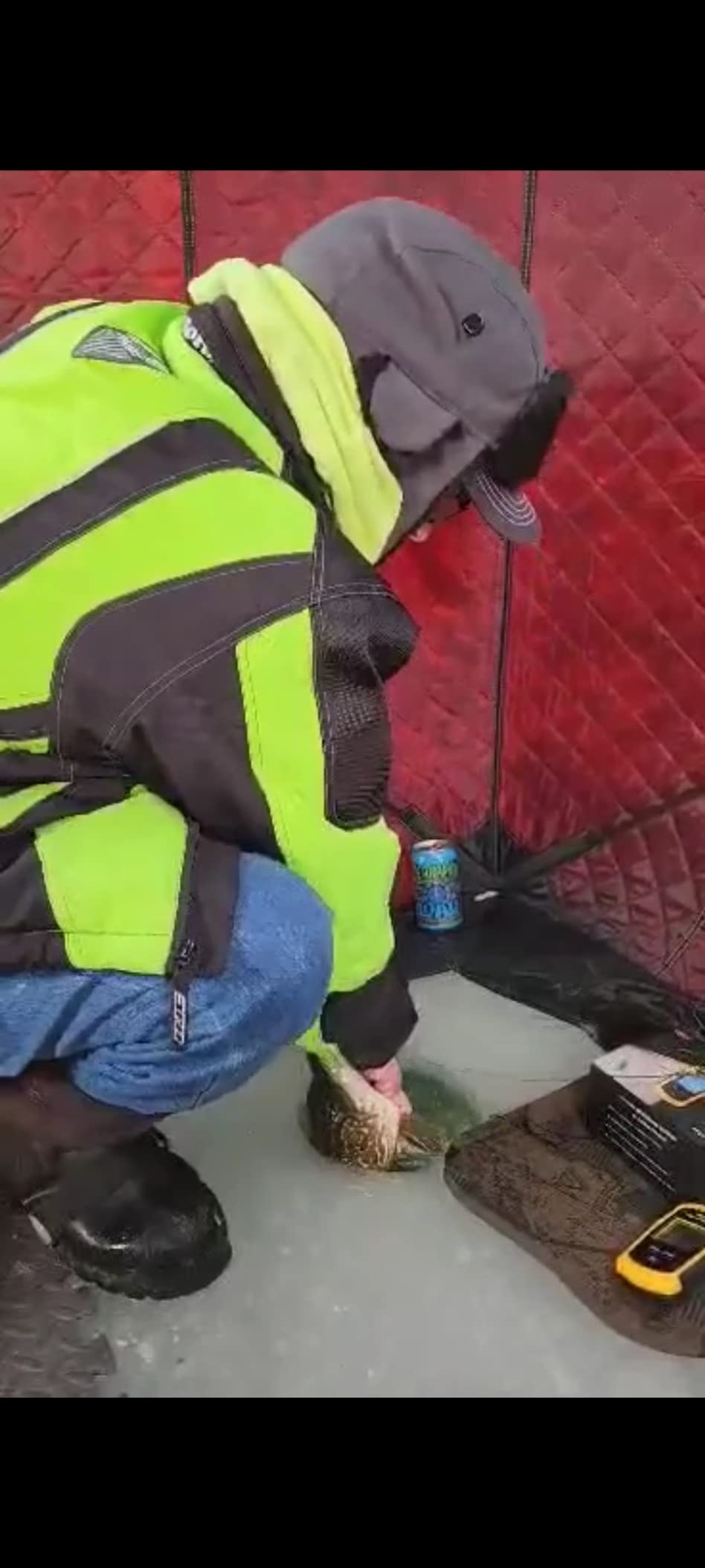
What forum anglers say about handheld depth finders
Kayak anglers on fishing forums repeatedly describe using a handheld like this one for depth reference and water temperature rather than for finding fish, and that reframing is exactly right. Nobody expects a 2 inch screen with no target separation to pick a bass off a weed line. The value is knowing you are in 4 feet, not 12, before you decide where to fish.
Hard limits: no fiberglass, no shore use
Two limits show up in the reviews often enough to plan around. It will not read through a fiberglass hull, so it only works as a hull mounted unit on polyethylene or aluminum kayaks, and it cannot be used from shore because the transducer must be in the water. A small number of owners also reported units that stopped powering on shortly after purchase, so test it immediately and keep the receipt.
When to spend more instead
If you want arches that separate a fish from a branch, or any way to mark and return to a spot, you need one of the GPS equipped units earlier in this list. The FFC1108 is a supplement, not a substitute, and pairing it with a phone based GPS map is the sensible combination for someone fishing new water on a limited budget.
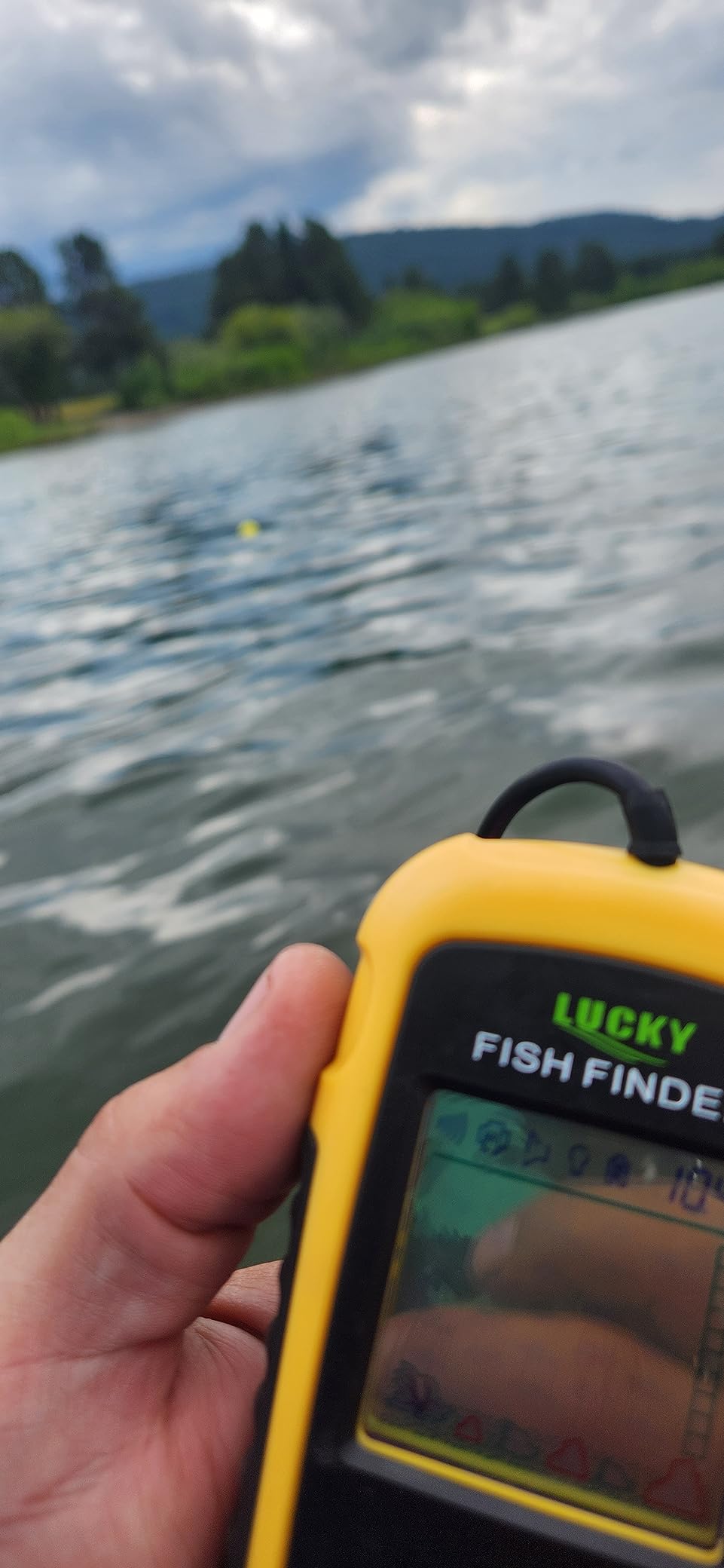
The neck strap and one handed form factor matter more than they sound for kayak fishing, where both hands are busy and the display is mounted in front of you. The switchable feet and meters readout and the backlight are small touches that make it usable at dawn and after dark.
9. Garmin STRIKER Plus 4 – Mapping and Dual Beam in a Compact Box
Garmin 010-01870-00 Striker Plus 4 with Dual-Beam transducer
4.3 inch sunlight readable screen
Dual beam CHIRP traditional transducer
Quickdraw contours and built-in GPS
200W RMS transmit power
+ Pros
- Quickdraw contours mapping is the standout on this unit
- Configurable vertical or horizontal split screen
- Bright screen readable in direct sun
- Runs for days on a small 7Ah SLA battery
- Transom and trolling motor mounts included
– Cons
- Screen resolution is down versus older Striker models
- No battery or connection fittings included in the box
- Quickdraw maps cannot be uploaded or downloaded
The value here is that this mapping bundle usually carries a 4 inch screen and a dual beam transducer, and it stays compact enough for a small hull. Quickdraw contours stores your own depth map with 1 foot contours across a very large area, and the built-in GPS handles waypoints, routes and boat speed. Owners frequently call the split screen, sonar beside map, their favorite layout.
It also works for ice fishing, which is rare at this tier. The dual beam CHIRP transducer runs on 50, 77, 83 and 200 kHz with 200 watts RMS, and reviewers report running for days on a small 7 amp hour sealed lead acid battery, which is exactly the endurance small boat owners want from a permanently installed unit.
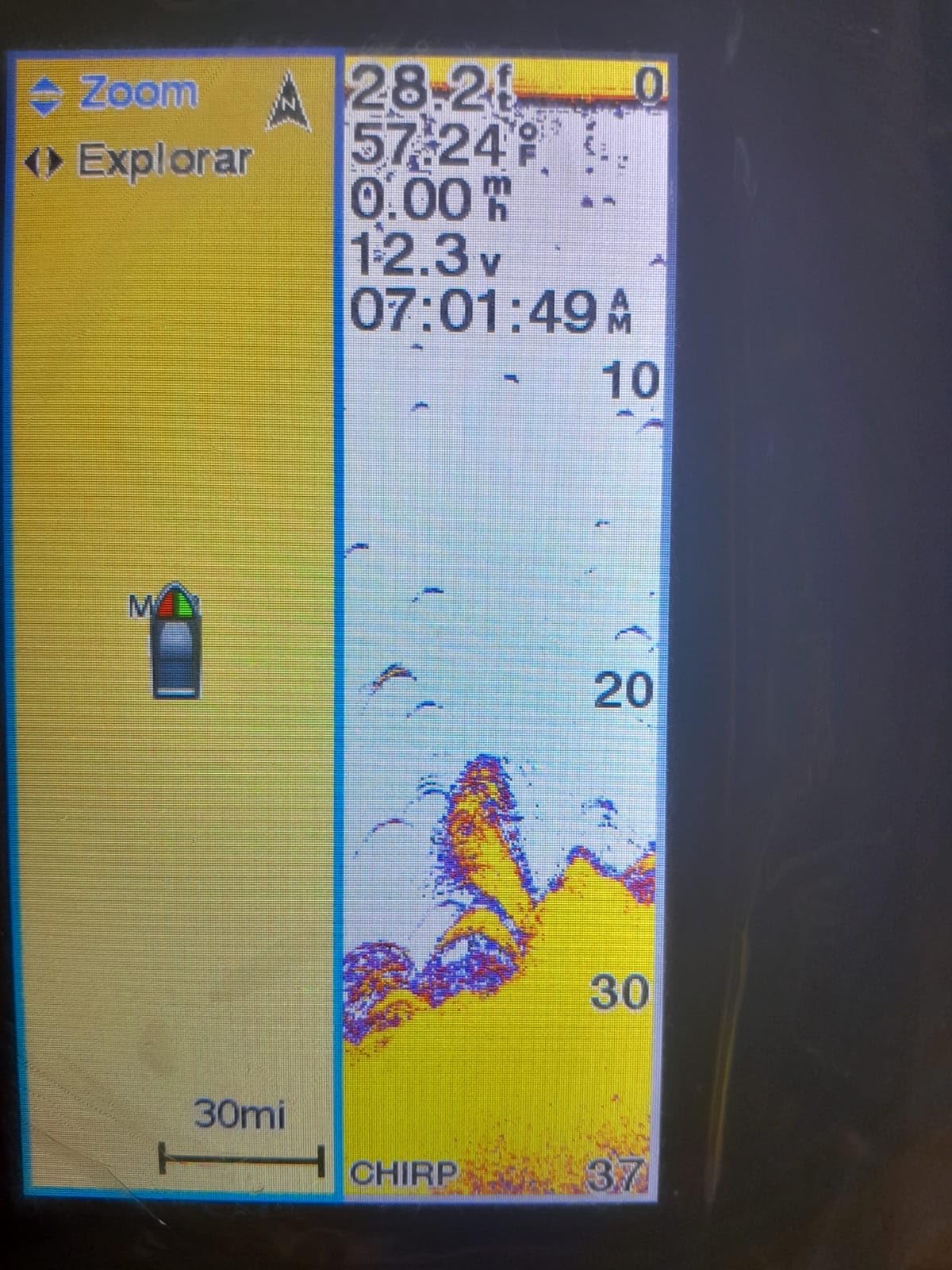
Resolution is the trade you are making
The most common criticism, and it appears in a large share of reviews, is that screen resolution is lower than on older Striker units. At normal viewing distance most anglers do not notice, but if you spend long sessions zoomed into structure, the difference is visible. The 4.3 inch sunlight readable panel itself is bright and sharp enough for direct sun.
Plan the power connection before the install
No battery, connection fittings or fuse are included, which is the biggest practical surprise for a first time installer. Budget for a fused 12V run with proper gauge wire, secure connections and a fuse close to the battery. Owners who did that report clean installs with no interference, including one who runs a Humminbird on the same boat without any sonar crosstalk.
Aluminum hulls and no drilling
The included transom and trolling motor mounts cover most small boat situations without touching the hull, which matters on aluminum where owners often do not want to fabricate anything. One reviewer notes that mounting on an aluminum hull without drilling took extra fabrication, so plan the bracket position before the boat is in the water. Quickdraw maps still cannot be uploaded or downloaded here, matching the Vivid model limitation.
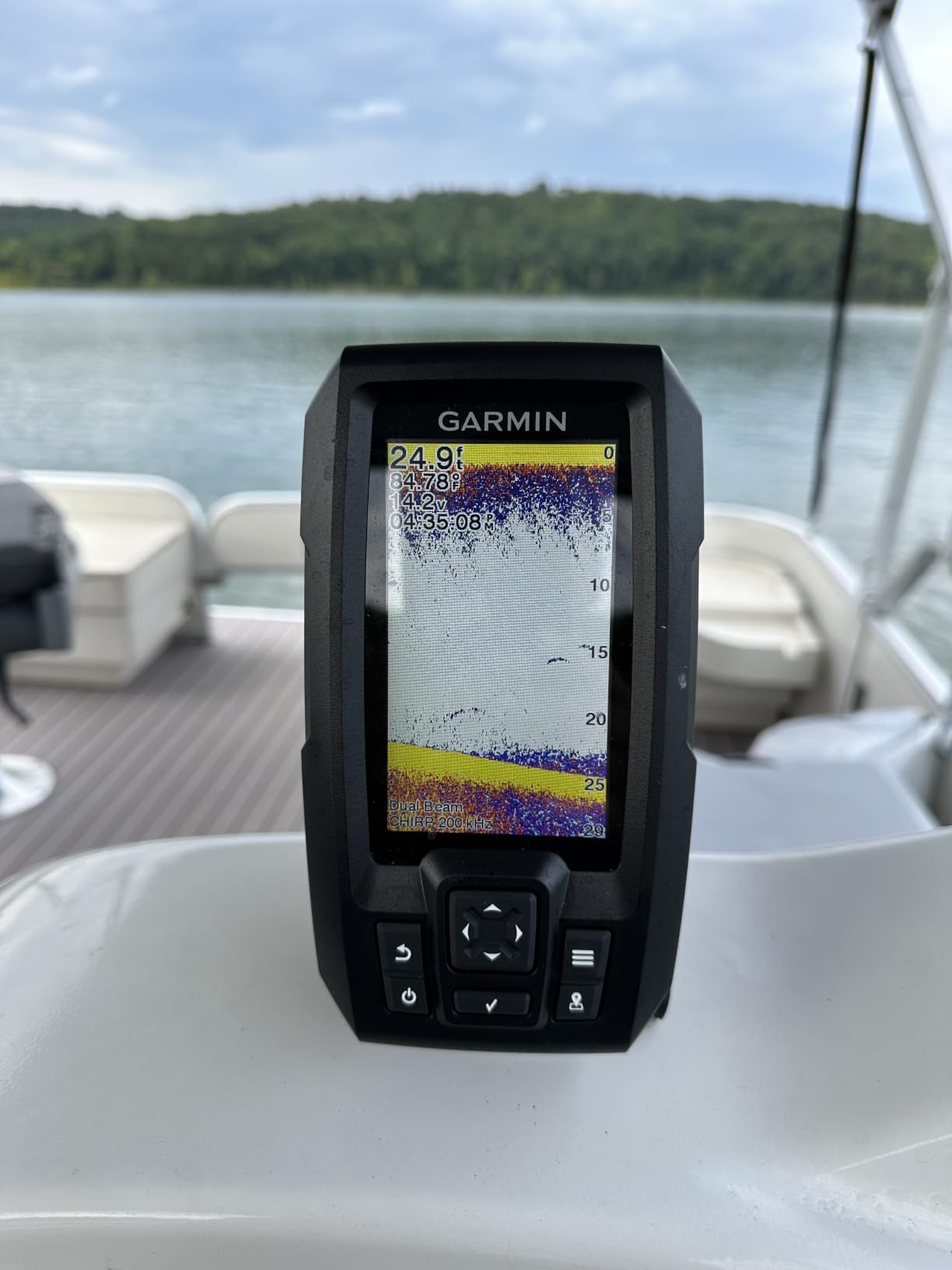
Bluetooth is listed among the control features, though owners describe the unit as a straightforward keypad and softkey interface rather than an app driven device. Setup instructions are thin for beginners, so budget an evening for the first power up rather than expecting a guided walkthrough in the box.
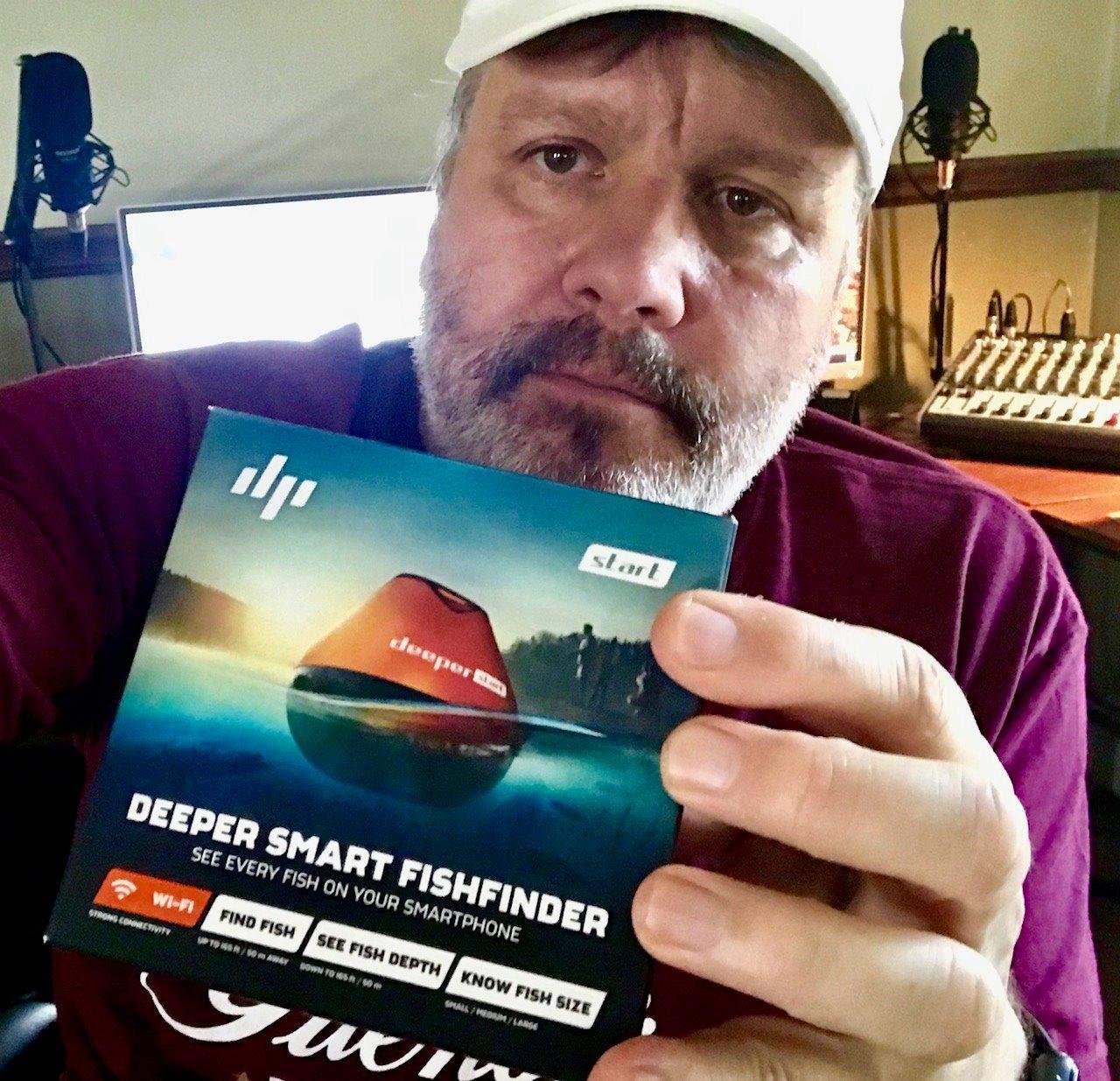
10. Deeper START – Low Cost Sonar You Can Fish From Shore or a Dock
Deeper Start Fish Finder – Portable and Depth Finder for Recreational Fishing from Dock, Shore, Bank or Kayak | Castable Deeper Smart Sonar with Free User Friendly App
Castable sonar with self generated Wi-Fi
Phone and tablet app display
165 ft casting and depth range
About 6 hours of battery
+ Pros
- No boat installation or wiring of any kind
- Creates its own Wi-Fi so no mobile data is used
- Auto-saves every scan with time and location
- About 6 hours of battery
- longer than the castable unit above it
– Cons
- Requires a phone or tablet as the display
- Around 9 percent of reviews are 1 star
- 40 degree beam is tighter than the Venterior so it takes more casts
The START is the simplest possible entry into sonar. It generates its own Wi-Fi network, so it does not consume mobile data and it works with no cellular signal, which matters on a river bank or a lake shore. The free Fish Deeper app shows fish location and size, depth, bottom contour and vegetation, and every scan is saved automatically with a timestamp and coordinates so you can return to a productive cast.
Casting and depth range both sit at 165 feet with a 40 degree beam, and a full charge takes 2.5 hours for roughly 6 hours of use. That runtime is better than the castable unit above it, and it is the number that decides whether a full day of shore fishing works. There is also a night fishing mode.
Phone dependent means phone dependent
The display is your phone or tablet, so you need one on the water, and if the app or connection fails you have no fallback screen. Connectivity and durability account for most of the complaints in the review record, and about 9 percent of ratings are 1 star. Treat it as a tool you bring to the bank rather than an instrument you trust for a whole season.
Narrow beam means more casts
A 40 degree beam is tighter than the 105 degree beam on the Venterior, which is a fair trade for better definition but means covering water takes more casts. For structure oriented fishing, where you are targeting a specific drop off or weed edge, that narrower cone is usually an advantage.

Shore, dock, bank or kayak
This is the unit to buy if you do not own a boat at all, or if you rent one and cannot drill. It fits in a jacket pocket, weighs almost nothing, and gives you a repeatable record of a shoreline you are learning. Anglers moving up from this typically step to the PRO+ 2 for built-in GPS and deeper range rather than to a mounted unit.
Against the marine castable units, the honest comparison is scope. A wired transom transducer with a dedicated display reads continuously at speed, while a castable sensor gives you a detailed snapshot wherever you put it in the water. For a small boat with a clean 12V supply, the fixed mount is the better instrument. For everything else, this does the job with no install at all.
How to Choose a Fish Finder for a Small Boat in 2026
Every mistake we see in this category comes from choosing the unit before choosing the boat. Work through these seven questions in order and the shortlist writes itself.
Screen size: why 4 to 5 inches is the real sweet spot
On a small hull you are seated low, angled up at the display, and often looking through polarized sunglasses in full sun. Below 3.5 inches you lose detail the moment you zoom, and above 5 inches you run out of mounting surface and end up looking up at a screen. Between 4 and 5 inches, every major brand offers a sunlight readable panel with enough pixels to separate structure. The IPS portrait option is worth considering if your console space is vertical rather than horizontal.
Sonar type decoded: CHIRP, ClearVu, SideScan and DualBeam
CHIRP traditional sonar sweeps a range of frequencies instead of one, which produces cleaner arches and better target separation. ClearVu and DownScan are scanning sonar that render structure as near photographic imagery, which is what finds weed edges and rock shelves. SideScan shows what is beside the boat, valuable in shallow water and weed edges. Dual Beam gives you a narrow beam for detail and a wide beam for coverage on the same screen. If you can only afford one, CHIRP traditional is the most useful single function, because it is what identifies fish and depth on every water type.
GPS and mapping: do you need to get back there?
If you fish the same lake every weekend, waypoints are optional and a dual beam or ClearVu unit will serve you better. If you move between water or want to record structure you just found, built-in GPS plus Quickdraw Contours or AutoChart Live changes how you fish. Premium chart support only matters if you fish unfamiliar coastal or multi lake water, where your own recorded contours do not help on the first trip.
Transducer mounting: transom, motor, castable or through hull
Transom mount is the default and works on almost any small boat without drilling, and the included trolling motor bracket on several units here means you do not even need a transom on a kayak. Through hull mounts are permanent and more accurate at speed but require core drilling, which is a dealbreaker on a rental boat, an aluminum hull you do not want to modify, or a kayak. Castable sensors need no install at all and can be rented, borrowed or moved between craft in seconds.
Power, fuses and trolling motor noise
A fish finder head unit is a small load. The STRIKER 4 is the only unit here with a published figure, 0.23 amp at 12V, which works out to roughly 2.8 watts. On paper and ignoring conversion losses, a 6 amp hour deep cycle battery covers about 26 hours, a 10 amp hour battery about 43 hours, and a 20 amp hour battery about 87 hours, so a permanently mounted unit is rarely what drains your small bank. The bigger problem is power quality. A 12V trolling motor battery alone, especially while the motor is running, produces voltage drop that shows up as noise, flicker and false readings. If the sonar is wired to the same battery as the motor, add a fused connection, keep the wire run short and heavy, and expect to gain clarity immediately.
Garmin versus Humminbird versus Lowrance for small boats
At the sizes that suit a small hull, the three brands separate by software more than hardware. Garmin leads on included mapping, with Quickdraw Contours standard on the STRIKER Plus 4 and the Vivid 4cv, and it has the longest warranty of the three in that tier. Humminbird leads on charting flexibility and control hardware, with premium chart support, AutoChart Live and a keypad that works with gloves, but its HELIX 5 needs more wiring than the others. Lowrance leads on physical design for a cramped console, with the portrait IPS screen on the EAGLE, and it is the easiest to retrofit onto an older Lowrance mount. If mapping is your priority, take Garmin. If you want premium charts and a bigger display, take Humminbird. If your console space is the constraint, take Lowrance.
What to skip: 7 inch and larger networked displays
This is the mistake small boat owners make most often, and it is driven by marketing rather than need. Networked multi function displays from 7 to 9 inches are built for helm positions on boats with a console, a dedicated electronics bay, NMEA 2000 backbone wiring and a house bank of batteries. On a jon boat or a kayak they have nowhere to mount, no clean power, and they cost several times a compact unit that does the same job on the structure that matters. Buy the 4 inch class and spend the difference on a good transducer and a proper fused install.
Frequently Asked Questions
Is Garmin better than Humminbird for a small boat?
For small boats, Garmin is the better default because it bundles mapping with the budget units: Quickdraw Contours comes standard on the STRIKER Plus 4 and the STRIKER Vivid 4cv, and the STRIKER 4 draws only 0.23 amp at 12V. Humminbird wins on charting flexibility and control hardware, with premium LakeMaster, CoastMaster and Navionics chart support, AutoChart Live contour recording and a keypad that works with gloves. Choose Garmin for mapping value and low power draw, Humminbird for premium cartography and a larger screen.
What is the best depth sounder for a small boat?
The Garmin STRIKER 4 is the best all-around depth sounder for a small boat: 3.5 inch color display, CHIRP traditional plus ClearVu scanning sonar, built-in GPS, 1600 foot freshwater depth rating and a 0.23 amp draw at 12V. It weighs 8 ounces, mounts on the transom or a trolling motor shaft without drilling, and the head unit lifts out of the bracket in one motion. For the largest screen and the most charting, step up to the Humminbird HELIX 5 CHIRP GPS G3.
Is Lowrance or Humminbird better?
Lowrance is better if your console space is the constraint, because the EAGLE 4 inch uses a portrait IPS display that fits a narrow mounting surface and stays readable through polarized sunglasses. Humminbird is better if you want charting and control, because the HELIX 5 CHIRP GPS G3 has a 5 inch color TFT screen, a Humminbird Basemap, AutoChart Live contour recording and premium chart compatibility. Lowrance is simpler and cheaper; Humminbird is more capable and more involved to install.
Is Garmin or Lowrance better for fishing?
Garmin is better for most small boat anglers because mapping is included as standard on the STRIKER Plus 4 and STRIKER Vivid 4cv, and the brand has the widest range of transducers that add ClearVu, side scan and down imaging to the same head unit. Lowrance is better for ultra compact installs, where the portrait IPS screen on the EAGLE fits where a landscape panel will not, and for owners upgrading from an older Lowrance unit using the same mount pattern. Pick Garmin for features, Lowrance for space.
Can you use a fish finder on a kayak, and do I need to drill?
Yes, and you do not need to drill. Mount a head unit on the trolling motor shaft or a RAM style arm, or use a castable sensor like the Deeper PRO+ 2 or the Venterior VT-FF005 that needs no installation at all. A mounted unit reads continuously as you paddle, while a castable sensor gives you a detailed snapshot wherever you cast it. The LUCKY FFC1108 reads through a kayak hull but will not work through fiberglass, and castable units are the only option on a rental craft where drilling is not allowed.
Which Fish Finder Should You Buy in 2026?
If you own a jon boat or aluminum flatbottom and want one unit that does everything without a project, buy the Garmin STRIKER 4. It is the most proven, it draws 0.23 amp so the battery is a non-issue, and it mounts two ways out of the box. If you want structure imaging in color and included mapping, take the Garmin STRIKER Vivid 4cv. If you want the same mapping idea on a dual beam transducer, the STRIKER Plus 4 gives you Quickdraw contours in a similar footprint.
If you need charting and a bigger screen on a pontoon, choose the Humminbird HELIX 5 CHIRP GPS G3 and budget time for a proper fused install. If you want the simplest possible unit with no menus, the Humminbird PiranhaMAX 4 is hard to argue with. If your console space is the problem, the portrait Lowrance EAGLE fits where nothing else will.
If your boat has no battery, no wiring or no permission to drill, the Deeper PRO+ 2 is the strongest of the castable units, the Venterior VT-FF005 is the easiest, and the Deeper START is the simplest way to fish sonar from a bank. If you just want to know the depth under a kayak before you cast, the LUCKY FFC1108 does that job honestly and takes little space.
Whichever one you choose, match the transducer to the mounting, run the power through a proper fuse, and give it a full day on the water before you trust it with a spot you have to drive back to. That is the whole difference between a gadget and a tool.
Leave a Reply