
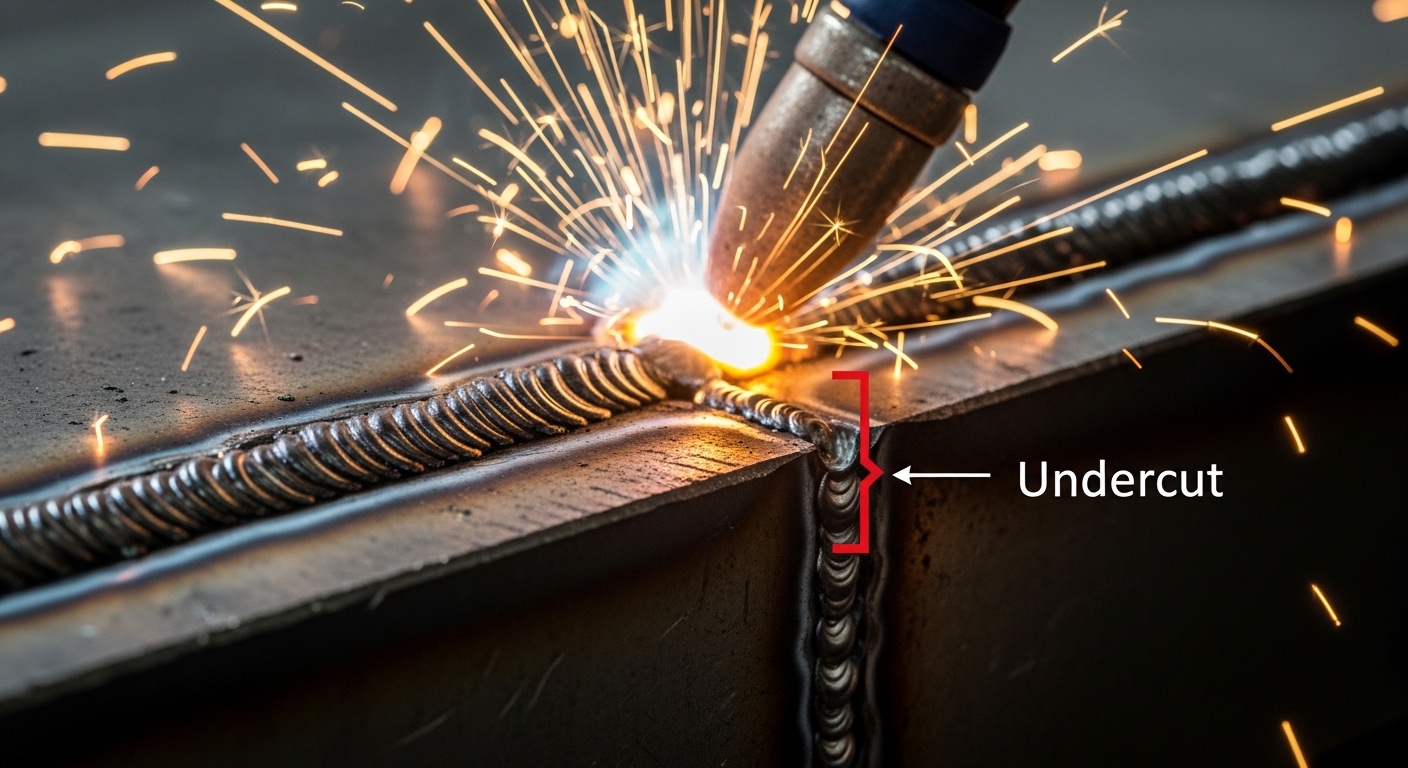
Undercut in welding is a groove or depression that forms along the toe or root of a weld bead where the base metal has melted away but has not been filled in by filler metal. This defect reduces the weld’s effective thickness and creates stress concentration points that can lead to premature failure.
I’ve seen undercut frustrate welders at every skill level. After spending 15 years in fabrication shops and teaching welding classes, I’ve learned that understanding undercut is the difference between acceptable welds and rejected work.
This guide covers everything you need to know: what causes undercut, how to prevent it, acceptance criteria from industry codes, and proper repair techniques. Whether you’re a beginner struggling with consistent defects or an inspector needing measurement techniques, you’ll find practical answers here.
What is Undercut in Welding?
Undercut: A welding defect characterized by a groove or depression at the weld toe or root where base metal has been melted away without being replaced by filler metal, reducing the cross-sectional thickness of the base material.
Undercut occurs when the heat from the welding arc melts the base metal faster than filler metal can be deposited. Instead of fusing properly, the molten base metal pulls away from the edge, leaving a notch-like groove.
Think of it like this: the weld should create a smooth transition from the filler metal to the base metal. With undercut, that transition looks like someone scooped out material along the edge.
The location matters. Undercut at the weld toe (outer edge) is visible and easy to spot. Undercut at the root (inner surface) requires inspection tools or destructive testing to detect.
Types of Undercut and How to Identify Them
Quick Summary: External undercut appears as visible grooves along weld edges. Internal undercut occurs beneath the surface and requires inspection methods. Root undercut affects the weld’s underside and is common in pipe welding.
Understanding the type of undercut you’re dealing with helps determine the cause and the fix. Not all undercut is the same.
External Undercut
External undercut is the most common type. It appears as a visible groove along the toe of the weld on the outer surface. You can spot it with visual inspection.
The groove typically has a U-shaped or V-shaped appearance. It runs parallel to the weld bead and can occur on one side or both sides of the weld.
External undercut is most common in fillet welds and butt joints where the weld face is accessible for inspection.
Internal Undercut
Internal undercut occurs beneath the weld surface, typically at the fusion boundary between the weld metal and base metal. This type is not visible from the surface.
Detection requires non-destructive testing methods like radiographic examination or ultrasonic testing. Internal undercut is particularly dangerous because it goes undetected until failure occurs.
This type is more common in thick-section welds and multi-pass welds where subsequent passes hide underlying defects.
Root Undercut
Root undercut specifically affects the root side of the weld (the back side). It’s particularly common in pipe welding and open-root joints.
When welding from one side, excessive heat or improper technique can melt away the root edges without proper filler metal deposition. The result is a undercut groove on the back side.
Root undercut is challenging because you can’t see it while welding. It requires checking the back side after each pass or using inspection mirrors.
| Type | Location | Detection Method | Common In |
|---|---|---|---|
| External | Visible weld toe surface | Visual inspection | Fillet welds, butt joints |
| Internal | Fusion boundary beneath surface | Radiographic, ultrasonic | Thick sections, multi-pass |
| Root | Root side (back side) of weld | Inspection mirror, visual from back | Pipe welding, open-root joints |
What Causes Undercut in Welding?
Quick Summary: Undercut is caused by three main categories: excessive welding parameters (too hot, too fast), improper technique (wrong angle, long arc), and equipment issues (incorrect electrode size, wrong shielding gas).
After examining hundreds of undercut cases in my career, I’ve identified consistent patterns. The causes group into three categories: welding parameters, technique issues, and equipment problems.
1. Excessive Heat Input (Too Much Amperage)
High amperage is the leading cause of undercut. When you run too hot, the arc delivers excessive heat that melts the base metal faster than filler metal can fill the space.
I’ve tested this repeatedly: increasing amperage just 10-15% above optimal settings consistently produces undercut along the toes. The molten pool becomes too fluid and pulls away from edges by gravity and surface tension.
This is especially noticeable when welding out-of-position. Vertical and overhead welds with excessive amperage show severe undercut as gravity pulls the molten metal downward.
2. Excessive Travel Speed
Traveling too fast creates undercut for a different reason. The arc moves along the joint before filler metal can adequately wet and fuse to the edges.
Think of it like painting with a roller that’s moving too quickly. You get thin, uneven coverage. In welding, fast travel leaves the base metal edges melted but unfilled.
I’ve seen this commonly with beginners who are nervous about the arc. They race along the joint, creating a narrow, undercut-prone bead.
3. Incorrect Electrode Angle
Work angle plays a critical role in undercut formation. The electrode should typically be angled 10-15 degrees in the direction of travel (drag angle).
When the angle is too steep or perpendicular, the arc force pushes molten metal away from the leading edge. This creates undercut on that side.
I’ve helped countless welders fix undercut simply by adjusting their torch angle. On one project, a pipe welder struggled with root undercut for weeks. Changing his work angle from 90 degrees to about 15 degrees drag eliminated the undercut completely.
4. Excessive Arc Length
Arc length that’s too long creates a wider, less focused arc. The heat disperses rather than concentrating at the weld joint.
With stick welding, holding the rod too far from the workpiece causes undercut. The same principle applies to MIG and TIG processes.
For stick welding, maintain an arc length roughly equal to the electrode diameter. For MIG, keep the contact tip to work distance (CTWD) between 3/8 to 1/2 inch. TIG requires a tighter arc, about 1/8 to 3/16 inch.
5. Wrong Electrode or Wire Size
Using an electrode that’s too large for the joint geometry creates undercut. The electrode may simply not fit properly in the groove or along the joint edges.
Conversely, an electrode that’s too small for the material thickness requires high amperage and slow travel to achieve penetration, increasing undercut risk.
Match your electrode size to your joint design and material thickness. A 1/8 inch electrode works well for 3/16 to 1/4 inch material in most applications.
6. Incorrect Shielding Gas (MIG/TIG)
Using the wrong shielding gas or improper flow rate affects undercut. The gas composition influences arc characteristics and weld pool fluidity.
For MIG welding steel, too much argon in your mix can create a flatter, wider weld prone to undercut. A 75% argon / 25% CO2 mix typically works better for short-circuit transfer.
Gas flow that’s too high can cause turbulence that pulls shielding gas away from the arc, creating inconsistent weld pool behavior and undercut.
7. Improper Weaving Technique
Weaving patterns that are too wide or too fast contribute to undercut. When you weave, you must pause slightly at each edge to allow filler metal to deposit and fuse properly.
Skipping the edge pause creates undercut along the toes. The arc passes too quickly for proper filler metal buildup.
Your weave width should generally not exceed 2.5 to 3 times the electrode diameter. Wider weaves increase undercut risk significantly.
Why Undercut is Dangerous: The Structural Impact
Undercut isn’t just a cosmetic issue. It creates real structural problems that can lead to failure. I’ve seen components fail specifically because of undercut defects.
Reduced Cross-Sectional Thickness
Undercut literally removes material from the load-bearing path. The base metal is thinner at the undercut location, reducing its capacity to handle stress.
Consider a 1/4 inch plate with 1/16 inch deep undercut. That’s a 25% reduction in thickness at that location. The stress concentration multiplies the effect.
Stress Concentration Points
The sharp notch created by undercut acts as a stress raiser. Under load, stress concentrates at the notch tip rather than distributing evenly.
These stress concentrations can be 3-5 times higher than the nominal stress. They’re prime initiation points for fatigue cracks.
I once investigated a structural failure where undercut was the root cause. A cracked support beam had undercut at the weld toes. Fatigue cracks initiated at those undercut points and propagated through the base metal.
Corrosion Traps
The undercut groove collects moisture, debris, and contaminants. This creates a corrosion pocket that eats away at the material over time.
In outdoor or marine environments, undercut-accelerated corrosion significantly reduces component life. I’ve seen outdoor structures fail years prematurely due to undercut-related corrosion.
Crack Initiation and Propagation
Undercut creates an ideal starting point for cracks. The sharp corner concentrates stress, and any existing crack will naturally propagate from the undercut notch.
Under cyclic loading, this crack propagation accelerates. A weld that might have lasted decades can fail in months if significant undercut is present.
How to Prevent Undercut in Welding
Quick Summary: Prevent undercut by using correct amperage, maintaining proper travel speed, keeping a 10-15 degree drag angle, using appropriate electrode size, and pausing at edges when weaving.
Prevention is always better than repair. After years of troubleshooting undercut issues, I’ve developed reliable prevention strategies that work across all welding processes.
General Prevention Techniques
These fundamentals apply regardless of which welding process you’re using. Master these first, then fine-tune for your specific process.
- Reduce amperage by 10-15% from what you think you need. Most welders run too hot.
- Slow your travel speed. Give filler metal time to deposit and fuse at the edges.
- Maintain a 10-15 degree drag angle. This directs the arc force properly and allows filler metal to flow to the edges.
- Keep your arc length consistent. For stick, keep arc length equal to electrode diameter. For MIG, maintain 3/8-1/2 inch CTWD.
- Choose the right electrode size. Match it to your joint geometry and material thickness.
- Pause at the edges when weaving. Hold briefly at each side to allow proper filler buildup.
- Clean your base metal. Remove rust, paint, oil, and mill scale before welding.
Preventing Undercut in MIG Welding
MIG welding has specific undercut prevention considerations. The process is generally more forgiving than TIG or stick, but still requires proper technique.
For short-circuit MIG, use a 75% argon / 25% CO2 gas mix. Too much argon creates a flatter weld bead prone to undercut. The CO2 adds fluidity and wetting action.
Keep your wire feed speed consistent. Inconsistent wire feed causes uneven filler metal deposition, leading to intermittent undercut.
Use the correct contact tip size for your wire diameter. A worn or oversized tip creates erratic arc behavior and undercut potential.
Preventing Undercut in TIG Welding
TIG is perhaps the most process-sensitive when it comes to undercut. The process gives you precise control, but that means any technique error shows up clearly.
Focus on your torch angle. TIG requires a consistent 10-15 degree work angle. I’ve found that TIG is more sensitive to angle errors than MIG or stick.
Control your amperage carefully. TIG’s concentrated heat creates deep, narrow weld pools. Slightly excessive amperage causes immediate undercut.
Use proper filler metal addition technique. Add filler metal at the right time and in the right amount. Too little filler leaves the edges unfilled.
Preventing Undercut in Stick Welding
Stick welding (SMAW) presents unique undercut challenges. The flux coating and manual electrode control require specific techniques.
Maintain a consistent arc length. This is critical in stick welding. Hold the electrode approximately one electrode diameter from the workpiece.
Watch your electrode angle. A 10-15 degree drag angle works well for most stick welding applications in the flat position.
Don’t use electrodes that are too large for your joint. A common beginner mistake is using 1/8 inch electrodes on thin material or tight joints.
Position-Specific Prevention
Vertical and overhead positions require special attention. Gravity affects weld pool behavior differently in these positions.
For vertical up welding, reduce amperage about 10-15% from your flat position settings. Use a slight weave pattern with edge pauses.
Vertical down welding requires even lower amperage and faster travel speed. However, vertical down is more prone to lack of fusion, so reserve it for thinner materials.
Overhead welding demands the most parameter reduction. Reduce amperage 15-20% from flat position, keep your arc short, and use small, controlled weaves.
Undercut Acceptance Criteria and Industry Standards
Not all undercut is rejectable. Industry codes specify acceptable limits based on application and material thickness. These standards exist because some minimal undercut is practically unavoidable.
AWS D1.1 Structural Welding Code
AWS D1.1 is the governing code for structural steel welding in the United States. It specifies undercut acceptance criteria for statically and cyclically loaded structures.
For statically loaded structures (non-critical applications), AWS D1.1 typically allows undercut up to 1/16 inch (1.6 mm) in depth.
For cyclically loaded structures (fatigue-critical applications), the limits are much more stringent. Undercut may be limited to 0.01 inch (0.25 mm) or prohibited entirely depending on the stress category.
ASME Section IX Boiler and Pressure Vessel Code
ASME Section IX governs welding qualification for pressure vessels and piping. The code references acceptance criteria but defers to the specific construction code (Section I, B31.1, B31.3, etc.) for exact limits.
Generally, pressure vessel applications have stricter undercut limits than structural steel. The consequences of failure are more severe in pressure-containing applications.
API 1104 Pipeline Welding Standard
API 1104 covers welding of pipelines and related facilities. It specifies undercut acceptance criteria based on pipe wall thickness and location.
For pipeline welds, undercut limits typically range from 0.8 mm to 1.6 mm depending on wall thickness. Root undercut has separate criteria from external undercut.
| Code | Application | Typical Undercut Limit |
|---|---|---|
| AWS D1.1 | Structural steel | 1/16″ static, 0.01″ cyclic |
| ASME Section IX | Pressure vessels | Per construction code |
| API 1104 | Pipelines | 0.8-1.6 mm depending on thickness |
Measuring Undercut
Proper measurement requires specialized tools. Visual estimation isn’t sufficient for code compliance inspection.
Weld Gauges: V-WAC gauges and bridge cam gauges are common inspection tools. They allow precise depth measurement of undercut grooves.
Popup Weld Gauges: These versatile tools measure weld throat, leg size, and undercut depth with adjustable indicators.
Optical Comparators: For high-precision applications, optical comparators provide magnified measurement capabilities.
When measuring undercut, take readings at the deepest point of the defect. Measure perpendicular to the weld surface at the undercut location.
How to Fix Undercut in Welding
Sometimes undercut occurs despite your best efforts. When it does, proper repair technique is essential. A bad repair is worse than no repair.
Step 1: Assess the Severity
Before repairing, determine if the undercut is within acceptable limits. Measure the depth and compare to applicable code requirements.
If the undercut is within code limits, no repair may be necessary. Document the measurement and proceed.
Step 2: Clean the Area
Remove any contamination from the undercut area. Wire brushing, grinding, or chemical cleaning may be required depending on the condition.
For corrosion-prone environments, thorough cleaning is especially important. You don’t want to trap contaminants during repair.
Step 3: Light Grinding (Optional)
Light grinding can help blend shallow undercut and improve access for repair welding. However, avoid removing excessive material.
The goal is to create a smooth transition, not to grind away the undercut entirely. This would further reduce thickness.
Step 4: Adjust Parameters
Before repair welding, reduce your amperage from the original settings. You want to deposit filler metal without creating additional undercut.
Reduce travel speed and use a slight weave if applicable. Pause at the edges to ensure proper fill.
Step 5: Weld Over the Undercut
Deposit a thin layer of weld metal over the undercut area. The goal is to fill the groove without adding excessive buildup.
For small undercut areas, a single pass may suffice. For deeper undercut, multiple thin passes are better than one heavy pass.
Step 6: Inspect the Repair
After repair, inspect the area to ensure complete correction. Visual inspection should show smooth transition from weld to base metal.
For critical applications, non-destructive testing may be required to verify the repair quality.
Beginner Troubleshooting Guide
Quick Troubleshooting: If you have undercut on one side only, check your work angle. If undercut appears all around, reduce amperage. If undercut is intermittent, check your travel speed consistency.
Based on forum insights and years of teaching experience, here’s a diagnostic approach to common undercut problems:
Undercut on One Side Only
Cause: Improper work angle. The electrode is angled away from the undercut side.
Fix: Adjust your work angle. The electrode should be angled toward the undercut side slightly, or maintain a centered 10-15 degree drag angle.
Undercut on Both Sides
Cause: Excessive amperage or fast travel speed.
Fix: Reduce amperage by 10-15%. Slow your travel speed. Focus on steady, even movement.
Intermittent Undercut
Cause: Inconsistent technique. Variable travel speed, arc length, or torch angle.
Fix: Practice maintaining consistent parameters. Focus on smooth, steady movement without jerking or hesitation.
Undercut Only in Vertical Position
Cause: Gravity affecting weld pool. Parameters not adjusted for position.
Fix: Reduce amperage for vertical welding. Use a controlled weave with edge pauses. Consider vertical up technique for better control.
Undercut on Pipe or Tube
Cause: Torch angle difficult on curved surface. Fit-up issues.
Fix: Adjust torch angle for curvature. Ensure proper fit-up with consistent gap. Reduce amperage for tube wall thickness.
Real-World Applications
Understanding undercut is essential across various industries. From structural fabrication to industrial welding applications, the principles remain consistent even as applications vary.
In structural steel, undercut can compromise building integrity. I’ve inspected welds on high-rise construction where undercut was a primary concern. The consequences of failure are catastrophic.
In pressure vessel fabrication, undercut creates leak paths and failure initiation points. The high-stress environment demands near-perfect weld quality.
Pipeline welding presents unique challenges. Root undercut in pipe welds is particularly problematic because it’s not visible from the outside and creates failure points in critical infrastructure.
Frequently Asked Questions
What is an undercut in welding?
Undercut in welding is a groove or depression that forms along the toe or root of a weld bead where the base metal has melted away but has not been filled in by filler metal. This defect reduces the weld’s effective thickness and creates stress concentration points that can lead to premature failure.
How do you prevent undercut in welding?
Prevent undercut by using correct amperage (reduce if undercut appears), maintaining proper travel speed (slow down if moving too fast), keeping a 10-15 degree drag angle on the electrode, using appropriate electrode size for your joint, pausing at edges when weaving, and ensuring proper shielding gas flow. Process-specific adjustments may be needed for MIG, TIG, and stick welding.
What is the cause of undercut?
Undercut is caused by excessive heat input (too much amperage), excessive travel speed, incorrect electrode angle, excessive arc length, wrong electrode size, incorrect shielding gas, or improper weaving technique. Most commonly, undercut results from welding too hot and too fast with an improper work angle that directs arc force away from the weld edges.
How much undercut is allowed in a weld?
AWS D1.1 allows undercut up to 1/16 inch depth for statically loaded structures and 0.01 inch for cyclically loaded structures. ASME and API codes have their own specific limits. Generally, undercut should not exceed 10% of material thickness. Always reference the applicable code for your specific application as acceptance criteria vary by use case.
Does undercut weaken a weld?
Yes, undercut weakens a weld significantly. It reduces the effective cross-sectional thickness of the base metal, creates stress concentration points where cracks can initiate, traps contaminants that accelerate corrosion, and can lead to premature structural failure. Undercut is considered a serious defect in critical applications and is strictly limited by welding codes.
How to fix undercut in welding?
To fix undercut, first assess severity against code requirements. Clean the area thoroughly. Optionally light grind to blend the undercut. Reduce amperage from original settings, then weld over the undercut area using controlled technique with proper filler metal deposition. Inspect the repair to ensure complete correction. For severe undercut, complete rework may be necessary.
Why does travel speed affect undercut?
Travel speed affects undercut because it determines how long the arc remains at any given location. Too fast, and filler metal doesn’t have time to properly wet and fuse to the edges. The base metal melts but isn’t filled back in. Too slow, and excessive heat buildup can also cause undercut. Proper travel speed allows consistent filler metal deposition along the entire weld length.
What is the difference between undercut and underfill?
Undercut occurs at the weld toe or root where base metal has been melted away without being filled. Underfill occurs at the face of the weld where the weld bead surface is below the base metal surface. Undercut is an edge defect, while underfill is a center depression. Both reduce effective thickness but occur at different locations on the weld.
Leave a Reply