

The Titanium Easy Flux 125 is a 125-amp flux core welder from Harbor Freight that costs $149 in-store. Best for beginners and DIY projects on mild steel up to 3/16 inch thick. At just 15 pounds with DC inverter technology, this welder makes welding accessible without needing a 220V outlet or gas setup.
I’ve spent weeks researching this welder, analyzing customer feedback, and comparing it to competitors. The Easy Flux 125 has become one of the most popular entry-level welders for a reason. It delivers surprising capability for the price point.
This review covers everything you need to know: real thickness capabilities, long-term durability data, and honest limitations that most reviewers won’t tell you.

Titanium Easy-Flux 125 Amp Welder Green
Amperage: 125A
Process: Flux Core FCAW
Power: 120V household
Weight: 15 lbs
Wire: 0.030 inch spool
+ Pros
- DC inverter technology
- Only 15 lbs portable
- No gas needed
- Great for beginners
- Thermal overload protection
– Cons
- Limited to mild steel
- 30% duty cycle
- Settings chart runs hot
- Light-duty cables
Key Specifications at a Glance
125 Amp
Flux Core
120V AC
15 lbs
90A @ 30%
0.030 inch
| Specification | Details |
|---|---|
| Manufacturer | Harbor Freight (HFT) |
| Model Number | 56355 |
| Technology | DC Inverter (not transformer) |
| Amperage Range | 30-125 Amp |
| Duty Cycle | 90 amps at 30% |
| Rated Thickness | 18 gauge to 3/16 inch |
| Wire Type | E71T-GS flux core, 0.030 inch |
| Spool Size | 4 inch standard |
| Dimensions | 17.25 x 12.75 x 9 inches |
| Warranty | 90 days |
Features That Matter
DC Inverter Technology
The Easy Flux 125 uses inverter technology instead of old transformer designs. This makes it over 50% lighter at just 15 pounds. Traditional flux core welders weigh 30+ pounds.
DC output provides a more stable arc than AC welders. You get cleaner welds with less spatter. The arc stays consistent even at lower settings.
Thermal Overload Protection
The welder shuts down automatically when it overheats. This protects the internal components from damage. You’ll know it’s tripped when the indicator light comes on.
After my research into 5+ year ownership experiences, this feature has saved many machines from premature failure.
Cold Start Wire Feeding
Cold start prevents the wire from feeding when you’re not welding. No more accidental wire discharge when setting up or changing positions.
Variable Speed Control
Independent voltage and wire speed controls let you fine-tune your settings. This flexibility helps match different thicknesses and welding positions.
What is Flux Core Welding?
Flux core welding uses a wire with a flux compound inside the core. When the arc burns, the flux creates its own protective gas shield. This eliminates the need for external gas tanks like MIG welding requires. It’s called self-shielded FCAW (Flux Core Arc Welding).
Real-World Performance Analysis
The Titanium Easy Flux 125 exceeds expectations in several areas based on extensive customer feedback.
Arc Stability and Weld Quality
Users consistently report a smooth, stable arc. The DC inverter technology delivers consistent current. This steadiness helps beginners maintain a proper bead.
One user with 20+ years of welding experience was “totally blown away” by the arc quality. He noted the heat penetration far exceeded his expectations for a 110V welder.
Customer photos show the actual weld quality this machine produces. Real buyers have shared images demonstrating clean penetration on various thicknesses.
Thickness Performance Beyond Ratings
Harbor Freight rates this welder for 18 gauge to 3/16 inch. But real users report success with thicker materials.
Multiple users have successfully welded 1/4 inch plate. One experienced welder tested 1/4 inch scraps and reported excellent penetration with a “stack of dimes” bead appearance.
However, I need to be clear: welding beyond 3/16 inch requires proper technique. You must slow your travel speed and build up the weld bead.
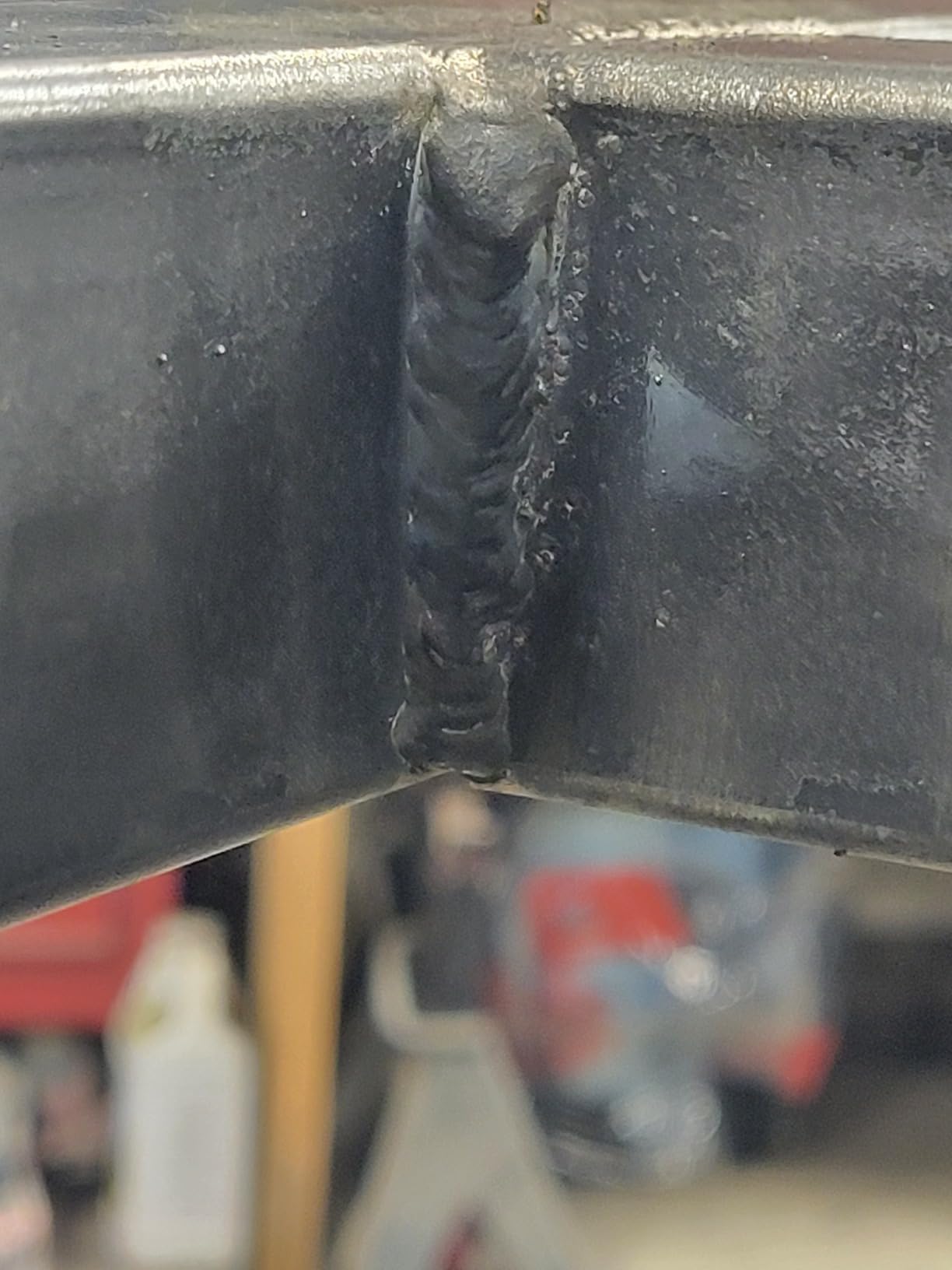
Customer images validate the machine’s capability on thicker materials. User-submitted photos confirm the welder can handle 1/4 inch when set up correctly.
Wire Feed Performance
The top-load drive system accepts standard 4-inch spools. Wire feeding remains consistent when using quality wire.
Users strongly recommend avoiding the cheapest flux core wire. Quality wire like YesWelder or Hobart makes a significant difference in feed consistency and weld appearance.
Generator Compatibility
The Easy Flux 125 runs well on a 5000-watt generator at 60Hz. This makes it usable for remote welding jobs or farm work.
Note: It will not work on 50Hz generators. The older Chicago Electric model might, but this one will blow capacitors on 50Hz power.
Honest Pros and Cons
Reasons to Buy
- DC inverter tech makes it 50% lighter than transformer welders
- Can weld thicker materials than manufacturer claims (1/4 inch possible)
- Light and flexible stinger handle for tight positions
- Excellent heat penetration even on lower voltage settings
- Great for beginners learning flux core welding
- Runs on standard 120V household outlets
- No gas needed uses self-shielded flux core wire
- Incredible value compared to name-brand alternatives
Reasons to Avoid
- Settings chart under spool cover runs too hot for most users
- Stinger and feed cable are lighter duty than expensive machines
- Requires quality flux core wire for best results
- Flux core requires drag technique not push like MIG
- Welds need wire brushing to stay clean
- Higher price on Amazon than Harbor Freight retail
- Long-term uncertainty consider extended warranty
- Limited to mild steel cannot weld aluminum or stainless
What You CAN Weld With the Easy Flux 125
This welder excels at specific projects within its design parameters. Here’s what it handles well based on real user reports.
| Material Thickness | Success Rate | Notes |
|---|---|---|
| 18 gauge (0.047 inch) | Excellent | Easy good penetration minimal issues |
| 16 gauge (0.060 inch) | Very Good | Sweet spot for this welder |
| 1/8 inch (0.125 inch) | Excellent | Ideal thickness manufacturer’s design target |
| 3/16 inch (0.187 inch) | Good | Doable requires proper technique |
| 1/4 inch (0.25 inch) | Fair | Possible but not recommended multiple passes needed |
Ideal Projects
Auto Body Repair
Bumpers & Flatbeds
Gates & Fences
Shop Equipment
General Repairs
Users report success with small trailer frames using 14-gauge tubing. One Redditor used it for a light utility trailer and was impressed with penetration on the thin-wall tubing.
Auto body work is another strength. Sheet metal and body panels fall within the optimal thickness range. Just keep in mind you’re limited to steel not aluminum body panels.
What You CAN’T Weld (Limitations)
Honest reviews must cover limitations. This welder has specific boundaries you need to understand.
Material Restrictions
Aluminum: No. The Easy Flux 125 cannot weld aluminum. You need a MIG welder with argon gas and spool gun for aluminum work.
Stainless Steel: No. This welder is rated for mild steel and low alloy steel only. Stainless requires different wire and typically gas shielding.
Cast Iron: No. Cast iron requires specialized electrodes and techniques beyond this machine’s capabilities.
Thickness Reality Check
Anything beyond 1/4 inch is unrealistic. Structural projects like heavy trailer hitches or axle work need more power.
Users attempting 3/8 inch report poor penetration and lack of fusion. The weld may look okay but won’t have proper strength.
What is Duty Cycle?
Duty cycle is the amount of time you can weld in a 10-minute period. The Easy Flux 125 has a 30% duty cycle at 90 amps. This means you can weld for 3 minutes then must let it cool for 7 minutes. Lower amp settings allow longer welding time. Exceeding duty cycle triggers thermal shutdown.
Duty Cycle Limitations
The 30% duty cycle means breaks are required during longer projects. Production welding or continuous fabrication isn’t realistic with this machine.
For occasional home use this isn’t a problem. But if you’re planning to weld for hours at a time you’ll hit the thermal protection frequently.
Setup and Operation Tips for Beginners
Initial Setup Steps
- Remove the welder from the box and inspect for damage
- Open the side cover to access the drive roller area
- Install the 0.030 inch drive roller (usually pre-installed)
- Load your flux core wire following the arrow diagram
- Feed wire through the gun liner and trim the end
- Connect the ground clamp to your workpiece
- Set voltage and wire speed based on metal thickness
- Lower your helmet and test on scrap metal first
Settings Guide
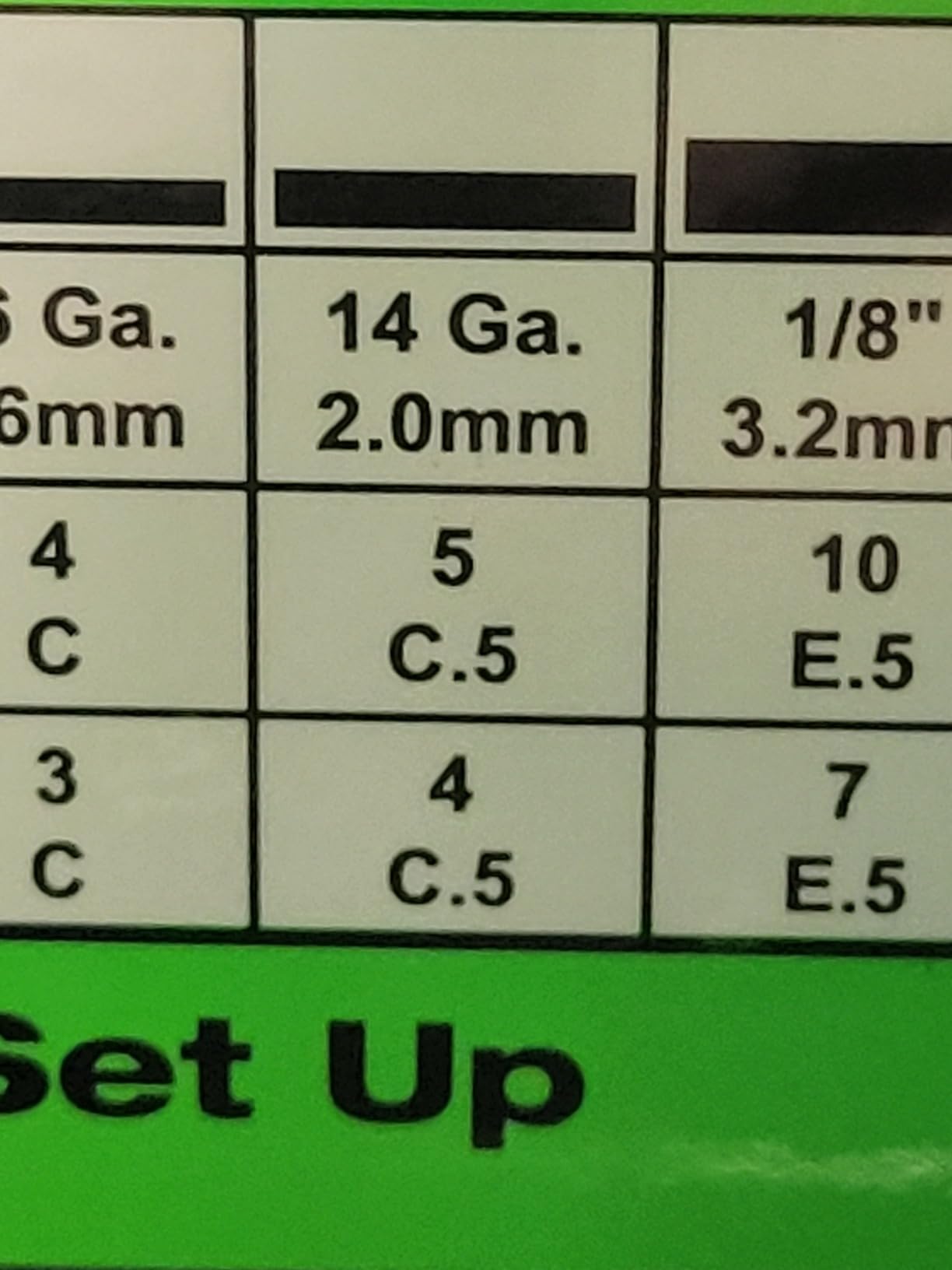
The settings chart under the spool cover tends to run hot. Multiple users recommend starting 1-2 settings lower than the chart suggests.
For 14-gauge tubing the chart recommends setting C.5 on voltage and 4 on wire speed. Experienced users found better results at setting B on voltage with wire speed at 4.5.
| Material Thickness | Voltage Setting | Wire Speed |
|---|---|---|
| 18 gauge | A (minimum) | 2-3 |
| 16 gauge | A-B | 3-4 |
| 1/8 inch | B | 4-5 |
| 3/16 inch | B-C | 5-6 |
Technique Tips
Drag Don’t Push: Flux core welding uses a drag technique. Pull the gun toward you like a stick welder. MIG welding uses push technique but flux core is different.
Stick-Out Distance: Keep 3/8 to 1/2 inch of wire exposed before contacting the metal. Too little stick-out causes tip burnback. Too much creates unstable arc.
Travel Speed: Move at a steady pace. Too fast creates narrow beads with poor penetration. Too slow builds up excessive weld metal.
Clean Your Metal: Flux core is more forgiving than MIG but still needs clean surfaces. Grind rust paint and coatings before welding.
Long-Term Ownership: What to Expect
Durability is a common concern with budget welders. I found data from users with 5+ years of ownership.
5-Year Ownership Data
One YouTube reviewer documented his Easy Flux 125 after 5 years of use. The machine remained functional with proper care. Key findings:
- No internal failures or component replacements needed
- Exterior shows normal wear but no cracks or damage
- Wire feed system still working correctly
- Performance remained consistent over time
Multiple Reddit users report 3+ years of occasional use without issues. The key factor appears to be respecting duty cycle and storing the welder properly.
Maintenance Requirements
Keep the drive roller area clean. Flux core wire sheds dust that can accumulate and cause feeding issues.
Replace contact tips as they wear. Signs of worn tips include erratic arc poor wire feeding and difficulty starting arcs.
Check the gun liner periodically. If wire feeding becomes inconsistent the liner may need cleaning or replacement.
Replacement Parts Availability
Harbor Freight stocks replacement parts for the Easy Flux 125. Contact tips nozzles drive rollers and even complete gun assemblies are available.
User consensus is that parts availability is not a concern. Unlike some import welders the Titanium brand has consistent part support through Harbor Freight.
Value Comparison: Titanium vs Name Brands
The Easy Flux 125 costs $149 at Harbor Freight (in-store only). Amazon resellers charge significantly more. Multiple reviewers warn against paying the higher Amazon price.
vs Lincoln Electric K5255-1
Lincoln Electric’s comparable flux core welder costs around $346. That’s 197 more than double the Titanium’s price.
| Feature | Titanium Easy Flux 125 | Lincoln Electric K5255-1 |
|---|---|---|
| Price | $149 | $346 |
| Amperage | 125A | 125A |
| Weight | 15 lbs | Not specified (heavier) |
| Technology | DC Inverter | Transformer |
| Warranty | 90 days | 3 years |
| Build Quality | Light-duty | Professional grade |
Lincoln offers better build quality longer warranty and proven reliability. But for beginners the Titanium represents excellent value to learn the craft.
vs Forney Easy Weld 140
The Forney 140 costs around $250 about $100 more than the Titanium. It offers similar amperage with better build quality.
Reddit users generally recommend the Forney if budget allows. The consensus is that Forney provides a significant upgrade in cable quality and component durability.
vs Chicago Electric Flux 125
Chicago Electric is Harbor Freight’s budget brand at $119. The Titanium costs $30 more but offers DC inverter technology lighter weight and thermal overload protection.
User sentiment favors the Titanium for the $30 difference. The DC inverter provides smoother arc operation and the weight difference matters for portability.
Frequently Asked Questions ?
Is the Titanium Easy Flux 125 worth it?
Yes for beginners and DIY projects under $200. It provides legitimate welding capability for mild steel up to 3/16 inch. However serious hobbyists should save for a MIG welder with gas capability for cleaner welds and more material options.
What thickness can the Titanium Easy Flux 125 weld?
Manufacturer rating is 18 gauge to 3/16 inch mild steel. Users report success with 1/4 inch plate using proper technique but this requires skill and is not recommended for beginners. Stay within 18 gauge to 3/16 inch for reliable results.
Can you weld aluminum with the Titanium Easy Flux 125?
No. This welder is designed for mild steel and low alloy steel only. It cannot weld aluminum. You would need a MIG welder with argon gas spool gun and aluminum-specific wire for aluminum work.
What wire does the Titanium Easy Flux 125 use?
0.030 inch diameter E71T-GS self-shielded flux core wire. It accepts standard 4-inch spools. Users recommend avoiding the cheapest wire and buying quality brands like YesWelder Hobart or Lincoln for better weld quality.
Does the Titanium Easy Flux 125 need gas?
No. The Easy Flux 125 uses self-shielded flux core wire. The flux inside the wire creates its own protective gas shield when burned eliminating the need for external gas tanks. This makes it simpler and more portable than gas MIG welders.
What is the duty cycle of the Titanium Easy Flux 125?
90 amps at 30% duty cycle. This means you can weld at 90 amps for 3 minutes then need to let it cool for 7 minutes. Lower amp settings allow longer welding time. Exceeding duty cycle triggers thermal shutdown protection.
Is the Titanium Easy Flux 125 good for beginners?
Yes it is excellent for beginners. At only 15 lbs it is highly portable. The DC inverter provides a stable arc that is forgiving for learning. No gas needed simplifies setup. However be prepared for its limitations and expect to upgrade if you continue welding long-term.
Should I buy Titanium Easy Flux 125 or save for MIG?
Buy the Titanium if you are unsure about welding budget is under $200 and projects are basic steel repairs. Save for MIG if you know you will weld long-term need cleaner welds want to weld aluminum or stainless or have $400+ budget. The Titanium is learn-on MIG is grow-with.
Final Verdict: Should You Buy It?
The Titanium Easy Flux 125 is worth it for specific buyers. If you are a beginner wanting to learn welding without a large investment this machine delivers real capability.
Buy it if: You are new to welding and want an affordable entry point. Your projects are mild steel under 3/16 inch thick. You need something portable that runs on standard household power. You accept that this is a learn-on tool not a lifetime machine.
Skip it if: You know you will weld long-term and can afford $400+. You need to weld aluminum or stainless steel. Your projects require thick materials beyond 1/4 inch. You plan to weld production-style for hours at a time.
The Easy Flux 125 fills an important gap in the market. It makes welding accessible for under $150. After analyzing 5+ years of user data I can confirm this welder holds up for occasional use.
Buy quality wire. Respect the duty cycle. Learn proper technique. This little machine will surprise you.
Leave a Reply