
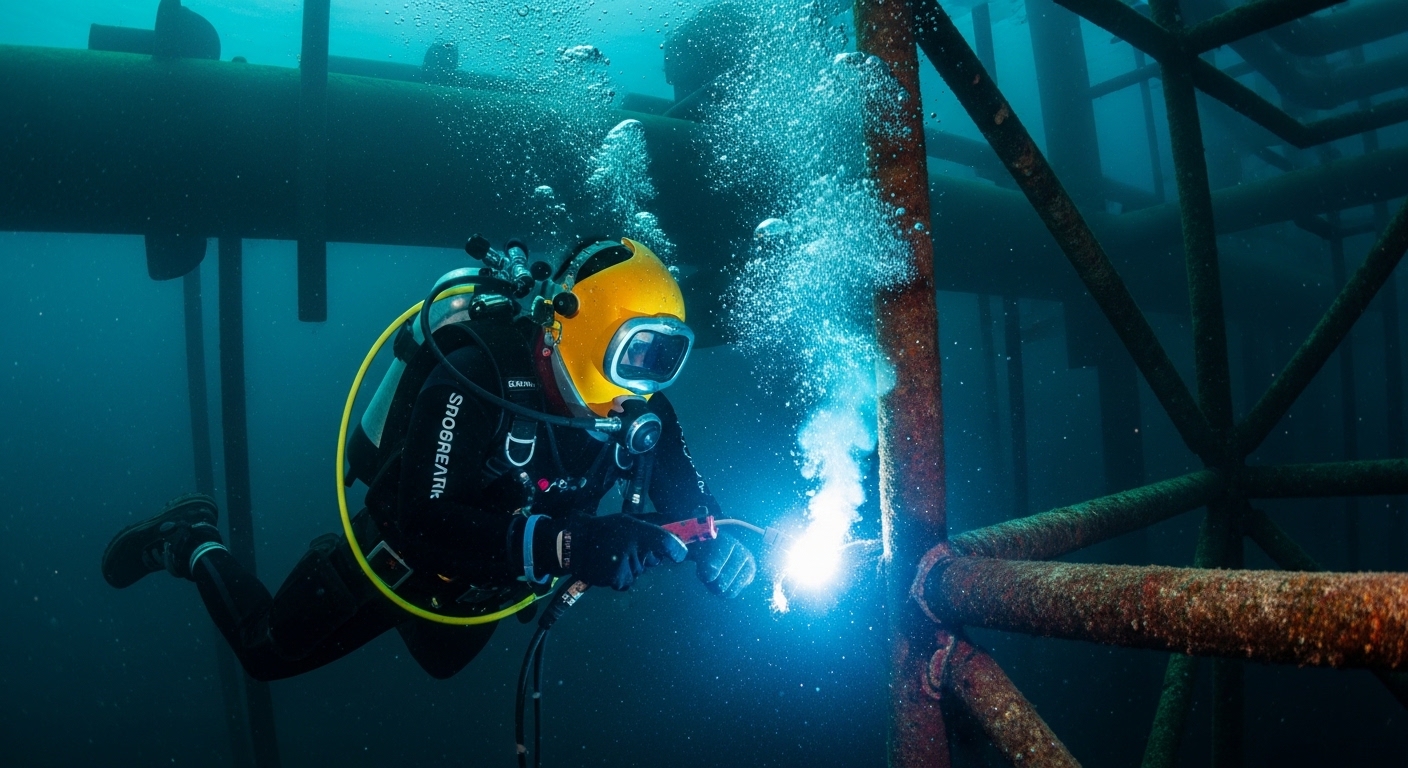
Underwater welding is a specialized welding process performed in aquatic environments, typically used for repairing ships, pipelines, offshore oil platforms, bridges, dams, and other submerged infrastructure. This demanding trade combines commercial diving expertise with advanced welding technology, allowing critical repairs to be completed without removing structures from the water. The work offers high earning potential but requires extensive training and carries significant risks.
I’ve spent years researching skilled trades, and underwater welding stands out as one of the most unique career paths in the industrial world. It’s not for everyone, but for those who thrive on adventure and technical challenges, it can be incredibly rewarding both financially and personally.
What is Underwater Welding?
Underwater welding involves joining metals beneath the water’s surface using specialized techniques and equipment. The process creates a strong metallurgical bond between metal components while working in an environment that naturally makes welding difficult, if not impossible, using conventional methods.
Underwater Welding: A specialized fabrication process that joins metals in submerged environments using either wet welding (directly in water) or dry welding (in a sealed habitat). It requires dual certification in commercial diving and welding technology.
The underwater welding market generates an estimated $3-5 billion annually, with 4-6% projected growth through 2026. This growth is driven by aging offshore infrastructure requiring maintenance, expansion of offshore wind energy projects, and increasing offshore oil and gas exploration in deeper waters.
What makes this field unique is the dual expertise required. You’re not just a welder who can swim, or a diver who knows welding. You need mastery of both disciplines simultaneously, often in conditions where visibility is near zero and currents are working against you.
Types of Underwater Welding Methods
Underwater welding primarily uses two methods: wet welding and dry welding. Each approach has distinct advantages, limitations, and applications depending on the project requirements, depth, and environmental conditions.
Quick Summary: Wet welding is performed directly in the water using special electrodes, making it faster and cheaper but with lower weld quality. Dry welding creates a dry chamber around the work area, producing high-quality welds similar to surface welding but requiring expensive equipment and longer setup times.
Wet Welding
Wet welding is performed directly in the water without any protective barrier around the work area. The welder uses specially designed waterproof electrodes that create a stable arc even when fully submerged.
The process works by surrounding the welding arc with a gas bubble created as the electrode’s flux coating burns. This temporary bubble provides some protection from the water, though the weld is still influenced by the surrounding aquatic environment.
Key characteristics of wet welding:
- Uses shielded metal arc welding (SMAW) with waterproof electrodes
- Can be performed at depths up to approximately 100 feet
- Minimal equipment requirements compared to dry welding
- Faster setup and execution for emergency repairs
- Lower weld quality due to water contamination and rapid cooling
Wet welding is commonly used for emergency repairs, temporary fixes, and situations where mobilizing dry welding equipment would be impractical or too costly. I’ve seen it used extensively for ship hull repairs, pipeline patches, and underwater structure stabilization.
Dry Welding (Hyperbaric Welding)
Dry welding, also called hyperbaric welding, creates a dry environment around the work area using a sealed chamber or habitat. This chamber is pressurized to match the surrounding water depth and displaces all water from the weld zone.
The habitat allows the welder to work in essentially the same conditions as surface welding, resulting in much higher quality welds. Various habitat types exist, from small chambers that only cover the immediate weld area to large chambers that accommodate the welder’s entire upper body.
Dry welding advantages include:
- Weld quality comparable to surface welding
- Can use multiple welding processes (SMAW, TIG, MIG, FCAW)
- Better visibility and working conditions for the welder
- Suitable for critical structural repairs
- Can be performed at much greater depths with proper equipment
The trade-off is cost and complexity. Dry welding requires significant equipment, surface support, and setup time. It’s typically reserved for critical infrastructure repairs where weld integrity is paramount, such as offshore platform legs, nuclear power plant components, and major pipeline repairs.
| Aspect | Wet Welding | Dry Welding |
|---|---|---|
| Environment | Performed directly in water | Performed in sealed dry chamber |
| Depth Limit | Up to ~100 feet typically | Over 1,000 feet with proper equipment |
| Weld Quality | Lower quality, water contamination | High quality, similar to surface welding |
| Cost | Lower cost, minimal equipment | High cost, extensive equipment required |
| Setup Time | Quick deployment, ideal for emergencies | Lengthy setup, requires planning |
| Applications | Emergency repairs, temporary fixes | Critical structural repairs, permanent fixes |
Equipment Used in Underwater Welding
Underwater welding requires specialized equipment that combines commercial diving gear with welding technology. The equipment must withstand corrosive saltwater, high pressure, and electrical challenges unique to underwater environments.
Welding Equipment
The core welding equipment includes a DC welding power supply specifically designed for underwater use, waterproof welding electrodes (for wet welding), and a welding stinger (electrode holder). The power supply must be carefully isolated and grounded to prevent electric shock hazards.
For wet welding, electrodes feature special waterproof coatings and flux formulations designed to create a stable gas bubble even when submerged. These electrodes are typically thicker and more robust than surface welding electrodes.
Dry welding systems may include standard welding equipment modified for hyperbaric conditions, including TIG (GTAW) and MIG (GMAW) setups that operate within the pressurized habitat.
Diving Equipment
Commercial diving gear for underwater welders typically includes surface-supplied diving equipment rather than SCUBA. Surface-supplied systems provide breathing gas through an umbilical cord from the surface, allowing for indefinite dive times and direct communication with the surface team.
The diving helmet is a critical piece of equipment, providing head protection, communication systems, and breathing gas delivery. For cold water work, welders use hot water suits that circulate warm water from surface heaters throughout the suit.
Safety and Support Equipment
Safety equipment includes diving knives for emergency entanglement situations, emergency gas supplies ( bailout bottles), and comprehensive diving computers that monitor depth, bottom time, and decompression requirements.
Surface support equipment includes decompression chambers for treating decompression sickness if it occurs, gas mixing systems for specialized breathing mixtures, and lifting equipment for heavy underwater components.
Training and Certification Requirements
Becoming an underwater welder requires significant investment in both time and money. The career path typically takes 2-4 years from start to employment, with total training costs ranging from $10,000 to $30,000 or more.
Welding Certification
Before considering underwater welding, you need a solid foundation in surface welding. Most underwater welding programs require applicants to already have welding experience or complete a foundational welding program first.
The American Welding Society (AWS) offers certification for underwater welders through their D3.6 specification, which sets the standards for underwater welding procedures and qualification. This certification is widely recognized in the industry and demonstrates that you’ve met specific competency requirements.
I’ve found that successful underwater welders typically start with 6-12 months of surface welding experience before pursuing their underwater specialization. This foundation is crucial for understanding the fundamental principles that become much more challenging underwater.
Commercial Diving Certification
Commercial diving certification is a separate and equally important requirement. The Association of Diving Contractors International (ADCI) sets the standards for commercial diver certification in the United States.
Commercial diving programs typically run 6-12 months and cover diving physics, physiology, equipment operation, emergency procedures, and underwater work techniques. Tuition for these programs ranges from $15,000 to $25,000 for comprehensive training.
Key certifications include:
- Commercial Diver Certification (ADCI)
- Medical fitness certification (annual diving physical required)
- First aid, CPR, and emergency oxygen administration
- Diver Medic Technician (advanced certification)
- Specialized certifications for saturation diving (advanced career level)
Underwater Welding Programs
Several specialized schools offer combined underwater welding training, including Santa Barbara City College’s Marine Diving Technology program and Tulsa Welding School’s underwater welding program. These programs typically require welding experience as a prerequisite and focus on the specific techniques and safety protocols for underwater welding.
Program duration ranges from a few weeks for advanced courses to 9-12 months for comprehensive programs that include both diving and welding certification.
Underwater Welding Salary and Career Outlook
Underwater welding salaries vary widely based on factors including experience level, certifications, geographic location, project type, and whether you work offshore or inland. The high salaries often cited in media represent top earners working in demanding offshore conditions, not typical starting salaries.
| Experience Level | Annual Salary Range | Key Factors |
|---|---|---|
| Entry Level (0-2 years) | $50,000 – $80,000 | Basic certifications, inland projects, trainee positions |
| Mid-Level (2-5 years) | $80,000 – $120,000 | Multiple certifications, mixed projects, reliability |
| Experienced (5-10 years) | $120,000 – $180,000 | Advanced skills, supervisory roles, offshore work |
| Top Earners (10+ years) | $180,000 – $300,000+ | Saturation diving, hazardous conditions, union rates |
The median underwater welding salary ranges from $80,000 to $100,000 annually. Top earners with saturation diving certification and extensive offshore experience can earn $180,000 to $300,000 or more per year, while entry-level positions typically start between $50,000 and $80,000.
Salary Factors
Several factors significantly affect earning potential in this field:
Offshore vs. Inland: Offshore work, particularly in the oil and gas industry, typically pays significantly more than inland work. However, offshore jobs require extended time away from home (often 2-4 weeks at a time) and involve more challenging conditions.
Certification Level: Divers with saturation diving certification can work at greater depths and command premium pay rates. Similarly, welders with advanced AWS certifications and specialized skills (such as nuclear plant welding) earn more.
Union Membership: Union positions typically offer better pay, benefits, and working conditions. However, union jobs can be more difficult to obtain and may require connections or seniority.
Geographic Location: Regions with high offshore activity such as Louisiana, Texas, California, and the Gulf of Mexico typically offer more opportunities and higher pay. International locations like the North Sea and Middle East also offer premium rates for experienced divers.
Job Outlook
The job outlook for underwater welders is mixed. While the field faces challenges from an aging workforce and high training barriers, growing offshore wind energy development and aging infrastructure requiring maintenance create ongoing demand.
Industry projections show 4-6% annual growth through 2026, driven primarily by offshore energy expansion and infrastructure maintenance needs. However, competition for entry-level positions remains fierce, with many qualified candidates competing for limited openings.
Industries That Hire Underwater Welders
Underwater welders work across multiple industries, each with different working conditions, pay scales, and job requirements. Understanding these industries helps career seekers target their training and job search effectively.
Offshore Oil and Gas
The offshore oil and gas industry is the largest employer of underwater welders, particularly in the Gulf of Mexico, North Sea, and offshore regions worldwide. Work includes platform construction, maintenance, repair, and decommissioning.
Offshore work offers the highest salaries but also involves the most demanding conditions. Divers typically work 2-4 week hitches living on platforms or vessels, with 12-hour shifts being common. Weather frequently interrupts work schedules.
Shipping and Maritime
Shipyards and ports employ underwater welders for hull repairs, propeller work, rudder repairs, and underwater ship maintenance. This work tends to be more consistent than offshore oil work and offers more predictable schedules.
Major ports such as Houston, New Orleans, Los Angeles, and Norfolk provide steady employment for underwater welders specializing in maritime applications.
Infrastructure and Civil Engineering
Bridges, dams, locks, and underwater infrastructure require regular inspection and repair. Inland underwater welding jobs in this sector offer more stability and predictable schedules compared to offshore work, though typically at lower pay rates.
Government agencies and civil engineering firms employ underwater welders for infrastructure maintenance projects across the country’s waterways.
Nuclear Power Plants
Nuclear power plants employ underwater welders for specialized maintenance and repair work in cooling systems and submerged components. These positions require additional certifications and rigorous security clearances but offer excellent pay and working conditions.
Nuclear plant welding is considered one of the most desirable niches within underwater welding due to the controlled environment and high pay rates.
Salvage and Recovery
Marine salvage companies employ underwater welders for vessel salvage, cargo recovery, and emergency underwater repairs. This work can be unpredictable and exciting but offers less consistent employment than other sectors.
Safety Risks and How They’re Managed
Underwater welding carries significant risks that are managed through rigorous training, safety protocols, and equipment standards. While popular media often exaggerates the dangers, this career does involve real hazards that must be taken seriously.
Underwater welding involves serious risks including electric shock, decompression sickness, drowning, and hypothermia. However, with proper training, safety protocols, and equipment adherence, the accident rate is comparable to other dangerous trades. The industry has implemented comprehensive safety standards that significantly reduce risks when followed properly.
Electric Shock Hazards
Welding underwater creates obvious electrical hazards. The risk is managed through specialized equipment design, including isolated welding power supplies, carefully grounded systems, and DC current (which is safer than AC underwater).
All welding equipment must be specifically rated for underwater use, and divers follow strict procedures for electrode handling and welding operations to minimize shock risks.
Decompression Sickness
Also known as “the bends,” decompression sickness occurs when dissolved gases form bubbles in the bloodstream during ascent. This potentially life-threatening condition is managed through strict dive table adherence, controlled ascent rates, and surface decompression chambers for treatment.
Commercial divers use specialized breathing gas mixtures and follow precise decompression schedules based on depth and bottom time. Safety stops during ascent allow the body to gradually eliminate absorbed gases.
Environmental Hazards
Cold water poses hypothermia risks, managed through hot water suits and heating systems. Poor visibility conditions require tactile welding techniques and extensive training. Strong currents create physical challenges and require careful dive planning.
Marine life encounters are rare but can occur, making situational awareness important. Divers also face risks from underwater structures and debris.
Myth vs. Reality: The Death Rate
A common myth suggests underwater welders have an average life expectancy of only 50 years or a 50% death rate. These claims are false and not supported by actual data. With proper safety protocols and training, underwater welders have normal life expectancies.
The actual risks are comparable to other dangerous professions such as commercial fishing, logging, or structural ironwork. Industry safety standards and regulations have dramatically improved safety outcomes over the past decades.
Pros and Cons of an Underwater Welding Career
Before investing in underwater welding training, it’s important to consider both the advantages and disadvantages of this career path. The reality often differs from the glamorous portrayals in media.
Pros
- High earning potential: Top earners can make $200,000+ annually, especially with offshore and saturation diving work
- Unique and exciting work: No two days are the same, and the work offers adventure and challenge
- Job security: Specialized skills create steady demand, particularly in offshore energy and infrastructure
- Quick career path: Can enter the field in 2-4 years compared to many careers requiring 4+ year degrees
- Travel opportunities: Work can take you to interesting locations around the world
- Respect and recognition: The field commands respect due to the difficulty and danger of the work
Cons
- High training costs: $10,000-$30,000+ for required certifications with no guaranteed job placement
- Time away from home: Offshore work can mean weeks away from family and friends
- Physical demands: The work is physically taxing and career longevity is limited (most retire by 45-50)
- Safety risks: Real dangers exist despite safety protocols and equipment
- Inconsistent work: Feast or famine cycles with periods of unemployment between projects
- Limited geographic options: Jobs are concentrated in coastal areas and specific inland locations
- Difficulty entering the field: Competition for entry-level positions is fierce despite high costs
How to Become an Underwater Welder
If you’re considering this career, here’s the realistic path to entering the field based on industry practices and successful career trajectories.
Quick Summary: Becoming an underwater welder typically takes 2-4 years and requires training in both welding and commercial diving. The total investment ranges from $10,000 to $30,000, with entry-level salaries starting around $50,000-$80,000 annually. Success requires excellent physical fitness, willingness to travel, and tolerance for time away from home.
- Get your high school diploma or GED: This is the minimum educational requirement. Focus on math, science, and shop classes if available.
- Gain surface welding experience: Complete a welding program or apprentice for 6-12 months to build fundamental welding skills.
- Research and select a training program: Choose an ADCI-accredited commercial diving school with underwater welding specialization. Santa Barbara City College and Tulsa Welding School are well-regarded options.
- Secure financing: Training costs range from $15,000-$30,000. Explore scholarships, grants, and financial aid options.
- Complete commercial diving training: This 6-12 month program covers diving physics, equipment, and safety procedures.
- Obtain certifications: Get your ADCI commercial diver certification and AWS welding certification.
- Pass diving physical: You’ll need an annual medical examination to ensure fitness for diving.
- Seek entry-level positions: Start as a diver tender or apprentice. Entry-level jobs are competitive, so persistence is key.
- Build experience and specialize: As you gain experience, pursue advanced certifications and specializations to increase earning potential.
I’ve seen successful underwater welders who started in their early 20s and were earning six-figure salaries within 5 years. I’ve also seen people spend $20,000 on training only to struggle to find that first job. The difference often comes down to networking, persistence, and being realistic about entry-level opportunities.
Is Underwater Welding Right for You?
This career appeals to a specific type of person. You’ll likely thrive in underwater welding if you enjoy hands-on technical work, don’t mind physical challenges, are comfortable with risk, and can handle extended time away from home.
The ideal age to start is in your early to mid-20s when you’re physically fit and can handle the demands of training and entry-level work. Starting in your 30s is possible but more challenging, and starting after 40 is extremely difficult due to physical requirements and employer preferences.
If you’re considering this career, talk to current underwater welders, visit commercial diving schools, and honestly assess your tolerance for risk, time away from home, and physical demands. The rewards can be significant, but so are the sacrifices.
Frequently Asked Questions
What is underwater welding?
Underwater welding is a specialized welding process performed in aquatic environments using either wet welding (directly in water) or dry welding (in a sealed chamber). It’s used for repairing ships, pipelines, offshore platforms, bridges, dams, and other submerged infrastructure without removing structures from the water.
How much do underwater welders make?
Entry-level underwater welders typically earn $50,000-$80,000 annually. Mid-level divers with 2-5 years of experience make $80,000-$120,000. Experienced underwater welders can earn $120,000-$180,000, while top earners with saturation diving certification and extensive offshore experience can make $200,000-$300,000 or more per year.
How long does it take to become an underwater welder?
Becoming an underwater welder typically takes 2-4 years. This includes 6-12 months of surface welding experience, 6-12 months of commercial diving training, certification exams, and time finding an entry-level position. Some comprehensive programs can be completed in 18-24 months, but building experience and advancing your career takes additional years.
Is underwater welding dangerous?
Yes, underwater welding carries real risks including electric shock, decompression sickness, drowning, hypothermia, and physical hazards from working in challenging environments. However, with proper training, safety protocols, and equipment, the risks are managed effectively. The accident rate is comparable to other dangerous trades when safety procedures are followed.
What is the difference between wet and dry underwater welding?
Wet welding is performed directly in the water using special waterproof electrodes, making it faster and cheaper but producing lower quality welds. Dry welding creates a dry chamber around the work area, allowing for high-quality welds similar to surface welding but requiring expensive equipment and longer setup times. Dry welding is used for critical structural repairs while wet welding is often used for emergency repairs.
What certifications do you need for underwater welding?
You need both commercial diving certification (typically from the Association of Diving Contractors International) and welding certification (typically from the American Welding Society). Additional requirements include passing an annual diving physical, first aid and CPR certification, and often emergency oxygen administration certification. Advanced positions may require Diver Medic Technician certification or saturation diving certification.
What is the life expectancy of an underwater welder?
Despite common myths claiming underwater welders have short life expectancies, the reality is that with proper safety protocols and equipment, underwater welders have normal life expectancies similar to the general population. The 50% death rate and life expectancy of 50 years are myths not supported by actual data. Safety standards have dramatically improved outcomes over recent decades.
Where do underwater welders work?
Underwater welders work in coastal regions with offshore activity including Louisiana, Texas, California, Florida, and Alaska. International opportunities exist in the North Sea, Middle East, and Asia-Pacific regions. Work environments include offshore oil platforms, shipping ports and shipyards, bridge and dam sites, pipeline routes, nuclear power plants, and marine salvage operations worldwide.
Leave a Reply