
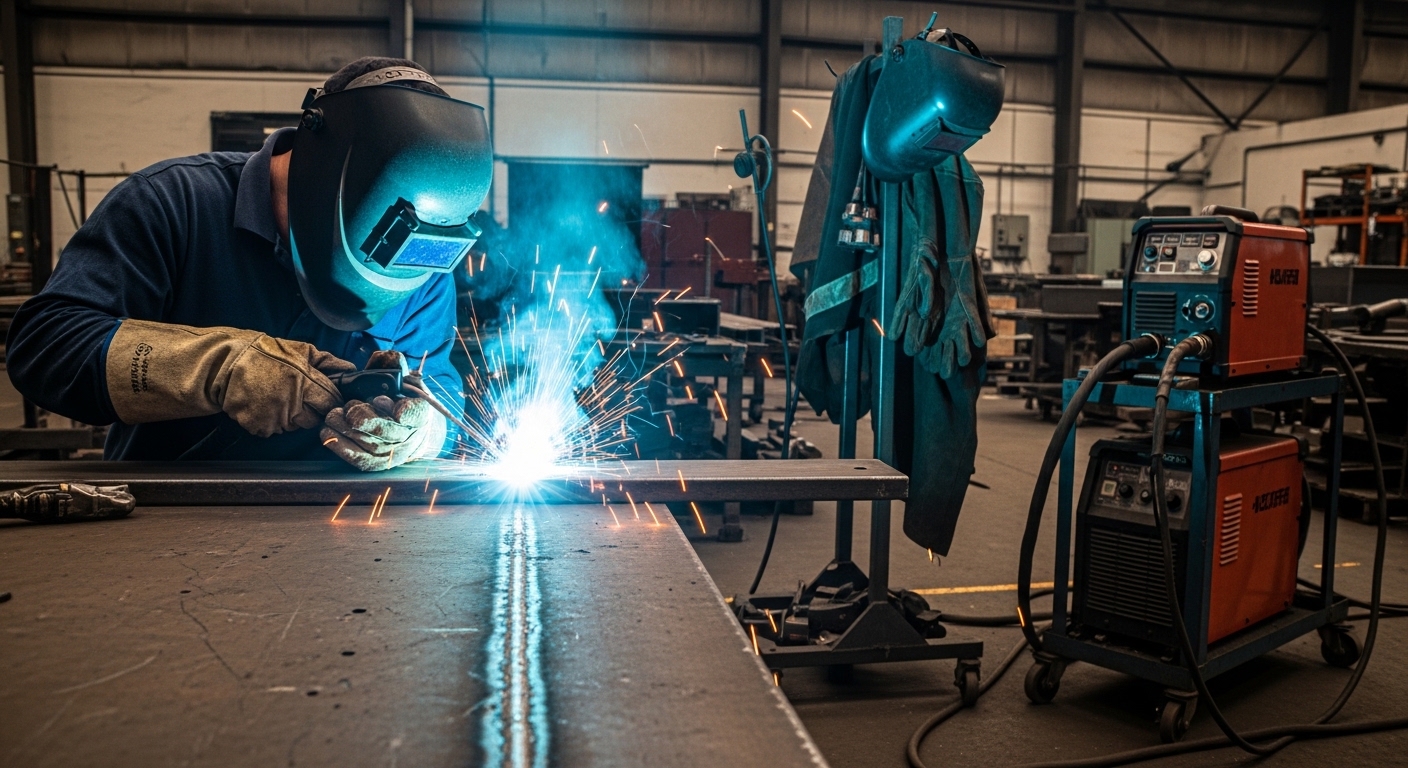
I’ve spent the last 15 years welding everything from thin sheet metal to 3-inch thick plate steel. In that time, I’ve learned that welding ferrous metals isn’t just about laying beads. It’s about understanding what’s happening at the molecular level when you apply 10,000 degrees to iron.
Welding ferrous metals involves selecting the right process (SMAW, GMAW, GTAW, or FCAW) based on material type, thickness, and application. Carbon steel welds relatively easily with minimal preparation. Cast iron requires preheating to 500-1200degF and slow cooling. Stainless steel needs low heat input and proper gas shielding to prevent carbide precipitation. Always match filler metal composition to base metal and follow WPS when code welding is required.
The $22 billion welding industry runs on ferrous metals. They account for roughly 80% of all welding applications worldwide. When I started my first fabrication job in 2026, I made every mistake in the book. Cracked welds on high-carbon steel, warping thin plate, and turning cast iron into scrap.
After repairing enough failed welds to fill a scrap yard, I learned that understanding the material makes all the difference. This guide covers everything you need to know about welding iron-based metals, from mild steel to exotic alloys.
What Are Ferrous Metals?
Ferrous Metals: Iron-based metals containing iron as the primary element, including carbon steel, cast iron, wrought iron, stainless steel, and alloy steels. The word “ferrous” comes from the Latin word “ferrum,” meaning iron. All ferrous metals are magnetic and contain varying amounts of carbon that dramatically affect weldability.
The key difference between ferrous and non-ferrous metals comes down to iron content. Ferrous metals contain iron as their main ingredient. Non-ferrous metals like aluminum, copper, and titanium contain no iron. This distinction matters because iron-based metals behave differently when you weld them.
Carbon content is the single most important factor in ferrous metal weldability. Low-carbon steel (under 0.15% carbon) welds easily. High-carbon steel (above 0.50% carbon) can crack just by looking at it wrong. I’ve seen beautiful welds on high-carbon steel crack hours later as the metal cools.
The carbon equivalent formula helps predict weldability:
CE = C + (Mn/6) + ((Cr+Mo+V)/5) + ((Ni+Cu)/15)
Where CE under 0.35 = excellent weldability, CE 0.35-0.45 = moderate, CE over 0.45 = special precautions needed
I use this formula constantly when working with unknown steels. Saved me from a disaster on a critical structural project last year.
| Metal Type | Carbon Content | Weldability | Key Considerations |
|---|---|---|---|
| Low Carbon Steel | 0.05-0.15% | Excellent | Minimal prep required |
| Medium Carbon Steel | 0.15-0.30% | Good | Preheat may be needed |
| High Carbon Steel | 0.30-0.50% | Fair | Preheat essential, use low-hydrogen electrodes |
| Cast Iron | 1.7-4.0% | Difficult | Preheat 500-1200degF, slow cool |
| Stainless Steel (300 series) | Low (alloyed) | Good | Watch heat input, use proper shielding gas |
| Chrome-Moly Steel | 0.15-0.25% | Good | Preheat for thickness over 0.5 inch |
Welding Processes for Ferrous Metals
Choosing the right welding process makes or breaks the job. I’ve seen operators struggle for hours with the wrong process when switching would have solved everything in minutes.
Shielded Metal Arc Welding (SMAW / Stick)
SMAW is the old reliable. I still use it for 80% of my field welding because it works outdoors, doesn’t need gas, and handles dirty material like a champ. The Lincoln Electric Fleetweld 5P+ rod has saved more jobs than I can count.
Best For: Outdoor welding, thick material, dirty/rusty surfaces, structural steel, repair work
Drawbacks: Slower deposition, frequent electrode changes, slag removal required
For carbon steel, I typically use E6010 for root passes (digging characteristics) and E7018 for fill and cap (smooth, strong welds). The key is keeping low-hydrogen electrodes dry. I once had a whole batch of E7018 absorb moisture and cause hydrogen cracking. Now I keep them in an oven at 250degF religiously.
Gas Metal Arc Welding (GMAW / MIG)
MIG welding dominates production environments for good reason. Once set up properly, it’s fast, clean, and easier to learn. I’ve trained complete beginners to make decent MIG welds in a single day.
For ferrous metals, I use ER70S-6 wire for carbon steel and ER308 for stainless. The 0.035″ diameter is my go-to for general fabrication. It handles the range from 22 gauge to 1/4″ steel well.
Best For: Production welding, thin material, clean shop environments, long continuous welds
Drawbacks: Sensitive to wind/drafts, requires gas shielding, less tolerant of surface contamination
Gas Tungsten Arc Welding (GTAW / TIG)
TIG is the precision tool in your welding arsenal. I use it for stainless steel, critical pipe welds, and anywhere weld appearance matters. The control you get is unmatched. I’ve TIG welded razor blades together without burning through.
For ferrous metals, TIG excels on stainless steel and thin materials. The downside is speed. A TIG weld that takes 10 minutes might take 2 minutes with MIG. But for critical applications, that precision is worth every minute.
Best For: Stainless steel, thin materials, precision work, critical welds, root passes on pipe
Drawbacks: Slow, requires high skill, sensitive to contamination
Flux Cored Arc Welding (FCAW)
FCAW is like MIG on steroids. The flux core allows outdoor welding without shielding gas and provides deeper penetration. I use it exclusively for heavy structural work and farm equipment repair.
The E71T-1 wire is my standard for general fabrication. It deposits weld metal fast and handles surface contamination better than solid wire. Just be prepared for slag removal and more smoke.
Best For: Heavy fabrication, outdoor welding, thick materials, high-deposition applications
Drawbacks: Slag removal, more smoke/fumes, weld spatter
| Process | Speed | Skill Required | Outdoor Capability | Best Application |
|---|---|---|---|---|
| SMAW (Stick) | Medium | Moderate | Excellent | Field repair, structural |
| GMAW (MIG) | Fast | Low | Poor | Production, fabrication |
| GTAW (TIG) | Slow | High | Fair | Precision, stainless |
| FCAW | Very Fast | Moderate | Good | Heavy fabrication |
Welding Carbon Steels
Carbon steel is the workhorse of ferrous metals. Understanding the three categories (low, medium, and high carbon) is essential for successful welding.
Low Carbon Steel (Mild Steel)
Mild steel is the most forgiving metal you’ll ever weld. A36 structural steel, 1018 cold-rolled, and 1020 hot-rolled are all in this category. They contain 0.05-0.15% carbon and weld like butter.
I rarely preheat mild steel unless it’s below freezing or extremely thick. For plate over 1 inch, I’ll bring it up to about 150degF to drive off moisture. Otherwise, clean to shiny metal and weld.
Filler metal selection is straightforward: match the base metal strength. For mild steel, ER70S-6 MIG wire or E7018 stick electrodes are perfect. I’ve welded thousands of feet of mild steel with these consumables without issues.
The one thing to watch with mild steel is cold rolled material. The mill scale can cause porosity if not removed. I grind a 1-inch band anywhere I’m welding, or wire wheel the entire surface if doing extensive work.
Medium Carbon Steel
Medium carbon steels (0.15-0.30% carbon) like 1045 and 4140 require more attention. The increased carbon makes them stronger but also more crack-prone during welding.
I always calculate carbon equivalent before welding medium carbon steel. If CE exceeds 0.45, preheating becomes mandatory. For 1-inch 4140 plate, I preheat to 400-500degF. This slows the cooling rate and prevents martensite formation in the heat affected zone.
Low-hydrogen electrodes are non-negotiable. E7018 rods stored properly in an electrode oven, or ER70S-6 wire with low moisture content. I learned this lesson the hard way when a medium carbon shaft weld cracked three days after welding.
High Carbon Steel
High carbon steel (above 0.30% carbon) like 1095 and O1 tool steel present serious welding challenges. The high carbon content makes the heat affected zone extremely hard and brittle.
Quick Summary: High carbon steel requires preheat (300-600degF), low-hydrogen electrodes, minimal heat input, and immediate post-weld stress relief. Without these steps, cracking is almost guaranteed.
For welding high carbon steel, I follow a strict procedure:
- Preheat to 500-600degF (depending on thickness)
- Use E8018 or E9018 low-hydrogen electrodes
- Keep heat input low with stringer beads
- Peen each pass while hot to relieve stress
- Cover with insulation after welding for slow cooling
- Stress relieve at 1100-1200degF if possible
Even with perfect technique, welding high carbon steel is risky. I often recommend brazing or using mechanical fasteners instead when the application allows.
Welding Cast Iron
Cast iron is notoriously difficult to weld. The high carbon content (1.7-4.0%) makes the heat affected zone brittle and crack-prone. I’ve seen more failed cast iron welds than all other metals combined.
Why Cast Iron Cracks: When you heat cast iron, the carbon forms graphite nodules. Rapid cooling transforms this structure into martensite, which is extremely hard and brittle. The unequal contraction between the weld metal and base metal causes cracks to form, often hours or days after welding.
Despite the challenges, cast iron can be welded successfully with the right approach. The key is controlling the cooling rate through proper preheating and post-weld heat treatment.
Preheating Cast Iron
Preheating is non-negotiable for cast iron. I aim for 500-1200degF depending on the size and complexity of the casting. Small parts might only need 500degF. Large engine blocks often require 1000-1200degF.
I use a torch or oven for preheating. Never rely on the welding arc itself. The goal is uniform heat throughout the casting, not just surface temperature. I once skipped proper preheat on a pump housing and watched it crack right down the middle as it cooled.
Cast Iron Welding Techniques
Two main approaches work for cast iron: hot welding and cold welding.
Hot Welding: Preheat the entire casting to 1200degF, weld with nickel-based electrodes (ENiFe-CI), then slow cool under insulation. This produces the most ductile weld but requires significant equipment. I use this method for critical structural castings.
Cold Welding: Preheat locally to 250-500degF, weld in short 1-inch beads with nickel electrodes, peen each bead, and allow cooling between passes. This works for repairs where full preheat isn’t practical. I’ve successfully repaired engine blocks, gear cases, and machinery bases this way.
My go-to electrodes for cast iron are ENiFe-CI (55% nickel) for general repairs and ENi-CI (99% nickel) for thin sections or where machinability is critical. The nickel electrode deposit is soft and ductile, accommodating the differential contraction.
Post-Weld Treatment for Cast Iron
After welding cast iron, slow cooling is critical. I bury the part in vermiculite, sand, or even dry asbestos-free insulation material. The goal is cooling rate under 50degF per hour down to 300degF.
For critical applications, full stress relief at 1100-1200degF for one hour per inch of thickness provides the best results. This isn’t always practical in the field, but it virtually eliminates cracking concerns.
Welding Stainless Steel and Alloy Steels
Stainless steel and alloy steels require different considerations than plain carbon steels. The alloying elements that give them special properties also introduce unique welding challenges.
Stainless Steel Welding
Stainless steel’s chromium content (minimum 10.5%) provides corrosion resistance but also creates welding challenges. The primary concern is carbide precipitation, which occurs when chromium combines with carbon at high temperatures.
When stainless steel stays in the 800-1600degF range too long, chromium carbides form at grain boundaries. This depletes the surrounding area of chromium, destroying corrosion resistance exactly where you need it most.
Preventing Carbide Precipitation:
- Use low heat input techniques
- Employ stringer beads, not weave beads
- Avoid excessive weave or dwelling
- For thick material, use low-carbon grades (304L, 316L)
- Consider 321 or 347 stabilized grades for high-temperature service
For welding 304 stainless steel, I use ER308L filler metal. The “L” designation indicates low carbon content (under 0.03%), which helps prevent carbide precipitation. For 316 stainless, ER316L is the correct choice.
Shielding gas selection matters. I use 98% argon / 2% CO2 for short-circuit MIG or straight argon for spray transfer. Too much CO2 adds carbon to the weld, defeating the purpose of low-carbon filler metal.
One trick I learned for stainless: keep the heat input low and the travel speed up. Faster welds spend less time in the carbide precipitation temperature range. I also use copper backing bars or heat sinks to pull heat away quickly.
Chrome-Moly Steel (4130/4140)
Chrome-moly steels offer excellent strength-to-weight ratios, making them popular for racing, aerospace, and high-performance applications. Welding them requires attention to detail.
For tubing under 0.120″ wall thickness, 4130 chrome-moly can be TIG welded without preheat using ER80S-D2 filler. This is common in roll cage construction where weight is critical.
Thicker sections require preheat. I preheat 4130 plate over 0.5″ thick to 300-400degF. The chromium and molybdenum increase hardenability, making the material more susceptible to cracking in the heat affected zone.
Post-weld heat treatment is often specified for critical chrome-moly applications. Stress relieving at 1100-1250degF reduces residual stress and improves ductility. For racing components, I always follow the manufacturer’s PWHT recommendations.
High Strength Low Alloy (HSLA) Steels
HSLA steels like A572 and A588 provide higher strength without heat treatment. They’re designed to be weldable with standard procedures, but some precautions apply.
Match filler metal strength to the base metal. For A572 Grade 50 (50 ksi yield), use E7018 electrodes or ER70S-6 wire. Overmatching strength isn’t necessarily better and can lead to brittle weld deposits.
For weathering steels like A588 (Corten), consider using electrodes with similar weathering characteristics if you want the weld to weather at the same rate as the base metal. Otherwise, standard E7018 works fine structurally.
Essential Techniques and Best Practices
Proper technique separates professional welds from amateur attempts. These fundamentals apply across all ferrous metal welding.
Determining Preheat Requirements
Preheat serves three purposes: removes moisture, slows cooling rate, and reduces thermal stress. Not all ferrous metals require preheat, but knowing when to apply it prevents costly failures.
I use the following guidelines:
| Material | Thickness | Preheat Temp |
|---|---|---|
| Low Carbon Steel | Any | None (unless below freezing) |
| Medium Carbon Steel | Under 0.5″ | 150-200degF |
| Medium Carbon Steel | Over 0.5″ | 300-400degF |
| High Carbon Steel | Any | 500-600degF |
| Cast Iron | Small parts | 500-600degF |
| Cast Iron | Large castings | 1000-1200degF |
| Chrome-Moly | Over 0.5″ | 300-400degF |
Heat Input Control
Excessive heat input causes problems: distortion, large heat affected zones, and degraded mechanical properties. I control heat input through amperage settings, travel speed, and technique.
For critical welds, I calculate heat input using this formula:
Heat Input (kJ/in) = (Voltage x Amperage x 60) / (Travel Speed x 1000)
Lower heat input = smaller HAZ, less distortion, better properties in heat-treated materials
Stringer beads produce lower heat input than weave beads. For stainless and high-alloy steels, I stick to stringers. For carbon steel fabrication, a slight weave increases deposition without excessive heat input.
Distortion Prevention
Distortion from thermal expansion and contraction can ruin tolerances and create alignment problems. I’ve seen carefully machined parts pulled out of spec by welding stresses.
These techniques help control distortion:
- Backstep welding: Weld opposite to the direction of progression. Each new bead pulls the previous one back toward neutral.
- Skip welding: Make welds in a staggered sequence rather than continuous. Distributes heat evenly across the assembly.
- Symmetrical welding: Weld opposite sides alternately. Counteracts forces from each side.
- Proper fixturing: Clamp securely but allow some movement. Over-constrained parts will crack or pull clamps loose.
- Pre-setting: Intentionally misalign parts slightly in the direction they’ll warp. They pull into correct position as they cool.
I once had to weld a 20-foot I-beam flange. Using skip welding in 6-inch segments, I kept the camber within 1/8-inch over the entire length. The same weld done continuously would have warped over an inch.
Joint Design and Fit-Up
Proper joint design and fit-up make welding easier and produce better results. Gaps that are too wide require excessive filler metal and increase distortion. Gaps that are too tight prevent proper penetration.
For plate from 1/8″ to 1/4″, I use a 1/8″ root opening with 60-degree included angle for V-groove joints. Thicker material gets larger root openings and double-V joints to reduce weld metal volume.
Proper cleaning before welding is non-negotiable. I grind at least 1 inch back from the weld joint on each surface. Oil, paint, rust, and mill scale all cause weld defects. A wire brush followed by acetone cleaning is my standard preparation.
Understanding Welding Procedure Specifications (WPS)
Welding Procedure Specification (WPS): A documented welding procedure that outlines all required parameters for producing acceptable welds. A qualified WPS specifies base metals, filler metals, preheat and interpass temperatures, shielding gas composition, electrical characteristics, joint design, and welding position. Following a WPS is mandatory for code welding and ensures consistent, repeatable results.
For professional welding, a WPS isn’t just paperwork, it’s your roadmap to success. The American Welding Society (AWS) and American Society of Mechanical Engineers (ASME) both provide WPS formats that are accepted industry-wide.
A proper WPS includes:
- Base metal identification (ASTM/ASME grade)
- Filler metal classification (AWS classification)
- Shielding gas composition and flow rate
- Electrical characteristics (AC/DC, polarity)
- Preheat and interpass temperatures
- Post-weld heat treatment requirements
- Joint design and geometry
- Welding position
- Technique details (stringer/weave, electrode angle)
When code welding is required, the WPS must be supported by a Procedure Qualification Record (PQR). The PQR documents actual testing that proved the procedure works. Tensile tests, bend tests, and impact tests verify the weld meets mechanical property requirements.
I’ve written WPS documents for everything from structural steel to pressure vessel fabrication. Taking the time to develop and qualify proper procedures saves countless headaches later. When questions arise, the WPS provides the answers.
Common Problems and Solutions
Even with proper preparation and technique, problems occur. Understanding the causes and solutions saves time and frustration.
| Problem | Causes | Solutions |
|---|---|---|
| Cracking (HAZ) | High carbon content, rapid cooling, hydrogen | Preheat, use low-hydrogen electrodes, slow cool |
| Porosity | Moisture, contamination, improper gas flow | Clean base metal, dry electrodes, check gas flow |
| Lack of Fusion | Low amperage, fast travel, improper angle | Increase heat, slow travel, correct work angle |
| Undercutting | High amperage, fast travel, improper technique | Reduce amperage, adjust travel speed, reduce weave width |
| Distortion | Excessive heat input, improper welding sequence | Use backstep/skip welding, reduce heat input, proper fixturing |
| Slag Inclusion | Incomplete slag removal, improper joint design | Clean between passes, adjust groove angle |
| Tungsten Inclusion | Touching tungsten to weld pool, excessive current | Use proper current, sharpen tungsten correctly, don’t touch pool |
| Cracking (Centerline) | High sulfur/phosphorus, excessive bead width | Use cleaner base metal, use stringer beads |
Hydrogen Cracking
Hydrogen cracking, also called underbead cracking or delayed cracking, is particularly insidious because it can appear hours or even days after welding. The hydrogen comes from moisture in electrodes, base metal contamination, or atmospheric hydrogen absorbed during welding.
Prevention is straightforward: use low-hydrogen electrodes stored properly in an electrode oven, clean base metal thoroughly, and preheat to slow cooling which allows hydrogen to diffuse out of the weld.
I once had a structural weld crack three days after completion. Investigation revealed the E7018 electrodes had been left out overnight. The moisture absorbed caused hydrogen cracking. Now I treat electrode storage as seriously as welding technique.
Stress Relief Cracking
Stress relief cracking occurs during post-weld heat treatment when the material’s ductility is at its lowest. It typically happens in high-strength low-alloy steels at stress relief temperatures.
The solution is using lower strength filler metal (undermatching) and keeping weld restraint low during PWHT. For critical applications, I specify a lower stress relief temperature or alternative heat treatment cycles.
Safety Considerations for Ferrous Metal Welding
Welding ferrous metals introduces specific hazards beyond general welding safety. Understanding these risks keeps you healthy on the job.
Fume Exposure
Welding ferrous metals produces fumes containing iron, manganese, and other alloying elements. Manganese exposure is particularly concerning. Long-term overexposure causes manganism, a neurological condition similar to Parkinson’s disease.
Always use adequate ventilation. For indoor welding, I recommend a fume extraction system positioned to capture welding plume at the source. Outdoor welding still requires care. Wind can blow fumes back toward you despite seeming like adequate ventilation.
Respiratory protection is mandatory when ventilation can’t control exposure. A P100 rated respirator protects against welding fumes. For stainless steel welding, the hexavalent chromium exposure makes proper ventilation and respiratory protection non-negotiable.
UV Radiation
The electric arc produces intense UV radiation that damages eyes and skin. Arc eye feels like sand in your eyes and can persist for days. Skin damage from UV exposure increases cancer risk over time.
Wear a proper welding helmet with correct shade number. I use auto-darkening helmets set to shade 10-12 for most ferrous metal welding. For high-current applications over 300 amps, shade 13 or 14 provides adequate protection.
Cover all skin. I’ve seen bad sunburn-like injuries from welding in short sleeves. T-shirt material provides essentially zero UV protection. Leather welding jackets or flame-resistant cotton coveralls are essential.
Fire and Explosion Hazards
Welding sparks travel 20-30 feet horizontally and can fall considerably farther. I’ve seen sparks start fires in unexpected places. Before striking an arc, I do a 35-foot radius inspection for combustible materials.
Hot work permits are standard in industry for good reason. They formalize the fire watch requirements and ensure proper preparation. When welding in unfamiliar environments, I insist on a fire watch regardless of what the procedure says.
Never weld on containers that held flammable materials without proper cleaning and purging. I follow API 2015 and API 2201 procedures for hot work on containers. The explosion risk is simply too high to cut corners.
Electric Shock
Welding equipment uses high current at relatively low voltage, but the open-circuit voltage (60-80 volts for most machines) can still cause serious shock. Wet conditions increase shock risk dramatically.
I always wear dry welding gloves and inspect cables before use. Frayed insulation is an accident waiting to happen. For work in wet or confined spaces, I use a welding machine with VRD (Voltage Reduction Device) that limits open-circuit voltage to 15 volts.
Never wrap welding cables around your body. I’ve seen operators do this for convenience, but if a fault occurs, you become part of the circuit. The convenience isn’t worth the risk.
Code Compliance and Certification
For many applications, simply making good welds isn’t enough. Code compliance ensures welds meet minimum standards for critical applications like pressure vessels, structural steel, and piping.
AWS D1.1 Structural Welding Code
AWS D1.1 is the primary code for structural steel welding in the United States. It covers welding requirements for buildings, bridges, and other structures. If you’re welding structural steel subject to code requirements, D1.1 applies.
The code specifies qualification requirements for welders and procedures, inspection requirements, acceptance criteria, and fabrication tolerances. I keep a current copy of D1.1 in my shop and reference it regularly.
ASME Section IX
ASME Boiler and Pressure Vessel Code Section IX covers welding qualification for pressure-containing applications. If you’re welding pressure vessels, boilers, or piping to ASME codes, Section IX governs the welding procedures and welder qualifications.
Section IX is more prescriptive than AWS D1.1 in many areas. The essential variables that require requalification are explicitly defined. I’ve had to requalify procedures for minor changes that wouldn’t matter under other codes.
Welder Certification
Certified welders have demonstrated their ability to make sound welds to a specific code. The certification process involves welding test plates or pipe under observation, then having the welds destructively tested.
I maintain certifications in multiple processes and positions. A 3G certification (vertical-up groove weld) doesn’t qualify you for 4G (overhead) or 6G (pipe in fixed position). Most employers require multiple certifications for versatility.
Certifications typically remain valid for six months with continued use. If you don’t weld with that process within the certification period, you must retest. I keep a logbook of all welding activity to document certification maintenance.
Applications and Industry Uses
Ferrous metal welding serves virtually every industry. Understanding the specific requirements of different applications helps tailor procedures accordingly.
Construction and Structural Steel
Structural steel for buildings and bridges typically uses A36 or A572 grades. These low-carbon steels weld readily with standard procedures. The main concerns are proper joint preparation, fit-up, and achieving full penetration.
For structural connections subject to seismic loads, I pay extra attention to weld soundness. Charpy V-notch testing may be required to ensure toughness. The welds in moment-resisting frames literally hold buildings together during earthquakes.
Pipeline Welding
Pipeline welding uses specialized procedures developed for cross-country pipe construction. API 1104 covers welding of pipelines and related facilities.
Pipeline welders use cellulose-coated electrodes (E6010, E7010) for root passes due to their digging characteristics. The key is achieving a good root pass on the inside without excessive penetration. I’ve watched expert pipeliners consistently make perfect ID beads that require zero grinding.
Pressure Vessels
Pressure vessel welding to ASME Section VIII requires meticulous procedures. The welds must withstand internal pressure, often at elevated temperatures. Radiographic inspection ensures weld soundness.
Pressure vessel materials often include higher-strength steels that require preheat and post-weld heat treatment. I’ve worked on vessels requiring 600degF preheat and stress relief at 1150degF. The procedures are exacting, but the consequences of failure are catastrophic.
Frequently Asked Questions
Can you weld ferrous metals?
Yes, ferrous metals are highly weldable using various processes. SMAW (stick), GMAW (MIG), GTAW (TIG), and FCAW all work well for ferrous metals. Carbon steel welds easily with minimal preparation. Cast iron requires preheating to 500-1200degF and slow cooling. Stainless steel needs proper shielding gas and heat input control to prevent carbide precipitation. The key is matching the process and technique to the specific ferrous metal type.
What is the best welding process for ferrous metals?
The best process depends on the specific application. SMAW (stick welding) is best for outdoor work and repairs because it tolerates wind and dirty surfaces. GMAW (MIG) excels in production environments due to speed and ease of use. GTAW (TIG) provides the highest quality and control for stainless steel and precision work. FCAW offers high deposition rates for heavy fabrication. For general carbon steel fabrication, GMAW provides the best balance of speed and quality.
Do you need to preheat steel before welding?
Preheat requirements depend on carbon content and thickness. Low carbon steel (mild steel) generally doesn’t require preheat unless working below freezing or welding plate over 1 inch thick. Medium carbon steel may require 150-400degF preheat depending on thickness. High carbon steel typically needs 500-600degF preheat. Cast iron requires 500-1200degF preheat depending on part size. Calculate carbon equivalent to determine specific preheat requirements for unknown steels.
Why do they say to drink milk after welding galvanized?
This is a myth and provides no real protection. Drinking milk after welding galvanized steel doesn’t prevent or treat metal fume fever. Galvanized steel contains zinc coating that produces zinc oxide fumes when welded. Exposure causes metal fume fever with symptoms like nausea, fever, and muscle aches that typically appear 4-12 hours after exposure. The only effective protection is adequate ventilation and respiratory protection. If you experience symptoms, seek medical attention rather than relying on folk remedies.
What metals cannot be welded together?
Dissimilar metal combinations present challenges but most can be joined with proper techniques. Ferrous to non-ferrous combinations like steel to aluminum cannot be fusion welded directly due to vastly different melting points and metallurgical incompatibility. These require brazing or mechanical fastening. Some stainless steels welded to carbon steel can cause galvanic corrosion in corrosive environments. Cast iron to steel welds are possible but require special nickel electrodes and careful preheat control. Always consider service environment when welding dissimilar metals.
What is the difference between ferrous and non-ferrous metals?
Ferrous metals contain iron as the primary element and are generally magnetic. They include carbon steel, alloy steel, cast iron, wrought iron, and stainless steel. Non-ferrous metals contain no iron and are typically non-magnetic. Common non-ferrous metals include aluminum, copper, brass, bronze, lead, and titanium. Ferrous metals generally have higher strength and lower cost but are more susceptible to rust (except stainless steel). Non-ferrous metals often have better corrosion resistance and lighter weight but are typically more expensive.
Conclusion
Welding ferrous metals successfully requires understanding the material, selecting the right process, and following sound procedures. After 15 years in the trade, I’m still learning and improving. Every weld teaches something new.
The fundamentals covered here apply across all ferrous metal welding: know your material, control the heat, use proper filler metals, and follow established procedures. When in doubt, consult the WPS. When no WPS exists, develop one based on sound principles and qualified testing.
The welding industry continues evolving with new materials, processes, and technologies. But the fundamentals remain constant. Master these, and you’ll produce quality welds on any ferrous metal that comes across your table.
Leave a Reply