
If your driveway runs a quarter mile or more, you have probably already learned the same lesson we did: the driveway alarm that looked perfect on the product page goes quiet two-thirds of the way down the lane. The best driveway sensors for long driveways are not the ones with the biggest number on the box. They are the ones whose advertised range still holds after a stand of pine trees, a gravel rise, and a metal-sided shop sit between the sensor and the house.
We spent several weeks working through the specs, owner reports and failure patterns behind ten of the highest-reviewed long range driveway sensors on the market, and we lined them up against the question owners with 900 ft to quarter-mile drives keep asking: how far does one of these actually reach, and what does it detect when it gets there? Our whole comparison turns on one distinction most listings blur — detection range (how wide an area the sensor watches) is not the same number as wireless signal range (how far the alert travels to your receiver). Confusing those two is why so many long-driveway installs end in disappointment.
That framing shaped every pick below. We rated each kit on real range behavior rather than headline range, on whether it powers the sensor without constant battery work, on whether you can run one sensor to a receiver in the house and another in a shop, and on what it does when a deer walks past at 4am. We also weighed the sensor type, because owners who switch from motion to vehicle-only detection usually report the biggest drop in false alerts of any change they make.
If you are still working out the basics, our wireless driveway alarm guide covers the shorter-range options, and our driveway design ideas can help you plan where a sensor post or gate hardware fits without wrecking the look of the lane.
We also kept the focus on early warning rather than appearance. A sensor tells you someone is there; it does not tell you who. If identification is your priority, read the camera comparison near the end of the buying guide before you commit.
Our Top 3 Best Driveway Sensors for Long Driveways (October 2026)

HTZSAFE 1/2 Mile Alarm Kit
- 1/2 mile wireless range
- 50 ft PIR detection with two sensitivity levels
- Expandable to 32 sensors and unlimited receivers

TECKNET Solar RGB Alarm
- 2600 ft signal range with 33 ft PIR throw
- Solar plus USB charging
- 36 melodies and 4 alert zones
- RGB flashing visual alert

Betterlink Solar Alarm
- 1/2 mile range with IP65 housing
- Solar plus USB-C backup charging
- 30 ft PIR with false-alarm algorithms
- Four alert modes
The kit we kept coming back to was the HTZSAFE 1/2 mile package: the widest expansion headroom here, a 50 ft detection throw that is the biggest in the group, and the deepest review history of anything we tested. If your drive is a quarter mile, that combination is the safest bet we found.
Comparing 10 Long Range Driveway Sensors Side by Side in 2026
Every kit below publishes a range figure, and only some of them publish a real-world one. We list the advertised number exactly as the manufacturer states it, then note what owners actually report back.
| Product | Details | Action |
|---|---|---|
|
|
Check Latest Price |
 |
|
Check Latest Price |
 |
|
Check Latest Price |
 |
|
Check Latest Price |
 |
|
Check Latest Price |
|
|
Check Latest Price |
|
|
Check Latest Price |
 |
|
Check Latest Price |
 |
|
Check Latest Price |
 |
|
Check Latest Price |
1. HTZSAFE 1/2 Mile Driveway Alarm – Best All-Round Pick for a Half-Mile Drive
Driveway Alarm- 1/2 Mile Long Range Motion Sensor- 1 Receiver+2 Sensors
1/2 mile wireless range
50 ft PIR detection
3 AA batteries per sensor
Expandable to 32 sensors
+ Pros
- Half mile range holds up across large properties
- 50 ft detection is the widest throw in this group
- Expands to 32 sensors with unlimited receivers
- 35 melodies and 4 volume levels
- Pre-paired plug-and-play setup
– Cons
- Three AA batteries needed per sensor and not included
- Real range drops with trees walls and terrain
This is the kit we recommend to almost anyone whose driveway is a quarter mile or shorter. It pairs one plug-in receiver with two sensors, the sensors are pre-programmed, and the radio link uses FSK with FHSS frequency hopping, which is the part that holds up when a metal barn or a masonry house sits between the sensor and the kitchen counter.
The detection head covers 50 ft with two sensitivity settings, 35 ft on low and 50 ft on high. That throw matters more on a long drive than most buyers expect: a 24 ft sensor placed too far up the lane leaves a gap where a fast car can pass without ever entering the detection pattern.

Expansion is where this kit separates itself. It scales to 32 sensors and unlimited receivers, so a property with a main drive, a shop entrance and a gate can run all of them and still add receivers in the barn and the upstairs hallway.
Sound options are generous for a kit at this level: 35 melodies and 4 volume levels, with per-zone melodies so you can hear which entrance fired without getting out of your chair. The receiver is a plug-in unit, so the location of a wall outlet decides where the chime lives.
Where the half-mile claim holds and where it does not
Owners with clear sightlines report the full 2,640 ft comfortably. Reviewers with wooded lanes, hills or buildings in the path report a shorter working distance, which is exactly the pattern we expected from the FSK and FHSS hardware. The listed operating range of -30 to 150 degrees Fahrenheit also means the sensor is built for a genuine four-season exterior post rather than a mild climate.
Why 50 ft of detection is the number to care about
A wider detection pattern catches a car earlier in its run up the drive, which buys you more time to get outside, a light on, or a door locked. It also catches more than you want: branches, grouse, and anything else with body heat moving through the pattern. That is why the two sensitivity settings matter more than the range figure, and why the low setting is where most long-driveway owners should start.
Who this suits and who should skip it
Choose it if you have multiple entrances, a long lane, and a house you want to hear from in more than one room. Skip it if you are installing far from any outlet and want zero battery maintenance — this is a battery sensor, and three AA cells per unit is a recurring job. The housing is listed as weather resistant rather than carrying a numbered ingress rating, so a fully exposed post in driving rain deserves a sheltered mount.
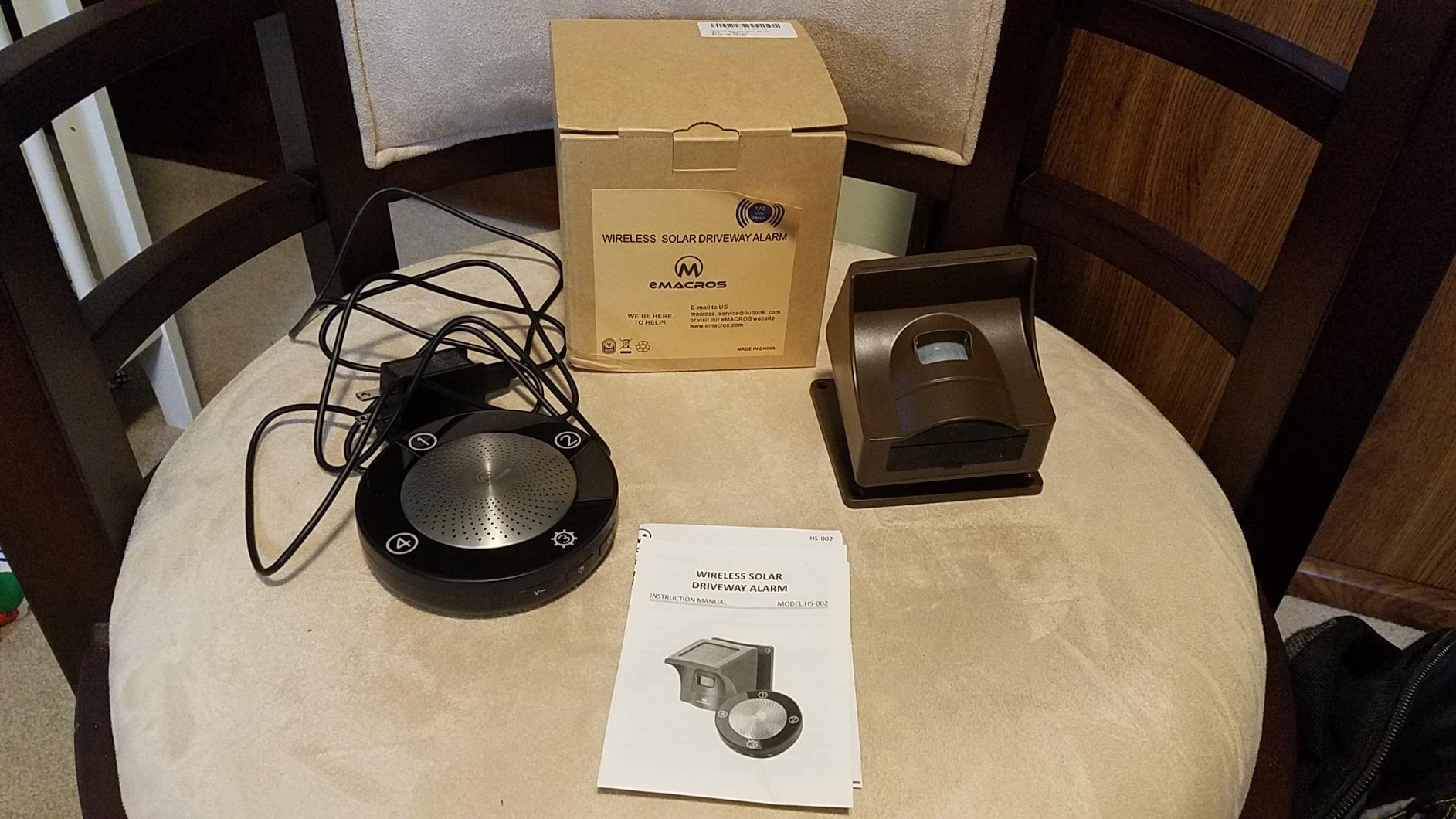
2. eMACROS 1/2 Mile Solar Driveway Alarm – Best for Whole-Property Coverage
eMACROS 1/2 Mile Solar Wireless Driveway Alarm, 1 Receiver & 1 Sensor
2,640 ft wireless range
Solar panel with internal battery
20 to 30 ft IR detection
Up to 64 sensors
+ Pros
- Solar panel removes sensor battery changes
- Half mile range tested in forests storms and rain
- Scales to 64 sensors with per-zone chimes
- No wiring or trenching needed
- Quick Start Guide included
– Cons
- IR throw of 20 to 30 ft is shorter than rivals
- Range varies with terrain and obstructions
The eMACROS kit exists for a specific kind of property: one with a lot of entrances and no appetite for annual battery work. The solar panel continuously charges an internal lithium polymer battery, so the sensor end of the system is genuinely hands-off once installed.
Range is quoted at 2,640 ft and the manufacturer states it was tested in forests, storms and heavy rain, which is a more useful claim than an open-field test. Operating temperature is listed at -20 to 60 degrees Celsius, so it holds up across a hot summer and a hard winter.
Expansion is the headline feature here: up to 64 sensors and unlimited receivers, each with its own chime. For a farm, an acreage property with a barn, a shop and a gate, or a business with a long access lane and a rear entrance, that headroom is hard to find elsewhere in this category.
Installation requires no wiring and no trenching, and the box includes a Quick Start Guide, charging cables and adapters. The manufacturer gives specific mounting heights: 3 to 4 ft when you want people detected, 2 to 3 ft when vehicles are the priority. That guidance is more useful than most, because mounting height is the single biggest lever on false alerts.
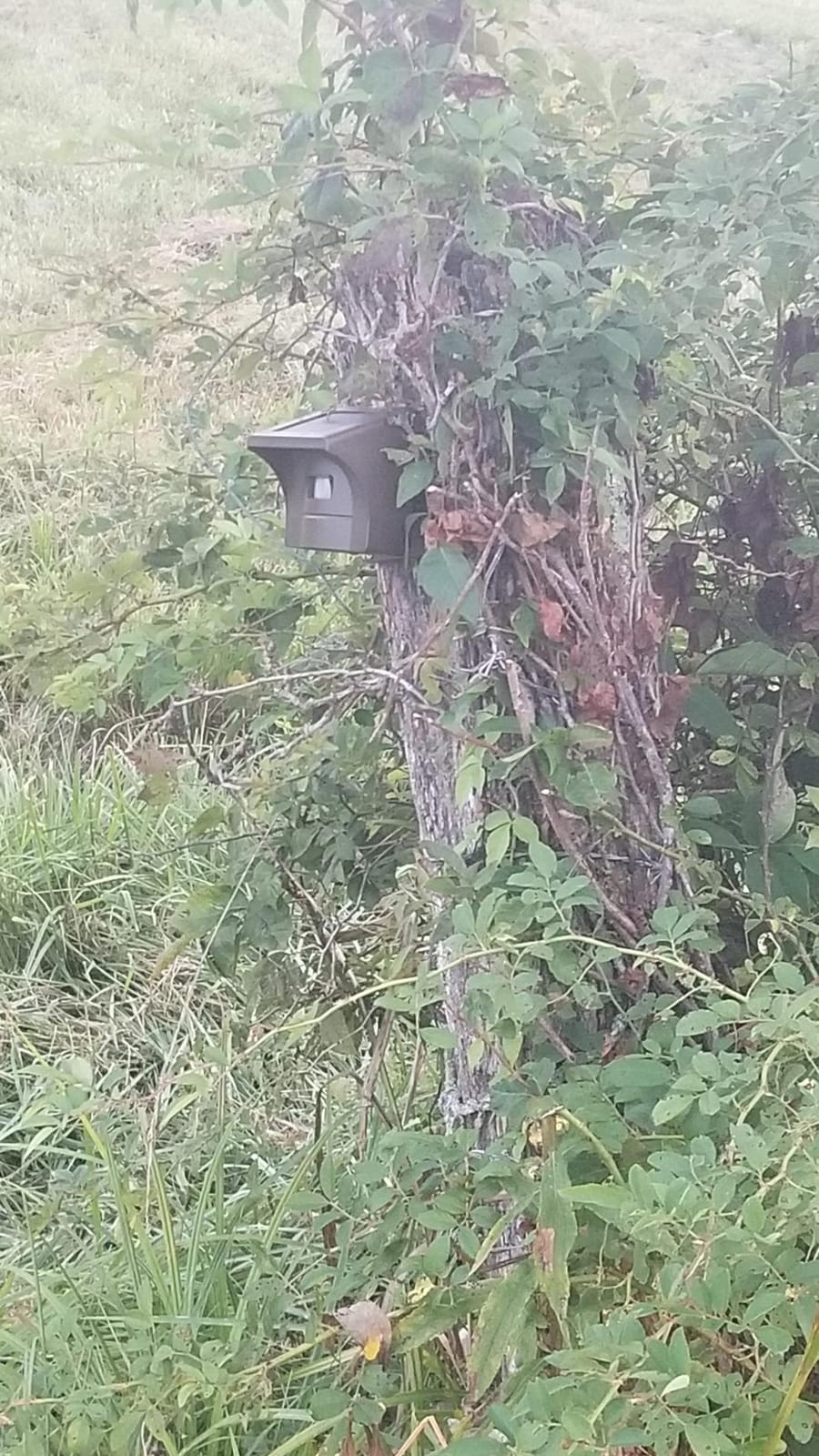
Solar charging in a northern winter
Solar sensors are not magic in January. Owners in cold cloudy regions report that panel orientation decides whether the sensor survives a stretch of grey days, and the common advice from people running them through winter is to face the panel south at install so it catches whatever light there is. A shaded post drains the internal battery faster than the panel can refill it.
The trade-off: a shorter detection throw
The eMACROS sensor detects across 20 to 30 ft with adjustable sensitivity, which is narrower than the 50 ft throw on the HTZSAFE kit and the 33 ft throw on the TECKNET. On a long, fast driveway that means placing the sensor further up the lane or accepting that a very quick pass might land outside the pattern. The housing measures just under 6 in on its longest side and weighs under 1 lb, which makes it easy to place high and visible.
When 64 sensors is the reason to buy
If you have one entrance, this is more system than you need. If you are covering multiple gates, outbuildings and a shop, the per-zone chime support and unlimited receivers make it a cleaner install than piecing together two brands. The kit ships with one sensor and one receiver, so expanding is a deliberate second purchase rather than an included extra.
3. HOSMART 1/2 Mile Wireless Driveway Alarm – Best for Harsh Weather and Rough Terrain
1/2 Mile Hosmart Driveway Alarm Wireless Motion Sensor System | Driveway Sensor Alert System Weatherproof Security Outdoor Motion Sensor & Detector Protect Outdoor/Indoor Property
About 1,500 ft real-world range
Industrial-grade PVC housing
38 ringtones
2 year warranty
+ Pros
- Manufacturer states roughly 1500 ft in typical conditions
- Tested through thick forestry hail wind heavy rain and snow
- Swivel mount for refining aim
- 38 selectable ringtones
- 2 year parts and workmanship warranty
– Cons
- Range falls well short of the half-mile headline figure
- Expansion limited to 4 sensors
- Batteries not included
Most brands in this category give you one range number. HOSMART gives you two, and the second one is the reason this kit is worth a look: about 1,500 ft in most real conditions rather than the 2,640 ft headline figure. A manufacturer willing to publish the smaller number is telling you something useful about how it tested.
The housing is industrial-grade PVC with a rubberized weather and water seal plus a sunshade over the detection window. The manufacturer lists testing through thick forestry, hail storms, gusty winds, heavy rains, heat and snow, and backs the system with a 2 year warranty on parts and workmanship — the longest explicit warranty in this group.
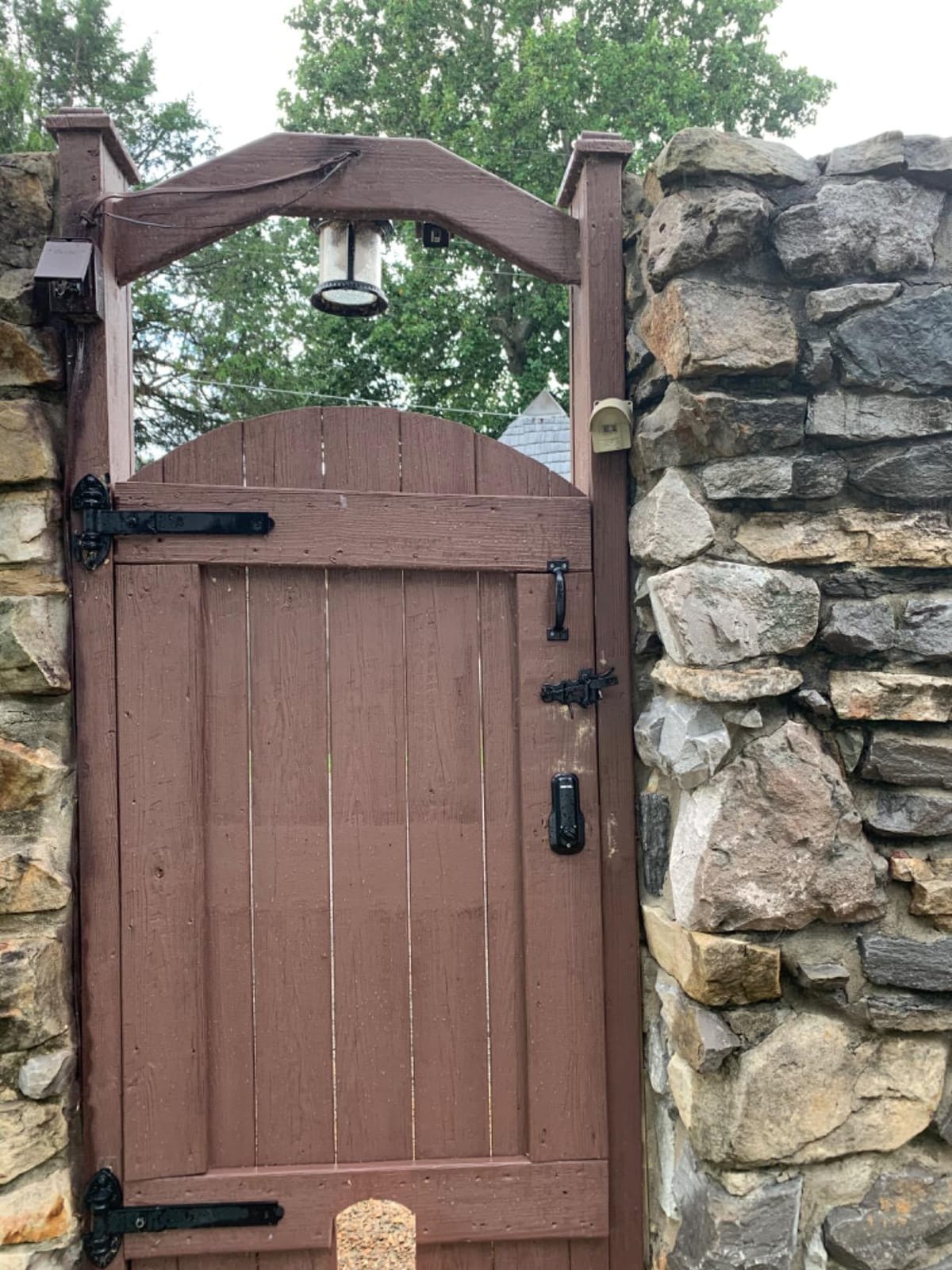
Detection is handled by a swivel mount, which lets you refine the detection focus and angle after the sensor is on the post. That is the cheapest false-alarm fix available and most people never use it, so a kit with a real swivel is worth a look even before range enters the conversation.
The receiver is an upgraded square unit with a ringtone selection button and 38 ringtones, and the kit detects humans, cars and large animals with four selectable chimes. Sensor batteries are 4 AA cells, listed at roughly a year of life, and the box ships with a base receiver, one sensor and an adapter.
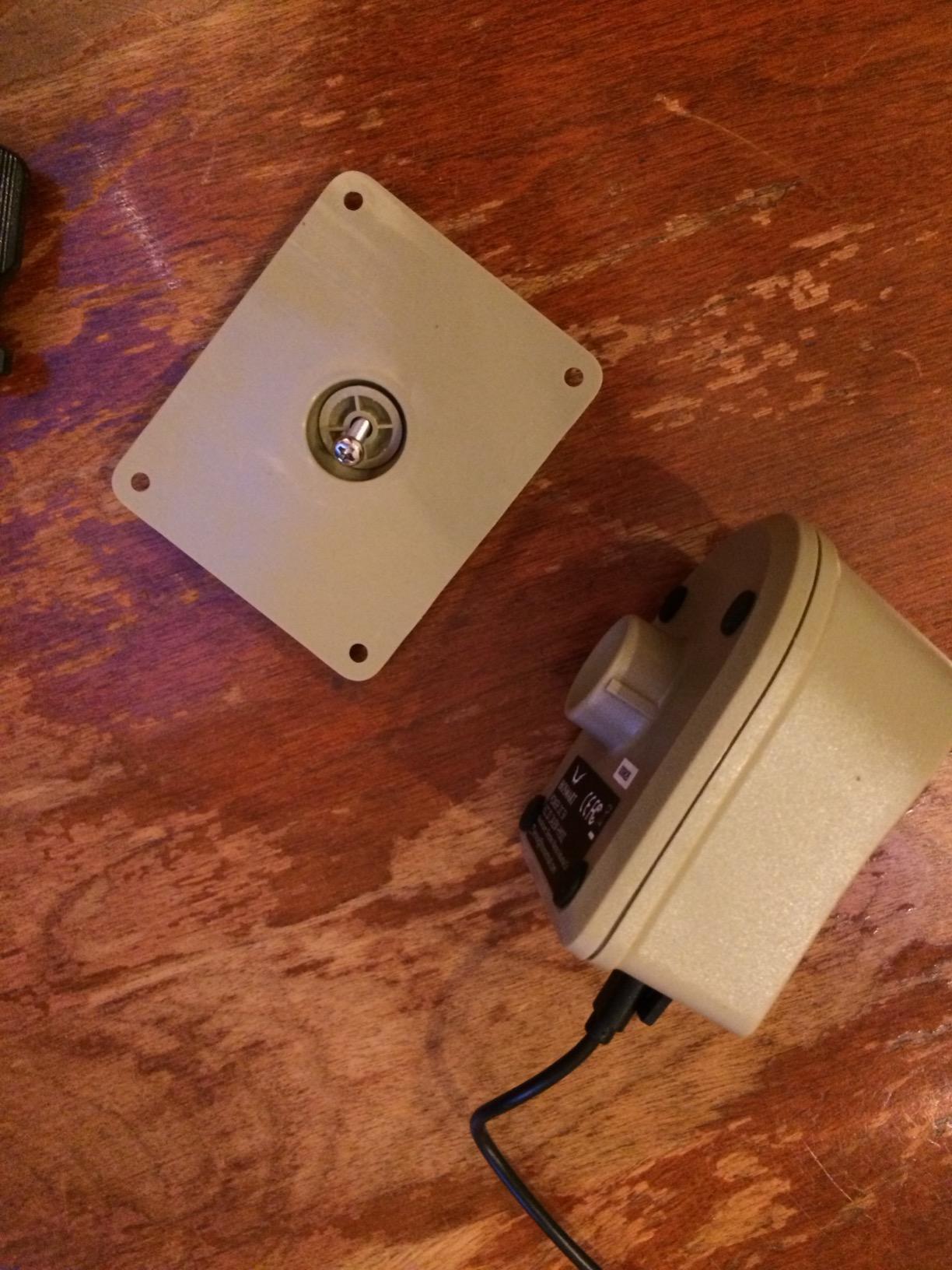
Reading the two range numbers correctly
Use 1,500 ft as the planning figure and treat 2,640 ft as a clear-line best case. That is the honest version of the size-up rule: if your sensor-to-receiver path is 900 ft through open ground, this kit works. If it is 900 ft with a hill and 60 ft of trees in between, move up a tier. Manufacturers do not agree on how they measure, which is why cross-brand range comparisons are worth taking with a grain of salt.
The 4 sensor ceiling
Expansion stops at 4 sensors with unlimited receivers. That is workable for a main drive, a side entrance and a shop, but it will not scale to the kind of whole-property coverage the 64 sensor kits are built for. Know which problem you have before you buy, because retrofitting a second brand later is where multi-entrance setups usually go wrong.
Where the swivel mount earns its keep
The detection zone is a cone, and a cone pointed at the road picks up every passing car outside your property. Owners who report calm alarms are typically the ones who swung the sensor inward, cut vegetation in front of it, and set sensitivity to the lower setting. The swivel is the tool; the discipline is the fix.
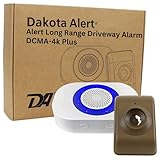
4. Dakota Alert DCMA-4K Plus – Best 1-Mile Kit for Quarter-Mile and Longer Drives
Dakota Alert Wireless Driveway Alarm DCMA-4K Plus 1-Mile Motion Sensor Kit
1 mile wireless range
9V battery lasts a year or more
110 dB alert
Up to 16 sensors per receiver
+ Pros
- Only kit here with a true 1 mile wireless range
- Radio more likely to cross large or obstructed properties
- Code-learning setup with no complicated wiring
- Single 9V battery lasts a year or more
- Four selectable sound levels
– Cons
- Costs more than the half-mile systems in this group
- Plug-in receivers tie the alert to an outlet
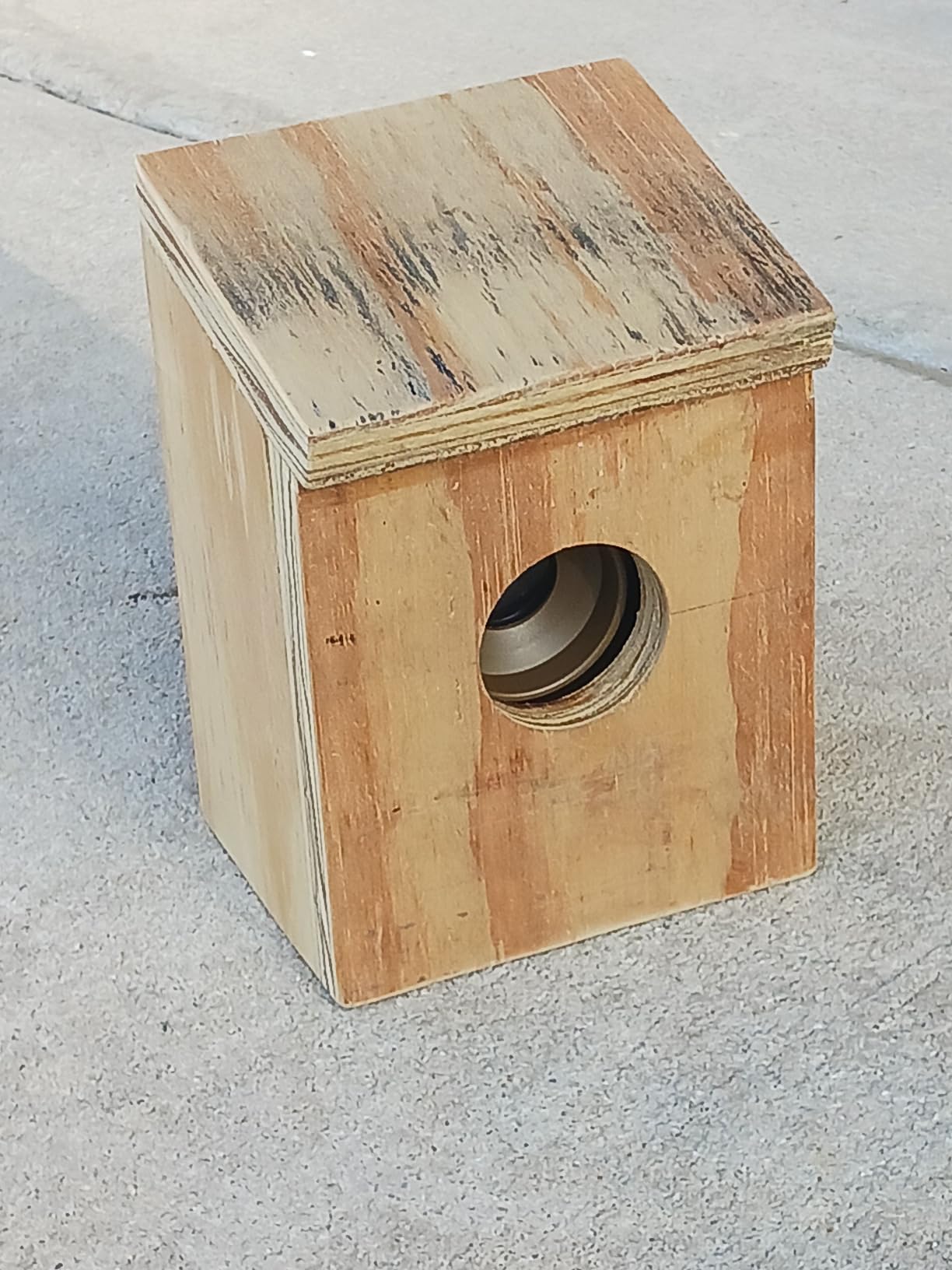
Everything else in this roundup tops out at half a mile. The Dakota Alert DCMA-4K Plus is rated at 1 mile, and that extra half mile is not a marketing flourish — it is the difference between a system that reaches your receiver and one that does not when the path runs through heavy tree cover or past a metal building.
Setup uses code-learning technology, so pairing is a button press rather than a jumper-setting ritual. The sensor runs on a single 9V battery rated at a year or more, which makes it the lowest-maintenance battery option we found: one cell, once a year, instead of three AA cells several times a year.
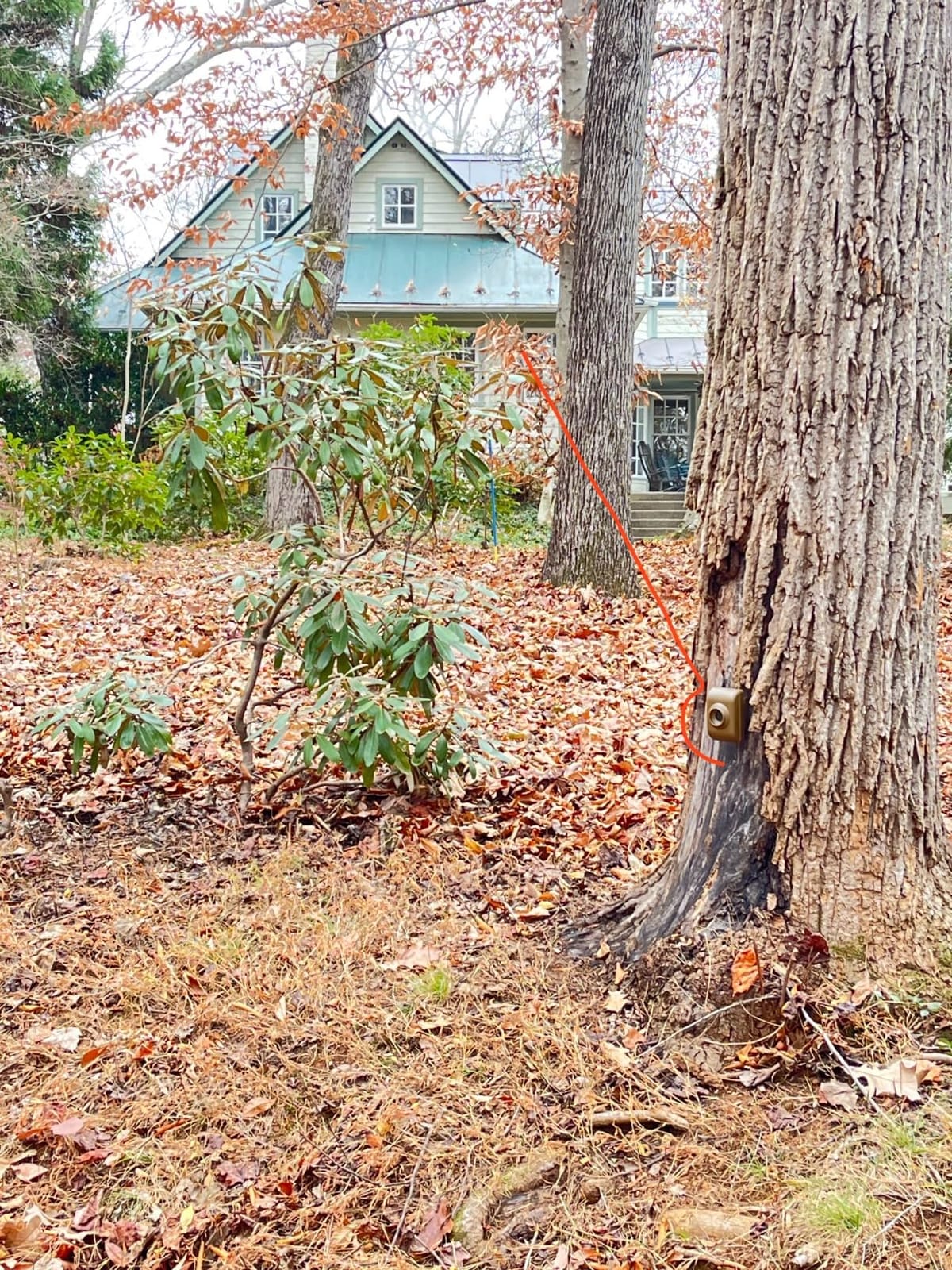
Audible output is listed at 110 dB with four selectable sound levels, which is loud enough to be heard over a workshop compressor. Pair up to 16 sensors with one receiver, or run unlimited receivers from a single sensor — the same one-to-many arrangement owners want when the shop and the house both need to chime.
Compatibility is limited to Dakota Alert 4000 Series sensors and receivers, so mixing with another brand is not on the table. For a buyer who wants one ecosystem across several entrances, that is a feature. For someone who already owns a different brand, it is a wall.
When a mile of range actually changes the outcome
Range matters most when the sensor sits at the far end of a long drive and the receiver is inside a house with a metal roof, a basement level, or several masonry walls between them. At 2,640 ft you are betting those obstacles cost you less than half your margin. At 1 mile you are not betting. That is the entire argument for this kit.
What the sensor type still gets wrong
This is a motion sensor, and motion sensors are the source of most wildlife complaints in this category. Owners of PIR driveway sensors frequently report that deer trigger reliably while some large vehicles pass quietly, and that behavior is a function of how a thermal sensor reads a moving heat signature, not a defect in any one brand. If animals are a daily problem on your property, the vehicle-only approach in pick 10 solves it properly.
Who should size up to this tier
Driveways past a quarter mile, properties where the sensor-to-receiver path is not a straight line, and anyone who has already returned a half-mile kit for missed alerts. The plug-in receiver requirement is the main friction: you are choosing where the outlet is, not where you want to hear the chime.
5. Wuloo Solar 1,800 ft Driveway Alarm – Best Honest-Range Pick for Wooded Lanes
Solar Driveway Alarm Wireless Outside 1800ft Range, Outdoor Motion Sensor & Detector Driveway Alert System with Rechargeable Battery/Weatherproof/Mute Mode(1&2-Brown)
1,760 ft real-world range
Solar with 24 month battery
Weatherproof in rain and snow
Receiver doubles as a clock
+ Pros
- Publishes a real-world 1760 ft range figure
- Solar plus rechargeable battery rated 24 months
- Receiver works as a clock and alarm with mute mode
- Weatherproof housing works in rain and snow
- Adjustable sensitivity cuts leaf and small-animal triggers
– Cons
- Shortest wireless range of the long-range kits here
- Expansion caps at 8 additional sensors
The Wuloo kit is the one we would trust most on a tree-lined drive, precisely because it does not overclaim. It advertises 1,760 ft — a third of a mile — and states that this is the range measured in real settings with trees, buildings, walls and vehicles present rather than an open field.
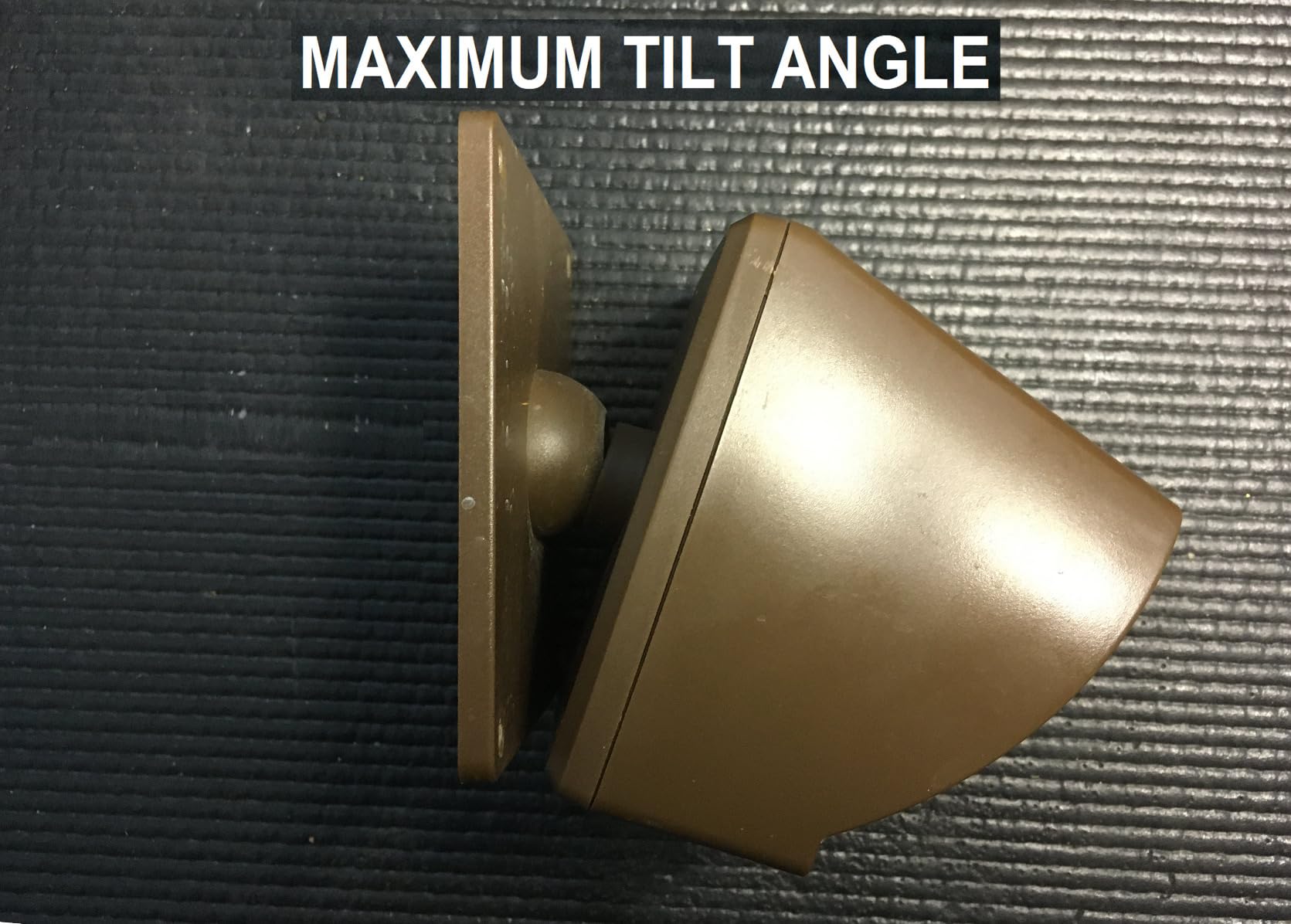
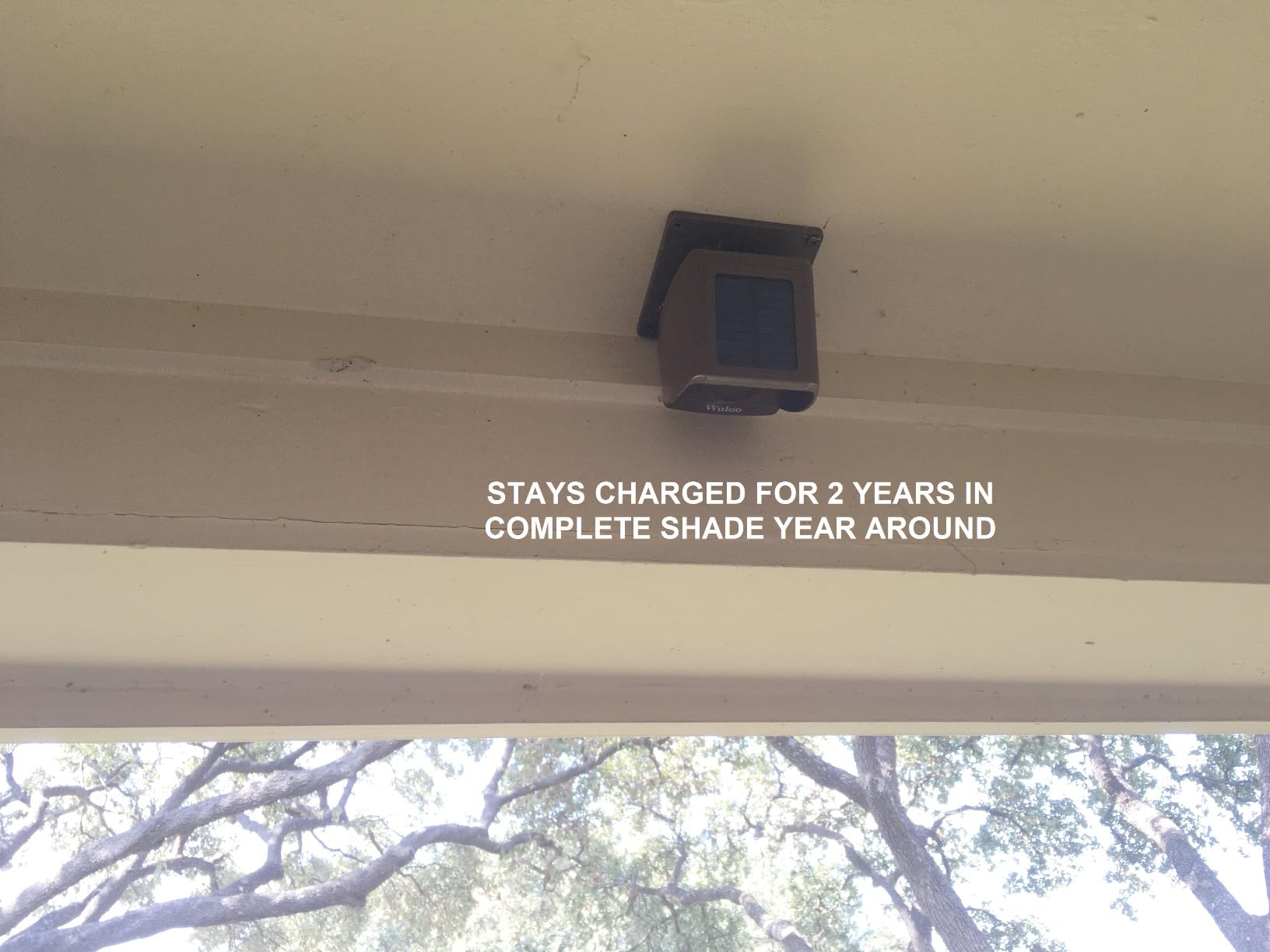
Solar charging runs a rechargeable lithium polymer battery rated at up to 24 months on a full charge, which is the longest published battery interval in this group. The sensor is described as weatherproof and working in rain or snow, and the listed weight of just under 2 lb makes it a comfortable fit on a fence post rather than a tree limb.
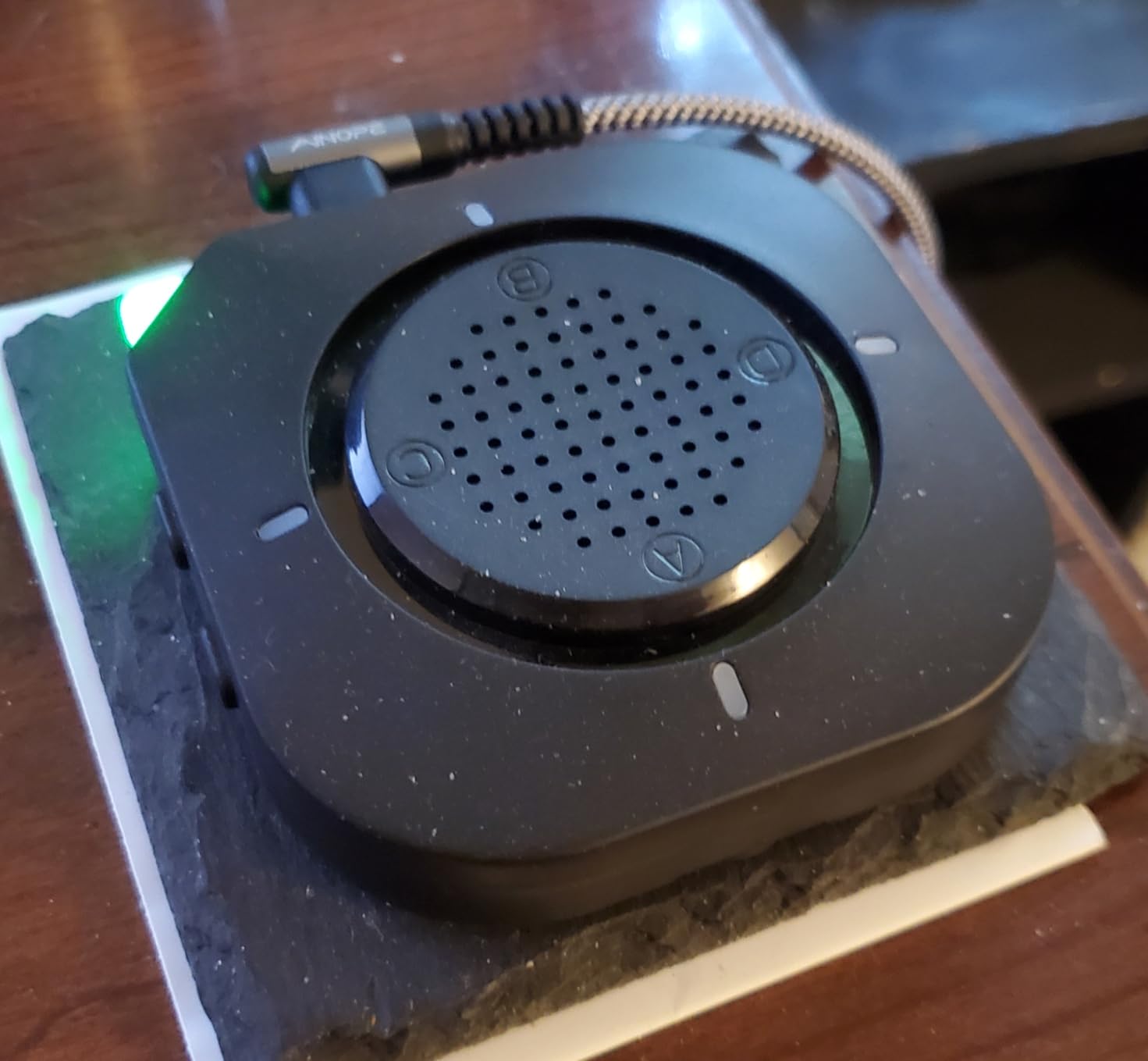
The receiver is the unusual piece here. It doubles as a clock and alarm clock with adjustable chimes and a mute mode, so you are not plugging a bare buzzer into the wall. Owners who have one of these in the kitchen generally end up leaving it visible rather than hiding it in a drawer, which matters for something that is supposed to be an early warning system.
Alerts fire when a person, vehicle or large animal moves within 30 ft. Sensitivity is adjustable specifically to filter leaves and small animals, and the system expands to 8 additional sensors. Wuloo lists more than 20 years spent on FM, ASK and FSK wireless technology, which explains a receiver that does more than chime.
Why a smaller number can be the better buy
A 1,760 ft figure that holds in a wooded lane beats a 2,640 ft figure that holds in a parking lot. If your drive has canopy cover, buildings in the path, or a rise that puts the receiver below the sensor’s antenna, the smaller honest number is the one that predicts your experience. This is the pick we suggest for a heavily treed rural lane of moderate length.
Detection throw and placement
A 30 ft detection distance with adjustable sensitivity sits in the middle of this group. The trade is the same one every PIR sensor presents: a wider pattern catches vehicles earlier but also catches whatever else is warm and moving. Owners who report steady performance typically pair the sensitivity setting with clear vegetation in front of the sensor, since branches in the detection cone generate alerts on windy days.
Expansion and multi-building setups
Eight additional sensors is enough for a main drive, a shop and a gate, which covers most homes with a detached building. It is not enough for a farm covering every outbuilding, and there is no phone app, so this is a sound-and-light notification system rather than a smart home device.
6. Betterlink 1/2 Mile Solar Wireless Driveway Alarm – Best IP65 Pick That Filters Small Animals
BetterLink 1/2 Mile Long Range Solar Wireless Driveway Alarm System 1R1S
2,640 ft open-area range
IP65 weatherproof housing
Solar plus USB-C charging
30 ft PIR with false-alarm algorithms
+ Pros
- Highest rated kit in this comparison at 4.5 stars
- Range confirmed in the field at 400 to 700 ft through thick forest
- Mounting height filters out cats and small dogs
- Solar plus USB-C gives two charging paths
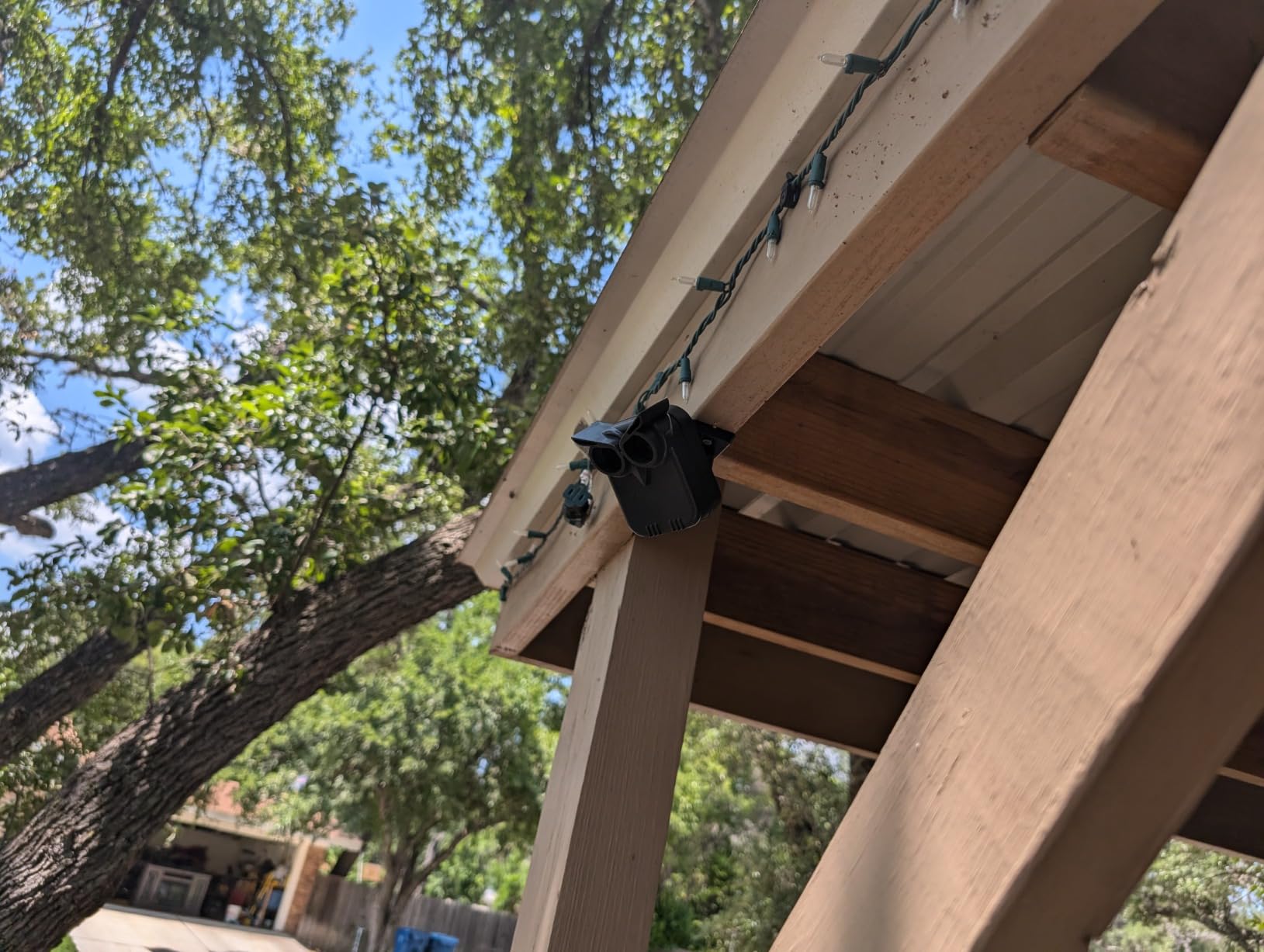
- Discreet owl-shaped housing
- Customer service covered postage for a replacement sensor
– Cons
- Solar panel cannot be tilted without rotating the whole body
- One sensor lost water resistance after about two years
- Can miss some detections in heavy rain
The Betterlink kit scored highest in our comparison, and the reason owners like it is not a spec sheet — it is what happens on a driveway with cats in it. The pyroelectric infrared sensor reaches 30 ft and runs software algorithms designed to minimize false alarms from environmental change, and owners report that mounting height does the rest, filtering out cats and small dogs while still catching vehicles.
It is also the only kit here with a numbered ingress rating: IP65 all-weather waterproof housing, with a working temperature range of -4 to 140 degrees Fahrenheit. For a sensor mounted on an exposed post in a climate that gets all four seasons, a rating you can verify beats a word like weatherproof.
Power is dual-path. The solar panel charges the internal battery, and the same sensor can charge over USB-C, which means you can top it up from a battery pack during a long run of grey weather. The box includes one receiver, one solar motion sensor, a Type-C cable, a manual and mounting screws.
The receiver offers four alert modes — Audible Alarm, Light Alarm, Sound and Light, and paired receiver mode — and one receiver handles up to 16 sensors. The manufacturer also notes it can work as a remote driveway doorbell, which is a genuinely useful second function for deliveries.
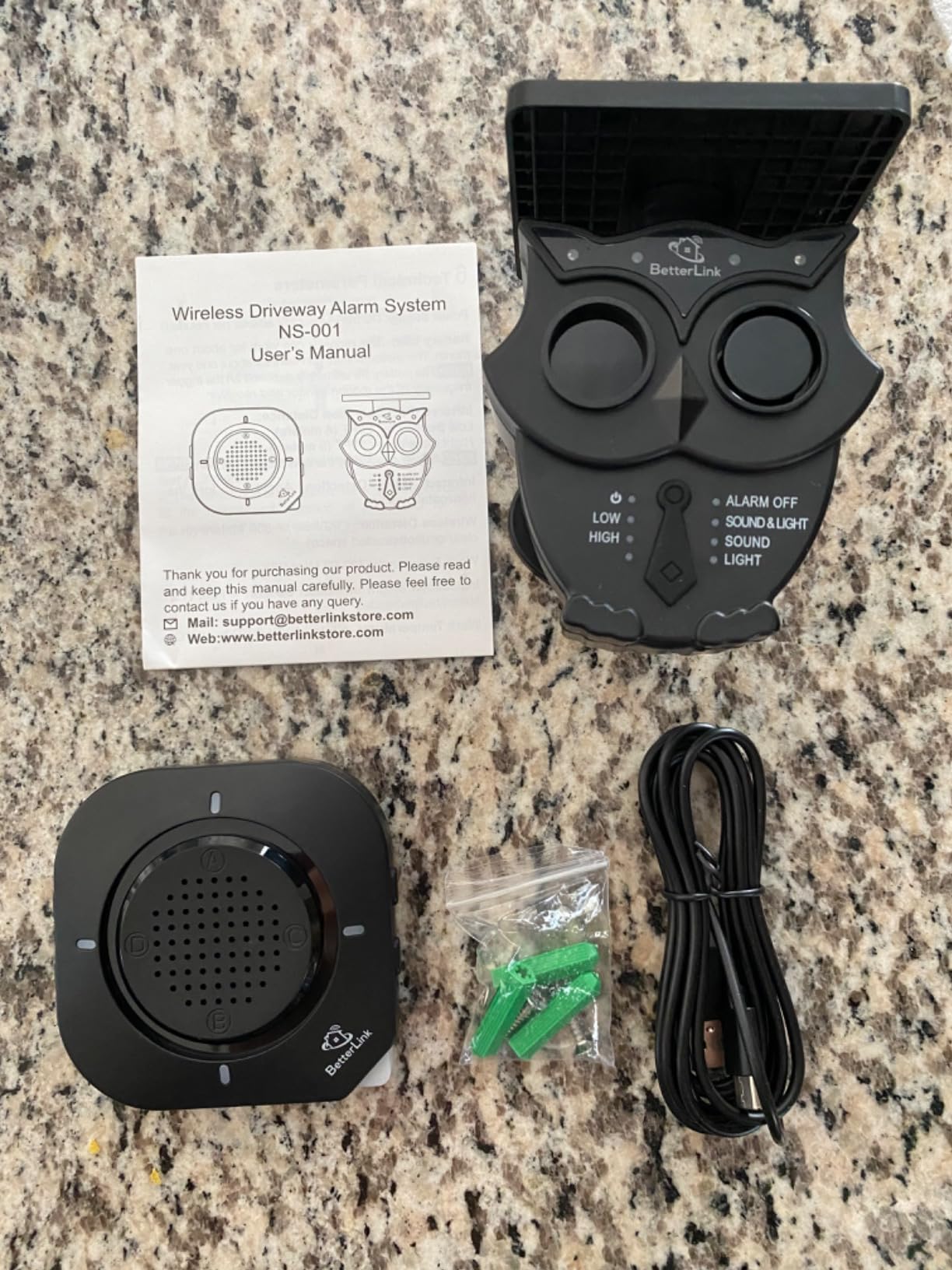
The solar panel orientation problem
The panel is fixed to the body, so you cannot tilt it independently. To face the sun in winter you have to rotate the entire sensor and re-aim the detection cone. Owners who mounted it once in summer report needing to go back and reposition it when the sun angle changed. The same reports describe the receiver light staying lit constantly, which some people find distracting at night.
What the field reports actually confirm
Owners confirm the half-mile claim at 100 to 700 ft depending on the property, including through dense woods. That is the real-world pattern across this whole category: a fraction of the headline number, but still far more than most short-range kits reach. The rating is backed by a low one-star rate, and customer service reportedly replaced a failed sensor with postage covered in both directions.
Known weaknesses, stated plainly
One owner reported a sensor that stopped keeping water out after roughly two years outdoors, and another reported missed detections in heavy rain. The default alarm tune is a single short melody with limited choice. None of these are dealbreakers at two years in, but they are the reasons we did not make this our top pick despite the best rating in the group.
7. TECKNET Non-App Solar RGB Driveway Alarm – Best App-Free Pick With Visual Alerts
TECKNET Non-APP Solar RGB Wireless Driveway Alarm
2,600 ft signal range
IPX5 waterproof
Solar plus USB recharging
36 melodies and 4 alert zones
+ Pros
- No app to download and no subscription
- Range confirmed at 1000 to 1200 ft through walls hills and trees
- RGB LED visual alerts work with audio off
- Adjustable lens panels cut animal triggers
- Solar held up through a dozen thunderstorms
– Cons
- Blue sensor LED announces that an event was detected
- No latching indicator if an alert goes unheard
- Some melodies run 3 to 5 seconds
The TECKNET kit is the one we recommend to people who do not want another app on their phone. The transmitter and receiver arrive pre-paired, there is no account to create, and there is no subscription. For a device that needs to work at 2am without a phone in your hand, removing the software layer removes a whole category of failure.
Owners confirm the signal at 1,000 to 1,200 ft through concrete walls, dense pine and over a hill, which puts it near the front of the group on real-world range. The IPX5 housing is rated from -15 to 50 degrees Celsius, and solar charging is reported to keep working through cloudy and rainy days, with USB recharging as a backup path.
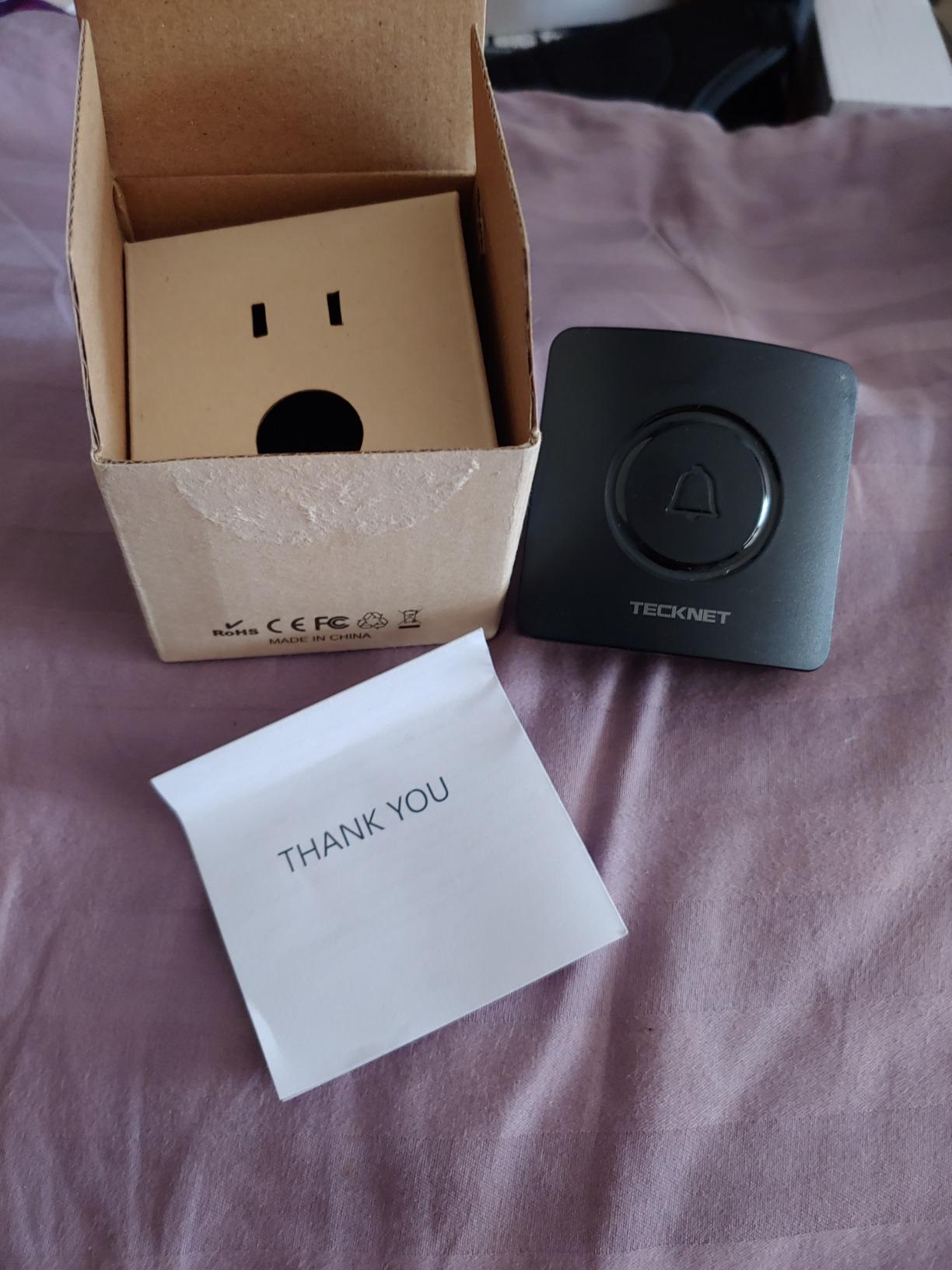
Detection runs 33 ft on the high sensitivity setting and 16 ft on low, and the sensor includes both a rotating bracket and sliding lens panels. The lens panels are the more interesting mechanism: they physically narrow the detection field, which is a more direct answer to animal false alerts than turning a sensitivity dial down and losing your vehicle in the process.
Alerting is unusually flexible for a kit this size: 36 melodies, 5 volume levels and 4 ringer alert zones with per-zone tones. The receiver also flashes multi-colored RGB LEDs, so a trigger is visible across a room with the sound off. Owners also note the internal build quality, specifically strain-relieved antenna solder joints, which is where cheap wireless gear usually fails first.
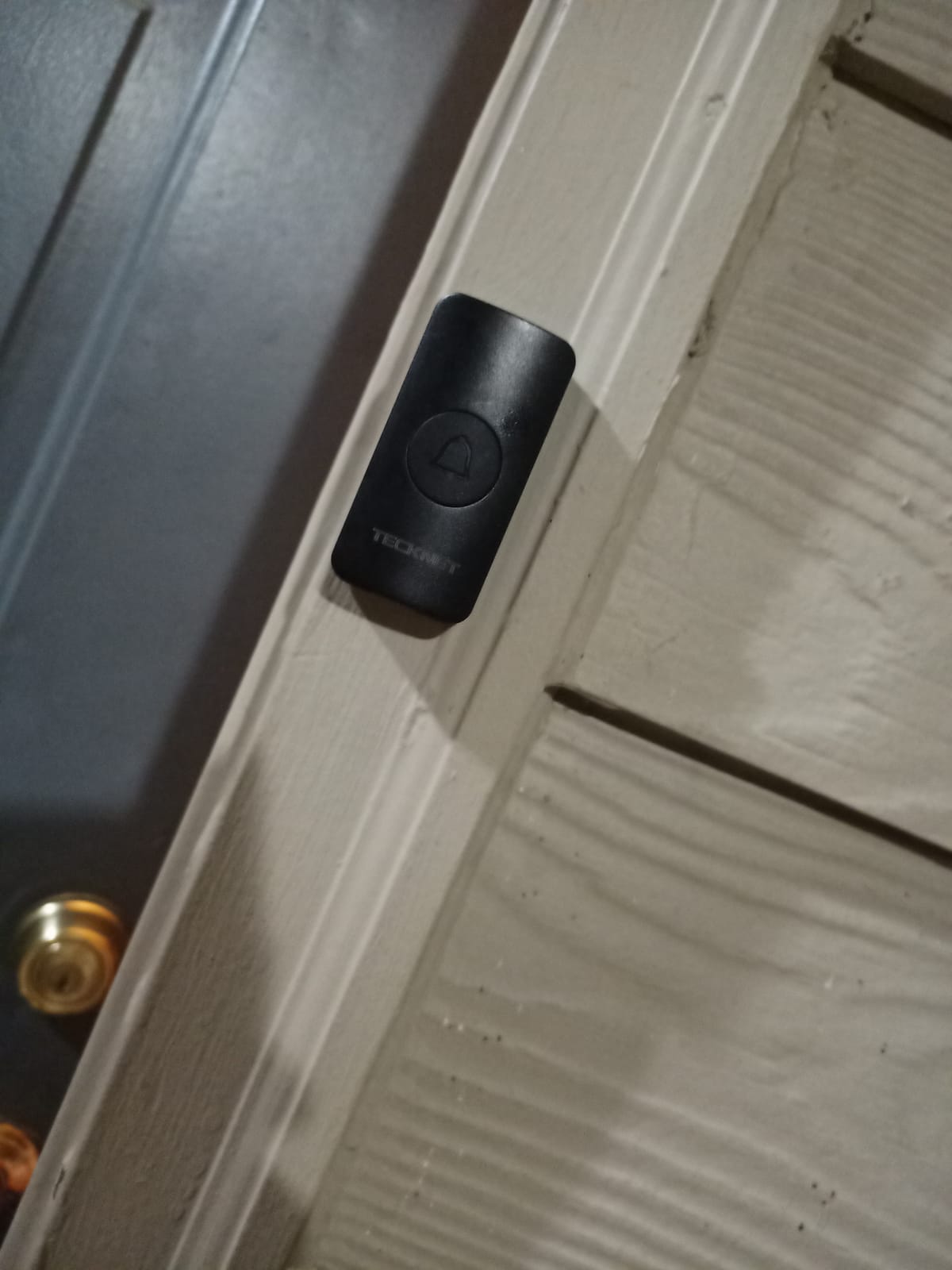
Who the RGB visual alert is really for
A flashing light solves two problems at once. It works for anyone who cannot hear a chime clearly, and it works in a space where sound is drowned out — a workshop with a compressor running, a shop floor, a truck cab with the windows up. Owners running a business entrance alert say the visual option is the feature that keeps the system from being ignored.
The blue LED, and why it matters
Several owners flag the blue status LED on the sensor, which lights when an event is detected. On a drive close to a road or a neighbor’s property, that is information you would rather not broadcast. It is a small thing, but on a security device it is the kind of detail that separates a thoughtful design from a default one.
Where the setup is less polished
There is no latching event indicator on the receiver, so an alert you did not hear leaves no trace — you will not know it fired unless you were listening. The included USB cable is short with no AC plug on the end, limiting wall-powered receiver placement, and a few versions of the mounting hardware have been reported with mounting holes that do not line up with standard wall anchors. Plan on your own screws.
8. HTZSAFE Solar 1/2 Mile Driveway Alarm – Best Budget Solar Kit With Spoken Zone Alerts
HTZSAFE Solar Driveway Alarm 1/2 Mile Long Range – 1 Receiver + 1 Sensor
2,640 ft wireless range
3 sensitivity levels at 25 50 and 70 ft
Receiver backup battery
Solar sensor
+ Pros
- Full 2640 ft range at the lowest cost in this group
- Receiver keeps chiming during a power outage
- Spoken-word zone alerts name the driveway or front door
- 70 ft high sensitivity gives the longest detection throw
- Discreet birdhouse housing
– Cons
- No on or off switch on the receiver
- Settings reset when the receiver is switched off
- No battery level indicator on the outdoor sensor
This is the HTZSAFE solar sibling of our top pick, and it does something none of the others do: the melodies include spoken-word alerts that say driveway, front door, backyard or garage out loud. On a property with several entrances, knowing which one fired without getting up is worth more than another ten melodies of the same chime.
Detection is the other standout. Three adjustable sensitivities run 25 ft, 50 ft and 70 ft, and the 70 ft setting is the longest detection throw available in this group. That reach means a vehicle is detected earlier in its run up the drive, which is the whole point of an early warning system on a long lane.
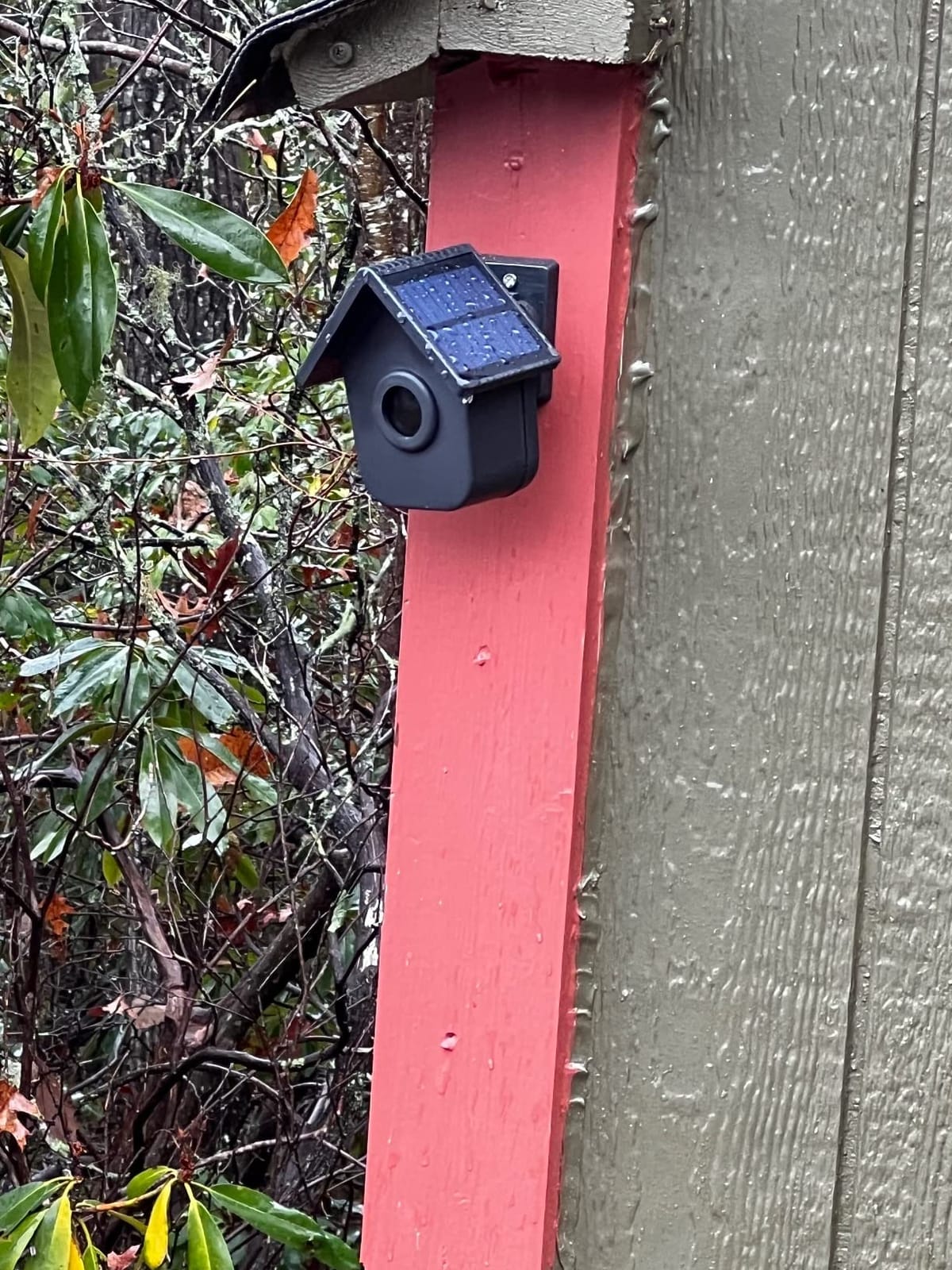
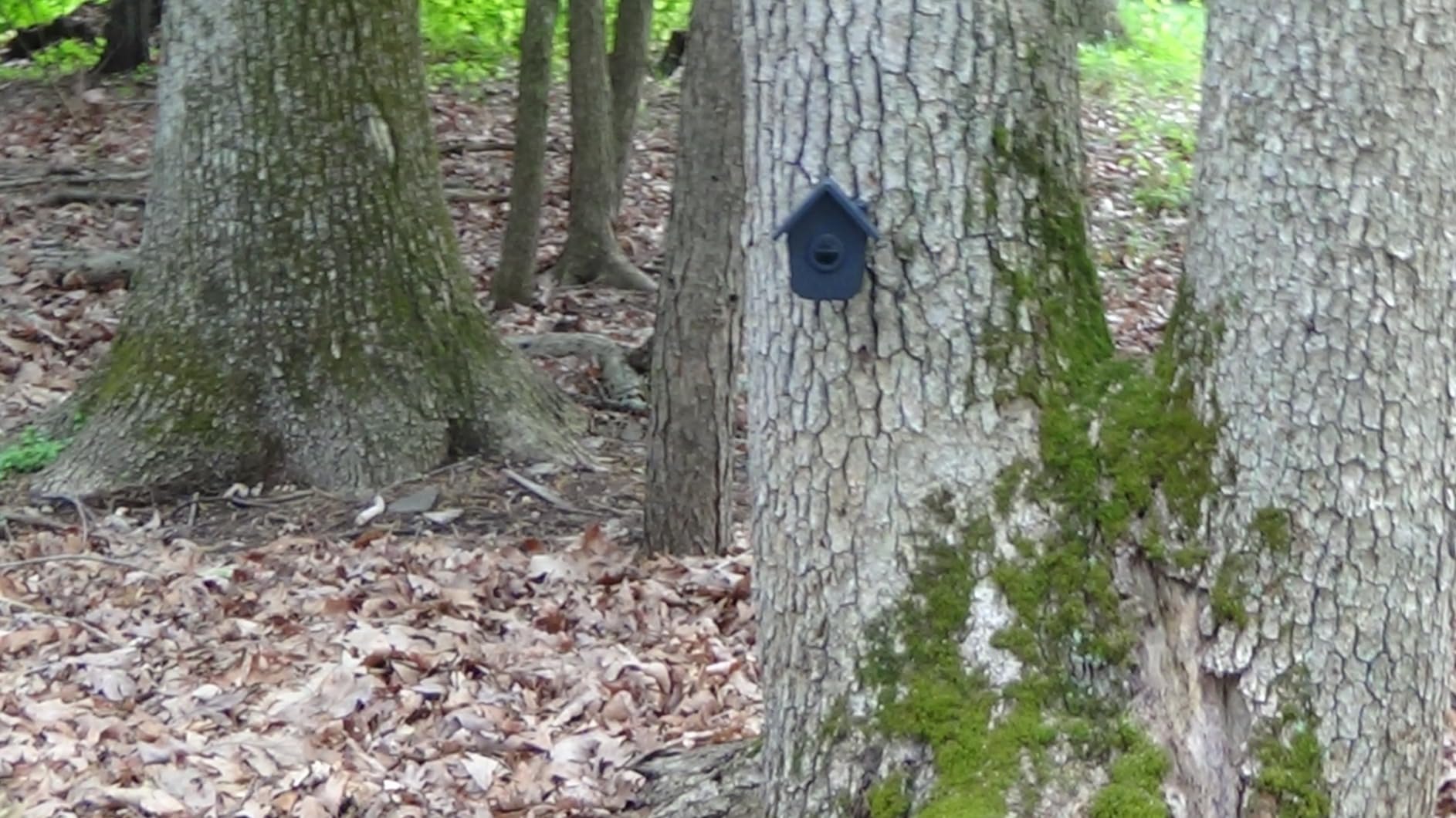
The receiver has a built-in rechargeable backup battery, so alerts continue through a power cut and the unit can be carried off the outlet to a different room. Dual solar panels on the sensor recharge faster than the single-panel designs, and the housing is a birdhouse shape that blends into landscaping instead of advertising itself.
Sound configuration runs 35 melodies and 5 volume levels with per-zone melodies, and the system expands to 4 motion sensors with unlimited receivers. Mounting is plug-and-play to a wall, fence post or tree, and the listing describes it as working straight out of the box.
Power cuts and portable receivers
The backup battery is the feature most likely to matter and least likely to be noticed until you need it. An outage at the end of a long drive is exactly when a visitor is least welcome, and a receiver that dies with the power is a receiver that fails silently. It also means you can put a receiver in a workshop or upstairs without running a cable to an outlet.
Controls that will frustrate you
There is no on or off switch. The button that powers the unit down is unlabeled, and powering it off clears your tone and volume settings, so the next person to use the receiver starts from scratch. For a device meant to run unattended for years, that is a design oversight rather than a limitation of the hardware.
Battery monitoring and audio quality
The outdoor sensor has no battery level indicator, so a depleted battery is discovered by missed alerts rather than by a warning. Owners also report tinny or long melodies with no option to record a custom sound, and a behavior where charging the receiver while it is powered on plays the doorbell tone at full volume. Mount the sensor in full sun — shaded posts drain it within days.
9. 1byone 1,000 ft Wireless Driveway Alarm – Best for Shorter Suburban Driveways
1byone Driveway Alarm Wireless Outside, 1 Receiver 2 Infrared Sensors
1,000 ft sensor to receiver range
24 ft IR detection
5 sensors per receiver
Sound or LED alert modes
+ Pros
- Inexpensive way to cover a driveway porch gate or pool
- Three alert modes including LED flash
- Expands to five sensors per receiver
- Plug-and-play mounting to walls posts or trees
- Works like a long-range doorbell for visitors
– Cons
- 1000 ft is the shortest range in this comparison
- 24 ft detection throw is also the shortest
- No solar option on this model
We include the 1byone kit as the honest floor of the category. At 1,000 ft of signal range and 24 ft of infrared detection, it will not cover a genuinely long driveway — and telling you that is more useful than pretending otherwise. For a suburban lot, a gated entrance near the house, or a shop entrance within sight of a window, it does the job for very little.
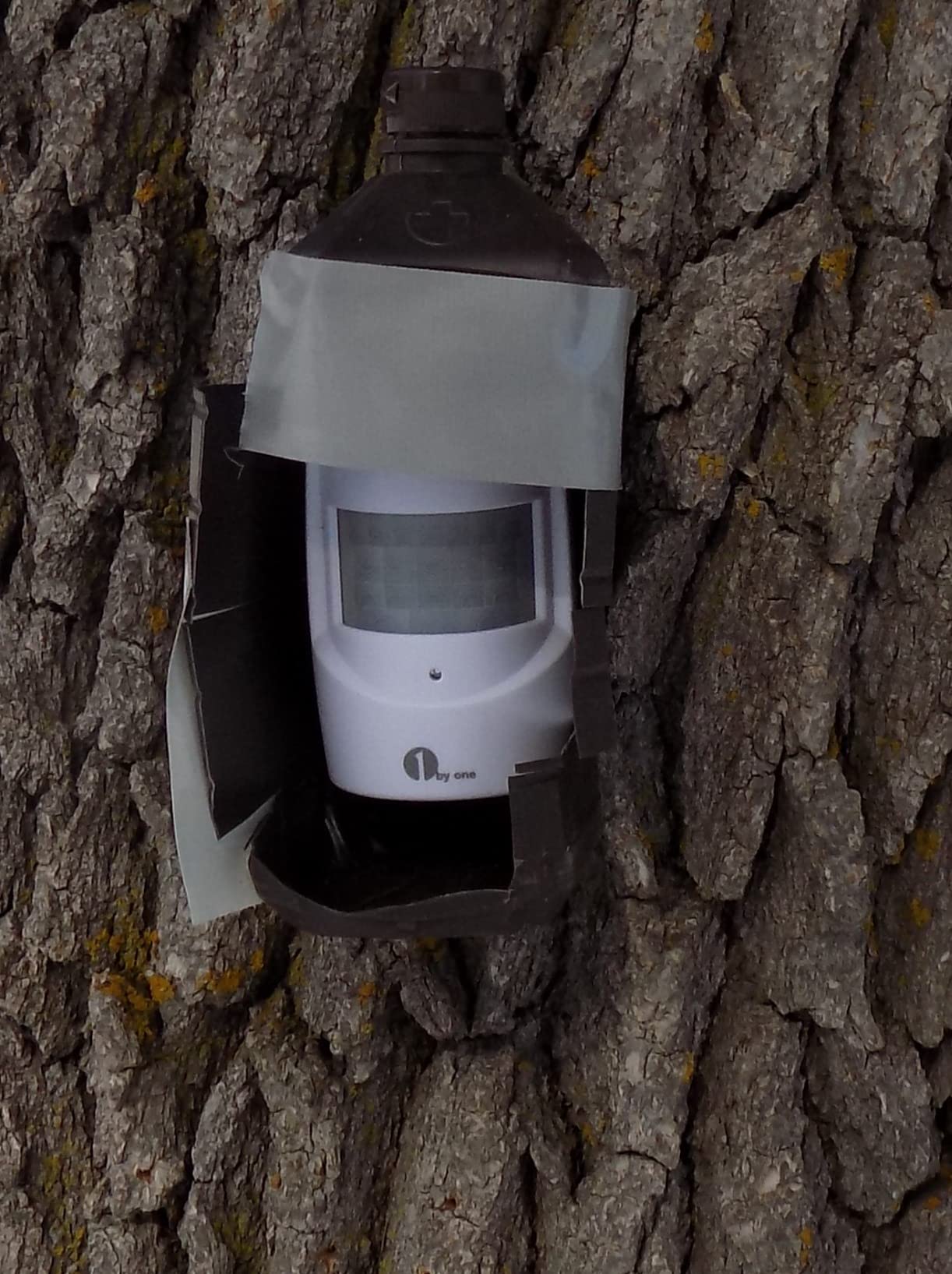
The kit ships with one receiver and two infrared sensors, and each receiver pairs with up to 5 sensors. Sensors are plug-and-play and mount to a wall, a fence post, a tree or any other surface, with no wiring required.
Alerting has two work modes and three options: sound, LED flash, or both together. That visual option is more capable than it sounds — a silent flash in a laundry room or a bedroom can wake someone who a chime would not. The angled IR eye detects cars, people and animals within 24 ft of the sensor face.
Owners use it in ways the name does not suggest: porch, gate, shed, walkway and pool coverage, and as a long-range doorbell for visitors and deliveries. On a property where a courier regularly walks up to a side gate, that use alone justifies the kit.
Why the range number decides this one
Every other kit here reaches at least 1,760 ft in real conditions. If your sensor-to-receiver path exceeds roughly 700 ft with any obstruction, this model is the wrong tool and no amount of clever placement will fix it. Judge it against your actual distance, not against the half-mile crowd.
Detection throw is the second limit
A 24 ft throw is narrow, and it is the reason a fast vehicle can slip past. The sensor has to sit close to where traffic actually passes, which on a long drive means near the entrance — potentially visible from the road. That is the trade: a cheap, discreet setup that works over a short distance, versus a sensor placed deep on a lane.
Batteries only, no solar path
This model is battery powered with no solar option, so it needs periodic cell changes at every sensor position. That recurring task is the main reason to step up to a solar kit if you have more than one entrance, or a 1,000 ft-plus path to cover.
10. Mighty Mule FM231 – Best Vehicle-Only Pick That Deer and Dogs Cannot Trip
Mighty Mule FM231 Wireless Driveway Alarm – Electromagnetic Vehicle Detection, Indoor Receiver, 400 ft Range, Expandable, Battery Powered, Easy Installation, Driveway & Property Security System
Electromagnetic buried probe
400 ft wireless range
125 dB receiver chime
2 AA batteries with low battery alert
+ Pros
- Triggered by vehicles only
- not people animals or foliage
- Nothing visible above ground after installation
- Over 20 years in the driveway alarm market
- Low battery indicator on the sensor
- Expandable with extra indoor receivers
– Cons
- 400 ft is far shorter than every wireless PIR system here
- Stays silent for anyone on foot
- Requires trenching to bury the sensor
Everything else in this roundup watches for heat and movement. The Mighty Mule FM231 uses an electromagnetic probe buried beside the driveway, and it responds to the metal mass of a vehicle. Nothing else does — not a deer, not a dog, not a person walking up, not a branch in the wind. For a rural property with livestock and wildlife crossing the lane, that single design choice eliminates the false alarm problem rather than mitigating it.
The trade is honest and worth stating plainly: you will get no alert for a person on foot. If your concern is vehicles arriving unannounced — an unexpected visitor at a gate, a contractor, a delivery — this is the cleanest answer in the category. If your concern is someone walking your property, it is the wrong tool.
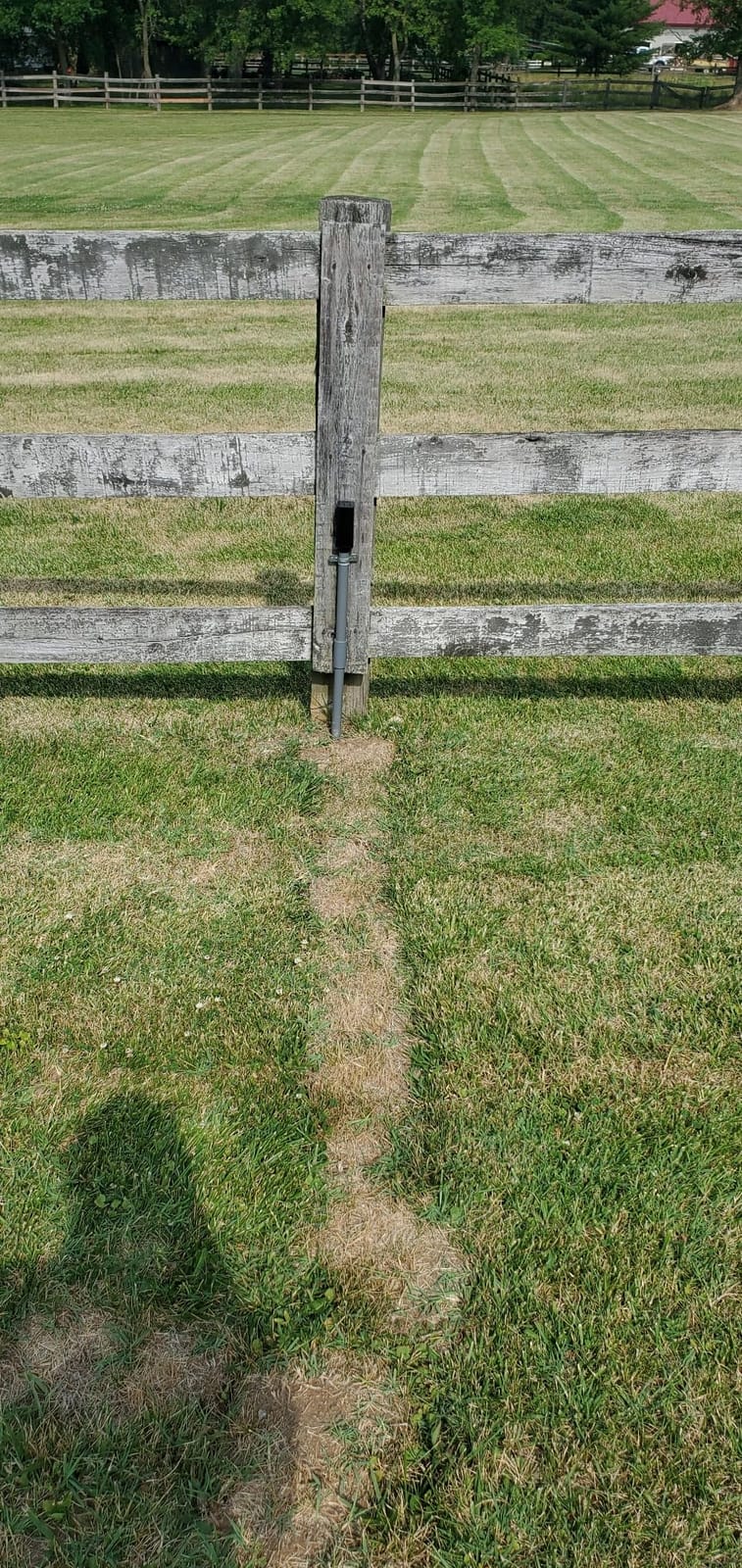
Range is 400 ft from the transmitter to the indoor receiver, which is the shortest here by a wide margin. On a long driveway that sounds disqualifying until you remember the sensor sits beside the lane near the entrance, not at the far end. Buried-probe systems get their range from proximity, and the probe goes where the vehicles actually pass.
The receiver chimes at a listed 125 dB, the loudest output in this group, and additional indoor receivers are available separately so the same sensor can ring in the house, the shop and the barn. The sensor runs on 2 AA batteries with a low battery indicator, and the package includes the transmitter, sensor, receiver, transformer, mounting post and manual.
Placement is the entire technique
A buried probe set too far to one side will miss vehicles whose tires run close to the shoulder, and a probe set right on the driving surface can be defeated by a vehicle that turns around nearby instead of continuing up the drive. The useful practice owners describe is burying the sensor a foot or so off the travel path and roughly 75 ft in from the entrance, where turning vehicles are less likely to pass over it.
What trenching actually involves
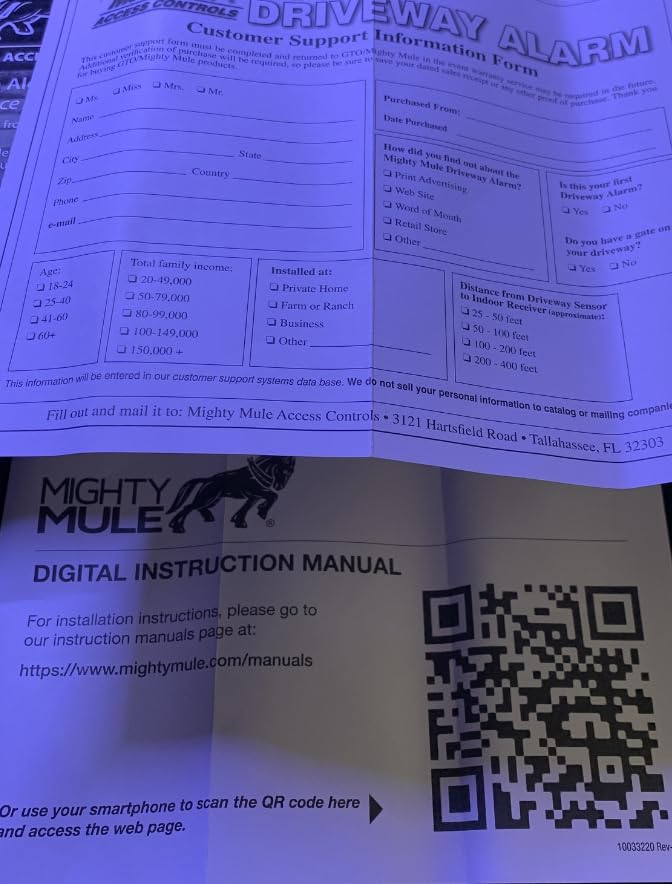
This is the only kit in the roundup that requires digging. The sensor is buried next to the driveway with nothing mounted above ground, which is a genuinely discreet installation and the reason it never gets knocked over by a plow or a mower. It is also why the instructions matter more here than for any plug-and-play kit: the burial depth and the sensor position decide whether it works at all.
Where it fits in a long-property setup
For a driveway past about 400 ft, a buried probe alone will not reach an indoor receiver from the far end. It works when the probe sits near the entrance and the radio leg is short. Mighty Mule sells additional indoor receivers separately, and the brand has a long track record in this category, but the 400 ft figure is a real limit rather than a conservative claim.
How to Choose a Driveway Sensor for a Long Driveway
Most returns in this category trace back to one of three mistakes: buying on the headline range number, ignoring what the sensor actually detects, and mounting it badly. The method below prevents all three before you spend anything.
Step 1: Measure the real sensor-to-receiver path, not the driveway
Walk the route the signal will travel and write down the distance. Use a wheel, a map, or your vehicle odometer, and measure from where the sensor post will actually stand to the wall where the receiver will actually plug in. Add 20 percent for any dogleg or corner. If the drive is gravel and the post goes at the far end, the number that matters is that full path length, not the paving width or your guess at the property size.
Step 2: Pick the detection type that matches what you want to know about
A PIR motion sensor senses body heat and movement, so it catches people, pets, vehicles and anything else warm crossing the cone. Its advantage is early notice and a simple surface mount; its cost is animal false alerts. A buried electromagnetic probe senses the metal mass of a vehicle, so it ignores wildlife entirely and stays silent for anyone on foot. Break-beam systems need a clear span across the drive. Rubber hose systems need a clean, straight, unobstructed stretch of surface.
If deer, moose, cattle or pets cross your lane daily, the probe option is a better fit than any amount of sensitivity tuning. If you want to know about visitors on foot, a motion sensor is the only one of the four that will tell you.
Step 3: Apply the size-up rule before you spend
Advertised range is a line-of-sight number measured in open ground. Trees, buildings, masonry, hills, metal siding and parked vehicles all reduce it, and every manufacturer measures differently. The rule we use: double your required distance, then move up one tier in the range table. A 1,200 ft gravel drive with a rise and a stand of pine needs the 2,500 ft to 4,000 ft class, not the 1,000 ft class, even though the drive itself is 1,200 ft.
How far does a driveway alarm really reach?
Plan on a fraction of the published figure, and the fraction depends on your property rather than the product. Of the kits in this roundup, the manufacturer that publishes a real-world number alongside its headline number puts typical reach at roughly 1,500 ft for a 2,640 ft system, and other owners report 400 to 1,200 ft for comparable half-mile kits depending on tree cover and walls. Treat the published range as an open-field ceiling.
A workable tier map for a typical property:
600 ft — suburban lots, short driveways, gates within sight of the house.
1,000 ft — longer suburban drives with a clear path and no major buildings in the way.
2,500 to 4,000 ft — rural drives, mild tree cover, one or two structures between the sensor and the receiver.
5,000 ft — long rural drives with hills, heavy canopy or a metal-clad building in the path.
1 mile and beyond — multi-entrance acreage, split-level homes, or any path where a missed alert is expensive.
Power: battery, lithium or solar
Battery sensors need attention. Owners across this category report replacing cells two to three times a year on standard alkaline, and roughly nine months to two years on lithium cells, depending on model and climate. Cold winters and heavy traffic both shorten that. Solar sensors remove the recurring task entirely, but only if the panel gets real sun and is aimed at it; a shaded post drains an internal battery in a matter of days. If you have more than one sensor position, or your lane sits in partial shade, solar is the right default. Our weed and vegetation guide is worth a look if overgrowth near the drive is part of your problem, since foliage in the detection cone is a leading cause of wind-triggered alerts.
Receivers, zones and ringing two buildings at once
Can one sensor ring in both the house and a detached shop? On most systems in this roundup, yes. Kits that support unlimited receivers can drive any number of indoor units from a single sensor, which is exactly the arrangement owners with a shop or barn want. Zones and per-zone tones are the more useful refinement: a distinct chime per entrance tells you where the alert came from without needing to check a camera.
Receiver type matters more than buyers expect. A plug-in receiver is fixed to an outlet. A portable receiver can follow you to the shop or the truck. A strobe or flashing LED gets noticed in a loud space where a chime disappears into the noise. If anyone in the house has hearing loss, put the visual option at the top of your list rather than the bottom.
How to stop false alerts from deer, branches and road traffic
Wildlife is the single most common complaint about driveway alarms, and no amount of brand switching fixes it. Motion sensors detect heat, and a deer crossing a 50 ft cone at 4am is a valid detection. The fixes are mechanical, not electronic: aim the detection cone away from the road and away from the tree line, clear vegetation in front of the sensor, trim low branches, and set sensitivity to the lowest setting that still catches your vehicles. Where a cone cannot be aimed away from a crossing point, change the sensor type rather than the settings.
Positioning helps more than people expect. Mounting the sensor roughly 75 ft in from the entrance, rather than right at the gate, keeps turning vehicles from triggering it and gives a fast car time to slow down. Test the setup by driving up at the speed you actually use, not at walking pace.
Where to mount the sensor and where never to mount it
Mount high enough to clear the tallest vegetation you will see in a year, and low enough that the detection cone still lands on the drive. Face any solar panel toward the sun at the winter angle, not the summer angle. Do not aim across a public road, and do not mount where a vehicle will back into the post. If the receiver is inside a basement, a metal-sided building, or a shop with a compressor running, expect to need more radio range than the driveway length suggests, and put a receiver closer to the signal path rather than assuming the chime will carry.
Driveway alarm vs driveway camera vs motion-activated light
A driveway sensor tells you an event happened. A driveway camera tells you who it was. A motion-activated light tells you nothing but removes the reason to want an alert at all, since the drive is already lit when someone arrives. If your concern is identification or recorded evidence, a camera is the better purchase, though it needs power and Wi-Fi at the far end and considerably more zone tuning to avoid the alert fatigue that camera owners complain about constantly. If your concern is advance notice on a long lane, a sensor is cheaper, simpler and far easier to install. Plenty of owners run both, using the sensor to trigger attention and the camera to answer the question.
While you are planning the layout, our driveway landscaping ideas and pressure washer picks both help with the surface work that comes before you drill a single post.
Frequently Asked Questions
What is the longest range driveway alarm?
The longest range alarm in this roundup is the Dakota Alert DCMA-4K Plus, rated at 1 mile between sensor and receiver. Every other kit we tested tops out at 1/2 mile (about 2,640 ft), except the Wuloo at 1,760 ft and the 1byone at 1,000 ft. Treat all of those as open-field ceilings rather than guaranteed working distances.
How far will a driveway alarm work?
Plan on well under the published figure. One manufacturer in this roundup states about 1,500 ft in typical conditions for a system advertised at 2,640 ft, and owners report 400 to 1,200 ft for comparable kits depending on tree cover, walls and terrain. A practical rule: double your measured sensor-to-receiver path and round up one range tier.
What is the best driveway alarm for long driveways?
For a quarter-mile drive, the HTZSAFE 1/2 mile kit is our pick: the widest 50 ft detection throw in the group, expansion to 32 sensors with unlimited receivers, and the deepest review history. If the path is past a quarter mile or runs through heavy tree cover, step up to the Dakota Alert 1 mile kit.
What is the best long range driveway alarm available right now?
The Dakota Alert DCMA-4K Plus, with 1 mile of wireless range, a single 9V battery rated at a year or more, and support for 16 sensors per receiver with unlimited indoor receivers. It is the only kit in our comparison whose radio has enough margin to cross large or obstructed properties.
Are driveway alarms worth it?
They are worth it when the drive is long enough that a visitor arrives before you can hear or see them, and when you want notice rather than identification. They are not worth it on a short suburban drive where a doorbell camera already covers the entrance, and they are a poor fit if you need to know who is there rather than that someone is.
Can a driveway alarm detect vehicles only, not people or animals?
Yes. A buried electromagnetic probe, such as the Mighty Mule FM231, senses the metal mass of a vehicle passing and ignores people, pets, wildlife and moving foliage entirely. The trade is that it stays silent for anyone on foot, and the sensor must be buried next to the drive rather than mounted on a post.
Is there a driveway alarm that can be connected to my phone?
Not reliably at this range, and that is a deliberate design choice. The long-range kits in this roundup are standalone: a sensor and plug-in or portable receiver, with no app and no subscription. Phone notifications in this category generally come from Wi-Fi or cellular camera systems that need power at the far end of the drive and accept the shorter range that comes with it.
What is the most common cause of false alarms?
Wildlife crossing the detection cone, by a wide margin, followed by wind-blown vegetation and low branches in front of the sensor. A motion sensor reacts to heat and movement, so a deer at 4am is a valid detection. Aim the cone away from the road, clear vegetation, set sensitivity low, and switch to vehicle-only detection if animals cross daily.
Which Driveway Sensor Fits Your Drive
Match the sensor to the length of the path and the problem you actually have, and the decision gets simple. If your drive is up to a quarter mile with a reasonably clear signal path and you want the widest detection and the most room to grow, the HTZSAFE 1/2 mile kit is the one to buy, and it is our overall pick for 2026.
Size up to the Dakota Alert DCMA-4K Plus when the drive runs past a quarter mile, or when trees, a hill or a metal building sit between the sensor and the house — one mile of radio leaves you margin that 2,640 ft does not. If you would rather not think about batteries at all and you have several entrances to watch, the eMACROS solar kit scales to 64 sensors, and the HTZSAFE solar kit adds spoken-word zone alerts if you want to know which entrance fired without looking.
Pick the TECKNET when you have no interest in an app and you need a visual alert as much as an audible one, and the Betterlink when cats and small dogs are the main source of false triggers and you want a verified IP65 housing in a four-season climate. The Wuloo is the right answer for a treed lane of moderate length, because it publishes a range figure that reflects real conditions instead of an open field.
And if animals, dogs or livestock cross your drive daily, the Mighty Mule FM231 is the only pick here that solves the problem rather than managing it — with the honest condition that it tells you about vehicles and nothing else.
Whichever you choose, measure the sensor-to-receiver path before you order, double it, and round up one tier. That single habit accounts for more successful long-driveway installs than any brand decision.
Leave a Reply